

I Introduction
Telemedicine has boomed over the last ten years thanks to new digital technologies, such as the extended use of the Internet and the availability of increasing amounts of data.Footnote 1 The virtual offering of new data-driven health care increases its accessibility to physically distant patients, including patients from other countries. In the European Union (“EU”), cross-border healthcare triggers specific reimbursement queries. A legal framework was developed over time to coordinate the various national reimbursement schemes in cases of cross-border care, which also explicitly regulates the reimbursement of cross-border telemedicine. This chapter assesses whether, in an EU cross-border context, patients have the same cross-border reimbursement rights for one form of telemedicine – digital diagnostics – as for receiving such health care in person, and the consequences thereof.Footnote 2
This introduction describes the EU context, the applicable EU reimbursement legislation, and the limitations in scope. The second section compares the situation of a patient receiving cross-border care in person, and a patient receiving cross-border telemedicine services while residing in their home country, highlighting the resulting reimbursement opportunities and limitations. The third section assesses the consequences of the described legal framework from the point of view of the patient, the telemedicine solutions providers, and the EU member states.
A EU Context
Digital diagnostics qualify as “telemedicine” under the EU legal framework applicable to cross-border reimbursement. Even though no official definition is available under EU health law, the European Commission provides the following indicative definition: “The provision of healthcare services at a distance through the use of ICT, e.g., teleconsultations, telemonitoring, telesurgery, … .”Footnote 3 Digital diagnostics constitute, depending on the circumstances, teleconsultations or telemonitoring, and, therefore, qualify as telemedicine. A 2018 market study on telemedicine of the European Commission stated that in almost all member states, reimbursement for telemedicine remained vague or even non-existent.Footnote 4 At the cross-border level, the report notes that the reimbursement issue is even more problematic.
The reimbursement struggles stem from the fact that public benefits still vary significantly among the member states.Footnote 5 The EU member states have parallel public and private health coverage. Most member states provide near-universal health coverage for a core selection of health care.Footnote 6 However, the amount of coverage varies.Footnote 7 These disparities in coverage make it impossible to grant EU citizens an unconditional right for receiving reimbursable health care in another member state. Therefore, it remains up to the member states to decide on both the “basket of health care” to which patients are entitled, specifically, the health care which is reimbursed, and the related financing mechanisms.Footnote 8 To safeguard the national social security systems, the EU legal framework strictly coordinates the reimbursement options for cross-border care, without touching upon the question of which type of health care falls within patients’ basket of health care. It clarifies which member state bears the financial burden for the cross-border care, and when the patient must request prior authorization to qualify for reimbursement. One aim for the codification of the current legislative framework was “modernising and simplifying” the “complex and lengthy” preceding rules.Footnote 9 Initially, the establishment of this framework, both via case law and via legislation, created a convergence among the national social security systems. However, among other reasons, the aging of the EU population, costly technology, and the economic crisis put this convergence under pressure.Footnote 10
B Cross-Border Health Care Law
Where a patient receives EU cross-border health care, the patient can choose between two legal bases for claiming reimbursement from the EU member state concerned. Regulation 883/2004 “on the coordination of social security systems”Footnote 11 (the “Regulation”)Footnote 12 provides the first reimbursement basis. The Regulation stems from the free movement of persons, one of the four fundamental freedoms of the EU.Footnote 13 Its aim is to ensure equality between citizens of the providing member state and EU patients receiving care in that member state, by treating EU patients as if they were insured under the providing member state’s public health care system.Footnote 14 The reimbursement right embedded in the Regulation co-exists with another reimbursement right, based on the free movement of goods and services, two other fundamental freedoms of the EU.Footnote 15 The European Court of Justice (ECJ) established this second reimbursement route via case law which has eventually been codified in Directive 2011/24/EU “on the application of patients’ rights in cross-border healthcare” (the “Directive”).Footnote 16 The aim of the Directive is to ensure that patients are entitled to treatment and reimbursement in other EU member states as if they were receiving the treatment in their own competent member state.Footnote 17 If both reimbursement routes are available, by default, the Regulation applies over the Directive.Footnote 18 However, patients may request otherwise if they prefer to receive reimbursement based on the Directive, if they deem this basis to be more advantageous for their situation.
As the Regulation and the Directive are based on different free movement rights, and as they consequently have different aims, it should be of no surprise that their scope, conditions for admissibility, and procedure also differ. For example, whereas the Regulation only concerns treatment covered by public health care, the Directive can also cover private health care. Hence, the potential interest for patients to opt for one or the other reimbursement basis. The following Table 14.1 provides a general overview of the differences relevant for cross-border telemedicine, which Section II analyses further in detail.
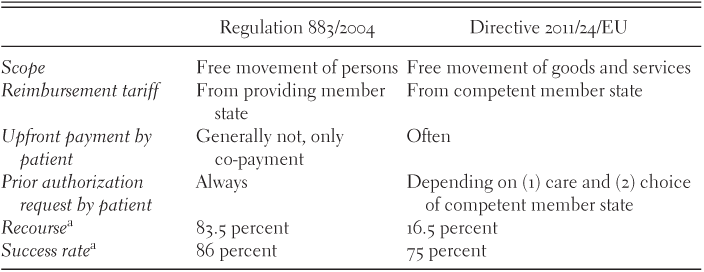
a European Commission, Directorate-General for Health and Food Safety et al., Data on Cross-Border Patient Healthcare Following Directive 2011/24/EU – Reference Year 2020 (December 2021), https://bit.ly/Directive-data-2020; European Commission, Directorate-General for Employment, Social Affairs and Inclusion et al., Cross-Border Healthcare in the EU under Social Security Coordination: Reference Year 2020 (October 2022), https://data.europa.eu/doi/10.2767/714637; see also infra Sections II.B to II.D.
Overall, the number of patients receiving cross-border care under the Regulation or the Directive, although rising every year, remains low. In 2016, a report estimated that cross-border health care under the Directive and the Regulation cost, respectively, 0.004 percent and 0.1 percent of the EU-wide annual health care budget.Footnote 19 In 2019, this increased slightly to 0.01 percent and 0.3–0.4 percent, respectively.Footnote 20 Although increasing patient mobility as such is not a goal in itself in the EU, the fostering of cross-border eHealth solutions is.Footnote 21 This includes telemedicine. Where these cross-border telemedicine solutions increase, implicitly patient mobility also increases. Despite the low market percentages, it is therefore very relevant to assess a patient’s virtual cross-border reimbursement rights.
C Limitations
The EU cross-border reimbursement framework solely concerns insured patients receiving health care crossing an internal EU border. The EU framework does not concern care provided outside of the EU, as the EU has no competence thereto.Footnote 22 As for physical health care, care providers using in-home digital diagnostics not established in the EU therefore depend on the reimbursement legislation of the member states individually.Footnote 23
The legal framework applies differently to unplanned health care – for example, falling ill during a holiday abroad – and planned health care – for example, going abroad for more qualitative dental care. Under EU law, the more interesting comparator is the situation of planned care, as the outcome in reimbursement options vis-à-vis in-person care is more divergent. Therefore, this contribution focuses on the rules concerning planned cross-border health care, such as a situation where a care provider monitors a patient who is located abroad for potential arrhythmias, using wearables to transfer the relevant heart rate data.
II Regulation v. Directive: Reimbursement Implications for Digital Diagnostics
A Various Situations
In the context of in-home digital diagnostics, there are two main EU cross-border health care situations: Patients residing in the member state where they are insured (situation 1, stagnant patient), and patients residing in a different member state from where they are insured (situation 2, patient insured abroad). In both situations, the patients stay at home to receive virtual diagnostic services from a health care provider established in another member state. To understand the legal consequences thereof, one should distinguish between the “competent member state,”Footnote 24 the “member state of residence” and the “member state of treatment” (see Table 14.2).
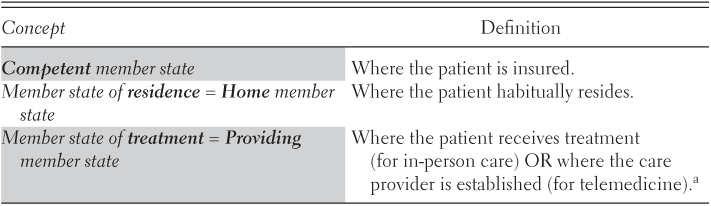
a Directive 2011/24/EU, art. 3(c) and (d).
Table 14.3 demonstrates what these concepts imply for both situations.
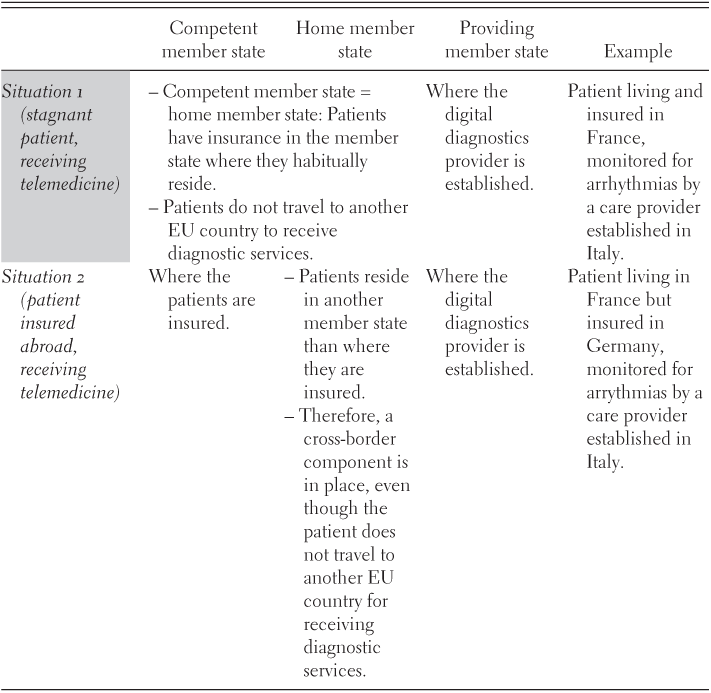
The different scopes of the Regulation and the Directive have direct consequences for telemedicine. Whereas the Directive explicitly includes telemedicine in its scope,Footnote 25 guidance published on the website of the European Commission states that the Regulation does not apply to telemedicine, which directly limits the reimbursement opportunities for patients.Footnote 26 However, considering both the situations of stagnant patients and patients insured abroad, this conclusion should be nuanced to fully reflect all possible scenarios. For situation 1, concerning stagnant patients, the Regulation indeed does not apply, as the patients did not exercise their free movement of persons. Stagnant patients can therefore only rely on the Directive for receiving potential cross-border reimbursement. However, in situation 2, patients do exercise their free movement of persons as they took up insurance in one member state and residence in another member state. This triggers the application of the Regulation. Consequently, contrary to stagnant patients, a patient insured abroad receiving digital diagnostics may qualify for reimbursement both under the Regulation and the Directive. This outcome is similar for physical cross-border health care, where patients can enjoy both legal bases for reimbursement (see Table 14.4).
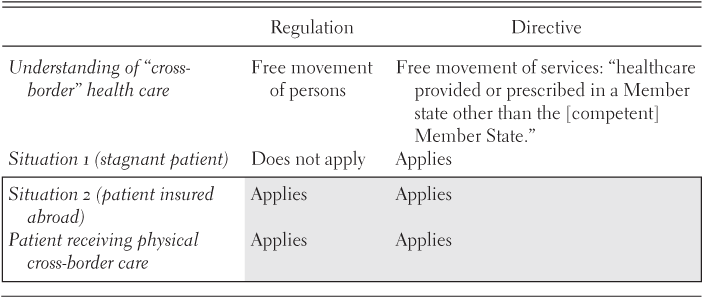
As situation 2 triggers the same legal outcome as for patients receiving physical cross-border health care, this chapter hereafter does not discuss situation 2 separately. The following subsections therefore focus on the comparison between the reimbursement options for in-home digital diagnostics for stagnant patients and for similar in-person diagnostics services, by analyzing the differences in scope and procedure of the Regulation and the Directive. This comparison allows for an assessment as to whether there are potential barriers to cross-border digital diagnostics.
B Price
The Directive generally requires a patient to pay all costs concerning the health care upfront, whereas, under the Regulation, the competent member state generally pays the providing member state directly.Footnote 27 Consequently, a patient receiving in-person care may solely be required to pay the co-payment, while a stagnant patient is more at risk of having to pay for the full treatment at the outset. The latter may be problematic concerning expensive treatments.
Depending on the type of health care sought, patients may have an advantage relying on the Regulation or the Directive, as both legal instruments calculate reimbursement rates on another basis. Under the Regulation, the tariff of the providing member state applies, whereas under the Directive, the tariff of the competent member state applies. As stagnant patients cannot receive reimbursement for telemedicine based on the Regulation, stagnant patients cannot benefit from potentially preferential reimbursement rates available in the providing member state, whereas patients having recourse to the exact same diagnostic services in person do have access to such rates. Where a patient receiving in-person treatment can perform forum shopping based on the Regulation, a stagnant patient cannot.
C Procedure
Both under the Regulation and the Directive, the competent member state may require a patient to seek prior authorization to receive reimbursement for cross-border care. At first sight, the prior authorization scheme under the Regulation seems stricter than the one under the Directive. Specifically, under the Regulation a patient must always request prior authorization, whereas under the Directive a member state can only require a patient to ask for prior authorization regarding specific types of health care. Currently, twenty of the EU member states have such a limited prior authorization scheme in place under the Directive.Footnote 28 Regarding telemedicine, some of these prior authorization bases of the Directive may apply more easily: For example, a member state could argue that, because of the distance, telemedicine presents “a particular risk for the patient” or gives rise “to serious and specific concerns [regarding] the quality or safety of the care.”Footnote 29 Also, a third category of justifications for requesting prior authorization may be relevant. The Directive allows a member state to require prior authorization to control costs and avoid waste of resources for care requiring “highly specialized and cost-intensive medical infrastructure or medical equipment.” A member state may, therefore, refuse the reimbursement of digital diagnostics to ensure the valorization of its national health care investments. At EU or member state level, there is no uniform approach regarding the definition of “highly specialized and cost-intensive medical infrastructure or medical equipment.”Footnote 30 However, a 2022 study indicated that, half of the time, member states harness this justification for requiring prior authorization regarding expensive imaging techniques, such as CT and PET scans, MRI, angiographies, or gamma knife.Footnote 31 Although such imaging techniques currently cannot be replaced by digital alternatives, they could serve as inspiration for the protection of other cost-intensive traditional imaging techniques. Therefore, where digital diagnostics are introduced to replace imaging techniques, the probability increases that other member states will require prior authorization, trying to limit the financial risk of stagnant patients seeking recourse to these virtual diagnostic services over traditional imaging techniques. The protection of the health care system, indeed, is the main reason for member states to implement a prior authorization scheme. In conclusion, telemedicine seems to fulfill the justifications under the Directive more easily, rendering it easier for member states to request prior authorization for such health care. Specifically, regarding digital diagnostics that would replace traditional imaging techniques, member states may fear for the waste of their national health care resources as cross-border health care increases in the EU. They may, therefore, increasingly try to request prior authorization for digital diagnostics under the Directive, as a barrier against such financial risk.
The Regulation and the Directive also have different procedures for refusing such prior authorization. Under the Regulation, the competent member state cannot refuse authorization if the national public health care of the home member state includes the health care requested, and if that care “cannot be given […] within a time limit which is medically justifiable.”Footnote 32 Under the Directive, the potential grounds for refusal are similar and formulated the other way around: A member state is only allowed to refuse authorization for specific, limited reasons. In a telemedicine context, a member state could again argue that the provision of health care at a distance raises concerns regarding the quality thereof, relying on the justification that the patient may be exposed to a “patient-safety risk that cannot be regarded as acceptable” or that the health care raises serious and specific concerns regarding national standards and guidelines on quality of care and patient safety. Furthermore, as for the Regulation, a member state can rely on the fact that it can provide the health care “within a time limit which is medically justifiable.” For the latter ground for refusal, reimbursement depends on the interpretation of the concept of a “medically justifiable time limit” for providing diagnostic services. Both the Directive and Regulation stipulate, in line with the case law of the ECJ, that such assessment should focus on the individual situation of the patient, considering the patient’s current state of health and the probable course of the illness, and the Directive specifies that restrictions should be limited to what is necessary and proportionate.Footnote 33 The proportionality test will include the availability of digital diagnostics, and the outcome of such an assessment will determine how far a member state is allowed to protect its investments when they are surpassed by more innovative techniques in other member states.
Even though, at first sight, the Regulation’s prior authorization scheme may seem stricter, as it is mandatory for all cross-border care, eventually, everything depends on the approach of the competent member state. First, although the reimbursement route via the Directive may seem more accessible as, contrary to the Regulation, it does not always require prior authorization, member states may impose prior authorization under the Directive more swiftly for telemedicine – for example, where digital diagnostics would replace traditional imaging techniques – to protect their national health care investments. Second, member states can refuse authorization on similar grounds under the Regulation and the Directive, namely that the competent member state can offer the treatment within a time limit that is medically justifiable. Third, although the Directive does also list other potentially relevant refusal grounds (namely, where digital diagnostics qualify as an unacceptable patient-safety risk or as raising serious and specific concerns regarding respecting national standards and guidelines on the quality of care and patient safety), member states may take such refusal grounds into account under the Regulation too, even though the Regulation does not explicitly refer to them. In conclusion, the criteria adopted by the member states determine whether the prior authorization scheme of the Regulation or Directive is more lenient for patients requesting cross-border care. Where the criteria under the Regulation would be more lenient than those of the Directive, the reimbursement disparity between stagnant patients and patients receiving in-person diagnostics becomes bigger.
D In Practice
Analyses of the recourse made to the Regulation and the Directive in the past years consistently demonstrate that patients submit far more prior authorization requests under the Regulation than under the Directive.Footnote 34 For example, two reports from the European Commission describing the EU cross-border health care landscape under the Directive and Regulation in 2020 specify that member states reported 5,409 requests under the Directive,Footnote 35 compared to 27,386 requests under the Regulation.Footnote 36 Consequently, only around 16.5 percent of the reported prior authorization requests are based on the Directive. This discrepancy stems partially from the fact that the Directive does not always require prior authorization. However, an analysis of the EU-wide annual health care budget shows that in 2016, the EU spent twenty-five times more budget under the Regulation than under the Directive,Footnote 37 figures unrelated to whether patients have to ask for prior authorization or not. As discussed, a priority rule is in place favoring the application of the Regulation over the Directive.Footnote 38 This default application of the Regulation may partially explain the discrepancy in recourse toward the different reimbursement routes. However, such a priority rule also implies that the advantages of the Regulation set out in this section apply automatically to patients receiving in-person treatment, anchoring their added value even more compared to cross-border health care for stagnant patients excluded from the scope of the Regulation.
The success rate for prior authorization requests for the two reimbursement routes is more comparable: In 2020, 75 percent of the requests were authorized under the Directive,Footnote 39 while under the Regulation, 86 percent of the requests were authorized.Footnote 40 Still, there is an 11 percent higher success rate in favor of the Regulation procedures, which in absolute numbers is considerable, given the Regulation’s wider applicability.
Finally, it is worth comparing the reasons for refusal of authorization, even though the reports state that not many member states were able to provide such details. Both under the Regulation (53 percent) and the Directive (71.4 percent) the main reason for which member states refused authorization was that the cross-border treatment applied for could be provided in the home or competent member state, respectively, within a medically justifiable time limit.Footnote 41 Further, member states only rarely refuse because of quality and safety concerns: They only reported one such case in 2022 under the Directive, and the report covering the Regulation does not even mention this refusal ground. Time will tell whether the member states will attempt to rely on such refusal grounds when telemedicine becomes more prominently available.
For stagnant patients, this implies that they have no access to the most frequented reimbursement route. The remaining reimbursement route is also less successful. Furthermore, member states refuse more frequently on the basis that they can provide treatment within a medically justifiable time limit, which is of importance for the example of cross-border digital diagnostics competing with traditional imaging techniques.
III Practical Implications
This section describes the potential consequences of the rules set out in Section II for the various stakeholders involved: The patients, the telemedicine providers, and the EU member states.
A Patient Perspective
The EU health framework takes a different approach toward stagnant patients and patients receiving cross-border care in person. Stagnant patients cannot select the most favorable rate among all potential providing member states, while patients crossing a border for the same care in-person can, even if it concerns the exact same diagnostic service. This is a disadvantage for elderly patients and severely ill patients, who are less mobile. In addition, there is a higher burden for stagnant patients to get access to care, as generally they must pay the full cost of the health care upfront. The Regulation generally does not require patients to pay upfront. Therefore, telemedicine will be less accessible for less wealthy patients. They may not be able to pay the full price upfront under the Directive, and they neither have the means to cover travel costs upfront for receiving the care physically in another country under the Regulation.
At first glance the procedure under the Directive may seem more favorable as the Directive does not always require prior authorization. However, everything depends on the criteria imposed by the member states. The grounds for refusal of prior authorization also depend primarily on the approach of the competent member state. Furthermore, the default application of the Regulation pursuant to the priority rule combined with the higher success rate reinforces the weaker reimbursement position of stagnant patients. As telemedicine solutions are booming, the discrepancy in reimbursement options between a stagnant patient and a patient receiving in-person cross-border diagnostics will become more apparent.
B Telemedicine Solution Providers’ Perspective
The EU spectrum of telemedicine solution providers is diverse: The main actors are telecom companies, Big Tech companies, medical device manufacturers, pharma companies, and start-ups.Footnote 42 Their development of telemedicine solutions holds great potential for society as it can create a scale advantage: A 2018 European Commission study concluded that “the higher the share of telemedicine, the more cost-effective wide-scale deployment becomes.”Footnote 43 The increased use of telemedicine reduces the total cost of the patient journey and the mortality rate, and increases life quality. Telemedicine can lead to the integration of, for example, e-visits to doctors for routine investigations, but could also create a market for innovative or niche treatments, as it enables reaching a crucial minimum number of patients. However, the 2018 study states that reimbursement is key to speeding up success.Footnote 44 Therefore, the EU cross-border reimbursement challenges are a de facto limitation of the potential scale advantage for telemedicine solution providers. A lack of interoperability across a fragmented EU health care market reinforces this limitation.Footnote 45
Consequently, if a company develops a diagnostics solution and releases it on the EU market, contradictorily, it may have a greater reach if offered physically in the member state which approved such reimbursement, rather than virtually. This way the Regulation is applicable too, and EU patients can access the diagnostic services in a more diverse, reimbursable way. The existing EU reimbursement system may therefore have a retarding effect on the development of the telemedicine market in the EU.
C EU Member State Perspective
The competent member state can decide to exclude cross-border in-home digital diagnostics from reimbursement because of budgetary concerns. When arguing against reimbursement for cross-border health care, member states traditionally state that the measure is necessary for “safeguarding the financial balance of the social security system.”Footnote 46 Cross-border telemedicine may indeed cost money. However, telemedicine may also be cost-effective for the member state.Footnote 47 When assessing whether cross-border reimbursement decisions compromise the sustainability of the social security system, member states should consider whether the advantages of cross-border digital diagnostics counter the potential cost of opening the reimbursement system further. Even though opening up the reimbursement scheme to certain cross-border telemedicine solutions requires the dedication of extra budget for that telemedicine solution, the solution provided could be substantially more cost-effective than the existing in-person alternatives – for example, analysis via data captured by a wearable instead of an expensive scan. Therefore, the overall balance for the member state could be positive, despite covering the reimbursement of both the in-person solution and the telemedicine alternative. The 2018 telemedicine market study noted that “a lack of willingness to adopt new solutions is a barrier to innovation.”Footnote 48 The member states’ adherence to known solutions could therefore hinder the integration of telemedicine solutions in the reimbursed “basket of health care.”
In addition, as mentioned in the introduction, the number of patients requesting health care under both the Directive and the Regulation remains low. Therefore, the real-life impact of telemedicine on the financial balance of a member state’s social security system is still low, even though patients are becoming more independent and increasingly look for care options across borders. The surge of telemedicine and digital diagnostics will require member states to perform thorough assessments regarding their financial benefits and risks, including cost effectiveness. If cross-border patient numbers remain low, the member states should also consider this more limited impact when assessing reimbursement feasibility.
IV Conclusion
In-home digital diagnostics are a form of telemedicine. The reimbursement of cross-border telemedicine constitutes specific reimbursement challenges in the EU. Patients insured in their home member state only qualify for reimbursement of cross-border telemedicine under Directive 2011/24/EU, whereas patients receiving the same care in person abroad qualify for reimbursement both under Directive 2011/24/EU and under Regulation 883/2004. Opting for one reimbursement basis or the other has an impact on the flexibility regarding the price of the health care sought, the potential upfront payment, and the prior authorization procedure which they must follow. Consequently, exclusion of the scope of the Regulation may disadvantage patients receiving telemedicine, as they have less reimbursement options. In addition, the Directive is the less frequented and less successful reimbursement route. Telemedicine solution developers too may face challenges, as the current reimbursement system deprives them partially of the scale advantages linked with telemedicine. Finally, the EU member states need to scrutinize whether they will reimburse in-home digital diagnostics or not, considering the cost-efficiency of telemedicine and the limited recourse made to telemedicine by patients. The overall EU cross-border reimbursement framework has again become “complex and lengthy,” especially when considering both in-person care and telemedicine. The legislator will need to consider whether the increase in telemedicine will again necessitate a modernizing and simplifying effort for this legal framework.


 Open access