


Horowitz' Impact of Event Scale (IES; Reference Horowitz, Wilner and AlvarezHorowitz et al, 1979) was created for the study of bereaved individuals, but soon it was used for exploring the psychological impact of a variety of traumas. It was constructed before the diagnosis of post-traumatic stress disorder (PTSD) was entered into the DSM—III (American Psychiatric Association, 1980), and although many measures of PTSD symptoms have emerged (Reference Wilson and KeaneWilson & Keane, 1997), the IES remains widely used. It may be argued that the IES is obsolete, since it does not measure the hyperarousal symptoms of the PTSD diagnosis in DSM—IV (American Psychiatric Association, 1994). Typically, this type of question is examined through evaluating the instrument's psychometric properties. This study aims to assess the psychometric properties of the IES on the basis of a comprehensive list of studies.
METHOD
Selection of studies
Studies that examined the IES' psychometric properties were selected from the accumulation of articles assembled in a meta-analytical study to be reported elsewhere (further details available from the author upon request). In addition, 43 studies were found in a direct library search. In all, 66 studies that analysed the IES' reliability and validity were located, and findings from 40 of these studies were selected on the basis of psychometric soundness and clinical relevance and reviewed for this study. Results from the statistical analyses from 23 of these studies are presented, as a potentially useful comparison resource in future studies of stress reactions related to traumatic events.
Following the American Psychological Association's Standards for Educational and Psychological Tests (1985), reliability will be presented in terms of internal consistency and stability. In reviewing the IES' validity we discuss: theoretical formulation; content validity; construct validity; and external validity. When multiple comparisons are made, the likelihood of error-rate inflation is significant, and therefore the minimum interpretable alpha for any computed analysis is set at 0.01.
RESULTS
Reliability
Internal consistency
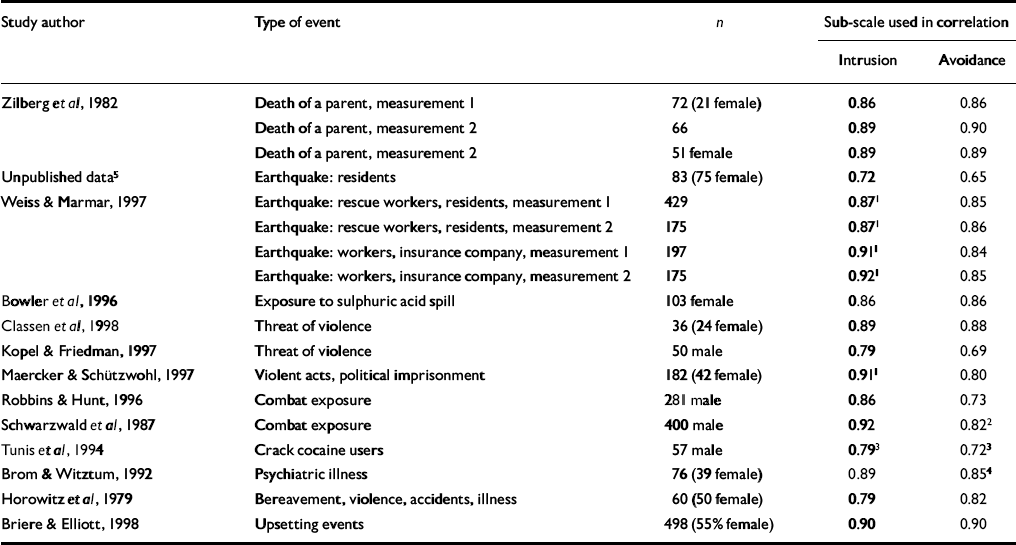
Table 1 presents 18 estimates of the internal consistency of the IES intrusion and avoidance for different populations.
Internal consistencies measured with Cronbach's alpha (Reference Cronbach and MeehlCronbach & Meehl, 1955) for the Impact of Event Scale (Reference Horowitz, Wilner and AlvarezHorowitzet al, 1979): intrusion and avoidance sub-scales
| Study author | Type of event | n | Sub-scale used in correlation | |
|---|---|---|---|---|
| Intrusion | Avoidance | |||
| Reference Zilberg, Weiss and HorowitzZilberg et al, 1982 | Death of a parent, measurement 1 | 72 (21 female) | 0.86 | 0.86 |
| Death of a parent, measurement 2 | 66 | 0.89 | 0.90 | |
| Death of a parent, measurement 2 | 51 female | 0.89 | 0.89 | |
| Unpublished data5 | Earthquake: residents | 83 (75 female) | 0.72 | 0.65 |
| Reference Weiss, Marmar, Wilson and KeaneWeiss & Marmar, 1997 | Earthquake: rescue workers, residents, measurement 1 | 429 | 0.871 | 0.85 |
| Earthquake: rescue workers, residents, measurement 2 | 175 | 0.871 | 0.86 | |
| Earthquake: workers, insurance company, measurement 1 | 197 | 0.911 | 0.84 | |
| Earthquake: workers, insurance company, measurement 2 | 175 | 0.921 | 0.85 | |
| Reference Bowler, Mergler and HuelBowler et al, 1996 | Exposure to sulphuric acid spill | 103 female | 0.86 | 0.86 |
| Reference Classen, Koopman and HalesClassen et al, 1998 | Threat of violence | 36 (24 female) | 0.89 | 0.88 |
| Reference Kopel and FriedmanKopel & Friedman, 1997 | Threat of violence | 50 male | 0.79 | 0.69 |
| Reference Maercker and SchutzwohlMaercker & Schützwohl, 1997 | Violent acts, political imprisonment | 182 (42 female) | 0.911 | 0.80 |
| Reference Robbins and HuntRobbins & Hunt, 1996 | Combat exposure | 281 male | 0.86 | 0.73 |
| Reference Schwarzwald, Solomon and WeisenbergSchwarzwald et al, 1987 | Combat exposure | 400 male | 0.92 | 0.822 |
| Reference Tunis, Delucchi and HallTunis et al, 1994 | Crack cocaine users | 57 male | 0.793 | 0.723 |
| Reference Brom and WitztumBrom & Witztum, 1992 | Psychiatric illness | 76 (39 female) | 0.89 | 0.854 |
| Reference Horowitz, Wilner and AlvarezHorowitz et al, 1979 | Bereavement, violence, accidents, illness | 60 (50 female) | 0.79 | 0.82 |
| Reference Briere and ElliottBriere & Elliott, 1998 | Upsetting events | 498 (55% female) | 0.90 | 0.90 |
For IES intrusion, mean α=0.86 (range 0.72-0.92), for IES avoidance mean α=0.82 (range 0.65-0.90). Using the 0.80 criterion set by Carmines & Zeller (Reference Carmines and Zeller1979), both IES sub-scales are consistent, which indicates that each of them measures a homogeneous construct.
Stability
In the original report on the IES (Reference Horowitz, Wilner and AlvarezHorowitz et al, 1979), adequate test—retest reliabilities were reported for the two sub-scales (0.87 and 0.79); time between measurements was 1 week. Test—retest estimates were also presented by Solomon & Mikulincer (Reference Solomon and Mikulincer1988), who found test—retest reliabilities of 0.56 and 0.74 respectively; time between measurements was 1 year. Weiss & Marmar (Reference Weiss, Marmar, Wilson and Keane1997) reported test—retest reliabilities for IES sub-scales based on two different samples. For the first sample, the average time since event was 3.1 years and time between measurements was 6 months. The second sample completed the IES 6 weeks after the event and follow-up was 6 months later. Test—retest reliability for the first sample was 0.57 for IES intrusion and 0.51 for IES avoidance; for the second sample, reliabilities were 0.94 and 0.89.
These estimates of test—retest reliability show that the shorter time interval (<0.6 weeks) between measurements in Horowitz et al (Reference Horowitz, Wilner and Alvarez1979) and the second sample in Weiss & Marmar (Reference Weiss, Marmar, Wilson and Keane1997) contributed to higher estimates of stability compared with the estimates obtained when a longer time interval was used (>1 year).
Validity
Theoretical formulation
The IES is based on clinical studies of psychological response to stressful events, and on Horowitz' (Reference Horowitz1976) theory about stress response syndrome, which offers an understanding of how people proceed through trauma. The clinical studies revealed two common responses to stress: intrusion and avoidance. Intrusion involved ‘unbidden thoughts and images, troubled dreams, strong pangs or waves of feelings, and repetitive behavior’ and avoidance involved ‘ideational constriction, denial of meanings and consequences of the event, blunted sensation, behavioral inhibition or counterphobic activity, and awareness of emotional numbness’ (Reference Horowitz, Wilner and AlvarezHorowitz et al, 1979). According to Horowitz (Reference Horowitz1976), intrusions and avoidances tend to oscillate during the same time period. Avoidant behaviour often results from the operation of unconscious control processes, and function to restore emotional equilibrium, prevent emotional flooding and reduce conceptual disorganisation. These defensive efforts are disrupted by intrusive experiences. Such dreaded states sharply contrast with a desired state of equilibrium. To restore stability, people react with heightened defensive control. Since individuals are not expected to report unconscious aspects of the control processes, the term avoidance was used instead of denial.
Content validity
We found 12 studies that examined the validity of IES' two-factor structure based on data collected after various events. In three out of 10 studies that successfully reproduced the intrusion and avoidance factors, a third factor was obtained, and this factor was labeled ‘emotional numbing’ (Reference Joseph, Williams and YuleJoseph et al, 1994; Reference Foa, Riggs and GershungFoa et al, 1995; Reference McDonaldMcDonald, 1997). Results from two more studies suggested an underlying structure with one factor only (Reference Hendrix, Jurich and SchummHendrix et al, 1994; Reference Weiss, Marmar, Wilson and KeaneWeiss & Marmar, 1997).
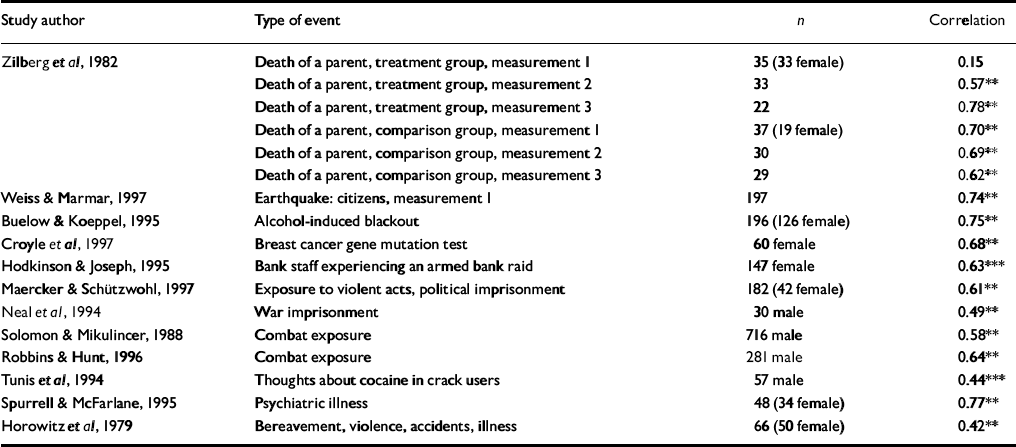
In the initial report on the IES (Reference Horowitz, Wilner and AlvarezHorowitz et al, 1979), the correlation between IES intrusion and avoidance was 0.41. This correlation between IES intrusion and avoidance along with results from 11 more studies are shown in Table 2. Mean correlation was 0.63, which suggested that the sub-scales were relatively independent of one another, each of them representing a different type of reaction in the face of stressful events.
Correlations between the Impact of Event Scale (Reference Horowitz, Wilner and AlvarezHorowitz et al, 1979) intrusion and avoidance sub-scales
| Study author | Type of event | n | Correlation |
|---|---|---|---|
| Reference Zilberg, Weiss and HorowitzZilberg et al, 1982 | Death of a parent, treatment group, measurement 1 | 35 (33 female) | 0.15 |
| Death of a parent, treatment group, measurement 2 | 33 | 0.57** | |
| Death of a parent, treatment group, measurement 3 | 22 | 0.78** | |
| Death of a parent, comparison group, measurement 1 | 37 (19 female) | 0.70** | |
| Death of a parent, comparison group, measurement 2 | 30 | 0.69** | |
| Death of a parent, comparison group, measurement 3 | 29 | 0.62** | |
| Reference Wilson and KeaneWeiss & Marmar, 1997 | Earthquake: citizens, measurement 1 | 197 | 0.74** |
| Reference Buelow and KoeppelBuelow & Koeppel, 1995 | Alcohol-induced blackout | 196 (126 female) | 0.75** |
| Reference Croyle, Smith and BotkinCroyle et al, 1997 | Breast cancer gene mutation test | 60 female | 0.68** |
| Reference Hodkinson and JosephHodkinson & Joseph, 1995 | Bank staff experiencing an armed bank raid | 147 female | 0.63*** |
| Reference Maercker and SchutzwohlMaercker & Schützwohl, 1997 | Exposure to violent acts, political imprisonment | 182 (42 female) | 0.61** |
| Reference Neal, Busuttil and RollinsNeal et al, 1994 | War imprisonment | 30 male | 0.49** |
| Reference Solomon and MikulincerSolomon & Mikulincer, 1988 | Combat exposure | 716 male | 0.58** |
| Reference Robbins and HuntRobbins & Hunt, 1996 | Combat exposure | 281 male | 0.64** |
| Reference Tunis, Delucchi and HallTunis et al, 1994 | Thoughts about cocaine in crack users | 57 male | 0.44*** |
| Reference Spurrell and McFarlaneSpurrell & McFarlane, 1995 | Psychiatric illness | 48 (34 female) | 0.77** |
| Reference Horowitz, Wilner and AlvarezHorowitz et al, 1979 | Bereavement, violence, accidents, illness | 66 (50 female) | 0.42** |
Construct validity
The moderate correlation between intrusion and avoidance obtained in a number of studies that used the IES (see Table 2) is consistent with Horowitz' (Reference Horowitz1976) prediction that people tend to present an oscillating pattern wherein intrusive symptoms are followed by avoidance. Horowitz (Reference Horowitz1976) also postulated that intrusive and avoidant symptoms will become less frequent over time as the implications of the stressor event are digested. Several studies reported results that are consistent with this assumption (e.g. Reference Sloan, Rozensky and KaplanSloan et al, 1994; Reference Kelly, Raphael and SmithersKelly et al, 1995).
According to Horowitz (Reference Horowitz1976), strong avoidance of painful thoughts may reduce dreaded states; however, it may also prevent adaptation to traumatic experiences. This assumption was supported by several researchers, for example McFarlane (Reference McFarlane1988) found that individuals who developed PTSD at 8 months after trauma had reported more avoidance on the IES at 4 months after the event as compared with those without PTSD.
Convergent validity
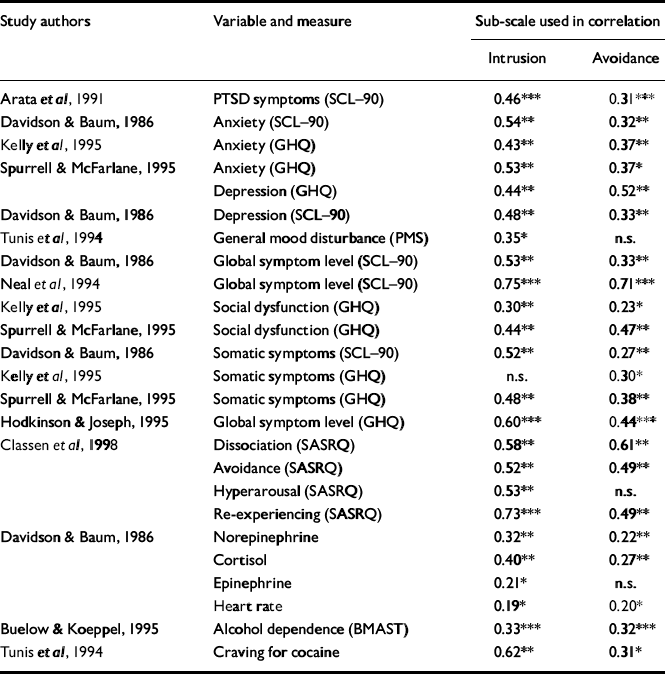
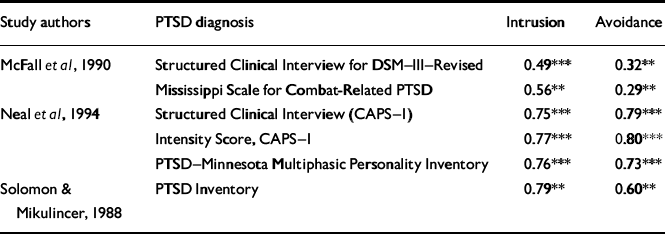
Table 3 presents studies that assessed the convergent validity of the IES, grouped according to the variable assessed in the study, for example, anxiety, depression, and general symptoms. In Table 4, correlations between the IES sub-scales and PTSD as diagnosed with six different instruments are presented. The correlations indicated that these relationships were moderate, indicating that IES intrusion and avoidance contribute information that is not captured with other symptom inventories and measures of PTSD.
Correlations between the Impact of Event Scale (Reference Horowitz, Wilner and AlvarezHorowitz et al, 1979) intrusion and avoidance sub-scales and other measures
| Study authors | Variable and measure | Sub-scale used in correlation | |
|---|---|---|---|
| Intrusion | Avoidance | ||
| Reference Arata, Saunders and KilpatrickArata et al, 1991 | PTSD symptoms (SCL-90) | 0.46*** | 0.31*** |
| Reference Davidson and BaumDavidson & Baum, 1986 | Anxiety (SCL-90) | 0.54** | 0.32** |
| Reference Kelly, Raphael and SmithersKelly et al, 1995 | Anxiety (GHQ) | 0.43** | 0.37** |
| Reference Spurrell and McFarlaneSpurrell & McFarlane, 1995 | Anxiety (GHQ) | 0.53** | 0.37* |
| Depression (GHQ) | 0.44** | 0.52** | |
| Reference Davidson and BaumDavidson & Baum, 1986 | Depression (SCL-90) | 0.48** | 0.33** |
| Reference Tunis, Delucchi and HallTunis et al, 1994 | General mood disturbance (PMS) | 0.35* | n.s. |
| Reference Davidson and BaumDavidson & Baum, 1986 | Global symptom level (SCL-90) | 0.53** | 0.33** |
| Reference Neal, Busuttil and RollinsNeal et al, 1994 | Global symptom level (SCL-90) | 0.75*** | 0.71*** |
| Reference Kelly, Raphael and SmithersKelly et al, 1995 | Social dysfunction (GHQ) | 0.30** | 0.23* |
| Reference Spurrell and McFarlaneSpurrell & McFarlane, 1995 | Social dysfunction (GHQ) | 0.44** | 0.47** |
| Reference Davidson and BaumDavidson & Baum, 1986 | Somatic symptoms (SCL-90) | 0.52** | 0.27** |
| Reference Kelly, Raphael and SmithersKelly et al, 1995 | Somatic symptoms (GHQ) | n.s. | 0.30* |
| Reference Spurrell and McFarlaneSpurrell & McFarlane, 1995 | Somatic symptoms (GHQ) | 0.48** | 0.38** |
| Reference Hodkinson and JosephHudkinson & Joseph, 1995 | Global symptom level (GHQ) | 0.60*** | 0.44*** |
| Reference Classen, Koopman and HalesClassen et al, 1998 | Dissociation (SASRQ) | 0.58** | 0.61** |
| Avoidance (SASRQ) | 0.52** | 0.49** | |
| Hyperarousal (SASRQ) | 0.53** | n.s. | |
| Re-experiencing (SASRQ) | 0.73*** | 0.49** | |
| Reference Davidson and BaumDavidson & Baum, 1986 | Norepinephrine | 0.32** | 0.22** |
| Cortisol | 0.40** | 0.27** | |
| Epinephrine | 0.21* | n.s. | |
| Heart rate | 0.19* | 0.20* | |
| Reference Buelow and KoeppelBuelow & Koeppel, 1995 | Alcohol dependence (BMAST) | 0.33*** | 0.32*** |
| Reference Tunis, Delucchi and HallTunis et al, 1994 | Craving for cocaine | 0.62** | 0.31* |
Correlations between the Impact of Event Scale (Reference Horowitz, Wilner and AlvarezHorowitz et al, 1979) intrusion and avoidance sub-scales and post-traumatic stress disorder (PTSD) diagnosis
| Study authors | PTSD diagnosis | Intrusion | Avoidance |
|---|---|---|---|
| Reference McFall, Smith and RoszellMcFall et al, 1990 | Structured Clinical Interview for DSM—III—Revised | 0.49*** | 0.32** |
| Mississippi Scale for Combat-Related PTSD | 0.56** | 0.29** | |
| Reference Neal, Busuttil and RollinsNeal et al, 1994 | Structured Clinical Interview (CAPS—I) | 0.75*** | 0.79*** |
| Intensity Score, CAPS—I | 0.77*** | 0.80*** | |
| PTSD—Minnesota Multiphasic Personality Inventory | 0.76*** | 0.73*** | |
| Reference Solomon and MikulincerSolomon & Mikulincer, 1988 | PTSD Inventory | 0.79** | 0.60** |
Clinical validity
The review of studies that examined the reliability and/or validity of the IES suggested that the IES is a psychometrically sound measure, and thus it is appropriate to explore the measure's clinical validity: is the information obtained with the IES relevant to clinical practice? For instance, can self-rated symptom severity serve a screening purpose, and enhance decision-making about treatment options? Several studies showed that the IES discriminates between people with severe and mild stress reactions. For example, a study of psychological responses to testing for the breast cancer gene BRCA1 reported that gene carriers manifested higher levels of intrusion and avoidance than non-carriers (Reference Croyle, Smith and BotkinCroyle et al, 1997). Women who considered genetic testing reported significantly higher breast-cancer-specific distress but similar levels of general psychological morbidity when compared with a group of matched controls (Reference Lloyd, Watson and WaitesLloyd et al, 1996). Studies of other groups, such as bereaved individuals (e.g. Reference Horowitz, Weiss and KaltreiderHorowitz et al, 1984) and war veterans (e.g. Reference Solomon and KleinhauzSolomon & Kleinhauz, 1996), have showed that the IES can aid the clinician in identifying individuals who need treatment.
Furthermore, the IES has been used in many psychopharmacological trials (e.g. Reference Frank, Kosten and GillerFrank et al, 1988; Reference Davidson, Kudler and SaundesDavidson et al, 1993; Reference Brady, Sonne and RobertsBrady et al, 1995; Reference Rothbaum, Ninan and ThomasRothbaum et al, 1996), and outcome studies (Reference Horowitz, Weiss and KaltreiderHorowitz et al, 1984; Reference Tunis, Delucchi and HallTunis et al, 1994; Reference Chemtob, Tomas and LawChemtob et al, 1997; Reference Grisaru, Amir and CohenGrisaru et al, 1998), which yield additional evidence of the measure's clinical relevance.
DISCUSSION
We have summarised studies of the psychometric properties of the IES. A crucial issue is whether the two types of stress reactions measured by the two subscales actually are relatively independent from each other.
IES two-factor structure
Twelve studies examined the IES' dimensionality and 10 of these replicated the intrusion and avoidance scales despite considerable differences between the samples and elapsed time since the event. Three of these studies reported that the avoidant factor was split in two: one avoidant and a second, labelled ‘emotional numbing’. Foa et al (Reference Foa, Riggs and Gershung1995) maintained that this finding contributes to the understanding of trauma victims' coping strategies: when dreaded states involving intrusive experiences cannot be warded off with avoidant behaviour, emotion is stifled (i.e. emotional numbing). Two more studies that examined the factorial structure of the IES obtained one meaningful factor only. The authors of one of these studies, Reference Hendrix, Jurich and SchummHendrix et al, 1994, interpreted the result to mean that over time, the distinction between intrusion and avoidance blurs, and the two merge into one over-all pattern of stress reactions or general level of distress. This general distress appears to contain both intrusive and avoidant symptoms as measured with the IES.
Stability of IES intrusion and avoidance
Both studies that used the original IES and the ones that used slightly altered sub-scales reported internal consistencies of a similar magnitude; all of them indicated that intrusion and avoidance sub-scales have good reliabilities and thus each sub-scale measures a relatively homogeneous construct. The fact that the correlation between the two sub-scales when averaged over 11 studies was moderate (0.63) suggested that intrusion and avoidance are separable constructs. The original intrusion and avoidance sub-scales shared approximately the same amount of variance as obtained when slightly altered scales were used, which indicates the stability of the IES.
IES — a measure of PTSD?
It has been suggested that the IES is a valid measure of post-traumatic stress symptoms but should not be used as a measure of PTSD. One reason is that the IES does not measure the hyperarousal symptoms included in the criteria for the diagnosis in the most recent version of the DSM.
The results summarised here add to the support of IES' reliability and validity. Particularly, the high correlation between IES intrusion and avoidance and PTSD diagnosis obtained in a number of studies validates the usage of the subject-rated IES as a screening measure for PTSD. Since the IES is a short self-report measure, it provides a low-cost measure to detect PTSD (Reference Rothbaum, Foa and RiggsRothbaum et al, 1992). Moreover, a number of the studies summarised here reported that the IES is well suited to assessing outcome from various types of treatment, and its sensitivity for drug—placebo differences has been confirmed.
Clinical Implications and Limitations
CLINICAL IMPLICATIONS
-
• A review of many studies that use the Impact of Event Scale (IES) showed that the measure is a reliable index of degree of subjective distress from a particular trauma, and can be used to compare one group of trauma victims with another, or hence one trauma or one type of victim with another.
-
• The review showed that the IES can be used as a repeated measure to track a trajectory of degree of subjective distress over time in a person or a group of people.
-
• The IES sub-scales were found to be useful for examination of variations in constellations of intrusion and avoidance symptoms over time in different people, including those with PTSD.
LIMITATIONS
-
• Limitations due to the self-report nature of the measure, which means that subjects may be influenced by a bias for reporting more or less distress, were not examined.
-
• The relationship between the avoidance component of the measure and unconscious denials was not explored.
-
• The relationship between the original IES and an eight-item version of the IES for children was not examined and so a potential difference between the two remained unknown.




eLetters
No eLetters have been published for this article.