

We live in times in which politicians accuse the media of manipulating public opinion and the media accuse politicians of not telling the truth. Therefore, the dissemination of news plays a crucial role in representative democracy by establishing a connection between elected representatives and electorate. This connection applies not only to the executive power; increasingly, legislators and judges are becoming involved in news scandals that shock public opinion. Regarding legislative activity, media coverage has the power to set an agenda that influences which content voters perceive as most relevant (Reference SorokaSoroka 2003), which creates the possibility that legislative behavior changes depending on the impact of news coverage. During electoral periods (Reference Arceneaux, Johnson, Lindstädt and WielenArceneaux et al. 2016), legislators seeking reelection focus more of their attention on specific issues that might maximize votes (Reference Traber, Sciarini and HugTraber et al. 2010). Among the issues addressed in previous studies, foreign policy is unique in relation to other public policies and may bring different incentives to legislative behavior (Reference McCormick and WittkopfMcCormick and Wittkopf 1990; Reference Fleisher, Bond, Krutz and HannaFleisher et al. 2000; Reference Kupchan and TrubowitzKupchan and Trubowitz 2007). This includes matters such as domestic economy, education, health, and public safety, which are all present in the daily life of the voter; however, foreign policy matters rarely involve personal experience (Reference SorokaSoroka 2003).
The distinction between the electoral appeal of different types of policies can affect legislative behavior. One distinction is caused by parliamentary disinterest in the matters that do not render votes, and foreign policy issues have a perception of low electoral return (Reference RosenauRosenau 1967; Reference HolstiHolsti 1992). Thus, legislators tend to support the foreign policy guidelines of the presidency with a high degree of consensus among political parties. A second distinction is that public opinion has a minimal effect in shifting a legislator’s preferences in foreign policy issues (Reference LipsetLipset 1966, Reference PatersonPaterson 1979). Unlike policies that are more sensitive to the electorate, foreign policy is “immune” from public opinion.
However, contrary to the distinctions from the classic literature, it is possible that public opinion sometimes has an influence on international affairs (Reference HillHill 1998), thus affecting legislative behavior. Technological advances certainly played a role in this phenomenon. The role of the media as intermediary between government actions and the electorate’s perceptions is an intervening variable that can make a foreign policy bill gain salience among public policies (Reference SorokaSoroka 2003).
We empirically test the effect of media coverage on the degree of legislative consensus on foreign policy bills addressed in the Paraguayan Chamber of Deputies. While the subject is widely debated in the literature and focused particularly on the American case (Reference O’HeffernanO’Heffernan 1991; Reference LindsayLindsay 1992; Reference Jacobs and PageJacobs and Page 2005), there are few studies of this nature addressing presidential systems in Latin America. Understanding the relationship between media coverage and legislative behavior allows us to evaluate the quality of democratic representation in foreign policy making.
By analyzing the degree of divergence between the ayes and nays on foreign policy issues, we test the effect of the quantity of news published in ABC Color, the country’s largest and most influential newspaper. We expect that the larger the amount of news on a certain foreign policy issue, the greater is legislators’ perception of the electoral relevance of the issue and thus the more polarized the voting will be. More media coverage would encourage legislators to publicly position themselves in the plenary sessions (through roll-call votes), distancing themselves from their political opponents and signaling a different political option to the electorate. More polarization would be associated with a lower degree of consensus in foreign policy votes, enabling a better understanding of the relationship between the media and legislative behavior.
We collected all roll-call votes on foreign policy bills between 2003 and 2012 that took place in the Paraguayan Chamber of Deputies, covering two presidential terms. For the six months prior to the vote in the plenary sessions, we collected all news published in the printed version of the ABC Color. This newspaper, founded in 1967, is the main media outlet in Paraguay, and its owners also control the ABC Cardinal AM radio station and the ABC TV television channel.Footnote 1 By means of Tobit models, we find a significant and positive association between quantity of news and degree of divergence between votes in foreign policy issues. In other words, legislative behavior is not sheltered from the degree of public debate on the subject.
In addition, estimating the ideal points of the legislators in foreign policy voting, we show that the differentiation among legislators is structured around the dichotomy between the coalition that supports and opposes the government, polarizing the Colorado Party on one side and the Liberal Party on the other.Footnote 2 Although it is difficult to claim causality in the current design of observational research, our finding goes against a consolidated claim in the Latin American literature about the electoral disinterest of legislators in the foreign policy of countries (Reference Almeida and AlbuquerqueAlmeida 2000; Reference Lima and SantosLima and Santos 2001; Reference SantosSantos 2006; Reference OliveiraOliveira 2005; Reference StuhldreherStuhldreher 2003). We complement the quantitative evidence with qualitative evidence gathered from interviews with politicians and experts in Paraguay.
The article is structured as follows: In the next section, we discuss the literature on the relationships of media coverage, foreign policy making, and legislative behavior. We then describe the methodological design of the work. We justify the election of the Paraguayan case and the use of roll-call votes. We also describe the data we collected and the statistical model chosen for the analysis. We present and discuss the main empirical results in light of the qualitative evidence from interviews. Finally, we conclude the study. Our main contribution is to cast doubts on the widespread idea that in Latin American countries, legislators see foreign policy making as an agenda that has no electoral consequences. Even for a country such as Paraguay, which is arguably less engaged in economic globalization than other countries,Footnote 3 those who study legislative behavior will have to acknowledge that foreign policy making is no different from other agendas with regard to electoral relevance.
Legislative Behavior and Media Coverage
The manifestation of conflict among political actors over public issues is a common feature of the democratic political processes. The divergence between legislators and their political parties has received great attention from scholars interested in Latin American politics (Reference Alcántara Saéz and RivasAlcántara Saéz and Rivas 2007; Reference Alemán, Calvo, Jones and KaplanAlemán et al. 2009; Reference Cantú and DesposatoCantú and Desposato 2012; Reference Power and ZuccoPower and Zucco 2009; Reference SaieghSaiegh 2015; Reference Zucco and LauderdaleZucco and Lauderdale 2011). The explanations regarding partisan and legislative divergence can be divided into two groups: external and internal sources of influence (Reference Barber, McCarty and PersilyBarber and McCarty 2015).
Examples of external influences are income inequality (Reference McCarty, Poole and RosenthalMcCarty et al. 2006), a polarized electorate (Reference LupuLupu 2015), media coverage (Reference Snyder and StrömbergSnyder and Strömberg 2010), and campaign funding (Reference MoonMoon 2004). In the case of internal influences, strategic disagreement (Reference ZuccoZucco 2009), party pressures (Reference Dewan and SpirlingDewan and Spirling 2011), and agenda control (Reference Hix and NouryHix and Noury 2016) are frequently highlighted as very influential in legislative polarization. This literature review focuses on the effect of media coverage on legislative behavior; one important external source of influence that still has few empirical studies of Latin American countries.
The literature on political communication has developed the agenda-setting theory perspective, which describes how the media agenda influences the political agenda (Reference Jones and BaumgartnerJones and Baumgartner 2005; Reference CookCook 2006; Reference Mazzoleni and SchulzMazzoleni and Schulz 1999; Reference Walgrave and AelstWalgrave and Aelst 2006). The agenda formation of the issues that qualify for thorough political consideration is the stage immediately before the public manifestation of divergence between political parties (Reference Green-Pedersen and StubagerGreen-Pedersen and Stubager 2010). Several country case studies (Reference SorokaSoroka 2002; Reference Sevenans, Walgrave and VosSevenans et al. 2015), comparative studies (Reference SevenansSevenans 2018; Reference MaurerMaurer 2011; Reference Vliegenthart, Walgrave, Baumgartner, Bevan, Breunig, Brouard, Bonafont, Grossman, Jennings, Mortersen, Palau, Sciarini and TreschVliegenthart et al. 2016), and single-issue studies (Reference YanovitzkyYanovitzky 2002; Reference Liu, Vedlitz and AlstonLiu et al. 2008) have demonstrated that politicians are, to varying degrees and conditions, responsive toward media priorities.
In general, legislators work with a significant degree of uncertainty regarding the preferences of the electorate (Reference Butler and NickersonButler and Nickerson 2011). In this regard, the media stands out as a source of information for the legislator to map constituents, linking voters and elected representatives (Reference Baum and PotterBaum and Potter 2008). Strömbäck (Reference Strömbäck2008) argues that media exert influence on both people’s and political institutions’ perceptions. Issues that receive more media attention are likely to have higher status on the political agenda (Reference Boas and SmithBoas and Smith 2019; Reference Díez and DionDíez and Dion 2018; Reference SevenansSevenans 2018). Studies relying on legislative surveys credit national and local news media as the most important source of information for members of Congress (Reference Bybee and ComadenaBybee and Comadena 1984; Reference RiffeRiffe 1990).
Drawing from a case study with Israeli members of parliament, Cohen and colleagues (Reference Cohen, Tsfati and Sheafer2008) demonstrated the influence of presumed influence of the media, where legislators’ perception of the power of the media increases their actions to appear in media coverage, enhancing media prominence and legislative activity. Snyder and Strömberg (Reference Snyder and Strömberg2010) show that members of the US House of Representatives who are less covered by the local press are less likely to attend congressional hearings and to vote against the party line. Another interesting empirical case addressed in the United States, utilizing a quasi-experimental research design, was the emergence of Fox News in some electoral districts and not in others (Reference DellaVigna and KaplanDellaVigna and Kaplan 2007; Reference Hopkins and LaddHopkins and McDonald Ladd 2014). The appearance of this conservative news channel allowed Republicans to position themselves closer to their party leader while Democratic legislators further distanced themselves from the party leader (Reference Arceneaux, Johnson, Lindstädt and WielenArceneaux et al. 2016).
Media coverage effects may also be more salient in opposition parties than in incumbent parties (Reference LeeLee 2009). Theories of representation suggest that the public values political parties that differentiate themselves from other parties (Reference RamirezRamirez 2009). Public expressions of congressional opposition to the administration are frequently featured prominently in the mass media, possibly jeopardizing the president’s and his or her party’s reputation in the next election (Reference Kriner and ShenKriner and Shen 2014). To some extent, opposition parties pay more attention to media coverage and put more effort into media coverage than incumbent parties do.
The degree of media influence on the politician’s perception and behavior varies across different issues (Reference Flemming, Wood and BohteFlemming et al. 1999; Reference Eshbaugh-Soha and PeakeEshbaugh-Soha and Peake 2005; Reference DelshadDelshad 2012). Among those issues, media relevance is even more exacerbated in the foreign policy realm, where the media plays a decisive role in informing the public debate (Reference SorokaSoroka 2003). Moreover, media coverage provides a means through which legislators might anticipate the foreign policy preferences of their constituents (Reference SeibSeib 2002; Reference Kriner and ShenKriner and Shen 2014). Therefore, the framing of the topics has a relevant impact on public sentiment in relation to governmental actions in foreign policy (Reference Boettcher and CobbBoettcher and Cobb 2006).
The direction of mass-media impact in legislative divergence has two main interpretations. One view has held that mass media tends to induce lower polarization among political parties, operating as an important moderating force and bringing members of Congress toward the political center (Reference Campante and HojmanCampante and Hojman 2013). In the opposite direction, mass-media coverage and diversification have increased polarization by enabling individuals to select outlets that conform to their prior ideologies as in an “echo chamber,” promoting higher levels of polarization among the electorate, which in turn polarize legislators (Reference Layman, Carsey and HorowitzLayman et al. 2006).
This article contributes to the empirical development of the research agenda reviewed in this section by analyzing the influence of media coverage on Paraguayan legislative behavior in foreign policy issues. A foreign policy issue with high media coverage means an indicator of visibility for the public; that is, the more prevalent the news is, the higher the level of public debate on the issue and the greater the probability of divergence among legislative votes. Therefore, greater divergence between legislators is expected when the subject in question is more widespread in the media. A greater level of news coverage on the subject may encourage legislators, especially from opposing parties, to differentiate themselves from their competitors to explore some niches of votes. Thus, we formulate the hypothesis of this study: the greater the amount of news about a foreign policy issue, the lower the degree of legislative voting consensus. In the next section, we describe the research design built to test this hypothesis.
Research Design
This section is divided into three parts. First, we justify the choice of the Paraguayan case based on its institutional characteristics. Second, we present the data we compiled and the selection criteria for foreign policy laws and news. Finally, we present the econometric models used in the statistical analysis and the ideal points to identify the polarizing variable.
Case selection: Why Paraguay?
Among the presidential systems of South America, the Paraguayan system presents four characteristics that allow it to “isolate” important components associated with legislative behavior and the relations between the executive and legislative powers. These components are related to the internal sources of influence on legislative voting described in the previous section. Next, we examine each of these elements.
Low presidential legislative powers
The Paraguayan president, in comparison with other presidents of the subcontinent, has few legislative powers, such as issuing decrees, executive initiatives, and vetoes. There are different ways in which the literature measures the legislative powers of the president; in all of them, the Paraguayan president is the weakest or one of the weakest presidents of South America (Reference Shugart and CareyShugart and Carey 1992, Reference Shugart, Haggard, Haggard and McCubbinsShugart and Haggard 2001, Reference Samuels and ShugartSamuels and Shugart 2003; Reference Payne, Zovatto, Carrillo Florez and ZavalaPayne et al. 2003; UN Development Program 2005). The presidential agenda powers have a significant impact on legislative behaviors within the framework of cooperation between the executive and legislative branches (Reference Figueiredo and LimongiFigueiredo and Limongi 2000, Reference Cheibub, Przeworski and SaieghCheibub et al. 2002). As strong presidents can induce cooperation in the legislature, joining a base of support, the vote of the legislator in the plenary sessions can be the fruit of partisan political negotiation. Thus, the analysis of a case whose president is little equipped with legislative powers suggests a greater approximation of the roll-call vote to the preference of the legislator.
Low partisan discipline
Paraguayan political parties are among the least disciplined in the region (Reference Molinas, Pérez-Liñan and SaieghMolinas et al. 2004), even in matters of foreign policy (Reference Feliú and OnukiFeliú and Onuki 2014). This means that party leaders have less influence on the behavior of Paraguayan legislators, isolating another institutional variable commonly associated with legislative behavior and the difficulty or ease of the president to build majority support in Congress. Once again, less influence from party leaders indicates closer proximity to the individual preferences of the legislator.
Low ideological polarization among political parties
According to the ideological classification of Latin American political parties made by the Parliamentary Elites of Latin American (PELA) project, the two largest Paraguayan political parties, the Colorado Party or ANR (the National Republican Association) and PLRA (the Liberal Authentic Radical Party), have a very low ideological polarization (Reference Filártiga Callizo and FreidenbergFilártiga Callizo 2016: 228). Both parties occupy the right wing of the ideological spectrum. On a scale where 1 is the most left-wing possible value and 10 is the most right-wing possible value, the ANR and PRLA were positioned at 6.33 and 6.78, respectively, in 2008. Given the absence of ideological polarization among the Paraguayan parties, we neutralize this important structuring factor of legislative behavior in our analysis.
The divergence between the ayes and nays in Paraguayan foreign policy is based on the dichotomy between the government and the opposition. The substantive differentiation in the political alternatives presented in plenary sessions is well described by the dimension that divides the parties belonging to and not belonging to the official base. Figures 1 and 2 represent the substantive content of the polarization between the votes of parliamentarians on foreign policy issues in the two administrations analyzed here. The figures illustrate the ideal points of the Paraguayan legislators estimated by means of the roll-call votes of the sample of this study in a one-dimensional space.
Ideal points in foreign policy during Duarte’s presidency. Elaboration of the authors based on data from http://www.diputados.gov.py. For a matter of clarity, we do not report the 95% confidence interval of the Bayesian estimate for each ideal point.

Ideal points in foreign policy during and Lugo’s presidency. Elaboration of the authors based on data from http://www.diputados.gov.py. For a matter of clarity, we do not report the 95% confidence interval of the Bayesian estimate for each ideal point.
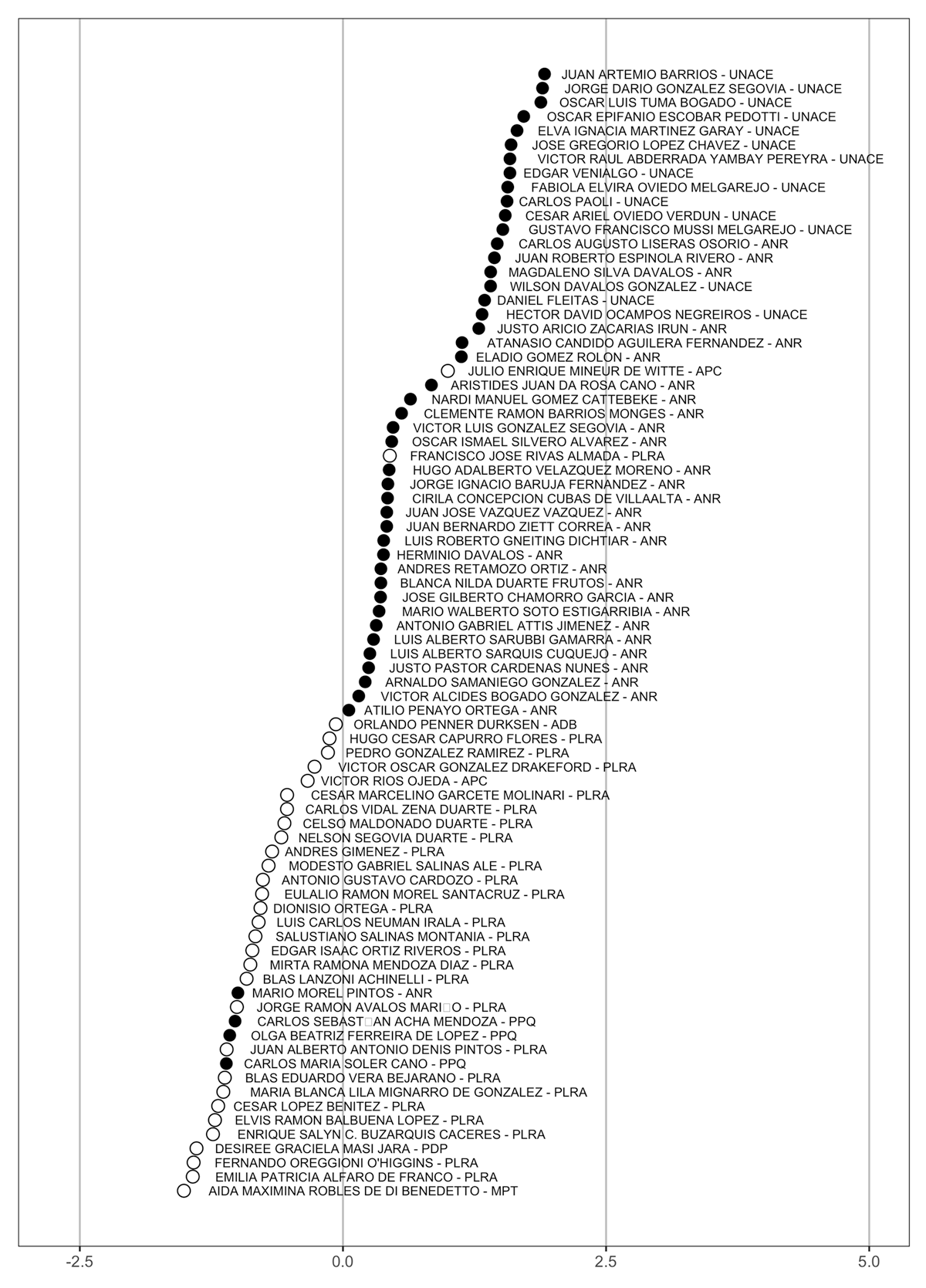
In Figures 1 and 2, respectively representing the governments of Duarte and Lugo, the dark dots identify the political parties with the government’s support, and the white dots belong to the parties with an opposing coalition. In addition to each dot, the name of the legislator and its party affiliation are described.
The purpose of the figures is to illustrate the structuring dimension of the polarization of the votes of the Paraguayan legislators in foreign policy. In both figures, we observe the majority of the legislators of the Colorado Party (ANR) positioned to the right of the one-dimensional space; on the opposite side are the majority of the legislators of the Liberal Party (PRLA). The difference between Figures 1 and 2 lies in the alternation of the main Paraguayan parties between the government and the opposition. While in the Duarte government, the Colorados were the base of support for the government, in the Lugo government, the Liberals supported the president during a significant part of the president’s interrupted mandate.
The polarization of legislative votes in foreign policy often opposes the two main political parties in Paraguay. The roll-call votes in the plenary sessions are public demonstrations that the political party competes for the electorate preference as a way to differentiate itself from the other parties. To the extent that a high level of public debate characterizes a foreign policy issue, the incentives for the Colorado Party to differentiate itself from the Liberal Party increase, indicating different political options to the electorate in the conduct of the country’s foreign policy.
Concentration of media ownership
The power of the Paraguayan media rests on two strongly oligarchic-patrimonialist elements: ownership concentration and links with traditional actors (Reference Ancos, Soler and MataAncos et al. 2014, 231). The media is concentrated into seven business family groups: Zuccolillo, Vierci, Domínguez Dibb, Wasmosy, Chena, Ángel González, and Rubín (Reference Segovia and SelSegovia 2010). These media groups have played the role of the promoters of the interests of the economic elites that own them, becoming pressure groups of political power (Reference Morínigo and BritezMorínigo and Brítez 2004). Although Paraguay is not the only country with highly concentrated media (for the Brazilian case, see Reference Amaral and GuimarãesAmaral and Guimarães 1994; Reference GalperinGalperin 2000; Reference PortoPorto 2012; for the Argentinean case, see Reference RepollRepoll 2010; Reference CalifanoCalifano 2014), the ABC group is, to this day, the most powerful in the country. As we will further explore, the media are strongly dominated by ABC Color in Paraguay, making the newspaper an omnipresent source of political information across the country. This holding, owned by the Zuccolillo family, has enormous leverage over public opinion and political influence.Footnote 4
Data availability
Our dependent variable is degree of consensus between the positive and negative votes of each of the 147 roll-call votes on foreign policy issues that took place between 2003 and 2012. The first aspect worth mentioning is the use of roll-call votes. Although the use of roll-call votes to measure legislative behavior is common, there is no consensus in the literature on their use in determining preferences of the individual legislator. The first problem associated with the use of roll-call votes derives from the fact that only a part of the votes is executed through the roll-call list (Reference Carruba, Gabel and HugCarruba et al. 2008). In the Paraguayan Chamber of Deputies, the internal regulation establishes the need for a fifth of the parliamentarians to be present in the session in order for the vote to be registered nominally.Footnote 5 This is certainly an inherent problem in the data. There is a part of Paraguayan foreign policy that is approved in a symbolic and unanimous manner. However, it is expected that the analysis of the roll-call votes in the plenary sessions will reflect the most relevant decisions of Congress (Reference Cox, Weingast and WittmanCox 2005). Roll-call votes are important, as they make the positioning of the party and individual legislators more visible to the electorate.
The use of roll-call voting as an individual manifestation of the legislator’s preference can be problematic in the presence of party discipline (Reference Rosenthal and VoetenRosenthal and Voeten 2004). High party discipline indicates strong incentives for the legislator to cooperate with party leadership, transforming his or her vote into the party’s position and not his or her own. As explained previously, the Paraguayan case is not characterized by high party discipline compared to its peers in the region. Therefore, the use of roll-call votes in Paraguay is adequate for capturing the effect of the media on the individual vote of the legislator.
The second relevant aspect refers to the classification of foreign policy votes. The voting subject was determined on the basis of the array of bills. To classify foreign policy measures, we use the definition of Tayfur (Reference Tayfur1994): “Official activity formulated and implemented by authorized agents of a sovereign State oriented to the external environment of the States.” The coding was manually conducted. We were able to summarize the content of the votes analyzed in this study in five categories:
1. Treaties and international agreements signed with foreign countries and international organizations: this category includes all cooperation treaties that do not affect trade. Most commonly, this includes agreements on educational and technological cooperation, extradition treaties, civil aviation, adherence to regimes and international organizations, infrastructure agreements, and the environment, among others. We highlight the high frequency of agreements regarding foreign loans and binational energy entities in Paraguay.
2. Trade policy: tariff and nontariff measures are very common in this category, including policies of stimulation or regulation of exports and imports and bilateral agreements to protect investments and avoid double taxation.
3. Direct actions in international affairs: this refers to legislative initiatives arising from the National Congress whose theme is foreign policy. This classification also includes requests to the executive branch that involve international issues and requests for information from foreign ministers or authorities responsible for conducting foreign policy in different areas.
4. Measures concerning the operation of the Ministry of Foreign Affairs and its diplomatic representations: in this category, the bills refer to the investment in the diplomatic corps and category regulations.
5. National defense: this category includes roll-call votes regarding the purchase of equipment, military bureaucracy, and permits for the entry of foreign armed forces for the purpose of conducting joint military exercises and training and border measures.
Creating a proxy to measure the dependent variable
To generate the legislative divergence index, we calculate the difference in the proportion of majority and minority votes and then subtract 1 from all values, as indicated by the following:

Thus, in a vote in which 60 percent of the votes were yes and 40 percent were no, we have a degree of divergence of 0.2. To make the measurement more intuitive, we transform the index to 0.8 so that the higher the index is, whose range is from 0 to 1, the greater the legislative divergence. Abstentions and absences in the plenary sessions were deducted from the calculation. Figure 3 shows the distribution of the variable.
Histogram of legislative divergence.

Independent variables
The central interest variable of this study is the frequency of news for each foreign policy roll-call vote included in the present sample. We use the search mechanism of the printed version of the newspaper ABC Color to find, within the previous six-month interval of the roll call in plenary sessions, the news published regarding the subject of each bill. Essentially, we seek to measure the degree of media exposure of the bills, functioning as a measure of the publicity of the debate held in the legislature. In total, we coded 1,179 news stories for the period of time. A great methodological advantage is that the newspaper makes their printed version available as a digitized version, which allows us to be confident that we have captured all of the available news.
A high level of popular support for the president increases the potential electoral costs for legislators to oppose a bill initiated by the executive power (Reference RudalevigeRudalevige 2002). Because about half of the foreign policy voting issues are initiated by the executive (see Table 1) and many legislative measures make direct mention of the conduct of foreign policy by the executive, we controlled for the president’s popularity as a possible unifying factor of the legislative votes. The monthly rates reported by the research companies (Cid-Gallup, Ati Snead, Latinobarómetro, Iberobarometro, and LAPOP) were used to construct the variable, and for the absent monthly rates, the rate reported in the previous month was maintained.
Descriptive statistics.

Source: Data from http://www.diputados.gov.py/, Cid-Gallup, Ati Snead, Latinobarometro, Iberobarometro, LAPOP, and ABC Color.
We controlled for the legislative initiative of the matters voted in the plenary sessions. The legislative initiatives of the executive power were coded as 1, while the legislative initiatives were coded as 0. Because the executive power is the initiator of a substantive part of foreign policy in presidential regimes, rejecting international agreements previously negotiated by the presidency has a cost for the country’s reputation (Reference Lima and SantosLima and Santos 2001), possibly inhibiting the legislative divergence in the plenary sessions.
Prins and Marshall (Reference Prins and Marshall2001) argue that defense and security issues exert great influence on legislative behavior. For the North American case, King (Reference King1986) points out that national defense issues, when compared with trade policy and external aid, for example, are those with the least degree of consensus among political parties. Following the national defense subcategory described earlier, we code votes referring to defense and security issues as 1 and the other foreign policy issues as 0.
To capture the possible specific effects of the presidential mandate, we created the dichotomous control variable called president, where the votes that took place during the term of President Fernando Lugo received a value of 1, and the votes that took place during the term of Nicanor Duarte and Franco received a value of 0.
Table 1 shows the descriptive statistics of the variables.
The degree of legislative divergence has an average of 0.54 and a standard deviation of 0.29. This indicates an interesting variability, having unanimous votes, as well as low, medium, and high divergences in the sample. The same applies to the news variable. The variability in news frequency by vote is considerably high. There are thirty-two bills without news coverage and fifty-four with news coverage. The popular approval of the presidents Nicanor Duarte and Fernando Lugo also oscillated considerably during the period. President Lugo, for example, ranged between 86 percent and 30 percent approval during his term. It is important to mention that not every month where the presidential evaluation is available was there a correspondence with foreign policy bills. With regard to the legislative initiative, 47.6 percent of foreign policy matters addressed in the National Congress had the executive power as the initiator. This number, when compared to other presidential systems in the region, is surprising because of the high number of initiatives of the National Congress in foreign policy. Finally, 19 percent of the foreign policy votes refer to defense and security issues, showing relevance in the Paraguayan foreign agenda, and 28.5 percent of the bills in this study occurred during the mandate of President Fernando Lugo.
The choice of the estimation model was based on two central characteristics of our dependent variable: the presence of 0s and 1s (unanimous votes) and the proportional structure of the data, varying from 0 to 1. This is a censored variable because values greater than 1 and less than 0 are not possible, and we can interpret the index as a proxy of a latent variable that corresponds to the legislative polarization for each bill (this is clearly seen in Figure 3). Thus, it is an ideal case to model via Tobit, where we have inferior and superior censorships. We explore the main results below.
Empirical Results
The results of the legislative divergence in the plenary sessions of the Paraguayan Chamber of Deputies are reported in Table 2. The first element to be observed in the model is the confirmation of our hypothesis. The amount of news published in ABC Color for each bill regarding foreign policy issues in the plenary sessions has a positive and statistically significant association with the degree of legislative polarization. The more news and, the greater the public debate, the greater is the tendency of divergence in the legislative votes of Paraguayan legislators.
Results of the Tobit models for legislative divergence.

Note: Robust standard error in parentheses. We tested the cross-validation robustness through bootstrapping simulations.
* p < 0.05; ** p < 0.01; *** p < 0.001.
Figure 4 facilitates interpretation of the model results. On the vertical axis, we have the mean of the divergence estimated by the model as a function of the frequency of news associated with each bill (horizontal axis). We perceive that the dichotomous national defense variable is also positive and significant; that is, the issue of defense and security alone increases the probability of voting being polarized. The polarized bills with little news are, for the most part, about national defense and security (i.e., high politics). Therefore, there is a combination of two relevant factors associated with the degree of legislative divergence: the issue of voting and the degree of public debate over voting.
Estimated average legislative divergence and the number of news stories.

Figure 5 helps us better understand this relationship. The dotted areas indicate the 95 percent confidence interval, the dashed gray line marks the subjects that are not security and defense (i.e., low politics), and the solid black line indicates the subjects of security and defense (i.e., high politics). When there are few news stories, there is a significant difference between the other news subjects and the security and defense issues, with the latter being the more polarized one.
Average legislative divergence estimated according to the frequency of news and the type of foreign policy.

To the extent that the news grows in quantity, the average of the legislative divergence increases and beyond the threshold of thirty-five-news-per-bill, the difference between issues is no longer statistically significant. That is, when there is a lot of news, regardless of foreign policy issue, the Paraguayan legislative divergence tended to be higher. Issues related to the armed forces generate greater divergence. This finding can be interpreted in light of historical links between politicians and the military in the Paraguayan case.Footnote 6 Since its independence, Paraguay had two prolonged authoritarian periods (1816–1865 and 1940–1989). Particularly during the dictatorship of Alfredo Stroessner (1954–1989), who headed the government, the armed forces, and the Colorado Party (Reference LópezLópez 2010, 93), there was a partitioning of the armed forces and a process of militarization of the Colorado Party (Reference SolerSoler 2009). As Lezcano and Martini (Reference Lezcano, Martini, Rivarola, Cavarozzi and Garretón1991, 99) point out, “Stroessner was president of the Government, General of the Army and Commander in Chief of the Armed Forces and honorary president of the Colorado Party. To be an official of the Armed Forces and of the Police, public employee, or simply doing business with the State, affiliation with the Government party was required. Virtually no differentiated spaces existed between these three institutional bodies—Government-Party-Armed Forces—which produced a serious deformation in them, affecting the entire society.”
The strong relationship between the armed forces and the Colorado Party can contribute to legislative dissent in plenary sessions. As we have shown, legislative votes in foreign policy are structured around the dichotomy of government and opposition. Defense and security matter, as they involve armed forces with party identification and have a significant divergence in plenary, placing liberals and Colorados on opposite sides.
The results allow for the rejection of the idea of a disinterested legislative body in foreign policy issues due to its low electoral impact. There is a significant association between the main information vehicle of foreign policy and legislative behavior expressed in votes. For the Paraguayan case, it is not possible to affirm isolation between the decision-making elite and public opinion on foreign policy issues. The perception of electoral disinterest in the Latin America legislature still lacks empirical studies for its support. The Paraguayan case analyzed here suggests the opposite: legislators, through the roll-call vote, demonstrate divergent interests regarding foreign policy issues with greater public visibility. The greater the degree of public debate of foreign policy, the greater the incentive for legislators to register positions different from those presented by the government, the adversary party, or the adversary faction of its own political party. The possibility of presenting a political alternative to voters attentive to the most widespread issues in the press prompts legislators to differentiate themselves in the plenary sessions, generating a lesser consensus on foreign policy issues subject to greater media exposure when compared with matters of foreign policy with less media exposure.
Qualitative Evidence of the Role of the Media in External Politics
To complement the quantitative evidence, which in no way has the ability to prove a causal mechanism, we decided to conduct ten in-depth interviews with politicians and analysts of Paraguayan politics. To guarantee anonymity of the interviewees, we do not refer to them by name, and we assigned a code to each interview for use in the interpretation of results. Interviewing politicians in Paraguay was a challenging task, first because of the reluctance of politicians to provide information they consider sensitive, and second because it required field trips to conduct on-site interviews, given the great rejection of telephone or email interviews. This reluctance likely explains why there are no political science works by non-Paraguayan authors published in English whose results are based on interviews. Table 3 contains the positions of respondents and the interview dates.
List of interviewees.

We consulted our interviewees about cases in which they believed that the media was decisive in matters of foreign policy, and we complemented them with official sources from ABC Color publications. According to them, the influence of the media on legislative behavior can be seen in several exemplary cases. One of them is when on July 25, 2009, the Paraguayan president Fernando Lugo and Brazilian president Luiz Inácio Lula da Silva agreed to modify the purchase prices of energy produced by the Itaipú Binacional Hydroelectric Power Plant. ABC Color initiated a follow-up to the political processing of the agreement in the Brazilian congress. This boosted the informal lobby of the Paraguayan parliamentarians in relation to the issue. After the approval in the Brazilian congress, ABC Color continued monitoring the implementation of the agreement, arguing that the increase in prices was “negligible” and therefore disadvantageous,Footnote 7 and giving visibility to debates that questioned the convenience of the agreement with the Brazilians.Footnote 8 When discussing the agreement, the legislators referred several times to the media when addressing disadvantaged aspects of the agreement. One example is Atanacio Candido Aguilera Fernández, deputy of the ANR, who used data and argued from what had been reported by the press.Footnote 9
A second example that illustrates our econometric evidence is the debate on the political crisis that took place in Venezuela between 2016 and 2019 and the actions of Paraguay in this case.Footnote 10 Edgar Isacc Ortiz Riveros, PLRA deputy, supports his argument based on Paraguayan media publications about the Venezuelan accusation that Paraguay, along with Argentina and Brazil, formed a “new triple alliance” against the Caribbean country, using a historical analogy with the war of Paraguay (1864–1870).Footnote 11
Perhaps the issue where the active role of the media in legislative activity can be more clearly observed is the Paraguay-Taiwan relationship and, consequently, diplomatic ties with the People’s Republic of China (Reference Long and UrdinezLong and Urdinez 2021). In 2009, while the Chamber of Deputies was debating the possibility of opening a commercial office in China, Blas Lanzoni Achinelli of the PLRA stated: “And I do not think it affects anything that this Congress or that this Chamber of Deputies accepts, the possibility and asks the Executive to see the possibility of opening commercial offices, only commercial ones, and to avoid the triangulation that is carried out and that we constantly hear these complaints in the media.”Footnote 12 On December 4, 2003, two proposals were made in the Chamber of Deputies related to the creation of the Parliamentary Friendship Commission with the People’s Republic of China, which ended up being rejected. The issue was first placed on the agenda in August 2003, after President Nicanor Duarte (ANR) took office. From that moment until the vote, ABC Color published nine news stories on the subject, where it took a clear stance on the matter favorable to the status quo and even dedicated it as an editorial. Both votes registered a high polarization (a score of 0.74). The argument developed by ABC Color emphasizes the undemocratic character of China and the lack of guarantees in human rights, picking up political assessments of the Taiwanese government and underlining the trajectory of more than forty years of relations between Paraguay and Taiwan.Footnote 13
From an analysis of the news published by ABC Color and from what our interviewees have declared, it is clear that the government’s position, expressed by Foreign Minister Leila Rachid de Cowles, was not to establish official relations with China at the time.Footnote 14 However, a group of deputies of the National Union of Ethical Citizens (UNACE) pushed the approach to China with direct contact and through an official note with the government of Beijing. In the face of this initiative, ABC Color quickly took a position asking itself about the “opportunist” character of UNACE’s note.Footnote 15 Parallel to this process, the formation of a Taiwan-Paraguay parliamentary friendship group was announced to strengthen parliamentary exchanges between the two countries.Footnote 16 Meanwhile, ABC Color continued to support the position of the Duarte’s government,Footnote 17 who made Taiwan’s economic cooperation visible, underscoring the Chinese government’s nondemocratic character,Footnote 18 and at the same time conveyed statements by Taiwanese diplomats, who denounced a Chinese friendship. Furthermore, the newspaper covered the diplomatic approach that the Taiwanese government made to the president of the Senate, who belonged to the PRLA,Footnote 19 presenting this gesture as an example of the tradition of friendship between both countries. The editorial line of ABC Color was explicitly against approaching China, which in an editorial is even called “red” because “there exists [in China] an outrageous dictatorship whose only interest in Paraguay is to break diplomatic relations with Taiwan, a country that for decades has shown us their friendship. Breaking it would be of a ‘bad apple’ (mal nacido), which Paraguayans are not.”Footnote 20 These arguments circulated among Paraguayan citizens and congressmen. At the time of voting, polarization was high, and the proposal to approach China ended up being rejected.
Conclusion
The content covered by the mass media, in this case, the newspaper with the largest circulation in Paraguay, influences the individual’s opinions regarding their country’s foreign policy. This is more so the case when these media belong to powerful families with immediate links to politics. As the legislators respond to the public and the public respond to the media, we recommend that analysis of the quality of political representation include the media as a potential explanatory variable of the decision-making processes in foreign policy. Paraguay is a country not often explored in terms of its foreign policy and almost always ignored as a case of interest. We believe that Paraguay is a case of great interest because of the characteristics of its national press and for the way foreign policy is decided at the legislative level.
The present study offers an empirical contribution in cases that still lack exploration in the literature, those that mainly focuses on the US presidential system. The advance in this type of empirical study allows us to review relatively consolidated theories in Latin America. The results are consistent with the hypothesis of positive association between media coverage, and legislative divergence is expected. Legislative divergence associated with more ABC Color exposure tends to polarize legislators.
This article is intended to open a future comparative research agenda on Paraguayan foreign policy while exploring mixed designs to analyze the processing of key votes, the individual positioning of legislators, and the content of the news disseminated by the media. This will be done with the objective of advancing the knowledge of the empirical relationship found among the media, legislative behavior and foreign policy.
Additional Files
The additional files for this article can be found as follows:
• Supplementary File 1. Main Dataset. DOI: https://doi.org/10.25222/larr.592.s1
• Supplementary File 2. DoFile Replication Stata. DOI: https://doi.org/10.25222/larr.592.s2
• Supplementary File 3. Data Set Figures 1. DOI: https://doi.org/10.25222/larr.592.s3
• Supplementary File 4. Data Set Figure 2. DOI: https://doi.org/10.25222/larr.592.s4
• Supplementary File 5. Script in R for estimating Ideal Points Figures 1 and 2. DOI: https://doi.org/10.25222/larr.592.s5


 Open access

