




Introduction
Academics across numerous disciplines and commentators with a more popular readership have identified lack of interpersonal connection as a contemporary societal condition that must be addressed. On the other side of the world, mature columnist and author, George Monbiot, in Out of the Wreckage: a new politics for an age of crisis, responds to his own, earlier book that questions How did we get into this mess?: politics, equality, nature (Reference Monbiot2017), by asserting that:
An epidemic of loneliness is sweeping the world. Our time is distinguished from previous eras by atomisation: the rupturing of social bonds, the collapse of shared ambitions and civic life, our unbearable isolation from each other. There are over 7 billion souls on Earth but many people are unable to find anyone with whom they can connect (Monbiot, Reference Monbiot2018, p. 17).
In this, he echoes John Ralston Saul’s observation in his book The Collapse of Globalism (2006), in which he states:
Most of us just seem to be disconnected, waiting for the wave to crash. We are waiting with the cruel, experienced eye of a citizenry that has lost respect for its leadership in general, yet hasn’t quite worked out what to do about it and so waits for them to self-destruct (Saul, Reference Saul2009, p. 13).
He insists that what we need are ideas… now, before the wave crashes; the wave that will leave a reconfigured society in its wake and the wave that will find some of us clinging to the hull of an upturned boat, gazing, while still dazed, into the face of another, a stranger.
The atomisation, and stratification of humanity and our society have been gradual yet unrelenting (Harris, Reference Harris2017; Monbiot, Reference Monbiot2018; Rushkoff, Reference Rushkoff2019). Have we forgotten how to engage with others? Have we become fearful of difference? When the tides of climate change overcome us, we might break the surface and find ourselves on the skeletal remains of that upturned boat, and find someone unfamiliar looking back. What then? What if we had hitherto limited ourselves to monocultural settings and avoided engagement with people from different backgrounds? In my thesis, Common/Room (Gunn, Reference Gunn2023b), I called this “intercultural discomfort”. How we work with this feeling determines whether it solidifies into racist behaviours or not. In the face of the metacrisis, when we are challenged left right and centre and on every level, we surely need to find ways to pull together in teams more than ever before, despite our differences. Can technology help us do this? Or is it to blame for the metacrisis?
What constitutes the metacrisis? Educational psychologist, Dr Karl Wheatley, informs us in How can education address the global metacrisis? 21 education goals for the 21st century, that:
Leading scientists have warned for decades that modern civilization is steadily disrupting the climate and degrading Earth’s ability to support life, and that worsening ecological and societal breakdown is inevitable unless we make rapid, far-reaching, and unprecedented changes in every aspect of society. Other researchers have warned us about the fraying social fabric, deteriorating democracies, loss of social cohesion, declining trust in governments, and assaults on science and truth (Wheatley, Reference Wheatley2025, pp. 1335–6).
So here we are, real people in real places, considering how we might take a first step forward, hopefully towards each other, to collectively tackle pressing real-world issues, in this instance the lack of social cohesion, while humbly offering what we have come to know from our own backgrounds, cultures and inklings. It is my belief that working together could help to address homelessness, combat our distressing levels of loneliness, support food sovereignty, and enable mutual aid. One impediment to such productive collaboration might be the “intercultural discomfort” that prevents people from taking a step towards each other, rather than moving on or moving away. Fear and mistrust were keeping us apart and technology was seen by some as making matters worse. Given this state of affairs, how can we reconnect? If we are too shy, too uncomfortable, how will we ever find ways to get to know each other, let alone form alliances, organise, build and take care of the Commons?Footnote 1 If we do not build relationships with Māori and step into our roles as Tangata TīritiFootnote 2, how will we ever experience and practice whanaungatanga – relationship-building, manākitanga – hospitality, and kaitiakitanga – care for the environment? In inter-human encounters, the first contact, that moment when we first set eyes on each other, is crucial. How we react then determines whether we may become friends or foe, whether we work in or against each other’s best interests. With loosely held rituals of encounter, Pākehā – people from European descent – seem most at sea in this regard.
From a Commoning perspective, I sought to create first-encounter XR experiences that hold the guests’ attention long enough to create a measure of understanding, empathy, compassion, respect, and affection for the women who appear before them and speak to them. People can practice human interaction by taking a breath, then pausing to look and listen, without needing to act on first impressions. They can wait until fresh perceptions take over, and consider reaching out towards the other.
Common Sense
The thrust of the stereoscopic video experience, Common Sense (Gunn, Reference Gunn2026), stems from a desire to address challenges that contemporary society is facing. We have an opportunity to find creative solutions and we are up to the task. The way through, I believe, is by shared experience. My Māori mentor of two decades, Irene Hancy (Te Hikutū), would say “it is in the encounter”. Film/moving image/XR production is one way of stimulating mutual engagement. It creates an opportunity to collaborate while we learn about each other and the place where we stand. The background to this research arose from an awareness of the Commons, and the potential that shared endeavour has for contemporary and oncoming challenges that are too great to counter alone. As a camerawoman, and documentary maker, I knew of the power of film to support visceral connections between the viewer, and the viewed. I wanted, through a PhD with a creative component (Gunn, Reference Gunn2023a), to discover whether Extended Reality technologies could offer an even deeper concord between an audience and the subject. Rosa’s resonances (Reference Rosa2023) are described by him as having three axes. The horizontal between people, as in love and friendship, the diagonal connects us to the material, as in objects or artefacts, and the third, the vertical, gives us “a sense of how we are connected to the world, or nature, or life, or some such ultimate reality as a whole” (Schiermer, Reference Schiermer2020, p 4). This chimes with the Radical Human Ecologists’ triune of people, environment and the divine (McIntosh, Reference McIntosh2004), and the Māori whenua/tangata/Atua (Forster, Reference Forster2019) that translates as land, people and the Gods. Whether we use axes, the triune or a vertical model depicting a person standing upright on the ground with their head touching the sacred, I can film and display them and their domain in a global image.
Stereoscopic video uses 360° moving images that are captured by special, usually spherical cameras with numerous lenses.Footnote 3 The resulting videos, that can be exported as either mono or stereoscopic images, when viewed in a VR headset, or projected either as a 360, 180, or similar images, surround the viewer who feels as though they have entered the world of the storyteller/subject/participant/interviewee. In Common Sense the mature female storyteller is right there, life-size, and seemingly seated just across the table. This is a way through which I can share with you the extraordinary wisdom of Irene from her remote dining table in rural Aotearoa. Although I am a Pākehā, a European descended from early and more recent “settlers,” and Irene is a Māori elder, she is my teacher and, through Extended Reality (XR) technologies that includes Augmented, Mixed, and Virtual Realities, can be yours too.
Common Sense is one work from Common/Room, a suite of XR experiences framed by discursive design principles. It uses artefacts in commensal settings to activate discussion about intercultural encounters. Each experience was situated at either real, virtual, or devised domestic dining tables. There, visitors met with women who spoke in their own voices, often in their own homes, in accordance with their own values. In this way, women were championed and expressed their sentiments in a relaxed, unscripted, conversational and seemingly natural manner, though captured and communicated via unnatural plastic and electronic devices – VR and AR headsets, or a stereoscopic projection. Some visitors to the experiences displayed in headsets felt that the women were actually “there” and responded to their statements, such was the authentic feel of the one-sided conversational experience. I value this quality when working with others to create a factual moving image work. I understand when Māori esteem “truthfulness.” “Dishonesty and lying were considered disgraceful” (Evison, Reference Evison1997, p. 23). Still are.
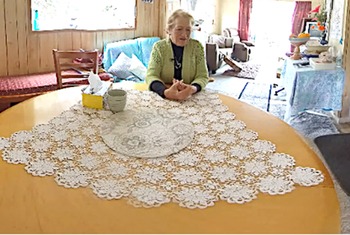
Common/Room (See Figure 1) invited visitors into safe and even playful encounters that allowed us to reimagine new ways of working together. Boundaries became porous, shifted in and out of “here” and “there,” from “my” table to those “real” kitchen tables that were within the domestic domains of the women who appeared in the VR works, Common/Place and Common Sense. This paper is primarily concerned with the latter, a 180° stereoscopic projection of Irene Hancy (See Figure 2), seated at her dining table in Te Taitokerau, the Far North of rural Aotearoa. A recently published book chapter (Gunn, Hancy, & Remana, Reference Gunn, Hancy, Remana, N. and M.2024) focused mainly on the Augmented Reality work – haptic HONGI. For Common Sense, in an informal and everyday setting, Irene addresses the viewers directly, sharing her knowledge and experience of ritualised encounters designed over millennia to reach across boundaries between host and guest, “us” and “them.” On these occasions, the hosts can exercise manākitanga – hospitality – and whanaungatanga – relationship building.
Common/Room exhibition in the George Fraser Gallery, Tāmaki Makarau (2023).

Irene Hancy at her dining table. Cropped screen grab from stitched footage for Common Sense (2023).

At hui – gatherings, the language used and attendant actions, such as singing, praying, sprinkling water, and eating food, are the very definition of human, the vernacular – “in a style that is liked or performed by ordinary people.”Footnote 4 Interestingly, even the word “Māori” is often defined as “normal, usual, natural, Common, ordinary.”Footnote 5 Of course, in more formal settings, some speakers may use ancient forms of the language, but there is great tolerance for those who speak Māori more casually, using phrases gleaned from various language courses, contemporary iwi – tribal – radio stations and Māori Television – Whakāta Māori. With the whole culture currently under pressure, merely speaking te reo Māori (the Māori language) is an act of resistance. Settler authorities have little to no power on marae – the collection of communal buildings and the central courtyard – that is the setting for encounters between local people and newcomers. In Common Sense, Irene tells us:
The one thing that’s really profoundly important for Māori is the practice. So, we don’t turn it off because somebody is not aware of our concepts of Tapu (sacred, set apart, holy, prohibited) and Mana (authority, dignity, spiritual wealth) and Mauri (life force or vital essence) and Wairua (spirit or soul). It’s the practice. It’s the practice. And sometimes visitors can have a wrong sense of what that whole encounter means. But if they’re not received in the way that the hospitality is given, then that doesn’t say much about the encounter because you go away and it’s… you can… it may not even have a lasting impression for you, as the visitor. Or it could be “Well I’m glad that’s all over now”. You know. We go back to being who we are until the next time there’s a karanga (call) to go to the marae.
Cause it’s like… whether visitors are even aware of how we view the encounter of TAPU with TAPU. Ours is the practice.
Irene Hancy at her home in Omanaia 10/10/20 for Common Sense
In Aotearoa, first encounters between indigenous Māori and more recent settlers are freighted with trauma and difficult histories, some tacit, some that continue to play out and trouble our contemporary society, despite an insistent denial from some quarters.
The way of an encounter for non-Māori and Māori is so… I don’t even know how to describe it. It’s almost like arm’s length. “Just stay there and I’ll greet you”. That’s not really how Māori are. The karanga, the hongi, the invitation into the space, you know. The welcome, acknowledging you, your mountain, your awa (waterway), your people, the daughter of…, the mokopuna (grandchild) of…, that is designed to help you be aware of this amazing thing of being you.
Irene Hancy at her home in Omanaia 10/10/20 for Common Sense
XR allows us to work relatively safely across time and space in ways that feel both immediate yet distanced, in which the digital women seem to respond to the visitors, although they are not actually present to each other in the same physical space or time. The women gaze and speak directly to visitors at the exhibition, although they remain securely in their own zones. The visitors, too, are safe from the pressure of having to do or say the “right” things, because, in reality, Real Reality (RR), no one is there to judge.
The intention of the work is to practice social engagement across perceived boundaries, and difference; to prioritise relational intent in order to reverse modern tendencies to atomise and isolate by drawing lines that slice and dice, thereby creating boundaries. It is becoming evident that only through strengthening social networks and relationships can we face the myriad challenges coming our way – together.
Common Sense provided a vehicle for others to “meet” my mentor (See Figure 3), so they could hear her wise counsel in a non-confrontational and relatively intimate setting. 180° video can be viewed in a headset without the need for the viewer/visitor/guest to move about in the space. In our case, the semi-cylindrical image was captured from a stationary camera position. I chose the option of a stereoscopic projection to allow an audience to sit together – the number of people determined by the quantity of suitable active 3D spectacles available.
Irene Hancy – frame grab from video interview (27/4/19).

Pre-production
The pre-production period for this work includes 17 years of relationship-building with Aunty Irene. In 2005 I asked to film her, and she said no, so I never asked again. Then, after almost 15 years she asked to work with me. In 2019 we recorded our first discussion on video. The portrait of her above is a frame grab from that session (See Figure 3). Here is an excerpt from the transcript when I asked if she was happy with how we were working together:
Irene: I quite like this really. I do quite like it. ‘Cos what I want to do is talk about a reality of compromised tikanga (right practice, and customary lore). And the compromise is that we have almost an out-dated sense of tikanga Māori values. But we’re not able to practice in a way that brings life, to practice that tikanga. And I talk of it as a, like a self-management tool and the work of the late Pā Henare Tate, around the dynamics of whanaungatanga (relationships and connections)Footnote 6.
Mairi: To clarify… You are saying that compromised tikanga is because of colonisation… and how colonisation was carried out.
Irene: Yes. And I don’t say that in a way of blame as much as I say it in a way of the total ignorance of one culture to another.
Mairi: So, in a way, it’s to do with that lack of a healthy encounter.
Irene: That’s right.
Mairi: So your work is very much to do with that encounter.
Irene: Yes. And the encounter of tapu (sacred, set apart, holy, prohibited) with tapu.
For example, you and I meeting. You’re tapu – “I am” – and we uphold that tapu. You have mana, I have mana. We each have a respect for that, and we would do lots of things together, have lots of discussions, and our mana (authority, dignity, spiritual wealth), our tapu, is enhanced. The only time it’s going to be diminished is when one of us violates the other.
(Irene Hancy talks with Mairi Gunn at her home in Omanaia 27/4/19)
To quote local Catholic priest Pā Tate:
Tapu is being with mana i.e, with ability to effect, tapu is the being of a person having dignity by reason of their link to a higher spiritual power, the source of all the aspects that constitute its totality; the spiritual (wairua), physical (tinana), psychological (hinengaro), family (whanau).Footnote 7
There are some things to keep in mind as tauiwi (non-Māori), including Pākehā, when working with Māori or other Indigenous people. It is my intention here to help support effective communication required for mutually beneficial collaborative endeavours. With so many modernist systems either causing or experiencing collapse or failure, Indigenous stories have assumed great significance as we re-assess former “certainties” and look at the pluriverse anew from our humbled positions. Irene says that if you sit on the floor for long enough, you will eventually be asked to stand up. In Aunty’s words from Common Sense:
…it is about listening, and it is about taking your time and allowing a lot of things to wash over you. I wonder what would have happened if we had the same opportunity, by way of colonisation, for a new way of being to wash over us. And then it wouldn’t have been as traumatising as it was.
If you allow stuff to wash over you, you would wake up one day and suddenly realise it’s OK and you would realise a lot of things.
Irene Hancy at her home in Omanaia 10/10/20 for Common Sense (Gunn, Reference Gunn2023a)
A vital consideration is whether you are seeking societal transformation for all who endure the vicissitudes that capitalism has wrought. If you believe that you are somehow saving Māori, think again. You and the planet are not immune from depletion by capitalistic plunder, and Māori have excellent ideas of their own. They are impatient for transformation. Irene is a case in point. Her deep psychological insight could heal the world, but, while the knowledge is intact, she decries the loss of roles for Māori in places where they could have most impact. In the words of Māori academic Ranginui Walker, in his seminal text Ka Whawhai Tonu Mātou (Reference Walker1990) – [theirs has been] a struggle without end. This acknowledges resistance to ongoing colonisation and desecration of Aotearoa and her people, experienced by many Māori as oppression. They demand acknowledgement of their sovereignty – rangatiratanga – and call for self-determination – mana motūhake (Network Waitangi, 2012). Several of their chiefs signed Te Tīriti o WaitangiFootnote 8 in 1840. There is an open call for the Crown, the other signatory, to honour the commitments they made. Māori, the Tangata Whenua – people of the land – invite their treaty partners Tangata Tīriti – people who live in Aotearoa by virtue of the Treaty (Bell, Reference Bell2024), to stand with them in this quest. Māori have no need for saviours, but for Tangata Tīriti to march alongside, as in the 2024 Hīkoi mo te Tīriti, as allies.Footnote 9
One could see such marches as a path for non-Māori to walk towards a deeper sense of belonging. However, talk of a partnership between hapū, the subtribes who signed Te Tīriti, and the Crown has rankled with our current government who have removed any mention of the Treaty from wherever they can – school curricula, legislation, and so on. One Māori idea that they definitely cannot countenance is that expressed in He whakaaro here whakaumu mō Aotearoa: the report of Matike Mai Aotearoa, The Independent Working Group on Constitutional Transformation (Matike Mai Aotearoa, 2016) that proposes ways to formalise power sharing in government. A movement including both Māori and non-Māori has arisen to disseminate and promote the report. Imagining a future where people, places and planet are overseen and protected by Indigenous values gives us hope. Such a vision is a motivating force. It feels like life or death.
XR technologies have a great potential to enable “journeys” home for multiple communities (people from migrant backgrounds as well as Indigenous people). There is, in some places, a drive to dissolve any connection to place, to forget particular languages and dialects, to forget one’s own cultural heritage and to become truly “international.” Such ideas were promulgated in The Sovereign Individual (Davidson & Rees-Mogg, Reference Davidson and Rees-Mogg1997, p. 179). It suggests that the severance of connection to place, especially the places of our birth, is of paramount importance if one wishes to avoid paying taxes. However, I argue that our personal stories and their telling are vital when promoting equity and re-establishing the authentic interrelational fabric of reality. Consider tracing your lineage back in time to when your forbears lived lives in relationship with the environment and each other, then look forward to where you are now. What can be learnt from this socio-temporal trajectory? In my experience of working with Māori and others, I have found that many share an interrelational reality and that is why I continue to find this overlapping cultural space exciting, challenging and rewarding.
A decolonised camera
Irene and I barely discuss my work. When we first met, in 2005, I was co-producer and camerawoman on the documentary Restoring the Mauri of Lake Ōmapere Footnote 10, and I have recorded her a few times since then. So, she gets that side of me, and what I bring to the table. Completely unphased by the headset, she was fascinated by stories told by the women in Common/Place (See Figure 4).
Irene Hancy watching 360° videos of women’s stories from Common/Place (2018).

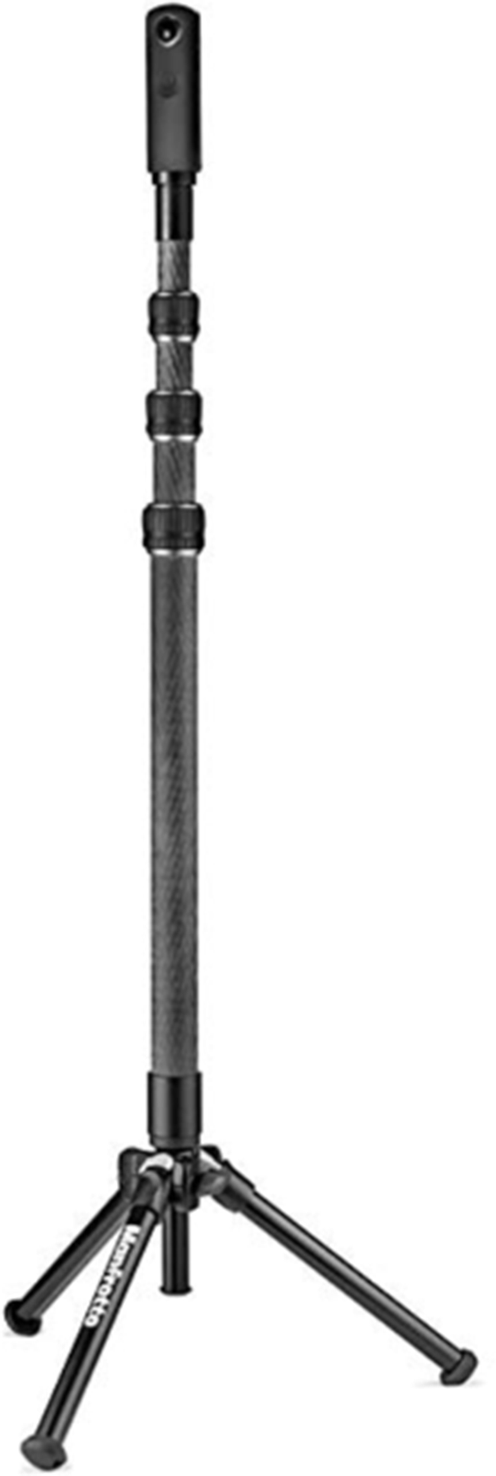
However, I was apprehensive about asking Irene if I could record a discussion between her and myself with an unusual looking 360° video camera. When I finally found the right time, te wā, she bargained with me. I could record her after I attended a hui (a meeting or gathering) with her and her students of the Dynamics of Whanaungatanga (DoW). She wanted me to record a similar hui at some later date. How could I, a Pākehā, record a Māori hui? I needed to find a way to relinquish control of the technology. I went home to consider this dilemma. We can sail these seas without hurtling towards an instant outcome. Hopefully solutions are revealed over time. Such as… What if we attached a small 360° camera to a stand that could then be passed from speaker to speaker like a tokotoko, a walking stick, often held by orators in traditional settings? Passing a talking stick is not a local tradition, but some are getting familiar with this device in community meetings. Many are also used to performing at homegrown musical events, so moving a microphone around on a stand might be a better reference. Either way, this seemed to be a solution. I was hugely relieved. With a 360° camera on a stand (See Figure 5), I could hand over control. Attendees could push the record button and move the camera/stand around themselves. This seemed to be an ideal way for filmmakers from dominant cultures to relinquish control and step back.
360 video camera on a tripod.

Positioned before a speaker, she would be bigger in frame, due to her proximity to the camera, she would be in focus due to the huge depth of field of the ultra-wide lenses such cameras use, framing would not be an issue, due to the global nature of the capture and the camera microphone would be well positioned to record the spoken words and prioritise them over the background hubbub. Conversely, anyone not wishing to be recorded could merely distance themselves or hide from the camera and microphone.
If design’s primary goal is providing functional objects, it should be user-centered. But if its primary goal is communicative, it should be audience-centered. […] Discursive design involves both actors and an audience; sometimes the audience stays in their seats, but sometimes they are also allowed to get on stage or participate within the theatre (Tharp & Tharp, Reference Tharp and Tharp2018, p. 27).
Production
Having seized on this solution, I was able to return to Irene’s the following day and set up to record her with the InstaPro 2 camera that my privilege afforded me. Whenever I visit her, I usually set aside about four or five hours for discussion. Even our telephone conversations can be three hours long. High resolution 360° video puts limits on us. We filmed for an hour. I used no lights, I captured no plates with which to replace the blown-out windows in post-production (I no longer had a crew nor a Visual Effects technician), and I recorded the audio myself using a trusty lapel mic and an H4n Zoom audio recorder with a handclap for synchronisation purposes.
Knowing that only 180° of Common Sense would be retained for projection, the hemisphere that included me, was cropped out (See Figure 6). Irene changed nothing in her room or on the table. She sat there exactly as she always does; composed and elegant, speaking in a clear and measured way. I may have simplified the shooting process but made sure her spoken word was crystal clear.
Top/Bottom equirectangular full 360° frame-grab from stitched footage for Common Sense, later cropped to lose 90° left and right, to exclude filmmaker.

Post-production
Together, Irene, the camera and I recorded over 300 gigabytes of data. While this means that the footage is high resolution, it is cumbersome. We used Mistika VR Professional Edition to stitch images captured by each of the six lenses together. In a parallel process, I transcribed the audio. Irene had a close look at the text, then we swapped notes. We both liked the passage about visitors to the marae when she tells us:
So, someone’s just been and robbed our kuia and kaumātua (elders) in the valley. And low and behold, here they are coming onto the marae. Our practice requires us to be the same, to be hospitable because we know there will be a process in which to deal later with the things that have gone down, by way of violation. So, it’s the practice. […] There’s still the waiata (song), there’s still the karakia (prayer), there’s still the himene (hymns) and there’s still the issue about what you did to the kuia and the kaumātua. But it’s all held in the space. And people are aware. So that it’s not about breaking people’s spirits, it’s about calling them to order.
Irene Hancy at her home in Omanaia 10/10/20 for Common Sense (Gunn, Reference Gunn2023a)
Irene described how ritual supports people in their social endeavours. The process is unchanging. People have roles. They know who they are, and what they are doing, although every hapū (subtribe) is distinct.
The edited footage came down to a full twenty-seven minutes of pure gold. There was no identifiable start nor finish, so this would be an endless loop that visitors could drop in and out of at will. There was no plan to offer headphones, so Irene’s voice would fill the gallery. Kōrero (a narrative) without end.
Exhibition
One way to attain synchronised “togetherness” among VR guests is to supply a large number of VR headsets, as renowned artist Lynette Wallworth did when she premiered her experience Collisions (Newnham and Wallworth, Reference Newnham and Wallworth2016) (See Figure 7). Still, the disconnect between the viewers and the star of the show, seated there on the floor, is plain to see. However, if the (largely white-skinned) viewers were to remove their headsets, would they strike up a conversation and connect with Nyarri Morgan from the Martu tribe? Or would they feel more able to do so after sharing the virtual space with him, seated by the fire, looking directly, and unself-consciously at him while listening to his story? Such is the paradox at play here. They are seated beside people they cannot see while their heads are in another world with other people who are only virtually “present.” Educator Ruth Unsworth speaks about such “spatially disconnected forms of collaboration between human actors who were either physically individualized […] or physically directed toward a technological artifact and thereby physically decentered. The full potential or drawbacks of this form of collaboration warrant further research… ” (Unsworth Reference Unsworth2024, p. 34–5).
Audience experience Collisions VR film by Lynette Wallworth. Photo by Renee Stamatis courtesy ACMI retrieved 31 August 2017 from http://www.realtimearts.net/article/issue136/12466.

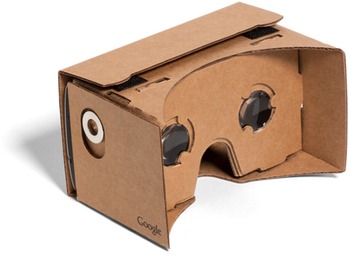
Although the headset and the projection are different modes of display, the capture can be identical for both. Viewing is possible on frequently used and inexpensive devices, such as scrolling on desktop PCs, tablets and even phones with Google Cardboard (See Figure 8), for example. Some headsets are too sophisticated or have unnecessary and complicated functions. This will no doubt be improved upon in future. However, achieving a global projection would require numerous projectors and a substantial surface to project onto. Therefore, using a headset, even a mobile phone in a $5 Google Cardboard or some such “device,” is a more democratic option.
A google cardboard headset for use with a mobile phone to screen 360° videos.

Lightweight stereoscopic glasses are very similar to regular spectacles. They are rechargeable, with only a simple on/off switch. The viewing experience approximates a regular cinema-going outing. Unlike using a VR headset, there are no boundary lines, no need for orientation, to use controls or hand gestures. Stereo projection is a “nonintrusive easy-to-achieve, relatively high-resolution virtual reality interface. It is superior to other virtual reality paradigms across many issues, particularly in field-of-view, visual acuity and lack of intrusion. Moreover, it is open to limited use for collaborative visualisation”. (Cruz-Neira et al., Reference Cruz-Neira, Sandin, DeFanti, Kenyon and Hart1992. P. 71) The projection meant that more than one person was able to sit at Aunty’s digital table so that Common Sense became quite a social experience (See Figure 9). Irene seemed to approve. In fact, at the exhibition opening she sat watching herself, nodding from time to time, liking what she has said as though it was a statement uttered by someone else. Our stereoscopic projector was only HD, rather than 4k. Projectors are often a bit mushy, lacking sharp focus, crisp definition and contrast. We accept less-than-perfect visuals, but the audio needed to be pristine.
Guests watching and listening to Common Sense with Irene in 180° stereoscopic video.

Common Sense exhibited for the first time on March 18–26, 2023, as part of Common/Room in the George Fraser Gallery, Te Waka Tūhura, Elam School of Fine Arts & Design, Waipapa Taumata Rau, University of Auckland (See Figure 1). It certainly drew the crowds. As a projected piece, guests could walk into that part of the gallery and, even if they were not wearing the stereo glasses, they could hear clearly, and her face was in focus, while other areas had the distinct double image of 3D display. This was social VR, of my own understanding. Every chair in the exhibition space was dragged in to the “theatre” and occupied. Although the 180° stereoscopic video is over 25 minutes long, many visitors to the exhibition sat still for the duration and longer.
Several guests commented that they noticed when Irene reached forward to communicate a point. The ultra-wide lens enlarged the foreground, including her hands, significantly. And the guests felt that she was reaching out to engage with them. Afterwards, they were able to remember lines from her dialogue. I took this to mean that they were listening deeply and valued what they experienced. They took notes and some asked for a transcriptFootnote 11, remarking on how impactful they found the experience of sitting “with” and listening to, Irene. One guest commented that it was a “masterclass” for someone like him who knew nothing about Māori protocols or culture. He commented that it was an excellent way to transfer information about the human experience of colonisation in a non-confrontational way. He loved that he could let his eyes wander, to gaze at Irene’s background and setting, without feeling impolite. He found the work far more compelling than traditional 2D video. Another visitor wrote in the Visitors Book, “I loved it. The most wonderfully real and communicative interview experience ever!”. The placement of a half-round table with a similar lacy tablecloth to Irene’s was also remarked on and appreciated. They enjoyed the illusion created when they placed their mug of tea and biscuits on the table that seemed to bleed into her digital table. It was a gesture that invited the audience into Irene’s home (See Figure 10). For some, this might have been their first experience of “sharing a table” with Māori.
Irene Hancy at her home in Omanaia (10/10/20) for Common Sense (Gunn, Reference Gunn2023a) with an illusion created by placement of tea and biscuits on the real table in the foreground.

At Common/Room exhibition (2023), Irene Hancy (back to us), Jane Ruka from first contact – take 2, playwright Gary Henderson and singer/songwriter Janet Thomson, Adjunct Prof Ruth Irwin, Reva Mendes from Common Ground and Karen Browne co-producer Restoring the Mauri of Lake Ōmapere at the round table discussion captured by 360° video camera (Pilot era).

Some guests felt like a “ghost” and revelled in their lack of presence. They could watch/listen but still be invisible. This experience did not include a totally direct gaze. Irene looks just off to the viewers’ right, her left. It seemed to make sense, when several people were in the audience. It had been pointed out that, in an anthropological context, white researchers are often invisible. Everyone in view is “other.” I had invited a female Pākehā – European – elder to the table. Subsequently, her partner’s illness prevented her participation. Another Pākehā woman fell gravely ill herself. So, there we were… It had also been suggested that I record myself at the table. Time constraints have made this a difficult option. If it was a perfect world, there would be no need for this project whatsoever. To counter the issue of the absent researcher, I make sure I am present throughout every exhibition, and I have included the recording of my voice asking a question of Irene. Guests knew I was in conversation with her. I was in the room, and she was looking at me.
Conclusion
So, can Extended Reality technologies support intercultural relationships in Aotearoa? Could this technology have an application in remote Māori communities? Can it help us to overcome our loneliness, our separation from each other? I wanted to learn whether the new technology would be an improvement on traditional documentary-making interview techniques as far as creating a connection between ‘subjects’ and ‘viewers’ is concerned. I also wanted to compare headset-based VR delivery with a projected experience. The discursive design framework appropriately prioritises creating discourse and changing hearts and minds over designing products for manufacture. It supports a Common inclination to nut problems out through conversation. It focuses on humanity and makes sure that technology is not given free reign by becoming the star of every show. Although the technology was a vital component, this was not style, not gimmick, over content. Had the technology not been up to scratch, the women and their stories would still have shone through.
The Onlife Manifesto addresses our relationship with information and communication technologies (ICTs) squarely, and succinctly.
ICTs are not mere tools, but environmental forces that are increasingly affecting:
1. our self-conception (who we are);
2. our mutual interactions (how we socialise);
3. our conception of reality (our metaphysics); and
4. our interactions with reality (our agency).
(Floridi (Ed.) Reference Floridi2015, p. 7)
In this we are reminded of the aforementioned interrelationships of people, place and the unseen. Our relationship with technologies needs rebooting. As Verbeek in Floridi (Reference Floridi2015) surmises:
When human beings cannot be understood in isolation from technology, and vice versa, approaching their relation in terms of struggle and threat […] is like giving a moral evaluation of gravity, or language. It does not make much sense to be ‘against’ them, because they form the basis of our existence. Technologies have always helped to shape what it means to be human. Rather than opposing them, and putting all our efforts in resistance and protest, we should develop a productive interaction with them.
(Floridi (Ed.) Reference Floridi2015, p. 222)
Such ideas create a positive framing for the opinions of some viewers. One of the exhibition guests pointed out that Common/Room, including Common Sense, gave women a platform to speak from. She said that “Making a rare space for women legitimates the conversation and the women who contribute to it. It elevated the domestic space and created a kind of paepae (an orators’ bench) through which powerful, articulate, rural, women could enter an urban setting”. (Pers. Comm.)
The distinct affordance of 360° video is that it brings a guest into the world of the storyteller. Traditional filmmaking and viewing allow an audience to gaze through a window to look at the world of the storyteller. In VR, we move through the window and find ourselves alongside the subject/performer/storyteller. We are with them. The proximity is remarkable. In this context, a direct gaze is not challenging, but logical. Situating every experience at domestic dining tables served its purpose very well. The constant position of the guests and the storytellers helped maintain the mutual gaze and diminished the number of variables so that we could focus on the women’s kōrero (discussion). It was a stylistic device that unified the convivial experiences.
The work is designed to invite people to practice connection, so that they might feel more able to connect with (real) others. At the outset of this research project, I had a mantra… that I work with real people in real places. The domestic tables became more of a symbol of place that stood in for home, a wharekai (dining hall), a Commons. Connection to, respect and care for place is vitally important, but maybe not explicit in this work. However, the real people are very present and throughout the process, I have become increasingly adamant about prioritising real people over ersatz copies or computer-generated avatars that iron out our quirks and humanness. Human consciousness is real, whatever it may be. To the best of my ability, I will make space for and champion that mysterious aspect of us all.
Maybe we might contemplate an assertion by author and farmer Wendell Berry that appeared in Feminism, the Body and the Machine from his slim volume Why I Am Not Going to Buy a Computer:
The body characterizes everything it touches. What it makes it traces over with the marks of its pulses and breathings, its excitements, hesitations, flaws, and mistakes. On its good work, it leaves the marks of skill, care and love persisting through hesitations, flaws, and mistakes. And to those of us who love and honor the life of the body in this world, these marks are precious things, necessities of life.
I know that there are some people, perhaps many to whom you cannot appeal on behalf of the body. To them disembodiment is a goal and they long for the realm of pure mind or pure machine; the difference is negligible.
(Berry, Reference Berry2018, p. 44–5)
Almost all the above, the flaws, mistakes, hesitations, excitements and so on are fully present in our work. And the love. We are still distant from the pure machine of which he spoke. It makes sense, out of interest’s sake, to navigate a course between extreme or pure positions. At the very least, one can resonate with the assertion of Computer Science philosopher Jaron Lanier who has no truck with post-human zealots, those who believe in the singularity, when machines will be able to reproduce themselves and take over the world.
When my friends and I built the first virtual reality machines, the whole point was to make this world more creative, expressive, empathic, and interesting. It was not to escape it. Will trendy cloud-based economics, science, or cultural processes outpace old-fashioned approaches that demand human understanding? No, because it is only encounters with human understanding that allow the contents of the cloud to exist.
(Lanier, Reference Lanier2011, p. 33).
Lanier is a polymath, a musician and a scientist, whose life exemplifies transdisciplinarity. He sees improvements in VR technology as a way to hone our perception in the real world. The interesting part of a VR experience is when we remove the headset, he reckons:
There will always be circumstances in which an illusion rendered by a layer of media technology, no matter how refined, will be revealed to be a little clumsy in comparison to unmediated reality. The forgery will be a little courser and slower; a trace less graceful. […] When confronted with high quality VR, we become more discriminating. VR trains us to perceive better, until that latest fancy VR setup doesn’t seem so high quality anymore. […] Through VR, we learn to sense what makes physical reality real. We learn to perform new probing experiments with our bodies and our thoughts, moment to moment, mostly unconsciously. Encountering top quality VR refines our abilities to discern and enjoy physicality.
(Lanier, Reference Lanier2017. p. 49–50)
Therefore, the question is not whether an XR experience is close to reality, but how XR and reality together might create new opportunities, in the words of (Tharp & Tharp, Reference Tharp and Tharp2018, p. 135), to remind, inform, provoke, inspire, to persuade AND to enhance our social lives. Maybe in this sense, the COVID-19 pandemic, while depriving us of human contact, also helped us define what sociability, conviviality and commensalism affords us, and how intercultural relationships can immeasurably enrich our lives.
The day after the exhibition opening for Common/Room, a Round Table discussion was recorded on a Pilot Era 360° camera lent to me by an expert in 360° video camera design and manufacture, who said it would be best suited to record a three-hour long hui (See Figure 11). It was user-friendly and sat supported by a vintage tripod on the table. It is impossible to determine what part, if any, the technologies played, except we can be sure that the research and exhibition brought people together around the subject of relationship building. Gathered at the table were people who had collaborated on at least four previous projects.
Considering future research, I wonder when XR will become more user-friendly. What will newly developed headsets offer? What about the number of people excluded from the experience for lack of access to the expensive and rare equipment and expertise required to develop such experiences? How can access to this technology become more democratic and widely available? How can it be used in tandem with a self-determining and re-indigenising impetus to make sure that technology does not enclose communities by exclusion? Does all this really matter? Aunty Irene on the subject of technology:
I’m really resistant to technology, I am. And the reason I am like that, is because I suppose I think, this is me, I think that I have got unopened treasures in my own box and I’m still unpacking them, ay. And anything that distracts from that… I can remember some friends saying that they would text each other from their bedrooms. And I couldn’t believe it, I said “What? Lying in bed and texting each other”.
Irene Hancy at her home in Omanaia 10/10/20 for Common Sense (Gunn, Reference Gunn2023a)
Given the openness to being recorded and the suitability of the Pilot Era camera to very long takes, I will be able fulfil Irene’s request to capture her lengthy hui in which she shares her knowledge of the DoW despite her ambivalence. She agrees with those who are adamant about recording their sessions so that others can witness the DoW in practice. I can relinquish control by setting the camera up on a stand positioned by attendees themselves and will hold workshops to ensure that others can operate the 360° video camera and edit the recorded data themselves.
When approaching potential XR projects, it would pay to consider:
nature of the subject matter
preferences, creative needs and affordances of storytellers
preferences, creative needs and skills of technical collaborators
intended audiences
potential exhibition environments and display modes
budget
In this way, the needs of people, the intention and the message inherent in the work will take priority over the needs of the technology.
Stating the obvious, the affordance of XR to step into the world of others adds a new dimension to standard two-dimensional filmmaking. XR is a powerful tool to help bring people together gently and respectfully. Even the production of Common/Room provided a pretext for building new alliances and collaborations with technical experts, computer engineers, developers, VR production houses and several mature and sage women. Unsworth, when considering the role of technology in the classroom, resituates these “technologies as a “gathering” of functionalities, people, software, hardware, places, stuff, and things, which can be described and traced”. (Unsworth Reference Unsworth2024, p. 24) There is a lot going on. A veritable confluence of humanity, matter and metaphysics.
In Common Sense, Irene Hancy assures us:
I feel like we’re in an exciting phase really, I do. Because the voices are getting louder… The voices around poverty, oppression… Those voices are getting louder. And I think the whole thing around the pandemic, when… I was really moved by people saying they didn’t know their neighbours and when the pandemic hit, they were meeting them. I thought how amazing that was. So, it shows you that that’s there in people. Just massage that some more…
Irene Hancy at her home in Omanaia 10/10/20 for Common Sense (Gunn, Reference Gunn2023a)
With or without technological enhancement, if we are clear about our desire to firstly acknowledge the metacrisis as a reality, then realise that reconnection and teamwork are fundamental strategies, we might find ways to overcome challenges, transform society, and create new rituals and other ways of moving forward together. But we can only realistically do this if some of us work with emerging technologies, to exercise and demonstrate their more beneficial affordances, and be at the table to take part in pivotal discussions about their ethical alignment. “Rather than keeping humanity and technology apart, we should critically accompany their intertwinement.” (Verbeek in Floridi (Ed.) Reference Floridi2015, p. 222)
Acknowledgements
Sincere gratitude to all reviewers, Professor Mark Billinghurst (Empathic Computing Laboratory), A/P Angus Campbell (PolyU), Zane Egginton (Head Technician, Faculty of Engineering and Design), Professor Ruth Irwin, academic mentor, and Jeffrey Martin from Mosaic Geospatial Imaging Systems who lent the Pilot Era 360° video camera.
Ethical statement
Ethics application passed by University of Auckland Ethics Committee.
Financial support
This research received no specific grant from any funding agency, commercial, or not-for-profit sectors.
Author Biographies
Mairi Gunn is a Senior Lecturer in Design at Waipapa Taumata Rau, University of Auckland. In an age of Ecological and Sociological Distress, she identifies as a Digital Human Ecologist. A Pākehā (European), she has worked with Māori for decades as an award winning documentary maker, cinematographer, installation artist, and Extended Reality experience designer. Her work has been exhibited locally – Whau Arts Festival, Arts West, Fluid Borders Festival and libraries – and further afield – SIGGRAPH Asia, Brisbane (2019) and Sydney (2023), Ars Electronica Garden Aotearoa via Mozilla Hubs (2021), then physically in Ars Electronica Garden Aotearoa Whanganui-a-Tara (2022).
Mrs Irene Hancy lives in rural South Hokianga, Aotearoa. As a revered mature Māori woman, she has assumed a role in her community that involves facilitating workshops with young offenders who are often dealing with effects of poverty and dispossession, addiction and violence. The organisation she works with, Kimihia -Ko Wai Au?, is a service provider for Te Mana o Ngāpuhi Kowhao Rau, which supports offenders who come before the Matariki Court, based in Kaikohe, Northland. When a person pleads guilty to an offence, the court will allow the offender to participate in a culturally appropriate rehabilitation programme (under the Sentencing Act 2002, s 25). The offenders’ iwi (tribe), hapū (sub-tribe) and whānau (extended family) may be involved in developing the rehabilitation programme. If the offender successfully completes this programme, the court will take this into account when it sets the final sentence. Irene Hancy is regarded as an expert in indigenous psychology, tikanga (Māori philosophy of right living) and spiritual practice.







 Open access

