

1. Introduction
Governments worldwide are seeking a strategic advantage in the development and deployment of frontier artificial intelligence (AI). As Kenneth Waltz argues in his structural realist theory, the anarchic nature of the international system compels states to pursue self-help strategies and prioritize relative power gains to ensure their survival and security (Waltz Reference Waltz1979). In the AI domain, this manifests in the global competition for technological superiority to maximize positioning in the international hierarchy.
The USA and China are often treated as the major powers in a race toward AI dominance. With the promise of AI as a strategic capability, the USA and China are incentivized to maximize their relative power in this domain to reach decisive military, economic and political advantages, in line with Mearsheimer’s offensive realism theory (Mearsheimer Reference Mearsheimer2014). While these two countries are the leading actors, other countries are playing increasingly significant roles in the AI supply chain and, as a result, altering global commercial and geopolitical dynamics.
These so-called swing states include two Gulf powers – the United Arab Emirates (UAE) and the Kingdom of Saudi Arabia (KSA), each of which has recently ramped up its attention and investment in AI. The UAE and KSA exemplify middle power behavior by leveraging their financial resources, energy assets and strategic geopolitical position to become indispensable nodes in the global AI infrastructure network. The UAE and KSA cannot easily compete with the leading-edge model development and chip design capabilities in the USA and China; however, their historical advantages in capital resources and energy production make pursuing indispensability at the investment and infrastructure layers of the frontier AI supply chain a tractable path toward securing some degree of “AI sovereignty.” From a Waltzian perspective, these states are engaging in strategic balancing behavior, aligning with the USA to counterbalance China’s growing competence in this domain, while actively deploying strategies of functional specialization to carve out their own space in the global AI competition, thereby maintaining strategic autonomy and flexibility.
As regime theory defines it, principles, norms, rules and behaviors can lead actors’ expectations to converge in any given area of international relations. The positioning strategies of the UAE and the KSA are unfolding in a context in which the same factors that make AI cooperation urgent for each country individually simultaneously make international agreement difficult. These factors include the perceived first-mover advantages in the “race” for artificial general intelligence (Abraham et al. Reference Abraham, Kavner and Moon2025) and the potential stakes of advanced AI applications in military and economic contexts for national and international security (Goldstein and Salib Reference Goldstein and Salib2025).
Our goals in this piece include evaluating how the UAE and the KSA are each currently situated in the global frontier AI model development and deployment supply chain and offering recommendations to the U.S. government on how best to partner with entities in these countries to protect national security and economic interests over the long-term. The emerging alliance between the USA and the Gulf powers on AI serves as an interesting example of the strategic alliance model. Our research investigates this alliance in order to provide recommendations that may also be relevant to future engagements involving middle powers that possess AI-relevant resources but cannot compete across as many segments of the supply chain as the USA and China.
Both the UAE and the KSA have strategic advantages in capital and energy, which allow them to place considerable bets on AI infrastructure and research. Development and deployment of frontier AI (which we define as highly capable foundation models, see Anderljung et al. Reference Anderljung, Schuett and Trager2023) requires massive investments in energy and data center infrastructure (Goldman Sachs 2025). These countries’ large sovereign wealth funds, existing advantages in access to energy resources and their forecasts of diminishing national returns from oil extraction have created perfect incentives for them to invest in becoming leaders in the frontier AI supply chain (Chmouri Reference Chmouri2025). Both the UAE and KSA are pursuing this goal through investing in domestically based companies and infrastructure, as well as companies and infrastructure based in the USA, China and elsewhere. Throughout this paper, the entities and actors profiled within the UAE and Saudi Arabia are selected due to their influence and relevance as they relate specifically to frontier AI model development.
Notable recent developments include the U.S.–UAE AI Acceleration Partnership (U.S. Department of Commerce 2025), centered on building a five-GW AI computing campus in Abu Dhabi – the largest outside the USA. Separately, the USA and Saudi Arabia announced a Strategic Economic Partnership under which NVIDIA will provide 18,000 cutting-edge GPUs to a new Saudi AI startup (Humain) backed by the Kingdom’s Public Investment Fund (Cherney et al. Reference Cherney, Nellis and Cherney2025). Additionally, at the 2025 Paris AI Action Summit, the UAE and France launched a joint AI Campus project (€30–50 billion for a 1+ GW data center in Europe) (News Wires 2025). Around the same time, the UAE committed an unprecedented $1.4 trillion investment over the next decade in U.S. sectors including AI, semiconductors, energy and manufacturing (Kwok Reference Kwok2025).
Combined, these investments illustrate the UAE’s and KSA’s interest in developing international partnerships, building local AI infrastructure to drive the Gulf’s regional AI transition and playing a key role in meeting the global demand for frontier AI infrastructure and AI services. The growing ambitions of the Gulf countries, as well as the dynamic developments in the Chinese AI industry, necessitate a response from the USA. Active engagement with and investment in countries that contribute to the frontier AI supply chain is crucial for influencing the design and development of essential inputs for frontier AI, ensuring ongoing access to these inputs and, in turn, unlocking new markets for U.S.-built AI models. Building upon existing strong security and intelligence ties between the USA and the Gulf countries, it is vital to uphold this partnership through closer collaboration in the AI domain. Focusing this collaboration on the specific strategic policy and technical areas we recommend will give the U.S. greater leverage over the newly built infrastructure, which is likely to become a critical input into security capabilities and economic prowess. If the USA fails to strengthen these partnerships, it risks eroding its footing in the region, missing out on investment opportunities in high-value sectors and indirectly supporting Chinese technological influence in these countries.
2. United Arab Emirates
2.1 Local ecosystem and key players in the UAE
Figures 1 and 2 provide a visual overview of the key entities and their connections within the UAE’s AI ecosystem.
Overview of key UAE government and corporate AI entities. The diagram is not comprehensive; it only shows particularly relevant entities and connections. Source: UAE Minister of State Office (2025); Abu Dhabi Media Office (2025b, 2025c); Abu Dhabi Media Office (2024); Allen et al. (Reference Allen, Adamson, Heim and Winter-levy2025); Chambers and Partners (2025); Hayward (Reference Hayward2024); White and Case LLP (2024); Mubadala (2025); XRG (2025); UAE Ministry of Industry (2025); Masdar (2025); MBZUAI (2025a); Abu Dhabi Media Office (2025c); MBZUAI (2025b); AIQ (2025); G42 (2023); Emirates News Agency – WAM (2023); Patel et al. (Reference Patel, Ontiveros, Kourabi, Chiam and Chu2025); Cornish (Reference Cornish2025a); Technology Innovation Institute (2025); businesswire (2025); Reuters (2025a); etisalat and (2025a, 2025b); etisalat and (2024); Huawei (2023); etisalat and (2025b); Mubadala (2014); Kwok (Reference Kwok2024); Intel (2025); MGX (2024); Metinko (Reference Metinko2025); Agnew and Cornish (Reference Agnew and Cornish2024); Cao et al. (Reference Cao, Bartenstein and Hawkins2024); and Reuters (2025c).

Figure 1 Long description
The diagram illustrates the connections between various UAE AI entities, global partners and key individuals. At the top, entities like Silver Lake, Global Infrastructure Part ners, Microsoft, OpenAI and Oracle are shown. Below them, the Global AI Infrastructure Investment Part nership is connected to Mubadala, INQ and the Stargate Project. Key individuals such as Khaldoon Khalifa Al Mubarak, Sultan Ahmed Al Jaber and others are linked to organizations like AIATC, ADNOC and Mubadala. The diagram highlights the roles of these individuals and their affiliations with different entities, showcasing the interconnectedness within the UAE's AI ecosystem.
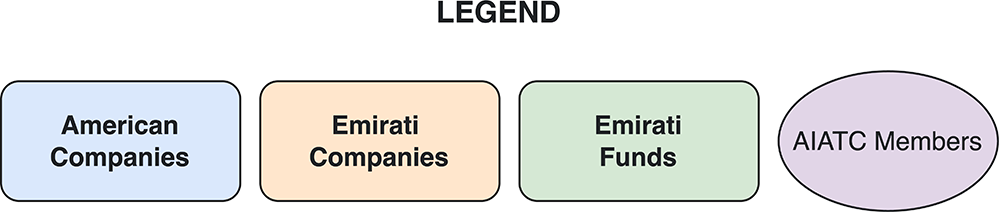
Legend for the UAE entity diagram. The diagram is not comprehensive; it only shows particularly relevant entities and connections.
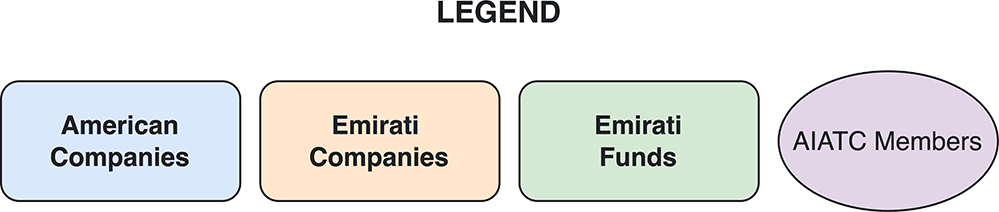
Figure 2 Long description
The legend consists of four categories. The first category is labeled 'American Companies' inside a rectangle. The second category is 'Emirati Companies' in another rectangle. The third category is 'Emirati Funds' also in a rectangle. The fourth category is 'AIATCI Members' inside an oval shape.
2.1.1 Government strategy and entities
Table 1 provides a breakdown of the key government entities in the UAE AI ecosystem.
Key government entities in the UAE AI ecosystem

Table 1 Long description
The table outlines key government entities involved in the UAE's AI ecosystem, highlighting their roles. The Ministry for Artificial Intelligence leads national AI policy and regulation. The AIATC in Abu Dhabi focuses on AI research, investment strategy, and partnerships. MBZUAI is dedicated to AI talent development and research. Local Free Zones and Emirates have specific oversight mechanisms for data privacy and AI applications, though their involvement is minimal so far. This distribution of roles indicates a structured approach to AI governance, with both national and regional bodies contributing to the ecosystem.
The UAE’s approach to AI governance is an aggressive pro-growth strategy that involves building government expertise and capacity, incentivizing local adoption and innovation and building strategic partnerships with leading companies and countries, all while holding off on instituting hard regulatory guidelines out of fear of discouraging entrepreneurship or investment. Within the UAE, the Emirate of Abu Dhabi plays a particularly important role in developing and executing on the national AI strategy, due to its stature as the political center of the UAE, the primary holder of the nation’s sovereign wealth and the primary driver of economic growth for the nation. The Artificial Intelligence and Advanced Technology Council (AIATC) is a government entity of the Abu Dhabi Emirate that counts among its members the leading figures in UAE AI investment and infrastructure.
The UAE’s proactive approach extends to the speed of its adoption of AI within government for highly consequential use cases. In May 2025, the UAE leadership announced its intention to utilize AI to “change how we create laws, making the process faster and more precise” and created a new cabinet unit, the Regulatory Intelligence Office, to oversee implementation (Cornish Reference Cornish2025b). The implementation plans involve aggregating data on the country’s federal and local laws, linking them to court and government service data and feeding this into an AI system to generate recommendations for legislative updates. The UAE’s autocratic rule enables rapid testing and piloting of new technologies.
In practice, the UAE’s investment and public–private partnership strategy aims to establish a leading role for the country in the global frontier AI model development and deployment supply chain. This is shown through its partnership with leading companies such as Microsoft and OpenAI, the recent agreements the country has established with France and the USA on building large-scale data center infrastructure and its increasing investment in developing new research and talent across the full stack of AI model development.
2.1.2 Key companies
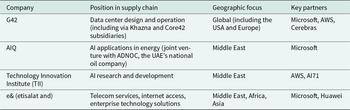
Table 2 provides a breakdown of the key companies in the UAE AI supply chain.
Key companies in the UAE AI supply chain
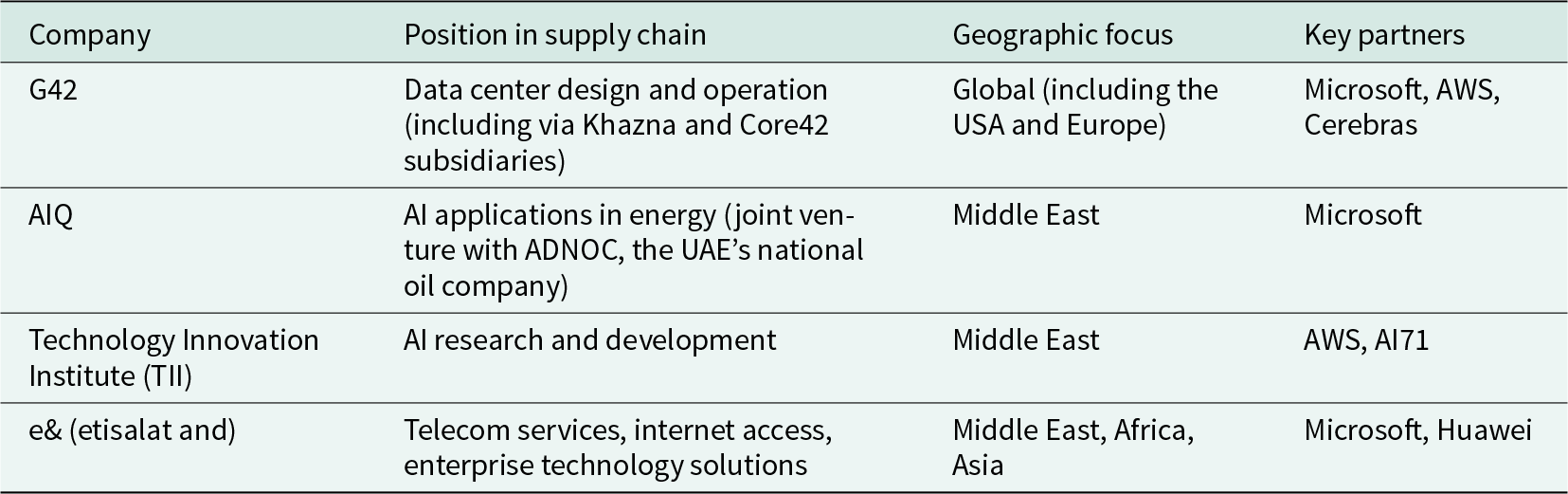
Table 2 Long description
The table outlines key companies in the UAE AI supply chain, detailing their roles, geographic focus, and key partners. G42 operates globally in data center design, partnering with Microsoft, AWS, and Cerebras. AIQ focuses on AI applications in energy within the Middle East, collaborating with Microsoft. The Technology Innovation Institute is involved in AI research and development in the Middle East, partnering with AWS and AI71. e& provides telecom services and technology solutions across the Middle East, Africa, and Asia, with partners including Microsoft and Huawei. The data highlights the strategic partnerships with major tech companies, emphasizing the UAE's integration into the global AI landscape.
The UAE has a number of AI and technology infrastructure companies – including G42, AIQ, TII and e& (etisalat and) – that are developing the country’s capacity to perform AI R&D domestically and build and offer data infrastructure, model applications and other telecom and tech services globally. Many of these are backed by government-funded investment corporations.
2.1.3 Investment funds
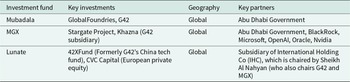
Table 3 provides a breakdown of the key AI investment funds in the UAE.
Key investment funds in the UAE AI ecosystem
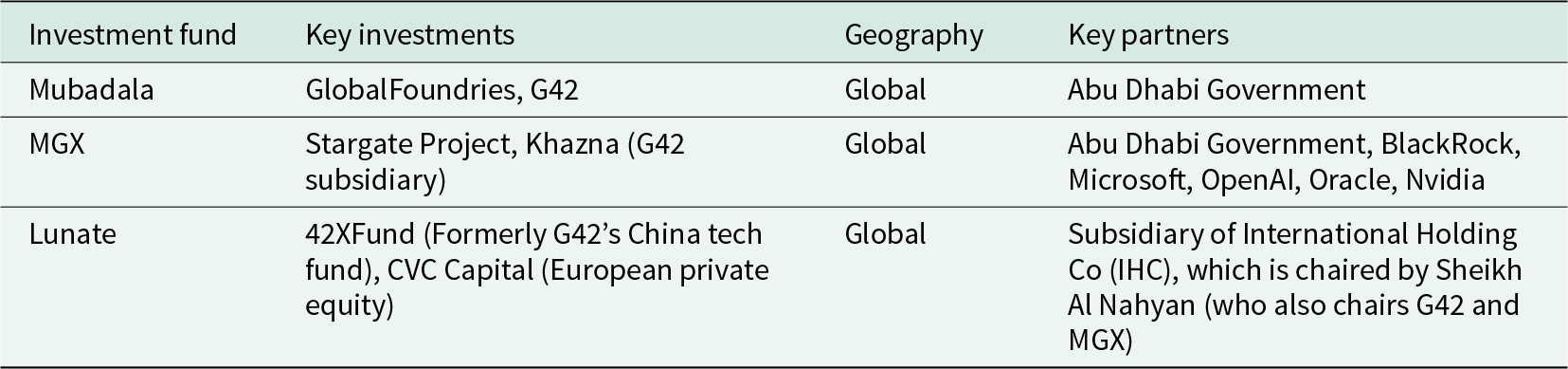
Table 3 Long description
The table outlines key investment funds in the UAE AI ecosystem, highlighting their investments, geographic reach, and partners. Mubadala invests in GlobalFoundries and G42, with global reach and partnership with the Abu Dhabi Government. MGX's investments include the Stargate Project and Khazna, with partners like BlackRock, Microsoft, and OpenAI. Lunate focuses on 42XFund and CVC Capital, with ties to International Holding Co and Sheikh Al Nahyan. All funds have a global investment scope, with significant partnerships in technology and government sectors, indicating a strong collaborative approach in advancing AI initiatives.
The UAE is dedicating a considerable amount of state-owned capital toward investing in AI companies. Particularly prominent funds include MGX, an AI-specific investment fund with government backing, Mubadala, Abu Dhabi’s sovereign wealth fund, and Lunate, a wide-ranging investment fund housed within Sheikh Al Nahyan’s International Holding Co (IHC).
3. Kingdom of Saudi Arabia
3.1 Local ecosystem and key players in the KSA
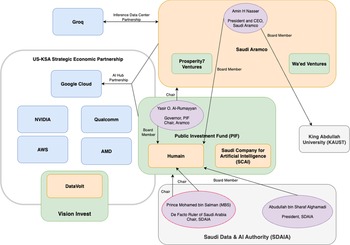
The Saudi AI ecosystem, illustrated in Figures 3 and 4, is similarly structured around state-led investment and strategic corporate partnerships.
Overview of key KSA government and corporate AI entities. The diagram is not comprehensive; it only shows particularly relevant entities and connections. Source: Carrington Malin (2025); SDAIA (2025); Reuters (2020); ACEGPT (2025); England and Al Omran (Reference England and Al Omran2025); Lucidity Insights (2024); Groq (2024); DataVolt (2025); Benito (Reference Benito2024); Narayanan (Reference Narayanan2024); Soliman (Reference Soliman2024); Farrell and Copeland (Reference Farrell and Copeland2024); PIF (2025); Olcott (Reference Olcott2024a); Olcott (Reference Olcott2024b); Cornwell et al. (Reference Cornwell, Magid and Cornwell2024); Together AI (2025); Wang (Reference Wang2025); Li (Reference Li2022); Wamda (2024); Lee (Reference Lee2024); Lavine (Reference Lavine2024); Saudi Gazette (2019); Reuters (2025c); CIA (2025); and Soliman (Reference Soliman2025).

Figure 3 Long description
The diagram illustrates key entities in the Saudi AI ecosystem, highlighting partnerships and board members. It includes the US-KSA Strategic Economic Part nership with companies like Google Cloud, NVIDIA, Qualcomm, AWS and AMD. The Public Investment Fund (PIF) is shown with connections to Humain and the Saudi Company for Artificial Intelligence (SCAI). Saudi Aramco is linked to Prosperity Ventures and Wa'ed Ventures, with board members Anna H. Nasser and others. The Saudi Data and AI Authority (SDAIA) is connected to Prince Mohammed bin Salman and Dr. Abdullah bin Sharaf Alghamdi. King Abdullah University (KAUST) is also mentioned. Connections between entities are depicted with lines and arrows, indicating strategic relationships and roles within the ecosystem.
Legend for the KSA entity diagram. The diagram is not comprehensive; it only shows particularly relevant entities and connections.

Figure 4 Long description
Each category is enclosed in a distinct shape, with American Companies in a rectangle, Saudi Public Organizations in a rectangle, Saudi Companies in a rectangle, Saudi Funds in a rectangle and Saudi Licenses in an oval.
3.1.1 Government strategy and entities
Table 4 provides a breakdown of the key government entities in the KSA AI ecosystem.
Key government entities in the KSA AI ecosystem

Table 4 Long description
The table lists key government entities involved in the AI ecosystem in Saudi Arabia, highlighting their roles. The Saudi Data and AI Authority (SDAIA) is responsible for overseeing the national AI strategy, positioning it as a central agency in the country's AI initiatives. In contrast, King Abdullah University for Science and Technology (KAUST) is dedicated to developing AI talent and conducting research, emphasizing its role in education and innovation. These entities illustrate the collaborative efforts between government oversight and academic research in advancing AI in Saudi Arabia.
The KSA ventured into AI slightly later than the UAE. The Kingdom unveiled Vision 2030, a plan to diversify the Saudi economy beyond oil, in 2016. After that, like the UAE, they launched an ambitious pro-growth national AI strategy funded by oil revenues. The KSA is establishing dedicated AI institutions and developing talent through specialized research centers and universities. The Saudi government has publicly shared ambitious goals – such as building AGI by 2050, as mentioned by Dr. Mohammed Alotaibi at the LEAP25 conference (Carrington Malin 2025) – which illustrate their objective to be at the frontier of AI development and deployment.
3.1.2 Key companies
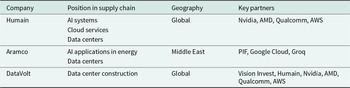
Table 5 provides a breakdown of the key companies in the KSA AI ecosystem.
Key companies in the KSA AI supply chain
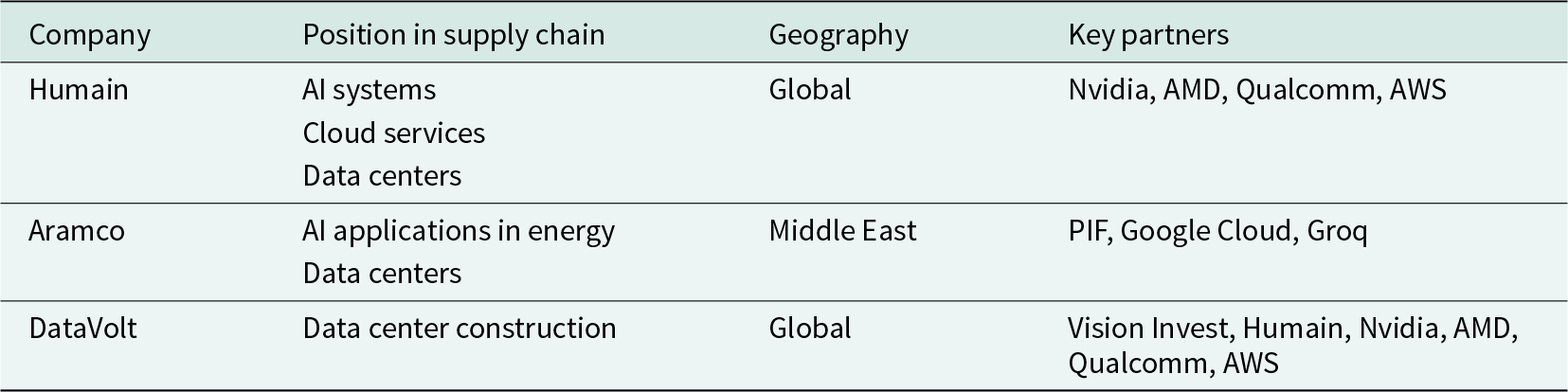
Table 5 Long description
The table outlines key companies involved in the AI supply chain in Saudi Arabia, detailing their roles, geographic reach, and key partners. Humain operates globally, focusing on AI systems, cloud services, and data centers, partnering with Nvidia, AMD, Qualcomm, and AWS. Aramco, centered in the Middle East, applies AI in energy and data centers, collaborating with PIF, Google Cloud, and Groq. DataVolt, also global, specializes in data center construction, sharing partners with Humain like Nvidia and AMD. The data highlights the interconnectedness of these companies through shared partners, emphasizing the global and regional reach of their operations.
Saudi Arabia has a few companies that are the primary actors developing the country’s capacity for AI R&D domestically and building and offering data infrastructure, model applications and other AI-related services globally. Many of these are government-owned and backed.
3.1.3 Investment funds
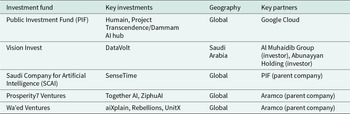
Table 6 provides a breakdown of the key AI investment funds in the KSA.
Key investment funds in the KSA AI ecosystem

Table 6 Long description
The table outlines key investment funds in the KSA AI ecosystem, highlighting their investments, geographic focus, and key partners. The Public Investment Fund (PIF) and Wa’ed Ventures have a global investment scope, partnering with major companies like Google Cloud and Aramco. Vision Invest is focused on Saudi Arabia, collaborating with local investors such as Al Muhaidib Group and Abunayyan Holding. SCAI and Prosperity7 Ventures also have a global reach, with SCAI being a subsidiary of PIF and Prosperity7 Ventures linked to Aramco. The data suggests a strong international presence for most funds, except Vision Invest, which is more locally oriented.
Saudi Arabia is dedicating a considerable amount of state-owned capital toward investing in AI companies via funds such as its sovereign wealth fund (the Public Investment Fund (PIF)), and entities and subsidiary funds, including Prosperity7 Ventures, and Wa’ed Ventures. There are also private funds and holding companies that are contributing capital toward AI development initiatives, including the Saudi Company for Artificial Intelligence (a PIF-owned holding company) and Vision Invest (a privately owned investment firm).
4. Cross-cutting themes
4.1 Partnerships with the USA and France
In 2025, the UAE and KSA announced landmark AI initiatives in collaboration with the USA and France, reflecting each nation’s strategic goal of becoming a global AI leader (as outlined in the UAE’s National AI Strategy 2031 and Saudi Vision 2030 discussed earlier). These new partnerships are designed to advance national priorities: the UAE is leveraging U.S. partnerships to build domestic AI capacity and talent, while Saudi Arabia is investing oil wealth into AI to diversify its economy in line with Vision 2030’s objectives.
4.1.1 2025 USA–UAE deals
During a visit by U.S. President Donald Trump to Abu Dhabi in mid-May, the UAE and the USA unveiled the U.S.–UAE AI Acceleration Partnership (U.S. Department of Commerce 2025). Core to this partnership is the construction of an AI data center campus in Abu Dhabi with five gigawatts of power capacity – billed as the largest AI computing campus outside the USA (Slattery et al. Reference Slattery2025). The scale of the data center, illustrated in Figure 5, is aimed at making it the leading hub for frontier model training and inference demands in the Middle East.
Summary of May 2025 USA–UAE AI deals.

Figure 5 Long description
A table with three columns: UAE Entities, US Entities and Scope. The first row under UAE Entities lists G42, with US Entities including OpenAI, Oracle, Nvidia, Cisco and SoftBank Group. The scope is the US-UAE AI Acceleration Part nership, valued at 200 billion dollars, with up to 1,500,000 GPUs for G42. It includes a 5 GW AI campus in Abu Dhabi and up to 500 kilowatts of Nvidia's GPUs (2025-27). UAE pledges to co-fund data centers of equal power. The second row lists e& etisalat and AWS, with the scope of the UAE Sovereign Launchpad, a sovereign cloud zone hosted in AWS-UAE. It includes a Gen-AI and cyber-innovation center. The third row lists Qualcomm under US Entities, with the scope being the Qualcomm Global Engineering Center, a joint design hub for Arm-based AI/datacenter CPUs. The table uses color coding to indicate UAE soil infrastructure capacity, USA soil infrastructure capacity and mixed distribution across UAE and USA.
The desire to establish stronger collaboration on building AI infrastructure was further solidified in November 2025 when the USA and the UAE signed a memorandum of understanding to expand cooperation on AI and energy (Shapero Reference Shapero2025). Collaboration between the UAE and the USA is likely to deepen further with the announcement of Pax Silica, a new U.S. diplomatic initiative focused on the supply chain for AI development (U.S. Department of State 2025). The UAE was one of the eight participating countries in the inaugural Pax Silica, underscoring the UAE’s emerging role in the international AI ecosystem and its importance to U.S. strategic interests.
4.1.2 2025 USA–KSA deals
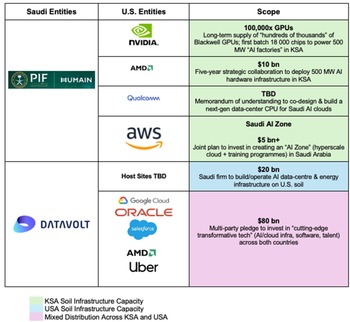
In Saudi Arabia, the government launched a state-owned AI startup called Humain, which is also serving as a national platform for partnerships with the U.S. government and American companies (Cherney et al. Reference Cherney, Nellis and Cherney2025). Humain is chaired by Crown Prince Mohammed bin Salman, as an entity owned by the PIF. During President Trump’s visit to Riyadh on May 13, a U.S.–Saudi strategic economic partnership agreement consisting of $600 billion in investments was signed (Kelley Reference Kelley2025). As part of this agreement, summarized in Figure 6, Saudi Arabia secured access to buy hundreds of thousands of NVIDIA’s latest AI chips to fuel its data centers, with an initial tranche of 18,000 high-end Blackwell GPUs going to Humain (Cherney et al. Reference Cherney, Nellis and Cherney2025).
Summary of May 2025 USA–KSA AI deals.

Figure 6 Long description
The table presents collaborations between Saudi and U.S. entities, detailing their scope and infrastructure capacities. Saudi entities include PIF and Humain, while U.S. entities feature NVIDIA, AMD, Qualcomm, AWS, Google Cloud, Oracle, Salesforce and Uber. The scope includes projects like the deployment of 100,000 GPUs by NVIDIA, a five-year strategic collaboration with AMD and a memorandum with Qualcomm for a data center. AWS is involved in a joint plan to invest in an AI zone in Saudi Arabia. Host sites are to be determined for a $20 billion Saudi investment in data centers. A multi-party pledge of $80 billion is noted for transformative tech across both countries. Infrastructure capacities are categorized as KSA soil, USA soil and mixed distribution across KSA and USA.
Saudi Arabia also announced collaborations with both Google Cloud and Amazon Web Services (AWS) to advance its AI ecosystem via building out domestic infrastructure and up-skilling citizens in partnership with KSA company DataVolt (Amazon Staff 2025; Kelley Reference Kelley2025). These actions directly support Saudi Vision 2030, and Saudi officials have framed these AI investments as a significant step toward making the Kingdom a worldwide leader in AI.
In November 2025, the strategic partnership between the USA and Saudi Arabia was reinforced by the signing of a new AI Memorandum of Understanding giving the KSA “access to world-leading American systems,” and aimed at bringing more Saudi investment into the U.S. economy (The White House 2025b). Alongside this MOU, a new joint venture was announced between Humain, AMD and Cisco to build up to 1 GW of new KSA-based AI infrastructure by 2030 (Zulhusni Reference Zulhusni2025). The first phase includes a 100 MW buildout using AMD Instinct MI450 GPUs. Additionally, the USA and Saudi Arabia committed to a Strategic Framework on Critical Minerals, which included the U.S. Department of Defense (recently renamed the Department of War) investing in a KSA-based rare earths refinery (Baskaran Reference Baskaran2025). Both the new Humain-AMD-Cisco joint venture and the USA-KSA critical minerals investment are laid out in Figure 7
Summary of November 2025 USA–KSA AI deals.

Figure 7 Long description
A table with three columns labeled Saudi Entities, U.S. Entities and Scope. The first row under Saudi Entities shows logos for PIF and Humain and under U.S. Entities, logos for Cisco and AMD. The Scope column describes a joint venture to build a 1 gigawatt data center by 2030, including a 100 megawatt buildout using AMD Instinct MI450 GPUs. The second row under Saudi Entities shows logos for Ma'aden and another entity and under U.S. Entities, logos for MP Materials and the U.S. Department of Defense. The Scope column details a strategic framework on critical minerals, focusing on two-way investment for uranium, metals, permanent magnets and other minerals for manufacturing and energy production. It mentions a new rare earths refinery in Saudi Arabia. A legend at the bottom indicates color coding for KSA soil infrastructure capacity, USA soil infrastructure capacity and mixed distribution across KSA and USA.
.
4.1.3 2025 France–UAE deals
Initially announced at the 2025 AI Action Summit, France and the UAE are partnering to build a 1.4 GW hyperscale data center AI campus in France (Abu Dhabi Media Office 2025a). The campus, detailed in Figure 8, will be co-funded by the Emirati MGX fund and the French Bpifrance public investment bank. Upon completion, this would be Europe’s largest such data center. The campus is planned to be powered by low-carbon energy sources, allow for “sovereign cloud” capacity within France and Europe, and to be a site for research projects initiated in collaboration between Ecole Polytechnique and Mohamed Bin Zayed University of Artificial Intelligence.
Summary of 2025 France–UAE AI deals.

Figure 8 Long description
The infographic outlines the collaboration between UAE and French entities in the field of artificial intelligence. The first section describes a new hyperscale data center with a capacity of 1.4 gigawatts, planned for completion by 2028. It will feature sovereign cloud services and low-carbon power, co-funded by MGX and Bpifrance. Ecole Polytechnique and Mohamed Bin Zayed University of Artificial Intelligence will collaborate on AI research projects. The second section details an AI platforms partnership between Mistral AI and G42, focusing on co-developing platforms for AI model training, agent intelligence and industry-specific applications. Mistral AI will also explore research and development collaboration with Mohamed Bin Zayed University of Artificial Intelligence. The infographic uses color coding to indicate UAE soil infrastructure capacity, French soil infrastructure capacity and mixed distribution across France and UAE.
4.2 Influence of China
As both the UAE and KSA aim to position themselves as the regional leaders, they are naturally seeking partnerships with both leading AI powers: the USA and China. This section aims to provide more details on each country’s approach to China and contextualize it in terms of their plans for regional AI leadership.
Publicly, the UAE has adopted a more cautious approach to China, seemingly aiming to protect its partnership with the USA. The UAE Minister of State for AI, Omar Al Olama, said that “in the AI space today, I think we need to be selective of who we work with,” implying that China is not necessarily the UAE’s most desired partner, and claiming that on AI “there is going to be complete alignment between the UAE and the US” (Harris Reference Harris2024). In line with this statement, Emirati officials are reported to be describing their activities as involving “decoupling” from China in AI, with G42 reportedly divesting from Chinese tech firms (Allen et al. Reference Allen, Adamson, Heim and Winter-levy2025). Clearly, the UAE has some wariness about appearing connected with China and is making efforts to appear as a more U.S.-aligned actor to maintain access to U.S. technology.
Still, there are doubts about the substantiveness of the UAE’s “decoupling” efforts. G42’s claimed divestments from China were actually transferred to Lunate, an investment fund overseen by the UAE’s national security advisor, Sheikh Al Nahyan (who also is the chairman of G42) (Cao et al. Reference Cao, Bartenstein and Hawkins2024). Moreover, the UAE state-owned telecommunications company e& still cooperates with both Microsoft and Huawei on its infrastructure. Notably, e& was a 40 percent equity holder in Khazna, the subsidiary of G42 that is heavily involved in the new datacenter construction project announced as part of the U.S.–UAE AI Acceleration Partnership (Reuters 2025c). It has recently sold its stake to the Emirati AI fund MGX and the American private equity fund Silver Lake, but e& remains a close strategic partner to Khazna/G42.
The UAE’s current partnerships with the USA seem not to be value-motivated but rather a pragmatic strategy to hedge bets on who might prevail in the AI race. Therefore, the UAE is likely ready to alter its priorities and partnerships if it perceives the USA as losing its strategic advantage. A similar transactional foundation underlies the U.S.–KSA relationship. Saudi sovereign wealth funds have been consistently investing in the Chinese AI ecosystem and even in U.S.-sanctioned companies (like surveillance company Dahua Technologies), betting on the continuing success of Chinese AI efforts. Moreover, Huawei has been opening cloud data centers in the country (Reuters 2023) and, in 2023, announced an investment of $400 million in the Saudi cloud (Vinh Nguyen Nemo 2023). It is unlikely that the KSA and the UAE will rely solely on their U.S. partnership, and the USA should remain vigilant about offshoring chips that could jeopardize its strategic advantage if diverted or covertly used by adversaries. Chip smuggling into China likely happens to some extent through both the UAE and the KSA (Grunewald and Aird Reference Grunewald and Aird2023).
President Trump’s administration should remain cautious while both countries maintain linkages to the Chinese AI ecosystem. The USA should closely monitor infrastructure built in the Gulf and insist on governance conditions that prevent diversion or misuse by China or other adversaries.
5. Conclusion
5.1 Policy recommendations
Partnering closely with the UAE and KSA makes sense for furthering American national security and economic interests. Energy, data center capacity and capital investment are each increasingly becoming bottlenecks for advancing AI model development, and the UAE and KSA are uniquely positioned to help unplug these bottlenecks for the USA. The UAE and KSA have prioritized AI nationally regardless of whether the USA partners with them, and have capital and other resources they are looking to put toward such initiatives. If the USA does not partner with them, China and others will fill the gap.
Gulf States and the USA each have much to gain from partnering with each other. The UAE and the KSA obtain infrastructure that would allow them to diffuse AI to emerging markets in Africa and Asia, becoming champions of the “Global South.” In exchange, the UAE and KSA can each help the USA stay in the lead on frontier capabilities due to their ample supply of capital to invest in infrastructure and their lack of regulatory barriers for building out infrastructure. However, the U.S. government will have to structure and steer these partnerships in a way that aligns American national security and economic interests.
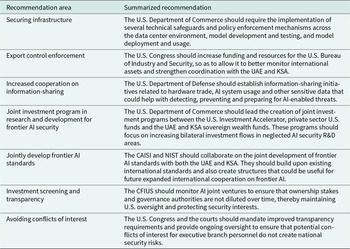
As the UAE and KSA become more influential in AI, their allegiance to the USA might evaporate (Xu Reference Xu2025). If by 2029 the world’s most powerful AI training facilities reside in the UAE or KSA rather than on U.S. soil, the USA must implement stringent technical and policy protections now to maintain its lead in AI development and to ensure those Gulf-based facilities cannot be misused by adversaries (Mickle and Swanson Reference Mickle and Swanson2025). We propose the policy recommendations summarized in Table 7 to protect long-term U.S. national security and economic interests.
Summary of policy recommendations

Table 7 Long description
The table outlines policy recommendations across various areas, focusing on enhancing security and cooperation in AI and technology sectors. It suggests the U.S. Department of Commerce implement technical safeguards in infrastructure, while Congress should boost resources for export control enforcement. Increased cooperation is advised for information-sharing initiatives by the Department of Defense. Joint investment programs and development of AI standards are recommended to strengthen ties with UAE and KSA. The table also highlights the importance of investment screening and transparency to maintain U.S. oversight, and avoiding conflicts of interest to protect national security. These recommendations aim to bolster security and international collaboration in frontier AI development.
5.1.1 Securing infrastructure
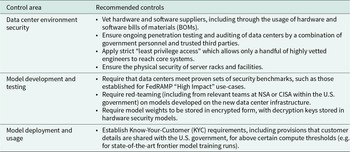
In order to ensure these new data centers are a long-term asset for U.S. AI leadership, security controls should include a combination of rigorous technical safeguards and enforceable policy controls, as detailed in Table 8.
Recommended technical and policy controls for AI infrastructure

Table 8 Long description
The table provides recommended technical and policy controls for AI infrastructure across three areas: data center environment security, model development and testing, and model deployment and usage. For data center security, it suggests vetting suppliers, conducting penetration testing, and enforcing strict access controls. In model development, it recommends meeting security benchmarks and storing model weights encrypted. For deployment, it advises implementing Know-Your-Customer requirements for high compute thresholds. These controls aim to enhance security and compliance in AI infrastructure management.
In addition to preventing unauthorized intrusions and misuse of AI infrastructure by foreign adversaries and non-state actors, the above measures will also help the USA to ensure that the infrastructure is accessed and used in an approved manner by the UAE and KSA government bodies and businesses. Both the UAE and KSA have deployed digital societal control systems that could increase in scope through the use of this new data center infrastructure. These include the UAE’s “Falcon Eye” and “Oyoon” video surveillance systems (Oxford Institute of Technology and Justice 2025) and Saudi Arabia’s “Absher” platform, which reinforces patriarchal control over women’s movements (Human Rights Watch 2019). Data center infrastructure could be used to assist with scaling these systems through the development and deployment of specialized AI applications. Of the recommended measures in Table 8, regular third-party auditing and KYC tracking of system usage would be particularly valuable to ensure that the USA maintains knowledge, oversight and veto power over how the UAE and KSA are making use of this infrastructure.
5.1.2 Export control enforcement
The increased exports of advanced GPUs from the USA to the UAE are part of a strategy designed to ensure that Gulf region infrastructure becomes more dependent on American rather than Chinese technology. However, these deals also increase the risk of potential diversion of advanced GPUs to China. Since carefully guarding access to advanced GPUs plays an important role in maintaining the USA’s lead in AI, it is crucial to ensure that strong cooperation is set up between the USA and UAE on enforcing existing export controls for GPUs (Goodrich Reference Goodrich2025). The U.S. Bureau of Industry and Security has adopted export-licensing rules tied to destination, end-user type and shipment size. However, there is still space for adjusting the export-licensing rules to incorporate stronger compliance verification mechanisms. One promising option recently proposed by Senator Tom Cotton involves mandating certain security features, such as location verification mechanisms on the exported chips (Reuters 2025b).
5.1.3 Increased cooperation on information-sharing
The USA should create an AI-specific information-sharing program with both the UAE and the KSA, which could meaningfully build upon the wide-ranging existing methods of shared defense coordination between each of these countries, and allow each country to better secure data centers, hardware and model development processes from attacks or infiltration by adversaries. Given the existing collaboration the USA has already set up with each of these countries on sensitive and complex international security issues, creating structures for AI-related information sharing would be a relatively low-effort but high-payoff next step.
Frontier AI systems have an increasing value proposition for accelerating cyber-offense and cyber-defense, and designing and manufacturing chemical, biological, radiological and nuclear threats (Department of Homeland Security 2024). Additionally, AI systems are being used to augment intelligence gathering and analysis processes (Mercer and Martin Reference Mercer and Martin2025), and their emerging capabilities could pose additional national security risks or advantages (Mitre and Predd Reference Mitre and Predd2025). Examples of the sorts of information that could be valuable to share through such a program include details about planned training runs for state-of-the-art AI models, such as the expected dates of beginning and ending of training, the expected compute used in FLOP, high-level descriptions of the pre-training dataset(s) and the security measures in place for that data, and an assessment of expected capabilities of the trained model (Belfield Reference Belfield2024).
5.1.4 Joint investment program in research and development for frontier AI safety and security
The USA should explore setting up joint investment programs with the UAE and KSA in neglected areas of AI security research and development, given that both countries have advantages in sovereign wealth and a pre-existing interest in allocating that capital toward sub-areas of AI with growth potential. These joint programs could be established through the Commerce Department’s United States Investment Accelerator to expedite investment by UAE and Saudi funds in early-stage AI security R&D initiatives within the USA. Likewise, U.S. government funds (such as the new sovereign wealth fund the Trump administration is establishing, or existing funds such as In-Q-Tel) and private leading U.S. funds should ensure they obtain privileged access to the nascent regional ecosystem of AI research and development ventures in both the UAE and the KSA (The White House 2025a). Neglected areas that could be a fit for such a program include third-party evaluation and assurance tooling, technical oversight and control mechanisms, and new paradigms for AI systems design (Delaney and Guest Reference Delaney and Guest2025).
5.1.5 Jointly develop frontier AI standards
As the UAE and the KSA more closely integrate with the U.S. AI ecosystem, greater cooperation and coordination on frontier AI standardization is a logical next step. Initially, this could include harmonization of existing standards related to frontier AI and expansion on top of existing standards that already have international buy-in, such as the UK Code of Practice for the Cyber Security of AI (UK Government 2025). This collaboration could then transition to the “priority topics for standardization work” as outlined in NIST’s Plan for Engagement on Global Standards (National Institute of Standards and Technology 2024) to ensure alignment between the KSA’s and the UAE’s standards and the U.S. standards on frontier AI.
5.1.6 Investment screening and transparency
The fast-track program for bringing new capital into the USA can only work to the country’s advantage if it is paired with frequent and ongoing reviews to ensure investments do not create risks over time. Historical precedent shows that the greatest risks from foreign investment come from changes in ownership, partnerships and personnel that can accumulate incrementally over time through dilution and erosion of initial interests (Greenberg Center for Geoeconomic Studies 2017). As these new infrastructure initiatives grow, the Treasury Department’s Committee on Foreign Investment in the USA (CFIUS) should monitor which other countries and companies G42, MGX, PIF and other entities in the UAE and KSA are transacting and partnering with (U.S. Department of the Treasury 2025). In order to successfully carry out such monitoring, CFIUS could benefit from an increased budget allocation from Congress.
5.1.7 Avoiding conflicts of interest
Throughout the prior sections, we discussed how the partnerships between the USA and the UAE, and between the USA and the KSA, are primarily transactional in nature, rather than values-based. Because of this transactional relationship, conflicts of interest could become vectors through which U.S. security and economic interests are compromised over the long term. The Trump administration faces several potential conflicts of interest vis-à-vis the UAE and the KSA, and it is crucial to set in place guardrails to ensure integrity in government-coordinated initiatives (Weissert Reference Weissert2025).
Concretely, oversight measures should cover the full lifecycle of partnerships: from investment, through to continued monitoring and operation of data center facilities. To accomplish this complete lifecycle oversight, we recommend Congress take two actions:
• Create a Special Inspector General (SIG) with oversight over international technology partnerships: Unlike standard agency Inspectors General, who are limited to reviewing their specific departments, this SIG would have the mandate to track and verify proper accounting for finances and technical components across agencies and borders. This could be modeled after the effective Special Inspector General for Afghanistan Reconstruction (SIGAR) or the Special Inspector General for Pandemic Recovery (SIGPR) (Office of Inspector General 2019). This office must be granted independent subpoena power to compel testimony and documents from private contractors and foreign partners. Implementation requires Congress to include provisions in the National Defense Authorization Act (NDAA) that establish the office, appropriate multi-year funding and explicitly define its reporting line directly to relevant congressional committees.
• Expansion of CFIUS Jurisdiction to “Greenfield” Investments: We endorse the Trump administration’s recommendation to strengthen CFIUS authority over “greenfield” investments (The White House 2025c). CFIUS currently operates with a large blind spot. While CFIUS has robust authority to review foreign acquisitions of existing U.S. businesses, its ability to review “greenfield” investments (for instance, where an entity builds a new facility from scratch) is currently largely limited to real estate transactions in close proximity to sensitive military sites. To close this gap, Congress must amend the Foreign Investment Risk Review Modernization Act of 2018 (FIRRMA). The amendment should explicitly expand CFIUS jurisdiction to cover all greenfield investments in “Technology, Infrastructure and Data” sectors, regardless of geographic location.
By combining upfront screening via CFIUS with continuous, independent auditing via a newly established SIG, the USA can safely leverage Gulf capital while robustly maintaining the strength and integrity of its technological lead.
Acknowledgements
The authors thank Christopher Covino and Oliver Guest of the Institute for AI Policy and Strategy for providing valuable feedback and insights. The authors used ChatGPT 5 Pro and Gemini 2.5 Pro to assist with proofreading and formatting.
Funding statement
No funding was received for the publication of this article.
Competing interests
The authors have no professional or personal competing interests related to the topics and recommendations discussed in this article.
Author contributions
N.M. and K.F. contributed equally to this work.
Nikhil Mulani is the founder of Augur, an AI supply chain research firm. Recently, he was the AI policy lead within the Office of Strategy, Policy, and Planning at the U.S. Cybersecurity and Infrastructure Agency. Previously, he advised the U.S. and U.K. governments on AI policy and built machine learning systems and data infrastructure at a variety of technology companies. He received his degrees from the Wharton School and Harvard University.
Kristina Fort is an independent AI governance researcher focusing on the geopolitics of AI. She is also the EU Research Manager at the Institute for Law and AI. She previously completed several AI governance fellowships and worked for Czech and EU public institutions. She received her degrees from the London School of Economics and Sciences Po Paris.








 Open access

