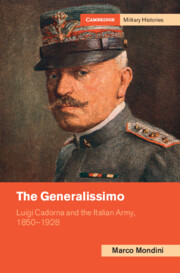


‘… musing on my strange destiny whereby I have swung between acclamation and crucifixion’.
The Luce newsreel focuses on the steps outside a church from which emerge various officers in full uniform, then a cluster of priests and acolytes, and finally a coffin which is solemnly lowered onto a gun-carriage and covered with the flag of Savoy. A caption informs viewers that this is the ‘austere funeral of His Excellency Luigi Cadorna Marshal of Italy’. Cut to the next scene. A dense throng, escorted by saluting army units, accompanies the bier on its last journey to the graveyard: ‘the Crown Prince and highest state dignitaries follow in religious solemnity’.Footnote 1
The newsreels have now acquired sound. Amid pealing bells and trumpet fanfares, we witness the transferring of the body of ‘His Excellency Field Marshal of Italy Luigi Cadorna to the mausoleum erected in his memory’. The camera lingers on the architecture of the shrine overlooking the long lake, designed by Marcello Piacentini on a quadrangular plan, adorned with twelve statues representing Italian soldiers fighting in the Great War. Marking the occasion is a guard of honour chosen from various army and militia units. From the authorities’ stand the popular wartime naval hero, now evergreen Communications Minister, Costanzo Ciano, reads aloud Mussolini’s inaugural message:
The whole of Italy that proudly served in the war gathers today at Pallanza around the monument that will keep alive the memory and glory of Cadorna down the centuries. Their passions now allayed by full knowledge of events, the Italian people acclaim Cadorna for his merits as an organizer, the chief who never despaired.
Cut to Carlo Delcroix, president of the Association of the Invalided and Mutilated in War, who lost his eyes and both his hands on the Marmolada in 1917, and was perhaps the most prominent pro-fascist veteran (and certainly one of the most passionate and influential orators of the post-war period):
Fellow-soldiers, mutilees, it is true: our first battles, driven by desperation, were almost entirely an act of solidarity with our allies. Who later, truth be told, had a different way of showing that solidarity. But it was ours to keep our word whatever the cost […] and in doing so we showed the greatest merit, for which Italy will sooner or later be duly acknowledged!Footnote 2
Hard though it is to detect nowadays amid all the rodomontade of public eulogy, behind that last tribute to the former commander there lurks a subtle irony.
Entombing and translating the prime commander of the Italian army in the Great War was none too different from the pageantry then being accorded to other war lords who had clashed on the field of battle in 1914–1918. Douglas Haig, iron-willed Field Marshal who sent British (and Commonwealth) soldiers to immolation on the Somme and at Passchendaele, died only a month or so before Cadorna causing a huge and sincere wave of mourning throughout the United Kingdom. The majestic Westminster Abbey funeral was an epoch-making event, the first ever to be covered live by the BBC. The coffin, escorted by two future kings, Edward VIII and George VI, wound its way between a crowd of Londoners bent on paying their respects to the erstwhile Commander-in-chief who had not yet become the butt of fierce criticism which would shortly earn him the soubriquet of ‘butcher’.Footnote 3 A few years later, in January 1931, it was Joseph Joffre who embarked on his final journey. The victor of the Marne’s bier crossed an awed and ghostly Paris. By his express wish he was not entombed at the Hotel des Invalides where he might have received a red granite sarcophagus to match Napoleon’s – something Cadorna would surely have appreciated. However, the decision to display the coffin for two days at the Ecole Militaire brought Frenchmen by the tens of thousands to pass before the Marshal’s body, while schools, universities, public offices, and even restaurants and cinemas closed throughout the country the day he was buried.Footnote 4 Even Franz Conrad von Hötzendorf, chief bane of Cadorna’s army and one of the great vanquished in the First World War, was given a princely send-off. Curiously like Cadorna, who died at Bardonecchia where he used to spend his holidays, Conrad died at a tourist resort – Bad Mergentheim in Germany – and his last journey to Vienna prompted a memorable pilgrimage, a nostalgic secular opportunity to venerate his saintly remains. This was after all the last act by the Imperial Austria of old. When the great Austro-German general of the Habsburg army came to be buried, the ceremony matched in grandeur the last farewell to Emperor Franz Joseph, for whom over 100,000 people had turned out.Footnote 5
One way or another, victors or vanquished, the commanding chiefs of the Great War were honoured by their heads of state, ministers, and monarchs, and accorded solemn choral accolades verging on sanctification. Whatever the ill that might have been spoken of them (and would be in future when their epic deeds dissolved into wry legend featuring a group of incompetent donkeys) they were at the time of death hailed as heroic warriors and raised upon altars of undying national gratitude.Footnote 6 Whether in verdant British parkland, monumental Viennese or Parisian cemeteries, the gloomy mausoleum of Tannenberg (where Marshal Hindenburg was laid to rest in 1934), or the grand stone Italian amphitheatres that awaited Gaetano Giardino and the Duke of Aosta entombed amid their soldiers, the commanders of yesteryear were mourned, fêted, and displayed as an example to future generations.Footnote 7
Cadorna’s fate was somewhat different. Last rites that should have been a consecration in the pantheon of national heroes, turned into an embarrassed mise-en-scène through which the desire of the regime and the monarchy not to be closely associated with his memory was all too apparent. Though newsreels and dailies of the period bent over backwards to extol the huge gathering – which included veterans, members of government, and the royal family – neither the king nor Benito Mussolini were actually present in person to honour the former war leader: the one, supreme head of the armed forces; the other, Duce of a belligerent Italy and leader of a party that professed spiritual descent from a great Victory. By contrast, in 1936, when the equestrian monument to Armando Diaz was unveiled in Naples, Vittorio Emanuele III went in person to pay tribute to Cadorna’s successor. As school textbooks would have it, Diaz was the saviour of the country who stemmed the Austrian and German advance at the Piave and Monte Grappa in 1917. He had triumphed at Vittorio Veneto, and was the first to lead a large Italian army to victory since imperial Roman times; he was a figure of reconciliation with the public; a man of unquestioned prestige; and (perhaps most importantly) a favourite with the regime.Footnote 8
Not so Cadorna. He was a problem. Though many years had passed since the burning issues of the immediate post-war period, the late General would always be the man behind the fruitless bloodbaths on the Isonzo, the special tribunals, the decimations and, to crown it all, the Caporetto debacle in October 1917. To his many detractors – including veterans and former military top brass – he was a ruthless despot accused of reigning in terror and repression, and sending 400,000 youthful soldiers to a pointless death in relentless head-on engagements only to lose his grip when defeat yawned. ‘A national calamity for all patriots’, Cadorna was accused of having brought the Kingdom of Italy to the brink of ultimate humiliation, the only good thing about which was that it finally sent him packing.Footnote 9 Silence fell on the misdeeds of the Supreme Command and its chief; but when the Commission of Enquiry set up to look into events amid the unrest of Italy 1919 published its report, it proved a media bombshell. Former liberals and neutralists, democratic interventionists, members of left-wing combatant associations, one and all saw Cadorna as the miscreant responsible for all the blunders of the Italian war, and perhaps even the decision to go to war itself. Mussolini himself inveighed against all attempts to rehabilitate the aged commander.Footnote 10
Il Duce would later take a softer line, but Cadorna remained an awkward and controversial figure from whom it paid to keep a healthy distance. Hence the missing faces at the Marshal’s official exequies, not to mention the bizarre rhetoric of those deputed to deliver the funeral elegy.Footnote 11 Not a word was said about the deceased’s military skills, or to commemorate his victories (which were few enough). They came, not to praise a glorious war leader and national hero, but to bury him so as to forget him, and with him lay to rest the hornets’ nest he had disturbed. With ‘passion allayed’ and the primary ‘indictee’ for Caporetto removed, at the last only the official anodyne version would remain: a war embraced wholeheartedly by Italians in general, skilfully waged by their leaders, dutifully fought by the soldiery and won by a nation united. Hard not to think, as one reads Ciano’s and Delcroix’s diplomatic words of praise, that they were asking Italians to be reasonable with the old boy, and please to forget that the whole first chapter of the war had been an unmitigated disaster.
With his mortal remains tucked away at the humble Pallanza memorial, far from Rome or the great shrines of Redipuglia or Monte Grappa where pageantry enfolded the cult of a warrior nation born anew from Victory, Cadorna became an oddity of the collective memory.Footnote 12 Officially his name and effigy ranged throughout the peninsula: ‘Cadorna squares’ and roads played their part in the craze for street-naming that lauded the war as the impetus for a new Italy.Footnote 13 His promotion to Generalissimo had turned him into a sacred idol; as one former subordinate (and victim), Roberto Brusati, would write, it put paid to all debate over his decisions and blunders.Footnote 14 Cadorna became an icon, unchanging and intangible. On ceremonial occasions his cardboard image could be given an airing, but the regime made sure he was no longer discussed. Rodolfo Corselli attempted a first biography, and was defeated by the same problem: ‘so one still can’t mention Cadorna without stirring up a hornets’ nest? So it would seem.’Footnote 15 The situation has hardly changed even now. To tackle the figure of Cadorna is still a tricky business.
True – as John Keegan writes –the First World War generals have such a dire reputation that it is hard to step back from the more or less informed charges brought against them.Footnote 16 And yet decades of European historiography have shown a surprising capacity for reviewing, tweaking, and if need be reversing judgements on the military leaders of the 1914–1918 war. After a season of choral glorification, petering out before the Twenties were over, French, Haig, Joffre, Pétain, Conrad, Falhenhayn, Hindenburg, and all the titans who ruled the destiny of millions of fighting men came up before the judgement of scholars. In many cases, those academics were not inclined to gloss over the vices, mistakes, and even crimes of the top commanders which censorship, propaganda or mere patriotic charity had long kept under wraps.Footnote 17 The result was a spate of elegant monographs plucking the Great War generals from the hagiography of amateur biographers (retired officers, for the most part) and turning a more complex searchlight on them, though not necessarily a more objective one. Some of those ‘architects of the apocalypse’ may have been directly to blame for precipitating the summer 1914 crisis. More often they were reluctant managing directors of a technological mass conflict for which they were ill-prepared as the cultural, social, ideological, and often neurotic products of the systems that trained and selected that period’s elites in power. That is how they are analysed and recounted today: the object of essays and monographs which, as Haig’s biographer J. P. Harris puts it, no longer seek to glorify or condemn, but are written by professional historians aiming to reach a level-headed judgement on the limitations, blunders, efforts, and successes of those generalissimi.Footnote 18
In Italy – over a century since he came to power, and even since his fall – Luigi Cadorna is still an unusually hazy figure, permanently poised between idolatry and demonization, a man often mentioned though rarely studied, and still a strongly emotive polarizing figure. Apart from a handful of encyclopaedia entries, and a flashy, quite problematic (and now distinctly unserviceable) biography by journalist Gianni Rocca thirty years ago, publications on Cadorna and his management of the war still fall into two camps: a few fond supporters, and ferocious detractors.Footnote 19 In the first camp are the polemicists who think we should rehabilitate a general who may have blundered, but who had the merit of organizing from scratch a mass army equipped for modern warfare. The basic conviction is that ‘the Marshal was undoubtedly an eminent military personality’ who simply lacked that necessary pinch of good luck. The tone and source material of such texts are hard to distinguish, however, from the spate of Cadorna hagiographies in the 1920s and 1930s.Footnote 20 The second camp includes freelance journalists and opinion-makers who see him as a brutal autocrat, a butcher (and proto-fascist) who should be expunged from the national memory. This translates into repeated bizarre demands that his name be excised from public place-names.Footnote 21 Oddly, both factions share certain assumptions. The first is that, whether a great warrior leader or a disastrous butcher, Cadorna was an outstanding personage in Italian history. The second, that his biography boils down to a few salient events, mainly Caporetto.
For Cadorna that defeat, and the public ignominy which followed, were clearly a traumatic turning-point from which he never recovered. Prior to 24 October 1917, he stood at the zenith of power, almost absolute master of an over 2 million strong army, feared by the men who governed him, who dared neither to criticise nor to oust him (much though they may have wished to). Two weeks later he was a beaten man, stripped of his command and forced to defend himself from the charge that he had dragged his country to the brink of destruction. The chief (as his closest co-workers called him) would, not surprisingly, spend the rest of his existence trying to shake off the ghosts of guilt, penning torrential memoirs and such polemical writings that some could not be published until after his death.Footnote 22 But just as Italy’s war cannot be fully understood without reference to the massive, often contradictory, authoritarian figure of its first commander-in-chief, so the rise and fall of Cadorna – scaling dizzy national heights, receiving lightning popular acclaim, then sudden decline – cannot be grasped if one only analyses his few years as chief of General Staff (to which he was only appointed in summer 1914).
The fact is that Cadorna was not an exception, but rather a classic product of his generation, family background, and professional milieu: a career soldier from a family of career soldiers who grew up in the small, competitive, culturally dull and ideologically ultra-conservative world of the Savoyard officer class astride the process of national unification. His lineage was not illustrious, yet his surname was a heavy one to bear. His father Raffaele had liberated Rome in 1870, one of the few Piedmontese generals to have won a victory (albeit farcical) in the campaign for independence. In an army of chronic losers, Luigi Cadorna was obsessively proud of his victorious father. At an advanced age, he wrote a biography that sets a challenge to any student of psychoanalysis. On virtually every page the loser at Caporetto seeks to mirror, and justify, himself in the glorious exploits of that victor of Rome.Footnote 23 Yet few, even of his apologists, have troubled to ask what influence the father figure had on his decisions and fixations, high among which were the good leader’s controlling grasp, infallible judgement, and absolute command.
Like all uniformed scions of good Piedmontese society, Cadorna was a devout monarchist (and more unusually also a good Catholic). Part of his dark legend is that at one point he set his sights on dictatorship. In actual fact, like any Italian professional soldier brought up in the second half of the nineteenth century, Cadorna thought that parliamentary politics was a calamity, socialism a potential threat to the country’s stability, and progressive parties a hotbed of pacifist instigators. His contempt for politicians and belief that civil government merely damaged the country burgeoned during his spell as chief of General Staff to the point of paranoia: the conviction that he was victim of a plot by ministers and MPs who were out to thwart him and prevent him from leading Italy to triumph. When all was said and done, the politicians were only a ‘bunch of traitors’, as he would write to Virginia, an erstwhile flame and later the confidante of his old age: traitors who had sold the country to socialist revolutionaries, sown the seeds of anarchy, and brought disaster in 1917; traitors upon whom, after the Victory, any decent Italian should have sought revenge, legitimately in defence of the nation.Footnote 24 However, he never questioned the need to abide by the Albertine Statute and its guarantee of liberty: even when, in old age, he greeted the rise of fascism with approval. It was the politically naïve stance of one who thought it a necessary interlude before order returned – a delusion shared by many other generals still commanding the armed forces.Footnote 25 As for his relation to political power, Cadorna was more like Haig than Hindenburg: Haig who thought in 1919 he might lead veteran associations in an anti-Bolshevik pressure movement, but had no intention of quitting his seat in the House of Lords, as opposed to Hindenburg, who threw himself into the political fray to lead the new republican Germany, and had nothing at all in common with a scheming putschist like Ludendorff.Footnote 26 To Cadorna the issue was not about building an authoritarian regime, but instilling more discipline into Italians. Like many another soldier (and politician or intellectual) of his day, he was haunted by the mediocrity of the Risorgimento past, the moral burden of the Italian army’s defeats (the rout at Custoza in 1866 was an especially tormenting memory), and the low esteem enjoyed by Italian soldiers at home and abroad. He felt that Italy could and should aspire to greatness, but that it could never do so with what he styled ‘a rebellious people’, whose spirit was tarred with anti-militarism.Footnote 27 War was an excellent opportunity to refashion the Italians, but the government in Rome must not interfere. For it he felt as much scorn as for the undisciplined conscripts that formed the bulk of his army. That civilians should not meddle in military matters, where they only caused mischief, was a solid principle for any European career soldier. Cadorna took it to extremes, governing the war zone like a viceroy from his court at Udine.
One last point: most judgements on Great War generals ignore the fact that professional soldiers in early twentieth-century Europe were not isolated within the confines of their own country. The upper ranks of the General Staffs moved as cultured and powerful state aristocracies who formed a small but highly influential ‘internationale’ of military power, within which they engaged in cordial relations (far more cordial than with their respective civil governments): friendships were formed, sometimes even matrimonial alliances; and (barring certain plans and counter plans secret even from their allies) ideas and know-how circulated with a surprising lack of constraint.Footnote 28 Descending as he did from Savoyard military tradition and far from nationalistic in culture, Cadorna felt quite at home in that prestigious martial community. He absorbed its ideas and propositions, helped by a considerable flair for languages and an excellent memory. This led him to believe that he was a first-rate theoretician of warfare (a vital career qualification in those times). In reconstructing his decisions, one has to place him in the transnational setting of contemporary professionals in arms, taking into account the common military culture he shared with his French, British, Austro-Hungarian, and above all German colleagues, the unquestioned masters for an Italian officer across the turn of the century. Cadorna will have had many faults in common with other members of the cosmopolitan Swordbearer élite. One was a belief that he could run the war upon the lines of traditional doctrine imbibed over decades of soldiering; another was traumatic disillusionment when he saw his plans fail; and above all the obsessive quest for the winning solution, cost what it might in blood and in lies gaily dispensed to his own rulers and public opinion to secure consensus and remain in power.Footnote 29 True, Luigi Cadorna was obsessed with success and personal prestige, but all in all not more so than many of his European colleagues.
Culture, tradition, education, ambitions, pet hates, delusions, and obsessions: the rise and fall of the most important general of his generation (like Pietro Badoglio, who remained in office for thirty years and wreaked havoc in two world wars, but who was much younger) is a mirror of Italian history, and not just of the Great War. To go back over Cadorna’s story, without falling into the ideological traps of rehabilitation or demonization, entails a reckoning with some unresolved issues of Italy’s past (maybe also of its present): an urge to reform Italians, contempt by the governing for the governed, an anachronistic ruling class system unable to cope with disruptive modernity, and the manifold, eternal and unrestrainable temptation of power.
