


Introduction
Disasters have historically posed significant threats to social order and ecosystems. According to the United Nations Office for Disaster Risk Reduction (UNDRR), a disaster is defined as a serious disruption in the functioning of a community or society caused by the interaction of hazardous events with conditions of exposure, vulnerability, and capacity, resulting in human, economic, or environmental losses.1 Contemporary disaster scholarship emphasizes that disasters should not be viewed merely as isolated natural events but rather as processes shaped by social, economic, and political structures that influence vulnerability and exposure.Reference Wisner, Blaikie, Cannon and Davis2
Recent global assessments indicate that natural hazards continue to generate substantial human and economic losses worldwide. According to the Emergency Events Database (EM-DAT), 393 natural disasters were recorded globally in 2024 alone, resulting in 16,753 deaths and approximately 242 billion US dollars in economic losses.3 While tectonic hazards such as earthquakes remain largely beyond human control, high-confidence evidence indicates that the frequency and intensity of several meteorological and hydrological extremes—including heatwaves, heavy precipitation events, and droughts—have increased due to anthropogenic climate change.4, 5
Climate change, driven largely by increasing anthropogenic greenhouse gas emissions, has intensified extreme weather events and amplified existing societal vulnerabilities.4, 6 Within the framework of the United Nations Sustainable Development Goals (SDG 13: Climate Action; SDG 11: Sustainable Cities and Communities), strengthening societal resilience and disaster preparedness has become a global priority.7 Achieving resilience-oriented objectives requires not only institutional capacity but also the strengthening of individual-level preparedness beliefs and behaviors.Reference Lindell and Perry8 Beyond cognitive risk appraisal processes, recent research has highlighted the role of affective responses in shaping climate-related behavioral tendencies. A large-scale meta-analysis synthesizing 94 studies across 27 countries (N = 170,747) found that climate change anxiety is more prevalent among younger individuals and women and is positively associated with climate risk perception and climate action, while negatively associated with well-being.Reference Kühner, Gemmecke and Hüffmeier9
Communication processes are widely recognized as integral components of disaster risk management, particularly in the context of information dissemination and public warning systems.Reference Houston, Hawthorne and Perreault10 Social media platforms, extensively used among young adults, play an increasingly important role in disseminating information related to climate change and disaster risks and have been linked to information seeking and crisis communication processes.Reference Houston, Hawthorne and Perreault10, Reference Nguyen, Nguyen and Nguyen11 However, empirical research directly testing the mediating role of social media between climate change awareness and disaster preparedness belief remains limited. Moreover, despite the growing body of literature, the underlying mechanisms linking climate change awareness to preparedness beliefs have not been sufficiently explored. Therefore, investigating this relationship among young adults is of particular importance. This is especially relevant in the context of Türkiye, which is highly vulnerable to both climate-related and geological disasters, making the preparedness of young populations a critical public health priority. This study aims to examine the mediating role of social media use purposes in the relationship between climate change awareness and belief in disaster preparedness among university students. By focusing on this mediating mechanism, the study provides a novel contribution to the literature by integrating climate awareness, social media use, and preparedness beliefs within a single analytical framework. The findings are expected to contribute to the evidence base informing disaster risk reduction and digital risk communication strategies targeting young populations.
Hypotheses
H1: Climate change awareness is positively associated with belief in disaster preparedness.
H2: Climate change awareness is positively associated with social media use purposes.
H3: Social media use purposes are positively associated with belief in disaster preparedness.
H4: Social media use purposes mediate the relationship between climate change awareness and belief in disaster preparedness.
Methods
Study Design, Population, and Sample
This cross-sectional study was conducted among university students enrolled at a university located in western Türkiye. The study population consisted of 46,748 students. The required sample size was calculated using Epi Info 7.2 software, with a 5% margin of error, 95% confidence interval, and P = 0.05, resulting in an estimated minimum sample size of 381 participants. The study was completed with 418 students who met the inclusion criteria within the predetermined data collection period. Participants aged 18 years and older who voluntarily agreed to participate were included in the study. Due to the use of a convenience sampling method and data collection from a single university, the findings may have limited generalizability.
Data Collection
Data were collected between October 2025 and January 2026 through an online survey form. The survey link was distributed through class representatives and online student groups. A non-probability convenience sampling method was employed. Students were able to participate only after approving the informed consent form presented at the beginning of the survey. Completion of the questionnaire took approximately 15 minutes. The online survey included sociodemographic questions (e.g., age, academic year, gender, social media use, and disaster experience) as well as the Global Climate Change Awareness Scale for University Students, the General Disaster Preparedness Belief Scale, and the Social Media Use Purposes Scale.
Global Climate Change Awareness Scale for University Students
The scale developed by Deniz et al. consists of 21 items across four dimensions assessing awareness related to the impacts and causes of climate change, its relationship with energy consumption, and awareness of global organizations and agreements.Reference Deniz, İncel and Sezer12 The original study reported a Cronbach’s alpha value of 0.826, whereas the Cronbach’s alpha in the present study was 0.898.
General Disaster Preparedness Belief Scale
Developed by İnal et al., this Health Belief Model–based scale measures general disaster preparedness belief.Reference İnal, Altıntaş and Doğan13 The scale consists of 31 items and 6 subdimensions: perceived susceptibility (6 items), perceived barriers (6 items), perceived benefits (3 items), perceived severity (3 items), self-efficacy (8 items), and cues to action (5 items). The original Cronbach’s alpha value was reported as 0.81, and in the present study it was calculated as 0.828.
Social Media Use Purposes Scale
The Social Media Use Purposes Scale developed by Ökten consists of four factors: “Content Consumption and Entertainment,” “Self-expression and Social Interaction,” “Social Connection and Human Relationships,” and “Work and Research.”Reference Ökten14 The instrument includes 18 items rated on a 5-point Likert scale. The overall Cronbach’s alpha coefficient reported in the original study was 0.90, while the Cronbach’s alpha value in this study was 0.883.
Data Analysis
The data were analyzed using SPSS version 25.0. Descriptive statistics were presented as numbers, percentages, means, and standard deviations. Relationships between variables were examined using Pearson correlation analysis. Multiple linear regression analysis was conducted to evaluate the effects of climate change awareness and social media use purposes on disaster preparedness belief. The mediating role of social media use purposes was tested using PROCESS Macro (Model 4) with 5,000 bootstrap samples. Statistical significance was accepted at P < 0.05.
Ethical Considerations
Ethical approval was obtained from the Social and Human Sciences Ethics Committee of Çanakkale Onsekiz Mart University (Decision No: 02/114, Date: 24.10.2025). Electronic informed consent was obtained from all participants before participation. Participants were informed that participation was voluntary, that they could withdraw at any time without penalty, and that anonymity and confidentiality would be maintained throughout the study. Data were collected anonymously and stored securely. The study was conducted in accordance with the Declaration of Helsinki.
Results
Sociodemographic Characteristics of Participants
Data obtained from 418 university students were analyzed. The mean age of the participants was 20.64 ± 3.21 years, with ages ranging from 18 to 47 years. Of the participants, 68.7% were female, the majority were undergraduate students (94.5%), and most reported living in urban areas (84.7%). In addition, 60.8% of the participants stated that they had previously experienced a disaster personally, while 62.9% reported receiving disaster-related training from the Disaster and Emergency Management Authority (AFAD), school, or similar institutions. Daily social media use was most commonly reported as 3-4 hours per day (42.6%) (Table 1).
Descriptive characteristics of the participants (n = 418)

Table 1. Long description
The table presents descriptive characteristics for 418 participants. At the top, age is shown as mean 20.64 plus or minus 3.21 years, range 18 to 47. Gender: 287 female (68.7 percent), 128 male (30.6 percent), 3 prefer not to say (0.7 percent). Academic year: 124 first year (29.7 percent), 166 second year (39.7 percent), 55 third year (13.2 percent), 73 fourth year (17.5 percent). Education level: 23 associate degree (5.5 percent), 395 undergraduate (94.5 percent). Place of residence: 64 rural (15.3 percent), 354 urban (84.7 percent). Relationship status: 2 married (0.5 percent), 317 single (75.8 percent), 99 in a relationship (23.7 percent). Family monthly income: 81 less than expenses (19.4 percent), 266 equal to expenses (63.6 percent), 71 greater than expenses (17.0 percent). Self-rated academic achievement: 151 good (36.1 percent), 252 moderate (60.3 percent), 15 poor (3.6 percent). Personal disaster experience: 254 yes (60.8 percent), 164 no (39.2 percent). Family or friend disaster experience: 363 yes (86.8 percent), 55 no (13.2 percent). Disaster training: 263 yes (62.9 percent), 155 no (37.1 percent). Daily social media use: 69 two hours or less (16.6 percent), 178 three to four hours (42.6 percent), 108 five to six hours (25.8 percent), 63 more than six hours (15.1 percent).
Descriptive Statistics for the Study Scales
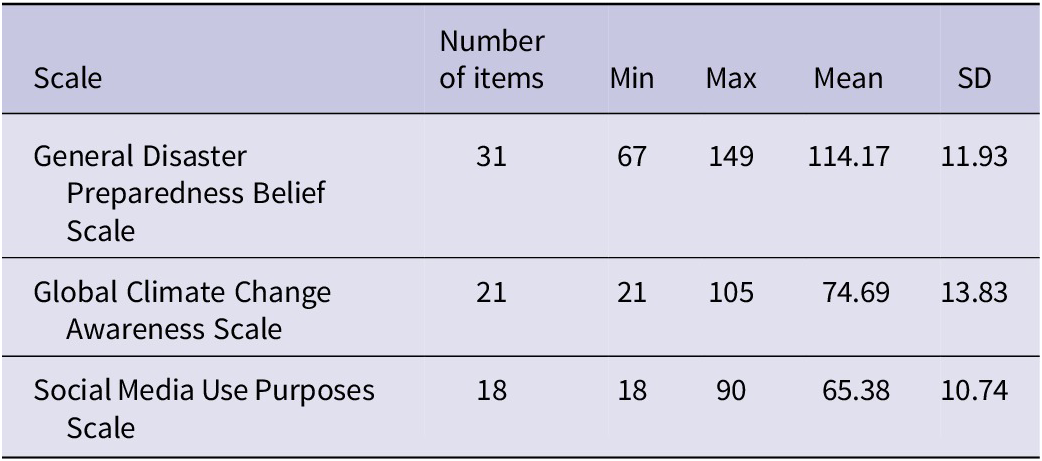
Descriptive statistics for the total scores obtained from the study scales are presented in Table 2. Scores on the General Disaster Preparedness Belief Scale ranged from 67 to 149, with a mean score of 114.17 ± 11.93. Scores on the Global Climate Change Awareness Scale ranged from 21 to 105, with a mean score of 74.69 ± 13.83. The total scores of the Social Media Use Purposes Scale ranged from 18 to 90, with a mean score of 65.38 ± 10.74.
Descriptive statistics of the study scales
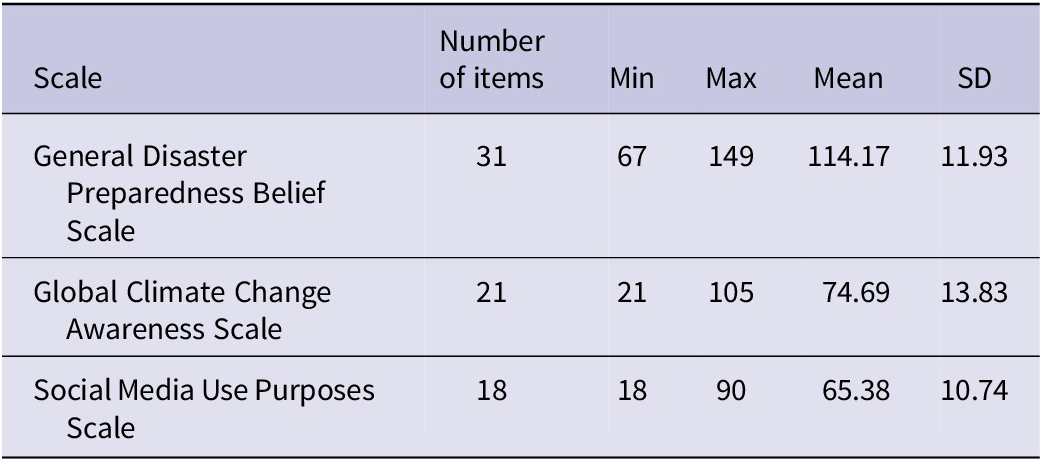
Table 2. Long description
The first row presents the General Disaster Preparedness Belief Scale with 31 items, minimum score 67, maximum 149, mean 114.17, and standard deviation 11.93. The second row shows the Global Climate Change Awareness Scale with 21 items, minimum 21, maximum 105, mean 74.69, and standard deviation 13.83. The third row lists the Social Media Use Purposes Scale with 18 items, minimum 18, maximum 90, mean 65.38, and standard deviation 10.74. Columns are labeled Scale, Number of items, Min, Max, Mean, and S D.
Relationships Between Variables
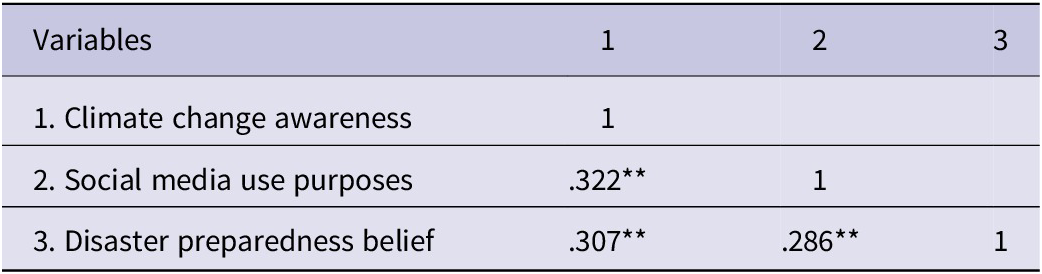
According to Pearson correlation analysis, climate change awareness was positively and significantly correlated with social media use purposes (r = .322, P < 0.001) and belief in disaster preparedness (r = .307, P < 0.001). In addition, social media use purposes showed a significant positive correlation with belief in disaster preparedness (r = .286, P < 0.001) (Table 3).
Correlation matrix of study variables

Table 3. Long description
The table consists of three variables listed vertically: 1. Climate change awareness, 2. Social media use purposes, and 3. Disaster preparedness belief. The matrix is symmetric with diagonal values of 1 for each variable. The correlation between climate change awareness and social media use purposes is 0.322 with two asterisks, indicating statistical significance. The correlation between climate change awareness and disaster preparedness belief is 0.307 with two asterisks. The correlation between social media use purposes and disaster preparedness belief is 0.286 with two asterisks. All coefficients are Pearson correlations and are significant at P less than 0.001.
Note: Pearson correlation coefficients are reported.
P < 0.001.
Regression Analysis
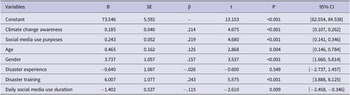
Multiple linear regression analysis was conducted to examine the effects of climate change awareness and social media use purposes on disaster preparedness belief while controlling for age, gender, disaster training, personal disaster experience, and daily social media use. The model was statistically significant (F(7, 410) = 18.33, P < 0.001) and explained 23.8% of the variance (RReference Wisner, Blaikie, Cannon and Davis2 = .238, Adjusted RReference Wisner, Blaikie, Cannon and Davis2 = .225).
Climate change awareness (B = 0.185, β = .214, P < 0.001) and social media use purposes (B = 0.243, β = .219, P < 0.001) were significant positive predictors of disaster preparedness belief. Among control variables, age (B = 0.465, P = 0.004), gender (B = 3.737, P < 0.001), and disaster training (B = 6.007, P < 0.001) were also significant. Daily social media use was negatively associated with preparedness belief (B = −1.402, P = 0.009), whereas personal disaster experience was not a significant predictor (P = 0.549). The regression analysis results are presented in Table 4.
Multiple linear regression analysis predicting belief in disaster preparedness (n = 418)

Table 4. Long description
Beginning with the constant row, the intercept is 73.546 with a standard error of 5.592, t value 13.153, and a 95 percent confidence interval from 62.554 to 84.538. Climate change awareness has B 0.185, S E 0.040, beta 0.214, t 4.675, P less than 0.001, and confidence interval 0.107 to 0.262. Social media use purposes has B 0.243, S E 0.052, beta 0.219, t 4.680, P less than 0.001, confidence interval 0.141 to 0.346. Age has B 0.465, S E 0.162, beta 0.125, t 2.868, P 0.004, confidence interval 0.146 to 0.784. Gender has B 3.737, S E 1.057, beta 0.157, t 3.537, P less than 0.001, confidence interval 1.660 to 5.814. Disaster experience has B minus 0.640, S E 1.067, beta minus 0.026, t minus 0.600, P 0.549, confidence interval minus 2.737 to 1.457. Disaster training has B 6.007, S E 1.077, beta 0.243, t 5.575, P less than 0.001, confidence interval 3.888 to 8.125. Daily social media use duration has B minus 1.402, S E 0.537, beta minus 0.115, t minus 2.610, P 0.009, confidence interval minus 2.458 to minus 0.346. Model statistics are F open parenthesis 7, 410 close parenthesis equals 18.33, P less than 0.001, R squared equals 0.238, adjusted R squared equals 0.225, Durbin-Watson equals 2.021.
Notes: F(7, 410) = 18.33, P < 0.001; R2 = .238; Adjusted R2 = .225; Durbin-Watson = 2.021.
Mediating Role of Social Media Use Purposes
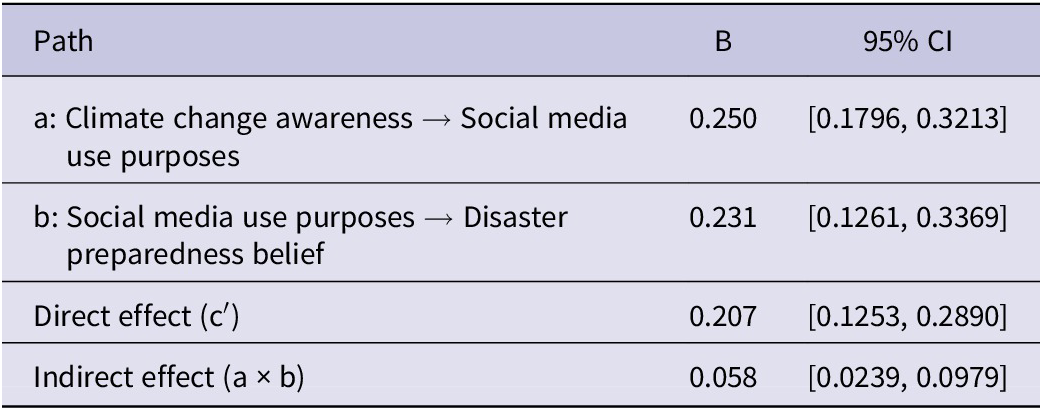
The mediating role of social media use purposes was tested using PROCESS Macro Model 4 with 5,000 bootstrap samples. Climate change awareness significantly predicted social media use purposes (path a: B = 0.250, P < 0.001), and social media use purposes significantly predicted disaster preparedness belief when controlling for climate change awareness (path b: B = 0.231, P < 0.001).
The direct effect of climate change awareness remained significant (c′ = 0.207, P < 0.001). The indirect effect was also significant (a × b = 0.058, 95% CI [0.0239, 0.0979]), indicating a partial mediating role of social media use purposes (Table 5).
Path coefficients of the mediation model

Table 5. Long description
From the top row downward, the first path is climate change awareness to social media use purposes, with B equal to 0.250 and 95 percent confidence interval from 0.1796 to 0.3213. The next path is social media use purposes to disaster preparedness belief, B equals 0.231, confidence interval from 0.1261 to 0.3369. The direct effect, labeled c prime, has B equal to 0.207 and confidence interval from 0.1253 to 0.2890. The indirect effect, labeled a times b, has B equal to 0.058 and confidence interval from 0.0239 to 0.0979.
Discussion
This study aimed to examine the effect of climate change awareness on belief in disaster preparedness among university students and to investigate the mediating role of social media use purposes in this relationship. The mean score obtained from the General Disaster Preparedness Belief Scale (114.17 ± 11.93) indicates a relatively high level of preparedness belief among participants when considering the possible score range. Previous studies conducted with university students in Türkiye have generally reported moderate levels of disaster preparedness and highlighted the roles of disaster education and risk perception in shaping preparedness-related outcomes.Reference Tatoğlu15, Reference Odabaş, Özkan and Gençer16 The fact that nearly two-thirds of participants reported receiving disaster training may have contributed to the relatively higher preparedness belief observed in this study. These findings are particularly relevant in the context of Türkiye, where disaster risk is high and strengthening preparedness among young populations is a national priority.
The mean climate change awareness score (74.69 ± 13.83) indicates a relatively elevated level of awareness when considering the scale range, suggesting that students are cognitively engaged with climate-related issues. Similarly, research conducted with nursing students has reported high levels of climate change awareness and demonstrated positive associations with environmental literacy.Reference İncesu and Altıner Yas17 Other studies indicate that climate change awareness is associated not only with sustainability attitudes but also with climate-related anxiety,Reference İlaslan and Şahin Orak18 highlighting that awareness may involve both cognitive understanding and emotional engagement. In light of recent meta-analytic evidence demonstrating that climate change anxiety is positively associated with climate action tendencies,Reference Kühner, Gemmecke and Hüffmeier9 the observed association between awareness and preparedness belief may reflect an integrated cognitive–affective pathway rather than a purely informational process. Although climate anxiety was not directly measured in the present study, emotional responses triggered by climate awareness may partially contribute to preparedness-related beliefs, suggesting that preparedness motivation may emerge from the interaction of risk appraisal and affective activation.
The mean score for social media use purposes (65.38 ± 10.74) suggests that students actively engage with social media platforms for content consumption, interaction, and communication. Consistent with prior research, social media constitutes a prominent component of young adults’ online activities, often integrated with messaging and communication practices.Reference Yalçın Gürsoy and Ozan19 Moreover, social media has been associated with learning processes and access to academic information.Reference Handayani and Jalwis20 Studies conducted in disaster contexts further indicate that social media platforms are widely utilized as rapid information channels during crises.Reference Topuz Eryürük, Odabaşı and Eryürük21 Taken together, these findings underscore the expanding role of social media as a digital environment that facilitates both information exchange and learning among young adults.
The positive correlations observed in this study indicate a consistent relational pattern among climate change awareness, social media use purposes, and belief in disaster preparedness. Regression analysis further demonstrated that both climate change awareness and social media use purposes significantly predicted preparedness belief, suggesting that preparedness may be influenced not only by individual awareness but also by the digital communication environments in which such awareness develops. Social media has been widely recognized as an important communication platform in disaster contexts, supporting information dissemination, public engagement, and emergency response processes.Reference Houston, Hawthorne and Perreault10, Reference Ogie, James and Moore22 Within this framework, social media may serve as a complementary digital context linking awareness to preparedness-related beliefs.
The mediation analysis revealed that social media use purposes partially mediated the relationship between climate change awareness and belief in disaster preparedness. The relatively modest indirect effect suggests that this relationship cannot be explained solely by social media use and that additional individual and contextual factors may also contribute. Rather than acting as a primary determinant, social media appears to function as a supportive contextual mechanism that enhances the translation of awareness into preparedness-related beliefs. Thus, social media may be interpreted as a contextual mechanism rather than a sole determinant of preparedness belief. Future research should further explore these relationships using longitudinal and experimental designs to better clarify causal pathways. Additionally, examining different populations and cultural contexts would enhance the generalizability of findings and provide deeper insight into how digital communication environments shape disaster preparedness.
Limitations
Several limitations should be acknowledged. First, due to the cross-sectional design, causal relationships cannot be inferred. Second, the study was conducted at a single university using a convenience sampling approach, which may limit generalizability. Third, data were collected through self-report and online survey methods, which may introduce response bias. Additionally, social media use was not examined in terms of platform differences or content characteristics. Despite these limitations, the study provides a comprehensive framework by integrating climate change awareness, social media use purposes, and disaster preparedness beliefs within a single model, offering a holistic understanding of these relationships among university students.
Conclusion
This study demonstrated that climate change awareness was positively associated with belief in disaster preparedness among university students and that social media use purposes played a statistically significant partial mediating role in this relationship. The findings suggest that social media should be considered not as a direct determinant of preparedness belief but rather as a complementary digital context that supports the relationship between climate awareness and preparedness beliefs.
From a practical perspective, integrating climate change and disaster preparedness content with reliable digital resources within university settings may strengthen preparedness-related beliefs among young adults. In addition, within public administration and disaster risk reduction policies, social media-based risk communication strategies targeting youth should be planned with verified and evidence-based content. Future research should employ longitudinal designs and include broader samples across multiple universities to better understand the temporal dynamics of the relationships among these variables. These findings may inform the development of targeted digital communication strategies aimed at increasing disaster preparedness among young populations.
Data availability
The datasets generated and/or analyzed during the current study are available from the corresponding author upon reasonable request.
Author contribution
Conceptualization: GÖ, SC; Methodology: GÖ, SC; Formal analysis and investigation: GÖ, SC; Data collection: GÖ, SC; Writing—original draft preparation: GÖ, SC; Writing—review and editing: GÖ; Supervision: GÖ. All authors read and approved the final manuscript.
Funding statement
The authors did not receive any specific funding for this research.
Competing interests
None.


 Open access

