




In his diaries first published in 1986, the Australian surgeon Ernest Edward “Weary” Dunlop, a former prisoner of war in Changi who had served in several makeshift hospitals across the Far East during World War II, wrote:
One aspect of our imprisonment only touched on in the diaries (and that only in relation to our time in Java) is the number of artists for whom we managed to procure paper, ink and watercolour paints. Their paintings and drawings add an extra dimension to the story of our prison life and form an invaluable record of the years between 1942 and 1945, when we were far from home and cut off from the world outside. The one camera that came into the camps with us had to be destroyed together with the film – the artists’ work is the only visual record of these times in my camps.Footnote 1
In a (failed) attempt to ensure full control of the narratives of their captives, and as reported by both civilians and military prisoners, the Japanese authorities organized regular searches of the prisoners’ belongings, confiscated drawings and set up photograph sessions to serve their propaganda.Footnote 2 Art represented a threat as it could capture evidence of ill treatment. The end of the war proved this concern to be legitimate, as many of the drawings made in that period by artists such as Ronald Searle or Philip Meninsky were indeed used during the War Criminal Trials in Tokyo.Footnote 3 In addition to this obvious power of the artworks – literally over life and death – artmaking among the Far East prisoners of war was prolific and served several purposes. Alongside sketches recording the living conditions of the prisoners, there exist many portraits, landscapes, or still-life paintings. Even in places of extreme suffering and with pitiful resources, artists not only produced art, but did so abundantly, and managed to safeguard a significant portion of it.Footnote 4
Following the end of the war, in 1946, Ronald Searle published a selection of war sketches in Forty Drawings. Twenty years later, he shared more in To the Kwai – and Back. Footnote 5 Also in 1946, Charles Thrale organized a first exhibition of watercolours and drawings which toured the United Kingdom for eighteen years, visiting 135 cities and towns, attracting thousands of people, both former prisoners of war (POWs) and members of the wider public, as comments books testify.Footnote 6 That same year, the Rev. John Northridge Lewis Bryan published The Churches of Captivity in Malaya, offering an account as a padre in the Far East, including references to the artworks created by POWs.Footnote 7 In his 1952 war narrative The Naked Island, Russell Braddon used drawings by Ronald Searle, made while in captivity, as illustrations for his account.Footnote 8 In 1995, an exhibition of watercolours and drawings by (Ashley) George Old, Keith Neighbour, Philip Meninsky and Jack Chalker was held in the Queen’s Hall, State Library of Victoria, Australia. It comprised artworks commissioned by Major Arthur Moon, an Australian surgeon and POW who had served alongside Weary Dunlop. Moon buried the resulting artworks in a tin in the jungle, which he retrieved after the war.Footnote 9 More recently, Arthur Godman, in The Will to Survive, with illustrations by Ronald Searle and Philip Meninsky, and Eric Cordingly in his diaries Down to the Bedrock (2013), mentioned the artworks made by fellow POWs, including the famous Changi cross.Footnote 10 These are only a few, yet significant, examples of exhibitions and publications either entirely dedicated to the art produced in captivity, or making references to it.
Yet, and in spite of the key role of the artists and their art highlighted above by Dunlop, hardly any academic work has explored the significant output of POWs in captivity. A recent publication, Captive Artists: The Unseen Art of British Far East Prisoners of War by Meg Parkes, Geoff Gill and Jenny Wood (2019), is a remarkable resource on artworks made by Far East POWs. However, it is primarily a catalogue of artists and their works.
Limiting the scope to British art in wartime, excellent academic work has been published on both world wars and the interwar period, the period during which many prisoners of war in Changi grew up, and which shaped their visual representations.Footnote 11 However, these studies focus primarily, if not exclusively, on British art produced in Britain (or more broadly in the West). This article thus seeks to begin to fill the gap in academic research on British art created in captivity in the Far East. It focuses especially on a particular series of religious paintings made in Changi Camp, Singapore, by Stanley Warren (1917–92) between September 1942 and the spring of 1943. Whilst they have been mentioned in a few publications, and most helpfully by Peter W. Stubbs in The Changi Murals: The Story of Stanley Warren’s War (2003), no previous academic study of Warren’s murals has been published.Footnote 12
These paintings were commissioned by one of the Anglican priests in the camp, Padre Gilbert John Marion Chambers (1900–45), for the Anglican Chapel of St Luke located within the makeshift hospital in Changi’s Roberts Barracks. They consist of a series of five murals, four of which represent major events in Jesus’s life (the Nativity, Last Supper, Crucifixion, Ascension) and one of St Luke in prison. Sometime in 1943, as the hospital was relocated, the murals were plastered over and thought to be lost. They resurfaced only after the war, in 1958, and Warren, who had not signed his paintings, was ultimately identified in February 1959 as the artist. Invited to restore the murals, though not without hesitation, he travelled back to Changi three times, in December 1963, July 1982 and May 1988.Footnote 13 The murals are now part of the Changi Museum in Singapore.
This article argues that these artworks helped to anchor the POWs in their British Christian identity, especially in the Far East, and were even a sign of resistance. Commissioned by a padre, they were designed to care for the souls of the captives, and to keep their dignity and humanity alive in the midst of extreme suffering, notably by moulding this suffering into the recognizable imagery of the cross and the familiar trope of Christian captivity. Compared with contemporary artworks in Britain, the murals present obvious similarities in the treatment of their subjects, yet given their particular context of production and location, they hold a redemptive message whose value remains to this day.
After contextualizing the paintings in the artistic and religious landscape of interwar Britain, the article will turn to Changi and the production of the murals. The analysis will explore their meaning for the POWs. Providing a comforting sense of familiarity, a message of universality and redemption, they supported the critical role of religion in the camp.
The British Artistic Context
As Margaret Garlakes writes, ‘works of art are embedded in their social contexts, are products of the conditions under which they were produced and … these contexts and conditions are complex, fluid and imbricated in one another.’Footnote 14 This evidently applies to Stanley Warren’s murals in Changi. This section places Warren in the British art context to which he would have been exposed as a child, like many of his generation, with whom and for whom he found himself producing art in captivity.
What we know of Stanley Warren’s (Figure 1) upbringing is minimal: he was born in England in 1917 and studied at Hornsey College of Art, founded in 1880, in Crouch End, Greater London.Footnote 15 After graduation, he was employed as a commercial artist and worked for the Grenada organization, producing posters to advertise film shows.Footnote 16 Albeit limited, these pieces of information exemplify two of the three closely-related phenomena characteristic of Britain’s artistic landscape during the Great War and immediately after: a need for escapism, the involvement of local communities in the commissioning of memorials, and the rise of commercial art.
Stanley Warren, c.1982, from Stubbs, The Changi Murals, 85. Reproduced with permission from Landmark Books via a CC BY-NC-ND licence.

In his excellent book British Art and the First World War 1914–1924, James Fox shows that the high demand for war images at the beginning of the Great War gave way, as early as 1915, to what George Bernard Shaw coined ‘hyperaesthesia’: a need for distraction through a variety of art forms, including, but not limited to, the visual arts. Escapism was found especially in the pastoral landscape, a recurring genre throughout the centuries.Footnote 17 Simultaneously, portrait-making was particularly in demand (for those who could afford it), both to keep in mind and heart loved ones gone to the front, and to remember those who had died. More than just a medium to keep memories alive, it also acquired some ritualistic and spiritual dimensions, offering a way to connect with a loved one from afar; in case of death, the portrait could serve as a medium between the living and the dead.Footnote 18 However, after the war, the individual receded, to the benefit of the community, with the commissioning of war memorials. Post-war Britain was marked by the need of mourning communities to gather for commemorative rituals around war memorials. As Fox points out, the key elements in the commissioning of these artworks were threefold: they were commissioned by the public; they were for local communities; and they were about the people. Unlike the art of portraiture mentioned above, except in the case of an individual portrait representing a whole generation (such as The Great Sacrifice by James Clark in 1914), these commissions were about the collective experience of war and loss. This also meant that the visibility of art in people’s everyday lives grew significantly: virtually present in every village across the country, it was immediately accessible, fully incorporated in familiar surroundings.
Concomitantly, commercial art began to emerge, especially through posters:
The war had transformed British attitudes towards the medium: between 1914 and 1918, posters had been produced in their millions, had helped mould public opinion and had even begun to be appreciated as artworks in their own right. … In the 1920s posters were even discussed at the Royal Academy, where increasing numbers of Academicians were being employed to design commercial images.Footnote 19
The fact that Warren himself was initially employed as a commercial artist reflects both the opportunities of his time, as well as a growing interest in the role and visibility of the artist within society.
The British Religious Context
Another essential aspect to understanding the Changi murals is the religious context in which Warren grew up and produced his art. As Michael Snape has richly demonstrated, along with Clive Field and others, the place that religion played during the Second World War for British soldiers has been significantly neglected.Footnote 20
This is partly due to what was communicated during the war itself. In 1937, Tom Harrisson, Charles Madge and Humphrey Jennings founded Mass Observation, an indigenous agency whose purpose was to document the everyday lives of ordinary people in Britain, in particular the ‘popular attitudes to religion, ethics, progress and politics in a London borough.’Footnote 21 The conclusion, published in Puzzled People in 1947, was that ‘most people nowadays don’t think much about religion, don’t set much conscious store by it, and have decidedly confused ideas about it’.Footnote 22
However, in his article, ‘Puzzled People Revisited: Religious Believing and Belonging in Wartime Britain, 1939–45’, Field depicts a far more complex landscape in which ‘Christian membership fell during the war but not spectacularly, by less than 4 per cent overall between 1939 and 1945, with the Roman Catholics enjoying modest growth’.Footnote 23 Reduced churchgoing did not mean a turning away from religion, but was linked to the rise of another media enabling participation in religious worship, namely radio broadcasts, as Hannah Elias has explored.Footnote 24 Services were frequently broadcast from St Paul’s Cathedral (a symbol of survival and resistance against evil through the iconic photograph of the cathedral standing in the midst of destruction and smoke in December 1940), but also from country parish churches, other cathedrals or the chapels of Oxford and Cambridge colleges. They offered psychological and spiritual comfort, providing ‘familiar hymns and music that conjured nostalgic memories of public worship.’Footnote 25 As Field reported, the ‘average aggregate audiences for the BBC’s three or four principal services … stood at 30 per cent in 1940, rose to 32 per cent in 1941, fell (inexplicably) to 22 per cent in 1942 and climbed steadily to 36 per cent in 1945 (when the People’s Service was launched)’.Footnote 26
The appetite for religion did not decline and Field argues that one of the main reasons was:
a widespread perception that the war was a legitimate defence of the ‘Christian values’ permeating the country’s political, social and ethical fabric. This view was promoted by the Churches in general and the Church of England in particular, which, after strong peace advocacy in the late 1930s, once war began largely portrayed Nazism as a totalitarian onslaught on all religion and Christian culture.’Footnote 27
When Puzzled People was published in 1947, another threat loomed large: the Cold War. Field infers that Mass Observation’s conclusion was written with this threat to the Christian ethic in mind: the ‘nation needed to be re-spiritualised and the bulwarks reinforced against the communism of the Cold War with its implicit threat – possibly even greater than Nazism – to Christian civilization.’Footnote 28 As Elias observes, this portrayal meant that the church in wartime was ‘caught between a desire to support the war effort and the gospel message of peace’.Footnote 29 This resonated at a personal level for soldiers, as Snape has studied in great detail.Footnote 30 Whilst in the context of captivity and not of combat, this tension also transpired in decisions made for the Changi murals in St Luke’s.
Equally important for an understanding of Warren’s murals in relation to religion is the ‘diffusive Christianity’ witnessed during both wars and in the interwar period: an ‘ethically based and non-dogmatic form of Christianity,’ rather a code of behaviour, with significant (perhaps surprisingly) religious illiteracy.Footnote 31 Snape quotes John Drewett, a Sheffield clergyman describing the situation in 1942:
the diffused Christian of the educated classes is almost proud of his ignorance of theology. His religion is one of works: he believes in giving the other fellow a helping hand; he is, or tries to be a good neighbour. He is friendly to the Church and admires the work of many of the clergy, but he has little patience with doctrine or dogma. The practice of Christianity seems to him to be a straightforward business.Footnote 32
Warren would have been aware of this attitude towards religion among his fellow POWs in Changi. By contrast, and whilst we do not know much about his personal religious upbringing, here is how he was described by one Ph. J. Weyer, another former POW, who identified him as the painter of the St Luke’s murals in 1959:
He was an Englishman. I’m sure of that. And he was a very fine man – quiet, modest, religious by nature. … We were both struck down by dysentery and shared the same ward. And it was in this ward that Warren painted the three [sic] murals – as a thanksgiving to God. … It was typical of him that after he had completed the murals, he did not put his signature to it. He insisted it was a gift to God and no amount of persuasion from us could make him change his mind.Footnote 33
‘Religious by nature’ and offering the murals as thanksgiving to God: these two elements convey how Warren’s attitude to religion gave a spiritual dimension to his practical works.
Stanley Warren in Singapore
Warren was about twenty-two when war broke out in 1939. In January 1940, he went to Ipswich and enlisted in the army. Due to his artistic skills, he was posted to the Royal Regiment of Artillery as an Observation Post Assistant, ‘whose responsibilities [were to make] quick drawings of panoramas used to plot targets for the guns.’Footnote 34 He served in this capacity for two years until January 1942, when he arrived in Singapore and became a bombardier.Footnote 35
By the end of the month, about 80,000 Australian, Indian, and British troops were trapped on the island, under siege along with the remaining population, as well as half a million refugees. By 13 February, the Japanese had reached the outskirts of the town of Singapore. The following day, the city was on fire. The Japanese controlled the water supply and Singapore capitulated on 15 February to prevent further massacre. Whilst victory was cause for celebration for the Japanese, captivity began for the allied forces and civilians. They were far more numerous than the Japanese had anticipated: about 15,000 Australians and 35,000 British (amongst others), along with around 3,500 British and Allied civilians.
The walk to Changi began around 17 February, a fourteen-mile trek, undertaken by the captives in the crushing equatorial heat, which lasted about two days. So-called ‘uncooperative’ behaviour led to ‘examples’ being made, with terrifying consequences. Perhaps not so-well known is the heavy impact on the Chinese and Malay populations. It is suggested that about 20,000 Chinese ‘were shot or beheaded during the first day after capitulation.’Footnote 36 Heads were put on display in the streets of Singapore as warnings to anyone considering opposition or rebellion. As Ronald Searle, along with others, reported, these horrific scenes were not simply the consequence of ‘uncooperative’ behaviour. From the first days of capitulation throughout their time of captivity, prisoners of war, military as well as civilians, would witness such scenes more than occasionally. Searle recorded in his drawings instances of the local population being beaten up for selling fruit to British prisoners, or simply for the sake of amusement.Footnote 37
Several accounts of former POWs in Changi record that conditions were at first bearable, although thousands of prisoners were packed in a camp initially built as a military base for a few hundred. Changi – named after a local tree of the Balanocarpus species – was part of a British naval base located in the Straits of Johore, with Changi as a major army cantonment.Footnote 38 In what was now used as a prisoner of war camp, food, though scarce, was still accessible. It consisted of a portion of rice with ‘the odd trimmings, plus anything edible that walked, wriggled or flew, or that could be scrounged or bartered through the wire.’Footnote 39
At least initially, and given the sheer number of prisoners, the Japanese had much else on their minds, and no plan for the prisoners. From March 1942 onwards, dysentery spread through the camp, along with its associated disease, cholera, as well as malaria. Insect bites and scratches turned into flesh-consuming tropical ulcers, and by the summer of 1942, hundreds had died. Originally composed of two barracks which would have hosted artillery men (Kitchener and Roberts), Changi ended up turning the S Block of Roberts Barracks into a hospital with one of its wings (Block 151) dedicated to patients suffering from dysentery. On the ground floor of that block, an ad hoc Anglican chapel was created at the initiative of the army chaplains. It was dedicated to St Luke, the physician.
The Making of the Murals
The murals that Warren painted in St Luke’s Chapel were not the first religious paintings he had done in captivity. Relatively soon after their arrival in Changi, a group of POWs had been sent to Bukit Timah Camp, about fifteen miles west of Changi, in order to build a road and stairs leading to a memorial to the Japanese dead in Bukit Batok, about five miles from the camp. There, a chapel was built. Warren was commissioned by a padre to decorate the asbestos panels in the altar area. These paintings rendered the nativity and the descent from the cross.Footnote 40 Here, as later in St Luke’s, Warren featured his unfortunate war companions: fellow prisoners with helmets, uniforms and digging tools – pickaxe and shovel – took the place of the disciples by the cross.
While Warren was at Bukit Timah, poor food and hygiene meant that he became quite ill, contracting dysentery, and was thus sent back to Changi on 23 May 1942, to the hospital in the Roberts Barracks. While convalescing, Warren heard a choir sing, which prompted him to enquire about the chapel.Footnote 41 Padre Chambers (British) and Padre Payne (Australian) were in charge: they had heard that Warren had made panels for the chapel at Bukit Timah. Chambers approached Warren and asked if he would consider painting murals for the chapel. Warren accepted, enquiring about dimensions and materials, and asking for a copy of the New Testament.
Although surgeon Dunlop mentioned in his memoirs procuring paper, ink and watercolour paints, many artists had to resort to whatever materials they could lay their hands on. As Warren explained in an interview in 1982, he managed to do his paintings thanks to some ‘scrounging’ of materials gathered by fellow prisoners: ‘turf-brown camouflage paint, a tin of quite high quality white oil paint, a very small tin of violent crimson, it’s really a terrible colour, and six cubes of billiard chalk.’Footnote 42
Warren began the drawings in August 1942.Footnote 43 He was still weak and reported being able to work only between the hours of nine and eleven in the morning. Despite the dizziness, Warren was able to climb a ladder in order to reach the upper parts of the walls. The type of materials available meant that his technique had to involve clear, strong sweeping lines and a dry brush in order to avoid big oil stains spreading out on the distemper. Any error would mean scraping off the basic ground colour of the distemper and ending up with a white patch of bare plaster.Footnote 44
The Murals: An Analysis
For the murals (Figures 2–7),Footnote 45 Warren read through the four gospels and selected texts ‘which would form the basis of a coherent group of paintings.’ He added an inspiring verse on each painting.Footnote 46 The first mural he undertook in September 1942 was the Nativity (Figure 2), which he aimed to finish in time for Christmas. The biblical verse he included on the mural read: ‘Peace on earth to men of goodwill’ (Luke 2: 14).
The Nativity, from Stubbs, The Changi Murals, 60 © Heritage Conservation Centre, National Heritage Board, Singapore; made available on a ‘rights reserved’ basis.
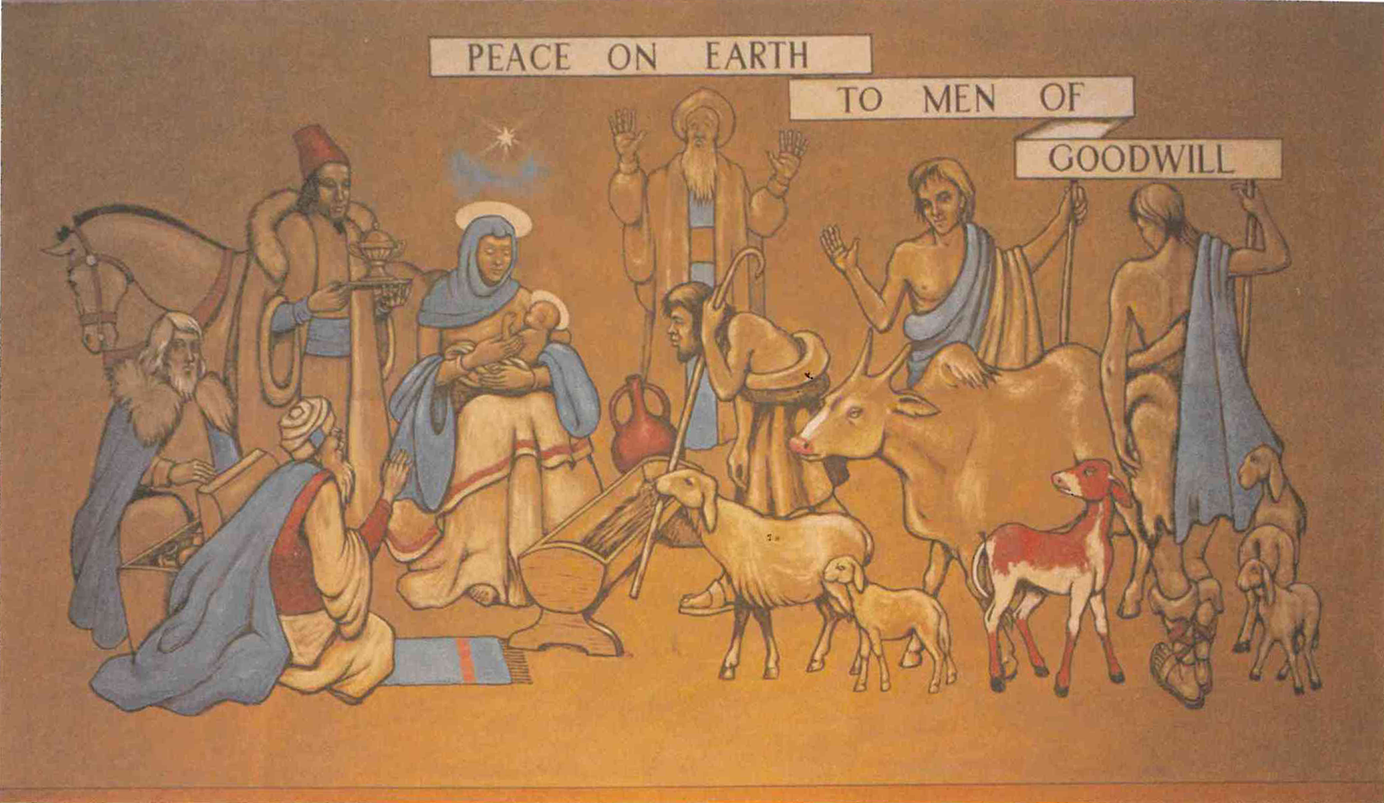
Figure 2. Long description
At the center, a seated woman in blue and beige holds an infant, both with halos. To her left, a kneeling figure in blue and red faces her, while behind him stands a bearded man in a fur-trimmed robe. Further left, a man in a red cap holds a vessel, and a horse stands at the edge. To the right of the mother and child, a standing figure in blue raises both hands, flanked by two other men in blue and beige robes, one with an arm around a large ox. In the foreground, a manger, a lamb, a goat, and a sheep are present. At the far right, a woman in blue stands with a child and two lambs. Above, a white banner in block letters reads Peace on Earth to Men of Goodwill, with the words spaced across the top. A star shines above the mother and child. The mural uses muted earth tones and stylized outlines.
Because he was uncertain whether he would survive, Warren then worked on the Ascension (Figure 3), inspired by Matthew 28: 19–20: ‘Go and teach the nations, I am with you’. By completing both the Nativity and the Ascension first, Warren ensured that, should he die before the series was finished, the full story of Jesus’s earthly ministry would in some way be covered.
The Ascension, from Stubbs, The Changi Murals, 62 © Heritage Conservation Centre, National Heritage Board, Singapore; made available on a ‘rights reserved’ basis.

Figure 3. Long description
At the center stands a radiant, partially draped figure with a halo, right hand raised and left hand lowered. Surrounding this figure are eleven individuals in robes, arranged in a semicircle. Four kneel or crouch at the lower left, two with hands raised, one holding a cross. The remaining seven stand to the right, some with hands clasped, one holding a staff, and one with a hand to the face. Above the group, two horizontal banners display the text Go and teach the nations and I am with you in uppercase letters. The background is a plain ochre tone.
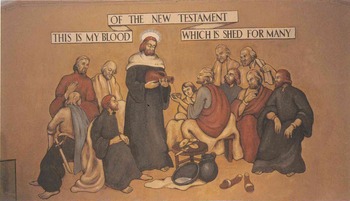
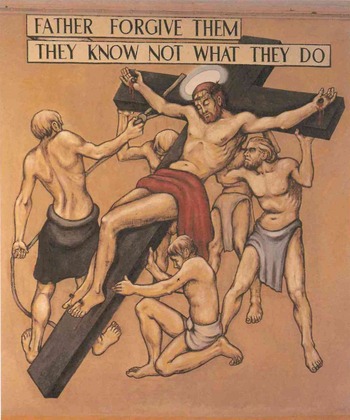
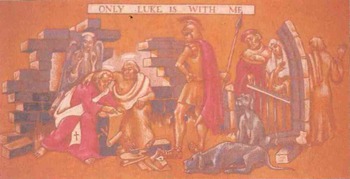
However, although still weak, Warren was able to complete three more paintings: the Last Supper (Figure 4) with ‘This is my blood of the New Testament which is shed for many’ (Luke 22: 20; Matthew 26: 28); the Crucifixion (Figure 5), with ‘Father forgive them, they know not what they do’ (Luke 23: 34). He concluded the series with a specific request made by Padre Chambers: a representation of St Luke in prison with ‘Only Luke is with me’ (2 Timothy 4: 11; Figures 6–7).
The Last Supper, from Stubbs, The Changi Murals, 61 © Heritage Conservation Centre, National Heritage Board, Singapore; made available on a ‘rights reserved’ basis.

Figure 4. Long description
At the center, a standing figure with a halo and white head covering holds a cup and plate. Surrounding this figure are eleven others, seated or standing, wearing robes in muted reds, blues, and browns. The group forms a semicircle, with some figures gesturing toward the central figure or holding bread. At the bottom, a low table holds loaves of bread, two large black vessels, and a cup. Sandals are placed on the floor near the table. Above the group, four white banners with black text read, from left to right and top to bottom: ‘OF THE NEW TESTAMENT’, ‘THIS IS MY BLOOD’, ‘WHICH IS SHED FOR MANY’. The background is a plain ochre wall, emphasizing the figures and text.
The Crucifixion, from Stubbs, The Changi Murals, 59 © Heritage Conservation Centre, National Heritage Board, Singapore; made available on a ‘rights reserved’ basis.

Figure 5. Long description
At the top, two lines of uppercase text read FATHER FORGIVE THEM and THEY KNOW NOT WHAT THEY DO. Below, at the center, a figure with a halo is nailed to a large dark cross, arms outstretched horizontally, feet together. Blood is depicted at the hands and feet. To the left, a figure in a dark loincloth holds a whip and looks toward the central figure. Below the cross, a kneeling figure in a white loincloth hammers a nail into the feet. To the right, two figures in light loincloths support the cross and the central figure’s body. Another figure stands behind the cross, partially obscured, holding the central figure’s arm. The background is a plain ochre color, emphasizing the figures and the cross.
‘Only Luke is with me’ (original mural from which a door was cut out), from Stubbs, The Changi Murals, 63 © Heritage Conservation Centre, National Heritage Board, Singapore; made available on a ‘rights reserved’ basis.

Figure 6. Long description
From the left edge, two figures with halos are outlined against block-like architectural forms. At the center, a Roman soldier in profile faces right, holding a spear and shield. Above the soldier, the inscription Only Luke is with me is enclosed in a rectangular box. To the right of the soldier, three figures are depicted, one with a halo and two without, all facing left. The rightmost background features more block-like shapes and a faint figure. The mural is faded, with visible areas where a door was cut out, disrupting the continuity of the artwork.
‘Only Luke is with me’ (post-war reconstructed mural by Warren), from Stubbs, The Changi Murals, 63. Reproduced with permission from Landmark Books via a CC BY-NC-ND licence.

Figure 7. Long description
At the center foreground, a robed figure in red and white with a cross on the garment bends to comfort a seated, partially clothed man. Scattered scrolls and books lie at their feet. Behind them, broken stone walls form an archway. To the right, a Roman soldier in armor and red cloak stands with a spear, facing the central figures. Further right, two onlookers in robes stand behind a barred gate, one with a hand raised. Another figure stands at the far right edge, facing away. In the foreground, two dogs, one sitting and one lying down, are positioned near the gate. At the top, a banner reads ‘ONLY LUKE IS WITH ME’ in uppercase letters.
Familiarity
The location of the paintings guided Warren’s decisions. The chapel was a place of gathering, where (convalescing) POWs were reminded of a shared identity. Services could conjure up nostalgic memories of home, notably through the singing of hymns. This collective experience shaped a sense of rootedness in a British Christian tradition. As such, it was even a source of resistance in the midst of dire circumstances of humiliation and physical suffering.
As a result, Warren’s attention in the Nativity was on conveying a sense of familiarity to European eyes, notably in the Virgin Mary through her features (tenderness) and costume (traditional dress). Counter-intuitively perhaps, this was not the decision that Warren had made for the chapel at Bukit Timah, where he had chosen to represent a Malay Madonna.Footnote 47 He also commented on how the painting contained some humour: in a shepherd ‘purs[ing] his lips cooing to the child’; in all the animals moving towards the child except the red calf ‘irreverently turning away’; and in Joseph raising his hands ‘in absolute amazement over everything that was happening around him.’Footnote 48 Humour in the camp was a way of coping.Footnote 49
More generally, the disciples were portrayed as POWs, as the figures wearing loin cloths in the Crucifixion exemplify. Similarly, in the painting of the Last Supper, Warren mentioned that the three-legged tables were from the Royal Army Medical Corps (RAMC) messes, while the bowl and jug were the ones used in the wards for washing patients who were bedridden. The sandals were what they called ‘chappal’: a wooden sole with pieces of rubber attached to it.Footnote 50
The inclusion of such familiar details makes Warren’s war paintings reminiscent of some of the war paintings of his contemporaries, such as Stanley Spencer (1891–1959) in Sandham Memorial Chapel (1926–32), or Duncan Grant (1885–1978) and Vanessa Bell (1879–1961) in the church of St Michael and All Angels in Berwick, Sussex (1941–4). As Paul Gough explores, facts and details from Spencer’s experience at the Beaufort War Hospital in Bristol enriched ‘the imaginary narrative of the Burghclere panels.’Footnote 51 Spencer did not depict the front and its battlefields, but the rear, the everyday activities of the wounded soldiers involving familiar objects. Likewise, and at the same time as Warren was painting the murals in St Luke’s, Duncan Grant and Vanessa Bell were undertaking their work in the Berwick church. Just as Warren depicted fellow prisoners as the disciples, Grant included three representatives of the British Armed Forces in the depiction of Christ in glory on the chancel arch.Footnote 52
Although contemporaries of Warren may have been able to identify features of fellow prisoners in his paintings, we do not have evidence of this. Furthermore, Padre Chambers might have been reluctant about including the faces of actual prisoners. One example to support this is the painting of St Luke, requested by the padre, and which was the cause of a disagreement between the two men. While Chambers wanted ‘Luke in Prison Writing His Gospels’, Warren remembered that he wanted to:
show Christ[’s] teaching mission. I wanted to show perhaps Luke raising a sick man. … But the Padre concentrated on this idea of Luke in Prison. And in the end, I fell in with the idea. And so a Roman soldier [is] watching the old saint, assisted by a boy who’s holding sheets; an angel stands behind him. And I can’t quite remember who the other figures were. We took saints at the time who were known to be there.Footnote 53
In response to the suggestion of representing Luke raising a sick man, Padre Chambers thought that it would be ‘too near our own situation.’Footnote 54 With many dying on a daily basis, others amputated or left with severely damaged limbs due to tropical ulcers, one might imagine the pastoral concerns of the padre. By contrast, the trope of captivity was welcome, as it drew the prisoners into a narrative that went beyond their local reality.
Somewhat disappointed by this request, Warren still found a way of communicating his personal take, through the representation of ruins: ‘I wanted to break the walls of the prison down and show that the Word could not be contained and perhaps, I suppose, the spirit of man could not be contained.’Footnote 55
Universality
As this example of St Luke illustrates, Warren’s faith was mainly characterized by human sympathy, universalism and idealism: threads tightly entwined throughout his representation of Jesus’s ministry. Commenting on the inscription on the Ascension painting (‘Go and teach the nations’), Warren noted: ‘There was, you know, a concept of total universality of the message.’Footnote 56 Likewise, for the Last Supper, Warren explained that he had chosen ‘the broadest of many of the texts which I used. “T[his is my blood which is shed for many]”.’Footnote 57 Here, Warren avoided the use of the words ‘shed for you’: ‘many’ includes ‘you’ as well as others.
The Nativity and the Crucifixion deserve closer attention. Through the three kings in the Nativity, Warren wanted to represent all humankind and commented that he had depicted the king holding the cup as ‘oriental, he would be from the Far East’, while the king kneeling at the front with the turban and the red robes would be from the Middle East, and the third could be ‘Slav or Teutonic somewhere from the north.’Footnote 58 While Balthazar, Caspar and Melchior traditionally represent nations and peoples from around the world, to include a king from the Far East paying homage to Christ might have borne particular meaning for Warren’s fellow POWs.
Warren wanted to go further, and the inscription included in the Nativity (‘Peace on earth and to men of goodwill’) was the cause of a lasting disagreement between him and the padre. Before we analyse this, the commission needs contextualizing.
As it had been the case for Spencer, whose work was commissioned by Mary and John Behrend, as well as for Grant and Bell, whose work was commissioned by George Bell, bishop of Chichester, the fact that the Changi murals were a commission by a padre is key in understanding their role in St Luke’s Chapel. As Snape has argued in God and the British Soldier, the role of the padres during the world wars became quite significant from 1915 onwards: it ‘was systematically harnessed to the maintenance and promotion of the army’s morale.’Footnote 59 Beyond fighting alongside soldiers, burying them amid battlefields and keeping a record of the location of the graves for bereaved families, chaplains were ‘expected to play a direct and sustained role in motivating soldiers to fight.’Footnote 60 This included the delicate job of finding the right balance between preparing the men for battle in their sermons, and setting peace as the ultimate goal. It meant providing some moral and religious justifications for the war, appealing to their strong nationalist convictions, while arguing that it would lead to a greater good. Yet, as Snape points out, some resisted this use of Christianity, like the practising Anglican Christopher Stone, officer in the 22nd Royal Fusiliers, who wrote to his wife in January 1916:
I have argued with the Chaplain out here about Christianity and the War, and have maintained that the war is not Christianity’s chance at all, as some thought it would be. It is opposed to war and no juggling with texts will make it approve of war. If it means anything it means peace on earth, good will towards men; it means war on evil things, on the Devil; but it does not mean stick that man with a bayonet because he’s wearing a German uniform.Footnote 61
Whilst the Changi murals were produced in a vastly different context from that of the soldiers at the front in the Great War, it is remarkable that this same verse ‘peace on earth, good will towards men’ (Luke 2: 14) was at the core of an argument between the painter and the padre. This was a text very familiar to practising Anglicans at the time, for it was included in the words of the Gloria, used in the order for holy communion in the Book of Common Prayer: ‘Glory be to God on high, and on earth peace, good will towards men’. It had also been popularized through Christmas hymns such as ‘It came upon the midnight clear’ and (somewhat paraphrased) ‘While shepherds watched their flocks by night’, in which the same idea was conveyed (‘on the earth be peace; … Good-will … to men’). Both carols appeared in the English Hymnal which was used in Changi.Footnote 62
Practising Anglicans (and Christians more broadly) in World War II continued to seek guidance, or at least a moral compass, from the Scriptures and struggled, as had Christopher Stone in the previous world war, with interpretations which did not align with what they believed to be Christian teaching about peace. In that sense, religion was also instrumental in preserving one’s soul in the midst of excruciating circumstances.Footnote 63 In his capacity as carer of souls, the padre continued to play a key role in maintaining the morale of the troops and, in Changi, Padre Chambers must have considered how the murals in St Luke’s could have contributed to this. If there was no military campaign to undertake against the Japanese, there was still something to fight for: one’s life and one’s dignity. Since Christianity would have been perceived as a foreign religion to the Japanese as well as promoting weakness, preserving Christian values meant preserving a British identity.Footnote 64
In the absence of a comment by Chambers himself, one can only hypothesize about the reason for the disagreement between the padre and the painter over the translation of Luke 2: 14. The version that Warren had in mind was the one mentioned above, from the King James Bible, popularized through hymns: ‘Glory to God in the highest, and on earth peace, good will toward men.’ However, another version appears on the painting: ‘peace on earth to men of goodwill’. Did the ‘men of goodwill’ include the Japanese? Was it an invitation to the prisoners to be men of goodwill? Warren had to alter the version, coming to terms with it thinking that the point was peace on earth and goodwill. But he still commented years later that Padre Chambers had ‘a very orthodox, a somewhat orthodox view.’Footnote 65
Yet, this was not to be Warren’s last attempt at changing the version. In 1958, when he was first identified and contacted to restore the paintings, not all of them had been uncovered and he thought that the Nativity painting had been lost.Footnote 66 The St Luke’s painting, partially destroyed, was recovered in 1964 and the Nativity painting only in 1982. Believing that it was lost, Warren made in 1963 a wallboard mural of a new Nativity to be transported to Changi. In it, he made some changes to the original painting: he substituted the donkey with an albatross in order to represent the Changi Air Squadron, and he also restored the King James translation in lieu of the version favoured by Padre Chambers. He explained that putting the albatross instead of the donkey was permissible because it was a reconstruction and not the original. However, when the Nativity mural was rediscovered in 1982, Warren reintroduced the donkey and kept the translation originally put on the wall.Footnote 67 Warren commented: ‘I was absolutely staggered that this should still be there. That’s the kind of story of their indestructibility.’Footnote 68
A Redemptive Quality
The final example on the theme of universality is the Crucifixion. By selecting the verse from Luke 23: 34 (‘Father forgive them, they know not what they do’), Warren made a strong statement which would outlive all POWs.
Two years before Warren started painting the murals in Changi, on 14 November 1940, Coventry Cathedral had been bombed. On Christmas Day of that year, a BBC radio broadcast took place from the ruins, and Provost Dick Howard shared a message of resilience, trusting in Christ’s presence amidst the suffering, and of indestructibility.Footnote 69 After the Blitz, ‘Father Forgive’ was inscribed on the wall of the ruined chancel. The destruction of the cathedral would have been known to Warren. In Changi, a prayer for forgiveness in the midst of suffering was an invitation to see even the guards as fellow human beings caught in the war, just like the prisoners. In an interview, Warren shared his motivation:
I was most anxious to show that those who carried out the execution of Christ were after all obeying orders. And this had special relevance because some of the extremely cruel things that were done to prisoners, which we won’t recount here, were often carried out by orders from above. And it must be remembered that those who carried them out were merely instrumental.
The words ‘Father forgive us [sic]’ obviously had a direct reference [to] ‘They know not what they do’. For some reason, the guards who used to come in every day and watch me, they would sit on the benches opposite, leaning their rifles against the wall, take off their caps and mop their heads, seemed particularly interested in this. Perhaps they recognised the crucifix symbol.
The sergeant-in-charge, too – he became very interested and watched the painting; stood here with his hands on his hips, watching the painting. I often wondered what would happen if they actually knew the words, could translate the words. I just wondered what their reactions would be. Never quite sure.Footnote 70
Although asking for forgiveness in the midst of atrocities might have proved rather challenging, the accounts of POWs such as Weary Dunlop and Olga Henderson, also express the desire to recognize the humanity of the Japanese guards and to acknowledge that they too had been victims.Footnote 71
Equally powerful for the POWs was identification with the crucified Jesus, to which Warren’s painting of the descent of the cross in Bukit Timah could already testify. The crucifixion had become a powerful symbol at the beginning of the Great War, for the popular painting by James Clark, The Great Sacrifice, completed in 1914, made a lasting impact on British people’s minds.Footnote 72 In the accounts of former POWs of the Second World War, it is not uncommon to encounter an analogy between Jesus’s crucifixion and their experience in the camps or, as Dunlop put it, their ‘Via Dolorosa’.Footnote 73
The Murals, Liturgy and Space
Alongside the paintings, the liturgy designed by the padres also helped in shaping a narrative for the POWs. As already noted, while Warren was convalescing on the first floor of the Roberts Barrack after his return from Bukit Timah, his attention was caught by the sound of the choir: ‘I heard the choir singing. … it was quite fascinating about the singing. It was not only high quality but they were singing the litany, the “Marbec” litany.’Footnote 74 Church of England chaplains used the Book of Common Prayer and Padre Chambers’ private papers contain an order of service for compline crafted after the 1928 Book of Common Prayer.Footnote 75
Chambers’s papers also contain the running order for a service of lessons and carols for Christmas Day 1942 and in several accounts – Dunlop’s diaries, Chambers’s papers, and other items in the Royal Army Chaplains’ Museum’s archives – there is evidence that these services (especially at Christmas) were fairly well attended. At the midnight mass in 1942, Chambers recorded 200 communicants and 600 participants, with padres Wearne, Chambers and Paine [Payne] serving. In the registers of services in the archives of the Royal Army Chaplains in Shrivenham, 115 communicants were recorded at the 1942 Christmas midnight service at which the Rev. L. V. Headley, R.A.Ch.D. [Royal Army Chaplains’ Department], presided.Footnote 76
Weary Dunlop was in Batavia, on the northern coast of Java, on Christmas 1942 and noted:
An impressive combined service at 0930 of some 1400 men in the form of hollow square in the recreation ground, with a choir at the eastern end. All the old Xmas hymns, and the choir sang some carols very well, accompanied by Page of the silver trumpet and ‘Curly’ with the baritone. ‘Silent Night’ was very well done.Footnote 77
On 24 April 1943, which was Holy Saturday, Dunlop was in Konyu Camp in Thailand, and gave an account not only of the attendance of the Church of England service, but also of the sermon preached that day, which would have deeply resonated with the captives:
Some hundreds of men attended the C. of E. service. … As the light faded, the padres’ candles and a few fires lit the scene fitfully. The theme of the address was suffering, the cross and the empty tomb. The suffering of which we had experienced something, only a little of that endured by millions of others, was not in vain; that if all suffering ended only in muddled stupidity the sacrifice of the Cross would not have been made. This service was followed by the Last Post and Reveille, beautifully played by Page. Then ‘God save the King’.Footnote 78
He also mentioned services by the Roman Catholic Church and the Free Church in Changi in 1944. This suggests that, as Snape highlights in Forgotten Warrior:
Contemporary statistics indicate that, from July to September 1942, around one-third of the British occupants of Changi were regular Anglican communicants – a proportion that remained remarkably stable until the end of the war and was far higher than in civilian life, especially among younger adult males. … Religion … was very much in vogue in Changi.Footnote 79
Chapels were not only used for services, but were places for captives to sit down, reflect, and have conversations.Footnote 80 Warren noticed, for instance, that, as he was painting the murals, fellow prisoners as well as guards would engage with the chapel. Remembering that St Luke’s Chapel was always cool, regardless of the outdoor temperature, he recalled: ‘the men would sit quietly on the benches, often discussing home, discussing family affairs and so on. … Incidentally, very, very few of them knew me. And I often sat at the back and listened in to their conversation.’Footnote 81 He remembered guards coming to look at the paintings.Footnote 82
Finally, the paintings held a particular place in Warren’s personal faith journey. Warren remembered that Padre Chambers led prayers of intercession when he was put on the ‘seriously-ill’ list before completing the Crucifixion painting.Footnote 83 Above all, in his view, the paintings themselves saved his life, when in 1943 he was almost sent elsewhere:
[O]nce I started the murals, I had already been transferred back to my own unit at Changi, and used to cross the barrier each day. And Colonel Collins, whom I had never seen really, the CO [Commanding Officer] of the hospital, said, ‘Do you know, Warren, your unit is going up country, but you are not in very good shape, you will have to need medical treatment and I think you should stay and finish the murals.’ Well, it just happened that that particular party F11 was the most ill-fated party. … I think everything happened to them including cholera; you know, they were almost decimated. And had I gone with them, most certainly, I would have died. So the murals very directly saved my life the way I could never have foreseen.Footnote 84
In the wider context of the war, of uncertainty, captivity and suffering, when one hardly had any control over one’s fate, when life seemed meaningless and hanging by a thread, it is no surprise that some objects would have been conferred mysterious, if not magical power. As Snape found in both world wars, amulets, individuals and even rituals were ‘widely employed to fend off bad luck.’Footnote 85 That Warren perceived the murals to hold a protective divine presence concurs with similar interpretations of the time.
Conclusion
Padre Chambers died in July 1945. He was forty-five. Working with fellow POWs in a tunnel, a prisoner was severely beaten up for failing to drag a basket of stones. Chambers intervened and ended up with severe internal bleeding from which he died overnight.Footnote 86
Unlike Germany (in spite of the atrocities perpetrated in the Nazi camps), Japan never ratified the Geneva Convention of 1929 on the treatment of prisoners. The conditions and humiliation were thus notoriously stark. Yet, and unlike Searle and others, Warren decided against depicting scenes of brutality, at least while he was in Changi.Footnote 87 He acknowledged that most of the works he did were idealized scenes: what characterized his faith was a strong idealism, a broad human sympathy and universalism, which shaped his religious art. Also, unlike most of the artworks of Searle, Thrale or others, Warren’s murals were visible to the Japanese and to the other guards around. Had they reflected an unflattering image of the jailers or criticism towards the Japanese, the paintings would have exposed Warren to serious reprisals. But this is not to say that what Warren depicted was not grounded in what he believed.
By placing Warren’s Changi murals in the wider context of the Second World War, this article has highlighted how they participated in keeping a sense of identity alive, offered familiar visuals around which a community could gather, and even contributed to a form of resistance against humiliation and extreme suffering. Whilst the content of the murals was the result of Warren’s decisions, sometimes with the occasional yet nonetheless significant input from Chambers, they were about the community, for the community, and to some extent made by the community (in the gathering of materials). As such, they were not too dissimilar from the memorials which emerged after the Great War and in which the cross featured prominently. A commission from the padre, the murals could help preserve the souls of the men and serve as ‘a mental life-belt’, as Ronald Searle put it, offering something familiar to anchor oneself when there was no escape in sight.Footnote 88
One surprise perhaps is that the murals are rarely, if at all, present in post-war accounts. Searle is often mentioned, including as the artist behind several theatre paintings in the camp, which may explain why the paintings in St Luke’s Chapel were initially attributed to him. There may be several reasons for this. First of all, few would have ventured to the dysentery wing unless they had to, and many died there. Secondly, there were other chapels across the camp. In addition, many left the camp to work on the Siam-Burma railway, and those who did not die there ended up in the Changi prison when they returned, in which stood another chapel: St Paul’s. Finally, and crucially, the murals were visible only for a short period of time: from Christmas 1942 until the hospital was moved from Roberts Barracks to Selarang Barracks in August 1943 and they were covered up.
After his return to London following the war, Warren painted a series called the ‘Black Passion’ around 1959–60.Footnote 89 Unlike the Changi murals, it depicted brutality and violence, with some figures being reminiscent of Warren’s time in Changi. This, sadly, was not uncommon among POWs who, over the years after the end of the war, carried or developed severe health issues, as well as a complicated relationship with their memories from the Far East, marked by physical and psychological trauma. As mentioned above, Warren was obviously constrained while in the camp, given the visibility of his art. Back in Britain, the violence of the experience resurfaced in his later works. But the murals were a means of acknowledging the POWs’ conditions, notably through the imagery of the cross and the trope of captivity, and contained a valuable message of redemption.
Warren’s murals are still visible today as the camp has been turned into a museum. However, concerns have been expressed that, instead of a site of pilgrimage and commemoration, it runs the risk of becoming a tourist attraction. There are also some questions around its being designed as a site of ‘national’ memory.Footnote 90 Reflecting on his experience of painting the murals, Warren concluded:
I think if one is a committed Christian, in the environment in which we lived here, if Christianity means anything to you at all, this is the time when it becomes real. That is my experience. To work on the murals was a religious experience for me. An experience that I had never known before and to some extent that I had never known again.Footnote 91




 Open access

