




The Alchemy of Performance
Images of transformation emerge as a recurrent trope in the reception of Joseph Joachim's performances. Numerous listeners were left with the impression that he had magically transfigured himself into the composer of the work. This phenomenon crystallized in his performances of Beethoven's violin concerto, a work that became an emblem of his identity as a performer. Hans von Bülow, entranced by Joachim's performances, imagined that ‘[y]esterday Joachim did not play Beethoven and Bach; Beethoven played himself’.Footnote 2 The Berlin-based music critic Otto Gumprecht (1823–1900) similarly marvelled at Joachim's shape-shifting: ‘I could no longer perceive the figure of the player, for it was to me completely obliterated by another. I clearly recognized it, that thickset, carelessly-clad figure, with wild hair all standing on end’.Footnote 3 Brahms expressed a similar idea, but with regard to authorship rather than embodied presence, when he wrote to Joachim, ‘I have always considered his [Beethoven's] concerto to be your own’.Footnote 4
This mingling of identities often struck spectators as a form of magic that bordered on the incantatory. In the afterglow of Joachim's 1853 performance of the Beethoven violin concerto, Robert Schumann, who had conducted the concert, extolled Joachim as a ‘magician and sorcerer who, with expert hand, led us through the heights and depths of this enchanting structure that most plumb in vain’.Footnote 5 The Rheinische Musik-Zeitung published a review of this concert which similarly invoked notions of rebirth, transfiguration and divine inspiration.Footnote 6 The review has a Beethovenian stamp to it, referring to ‘der göttliche Funke’ (the divine spark), which resonates with Schiller's renowned words ‘schöne Götterfunken’ in Beethoven's Ninth Symphony. Ideas of magic also surface in Eugène Ysaÿe's mid-1880s perception that ‘Joachim's interpretation [of Beethoven's violin concerto] was as a mirror in which the power of Beethoven was reflected’.Footnote 7
A number of commentators ascribed this transformative phenomenon to the apparently improvisatory character of Joachim's playing. Andreas Moser, Joachim's biographer, observed that his performances sounded as though the work were spontaneously taking shape at that moment. For Moser, Joachim followed the inspiration of the moment and thereby discovered new facets of works that had already been played a hundred times.Footnote 8 Such rhetoric resonates with what Janet Schmalfeldt has theorized as the process of becoming, entailing formal trajectories that undergo continual transformations during a performance.Footnote 9
Joachim's perceived transformations, however, involved not only the musical work itself, but also his embodied presence on stage. Scholars such as Donald Francis Tovey, and more recently Katharina Uhde and Karen Leistra-Jones, have explored how Joachim generated the electrifying impression of becoming the composer and creating each work anew. Leistra-Jones has identified several of the features that imparted a sense of authenticity to Joachim's performances, such as the absorption and introspection projected in his publicity photos as well as his restrained facial and bodily movements when playing.Footnote 10
In this article I examine an additional factor that seems to have contributed to Joachim's perceived authenticity: the way in which his cadenzas helped shape his public image. These cadenzas, as I will argue, offer new insights into his reception as an authentic and improvisatory performer. Pertinent here is the related question of how Joachim fostered slippages between composer and performer. I situate his improvisatory reputation in the context of his cadenzas. To be sure, the genre had become decidedly less improvisational since its extemporaneous heyday in the eighteenth century.Footnote 11 A watershed moment in this regard was Beethoven's Piano Concerto No. 5 in E flat Major, Op. 73 (1809), in which the first-movement cadenza appears in the score as an integral part of the work.
In fact, Beethoven's approach seems to have contributed to the evolutionary forces that were to make the cadenza a largely composed genre by the 1850s. Beethoven's meticulously crafted cadenzas for Mozart's Piano Concerto No. 20, K466, diverged from the traditional improvisatory approach.Footnote 12 In Beethoven's hands, the cadenza became something almost akin to a theme and variations in which developmental work could unfold.
Nonetheless, throughout much of the nineteenth century, cadenzas could still evoke an air of spontaneity that hearkened back to a pre-Werktreue aesthetic of performative creation. We might borrow Dana Gooley's apt term ‘improvisation imaginary’ to describe cadenzas as the nineteenth century wore on, during which they were often notated rather than improvised but still carried the connotation of immediacy.Footnote 13 The (increasingly false) perception of the cadenza as improvisatory persisted as late as the 1920s, during which Ferrucio Busoni described his own cadenzas as ‘completely improvised’ although he had written them in advance.Footnote 14
Joachim composed – and performed – cadenzas for many of the concertos in his core repertoire, including works by Giuseppe Tartini, Mozart, Giovanni Battista Viotti, Beethoven, and Brahms. My examination of selected cadenzas by Joachim relies primarily on their published versions in the Moser/Joachim Violinschule Vol. 3.Footnote 15 Regrettably, no dates seem to be available for when Joachim first composed and performed these cadenzas. The only date that can be reliably ascertained is the date of publication, 1905, in the Violinschule. It seems likely, however, that Joachim performed versions of these cadenzas well before then. Joachim's cadenza for the Beethoven violin concerto is one of the few for which multiple notated versions exist.Footnote 16 Joachim's other cadenzas, for which we have only the Violinschule scores, may well have been more virtuosic in performance than in their published form. Nevertheless, I assume that the Violinschule versions offer a reasonably accurate record of the concert stage versions.
In my analyses of Joachim's cadenzas, I propose that they enact a compositional approach to the thematic material. Joachim frequently recomposes not only the soloistic passages but also, as we will see, several ritornello sections that are played only by the orchestra in in what I will term the ‘parent’ concerto. To be sure, the textbook notion of concerto form, especially for eighteenth-century repertoire, is that all of the ritornello music is generally repeated in the solo exposition. However, in some concertos, the orchestra plays ritornello material that does not reappear in the solo exposition.Footnote 17 Several concertos for which Joachim wrote cadenzas belong to this category (for example, Beethoven's Violin Concerto in D Major, Op. 61/i). In such cases, Joachim's use of ritornello themes may be heard as a soloistic performance of orchestral ideas.
When engaging with ritornello and solo material, Joachim's cadenzas are often developmental and modulatory. As I will propose, they explore harmonic avenues that are only hinted at in the ‘parent’ concerto. My aim is to show how Joachim fulfils moments of unrealized potential in the parent concertos. Joachim's cadenzas are faithful to the original work in an intriguingly paradoxical way. By pursuing new possibilities for modulation and thematic development, Joachim performs a double manoeuvre: he honours the original conception of the work while imbuing it with his own compositional voice. At times, it is as though the original composer of the concerto is revising, commenting on, and expanding his own work. Before delving into a more thorough analysis of this phenomenon in specific cadenzas, I set the stage by exploring Werktreue, virtuosity and cadenza practice in Joachim's milieu. Equipped with this background, I then examine Joachim's cadenzas from a hermeneutical and music-theoretical perspective.
Between Werktreue and Virtuosity
Joachim's cadenzas are not the only nineteenth-century contributions to the genre that evince a compositional approach. He was, however, among the few performers who wrote compositionally meaningful cadenzas. Most other cadenzas of a similar quality were written by composers who did not have prominent careers as public performers. Cadenzas by (for example) Beethoven and Brahms could not necessarily make the same impression as Joachim's, for they were not frequently performed on stage by the person who had written them.
On the other hand, the cadenzas created by performers tend to show less compositional ambition, often employing nonthematic passagework and verbatim quotations rather than motivic development.Footnote 18 Eugène Ysaÿe (1858–1931) observed that ‘[i]n original cadenzas by virtuosi, we find too much violin and too little music’.Footnote 19 Ysaÿe's own cadenzas for the Beethoven violin concerto were criticized for these very flaws, being deemed ‘monstrous excrescences on the movements, nailed on, not grafted in, have no form, being merely examples of madly difficult ways of playing the themes that have been reasonably and beautifully presented by Beethoven’.Footnote 20
In a musical culture in which compositionally weak cadenzas such as Ysaÿe's were often heard on the concert stage, Joachim distinguished himself from other virtuosi by writing cadenzas in the style of serious compositions. Pertinent examples include his cadenzas for concertos by W.A. Mozart, Giovanni Battista Viotti, Beethoven, and Brahms, some of which will be examined later.
In Joachim's era, a cleft was rapidly developing between performers and composers. Lydia Goehr observes that ‘[t]he ideal of Werktreue’ created a culture in which ‘performances and their performers were respectively subservient to works and their composers’.Footnote 21 Yet Joachim inhabited the dual worlds in a way that enabled his cadenzas to be performative events and compositional interventions. He thus belongs to an elite group of composer-performers who wrote and played cadenzas that engaged meaningfully with the parent concerto, a group that also included Clara Schumann,Footnote 22 Henri Vieuxtemps, Louis Spohr and Felix Mendelssohn.Footnote 23
Beginning with Joachim's earliest performances as a child prodigy, his cadenzas were hailed as compositional masterpieces. An anonymous critic, ‘Q’, in The Musical World (1844), described Joachim's two cadenzas for the Beethoven Violin Concerto as ‘tremendous executive feats, but ingeniously composed – consisting wholly of excellent and musician-like workings of phrases and passages from the concerto’.Footnote 24 Similarly, an 1844 review in the Dublin Weekly Register praised Joachim's cadenzas for their compositional skill:
Herr Joachim, a lad of not 13 years of age has been exciting the wonder of the musical world at the Philharmonic concerts in London … He is not only an experienced concerto-player – he played the whole of Beethoven's Concerto from memory, with the utmost self-possession – but a composer. The Paganinian cadences he produced were of first-rate description, and are said to be his own.Footnote 25
The reference to Paganini, the archetypal image of the violin virtuoso, signals that Joachim's performances – even at this early stage of his career – were considered virtuosic. Yet his was a particular brand of virtuosity, often perceived as high-minded rather than swashbuckling display. To this end, Maiko Kawabata has drawn a useful distinction: ‘In contrast to “empty” virtuosity, “true” virtuosity resulted from the performer channelling his virtuosity in the service of interpreting the work, and even then only when it was compatible with the nature of that music’.Footnote 26 Joachim's performance style, as an anonymous reviewer wrote in 1858, represented this ‘very uncommon class’ of virtuosity rooted in skilful fidelity.Footnote 27 Another reviewer similarly praised Joachim for using his undeniably virtuosic technique to ‘giv[e] a tongue to Beethoven's thoughts’.Footnote 28 It thus seems that Joachim's performances were received as embodying the seemingly paradoxical category of Werktreue virtuosity. We are now in a position to analyse how the structural, harmonic and motivic features of his cadenzas might have contributed to this reception.
The Soloist's Ritornello: Joachim's Symphonic Cadenza for Beethoven's Violin Concerto
Joachim's cadenzas tend to give the violin a symphonic sound with double stops and predominantly orchestral material. At times he imitates the characteristics of other instruments, using horn fifths in his cadenzaFootnote 29 for Viotti's Violin Concerto No. 22 in A Minor (1792). Such tactics attest to the violin's power to evoke a full orchestral battery of instruments, perhaps countering the keyboard-centric culture of the nineteenth century. Franz Liszt asserted that ‘the piano increasingly aims to absorb all orchestral compositions’.Footnote 30 Joachim's cadenzas may be heard as asserting a similar goal for the violin.
As we will see, Joachim's cadenza for Beethoven's Violin Concerto engages with orchestral material not played by the soloist within the parent concerto. This redistribution of material, as I will argue, counts as a compositionally virtuosic feat in the context of the repertoire for which Joachim wrote cadenzas. Many of his cadenzas are for eighteenth- and early nineteenth-century concertos, a repertoire in which the distinction between solo and ritornello is sharply polarized.Footnote 31 The contrasts between these two forces almost approach the status of dialectical oppositions in this corpus, encompassing parameters such as divergent tonal orientations, formal functions, and sometimes rhetorical affect.Footnote 32
Joachim's emphasis on ritornello material endows the violinist with a multivocal role that blurs the boundaries between orchestra, soloist, composer and performer. The soloist thus emerges as a multifaceted being who embodies (and perhaps controls) the entire orchestra. Joachim's cadenza (1852; revised in Joachim/Moser Violinschule)Footnote 33 for the first movement of Beethoven's Violin Concerto in D Major, Op. 61 (1806) exemplifies this approach. As Uhde has observed, ‘Joachim not only used motives and themes from the Concerto, but developed them’, a compositional style that dates back to his earliest extant cadenzas for the Beethoven concerto.Footnote 34 The Joachim/Moser Violinschule version of the cadenza, like the 1852 version, opens with the repeated-note motive which functions in the Beethoven concerto as an iconic signature of the ritornello. Interpolated between these motivic statements, Joachim moves from a B Major chord to B-flat major in the context of a sequential chord progression (Ex. 1).
Joachim's cadenza for Beethoven's Violin Concerto/i, bars 1–12
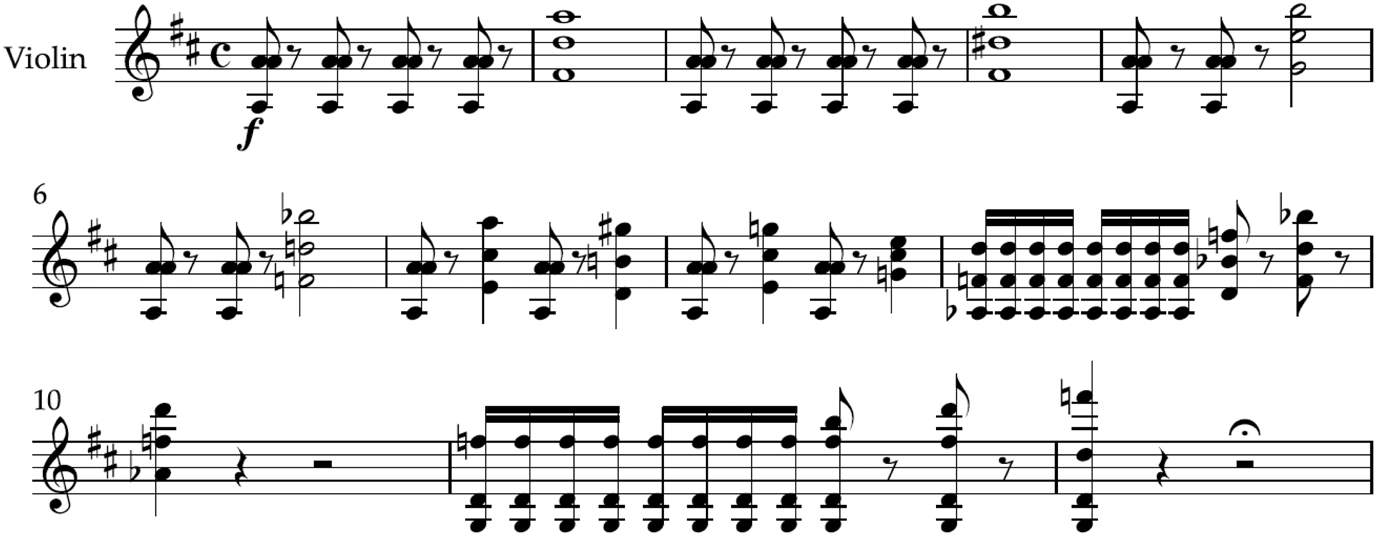
Joachim's use of these two chords is not coincidental: their juxtaposition may be heard as an analytical commentary on Beethoven's opening ritornello. Beethoven unexpectedly introduces D-sharp in bars 10 and 12, revisiting this pitch enharmonically as E-flat in bar 30. This return sets the stage for Beethoven's modulation to the flat submediant, B-flat major. As Timothy Cutler has observed, ‘Beethoven explores not only the compositional possibilities of D-sharp but also its enharmonic equivalent, E-flat‘Footnote 35 when the flat submediant arrives. This flat submediant appears in Joachim's cadenza, in which bars 9–10 cite the ritornello material from bars 28–33 in the Beethoven concerto. A sequential repetition follows on V/♭VII. This particular section of ritornello material is never performed by the soloist in the parent concerto. In fact, Beethoven contrasts this stormy outburst (Ex. 2) with the soloist's lyrical themes.
Beethoven, Violin Concerto/i, bars 26–31
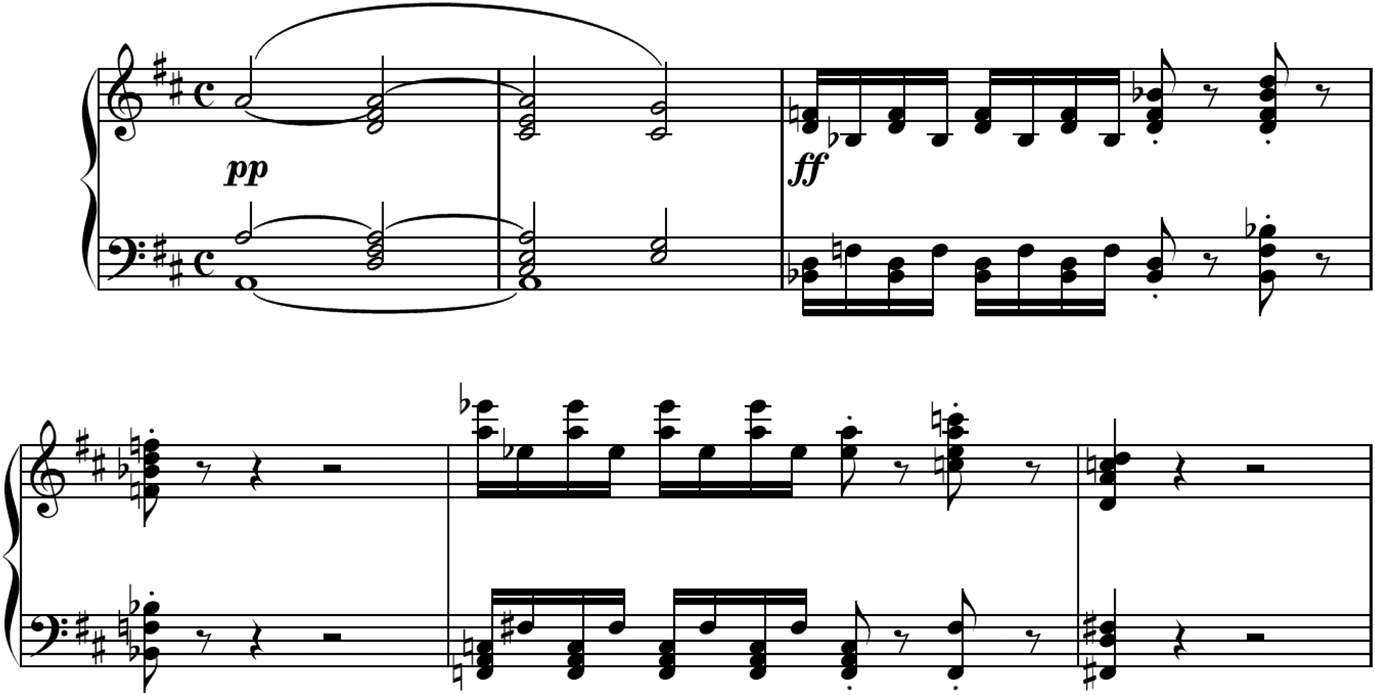
Thus, in the parent concerto, this ritornello material brings about a rupture in the exposition (bars 28–34). Its recapitulation (bar 497) retains some of the initial disruptive quality as a ‘typically Beethovenian dramatic gesture: a sudden, energetic fortissimo outburst in the remote key of B-flat major’.Footnote 36 Such ruptures drew criticism in the early days of the then-fraught reception of Beethoven's Violin Concerto. In an 1807 review, the music critic Johann Nepomuk Möser remarked that ‘the continuity often seems to be completely disrupted’ in Beethoven's Violin Concerto.Footnote 37
Joachim's cadenza transforms the meaning and function of this disruptive moment. By employing the B-flat outburst toward the beginning of his cadenza (see Ex. 1), he stamps it with a soloistic and introductory character that differs from the parent concerto. In Joachim's hands, this passage becomes an initiatory gesture rather than an interruption. We might ask whether this material retains its Sturm und Drang affect in this altered context or whether it takes on a new character as an opening fanfare? That is, does Joachim ‘de-rupture’ the rupture? Such questions are perhaps unanswerable: the important point is that Joachim's cadenza invites the listener to ponder these matters. The topic of rupture in nineteenth-century music has received much scholarly attention.Footnote 38 However, scholars have yet to theorize the reprise of formerly disruptive material in a non-disruptive context. Pertinent here are the types of agency and subjectivity that emerge from Joachim's creative repurposing of Beethoven's material.Footnote 39 Joachim's recontextualization of the ritornello outburst suggests that the composer himself has stepped forth to develop his own ideas in new ways. It is likely that such compositional interventions enhanced Joachim's perceived fusion with Beethoven.
If Joachim stabilizes the previously stormy ritornello passages, he does the opposite for the solo material. As we will see, what emerges from Joachim's reworking of the tutti/solo dialectic is a symphonic conception of the violin. In bars 51–53 of his cadenza (Ex. 3), Joachim transposes the violin's initial entrance to an unstable harmonic region, a diminished seventh chord on G-sharp (functioning as viiº/V). This sonority seems to have been integral to Joachim's conception of this passage.
Joachim's cadenza for Beethoven's Violin Concerto/i, bars 50–54
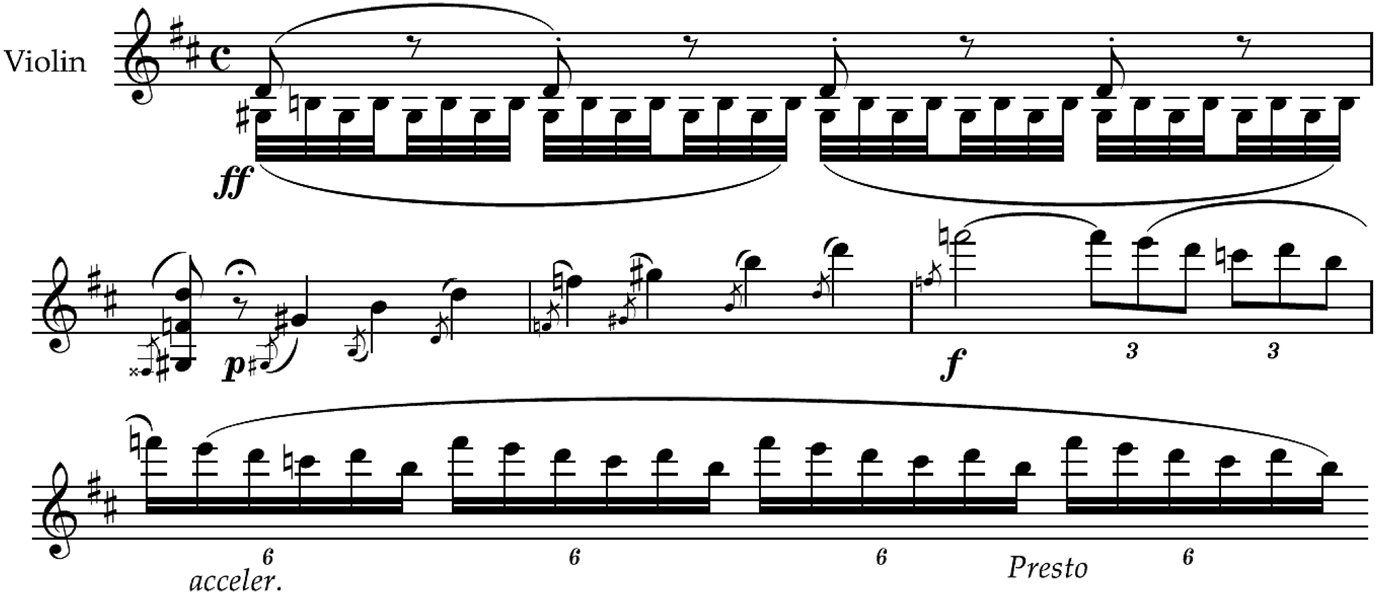
As Uhde observes, Joachim had already made a similar move in his ‘Dublin’ cadenza with the use of a diminished-seventh chord on B.Footnote 40 In both cadenzas, Joachim destabilizes a passage that had been stable in the Beethoven concerto (Ex. 4), in which the violin enters (bars 89–93) on a dominant seventh chord. A few bars later in his cadenza, Joachim presents this same opening material in the flat submediant, a key associated with the ritornello rather than the solo sections. He unites these two forces by combining the thematic material from the solo part with the tonal region of the ritornello part.Footnote 41 Throughout this process, the flat submediant functions as a secondary key area to unify the cadenza. It might almost be described as a tonal pairing in Peter H. Smith's sense.Footnote 42
Joachim's cadenza for Beethoven's Violin Concerto/i, bars 89–93
Joachim's cadenza practices were both indebted to and yet distinct from those of his colleagues and mentors. As we have seen, he emphasized the flat submediant in his first-movement cadenza for Beethoven's violin concerto. Joachim's mentor Ferdinand David (1810–1873) had composed a cadenza (published in 1854) for this same movement.Footnote 43 David assigns the flat submediant (B-flat major) an important role in the tonal structure, as Joachim would subsequently do. We have noted how Joachim minimized the disruptive effect of the flat submediant. This tactic might have been inspired by David, who similarly prepares the flat submediant carefully, introducing it in bar 13 of his cadenza, preceded by an applied dominant. David then moves to the tonic minor in bar 17, further establishing modal mixture as part of his tonal structure, and setting the stage for a reference to Beethoven's turn to the flat submediant (bars 28–33 in the parent concerto; bars 27–33 in David's cadenza). In David's hands, the flat submediant undergoes a transformation from the local tonic into the applied dominant of the Neapolitan key E-flat major. These varied roles for the flat submediant allow for its smooth integration into David's cadenza.
Joachim took David's submediant approach in a different direction that arguably aligned more closely with Beethoven. While bars 40 and 41 of David's cadenza quote verbatim from bars 286–287 of the parent concerto's development section,Footnote 44 Joachim treats this passage sequentially (see bars 53, 58, and 62 of his cadenza). Joachim's approach seems more compositionally oriented insofar as he takes Beethoven's material in a new direction rather than simply repeating it. Therefore, at least in this passage, Joachim engages with the parent concerto more creatively than David, in a quasi-developmental fashion with expansion and reworking of Beethoven's motivic cells.Footnote 45 In terms of formal function, however, Joachim's cadenzas sometimes seem more recapitulatory than developmental, as we will see in the following section.
Joachim's Cadenzas as Recapitulatory Spaces
The genre of the cadenza has often been heard as a secondary development section despite (usually) occurring during the recapitulation.Footnote 46 According to John Daverio, Schumann's cadenza for his own Concert-Allegro (1853) ‘amounts to no less than a secondary development section’.Footnote 47 Matthew Bribitzer-Stull similarly observes that cadenzas by Beethoven and later composers ‘take on the characteristics of free fantasy, sometimes rivaling the development section itself in terms of scope and length’.Footnote 48 Joachim's cadenzas complicate this notion of the secondary development function, for they sometimes revisit material from the development section as though suggesting a quasi-recapitulatory resolution. For instance, Joachim's cadenza for Brahms's Violin Concerto in D Major, Op. 77 (1878) recapitulates themes from the development section.Footnote 49
The motive beginning at bar 312 in the Brahms concerto (Ex. 5) functions as a countersubject to the main theme. Joachim, however, accords it a prominent position as a solo melody in its own right (Ex. 6). He states it in the supertonic E Minor rather than its original key of C Major (♭VII). E minor is barely touched on in the parent concerto; it exists only as an ephemeral tonicization, an unrealized possibility, briefly appearing in bars 178–179 only to be quickly replaced by E major as the dominant of A. The key of E minor, a fleeting moment in the parent concerto, materializes in Joachim's hands as a realm existing only in his compositional intervention, in the liminal space between performer and composer. Why might Joachim have been drawn to this particular motive as the vehicle for his E-minor excursion? Perhaps he was drawn to its troubled mood of obsessive rumination. As Leistra-Jones points out, this motive in the Brahms Violin Concerto is based on ‘repetitive figuration’ that finds itself ‘trapped in C minor’.Footnote 50 Joachim's fascination with this material seems to have resonated with his own compositional proclivities: the technique of ‘trapping’ a motive characterizes some of his own compositions and his cadenzas, as Uhde has observed.Footnote 51
Brahms, Violin Concerto/i, bars 312–318
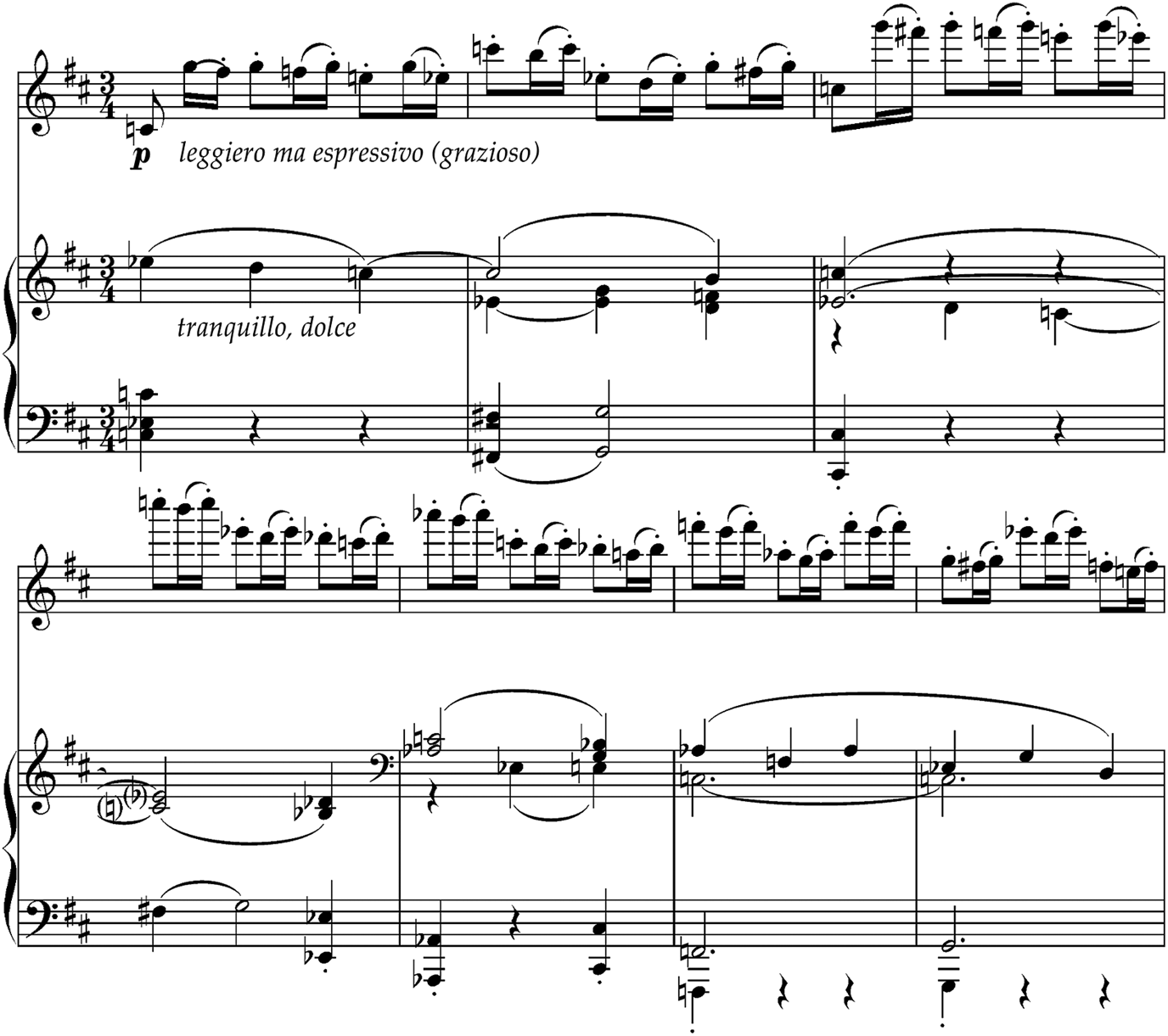
Joachim's Cadenza for Brahms's Violin Concerto/i, bars 23–41
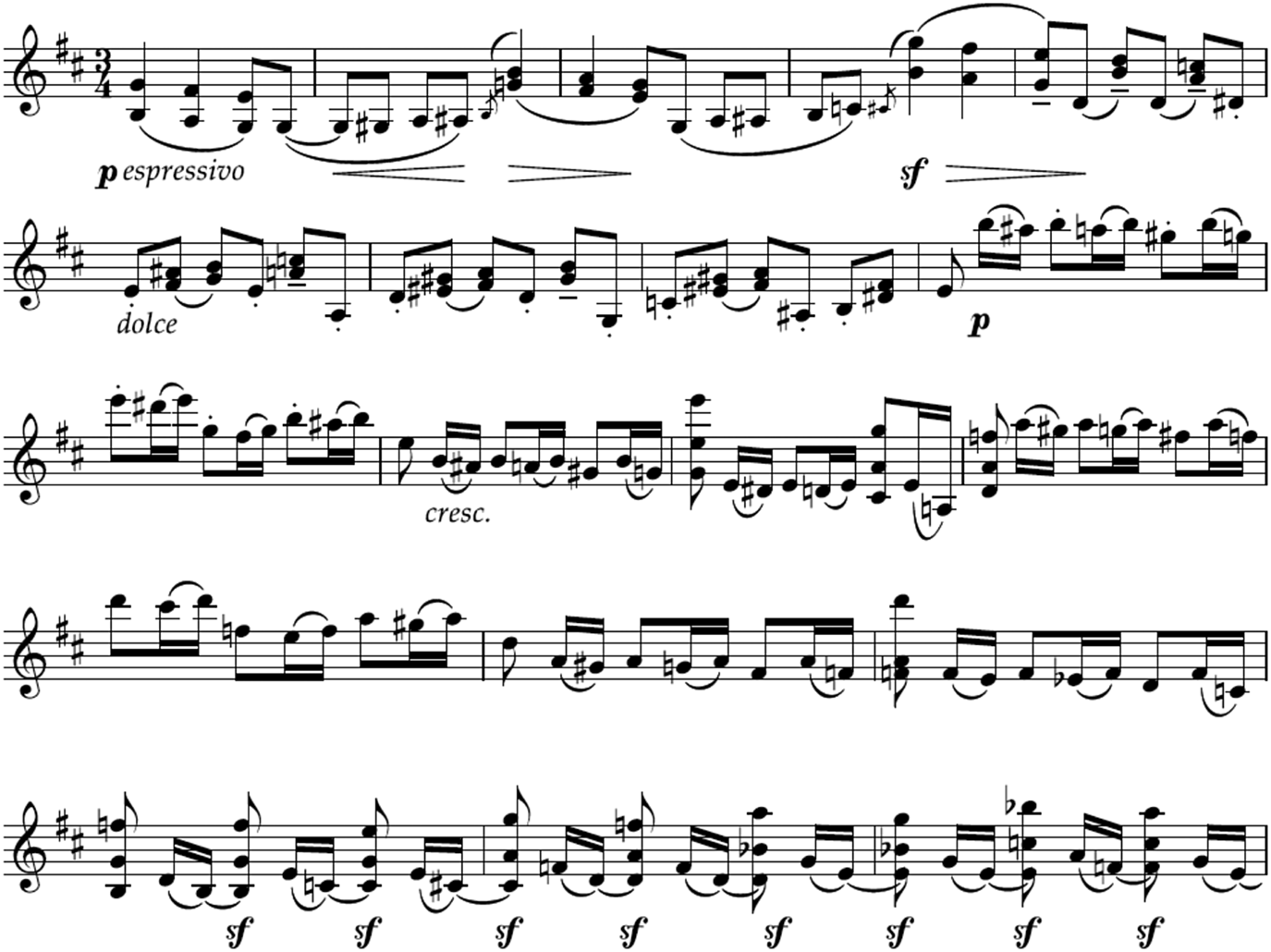
Joachim's use of Brahms's ‘trapped motive’ in his cadenza enacts not only a brooding affect, but also a structural intervention: it provides a recapitulation of this theme. The ‘trapped motive’ functioned in the parent concerto as a new idea in the development section. Brahms never brings it back – but Joachim does. Joachim's reprise of this motive resonates with the sonata principle – the idea that non-tonic themes from the exposition (and the development if it contains new material) will often be restated in the tonic.Footnote 52 Charles Rosen observed that ‘when the development contains new material, it … may be resolved in the recapitulation’.Footnote 53 Rosen's examples include Mozart's Sonata for Two Pianos in D Major, K375a/448 (1781) and hiss Piano Concerto No. 23 in A Major, K488 (1786).
Recapitulations, however, are not necessarily the only place for the reprise of new developmental material. Composers such as Mendelssohn and Schumann sometimes used the coda to bring back unrecapitulated themes from the development (perhaps following the famous coda return of the development-section theme in the first movement of Beethoven's Eroica).Footnote 54 For Joachim, it seems to have been the cadenza that served as his recapitulatory platform for new developmental material. Hepokoski and Darcy have asked ‘whether it is possible for a cadenza to restore or compensate for otherwise “lost” or understated material from the sonata proper, thereby providing a balance or completion lacking in the rest of the movement’.Footnote 55 Yet they appear to doubt that a cadenza can fully accomplish such a task, something which would require ‘the composition of an absence or incompleteness into the sonata proper, which could then be addressed as a conceptual topic in the cadenza-improvisation’.Footnote 56
Hepokoski and Darcy seem to assume that cadenzas are written (or improvised) by the composer, as was generally the case for the eighteenth-century repertoire in their study. In Joachim's cadenzas, however, it appears that he sometimes perceived (and perhaps even sought to rectify) absences that the composer did not necessarily view as such. Joachim's aforementioned inclusion of Brahms's ‘trapped theme’ is a case in point. Although Joachim does not bring it back in the tonic key, it nonetheless has a recapitulatory force: he uses the supertonic, which is more closely related to the tonic than the motive's original key of C minor.
Recapitulatory restatements of new developmental material could be understood, Hepokoski suggests, ‘as a convenient by-product of a larger governing idea: that of thematic rotation, or the architectural propensity within the style to recycle arrays of thematic material in relatively the same order’.Footnote 57 Indeed, Joachim's cadenza for Brahms's Violin Concerto retraces the thematic arc of the exposition. As Leistra-Jones perceptively observes, the first seven sections of Joachim's cadenza recapitulate ‘many of the movement's main themes and motives in the order in which they had originally appeared’.Footnote 58 Hepokoski and Darcy note that these types of cadenzas – what they call ‘rotational cadenzas’ – provide ‘an ordered, if abbreviated revisiting of the concept of rotation itself, one of sonata form's most essential principles – thereby interpolating a telescoped, “last glance”, nonstructural rotation-within-a-rotation’.Footnote 59 It is this type of condensed encapsulation that Joachim offers in his cadenza for the Brahms violin concerto. Within the compressed temporality of the cadenza space, Joachim revisits the structural layout of the movement.
Joachim's cadenzas are not mere run-throughs of the material from the parent concerto, however. Joachim would likely have considered such fidelity to be unimaginative. The recapitulatory character of Joachim's cadenzas does not depend on literal restatement, for he reshapes the tonal trajectories of motives derived from the parent concerto. It is as though he discovers alternative tonal pathways implicit within the parent concerto's structure. For instance, Joachim's cadenza for the first movement of Viotti's Concerto No. 22 in A MinorFootnote 60 offers a tonic statement of a motive that never appears in the tonic in the parent concerto. In fact, the trajectory of this motive in the Viotti concerto veers away from the A minor tonic toward a sharp-side orientation.
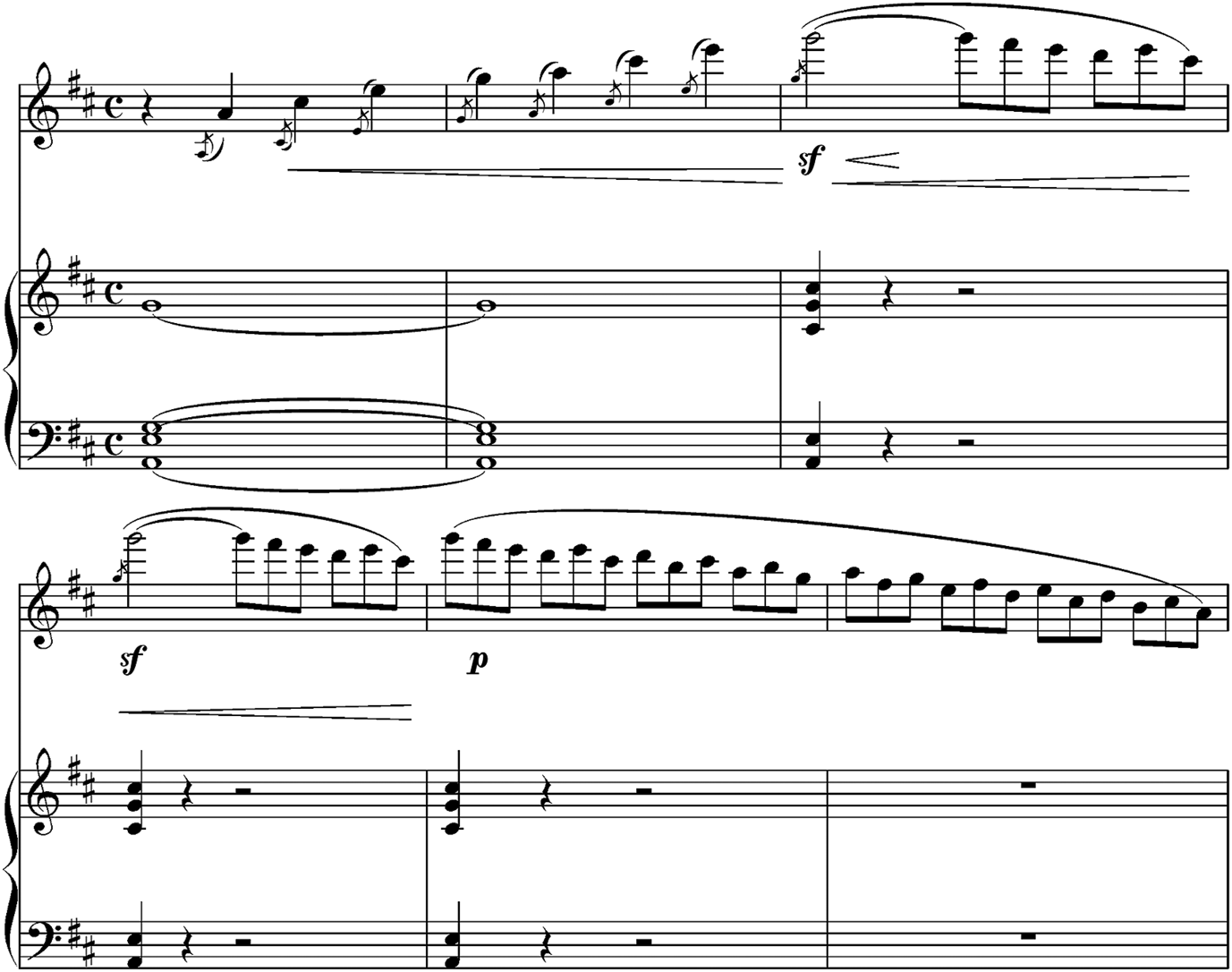
Viotti states the motive in the dominant (Exx. 7 and 8) and then in the mediant, C-sharp minor (Ex. 9). Joachim, however, opens with this motive in the tonic (Ex.10), perhaps invoking the sonata principle in which non-tonic material possesses an innate drive toward eventual tonic restatement. Such tonal reworkings stand in contrast to the compositionally unimaginative cadenzas by certain other performers.
Viotti, Violin Concerto No. 22 in A Minor/i, bars 33–7
Viotti, Violin Concerto No. 22 in A Minor/i, bars 127–31
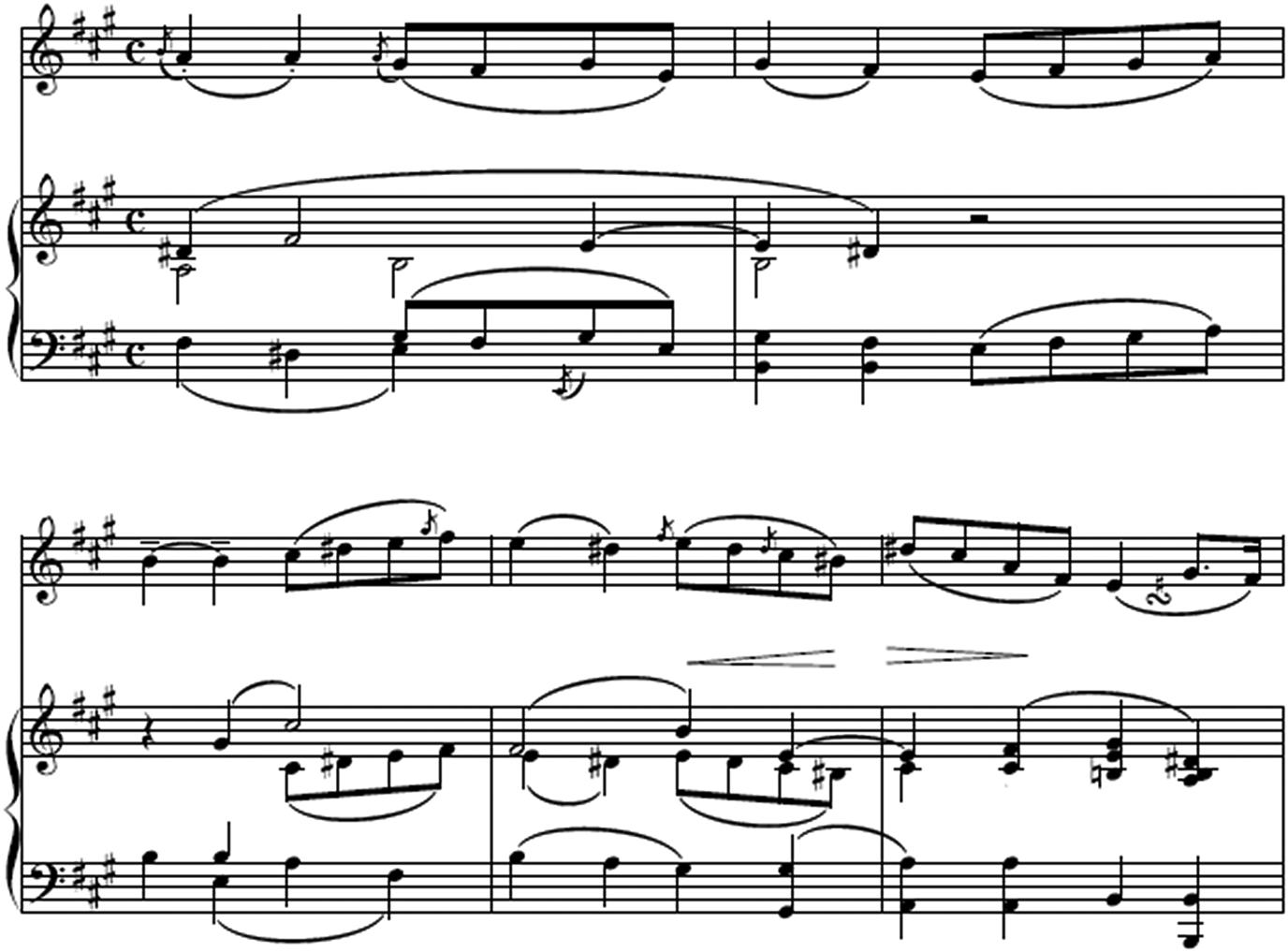
Viotti, Violin Concerto No. 22 in A Minor/i, bars 220–224
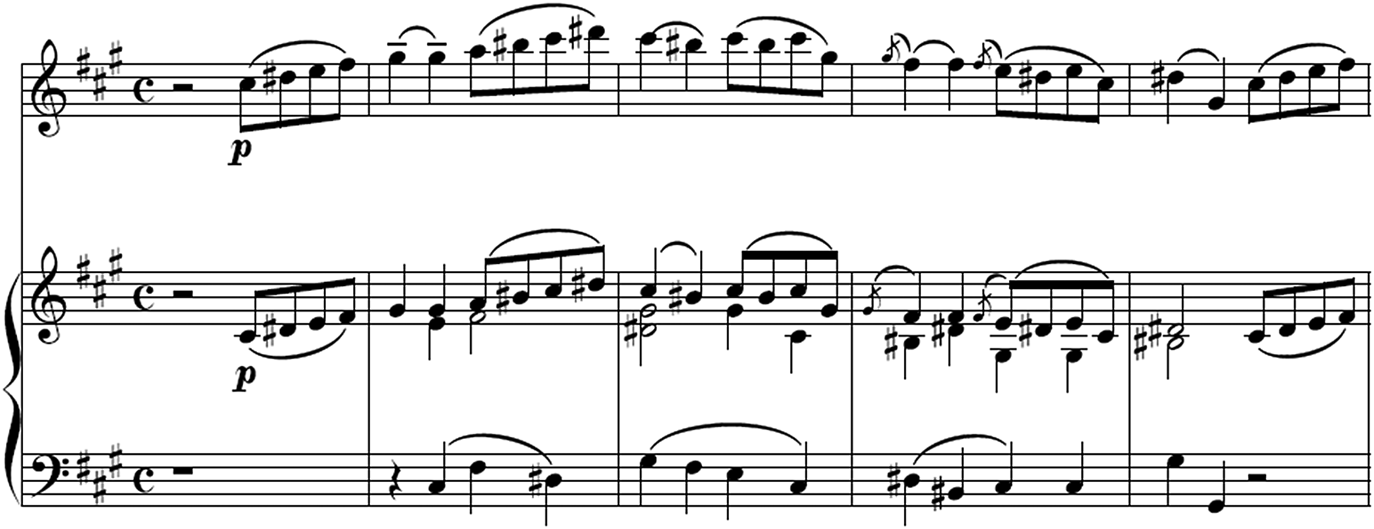
Joachim's cadenza for Viotti's Violin Concerto No. 22 in A minor/i, bars 1–16
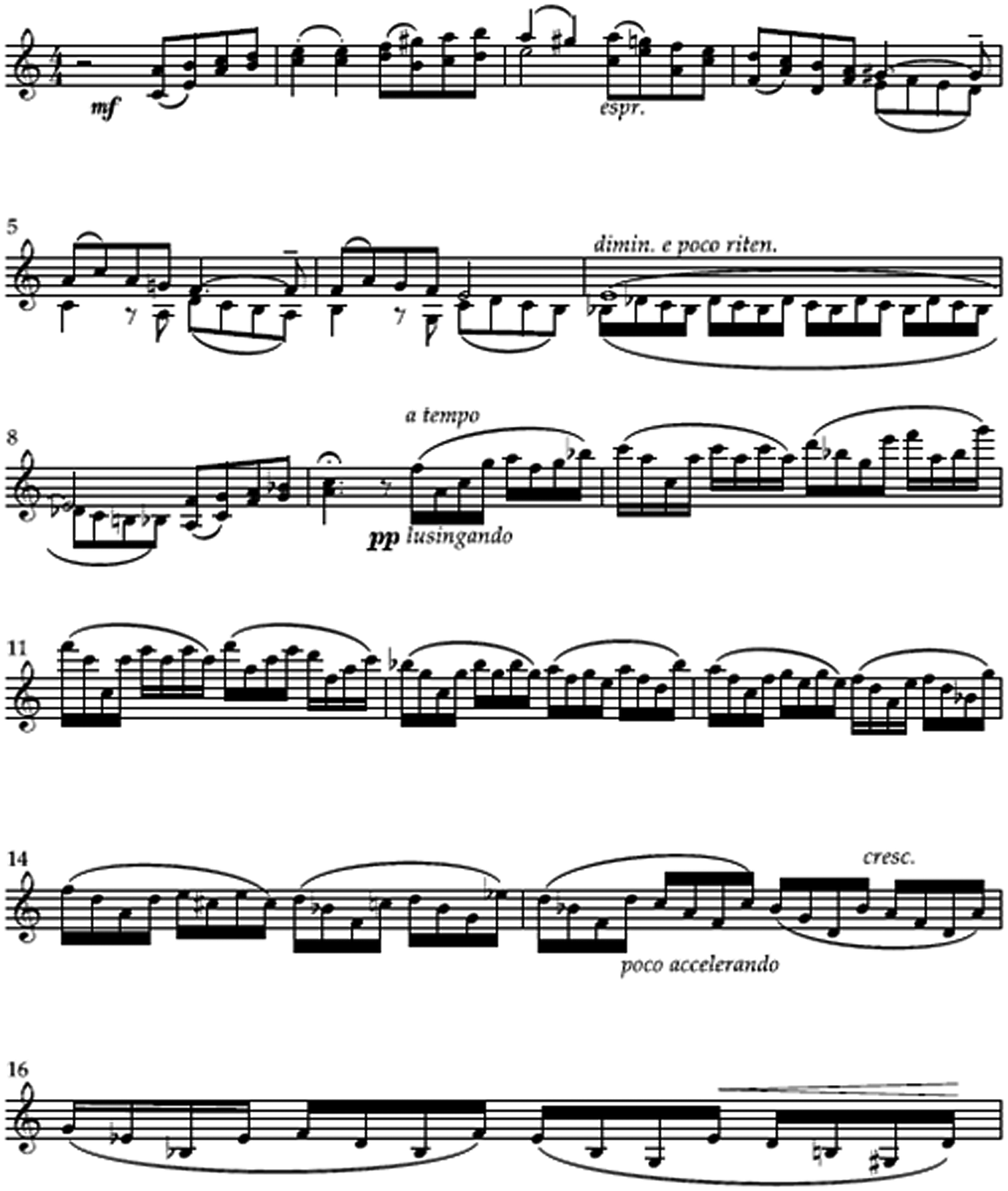
For instance, the virtuoso violinist Jean-Delphin Alard (1815–1888) wrote a cadenza for this same Viotti concerto (Ex. 11). Adhering closely to Viotti's tonal plan, Alard states the motive in the dominant (as in the original concerto) and then in F-sharp minor. Both of these key areas conform to Viotti's sharp-side treatment of this motive.
Alard, cadenza for Viotti's Violin Concerto No. 22 in A Minor/i
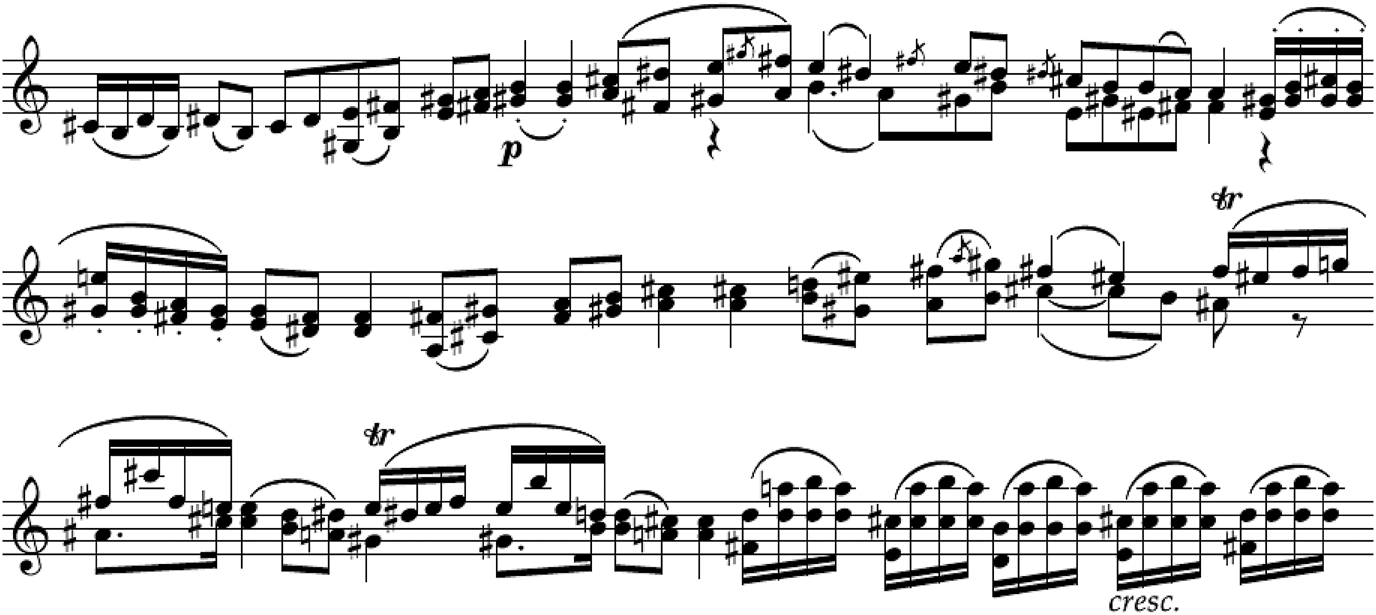
Joachim, however, creatively reimagines Viotti's tonal plan, using the motive to launch a recapitulatory intervention with new key areas. Following the tonic statement of this motive, Joachim proceeds through sequential modulations that lead to the flat submediant, F Major (Ex. 10). He explores – and establishes – this key with figuration based on tonic–dominant oscillations. This key of the flat submediant, central to Joachim's cadenza for this work, does not occur in Viotti's concerto. By introducing this otherwise absent region, it is as though Joachim sought to balance out Viotti's emphasis on sharp-side keys.Footnote 61 This tonal tactic, in which a subdominant-type tonality balances out an earlier dominant orientation, occurs frequently in eighteenth- and nineteenth-century recapitulations (though generally not in cadenzas). Charles Rosen remarks upon the ‘force for resolution, an antidominant, in fact, and there is a tendency for the second half of a sonata to move toward the subdominant and other flat keys’.Footnote 62 Joachim imports this manoeuvre into the genre of the cadenza, endowing it with a recapitulatory power.
The Viotti concerto is not the only work in which Joachim explores the recapitulatory implications of flat-side keys. Other examples include his cadenzas for the first and second movements of Mozart's Violin Concerto No. 4 in D Major, K218 (1775).Footnote 63 These cadenzas make extensive use of the flat submediant (B-flat major in this case), absent from the parent concerto. Along similar lines, Joachim's cadenza for the first movement of Mozart's Violin Concerto No. 5 in A Major, K 219 (1775) uses the Neapolitan key (B-flat major) and the minor subdominant (D minor).Footnote 64 Joachim includes the minor subdominant in his cadenza for Brahms's Violin Concerto as well. This emphasis on the flat submediant and other flat-side tonalities might have been influenced by Beethoven's Violin Concerto, whose first movement tonicizes the flat submediant in the ritornello passage discussed above.
In Joachim's cadenzas, these flat-side keys assume a recapitulatory function as tonic substitutes, while also widening the tonal range of the parent concerto. This expansion can be heard as enhancing the recapitulatory force of the post-cadenza tutti. Following on the heels of the new modulations in Joachim's cadenzas, the final tutti – and its tonic return – seems to make a stronger impact. Thus Joachim's cadenzas might be heard as a counterexample to Hepokoski and Darcy's assertion that cadenzas contain ‘little or any essentially structural sonata work’.Footnote 65 Insofar as Joachim enriches the tonal range of the parent concerto, and restores otherwise unreprised material, his cadenzas engage in developmental and recapitulatory work.
These processes perhaps bear the stamp of nineteenth-century approaches to form and tonality. Despite Joachim's famed reputation as a Werktreue composer, there is nonetheless a touch of anachronism in his aforementioned Beethoven, Viotti and Mozart cadenzas. As we have seen, he establishes chromatic key areas and motivic unity in ways that seem more characteristic of his own time, the mid-to-late nineteenth century. His emphasis on the flat submediant, in particular, aligns more with later nineteenth-century harmonic practice than with the tonal palette of the eighteenth/early nineteenth centuries. Mediant and submediant keys became increasingly important as the nineteenth century progressed. Janet Schmalfeldt observes that ‘something rather drastic happened to European common-practice tonality over the course of the nineteenth century and into the twentieth. Depending on one's rhetoric, either the blame or the credit goes first of all to what we know as mediants or “third relations”’.Footnote 66 Such mediant relations play an important role in Joachim's compositions.Footnote 67 The role of the flat submediant in Joachim's Viotti cadenza might even be described as tonal pairing, a nineteenth-century technique that combines the tonic with (usually) a third-related key.Footnote 68 Joachim thus might be heard as integrating two different key areas into his cadenzas, in keeping with nineteenth-century notions of unity and cyclicity.Footnote 69
Despite such relative liberties, however, Joachim's cadenzas remain faithful to the parent concerto, especially when compared with the more blatantly anachronistic cadenzas penned by some of his contemporaries. When Joachim updates eighteenth-century concertos in his cadenzas, he does so in a more tasteful manner than was generally the fashion in the nineteenth century. He focuses on exploring, or balancing out, key areas already introduced in the parent concerto. Some of his contemporaries moved beyond these bounds, at times introducing new keys with no apparent relation to the parent concerto. A case in point is Liszt's cadenza, S. 389a (1879) for the first movement of Beethoven's Piano Concerto No. 3 in C Minor. Liszt modulates to B Major, a key absent from the parent work. In the context of such anachronistic liberties, then, one can perhaps see why Joachim was hailed as a Werktreue performer and writer of cadenzas.
Expanding the Recapitulation, Integrating the Cadenza
Joachim's recapitulatory work occurs not only in his cadenzas for other composers’ concertos, but also in the ones for his own compositions. In his Hungarian Concerto, Op. 11 (1857), the cadenza for the first movement opens in the tonic key of D minor, signalling a recapitulatory bent from the outset.
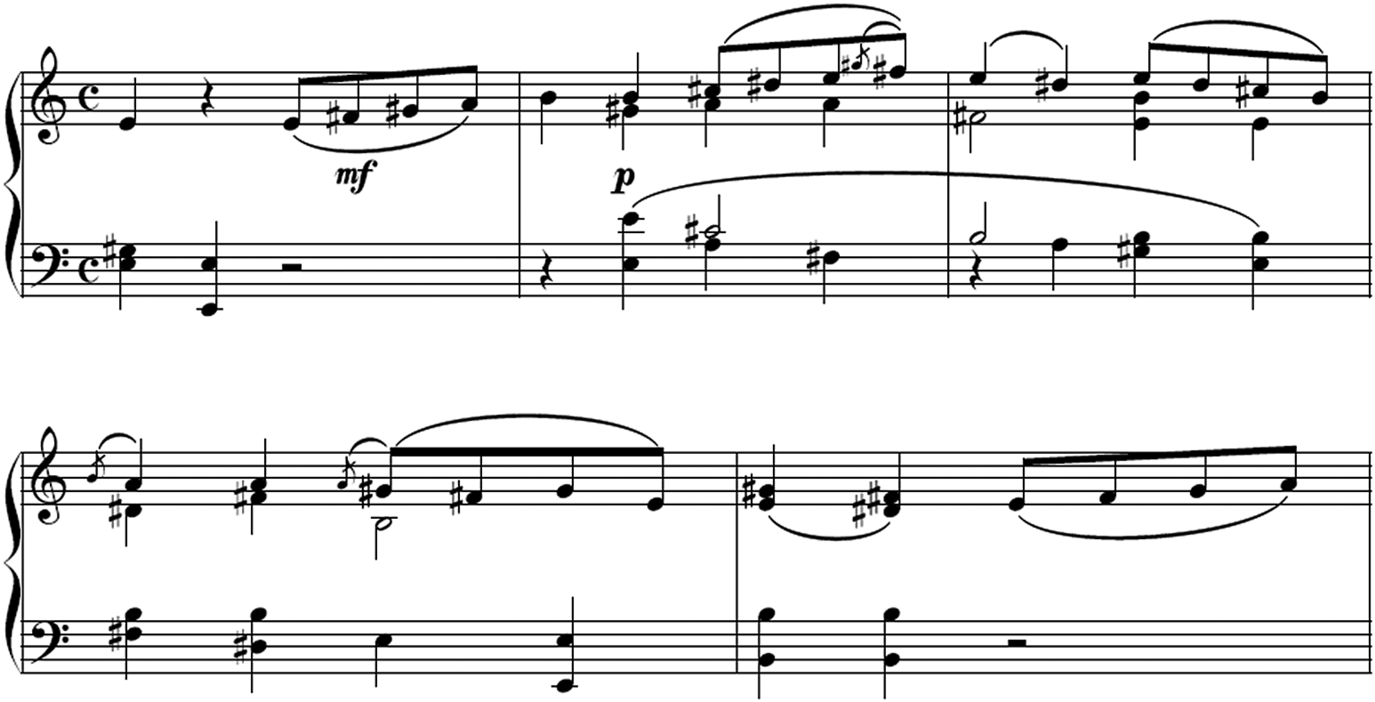
Adding to this recapitulatory function is the reprise of a new theme that first appeared in the development section (bars 284–287; Ex. 12) and does not return in the recapitulation proper. Instead, it resurfaces in the cadenza, in which ‘the soloist is soon joined by several instruments of the orchestra, which recapitulate the main themes of the movement’.Footnote 70
Joachim, Hungarian Concerto/i, bars 282–287
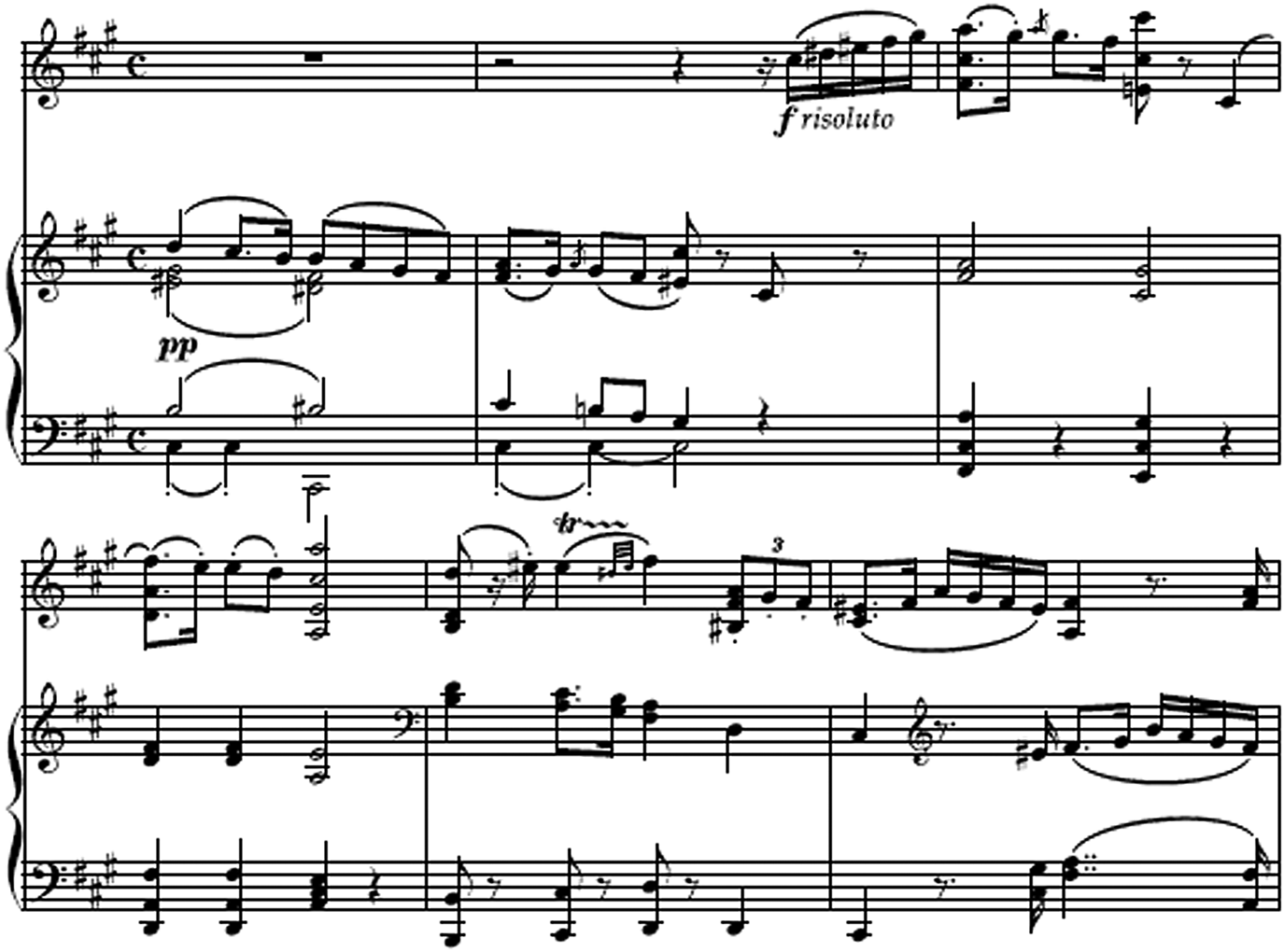
During this section of the cadenza, ‘[t]he flute plays the new theme of the development in B minor’Footnote 71 (Ex. 13). By including orchestral instruments in this way, Joachim folds this cadenza into the recapitulation rather than treating it as an island of solo material. As Paul Mies observes, ‘In his “Hungarian Concerto”, Op. 11, Joachim interrupts the virtuosic cadenza – which otherwise is traditional in placement and function – via a twofold motivic intervention on the part of the orchestral instruments’.Footnote 72 Mies cites a few precedents, among them Mendelssohn's Violin Concerto in E minor, Op. 64 (1844) and Schumann's Phantasie for Violin and Orchestra, Op. 131 (1853). Joachim, however, seems to integrate the orchestra into his cadenza more fully than his precursors.
Joachim, Hungarian Concerto/i, bars 452–457
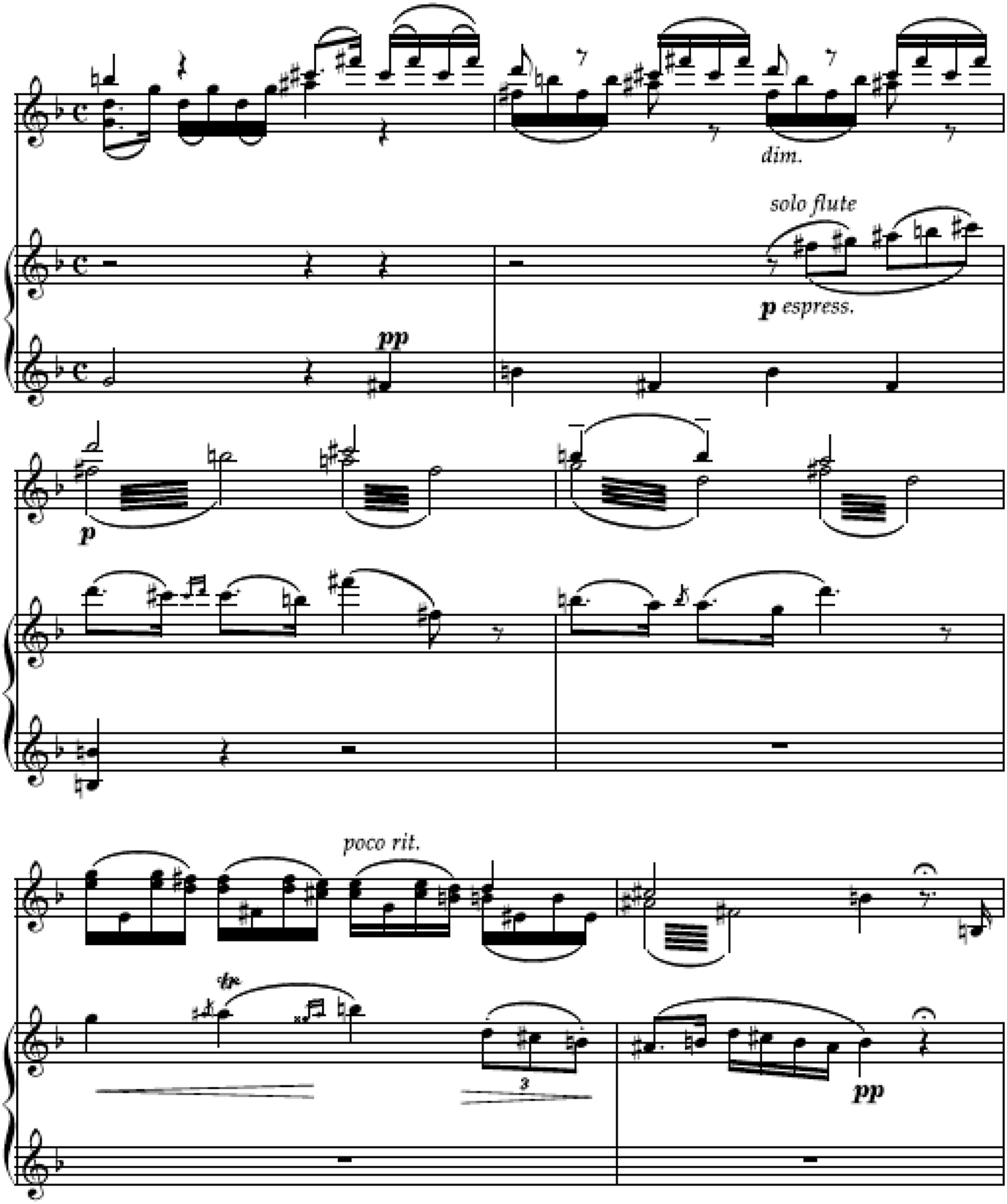
By incorporating his Hungarian Concerto cadenza into the recapitulation, Joachim departs from the classical aesthetic of the cadenza, whose traditional function was to prolong the dominant in a manner akin to a development section or the second thematic group of the exposition. Joseph Swain observes that ‘the most concise way to describe a Mozart cadenza would be to say that it is an improvisation on a prolonged dominant chord’.Footnote 73 The use of extended dominant harmony makes the Mozartean cadenza (and, by extension, most eighteenth- and even nineteenth-century cadenzas) resemble a secondary development section, for ‘most developments prolong the home-key dominant at a deep structural level, with other tonal regions emerging only through a strictly organized contrapuntal scheme within this dominant prolongation’.Footnote 74 Insofar as cadenzas also tend to prolong the dominant, this shared tonal orientation links the cadenza and development section together.
Joachim, however, seems to follow a different tonal logic in the Hungarian Concerto cadenza (and in many of his other cadenzas as well). As we have seen, he often downplays the role of the dominant in favour of tonic harmonies and their substitutes. Joachim's cadenzas thus tend to resemble recapitulatory rather than developmental spaces. For instance, his cadenza for the Brahms Violin Concerto begins with a tonic restatement of the opening theme. In this and many of his other cadenzas, Joachim departs from the standard function of a cadenza as an interruption in the recapitulatory unfolding.
To be sure, the extent to which a cadenza can (or should) be heard as part of the recapitulation varies depending on the listener's analytical approach. Matthew Bribitzer-Stull acknowledges that ‘a survey of the scholarly literature on cadenzas turns up unequivocal statements that the cadenza both is and is not a component of tonal structure’.Footnote 75 Joachim's cadenzas seem to align with the first of these possibilities, insofar as Joachim aims for integration rather than rupture – the integration of the cadenza into the recapitulation. In fact, as we have seen, Joachim's cadenza for the Beethoven Violin Concerto manages to stabilize a theme that had been disruptive in the parent concerto.
Joachim's apparent desire for unity offers insight into his aesthetic of performance. It is almost as though he sought to shrink the gap between concerto and cadenza – and by extension, the gap between composer and performer. As a reflection of his investment in musical integration, he sought textual integration as a symbolic mirror of musical unity. As Leistra-Jones perceptively observes, ‘Joachim's own edition of the solo part [of the Brahms Violin Concerto], published as part of his Violinschule (1902–1905), the cadenza is merged seamlessly into the text of the solo part’.Footnote 76 Joachim's cadenzas tend to avoid non-thematic figuration, focusing instead on motivic development. In this sense, Joachim's cadenzas resonate with (and, in the case of his early cadenzas, anticipate) Brahms's technique of developing variation. As Walter Frisch argued in his landmark study, Brahms's music engages in constant thematic development with a minimum of stock passagework.Footnote 77 By using this style in which every note contributes to an interconnected network of motives, Joachim crafted cadenzas that perhaps approach the status of compositions. In the following section, we further investigate the extent to which cadenzas could be perceived as musical works in the mid-to-late nineteenth century.
Cadenzas as Compositions
Joachim's engagement with techniques such as developing variation and the sonata principle attests to his compositional view of the cadenza. In fact, Ferdinand David went so far as to imply that Joachim's cadenzas surpassed his actual compositions in their construction and ease of expression, as suggested by his remark that ‘Joachim has composed a very pretty cadenza into the first movement of Beeth:[oven's] Violin Concerto; he is [currently] working on a Rondo in B minor in which some nice moments occur, but composing seems to be much harder for him than playing the violin’.Footnote 78 David's word choice is telling: he uses the powerful word ‘componirt’ (composed) for Joachim's cadenza, while employing a weaker word ‘schreibt’ (writes/is writing) for the Rondo.
David's rhetoric implies that perhaps cadenzas could be perceived as musical works in mid-to-late-nineteenth century German (and, more broadly, European) culture. Were cadenzas indeed becoming assimilated to the work concept? Tobyn C. DeMarco has suggested that ‘[t]he odd and paradoxical history of the cadenza is that while originally its purpose was as an outlet for the performer, to indulge one's virtuosic skills and improvisational skill, the nineteenth century brought the cadenza into a writing exercise’.Footnote 79 Lending credence to this compositional view, cadenzas were sometimes published separately with their own opus numbers in the later nineteenth century. A fuller study of how cadenzas could be marketed as self-contained works is beyond the scope of this article. To cite one striking example, however, Carl Reinecke (1824–1910) published a book consisting entirely of his cadenzas: Kadenzen zu klassischen Klavier-konzerten (Cadenzas for Classical Piano Concertos), Op. 87 (Breitkopf & Härtel, 1895).
Some volumes of published cadenzas use the word ‘composed’ on the title page, further supporting the connection to the work concept. Vieuxtemps's set of cadenzas for Beethoven's Violin Concerto are described on the title page as ‘composées par H. Vieuxtemps’.Footnote 80 Similarly, Ferdinand Laub's (1832–1875) set of cadenzas for Beethoven's Violin Concerto bears the title Cadenzen zum Beethoven'schen Violin Concert, componirt von Ferd. Laub. Joachim's own published cadenzas for Beethoven's violin concerto are subtitled ‘componirt von Joseph Joachim’.Footnote 81
As early as 1829, Carl Czerny's Systematische Anleitung zum Fantasieren auf dem Pianoforte had hinted at an emerging view of cadenzas as works. Czerny proposes that ‘concerto fermatas’ (by which he presumably meant cadenzas) should ‘contain all motifs of the concerto that are worthy of note, as well as its most brilliant passages, even though they can be shaded and emphasized at will’.Footnote 82 The selection of the most noteworthy passages calls for compositional – and analytical – judgement. Thus, according to Czerny's definition, the improvisation or composition of a cadenza is (or at least should be) an analytical act in which the performer assesses the structural significance of each motive.
Perhaps one way to think of cadenzas, then, is that they supplement the main work with a ‘second textual layer’, consisting of ‘an annotated text’.Footnote 83 The notion of polytextual layering sheds light on the way in which Joachim's cadenzas enacted not only a performance of his technical prowess, but also of his analytical acumen and compositional artistry. By offering thoughtful musings on the original concerto, Joachim positioned himself as a collaborator in the compositional process.
Relevant in this regard is Bernard Shaw's distinction between tasteful and egotistical cadenzas. Shaw placed Sarasate and Joachim in the former category and Ysaÿe in the latter:
Sarasate never insists on his extraordinary feats: he treats his own skill as a matter of course … Joachim, whose cadenzas … are much better than Ysaÿe's, takes his place beside the conductor and his orchestral colleagues as the interpreter of Beethoven, whose supremacy he never obscures for a moment …. Ysaÿe is Titanically emphasizing himself.Footnote 84
By engaging respectfully with the concertos in his repertoire, Joachim entered into the work to fuse his identity with that of the original composer.
Contrapuntal Fusions in Joachim's Cadenzas for Mozart's Violin Concertos
Fusion seems to be at the heart of Joachim's cadenza aesthetic. We have seen how he fuses his cadenzas with the parent concerto through recapitulatory manoeuvres. As I will now seek to demonstrate, he also recombines motives from the parent concerto. Thus, his cadenza for the first movement of Mozart's Violin Concerto No. 4 in D Major, K218,Footnote 85 blends two motives into a single idea. These motives derive from bar 18 (Ex. 14) and bar 58 (Ex. 15) in the parent concerto, in which they are never stated simultaneously. In fact, these two motives inhabit distinct formal zones in the parent concerto. The material from bar 18 is in the opening ritornello, while the motive at bar 58 is ‘a “new” transition-idea, S[olo]1:/TR[ansition] (that is, with a replacement model for the one used as TR in R[itornello]1), that we shall call the sujet libre’.Footnote 86 The term sujet libre derives from the French musicologist Georges de Saint-Foix (1874–1954), referring to material that belongs to ‘the soloist as a personalized theme (that is, it had not appeared in R1 and would never be stated anywhere by the orchestra)’.Footnote 87
Mozart, Violin Concerto No. 4 in D Major, K218/i, bars 18–20
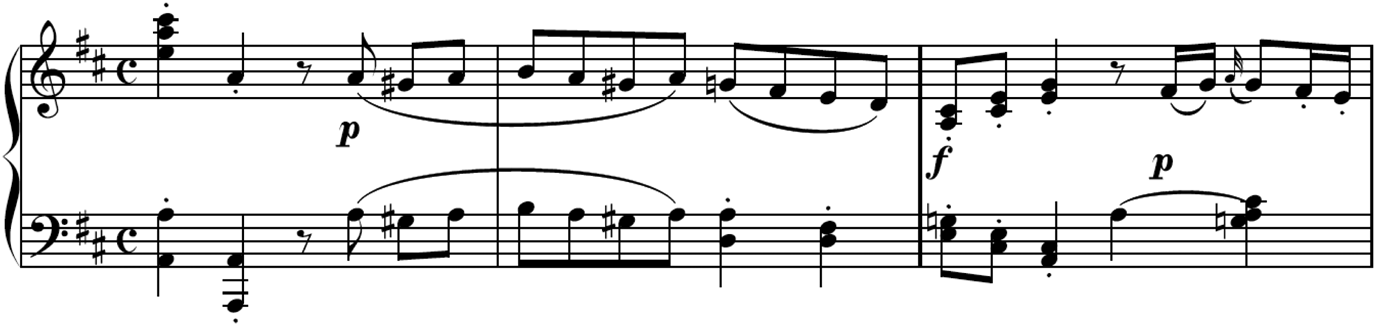
Mozart, Violin Concerto No. 4 in D Major, K218/i, bars 56–60

In his cadenza for Mozart's K218, Joachim develops the ritornello theme from bar 18 and the sujet libre theme from bar 58 in a way that enables their fusion (Ex. 16). Joachim merges these themes by citing the rising sixth from bar 58 to lead into the motive from bar 18, underscoring an intervallic resonance between the stepwise and broken-chord patterns. Mozart, who treated the two motives as polarized formal units, never foregrounded this similarity in the parent concerto.
Joachim's cadenza for Mozart's Violin Concerto No. 4 in D Major, K218/i, bars 1–12
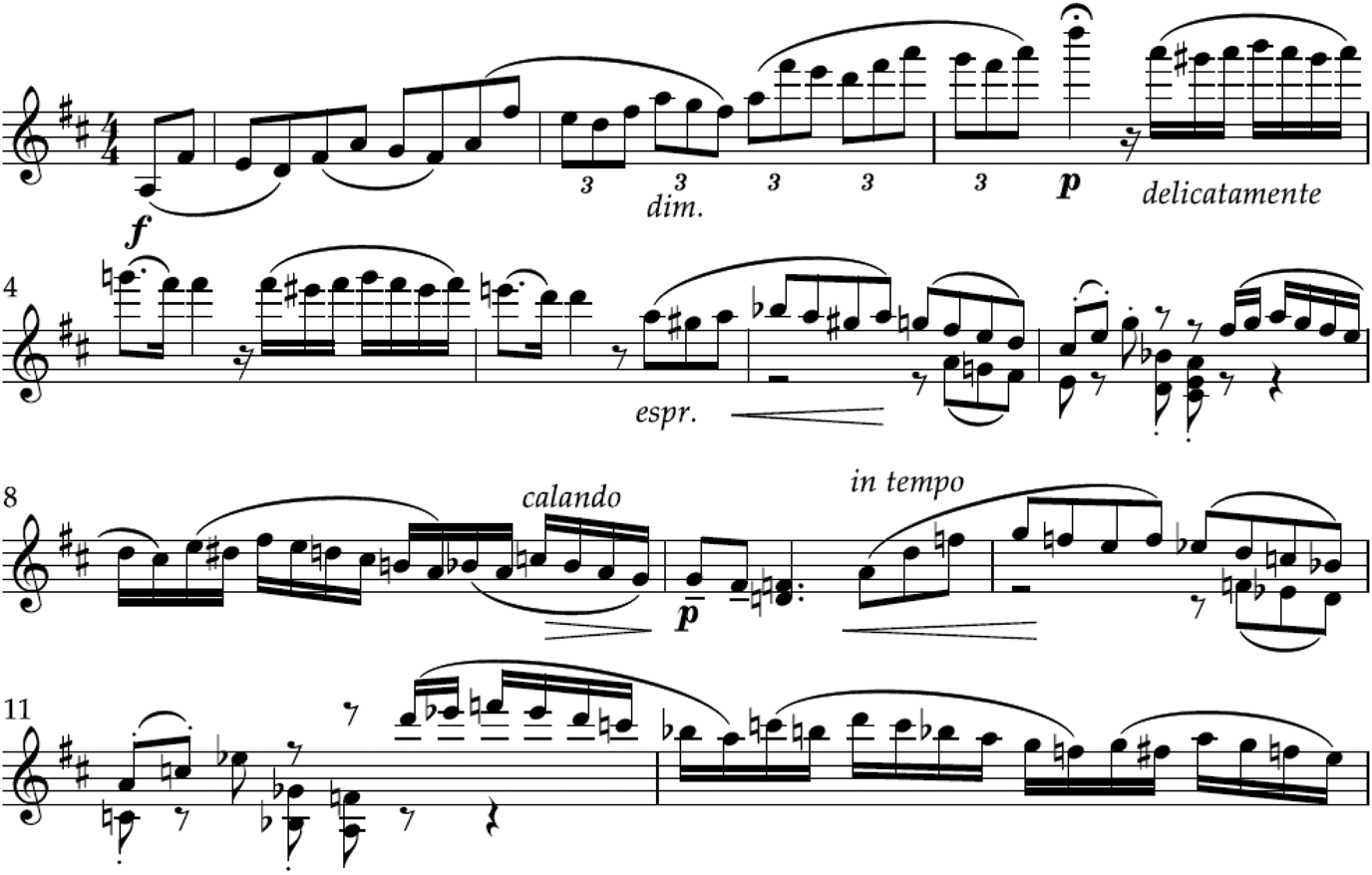
Joachim's amalgamation of these previously separate modules demonstrates the impulse toward unity that shapes many of his cadenzas. As we have seen, Joachim tends to combine solo and ritornello material in a way that softens the traditional polarity between these forces. This unity enhances the recapitulatory function of his cadenzas, for ‘[i]t is the task of all recapitulations to reconcile or synthesize whatever different “points of view” there may be between R1 and S1’.Footnote 88 For Joachim, this seems also to be the task of the cadenza, even (or especially) when the recapitulation in the parent concerto leaves certain expositional conflicts unresolved.
A few bars later in the same cadenza for Mozart's K218/i, Joachim crafts a motivic fusion based on material first heard at bar 26 of the opening ritornello. It is likely, however, that Joachim's reference to this material derives not from bar 26, but from the return of this motive in bar 96 in the solo exposition (Ex. 17).
Mozart, Violin Concerto No. 4 in D Major, K218/i, bars 96–9

In the parent concerto, the violin soloist introduces a motive built around repeated notes followed by a rising and falling fourth, starting on the last three quavers of bar 96 and continuing into bar 97. This idea is then taken up by the lower strings while the orchestral violins perform a countermelody based on quaver and semiquaver figuration in bars 97–98. Joachim's cadenza accomplishes the virtuosic feat of creating a solo violin version of this panoramic array of motives (Ex. 18).
Joachim's cadenza for Mozart's Violin Concerto No. 4 in D Major, K218/i, bars 13–17
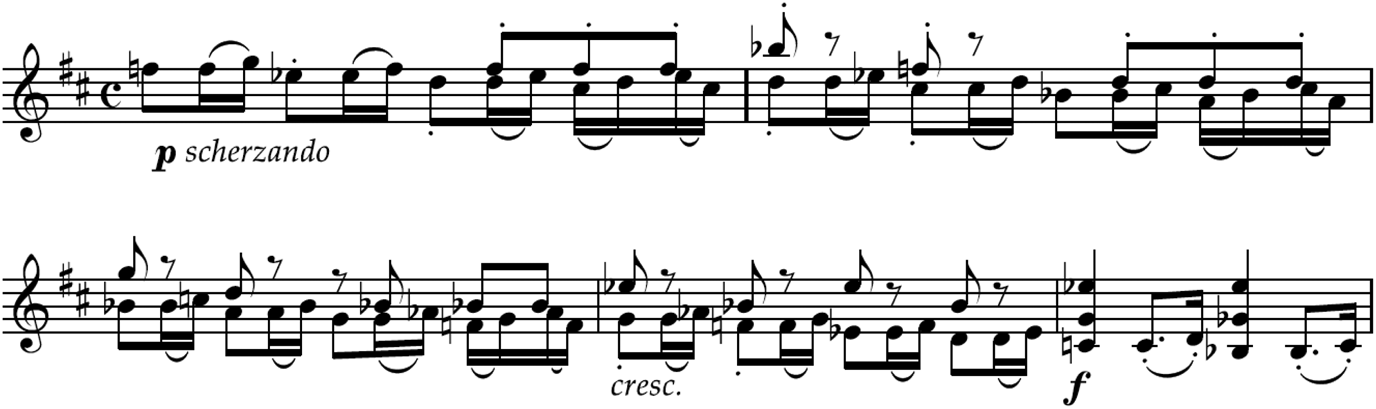
Bars 14–16 of the cadenza feature the rising-fourth motive in the top voice with the countermelody in the lower voice, producing an orchestral texture. In fact, this motivic fusion reflects Joachim's penchant for assigning orchestral material to the soloist. The semiquaver countermelody, an integral part of Joachim's polyphonic cadenza for K218, belongs to the tutti sections and is never performed by the solo violin in the parent concerto. Joachim thus creates an idealized reminiscence in which the cadenza encapsulates both soloist and orchestra. Bar 17 of Joachim's cadenza continues to develop these motivic cells. Joachim pares down the upper motive to its intervallic essence, the alternating fourths, while continuing the counterfiguration in the lower voice. Joachim's distillation of the upper motive draws on the compositional technique of fragmentation, in which a musical idea is gradually reduced to a representative snippet.Footnote 89
Joachim's fusion of motivic material in his K218 cadenza allows him to explore an opportunity that was unrealized in the parent concerto, which never puts the violin in counterpoint with itself as Joachim does in the cadenza. Joachim displays his contrapuntal skills insofar as the solo violin takes on a polyphonic quality in a quasi-Bachian sense.Footnote 90 Joachim and his circle placed a high value on counterpoint, exchanging exercises in part-writing.Footnote 91 The fruits of this labour find powerful expression in Joachim's cadenzas, which combine motives to reveal unexpected resonances between seemingly disparate ideas. Thus, as we have noted, Joachim's cadenzas often seem to merge with the parent concertos, potentially contributing to the view of Joachim as channelling the composers themselves.
Conclusion: Joachim's Werktreue Cadenzas
In analysing Joachim's compositional engagement with his concerto repertoire, we have explored some possible reasons why Joachim was often perceived as embodying both freedom and authenticity. As we have discovered, Joachim's performances enacted a capacious form of the Werktreue ideal in which spontaneity and fidelity were able to coexist. Joachim's cadenzas, as I have suggested, drew on improvisatory tropes while simultaneously honouring the spirit of the original composer. The metaphors inspired by Joachim's performances seem to reflect this apparent paradox. The mirror to which Ysaÿe compared him, the magician that Schumann saw appearing under his baton, the reincarnation of Beethoven that Gumprecht glimpsed like a mirage on stage: all of these images convey fidelity in tandem with compositional agency.
Examples of such tropes abound in Joachim reception. A further example is offered by George Grove (1820–1900), an engineer and writer on music best known for founding Grove's Dictionary of Music and Musicians. In an 1898 article in The Musical Times, Grove was quoted as saying:
I should like … to say something about that which strikes me as the best of all my dear old friend's characteristics. Other players have as fine execution as he has; and to them, as to him, ‘difficulties are nothing’; and others, too, have as charming expression as he; but no one forgets himself as Joachim does. When you hear him you are never reminded of Joachim; it is the composer one thinks of. When one hears him play the Beethoven Concerto, or a Bach solo, or anything else, it is obvious that the player's desire all through has been to play the piece as nearly as possible as Beethoven or Bach wanted it.Footnote 92
As I have proposed, the impression of a performance in keeping with the composer's wishes was fostered in large part by Joachim's cadenzas. Grove refers to Joachim's ‘forgetting himself’. This phenomenon, however, seems to depend more on memory and reminiscence than on forgetfulness. Joachim's process of reworking and revisiting enhances the listener's memory of the parent concerto, while simultaneously making the performer seem to disappear within the work itself.


 Open access

