





Introduction
The adaptation of CRISPR (Clustered Regularly Interspaced Short Palindromic Repeats), a biological mechanism for microbial defence, into a precise genome editing (GE) tool marked a major scientific breakthrough. Over the last decade, this development has opened a wide range of unprecedented biotechnological applications (eg Ansori, Antonius, Susilo et al. Reference Ansori, Antonius, Susilo, Hayaza, Kharisma, Parikesit, Zainul, Jakhmola, Saklani, Rebezov and Ullah2023). This has sparked intense debate, the importance of which is hard to overstate given the profound impact that new genomic techniques (NGTs) promise to have on societies and ecosystems (eg Almeida and Ranisch Reference Almeida and Ranisch2022).
One of the primary ongoing discourses revolves around the governance of NGTs (Nelson, Selin, and Scott Reference Nelson, Selin and Scott2021). Existing frameworks for NGTs appear to be inadequate in addressing the multifaceted political, economic, and ethical implications posed by this technology (eg Nelson and Selin Reference Nelson and Selin2023). The current governance structure, which is intricately woven into transnational networks of authorities, entrepreneurs, and experts, raises legitimate concerns from a democratic standpoint (eg Fajardo-Ortiz, Hornbostel, Montenegro de Wit et al. Reference Fajardo-Ortiz, Hornbostel, Montenegro de Wit and Shattuck2022).
Calls for the governance of NGTs to be democratized and for increased public engagement on the topic have been made by scholars (eg Adashi, Burgess, Burall et al. Reference Adashi, Burgess, Burall, Glenn Cohen, Fleck, Harris, Holm, Lafont, Moreno, Neblo, Niemeyer, Rowe, Scheufele, Testa, Vayena, Watermeyer and Fung2020) and several stakeholders, including the National Academies of Sciences, Engineering, and Medicine (eg 2017) and the World Health Organization (eg 2021). This need is especially evident with regard to the application of NGTs to the human germline, although it is by no means limited to this (Scheufele, Krause, Freiling et al. Reference Scheufele, Krause, Freiling and Brossard2021).
Against this backdrop, to promote democratization at both national and global levels, scholars and practitioners have called for greater use of deliberative and participatory forums (Scheinerman Reference Scheinerman2023; Barlevy, Juengst, Kahn et al. Reference Barlevy, Juengst, Kahn, Moreno, Lambert, Charo, Chneiweiss, Farooque, Guston, Hyun and Knoepfler2024). These forms of public engagement are generally understood in the context of democratic innovations, which are processes designed to find new ways to enhance citizen participation, deliberation, and influence in political life (Smith Reference Smith2009). Countries as diverse as Australia, Brazil, and South Africa have developed participatory and deliberative processes to address these issues. However, their effectiveness is not yet clear. Some scholars have cast doubt on the ability of democratic innovations to address issues relating to NGTs. For instance, Conley and colleagues (Reference Conley, Jean Cadigan, Davis, Juengst, Kuczynski, Major, Stancil, Villa-Palomino, Waltz and Henderson2023) argue that there is a disconnect between the aspirational calls for broad and inclusive public engagement and the reality of limited, expert-driven processes engaging self-selected members of the public.
Overall, little is known about the specific challenges that democratic innovations face in the democratization of the field of NGTs (Scheufele, Krause, Freiling et al. Reference Scheufele, Krause, Freiling and Brossard2021). Our main goal is to start addressing this gap. Following Fung and Wright’s (Reference Fung and Wright2003) seminal characterization, we conceptualize democratization as the capacity to expand and deepen democratic engagement in a specific context. We do so by bringing a largely missing political science perspective (see Frazzetta and Felicetti Reference Frazzetta and Felicetti2025), based on cutting-edge debates from the field of democratic innovations.
What is the democratizing potential of democratic innovations when it comes to NGTs? To respond to this question, this paper engages in a qualitative study comparing two experiments developed in France and the United Kingdom, which involve two different approaches in debating NGTs, namely, a participatory approach in France and a more deliberative one in the United Kingdom. Both cases can be considered as pilots of a yet-to-be-conducted Global Citizen Assembly (GCA) on GE (see Dryzek, Nicol, Niemeyer et al. Reference Dryzek, Nicol, Niemeyer, Pemberton, Curato, Bächtiger, Batterham, Bedsted, Burall and Burgess2020). The one-off nature of these processes is common in public forums on NGTs. Yet, it represents a longstanding and often problematic aspect for experiments of this kind, which lack a substantive degree of permanence desirable for democratic innovations (see, eg Geissel Reference Geissel2012).
Our analysis shows that the ability of these experiments to promote democratization in the cases studied here is modest. We find that the French case is an interesting but very limited instance of education through participation, whereas the UK example represents an expert-driven forum that bypasses wider engagement. It is hardly surprising that isolated experiments cannot solve democratic problems. However, we identify the specific challenges to the effectiveness of democratic innovations in the context of the development of NGTs and suggest crucial aspects that should be addressed. Our analysis is based on the ‘democratic assemblage’ approach, which provides a very valuable way to investigate democratization issues in the context of NGTs, as well as in other domains.
The next section opens up with a review of the literature on NGTs’ governance, followed by a discussion on the idea of ‘democratic assemblage’. In the section after that, we first present the methodology of the paper and then our comparative analysis. In the following section, we discuss our findings. The concluding section offers some final remarks and recommendations for future research.
The democratic challenges of GE
The potential benefits of NGTs for an incredibly wide range of fields and industries have been consistently highlighted over the past decade (Schermer and Benzing Reference Schermer and Benzing2019). Only recently, instead, there has been some attention to the challenges NGTs pose to democracy. These are at least twofold. On the one hand, the way decisions are made is not very democratic. On the other hand, in some cases, the impact of these decisions has the potential to exacerbate existing societal problems.
Regarding the former aspect, the governance of NGTs seems to be flawed on both the transnational and the national levels. Still based on the 1975 model of the Asilomar conference that regulates recombinant DNA technologies (Yu, Xue, Barrangou et al. Reference Yu, Xue, Barrangou, Chen and Huang2021: 2), the governance of NGTs is heavily reliant on international summits. That does not capture that the existing research community is both very large and diverse (Meyer and Vergnaud Reference Meyer and Vergnaud2021). It also overlooks the fact that many researchers nowadays are based in private bodies, which raises possible conflict of interest, and does not take into account the evolving views and interests of various publics (Kato-Nitta, Maeda, Inagaki et al. Reference Kato-Nitta, Maeda, Inagaki and Tachikawa2019). The field tends toward a logic of socializing risks while privatizing rewards (Mazzucato Reference Mazzucato2011; Fajardo-Ortiz, Hornbostel, Montenegro de Wit et al. Reference Fajardo-Ortiz, Hornbostel, Montenegro de Wit and Shattuck2022). Furthermore, although the involvement of the public is increasingly deemed vital, many scientists remain skeptical about its real contribution, posing an additional barrier to their engagement (Waltz, Flatt, Juengst Juengst et al. Reference Waltz, Flatt, Juengst, Conley and Cadigan2024).
As for the societal problems connected to GE, these have long been provoking concern, even before the invention of CRISPR (Fukuyama Reference Fukuyama2003; Habermas Reference Habermas2003; Sandel Reference Sandel2007). In recent years, critics have argued that NGTs pose an existential risk when applied to humans (Garland-Thomson Reference Garland-Thomson2020), deepening the divide between those who can access genetic medicine and those who cannot, as well as replicating gender, race, and class inequalities (Gordon Reference Gordon2022). According to Nestor and Wilson (Reference Nestor and Wilson2022), the use of CRISPR in humans could undermine social justice and worsen the condition of socioeconomically disadvantaged and marginalized communities, especially if scientists, other elite actors, and institutions continue dictating policy on the topic as is currently the case. There are also risks of a new wave of eugenics, human rights abuses, and increased discrimination and stigmatization (Baylis Reference Baylis2018), including of social groups more exposed to the actions of the criminal justice system (Machado and Granja Reference Machado, Granja, Machado and Granja2020).
Furthermore, encouraging societal views that promote the use of genetic engineering to enhance the abilities of individuals, or avoid disability, might undermine efforts to modify ableist environments (Knight Reference Knight2023). Such ethical controversies are even more marked when it comes to human germline editing (eg Singh Reference Singh2021), as is the skepticism expressed by citizens (Funk, Tyson, Kennedy et al. Reference Funk, Tyson, Kennedy and Johnson2020). At the same time, the distinction between therapeutic use and enhancement blurs (Braunschweig Reference Braunschweig2024). Concerns also exist with respect to the yet overlooked issue of the use of NGTs on non-human animals (de Graeff, Jongsma, Johnston Johnstonet al. Reference de Graeff, Jongsma, Johnston, Hartley and Bredenoord2019), including lab animals (eg Gjerris, Kornum, Röcklinsberg et al. Reference Gjerris, Kornum, Röcklinsberg and Sørensen2023), and cattle (eg Ishii Reference Ishii2017). The remarkable potential benefits of NGTs in terms of ecosystem restoration and biodiversity are paralleled by emerging ecosystemic concerns (Breed, Harrison, Blyth et al. Reference Breed, Harrison, Blyth, Byrne, Gaget, Gellie, Groom, Hodgson, Mills, Prowse and Steane2019), as in the case of gene drives, for example (see Moreno, Valera, Borgoño et al. Reference Moreno, Valera, Borgoño, Castilla and Riveros2024). Moreover, the use of NGTs risks favoring the interests of corporations over those of farmers and sustainable agriculture practitioners (eg Schnurr, Rock, Kingiri et al. Reference Schnurr, Rock, Kingiri and Lieberman2022).
Many observers have highlighted the need for a more democratic approach to decision-making and more sustained public engagement on the issue of NGTs, particularly but not exclusively in relation to human GE (Scheufele, Krause, Freiling et al. Reference Scheufele, Krause, Freiling and Brossard2021; Almeida and Ranisch, Reference Almeida and Ranisch2022). Democratic innovations have come to the fore in dealing with ‘the public engagement imperative’ (Adashi, Burgess, Burall et al. Reference Adashi, Burgess, Burall, Glenn Cohen, Fleck, Harris, Holm, Lafont, Moreno, Neblo, Niemeyer, Rowe, Scheufele, Testa, Vayena, Watermeyer and Fung2020; Scheinerman Reference Scheinerman2023). This has raised awareness of the existence of different publics. For instance, the US National Academies’ (2016) Report on Gene Drives on the Horizon identifies three groups of reference (communities, stakeholders, and citizenry), each of which needs to be addressed in suitably different ways. It has also resulted in a growing body of participatory and deliberative processes in relation to NGTs across countries on all continents. That, in turn, has steered a debate on the strengths, weaknesses, potential, limitations, and varieties of invited spaces (Neblo and White Reference Neblo and White2023; Park, Bagg and Lewis Reference Park, Bagg and Lewis2023; Rzepiński Reference Rzepiński2023).
These developments call for investigations into the specific benefits and hurdles that democratic innovations provide in the context of NGTs. To do this, we will analyze two case studies (one in France and one in the United Kingdom) where different processes were used to engage with the public on the topic of GE. The French and British cases are especially interesting given that these are key European players in the field of NGTs, for instance, in the field of health (see Horn Reference Horn2019). Also, the two contexts are markedly different. The United Kingdom has traditionally been more open to NGTs, seeking to further this approach since Brexit, for instance, in agriculture (Greer and Grant Reference Greer and Grant2023). France, instead, since the genetically modified organisms (GMOs) debate, has long retained a markedly restrictive and precautionary approach with the firm opposition of dynamic social movements (see Marris, Joly, Ronda et al. Reference Marris, Joly, Ronda and Bonneuil2005). Finally, the UK and French cases under study were inspired by two distinct understandings of democratic innovation. The Citizens Jury on Human Embryo Editing pursued a deliberative model. The Consultation citoyenne sur l’édition du génome, instead, pursued a more participatory one. We will show the strengths and weaknesses of each case. Yet, we already specify that the association with the deliberative and participatory models is limited by the fact that the UK case focused on a specific subgroup of citizens, rather than a representative sample of the citizenry, and the French one involved mostly students, rather than generally interested citizens.
The democratic assemblage
We look at our case studies by adopting a democratic assemblage approach. Certainly, scholarship on deliberation and the systemic approach can be used toward this end (eg Parkinson and Mansbridge Reference Parkinson and Mansbridge2012). Yet, thinking in terms of assemblages helps us to better understand, from a democratic standpoint, how different processes emerge, how they interact with their context, and what effect they have (Hendriks and Kempeneer Reference Hendriks and Kempeneer2025; Bussu, Wojciechowska, Forde et al. Reference Bussu, Wojciechowska, Forde and Santos Dias2025a). That is, looking beyond the assembly to the assemblage helps us to understand the way extant arrangements take shape in the first place.
Assemblage and democratic system theories stem from different debates and shed light on different aspects of democratic life. The so-called systemic approach is rooted in deliberative democracy scholarship. Though not without limitations (see Owen and Smith Reference Owen and Smith2015), this approach boasts a rich theoretical and empirical apparatus to study assemblies such as the ones here under investigation. Systemic analyses tend to take components of a system as a given. Their qualities depend not only on the type of involvement they promote (eg high-quality deliberation or inclusive participation) but also on how the forums fit within and contribute to the system. Scholars in this approach tend to focus on the systemic functions that forums perform, or on the problems they help solve, or on their contribution to a system’s overall capacity to deliberate.
Assemblage theory, by contrast, urges us to problematize and investigate the very nature of forums. These can be thought of as evolving, strategically built processes that will benefit some groups, underplay the role of others, and leave others yet unaffected. From a normative standpoint, the assemblage approach gives more attention to the choices identifying the components and the strategic objectives of a process and the way that affects its legitimacy. More than the systemic goals that forums aim at, from an assemblage standpoint, we are interested in whether and how established modes of governance are challenged and changed by different, democratic alternatives (see Van Wezemael Reference Van Wezemael2008).
Assemblage theory, which is rooted in the work of Deleuze and Guattari (Reference Deleuze and Guattari1977) and later developments (Latour Reference Latour2007; DeLanda Reference DeLanda2016), is not the customary way to investigate forums such as the one under study here. Nevertheless, different perspectives in political theory have engaged with this idea for decades. More recently, Felicetti (Reference Felicetti2021) has referred to the idea of assemblage as an alternative to the concept of the democratic system that dominates contemporary studies on democratic innovations. The idea of democracies as assemblages has been invoked to critically investigate the elements and connections that constitute a given political problem (see Eadson and Van Veelen Reference Eadson and Van Veelen2021). It is exactly in its ability to address the limitations of the systemic approach that Asenbaum and Bussu envisage the ‘great potential for the study of democracy’ that assemblage theory has to offer (Reference Bussu, Senabre Hidalgo, Schulbaum and Eve2025: 1). Indeed, Asenbaum (Reference Asenbaum, Davidian and Jeanpierre2022a: 1) has defined democratic assemblage as a concept that not only ‘denote[s] a formation that realizes democratic core values, but also the very process by which such a constellation is brought about. Democratic assemblage is both a state and a becoming’. Recent studies show how it is possible to apply these lenses to empirically study different phenomena from Latin American democratic practices to participatory budgeting to civic tech for youth (eg Hendriks and Kempeneer Reference Hendriks and Kempeneer2025; Motta, Mendonça, Veloso et al. Reference Motta, Mendonça, Veloso and Magalhães2025; Bussu, Senabre Hidalgo, Schulbaum et al. Reference Bussu, Senabre Hidalgo, Schulbaum and Eve2025b).
Interestingly, Asenbaum (Reference Asenbaum2022b) explains that while systems tend to assess to what extent assemblies display desirable democratic qualities or (contribute to) perform democratic functions, assemblage lenses allow us to observe the process through which, in different contexts, democratic properties emerge (or not). As seen, some recent studies have applied the assemblage lenses for empirical investigations. Yet, to the best of our knowledge, our investigation is the first one to use this approach on these participatory processes from a comparative perspective, an attempt that is consistent with similar undertakings in transdisciplinary sustainability research (Lang, Wiek, Bergmann et al. Reference Lang, Wiek, Bergmann, Stauffacher, Martens, Moll, Swilling and Thomas2012). For instance, Kaplan and colleagues (Reference Kaplan, Farooque, Sarewitz and Tomblin2021) offer a three-phase schema comparable to the one we propose here. Their work engages in a participatory technology assessment method, including mini-publics, to involve actors from outside academia to support democratic decision-making on a variety of science and technology issues.
Democratic assemblage

Building on the above developments, we engage with a set of ideas from assemblage theory to develop a conceptualization of democratic assemblages that is theoretically sound and empirically useful for the purposes of comparative analysis. In their original definition of assemblage, Deleuze and Guattari use the French term agencement to refer to ‘an arrangement or layout of heterogenous elements’ (Nail Reference Nail2017: 22) without unity and essence but rather multiplicity and events that are laid out through a constructive process. To identify the relevant aspects of that, we focus on constitutive elements and modes of ordering. Second, to understand the interaction between components of an assemblage, we consider relations of exteriority, both imagined and actual, as well as the idea of embeddedness. Third, to understand the issue of power in the contexts under examination, the paper focuses on the concepts of problematization processes and resistance (see Table 1).
To begin with the nature of an assemblage, we refer to constitutive elements and modes of ordering. Assemblages are made up of heterogeneous components that are in ‘a contingent rather than necessary relationship, brought together into particular relational configurations’ (Savage Reference Savage2020: 325; see also Bussu, Wojciechowska, Forde et al. Reference Bussu, Wojciechowska, Forde and Santos Dias2025a). Constitutive elements are the diverse and heterogeneous parts – such as objects, organizations, people, and ideas – that come together and interact to form a dynamic, emergent whole and contribute to collective properties. Assemblage’s components are assembled with specific strategic relations and impacts in mind. The modes of ordering assemblages ‘are heterogeneous and variable but always include the search for strategic effects, the aim to transform an existing situation in a certain predetermined way through the establishment of particular sets of relations between new and existing entities’ (Ureta Reference Ureta2015: 12; see also Li Reference Li2007). In other words, these are distinct processes or mechanisms through which heterogeneous elements are arranged, connected, and stabilized to create a functional and temporarily coherent whole aimed at producing specific effects or transformations. Importantly, modes of ordering seek to establish contingent coherence out of multiplicity. While an assemblage lacks an essence, it does not lack coherence (Ureta Reference Ureta2015).
Relations are the second key aspect we consider. In assemblage theory, focusing on the relations established between different components is seen ‘as just as (if not more) fundamental to understanding policies as the components themselves’ (Savage Reference Savage2020: 327). This aspect resonates with recent calls in democratic theory to focus on relational dynamics more openly when analyzing democratic politics (Mendonça, Veloso, Magalhães et al. Reference Mendonça, Veloso, Magalhães and Motta2024). The relation that occurs between components of an assemblage is such that they can be separated from one another and integrated into another without losing their individual identity. That allows for flexible and changing interactions that shape the whole. We focus on the relations ‘of exteriority’, both presumed and actual, which refer to the idea that when elements are brought together in close proximity in an assemblage, they ‘establish relations between and among themselves while remaining external to each other and thereby retaining their original properties’ (Rabinow Reference Rabinow and Faubion2014: 206, also in Savage Reference Savage2020). The distinction between presumed and actual relations of exteriority is intended to draw empirical attention to the difference between imagined relations and those that exist. The systemic approach has placed the relations among sites, actors, and processes at the center of systemic analyses. It highlighted how the legitimacy of forums is also dependent on the web of relations within systems, looking at how public and empowered spaces relate to each other through coupling, or transmission and accountability (eg Hendriks Reference Hendriks2016). By using the assemblage approach, instead, we focus on whether and to what extent relations were ‘embedded’ in their contexts. Embeddedness, which is a concept used at the crossroads of democratic innovation and assemblage literature, refers to ‘a productive interaction with the other actors and institutions within the governance context and a rootedness of participatory processes and culture in the political or policy system’ and is seen as key to enabling participatory processes that are effectively democratic (Bussu, Bua, Dean et al. Reference Bussu, Bua, Dean and Smith2022: 121). Furthermore, our analysis places emphasis on the political work that needs to go into imagining a democratic network of reference for a given forum and then into turning imagined relationships into actual ones. This effort, especially when democratic, will have to be earnestly adaptive to the context in which it unfolds. Insofar as public engagement processes are meant to promote democratization, it is important to observe the extent and ways in which they enable democratic coalition building, or not. This focus helps engage more directly with extant research criticizing spaces of dialogue as anti-political because, among other things, they undermine the work of articulating coalitions to engage in effective political contention (eg Coni-Zimmer, Deitelhoff, and Schumann Reference Coni-Zimmer, Deitelhoff and Schumann2023).
The third aspect regards the issue of power, understood as a dynamic capacity or force within a network of heterogeneous elements, which shapes relationships, influences interactions, and enables both stabilization and change within the assemblage. We investigated this issue with reference to the concepts of problematization and resistance (Savage Reference Savage2020). Problematization refers to ‘how problems come to be defined as problems in relation to particular schemes of thought, diagnoses of deficiency and promises of improvement’ (Li Reference Li2007: 264, also in Savage Reference Savage2020). It captures the process of identifying, questioning, and making something a focus of critical reflection and opens up possibilities for new interpretations, alternative solutions, or transformations. The focus of resistance, instead, is on whether a given assemblage expands popular ability to wield power or oppose resistance to the wielding of power by elites and the extent to which this is possible. In assemblage theory, power is understood as being widespread rather than concentrated: ‘… power is everywhere in an assemblage, which, if we follow Michel Foucault’s lead, means resistance is also always present’ (Savage Reference Savage2020: 329). Thus, by resistance we refer to a productive force to oppose, transform, or navigate power relations. Deliberative democracy has recently taken up the problem of power more systematically. For instance, Curato, Hammond, and Minand (Reference Curato, Hammond and Min2019) argue that deliberation is a form of power that is discursively generated and that power inequality is constitutive of systems. Our power-based way of understanding the democratic impacts seeks to engage with this insight by showing how our objects of study disperse, further concentrate, or leave extant power structures unaltered.Footnote 1 As recent scholarship (Bussu, Wojciechowska, Forde et al. Reference Bussu, Wojciechowska, Forde and Santos Dias2025a: 79) suggests, democratic governance in general and democratic innovations in particular, are means ‘for opening up closed spaces and facilitating instances of becoming-democratic … [to] expose vulnerabilities in existing democratic systems and create opportunities for new alternatives to emerge’. Rather than solving problems, performing functions, or building capacities, forums can be seen as opening up and/or closing down spaces for democratization. This understanding of democratic outcomes based on power takes seriously a key lesson of assemblage theory, whereby any political process, including forums, has effects that are multifaceted, with possibly divergent and ambiguous impacts.
The French and UK cases through the assemblage lens
Methodology
The two cases under consideration are among the most significant to have taken place in Europe in relation to the topic of NGTs. Furthermore, both were organized within the framework of the Global Citizens’ Assembly on Genome Editing (in addition to France and the United Kingdom, similar assemblies have been organized in Australia and the United States).
This contribution is based on an in-depth qualitative analysis of documents from the cases under study (Bowen Reference Bowen2009), interpreting their contents through the lens of the assemblage theoretical framework. The documents under analysis are the final reports of each assembly, which are available online. Thus, one document refers to the UK assembly, while six separate documents refer to the French case, one for each of the assemblies organized. We search for the empirical references exposed in Table 1, so as to interpret the two cases under the assemblage relevant concepts adopting a comparative perspective. Specifically, to outline the nature of both cases, we refer to the actors that promoted the consultations, the actors and the public involved (constitutive elements), and the declared aims of the two consultations (modes of ordering). To outline the relations, we refer not only to who is involved in the two cases (actual relations) but also to the potential or imagined participants (imagined relations). Finally, to outline power, we refer to how the issue of GE is framed (problematization) and to the results of both consultations (resistance).
Before moving on to the cases, we highlight that France and the United Kingdom have different legislative frameworks regarding the use of NGTs. At the time when our cases took place, France did not allow the use of NGTs in all fields of application, in accordance with the European directives. The ongoing debate at the European level regarding the potential deregulation of NGTs in plants also engages the national level of member states, including France. The United Kingdom is no longer bound by European rules, so it is allowed to use NGTs on plants and animals for research and commercial purposes. The Genetic Technology (Precision Breeding) Act, adopted in 2023, along with the subsequent implementing regulations, rules the application of NGTs in such fields. Regarding the use of GE on human beings, this is not permitted. It is allowed for research purposes, but only under strict restrictions and following rigorous evaluation prior to the issuance of a license. In such cases, the relevant legal framework is the Human Fertilization and Embryology Act (HFE Act) of 1990, whose technical provisions have been updated over the years – most recently in 2024 – without, however, altering its substantive nature. More recently, the Medicines and Healthcare products Regulatory Agency has approved the use of CRISPR-Cas 9 as a somatic therapeutic technology (Wong Reference Wong2023).
Nature of the assemblages
We can start investigating the constitutive elements of the two cases, starting with their leading actors. The French assemblies were promoted by two public authorities under the Ministry of Health: the Espace de Reflexion étiques (ERER) and the Institut National de la Santé et de la Recherche Médical (INSERM) and were divided into six different regional consultations which took place on different dates between October 2021 and January 2022, and each had a minimum of three or a maximum of six meetings. This is not the first time that ERER has organized consultations; indeed, it is recognized by the French Health Ministry as ‘key actors in bioethics and medical ethics. It is their responsibility to contribute, at the regional level, to the development of a genuine ethic culture among healthcare professionals and public’.Footnote 2 ERER was highly active in 2018, during the revision of the national bioethics law, organizing hundreds of regional consultations on bioethical issues.
The UK assembly, instead, took place from 13 – 16 September 2022 and was organized by a public charity, Involve UK, and funded by another public charity, Wellcome Connecting Science. Involve UK has extensive experience and expertise in public consultations on a variety of topics and is used to working with different partners, ranging from universities and local administrations to national government ministries. Wellcome Connecting Science, which belongs to the Wellcome Trust Foundation – an organization engaged in health and health research – is primarily focused on training in GE, to build scientific capacity as well as foster a broader public understanding of the topic. In both cases, some experts have been involved, such as geneticists, lawyers, and bioethics professors. In the French case, professors of philosophy and literature, ethicists, neurobiologists, doctors, hospital engineers, and a marine biologist have also been involved (P2: 15–16; P3: 2; P4: 4; P6: 6; P8: 6)Footnote 3 . In the UK case, there was also an attempt to include both a Christian and an Islamic perspective. The number and the logic of sampling participants are different. In the French consultation, 184 citizens participated, which was not representative of the population of France or the local region. About 68% of the participants were students (P7: 2). By contrast, in the UK case, the selection of participants aimed to reflect the demographic make-up of the patients who are eligible to access genomic medicine services and genetic counseling (P1: 11–14). Thus, 21 people with experience of genetic conditions were selected.
Moving to modes of ordering, we refer to the aims of these processes. The French assemblies did not have a pre-defined question to deliberate on and focused on the use of GE on plants, animals, and humans (P2; P3; P4; P5; P6; P8). Instead, the UK consultation sought to answer a specific question: ‘Are there any circumstances under which a UK government should consider changing the law to allow intentional GE of human embryos for serious genetic conditions?’ (P1: 5). Indeed, the assumption made by UK organizers was that it was necessary to explore what people think about human GE to regulate its future use (P1: 4, 10–11). Overall, the French case had the aim of mapping citizens’ concerns on GE, without having a defined question to deliberate on. Instead, the UK assembly sought to provide insight into the perspectives of a group of patients with inherited conditions about the benefits and the risks of using embryo GE. That would serve as a basis for a list of recommendations for policymakers, researchers, and civil society (P1: 51).
Relations of exteriority
The promoters of both processes shared their imagined relations, as they stressed the importance of engaging in public debate with not just citizens but also civil society organizations and all interested stakeholders. Yet, there is no convincing evidence that these have manifested in practice. No civil society organizations were involved in the design of the deliberation processes. There is also a lack of engagement with the wider citizenry. Furthermore, both processes refer to their intention to contribute to the GCA on Human GE (P1; P2; P3; P4; P5; P6; P8), a project that was expected to take place in 2024 but that has yet to transpire.
The actual relations in the French forums were made of public organizations under the auspices of the Ministry of Health, with the intent of exploring the opinions of an informed public about the use of GE (P2: 59–62; P4: 15; P8: 5). The members of the public involved were not intended to be representative of the French population; the recruitment process (P2: 59; P4: 2–3; P8: 6; P3: 3) focused specifically on selected schools in each of the French regions. By contrast, the main targets of the UK process were policymakers as well as ‘researchers and wider civil society to better understand informed public perspective’ (P1: 4). To recruit participants, Involve collaborated with Genetic Alliance, a network of organizations supporting people affected by genetic diseases, which oversaw the recruitment process (ibidem, 11–14).
Power
In both processes, problematization occurred as a set of perceived possibilities and problems associated with the use of GE in humans were critically reflected upon. Most of the participants agreed that the use of GE on humans should be allowed in the future in relation to medical use, only if less radical and invasive alternatives are not possible. It was perceived as a possibility to eradicate serious diseases and disabilities, to limit pain for future generations and increase the well-being of humans (P1; P5; P6), where access should be equal for everybody (P1; P2; P5) and privacy protection should be guaranteed (P1; P2; P6). A minority of people did not agree with the use of GE on humans, even in the case of medical use, due to what they saw as a concrete risk of eugenics (P1; P2; P3; P5) and the possible exacerbation of existing structural inequalities in contemporary society related to disability and people suffering from severe disease (P1; P2). Some worries are recurring, such as the creation of new forms of discrimination (P1; P3; P5) and the role of private industry and companies in directing research on GE and its use for private purposes (P3; P4; P5). Finally, most of the participants in the assemblies agreed that decisions on the use of GE should be as inclusive as possible, involving policymakers, specialists, civil society, and people with a special interest in the development of GE medical treatments (P1; P2; P4; P5).
As already mentioned, the French assemblies also dealt with the use of GE on plant life and animals, focusing on food production for human needs. In relation to animals, the use of GE is more acceptable than other uses in all the regional assemblies (P2; P3; P4; P5; P6; P8), while for plants, all the assemblies expressed the need to deepen our knowledge about the long-term consequences of GE on the environment (ibidem), apart from the Occitan assembly (P5). Some recurrent issues that emerge refer to the need to carry out publicly funded research, to be shared with less developed countries, so as to avoid strengthening global inequalities (P3; P4; P6). Second, there was a desire for GE to be used only if the alternatives did not provide efficient results (P3; P5). Finally, in several regional assemblies, some concern emerged about power relations between humans and other living beings (P3; P4; P5).
Both processes met their intended aims and managed to involve people in a debate that is still not very mainstream, enabling them to express an opinion on a very specific and complex issue. This, however, did not translate into the ability to create substantive democratic abilities. Some significant differences emerged between the two processes in terms of resistance. The French case took on the form of an educational process. As was reported in several documents, the French assemblies aimed to allow people to formulate an opinion on controversial topics while engaging with different points of view (P2; P4; P5). Even if education through participation is a key tenet of participatory democracy, an important limitation in this case is the fact that only a very small segment of the population – mostly students – was granted the benefit of (high-quality) engagement. Educating through participation may have its benefits, however, as in two of the French assemblies participants expressed doubts about the genuine capacity of citizens to influence policymakers (P2; P4): given the complexity of the issue at hand, key points that emerged in the debate included who should make decisions, how decisions should be made, and how could citizens be empowered to influence decisions. The UK case study, on the other hand, more closely resembled a lobbying campaign featuring high-quality engagement with a specific constituency. Although the whole process was reported in detail in the final report, and while all the steps were explained to participants, what is not very clear is how such deliberation would achieve its main goal and thus support policymakers. In other words, how were the results disseminated and to whom? While it is not clear how the results have been shared with the wider public, stakeholders, and policymakers, we cannot exclude the possibility that the deliberation and its results have indeed influenced public debateFootnote 4 in the country that became the first in the world to allow the use of CRISPR-Cas9 for medical treatments. Involving the public in deliberation, especially vulnerable individuals, as is the case in this process, is undoubtedly valuable from a deliberative democratic perspective. Nevertheless, this is not a case where promethean elites encounter precautionary publics, as laid out in a seminal study on the value of deliberation (Dryzek, Goodin, Tucker et al. Reference Dryzek, Goodin, Tucker and Reber2009). The positions that emerge from the deliberation of a specific group of people, rather than a sample of the general population, seem rather in line with the views of scientific and business leaders. Civil society actors, who often hold highly skeptical views on GE (Frazzetta and Felicetti Reference Frazzetta and Felicetti2025), are practically bypassed.
Discussion
Calling for and implementing participatory and deliberative processes, such as those examined here, is an entirely reasonable means to try to improve public debate and decision-making on NGTs and their governance. However, there is no guarantee these processes will achieve that. The assemblage approach helps to understand why this is the case and what could be improved. In particular, our analysis shows how the emergent qualities of an assemblage depend on the relations that occur within and across its main aspects (nature, relations, power). We discuss the former and the latter below.
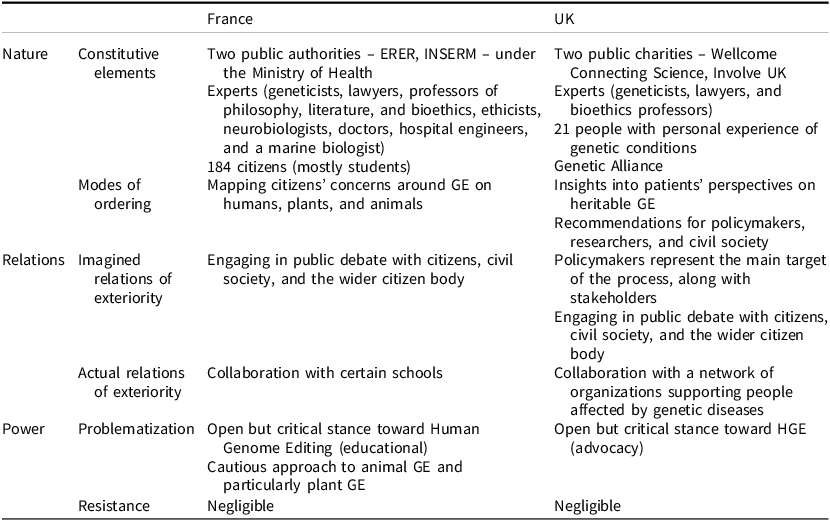
To begin with the nature of the processes under study, their composition relies on three key figures (organizers, experts, and participants) as is customary in these processes (see Curato, Farrell, Geissel et al. Reference Curato, Farrell, Geissel, Grönlund, Mockler, Pilet, Renwick, Rose, Setälä and Suiter2021). However, the French experiment was more closely tied to public authorities than the UK case. The former also hosted a wider range of experts, reflecting the broader scope of the process, which was interested in discussing GE more generally, rather than simply in relation to humans. In terms of participants, the former focused mainly on students, while the latter involved a specific group of public sphere actors (see Table 2, ‘constitutive elements’).
French and UK assemblies summarized through the lens of democratic assemblage

The modes of ordering of each process are in line with their respective composition. Consistent with the abovementioned report of the US National Academies, these processes aligned their modalities of engagement to the type of public they targeted. The French case tends to address the broader public, whereas the British case targets the intersection between stakeholders and affected communities. The objective of the French case was primarily exploratory, aiming to map citizens’ concerns about GE in general and to create an informed public and learn from their insights (see Table 2, ‘modes of ordering’). In this context, the involvement of students over other groups of citizens is understandable as the focus of the initiative tended to be on the broad public. Also, the composition of the UK case can be understood in terms of its intended end, that is, to reach out to political actors with recommendations from a specific group of citizens who are particularly sensitive to the topic under discussion (see Table 2, ‘modes of ordering’). In other words, one group of stakeholders that is well-organized and boasts large resources brought together and mobilized a directly affected community to advocate for change. This is an effective strategy in the United Kingdom, where ‘patients/consumers have become influential actors in shaping policy. Politically, leading scientists were successful in building a broad community of promise involving patients that was sufficiently influential to overcome resistance from groups opposed to embryo research’ (Martin and Turkmendag Reference Martin and Turkmendag2021: 402).
Moving on to relations of exteriority (see Table 2, ‘imagined’ and ‘actual’ relations), we notice that these are particularly important to processes aimed at fostering public debate and are considered a crucial objective for participatory processes on GE. According to our analysis, however, these processes showed mostly imagined relations, rather than actual ones. Collaboration with civil society organizations is notably absent in both cases. That reduces the inclusivity of these processes and poses an important democratic limitation.
When it comes to power, we observe an imbalance, as only problematization occurred, and there were no substantive signs of resistance (see Table 2). Interestingly, scholarship on science from a policy or social science perspective highlights how public engagement can focus on different questions (‘should we’, ‘how should we’, and ‘whether’) depending on whether it feeds into the input, throughput, or output phases of the decision-making process (see Schuubiers and Fisher Reference Schuurbiers and Fisher2009). That helps to see how the processes under study could democratize two different aspects: improving scientific literacy and building awareness (upstream impact) in France and acceptance of a specific type of NGT applications (midstream) in the United Kingdom. Nevertheless, in the absence of resistance, these democratizing aims boiled down to an educational campaign for a minuscule section of the public, in the French case, and an advocacy effort on germline human GE in the British one. These limits notwithstanding, these experiments offered small, initial steps in democratizing the field of NGTs by opening up problem framing in the UK case and in reflexively engaging underrepresented segments of the public in France. Furthermore, useful lessons can be gathered for future processes that can promote democratization more effectively.
To do that, we reflect on how the assemblages are shaped by the relations across their key aspects. Overall, in terms of their nature, both cases featured consistency between the constitutive elements of a process and its modes of ordering, but they were partial. The UK assembly lacked the substantive presence of government actors among its constitutive elements, which were present in the French case. Also, the French Consultation missed a clear political goal as a mode of ordering, as in the UK case. Internally consistent but only partially set up to engage with their contexts, these processes were unable to establish meaningful relations of exteriority. Extensive references to civil society actors, which are crucial to foster the democratic qualities of these processes, do not materialize in practice and present an obvious barrier to embedding these processes in real-world contexts (Bussu, Bua, Dean et al. Reference Bussu, Bua, Dean and Smith2022). The nature of these processes and their relations of exteriority concurred to shape the dimension of power. In particular, as these processes were meant to affect public debate (modes of ordering), involved actors (constitutive elements) could effectively engage in problematization – what should or should not be discussed – except for the problem that civil society (dissenting) views were largely missing (actual relations). This limitation on problematization precludes the possibility of building a stronger, more coherent political awareness that motivates communities to actively engage in pursuing changes that benefit everyone. Resources to build democratic abilities to engage the surrounding context (resistance) were thus limited. Without the creation of new democratic abilities, processes are unlikely to be of use for actors seeking to exercise (or contest) power.
In our view, the challenge here consists in connecting top-down modes of ordering, which are necessary to ensure a certain amount of impact, with bottom-up relations of exteriority, which are essential to secure democratic thrust. Exploring the possible ways in which this could be achieved is beyond the remit of the paper. Indeed, though it is inevitable that this challenge is context-dependent, it is important that these processes do not work at a distance from or, worse still, against civil society (della Porta and Felicetti Reference Della Porta and Felicetti2022).
Importantly, neither of the processes examined here contributes to attenuating their promethean consideration of elites. In relation to GMOs, this has been a key challenge for deliberative processes aimed at adding democratic legitimacy to decisions on this topic (Dryzek, Goodin, Tucker et al. Reference Bowen2009). There is evidence that the public still tends to take a precautionary position in the era of CRISPR (Wise and Borry Reference Wise and Borry2022). In addition, there is a tendency to frame the role of the public in participation simply in terms of ‘acceptability’, ‘support’, or ‘rejection’ of given proposals (Busch, Ryan, von Keyserlingk et al. Reference Busch, Ryan, von Keyserlingk and Weary2022) or to understand problems in terms of a ‘cognitive distance’ between scientists, policymakers, and regulators, on the one hand, and the rest of the population, on the other (Cisnetto and Barlow Reference Cisnetto and Barlow2020). Another tendency is to refer to the public as ‘recalcitrant’, which needs to be educated, informed, and convinced (Meyer and Vergnaud Reference Meyer and Vergnaud2021: 11). That can lead to framing ‘public engagement as an instrument for generating societal acceptance of novel technological applications, instead of facilitating genuine and earnest public debate’ (Gunn and Jongsma Reference Gunn and Jongsma2023: 79–80). To date, even advanced efforts to promote translation and co-production work on CRISPR seem to have failed to attain a genuinely dialogical dimension and a two-way conversation where the voice of the public is recognized (Svingen and Jahren Reference Svingen and Jahren2024).
Conclusions
Our analysis finds that the processes under study do not contribute significantly to democratizing the relevant policymaking process or the public debate. Borrowing concepts from assemblage theory, we have developed a framework of reference to study these cases. Although these processes produce a significant amount of problematization, they seem unable to grant resistance. We have explained this outcome by considering the nature and relations of exteriority that characterized both processes. Our considerations are not meant to criticize the processes examined here. Instead, they highlight a broader challenge with participatory and deliberative forums. Finding ways to improve these processes remains crucial, all the more so since, in the domain of GE, more traditional forms of governance, such as those hinged on electoral governance, clearly fall short. Thus, we have argued that substantive improvements can be attained through relatively direct changes to the composition and modes of ordering of these processes. Another, more challenging effort lies in the ability to build actual relations of exteriority between top-down processes and bottom-up publics to promote embeddedness (Bussu, Wojciechowska, Forde Fordeet al. Reference Bussu, Wojciechowska, Forde and Santos Dias2025a). This is particularly difficult in the context of NGTs, where calls for participation hinge on the need to inform publics and to learn about their preferences, whereas the call to empower publics seems less widespread. Overall, our insistence on actual relations of exteriority is in line with the emphasis in assemblage theory on ‘reorient[ing] our thinking toward the production of connections with different entities and how each new connection creates possibilities and conflicts for becoming-democratic’ (Eadson and Van Veelen Reference Eadson and Van Veelen2021: 10; see also Bussu, Wojciechowska, Forde et al. Reference Bussu, Wojciechowska, Forde and Santos Dias2025a).
Recent literature has highlighted the need to reflect systematically on issues of governance and professionalization affecting deliberative and participatory forums. Chilvers (Reference Chilvers, Bherer, Gauthier and Simard2017) highlights the risks that emerge in the United Kingdom in the context of institutionally commissioned public dialogue on science and technology, including hindering reflexivity on the governance of these forums. Parry, Curato, and Dryzek (Reference Parry, Curato and Dryzek2024) convincingly argue for more reflexivity and meta-deliberation on governance practices of mini-publics. We believe this might be important to try to ensure that processes such as the ones under consideration here can have a democratizing effect.
Naturally, our paper is not without its limitations. Our understanding of the role that participatory and deliberative processes can play would undoubtedly be improved by studies that considered a larger number of cases, ideally focusing on different issues within the broader topic of NGTs. Such studies could also generate more context-specific insights. Furthermore, our use of assemblage theory is only one of the possible ways to adopt this theory for democratic analysis. Future studies might certainly improve upon our model. Nevertheless, we hope that our contribution encourages a much-needed debate on the democratic challenges posed by NGTs and offers an original means to investigate this and other issues facing democratic societies.
Data availability statement
All the cited documents are available online.
Acknowledgments
The authors would like to thank Hans Asenbaum, André Bachtiger, and Sonia Bussu for their generous comments on earlier versions of this work.
Funding statement
No funding to disclose.
Competing interests
The authors declare no conflict of interest.
Ethical standard
This study relies exclusively on publicly available documents and does not involve human subjects.
AI use
LLM (Claude Anthropic) was used for language editing; all intellectual content is original and authored by the researchers.


 Open access

