


Introduction
Voters in most contemporary democracies get to choose between a large number of parties and candidates. To make an informed decision, voters should ideally obtain and process information about all these electoral options—a seemingly Herculean task, considering that many voters are not very politically active and lack direct political knowledge (Converse, Reference Converse and Apter1964; Powell and Whitten, Reference Powell and Whitten1993; Delli Carpini and Keeter, Reference Delli Carpini and Keeter1996). Yet, a recent revisionist line of research demonstrates that voters frequently make informed decisions in complex information environments. They do so using heuristic rules that map simple information inputs to accurate cognitions (Fortunato and Stevenson, Reference Fortunato and Stevenson2019; Fortunato et al., Reference Fortunato, Lin, Stevenson and Tromborg2021). Voters use such ‘ecologically rational’ heuristics when the inputs are relatively easy to obtain, the rules are simple to apply, and the resulting inferences are accurate on average. Based on this, we argue that candidate voting advice applications (VAAs) provide an important (but often overlooked) cue that the users frequently apply in an ecologically rational way when they decide who to vote for.
Contemporary VAAs are online tools that voters can use during election campaigns to assess which parties or candidates share their issue positions. Typically, VAAs ask the candidates or parties running in an election about their preferences on a large number of issues. Once these responses are collected, VAA users can answer the same questions online and receive voting advice based on the proximity between their issue preferences and those of the candidates running in the district or the national parties. VAAs are becoming increasingly popular (Garzia and Marschall, 2012, Reference Garzia and Marschall2019). In the Netherlands, the VAAs Stemwijzer and Kieskompas had 6.85 million users in the week before the 2017 national election (Van de Pol et al., Reference Van de Pol, Kamoen, Krouwel, De Vreese and Holleman2019). In Germany, the VAA Wahl-O-Mat attracted more than 21,000,000 users during the 2021 general election (Bundeszentrale für politische Bildung, 2021). In Denmark, approximately 60% of the electorate used a VAA before voting during the 2019 parliamentary election (Hansen and Stubager, Reference Hansen and Stubager2019). VAAs have a lower reach outside Northwestern Europe, but are also employed in East Asia (Liao et al., Reference Liao, Chen, Jensen and Pritchard2016), Latin America (Marzuca et al., Reference Marzuca, Serdült and Welp2011), Oceania (Lees-Marshment et al., Reference Lees-Marshment, Dufresne, Eady, Osborne, van der Linden and Vowles2015), Canada (CBC, 2021), and the USA (Washington Post, 2020; iSideWith.com, 2021). Understanding whether and how VAAs influence voting behavior is critical to understanding contemporary elections.
Despite this, there is no consensus on whether and how VAAs influence voters. Observational studies (e.g., Andreadis and Wall, Reference Andreadis, Wall, Garzia and Marschall2014; Wall et al., Reference Wall, Krouwel and Vitiello2014; Kleinnijenhuis et al., Reference Kleinnijenhuis, van de Pol, van Hoof and Krouwel2019) generally find evidence of rather large effects, but the estimates may be biased upwards from users receiving similar information inputs from other sources (e.g., the news). Experimental designs find much less evidence of VAA effects, but this may be because they compare treated voters to a control group in terms of their likelihood of vote switching, and VAAs could have countervailing effects depending on whether the advice is consistent or inconsistent with the users’ prior vote intentions. Furthermore, little work so far has been done to disentangle how VAA advice about candidates in the district influences individual vote choices for parties and candidates. This is important because many districts contain a large number of candidates, which makes it quite complex to incorporate information about district candidates into the vote decision. We address these gaps both theoretically and empirically.
Theoretically, we argue that many voters use VAA advice to update their voting decision in ways that are consistent with the heuristics framework for understanding individual voting behavior. Specifically, we argue that when voters use VAA advice to update their vote choice it is because the VAA allows them to use relevant information about the electoral options without doing an extensive information search. This framework for understanding VAAs has important implications for who we expect to be influenced by candidate-based VAA advice. VAA users should be more susceptible to the advice when they are unlikely to obtain more nuanced information about the candidates in alternative ways (i.e., when it is ecologically rational) and when strong competing cues are not present (e.g., party labels for party identifiers).
Empirically, we use data from an original 2019 election survey in Denmark. To establish both internal and ecological validity, we use a within-subject design where respondents were asked about their vote intention immediately before and after taking a real candidate VAA that was used approximately 2.5 million times during the election campaign. The results show that VAA users who receive advice that is in conflict with their pre-existing party preferences (i.e., party-incongruent advice) become 16% points more likely to change their vote intention than VAA users who receive advice that is consistent with their preferences (i.e., party-congruent advice). Sixty-three percent of the users who receive party-incongruent advice and change their vote intention switch to a party they are recommended, and 27% of them switch to a non-party option (e.g., undecided). VAA users who are undecided about what party to vote for prior to taking the VAA are even more inclined to follow the advice. Finally, candidate-incongruent advice also leads to vote-switching within parties.
The concluding section discusses the implications of these results. It underscores how they corroborate recent research demonstrating that voters can make sensible decisions when ecologically rational heuristics are available in complex information environments. Furthermore, the results are discussed in light of Zaller’s theory of how people receive information about politics. Building on insights from this discussion, we show how the heuristic framework where VAA advice is considered a simple cue that fills an information need can help reconcile the VAA literature on vote choice with that on turnout. Finally, we reflect on the limits and weaknesses of VAAs, and their ability to remain relevant in more polarized political landscapes
Voters and candidate VAAs: experiences and expectations
Existing research on VAAs comes to different conclusions about whether and how much VAAs impact vote choices. The differences seem to be linked to empirical design, as illustrated in Table 1. In general, descriptive and observational studies indicate that VAAs impact their users. However, these studies may have inherent biases that lead to an overestimation of VAA effects. Descriptive studies (which are also sometimes included in papers using an observational design) simply examine whether users report having been influenced by the VAA advice they received. This may result in VAA effects being overestimated if their recollections are systematically biased upwards. Observational studies attempt to isolate the effects of VAA advice by comparing the voting behavior of users and non-users over time. However, users and non-users are likely to be systematically different from each other at the outset, which could affect both their voting behavior and their propensity to use a VAA. Furthermore, if VAAs work the way they are supposed to, then the advice that a VAA user receives is a function of the user’s underlying preferences. Consequently, users may receive information inputs from other sources (e.g., from the news or from conversations with colleagues, family, and friends) that are consistent with the VAA advice in the time that passes between taking the VAA and voting in an election. Such confounding effects from users’ underlying preferences would also result in an overestimation of the true VAA advice effects.
Selection of previous research on VAA vote choice effects
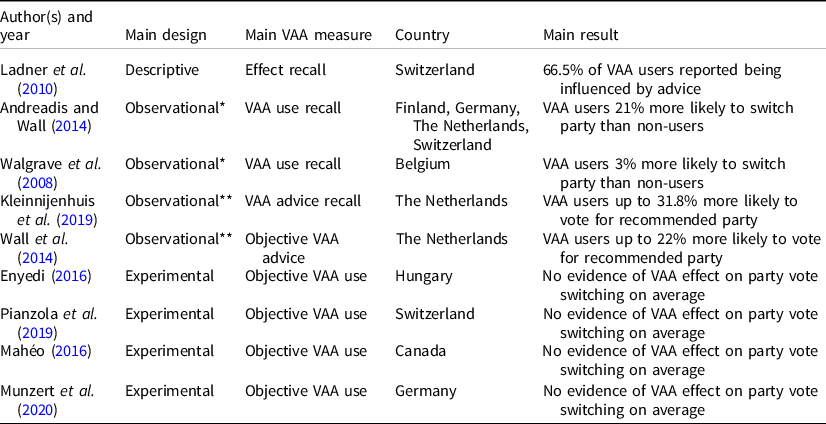
Note: Other research analyzes different choice outcomes, such as propensity to vote scores (Alvarez et al., Reference Alvarez, Levin, Mair and Trechsel2014) and aggregate vote choice volatility and fragmentation (Kleinnijenhuis et al., Reference Kleinnijenhuis, van de Pol, van Hoof and Krouwel2017).
* Panel data comparing the propensity of vote change between users and non-users.
** Panel data comparing specific vote choices as a function of VAA advice.
To address these internal validity issues, some recent studies employ experimental designs. In general, these studies randomly assign citizens to take a VAA and then compare them to a control group in terms of how likely they were to switch their initial vote choice between taking the VAA and voting in an election. However, this design may underestimate true VAA effects because they are likely to depend on whether the advice is congruent or incongruent with the user’s pre-existing preferences. If the advice is incongruent then VAA use may lead to vote switching, but if the advice is congruent then it may lead to vote choice stability. These countervailing effects may explain the null effects in experimental studies. Interestingly, some of these studies do find VAA advice effects when they condition the analysis on the congruence of the advice, but this may be a function of the same selection bias as in the observational studies because the congruence of the advice is not randomly assigned.
It follows from the discussion, so far, that we need a design that can disentangle the effects of VAA advice while accounting for potential confounders and counterveiling effects. One promising way to address these issues is to survey citizens about their political preferences immediately before and after using a VAA, and store information about the VAA advice they received (Alvarez et al., Reference Alvarez, Levin, Mair and Trechsel2014). In terms of confounders, the advantage is that the only information input the VAA users are likely to receive while taking the survey is the VAA advice itself. In terms of countervailing advice effects, we can use the design to compare users who receive advice that is incongruent to those who get more congruent advice. We go into more detail about how we apply this within-subject design in the next section.
We also need a theory to generate specific expectations that we can test using this design. We argue that candidate-based VAAs, when available, provide a simple cue that many voters are likely to use to meet the demands associated with finding and processing information about their electoral options. This argument builds on research on ecological rationality in psychology and political behavior, which suggests that voters frequently use simple informational inputs to arrive at complex political decisions (Gigerenzer and Gaissmaier, Reference Gigerenzer and Gaissmaier2011; Fortunato and Stevenson, Reference Fortunato and Stevenson2019; Fortunato et al., Reference Fortunato, Lin, Stevenson and Tromborg2021). Specifically, when available, voters tend to use heuristic rules in complex information environments that (1) have low information costs, (2) are simple to use, and (3) improve accuracy on average. Doing so is considered ecologically rational because it allows voters to make decisions that are, on average, more consistent with their political preferences without incurring information costs that they are unwilling or unable to pay.
We believe that it is reasonable to consider VAA advice an ecologically rational cue because it fulfills these conditions for ecological rationality quite well. The information costs for VAA use are comparatively low. Taking a candidate-based VAA typically only takes a few minutes and provides an information input that quickly differentiates between many candidates across a wide range of issues. Compared to alternative information search strategies (e.g., attending political debates, reading news articles, or reading social media posts), a VAA provides a much faster way to receive comparable and relevant information about a large number of candidates and parties. The cue is also simple to use. It is straightforward to map the advice onto an inference about which party candidates hold congruent policy views. VAAs thus provide information that is easily translated into the voting decision. In terms of accuracy, the candidate positions are provided by the candidates themselves and elected politicians have been found to stay true to the positions they took in the VAA (Fivaz et al., Reference Fivaz, Louwerse, Schwarz, Garzia and Marschall2014; Ilmarinen et al., Reference Ilmarinen, Isotalo, Lönnqvist and von Schoultz2022). While VAAs have inherent weaknesses that could reduce accuracy (a point we will elaborate in conclusion), there is thus reason to believe that using VAA advice can lead to a more accurate understanding of the district candidates’ positional congruence.
This understanding of VAA advice as an ‘ecologically rational’ cue has implications for if, when and for whom we expect VAAs to have an influence. In terms of if, we expect that VAA advice should lead to vote switching for some users because they provide new and relevant information inputs. In terms of when, we expect that VAAs only leads to vote switching when the advice conflicts with the users’ existing preferences (i.e., when the users receive ‘incongruent advice’). Clearly, it would not be ‘ecologically rational’ for users to change their vote intention based on advice that is consistent with this intention (i.e., congruent advice). Therefore, our first expectation is that candidate-based VAA advice results in more party switching in general when it is less party-congruent. This happens when the VAA provides evidence that the user disagrees with the candidates fielded by the party that the voter intended to vote for prior to taking the VAA (the user’s pre-VAA party). Such a VAA result is a cue that other parties field more congruent candidates, and the less party-congruent the advice, the stronger the cue. Consequently, we expect the probability of withdrawing support for the pre-VAA party to increase with less party-congruent advice.
Hypothesis 1: VAA users who receive less party-congruent VAA advice are more likely to withdraw their support from the party they expected to vote for prior to using the VAA.
In terms of whom, the heuristics framework has the implication that users who have a greater need for a VAA cue should be influenced more by the advice. It would not be ecologically rational to factor the advice into the voting decision for users who can obtain better information inputs from other sources. The need for the VAA cue is thus a function of the accuracy of the VAA tool and the characteristics of the VAA user. VAAs employ many decision rules that could reduce their accuracy (the algorithm used to match voters and candidates, the questions used in the VAA, etc.). They also only factor in policy positions, but voters may also care about other characteristics of candidates when they vote, such as their perceived competence. Consequently, using VAA advice to determine who to vote for is less ecologically rational for users who get more direct and nuanced information from other sources (e.g., watching the news, going to candidate websites, and attending debates). Voters who are more politically interested are more likely to obtain such nuanced political information about their candidates and less likely to perceive the costs. This is also consistent with the established pattern that those with high levels of political interest are generally less likely to rely on simple cues when they decide who to vote for (Fortunato and Stevenson, Reference Fortunato and Stevenson2013; Lin et al., Reference Lin, Stevenson, Wessel Tromborg and Fortunato2017). Consequently, we expect that less politically interested VAA users are more likely to use the VAA advice to update their preferences.
Hypothesis 2: VAA users with a lower level of political interest are more likely to be affected by the received VAA advice.
In terms of whom, the heuristics framework also implies that users should be less likely to use VAA advice to update their vote intention when the strength of a competing cue is greater. One of the most important cues that voters use is the party label (Downs, Reference Downs1957; Cox and McCubbins, Reference Cox and McCubbins1993), and voters who identify with a particular party are likely to have strong prior beliefs that candidates who run under this party’s label are more ideologically proximate and competent than candidates from other parties (Campbell et al., Reference Campbell, Converse, Miller and Stokes1960; Lewis-Beck et al., Reference Lewis-Beck, Jacoby, Norpoth, Weisberg and Converse2008). Consequently, they are less likely to accept any new information that this is not the case (Laustsen and Petersen, Reference Laustsen and Petersen2020). Furthermore, while party identification may be less applicable in Europe than in the USA (Thomassen, Reference Thomassen1976) it does seem to influence how voters process information in the European context as well (e.g., Bisgaard, Reference Bisgaard2015). Taken together, this suggests that VAA users who identify with a party will be less likely to update their party choice when they receive advice that is incongruent with the party they identify with.
Hypothesis 3: VAA users who do not identify with their pre-VAA party are more likely to be affected by the received VAA advice.
The theoretical framework also has implications for whom gets influenced based on prior vote intentions. Users who are undecided about who to vote for are likely to perceive a greater need for a cue that will help them make this decision than those who feel like they have already received sufficient information to make an informed choice. Furthermore, it would clearly not be rational to use VAA advice to switch to a party that was not actually recommended. Consequently, and consistent with arguments in previous research (Van de Pol et al., Reference Van de Pol, Holleman, Kamoen, Krouwel and De Vreese2014), we expect that VAA users tend to switch to congruent parties and especially so if they are undecided about who to vote for before they take the VAA.
Hypothesis 4: VAA users who switch their party choice after taking the VAA are more likely to switch to a more congruent party.
Hypothesis 5: Undecided users are more likely to switch to a congruent party than users who expected to vote for a party prior to using the VAA.
Finally, an implication of the theoretical framework is also that VAA advice should lead to within-party switching for some users. We expect this to be more likely to happen when the advice is party-congruent, but not candidate-congruent. This type of advice is a cue to the user that the pre-VAA party fields congruent candidates, but also that some of them are more congruent than the pre-VAA candidate. Consequently, users who receive this type of advice should stick with the pre-VAA party, but be more likely to abandon their pre-VAA candidate. Furthermore, and following the theoretical logic underlying H2, we expect this VAA advice effect to be stronger among users with a greater need for a cue (i.e., less politically interested voters). However, we do not expect that it is conditioned by party identification. This is because the party cue does not compete with the VAA cue when the user decides which within-party candidate to vote for—the party cue cannot be used to discriminate between candidates from the same party.
Hypothesis 6: VAA advice that is party-congruent, but less candidate-congruent, is more likely to lead VAA users to switch their within-party candidate choice.
Hypothesis 7: VAA users with a lower level of political interest are more likely to be affected by the VAA advice in their within-party candidate choice.
Methods
Data
In order to test the empirical implications of the theoretical framework, we developed an original survey in Denmark in collaboration with one of the most widely used Danish VAAs (Altinget’s VAA). This survey was implemented in the weeks leading up to the 2019 Danish parliamentary election. We first recruited a sample of Danish citizens over the age of 18 from the survey company Dynata. The respondents were online Dynata panelists who were randomly invited to participate by Dynata via e-mail. They received reward points to redeem for cash and prizes in return for participating. The final sample size was 1,496 respondents. To account for any systematic non-response bias that may occur in such a survey, and the fact that the original Dynata panel is not a random sample of the Danish voting age population, we use survey weights that address non-response and sampling bias for all analyses (see online Appendix A.5 for more details).
After recruiting the respondents, we first asked them about their political interest, party identification, and what party and candidate they expected to vote for in the upcoming election (See online Appendix A.1. for specific wording for each question). Next, we directed them to Altinget’s VAA where Altinget recorded the advice they received. Finally, the respondents were sent back to our survey immediately after completing the VAA where we asked them again which party and candidate they expected to vote for in the upcoming election. This survey structure allows us to examine whether candidate advice has an effect on vote intentions while maintaining a high degree of ecological validity. Regarding effects, the median response time for respondents to complete the three parts (i.e., the pre-VAA survey, the VAA, and the post-VAA survey) was 13 minutes, which means that it is unlikely that the respondents received any other informational inputs than the VAA advice itself during the survey completion time.Footnote 1 Consequently, any change in political preference should be due to the VAA advice, and not to other events happening between the advice and the final vote intention statement. Regarding ecological validity, the respondents used a real candidate VAA that is typical in terms of format and was used roughly 2.5 million times in the 2019 Danish election. A disadvantage of the design is that it focuses on vote intentions instead of actual (or self-reported) vote choices. We discuss this issue more in detail in the conclusion, but note that we also employed a post-election survey that generally showed similar results despite the internal validity issues associated with this design (Appendix A.4). Another potential disadvantage is that the users’ pre-VAA vote intention answers might impact their post-VAA vote intentions. If so, this would likely result in a conservative bias of our estimated effect sizes. However, it is important to note that respondents answered 30 other survey questions (i.e., the VAA questions) between the two vote intention questions, which should limit priming effects from the first question.
The Danish case
There are 175 Danish MPs in the unicameral Parliament, and they are elected in 10 multimember districts. 13 parties and 900 candidates ran for election in 2019. Most candidates ran on open party lists, but three parties used flexible lists.Footnote 2 The flexible lists resemble closed lists except that district voters can move a candidate to the top of the list by giving that candidate a number of personal votes that meet a high threshold. For both flexible and open lists, voters have the option to vote for a party’s list (helping the party win seats) or to vote personally for a candidate on the party’s list (helping the candidate and the candidate’s party win seats). Approximately half of the Danish electorate typically votes personally in a general election. Thus, the Danish electoral system contains elements that are familiar across most parliamentary democracies with multimember district rules (e.g., open lists, flexible lists, party votes, and personal votes). Given this, and the fairly large number of parties and candidates, the results may generalize to other complex multiparty systems. However, our theoretical framework suggests that they are less likely to generalize to contexts with fewer parties and candidates because the demand for a simple informational cue should be lower. Accordingly, VAAs tend to be more popular in multiparty systems (Garzia and Marschall, Reference Garzia and Marschall2012: 211; Pianzola et al., Reference Pianzola, Trechsel, Vassil, Schwerdt and Alvarez2019), Altinget’s VAA included 30 questions answered by both users and candidates using a 1–5 ordinal response scale (ranging from 1 ‘strongly agree’ to 5 ‘strongly disagree’) with four response options. The middle category was hidden in order to make the advice more directional and to reduce the benefits of taking centrist positions for candidates. Using these responses, the VAA calculated the Manhattan distance between each user and each candidate running in the user’s district. Users and candidates also had the opportunity to tick a box for each question, indicating that the issue was salient to them. Questions carried double weight when ticked as important by a user and triple weight when also ticked as important by a candidate. Using this algorithm, the VAA finally gave advice by reporting the five most congruent candidates in the user’s district (as well as their party affiliation) in order of how congruent the candidates were. The most congruent candidate was highlighted in bold (illustrated in Appendix A.2).
Measures and data analysis for party vote switching
Testing the different hypotheses requires different measures and different modeling strategies.Footnote 3 Consequently, we detail each model separately. We begin here with the measures used to test the hypotheses about VAA advice and party vote switching (Hypotheses 1, 2, 3, 4, and 5). In this analysis, we make the unit of analysis the respondent-party (i.e., we use a stacked dataset with voter-party dyads). This allows us to measure the probability of choosing a party after taking the VAA, conditional on the pre-VAA party choice and the VAA advice received.
Pre-VAA party choice
In the first (pre-VAA) part of the survey, respondents were asked who they expected to vote for in the upcoming election. We code this variable as 1 for the party each respondent expected to vote for prior to taking the VAA, and 0 for all other parties.
Undecided
Other respondents in the first part of the survey indicated that they were undecided about who to vote for in the upcoming election. These respondents are assigned the value 1 on the undecided variable while all other respondents are coded as 0.
Non-party
Some respondents indicated that they had decided how they were going to vote prior to taking the VAA but did not plan to vote for one of the 13 parties running in the election. We code these respondents as 1 on the non-party variable (0 otherwise). This includes respondents who chose ‘independent candidate’ or ‘other party’ when asked which of the 13 registered parties (if any) they expected to vote for, prior to taking the VAA, and those who declared that they were expecting to cast a ‘blank vote’ (i.e., a vote that does not count for any parties or candidates).
Abstain
Another group of voters indicated that they expected to abstain from voting in the upcoming election. These respondents are coded as 1 on the abstain variable (otherwise 0).
Party ID
The party identification variable is 1 or 2 for the party that the respondent identified with (2 if the respondent identified strongly with the party and 1 if the party identification was weak) and 0 for all other parties. The party identification question wording comes from the recurrent Danish election survey and asks respondents first whether they ‘feel like supporters of a particular party,’ and, if so, which party and, next, whether or not they are highly convinced supporters of the party they chose (if any).
Political interest
To measure political interest, we use the ordinal response scale from a question asking respondents how much interest they had in politics. The ordinal response categories were 0: No interest, 1: A little interest, 2: Some interest, and 3: A lot of interest.
No advice
In the second part of the survey, the respondents took the VAA and received a candidate-based advice. Using the VAA advice data, we code the no advice variable as 1 for parties that fielded no candidates the respondent was recommended (0 otherwise). VAA advice is thus party-incongruent (i.e., the lowest congruence level) for respondent-party observations that are coded as 1 on both the pre-VAA party choice variable and the no advice variable.
Weak advice
This variable is coded as 1 for parties that fielded one or more candidates who were recommended to the respondent, but not the most congruent candidate (i.e., not the candidate highlighted in bold on the VAA advice page). Given this, we consider observations that are coded as 1 on both the pre-VAA party choice variable and the weak advice variable as indicating partially party-congruent advice.
Strong advice
This variable is coded as 1 for the party that fielded the candidate with whom the respondent agreed the most (the candidate highlighted in bold on the VAA advice page). We consider observations that are coded as 1 on both the pre-VAA party choice variable and the strong advice variable as indicating highly party-congruent VAA advice.Footnote 4
Post-VAA party choice
In the third (post-VAA) part of the survey, respondents were again asked whom they expected to vote for in the upcoming election. We code this variable as 1 for the party each respondent said they expected to vote for after taking the VAA and 0 for all other parties.
Data analysis for party vote switching
The basic model analyzing VAA effects on party choices takes the following form where i indexes each respondent and p indexes each party:
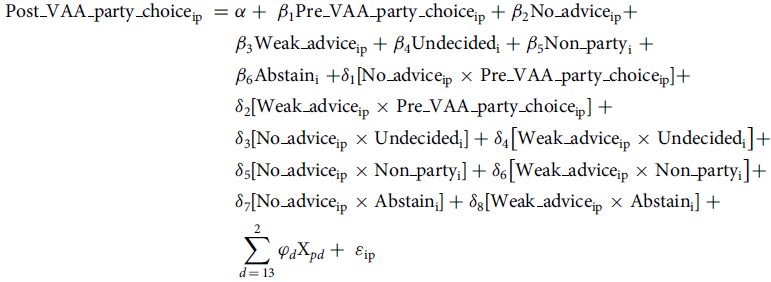 \begin{align}{\rm{Post}}\_{\rm{VAA}}\_{\rm{party}}\_{\rm{choic}}{{\rm{e}}_{{\rm{ip\;}}}} &= {\rm{\alpha }} + {\rm{\;}}{{\rm{\beta }}_1}{\rm{Pre}}\_{\rm{VAA}}\_{\rm{party}}\_{\rm{choic}}{{\rm{e}}_{{\rm{ip}}}} + {{\rm{\beta }}_2}{\rm{No}}\_{\rm{advic}}{{\rm{e}}_{{\rm{ip}}}} +\\
&\quad {{\rm{\beta }}_3}{\rm{Weak}}\_{\rm{advic}}{{\rm{e}}_{{\rm{ip}}}} + {{\rm{\beta }}_4}{\rm{Undecide}}{{\rm{d}}_{\rm{i}}} + {{\rm{\beta }}_5}{\rm{Non}}\_{\rm{part}}{{\rm{y}}_{\rm{i}}}{\rm{\;}} +\\
&\quad {{\rm{\beta }}_6}{\rm{Abstai}}{{\rm{n}}_{\rm{i}}}{\rm{\; + }}{{\rm{\delta }}_1}[{\rm{No}}\_{\rm{advic}}{{\rm{e}}_{{\rm{ip}}}} \times {\rm{Pre}}\_{\rm{VAA}}\_{\rm{party}}\_{\rm{choic}}{{\rm{e}}_{{\rm{ip}}}}] +\\
&\quad {{\rm{\delta }}_2}[{\rm{Weak}}\_{\rm{advic}}{{\rm{e}}_{{\rm{ip}}}} \times {\rm{Pre}}\_{\rm{VAA}}\_{\rm{party}}\_{\rm{choic}}{{\rm{e}}_{{\rm{ip}}}}]{\rm{\; + }}\\
&\quad {{\rm{\delta }}_3}[{\rm{No}}\_{\rm{advic}}{{\rm{e}}_{{\rm{ip}}}} \times {\rm{Undecide}}{{\rm{d}}_{\rm{i}}}] + {{\rm{\delta }}_4}\left[ {{\rm{Weak}}\_{\rm{advic}}{{\rm{e}}_{{\rm{ip}}}} \times {\rm{Undecide}}{{\rm{d}}_{\rm{i}}}} \right] +\\
&\quad {{\rm{\delta }}_5}[{\rm{No}}\_{\rm{advic}}{{\rm{e}}_{{\rm{ip}}}} \times {\rm{Non}}\_{\rm{part}}{{\rm{y}}_{\rm{i}}}] + {{\rm{\delta }}_6}\left[ {{\rm{Weak}}\_{\rm{advic}}{{\rm{e}}_{{\rm{ip}}}} \times {\rm{Non}}\_{\rm{part}}{{\rm{y}}_{\rm{i}}}} \right] +\\
&\quad {{\rm{\delta }}_7}[{\rm{No}}\_{\rm{advic}}{{\rm{e}}_{{\rm{ip}}}} \times {\rm{Abstai}}{{\rm{n}}_{\rm{i}}}] + {{\rm{\delta }}_8}[{\rm{Weak}}\_{\rm{advic}}{{\rm{e}}_{{\rm{ip}}}} \times {\rm{Abstai}}{{\rm{n}}_{\rm{i}}}]{\rm{\;}} +\\
&\quad \mathop \sum \limits_{d\,=\,13}^2 {{\rm{\varphi }}_d}{{\rm{X}}_{pd}} + {\rm{\;}}{{\rm{\varepsilon }}_{{\rm{ip}}}}\end{align}
\begin{align}{\rm{Post}}\_{\rm{VAA}}\_{\rm{party}}\_{\rm{choic}}{{\rm{e}}_{{\rm{ip\;}}}} &= {\rm{\alpha }} + {\rm{\;}}{{\rm{\beta }}_1}{\rm{Pre}}\_{\rm{VAA}}\_{\rm{party}}\_{\rm{choic}}{{\rm{e}}_{{\rm{ip}}}} + {{\rm{\beta }}_2}{\rm{No}}\_{\rm{advic}}{{\rm{e}}_{{\rm{ip}}}} +\\
&\quad {{\rm{\beta }}_3}{\rm{Weak}}\_{\rm{advic}}{{\rm{e}}_{{\rm{ip}}}} + {{\rm{\beta }}_4}{\rm{Undecide}}{{\rm{d}}_{\rm{i}}} + {{\rm{\beta }}_5}{\rm{Non}}\_{\rm{part}}{{\rm{y}}_{\rm{i}}}{\rm{\;}} +\\
&\quad {{\rm{\beta }}_6}{\rm{Abstai}}{{\rm{n}}_{\rm{i}}}{\rm{\; + }}{{\rm{\delta }}_1}[{\rm{No}}\_{\rm{advic}}{{\rm{e}}_{{\rm{ip}}}} \times {\rm{Pre}}\_{\rm{VAA}}\_{\rm{party}}\_{\rm{choic}}{{\rm{e}}_{{\rm{ip}}}}] +\\
&\quad {{\rm{\delta }}_2}[{\rm{Weak}}\_{\rm{advic}}{{\rm{e}}_{{\rm{ip}}}} \times {\rm{Pre}}\_{\rm{VAA}}\_{\rm{party}}\_{\rm{choic}}{{\rm{e}}_{{\rm{ip}}}}]{\rm{\; + }}\\
&\quad {{\rm{\delta }}_3}[{\rm{No}}\_{\rm{advic}}{{\rm{e}}_{{\rm{ip}}}} \times {\rm{Undecide}}{{\rm{d}}_{\rm{i}}}] + {{\rm{\delta }}_4}\left[ {{\rm{Weak}}\_{\rm{advic}}{{\rm{e}}_{{\rm{ip}}}} \times {\rm{Undecide}}{{\rm{d}}_{\rm{i}}}} \right] +\\
&\quad {{\rm{\delta }}_5}[{\rm{No}}\_{\rm{advic}}{{\rm{e}}_{{\rm{ip}}}} \times {\rm{Non}}\_{\rm{part}}{{\rm{y}}_{\rm{i}}}] + {{\rm{\delta }}_6}\left[ {{\rm{Weak}}\_{\rm{advic}}{{\rm{e}}_{{\rm{ip}}}} \times {\rm{Non}}\_{\rm{part}}{{\rm{y}}_{\rm{i}}}} \right] +\\
&\quad {{\rm{\delta }}_7}[{\rm{No}}\_{\rm{advic}}{{\rm{e}}_{{\rm{ip}}}} \times {\rm{Abstai}}{{\rm{n}}_{\rm{i}}}] + {{\rm{\delta }}_8}[{\rm{Weak}}\_{\rm{advic}}{{\rm{e}}_{{\rm{ip}}}} \times {\rm{Abstai}}{{\rm{n}}_{\rm{i}}}]{\rm{\;}} +\\
&\quad \mathop \sum \limits_{d\,=\,13}^2 {{\rm{\varphi }}_d}{{\rm{X}}_{pd}} + {\rm{\;}}{{\rm{\varepsilon }}_{{\rm{ip}}}}\end{align}
The model contains each of the measures described above except the moderators (party ID and political interest) and the strong advice variable, which is the omitted baseline advice category. The extended regression equation that uses the moderators to test Hypotheses 2 and 3 is reported in Appendix A.8 and includes each moderator in a three-way interaction with each VAA advice variable and the pre-VAA party choice variable. The two-way interactions between VAA advice and pre-VAA party choice in Equation 1 (with effect parameters ${{\rm{\delta }}_1}$
and
${{\rm{\delta }}_1}$
and ${{\rm{\delta }}_2}$
) allow us to test Hypothesis 1 by analyzing the effects of receiving party-incongruent and partially party-congruent advice. Specifically, these interactions allow us to test Hypothesis 1 by comparing the probability of staying with the pre-VAA party choice among those who received no advice or weak advice for this party, to those who received strong advice. The moderators in the extended model are interacted with these product terms to test whether the effect estimates captured by
${{\rm{\delta }}_2}$
) allow us to test Hypothesis 1 by analyzing the effects of receiving party-incongruent and partially party-congruent advice. Specifically, these interactions allow us to test Hypothesis 1 by comparing the probability of staying with the pre-VAA party choice among those who received no advice or weak advice for this party, to those who received strong advice. The moderators in the extended model are interacted with these product terms to test whether the effect estimates captured by ${{\rm{\delta }}_1}$
and
${{\rm{\delta }}_1}$
and ${{\rm{\delta }}_2}$
are conditional on political interest and party identification (Hypotheses 2 and 3).
${{\rm{\delta }}_2}$
are conditional on political interest and party identification (Hypotheses 2 and 3).
The dummy variables that measure whether the respondents were undecided, planned to vote for a non-party option, or to abstain are also interacted with the VAA advice variables. These interactions (with effect parameters ${{\rm{\delta }}_{3 - 8}}$
) allow us to measure the effect of VAA advice within each group by comparing the probability of choosing a party that the group member was highly or weakly recommended to the probability of choosing a party the group member was not recommended. This enables a test of Hypotheses 4 and 5 because we can compare the effect size between those who expected to vote for a party before taking the VAA to those who were undecided (as well as the other groups for whom we do not have firm theoretical expectations).
${{\rm{\delta }}_{3 - 8}}$
) allow us to measure the effect of VAA advice within each group by comparing the probability of choosing a party that the group member was highly or weakly recommended to the probability of choosing a party the group member was not recommended. This enables a test of Hypotheses 4 and 5 because we can compare the effect size between those who expected to vote for a party before taking the VAA to those who were undecided (as well as the other groups for whom we do not have firm theoretical expectations).
The model also accounts for the multilevel structure of the data by using party-fixed effects for the 13 parties. This allows us to control for all party characteristics that are constant across individuals and thus to account for bias that would otherwise be present if both the dependent and independent variables correlate with the party grouping structure (e.g., bias due to VAA users having a higher baseline probability of receiving advice for candidates and parties with a higher baseline level of popularity). The use of such fixed effects is generally considered inappropriate in non-linear models (Greene, Reference Greene2004), so we use a linear probability model (LPM) to estimate the results. We further account for the multilevel structure of the dataset by clustering the standard errors on individual respondents. Finally, we generalize the effects in the sample to the Danish voting-age population using survey weights. These weights were first calculated to adjust for unit non-response (to account for different attrition rates among different types of users) and then post-stratified using census data (to account for initial unrepresentativeness in the Dynata panel). Further details about the survey weights can be found in Appendix A.5.
Measures and data analysis for candidate vote switching
We also need a model capable of testing within-party candidate switching as a function of how congruent the party-congruent candidates were (Hypotheses 6 and 7). To do this, we focus on the subset of respondents who stayed with their party after receiving highly or partially party-congruent advice. Using the respondent as the unit of analysis, we generate a model that estimates the probability that a respondent’s post-VAA candidate choice is the same as the pre-VAA candidate choice as a function of the advice received. Respondents who did not expect to vote for a candidate prior to taking the VAA are omitted from the analysis. The number of respondents who fit these criteria is 252.
Candidate choice stability
The dependent variable in this model uses answers to the survey questions asking the respondents which candidate (if any) they expected to vote for before and after taking the VAA. The variable is measured as 1 for respondents who expected to vote for the same candidate and 0 for respondents who did not.
Candidate-incongruent
This variable is measured as 1 for respondents whose pre-VAA candidate choice was not among the five recommended candidates (0 otherwise).
Partially candidate-congruent
This variable is measured as 1 when the pre-VAA candidate was among the recommended candidates, but another candidate from the same party was even more congruent with the respondent (0 otherwise).
Data analysis for candidate vote switching
The basic model analyzing VAA effects on within-party choices is represented in the equation below where i indexes each (weighted) respondent:
 $$\eqalign{{\rm{Candidate}}\_{\rm{choice}}\_{\rm{stabilit}}{{\rm{y}}_{{\rm{i\;}}}} = \,\,&{\rm{\alpha }} + {\rm{\;}}{{\rm{\beta }}_1}{\rm{candidate}}\_{\rm{incongruen}}{{\rm{t}}_{\rm{i}}}\; +\cr &{{\rm{\beta }}_2}{\rm{partially}}\_{\rm{candidate}}\_{\rm{congruen}}{{\rm{t}}_{\rm{i}}}}$$
The model includes candidate-incongruent and partially candidate-congruent advice on the right-hand side, which means that the omitted baseline category is highly candidate-congruent advice. Given this, the coefficients on ${{\rm{\beta }}_1}$
and
${{\rm{\beta }}_1}$
and ${{\rm{\beta }}_2}$
estimate the effects of receiving candidate-incongruent and partially candidate-congruent advice, respectively, relative to receiving highly candidate-congruent advice. In the extended model (Appendix A.8), we also include Party ID (measured as 1 if the respondent identified with the pre-VAA party vote choice, 0 otherwise) and Political interest, and we interact these variables with the VAA advice variables to test whether their effects are conditional on these moderators. We only expect the latter to have this effect (Hypothesis 7). Finally, we again use an LPM estimator with survey weights to generalize the effects in the sample to the Danish voting age population.
${{\rm{\beta }}_2}$
estimate the effects of receiving candidate-incongruent and partially candidate-congruent advice, respectively, relative to receiving highly candidate-congruent advice. In the extended model (Appendix A.8), we also include Party ID (measured as 1 if the respondent identified with the pre-VAA party vote choice, 0 otherwise) and Political interest, and we interact these variables with the VAA advice variables to test whether their effects are conditional on these moderators. We only expect the latter to have this effect (Hypothesis 7). Finally, we again use an LPM estimator with survey weights to generalize the effects in the sample to the Danish voting age population.
Results
Results for party vote switching
Figure 1 illustrates the results from the party vote-switching tests of Hypotheses 1, 2, and 3. The figure reports the marginal effects of receiving party-incongruent (circles) and partially party-congruent (triangles) advice on the probability of choosing the same party before and after taking the VAA. A negative probability estimate in the figure thus indicates that VAA users receiving party-incongruent or partially party-congruent advice are more likely to switch away from their pre-VAA party choice (e.g., by switching to a recommended party or becoming an undecided voter) than users who receive highly party-congruent advice.
VAA advice effects on staying with original party choice.
Note: Marginal effects of receiving party-incongruent and partially party-incongruent advice on choosing the same pre-VAA and post-VAA party. N/n = 19,448/1,496. Horizontal lines represent 90% and 95% confidence intervals. Marginal effects of party-incongruent advice are calculated as Pr(Post-VAA party choice = 1 | Pre-VAA party choice = 1, no advice = 1) – Pr(Post-VAA party choice = 1 | Pre-VAA party choice = 1, strong advice = 1). Marginal effects of partially party-congruent advice are calculated as Pr(Post-VAA party choice = 1 | Pre-VAA party choice = 1, weak advice = 1) – Pr(Post-VAA party choice = 1 | Pre-VAA party choice = 1, strong advice = 1). Regression coefficients are reported in Appendix A.10.
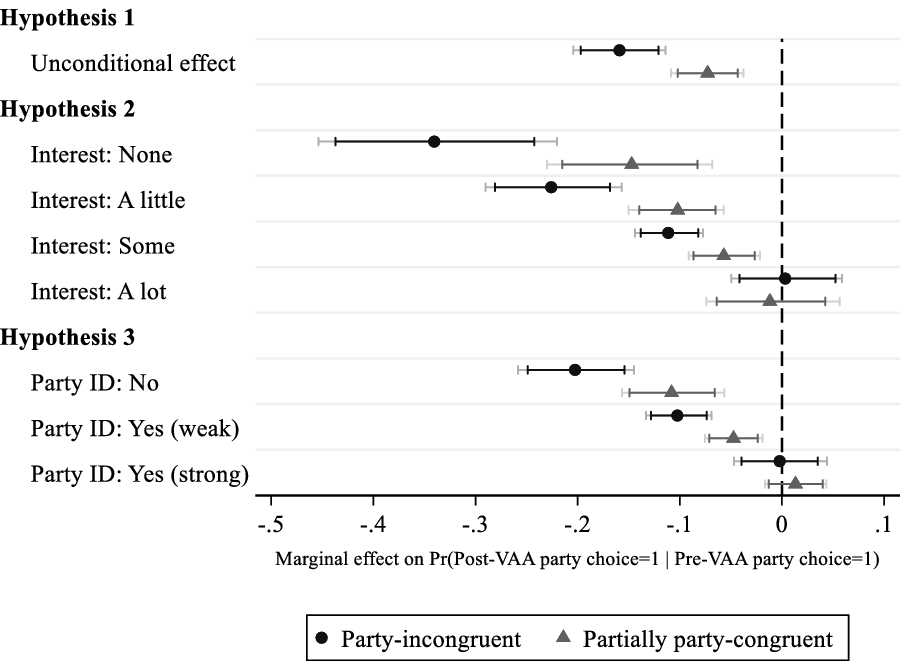
The results in Figure 1 are consistent with the theoretical expectations. VAA users are more likely to switch away from their pre-VAA party choice if they receive incongruent and partially party-congruent advice than if they receive highly party-congruent advice (Hypothesis 1).Footnote 5 The estimated effect of receiving party-incongruent VAA advice is a 16% point increase in the probability of changing the expected party choice for VAA users who receive party-incongruent advice (7% points for VAA users who receive partially party-congruent advice). As expected, the effect sizes are larger for VAA users who have a lower level of political interest (Hypothesis 2) and for VAA users who do not identify with the party they expect to vote for prior to taking the VAA (Hypothesis 3). Specifically, the effect of receiving incongruent advice on party vote switching is reduced by 11% points for each increasing level of political interest, and by 10% points for each increasing level of party identification.
One astonishing result from Figure 1 is that the estimated effect of receiving party-incongruent advice is a 34% point increase in the probability of party choice change among VAA users who have no political interest. However, it is important to note that this does not suggest that 34% of all Danish voters with no political interest were influenced by a VAA in the election (Kleinnijenhuis et al., Reference Kleinnijenhuis, van de Pol, van Hoof and Krouwel2019). First, not all voters use a VAA. Second, not everyone receives incongruent advice. Third, while low-interest voters are often more likely to accept new political information, they are also less likely to receive it (Zaller, Reference Zaller1992).Footnote 6 Accounting for the propensity to use a VAA, and the average probability of receiving different types of advice, our results indicate that 3.7% of all Danish voters updated their party preferences because they received either partially party-congruent or party-incongruent advice in a VAA in 2019 (Appendix A.11). These results should be interpreted cautiously because voters use different VAAs with different formats, but they suggest that nearly 175,000 Danish voters updated their party preferences in 2019 due to their VAA use. Furthermore, we find that VAA effects in the electorate as a whole were strongest among Danish voters with ‘a little’ political interest and weakest among voters with ‘a lot’ of political interest. This indicates that voters need to reach a certain threshold of political interest before they use VAAs, even if they are highly susceptible to the advice. We return to this point in the concluding section.
Figure 2 illustrates the results from the test of Hypotheses 4 and 5. The figure reports the marginal effects of receiving strong advice (circles) and weak advice (triangles) on the probability of choosing a party that the user did not expect to vote for prior to taking the VAA. A positive probability estimate in the figure thus indicates a higher probability of switching to a party that the VAA user was recommended than to a party the user was not recommended.
VAA advice effects on choosing a party (Hypotheses 4 and 5).
Note: Marginal effects of receiving strong and weak advice for a party that was not the pre-VAA advice party choice on the probability of switching to that party after using the VAA. N/n = 19,448/1,496. Horizontal lines represent 90% and 95% confidence intervals. Marginal effects of strong advice are calculated as Pr(Post-VAA party choice = 1 | Pre-VAA party choice = 0, strong advice = 1) – Pr(Post-VAA party choice = 1 | Pre-VAA party choice = 0, no advice = 1). Marginal effects of weak advice are calculated as Pr(Post-VAA party choice = 1 | Pre-VAA party choice = 0, weak advice = 1) – Pr(Post-VAA party choice = 1 | Pre-VAA party choice = 0, no advice = 1). Regression coefficients are reported in Appendix A.10.
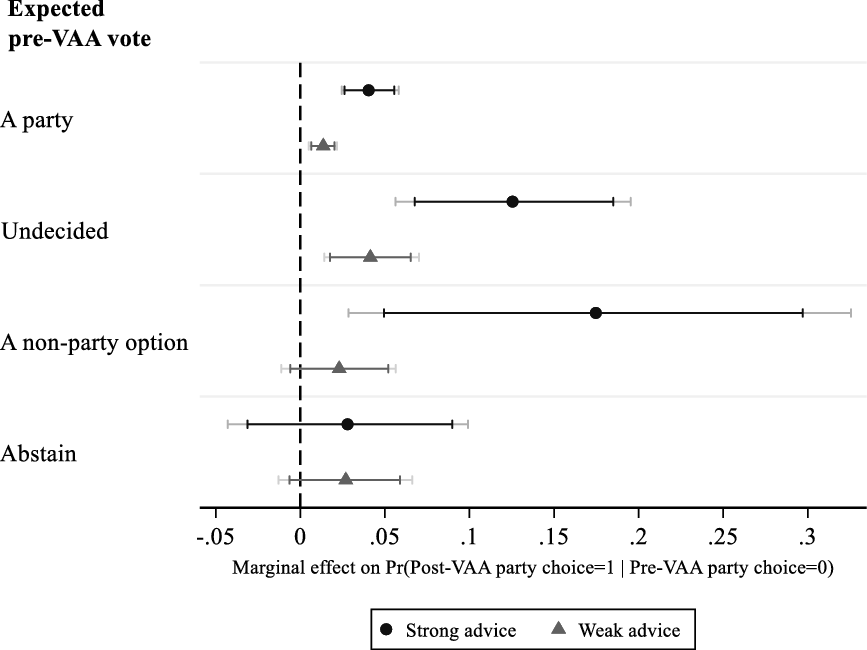
The results in Figure 2 are broadly consistent with Hypotheses 4 and 5. The figure shows that VAA users are more likely to switch to a recommended party than to a party that was not recommended. It also shows that this effect is stronger among those who were undecided before taking the VAA. Undecided voters were more than 10% points more likely to switch to a party they received strong advice for than one they received no advice for (3% points for VAA users who had a pre-VAA party choice). This difference is robust to comparing the undecided voters only to voters who received party-incongruent advice for their pre-VAA party choice (Appendix A.12).Footnote 7 Interestingly, we also see evidence that VAA users who expected to cast a non-party vote are likely to be highly influenced by strong VAA advice. However, this result should be interpreted with caution as this group is fairly small (41 respondents), and the confidence intervals are accordingly wide. We find no evidence that VAA users who expected to abstain from voting became more likely to choose a party they were recommended after using the VAA. We elaborate more on this point in the concluding section, but we note here that we also implemented a post-election survey, which largely corroborated the results from the main analysis (these results are reported in Appendix A.4).
Results for candidate vote switching
Now we turn to the analysis of Hypotheses 6 and 7. Figure 3 reports the marginal effects of receiving candidate-incongruent advice (circles) and partially candidate-congruent advice (triangles) on the probability of choosing the pre-VAA candidate again. The analysis is conducted on the subset of VAA users who expected to vote for a candidate prior to taking the VAA and stayed with their expected party choice after receiving party-congruent advice. This group is fairly small, but still sufficiently large to make a meaningful analysis.Footnote 8 A negative probability estimate indicates that candidate-incongruent or partially candidate-congruent VAA advice leads to a higher probability of switching away from the pre-VAA candidate choice than highly candidate-congruent advice.
Party-congruent/candidate-incongruent advice and within-party switching.
Note: Marginal effects of receiving candidate-incongruent and partially candidate-incongruent advice on choosing the same pre-VAA and post-VAA candidate. The analysis only includes respondents who stayed with their pre-VAA party choice after receiving highly or partially party-congruent advice. n = 252. Horizontal lines represent 90% and 95% confidence intervals. Regression coefficients are reported in Appendix A.10.
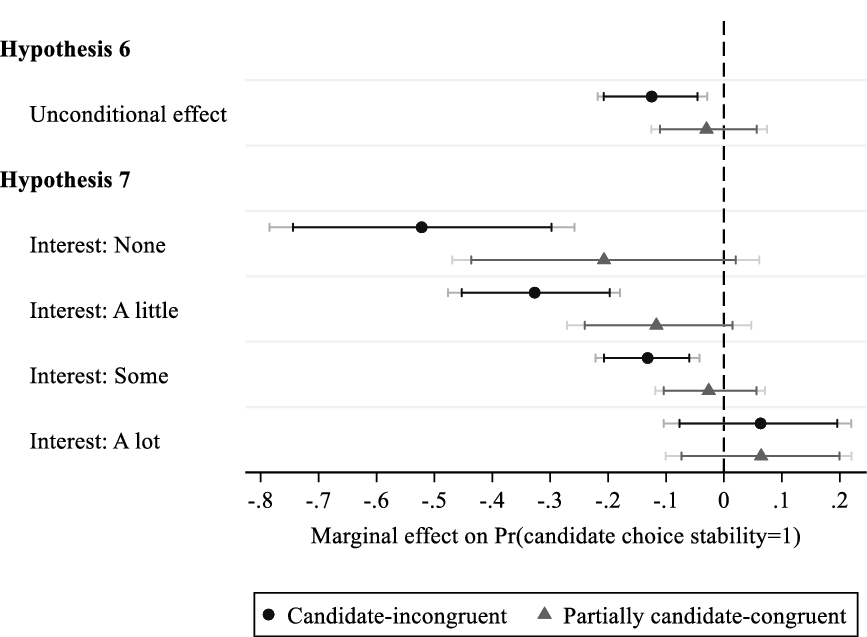
The results in Figure 3 are consistent with the expectations from Hypothesis 6 for VAA users who received candidate-incongruent advice. Such users were 13% points less likely to choose the same candidate again after using the VAA than users who received highly candidate-congruent advice. VAA users receiving partially candidate-congruent advice were no more likely to change their expected candidate choice than users receiving highly candidate-congruent advice. The conditional patterns of incongruent advice effects are consistent with Hypothesis 7. The effects of incongruent advice were much stronger among VAA users who had a lower level of political interest. We further find no evidence that party identification moderates these effects (demonstrated by insignificant coefficients on the party identification interaction terms as reported in Table A.10.2 in the Appendix), which is also consistent with our expectations. Party identifiers cannot use the party label as a competing cue for choosing between candidates from the same party. We further note that only one respondent who received candidate-incongruent advice switched to a candidate that the respondent was not recommended to vote for (Appendix A.14).Footnote 9 This further indicates that VAA users apply the candidate VAA advice in ecologically rational ways when they decide who to vote for.
Conclusion
This paper has analyzed whether and how voters use information from candidate-based VAAs to update their political preferences using original survey data from the 2019 Danish parliamentary election. VAA users who received incongruent advice for the party they expected to vote for became 16% more likely to change their party vote intention than users who received advice that was consistent with their pre-existing party preferences. Many users switched to the recommended party, and undecided voters were particularly susceptible to the advice. Users who received party-congruent advice, on the other hand, maintained their party vote intention, but switched their candidate vote intention within the party’s list if the advice was candidate-incongruent. The effect sizes were largest among VAA users who had a low level of political interest and who did not identify with the party they expected to vote for prior to taking the VAA (the latter for party choices only). These findings corroborate emerging research demonstrating that voters frequently navigate complex information environments in sensible ways using ecologically rational heuristics.
The results are based on expected vote choice rather than actual vote choice. This choice was made to reduce concerns about internal validity related to the time lag between taking the VAA and casting the actual vote. However, we also administered a survey after the election to the same respondents where we asked them to report their actual vote choice. The results from this post-election survey (reported in Appendix A.4) are similar to those presented in the main paper. However, there are two noteworthy exceptions. First, the unconditional substantive effects of receiving incongruent advice are larger than in the main analysis. This is likely due to VAA users receiving other informational inputs that confirm the incongruent VAA advice. Second, the moderating effects of party identification and political interest drop out of statistical significance. It is difficult to know why, given the weaker internal validity of the design, but they may do so for substantively important reasons. For example, low-interest voters may be more likely to receive inconsistent inputs from other sources (e.g., other VAAs using different questions and matching algorithms), which change their vote choice again.
The main analysis of the paper focuses on how VAA users are affected by the VAA advice. This is important for understanding the potential effects of increasing VAA use across contemporary democracies. Yet, not all voters use a VAA. Consequently, the number of voters who are influenced by VAAs will also depend on patterns of use and non-use. In this regard, our results are consistent with the expectations from Zaller’s RAS model. This model suggests that voters with a low level of political interest are more likely to accept political information, but less likely to receive it. Likewise, in a supplementary analysis (Appendix A.11), we found that when we took into account the propensity to use a VAA and the likelihood of receiving a particular type of advice, then the probability of being influenced by a VAA in the 2019 election was greater among voters with a low level of political interest than among voters with a high level of interest, but also than among voters with no political interest. This indicates that at current patterns of use and non-use, voters with a medium level of political interest are most likely to be influenced by a VAA during an election campaign.
The paper also has important implications for a different branch of the VAA literature, which focuses on the relationship between VAA use and turnout (Gemenis and Rosema, Reference Gemenis and Rosema2014; Garzia and Marschall, Reference Garzia and Marschall2019; Munzert and Ramirez-Ruiz, Reference Munzert and Ramirez-Ruiz2021). This literature generally finds that VAA use increases turnout, and our theoretical framework for understanding VAA effects may help explain why. Specifically, we understand VAA advice as a simple cue that fulfils an information need, and information costs are generally considered one of the most important impediments to voting (e.g., Downs, Reference Downs1957: 265). VAAs may thus increase turnout by lowering information costs among those with a greater need for a simple cue. This has the implication that the voter characteristics that condition the effects of VAA advice on vote choice (e.g., political interest, party identification, and being undecided) are also likely to condition the effects of VAA advice on turnout.
We end our conclusion with a more normative discussion of the role of VAAs in representative democracy and how our results fit in. We begin with the observation that VAA advice is only useful – or at least will only be perceived to be useful – when certain conditions are met. These pertain both to the quality of the advice and the extent to which the type of advice a VAA gives is considered relevant. In terms of quality, VAAs could – as any other tool to help people navigate information – be manipulated in ways that bias results in favor of certain parties or candidates. Such problems may be caused by ill intentions or innocent but misguided design decisions (such as excluding parties without seats in the parliament (cf Skop, Reference Skop2010). This underscores the importance of transparency from VAA providers (Ladner et al., Reference Ladner, Felder and Fivaz2010), as well as the ongoing best-practice discussions regarding the wording of issue statements (Louwerse and Rosema, Reference Louwerse and Rosema2014; Holleman et al., Reference Holleman, Kamoen, André, van de Pol and de Vreese2016; Isotalo, Reference Isotalo2021) and different forms of aggregating preferences (Germann et al., Reference Germann, Mendez, Wheatley and Serdült2015; van der Linden and Dufresne, Reference van der Linden and Dufresne2017; Padilla et al., Reference Padilla, Ramos, Romero and Chueca2021).
In terms of relevance, VAAs will only be perceived to be useful if they provide the information the users want (i.e., if they fulfill a perceived need). VAAs are tied to the idea of issue voting (Fossen and Anderson, Reference Fossen and Anderson2014), and are thus only useful to the extent that users want to vote based on issue congruence. For example, during times of crisis voters may care more about the perceived performance and trustworthiness of parties and candidates than their issue congruence. In this case, VAA advice is less likely to be useful for users. Likewise, when vote choices are made in a more polarized environment, and are thus likely to be more about emotional attachments to parties (or animosity towards others), then VAAs are – in their current design – less likely to be perceived as useful by voters (as demonstrated by the weaker effects of party identification on vote choices in our analysis). On the other hand, they may provide a rare opportunity for party identifiers to receive information inputs that are inconsistent with their party preferences, which could help reduce polarization.
Overall, while changing political landscapes may reduce the (perceived) usefulness of VAAs, we think it is reasonable to expect that VAAs will remain relevant for large segments of voters in the future – as indicated by their increasing popularity. Our contribution has been to demonstrate that VAAs have the potential to influence voter preferences both within and between party lists using a design with a high degree of internal and ecological validity. Furthermore, voters seem to use the advice in ways that are ecologically rational – i.e., VAA users who need the advice the most are also those who are most likely to be impacted by it. This suggests that the implementation of candidate-based VAAs can be a promising way for practitioners to generate valuable information for (especially) low-interest voters, unlikely to seek out such information elsewhere – even if reaching those, with the least political interest is likely to require extra effort.
Supplementary material
To view supplementary material for this article, please visit https://doi.org/10.1017/S1755773923000103.
Acknowledgements
We are grateful comments received at the ECPR General Conference in Wroclaw, Poland, September 2019, and at the section for Comparative Politics: Behavior and Institutions, Department of Political Science, Aarhus University, October 2019. We would also like to extend our gratitude to Altinget for a fruitful cooperation, especially to Kristoffer Hecquet and Michael Kellberg. We are also grateful to Oliver Poulsen for very competent research assistance. Furthermore, we would like to thank the following for their comments: Lene Aarøe, Anne Binderkrantz, Alexander Bor, Martin Bisgaard, Kristian Vrede Skaaning Frederiksen, Ida B. Hjermitslev, Marie Kaldahl, Lasse Laustsen, Stefan Marschall, Mathias Osmundsen, Helene Helboe Pedersen, Martin Rosema, Rasmus Skytte, Rune Slothuus, Rune Stubager, Kim Sønderskov, David Talukder, and Laura Uyttendaele.
Funding statement
We would like to acknowledge the following grants: Danmarks Frie Forskningsfond (DFF - 7013-00002); Danmarks Frie Forskningsfond (DFF - 2033-00003B); Danish National Research Foundation (DNRF114); The European Research Council (ERC) under the European Union’s Horizon 2020 research and innovation programme (Grant agreement No. [870996]); The European Research Council (ERC) under the European Union’s Horizon 2020 research and innovation programme (Grant agreement No. [817855]).
Conflicts of interest
The author(s) declare none.


 Open access

