


Introduction
Agriculture plays an important role in the maintenance of biodiversity in Europe because agricultural land covers about 50% of its area (Halada et al. Reference Halada, Evans, Romão and Petersen2011), and many European species, therefore, depend on low-intensity agriculture for their conservation (Pe’er et al. Reference Pe’er, Dicks, Visconti, Arlettaz, Báldi, Benton, Collins, Dieterich, Gregory, Hartig, Henle, Hobson, Kleijn, Neumann, Robijns, Schmidt, Shwartz, Sutherland, Turbé, Wulf and Scott2014). Various studies have shown that low-intensity agricultural areas are favourable habitats for a significant number of animal and plant species, which partly rely on environmentally friendly farming practices (Donald et al. Reference Donald, Sanderson, Burfield and van Bommel2006, Morelli Reference Morelli2018, Tarifa et al. Reference Tarifa, Martínez‐Núñez, Valera, González‐Varo, Salido and Rey2021). Nevertheless, farmland areas with a high value for nature are declining in Europe due either to agricultural intensification or land abandonment (Keenleyside et al. Reference Keenleyside, Beaufoy, Tucker and Jones2014, Anderson and Mammides Reference Anderson and Mammides2020), and this has led to an overall loss of biodiversity in agricultural areas (Donald et al. Reference Donald, Sanderson, Burfield and van Bommel2006, Maxwell et al. Reference Maxwell, Fuller, Brooks and Watson2016).
Various works have, in particular, shown that farmland birds are one of the biological groups most affected by agricultural intensification (Donald et al. Reference Donald, Sanderson, Burfield and van Bommel2006, Reif and Vermouzek Reference Reif and Vermouzek2019). According to an aggregated index of population trends, 39 common farmland species declined by 34% from 1990 to 2017, a sharper decline than the EU’s population of all common bird species (Eurostat). In brief, the main features of agricultural intensification producing this steep decline are i) the loss of landscape heterogeneity and complexity, mainly owing to the removal of semi-natural vegetation areas, such as field borders, hedges and fallow land, and ii) the intensive use of agrochemicals (e.g. Donald et al. Reference Donald, Sanderson, Burfield and van Bommel2006, Tarjuelo et al. Reference Tarjuelo, Margalida and Mougeot2020). Most research in this respect is focused on the effect of the intensification of arable land on farmland species, whereas the effect of the intensification of woody crops and expansion on farmland birds has only been studied to a lesser extent (but see Castro-Caro et al. Reference Castro-Caro, Barrio and Tortosa2014, Santos et al. Reference Santos, Bessa, Cabral, António, Pacheco, Leitão, Moreira, Pinto, Lecoq and Silva2016, Casas et al. Reference Casas, Gurarie, Fagan, Mainali, Santiago, Hervás, Palacín, Moreno and Viñuela2020, Morgado et al. Reference Morgado, Santana, Porto, Sánchez-Oliver, Reino, Herrera, Rego, Beja and Moreira2020, Reference Morgado, Pedroso, Porto, Herrera, Rego, Moreira and Beja2021, Cabodevilla et al. Reference Cabodevilla, Arroyo, Wright, Salguero and Mougeot2021).
This is not a trivial issue, since the area devoted to woody crops has increased dramatically in the Mediterranean basin in the last two decades (Vilar and Pereira Reference Vilar and Pereira2018). This is particularly the case for olive groves, as the planting of new olive groves on arable land was one of the most frequent land use changes in Europe during the period 2000–2006, representing 0.79% of all the areas in which changes took place (Büttner and Kosztra Reference Büttner and Kosztra2011). According to the Spanish Ministry of Agricultural, Food and Fisheries (MAPA 2020), the area devoted to olive cultivation in Spain has increased by 126,000 ha in the last decade (2010–2019), mainly owing to the expansion of intensive and super-intensive olive groves, since most of new plantations are planted with higher tree densities than traditional olive groves (Junta de Andalucía Reference de Andalucía2019), and now approximately 2.4% of the olive groves are super-intensive (Vilar and Pereira Reference Vilar and Pereira2018). These new intensive systems are characterised by younger trees, which are usually irrigated, and by a higher tree density of 800–2,000 trees ha-1 (Martínez-Sastre et al. Reference Martínez-Sastre, Ravera, González, López Santiago, Bidegain and Munda2017, Lo Bianco et al. Reference Lo Bianco, Proietti, Regni and Caruso2021), which has entailed a considerable transformation of the landscape (Guerrero-Casado et al. Reference Guerrero-Casado, Carpio, Tortosa and Villanueva2021). Furthermore, this intensification has also occurred in traditional olive groves (mainly by increasing mechanisation and agrochemical input, removing natural vegetation, and homogenising the landscape), which also has negative effects on bird communities (Rey et al. Reference Rey, Manzaneda, Valera, Alcántara, Tarifa, Isla, Molina-Pardo, Calvo, Salido, Gutiérrez and Ruiz2019, Martínez-Núñez et al. Reference Martínez-Núñez, Rey, Manzaneda, Tarifa, Salido, Isla, Pérez, Camacho and Molina2020, García-Navas et al. Reference García-Navas, Martínez-Núñez, Tarifa, Manzaneda, Valera, Salido, Camacho, Isla and Rey2022).
Some reports have suggested that this large increase in the area of olive groves may affect steppe birds by reducing the availability of their optimal habitat (e.g. Alonso Reference Alonso2007, Contreras et al. Reference Contreras, Barea-Azcón and Ramos2018). In Portugal, Santos et al. (Reference Santos, Bessa, Cabral, António, Pacheco, Leitão, Moreira, Pinto, Lecoq and Silva2016) predicted that the conversion of rain-fed land use into olive groves would cause changes in the spatial distribution of the Little Bustard Tetrax tetrax and a general decline in its population. Likewise, Marques et al. (Reference Marques, Moreira, Alcazar, Delgado, Godinho, Sampaio, Rocha, Sequeira, Palmeirim and Silva2020) showed that recent irrigation projects in Portugal have promoted the conversion of grasslands into woody crops, thus reducing the habitat availability for the Little Bustard. More recently, Morgado et al. (Reference Morgado, Pedroso, Porto, Herrera, Rego, Moreira and Beja2021) have shown that open farmland bird species reacted particularly negatively to increasing cover by intensive olive groves. However, there is a lack of research to quantify how this increase in woody crops, mainly olive orchards, is affecting the landscape within the distribution of steppe birds. In this work, we analyse the planting of new olive groves over almost two decades (2000–2018) concerning the potential distribution of two typical steppe birds (the Great Bustard Otis tarda, and the Little Bustard Tetrax tetrax) in Andalusia (Southern Spain), the region in which most olive oil is produced on a worldwide basis. Both species showed negative population trends in the last century, although populations of Great Bustards have recovered in recent decades (Casas et al. Reference Casas, Mougeot, Arroyo, Morales, Hervás, García De La Morena, Fagan and Viñuela2019), and now the Great Bustard is listed as ‘Near Threatened’ and the Little Bustard is listed as Endangered in the Spanish Red Book of Birds (SEO/BirdLife 2021). The Great Bustard and the Little Bustard are greatly dependent on the mosaic of habitats created by non-intensive or traditional cereal farming (Moreira et al. Reference Moreira, Morgado and Arthur2004, Silva et al. Reference Silva, Palmeirim and Moreira2010), including fallow land, stubble fields and agricultural areas with complex patterns (Palacín et al. Reference Palacín, Alonso, Martín and Alonso2012, Tarjuelo et al. Reference Tarjuelo, Margalida and Mougeot2020). The change in traditional annual crops as well as agricultural intensification have consequently been identified as the principal harmful factors in this respect (Alonso et al. Reference Alonso, Martín, Palacín, Martín and Magaña2005, Palacín et al. Reference Palacín, Alonso, Martín and Alonso2012; Marques et al. Reference Marques, Moreira, Alcazar, Delgado, Godinho, Sampaio, Rocha, Sequeira, Palmeirim and Silva2020, Tarjuelo et al. Reference Tarjuelo, Margalida and Mougeot2020). Plantations of high-density olive groves in arable lands can, therefore, be considered as a growing threat for these species.
Some works have shown that land-cover changes are less frequent within protected areas (Hellwig et al. Reference Hellwig, Walz and Markovic2019, Jiang and Yu Reference Jiang and Yu2019). However, unfortunately, forest and woodlands are the land uses that dominate in the majority of the Nature 2000 network of protected sites (Cheţan and Dornik Reference Cheţan and Dornik2021), and therefore, since most agricultural areas are unprotected, land-use changes, such as the conversion of arable land and pastures into woody crops, are more likely to occur. Particularly in Spain, some Important Bird and Biodiversity Areas (IBAs) were set up in agricultural landscapes to conserve some threatened species highly associated to the agroecosystems (Infante et al. Reference Infante, Fuente and Atienza2011). The IBAs are places of international significance for the conservation of birds and other types of biodiversity based on an internationally agreed set of criteria, covering approximately 6.7% of the total surface of the Earth (Donald et al. Reference Donald, Fishpool, Ajagbe, Bennun, Bunting, Burfield, Butchart, Capellan, Crosby, Dias, Diaz, Evans, Grimmett, Heath, Jones, Lascelles, Merriman, O’Brien, Ramírez, Waliczky and Wege2019, Birdlife International 2020). However, in Spain, approximately half of the area of the IBAs is not covered by protected areas (Kukkala et al. Reference Kukkala, Santangeli, Butchart, Maiorano, Ramirez, Burfield and Moilanen2016), and since unprotected IBAs are also more threatened by different human activities (Waliczky et al. Reference Waliczky, Fishpool, Butchart, Thomas, Heath, Hazin, Donald, Kowalska, Dias and Allinson2019), the aforementioned land-use changes also probably affect these unprotected IBAs.
In this scenario, the specific objectives of this paper are: i) to compare the different land uses between 2000 and 2018 in the distribution areas of the Great and Little Bustard, with a special emphasis on quantifying the new olive groves planted in their distribution areas during the same period; ii) to compare the fragmentation index of the arable land (the land use most preferred by steppe birds in Andalusia) between 2000 and 2018; and iii) to quantify the new olive groves planted in the IBAs designed to protect the selected species, with the final objective of discussing whether the IBAs are effective in preventing land-use changes which can be harmful for farmland birds.
Methods
Study area
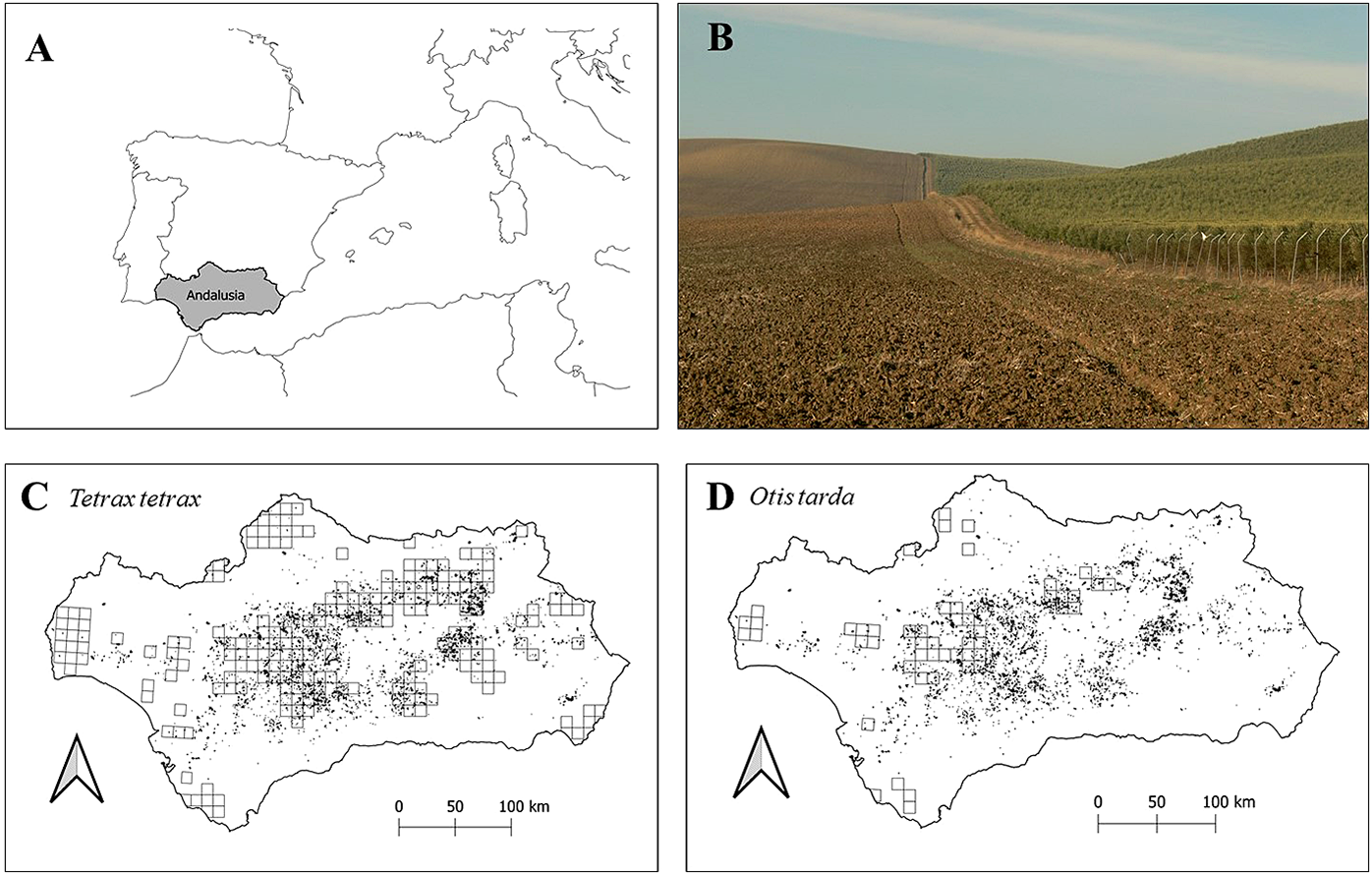
This work is focused on Andalusia (Southern Spain; Figure 1), in which more than 1.6 million hectares are devoted to olive groves (MAPA 2020). Andalusia is a large region (8.73 million ha), with the olive production concentrated in the central-eastern area, mainly in the provinces of Cordoba and Jaen, where the climate is characterised by markedly hot and dry seasons. The Great Bustard and the Little Bustard are classified as ‘endangered’ and ‘vulnerable’, respectively, on a regional scale (Junta de Andalucía, Reference de Andalucía2012). In Andalusia, the habitat suitability for both species is generally lower in comparison with that of other Spanish regions (Suárez-Seoane et al. Reference Suárez-Seoane, Osborne and Alonso2002).
(A) The location of Andalusia in Southern Spain. (B) An example of the new intensive olive groves planted in arable land. New olive groves (dark polygons) planted from 2000 to 2018 according to the Corine Land Cover Changes and their relationship with the distribution in 2003 of (C) Tetrax tetrax and (D) Otis tarda in 10x10 km UTM cells (squares with black lines).
Distribution of steppe birds
The potential distribution areas of the Great Bustard and the Little Bustard have been used to show how the expansion of new olive groves may affect their habitat availability. These species were selected because they are highly associated to non-irrigated annual crops and permanent pastures (Alonso Reference Alonso2007), which have been frequently converted to woody crops in Spain and Portugal in the last few years (Marques et al. Reference Marques, Moreira, Alcazar, Delgado, Godinho, Sampaio, Rocha, Sequeira, Palmeirim and Silva2020). Moreover, in Andalusia, the expansion of olive groves partly overlaps with the distribution range of these two species (Figure 1). Finally, these species have been proposed as umbrella species for the agricultural landscapes (Tarjuelo et al. Reference Tarjuelo, Morales, Traba and Delgado2014), and therefore, assessing the land-use changes in their distribution may be useful to study the modification of agricultural landscapes which might also affect other farmland species.
The distribution of these species was obtained from the Atlas of breeding birds of Spain (Marti and del Moral Reference Martí and Del Moral2003), which shows the distribution range of the bird species in a Universal Transverse Mercator (UTM) grid system of 10 x 10 km. This dataset has frequently been used in large-scale studies in Spain (e.g. Araújo et al. Reference Araújo, Lobo and Moreno2007, Carpio et al. Reference Carpio, Oteros, Tortosa and Guerrero-Casado2016, Reference Carpio, Barasona, Guerrero-Casado, Oteros, Tortosa and Acevedo2017, Ascensão et al. Reference Ascensão, D’Amico, Martins, Rebelo, Barbosa, Bencatel, Barrientos, Abellán, Tella, Cardador, Anadón, Carrete, Murgui, Fernandes, Santos, Mira, da Luz Mathias, Tiago, Casabella, Reino, Paulo, Pereira and Capinha2021). According to this atlas, the Great Bustard and the Little Bustard were present in 49 and 204 of the UTM cells, respectively, in Andalusia in 2003. Although these distributions probably do not reflect the current ranges, they may be useful to evaluate how the potential distribution of these species has been modified in the long term (from 2000 to 2018, see below) by the implementation of new olive groves.
Land-use changes in the distribution area of steppe birds
CORINE Land Cover (CLC) has been used in this work to analyse land-use changes in the distribution range of the Great and the Little Bustard. CLC is the largest available land cover database with a consistent class labelling system (Cole et al. Reference Cole, Smith and Balzter2018). Firstly, the area of the new olive groves planted in Andalusia and in the distribution range of the two selected species was calculated during the period 2000–2018 by merging the information concerning CORINE land cover changes in the three available periods (2000–2006, 2006–2012 and 2012–2018), which coincide with the periods of greatest expansion of olive groves in Andalusia (Junta de Andalucía Reference de Andalucía2019). These land-use change maps have a minimum map unit (polygon) of 5 ha, which allows the detection of smaller scale changes and a higher accuracy of the changes than a comparison between two CLCs with a minimum map unit of 25 ha (Cole et al. Reference Cole, Smith and Balzter2018), including changes that reflect any real evolution processes with a periodicity longer than a year or season (Büttner and Kosztra Reference Büttner and Kosztra2011). In particular, and for each period, the CLC provides data on new polygons of olive groves and in which land-use area they were planted, and we were therefore able to calculate the total area of the previous land use in which the new olive groves were planted according to the six reclassified categories (see below).
Secondly, because the spatial information regarding the distribution range of the great and the Little Bustard was obtained from fieldwork performed from 1998 to 2002 (Marti and del Moral Reference Martí and Del Moral2003), the CLC of the year 2000 (CLC-2000) was used to establish the land use at the beginning of the study period. The CLC for the year 2018 (CLC-2018) was similarly used to characterise the land use at the end of the study period. For this purpose, we used the Corine Land Cover Accounting Layers (available at https://www.eea.europa.eu/data-and-maps/data/corine-land-cover-accounting-layers), which were created for the purpose of consistent statistical analysis of changes in land cover, since the methodological changes in the production of CORINE has produced important inconsistencies (e.g. García-Alvárez and Camacho Olmedo Reference García-Álvarez and Camacho Olmedo2017). The original CLC nomenclature is hierarchical and distinguishes 44 classes at the third level, 15 classes at the second level and 5 classes at the first level (Kosztra et al. Reference Kosztra, Büttner, Hazeu and Arnold2017). In this article, the land uses were reclassified into five classes at the second level: 1-arable land, 2-permanent crops, 3-heterogeneous agricultural areas, 4-forests, and 5-scrub and/or herbaceous vegetation associations including pastures, and the remaining three classes of the second level (artificial surfaces, open spaces with little or no vegetation such as beaches, bare rocks and burnt areas, wetlands, and water bodies) were merged into one category (6-other land uses) because these classes are hardly represented in the range of the study species. These datasets were used to calculate the percentage of each reclassified land use in each UTM 10 x 10 km cells shaping the distribution of steppe birds in Andalusia in 2000 and 2018 according to the CLC-2000 and the CLC-2018, respectively, which made it possible to estimate the variation in the proportion of each land use during the study period.
Fragmentation index
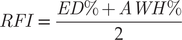
The fragmentation of arable land (the most important land use in Andalusia for steppe birds) in each of the UTM cells, into which the distribution of the Great Bustard and the Little Bustard were divided, was calculated using the Reticular Fragmentation Index (RFI) proposed by Leautaud Valenzuela (Reference Leautaud Valenzuela2014) (Formula 1):
 $$ RFI\hskip0.35em =\hskip0.35em \frac{ED\%+ AWH\%}{2} $$
where ED is the Edge Density, calculated as the amount of edge (km) relative to the land-use area (km2) within the UTM cell, and AWH is the percentage of area without arable land within the UTM cell (Rivas et al. Reference Rivas, Guerrero-Casado and Navarro-Cerillo2021). In order to determine 100% of the AWH% and ED% metrics, a 500 x 500 m plot of a certain land in 1990 was used as a reference value. This size was used because smaller sizes could distort the calculation. The RFI values for the arable land were calculated for the distribution of the two steppe birds according to the CLC-2000 and CLC-2018 in each UTM cell of their distribution, which made it possible to assess whether the RFI value has increased during the study period.
New olive groves in Important Bird and Biodiversity Areas (IBAs)
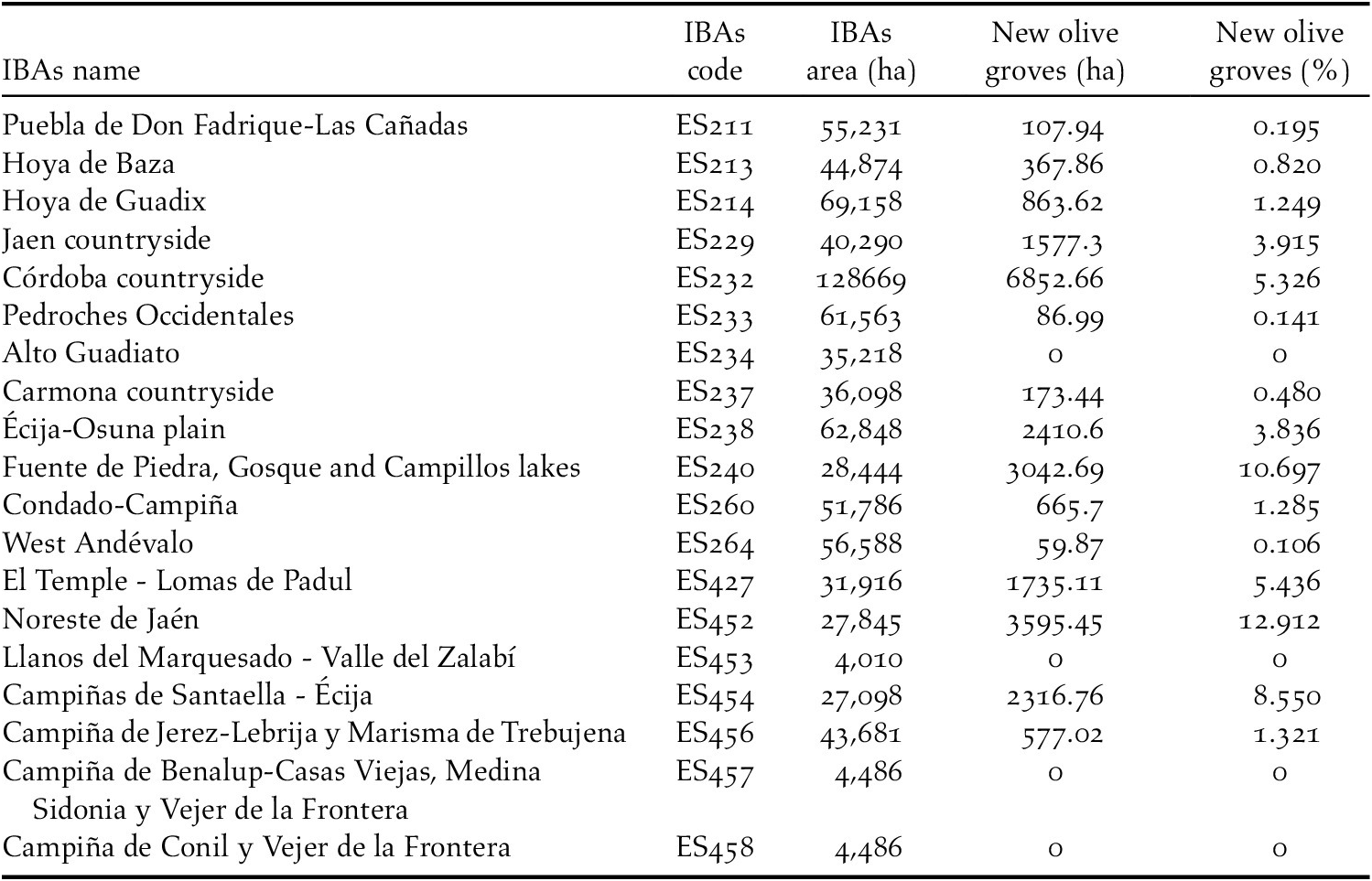
We obtained the boundaries of IBAs in Andalusia, in which at least one of the two steppe species is included on the trigger species list (those for which sites are selected) (BirdLife International 2020). Nineteen different IBAs meet these criteria in Andalusia (Figure 1; Table 3), covering 816,869 ha. The area (ha) of new olive groves planted inside the limits of these 19 IBAs and their proportion in relation to the size of the IBAs (ha) were calculated for the study period (2000–2018) by merging the information of CORINE land cover changes in the three available periods (2000–2006, 2006–2012 and 2012–2018). Moreover, buffer areas of 10-km outside the limits of the IBAs were created to compare the proportion of new olive groves planted inside the IBAs and in these surrounding buffer areas. Finally, the spatial overlap between the 19 selected IBAs and the Natura 2000 network was performed (obtained from the Andalusian Environmental Information Network – REDIAM).
Statistical analysis
The differences in landscape composition (percentage of each land use in each UTM cell) among years (fixed factor) and UTM-cells (random factor) were tested using the permutational multivariate analysis of variance (PERMANOVA) (Anderson Reference Anderson2001). The type III (partial) sum of squares was used, and all the tests were performed with 999 permutations. The similarity percentage analysis (SIMPER) was used to evaluate the dissimilarity between years and to analyse the influence of each land use regarding similarity/dissimilarity (Anderson et al. Reference Anderson, Gorley and Clarke2008). Herein, SIMPER was employed to identify which land uses explain the largest proportion of the differences in landscape composition among years (2000 vs. 218). Moreover, the average dissimilarity between 2000 and 2018 of each land use was calculated as a measure of the land-use changes. Larger dissimilarity values indicate greater changes between years. The analysis was carried out separately for the Great Bustard and the Little Bustard. Wilcoxon paired tests were used to compare the RFI values of arable land between CLC-2000 and CLC-2018 in each UTM cell. For all these analyses, the sample unit for the analyses was the UTM cells occupied by each species, and therefore sample sizes were 49 and 204 for the great and Little Bustard respectively. The comparison between the proportion of new olive groves planted inside and outside the limits of the IBAs was also analysed by means of Wilcoxon paired tests (paired by the IBA; n = 19).
Results
Land-use changes in the distribution of steppe birds
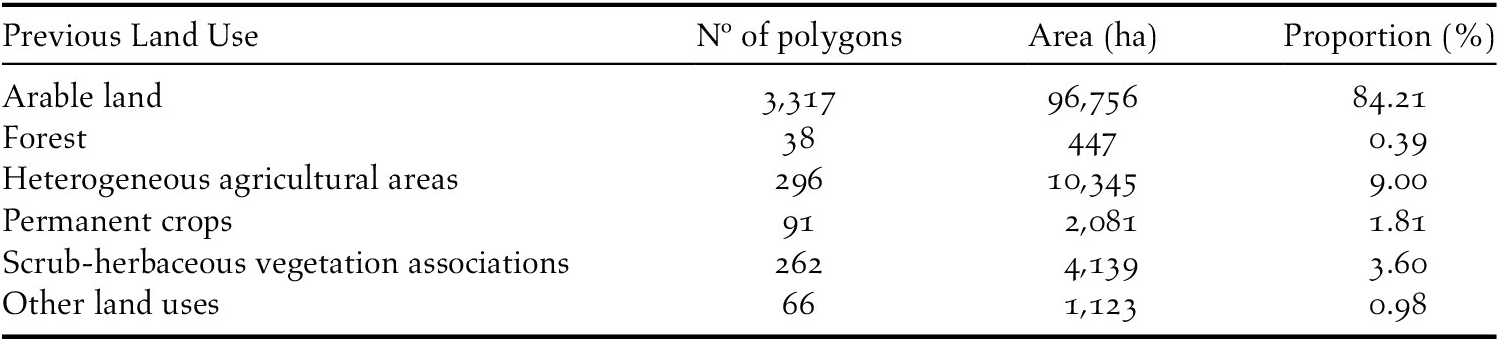
Overall, 4,070 new polygons of olive groves covering 114,894 ha were planted in Andalusia from 2000 to 2018. The majority of these new olive groves were planted on arable land (84.21%), followed by heterogeneous agricultural areas (9.00%), with a much smaller area being employed for other land uses (Table 1).
Number of polygons that have changed to olive groves (and the area covered -ha-) planted during the period 2000-2018 according to the previous land use in which they were planted. The proportion (%) refers to the percentage in relation to the total area of new olive groves for each land use separately.
In absolute terms, in the period 2000–2018, 10,854 and 53,526 ha of new olive groves were planted within the distribution ranges of the Great Bustard and the Little Bustard, respectively, which represents 2.14% and 2.61% of the range in the year 2000. At the UTM cell level, the mean value (± SD) of the area occupied by the new olive groves was 2.93% (± 2.82) and 3.45% (± 3.84) for the Great Bustard and the Little Bustard, respectively, although the maximum values were 12.99% and 18.87%, respectively. Consequently, the median percentage of arable land in the UTM cells has decreased from 63.3% in 2000 to 53.85% in 2018 in the distribution range of the Great Bustard, and from 30.04% to 27.8% in the distribution range of the Little Bustard. Conversely, the median value of the percentage of permanent crops has increased from 9.27% to 12.19% in the Great Bustard distribution range, and from 15.56% to 17.8% in the Little Bustard range.
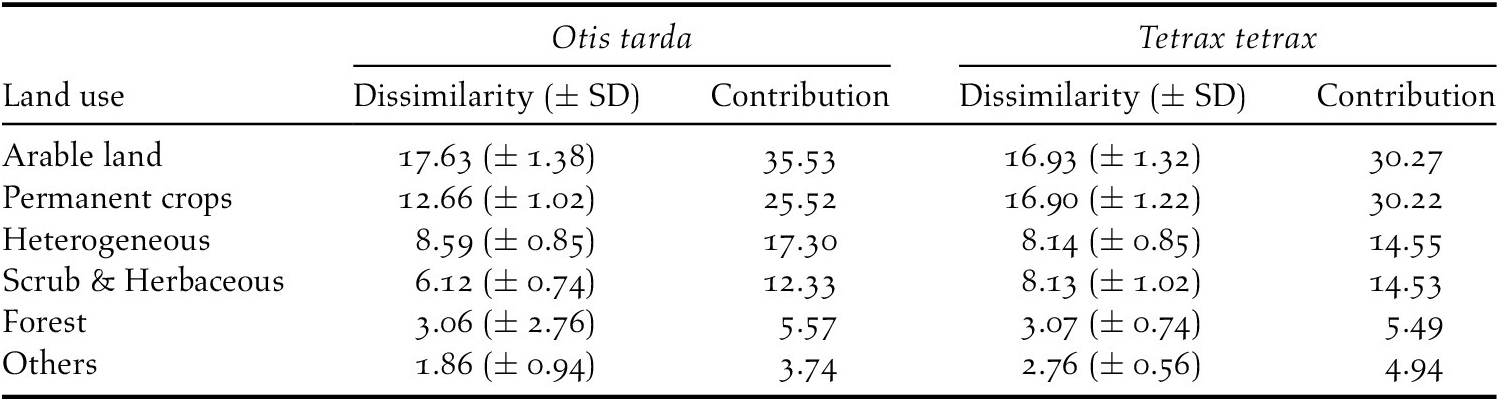
PERMANOVA showed significant differences in the landscape composition between the years for both the Great Bustard (F = 150.54; df = 20; MS = 3,312; P = 0.001) and the Little Bustard (F = 168.53; df = 206; MS = 3,731; P = 0.001). SIMPER showed an average dissimilarity of 49.62% and 55.93% for the Great Bustard and the Little Bustard respectively between 2000 and 2018, suggesting a moderate modification of the landscape. The land uses with the highest dissimilarity contribution between years were arable land and permanent crops, since both land uses had the highest average dissimilarity between years (Table 2).
SIMPER results of the average dissimilarity (± standard deviation) and contribution (%) of each land use to the dissimilarity between 2000 and 2018 for the distribution of the Great Bustard Otis tarda and the Little Bustard Tetrax tetrax separately.
The RFI values for the arable land significantly increased from 2000 to 2018 for both species. In the Great Bustard’s distribution area, the median value of the RFI for arable land was 40.16% in 2000, whereas in 2018 it was 48.34% (mean dif = 2.1 ± 3.93; Z = 5.39; P <0.0001). Similarly, in the Little Bustard’s distribution area, the median RFI was 68.01% in 2000 and 73.2% in 2018 (mean dif = 3.07 ±7.99; Z= 8.47; P <0.0001).
New olive groves in the IBAs
Of all the new area devoted to olive groves in Andalusia, 21.26% (24,433 ha) has been planted in IBAs for steppe birds, which represents 2.99% of the total area of IBAs. An average of 2.96% (± 0.91 SE; range = 0–12.91%) of the area of the IBAs has been replaced with new olive groves. However, there is a marked variation between IBAs (Table 3). In 10 of them, the new olive groves cover less than 1% of their area, whereas in two IBAs they represented more than 10% of their surface area (Table 3). The Wilcoxon paired test showed marginally significant differences (Z = 1.97; P = 0.052) as regards the proportion of new olive groves planted inside the IBAs (2.96 ± 0.91) and in the surrounding buffer areas (1.57 ± 0.39). Only 12.07% of the total area of the nineteen IBAs selected is protected by the Natura 2000 network, and only three IBAs (ES-238, ES-234 and ES-240) are designated as Special Protection Areas under the Bird Directive.
The area (ha) of new olive groves cultivated in each of the 19 IBAs for steppe birds in Andalusia (southern Spain) during the period 2000–2018, and their proportions (%) according to the IBA area.
Discussion
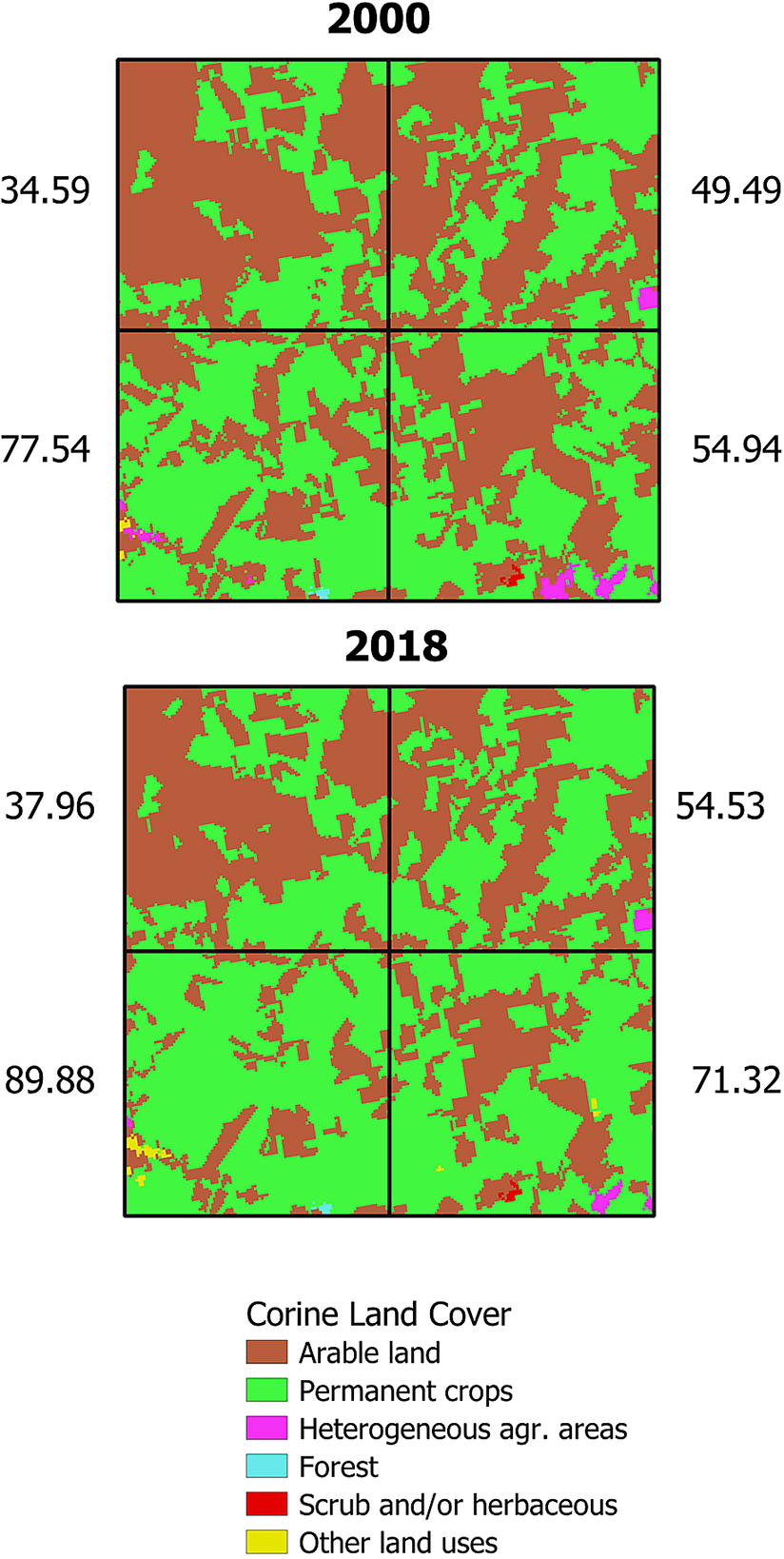
We have demonstrated here that an important area of arable land included in the distribution range of the Great and the Little Bustard has been replaced by new olive groves. Indeed, the increase in arable land and the decrease in permanent crops were the main drivers of the dissimilarity of the landscape composition between 2000 and 2018. Although the area covered by new olive groves did not reach larger continuous areas, our results show that the spatial configuration of arable lands has changed, with a significant increase in the fragmentation index, that is, smaller continuous patches (Figure 2). Therefore, the implementation of new olive groves not only reduces the total amount of habitat available, but also its suitability because of the increase in its fragmentation.
An example of how the increase in permanent crops has entailed a decrease in arable land and the subsequent increase in its fragmentation (RFI). The reclassified land uses according to the Corine Land Cover for the years 2000 and 2018 in four UTM 10x10 km cells are shown. The numbers indicate the RFI value of arable land for each cell.
These changes may have modified the habitat quantity and quality for steppe birds in different ways. Firstly, the total amount of arable land (the dominant land use for steppe birds in the study area) was lower in 2018 than in 2000. Secondly, most of the new olive groves have high-tree densities (usually more than 800 trees ha-1, Junta de Andalucía 2019), which makes these crops unsuitable for steppe birds and other open-land birds (Morgado et al. Reference Morgado, Pedroso, Porto, Herrera, Rego, Moreira and Beja2021) owing to the poor visibility and, in the case of the larger species, the lack of space in which to land and take off. Although traditional olive groves with a low tree density (<150 trees ha-1; AEMO 2020) can, as part of a heterogeneous landscape, be used by steppe birds in order to rest, feed and seek shade (Redondo and Tortosa Reference Redondo and Tortosa1994, Lane et al. Reference Lane, Alonso and Martín2001), we are of the opinion that the new intensive olive systems with higher tree densities are totally unsuitable for large steppe birds (Muñoz-Cobo Reference Muñoz-Cobo1992). Indeed, Tarjuelo et al. (Reference Tarjuelo, Morales, Traba and Delgado2014) found that woody crops were negatively related to the predicted probabilities of habitat suitability for the Little Bustard. Thirdly, the new olive groves planted in open habitats could reduce visibility in the adjacent areas, which may be very harmful because both species have a lek mating system (Silva et al. Reference Silva, Palmeirim and Moreira2010, Alonso et al. Reference Alonso, Álvarez-Martínez and Palacín2012). These species select lek sites with a high visibility for courtship, which also enhances the probability of detecting approaching predators (Alonso et al. Reference Alonso, Álvarez-Martínez and Palacín2012). Silva et al. (Reference Silva, Palmeirim and Moreira2010) found a higher probability of the occurrence of breeding for Little Bustard males in larger grassland fields, and therefore the increase in the fragmentation of open-land habitats shown herein could reduce this probability of occurrence. Moreover, the Great Bustard has a remarkable inter-annual, lek-site fidelity (Magaña et al. Reference Magaña, Alonso and Palacín2011), and the alterations made to these mating sites thanks to the planting of new olive groves could, therefore, affect the aggregation of individuals in the subsequent years. Nonetheless, more fieldwork should be performed to confirm how the implementation of new olive groves is affecting the bustards’ density, home range and breeding behaviour.
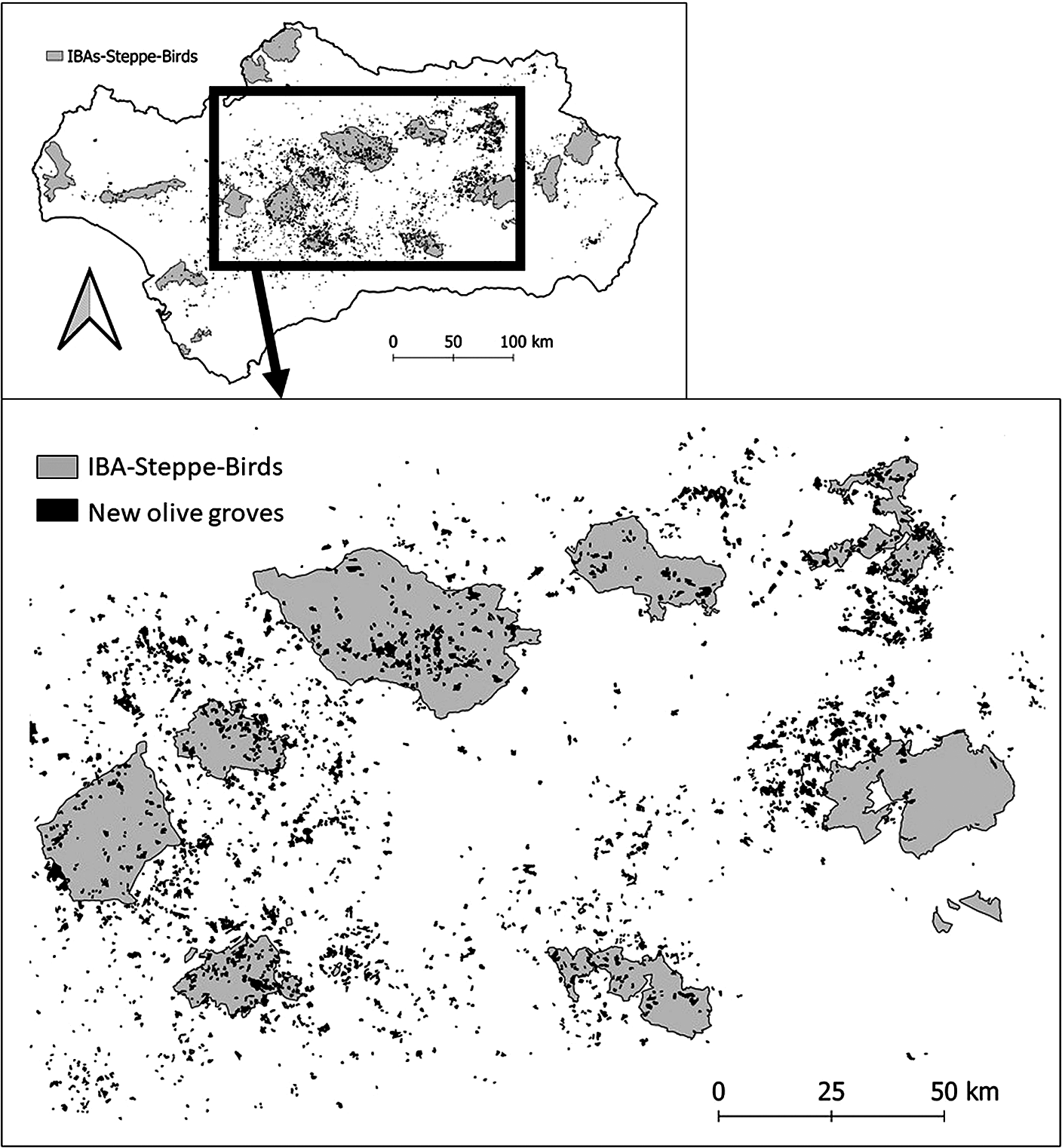
The great profitability obtained by planting high-density olive groves (AEMO 2020) together with the low profitability of cultivating cereals in the area suggests that more hectares of arable land are likely to be converted into olive groves in the coming years. Here, we show that an important area of IBAs for steppe birds has been replaced with new olive groves (Figure 3), which may reduce the habitat quality of these areas, thus affecting these species. As our results show, the proportion of new olive groves is quite similar inside and outside the limits of the IBAs, which suggests that unprotected IBAs are ineffective with regards to regulating these changes in land use (Bonzi et al. Reference Bonzi, Cabral, Castillo, Benítez-Riveros, Galluppi, Sforza, Báez and Yanosky2021). Moreover, it is also important to highlight that only three out of the 19 IBAs selected are protected by the Natura 2000 network, in which some olive groves were also planted (Table 3). Agricultural and livestock intensification and the loss of traditional agricultural landscapes have already affected 78% of Spanish IBAs, being one of their main threats (Infante et al. Reference Infante, Fuente and Atienza2011).
Detail of the IBAs (soft grey) in Andalusia most affected by the implementation of new olive groves (dark polygons).
Therefore, the conversion of some IBAs into formal protected areas included in the Natura 2000 network may help to establish regulation to prevent the expansion of woody crops. It has been shown that a greater protected area within IBAs reduces the risk of extinction of the target species for which the IBAs were delimited (Butchart et al. Reference Butchart, Scharlemann, Evans, Quader, Aricò, Arinaitwe, Balman, Bennun, Bertzky, Besançon, Boucher, Brooks, Burfield, Burgess, Chan, Clay, Crosby, Davidson, De Silva, Devenish, Dutson, Fernández and Woodley2012, Waliczky et al. Reference Waliczky, Fishpool, Butchart, Thomas, Heath, Hazin, Donald, Kowalska, Dias and Allinson2019). Therefore, in those IBAs that are located mainly in agricultural landscapes, an integrative spatial planning, taking into account environmental, social and economic issues, is desirable in order to attain a better trade-off between economic and conservationist benefits.
Finally, it is important to consider some limitations to interpreting our study. We used the distribution of this species in 2003, because our aim is to show how the potential habitat of bustards has changed in their potential distribution areas in the last two decades. Although more recent information on their distribution is available (see the results of the Spanish report of the Habitats Directive Art. 17), we consider that the distribution in 2003 can be considered as a good approach to quantify how the expansion of the olive groves has modified the habitat in which these species occur or are likely to occur if populations recover. In Andalusia, unirrigated arable land is the most important habitat for the Great and the Little Bustard (Alonso Reference Alonso2007), which is also the land use most frequently converted to olive groves. Hence, in other regions in which permanent pastures are more abundant and more important for the steppe birds, the results may be different. Moreover, in some areas, traditional low density olive groves are being uprooted and replaced by new high-density olive groves, but unfortunately, this change cannot be estimated by Corine Land Cover, since both types of crops are classified under the same category. However, as we discuss above, high-density olive groves are less suitable for steppe birds than traditional low-density olive groves, and therefore, this conversion might also affect steppe birds.
Implications for conservation
In conclusion, the cultivation of new olive groves is taking place in IBAs that were designed to conserve steppe bird species, and in their potential distribution areas, which could reduce habitat availability and suitability. Consequently, it is urgent to regulate the new olive grove plantations to preserve steppe ecosystems to also preserve steppe birds and other open-farmland bird species. For instance, new high-density olive groves should be avoided in sensitive hotspots for the Great Bustard and the Little Bustard, such as lek sites and nesting sites. However, the lack of any formal protection of most of the IBAs makes it difficult to limit the expansion of olive groves. In this scenario, EU agricultural subsidies may play a role in preserving arable lands in IBAs by providing compensation for not allowing the cultivation of the more profitable intensive olive groves. The next Common Agricultural Policy for the period 2023-2027 should therefore consider explicit measures to enhance habitat suitability in Mediterranean arable lands considering their associated wildlife species (see Díaz et al. Reference Díaz, Concepción, Morales, Alonso, Azcárate, Bartomeus, Bota, Brotons, García, Giralt, Gutiérrez, López-Bao, Mañosa, Milla, Miñarro, Navarro, Olea, Palacín, Peco and Velado-Alonso2021 for more details).
Acknowledgements
This work was partially funded by the 1264483-R project, supported by the European Regional Development Fund (ERDF) and the Consejería de Economía, Conocimiento, Empresas y Universidad - Junta de Andalucía. We are very grateful to Antonio J. Carpio for his useful comments.




