


A. Introduction
Anecdotal observation suggests that what legal scholars and law students know about EU law is principally shaped by what they read in textbooks, law review articles, and, occasionally, the odd directive or regulation—when these happen to involve their main area of interest. Of course, nobody can read the massive number of texts generated by EU legislators, judges, and legal scholars. Over its lifetime, the EU has produced more than 200,000 legislative acts. If advisory and Advocate General opinions are included, the CJEU has issued more than 55,000 documents. Legal scholars, in the meantime, have churned out tens of thousands of articles and case notes along with textbooks and commentaries.
So, however voracious a reader, what one manages to read can only paint an incomplete and fragmented picture of all the issues that EU law embraces and prioritizes. Yet, despite the cognitive challenge posed by the sheer mass of textual information, statements about the substantive focus of EU law or alleged inflections abound: The Maastricht Treaty allegedly marked an inflection from an economic “businessmen’s Europe” to a “people’s Europe”Footnote 1; the Charter of Fundamental Rights is said to have ushered in a more rights-centered vision of the European projectFootnote 2; the Lisbon Treaty is intended to have established a more robust and expansive conception of European citizenship;Footnote 3 and so on.
Among other issues, the place of human rights in the jurisprudence of the CJEU has been the subject of conflicting assertions.Footnote 4 Some commentators have stressed the growing role of the CJEU “as a human rights adjudicator”Footnote 5 that “has evolved from being a tribunal concerned primarily with economic matters to one with a much wider range of jurisdiction which is now explicitly tasked with enforcing human rights.”Footnote 6 For many, the coming into force of the Lisbon Treaty marked the EU’s new age as a human rights actor,Footnote 7 where the EU’s center of gravity is no longer limited to the policy areas such as free trade, the single market and regulationFootnote 8, but has expanded to the fields typically reserved for its sister organization, the Council of Europe.Footnote 9 Others have cast doubt on the ability of the CJEU to act as a human rights actor.Footnote 10 Interestingly, some CJEU judges have explicitly declared that their Court is not a “human rights court.”Footnote 11 While it has been claimed that the use of human rights discourse by the CJEU reflects less an aspiration to promote rights than a desire to strengthen the principles of supremacy, autonomy, and legitimacy of EU law,Footnote 12 some see the recent case law as evidence that the CJEU is taking rights more seriously.Footnote 13 Yet, given the unrepresentative character of the sample of EU legal materials on which these statements—be they about human rights or about the shift away from economic integration—likely rely, it is not illegitimate to ask whether they actually provide an accurate depiction of reality. Have the Maastricht and Lisbon treaties really marked inflections in the focus of EU legislators and judges? Is EU law more about markets than it is about rights and citizens? To give but one example, the most popular EU law textbookFootnote 14 devotes seventeen percent of its attention—as measured in pages—to human rights, citizenship, anti-discrimination law, and criminal matters. But is this representative of the prominence of these topics in EU legislation and CJEU rulings? In other words: does legal scholarship provide an accurate picture of the balance of issues that form the bulk of EU legislation and adjudication?
Before joining the CJEU as Advocate General, Michal Bobek criticized legal scholars for their overemphasis on constitutional cases:
The normal life of EU law is not defined by grand constitutional battles on the question of EU law supremacy over national law that reach the courts once in every ten years, but rather by thousands of dull tax cases, consumer protection actions, common customs tariff classification disputes, trans-border enforcement of small civil claims, companies’ shareholders quarrels and so on.Footnote 15
Similarly, in a seminal article penned together with Hans-Wolfgang Micklitz, Rob van Gestel, who himself specializes in legislative drafting, has lamented the tendency of EU law scholarship to lapse into “case law journalism.”Footnote 16 Are these fair characterizations of EU law scholarship? Do EU law academics overly concentrate on constitutional questions, thereby misleadingly suggesting that they represent the daily life of EU law? Do they overly focus on the agenda of its adjudicator in chief?
Because of the aforementioned cognitive challenge, such questions may appear impossible to answer with much certainty. But imagine that we could find a way to systematically summarize the contents of all EU legislative acts and all CJEU judgments issued over the EU’s lifetime. Imagine, too, that we were able to do the same for a large, plausibly representative, sample of academic contributions. Equipped with these summaries, we would be in a position to evaluate the veracity of these claims.
This is, in a nutshell, what the present Article purports to do. We explore a mega EU law corpus—comprising the entire universe of legislative acts adopted since 1966—,all CJEU judgments and opinions published since 1963, and all articles from the Common Market Law Review (CMLR) published since 1963 and up to 2018. We then map issue proportion in this mega corpus by applying a natural language processing technique known as probabilistic topic modelling, which leverages the power of unsupervised machine learning to annotate and classify texts with little human input. We use this technique to construct visual representations and metrics of issue emphasis across time and sources.
Aside from mapping issue prevalence across our legislative, judicial, and academic sub-corpora, our computer-aided text analysis documents several trends. First, economic and market integration has been, and continues to be central to, EU legislation and CJEU rulings. EU law is, in that sense, still predominantly about homo economicus rather than homo politicus or homo juridicus. Second, social policy issues—social benefits, pension rights, housing, etc.—feature more prominently in CJEU cases than in legislation. Third, whereas farming regulation and the Common Agricultural Policy (CAP) account for a large share of legislative and judicial activity, they hardly receive any attention from legal scholars—at least those who contribute to CMLR.Footnote 17 Fourth, although attention to human rights has increased across the three categories of documents, human rights topics are significantly more prominent in the writings of academics than in the textual production of legislators and judges.
These findings, we speculate, can be rationalized, in significant part, by the distinct institutional incentives and constraints that determine the thematic orientation of the text producers. EU law text producers operate in separate, but nonetheless interrelated, institutional environments. Institutional conditions allow for differing patterns of emphasis. Yet EU law text producers cannot sing entirely divergent tunes. To characterize the nature of the relationship among these partly interdependent, partly autonomous voices of EU law, we suggest a biological analogy and propose to conceptualize the interplay of text producers as a form of co-evolution. The concept of co-evolution underscores the degree of interdependence among the three voices of EU law. Yet it does not imply that independence must necessarily be symmetric or reciprocal. Our textual analysis suggests that legislation influences issue attention on the CJEU, which, in turn, affects what law professors choose to write about. However, the causal arrow rarely seems to travel in the opposite direction while patterns of emphasis in legislation and law review articles appear to diverge considerably.
Importantly, our methodological approach does not impose any a priori classification on our corpus. Instead, our modus operandi allows topics to emerge from the analysis. This point bears emphasis because our starting point is precisely that nobody can realistically claim to know the entire set of legal issues and policy areas addressed by legislation, court cases, and law review articles. Any attempt to devise a classification scheme a priori—that is, before one gets a comprehensive overview of the actual continents of the textual data—is bound to result in categories biased towards the domains known to the analyst.
The remainder of the article is structured as follows. First, we reflect on the text generating process—the factors that have the potential to shape our legal authors’ choice of subject. On the face of things, it would seem that one could not imagine more different legal writers than legislators, judges, and law professors. Yet we argue that, although these legal authors are subject to differing institutional incentives and constraints, litigation often brings the output of EU legislators before the CJEU. Legal academics, meanwhile, are expected to cover judicial developments at least as much as legislative ones. We introduce the concept of co-evolution to make sense of the dependencies among our three categories of EU law text producers. Second, we present our corpus and text-mining methodology. While describing our rich corpus, we explain the basic assumptions underpinning probabilistic topic modelling. We emphasize the unsupervised, let the data speak character of the technique and its analytical leverage for the exploration of large collections of legal texts. Third, and finally, we report and discuss our results. We do so mainly through visuals comparing topic prevalence across legislation, court cases, and law review articles synchronically and over time. We conclude with some thoughts and suggestions on how to further refine our findings and how computer-aided text-mining methods ameliorate our understanding of the law.
B. The Production and Co-evolution of EU Law Texts
EU legislators, CJEU judges, and academics who write about EU law operate in very different institutional environments. Depending on the policy domain and legislative procedure, the adoption of EU legislation may involve Commissioners, national government representatives, MEPs, and various committees.Footnote 18 Procedures have changed over time, as new treaties extended qualified majority voting and created new legal bases for EU rulemaking while vesting new powers in the European Parliament.
Formally speaking, the European Commission has a general monopoly over legislative initiatives. Politically though, national governments play a key role in defining the broad contours of the legislative agenda announced in European Council meetings.Footnote 19 Together, the Commission and the European Council effectively act as the main legislative agenda-setters. Yet, thanks to the extension of its co-decision powers, the European Parliament has become a powerful veto-player able to block the passage of legislative proposals supported by the other institutions.Footnote 20 At the high level of generality assumed in this Article, MEPs, Commissioners, and national governments can be viewed as the main authors of EU legislation—although their respective influence over the legislative has fluctuated as a result of shifts in the prevailing balance of powers under the successive treaty regimes.
Unlike EU legislators such as the European Commission, CJEU judges cannot act sua sponte. They can only engage with an issue if a litigant files a suit. Case initiators act, in that sense, as functional co-authors of the judges’ written output.
To the extent that litigation dynamics effectively determine the actual scope of judicial discourse, examining who enjoys the right to initiate a case and under what conditions should go some distance towards explaining what questions occupy the judges’ agendas. Differences in procedural setup translate into different dockets, with judicial issue attention varying according to the priorities of the enfranchised case initiators.
The three main procedures governing access to the Court of Justice and the General Court come with distinct causes of action, remedies, and standing rules. Infringement cases may be brought by national governments, who rarely do so, or the European Commission—who is meant to serve as chief European prosecutor. The right to bring annulment actions against EU acts is vested in EU institutions and member state governments. Only in restricted circumstances do private litigants wield the same right. Preliminary references are ordinarily viewed as providing a more open access channel to non-institutional litigants,Footnote 21 although the decision to refer ultimately lies with the domestic court hearing the case.
Compared to judges and legislators, legal academics would seem to enjoy greater leeway in deciding what to write about. After all, the liberty to choose what one writes about arguably constitutes a cornerstone of academic freedom. However, several factors conspire to make academic writing more predictable than this principle, alone, would suggest. First, bar association regulations and law school curricula often determine what law has to be taught. Together with habit and tradition, these institutional factors influence which candidates are looked for and hired on the academic job market. We speculate that the topic on which legal academics choose to specialize is often influenced by the courses and instructors that they were exposed to during their studies and the specialization of their doctoral supervisor, thereby inducing a great deal of thematic continuity in the focus—and methodology—of legal scholarship. Second, despite attempts to revive the study of legislation,Footnote 22 legal education and legal scholarship tend to concentrate on judicial activity to such an extent that studying law is often implicitly equated with studying court rulings. Van Gestel and Micklitz’s “case law journalism” quip suggests that EU law scholarship is equally obsessed with court rulings.Footnote 23 Third, from the perspective of legal academia, judicial decisions themselves are not all born equal. Decisions that only resolve individual disputes without altering the stock of legal doctrines are of little interest to legal scholars, who typically restrict their doctrinal inquiry to the decisions that have the potential to become precedents. Finally, one should not underestimate the power of fashion in shaping the interests of academic writers. Some topics—say judicial independence in Central and Eastern European member states—simply appear more exciting than others, for example, VAT.
While operating within distinct institutional frameworks, the three sites of EU law text production are nonetheless interrelated. CJEU judges are asked by litigants to review the validity of EU acts or to clarify their meaning. Adjudication, in that sense, responds to legislation, although always through the mediation of litigation. There might also be instances where EU legislators respond to CJEU rulings, although the evidence suggests that these cases are rare.Footnote 24 Legal scholarship has a greater degree of autonomy both vis-à-vis judges and vis-à-vis legislators. Yet what prompts an EU law scholar to write an article is often a salient CJEU ruling. Furthermore, a study by Harm Schepel and Rein Wesseling found a significant proportion of articles in the Common Market Law Review, the Cahiers de droit européen, and Europarecht to have authors affiliated with the European Commission, the CJEU or other EU institutions.Footnote 25 We would expect such institutional links to increase thematic overlap across legislative, judicial, and academic discourse.
A helpful concept to capture the dynamic relationship between these three sources of EU law writings is that of co-evolution. Borrowed from biology, the term co-evolution designates a process by which two or more distinct groups evolve in tandem through reciprocal influence.Footnote 26 Applied to EU law discourse, this definition suggests that legislative, judicial and academic writers constitute separate but interdependent groups. Even though the concept of convolution does not necessarily entail that reciprocal influences are symmetric in magnitude, it implies that one group cannot exist, or at least not in the same way, without the other. It is, indeed, difficult to imagine how EU scholarship would look like were the CJEU to stop issuing decisions. Assuredly, EU law scholarship would then lose its principal raison d’être. In like fashion, much of the decision-making activity of CJEU judges would simply evaporate if the Commission, Parliament, and Council ceased to produce legislation. Yet, because of legal scholars’ focus on courts and relative neglect of legislation, we should expect considerable thematic overlap between judges and legislators, and judges and academics, but less between academics and legislators.
C. EU Law as Data
I. EU Law Corpus
We used computer scripts written in the programming language R to extract legislative acts and CJEU documents from the EUR-Lex website. CMLR articles were obtained from the journal’s webpage repository to which we had access through our host institution. While there are other well established legal periodicals specializing in EU law, CMLR is the longest running among the Anglophone journals—its launch predating its main competitors by more than two decades. Whereas its editorial policy does, to some extent, differ from that of the European Law Journal and the European Law Review—it does not publish much interdisciplinary legal research and, initially at least, had a marked focus on market integration—it seems reasonable to assume that articles and case notes appearing in CMLR constitute a fairly representative sample of Anglophone EU law scholarship and of its evolution over time.Footnote 27
As some documents—notably older legislative texts and CJEU decisions—were only available in PDF format, we applied optical character recognition to digitalize them. Although we collected the entire universe of published legislative and CJEU documents from 1953 onwards, our operational corpus—the one we use to perform our text-mining analyses—ignores legislative documents issued prior to 1966 and CJEU documents produced prior to 1963. The reason is that the very low number of legislative acts and judicial documents issued prior to these dates proved a source of modelling complications. Yet these documents constitute a tiny fraction of the corpus, meaning that this methodological choice can be regarded as innocuous.
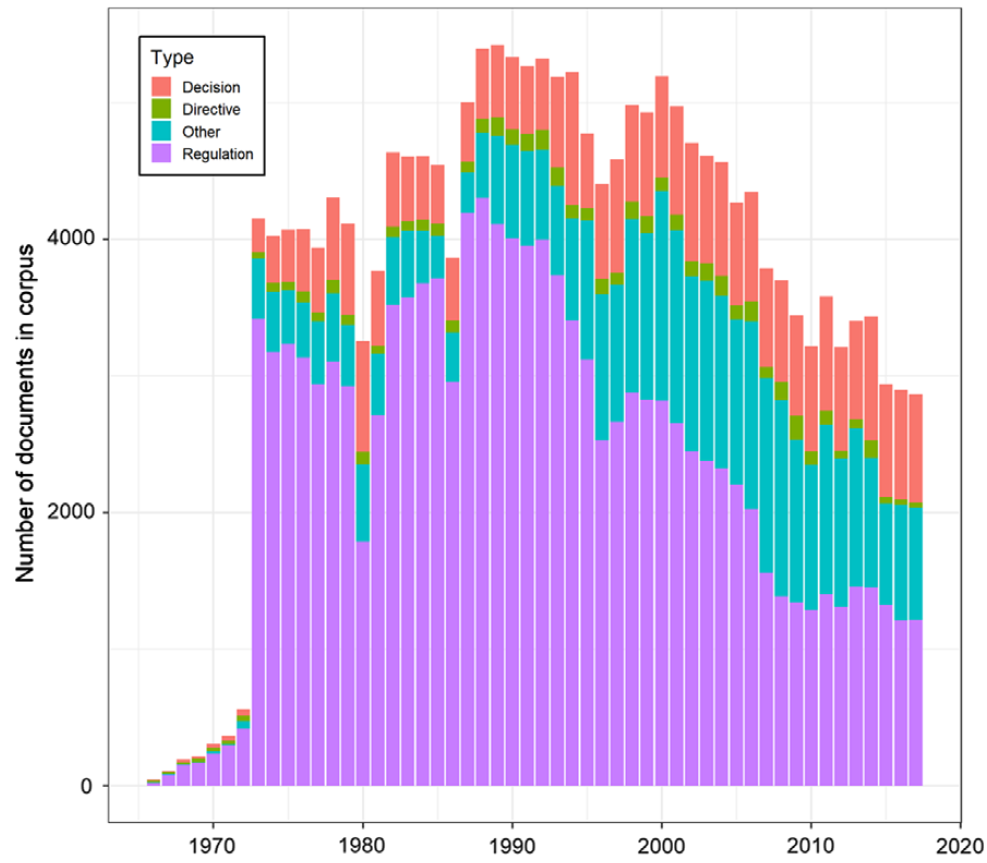
The three sets of documents, or sub-corpora, making up our operational corpus are summarized in Table 1. The first and smallest sub-corpus consists of 3809 CMLR articles and case notes. The second set of documents encompasses all Court of Justice, General Court, and Civil Service Tribunal opinions and judgments along with all Advocate General opinions issued since 1963 and available at the time of writing. Figure 1 illustrates the distribution of these judicial documents over time. Whereas the number of Advocate General opinions has remained more or less constant since the 1970s, the number of Court of Justice and General Court rulings has experienced a sharp increase from 2005 onwards. The third and, by far the largest, sub-corpus comprises all the legislative acts passed by the European Union institutions between 1966 and 2017. Legislative acts include treaties, directives, regulations, and decisions. Figure 2 shows the proportion of directives, regulations, and decisions over time. Regulations clearly account for the bulk of legislative activity. Striking, too, is the decline in legislative production since the turn of the millennium.
Description of sub-corpora

Documents in judicial sub-corpus by year of issuance.

Document types in legislative corpus by year of issuance.
Naturally, for the reasons discussed in the previous Section, there are limits to what we should expect to find in the substantive content of EU legislation, case law, and academic publications in our corpus. Obviously, the diversity of topics reflected in EU legislation is constrained by the breadth of the EU’s legislative powers. Although the EU has been regularly accused of intruding on national sovereignty, for example through an expansive interpretation of its internal market competences, the EU is, in general, more likely to enact legislation on issues close to its historical core competences—agriculture, international trade—than in areas lacking an explicit legal basis in the treaties, such as human rights or the rule of law. Similarly, the content of CJEU case law might be more likely to reflect justiciable issues, although, when it comes to preliminary rulings, national courts are free to refer questions concerning any EU rules deemed relevant to the dispute at hand. As for the CMLR, the decisions and policies of the journal’s editors undeniably play a significant role in filtering what gets published.
Nevertheless, these constraints do not fully determine the contents of the texts eventually produced. At any rate, they leave ample room for variations resulting from factors either endogenous—such co-evolutionary influences—or exogenous—such as the preferences of litigants and academics—to the text-generating process.
II. Methodology
Our main text-mining method is known as probabilistic topic modelling.Footnote 28 Probabilistic topic modelling has been developed for the purpose of discovering and annotating large archives of documents with thematic information. As with all-natural language processing techniques, probabilistic topic modelling relies on simplifying assumptions—in short, it does not parse words, sentences and contexts quite the way the human brain does. Yet, it has been shown to perform well on a wide range of documents, including legal ones.Footnote 29 Probabilistic topic modelling is an unsupervised machine learning method. That is to say, the document classification is not learned from human annotations, but “discovered” by the algorithm itself. The basic intuition behind the technique is that documents addressing the same topic are likely to contain similar words. Words such as “import”, “products” and “tariffs” will appear more often in documents about trade whereas “residence,” “citizenship,” “family” and “visa” will be more common in documents about immigration. Also, a document, whether a legislative act, a ruling or a law review article, will frequently straddle several topics. A ruling about a procedural or constitutional issue will also refer to the more substantive issue of the case—which may be milk quotas or wildlife conservation.
Topic modelling builds on these assumptions to model topics as clusters of words and documents as mixtures of topics. In more technical language, a topic model posits a latent space in which topics are represented as probabilistic distributions over words and documents as probabilistic distributions over topics. Once the researcher has set the desired number of topics, commonly denoted by the letter k, the algorithm seeks the topics—conceptualized as clusters of words—that best classifies the documents—modelled as mixtures of topics—in the corpus.
The k number of topics chosen to represent the content of a corpus is set by the researcher. This parameter is best viewed as determining how fine-grained a picture of the corpus the final topic model should provide.Footnote 30 A large k will result in a model with lots of very specific topics. A smaller k will produce a model with fewer topics but broader themes. For our analysis of EU law, we construct four topic models. One for the aggregate corpus and one for each of the three sub-corpora. For each of these models, we chose a number of topics that appeared to strike a reasonable balance between precision and tractability. As opposed to the number of topics, the words defining the topics are not chosen by the researcher, but are produced by the model. For that reason, probabilistic topic modelling is known in natural language processing as an unsupervised document classification technique.
Given the considerable temporal variation in document numbers, as illustrated in Figures 1 and 2, one might be concerned that a computerized text analysis would be skewed towards the period in which the largest number of documents has been produced. For the CJEU, for instance, we might fear that our topic model would essentially be a representation of topic prevalence after 2005. This is why the topic model we utilize is dynamic. It assumes that thematic attention may change over time and, for that reason, gives each year the same weight in the computation.
Before feeding them to the algorithm, documents were pre-processed, as is standard practice in natural language processing tasks. Pre-processing steps involved removing words and symbols that provide no thematic information: Punctuation, numbers and very frequent terms such as “the,” “but,” and “with.” We also removed words that appear in a high proportion of documents, as they are not useful for discriminating between different topics and make the interpretation of the model more difficult. Characters were all converted to lowercase so as to ensure that “Legal” and “legal,” for example, are treated as the same word.Footnote 31 All these steps were performed using the R programming language.
D. Variations in Issue Attention in Legislative, Judicial and Academic Texts
This Section presents and discusses the results of our topic modelling exercise.
I. Mega Topic Model of EU Law
We begin our textual exploration of EU law with our “mega” topic model, which treats the three text collections as a single corpus. The model summarizes this aggregate corpus in 63 topics. For this topic model, we restricted the analysis from 1972 through 2017 to facilitate interpretation.Footnote 32
Plotted in Figure 3 are the 63 topics with their four most characteristic words. It is important to bear in mind that these words have not been selected by the researchers, but are produced by the algorithm. We did not know in advance what topics would emerge from the model.
Mega topic model of EU law (1972–2017).
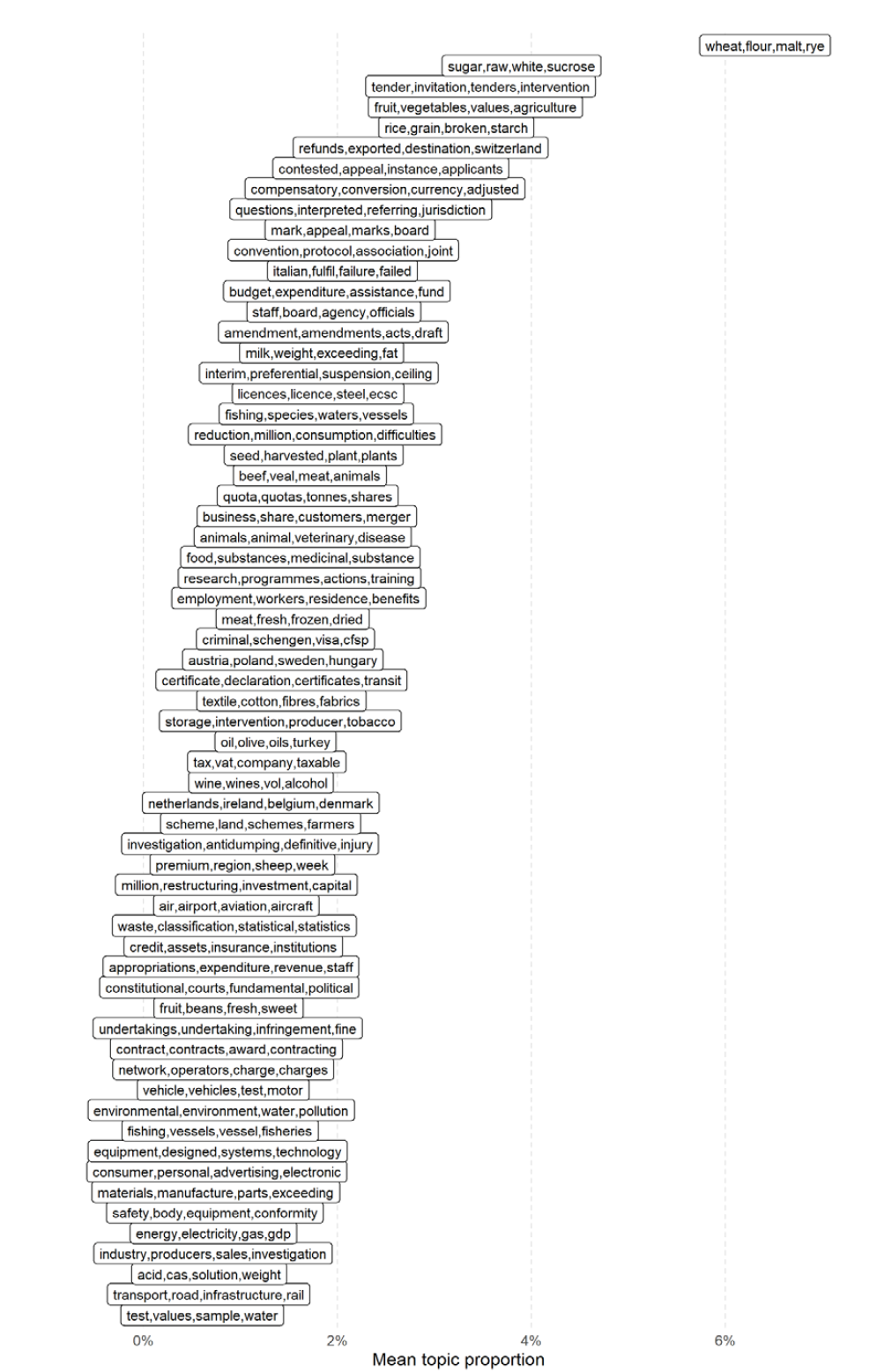
Interpreting the keyword-like terms defining a topic requires some basic knowledge of EU law and institutions. For example, the terms “questions,” “interpreted,” “referring,” “jurisdiction” may not seem readily meaningful to a layperson, but a jurist with some knowledge of EU law will instantly recognize words associated with the preliminary ruling procedure.
In Figure 3, the position a topic occupies on the horizontal axis indicates its overall prevalence in the corpus. The most prevalent topic appears in the upper-right region of the plot. Its most characteristic terms are “wheat,” “flour,” “malt” and “rye.” This topic accounts for more than 6 percent of the overall thematic attention. The second most prevalent topic is defined by the terms “sugar,” “raw,” “white” and “sucrose.” The fourth —‘fruit, vegetables, values, agriculture’— and fifth —"rice, grain, broken, starch”— most-prevalent topics are also related to agriculture. The topic in the third position from the top—“tender, invitation, tenders, intervention”—suggests that public procurement is another area of intense activity.
While we do find topics pertaining to judicial and constitutional issues—for example, “constitutional, courts, fundamental, political”—the overwhelming majority of topics address either trade, market or farming activities. As we shall see when we examine the separate topic models for legislation, CJEU documents and CMLR contributions, the predominance of economic and farming issues is in large part the consequence of the legislators’ voice. Yet these themes also feature prominently, albeit to a lesser extent, in the CJEU’s dispute settlement activity.
II. Legislative, Judicial, and Academic Sub-corpora
For the three sub-corpora, we chose topic models with, respectively, 35 —legislation and court— and 45 CMLR topics.
We first examine the model corresponding to the largest sub-corpus, EU legislation. We find, again, a high proportion of agriculture-related topics, with again cereals—“wheat, flour, maize, malt”—sugar—“sugar, white, basic, exported”—and rice—“rice, grain, broken, processed”—coming out on top. Public procurement comes in the fourth position, but is followed by yet another farming topic —“fruit, values, vegetables, nomenclature.” When not with agricultural commodities, other topics deal with competition—for example, topic “competition, business, services, share”—trade—for example, topic “industry, dumping, producers, investigation”—and transportation—“transport, services, service, airport.” Only two topics do not seem to bear a direct relationship to the single market or the CAP. One relates to the Common Foreign and Security Policy—“security, cfsp, birth, person”. The other to environmental protection—“safety, assessment, waste, environmental.”
Overall, Figure 4 shows considerable overlap with Figure 3, which is hardly surprising given the imbalance in the size of the three sub-corpora and the hefty share accounted for by legislative documents. If anything, the topics in Figure 4 appear even more technical and market-centered. The high prevalence of farming topics can be explained by the regulatory regime embraced by the CAP, which leans heavily on market intervention. Despite recent reforms, the CAP is not exactly known for its light-touch approach to regulation.Footnote 33 Frequent interventions concerning specific commodities translate into abundant, short-term regulations.
Topics and topic proportion, legislative sub-corpus (1966–2017).
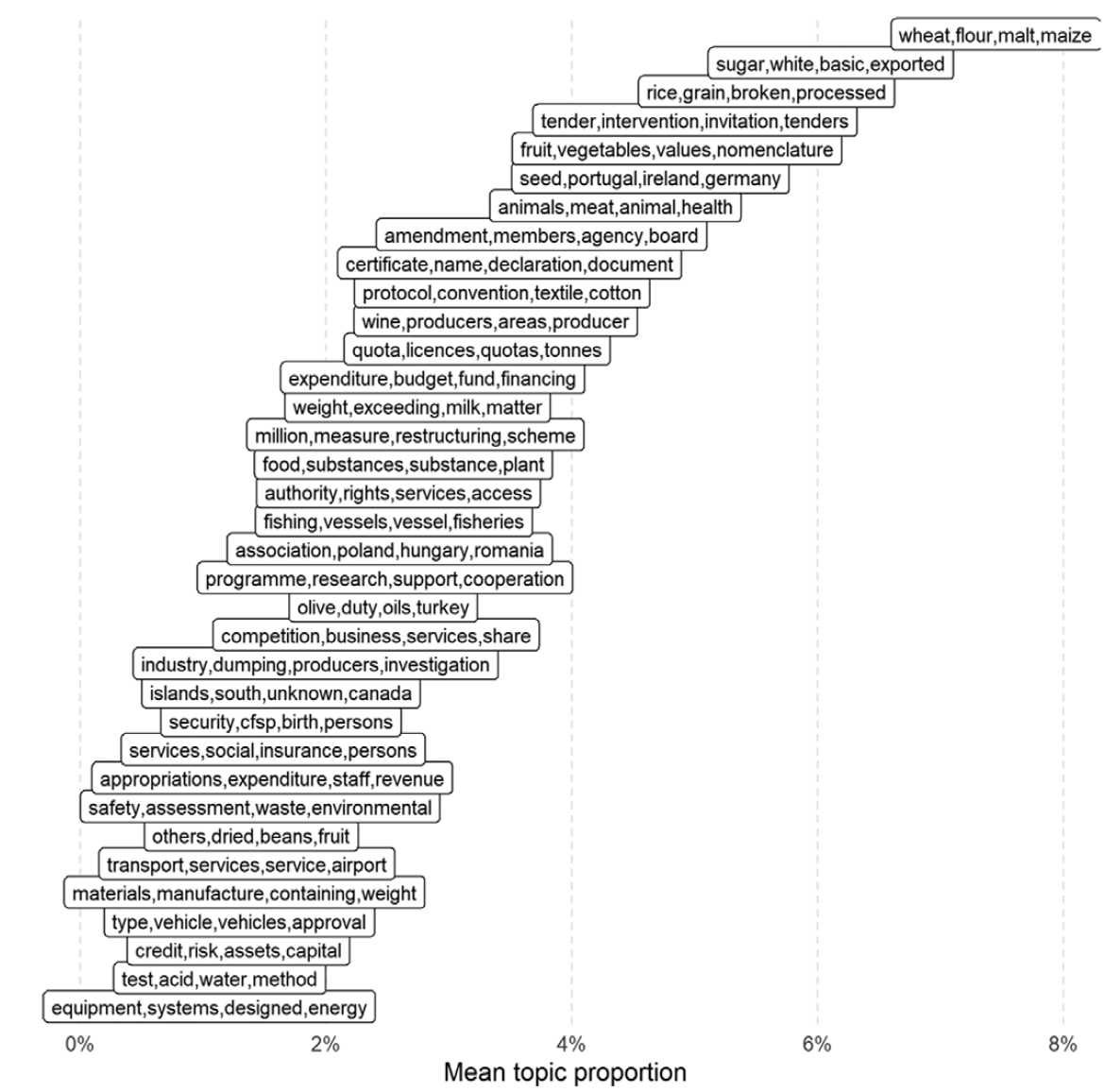
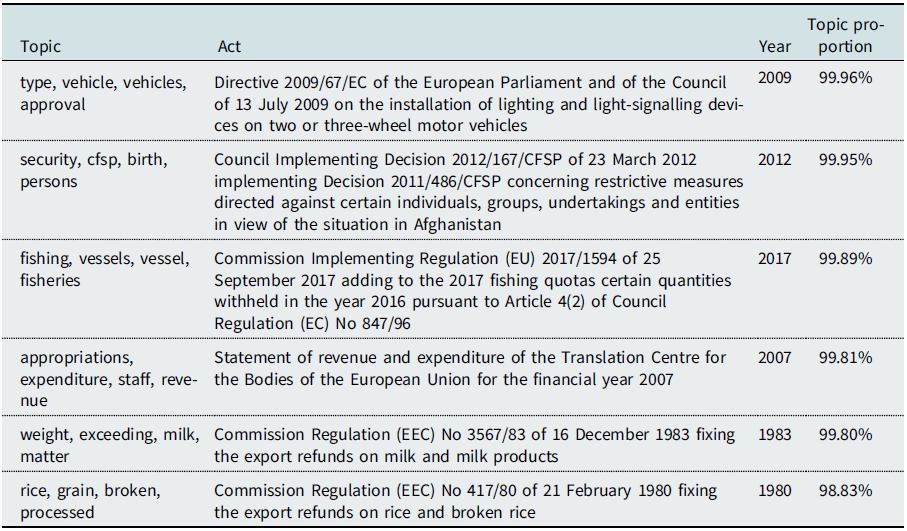
Table 2 shows the legislative documents with the highest topic proportion for a sample of legislative topics. For example, the document with highest proportion of topic “type, vehicle, vehicles, approval” is Directive 2009/67/EC of the European Parliament and of the Council of 13 July 2009 on the installation of lighting and light-signaling devices on two or three-wheel motor vehicles. Table 2 shows how topic modelling can be used to search for legal documents pertaining to a specific topic. A topic model gives us an indication of topic proportion not just for a single document but for all documents in the corpus—which is a great advantage over methods based on keyword search. Inspecting documents with high topic proportion can also help interpret topics that may at first appear ambiguous. For example, the topic “appropriations, expenditure, staff, revenue” may not look immediately obvious, but it becomes very clear when we look at the act featuring the largest proportion of the topic, namely the Statement of the revenue and expenditure of the Translation Centre for the Bodies of the European Union for the financial year 2007.
Acts with the largest topic proportion for a sample of legislative topics
Moving from legislative to judicial discourse, Figure 5 illustrates our topic model for the CJEU texts. In comparison to legislators, EU judges devote less attention to CAP issues, although these are still well represented—for example, topic “sugar, price, wine, tobacco” and topic “milk, agricultural, quota, levy.” The sizable number and monolithic character of staff cases, which for a time were handled by a specialized Civil Service Tribunal, make this topic—“staff, officials, post, committee”—the most prevalent in the judicial corpus. Probably because they rarely, if ever, result in landmark rulings with far-reaching doctrinal and policy implications, staff cases seldom get mentioned in academic publications. Yet, they form a constant source of workload for the EU judiciary.Footnote 34
Topics and topic proportion in judicial sub-corpus (1963-2018).
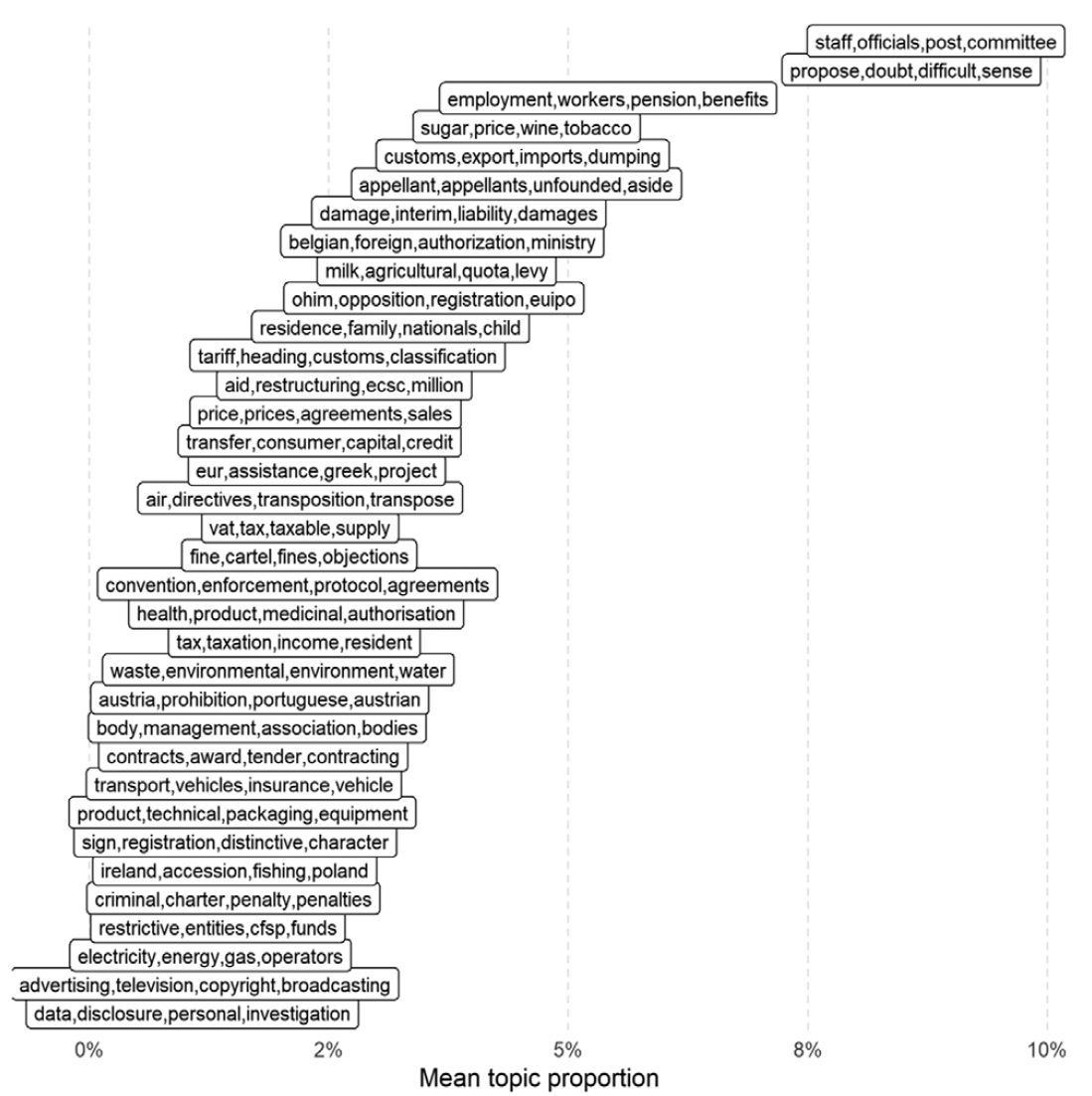
Beyond staff cases, many topics deal with single market themes—for example, customs, tariff nomenclature, VAT, product packaging, taxation of cross-border operations, competition. Yet, we also see some social policy—“employment, workers, pension, benefits”—and citizenship themes—“residence, family, nationals, child”.
Overall, our unsupervised document classification reveals the judicial sub-corpus to be more diverse than its legislative counterpart. The homo economicus looms large in CJEU adjudication, but not as conspicuously so as in legislation. The topic model gives a sense of what the typical case on the CJEU docket looks like. Topics such as “customs, export, imports, dumping,” “tariff, heading, customs, classification,” and “vat, tax, taxable, supply” lend some support to Michal Bobek’s claim that these dull subjects represent the normal life of EU law.Footnote 35 Yet, topics like “employment, workers, pension, benefits,” “residence, family, nationals, child,” and “criminal, charter, penalty, penalties” suggest a more nuanced picture.
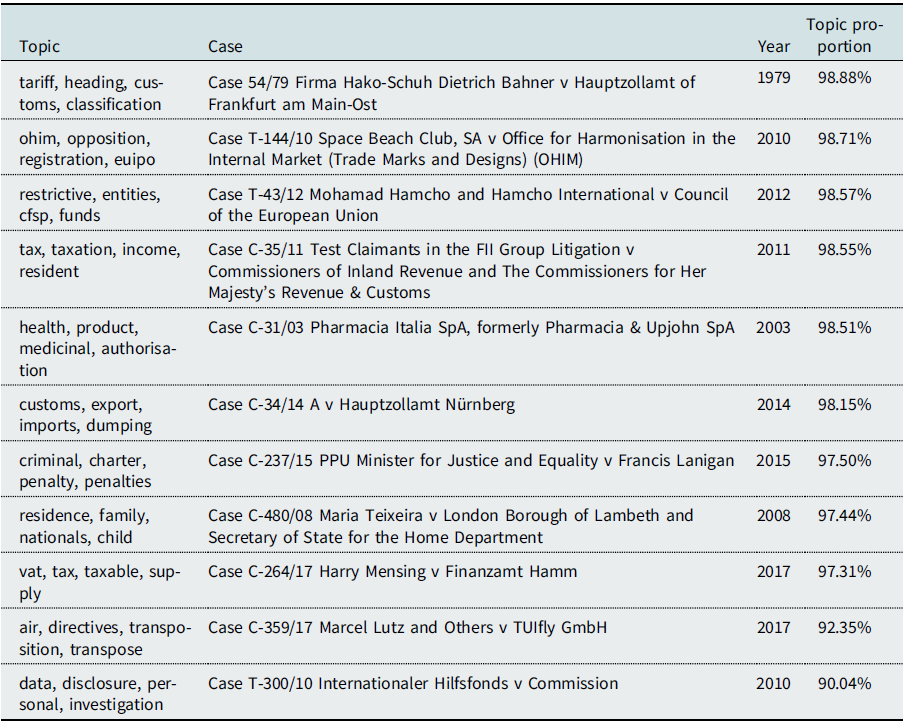
Similar to Table 2, Table 3 lists examples of cases heavily focused on a particular topic. The names of the parties involved suggest that the listed topics are, indeed, central to these rulings. The ruling most characteristic of the topic “criminal, charter, penalty, penalties,” PPU Minister for Justice and Equality v Francis Lanigan (Case C-237/15), is a well-known urgent preliminary reference involving the Irish Ministry of Justice. Not unexpectedly, given the words defining the topic, the Grand Chamber ruling involves the interpretation of both the Framework Decision on the European Arrest Warrant and the Charter of Fundamental Rights and Freedoms of the European Union. Likewise, it should not be surprising Maria Teixeira v London Borough of Lambeth and Secretary of State for the Home Department (Case C-480/08) involves the British Home Department given that it is the ruling most characteristic of the topic “residence, family, nationals, child.”
Cases with the largest topic proportion for a sample of judicial topics
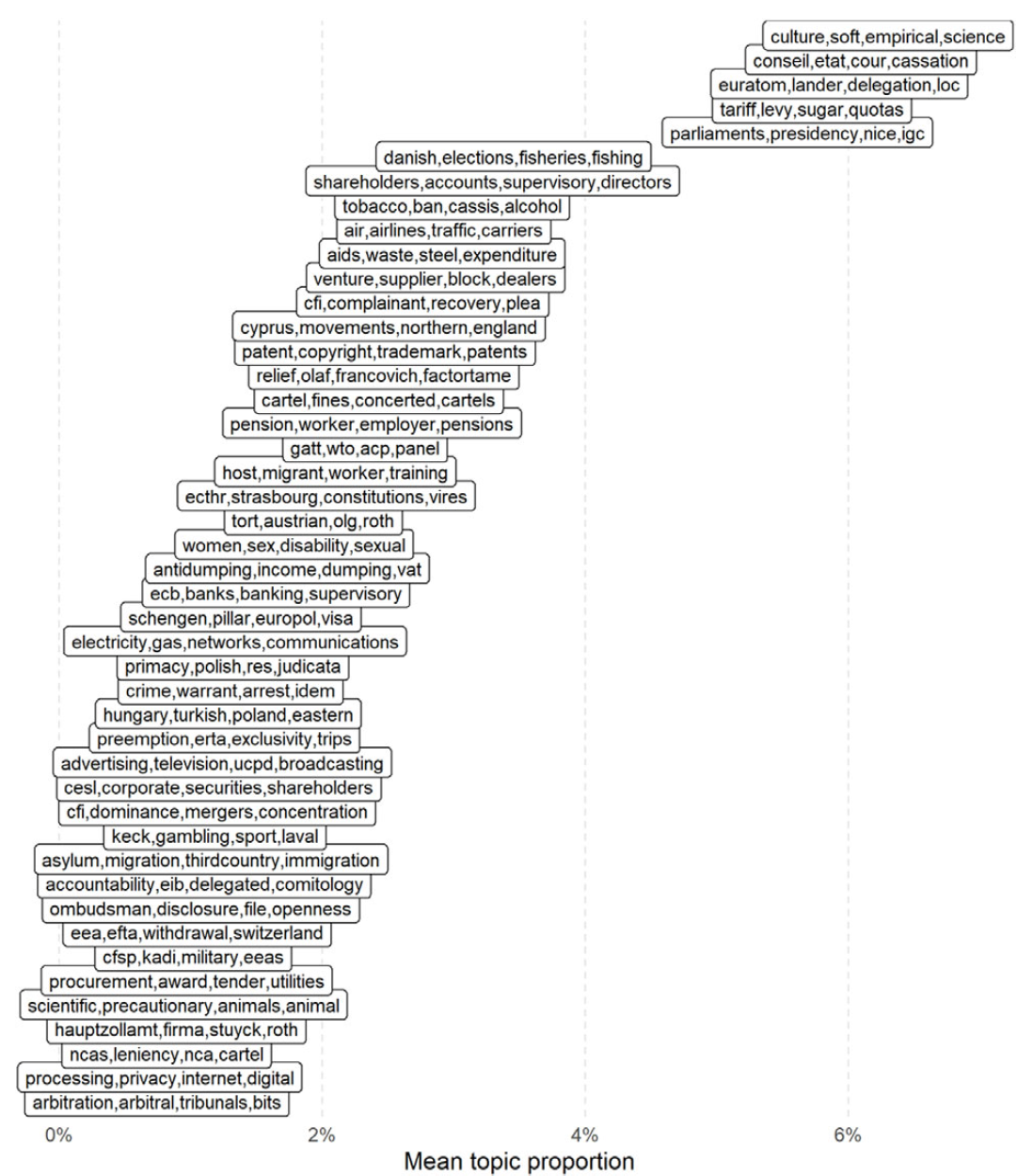
Turning now to the CMLR corpus, Figure 6 depicts our “academic” topic model. In contrast to the legislative and judicial topic models, the CMLR topic model indicates considerably lower attention for CAP issues, but considerably more attention for constitutional matters. Except for one topic—“tariff, levy, sugar, quotas”—we do not find topics that clearly relate to agricultural commodities or CAP regulations and disputes. By contrast, several topics pertain to constitutional issues. One such topic is “ecthr, strasbourg, constitutions, vires.” As shown in Table 4, the CMLR contribution most characteristic of this topic is Matthias Kumm’s “Who is the Final Arbiter of Constitutionality in Europe?: Three Conceptions of the Relationship Between the German Federal Constitutional Court and the European Court of Justice.” Table 4 confirms that the topic “conseil, etat, cour, cassation,” too, can be interpreted as constitutional. The document containing the highest proportion of the topic is a 1974 article titled “How Supreme is Community Law in the National Courts?” by Gerhard Bebr.
Topics and topic proportion in the CMLR sub-corpus (1963–2018).
Articles with largest topic proportion for a sample of CMLR topics
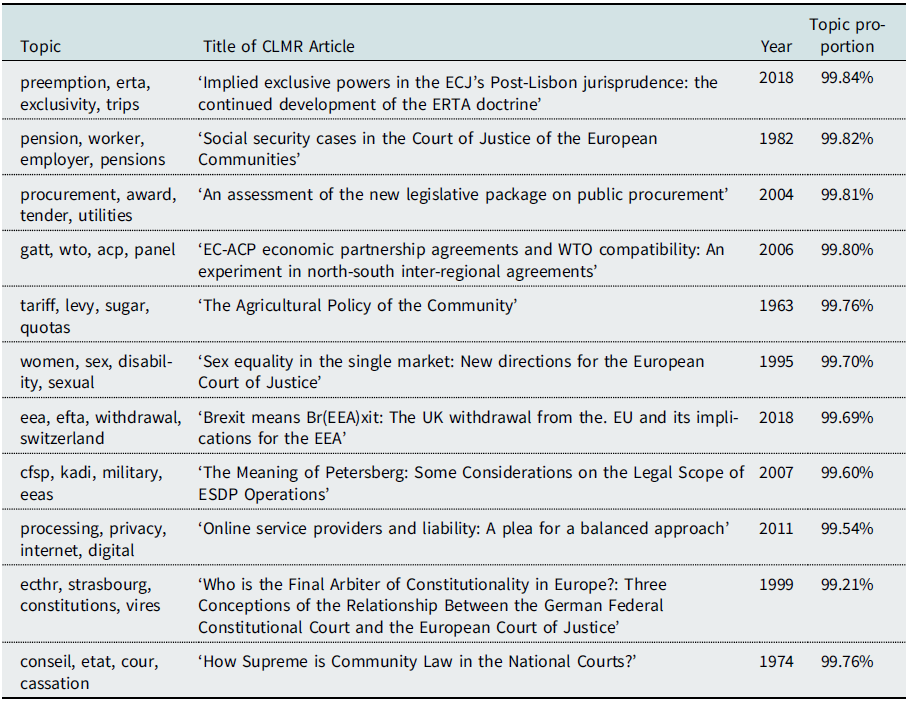
Topics arguably constitutional in character further include “women, sex, disability, sexual” and “preemption, erta, exclusivity, trips.” The topic “eea, efta, withdrawal, switzerland,” which covers articles over Brexit—see Table 4—may also be seen as possessing a constitutional dimension, at least in the broad sense of the term.
Comparing the CMLR topic models with the legislative and judicial models appears to confirm the intuition that EU law scholars tend to focus more on what occurs at the CJEU stage than at the legislative stage. This seemingly buttresses the critique Rob Van Gestel and Hans Micklitz have leveled at “case law journalism.”Footnote 36
So ingrained is the focus on court rulings that it might seem to follow naturally from the doctrinal method or from basic considerations of justiciability. However, not only do EU legislative texts spell out rules that are at least as important as those enunciated in judicial opinions, but only a small fraction of those are ever litigated before the CJEU. Justiciability alone cannot explain the inordinate emphasis on CJEU rulings. In fact, as legislative scholars, like Rob van Gestel have insisted, there is no reason inherent to the doctrinal approach to concentrate exclusively on legal developments at the judicial stage.
Rather than methodological precepts or dictates of justiciability, this pattern points to the existence of discussion cycles heavily influenced by the CJEU’s agenda. Both CMLR editors and academic writers prioritize the themes that the CJEU has put in the discussion cycle. The reasonable presumption that a manuscript addressing a topic in the current discussion cycle stands a better chance of being accepted, may work to further reinforce this dynamic. As we shall see, the diachronic analysis we present below is also consistent with this analysis.
Zooming in on differences between judges and academics, the latter exhibit a greater predilection for sexier constitutional topics. This relative divergence echoes the critique of Michal Bobek. To be sure, academic contributions devoted to the CAP or to public procurement—captured by the judicial topic “procurement, award, tender, utilities”—do exist.Footnote 37 Yet these topics seem less prevalent in academic than in judicial discourse. This pattern may, in part, reflect editorial policy. As its name implies, the CMLR was originally meant to focus on the construction of the internal market. But the personal predilections of academic writers represent a significant factor, too.
Interestingly, the article most representative of the sole academic topic presenting a real connection with the CAP—“tariff, levy, sugar, quotas”—is penned by a European Commission official—see Table 4. “The Agricultural Policy of the Community” was published in 1963 by Giancarlo Olmi, who worked for the European Commission’s legal service. While ascertaining the affiliation of CMLR contributors is beyond the scope of the present Article, this finding is consistent with what we said above about the impact of overlap in personnel on the focus of EU law scholarship. As Harm Schepel and Rein Wesseling have demonstrated, albeit on the basis of a smaller corpus, many CMLR contributors have links to EU institutions.Footnote 38
III. Temporal Variations
Figure 7 is another illustration of the points we just made about the focus of EU legal scholarship. The plot depicts the relative proportion of the phrase “human/fundamental rights” across the three sub-corpora over time. Although legislators, judges, and academics have all been giving greater attention to fundamental rights, the emphasis on rights is clearly, and consistently stronger in academic writings. Consistent with our concept of co-evolution, the three discourses have, to a noticeable extent, developed along similar upward trajectories, but with diverging growth rates.
Relative frequency of the phrase human/fundamental rights in the three sub-corpora.
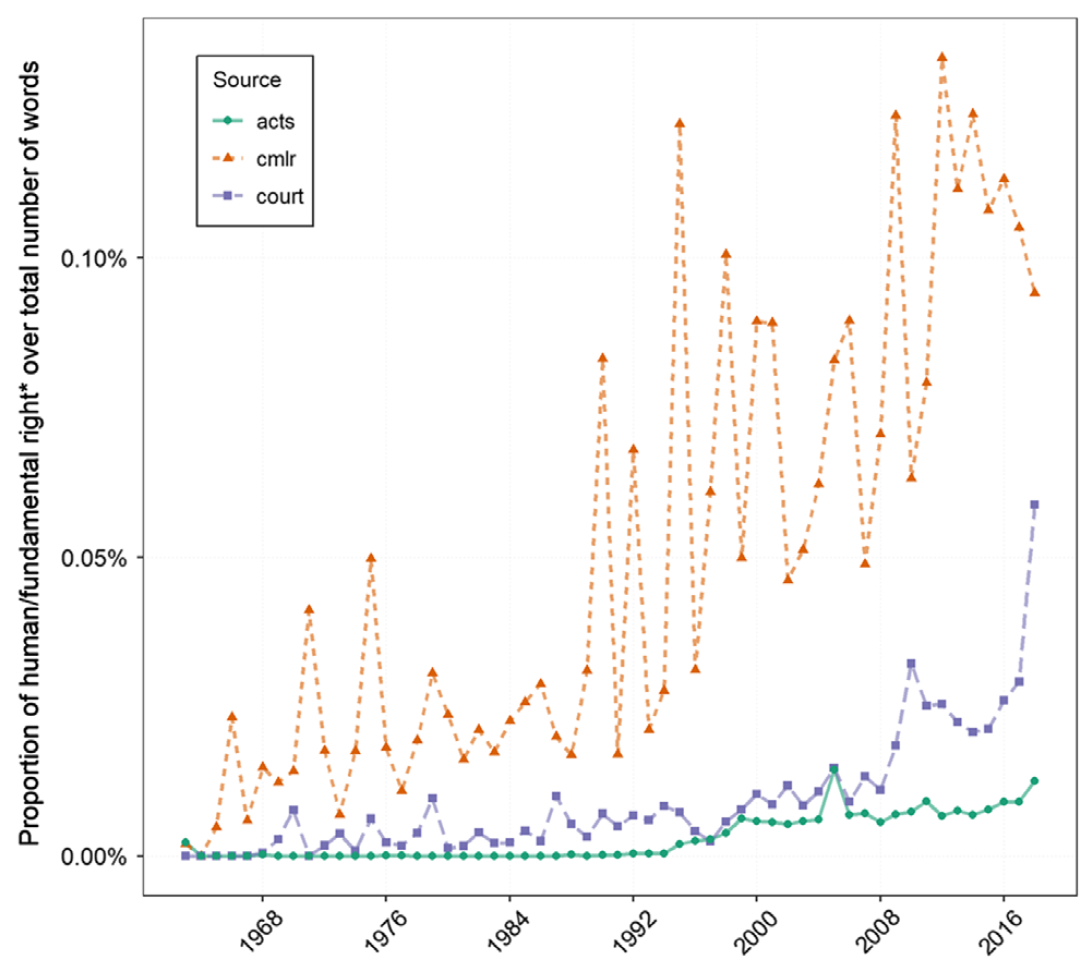
The plot shows a clear increase in attention to human/fundamental rights coinciding with the adoption of the Lisbon Treaty in both the judicial, and CMLR sub-corpora, plausibly as a consequence of the entry into force of the Charter of Fundamental Rights, and the obligation for the EU to accede to the European Convention on Human Rights, Article 6(2) TEU.
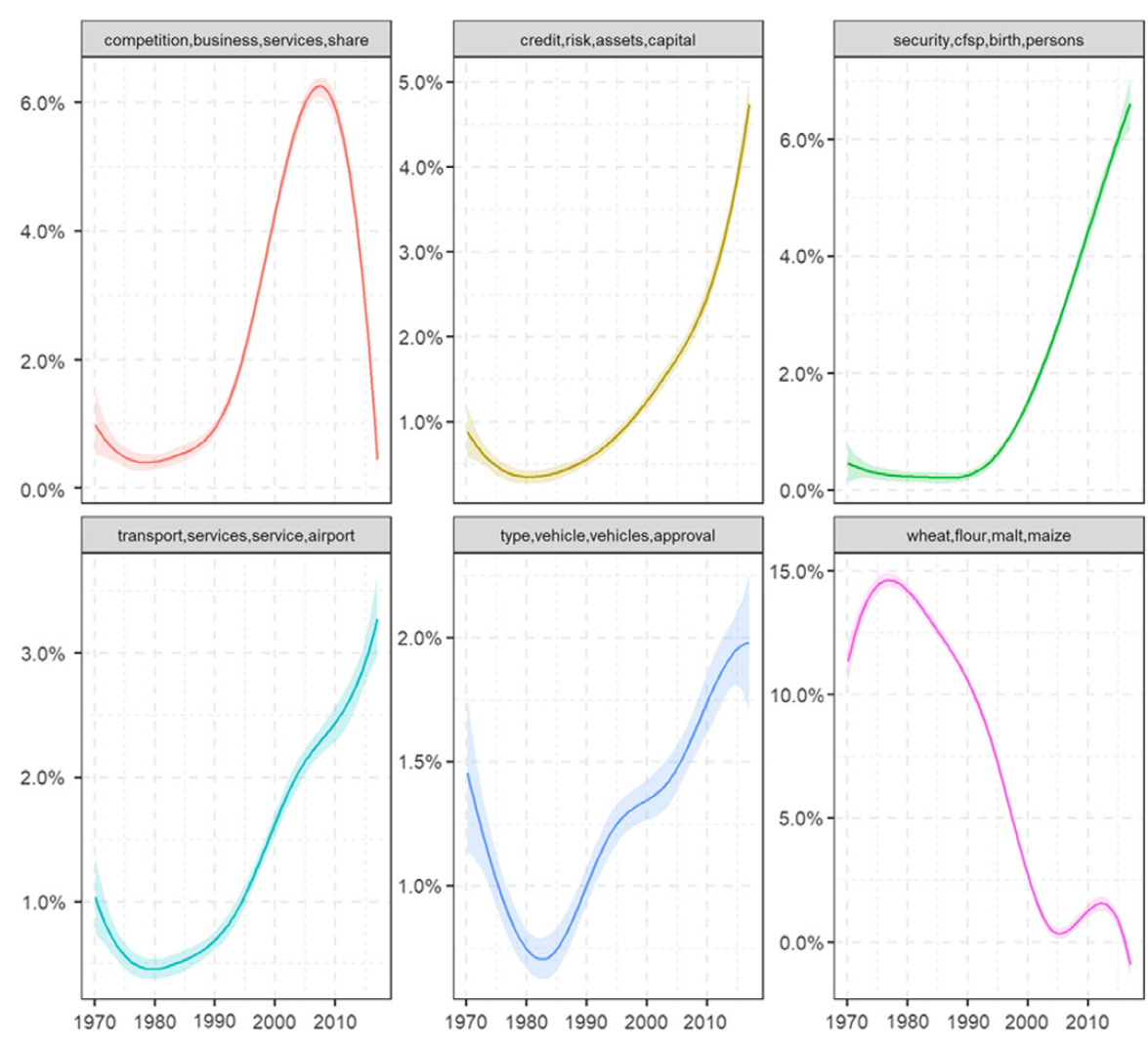
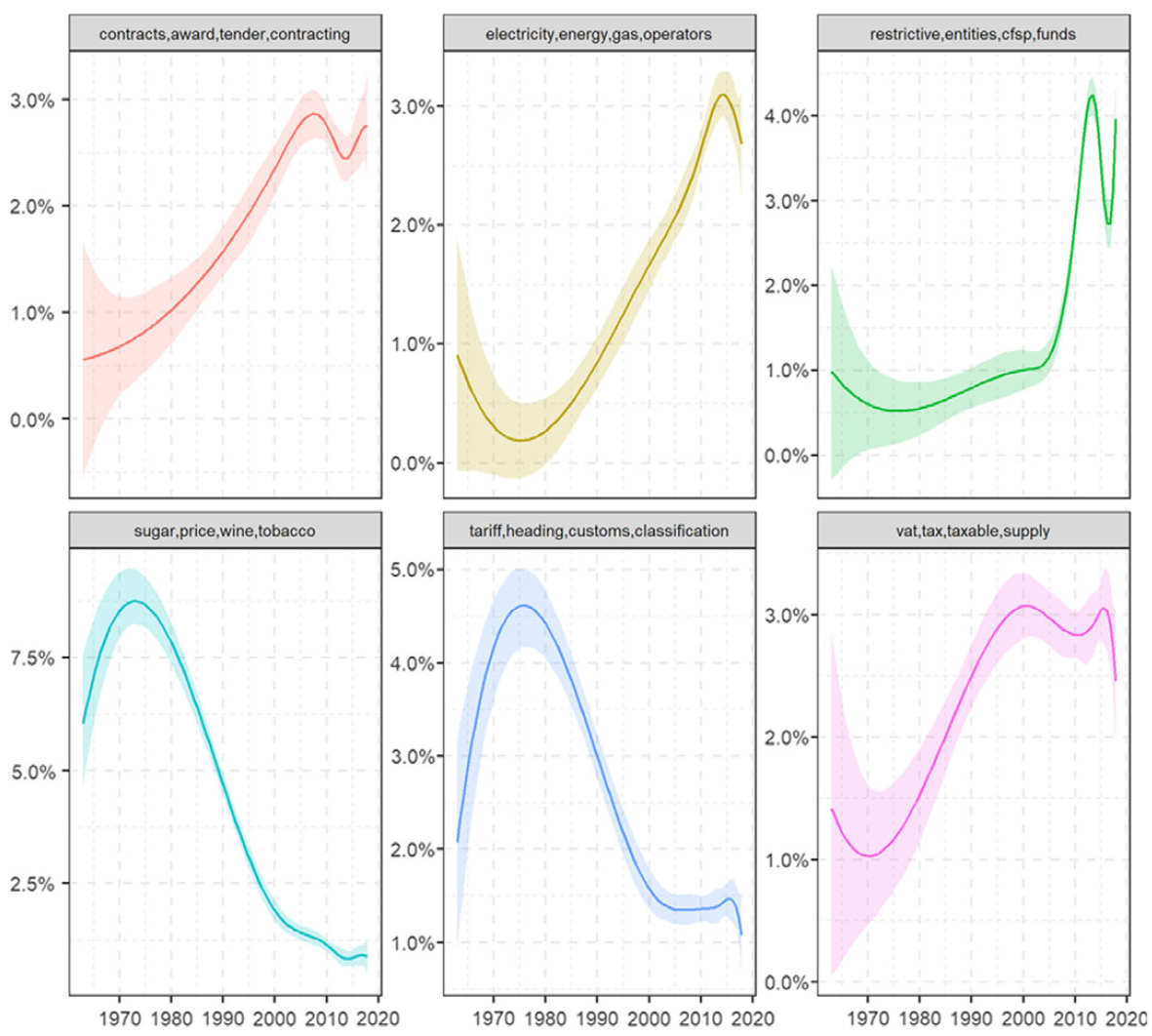
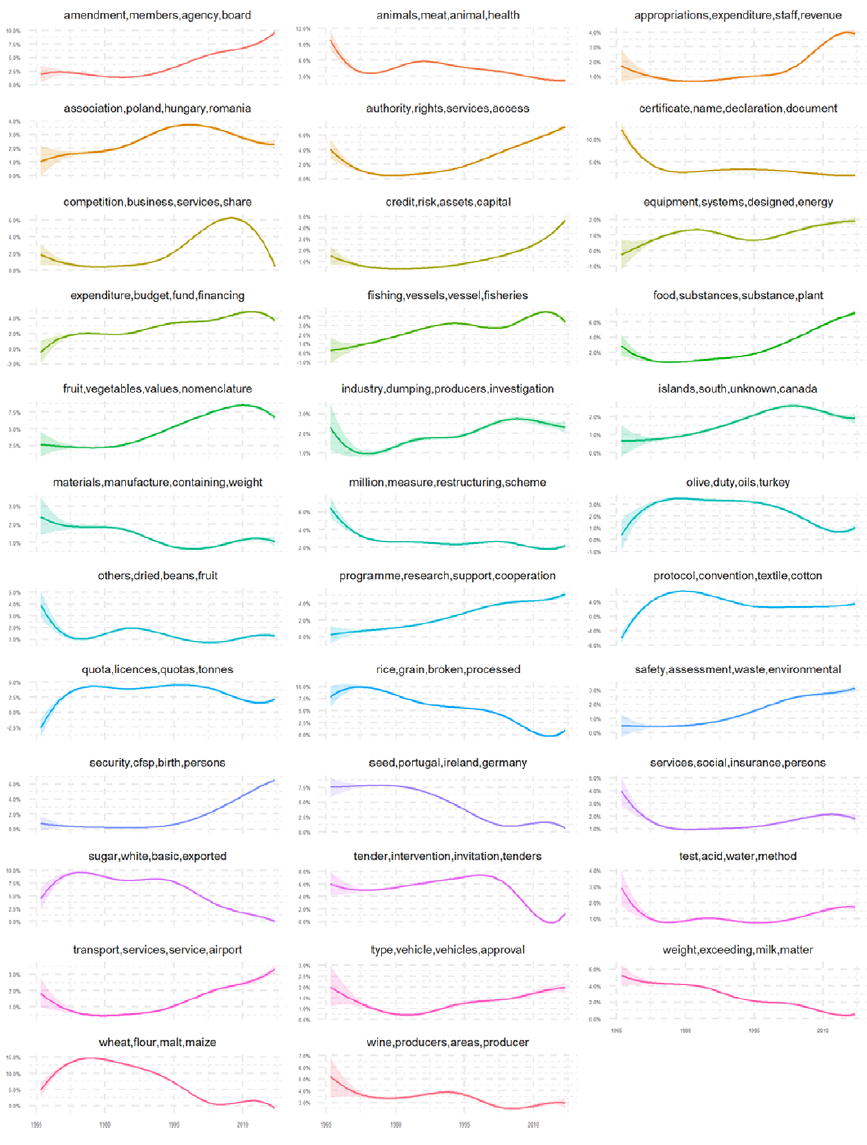
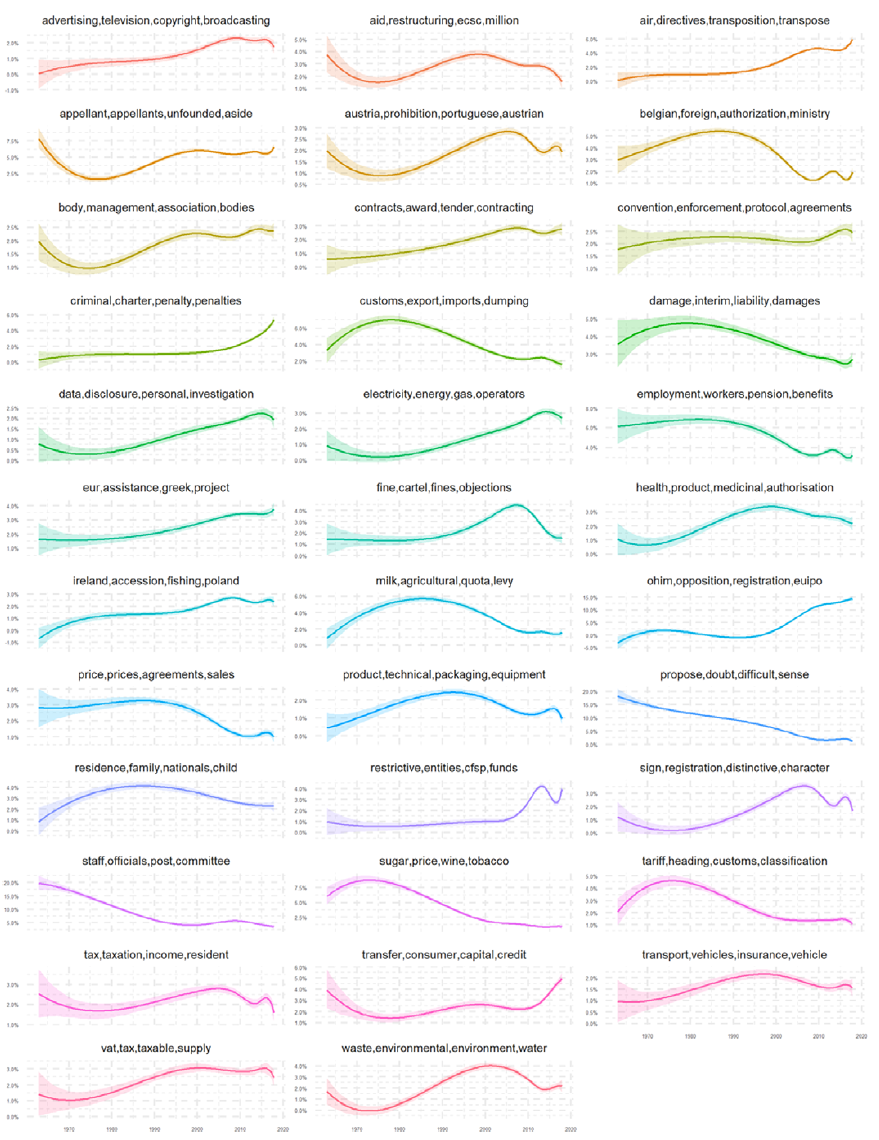
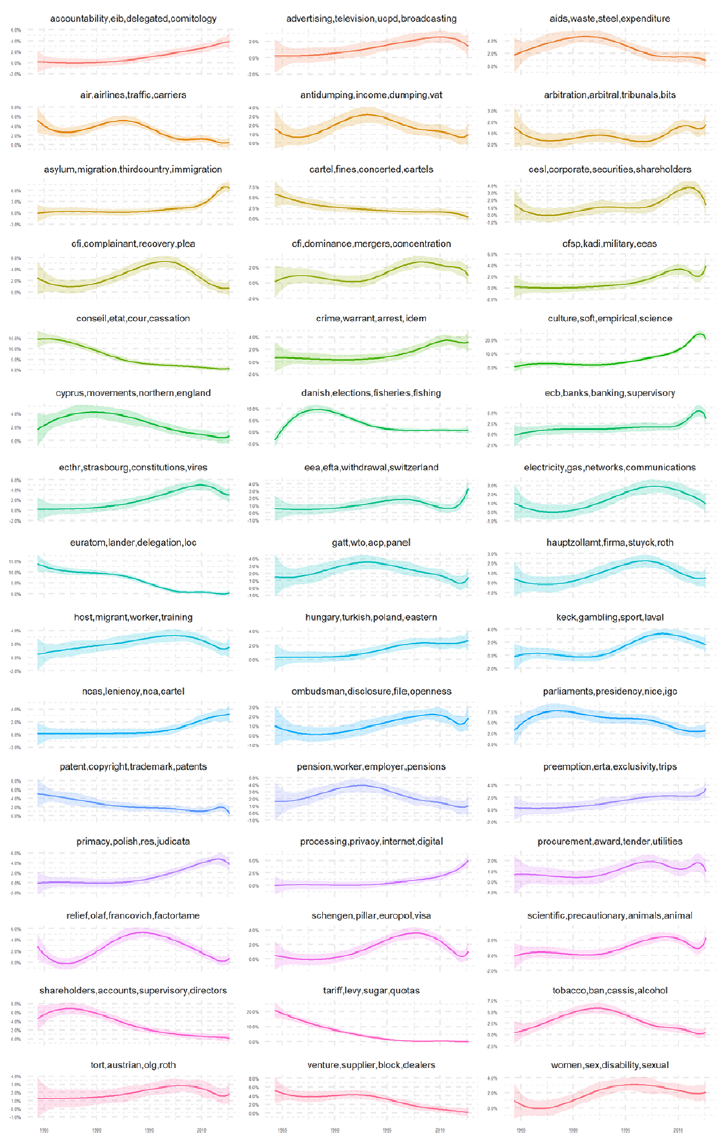
As the issue of human rights illustrates, topic attention may undergo substantial shifts over time. For reasons of space, we do not report time trends for all topics, and reserve them for the Appendix. Instead, we focus on a selection of legislative, judicial, and CMLR topics that illustrate shifts which we judged to be substantively important. These are depicted in Figures 8, 9, and 10, where shaded bands around the curves indicate how certain the model is about the true topic proportion.
Topic proportion over time for selected legislative topics.
Topic proportion over time for selected CJEU topics.
Topic proportion over time for selected CMLR topics.

As a cursory look at the three figures makes plain, shaded bands are larger for CMLR topics because the topic model is constructed from a smaller number of documents. Fewer documents mean less information to adjust the topic model to the corpus, and therefore, more uncertainty over topic proportion. Similarly, confidence bands for the CJEU and legislative topics are larger in the early years, reflecting lower judicial, and legislative output in those years.
More substantively, some of the downward and upward trends in Figures 8 and 9 are illustrative of the evolution of single market economic regulation. Legislation has become less about agricultural commodities—as exemplified by the declining share of “wheat, flour, malt, maize”—and more about free movement of capital—“credit, risk, assets, capital”—, the liberalization of transport markets—“transport, services, service, airport”—,and the harmonization of safety standards—“type, vehicle, vehicles, approval.” Likewise, Figure 9 shows that attention to tariffs and farming issues has decreased, while the proportion of cases dealing with taxation, public procurement, and energy markets has gone up. These dynamics appear to reflect distinct phases of the construction of the single market, with the early phase focusing more on the removal of tariff barriers and the establishment of a customs union and later phases focusing on deeper regulatory obstacles to the free movement of services, products and capital, and the liberalization of utility and transport markets.Footnote 39 The upward slope for the topic “credit, risk, assets, capital” in Figure 8, in particular, seems to reflect legislative efforts, at the end of the 1990s, to make the free movement of capital an economic and legal reality.Footnote 40 The temporal trends for these topics along with those reported in the Appendix suggest that, as far as legislators and judges are concerned, economic integration and the homo economicus continue to occupy centre stage, although the emphasis has shifted from “old” issues, for example, tariffs and farming, to “new” issues, for example, transport, energy, taxation, technical standards.
The trends for topic “security, cfsp, birth, persons” in Figure 8, topic “restrictive, entities, cfsp, funds” in Figure 9 and topic “cfsp, kadi, military, eeas” in Figure 10 all point to an increase in attention to security and foreign policy issues around 2000. Before that mark topic proportion is zero or close to zero. The curves in the judicial and CMLR topic models even display similar shapes.
Less surprising is the increase in attention to immigration—topic “asylum, migration, third country, immigration” in Figure 10—and criminal matters—“crime, arrest, warrant, idem”—in CMLR articles. Interest in these topics is relatively new. Interests in criminal procedure can be linked to the legislative act introducing the European Arrest Warrant and the relatively large number of CJEU cases it has spawned.Footnote 41 The CJEU’s case law on citizenship and immigration is also of recent origin.Footnote 42 Discrimination—“women, sex, disability, sexual”—by contrast, has been an established topic in EU legal scholarship for somewhat longer, which, again, reflects the temporal evolution of the CJEU’s case law.Footnote 43
While academics do not cover each and every CJEU ruling, our diachronic analysis suggests that the CJEU is, nonetheless, the most influential voice in the discussion cycle. CJEU rulings largely dictate when topics enter and exit the discussion cycle.
E. Conclusion
In this Article, we explored a novel, giant corpus of EU law texts using computer-based text-mining techniques. The aim of our analysis was to measure and compare issue attention in legislative, judicial, and academic texts at a relatively high level of generality. Overall, our text analytics cast light on areas of both convergence and divergence, in line with the notion of co-evolution which we suggested as a way to conceptualize relations among the three domains.
We found that, on the whole, there is a greater overlap between the judicial and the legislative voice and between the judicial and the academic than between the academic and the legislative. Academics respond more to CJEU rulings than to legislative enactments, which implies that there might be a grain of truth in the “case law journalism” critique levelled at EU law scholarship. From our analysis, legal scholars also look more inclined to shun the technical, regulatory stuff that forms the bread and butter of legislation and, to a large degree, of CJEU adjudication. The daily life of EU law, as some have put it, is indeed, more often than not about dull, unexciting matters such as VAT, tariff nomenclatures, and agricultural commodities.
As EU law scholars’ attention tends to be skewed towards constitutional and fundamental rights topics, a reader leafing through contributions in a law journal like CMLR might get the impression that EU law has moved away from businessmen’s Europe more than it really has. According to our textual analysis, EU positive law continues to mostly concern itself with the regulation of economic activity, although the focus of market regulation has shifted somewhat, away from farming commodities and custom duties and towards capital flows, taxation, and safety standards. On the one hand, while attention to fundamental rights in legislation and CJEU rulings seems to have increased in recent years, it is far from being central to the agenda of judges and legislators. On the other hand, the discrepancy in focus between legal scholarship and legislation and case law is something that one may put to the academics’ credit. Indeed, it can be argued that it is the responsibility of legal scholars to take fundamental rights and constitutional issues seriously when judges and legislators are perceived to fail their duty.
In any case, the analysis presented in this Article was conceived as primarily exploratory and descriptive, and we did not purport to adjudicate these questions. While the methodological approach we adopted is indubitably unconventional, at least for a legal audience, recent contributions have presented corpus linguistics and text-mining techniques as providing a new methodological paradigm for European legal research.Footnote 44 Although we certainly see room for further refinements of our findings, we hope we have demonstrated what such methods can achieve in terms of uncovering patterns and dynamics in large collections of EU legal texts.
F. Appendix
Topic proportion over time for legislative topics.
Topic proportion over time for CJEU topics.
Topic proportion over time for CMLR topics.


 Open access

