

Introduction
The Make America Great Again (MAGA) agenda, instantiated by popular support for Donald Trump and those who stormed the U.S. Capitol on January 6th, 2021, can be explained by a host of factors. Our focus is to reveal the dynamics of race and gender among Americans in their support for the MAGA agenda by examining the contributing role of right-wing authoritarianism (RWA). Contrary to Fukuyama’s declaration that the success of late-20th century Western liberal democracy defined the ideological “end of history,” the rise of Trump and his capture of the modern Republican Party have prompted political scientists to focus anew on the threat of right-wing authoritarianism at the elite system level as well as within the mass public (Fukuyama Reference Fukuyama1992; Levitsky and Ziblatt Reference Levitsky and Ziblatt2018). Republican Party domination in both chambers of the 119th Congress, in the executive branch under Trump, and in the majority-conservative Supreme Court creates a political scenario in which the guardrails of democracy will be put to the test. Concerns about democracy under the MAGA agenda have been raised by government officials who have worked closely with Trump, including former White House chief of staff John Kelly, who is on the record saying that Trump is “certainly an authoritarian” (quoted in Schmidt Reference Schmidt2024). This portrayal of Trump was at the center of the Democrats’ 2024 campaign, and yet the MAGA-fueled Republicans prevailed, suggesting a widespread acceptance, if not outright embrace, of right-wing authoritarianism in America.
While skepticism about the extent to which the public has any substantial effect on public policy is well founded (Gilens and Page Reference Gilens and Page2014; Page and Gilens Reference Page and Gilens2020), it remains the case that ordinary voters are responsible for the Republican Party’s clean sweep of executive and legislative elected offices at the federal level. With the outcome of the 2024 election now known, analysts must interrogate why so many more voters responded positively to the MAGA agenda and the Republican Party brand, and in particular why specific groups of people voted in favor of this ideology. Early exit polls tell a story that is consistent with that of recent elections and emphasize the importance of both race and gender in the American electorate. White Americans strongly supported the Republican Party candidate while most voters of color voted for the Democratic Party candidate Kamala Harris. Moreover, and consistent with widely held predictions in the post-Dobbs context, women voters favored Harris, producing a negative “gender gap” against Trump (NBC News 2024). That being said, white men alone could not have elected Donald Trump. Subgroups of white women and people of color voted in conjunction with white men to support Trump and his MAGA agenda. In this paper, we use an intersectional analysis emphasizing RWA to help explain the origins of these additional pockets of support.
The 2024 vote patterns of women of color and white men are consistent with past behavior and expectation, with the former voting for Democrats and the latter voting for Republicans. While these patterns align with pre-election forecasts, the vote patterns of white women and Latino men defied widespread expectations, as both race-gender groups supported Trump by a majority. Though contradicting both the broader perception of women as politically progressive and the record of Democratic voting among women of color, this result for white women voters is a predictable redundancy, as white women voters have shown themselves to be consistent Republican Party supporters (Frasure-Yokley Reference Frasure-Yokley2018; Junn Reference Junn2017; Junn and Masuoka Reference Junn and Masuoka2020, Reference Junn and Masuoka2024; Kim and Junn Reference Kim and Junn2024; Phillips Reference Phillips2018; Simien Reference Simien2015; Tien Reference Tien2017; Wilson Reference Wilson2012). The pattern of Trump support among Latino men (and similarly, the lower levels of Democratic support among Black men compared to past elections), however, is unexpected and more difficult to explain with existing concepts from scholarship on race and ethnic politics. Our paper addresses this gap in the literature by analyzing the role of right-wing authoritarianism in support for the MAGA agenda at the intersection of race and gender.
The MAGA agenda privileges a return to traditional values, renewed support for gender hierarchies, and the repulsion and exclusion of outsiders (e.g., Cassese and Barnes Reference Cassese and Barnes2018; Graham et al. Reference Graham, Cullen, Butler, Burton and Burton2021; Lajevardi and Abrajano Reference Lajevardi and Abrajano2018). Underlying the MAGA agenda are negative emotions of anger and resentment as well as perceptions of threat from newcomers and those who are getting ahead “undeservingly” or faster than they purportedly should be. These underlying emotions and perceptions are expressed in fear-laden rhetoric that lambastes change and non-conformity while promising punishment and retribution against those who misbehave or disagree. In this regard, the MAGA agenda for the United States is consistent with rhetoric and policy in other contemporary right-wing authoritarian regimes around the globe and across history (Inglehart and Norris Reference Inglehart and Norris2017).
The explicitly inegalitarian and anti-immigrant sentiments of the MAGA agenda encapsulated by restrictions on reproductive rights and calls for mass deportations may appear to be unfriendly policy positions to women and minority voters. But this impression is misleading, in large part because it ignores the identity-based cross-pressures voters can face because of their race-gender positionality. White men are dominant within the tandem structures of patriarchy (where men have more power than women) and racial hierarchy (where white Americans have more power than minorities). White men’s privilege based on both gender and race allows for congruence in the formation of political attitudes, helping explain their support for the MAGA agenda. Simultaneously, women of color face barriers from both gender and race, helping explain their opposition to the MAGA agenda. The positionality of white men and women of color within white patriarchy mitigates identity-based cross-pressures in public opinion and voting behavior. But when these broader categories are at odds with one another, and when those tensions are highlighted by rhetoric and campaign communications, the behavior and attitudes of voters require further theorizing and testing at the intersection of race and gender. This is the case for white women and men of color in the 2024 election cycle and as such, these cross-pressures require deeper consideration.
In the context of the 2024 election cycle and beyond, these cross-pressures play a key role in explaining how, and for whom, right-wing authoritarianism drives voter support for the MAGA agenda. White women voters are advantaged by racially motivated policy positions within the MAGA agenda while simultaneously disadvantaged by the Republican Party’s embrace of patriarchal traditions (Junn and Masuoka Reference Junn and Masuoka2024; Masuoka, Grose, and Junn Reference Masuoka, Grose and Junn2021). Conversely, men voters of color are disadvantaged by the white supremacist sympathies of the MAGA agenda while nonetheless structurally advantaged under patriarchy. This dynamic makes them relatively amenable to MAGA’s endorsement of traditional gender values and dominance on the basis of sex. When considered along these lines, the intersectional positionality of voters by race and gender provides stronger analytical leverage to explain support for the MAGA agenda and its ideological antecedents of right-wing authoritarianism. In the forthcoming analysis, we reveal systematic differences between race-gender groups in the American electorate, demonstrating heterogeneity in the relationship between RWA and MAGA in a manner that reflects the broader influence of positionality under white patriarchy and its attendant identity-based cross-pressures. Using an empirical strategy of race-gender disaggregation, we illustrate the nuances of how right-wing authoritarianism drives support for the MAGA agenda at the intersection of race and gender. Our findings underscore the role of identity-based cross-pressures in support for the MAGA agenda, revealing an authoritarian dynamic that is widespread in the electorate yet consistently ineffectual among women of color.
Support for the MAGA Agenda and the Role of Right-Wing Authoritarianism
We argue that support for the MAGA agenda and its authoritarian underpinnings is rooted in one’s positionality as advantaged or disadvantaged in the context of white patriarchy (see Strolovitch et al. Reference Strolovitch, Wong and Proctor2017). Voters who enjoy some degree of advantage based on race and/or gender (i.e., white men, white women, and men of color) are more likely to support the MAGA agenda. Conversely, the doubly disadvantaged (i.e., women of color) are the least likely to support the MAGA agenda. In our analysis, we explore how this overall pattern extends to the relationship between right-wing authoritarianism and support for the MAGA agenda, examining how race-gender privilege helps to explain the strength of the RWA-MAGA relationship.
These expectations are generated from our contention that, in the U.S. context, right-wing authoritarianism is both gendered and racialized. Defined in broad terms, authoritarianism involves an orientation in which group authority and uniformity are paramount (Adorno et al. Reference Adorno, Frenkel-Brunswik, Levinson and Nevitt Sanford1950; Altemeyer Reference Altemeyer1981; Reference Altemeyer1988). Considered a relatively stable personality trait, authoritarianism involves a powerful aversion to social difference and a preference for the top-down enforcement of conformity (Stenner Reference Stenner2005). As such, people with authoritarian tendencies are especially activated when perceiving threats to the normative order—that is, threats to “some system of oneness and sameness that makes ‘us’ an ‘us’,” and a moralistically good “us” at that (Stenner Reference Stenner2005, 17). The MAGA phrase itself—Make America Great Again—implies normative threat. Moreover, the phrase profits off its own ambiguity. The prevailing threat to American greatness is unnamed, allowing for members of the public to project their own narratives of threat onto the slogan and its broader movement. From the vantage point of patriarchy, normative threats encompass anything that destabilizes the social order under gender hierarchy (e.g., deviating from gender roles and stereotypes). From the vantage point of white supremacy, normative threats encompass anything that destabilizes the social order under racial hierarchy (e.g., DEI programs and critical race theory in schools). In turn, we argue that the appeal of MAGA is a function of how a voter’s race-gender positionality primes them to perceive threats to white patriarchy writ large. For the least advantaged voters under white patriarchy (i.e., women of color), the normative threats implicitly and explicitly purported by the MAGA agenda do not resonate as strongly. Consequently, the role of RWA in MAGA support varies based on the intersection of race and gender.
In political psychology, the role of normative threat in activating latent authoritarian predispositions is referred to as the “authoritarian dynamic” (Stenner Reference Stenner2005). In contrast to the typical inclinations of conservative ideology that emphasize stability and preserving the status quo, the net result of the authoritarian dynamic among right-leaning voters is a distinct willingness to “tear the whole thing down” (Stenner Reference Stenner2005). The stability of democracy is a worthy sacrifice in the eyes of authoritarianism, so long as the agenda of oneness and sameness (i.e.,—comportment with the white-patriarchal normative order) is advanced. In this sense, MAGA sympathies toward the January 6th riot may reflect a historical moment that “unmask[s] the two characters” of status quo conservatism and authoritarianism (Stenner Reference Stenner2005: 177), revealing the important distinction between these expressions of right-leaning ideology when analyzing today’s political landscape.
In this paper, we argue that the authoritarian dynamic, as it manifests in contemporary American politics, is race-gendered. For the authoritarian dynamic to enter the political scene and culminate in the level of political violence witnessed on January 6th and implicitly condoned by voters in 2024, there needs to be an authoritarian leader. Trump fits this profile. Through his own brand of entrepreneurial politics, Trump positioned himself as a strong-man leader who is willing and able to confront the gendered and racialized “dangers” of modern America, the perception of which has been meaningfully manufactured by his own political rhetoric. This messaging is evident in the MAGA movement’s demonization of immigrants and outsiders, as exemplified by a wide range of racist commentary about people of color that includes calling Puerto Rico a “floating island of garbage” and characterizing Kamala Harris as “low IQ” (see Krieg Reference Krieg2024). Trump’s success in catalyzing perceptions of normative threat is likely a core factor in shaping the relationship between right-wing authoritarianism and MAGA support. His success in self-projecting as a figure of traditional masculinity, typified by physical strength and coercion, has buoyed his political appeal in the face of manufactured threat.
The foregoing arguments give way to a series of hypotheses that build on one another. First, we hypothesize that there will be a significant gender gap in MAGA support among voters of color, but that whites will not evince as strong of variation between men and women (H1). Second, we hypothesize that, among women, white women voters will have stronger MAGA agenda support compared to women of color (H2). These hypotheses (H1-H2) echo the idea that the gender gap is a race gap. Though we expect some gender differences overall, they will be most pronounced among voters of color, while white women’s preferences will more closely resemble those of white men. White women are cross-pressured as they are first in race, but second in sex (Junn Reference Junn2017). The relative advantage white women derive from their racial identity leads us to predict that their attitudes will more closely resemble those of white men. By contrast, women of color, who are doubly bound by both race and gender (Combahee River Collective 1977; Crenshaw Reference Crenshaw1989), will be the least supportive of the MAGA agenda as they risk harm from it on both fronts. Extending these insights to our primary focus, we hypothesize that the positive association between RWA and support for the MAGA agenda will vary based on race-gender positionality (H3). Women of color will exhibit the weakest RWA-MAGA relationship, while white men, white women, and men of color will exhibit a stronger RWA-MAGA relationship, given their relative positions of privilege under white patriarchy.
We test these hypotheses while controlling for an array of individual-level constructs that are associated with conservatism, including social dominance orientation, system justification, and racial resentment. Taken together, these constructs account for generalized preferences for group-based hierarchy (Sidanius and Pratto Reference Sidanius and Pratto1999), perceptions of the legitimacy of the status quo (Jost Reference Jost2021), and emotion-laden beliefs that undeserving racial minorities are taking advantage of resources in a manner that is unfair to whites (Davis and Wilson Reference Davis and Wilson2022, Reference Davis and Wilson2023). By controlling for these constructs, we can more precisely test our hypotheses regarding the relationship between right-wing authoritarianism and support for the MAGA agenda.
Methods
We utilize data from a national probability sample survey of Americans undertaken prior to the 2024 election to reveal how gender, race, and right-wing authoritarianism influence attitudes about the Trump MAGA agenda. The Health of Democracy study conducted by the University of Notre Dame (NDHOD) included a wide range of questions about support for Trump, the MAGA agenda, and reactions to January 6th (Hall and Campbell Reference Hall and Campbell2022). This study also included standard questions on right-wing authoritarianism (RWA), social dominance orientation (SDO), system justificationFootnote 1 , and racial resentmentFootnote 2 .
While the sample was sizable, this study did not include minority oversamples with sufficient size to disaggregate by gender. Thus, and while far from ideal, the analyses below combine non-white minority Americans (aggregating together Black, Latinx, Asian American, and other racial/ethnic samples). In total, our sample includes 549 white women, 471 white men, 291 women of color, and 269 men of color. We are able to analyze differences by gender among white voters as well as minority voters, but not within specific race and ethnicity groups. We recognize that this analysis is imperfect and as such, we conduct additional descriptive analysis of questions related to Trump’s MAGA agenda and specifically the January 6th insurrection from the Collaborative Multiracial Post-Election Survey (CMPS), which oversamples Black, Latinx, and Asian American respondents. These descriptive tables can be found in Appendix A Footnote 3 .
In terms of the MAGA agenda, our main dependent variable of interest, we analyze 7 questions in the 2022 NDHOD to create a MAGA scale: (A) “I am a loyal supporter of Donald Trump above any political party,” (B) “Donald Trump is the true voice of the real American people,” (C) “Joe Biden stole the 2020 presidential election,” (D) “Democrats often engage in voter fraud,” (E) “The January 6th protest at the U.S. Capitol was a justified reaction by patriots,” (F) “Any violence at the January 6th protest at the U.S. Capitol was perpetrated by Antifa,” and (G) “The media exaggerated the violence at the January 6th protest at the U.S. Capitol.”
We theorize the concept of support for the MAGA agenda to include all these elements, including the first two items (A) and (B) about how much a respondent is loyal to Trump (rather than any party) and how much they believe he is the true voice of the MAGA agenda. Two other items (C) and (D) ask about the Democratic Party and President Biden in particular, providing opportunity for negative valence to be observed among respondents to entities that are alleged to be working in direct opposition to the MAGA agenda. Item (E) is consistent with the MAGA agenda in that it prompts respondents with patriotism as the underlying motive for January 6th insurrectionists. Item (F) is another negative valence item attributing blame for the violence on Antifa, thereby relieving responsibility for the death and destruction in the Capitol from supporters of the MAGA agenda. Item (G) is also consistent with the MAGA agenda as a measure intended to capture the undermining of mediated communications from traditional news sources, a consistent conspiracy refrain among Republican Party candidates and supporters.
Interestingly as these indicators of support for the MAGA agenda are separate, we combined them into a scale that yielded a Cronbach’s alpha score of 0.93, indicating high internal validity. This along with the results of simple correlation analysis confirming positive coefficients among all the items are provided in Appendix B. Further documented in the appendix are the results of a factor analysis that yielded results of a strong single factor with high loadings (.70–.90) across all 7 items of support for the MAGA agenda included in the 2022 NDHOD.
Right-wing authoritarianism (RWA), our main independent variable of interest, is measured using four items in the 2022 NDHOD, including: (RWA1) “Our country desperately needs a mighty leader who will do what has to be done to destroy the radical new ways and sinfulness that are ruining us,” (RWA2) “What our country really needs is a strong, determined leader who will crush evil, and take us back to our true path,” (RWA3) “Our country will be great if we honor the ways of our forefathers, do what the authorities tell us to do, and get rid of the “rotten apples” who are ruining everything,” and (RWA4) “This country would work a lot better if certain groups of troublemakers would just shut up and accept their group’s traditional place in society.” Cronbach’s alpha score of four RWA items is 0.88, indicating high internal validity.
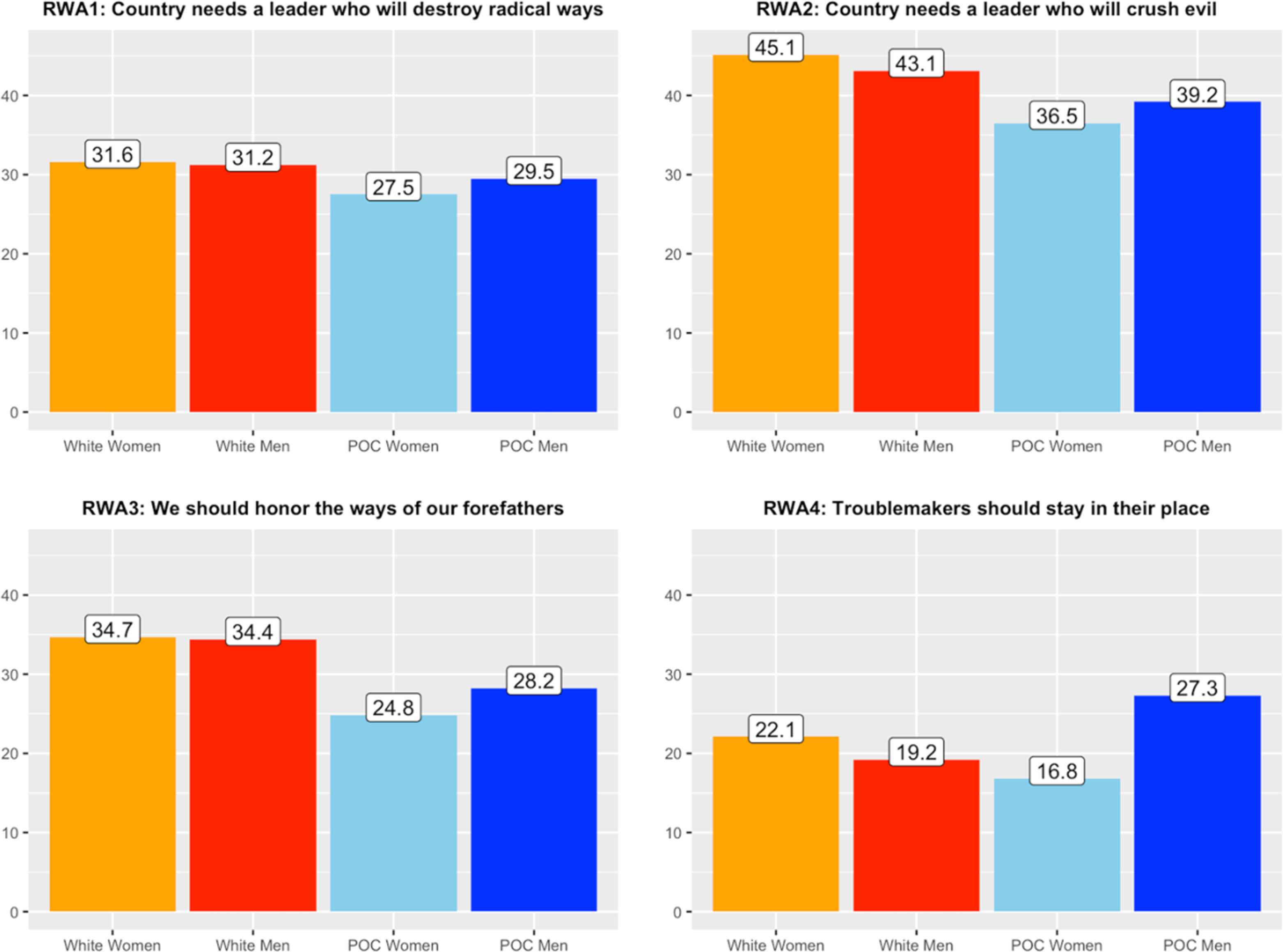
Figure 1 displays the degree of agreement for each RWA item, categorized by race-gender groups and measured as the proportion of respondents who either “strongly” or “somewhat” agree. Scholarship has identified a conflicting record on gender differences in RWA, with some suggesting that women exhibit lower levels of RWA as compared to men (Kemmelmeier Reference Kemmelmeier2010), whereas other research emphasizes gender symmetry across the RWA spectrum (Altemeyer Reference Altemeyer2004). On the other hand, the role of race in shaping RWA gender patterns is not addressed in extant studies, leaving a gap in the overall authoritarianism literature. Our analysis of how RWA is distributed across race-gender groups offers an important advance in this regard. To this end, as illustrated in Figure 1, we find that both white men and white women consistently exhibit comparable levels of RWA across all items, whereas women of color are the least supportive of RWA. The story of RWA for men of color, however, is more complex. Men of color show the highest agreement with RWA4, but they score lower than both white men and white women on the other three RWA indicators. On the other hand, men of color consistently show higher agreement on all the indicators of RWA compared to women of color.
Agreement of RWA items by Race-Gender Groups.
Note. All estimates are adjusted using survey weights.
Source: 2022 NDHOD.
These bivariate patterns in the data analyzed by race-gender categories foretell how authoritarian predispositions influence support for the MAGA agenda. In the next section, we test our hypotheses about the unique influence of RWA on MAGA agenda support and how these influences vary by race and gender.
The Impact of Right-Wing Authoritarian on Support for the MAGA Agenda
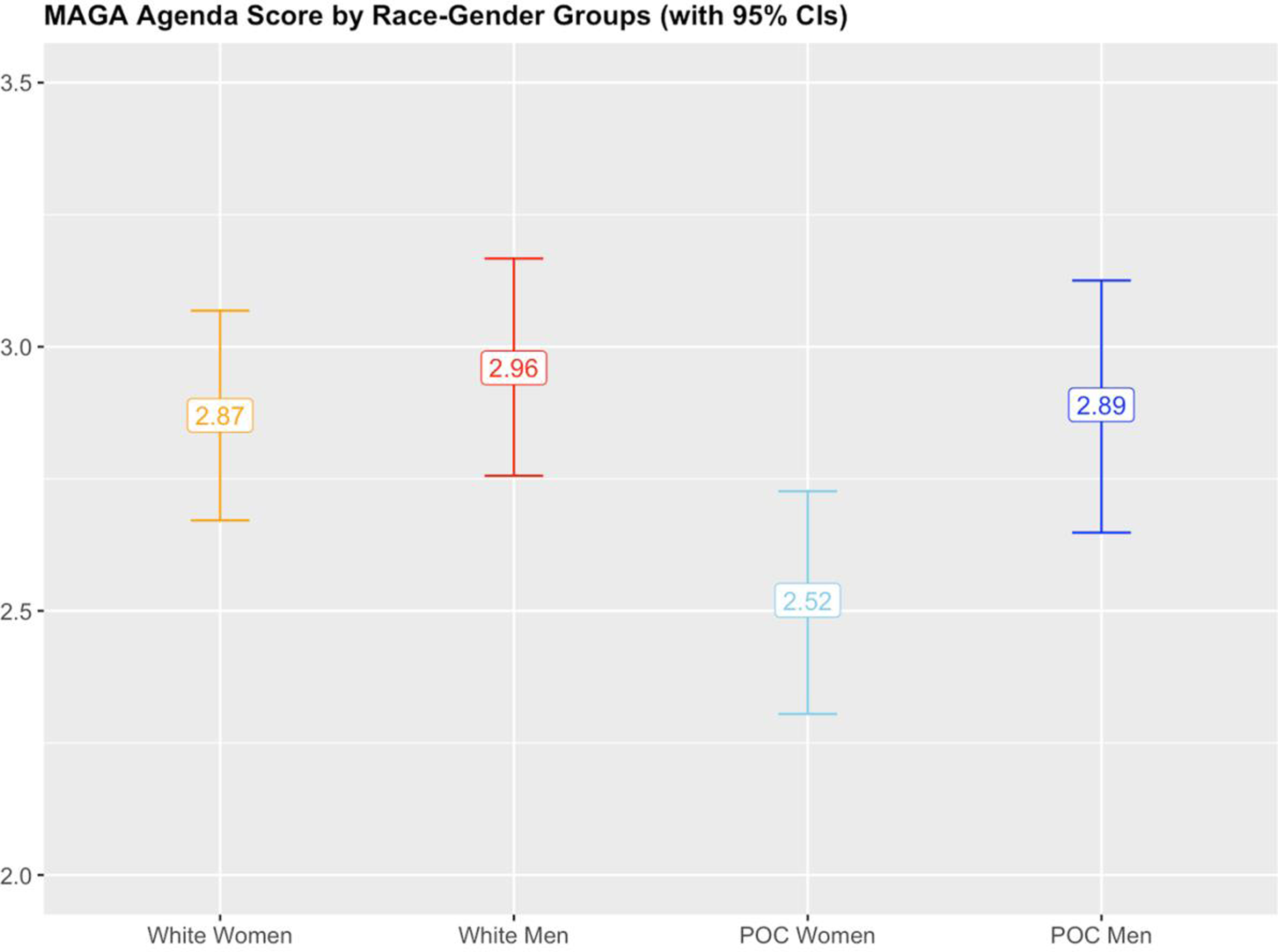
To begin, we present the MAGA agenda score for race-gender groups in Figure 2. The MAGA agenda score is calculated as the mean score of 7 MAGA agenda items from the 2022 NDHOD, along with the 95% confidence interval. As illustrated in Figure 2, the MAGA agenda score is highest among white men (2.96), then men of color (2.89), and white women (2.87) following closely behind, whereas the score for women of color (2.52) is substantively lower compared to other groups. The mean score of the MAGA agenda items for women of color is significantly lower than the mean score of white men. While there are large confidence intervals for the race-gender groups, the pattern is nevertheless revealing of group-based differences. In other words, our analysis generally aligns with our expectations about a gender gap in MAGA support among voters of color, with less variation between men and women among whites (H1). Additionally, we find heterogeneity among women in MAGA support, showing that white women exhibit stronger support for the MAGA agenda compared to women of color (H2).
MAGA Agenda Score by Race-Gender Groups.
Note. All estimates are adjusted using survey weights.
Source: 2022 NDHOD.
Next, to test our main hypothesis about the unique influence of RWA on MAGA agenda support by race and gender (H3), we first look at the correlation coefficient with the RWA and the MAGA agenda score for the race-gender groups. Consistent with what we have hypothesized, the results support the race-gendered patterns of the relationship between RWA and support for the MAGA agenda. The correlation coefficient between RWA and MAGA agenda scale is highest among white men (0.66), followed closely by white women (0.63). In contrast, women of color report the weakest relationship (0.39), while men of color fall in between (0.41). We provide a more detailed analysis of the correlation coefficients between RWA and individual MAGA items in Appendix D, and similar patterns are observed consistently throughout the analysis.
To further investigate our main hypothesis, we present in Figure 3 the unique influence of RWA on support for the MAGA agenda while accounting for other individual-level constructs, including social dominance orientation (SDO), system justification, and racial resentment, as well as accounting for important factors like educational attainment, income, religiosity, age, region, and partisanship (a table version reporting full regression results is attached in Appendix E.) By analyzing the discrete impact of these constructs that are broadly associated with conservatism, we unpack the nuanced factors underwriting support for the MAGA agenda. According to our findings, while partisanship and racial resentment consistently drive MAGA agenda support across race-gender groups, RWA plays a distinctive role in differentiating the attitudes of white Americans from those of Americans of color, particularly women of color.
Predictors of Support for the MAGA Agenda.
Note. Basic demographic and socioeconomic factors, such as age, education, income, region (South), and religion (Born-again Christian), are controlled in the models. As Black respondents did not receive racial resentment questionnaires, we conducted predictions for both models with and without Black samples for analysis among people of color.
Source: 2022 NDHOD.
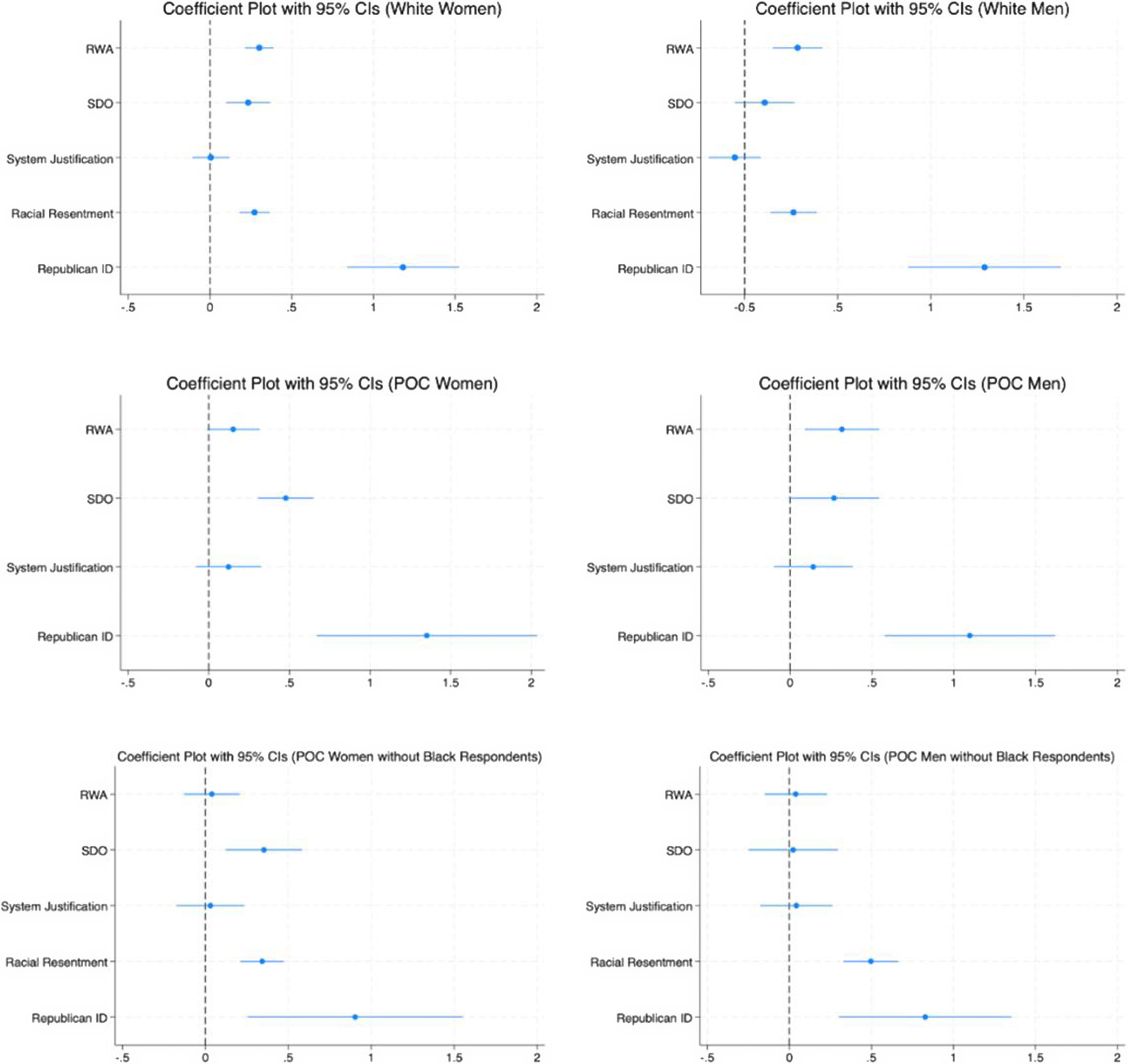
To be specific, RWA significantly affects MAGA agenda support among both white women and men even after considering various constructs in the models. Additionally, the heterogeneity among women is captured, with RWA falling short of statistical significance among women of color, unlike white women. However, the effect of RWA is significant among men of color in the model that excludes the racial resentment variable. Because Black respondents were not asked the racial resentment questions in the 2022 NDHOD, we estimated a separate model excluding this variable in order to analyze the full sample of men of color. In sum, our findings overall align with our expectation that RWA is positively associated with support for the MAGA agenda for white women and white men, and to a lesser degree among men of color (H3).
On the other hand, the effects of racial resentment on the MAGA scale are activated among both white and non-Black racial minority samples, which shows how racial dynamics underpin support for the MAGA agenda. In terms of SDO, we find a statistically significant relationship between SDO and MAGA among both white women and women of color, suggesting that a generalized preference for dominance and inequality may be linked to support for the MAGA agenda among women voters, regardless of race. As we report more fully in Appendix F, however, the interactive effects of SDO (modeled as race-gender groups * SDO) on the MAGA scale are not statistically significant. Lastly, attitudes about system justification are not statistically significant among all groups, indicating that the authoritarian dynamic driving support for the MAGA agenda contrasts with the status quo conservatism that would otherwise prioritize the stability and preservation of the U.S. political system.
Upon closer investigation of group differences in the effects of RWA, we also present interaction plots in Figure 4 showing how the relationship between RWA and MAGA agenda support depends on the intersection of the respondents’ race and gender (a table version of these results can be found in Appendix G). Other factors included in the models are set as their means. What is noteworthy is that women of color consistently show a stronger negative interaction with RWA compared to both white women and white men. This indicates that the influence of RWA on support for the MAGA agenda is significantly weaker among women of color compared to both white women and white men. In contrast, the interaction term for the gender gap within white samples is insignificant, suggesting that RWA influences MAGA support similarly for white women and white men. In other words, the results suggest again that support for the MAGA agenda is influenced by one’s position in the context of white patriarchy. White women, despite their disadvantaged position relative to white men, identify just as strongly with a white-centric vision of American identity, exhibiting similar patterns as white men in the RWA-MAGA relationship in a manner that meaningfully differentiates them from women of color.
RWA * Race-gender Groups on Support for the MAGA Agenda.
Note. Adjusted predictions with 95% CI.
Source: 2022 NDHOD.
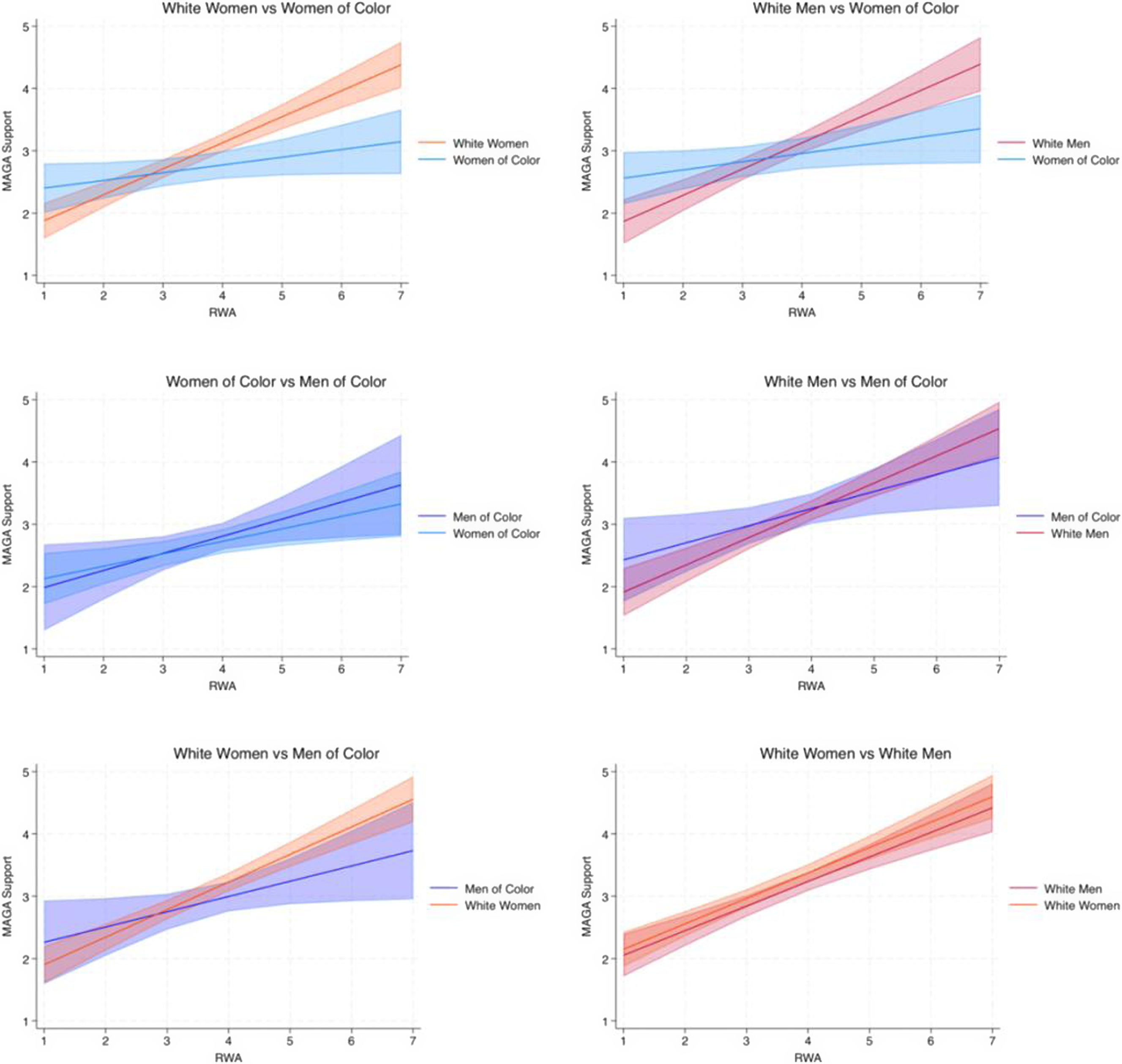
Finally, for men of color, there are no significant interaction effects across all comparisons. Unlike women of color, who are significantly different from whites, men of color do not show significant differences when compared to either women of color or white men and women. In particular, the relatively large confidence intervals for men of color indicate within-group variability in how RWA influences support for the MAGA agenda in this group. Future research should endeavor to disaggregate within this group of men of color. It is possible that these large confidence intervals are related to different levels of RWA among Black, Latino, and Asian American men, who are all combined in this analysis. Taken together, our findings suggest that men of color may benefit from advantages under patriarchy compared to women of color. These advantages create cross-pressures that strengthen the RWA-MAGA connection, shifting men of color into closer alignment with white men and white women relative to women of color.
Discussion
To understand the role of right-wing authoritarianism in support for the MAGA agenda among white Americans specifically, one must consider the broader context of the Trump presidency and the racial dynamics surrounding it. The ascent of Donald Trump onto the political stage was in part paved by his own promulgation of the birther conspiracy theory that alleged Barack Obama is not a U.S.-born citizen and was thus ineligible for the presidency (Nacos and Bloch-Elkon Reference Nacos and Bloch-Elkon2024). This rhetorical maneuver of then-reality TV star Donald Trump represents an early precursor to the racialized patterns of right-wing authoritarianism that appear to underwrite whites’ support for the MAGA agenda. The birther conspiracy theory plays implicitly on an intolerance for difference that is at the heart of authoritarianism and that drives preferences for “strong leaders” who will enforce conformity. Obama was made out to be a symbol of normative threat to white-centric America, not only as an embodiment of group difference but also as an authority who is unworthy of respect (Tesler Reference Tesler2016). Stenner (Reference Stenner2005) emphasizes this latter dimension of normative threat, and we can see how it plays into both birtherism and election theft conspiracy theories. In either case, whether it be Barack Obama or Joe Biden, the president-elect is positioned as an illegitimate actor obstructing the rightful authority of Donald Trump, who is positioned as “one of us,” from the perspective of white Americans with strong RWA predispositions. Indeed, authoritarianism is associated with increased propensities of conspiracy thinking along these lines (Richey Reference Richey2017).
Intolerance of social diversity is not a new phenomenon in American politics. The connection between authoritarianism and white supremacy can be seen throughout American history (Parker and Towler Reference Parker and Towler2019). And yet, the culmination of developments leading to January 6th and resulting in Trump’s second electoral victory in 2024 reflects a distinct resurgence of the authoritarian dynamic among white Americans. As Wetts and Willer (Reference Wetts and Willer2018) demonstrate, American politics throughout the 21st century have been animated by a felt sense of “status threat” among right-leaning, white Americans, whose position of racial dominance is perceived as tenuous amid demographic trajectories of a majority-minority population in the coming decades. This perception of status threat is associated with increased support for exclusionary policies (Wetts and Willer Reference Wetts and Willer2018).
Despite this ongoing pattern in contemporary politics, the kind of “reactionary conservatism” that may spring from perceptions of status threat among white Americans does not always go hand-in-hand with authoritarian tendencies (Parker and Barreto Reference Parker and Barreto2013). For instance, extant scholarship demonstrates the reactionary nature of the Tea Party, whose rise in national popularity was driven by the perceived status threat posed by Obama’s presidency and the resultant desire among whites to “regain social prestige by returning to the past” (Parker and Barreto Reference Parker, Barreto, Lieberman, Mettler and Roberts2021, 200; Parker and Barreto Reference Parker and Barreto2013). While this status threat was operative among Tea Party supporters, it nonetheless propelled the movement in tandem with a more conventionally “libertarian” agenda, as expressed in terms of preferences for limited government (Parker and Barreto Reference Parker and Barreto2013). Authoritarianism was not predictive of Tea Party support, illustrating the contingent influence of authoritarianism, even in instances of reactionary conservatism.
The racialized nature of authoritarianism in the United States, as demonstrated in our analysis, nonetheless aligns with a wide range of insights from extant scholarship. The racial dimension of normative threat perceived among MAGA supporters comports with the idea that whites are a “besieged minority” (Hochschild Reference Hochschild2016) who have been forgotten about (Davis and Wilson Reference Davis and Wilson2022; Haney Lopez Reference Haney López2014; Metzl Reference Metzl2019). This overarching idea of whites as under threat is further reflected in findings that support for the January 6th insurrection is positively correlated with perceptions of whites as being “left behind,” beliefs in white replacement theory, negative opinions about the 2020 George Floyd protests, and negative attitudes toward immigrants (Barreto et al. Reference Barreto, Alegre, Isaiah Bailey, Davis, Ferrer, Nguy, Palmisano and Robertson2023). Characterized as “racial-status impotence” by Barreto and colleagues (Reference Barreto, Alegre, Isaiah Bailey, Davis, Ferrer, Nguy, Palmisano and Robertson2023), these patterns of public opinion reflect a racialized authoritarian dynamic that became increasingly active amid the tumultuous political landscape in 2020 and 2021 that highlighted issues related to race and promoted greater attention and support for people of color. In turn, many white people took this shift in attention as a threat to the normative order under racial hierarchy (see Jardina Reference Jardina2019; Major et al., Reference Major, Blodorn and Major Blascovich2018; Mutz Reference Mutz2018; Schildkraut Reference Schildkraut2010). Ultimately, the connection between whiteness and support for the MAGA agenda can be understood as a racialized authoritarian dynamic in action that prevails among white men and women alike who cling to an idealized version of the country prioritizing traditional white conservatism.
While our findings on gender from the analysis of the 2022 NDHOD data are clear and consistent, there is far less guidance in the existing literature about how systems of gender and patriarchy play a role in support for the MAGA agenda. One example of scholarship to this end includes that of Moskalenko et. al. (Reference Moskalenko, Pavlović and Burton2023), whose research analyzes beliefs in the QAnon conspiracy theory and finds that women’s average endorsement of the QAnon theory is higher than that of men. In general, conventional wisdom in the gender and politics scholarship emphasizes that women voters, in contrast to men, are typically more progressive in their political stances. In the field of political science, the gender gap among the U.S. electorate has been widely reported since the 1980s (e.g., Norrander Reference Norrander1999; Box-Steffensmeier, De Boef, and Lin Reference Box-Steffensmeier, De Boef and Lin2004; Ondercin Reference Ondercin2017). However, our race-gendered analysis from the 2022 NDHOD demonstrates that white women do not meet this expectation. White women are consistently more likely than women of color to be supportive of the MAGA agenda and indeed exhibit patterns most similar to white men.
This pattern reflects the racialized dimension of perceived normative threat that activates authoritarian predispositions and tilts the scales among white women in favor of white patriarchy via the MAGA agenda. Even though women occupy subordinate positions to men within the patriarchal system, white women experience more privileges than women of color via their racial position (Masuoka and Junn Reference Masuoka and Junn2013; Lien and Filler Reference Lien and Filler2022; Junn and Masuoka Reference Junn and Masuoka2024). This reality creates an identity-based cross-pressure that renders white women and women of color differentially receptive to the racialized normative threats promulgated in the MAGA agenda. The messaging of MAGA that raises alarm regarding alleged threats to American greatness resonates among white women by virtue of their racial identity while gaining comparatively little traction among women of color due to their positionality as “second” in both sex and race (Junn Reference Junn2017). Our analysis lends support to this interpretation of Trump-era politics, as we find that RWA has no effect in predicting MAGA support among women of color in our multivariate analysis.
While RWA distinguishes MAGA support among women on the basis of race, we find that social dominance orientation is a consistent predictor of MAGA support among women voters regardless of race, as demonstrated in both correlation and interaction analyses. This finding underscores the importance of future research that can unpack the theoretical distinctions between RWA and SDO in the context of Trump-era politics. Extant scholarship on the different social worldviews underlying RWA and SDO offers one potential direction for further investigation. Insofar as a “dangerous worldview” underlies RWA and a “competitive jungle worldview” underlies SDO, the patterns we observe when comparing white women and women of color may stem from how each group filters social life through these different worldviews (Duckitt and Sibley Reference Duckitt and Sibley2010).
With respect to the RWA-MAGA relationship, the cross-pressures that distinguish women voters on the basis of race also differentiate voters of color on the basis of gender. Whereas women of color appear to be relatively free of the authoritarian dynamic in our analysis, men of color show signs of authoritarian-based support for the MAGA agenda. Despite their political alienation vis-a-vis the racist dimension of the MAGA agenda, men of color are nonetheless comparatively more responsive than women of color to MAGA misogyny. Men of color enjoy advantages under patriarchy that exert a cross-pressure on their political attitudes in favor of MAGA, particularly when its messaging espouses normative threats to the man-dominant social order. Trump presents to the public as an implicit figurehead of patriarchy, and that carries appeal for men of color with latent authoritarian predispositions. The relationship between RWA and MAGA support among men of color is less consistent than it is for white men and women; however, the partial support for this relationship demonstrated in our analysis distinguishes men of color from women of color, thus illustrating our broader argument regarding the role of race-gender cross-pressures in authoritarian-based MAGA support.
Future research is needed to clarify the inconsistencies among men of color observed in our analysis. When controlling for racial resentment, we find that RWA falls short of statistical significance in predicting MAGA support among men of color. Importantly, this loss in statistical significance occurs when excluding Black men from the sample, as the survey did not collect their responses to the racial resentment questions. The loss of statistical significance could stem from several factors, including (1) limitations of sample size, (2) how RWA and racial resentment are theoretically related, and (3) within-group variability among men of color. The present study lacks sufficient data to resolve which of these factors are at play. Nevertheless, the findings support our overall argument regarding the role of race-gender positionality. While racial differences among men in the RWA-MAGA relationship are not fully consistent, racial differences among women in the RWA-MAGA relationship are robust. This pattern aligns with our overarching theory regarding the racialized authoritarian dynamic in the context of white patriarchy.
Conclusion
Considered in broad terms, our results from the analysis of the 2022 NDHOD data further upend the conventional wisdom about women voters, who are typically considered primarily Democratic. In terms of support for the MAGA agenda, white women are not much different from white men in their authoritarian tendencies, in contrast to women of color, who exhibit the lowest levels of RWA that bear no robust relation to MAGA support when statistically analyzed. For white women voters, their attraction to right-wing authoritarian positions significantly predicts their support for the MAGA agenda even when a range of demographic/socioeconomic conditions and party identification are accounted for in the model estimations. In addition, the specification of the models to include an interaction term also supports the conclusion that RWA is significantly more pronounced among white women compared to women of color.
The comparison between white women and women of color thus underscores the paramount importance of intersectional dynamics in understanding the authoritarian underpinnings of support for the MAGA agenda. It is both gender and race together that influence our politics. Underlying the support for Trump and the MAGA agenda is the role of right-wing authoritarian ideology, and our results highlight the significance of this belief system among voters characterized by race and gender who have something to gain from white patriarchy. Women of color are the only outliers for RWA, distinguishing them from their men of color counterparts, who exhibit higher levels of RWA than women of color as well as higher levels of MAGA support that in some instances exceed the levels of white men and women. Future analyses of this important group of voters and their behavior and attitudes in the 2024 U.S. presidential election will further illuminate the dynamics of men of color voters who labor under white supremacy, but who also seem more open to the MAGA agenda and its traditional masculinist and anti-feminist orientation.
Taken together, the analysis presented above provides strong support for the presence of a race-gendered authoritarian dynamic among some American voters. Activated and shaped by rhetoric in support of the MAGA agenda, and nourished by right-wing authoritarian tendencies, a majority of American voters embraced Trump and his political brand. How to understand and analyze these dynamics going forward requires political scientists to leave conventional wisdom behind and utilize more appropriate methodological strategies of analysis. In particular, and as modeled by this analysis, analyzing gender and race separately does not and cannot capture the complexity of our current democratic politics. Instead, utilizing a race-gender intersectional method of analysis allows the identification of differences not just by race or gender alone, but both together simultaneously.
Gender and race are intricately intertwined in American politics and society and signify intersectional positionality in patriarchy and white supremacy. These broader structures do not work separately in “either/or” circumstances, but instead together to create a context of dual marginalization for women of color and at the same time one that privileges white women voters in comparison, and to a certain degree men of color as well. That these patterns can be revealed when utilizing this method of analysis provides a strong argument for abandoning the standard analytical technique of simply “controlling for” gender and adding a dummy variable in an analysis for race. Given the patterns in the descriptive data as well as the inferential results, a more fruitful strategy is one that embraces both gender and race together, particularly when addressing questions about support for Trump and the MAGA agenda. Doing so revealed the contours and early indicators of the 2024 outcome among white women voters and some men of color, highlighting the presence of a race-gendered authoritarian dynamic in the United States.
Supplementary material
For supplementary material accompanying this paper visit https://doi.org/10.1017/rep.2025.21
Acknowledgements
The authors are grateful for suggestions from participants at the 2024 UCLA CMPS January 6th Conference and thank the organizers, Lorrie Frasure, Matt Barreto, and Matthew Hall. Thank you to the two reviewers and to the editors, Benjamin Gonzalez O’Brien and Christopher Towler. We acknowledge the Rooney Center for the Study of American Democracy at the University of Notre Dame for access to the data.
Funding statement
This research did not receive any specific financial support.
Competing interests
The authors declare none.


 Open access

