





Introduction
The project “Medieval Urban Health: From private to public responsibility AD ca. 1000–1600 (MEDHEAL600)” aimed to generate new empirical knowledge and methods essential to understand how and why health and sickness developed from an individual concern to a public responsibility. The overall research design was to compare archaeological, palaeobotanical, and osteo-archaeological sources with ancient DNA (aDNA) and stable isotope analyses (δ13C, δ15N) in order to illuminate how health developed in a pre-industrial urban environment and ecological system in a long-term perspective with Trondheim, Norway as case study. Many radiocarbon and stable isotope measurements have been carried out for the project. The data will be published in an upcoming book. The purpose of this article is to analyse this data and calculate re servoir ages for the various sites in Trondheim. This is important to accurately date the burial phases in the involved cemeteries, and the development of the city of Trondheim more generally.
The graves generally did not contain grave goods, which might otherwise have allowed for typological dating. Therefore, radiocarbon dating was the only possibility to date the burials and develop absolute site chronologies in most cases. Wood from coffins was not present, e.g. due to decay, and even if preserved, would have had a great risk of the old wood effect due to e.g. re-use of planks from other contexts (Schiffer Reference Schiffer1986). Relative chronologies were difficult to obtain from the cemeteries, which had been in use throughout several centuries, although some stratigraphic relations were noted In many cases, the skeletons could be assigned to archaeological layers or main site phases. This is used for calculating age models in this article.
While radiocarbon dating is useful for directly dating the skeletons, there is a risk of the marine reservoir effect significantly affecting the dates. The marine reservoir effect is caused by the fact that the ocean’s deep water is isolated from exchange with atmospheric CO2. 14C in the deep-water decays before it is again mixed with surface water, resulting in samples from the mixed layer of the ocean being 400-550 radiocarbon years “older” than contemporaneous samples (Craig Reference Craig1957; Heaton et al. Reference Heaton, Köhler, Butzin, Bard, Reimer, Austin, Bronk Ramsey, Grootes, Hughen and Kromer2020; Olsson Reference Olsson, Berger and Suess1976; Stuiver et al. Reference Stuiver, Pearson and Braziunas1986). Local effects can decrease or increase this reservoir age (e.g. Ascough et al. Reference Ascough, Cook and Dugmore2005; Heier-Nielsen et al. Reference Heier-Nielsen, Heinemeier, Nielsen and Rud1995; Mangerud and Gulliksen Reference Mangerud and Gulliksen1975). Reservoir ages of different parts of the oceans are collected in the Marine Reservoir Correction Database (Reimer and Reimer Reference Reimer and Reimer2001). However, these are mainly based on shells, not fish, and there are no values available for the Trondheim region (http://calib.org/marine/ checked on August 18, 2025).
The reservoir effect does not only affect fish living in the ocean, but also terrestrial animals sustaining on fish, including humans (e.g. Arneborg et al. Reference Arneborg, Heinemeier, Lynnerup, Nielsen, Rud and Sveinbjörnsdottir1999; Olsson Reference Olsson, Berger and Suess1976). In addition to lower 14C concentrations, the oceans’ 13C concentration also differs from that of the terrestrial environment (Craig Reference Craig1957).
Due to the Christian fasting rules in the early Medieval period, meat of terrestrial animals was forbidden on many days. These could have been replaced by fish, eggs or dairy products. There is evidence for fish trade in Trondheim (Blom Reference Blom1997). Furthermore, a trading town such as Medieval Trondheim would have housed people with various geographical backgrounds and culinary habits (Gopalakrishnan et al. Reference Gopalakrishnan, Ebenesersdóttir, Lundstrøm, Turner-Walker, Moore, Luisi, Margaryan, Martin, Ellegaard and Óþ2022). In addition to that, also the food itself could have been traded over large distances, as bulk transport of goods such as preserved fish became important in the Medieval period (Barrett and Orton Reference Barrett and Orton2016).
The dates of human bones must therefore be corrected for a fraction of the marine reservoir effect corresponding to the percentage of marine food in their diet, which can be measured by analyzing the stable carbon isotope values (δ13C) of the individuals, and comparing it to the δ13C values of 100 % marine and 100 % terrestrial resources (e.g. Arneborg et al. Reference Arneborg, Heinemeier, Lynnerup, Nielsen, Rud and Sveinbjörnsdottir1999; Chisholm et al. Reference Chisholm, Nelson and Schwarcz1982; Schoeninger and DeNiro Reference Schoeninger and DeNiro1984; Lanting and Van der Plicht, Reference Lanting and Van der Plicht1995/1996).
The sources of marine food in Trondheim in the Middle Ages were relatively numerous: the fjord was rich in saltwater fish, there was salmon in the river (consumed especially by the local elite; Hufthammer Reference Hufthammer, Barrett and Orton2016, 222), and in the small lakes around the town there were, among other species, trout and pike. In lakes and rivers, there is a risk of a freshwater reservoir effect (Broecker and Walton Reference Broecker and Walton1959). From the archaeological investigations on the Folkebibliotekstomta/Library Site (1973–1985), several saltwater fish have been found together with bones from various whale species, porpoises and seals (Lie Reference Lie1989). Among the saltwater fish, cod and other cod fish dominate, which could have been traded from as far afield as Iceland (Vésteinsson Reference Vésteinsson, Barrett and Orton2016) or Lofoten, Northern Norway (Nedkvitne Reference Nedkvitne, Barrett and Orton2016). Herring must also have been an important part of the diet from the time the fasting rules were widely implemented (Jahnke Reference Jahnke2000). Herring was probably not preserved in Norway, as large amounts of high-quality salt are required for this purpose. These resources can therefore have different ΔR values than the local waters of the Trondheim fjord.
In conclusion, the individuals analyzed in the MedHeal project can have varying contributions of marine food to their diet, the source and thus ΔR, δ13C and δ15N of the fish is unknown, there are no 100 % terrestrial samples clearly associated with the skeletons, and there is little stratigraphic information to develop relative chronologies. The objective of this study is to assess whether it is still possible to arrive at reservoir corrections that are consistent with the archaeological information. Can %marine be correctly predicted by δ13C values, and can this be used for accurate calibration of radiocarbon dates, even though the provenance (and isotopic baseline) of the marine resources is unknown?
Materials
At the ruin of Sverresborg, an Early Medieval fortress in Trondheim, a skeleton was found in a well. This is probably associated with the destruction of the fortress in AD 1197, according to Sverre’s sagaFootnote 1 and thus a well-dated test case.
The Søndre Gate 4 site in central Trondheim was excavated in 1971–1975. Here, the remains of a stone church from the 12th century were uncovered. Numerous burials were found surrounding the church, as well as a few skeletons within the building (Ramstad Reference Ramstad2002). The church ruin was excavated separately in six trenches (called AV, AM, AØ, AT, AS and S) and the stratigraphies of the individual trenches were not related to each other. Therefore, it was difficult to determine a relative chronology of all burials that would be valid for the entire site. It was, however, possible to discern building phases such as remodelling or extensions of the church, as well as churchyard phases (Ramstad Reference Ramstad2002).
The Krambugata 2 site in central Trondheim was excavated in 2016/2017. This site is also known as Søndre Gate 7–11; however, that name will be avoided in this paper to prevent confusion with the site Søndre Gate 4. Several phases of overlying wooden churches were found. Numerous skeletons were recovered from the churchyards around the churches. However, it was difficult to match the churchyard/burial phases to the phases of the churches (Sæhle et al. Reference Sæhle, Petersén, Wood, Brink and Valstrand2021).
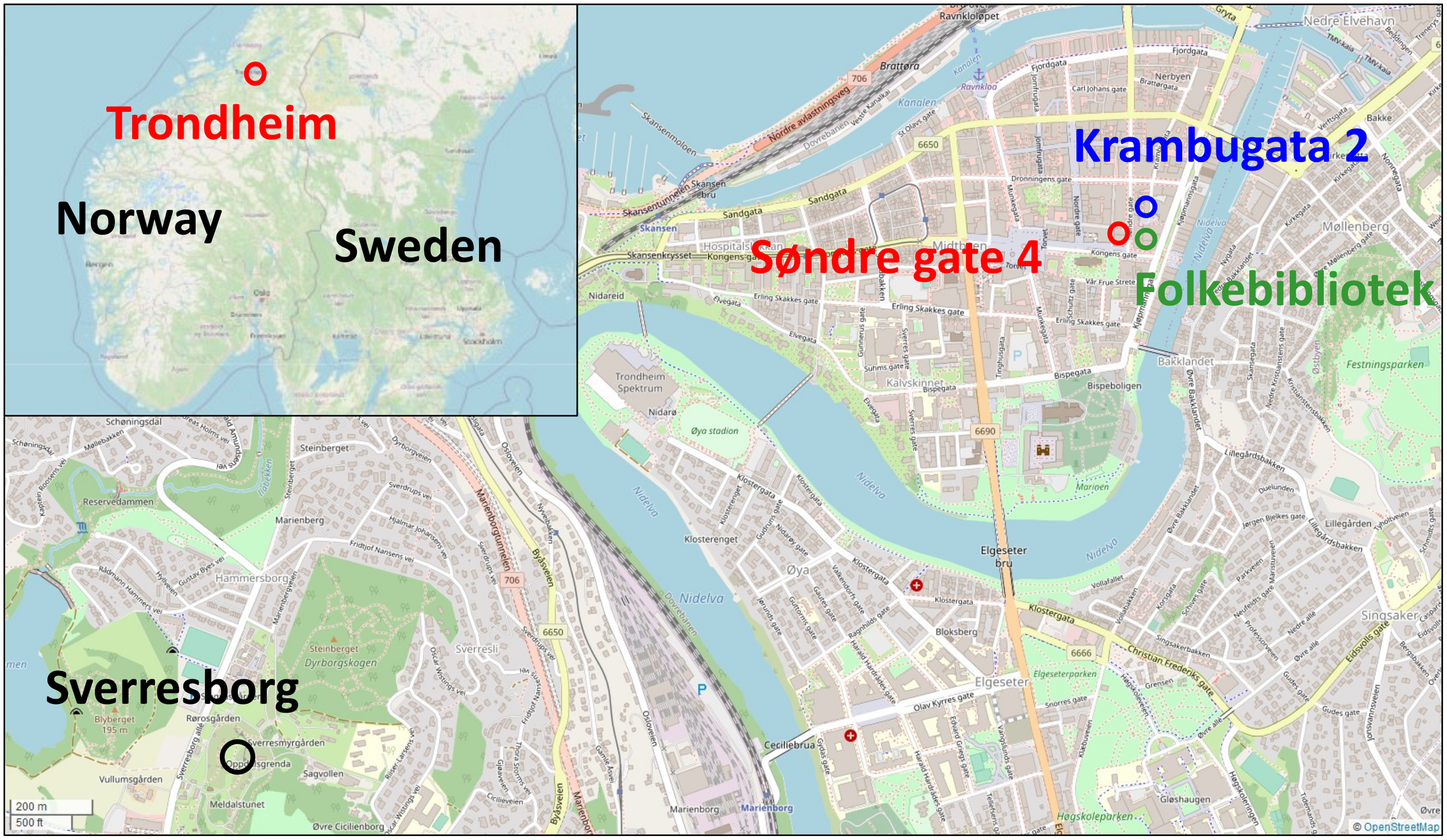
In 1984–1985, parts of a cemetery under the Public Library in Trondheim were excavated. The cultural layers were a mixture of organic material, sand and gravel, which made the preservation conditions changeable and the stratigraphy difficult to interpret, consequently the possibility to establish a secure relative chronology between the graves was difficult in some cases (Anderson and Göthberg Reference Anderson and Göthberg1986; Forsåker and Göthberg Reference Forsåker and Göthberg1986). The location of the sites within Trondheim is shown in Figure 1.
Map of Trondheim with sampling locations marked.

Several factors needed to be balanced out when selecting individuals for inclusion in the MEDHEAL600 study. The primary goal was to select individuals which were able to provide data across as many of the intended analyses as possible (traditional osteological analyses, histological analyses, biomolecular analyses). In addition to this, as the project sought to look at changes in general health over time, individuals from various periods were also required, as far as that was possible to achieve. Finally, it was necessary to decide whether the study-group should represent a broad range of individuals or, for larger burial contexts, more closely adhere to the demographic make-up of the specific burial assemblage. The former was selected for the present study, and the following selection criteria applied:
-
1. Skeletal completeness
-
2. Macroscopic preservation level
-
3. Time period
-
4. Biological sex
-
5. Age-at-death
-
6. Inferred social status
For the first two criteria, individuals with the most complete and best-preserved skeletons (as indicated by excavation/post-excavation documentation) were selected. For the remaining criteria, it was attempted to select, for the various activity phases, a range of ages and social statuses and an equal representation of males and females.
Each of the sites had their own challenges when it came to applying these criteria. The Library Site and Søndre Gate 4 have large, well-documented burial assemblages. In addition, the Library Site has a relatively large number of securely phased burials as well as the ability to infer social status from grave placement. This made it relatively uncomplicated to choose appropriate samples, although more so for the Library Site than Søndre Gate 4. Thirty-five individuals were selected from each of these two sites. The excavations at Krambugata 2 were ongoing at the time of sample selection, thus the ability to account for all the variables was limited. The selection of 18 individuals was undertaken by the excavation osteologist rather than the MEDHEAL600 team. Finally, as only one individual was available from Sverresborg, no selection criteria were applied.
It was not necessary to sample all individuals for both radiocarbon dating and stable isotopic analysis in order to develop chronologies for each of these burial assemblages. Individuals were sampled based on the dating needs of each activity phase/layer. Not only did this help limit destruction of the remains, it conserved financial resources for other aspects of the project, although individuals not sampled for radiocarbon dating were still sampled for stable isotopic analysis. Nineteen individuals from Søndre Gate 4 and 20 from the Library site were sampled for radiocarbon dating and stable isotopic analysis, while 14 from Krambugata 2 were selected in addition to the single individual from Sverresborg. In addition, we include previously measured dates from the Søndre Gate 4 excavation (Ramstad Reference Ramstad2002).
Methods
Collagen was extracted using a modified Longin procedure (Longin Reference Longin1971; Seiler et al. Reference Seiler, Grootes, Haarsaker, Lélu, Rzadeczka-Juga, Stene, Svarva, Thun, Værnes and Nadeau2019). Samples were combusted, graphitized and dated at the 1 MV accelerator in Trondheim as described in Nadeau et al. (Reference Nadeau, Vaernes, Svarva, Larsen, Gulliksen, Klein and Mous2015); and Seiler et al. (Reference Seiler, Grootes, Haarsaker, Lélu, Rzadeczka-Juga, Stene, Svarva, Thun, Værnes and Nadeau2019). Calibrations were done with OxCal v. 4.4 (Bronk Ramsey Reference Bronk Ramsey2009).
The collagen extracted for radiocarbon dating was also used for measurements of stable isotopes. The measurements were carried out at the isotope ratio mass spectrometry (IRMS) instrument at the National Laboratory for Age Determination in Trondheim. The instrument used is a Delta V coupled to a Flash 2000 elemental analyzer (EA) through a ConFlo IV interface, all manufactured by Thermo Scientific. Approximately 1 mg of collagen was weighed into tin capsules for the analysis. The samples were combusted at 1020°C in a short oxygen flow and the combustions products (N2, CO2) were separated by the gas chromatographic column of the EA so that they are sequentially injected into the ion source of the IRMS instrument for isotopic analysis. Variations of the sample size were addressed with an automated dilution of the sample gas to match the amplitude of the reference gas that is injected into the ion source before the sample, for nitrogen, and after the sample, for CO2. The samples are directly measured against our internal reference gases, N2 and CO2, supplied by Linde. The isotopic ratios of the gases were calibrated against the IAEA-600 standard and in-house gelatine standards are used for quality control of the measurements.
The radiocarbon dates of the collagen extracted from the bones were corrected for the marine reservoir effect based on the isotopic ratios (δ13C, δ15N) from the IRMS measurement. To calculate the percentage of marine content of the samples, we assumed a linear relationship between a terrestrial and a marine source. Isotopic ratios for the terrestrial and marine basis were taken from literature (Barrett et al. Reference Barrett, Beukens and Brothwell2000). These values can vary geographically. Therefore, based on the measurements we performed, we adjusted the interval so that the samples are not outside the defined range. For a purely terrestrial diet, we used a δ13C = –22‰ and δ15N = 10‰, while a fully marine diet would correspond to δ13C = –12‰ and δ15N = 23‰. δ13C and δ15N values can result in different values for the percentage of marine food. This can be due to differences in marine δ13C values between different marine resources, e.g. geographical variations or variations between ecosystems. Terrestrial δ13C values can be influenced by the canopy effect (van der Merwe and Medina Reference van der Merwe and Medina1991). δ15N values can vary due to several factors as well. These include nursing, manuring of crops, and generally the trophic level of the food (Schoeninger et al. Reference Schoeninger, DeNiro and Tauber1983), both from marine and terrestrial ecosystems. We calculated %marine both from δ13C and δ15N and calculated their average. The uncertainty was estimated by calculating the difference between %marineδ13C and %marineδ15N. However, the uncertainty was set to at least 5 % in cases where the difference between %marineδ13C and %marineδ15N was <5 %. In cases where only δ13C values were available, the uncertainty was set to 10%.
For each site, a simple age model was constructed by grouping the dates of the skeletons according to the main archaeological phases and placing those in a sequence (Bronk Ramsey Reference Bronk Ramsey1995). The dates were calibrated with IntCal20 (Reimer et al. Reference Reimer, Austin, Bard, Bayliss, Blackwell, Ramsey, Butzin, Cheng, Edwards and Friedrich2020) and Marine20 (Heaton et al. Reference Heaton, Köhler, Butzin, Bard, Reimer, Austin, Bronk Ramsey, Grootes, Hughen and Kromer2020), using OxCal’s mixed curve command and the %marine calculated from the skeleton’s δ13C and δ15N values (see supplementary material for all OxCal codes). This enabled us to test whether the marine corrections were consistent with the site stratigraphy. When the radiocarbon dates corrected in this way, did not agree with the prior information, we allowed for variable ΔR values per phase.
Results
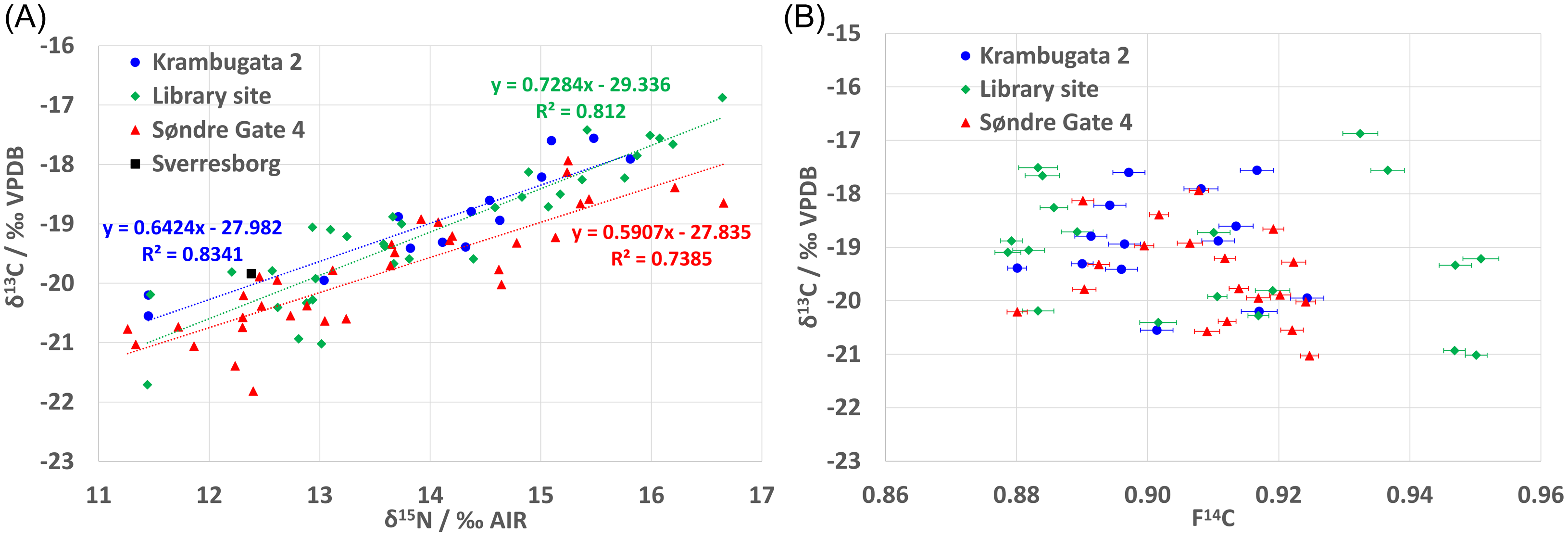
All results are collected in Supplementary Table 1. The stable isotope values of the skeletons analyzed in this study span a range from almost –22‰ to –17‰ in δ13C and 11‰ to 17‰ in δ15N. There is almost no difference between the sites (Figure 2). The individuals buried at Krambugata 2 and the Library site probably belonged to the same parish (Christophersen, forthcoming). The individuals from Søndre Gate 4 belonged to a different parish and show a tendency towards lower δ13C values and/or higher δ15N values than the others.
(A) δ13C and δ15N values of the skeletons from the four sites analysed in this study. Linear correlation coefficients are given for each site (with the exception of the Sverresborg site, where only one skeleton was analyzed). (B) Radiocarbon concentrations and δ13C values of the individuals analyzed in this study. The Sverresborg site is left out from this figure, as it only had one individual.

For each of the three sites with multiple skeletons, there is a linear correlation between the δ13C and δ15N values, with R2 between 0.74 and 0.83. This indicates that there are two main carbon sources, terrestrial and marine protein. The consumption of freshwater fish would result in low δ13C values associated with high δ15N values (Hobson Reference Hobson1990; Lanting and van der Plicht Reference Lanting and Van der Plicht1998). Freshwater fish consumption at a small scale cannot be excluded in this dataset but does not appear to have been significant. The slope A of the equation δ13C = A×δ15N – B is between 0.6 and 0.7 for the three sites. If the linear relationship between δ13C and δ15N was only caused by a trophic level effect, the slope would be expected to be much smaller, as one would expect a ca. 1‰ increase in δ13C for each trophic level with a 3–5‰ increase in δ15N (Bocherens and Drucker Reference Bocherens and Drucker2003), i.e. a slope between 0.33 and 0.2.
There is no apparent trend in the δ13C or δ15N values over time (see supplementary figures). The comparatively broad range of isotopic values can be found throughout the entire history of the three sites. Even within the same individual, there can be isotopic differences between different skeletal elements (see Supplemenary Table 1 for examples). This is not unexpected, as different bones can have different collagen turnover times. Although not possible here, generally for high-precision age modelling the collagen turnover has to be taken into account (Nielsen et al. Reference Nielsen, Philippsen, Kanstrup and Olsen2018).
For calculating the proportion of marine food in the diet, the terrestrial and marine isotopic endpoints of the diet must be known. Due to the lack of faunal data from the sites analyzed in this study, we base our calculations on values from the literature (see above).
The calibration of the Sverresborg date with IntCal20 results in a calibrated age range between 1028 and 1172 cal AD, which is before the saga date of 1197 AD. Calibrating with Marine20 would result in a too recent age between 1440 and 1680 cal AD. However, when applying the marine% calculated from the stable isotope values (20 % marine), the calibrated radiocarbon age is 1055–1076 (2.5%) and 1153–1277 (92.9%) cal AD and agrees with the historical date.
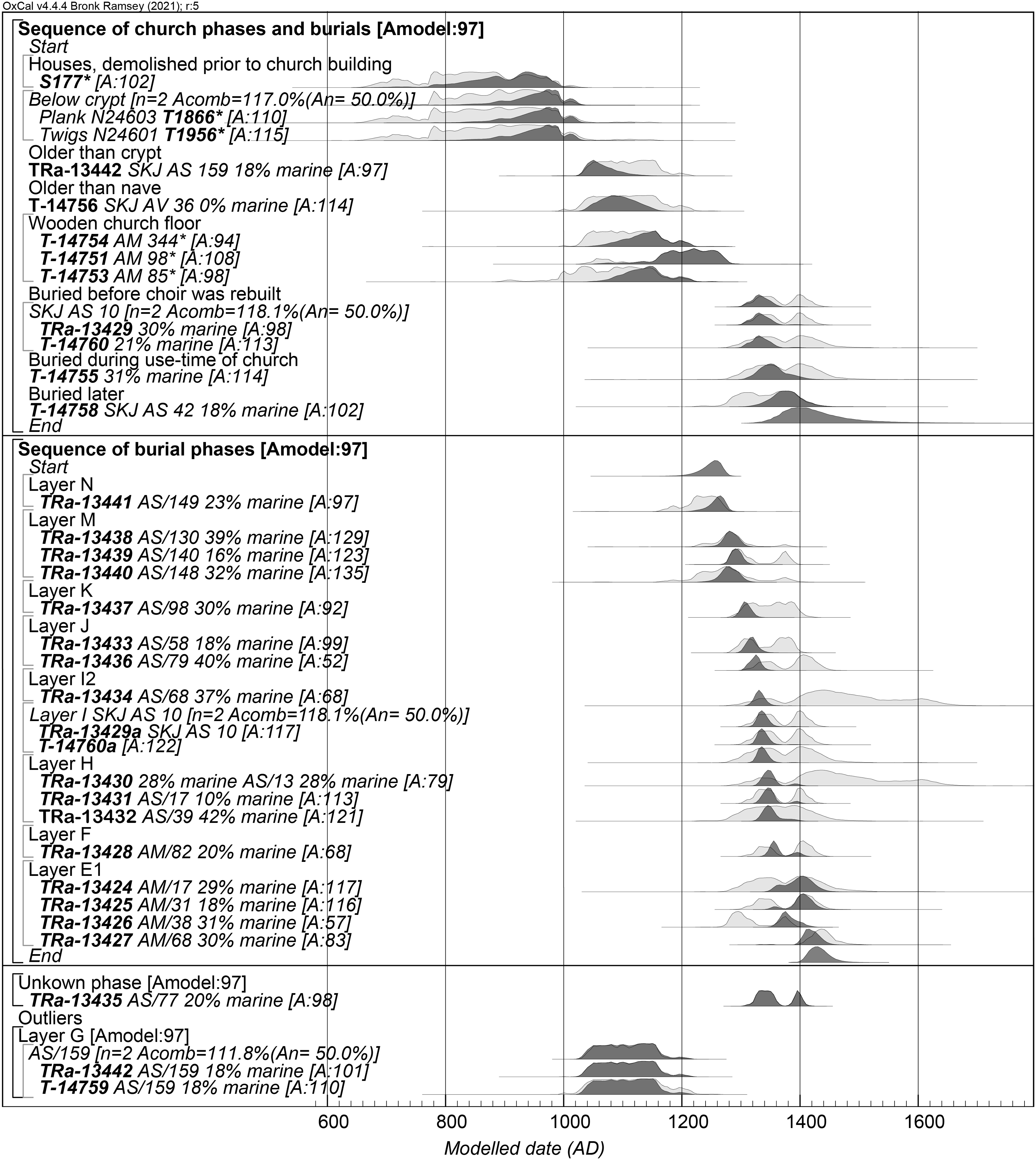
At the Søndre Gate 4 site, skeletons were found associated with several phases of the church, which could be dated by radiocarbon dating construction elements from the wooden predecessor of the stone church (Ramstad Reference Ramstad2002). Other skeletons could be assigned to archaeological layers during the excavation. We thus constructed two sequences for this site; one with the dates of architectural elements and the skeletons associated with those; and another with the skeletons that were found in different layers. Both sequences are shown in Figure 3. In the second sequence, skeleton AS/159 (TRa-13442 and T-14759) dates older than expected from its context. The AMS date (TRa-13442, 1026±14) and the conventional date (T-14759, 1026±36) of this skeleton are identical, the only difference being the larger uncertainty for the conventional date. This “too old” skeleton could be due to an unidentified freshwater reservoir effect. However, with a δ15N value of only 12.3‰, this is unlikely.
Calibrated radiocarbon dates of skeletons and architectural remains from the site Søndre gate 4. The description of sample T-14758, “skeleton buried later” means “Buried after additional building on northern side of the choir was demolished.” “Below crypt” means “Found below the floor of the crypt.” Dates on wood are marked with an asterisk. All other dates were made on human bones, calibrated with mixed curves (IntCal20 and Marine20) according to %marine.

T-14756 does not have a δ15N value; however, its δ13C value of –22.3‰ is a clear indication of terrestrial diet. T-14758 also only has a δ13C value of –20.2‰. This indicates 18% marine diet; however, due to the missing δ15N value for this skeleton, we increased the uncertainty of this percentage to 18±10% marine diet. T-14760 would have, from the δ13C value alone, 21±10% marine diet. Another bone from the same skeleton, TRa-13429, was measured to have 30% marine diet. The %marine of the two samples agree within uncertainties. If bones with different turnaround times had been dated, however, also a change of diet with time would be possible.
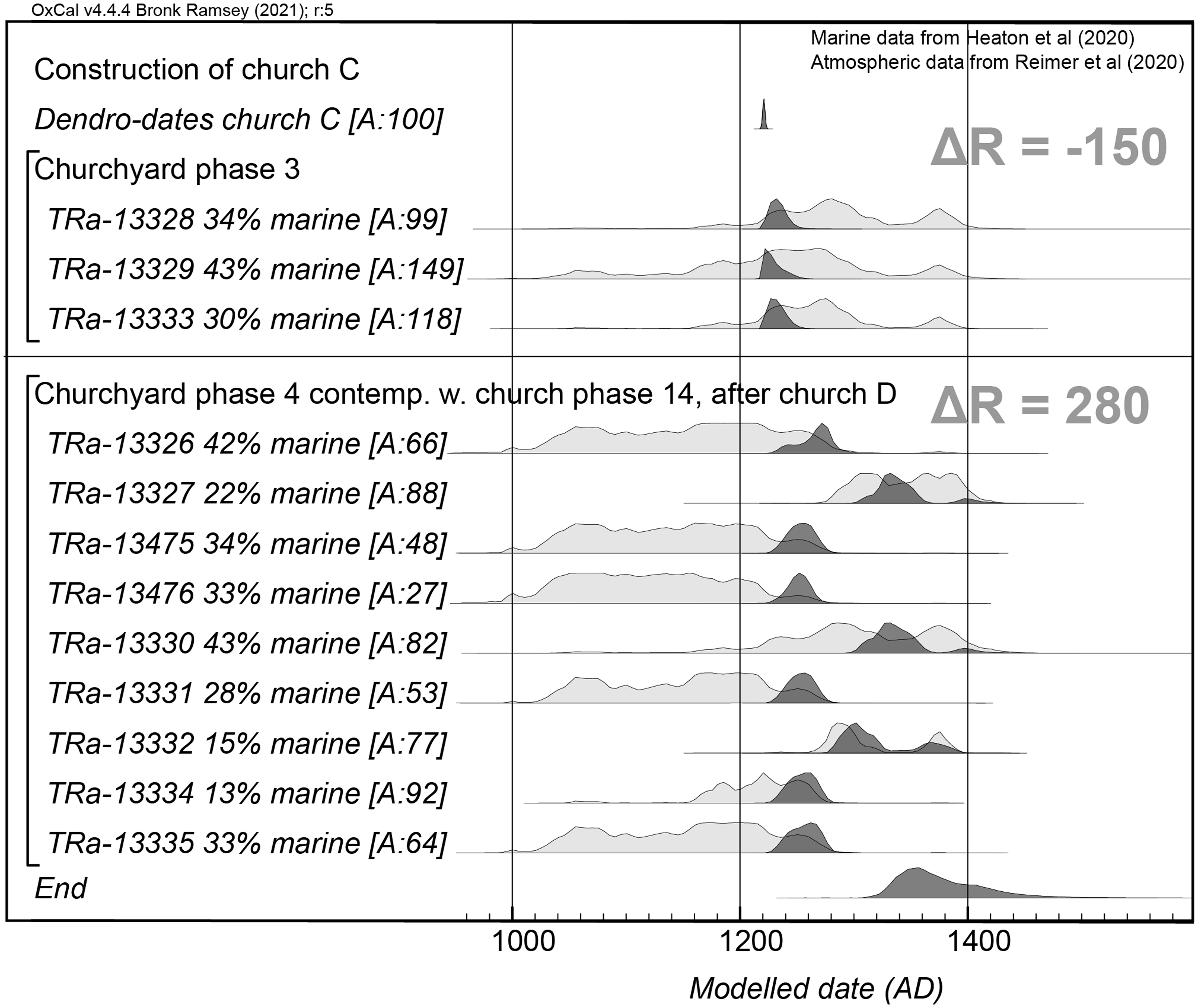
At the Krambugata 2 site, applying the mixed curve calibration results in calibrated ages that are inconsistent with the site stratigraphy. Therefore, we allowed variable ΔR values for this site, with ΔR values specific for each archaeological phase (Macario et al. Reference Macario, Souza, Aguilera, Carvalho, Oliveira, Alves, Chanca, Silva, Douka and Decco2015). The model leads to ΔR = –150 yr for the churchyard phase 3 and ΔR = 280 yr for phase 4 (Figure 4).
Calibrated ages of the two well-defined churchyard phases from the excavation at Krambugata 2. One dendrochronological date of a church phase corresponding to a churchyard phase is given; all other dates were made on human bones, calibrated with mixed curves (IntCal20 and Marine20) according to %marine. We allowed for variable ΔR values in the two phases. The model output is ΔR = –145±47 (median ± 1 st.dev.) for churchyard phase 3 and 280±140 for churchyard phase 4.

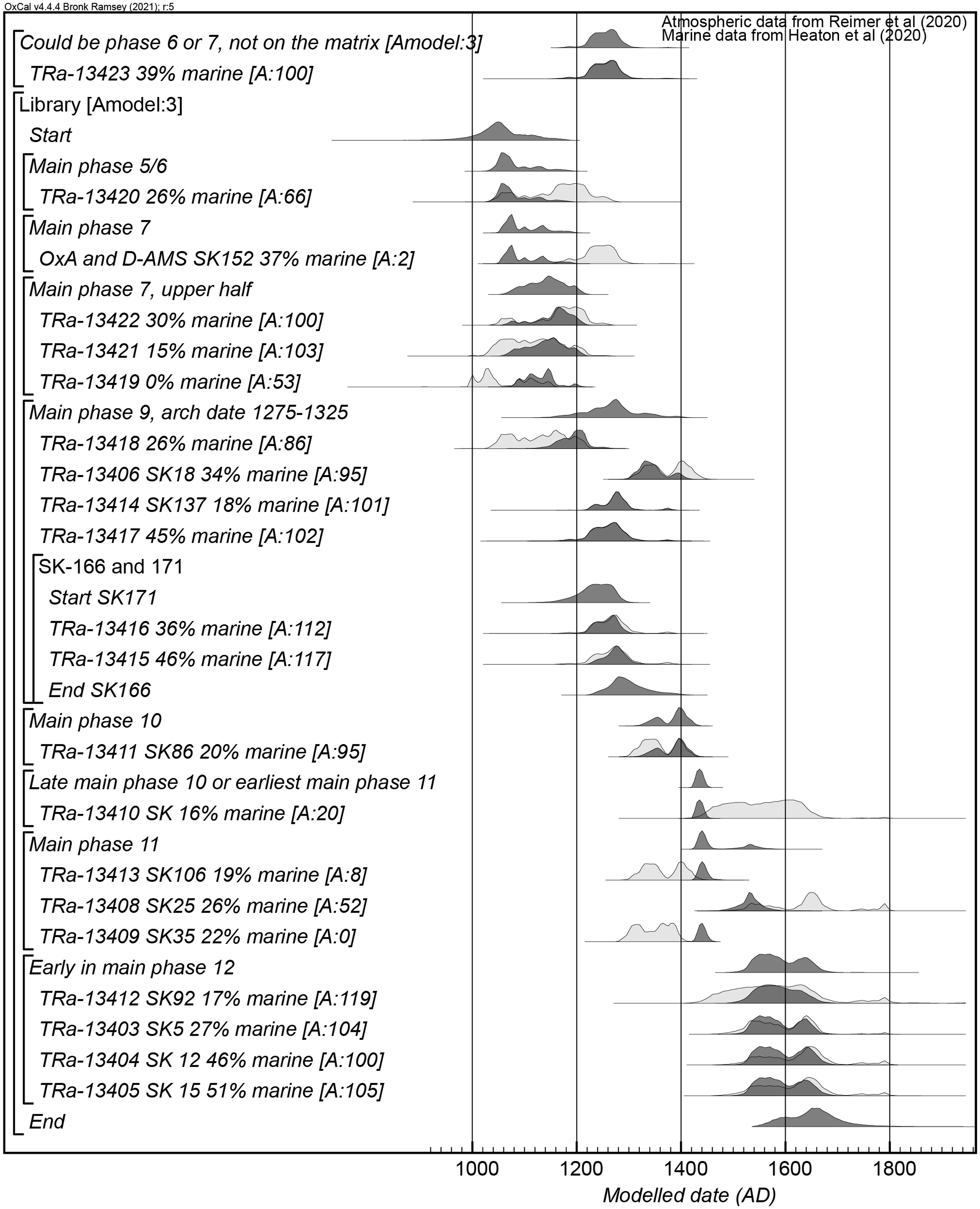
The age model for the Library site yields low agreement. This is only caused by a few radiocarbon dates, one in main phase 7 and two in main phase 11 (Figure 5). Phase 7 has been, however difficult to insert into an overall chronology, because many of the buildings were burnt, and few traces of activity remain from this phase (Christophersen and Nordeide Reference Christophersen and Nordeide1994). Allowing for different ΔR values per phase would not solve this problem, as the three samples from main phase 11 have similar %marine reconstructions. Also, when we allowed for variable ΔR values per phase (e.g., Delta_R(“Main phase 7’,0,1000);), the posterior ΔR values were not different (but e.g. 0±1000), for all tested starting values. Instead, the observed outliers could represent individuals of different origin—or their diet had different origin, with those that were dated “too old” having had a diet with larger ΔR than the others. Furthermore, the cultural layers of phase 11 were very thin, poorly preserved and partly destroyed during the excavation. A coin found in phase 11 is dated to AD 1523-1524, which is thus the minimum age of this phase (Christophersen and Nordeide Reference Christophersen and Nordeide1994, pp. 33–36, their Table 23 and Fig. 24).
Calibrated radiocarbon ages from the Library site. All dates are of human bones, calibrated with mixed curves (IntCal20 and Marine20) according to %marine, and arranged in a sequence model according to archaeological phases of the site.

Discussion
Based on the δ13C and δ15N values, the individuals from the four sites had diets with varying contributions from marine proteins. There is no systematic difference between sites which could indicate difference in social status or adherence to fasting rules. Furthermore, there is no trend in isotope values over time.
The δ15N values are comparatively high. While the Trondheim individuals vary between 11‰ and 17‰, pagan and early Christian bone samples from Iceland had δ15N values between 6.5‰ and 15.5‰ (Sveinbjörnsdottir et al.). This is probably not only due to differences in marine consumption. For example, 14 individuals from an inland farm on Iceland had average δ13C values of –20.5±0.8‰, thus largely terrestrial, and δ15N values of 7.8±0.9‰ (Walser III et al. Reference Walser, Kristjánsdóttir, Gröcke, Gowland, Jakob, Nowell, Ottley and Montgomery2020). In contrast, all Trondheim individuals with the “most terrestrial” δ13C values between –22 and –20‰ have δ15N values of more than 11‰. This could be due to the consumption of higher-trophic level food or due to a higher degree of manuring on the fields around Trondheim (Kanstrup et al. Reference Kanstrup, Holst, Jensen, Thomsen and Christensen2014). δ15N values of 33 individuals from the regions north of Trondheim (Rørvik to Kvaløya) from the immediately preceding periods (the Merovingian Age and Viking Age) range from 11.0 to 18.1‰ (Naumann et al. Reference Naumann, Price and Richards2014). Therefore, these individuals, which are geographically closer but from earlier periods, are a better comparison for our study than contemporaneous individuals from Iceland.
The lack of a trend in δ15N values is in contrast to the historical sources of increasing consumption of meat and fish throughout Europe, which was observed in the late Middle Ages after the population decline following the Black Death (Nedkvitne Reference Nedkvitne, Barrett and Orton2016, 54, and references therein). In Norway, after the Black Death of 1349/1350, the surviving people concentrated on the best farms and thus experienced improved living conditions (Nedkvitne Reference Nedkvitne, Barrett and Orton2016, 54). Many of the deserted farms were located inland and people moved to available farms closer to good fishing grounds (Sørheim Reference Sørheim, Barrett and Orton2016, 69). Fishing settlements continued to prosper during the 14th-century crises (Barrett Reference Barrett, Barrett and Orton2016, 262). If that had resulted in an increase in meat and fish consumption, we would observe increased δ15N values of individuals dated to after AD 1350. The lack of such a trend indicates that local consumption remained as variable as prior to the Black Death, and that both terrestrial and marine resources remained to be accessible.
The high δ15N values of the Trondheim individuals are not unusual on a global scale. For example, δ15N values between 17 and 20‰ were found in North American marine mammal hunters and North American salmon fishers (Schoeninger et al. Reference Schoeninger, DeNiro and Tauber1983). Their mean δ13C values, however, were around –14‰ and thus considerably higher than those of the Trondheim individuals. Therefore, the elevated δ15N values of the individuals in our study are probably caused by a combination of marine resources and other factors increasing the trophic level of the food, such as manuring. Also, marine fodder for terrestrial animals is a possibility. For example, seaweed and fish waste were regular winter fodder for domestic animals in North Norwegian fishing villages up to the 19th century (Nedkvitne Reference Nedkvitne, Barrett and Orton2016, 47, and references therein).
The δ13C values between –22 and –17‰ are generally lower than the values from the aforementioned study by Naumann et al. (Reference Naumann, Price and Richards2014), who found a δ13C range between –20.5 and –14.4‰. This indicates that the diet in Medieval Trondheim included more terrestrial resources than the Merovingian and Viking Age diet from Northern Norway, while being at the same trophic level according to the δ15N values. This is probably due to the general resource availability in the North, where the potential for agriculture is limited.
Because of the aforementioned factors (especially bulk import of food from various regions, both terrestrial and marine), it is difficult to determine one isotopic baseline and reservoir correction that applies to all samples. The dates of the skeletons from Krambugata 2 reflect this fact. There, the beginning of churchyard phase 3 is well-defined, because it is linked archaeologically to church C. This church phase was precisely dated by dendrochronology (Figure 4). The radiocarbon dates of the skeletons are only consistent with their position in the stratigraphy when we allow for variable ΔR values, which change from one archaeological phase to another. Also, the uncertainties of the modelled ΔR values are large. This indicates that the different people buried at Krambugata 2 not only had different proportions of marine diet, but also that their marine food came from different aquatic environments. As mentioned above, these could include dried cod from Northern Norway, salmon from the Norwegian rivers, and pickled herring from the Danish and Swedish coasts, fjords and the Baltic. The shift from one ΔR to another, more variable ΔR value, occurs in the 13th century. As the ΔR value increases, it could be interpreted as a shift from low-ΔR foods such as Baltic herring or locally caught coastal fish, which is consistent with a reservoir age of ΔR = –150 yr, to high-ΔR foods, such as fish from Arctic waters, e.g. cod from the Northern coasts of Norway. However, the calculated value of ΔR = 280 yr is larger than what is reported for the area (Mangerud and Gulliksen Reference Mangerud and Gulliksen1975, http://calib.org/marine/ accessed on August 18, 2025). The reported values are mostly based on molluscs and might not represent fish that would have been traded such as cod. This is supported by the observation that farmers in Northern Norway started fishing for cod on a commercial scale, probably encouraged by a cooler climate and thus worsening conditions for agriculture in the North, in combination with a high demand for fish in Europe due to population growth and fasting rules (Nedkvitne Reference Nedkvitne, Barrett and Orton2016, 42–43). Although the earliest commercial cod fishing station on Lofoten is documented around AD 1100, permanent fishing villages and large-scale commercial cod fishing were established only in the 13th century (Nedkvitne Reference Nedkvitne, Barrett and Orton2016, 48). Another indication of changing trade patterns in the 13th century are the cessation of timber import to Trondheim after ca. AD 1250–1280 (Thun, forthcoming) and the growing influence of the Hanseatic league after a peace treaty between the town of Lübeck and the Norwegian king in AD 1250 and the establishment of a hanseatic kontor in Bergen in AD 1360 (Nedkvitne Reference Nedkvitne, Barrett and Orton2016, 46).
In addition to the mobility of the food, the mobility of the analyzed individuals themselves has to be taken into account. While we do not have mobility data for the skeletons analyzed in this study, strontium, δ13C and δ18O analyses of tooth enamel of other Medieval individuals from Trondheim indicate that some people moved over long distances (Laffoon Reference Laffoon2020). Their isotopic values would reflect the local diet of the region where they lived while their bone collagen was formed, and not necessarily the local diet of Trondheim.
Conclusions
As expected, a marine reservoir correction is highly relevant for radiocarbon dating of Medieval individuals. δ13C and δ15N values show that the consumption of marine resources varied greatly. This was also the case within one archaeological phase or within the population of the same parish. Diet reconstruction on an individual basis is thus an important addition to the reconstruction of the diet of the entire urban population, which can be achieved by e.g. archaeozoology or historical records.
δ15N values are generally very high for the Medieval population of Trondheim, even for individuals with terrestrial δ13C values. This implies that other factors than the proportion of marine diet influence the δ15N values, such as freshwater fish, manured terrestrial plant foods, or terrestrial animal food with a high trophic level (e.g. omnivores such as pigs or chicken).
Not only the proportion of marine food, but also the reservoir age of the marine component of the diet varied considerably. For example, different ΔR values were found in two subsequent phases of one churchyard—from –150 to +280 years (Figure 4). Changes in trading patterns are one cause for ΔR changes, as fish from different regions can have different reservoir ages (e.g. high reservoir ages in Arctic cod, low reservoir ages in Baltic herring). It should not be forgotten that the ΔR reconstructions rely on the archaeological stratigraphy and phasing, which is difficult in a complex urban burial site, which had been in use during long periods.
Ideally, ΔR of the fish and marine mammals would be measured directly. However, this is precluded by the lack of suitable samples, partly caused by the fact that fish and marine mammals were processed outside the city, leading to a lack of datable bones. Instead, it can be helpful to allow variable ΔR values, e.g. per phase, in an age model. This can give valuable information about changes in diet and trade. However, allowing the model to choose ΔR freely for each phase can also lead to wrong values (i.e. assigning false ΔR values to dates that should have been outliers).
Future research should focus on establishing better baseline data for terrestrial and marine fauna (and flora, if possible). Accurate radiocarbon dates can link diet changes to social, environmental and climate changes. Measuring dietary isotopes (δ13C, δ15N on bone collagen) on the same individuals as isotopes for geographical origin (δ18O, Sr on tooth enamel) would further help to establish changes in diet, trade, and migration.
Supplementary material
To view supplementary material for this article, please visit https://doi.org/10.1017/RDC.2025.10166


 Open access

