


Introduction
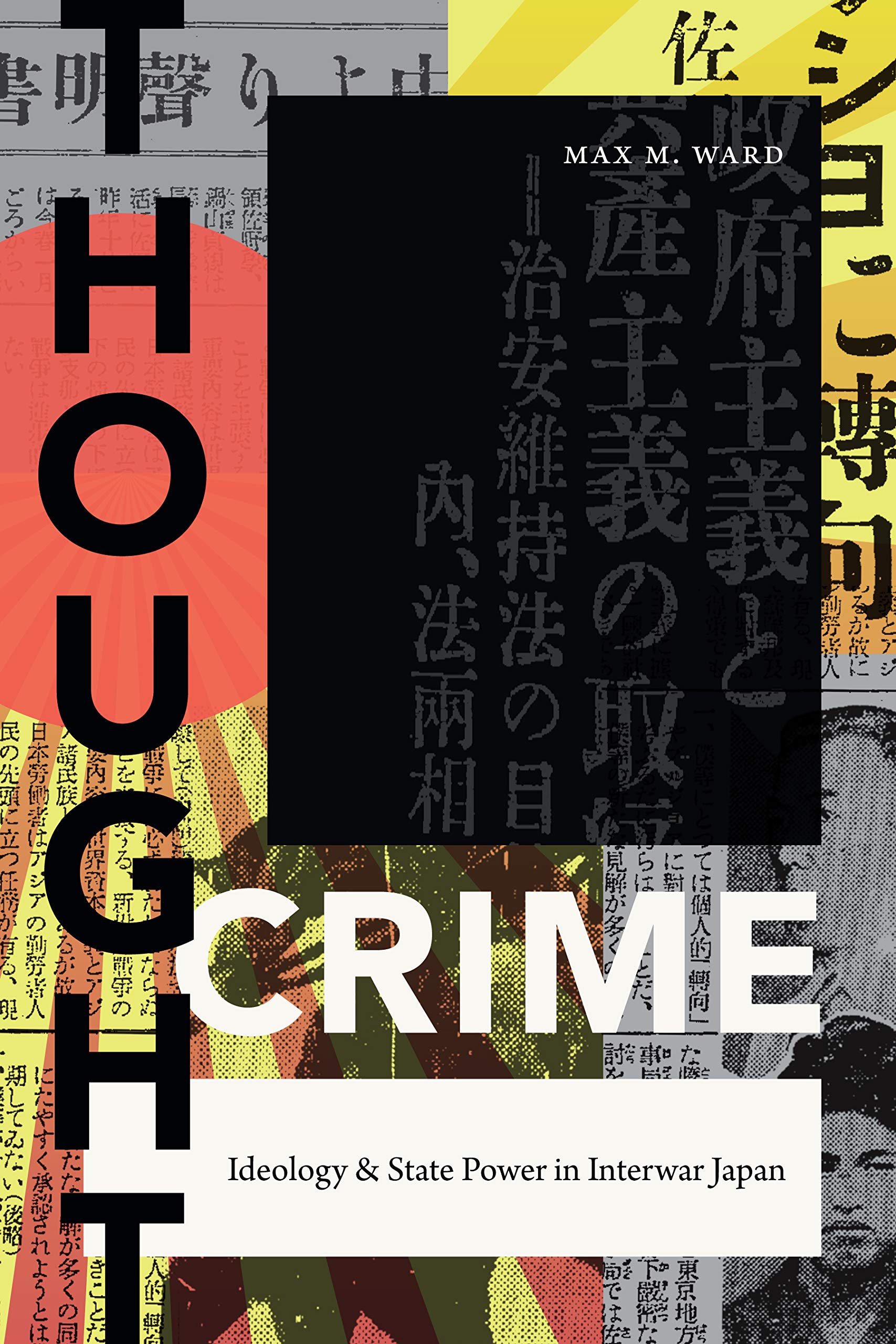
This year marks the centennial of Japan’s most infamous law of the prewar period, the Peace Preservation Law (Chianijihō). Enacted in March 1925 and implemented that May, the law was utilized to arrest over 70,000 people in the Japanese metropole and tens of thousands more in Japan’s colonial territories —especially in Korea—until it was repealed by order of Allied Occupation authorities in October 1945. It was initially proposed as a legal instrument to suppress domestic communists and anticolonial activists who were threatening to “alter the kokutai” (national polity). However, the purview of the law expanded in the 1930s to include academics, other political activists, and members of religious groups, who were seen as challenging imperial orthodoxy. Not only was the purview of the law expanded, but the policies that were developed to administer those detained under it also transformed and intensified. As I explore in more detail in my book Thought Crime: Ideology and State Power in Interwar Japan (Duke, 2019), by the late 1930s the law was informing a complex apparatus for the assessment, reform, and “ideological conversion”—or tenkō—of detained political criminals. For the purposes of this essay, I excerpt portions of the first two chapters of Thought Crime to provide insight into the early legislative debates over the law, the interpretive questions that arose over its central category kokutai, and how the law and its application started to transform as it was applied in the late 1920s and early 1930s.Footnote 1
In Thought Crime, I read the law not simply as an instrument to suppress “dangerous” ideology but as an index of imperial state ideology—first and foremost, the ideology of imperial sovereignty and the relationship between sovereign and subject as symbolized in the concept kokutai —and how this ideology transformed within the expanding apparatus to police political crime in the 1930s. Although early postwar scholarship represented the law as a clear and straightforward instrument of state repression, I reveal how officials continually questioned how to interpret the law’s central categories and experimented with different policies on the basis of the changing political circumstances in the Japanese Empire. Indeed, the transformation and expansion of the law was indexed by the changing interpretations of kokutai that were taking place in police interrogation rooms, district courts, colonial police bureaus, criminal rehabilitation centers, and in the prison writings of those arrested. For these reasons, the law’s extension and increasing institutional complexity provide a unique archive in which to study how policing and state power can expand far beyond the original intentions of proponents of these kinds of national security and antiradical laws.
Context and early precedents
The 1925 Peace Preservation Law was the product of increasing concern about international radicalism and how it might proliferate among the unstable socioeconomic condition of the Japanese Empire after World War I. Specifically, state officials were worried that existing laws such as the 1900 Public Peace Police Law (Chian keisatsu hō) in Japan or the 1907 Security Law (Hoanhō) in Korea would be ineffectual against what they perceived to be new ideological threats, particularly following the successful Bolshevik Revolution and the establishment of the Communist International (Comintern). These anxieties inspired the Home Ministry, with the collaboration of the Justice Ministry, to introduce an antiradical bill to the Imperial Diet in 1922 called the Kageki shakai undō torishimari hōan (draft bill to control radical social movements, hereafter, Antiradical Bill). It was explained that: “Recently in our nation there are those who, working with their foreign counterparts, have spread extremism, and together with lawless Koreans and Chinese, have attempted to Bolshevize [sekka] our country” (Naimushō, cited in Ogino Reference Fujio1996, vol. 1, 23). As we see here, the threat was conceived as a foreign ideological threat from the Soviet Union and its spread by anticolonial or revolutionary activists within the Japanese Empire.
Furthermore, this threat was understood to be of an ideological character, which, it was argued, fell outside of existing laws that criminalized violent acts or illegal political parties. As was explained in Diet deliberations, this Antiradical Bill would allow the state to “recognize, capture, and imprison” elements that “are poisoning society” through ideological dissemination (cited in Okudaira Reference Yasuhiro1973a, 6). One Home Ministry official urged legislators to recognize that current laws only covered civil disturbances when they reached a level of violence, not “the slow infiltration of dangerous thought into the hearts and minds [of the people],” which would eventually “destroy the national structure from within” (cited in Okudaira Reference Yasuhiro1973a, 7). However, debates centered on the categories used in the bill to identify such a threat, including how to identify whether someone was spreading propaganda that would alter the “fundamental structure of society” (shakai no konpon soshiki) or “subvert the laws of state” (chōken o binran suru).Footnote 2 The general ambiguity of these terms and the failure to reach a consensus over what they designated forced proponents to simply insist on the necessity for the law in a time of foreign ideological assault against the Japanese Empire. They tried to calm fears that this bill would infringe upon freedom of speech and academic research by stressing that the law would be applied only to those who were in contact with foreign agents, receiving money from outside the country, or importing and spreading dangerous ideas from abroad. In the end, the Antiradical Bill was pulled from Diet consideration owing to concern that it would obstruct other important bills being deliberated at the time. The general consensus was that the bill had not been properly prepared, exemplified in the inadequate explanations provided by officials from the Justice and Home Ministries.
Although the 1922 bill was not enacted, it serves as an early example of how officials believed that the Japanese Empire was facing an ideological threat from abroad. Throughout its many revisions, the underlying logic of this bill remained a binary opposition between foreign ideological threats and domestic objects requiring protection. The later 1925 Peace Preservation Bill would inherit this logical structure, and many of the terms that were used to explicate the 1922 bill would reappear in the 1925 debates. The challenge for proponents in 1925 was to present this binary in terms that could either answer or override concerns about restricting political debate, speech, assembly, or thought. In the context of increasing alarm over political radicalism in the empire and the intensifying geopolitical situation after 1922, officials redoubled their efforts to pass a new security bill.
The official fear of ideological infiltration was heightened by a number of incidents in 1923, including not only the knowledge that a communist party had illegally formed in Japan but also an attempted assassination of Prince Regent Hirohito on December 27, 1923. These concerns were compounded as Japan moved toward formally recognizing the Soviet Union and with the anticipated passage of Universal Manhood Suffrage (both completed in 1925). In this context, state officials worked to draft a security bill that could pass legislative scrutiny. Here the initiative shifted from the Home Ministry to the Justice Ministry, which took the lead in drafting and conceptualizing the new Peace Preservation Bill (Chianijihōan).Footnote 3 Early drafts of the Justice Ministry bill continued to define the danger as those who wished to “subvert the laws of the state” (chōken o binran); however, in contrast to the earlier 1922 bill, it was no longer subversion through propaganda activities (senden) but now by means of “secretly organizing societies [himitsu ni kessha o soshiki] with the intent to subvert the laws of the state.”Footnote 4
Moreover, these early drafts more explicitly elaborated how “to subvert the laws of state” would apply to the colonies. For instance, a 1924 Home Ministry document (reprinted in Ogino Reference Fujio1996, vol. 1, 172–173) explains that an act of “subverting the laws of the state” includes: “to proscribe the scope of sovereign authority; for example, to overthrow the government; to seize part of the realm; to plan for colonial independence, or; to combine [a part of the empire] with a foreign country.” It is important to note that at the very same time this bill was taking shape in Tokyo, the Police Bureau of the Korean Government-General was also reviewing their security ordinances and, according to the research of Mizuno Naoki (Reference Naoki2000, 108-110), began drafting an ordinance called the Public Peace Police Ordinance (Chian keisatsu rei). Ultimately, the ordinance was not put into effect, but we can understand it as one more aspect contributing to the development of the Peace Preservation Law.
Another important development came in November 1924, when the Police Bureau of the Home Ministry, working in response to the earlier Justice Ministry drafts, produced its own Peace Preservation Bill draft. The first article from this draft read: “Anyone who forms a society with the intention to destroy the national polity [kokutai o henkai], to deny the state or its laws, or to seize a part of the realm, or knowingly joins such a society, shall be liable to imprisonment with or without hard labor for a term not exceeding 3 years” (reprinted in Ogino Reference Fujio1996 vol. 1, 154–55). As scholar Ogino Fujio (Reference Fujio1993, 22–27) has shown, from this point forward every draft produced by the Justice and Home Ministries contained the term “kokutai.” And as Mizuno Naoki has argued (Reference Naoki, Toyomi and Toshihiko2004, 421), the earlier association of colonial independence as threatening the laws of the state was now defined as an infringement against the kokutai. In subsequent versions, drafters focused their attention on revising terms other than kokutai, such as state (kokka), state authority (kokken), constitutional system (kenpō ni sadameru seido), and constitutional organization of rule (kenpōjō no tōchi soshiki). Moreover, after multiple drafts were shared between the Justice and Home Ministries, and then reviewed by the Cabinet Legislation Bureau (Naikaku hōseikyoku), these other terms became encapsulated in the single term “state form” (seitai).
Debating the 1925 Peace Preservation Bill
The three terms designating the objects to be protected in the first draft of the Peace Preservation Bill submitted to the Diet were national polity (kokutai), state form (seitai), and private property system (shiyūzaisan seido). The first version of Article 1 read, “Anyone who forms an organization with the intention of altering the kokutai or seitai, or rejecting the private property system, or anyone who knowingly joins such an organization, will be liable to imprisonment for no more than 10 years” (cited in: Okudaira ed. Reference Yasuhiro1973a, 51) The first two terms, seitai and kokutai, had appeared in constitutional theory before, but it is important to note that they formed an inseparable categorical dyad—wherein kokutai signified the location of sovereignty, and seitai designated the means or form through which that sovereignty was expressed.Footnote 5 In other words, kokutai did not have its own constitutional designation divorced from its pairing with seitai; constitutional theorists merely differed in how they theorized the juridical and historical relationship between the two. While the choice to use these terms may indicate that the bill’s drafters were familiar with ongoing debates in Japanese constitutional theory, by using these terms, they inadvertently brought these conceptual issues into the discourse of criminal law.
As we will see, kokutai was initially defined by proponents of the Peace Preservation Bill as signifying the location of sovereignty in the “line of Emperors unbroken for ages eternal” (bansei ikkei no tennō) and consistently referred to Articles 1 and 4 of the Meiji Constitution of 1889, which stated that the “Empire of Japan shall be reigned over and governed by a line of Emperors unbroken for ages eternal” and that the “Emperor is the head of the Empire, combining in Himself the rights of sovereignty, and exercises them, according to the provisions of the present Constitution,” respectively.Footnote 6 It is important to note that, although legislators cited the Meiji Constitution to legally define kokutai, the term itself does not appear in the text of the Constitution; it was only after the promulgation of the Constitution in 1889 that constitutional theorists started using the term kokutai to interpret the juridical form of the new imperial state.
Rather, kokutai was best known for its use in the 1890 Imperial Rescript on Education (Kyōiku ni kansuru chokugo, or Kyōiku chokugo), which was memorized by schoolchildren throughout the Japanese Empire. This rescript translated the neo-Confucian ethics of loyalty and filial piety into a modern form of imperial morality that all subjects were to embody. The rescript reads in part: “Our Imperial Ancestors have founded Our Empire on a basis broad and everlasting and have deeply and firmly implanted virtue; Our subjects ever united in loyalty and filial piety have from generation to generation illustrated the beauty thereof. This is the glory of the fundamental character of our Empire [waga kokutai no seika], and herein also lies the source of our education.”Footnote 7 Note that here kokutai did not signify imperial sovereignty per se, but rather the purported ethical values mediating the relationship between emperor and subject from time immemorial. We will see how this ethical significance was periodically invoked in discussions over the Peace Preservation Law, thus complicating the attempt to define kokutai in purely constitutional terms.
The bill was delivered to the Lower House of the 50th Imperial Diet on February 19, 1925. Similar to the earlier 1922 Antiradical Bill, officials from the Justice and Home Ministries explained that the objective of the new Peace Preservation Bill was to “suppress … anarchism and communism.” Home Minister Wakatsuki Reijirō introduced the bill by pointing to the urgency of the contemporary moment—emphasizing the danger posed by the restoration of diplomatic relations with the Soviet government the month before. He reminded the Diet that current laws were ineffectual against this new threat, since compared with other social movements, communism was composed largely of “dangerous ideological activities” (kiken naru shisō kōdō) (reprinted in Okudaira Reference Yasuhiro1973a, 52). To whatever degree Diet members were persuaded that Japan faced an external ideological threat, debate immediately began over the terminology of the bill and what effect the bill would have on public speech, academic research, and other reforms that were being debated at the time, particularly in regard to the Universal Male Suffrage Act, which was also under deliberation at the time. For example, one critic called the proposed bill an “extremely oppressive policy” that indicated that the government “did not trust the Japanese people” (Hoshijima Nirō, cited in Ibid, 53).
Interestingly scrutiny of the bill’s terminology tended to overlook kokutai and focus rather on the term seitai. For example, the same critic declared: “I cannot believe there is one person in the nation who would wish for something akin to altering the kokutai,” and thus questioned if his desire “to build a better state form [seitai] with human and social progress as its necessary principles …one based upon Japan’s kokutai as the foundation, a kokutai that has not changed for 3,000 years,” would not infringe upon the alteration of the seitai crime (Ibid, 54–55). Many critics followed this line of attack—accepting kokutai as something absolute (zettai no mono)—while focusing on determining what political reforms would fall under the seitai infringement. This logical distinction between something transcendent/absolute and secular/historical would continue to frame the debates over the bill’s categories in which state form and private property system were repeatedly contrasted to kokutai. The result was that, while critics were concerned about protecting the scope of political criticism and social reform from falling under the category seitai, the category kokutai was isolated as something unquestionable and projected outside of legislative scrutiny. Ultimately, legislators were being asked to understand kokutai as both something ostensibly absolute and something seemingly under existential threat from foreign ideologies.
Responding to these kinds of criticisms, Home Minister Wakatsuki (cited in Ibid, 56–57) repeatedly argued that drafters chose terms that did not lend themselves “to vague interpretations.” To demonstrate the concreteness (gutaiteki) of the bill’s terms, he cited Article 1 of the Meiji Constitution, arguing that kokutai signified that the Japanese empire is ruled by a “line of Emperors unbroken for ages eternal” (bansei ikkei no tennō) and added that “if someone is planning to alter our glorious kokutai, then we must use the law to suppress this.” Regarding state form, Wakatsuki did not elaborate seitai as a general category of constitutional theory but rather explained the concept by listing the supposed varieties of state formations, including the “aristocratic state form” and the “parliamentary state form.” He added, “If it is asked what kind of seitai we have in Japan, it would be a constitutional state form, a representative state form” (rikken seitai, daigi seitai). Wakatsuki did not explain how the constitutional state form was based on the location of sovereignty in the eternal unbroken line of emperors as symbolized in the term kokutai. He merely declared that if someone intended to “destroy this state form,” then it was necessary to “control this with this law.”
Following this first round of discussions, the bill was sent into committee consideration, which focused on how to revise the bill to answer the questions related to kokutai and seitai and to quell fears that the law could apply to those who were calling for legitimate political and social reforms. The result was that when the bill returned for Diet deliberation on March 7, seitai was excised from the bill, leaving kokutai and shiyūzaisan seido (system of private property) as the two objects under threat from foreign ideologies (Okudaira Reference Yasuhiro1973a, 88–99).
Even with seitai’s erasure from the bill, debates continued to note how, in constitutional theory, kokutai was theorized in relation to seitai. For instance, in the March 7 Diet meeting, it was asked that if kokutai signified the location of sovereignty and seitai the “objective and subjective aspects” of this sovereignty, was not then “the monarchy (kunshu) itself the kokutai?” (Kiyose Ichirō, cited in Kōtō Hōin Kenjikyoku, 1928: 57). If so, then it would mean the law was directed toward those planning to “harm the Emperor himself,” which was already covered by other laws (Ibid, 65–66). Justice Minister Ogawa Heikichi retorted that to alter the kokutai was “not related to doing physical harm to the Emperor” but rather the various ways in which imperial sovereignty could be “impinged upon [sawaru]” (Ibid, 66–67, 72). Another legislator inquired into the decision to delete seitai while retaining kokutai, asking if “the constitution determines our state form as a constitutional monarchy” (rikken kunshu seitai) and if kokutai refers to the “line of Emperors unbroken for ages eternal” as stipulated in Article 1 of that very same constitution, then “kokutai is included in seitai,” and there is no need to distinguish them (Kikuchi Kenjirō cited in: Ibid, 69–71). Justice Minister Ogawa responded to these kinds of questions by explaining that kokutai was “absolute” and thus not “something that begins with the constitution.” He urged the Lower House not to confuse seitai with kokutai, arguing that no matter the various state forms in Japanese history—whether absolute monarchy or representative government—“sovereignty is not altered” by these forms. Ultimately, to equate “the location of sovereignty’s operation” (taiken no hataraku tokoro) with the “form of its exercise” was to “confuse the two” (Ibid, 72). In a later meeting, Justice Minister Ogawa ultimately collapsed two definitions of kokutai—one constitutional, the other based on the Imperial Rescript on Education—when he explained that: “The Emperor founded the country, and through morality governed the people, and the people in turn were filial and pious… This is the glory of our kokutai. And I believe this does not change [the meaning of] Article 1 [of the Meiji Constitution], nor does it change what this is grounded upon.” He continued that kokutai was “the deep and profound morality” as explained in the Imperial Rescript on Education as well as “what constitutes the governance of our country” as defined in the Meiji Constitution (Ibid, 144).
However, despite continuing concern over the ambiguity of its terms, it was apparent by mid-March that there was enough support to pass the bill. In the last meeting in the House of Peers, on March 17, the topic of the law’s applicability to the colonies was addressed. The discussion centered on how to interpret the language in Article 7 of the bill, which stated that the law could apply to those committing these infringements “outside of the jurisdiction of this law” (honhō shikō kuiki gai). It was explained that this law would be issued through each particular colonial legal system and would apply to any national who committed crimes outside of the imperial realm.Footnote 8 This then led to further questions about what exactly would constitute “rejecting sovereign rule” (tōchiken o hinin) as symbolized in the term “altering the kokutai” in the colonial context. Justice Minister Ogawa explained, “To separate one part of the Empire, for instance, all of Korea, or let’s say half of Korea, from imperial rule” (heika no tōchiken kara hanareru) would thus constitute a case of “altering the kokutai.”Footnote 9 This territorial emphasis of sovereignty would become one of the distinguishing aspects of how the law would be interpreted differently in Japan’s colonies.
Although debates over the meaning of kokutai continued into the final deliberation of the bill, there was enough support to pass it on March 19. The Peace Preservation Law was promulgated on April 22 (Law no. 46) and went into effect in the Japanese metropole on May 11, 1925. On May 8, the government issued two imperial decrees announcing that the Peace Preservation Law would be adopted in the particular legal systems of Korea, Taiwan, and Karafuto (no. 175) as well as the Kwantung Leased Territory and the South Sea Islands (no. 176).Footnote 10 The final version that went into law read as follows:
Article One: Anyone who has formed a society with the objective of altering the kokutai or rejecting the private property system, and anyone who has joined such a society with full knowledge of its objective, shall be liable to imprisonment with or without hard labor for a term not exceeding 10 years.
Any attempt to commit the crime in the preceding clause will be punished.
Article Two: Anyone who has discussed [kyōgi] the execution of matters specified in Paragraph One of Article One with the objective mentioned therein shall be liable to imprisonment with or without hard labor for a term not exceeding 7 years.
Article Three: Anyone who has instigated (sendō) the execution of the matters specified in Paragraph One of Article One with the objective mentioned therein shall be liable to imprisonment with or without hard labor for a term not exceeding 7 years.Footnote 11
Article 4 stipulated penalties for those causing violence or property damage in relation to the crimes listed in Article 1, while Article 5 penalized those who supported or who received material support to commit such crimes. Article 6 concerned the reduction of sentences for those who cooperated with authorities, while the last article stipulated that the law would apply to those committing such crimes outside of the law’s jurisdiction. Regarding this last article, it is important to note that when the Peace Preservation Law was enacted by colonial governments in their respective legal systems, the law’s terminology was left unchanged. Consequently, we can understand the Peace Preservation Law as a security measure that, in its implementation, was largely coextensive with the territory of the Japanese Empire itself. Furthermore, when crimes were committed by imperial nationals outside of the formal jurisdiction of the Japanese Empire, these nationals could be prosecuted when they returned or were extradited.
As the legislative debates reviewed above demonstrate, the Peace Preservation Law’s categories of protection were anything but clear to legislators. The capacity for their wide interpretation and application not only was a source of objection by the bill’s opponents but now also became a particular problem for those who had to implement the law, including for police, procurators, and district court judges. The next section explores how these interpretive problems—and in particular, with the term kokutai—continued in the institutional implementation of the Peace Preservation Law in the late 1920s. And while the law was initially implemented to suppress threats to imperial sovereignty as originally intended, by the early 1930s procurators and prison officials started to experiment with reforming political criminals so they could be safely reintegrated into society, thus adding another interpretation of kokutai’s significance in the law (which I will address briefly below).
Early applications of the Peace Preservation Law
The first two applications of the Peace Preservation Law took place in 1925. One was in the prosecution of members of the Student Federation of Social Science (Gakusei shakaikagaku kenkyūkai, or Gakuren) from campuses in the Kansai region.Footnote 12 Arrests were made in the winter of 1925–1926, and the first trials took place in Kyoto District Court in the spring of 1927. In total, 38 students, many of whom were from the elite Kyoto Imperial University, were tried for having discussed “altering the kokutai” and “rejecting the private property system” as defined in the new Peace Preservation Law (Matsuo 1968–1970, 74). Procurators from district courts facilitated the arrest, investigation, and prosecution of the students after the local Special Higher Police had bungled the first round of arrests in early December 1925. One unique aspect of this early episode in metropolitan Japan was that the Gakuren defendants were ultimately found guilty of infringing the “reject the private property system” clause rather than the kokutai clause. This was one of the few times that this clause was applied in the Japanese metropole (Okudaira Reference Yasuhiro2006: 84)
The other but less known application of the law in 1925 was against suspected communists in Korea (the so-called Chōsen kyōsantō jiken, or Korean Communist Party Incident). Arrests were carried out in November 1925 (1 month earlier than the Gakuren arrests), and defendants were later tried and sentenced for forming an organization with the objective of “altering the kokutai.” And similar to cases in Japan, courts in Korea had to first distinguish between the Peace Preservation Law and other antiradical ordinances at their disposal when indicting a suspect (Mizuno Reference Naoki, Toyomi and Toshihiko2004: 431–434). However, one immediate difference exemplified between the metropole and colonial Korea was that, in June 1925, only 1 month after the Peace Preservation Law was implemented in Korea, the head procurator of the Chōsen High Court issued a directive in which he directly connected the new law to the Korean independence movement: “It has been determined that the Peace Preservation Law will be applied to those organizing a society with the objective of Korean independence, joining such a society knowingly, or assisting in implementing this objective, or agitating for its implementation” (cited in Mizuno Reference Naoki, Toyomi and Toshihiko2004: 423). As many scholars have noted, this direct association of altering the kokutai with national independence signaled an important difference in how the law would be interpreted in the colony, opening the way for many noncommunist national independence groups to be charged with intending to alter the kokutai.
Moreover, up through the end of the 1920s, Korean communists were often prosecuted for infringing both the “alter the kokutai” and “reject the private property system” clauses— something that, despite a few early exceptions, such as the 1925 Gakuren Incident, did not occur in the Japanese metropole. In February 1928, the Keijō District Court handed down a decision against suspected Korean Communist Party members explaining that “a kind [isshu no] of communist movement was carried out that blended [konwa] communist thought with the idea of Korean national liberation.” It was explained that this “kind of” communist movement “had the objective of repudiating the private property system in Chōsen and actualizing a communist system, as well as seceding Chōsen from the bonds [kihan] of our empire” (cited in Mizuno Reference Naoki, Toyomi and Toshihiko2004, 428). In another important case that same year, the Keijō District Court handed down a guilty verdict predicated on a similar combination of the two clauses, stating that “Our Japanese Empire celebrates [ōka] the private property system,” which the defendants “repudiated and planned to realize a communist system in Chōsen.” In addition, it was argued that the defendants were also planning to have “Chōsen secede (ridatsu) from the bonds of our Japanese Empire, and become an independent nation” (cited in Mizuno Reference Naoki, Toyomi and Toshihiko2004, 428). In early trials in colonial Korea, courts interpreted the Peace Preservation Law in such a way as to encapsulate the objectives of colonial independence as well as overthrowing capitalism.
Mass arrests in 1928–1929 and the 1928 revision of the Peace Preservation Law
On March 15, 1928, 1 month after the first general elections were held following the passage of the Universal Manhood Suffrage Law in 1925, there was a nationwide roundup of suspected communists, which came to be known as the 3.15 Incident. On the basis of information obtained in this first roundup, more arrests continued throughout the year, with another coordinated roundup on April 16, 1929. In total, over 8,000 suspected communists were netted in this empire-wide arrest campaign.Footnote 13 The increasingly powerful procurators of the Tokyo District Court led the organizational planning of this nationwide campaign (Ogino Reference Fujio2000: 31–32). From these arrests, detailed information was gathered concerning the activities and organization of the communist movement, which spurred procurators and police to redouble their efforts to study the movement in closer detail. Within a few years, this produced a massive amount of information on what was being called “thought crime” (shisō hanzai) and the figure of the thought criminal (shisō hannin) (see: Ward Reference Ward2022).
Although the Japanese Communist Party (JCP) was relatively small at the time, these arrests confirmed conservative fears of a communist conspiracy inside the empire, leading to new efforts to suppress political radicalism. The cabinet of Prime Minister Tanaka Giichi quickly went on the offensive. The result was the dissolution of many labor and student organizations, as well as the new proletarian political parties that formed for the 1928 general election (Nakazawa Reference Shunsuke2012: 97). In addition, the Ministry of Education ramped up efforts to monitor campus activism, while the Home Ministry increased the staff as well as funding for police agencies (Matsuo Reference Hiroshi1979: 129-131). In regard to the Justice Ministry, although a thought section had been established in the procuracy of the Tokyo District Court in 1927, in 1928 thought procurators were established in the Supreme Court and important district courts, as well as in the Korean Government-General that August (Ogino Reference Fujio2000: 8). A directive in May 1928 outlined the mandate for thought procurators: to review all cases related to the Peace Preservation Law, political crimes, publication crimes, violent political acts, and rioting inspired by political motives, among other politically inspired crimes (Steinhoff Reference Steinhoff1991: 40–42). In this manner, state power expanded through the campaign to control so-called dangerous thought.
At the center of the state’s attempt to strengthen its ability to suppress communists and other radicals was a proposed revision to the Peace Preservation Law in the spring of 1928. Suzuki Kisaburō, Home Minister in the Tanaka government, introduced the bill to the 55th Imperial Diet in April 1928, but the bill failed to go to the floor before the Diet adjourned.Footnote 14 In an extraordinary move, the Tanaka government introduced the bill as an emergency imperial ordinance to the extraconstitutional Privy Council on June 27, which passed the ordinance (Ordinance no. 129).Footnote 15 The Diet formally approved the revision in February and March of the following year.
In the revised Peace Preservation Law, the kokutai and private property system clauses were separated and assigned different punishments. While the punishment for forming or joining a society with the intention of rejecting the private property system remained the same (up to 2 years imprisonment), the punishment associated with forming or leading an organization with the objective of altering the kokutai became punishable by death (shikei). These changes signaled that altering the kokutai represented the primary infringement of the Peace Preservation Law, evidenced by the fact that from the late 1920s until its repeal in 1945, almost all the arrests under the Peace Preservation Law were owing to this clause. Furthermore, due to the complexity of processing thousands of suspected communists after the March arrests, justice officials added a clause concerning “persons who commit acts in order to further the aims” (mokuteki suikō) of an organization intending to alter the kokutai or reject the private property system, thereby expanding the Peace Preservation Law’s purview beyond individuals who were simply members of organizations.Footnote 16
In both the Privy Council and Diet debates, proponents of the revision cited the unique dangers facing Japan at the time. For example, on June 27, 1928, Hiranuma Kiichirō and Prime Minister Tanaka Giichi presented the revision to the Privy Council by portraying the arrests of communists earlier in the year as evidence of the extensive dangers that Japan faced both domestically and abroad (reprinted in: Okudaira Reference Yasuhiro1973a, 120, 121). Proponents defined these dangers by contrasting them to the term kokutai, as when Home Minister Mochizuki Keisuke (cited in Okudaira Reference Yasuhiro1973a, 121) argued that the threat posed by foreign thought (gairai shisō), such as communism, was to undermine “the spirit of our national foundation” and the “glory of our kokutai” (kokutai no seika). In addition to focusing on the supposed threat to the kokutai, proponents now clearly defined the foreignness of such threats. For instance, Prime Minister Tanaka explained that Soviet representatives were operating inside the country, and that Moscow was trying to ideologically infiltrate Japan through the Comintern. For Justice Minister Hara Yoshimichi, this external threat was clearly expressed in the Japanese Communist Party’s 1927 Theses, which called for “abolishing the monarchy” (kunshusei haishi).
Most of the debate in the Privy Council centered on the format of the proposed revision as an emergency imperial ordinance and the significance of including the death penalty. However, the Privy Council adopted the revision on June 28. For almost 8 months, the revision existed as an emergency imperial ordinance, until the Diet was able to deliberate the revision in early February the following year. In the 56th Imperial Diet of 1929, Justice Minister Hara Yoshimichi (Okudaira Reference Yasuhiro1973a, 147) repeated his warning that Japan’s “pure kokutai” was under threat from communist ideology with “international revolution as its aim.” In addition, Hara emphasized that unlike the criminal acts covered in Japan’s regular Criminal Code, the threat posed by communism was unique since it was largely one of ideas, explaining, “we should say that these are crimes of an ideological foreign threat” (shisōteki gaikanzai). Opponents in the Diet focused their critiques on the same concerns as were voiced earlier in the Privy Council; namely, the inclusion of the death penalty and the form of the revision as an emergency imperial ordinance. Yet Hara continued to argue that the Meiji Constitution allowed for such imperial ordinances to be issued in times of emergency and emphasized that the addition of the death penalty was intended as a preemptive deterrent only. Apparently convinced by such reasoning, the Lower House ratified the revision, with the Upper House following suit in March.Footnote 17
Then, on April 16, procurators and the Special Higher Police carried out a second wave of arrests, known as the 4.16 Incident. Combined with the arrests the year before, most of the JCP’s central committee was arrested or had gone underground. In total, Okudaira Yasuhiro estimates that 3426 people were arrested in 1928 and 4942 in 1929. The annual number of arrests would continue to increase into the 1930s.Footnote 18
Thus, by the end of the decade, the Peace Preservation Law had become what proponents had originally intended: a legal instrument used to suppress ideological threats to imperial sovereignty in both the metropole and colonies. By 1930, the police and various justice departments had their finances and personnel increased to combat thought crime—including the Korean Government-General—and thousands of suspected communists were detained and/or under investigation. In addition, the text of the Peace Preservation Law had been revised, elevating the offense of altering the kokutai to be punishable by death. In the same year that this revision was ratified (1929), the Sapporo Court of Appeals confirmed the legal definition of kokutai in the law as signifying the location of sovereignty in the “line of Emperors unbroken for ages eternal” as stipulated in the Meiji Constitution. The Supreme Court confirmed this interpretation in decisions in 1929 and 1931, thus establishing this definition as legal precedent in the metropole.Footnote 19
The developments that took place in the metropole in the late 1920s had an influence in the colonies as well. Recall that up until the 1928 revision, colonial administrators and judges in Korea had prosecuted suspected communists with infringing both the “alter the kokutai” and “reject the private property system” clauses. In 1929, however, prosecutors and courts started to emphasize the kokutai infringement by equating it with the territorial integrity of Japan’s sovereign empire. Around this time, communists in Korea were increasingly charged with pursuing “the objective to secede from the bonds of our empire.” This colonial interpretation of kokutai as territorial sovereignty became legal precedent in 1930–1931 through Keijō High Court decisions (Mizuno Reference Naoki, Toyomi and Toshihiko2004: 431–436). This was largely in response to challenges and appeals that had been brought by defendants charged under the law. In one such case in 1930, the High Court recognized the applicability of Article 1 to the Korean independence movement this way: “To try to establish Korean independence is to usurp [sensetsu] one part of our empire’s territory, to substantially reduce the content of sovereignty [tōchiken no naiyō] and thus is nothing more than violating this sovereignty. Therefore, it is appropriate to understand this as planning to alter the kokutai [as proscribed in] the Peace Preservation Law” (cited in Mizuno Reference Naoki, Toyomi and Toshihiko2004, 433). Citing this earlier ruling, a later 1931 High Court decision added a further explanation stating that “the kokutai is not simply in reference to the location of sovereignty, but is to be understood as a concept that also includes the content of that very sovereignty,” which we can interpret as meaning the territorial integrity of the Japanese Empire, even with the legal distinction between the metropole (naichi) and the colonies (gaichi).Footnote 20 It should be noted that an imperial national who carried out one of these criminal acts outside the borders of the empire could be arrested and tried once he or she returned or was extradited. Mizuno Naoki (Reference Naoki, Toyomi and Toshihiko2004, 436) argues that it was paradoxical for kokutai to be used to prosecute independence activists in Korea since it was not used during the initial incorporation of Korea into the Japanese Empire. In other words, kokutai was not initially identified in Japan’s sovereign claims over Korea. Only now, almost 20 years since Korea was formally annexed in 1910, were courts interpreting kokutai as the basis of Japan’s sovereign authority over its colonial territory and peoples.
Arrests continued into the 1930s, both in the metropole and in the colonies. In Japan, 6124 persons were arrested in 1930, 10,422 in 1931, 13,938 in 1932, and 14,622 in 1933.Footnote 21 As Nakazawa Shunsuke has argued (2012: 130–131), this increase in arrests in the early 1930s was owing to the expansion of arrests to affiliated groups (gaibu dantai) whom authorities suspected of trying to reorganize the JCP after the arrest campaigns of the late 1920s. In colonial Korea, 2661 activists were arrested in 1930, 1708 in 1931, 4481 in 1932, and 2007 in 1933.Footnote 22 Beyond Korea, Ogino summarizes that up to 1934 there were 701 arrests in Taiwan and 420 in the Kwantung Leased Territory.Footnote 23 In addition to these arrests in the formal boundaries of the Japanese Empire, Erik Esselstrom (Reference Esselstrom2009) has shown that the Foreign Ministry Consular Police also applied the Peace Preservation Law when policing ideological threats in Chinese port towns and the Japanese settlement in Shanghai in the early 1930s.
Administering thought criminals in the 1930s
In subsequent chapters of Thought Crime, I trace how this expanding population of detainees arrested under the Peace Preservation Law produced an administrative problem for officials in the metropole who found themselves responsible for interrogating, investigating, and surveilling an ever-increasing population of so-called thought criminals. I show how the initial repressive application of the law in the late 1920s inspired procurators in the metropole to experiment with reform and rehabilitation as a means to deal with this large population of thought criminals. By developing protocols to assess the degree of criminal-ideological danger that each individual detainee posed, the categorical function of kokutai shifted from defining what was specifically illegal about someone’s intentions, beliefs, or motivations (i.e., to “alter the kokutai”) to a standard upon which to measure the degree someone “ideologically converted” (tenkō) as a loyal subject of the empire.
In response to the challenge of administering the large population of detained political criminals, the Justice Ministry started to utilize pre- and post-trial means to have a suspect repent before going to trial or prison. Although not utilized extensively until the 1930s for adult offenders, the Japanese criminal code allowed for a suspect—political or otherwise—who showed potential for reform during pretrial interrogation to be granted a suspended indictment (kiso yūyo) or, once convicted, to be issued a suspended sentence (shikkō yūyo) before they were sent to prison.
Both of these were meant to provide the detainee time to reflect on their supposed crimes and to “repent” (kaijun) their misdeeds. In thought crime cases, this came to be referred to as “ideological conversion” (tenkō), since the crime was being ideologically led astray and joining or supporting organizations that planned to “alter the kokutai” (Ward Reference Ward2019, Chapter 3). However, it is important to emphasize that this administrative transformation of the Peace Preservation Law was initially limited to the Japanese metropole, as the repressive/punitive application remained the primary mode of the law’s application in colonial Korea. It was only much later, in the late 1930s, that colonial procurators started to discuss what it meant for a colonial subject to “convert” as a subject of the empire, largely on the basis of the unique ways in which the criminality of anti-colonial activism had been defined by the courts back in the late 1920s and early 1930s.
Following a wave of defections from detained JCP members in the summer of 1933, procurators in the Japanese metropole urged all those arrested under the Peace Preservation Law to “ideologically convert.” This produced its own administrative challenges, as procurators and others were now tasked with overseeing thousands of “thought criminals” at various degrees of conversion. In response to this challenge, officials passed a 1936 law titled the Thought Criminal Protection and Supervision Law (Shisōhan hogo kansatsu hō), which codified tenkō as one of the central policies of the Peace Preservation Law. To facilitate tenkō, this 1936 law established a network of 22 Thought Criminal Protection and Supervision Centers (Shisōhan hogo kansatsu sho) in the Japanese home islands, 7 centers in colonial Korea, and 1 center in Dalian in the Kwantung Leased Territory.Footnote 24 Central to assessing conversion was none other than the category of kokutai, which was used to measure to what degree a detainee re-identified as a loyal imperial subject.
In later chapters of Thought Crime, I explore how the Peace Preservation Law returned to fulfill a repressive function during wartime, following yet another revision to the law in 1941 which expanded procurator discretion and extended the period of what was called “preventative detention” (yobō kōkin) for suspects who did not exhibit potential for conversion. Preventative detention centers were established throughout the empire. In the case of colonial Korea, detainees who did not exhibit sufficient progress in converting were held in these centers so, as one report explained, they could “grasp ideas that clarify the kokutai” and have “a resolute faith in the way of the imperial nation” instilled in them (cited in Ogino Reference Fujio1996, vol. 4, 723).
Conclusion—the Peace Preservation Law at its centennial
Although the Peace Preservation Law has been portrayed in previous scholarship (e.g., Mitchell Reference Mitchell1973) as a uniquely Japanese way of dealing with domestic political threats, I believe it provides lessons for those of us who are concerned with the expansion of police and state power under the guise of combatting homegrown “radicalization” or other notions of ideological influence since the beginning of the war on terror. In the preface of Thought Crime, I draw parallels between the interwar Japanese system of thought rehabilitation and efforts in the United States and Europe to monitor and rehabilitate youths who, it is feared, might be led astray by Jihadist ideology. And in subsequent research (e.g., Ward Reference Ward2022, 55–56), I reflected on the policing of thought in interwar Japan “to consider how the discourse of radicalization [had] transformed the strategic field of state power, and how it informs a particular mode of policing implemented in ‘countering violent extremism’ programs across North America and Europe.” There I argued that “the example of the interwar Japanese thought police can provide a historical example from which we can reflect on how the discourse on radicalization” has created a new mode of policing of supposed motivations or ideological dispositions that, “when harnessed by security agencies and thus backed by state power, has changed the modality of policing in the endless war on terror.” Although the political situation in 2025 has developed since the early years of the war on terror, many of the institutions and policies for policing and prosecuting “radicals” are still in place and can be easily recalibrated and harnessed to suppress contemporary social movements as so-called internal enemies today. Unfortunately, the Japanese Peace Preservation Law may continue to serve as a historical vantage point from which to reflect on the operations of state power in our increasingly vexed sociopolitical situation.
Supplementary material
The supplementary material for this article can be found at https://doi.org/10.1017/apj.2025.1
Author biography
Max Ward is Associate Professor of History at Middlebury College, author of Thought Crime: Ideology and State Power in Interwar Japan (Duke 2019) and co-editor of Transwar Asia: Ideology, Practices, Institutions (Bloomsbury 2021) and Confronting Capital and Empire: Rethinking Kyoto School Philosophy (Brill 2017).


 Open access

