


Introduction
Parasites with complex life cycles depend intrinsically on interactions among multiple host species, making host co-occurrence pivotal for their persistence in natural environments (Benesh et al. Reference Benesh, Parker and Chubb2021a; Campião and Dáttilo Reference Campião and Dáttilo2020). However, host co-occurrence alone is not sufficient to ensure parasite persistence. Host traits, together with the structure and composition of host communities, strongly influence parasite survival and transmission, making some host stages within a parasite’s life cycle more critical for colonisation or establishment than others (Benesh et al. Reference Benesh, Parker, Chubb and Lafferty2021b; Bolnick et al. Reference Bolnick, Resetarits, Ballare, Stuart and Stutz2020; Lockyer et al. Reference Lockyer, Jones, Noble and Rollinson2004; Mihaljevic et al. Reference Mihaljevic, Hoye and Johnson2018). Among these traits, host mobility has traditionally been considered a key driver of parasite dispersal (Criscione Reference Criscione2008; Jarne and Théron Reference Jarne and Théron2001; Sweet and Johnson Reference Sweet and Johnson2018). Consequently, migratory hosts such as birds, which can perform long-distance movements, are frequently assumed to play a major role in the large-scale spread of parasites and associated pathogens (Altizer et al. Reference Altizer, Bartel and Han2011; Fritzsche et al. Reference Fritzsche McKay and Hoye2016; Morshed et al. Reference Morshed, Scott, Fernando, Beati, Mazerolle, Geddes and Durden2005). However, growing evidence suggests that parasite dispersal via vagile hosts may be more limited than commonly expected, as successful transmission depends on multiple ecological and physiological constraints (Thieltges et al. Reference Thieltges, Hof, Borregaard, Matthias Dehling, Brändle, Brandl and Poulin2011).
The family Diplostomidae Poirier, 1886, is a cosmopolitan and highly diverse group of digenean trematodes that are ubiquitous in freshwater ecosystems. Members of this family are characterised by a complex life cycle that typically involves pulmonate snails as the first intermediate hosts, fish as the second intermediate hosts, and piscivorous birds as the definitive hosts (Blasco-Costa and Locke, Reference Blasco-Costa and Locke2017; Chappell Reference Chappell, Pike and Lewis1994). Host specificity within this group varies across the life cycle, being most restricted in the first intermediate host, as most diplostomids are limited to a single snail family (Faltýnková Reference Faltýnková2005; Selbach et al. Reference Selbach, Soldánová, Georgieva, Kostadinova and Sures2015; Soldánová et al. Reference Soldánová, Selbach, Sures, Kostadinova and Pérez-del-Olmo2010). By contrast, the second intermediate hosts typically show the lowest specificity, and a single diplostomid species can infect many fish species across multiple families (Chappell Reference Chappell1995; Locke et al. Reference Locke, Daniel Mclaughlin and Marcogliese2010a; Reference Locke, McLaughlin, Dayanandan and Marcogliese2010b; 2015; Marcogliese et al. Reference Marcogliese, Compagna, Bergeron and McLaughlin2001). In birds, diplostomids typically demonstrate moderate host specificity. They are more specific in bird hosts than in fish hosts, yet less specific than in their first intermediate snail hosts (Galazzo et al. Reference Galazzo, Dayanandan, Marcogliese and McLaughlin2002; Georgieva et al. Reference Georgieva, Soldánová, Pérez-del-Olmo, Dangel, Sitko, Sures and Kostadinova2013).
High-latitude freshwater ecosystems are often characterized by low species diversity across multiple trophic levels (Hoberg et al. Reference Hoberg, Galbreath, Cook, Kutz and Polley2012; Thieltges et al. Reference Thieltges, Hof, Borregaard, Matthias Dehling, Brändle, Brandl and Poulin2011). This pattern is particularly evident in North Atlantic regions, such as Iceland, Greenland, northern Norway, and the Faroe Islands, where the composition of fish and mollusc communities is strongly constrained by geographic isolation and harsh climatic conditions. Indeed, these regions support only a limited number of freshwater fish species. Arctic char (Salvelinus alpinus), Atlantic salmon (Salmo salar), and three-spined stickleback (Gasterosteus aculeatus) are distributed across the North Atlantic, while brown trout (Salmo trutta) is present in Iceland, Norway, and the Faroe Islands (Jeppesen et al. Reference Jeppesen, Lauridsen, Christoffersen, Landkildehus, Geertz-Hansen, Amsinck, Søndergaard, Davidson and Rigét2017; Klemetsen et al. Reference Klemetsen, Amundsen, Grotnes, Knudsen, Kristoffersen and Svenning2002; Laske et al. Reference Laske, Amundsen, Christoffersen, Erkinaro, Guðbergsson, Hayden, Heino, Holmgren, Kahilainen, Lento, Orell, Östergren, Power, Rafikov, Romakkaniemi, Svenning, Swanson, Whitman and Zimmerman2022; Malmquist et al. Reference Malmquist, Ingimarsson, Jóhannsdóttir, Gíslason and Snorrason2002). Snail diversity is likewise depauperate, with only one planorbid (Gyraulus parvus) and one lymnaeid species (Ladislavella catascopium) occurring in Greenland (Horsák et al. Reference Horsák, Horsáková, Samaš, Divíšek, Coles and Nekola2025). In Iceland, Norway, and the Faroe Islands, the most abundant snail is the lymnaeid Ampullaceana balthica but additional species, like Radix auricularia and Bathyomphalus contortus, have been reported in these regions (Faltýnková et al. Reference Faltýnková, Kudlai, Jouet, O’Dwyer, Pantoja and Skírnisson2025; Fog, Reference Fog, Spärck and Tuxen1971; Klemetsen and Elliott, Reference Klemetsen and Elliott2010; Michal Horsák, pers. comm.).
In stark contrast to their low freshwater diversity, avian communities are comparatively rich. Greenland, Iceland, Norway, and the Faroe Islands are located along the East Atlantic Flyway, a major migratory corridor linking Arctic breeding grounds with wintering areas in Europe and Africa (Galbraith et al. Reference Galbraith, Jones, Kirby, Mundkur, Heredia, Waedt, García and Donkor2014; Lyngs, Reference Lyngs2003). Greenland also represents the northernmost extent of the American Atlantic Flyway, which connects breeding locations in Greenland and Arctic Canada with wintering areas across the Americas, making this region a key intersection of migratory routes spanning the Americas, Europe, and Africa (Frederiksen et al. Reference Frederiksen, Descamps, Erikstad, Gaston, Gilchrist, Grémillet, Johansen, Kolbeinsson, Linnebjerg, Mallory, McFarlane Tranquilla, Merkel, Montevecchi, Mosbech, Reiertsen, Robertson, Steen, Strøm and Thórarinsson2016; Reference Frederiksen, Moe, Daunt, Phillips, Barrett, Bogdanova, Boulinier, Chardine, Chastel, Chivers, Christensen-Dalsgaard, Clément-Chastel, Colhoun, Freeman, Gaston, González-Solís, Goutte, Grémillet, Guilford, Jensen, Krasnov, Lorentsen, Mallory, Newell, Olsen, Shaw, Steen, Strøm, Systad, Thórarinsson and Anker-Nilssen2012; Galbraith et al. Reference Galbraith, Jones, Kirby, Mundkur, Heredia, Waedt, García and Donkor2014; Morten et al. Reference Morten, APB, Beal, Bonnet-Lebrun, Dias, Rouyer, Harrison, González-Solís, Jones, Garcia Alonso, Antolos, Arata, Barbraud, Bell, Bell, Bose, Broni, de L Brooke, Butchart, Carlile, Catry, Catry, Charteris, Cherel, Clark, Clay, Cole, Conners, Debski, Delord, Egevang, Elliot, Esefeld, Facer, Fayet, Fijn, Fischer, Franklin, Gilg, Gill, Granadeiro, Guilford, Handley, Hanssen, Hawkes, Hedd, Jaeger, Jones, Jones, Kopp, Krietsch, Landers, Lang, Le Corre, Mallory, Masello, Maxwell, Medrano, Militão, Millar, Moe, Montevecchi, Navarro-Herrero, Neves, Nicholls, MAC, Norris, O’Dwyer, Parker, Peter, Phillips, Quillfeldt, Ramos, Ramos, Rayner, Rexer-Huber, Ronconi, Ruhomaun, Ryan, Sagar, Saldanha, Schmidt, Schultz, Shaffer, Stenhouse, Takahashi, Tatayah, Taylor, Thompson, Thompson, van Bemmelen, Vicente-Sastre, Vigfúsdottir, Walker, Watts, Weimerskirch, Yamamoto and Davies2025; Lyngs Reference Lyngs2003). Consequently, many piscivorous birds may act as potential long-distance vectors for parasite dispersal across the North Atlantic. For example, the red-throated diver (Gavia stellata), Greenland white-fronted goose (Anser albifrons flavirostris), and the brent goose (Branta bernicla) breed in West Greenland, North-eastern Canada, or both, while overwintering in western Europe (Lyngs Reference Lyngs2003). Similarly, different gull species (Larus spp.) frequently traverse the North Atlantic (Boertmann Reference Boertmann1994; Lyngs Reference Lyngs2003), common gulls (Larus canus) of European origin breed in southwest Greenland (Boertmann Reference Boertmann1994), whereas lesser black-backed gulls (Larus fuscus) that breed in West Greenland overwinter in North America (Barber et al. Reference Barber, Brauning and Murphy2026).
Despite their broad distribution and high prevalence in freshwater environments (Blasco-Costa and Locke Reference Blasco-Costa and Locke2017; Chappell Reference Chappell, Pike and Lewis1994), diplostomid diversity in some Arctic and Subarctic regions remains understudied. Due and Curtis (Reference Due and Curtis1995) reported twenty metazoan parasite taxa infecting Arctic char in Greenland, with Diplostomum spp. among the most common parasites. However, this study relied exclusively on morphology-based taxonomy, a method widely recognised as insufficient for resolving diplostomid larval stages at the species level (Cribb et al. Reference Cribb, Barton, Blair, Bott, Bray, Corner, Cutmore, De Silva, Duong, Faltýnková, Gonchar, Hechinger, Herrmann, Huston, Johnson, Kremnev, Kuchta, Louvard, Luus-Powell, Martin, Miller, Pérez-Ponce De León, Smit, Tkach, Truter, Waki, Vermaak, Wee, Yong and Achatz2025; Georgieva et al. Reference Georgieva, Soldánová, Pérez-del-Olmo, Dangel, Sitko, Sures and Kostadinova2013). In the Faroe Islands, knowledge of diplostomid parasites is even more limited. Højgaard et al. (Reference Højgaard, Steingrund and Bristow2008) examined sticklebacks in three freshwater lakes and reported a low prevalence (3–5%) of an unidentified digenean. In contrast, evidence from other Arctic and Subarctic regions, such as Iceland and Norway, reveals unexpectedly high diplostomid diversity. Both share comparable diplostomid communities, including at least six Diplostomum lineages exploiting the same fish and snail hosts present in the Faroe Islands (Blasco-Costa et al. Reference Blasco-Costa, Faltýnková, Georgieva, Skírnisson, Scholz and Kostadinova2014; Faltýnková et al. Reference Faltýnková, Georgieva, Kostadinova, Blasco-Costa, Scholz and Skírnisson2014, Reference Faltýnková, Kudlai, Jouet, O’Dwyer, Pantoja and Skírnisson2025; Soldánová et al. Reference Soldánová, Georgieva, Roháčová, Knudsen, Kuhn, Henriksen, Siwertsson, Shaw, Kuris, Amundsen, Scholz, Lafferty and Kostadinova2017). Similarly, intensive research in North America has revealed substantial diplostomid diversity. Locke et al. (Reference Locke, Daniel Mclaughlin and Marcogliese2010a; Reference Locke, McLaughlin, Dayanandan and Marcogliese2010b) reported twenty species-level lineages of Diplostomum, which apparently have a restricted geographic distribution. For example, Diplostomum sp. 6, 7, and 9 have only been reported in North America (Locke et al. Reference Locke, Daniel Mclaughlin and Marcogliese2010a; Reference Locke, McLaughlin, Dayanandan and Marcogliese2010b), whereas Diplostomum linages 3 and 6 are only found across Northern Europe (Blasco-Costa et al. Reference Blasco-Costa, Faltýnková, Georgieva, Skírnisson, Scholz and Kostadinova2014; Kuhn et al. Reference Kuhn, Kristoffersen, Knudsen, Jakobsen, Marcogliese, Locke, Primicerio and Amundsen2015; Vlasenko et al. Reference Vlasenko, Sokolov, Izotova, Ieshko, Belikova, Parshukov, Kashinskaya and Solovyev2026). Nevertheless, our understanding of Diplostomum diversity remains partially unresolved, as recent studies have documented additional lineages infecting the snails Lymnaea stagnalis and Ladislavella elodes in North America (Achatz et al. Reference Achatz, Martens, Kostadinova, Pulis, Orlofske, Bell, Fecchio, Oyarzún-Ruiz, Syrota and Tkach2022; McPhail et al. Reference McPhail, Tomusiak, Veinot, Dodds and Hanington2025). These findings suggest that diplostomid diversity in high-latitude regions is likely underestimated, and that even a depauperate intermediate host fauna may support complex parasite assemblages.
In this study, we investigate diplostomid communities infecting the eyes of freshwater salmonids in Greenland and the Faroe Islands to uncover previously uncharacterised parasite diversity and to expand current knowledge of their host range and geographic distribution. To achieve this, we screened Arctic char, Atlantic salmon, and brown trout using a metabarcoding approach targeting a cytochrome c oxidase subunit I (cox1) fragment (Diaz-Suarez et al. Reference Diaz-Suarez, Noreikiene, Kahar, Ozerov, Gross, Kisand and Vasemägi2023; Moszczynska et al. Reference Moszczynska, Locke, McLaughlin, Marcogliese and Crease2009). This new dataset, combined with recent findings from Iceland and Norway (Blasco-Costa et al. Reference Blasco-Costa, Faltýnková, Georgieva, Skírnisson, Scholz and Kostadinova2014 ; Faltýnková et al. Reference Faltýnková, Georgieva, Kostadinova, Blasco-Costa, Scholz and Skírnisson2014; Reference Faltýnková, Kudlai, Jouet, O’Dwyer, Pantoja and Skírnisson2025 ; Soldánová et al. Reference Soldánová, Georgieva, Roháčová, Knudsen, Kuhn, Henriksen, Siwertsson, Shaw, Kuris, Amundsen, Scholz, Lafferty and Kostadinova2017), enabled us to test the hypothesis that diplostomid communities exhibit a significant longitudinal divergence in composition across the North Atlantic islands (Berkhout et al. Reference Berkhout, Borregaard, Brandl, Brändle, Dehling, Hof, Poulin and Thieltges2020). Under this framework, we consider two alternative scenarios. First, overlap in snail intermediate host across regions would be expected to result in high similarity among diplostomid communities, as avian definitive hosts are expected to facilitate efficient long-distance dispersal via migratory routes (Blasco-Costa and Poulin, Reference Blasco-Costa and Poulin2013; Thieltges et al. Reference Thieltges, Hof, Borregaard, Matthias Dehling, Brändle, Brandl and Poulin2011). Conversely, the presence of distinct parasite communities and the discovery of localised lineages despite overlap in avian host and similar snail communities would suggest restricted bird-mediated dispersal of diplostomid parasites across the North Atlantic.
Materials and methods
Greenland sampling
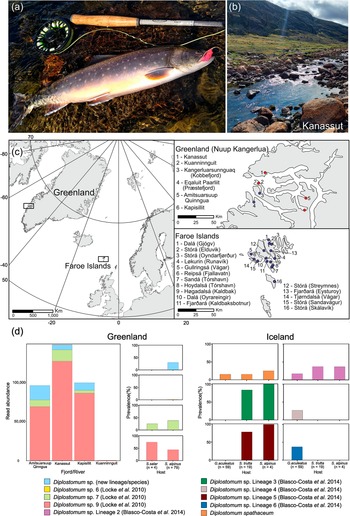
In total, 79 Arctic char and four juvenile Atlantic salmon were sampled across six rivers within the Nuup Kangerlua fjord system, southwest Greenland, from 19 to 26 August 2024 (Table 1). Sampling was authorized by the Ministry of Foreign Affairs, Business and Trade, Government of Greenland (Licence No. G24-063 for the utilisation of Greenlandic genetic resources). Fish were captured using five- to six-weight recreational fly-fishing gear (Vision Fly Fishing, Finland) in the lower reaches of the rivers. Specimens were euthanized by a percussive blow and temporarily stored (for up to eight hours) in sterile plastic bags in a cooler prior to dissection at the laboratory at the Greenland Institute of Natural Resources (GINR). For each individual, total length and body mass were recorded (Table 1), and a single full eye was removed and stored in 96% ethanol (Fig. 1a, b, and c).
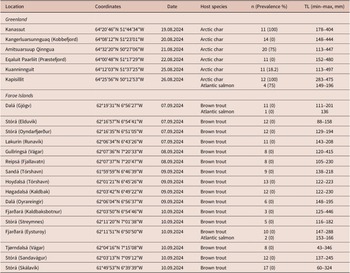
Sampling information of salmonid fish hosts in Greenland (Nuup Kangerlua fjord system) and the Faroe Islands. Site names in Greenland are given in Greenlandic, with old Danish names in brackets. In the Faroe Islands, names refer to stream and location names (in brackets). Streams in the Faroe Islands sharing identical names represent distinct watercourses and were analysed as independent sites. Sample size (n), overall prevalence (%), and total length (TL, mm; minimum–maximum) are provided for each site

Table 1. Long description
Beginning with Greenland, the table lists Kanassut at 64 degrees 20 minutes 46 seconds North 51 degrees 44 minutes 34 seconds West, sampled on 19.08.2024, with Arctic char, 11 specimens, 100 percent prevalence, total length 178 to 404 millimeters. Kangerluarsunnguaq (Kobbefjord) at 64 degrees 08 minutes 12 seconds North 51 degrees 23 minutes 01 second West, sampled on 20.08.2024, Arctic char, 14 specimens, 0 percent prevalence, length 148 to 444 millimeters. Amitsuarsuup Qinngua at 64 degrees 32 minutes 20 seconds North 50 degrees 27 minutes 06 seconds West, sampled on 21.08.2024, Arctic char, 20 specimens, 75 percent prevalence, length 113 to 447 millimeters. Eqaluit Paarliit (Præstefjord) at 64 degrees 00 minutes 48 seconds North 51 degrees 17 minutes 29 seconds West, sampled on 22.08.2024, Arctic char, 11 specimens, 0 percent prevalence, length 152 to 480 millimeters. Kuanninnguit at 64 degrees 12 minutes 03 seconds North 51 degrees 37 minutes 25 seconds West, sampled on 25.08.2024, Arctic char, 11 specimens, 18.2 percent prevalence, length 113 to 497 millimeters. Kapisillit at 64 degrees 25 minutes 56 seconds North 50 degrees 12 minutes 53 seconds West, sampled on 26.08.2024, Arctic char, 12 specimens, 100 percent prevalence, length 283 to 475 millimeters; Atlantic salmon, 4 specimens, 75 percent prevalence, length 149 to 196 millimeters. The Faroe Islands section starts with Dalá (Gjógv) at 62 degrees 19 minutes 31 seconds North 6 degrees 56 minutes 27 seconds West, sampled on 07.09.2024, brown trout, 11 specimens, 0 percent prevalence, length 111 to 201 millimeters; Atlantic salmon, 1 specimen, 0 percent prevalence, length 136 millimeters. Stóra (Elduvik) at 62 degrees 16 minutes 57 seconds North 6 degrees 54 minutes 41 seconds West, sampled on 07.09.2024, brown trout, 12 specimens, 0 percent prevalence, length 88 to 158 millimeters. Stóra (Oyndarfjørður) at 62 degrees 16 minutes 35 seconds North 6 degrees 51 minutes 05 seconds West, sampled on 07.09.2024, brown trout, 12 specimens, 0 percent prevalence, length 129 to 194 millimeters. Løkurin (Runavík) at 62 degrees 06 minutes 34 seconds North 6 degrees 43 minutes 26 seconds West, sampled on 07.09.2024, brown trout, 11 specimens, 0 percent prevalence, length 143 to 208 millimeters. Gullringsá (Vágar) at 62 degrees 07 minutes 36 seconds North 7 degrees 20 minutes 33 seconds West, sampled on 08.09.2024, brown trout, 8 specimens, 0 percent prevalence, length 120 to 415 millimeters. Reipsá (Fjallavatn) at 62 degrees 07 minutes 37 seconds North 7 degrees 20 minutes 47 seconds West, sampled on 08.09.2024, brown trout, 8 specimens, 0 percent prevalence, length 105 to 230 millimeters. Sandá (Tórshavn) at 61 degrees 59 minutes 59 seconds North 6 degrees 46 minutes 39 seconds West, sampled on 09.09.2024, brown trout, 9 specimens, 0 percent prevalence, length 138 to 218 millimeters. Hoydalsá (Tórshavn) at 62 degrees 01 minute 21 seconds North 6 degrees 45 minutes 26 seconds West, sampled on 09.09.2024, brown trout, 13 specimens, 0 percent prevalence, length 122 to 223 millimeters. Høgadalsá (Kaldbak) at 62 degrees 03 minutes 42 seconds North 6 degrees 49 minutes 22 seconds West, sampled on 09.09.2024, brown trout, 12 specimens, 0 percent prevalence, length 122 to 230 millimeters. Dalá (Oyrareingir) at 62 degrees 06 minutes 04 seconds North 6 degrees 56 minutes 37 seconds West, sampled on 09.09.2024, brown trout, 6 specimens, 0 percent prevalence, length 148 to 195 millimeters. Fjarðará (Kaldbaksbotnur) at 62 degrees 03 minutes 50 seconds North 6 degrees 54 minutes 46 seconds West, sampled on 10.09.2024, brown trout, 3 specimens, 0 percent prevalence, length 125 to 446 millimeters. Stóra (Streymnes) at 62 degrees 11 minutes 20 seconds North 7 degrees 01 minute 38 seconds West, sampled on 10.09.2024, brown trout, 5 specimens, 0 percent prevalence, length 116 to 182 millimeters. Fjarðará (Eysturoy) at 62 degrees 11 minutes 51 seconds North 6 degrees 50 minutes 50 seconds West, sampled on 10.09.2024, brown trout, 10 specimens, 0 percent prevalence, length 147 to 288 millimeters; Atlantic salmon, 2 specimens, 0 percent prevalence, length 153 to 166 millimeters. Tjørndalsá (Vágar) at 62 degrees 04 minutes 16 seconds North 7 degrees 15 minutes 08 seconds West, sampled on 10.09.2024, brown trout, 8 specimens, 0 percent prevalence, length 43 to 346 millimeters. Stóra (Sandavágur) at 62 degrees 03 minutes 13 seconds North 7 degrees 09 minutes 12 seconds West, sampled on 10.09.2024, brown trout, 12 specimens, 0 percent prevalence, length 137 to 245 millimeters. Stóra (Skálavík) at 61 degrees 49 minutes 53 seconds North 6 degrees 39 minutes 39 seconds West, sampled on 10.09.2024, brown trout, 17 specimens, 0 percent prevalence, length 60 to 324 millimeters. Each site entry includes location, coordinates, date, host species, sample size with prevalence percentage, and minimum to maximum total length in millimeters.
(a) Arctic char (Salvelinus alpinus) collected at Amitsuarsuup Qinngua, Nuup Kangerlua fjord system (Greenland); (b) Kanassut River, a sampling site within the Nuup Kangerlua fjord system (Greenland); (c) sampling localities in Greenland and the Faroe Islands. Localities with detected infections are indicated by red dots; (d) total read abundance of the four Diplostomum lineages across sampled localities, and the prevalence of each lineage in Greenland, compared with prevalence estimates from Iceland reported by Blasco-Costa et al. (Reference Blasco-Costa, Faltýnková, Georgieva, Skírnisson, Scholz and Kostadinova2014). Additional Diplostomum lineages were described by Locke et al. (2010). N represents the number of sampled individuals.

Figure 1. Long description
Panel a at top left is a photo showing a single Arctic char lying on rocks in shallow water, with a fishing rod above it. Panel b at top right is a landscape photo of the Kanassut River, with rocky banks and mountains in the background, sunlight streaming through clouds. Panel c at bottom left is a map with two insets: the main map shows Greenland and the Faroe Islands with sampling localities marked by numbered dots. The right inset zooms into the Nuup Kangerlua fjord system in Greenland and the Faroe Islands, with red dots indicating sites where infections were detected. Locality names and numbers are listed for both regions, with a scale bar for distance. Panel d at bottom right contains four bar graphs. The largest graph on the left shows total read abundance of four Diplostomum lineages by fjord or river in Greenland, with colored bars corresponding to lineages in the legend below. Three smaller graphs to the right show prevalence percentages for each lineage in Greenland (by host species S. salar and S. alpinus) and Iceland (by host species G. aculeatus, S. trutta, S. alpinus), with colored bars matching the legend. The legend at the bottom identifies each Diplostomum lineage by color and reference. N values for sample sizes are indicated above each bar.
Faroe Island sampling
In total, 161 brown trout and three Atlantic salmon were collected across four islands (Vágar, Streymoy, Eysturoy, and Sandoy) and 16 streams in the Faroe archipelago from 7 to 11 September 2024 in collaboration with the Faroe Islands National Museum. Sampling was conducted in the lower reaches of the streams using five- to six-weight recreational fly-fishing gear (Vision Fly Fishing, Finland; Lauringson et al. Reference Lauringson, Pukk, Hansen and Vasemägi2026). For each individual, total length and body mass were recorded (Table 1), and a single full eye was removed and stored in 96% ethanol (Fig. 1c).
DNA extraction and initial screening
One full fish eye per individual was digested overnight at 56°C in 4 ml of lysis buffer (0.4 M NaCl, 10 mM Tris-HCl, pH = 8, 2 mM EDTA, 2% sodium dodecyl sulphate (SDS)), supplemented with 0.4 ml of 20% SDS and 40 μl of Proteinase K (Thermo Scientific). DNA from the resulting lysate was isolated using a salt-based extraction method (Aljanabi Reference Aljanabi1997). To determine the presence of diplostomid infection, all samples were initially screened using polymerase chain reaction (PCR) and agarose gel electrophoresis. For this, a fragment of the cox1 gene was amplified using Plat-diploCOX1 diplostomid-specific primers (Moszczynska et al. Reference Moszczynska, Locke, McLaughlin, Marcogliese and Crease2009). PCR reactions were performed in a final volume of 10 μl using 2 μl of Hot Firepol® Blend Master Mix (Solis Biodyne), 300 nM of each primer and 100 ng of template DNA. Thermal cycle began with an initial denaturation step of 15 min at 95°C, followed by 30 cycles of denaturation of 30 s at 94°C, annealing for 90 s at 57°C, extension for 90 s at 72°C, ending with a final extension of 10 min at 72°C. PCR products were visualised on a 1% agarose gel stained with ethidium bromide and examined under UV illumination. The initial testing indicated that none of the fish collected in the Faroe Islands were infected, despite successful amplification of positive controls. Furthermore, we validated the high DNA integrity derived from these Faroese individuals by targeting the myxozoan parasite Tetracapsuloides bryosalmonae (Lauringson et al. Reference Lauringson, Pukk, Hansen and Vasemägi2026). Faroese samples were therefore excluded from Next-Generation Sequencing (NGS) library preparation, due to an apparent absence of the parasite.
Library preparation
A total of 83 individuals collected in Greenland, both infected (n = 43) and uninfected (n = 40), were included in the NGS library preparation. To account for potential index hopping, four DNA-negative samples consisting of molecular-grade RNase-free water (Qiagen) were included in the library (Costello et al. Reference Costello, Fleharty, Abreu, Farjoun, Ferriera, Holmes, Granger, Green, Howd, Mason, Vicente, Dasilva, Brodeur, DeSmet, Dodge, Lennon and Gabriel2018). In addition, DNA from the eyes of two Eurasian perch ( Perca fluviatilis ) and two common roach ( Rutilus rutilus ) from Estonia, for which parasite communities have been previously characterised using the same method, was included as positive controls (Diaz-Suarez et al. Reference Diaz-Suarez, Noreikiene, Kahar, Ozerov, Gross, Kisand and Vasemägi2023).
Quadruple-indexed metabarcoding libraries, including all previously described samples, were built using a dual PCR method. In the first PCR, the target amplicon was amplified with a modified version of Plat-diploCOX1 incorporating dual index pairs (internal indices; Moszczynska et al. Reference Moszczynska, Locke, McLaughlin, Marcogliese and Crease2009; Glenn et al. Reference Glenn, Nilsen, Kieran, Sanders, Bayona-Vásquez, Finger, Pierson, Bentley, Hoffberg, Louha, Garcia-De Leon, del Rio Portilla, Reed, Anderson, Meece, Aggrey, Rekaya, Alabady, Belanger, Winker and Faircloth2019). These PCR reactions were performed in a total volume of 10 μl using the 2× QMP reagent (Qiagen Multiplex PCR Kit), containing 0.6 μl of 500 nM of each primer, 5 μl of the master mix, and 80–100 ng of template DNA. Thermal cycling conditions consisted of an initial activation of 15 min at 95°C, followed by 35 cycles of denaturation for 30 s at 94°C, annealing for 90 s at 57°C, extension for 90 s at 72°C, and a final extension for 10 min at 72°C. In the second PCR, an additional dual index pair (external indices) and Illumina sequencing adapters were incorporated through limited-cycle PCR amplification. Reaction conditions were identical to the first PCR, but included 2 μl of the first PCR product instead of template DNA. The limited-cycle PCR comprised an initial activation for 15 min at 95°C, followed by 15 cycles of denaturation for 30 s at 94°C, annealing for 90 s at 60°C, extension for 90 s at 72°C, and a final extension of 10 min at 72°C. To reduce false positives and improve the detection of diplostomid diversity, we performed two PCR replicates (Alberdi et al. Reference Alberdi, Aizpurua, Gilbert and Bohmann2018). Each sample was therefore processed twice, using a unique index combination. In this way, each replicate could be individually traced during bioinformatic analysis. PCR products from the second reaction were pooled and size-selected using AMPure XP beads (Beckman). After purification, pooled libraries were paired-end sequenced with a 300 × 2 paired-read length using a MiSeq sequencer (Illumina Inc., San Diego, CA, USA) at the Uppsala Biomedical Centre (SciLifeLab, Uppsala, Sweden).
Bioinformatic pipeline
Demultiplexing of the external indices and quality testing were performed by SciLifeLab using MultiQC (Ewels et al. Reference Ewels, Magnusson, Lundin and Käller2016). Demultiplexing of the internal indices was performed using cutadapt 5.1 (Martin Reference Martin2011), and paired-end reads were merged using PEAR 0.9.10 (Zhang et al. Reference Zhang, Kobert, Flouri and Stamatakis2014). In order to improve the characterisation of parasite diversity, we combined denoising and clustering methods (Antich et al. Reference Antich, Palacin, Wangensteen and Turon2021; Brandt et al. Reference Brandt, Trouche, Quintric, Günther, Wincker, Poulain and Arnaud-Haond2021). The denoising method consisted of quality filtering based on error rate, removing all sequences with one or more expected errors (--fastq_maxee 1), followed by dereplication, denoising, and chimera filtering using VSEARCH 2.18 (Rognes et al. Reference Rognes, Flouri, Nichols, Quince and Mahé2016). For OTU (Operational Taxonomic Unit) delimitation, the obtained ASVs (Amplicon Sequence Variants) from the denoising method were clustered at 97% similarity using a greedy algorithm in USEARCH (Zhou et al. Reference Zhou, Liu and Li2024). Taxonomic assignment of the resulting 463 bp ASVs and OTUs was performed using four complementary methods. BLASTn 2.15, which is based on sequence similarity (Camacho et al. Reference Camacho, Coulouris, Avagyan, Ma, Papadopoulos, Bealer and Madden2009); SINTAX, a probability-based method implemented in USEARCH (Edgar Reference Edgar2016; Zhou et al. Reference Zhou, Liu and Li2024); IDTAX, a machine learning–based classifier available in the DECIPHER 3.0.0 package for R (Murali et al. Reference Murali, Bhargava and Wright2018; Wright Reference Wright2016); and QIIME2 using a custom-made Bayesian classifier trained with a custom reference database. The custom reference database was assembled using CRABS 1.9 (Jeunen et al. Reference Jeunen, Dowle, Edgecombe, von, Gemmell and Cross2022), including all Diplostomidae cox1 sequences available in NCBI (National Center for Biotechnology Information) and BOLD (The Barcode of Life Data Systems) as of October 2025. The database was curated to retain unique representative sequences, with sizes ranging from 400 to 500 bp in length.
Downstream filtering
An initial filtering step was applied to the count matrix using a 0.01% threshold, given that relative methods generally provide greater reliability than absolute methods (Elbrecht and Leese Reference Elbrecht and Leese2017). Subsequently, to prevent incorrect sequence counts resulting from index hopping, all values equal to or below the mean counts of the most misassigned OTUs (OTU1; mean = 25.3) and ASVs (ASV1; mean = 9.1) across all negative samples were set to zero. To further reduce false positives, all counts not assigned to both replicates were set to zero. Finally, we confirmed that all resulting ASVs were represented in one of the remaining OTUs. ASV2520, which was assigned to Greenland samples, was not included in any OTU assigned to these samples and instead corresponded to OTU11, which was assigned to the positive controls; therefore, it was excluded from downstream analyses. At this stage, replicate counts were summed, and the remaining ASVs and OTUs were retained as real biological entities.
Molecular phylogenies
ASVs were truncated to 405 bp and aligned with one representative of the 44 species/species-level lineages included in Schwelm et al. (Reference Schwelm, Georgieva, Grabner, Kostadinova and Sures2021), the most comprehensive study of Diplostomum diversity to date, together with five additional sequences from NCBI. We also included one sequence of Tylodelphys clavata as an outgroup (Supplementary Table S1). The alignment was performed with the MUSCLE algorithm implemented in the msa package 1.36.1 (Bodenhofer et al. Reference Bodenhofer, Bonatesta, Horejs-Kainrath and Hochreiter2015). A neighbour-joining tree based on Kimura two-parameter model was constructed using ape 5.0 (Paradis and Schliep Reference Paradis and Schliep2019). Furthermore, an additional phylogenetic analysis was performed using Bayesian inference (BI) implemented in MrBayes 3.2.7 (Huelsenbeck and Ronquist Reference Huelsenbeck and Ronquist2001). The best-fitting model of nucleotide substitution was identified as T92 + G + I using MEGA11 (Tamura et al. Reference Tamura, Stecher and Kumar2021). BI analysis was performed using a Markov chain Monte Carlo (MCMC) approach for 3 million generations, with sample frequency of 1,000. Log-likelihood scores were plotted, and only the final 75% of trees were used to produce the consensus tree. The resulting phylogenetic trees were visualised using ggtree 3.12.0 (Yu et al. Reference Yu, Smith, Zhu, Guan and Lam2017).
To study the distribution of intraspecific diversity, two parsimonious haplotype networks were constructed using the pegas 1.2 package (Paradis Reference Paradis2010). One included all ASVs assigned to Diplostomum sp. 9 and Diplostomum sp. 7 (Locke et al. Reference Locke, Daniel Mclaughlin and Marcogliese2010a; Reference Locke, McLaughlin, Dayanandan and Marcogliese2010b), together with all available published sequences to better illustrate their relationship to previously described diversity. The second network included the ASVs that did not closely match any known sequences in NCBI. The distribution of the different lineages across the sampling localities was visualised with ggplot2 2.4 (Wickham Reference Wickham2016).
Results
Prevalence of infection
The eyes of 79 Arctic char and four Atlantic salmon from Greenland, along with 161 brown trout and three Atlantic salmon from the Faroe Islands, were initially screened for diplostomid infection using amplification of the Plat-diploCOX1 fragment (Moszczynska et al. Reference Moszczynska, Locke, McLaughlin, Marcogliese and Crease2009), followed by agarose gel electrophoresis. None of the salmonids from the Faroe Islands showed evidence of diplostomid infection in their eyes. In contrast, samples from Greenland showed infection at four of the six sampling locations, with high prevalence (33.3–100%), occurring in both host species (Table 1).
Diplostomid diversity
Over 23.5 million raw reads were generated across both PCR replicates, of which 2.9 M were retained after demultiplexing and quality filtering. Subsequent denoising generated 351 ASVs, while clustering produced 37 OTUs. After index-hopping filtering and retaining only ASVs and OTUs present in both replicates, 58 ASVs and 12 OTUs were retained. Of those, 32 ASVs (mean number of reads mapped per replicate = 4,328.87) and 6 OTUs (mean number of reads mapped per replicate = 2,385.37) were assigned to the positive controls, while 25 ASVs (mean number of reads mapped per replicate = 4,004.85) and 6 OTUs (mean number of reads mapped per replicate = 3,325.9) were assigned to Greenland samples. Raw Illumina sequencing data are available in NCBI under BioProject accession no. PRJNA1436495, and ASVs are available under accession numbers PZ322951–PZ322975.
Taxonomic assignments did not differ among the BLASTn, SINTAX, IDTAX, and QIIME2 analytical methods (Supplementary Table S2). ASVs and OTUs from the positive controls were assigned to six lineages belonging to the genera Tylodelphys and Diplostomum (Supplementary Figure S1), consistent with previous characterisations of these parasite communities (Diaz-Suarez et al. Reference Diaz-Suarez, Noreikiene, Kahar, Ozerov, Gross, Kisand and Vasemägi2023). The samples from Greenland were assigned to four lineages. The most abundant was Diplostomum sp. 9 (Fig. 1d; Locke et al. Reference Locke, Daniel Mclaughlin and Marcogliese2010a; Reference Locke, McLaughlin, Dayanandan and Marcogliese2010b), comprising seven ASVs and accounting for 82.2% of the total reads. Of these seven ASVs, two have been previously described (ASV1 and ASV2; NCBI accession numbers KR271410 and KR271411; Fig. 2), while the remaining five represent novel haplotypes (PZ322955–PZ322957, PZ322963, PZ322964). The second most abundant lineage included eight ASVs representing 10% of the total reads but was only assigned to the genus level (Diplostomum) and did not match any previously characterised species or lineage (PZ322953, PZ322959, PZ322960, PZ322965, PZ322971, PZ322972, PZ322974, PZ322975). The third most abundant was Diplostomum sp. 7 (Locke et al. Reference Locke, Daniel Mclaughlin and Marcogliese2010a; Reference Locke, McLaughlin, Dayanandan and Marcogliese2010b), which accounted for 7.8% of the reads and included nine ASVs, of which only ASV4 has been previously described (NCBI accession number KR271396), with the remaining eight representing novel haplotypes (PZ322958, PZ322961, PZ322962, PZ322966–PZ322970). Finally, Diplostomum sp. 6 (Locke et al. Reference Locke, Daniel Mclaughlin and Marcogliese2010a; Reference Locke, McLaughlin, Dayanandan and Marcogliese2010b) accounted for 0.02% of the reads and was represented by a single ASV that has been previously described (NCBI accession number KR271394; Supplementary Table S2). However, given the low number of reads and prevalence, these results should be treated cautiously.
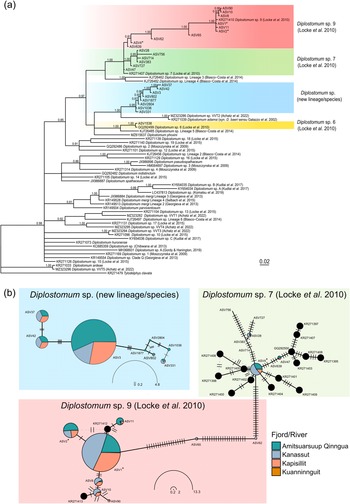
Phylogenetic relationships and haplotype diversity of Diplostomum in Greenland. (a) Phylogenetic reconstructions based on Bayesian inference and cox1 fragments of the novel ASV together with 44 previously characterised Diplostomum linages and Tylodelphys clavata as outgroup. Sequence identification is as in NCBI accession number, followed by the name provided in original publication. Coloured boxes indicate the four lineages containing newly generated ASVs (amplicon sequence variants). (b) Haplotype networks of newly generated ASVs together with available sequences from NCBI. Circle size represents the number of fish infected by each haplotype. Small black lines indicate the number of mutational steps between haplotypes, and colours represent the proportion of each haplotype recovered at each sampling location. ASVs matching previously described haplotypes are marked with an asterisk (*) (ASV1 = KR271410, ASV2 = KR271411, and ASV4 = KR271396).

Figure 2. Long description
The top panel is a vertical phylogenetic tree reconstructed using Bayesian inference of c o x 1 fragments. The tree starts at the base with Tylodelphys clavata as outgroup and branches upward. Four main colored clades are highlighted: red for Diplostomum sp. 9 (Locke et al. 2010), green for Diplostomum sp. 7 (Locke et al. 2010), blue for Diplostomum sp. (new lineage/species), and yellow for Diplostomum sp. 6 (Locke et al. 2010). Each clade contains labeled ASVs and reference sequences, with support values at nodes. The scale bar at the bottom right reads 0.02. The bottom panel contains three haplotype networks, each in a colored box matching the corresponding clade in the tree. The left network (blue) shows circles of varying sizes for each haplotype, labeled with ASV numbers, connected by black lines indicating mutational steps. Circle segments are colored to represent the proportion of each haplotype at four sampling locations: Amitsoq, Kanasut, Kapisillit, and Kuanninnguit, as indicated by the legend. The top right network (green) and bottom network (red) follow the same structure, with labeled ASVs and reference sequences. Asterisks mark ASVs matching previously described haplotypes. Scale bars under each network indicate mutational steps. All text and labels are transcribed as in the original diagram.
The phylogenetic reconstructions based on Bayesian inference clustered Greenland diplostomid ASVs into four clades, but they did not completely match the results obtained from the taxonomic assignment. Specifically, ASV4, ASV62, and ASV639 clustered with Diplostomum sp. 9 rather than Diplostomum sp. 7 (Fig. 2a; highlighted in red and green). The ASVs that were assigned to the genus level (Diplostomum) formed a strongly supported monophyletic clade, clustering with Diplostomum sp. VVT2 (Achatz et al. Reference Achatz, Martens, Kostadinova, Pulis, Orlofske, Bell, Fecchio, Oyarzún-Ruiz, Syrota and Tkach2022) as a sister clade (Fig. 2a, highlighted in blue). The neighbour-joining phylogeny based on cox1 sequences also clustered Greenland ASVs into four clades, but fully matched the taxonomic assignment results, with ASV4, ASV62, and ASV639 clustering with Diplostomum sp. 7 (Supplementary Figure S2). However, both methods supported the presence of the undescribed Diplostomum lineage/species. Genetic similarity analysis based on BLASTn indicated that the closest sequences to the new lineage were Diplostomum adamsi (syn. D. baeri sensu Galazzo et al. Reference Galazzo, Dayanandan, Marcogliese and McLaughlin2002; accession numbers KR271053 and KR271060) and Diplostomum sp. L3 (Rochat et al. Reference Rochat, Paterson, Blasco-Costa, Power, Adams, Greer and Knudsen2022; accession number OP577860), showing 92.66–94.17% sequence identity.
Spatial and host-related distribution of the diplostomid diversity
The three infected Atlantic salmon harboured exclusively Diplostomum sp. 9, whereas Arctic char harboured all four detected lineages. Coinfection was common in char, with 16 individuals (37.2%) infected by two or three lineages and one individual infected by all four lineages (Supplementary Figure S3).
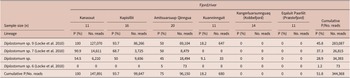
The four diplostomid lineages exhibited distinct distributions across the sampled localities in Greenland. Diplostomum sp. 9 was detected at four of six sites and showed the highest prevalence (33.3–100%) and read abundance (283,087 cumulative reads). The novel lineage/species was likewise present at the same four sites but at lower prevalence (45–54.5%) and read abundance (34,393 reads). Diplostomum sp. 7 occurred at three locations (Kanassut, Kapisillit, Amitsuarsuup Qinngua), with prevalence ranging from 50 to 90.9%, and 26,815 cumulative reads. In contrast, Diplostomum sp. 6, detected only in Amitsuarsuup Qinngua, showed very low prevalence (1.2%, observed in a single fish) and read abundance (73 cumulative reads) (Table 2).
Prevalence (P, %) and total number of sequencing reads (No. reads) of Diplostomum lineages detected in Arctic char from seven rivers in the Nuup Kangerlua fjord system, Greenland. Sample size (n) indicates the number of fish examined per locality. Cumulative values represent overall prevalence and total reads across all localities combined. Prevalence was calculated as the proportion of examined fish infected with a given lineage
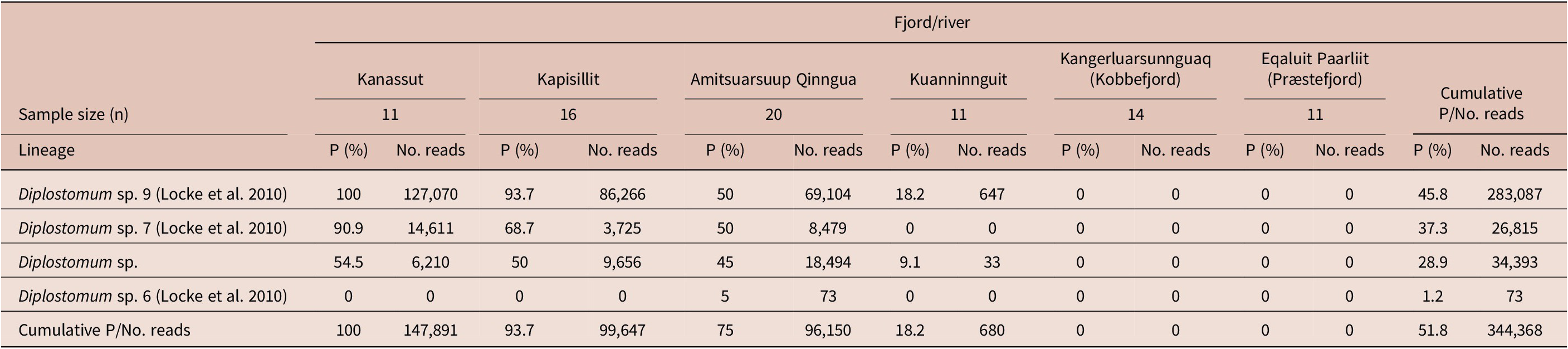
Table 2. Long description
From left to right, columns are Kanassut, Kapisillit, Amitsuarsuup Qinngua, Kuanninnguit, Kangerluarsunnguaq, Eqaluit Paarliit, and cumulative totals. Each river has two subcolumns: P percent and number of reads. The first row lists sample sizes: Kanassut 11, Kapisillit 16, Amitsuarsuup Qinngua 20, Kuanninnguit 11, Kangerluarsunnguaq 14, Eqaluit Paarliit 11. For Diplostomum sp. 9, prevalence and reads are: Kanassut 100 percent 127070, Kapisillit 93.7 percent 86266, Amitsuarsuup Qinngua 50 percent 69104, Kuanninnguit 18.2 percent 647, Kangerluarsunnguaq and Eqaluit Paarliit both 0 percent 0, cumulative 45.8 percent 283087. Diplostomum sp. 7: Kanassut 90.9 percent 14611, Kapisillit 68.7 percent 3725, Amitsuarsuup Qinngua 50 percent 8479, others 0 percent 0, cumulative 37.3 percent 26815. Diplostomum sp.: Kanassut 54.5 percent 6210, Kapisillit 50 percent 9656, Amitsuarsuup Qinngua 45 percent 18494, Kuanninnguit 9.1 percent 33, others 0 percent 0, cumulative 28.9 percent 34393. Diplostomum sp. 6: Amitsuarsuup Qinngua 5 percent 73, others 0 percent 0, cumulative 1.2 percent 73. The final row gives cumulative prevalence and reads per river: Kanassut 100 percent 147891, Kapisillit 93.7 percent 99647, Amitsuarsuup Qinngua 75 percent 96150, Kuanninnguit 18.2 percent 680, others 0 percent 0, overall cumulative 51.8 percent 344368.
The patterns of intraspecific diversity were similar among lineages, each being characterised by the clear dominance of a single, primary ASV. Diplostomum sp. 9 was dominated by ASV1 (corresponding to NCBI accession number KR271410), which was present at the four localities with a frequency of 78.8%, and no rare haplotypes were detected. Diplostomum sp. 7 was likewise dominated by a single haplotype, ASV4 (corresponding to NCBI accession number KR271396), with a frequency of 78.1%, but two rare haplotypes were detected in Kanassut. Finally, the novel Diplostomum sp. Lineage/species was dominated by ASV3, with a frequency of 85.6%, and exhibited four rare haplotypes at Amitsuarsuup Qinngua (Fig. 2b).
Discussion
The current ecological paradigm of diplostomid ecology identifies snails as the primary bottleneck to parasite occurrence, due to their high host specificity and restricted movement (Cribb et al. Reference Cribb, Bray, Olson, Timothy, Littlewood, Littlewood and Bray2003; Faltýnková et al. Reference Faltýnková, Sures and Kostadinova2016; Soldánová et al. Reference Soldánová, Selbach, Sures, Kostadinova and Pérez-del-Olmo2010). This framework assumes that the high vagility of avian definitive hosts offsets local constraints, thereby facilitating large-scale parasite dispersal. However, our findings, combined with available data from the North Atlantic, provide a more nuanced view of these dispersal dynamics, suggesting that avian mobility does not facilitate the long-distance spread of diplostomids with equal efficiency across the North Atlantic. Specifically, our results demonstrate a strong signal of long-distance transport between North America and West Greenland. This suggests that dispersal is more efficient along North American routes than across the oceanic expanse separating Greenland from Iceland and Europe (the East Atlantic Flyway), indicating a predominantly Nearctic origin of Greenland diplostomid parasites. Below, we discuss the biogeographic implications and potential environmental constraints that may limit the extent to which bird-mediated dispersal homogenises parasite communities across large spatial scales (Thieltges et al. Reference Thieltges, Hof, Borregaard, Matthias Dehling, Brändle, Brandl and Poulin2011).
Consistent with the earlier observations of Due and Curtis (Reference Due and Curtis1995) in West Greenland, we found Diplostomum to be frequent parasites of Arctic char in the Nuup Kangerlua fjord system, with infections detected at four out of six localities. The increased taxonomic resolution provided by molecular methods allowed the identification of Diplostomum sp. 9 and sp. 7 (Locke et al. Reference Locke, Daniel Mclaughlin and Marcogliese2010a; Reference Locke, McLaughlin, Dayanandan and Marcogliese2010b) as common lineages in the area, representing their first record in Greenland and extending their known distribution from North America. Additionally, the low snail diversity in the region, with only the planorbid Gyraulus parvus and the lymnaeid Ladislavella catascopium (Horsák et al. Reference Horsák, Horsáková, Samaš, Divíšek, Coles and Nekola2025), suggests that the latter is the most likely host, given that lymnaeids are frequently reported as first intermediate hosts of Diplostomum spp. (Faltýnková et al. Reference Faltýnková, Našincová and Kablásková2007; 2014). Furthermore, Due and Curtis (Reference Due and Curtis1995) also reported spatial variation in Diplostomum infection and proposed that the distribution of this snail species (referred to as Lymnaea vahli) drives the spatial differences in Diplostomum infection, a pattern that may also apply to the Nuup Kangerlua fjord system. However, the sampling localities included in Due and Curtis (Reference Due and Curtis1995) are hundreds of kilometres away, and further research in the Nuup Kangerlua fjord system is needed to confirm this pattern. Our study also provides the first record of Diplostomum sp. 6 in Arctic char, a lineage previously reported only from Fundulus diaphanus and Pimephales notatus in North America (Locke et al. Reference Locke, McLaughlin, Dayanandan and Marcogliese2010b; 2015). In addition, we detected previously undescribed intraspecific diversity within Diplostomum sp. 7 and 9, comprising five and eight cox1 haplotypes, respectively. The discovery of these unique variants, which lack close matches in public databases, underscores that a substantial portion of diplostomid genetic diversity in the Arctic remains undocumented. Furthermore, the presence of distinct diplostomid communities suggests that Greenlandic Arctic char support a parasite fauna that is divergent from that in other North Atlantic regions, including Iceland and Norway (Blasco-Costa et al. Reference Blasco-Costa, Faltýnková, Georgieva, Skírnisson, Scholz and Kostadinova2014; Faltýnková et al. Reference Faltýnková, Georgieva, Kostadinova, Blasco-Costa, Scholz and Skírnisson2014; Reference Faltýnková, Kudlai, Jouet, O’Dwyer, Pantoja and Skírnisson2025; Soldánová et al. Reference Soldánová, Georgieva, Roháčová, Knudsen, Kuhn, Henriksen, Siwertsson, Shaw, Kuris, Amundsen, Scholz, Lafferty and Kostadinova2017). Despite their relative geographic proximity along shared bird migratory routes, West Greenland shares no common lineages with these regions, suggesting that the Denmark Strait likely acts as a barrier to diplostomid dispersal. However, further studies in East Greenland are needed to confirm the Nearctic composition of Greenlandic diplostomid communities, because East Greenland can be a common migratory end-point for birds travelling along flyways from Europe (Lyngs Reference Lyngs2003).
In line with the pronounced differences between Greenlandic and Icelandic/Norwegian diplostomid assemblages, we also identified a novel, putatively species-level lineage within the genus Diplostomum. This lineage exhibits 92.76–94.2% sequence identity to Diplostomum adamsi (syn. D. baeri sensu Galazzo et al. Reference Galazzo, Dayanandan, Marcogliese and McLaughlin2002) and Diplostomum sp. L3 (Rochat et al. Reference Rochat, Paterson, Blasco-Costa, Power, Adams, Greer and Knudsen2022), both previously reported in North America. Specifically, eight ASVs formed a well-supported monophyletic clade in both Bayesian inference and neighbour-joining phylogenetic reconstructions, with the recently described Diplostomum sp. VVT2 as the sister lineage (Achatz et al. Reference Achatz, Martens, Kostadinova, Pulis, Orlofske, Bell, Fecchio, Oyarzún-Ruiz, Syrota and Tkach2022). This finding mirrors recent reports of undescribed Diplostomum lineages from Minnesota (USA) and Alberta (Canada) (Achatz et al. Reference Achatz, Martens, Kostadinova, Pulis, Orlofske, Bell, Fecchio, Oyarzún-Ruiz, Syrota and Tkach2022; McPhail et al. Reference McPhail, Tomusiak, Veinot, Dodds and Hanington2025), further illustrating that our knowledge of diversity within the genus is far from complete (Blasco-Costa et al. Reference Blasco-Costa, Faltýnková, Georgieva, Skírnisson, Scholz and Kostadinova2014; Locke et al. Reference Locke, Al-Nasiri, Caffara, Drago, Kalbe, Lapierre, McLaughlin, Nie, Overstreet, Souza, Takemoto and Marcogliese2015). Furthermore, the detection of this novel lineage with high prevalence (28.9%; 24 of 83 studied fish) and a high number of sequence reads (10%, 34,393 cumulative reads) makes it unlikely that it represents a sampling or PCR artefact. Instead, the presence of such distinct, locally abundant lineages indicates that bird-driven dispersal across the North Atlantic, particularly between West Greenland and Iceland, may not be as efficient at homogenising parasite communities as previously assumed. Thus, our data indicate potential dispersal of diplostomid parasites from North America to Greenland via the American Atlantic Flyway. However, the relatively low prevalence of Diplostomum sp. 7 and 9 in other parts of North America, together with the detection of a novel lineage/species in this study, suggests a limited distribution even within North America itself. For example, Locke et al. (Reference Locke, Al-Nasiri, Caffara, Drago, Kalbe, Lapierre, McLaughlin, Nie, Overstreet, Souza, Takemoto and Marcogliese2015) reported <1% prevalence for lineages Diplostomum sp. 7 and 9 across 600 individuals from six fish species in the St. Lawrence River. This pattern suggests that Arctic char may represent a preferred second intermediate host for these lineages, or that these lineages are largely restricted to higher latitudes. Therefore, fish species predominantly occurring in northern regions, such as gasterosteids, salmonids, and cottids, may harbour currently undescribed diplostomid diversity (Blasco-Costa et al. Reference Blasco-Costa, Faltýnková, Georgieva, Skírnisson, Scholz and Kostadinova2014; Locke et al. Reference Locke, Al-Nasiri, Caffara, Drago, Kalbe, Lapierre, McLaughlin, Nie, Overstreet, Souza, Takemoto and Marcogliese2015).
Dispersal limitation in diplostomids may reflect the complex constraints inherent to their multi-host life cycle. Despite being highly successful, the persistence of diplostomids is inherently fragile, as the free-living stages are highly sensitive to environmental conditions, temporal constraints, and the obligate co-occurrence of suitable host species. Infection experiments have suggested that adult diplostomids survive only briefly within their avian hosts (approximately three weeks; Yurlova Reference Yurlova1989; Field et al. Reference Field, McKeown and Irwin1994; Field and Irwin Reference Field and Irwin1995), and successful transmission requires the presence of suitable snails for miracidial infection. Moreover, egg development is inhibited at low temperatures (Waadu and Chappell Reference Waadu and Chappell1991), and cercarial shedding is markedly reduced below 6°C (Karvonen et al. Reference Karvonen, Paukku, Valtonen and Hudson2003; Morley Reference Morley2020). Together, these constraints suggest that transmission is most likely to occur in breeding grounds of avian hosts during the summer, where environmental conditions and host availability are more favourable. In contrast, transmission in wintering areas is likely limited if suitable snail hosts are absent, if environmental conditions are suboptimal, or if migratory movements exceed the lifespan of the parasite. This is further supported by experimental evidence on cercarial behaviour. Born-Torrijos et al. (Reference Born-Torrijos, Van Beest, Vyhlídalová, Knudsen, Kristoffersen, Amundsen, Thieltges and Soldánová2022) reported higher cercarial activity at 13°C than at 6°C in Diplostomum sp. collected from a subarctic lake in Norway, suggesting adaptation to maximise transmission during short seasonal windows of optimal temperatures. However, further studies on egg development and cercarial shedding in Diplostomum lineages with high-latitude distributions are needed to fully understand parasite transmission in Arctic and Subarctic ecosystems.
This pattern of a ‘short transmission window’ draws an interesting parallel to certain haemosporidian parasites (Plasmodium, Haemoproteus, and Leucocytozoon), where parasite prevalence and community structure are often dictated by the breeding range rather than the wintering grounds of the avian host (Huang et al. Reference Huang, Jönsson and Bensch2020; Pulgarín-R et al. Reference Pulgarín-R, Gómez, Bayly, Bensch, FitzGerald, Starkloff, Kirchman, González-Prieto, Hobson, Ungvari-Martin, Skeen, Castaño and Cadena2019; Sorensen et al. Reference Sorensen, Asghar, Bensch, Fairhurst, Jenni-Eiermann and Spottiswoode2016). It is therefore likely that the definitive hosts of the described Diplostomum lineages are avian species that breed at high latitudes and overwinter in more southern regions. Gulls, terns, and mergansers are well-documented hosts of Diplostomum spp. (Galazzo et al. Reference Galazzo, Dayanandan, Marcogliese and McLaughlin2002; Niewiadomska, Reference Niewiadomska1996), but a broader range of avian taxa has also been suggested (Blasco-Costa et al. Reference Blasco-Costa, Faltýnková, Georgieva, Skírnisson, Scholz and Kostadinova2014; Locke et al. Reference Locke, Drago, Núñez, Souza and Takemoto2020). For example, the divers Gavia immer and G. stellata, the horned grebe Podiceps auritus, and the mergansers Mergus serrator and M. merganser have been proposed for the Icelandic lineages, as they are among the few species that breed in the region and are closely associated with freshwater habitats (Blasco-Costa et al. Reference Blasco-Costa, Faltýnková, Georgieva, Skírnisson, Scholz and Kostadinova2014). We therefore hypothesise that the divers Gavia spp., the red-breasted merganser Mergus serrator, the Arctic tern Sterna paradisaea, and gulls Larus spp. that breed in Greenland (Boertmann Reference Boertmann1994) and utilise freshwater habitats may serve as definitive hosts for Diplostomum sp. 9, sp. 7, and the novel lineage.
Contrary to the expectations of widespread dispersal across the North Atlantic, no evidence of diplostomid infection was found in 161 trout and three Atlantic salmon sampled across four islands in the Faroe Archipelago. This absence is striking given the high parasite diversity documented in Iceland and Norway, the similarity of their snail and fish host communities, and the connection via the East Atlantic Flyway (Blasco-Costa et al. Reference Blasco-Costa, Faltýnková, Georgieva, Skírnisson, Scholz and Kostadinova2014; Faltýnková et al. Reference Faltýnková, Georgieva, Kostadinova, Blasco-Costa, Scholz and Skírnisson2014; Reference Faltýnková, Kudlai, Jouet, O’Dwyer, Pantoja and Skírnisson2025; Gíslason Reference Gíslason2005; Soldánová et al. Reference Soldánová, Georgieva, Roháčová, Knudsen, Kuhn, Henriksen, Siwertsson, Shaw, Kuris, Amundsen, Scholz, Lafferty and Kostadinova2017). Parasite assemblages are generally expected to reflect local host availability (Locke et al. Reference Locke, McLaughlin and Marcogliese2013; Poulin Reference Poulin2010), and A. balthica is common in the Faroe Islands (Fog Reference Fog, Spärck and Tuxen1971; Michal Horsák, pers. comm.), the primary first intermediate host for Diplostomum spp. in Iceland and Norway (Blasco-Costa et al. Reference Blasco-Costa, Faltýnková, Georgieva, Skírnisson, Scholz and Kostadinova2014; Faltýnková et al. Reference Faltýnková, Georgieva, Kostadinova, Blasco-Costa, Scholz and Skírnisson2014; Reference Faltýnková, Kudlai, Jouet, O’Dwyer, Pantoja and Skírnisson2025; Soldánová et al. Reference Soldánová, Georgieva, Roháčová, Knudsen, Kuhn, Henriksen, Siwertsson, Shaw, Kuris, Amundsen, Scholz, Lafferty and Kostadinova2017). Likewise, brown trout, widely distributed in the archipelago, are a well-documented second intermediate host for diplostomids (Blasco-Costa et al. Reference Blasco-Costa, Faltýnková, Georgieva, Skírnisson, Scholz and Kostadinova2014; Kristmundsson and Richter Reference Kristmundsson and Richter2009; Vlasenko et al. Reference Vlasenko, Sokolov, Izotova, Ieshko, Belikova, Parshukov, Kashinskaya and Solovyev2026). Thus, our findings indicate that the presence of suitable first and second intermediate hosts alone appears to be insufficient to ensure parasite establishment and further suggest that the ‘short transmission window’ may play a critical role in this distributional gap. In particular, very few piscivorous avian species associated with freshwater environments, most notably divers (Gavia spp.) and mergansers (Mergus spp.), breed in the Faroe Islands, while the overwintering locations for some species, such as red-throated divers, are primarily marine (Olofson and Pólsdóttir Reference Olofson and Pólsdóttir2022). The predominance of marine habitat use is critical, as habitat-specific partitioning by birds strongly influences trematode transmission dynamics, even at small spatial scales (Byers et al. Reference Byers, Malek, Quevillon, Altman and Keogh2015; Resetarits and Byers Reference Resetarits and Byers2023). Thus, the scarcity of breeding avian hosts associated with freshwater environments may constrain local transmission, thereby preventing parasite persistence. On the other hand, both terns and Larus spp. are present in the Faroes, yet their role as effective definitive hosts may be limited by a lack of seasonal overlap with freshwater habitats during the critical parasite transmission window. This suggests that while these bird species are capable of transporting parasites, the lack of freshwater-focused residency in the Faroes may create a disconnect in the life cycle, preventing successful transmission from avian hosts to the local snail and fish populations.
In addition to the potential restriction on parasite dispersal mediated by the ‘short transmission window’, the characteristics of fish and snail communities may also play a role in parasite establishment. For example, snail densities strongly influence transmission rates (Selbach et al. Reference Selbach, Soldánová, Feld, Kostadinova and Sures2020; Voutilainen et al. Reference Voutilainen, Valdez, Karvonen, Kortet, Kuukka, Peuhkuri, Piironen and Taskinen2009), and the small, oligotrophic streams with intermittent flow regimes in the Faroes may support lower snail densities compared to lacustrine environments. In addition, although diplostomids utilise a broad range of fish species (Chappell Reference Chappell1995), the level of infection can vary greatly, and the maintenance of local populations often relies on a few key species (Poulin Reference Poulin2005). Previous research has shown that infection intensities in Arctic char can be ten times higher than in brown trout, suggesting that the latter may possess higher resistance (Blasco-Costa et al. Reference Blasco-Costa, Faltýnková, Georgieva, Skírnisson, Scholz and Kostadinova2014; Kristmundsson and Richter Reference Kristmundsson and Richter2009). Nevertheless, considering the high detection sensitivity of amplification-based methods and the substantial sample size, it is unlikely that low parasite burden in Faroese brown trout alone accounts for the total lack of diplostomid detections in this study. Statistically, if the true prevalence were as low as 5%, the probability of failing to detect a single positive case among 161 samples would be less than 0.0003 (P <0.001, binomial distribution). This suggests that our results reflect a genuine ecological absence of infection among Faroese salmonids rather than a sampling artefact. However, expanded surveys targeting additional host taxa in lacustrine environments (e.g., sticklebacks) are necessary to confirm whether this apparent distributional gap extends across all freshwater habitats in the Faroe Islands.
To conclude, this study highlights substantial gaps in our understanding of the factors governing parasite distribution in high-latitude freshwater ecosystems in the North Atlantic. The observed biogeographic fragmentation is consistent with limited long-distance dispersal via bird migration between North Atlantic regions, although environmental constraints may also contribute to patterns of community assembly. Our findings suggest that even when suitable intermediate hosts are present, the successful establishment of diplostomids may also be constrained by specific avian migration routes and the narrow seasonal windows for transmission in the Arctic. Consequently, diplostomid communities across the North Atlantic exhibit considerable regional isolation rather than forming a continuous, highly connected bird-mediated network, underscoring the need for further exploration of these remote and rapidly changing environments.
Supplementary material
The supplementary material for this article can be found at http://doi.org/10.1017/S0022149X26101631.
Acknowledgements
We would like to thank Claus Damgaard and the Greenland Institute of Natural Resources (GINR) for logistical support, as well as Jón Aldará (Faroe Islands National Museum) and Lis Mortensen (The Faroese Geological Survey) for their valuable assistance. We express our special appreciation to Vision Fly Fishing for providing the fishing gear and outerwear used during fieldwork. We acknowledge the resources provided by the National Academic Infrastructure for Supercomputing in Sweden (NAISS) at the PDC Center for High Performance Computing, on the Dardel system under projects NAISS 2025/5-224 and 2025/6-155.
Financial support
This study received Transnational Access funding from INTERACT III under the European Union’s Horizon 2020 Grant Agreement No. 871120 and from the Estonian Research Council (Grant Nos. PSG849 and PRG3078).
Competing interests
The authors declare no conflicts of interest.
Ethics statement
Fish sampled in the study were euthanised in accordance with the principles described in ‘Directive 2010/63/EU of the European Parliament and of the Council of 22 September 2010’ on the protection of animals used for scientific purposes.


 Open access

