


Ideological polarization across party lines in the mass public has become a pervasive feature of American politics in recent decades. Although the causes and consequences of such ideological polarization have been widely studied (e.g., McCarty, Poole, and Rosenthal Reference McCarty, Poole and Rosenthal2016), another emerging trend is also dividing the American public: educational polarization. As documented most recently by Grossmann and Hopkins (Reference Grossmann and Hopkins2024), a “diploma divide” has emerged between Republican and Democratic voters in the United States. Since 2000, a majority of white Americans without college degrees have identified with the Republican Party, and white Americans with college degrees have increasingly identified with the Democratic Party. This relationship between college education and party identification has mapped into voting behaviors, most notably in presidential elections.
More broadly, Grossmann and Hopkins (Reference Grossmann and Hopkins2024) document behaviors and attitudes—including support for progressive policy agendas and respect for policy and technical expertise— that are correlated with college attendance and are increasingly correlated with party affiliation. Hence, diverging outlooks across the parties, such as their deference to academic expertise and their trust in institutions more broadly, may arise organically from the parties’ core constituencies, which differ substantially in their patterns of college attendance.
To what degree is this polarization by degrees reflected among political elites like members of the US Congress and with what effects? This may seem like a naïve question, given that nearly all members of Congress serving since the 1980s have college degrees. Hence, it seems unlikely that a substantial dividing line between Republicans and Democrats in Congress would be based on college attendance.Footnote 1 However, not all higher education experiences are the same. Attending certain institutions of higher learning might facilitate the creation of professional opportunities and influence politicians’ views in ways that do not follow from attending other educational institutions.
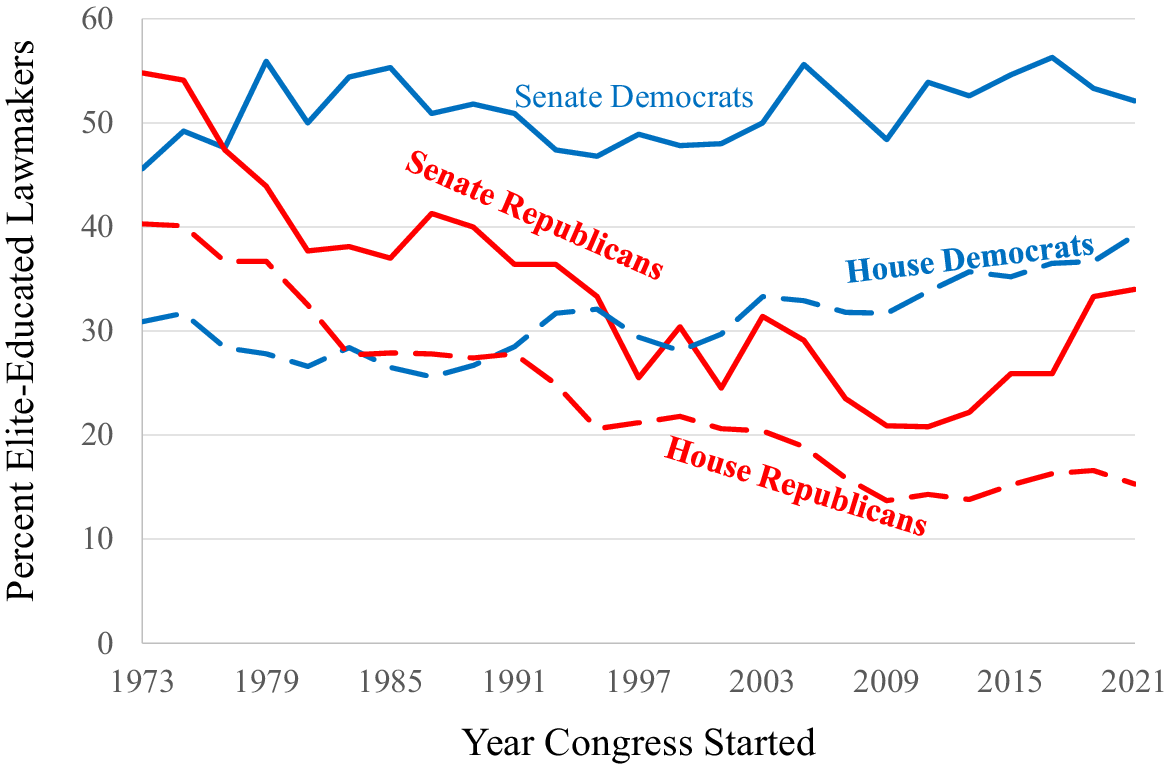
Drawing on data on legislators’ educational backgrounds between the 93rd and 117th Congresses (1973–2023), we demonstrate that a sharp divide has emerged between Republicans and Democrats in Congress in the kinds of institutions they attended for their undergraduate and graduate degrees. Whether due to ideological biases of American universities (e.g., Abrams and Khalid Reference Abrams and Khalid2020) or to Republican voters turning a skeptical eye to elite-educational experiences (e.g., Gift and Lastra-Anadón Reference Gift and Lastra-Anadón2018), since the 1970s the percentage of Republicans in Congress who attended elite institutions has fallen substantially. Whereas 40% of Republican representatives hailed from top colleges, universities, and professional schools a half-century ago, today that rate is 15%. In the Senate, the drop has been from 55% to 35%. In contrast, the proportion of elite-educated Democrats in Congress has been relatively constant over time, if not increasing: more than 50% of Democratic senators and nearly 40% of Democratic representatives attended elite educational institutions.
We argue that such differences are meaningful, perhaps especially when political and educational institutions are being targeted by the Trump administration. In this reflection, we establish that elite educational partisan differences correspond with several other observable patterns in the US Congress over recent decades. First, for both Democrats and Republicans, elite-educated lawmakers are more ideologically liberal than their counterparts. Second, whereas elite-educated Democrats in the House have been more effective as lawmakers than have others, such patterns do not hold for Republicans in either the House or the Senate. Finally, Republicans without elite-educational backgrounds may have a less-consensual outlook on political compromise, as evidenced by only 10% of the partisan warrior “Gingrich Senators” (Theriault Reference Theriault2013) having elite educational backgrounds during the key polarizing era of the 1990s.
We argue that political scientists may find value in turning our attention to the causes and consequences of governance by elite-educated politicians.Footnote 2 Outside the United States, it has been well documented that elite politicians are often connected by similar backgrounds and experiences, including their educational paths. In the United Kingdom, for example, attending Eton and then Oxford has often helped facilitate a channel to political leadership. In Japan, members of the Diet and leaders in the bureaucracy have often attended the University of Tokyo. By highlighting notable partisan distinctions between the educational experiences of political elites in the United States, we suggest one reason why members of opposite parties may find it increasingly difficult to cultivate common networks or philosophical outlooks, with implications for policy making and American governance.
Moreover, the findings that we present here suggest a reinforcing set of likely permanent changes in the Republican Party in Congress. Elite-educated Republicans tended to be ideologically out of step (e.g., Canes-Wrone, Brady, and Cogan Reference Canes-Wrone, Brady and Cogan2002) with the rightward shift of the Republican Party but gain no other offsetting benefits, such as greater lawmaking effectiveness, that might enhance their electoral viability. Over time, these members have been replaced in no small part by a more conservative set of partisan warriors who are less likely to share common educational ties with their Democratic counterparts. Such changes may help explain the broad anti-institutional tendencies—especially those that include open hostility to elite educational institutions—that are evident among many Republican leaders today.
In essence, recent decades may have ushered in a transformation from a system of two parties with leaders who have relatively similar educational experiences to two parties whose leaders have notably different educational experiences, which are both reflective of and reinforced by the educational polarization among their core constituencies. The rise of populism within the Republican Party might have been slower and less profound had there been greater congressional resistance to its anti-elite tendencies. Coupled with the social divergence among public supporters of each party (e.g., Mason Reference Mason2018), the divergence in backgrounds across members of Congress suggests that overcoming current partisan divides may be increasingly difficult.
Measuring the Decline in Elite-Educated Republicans
To capture the decline of elite-educated Republicans and to begin exploring its consequences, we gathered details on the educational backgrounds of every member of the US House and Senate who served in the 93rd–117th Congresses (1973–2023). Our data include their undergraduate institution, as well as where they attended law school, business school, or some other graduate or professional school such as medical school. Drawing on these data, we categorized legislators based on whether they earned a degree from an elite educational institution.
There are several potential ways to categorize higher education institutions as “elite” or “non-elite.” One possibility is to focus solely on those schools that are historically recognized as being highly selective and elite, such as the eight “Ivy League” institutions. Relying solely on such a categorization, however, would surely lead to the exclusion of numerous universities and colleges that, according to reasonably objective criteria, would qualify as being highly selective but that lack the historical cachet to obtain such a designation.
Another approach is to directly measure the qualities of institutions’ student cohorts by focusing on metrics such as schools’ average admissions (e.g., SAT) test scores for their applicants and their average acceptance rates across cohorts and then to use these data to categorize schools as being elite or non-elite. Although such data could help identify the relative selectivity of a school, neither metric is ideal for our purposes. Focusing on average admissions rates might be an improper proxy for school academic rigor or selectivity, because there could be quite a bit of self-selection in the applicant pool that might influence acceptance rate statistics, and average admissions test scores are not publicly accessible for all schools over a substantial period of time.
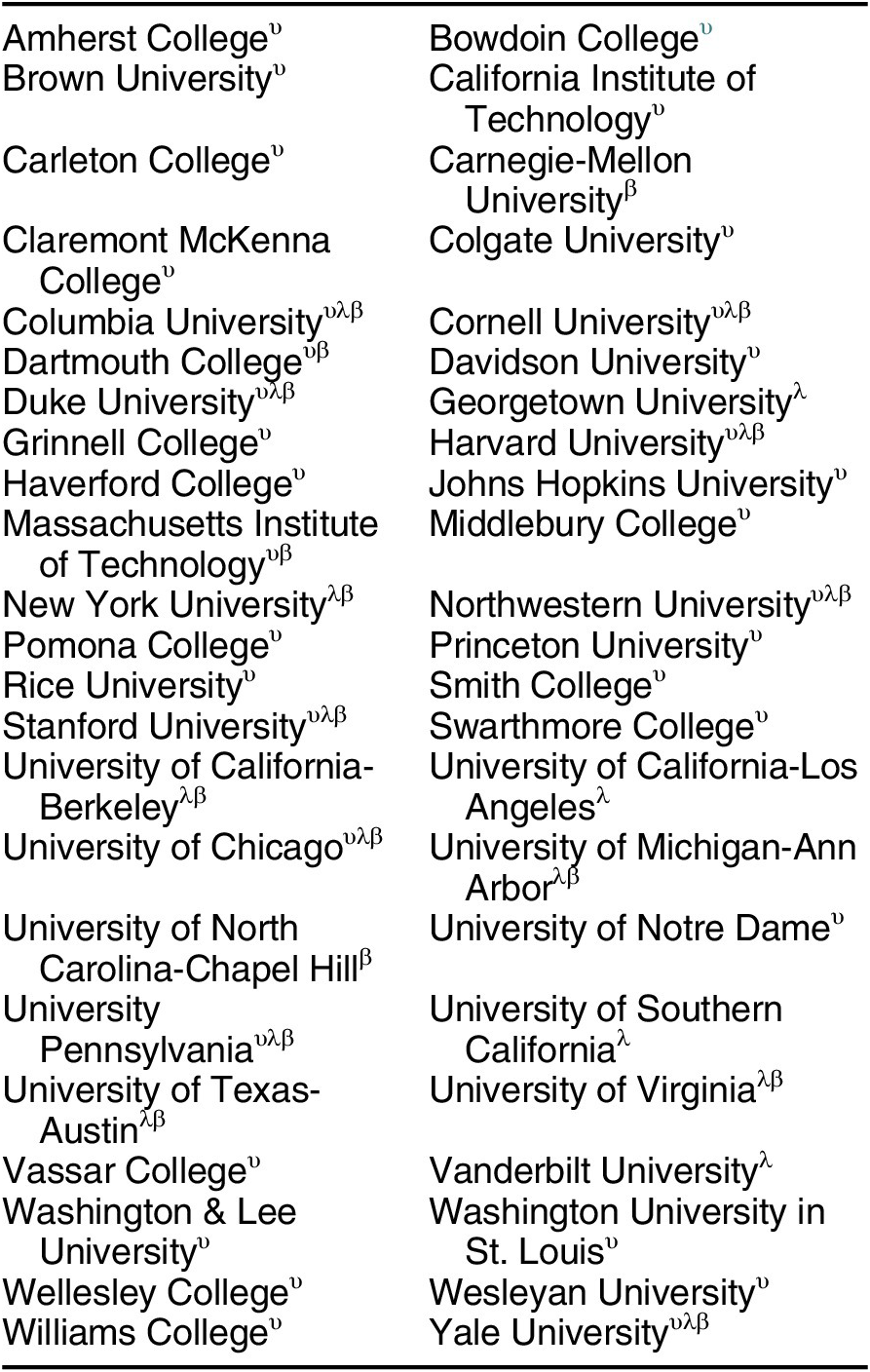
Our measurement strategy embraces this broader definition of elite education in spirit but sidesteps some of the complications just noted. We build on the coding protocol used by Wai (Reference Wai2013) in his study of American high achievers and leaders, which focused on the test scores of median students as reported in the 2013 US News and World Report Rankings (where the median student at elite schools scored in the top percentile of all test takers). Because our data on members of Congress go further back than 2013, and because test score medians are not reported in many earlier years, we modified Wai’s approach. After determining that Wai’s list corresponded most closely to the “top 20” colleges and universities in the overall US News rankings, we identified every top 20 college and university in those rankings between 1987 and 2009, the top 20 law schools between 1987 and 2003, and the top 20 business schools between 1991 and 2009 (business schools were not ranked in the 1980s). We then labeled as “elite” any educational institution that was in the top 20 for more than 75% of such rankings.Footnote 3 Although there may be small changes in what is considered an “elite” institution over time, our coding protocol follows Cole’s (Reference Cole2009, 33–34) observation that these rankings are generally quite consistent over large periods of time and are robust to the use of different ranking criteria. The top 20 list of elite educational institutions is presented in table 1.
List of Elite Educational Institutions

υ Undergraduate/graduate school, λlaw school, βbusiness school.
A quick inspection of table 1 illustrates how many of the most prestigious academic institutions in the United States are found on our list of elite educational institutions. Every school in the Ivy League, for example, is included, as are highly prestigious liberal arts colleges (e.g., Williams College) and several prestigious public flagship institutions (e.g., the University of Virginia). Combining these data, we code a representative or senator as having attended an elite educational institution if he or she attended an elite undergraduate or graduate institution or an elite law school or business school, as defined earlier.Footnote 4 In auxiliary analyses reported next, we likewise explored the robustness of our results when accounting for alternative ways to code for a legislator having attended an elite institution.
Using these data, striking patterns emerge regarding the presence of elite-educated members of Congress over recent decades, as illustrated in figure 1. First, a notably larger percentage of senators have acquired degrees from elite institutions than have representatives. Across the entire sample, approximately 44% of senators earned a degree from an elite institution, compared to approximately 26% of representatives. Second, the percentage of elite-educated Democrats generally held steady over the last half-century and, in fact, even increased. In 1973, nearly half of Senate Democrats held elite degrees, with that rate rising above 50% recently. For the House, elite-educated Democrats grew from around 30% to now nearly 40%. This steady or increasing level of elite educational attainment is even more remarkable given the changing demographics of the Democratic Party in Congress. Along with the increase in the number of Democratic women and minorities, one might have expected a decline in elite-educated Democrats, because these groups were traditionally underrepresented in elite educational institutions.Footnote 5
Decline in the Percentage of Elite-Educated Republicans in Congress

Third, and in stark contrast, the percentage of elite-educated Republicans declined significantly since 1973. In the House, elite-educated Republicans dropped from 40% of the party in the 93rd Congress (1973–75) to just 15% in the 117th (2021–23), about one-third of its former value. In the Senate that drop was from more than half of all Republicans having elite-educated backgrounds in the 1970s to less than one-third recently.Footnote 6 As such, the partisan gap is now substantial in both the House and Senate.Footnote 7
Although we focus here on the US Congress, it is informative to briefly note partisan patterns across other branches of government. No major partisan difference across elite educational attendance appears among members of the Supreme Court (where every current sitting Justice other than Trump-nominated Justice Amy Coney Barrett attended an “elite” law school).Footnote 8 However, the Republican–Democrat divide does emerge in other political contexts at the federal level. Recent observers of the Biden and first Trump administrations, for example (e.g., Lippman Reference Lippman2021), pointed to how approximately 42% of Biden White House top staffers had Ivy League degrees, whereas only 21% of top staffers in the first Trump administration’s White House had graduated from Ivy League institutions. Our own analysis of presidents’ cabinets over the past 50 years likewise points to the emergence of Republican–Democratic differences in attending elite institutions. Although at least 55% of the cabinet members of each of the Nixon, Ford, and Reagan administrations had graduated from elite institutions, only 47% of George W. Bush’s administration’s cabinet and only 33% of the cabinet members in President Trump’s first term had done so. In contrast, 56% and 58% of the Clinton and Biden cabinets, respectively, and more than 70% of Obama’s cabinet had earned degrees from elite institutions.
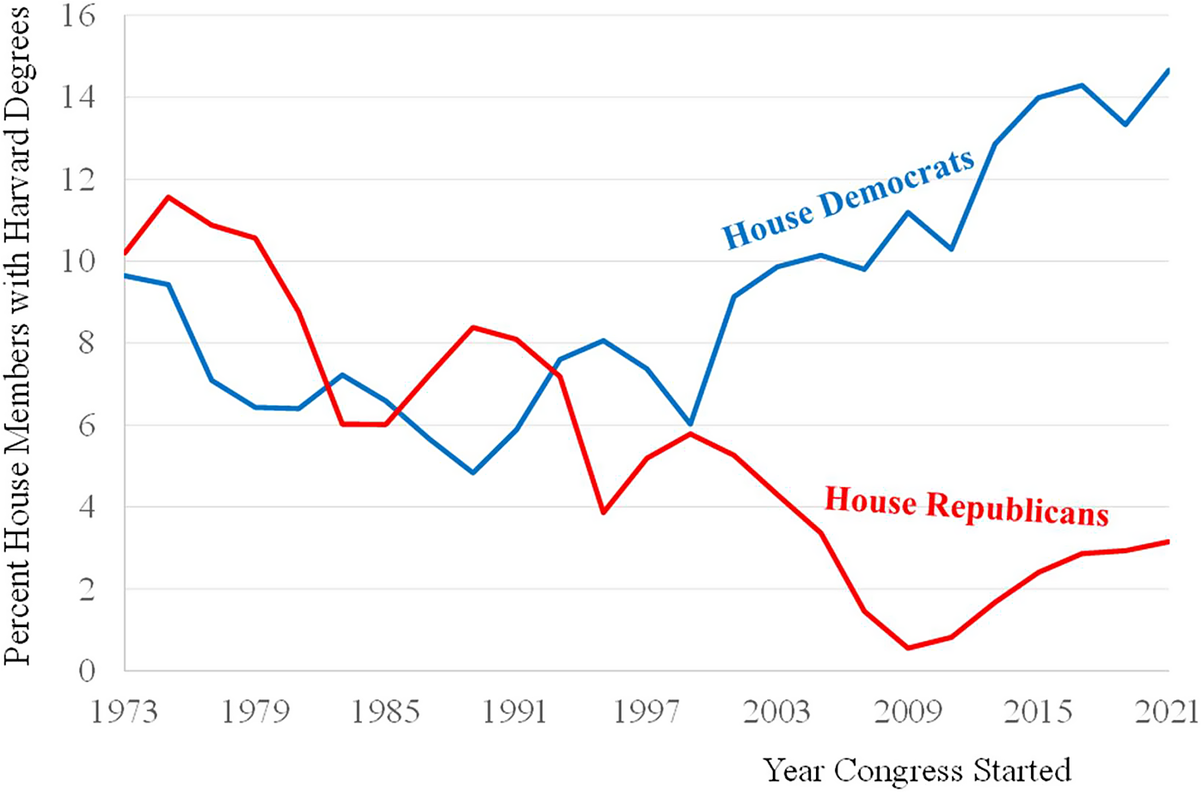
Turning to Congress, some specific educational institution examples illustrate the trends undergirding these broad partisan differences. Figure 2, for instance, shows the rise in House Democrats with Harvard degrees (combining undergraduate and graduate education) compared to the drop for Republicans. Whereas the parties were relatively comparable in the 93rd Congress (which began in 1973) with 10.2% of Republicans and 9.6% of Democrats having obtained a Harvard degree, by the 117th Congress (which began in 2021), we see that nearly 15% of Democrats in the House had obtained a Harvard degree in contrast to only 3% of House Republicans.
Harvard Graduates in the House, by Party

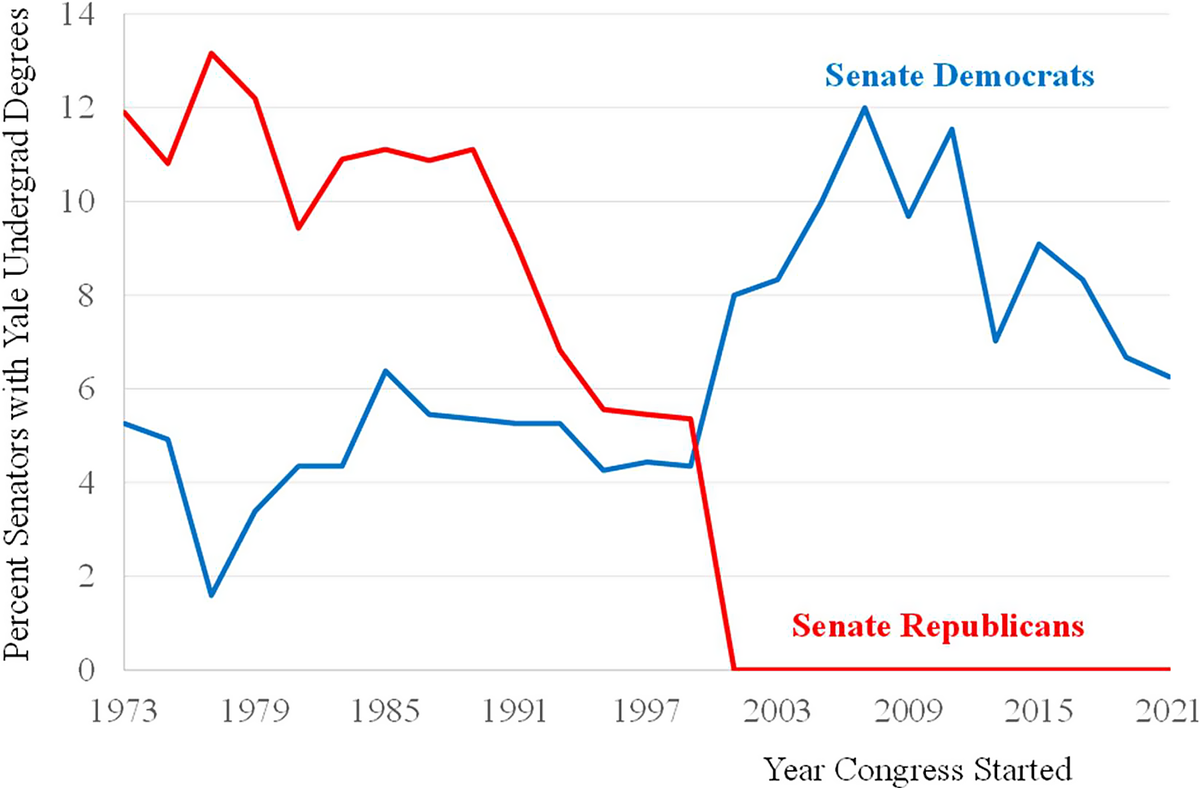
Similarly stark findings can be found in figure 3, which illustrates the percentage of Republicans and Democrats who served in the Senate between 1973 and 2023 and who obtained an undergraduate degree from Yale. Whereas it was more common for Republican senators to graduate from Yale in the 1970s compared to Democrats (12% vs. 5%), those relationships had reversed dramatically by the beginning of the Biden administration in 2021. In fact, we see that no Republican senator serving in the Senate since 2001 earned an undergraduate degree from Yale.Footnote 9 Appendix figures A1 and A2 illustrate the ways in which Republican representatives’ and senators’ decrease in elite school attendance has corresponded, to a partial degree, with an increase in their attendance at non-elite, public flagship institutions over the past 50 years.Footnote 10
Yale Undergraduate Degrees in the Senate, by Party

Thinking more broadly about the patterns shown in figure 1, we argue that the electoral and candidate-recruitment implications behind this gap are worthy of further study. For example, given that elite college attendance is correlated with parental and neighborhood income (Chetty et al. Reference Chetty, Friedman, Saez, Turner and Yagan2020), these data suggest that the Republican Party has started to draw on candidates from more socioeconomically diverse backgrounds in recent years to a greater degree than have Democrats.Footnote 11 Moreover, voter preferences across parties in favor of elite-educated candidates may be changing, such that Republican constituencies might be less supportive of candidates who have attended elite institutions. Indeed, recent observers (e.g., Paul Reference Paul2024) have pointed to how prominent Republicans such as Florida governor (and former representative) Ron DeSantis (educated at Yale and Harvard), and Vice President (and former senator) J. D. Vance (educated at Yale) have deemphasized or even disparaged their elite educational credentials when campaigning.Footnote 12 Our current explorations, however, center on legislative behaviors—in terms of ideology, lawmaking effectiveness, and early partisan warriorship—rather than on electoral considerations.Footnote 13
Elite-Educated Legislators Are More Liberal
Whether due to selection or socialization, those who attend elite colleges and universities may emerge into their chosen professions differently than do others. Sometimes such possibilities are viewed with concern or trepidation. Thomas Jefferson, for example, argued for founding the University of Virginia as an alternative to sending young Virginians to Harvard, which “will return them to us fanatics and tories” (Meacham Reference Meacham2012, 469). And conservative thinker William F. Buckley Jr. commonly quipped, “I’d rather entrust the government of the United States to the first 400 people listed in the Boston telephone directory than to the faculty of Harvard University” (quoted in Shaw Reference Shaw2011).
To explore ideological differences linked to educational backgrounds, we rely on roll-call-based scaling through DW-NOMINATE scores (i.e., Poole and Rosenthal Reference Poole and Rosenthal1997), as is standard in the legislative politics literature.Footnote 14 DW-NOMINATE scores cardinally rank members of the House and Senate on a scale from -1 to +1, where lower values are interpreted to mean more liberal positions. The scores are calculated based on representatives’ and senators’ voting decisions on publicly observable roll-call votes in Congress.Footnote 15 Analyzing who votes together on which side of bill proposals can identify more moderate and extreme positions. Hence, a representative who has a DW-NOMINATE score at -0.5 would be viewed as being notably more liberal than a representative with a DW-NOMINATE score of 0.25.
Drawing on these data, we begin our analysis by estimating an ordinary least squares regression, where the dependent variable is a legislator’s DW-NOMINATE score and the key independent variable is an indicator of an elite educational background. We also control for numerous individual and institutional considerations that might be correlated with a legislator’s ideology, including the lawmaker’s party status, committee and subcommittee chair positions, seniority, gender, race and ethnicity, and vote share in the previous election. Descriptive statistics for these variables are presented in appendix table A1 (Volden et al. Reference Volden, Wai and Wiseman2025).
Our detailed results for the House and Senate are presented in appendix tables A2 and A3, respectively. The models in table A2 show that those Republican and Democratic representatives who attended elite educational institutions are notably more liberal than their co-partisans who did not attend these institutions. Such an effect is particularly significant (substantively and statistically) for Republicans. These differences are statistically significant, and they are robust to the inclusion of a wide range of covariates, as well as controlling for Congress-level fixed effects, which helps account for the changing mix of lawmakers over time. The results in table A3 paint a substantively similar picture for the US Senate: senators of both parties who attended elite educational institutions are more liberal than their co-partisans who did not attend such institutions.Footnote 16 Once again, these effects are particularly pronounced among Republicans.
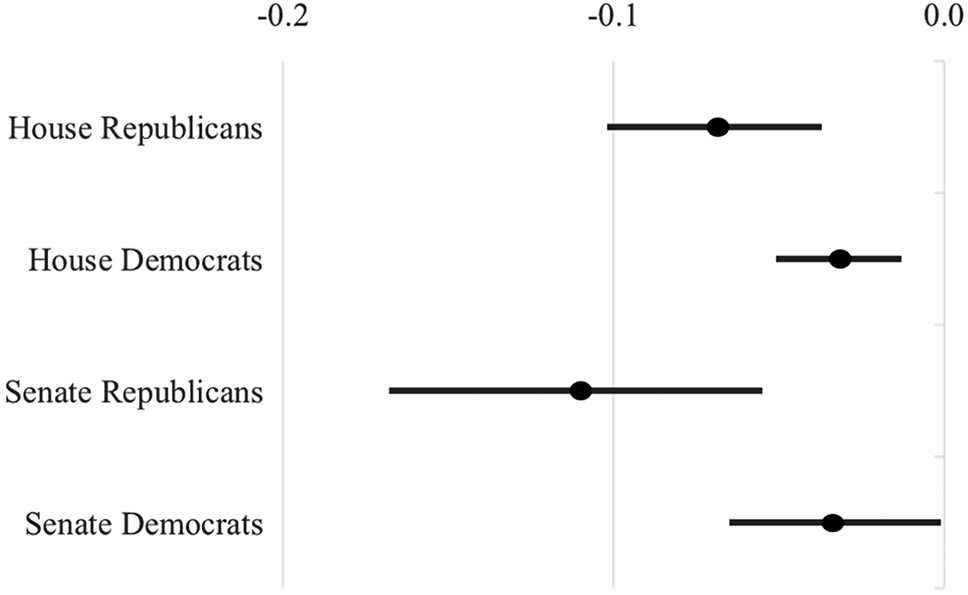
These results are presented graphically in figure 4. Given the level of variance in the ideology within each party, we find that elite-educated House Republicans are about half of a standard deviation more liberal than other House Republicans, whereas elite-educated Senate Republicans are nearly two-thirds a standard deviation more liberal than their counterparts.Footnote 17 As demonstrated in tables A2 and A3, these effects are comparable in size to the degree that Republican women in the House and Senate are more liberal than their male counterparts. During an era of increasing polarization, such differences indeed place elite-educated Republicans out of step with the direction in which their party was moving.
Elite-Educated Lawmakers Are More Liberal
Note: Coefficients and 95% confidence intervals resulting from regressions of DW-NOMINATE score on an Elite Education indicator along with numerous control variables. Full results can be found in models A2.2, A2.5, A3.2, and A3.5 in appendix tables A2 and A3. In all cases, we find that elite-educated members of Congress are more liberal than their peers.

As shown in the supplemental appendix, these results are robust to the inclusion of additional variables, such as indicators for different regions of the country (tables A5 and A6), accounting for the decline of congressional Republicans in the Northeast and their increased numbers in the more conservative South.Footnote 18 These results are also substantively identical to those obtained if we control solely for whether a legislator attended an Ivy League school (tables A7 and A8), rather than any of the elite institutions listed in table 1.
Moreover, in auxiliary analysis, we explored the robustness of these results to using alternative methods to measure whether a legislator had attended an elite institution. First, we focused solely on whether a legislator had attended an elite undergraduate institution (as categorized in table 1), disregarding their professional school or other graduate school attendance. Second, we focused solely on whether a legislator had attended an elite undergraduate university (disregarding whether they had attended an elite undergraduate liberal arts college or graduate or professional school). Third, we recategorized our elite variable to exclude liberal arts colleges altogether. In other words, we categorized a legislator as having attended an elite institution if she had attended an elite university (as identified in table 1) for her undergraduate years; or attended an elite law school, business school, or other graduate school; or both—but colleges such as Williams College or Carleton College were no longer categorized as being “elite.” As shown in table A4, the results from these analyses, with respect to the magnitude and statistical significance of the coefficients on ideology, are substantively similar to those reported in tables A2 and A3.
Finally, we created a new variable, which measured the total number of elite educational institutions that the legislator had attended.Footnote 19 Results from this analysis (also presented in table A4) suggest that those Republicans and Democrats who attend more than one elite institution across their educational experiences are, ceteris paribus, more liberal than those who attend fewer (or no) elite educational institutions.
Elite-Educated Republicans Are No More Effective
A second legislative characteristic that may be linked to elite education is lawmaking effectiveness. On the one hand, elite-educated leaders may positively influence the outcomes of their organizations, akin to the patterns Wai and Rindermann (Reference Wai and Rindermann2015) find among Fortune 500 CEOs. On the other hand, if there is an electoral bias favoring elite-educated candidates, they may be held to lower standards on such traits as lawmaking or representational effectiveness, following a logic similar to Anzia and Berry’s (Reference Anzia and Berry2011) findings for women in Congress.
For our purposes, we explore whether elite-educated members of Congress exhibit greater lawmaking effectiveness according to Volden and Wiseman’s (Reference Volden and Wiseman2014; Reference Volden and Wiseman2018) Legislative Effectiveness Scores (LES). These scores are based on publicly available data on all public bills (H.R. or S. bills) that were introduced by members of the US House and Senate from the 93rd Congress until the present day. For each legislator, the scores identify how many bills the lawmaker introduced and how many of their sponsored bills received any sort of action in committee, action beyond committee, passed their parent chambers of origin, or became law. Additionally, each bill is coded for its relative substantive significance (either commemorative, substantive, or substantive and significant). Drawing on 15 bill–member indicators (five status steps and three substantive significance levels for each bill), the LES captures a weighted average of how successful an individual member of the House or Senate is at moving sponsored bills through each stage of the lawmaking process, compared to all other members within their respective chamber, during a two-year Congress.
The LES is normalized to take an average value of “1” within each chamber for each Congress. Hence, a representative who has an LES higher than 1 in the 116th Congress, for example, is, by construction, above average in lawmaking effectiveness, compared to all other representatives whom she served with in the 116th Congress. In earlier work, the LES has been shown to be associated with majority-party status, seniority, chair positions, staff hiring practices, social networks, bipartisanship, gender, and many other factors (e.g., Battaglini, Sciabolazza, and Patacchini Reference Battaglini, Sciabolazza and Patacchini2020; Crosson et al. Reference Crosson, Lorenz, Volden, Wiseman, Drutman, Kosar and LaPira2020; Harbridge-Yong, Volden, and Wiseman Reference Harbridge-Yong, Volden and Wiseman2023). It is also worth noting that earlier scholarship by Volden and Wiseman (Reference Volden and Wiseman2014; Reference Volden and Wiseman2018) demonstrates that there is no substantive difference in the lawmaking effectiveness of Republicans and Democrats (as measured by LES), once one controls for whether a member is in the majority or minority party. We build on this earlier research to explore whether elite education is likewise linked to lawmaking effectiveness.
As with our analysis of ideology, we estimate a series of OLS regressions, here with LES as the dependent variable, an indicator of elite educational attainment as the key independent variable, and a large number of control variables that are standard in the literature cited earlier. We present our results in tables A9 and A10 for the House and Senate, respectively.
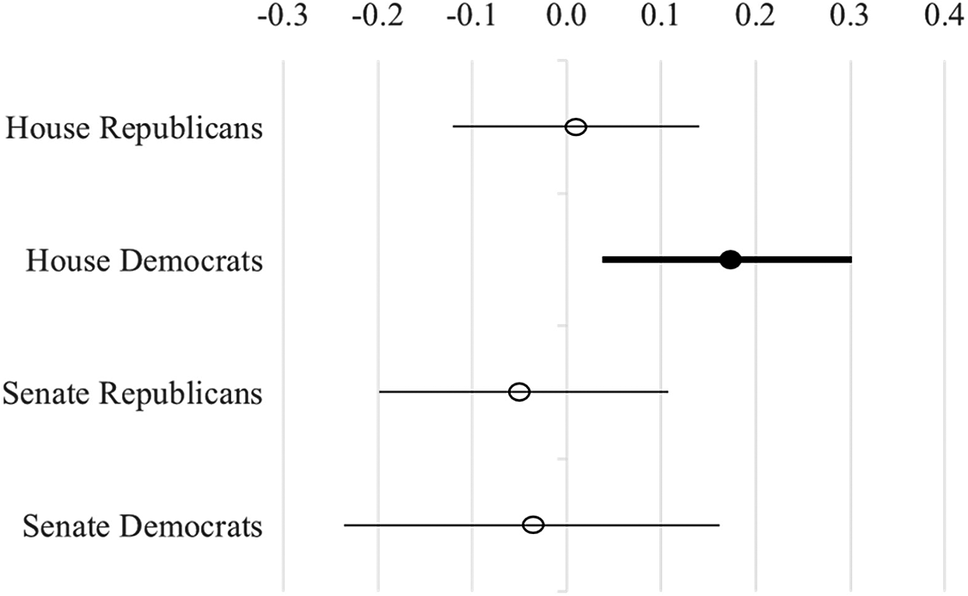
Across specifications, for three of the four sets of legislators, we find no significant relationship between elite education and effective lawmaking. These findings are illustrated graphically in figure 5, which shows the effects for elite education across four separate models, divided by party and chamber. This pattern of null findings across most of the chambers and parties may be due to the absence of any underlying relationship or because that relationship is conditional on additional factors.Footnote 20 The one exception is that, among House Democrats, those who are elite-educated are approximately 17% more effective as lawmakers.Footnote 21 On the whole, however, we find no evidence of elite-educated Republicans achieving a heightened level of lawmaking effectiveness, either before or after their ranks declined significantly. As with the ideology findings, as illustrated in tables A11 and A12, our results are robust to alternative model specifications, in which we explore whether legislators attended Ivy League institutions rather than elite institutions, more broadly considered.
Elite-Educated Republicans Are No More Effective
Note: Coefficients and 95% confidence intervals resulting from regressions of Legislative Effectiveness Score on an Elite Education indicator along with numerous control variables. Full results can be found in models A9.2, A9.5, A10.2, and A10.5 in tables A9 and A10. Closed circles and bold confidence intervals indicate statistical significance. Specifically, we find that elite-educated Republicans are no more or less effective as lawmakers than are their peers, whereas elite-educated House Democrats appear to be more effective at lawmaking.

Survey experiments (e.g., Butler et al. Reference Butler, Hughes, Volden and Wiseman2023) and observational analyses of congressional primaries (e.g., Treul et al. Reference Treul, Thomsen, Volden and Wiseman2022) suggest that voters prefer more effective lawmakers. The fact that elite-educated Republicans do not seem to achieve any heightened lawmaking prominence perhaps undercuts any claims these incumbents make for returning them to Congress. In contrast, elite-educated Democrats could make a compelling case of being more liberal (in line with their primary voters) and more effective (at least in the House), perhaps helping preserve their disproportionately high numbers among congressional lawmakers, and thus widening the partisan gap, as found in figure 1.
Elite Education and the Rise of the Gingrich Senators
Beyond their individual legislative behaviors, we argue that the decline in elite educational backgrounds among Republicans may have more collective effects as well, as part of the breakdown of a single bipartisan governing class. To explore this possibility, we turn briefly to an examination of the rise of the “Gingrich Senators” (i.e., those senators who served in the House with Speaker Newt Gingrich) during the 1990s, whom Theriault (Reference Theriault2013) argues were among the root causes of spreading partisan warfare from the House to the Senate.
A crucial period of this transformation occurred during the 104th through 106th Congresses, the first time in decades when Republicans controlled both houses of Congress. This period started with the Republican Revolution of the 1994 elections and extended until Senator Jim Jeffords of Vermont left the Republican Party early in 2001.
Across these three Congresses, 68 different Republicans served in the US Senate. As figure 1 shows, about 30% were elite-educated. Where the contrast between them arises, however, is in who were the partisan warriors versus who were the traditional Republicans and were more likely to value working across the aisle. Specifically, we find that only around 10% of the Gingrich Senators had an elite-educational background, in contrast to almost 40% of other Republican Senators.Footnote 22 This difference in proportions is both substantively and statistically significant (p < 0.05).Footnote 23 Although we cannot establish that the lack of a common educational bond with their Democratic counterparts contributed meaningfully to their embrace of partisan warfare, there is a clear correlation between the rise of Senate acrimony and the decline of elite-educated Republicans.Footnote 24
Such a divergence from the past was noted by the Yale- and Harvard-educated Senator Jeffords who said, as he left the Republican Party, “Increasingly, I find myself in disagreement with my party…. I understand that many people are more conservative than I am and they form the Republican Party. Given the changing nature of the national party, it has become a struggle for our leaders to deal with me and for me to deal with them” (quoted in Graff Reference Graff2001).
Causality and Conclusions
We argue that the elite-educated backgrounds of elected officials may be worthy of study. The percentage of elite-educated lawmakers among Republicans in Congress has declined by more than half over the past half-century, whereas their ranks in the Democratic Party have not diminished. Moreover, we find that, relative to other comparable legislators, elite-educated lawmakers are more ideologically liberal, an especially strong finding within the Republican Party. Future studies of partisan polarization might therefore benefit from examining the role of elite education. Additionally, we show that elite-educated senators and elite-educated Republicans are no more or less effective lawmakers than their counterparts, whereas elite-educated House Democrats are significantly more effective at lawmaking, perhaps contributing to their continued high numbers. Finally, we demonstrate a correlation between the decline of elite-educated Republican senators and the rise of the partisan warrior Gingrich Senators.
These findings are especially timely in light of ongoing political developments in the United States, as the Trump administration and Republicans in Congress have become increasingly critical of higher education and elite institutions. In spring 2025, for example, the Trump administration took actions to freeze hundreds of millions of dollars in federal contracts and grants that had been previously awarded to Harvard, Columbia, Brown, and several other prominent “elite” universities. In May 2025, Republicans in Congress advanced legislation to significantly expand the scope of the existing university endowment excise tax. The new tax rates would only apply to private higher educational institutions, disproportionately affecting those we code here as “elite.”Footnote 25 Our research findings point to how these recent policy developments have not occurred in a vacuum but rather correspond to a profound divide in the educational backgrounds of Republican and Democratic members of Congress that has emerged over the past 50 years.
One may be tempted to tell a causal story around these findings. However, these observational data do not allow such causal claims to be justified. Indeed, reverse causality may be a driving factor in some cases. For example, was it the case that elite-educated Republicans were ideologically out of step with their party’s movement and did not make up for that discrepancy with any heightened lawmaking effectiveness at sufficient levels to retain their seats? Or, rather, did the decline of elite-educated Republicans speed up the rightward movement among congressional Republicans over recent decades? Regardless of the direction of any causal relations, our goal is to establish that there are intriguing trends in the numbers and legislative behaviors of elite-educated legislators. Future work extending the study of elite-educational backgrounds to additional political outcomes—electoral results, oversight, campaign contributions, party-line voting, bipartisanship, or network connections—may be fruitful. Exploring whether a decline in elite education is linked to more limited institutional maintenance behavior among members of Congress (e.g., Bernhard and Sulkin Reference Bernhard and Sulkin2018; Fenno Reference Fenno1997) may shed light on any broader anti-institutional populism animating the Republican Party at present.
Although we explore some of the possible legislative consequences of declines in the percentages of elite-educated Republicans, future work on the causes of those decreases is also welcome. There may be many steps in these causal chains. For example, are future Republican leaders less likely to apply to elite educational institutions and less likely to be admitted or to enroll? Are elite-educated Republicans less likely to take career paths (such as local public service) that lead them to Congress? Are they less likely to run for Congress or to raise substantial campaign funds and to win (either in primary or general elections)? And why are these patterns so different over time, and so different for Democrats?
Moreover, what are the implications that our findings raise for descriptive representation, with Democrats being so disproportionately more attached to elite educational institutions than are their voters? Will this lead to policy positions that set a further course toward the Democratic Party being perceived as less welcoming to voters without college degrees?
Finally, we noted earlier that similar partisan divides in elite educational backgrounds may be emerging in the national executive branch. Investigations of whether similar shifts in elite educational backgrounds are occurring in other contexts—in state legislatures or legislatures around the world—may offer new insights into policy making and governance within representative democracies more broadly.
At a more fundamental level, however, we believe that the decline in elite-educated Republicans in Congress is important, in and of itself, as a key sign of the end of an era. Despite partisan and ideological differences, the American governing class was largely monolithic, not just in race and gender but also in the outlooks and governing philosophies derived or reinforced at a small set of elite schools. What are the implications of entering an era of two governing classes—divided by party and lacking common educational bonds—for governance, policy making, and the future of American democracy?
Supplementary material
To view supplementary material for this article, please visit http://doi.org/10.1017/S1537592725102260.
Data replication
Data replication sets are available in Harvard Dataverse at: https://doi.org/10.7910/DVN/SZOD5E
Acknowledgments
The authors thank Larry Bartels, Vlad Kogan, Dave Lewis, Bob Lowry, seminar participants at Vanderbilt University, anonymous reviewers and the editors of Perspectives on Politics, and conference participants at the APSA and APPAM annual meetings for helpful suggestions. The authors also thank Robert Krebs and Nicole Miller for their valuable contributions as research assistants. In addition, Volden and Wiseman thank the US Democracy Program of the Hewlett Foundation for its continued support of the Center for Effective Lawmaking (www.thelawmakers.org).


 Open access

