




Introduction
Causal reasoning emerges as early as 6 months of age for a wide variety of events such as physical causes of launching and entraining (e.g., Gopnik, Glymour, Sobel, Schulz, Kushnir & Danks, Reference Gopnik, Glymour, Sobel, Schulz, Kushnir and Danks2004; Michotte, Reference Michotte1963; Piaget, Reference Piaget1954; Saxe & Carey, Reference Saxe and Carey2006). Children’s first verbs, however, are rarely used in causal structures before 4 years of age in naturalistic settings and even later in experimental settings (e.g., Bowerman, Reference Bowerman1974; Göksun, Hirsh-Pasek & Golinkoff, Reference Göksun, Hirsh-Pasek and Golinkoff2010; Kanero, Hirsh-Pasek & Golinkoff, Reference Kanero, Hirsh-Pasek and Golinkoff2015; Muentener & Lakusta, Reference Muentener and Lakusta2011). Most languages have at least one way to express causativity. In these causal events, an agent (e.g., figure) acts upon the patient (e.g., direct object) to change the state or position of the patient. Causal constructions in verbs can differ across languages. For example, languages use lexical or morphological verb constructions to express causativity (Comrie, Reference Comrie1989). Turkish has both lexical (e.g., kes, ‘to cut’) and morphological causatives (e.g., ye-Dir, ‘make someone eat’) to represent causativity. Only a few studies investigated how parents’ use of different causal constructions relates to children’s use of causal language (e.g., Evers-Vermeul & Sanders, Reference Evers-Vermeul and Sanders2001; van Veen, Reference van Veen2011). Different contexts may elicit different amounts of specific language structures (i.e., spatial language elicited in block play) (e.g., Ferrara, Hirsh‐Pasek, Newcombe, Golinkoff & Lam, Reference Ferrara, Hirsh‐Pasek, Newcombe, Golinkoff and Lam2011). The effects of differential input in these contexts on later child language outcomes are studied even less often. In the present study, we ask whether (1) parental causal language input differs for different types of play, and (2) early parental causal language input predicts children’s later causal verb understanding.
Parental language input and different types of play
Parent–child play provides children with extensive verbal and nonverbal communication opportunities (Bornstein, Vibbert, Tal & O’Donnell, Reference Bornstein, Vibbert, Tal and O’Donnell1992; Tamis-LeMonda & Bornstein, Reference Tamis-LeMonda and Bornstein1991). Research suggests that specific parental input supports children’s acquisition of specific word types such as adjectives (Blackwell, Reference Blackwell2005), verbs (Naigles & Hoff-Ginsberg, Reference Naigles and Hoff-Ginsberg1998), and spatial words (Levine, Ratliff, Huttenlocher & Cannon, Reference Levine, Ratliff, Huttenlocher and Cannon2012). Less is known about how different play types elicit specific language input. The present study focuses on two types of play: (1) guided play and (2) free play. In guided play, adults scaffold children’s exploration in achieving a goal (Fisher, Hirsh-Pasek, Golinkoff, Singer & Berk, Reference Fisher, Hirsh-Pasek, Golinkoff, Singer, Berk and Pellegrini2011; Weisberg, Hirsh-Pasek & Golinkoff, Reference Weisberg, Hirsh-Pasek and Golinkoff2013a). On the other hand, in free play, the child acts upon the environment and updates the information without having a specific goal (Piaget, Reference Piaget1954).
Parental language input at playtimes may depend on several factors, such as toys being used. For instance, parents used simpler language during toy play compared to when they engaged in book play (a catalog of toys and children’s clothes was used) or toyless free play (Lewis & Gregory, Reference Lewis and Gregory1987). Additionally, parents produced more directives (e.g., put, lift) and longer utterances during toy play. The toyless free play elicited more repetitive language and fewer directives. Likewise, O’Brien and Nagle (Reference O’Brien and Nagle1987) investigated parental language during parent-child play with different types of toys, such as dolls, vehicles, and shape sorters. Results showed that parents tended to talk the most while playing with dolls and talk the least while playing with vehicles. For specific types of input, Thippana, Elliott, Gehman, Libertus and Libertus (Reference Thippana, Elliott, Gehman, Libertus and Libertus2020) examined how parental math talk differs for math-related (e.g., card games, puzzles, board games) vs. non-math-related activities (e.g., dolls, cars, kitchen/food). More math talk was elicited for math-related activities. Research also suggests that playing with spatial toys such as blocks increases parental spatial language input (Brosnan, Reference Brosnan1998; Caldera, Culp, O’Brien, Truglio, Alvarez & Huston, Reference Caldera, Culp, O’Brien, Truglio, Alvarez and Huston1999; Ginsburg, Reference Ginsburg2007). While playing with blocks, parents direct children’s attention to spatial relations between them (i.e., one block is under the other). Differences in input also occur when electronic toys are compared to traditional ones. For instance, Zosh, Hopkins, Jensen, Liu, Neale, Hirsh-Pasek, Solis and Whitebread (Reference Zosh, Hopkins, Jensen, Liu, Neale, Hirsh-Pasek, Solis and Whitebread2017) found that traditional shape sorters elicited more spatial language from parents compared to electronic shape sorters. These findings indicate that specific toys might elicit specific language input. However, the context of play might also play a role while playing with specific toys.
Play contexts might alter adult language input at home (Eason & Ramani, Reference Eason and Ramani2020; Zosh et al., Reference Zosh, Hopkins, Jensen, Liu, Neale, Hirsh-Pasek, Solis and Whitebread2017) as well as in educational settings (Weisberg et al., Reference Weisberg, Hirsh-Pasek and Golinkoff2013a; Weisberg, Zosh, Hirsh-Pasek & Golinkoff, Reference Weisberg, Zosh, Hirsh-Pasek and Golinkoff2013b; Weisberg, Kittredge, Hirsh-Pasek, Golinkoff & Klahr, Reference Weisberg, Kittredge, Hirsh-Pasek, Golinkoff and Klahr2015). Parents produce specific types of input in certain play contexts. For example, playing with blocks may take different forms, depending on the type of play. Ferrara et al. (Reference Ferrara, Hirsh‐Pasek, Newcombe, Golinkoff and Lam2011) investigated the use of spatial language during block play in three conditions: free play, guided play, or play with preassembled structures. Parents in the guided play condition, where the task was to reassemble a certain layout (e.g., build garage or helipad), used more spatial language (e.g., spatial locations, dimensions, spatial features) than parents in the free play or play with preassembled structures conditions. Parents had a goal to accomplish in a guided play context. Play contexts may also be influential for parent-child math talk. Eason and Ramani (Reference Eason and Ramani2020) found that guided play elicited more math talk about fractions than unguided play for 4- and 5-year olds.
Overall, research suggests that types of toys and play contexts may both influence how parents talk during play. The present study investigated parents’ use of causal language in free play and guided play contexts to highlight the role of different play types in acquiring specific language structures.
Parental causal input and children’s causal verb understanding
Early parental input is crucial for children’s later language skills. Children’s vocabulary development is closely related to the amount of exposure to different word types as well as the number of words (e.g., Hart & Risley, Reference Hart and Risley1995; Hoff, Reference Hoff2006). Exposure to different words predicts vocabulary development (Weizman & Snow, Reference Weizman and Snow2001). Studies found interrelations among language input during parent-child play and children’s language development (Bornstein, Vibbert, Tal & O’Donnell, Reference Bornstein, Vibbert, Tal and O’Donnell1992; Tamis-LeMonda & Bornstein, Reference Tamis-LeMonda and Bornstein1991; Tamis-LeMonda, Bornstein & Baumwell, Reference Tamis-LeMonda, Bornstein and Baumwell2001). That is, the sophistication of parent-child play and parental language input enhances children’s language outcomes.
Previous findings indicate that specific language skills that children acquire are related to specific parental input. For instance, parents’ use of spatial language is related to children’s spatial word knowledge (Cartmill, Pruden, Levine, Goldin-Meadow & Center, Reference Cartmill, Pruden, Levine, Goldin-Meadow and Center2010; Kısa, Aktan-Erciyes, Turan & Göksun, Reference Kısa, Aktan‐Erciyes, Turan and Göksun2019; Pruden, Levine & Huttenlocher, Reference Pruden, Levine and Huttenlocher2011). In their study on causality, McCabe and Peterson (Reference McCabe, Peterson, Costermans and Fayol1997) highlighted that children’s causal language can be enriched by parental responses to children’s questions as repeating, modifying, or responding to them. In a longitudinal study, they investigated the effects of parental language on children’s causal language use and found that parents scaffolded children’s causal language (e.g., using the connector because) by using why-questions. Likewise, for German and English, van Veen, Evers-Vermeul, Sanders and van den Bergh (Reference van Veen, Evers-Vermeul, Sanders and den Bergh2013) found a similar pattern in which parents adapted their causal connective use to children’s increasing abilities. Growth curve analyses of children’s imitated, elicited, and independent use of English because and German weil showed that parents scaffolded their children’s causal connective use in elicited forms, using why/warum-questions. Although these studies indicate that parental causal language input might improve children’s causal language, they are restricted only to the use of causal connectors and do not involve causal verbs. Our study will focus on causal connectives and different forms of causal verbs (lexical and morphological).
An accumulating body of evidence suggests that children hearing verbs in a variety of syntactic environments are at an advantage since each syntactic frame (e.g., with a direct object such as the duck is blicking the bunny, or in a sentence complement I like blicking) provides additional presumptions about that verb (e.g., Gleitman, Reference Gleitman1990; Naigles, Reference Naigles1996; Naigles & Hoff-Ginsberg, Reference Naigles and Hoff-Ginsberg1998). Therefore, in investigating children’s comprehension of causal verbs, more sophisticated input analysis is needed. Corpus studies address parental input and children’s use of causal connectors but not specifically target causal verbs (Evers-Vermeul, Reference Evers-Vermeul2005; van Veen et al., Reference van Veen, Evers-Vermeul, Sanders and den Bergh2013; but see You, Daum & Stoll, Reference You, Daum and Stoll2020). As comprehension mostly precedes production, studying causal verb comprehension might be more informative. Taken together, children’s causal language might be closely related to the quality of parental input received.
Children extract verb meanings making use of the syntactic and morphological cues available in the language (Gleitman, Reference Gleitman1990; Landau & Gleitman, Reference Landau and Gleitman1985; Naigles, Gleitman & Gleitman, Reference Naigles, Gleitman, Gleitman and Dromi1993). Findings with 2- and 3-year-olds indicate that children become faster at processing grammatical devices like word order as they grow (Candan, Küntay, Yeh, Cheung, Wagner & Naigles, Reference Candan, Küntay, Yeh, Cheung, Wagner and Naigles2012; Ilgaz & Hirsh-Pasek, Reference Ilgaz, Hirsh-Pasek, Candan, Küntay, Yeh, Cheung, Wagner and Naigles2012). For instance, children are faster in processing word order if their language has a strict word order (e.g., English) than children who learn languages with flexible word order (e.g., Turkish and Mandarin). Thus, the type of input affects the speed of processing for grammatical elements. On the other hand, for lexical causatives, children have to rely on word order (in languages such as English and Turkish) as well as on the number of arguments or case marking (languages like Turkish) to extract causal information. In agglutinative languages such as Turkish, in addition to the word order, children use both nominal case marking and verbal morphology as cues to highlight the semantic information (Göksun, Küntay & Naigles, Reference Göksun, Küntay and Naigles2008).
In Turkish, morphological causatives are formed by the attachment of a causative suffix (e.g., -Dır,, t, It -Ir, -Ar, -Art), to either a transitive or intransitive verb stem (e.g., yap-tır, ‘make [s.o.] do [s.t.]’) (Göksel & Kerslake, Reference Göksel and Kerslake2005). These causative suffixes attached to the verb stem are also predictable. Monosyllabic stems, most of which are intransitive, take one of these forms: -It, -Ir, -Ar or -Art. Polysyllabic stems that end with a vowel are combined with -t. The rest of the verb stems take the suffix -DIr. To give an example, the verb uyu in Turkish refers ‘to sleep’ in English. When a causative suffix -t is attached to the verb uyu, the new verb becomes uyu-t which refers ‘to make someone sleep.’ These suffixes act as a cue for young learners (Kornfilt, Reference Kornfilt1997). Although in language production, lexical causatives seem to emerge as early as 1 year of age (e.g., at ‘throw’), morphological causatives (e.g., giy-Dir, ‘make someone dress’) do not appear before the age of 1;9 (Ketrez, Reference Ketrez1999). The acquisition of different causatives in childhood has not been studied often in Turkish. For Turkish, causative morphemes might be one of the most salient cues that indicate semantic causativity. Since morphological marker is a transparent indicator of causality, which lexical causatives lack, morphological causatives might guide children to better extract information regarding causality. On the other hand, in the case of lexical causatives, children can only rely on the number of arguments and word order, which can be indicators of transitive structure. However, the flexible word order in Turkish cannot be informative at all times. Additionally, not all transitive verbs represent causality (Shibatani & Pardeshi, Reference Shibatani, Pardeshi and Shibatani2002), and causal inferences based on word order might not yield correct outcomes. The verb-semantics hypothesis indicates that verbs might suggest less vs. more transparent causation that reflects the semantics of those verbs (Shibatani & Pardeshi, Reference Shibatani, Pardeshi and Shibatani2002). If cause and effect are more independent of one another, more transparent causatives will be used. In those contexts where causality needs to be emphasized strongly, more causal input might be produced. Guided play provides such a context where parents assist their children for actions that involve more causal input to reach a goal (i.e., put the piece of the puzzle, turn the block) than a free play context.
The present study
The present study extends the literature by examining early parental causal input (causal connectors, lexical and morphological causal verbs) for different play contexts (guided play and free play) and its relations with children’s later causal verb understanding. The study had three timepoints. At Time 1 and Time 2, when children were 14 and 19 months of age, respectively, we used different play contexts (free play and guided play) to elicit parental language input. At Time 3, when children were 35 months of age, we administered a verb comprehension task (for both causal and non-causal verbs) to children. We asked whether (1) parental causal language input differed for different types of play, and (2) early parental causal language input predicted children’s later causal verb understanding. We had three hypotheses. First, based on the previous findings, we expected that parents would use more causal language in the guided play contexts compared to the free play contexts (Ferrara et al., Reference Ferrara, Hirsh‐Pasek, Newcombe, Golinkoff and Lam2011). In the guided play contexts, parents might use more directive language to assist their children in completing the puzzles manually, and as a result, these directive language constructions would include more causal structures than the ones in the free play contexts. Second, for both play contexts, we expected that parental causal input would increase from Time 1 to Time 2 to scaffold children’s developing language skills. Third, we predicted that early overall parental causal input would predict later child causal verb comprehension but not non-causal verb comprehension. Last, morphological causal verb input would be a better predictor of causal verb understanding than lexical causal verb input as it provides more cues for the child to extract causal meaning. Given the scarcity of earlier work, we did not have specific hypotheses for how lexical and morphological causal input would differ for different contexts.
Method
Participants
Twenty-nine infants (15 females) participated at three timepoints: Time 1 (M=14.51 months, SD=1.45), Time 2 (M=19.21 months, SD=1.32), and Time 3 (M=34.76 months, SD=1.56). All participants were monolingual native speakers of Turkish from upper-middle-class families. Children were tested at daycare centers, where they attended playgroups with their mothers. The study was approved by [Blinded University is Koç University] University’s Institutional Review Board (Project name: Turkish learning children’s relational word learning: A longitudinal study - Protocol no: 2014.052.IRB.2.015).
Materials and procedure
Time 1 and Time 2 parent–infant play sessions
At Times 1 and 2, we recorded parent-infant play sessions for two types of play: (1) free play (i.e., a felt school/vehicles and a parking lot), and (2) guided play (i.e., puzzles to be completed) (see Figure 1 for details of the stimuli). Each play session lasted about 3 to 4 minutes for both types of plays. Parent-infant dyads first completed free play and then moved on to guided play. For free plays, parents were instructed to play with the toys together with their children as they wished. For guided plays, parents were instructed to complete the puzzles given to them together with their children as they were playing. In these guided plays, parent-child dyads had a final goal to complete the puzzles.
Free play and guided play toys: Time 1- (a), Time 2 (b)

For Time 1, we used a felt school with felt figures for free play purposes. We introduced different school sections (e.g., playground, café, and classroom) to acquaint parent-child dyads with the toy set. For the guided play, we presented a wooden puzzle toy that contained pieces of different sizes and patterns, depicting the body parts of the mother, father, and baby bear (head, torso, legs). The goal of the game was to complete different mother, father, and baby bear alternatives; as some parts did not fit specific bears, there was an inherent goal to form a correct bear.
For Time 2, we used plastic cars and a parking lot for free play. There were three cars, which could be magnetically attached. Parking lots had lids that the child could easily open. For the guided play, we used a 9-piece cube puzzle. There were six target pictures, each target picture corresponded to one side of the cubes. The task was to choose one of the six target pictures and complete the puzzle using the nine cubes.
We used different sets of toys for Times 1 and 2. Since there were only approximately 5 to 6 months between two sessions, we wanted to avoid parents’ familiarity particularly with puzzle toys (i.e., having solved the puzzle earlier might have an effect on how parents talked to their children), so that the familiarity of the toys would not drive language input.
Coding of parent – infant play sessions
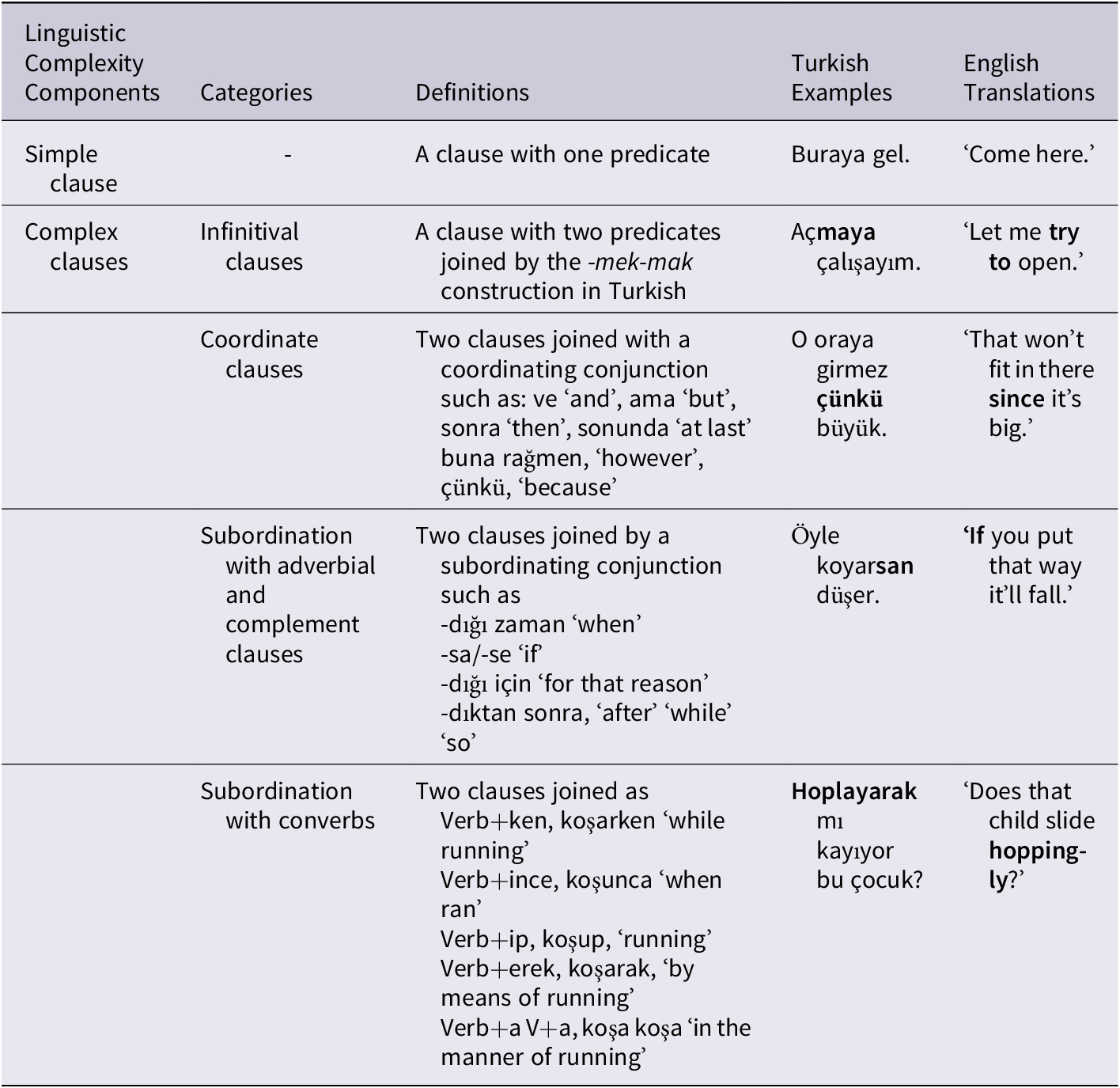
We coded play sessions based on two main coding schemes: (1) Linguistic complexity, and (2) Causal language. Linguistic complexity was coded as an overall characteristic of linguistic input. For each parent-infant conversation, we coded all simple and complex clauses parents used. Then, we calculated the linguistic complexity score by taking the percentage of complex clauses with respect to the total number of clauses (see Table 1 for the coding details). We took the linguistic complexity score as a control variable for the overall input in our analyses.
Linguistic complexity coding scheme
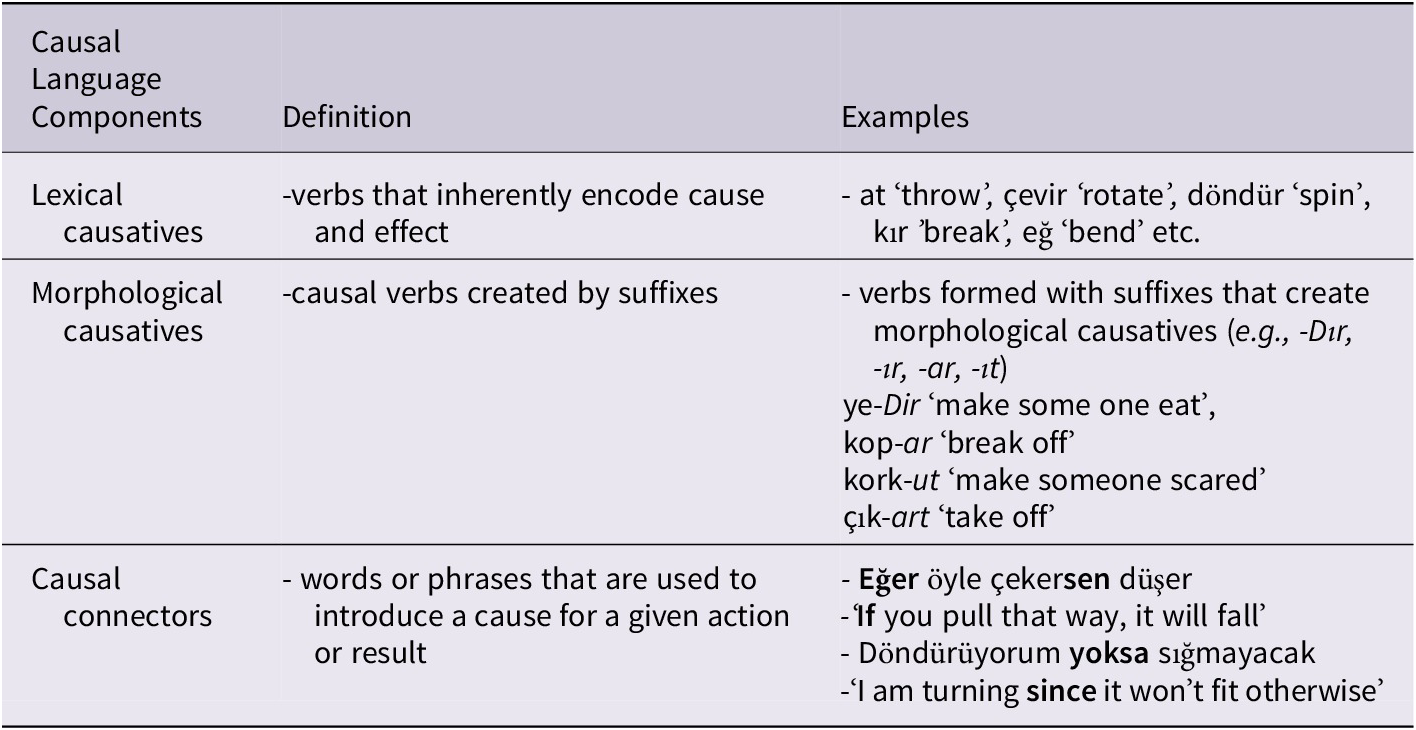
The causal language was coded based on causal verbs as well as causal connectors. Causal verbs fall into two categories: (1) lexical causatives, and (2) morphological causatives. Lexical causative verbs inherently encode cause and effect (result). Morphological causatives are formed by converting a non-causative verb into a causative one using a causative suffix. We also coded causal connectors that included words or phrases to introduce a cause for a given action or result in a sentence (see Table 2 for the coding scheme). Due to the small number of occurrences of causal connectors, we excluded them from calculations and analyses. Thus, we formed two scores for causal language input: (1) proportion of lexical causatives, and (2) proportion of morphological causatives. We calculated each score by dividing the total number of lexical causal verbs/morphological causal verbs by the total number of clauses. For complex sentences containing coordination or subordination, we counted the actual number of clauses within these sentences.
Causal language coding scheme
Time 3 Tasks: TIFALDI-E
At Time 3, children completed TIFALDI (Turkish Expressive and Receptive Language Test- Expressive subtest) (Berument & Güven, Reference Berument and Güven2010). We used this test to obtain a general language score from children and control for children’s general expressive language skills in predicting causal verb understanding through parental input. This test measures the expressive vocabulary of children aged from 2 to 12 years. The test includes 80 items, each having a picture that depicts the target word. Children were instructed to tell the name of the object presented in the picture. The task took 15 to 20 minutes to complete.
Time 3 Tasks: Verb Comprehension Task
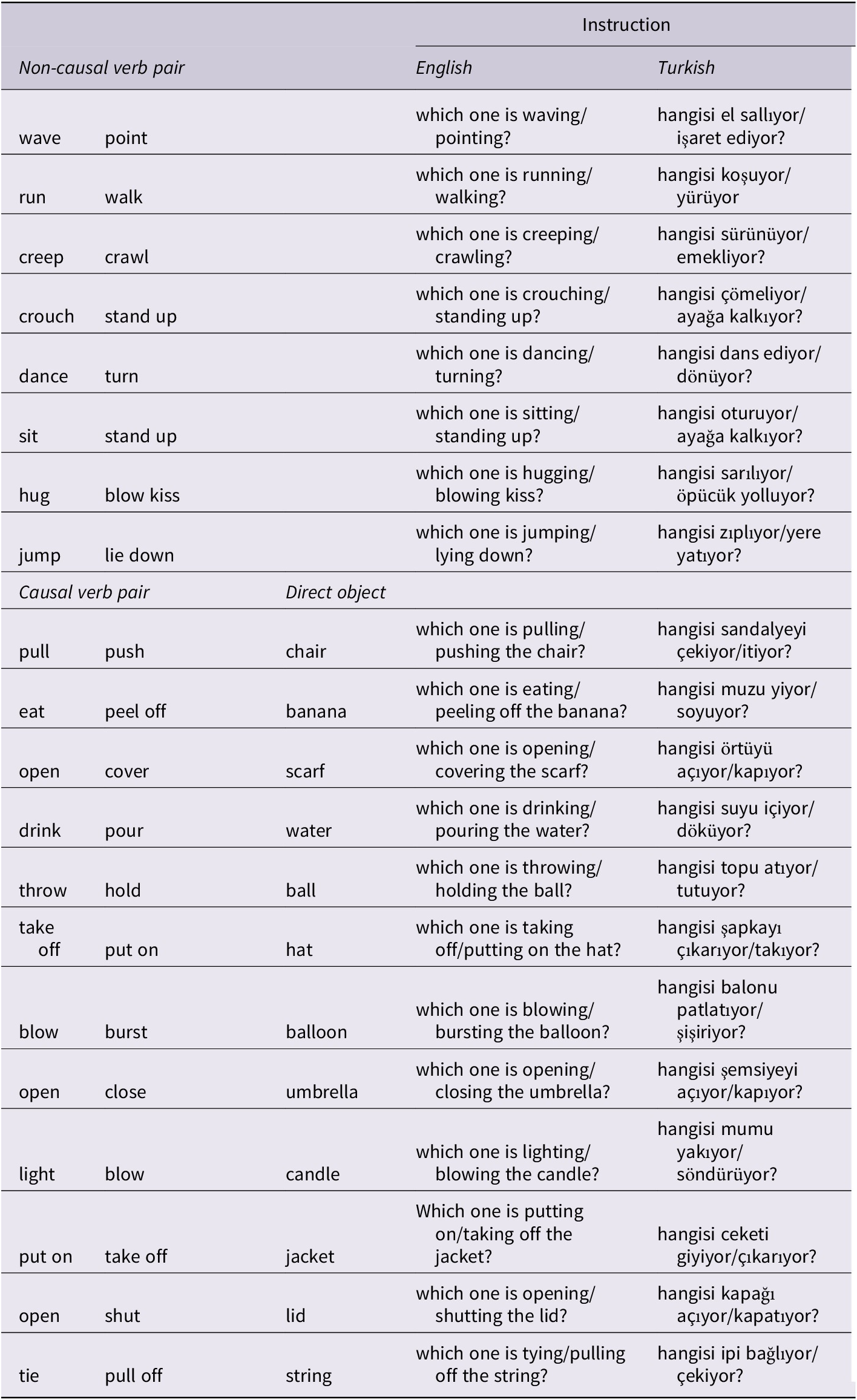
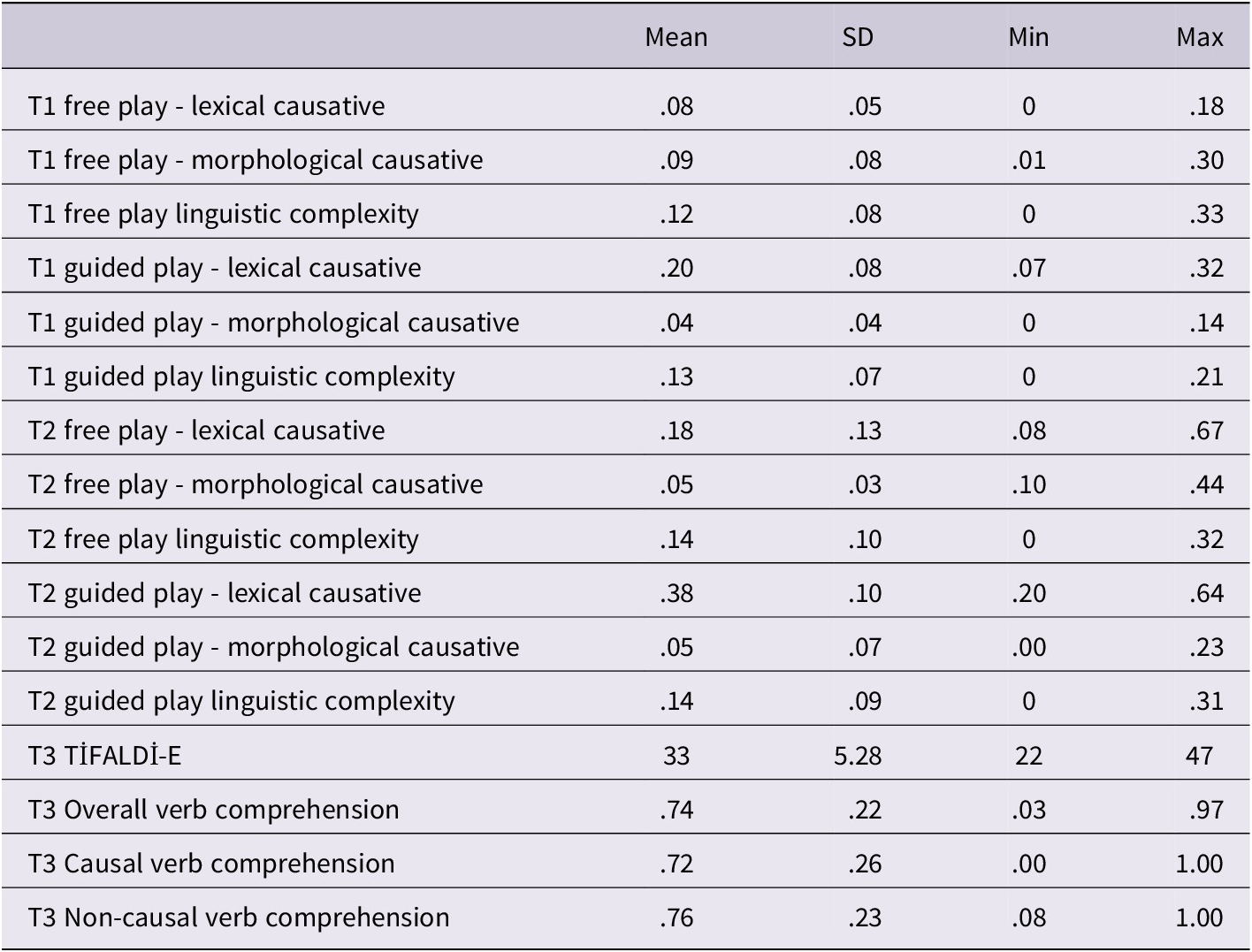
The task was adapted from Konishi, Stahl, Golinkoff and Hirsh-Pasek (Reference Konishi, Stahl, Golinkoff and Hirsh-Pasek2016), in which children were presented with a split-screen depiction of actions (for the Turkish version, see Aktan-Erciyes & Göksun, Reference Aktan-Erciyes and Göksun2019). The task consisted of 20 trials. In each trial, children were presented with two video clips that played simultaneously on a split-screen where a human actor performed similar actions (e.g., running vs. walking). Before the test, children were given two practice trials that included common objects (e.g., cake vs. hamburger) to ensure they could point at the instructed stimulus. Eight trials contained non-causal verbs, and 12 trials consisted of causal verbs. Of all 12 pairs of causal verbs (a total of 24 verbs), there were 4 morphological causative verbs and, the rest were lexical causative verbs. Children were tested on each verb once, and they saw each verb pair only once. The experimenter asked the child to point to the target action (e.g., Which one is running?) as the video clips started. Video clips were presented up to two times in case the child did not give any response. After the second display, if there had still been no response from the child, the experimenter would have continued with the next trial. Children were assigned to one of the two conditions in which verb pairs were randomly ordered (see Table 3 for all verb pairs and instructions). All children watched the same verb pairs; however, the target verb changed across the two conditions. For example, in Condition 1, we asked which actor was ‘running’, whereas Condition 2 asked which one was ‘walking’ (see Table 4 for all means and standard deviations of Time 1, 2, and 3 measures). This task took about 6 to 8 minutes to complete for each child. Children first completed the verb comprehension task, then moved on to TİFALDİ-E.
The verb pairs and instructions used in the experiment
Means and standard deviations of Time 1, 2, 3 measures
Results
We asked whether (1) parental causal language input differed for different types of play at two timepoints during children’s first two years, and (2) early parental causal language input was associated with children’s later causal verb understanding. As a preliminary analysis, we compared the total number of utterances for different types of play for two time points. Results indicated that parents used similar numbers of utterances for free play and guided play both at Times 1 and 2, (t(28)=.51, p=.61, t(28)=-.56, p=.57).
Comparison of maternal causal input across play types and timepoints
For our first research question, we compared free and guided play sessions for Time 1 and Time 2. We conducted a repeated-measures-ANOVA, taking play type (free play, guided play), causal input type (lexical vs. morphological), and time (Time 1 and Time 2) as within-subject variables (see Figure 2 and Table 4 for details). We used Bonferroni correction for post-hoc t-tests. Results indicated significant main effects of play type, causal input type, and time, F(1,27)=24.21, p<.001, ηp 2 = .54, F(1,27)=112.83, p<.001, ηp 2 = .84, F(1,27)=41.18, p<.001, ηp 2 = .67, respectively. There was a significant interaction between play type and causal input type, F(1,27)=22.48, p<.001, ηp 2 = .53. There was no significant interaction between time and play type, F(1,27)=.07, p=.782, ηp 2 = .004.
Parental lexical vs. morphological causal input across play types and timepoints
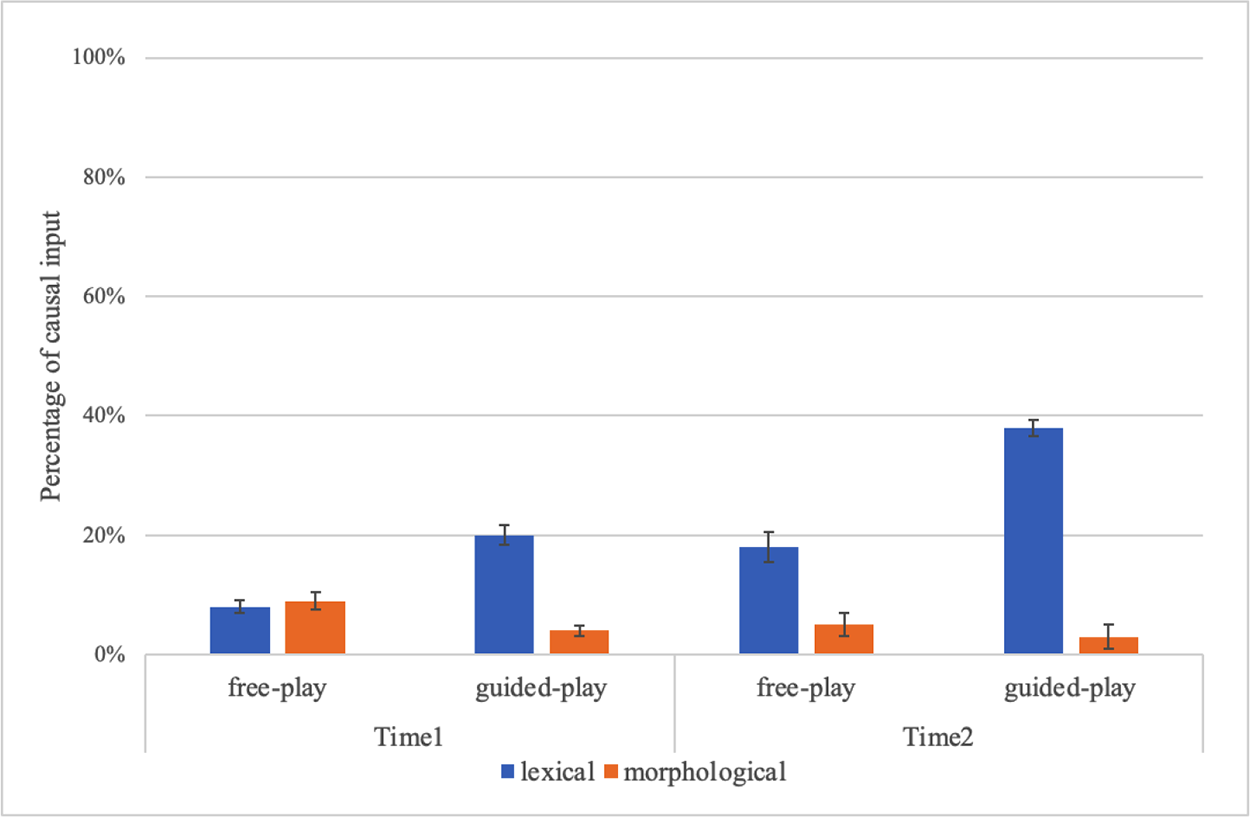
The three-way interaction of time, causal input, and play type was also significant, F(1,27)=14.65, p<.001, ηp 2 = .42. When we considered the play type, results indicated that during guided play, parents provided more lexical than morphological causatives, for both Time 1 and Time 2, t(28)= 6.84, p<.001 and t(28)= 12.89, p<.001, respectively. On the other hand, during free play, they provided more lexical than morphological causatives at Time 2, but not for Time 1, t(28)= 11.15, p<.001 and t(28)= .841, p=.44, respectively.
When we considered the causal input type, results revealed that lexical causatives increased from Time 1 to Time 2, whereas morphological causal input decreased from Time 1 to Time 2, t(28)= 3.95, p<.001 and t(28)= 11.15, p<.001, respectively. Additionally, post-hoc tests for time-related changes revealed that the amount of lexical causative input was greater in guided play than in free play for both Time 1 and Time 2, t(28)= 3.21, p<.01 and t(28)= 6.74, p<.001, respectively. However, morphological causal input did not differ across play types neither at Time 1 nor at Time 2, t(28)= 1.17, p>.05 and t(28)= 1.01, p >.05, respectively.
Relations between early maternal causal input and later causal verb understanding
To investigate relations between early parental causal input (Time 1 & Time 2) and later causal verb understanding at Time 3, we conducted hierarchical linear regression analyses, taking either free play or guided play variables as predictors, controlling for age, the overall vocabulary of children, and parental linguistic complexity in play sessions. We predicted that early parental causal input would specifically be related to causal verb comprehension. For both timepoints, we examined the same variables, linguistic complexity, and lexical and morphological causal input. Therefore, we computed composite scores for these variables for each play type: Time 1-Time 2 free play linguistic complexity, Time 1-Time 2 guided play linguistic complexity, and Time 1 and Time 2 composite scores for lexical and morphological causal input. We used these composite scores in the regression analyses.
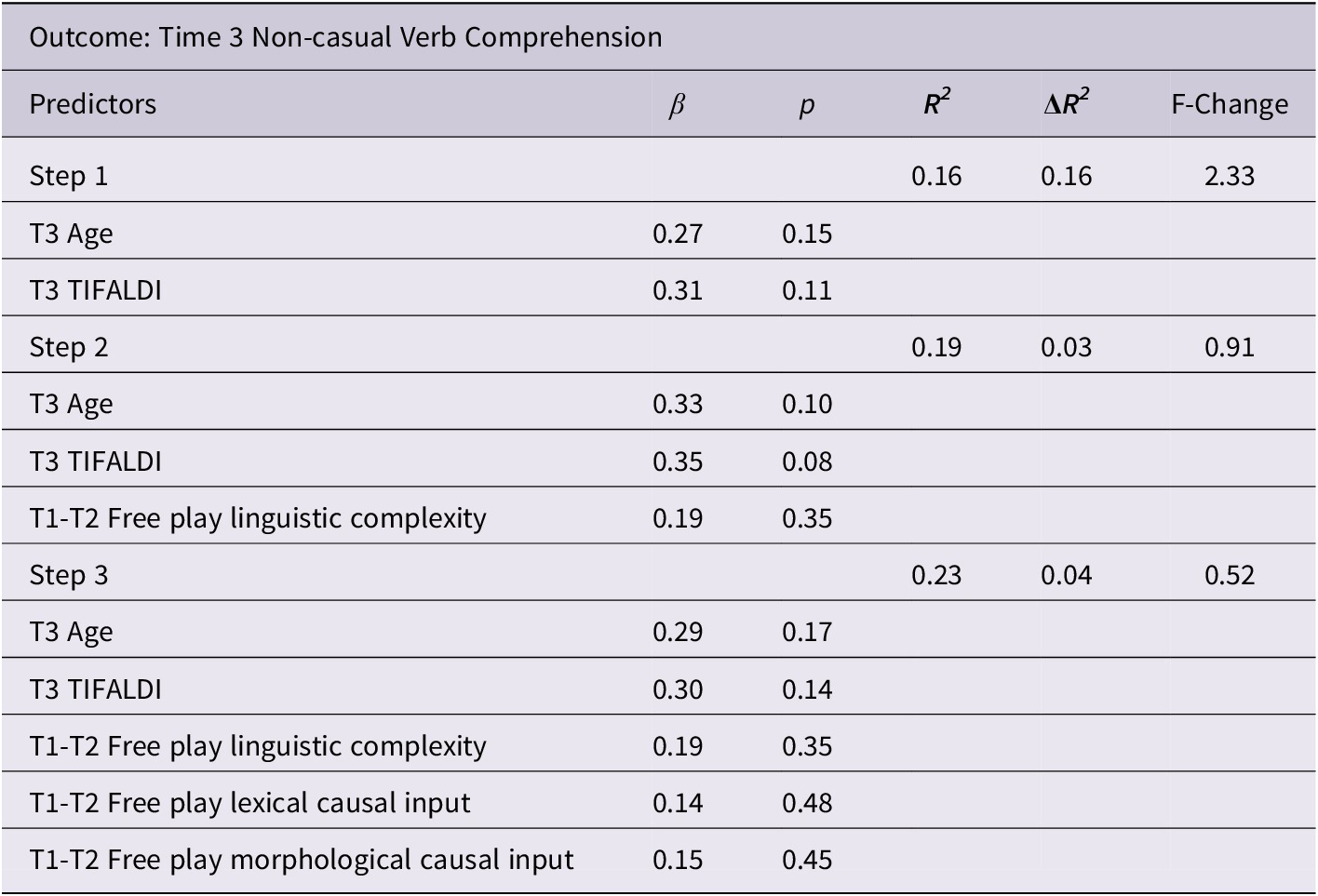
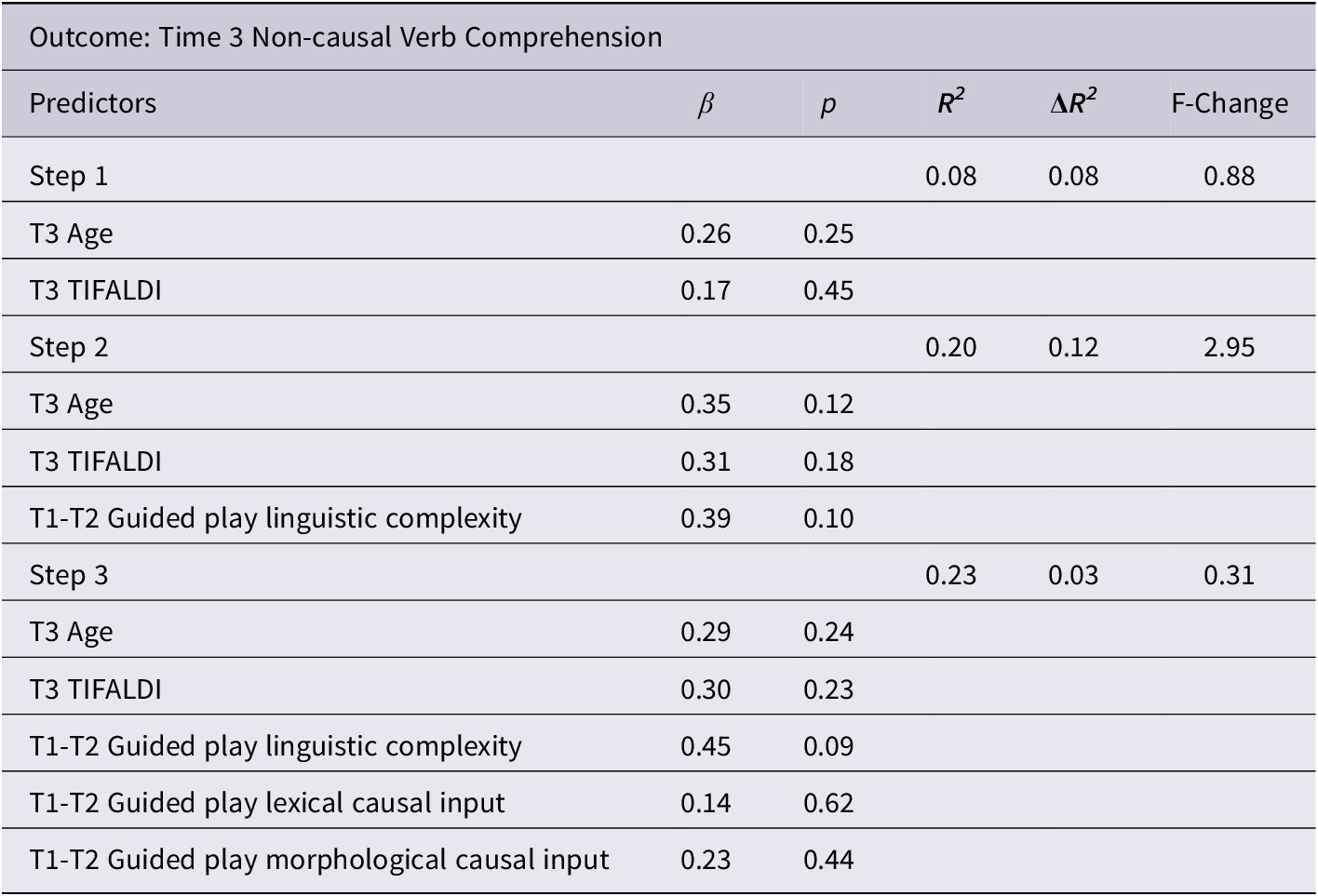
We tested four models. The first two models included Time 3 non-causal verb comprehension as outcome variables. The predictors were age at Time 3, Time 3 TIFALDI scores, linguistic complexity composite score (either free play (Model 1) or guided play (Model 2)), morphological and lexical causal input composite scores in corresponding play sessions. None of these models (Model 1 and Model 2) predicting non-causal verb comprehension were significant (see Tables 5 and 6).
Parental Causal Input in Free Play Predicting Non-Causal Verb Comprehension
Parental Causal Input in Guided Play Predicting Non-Causal Verb Comprehension
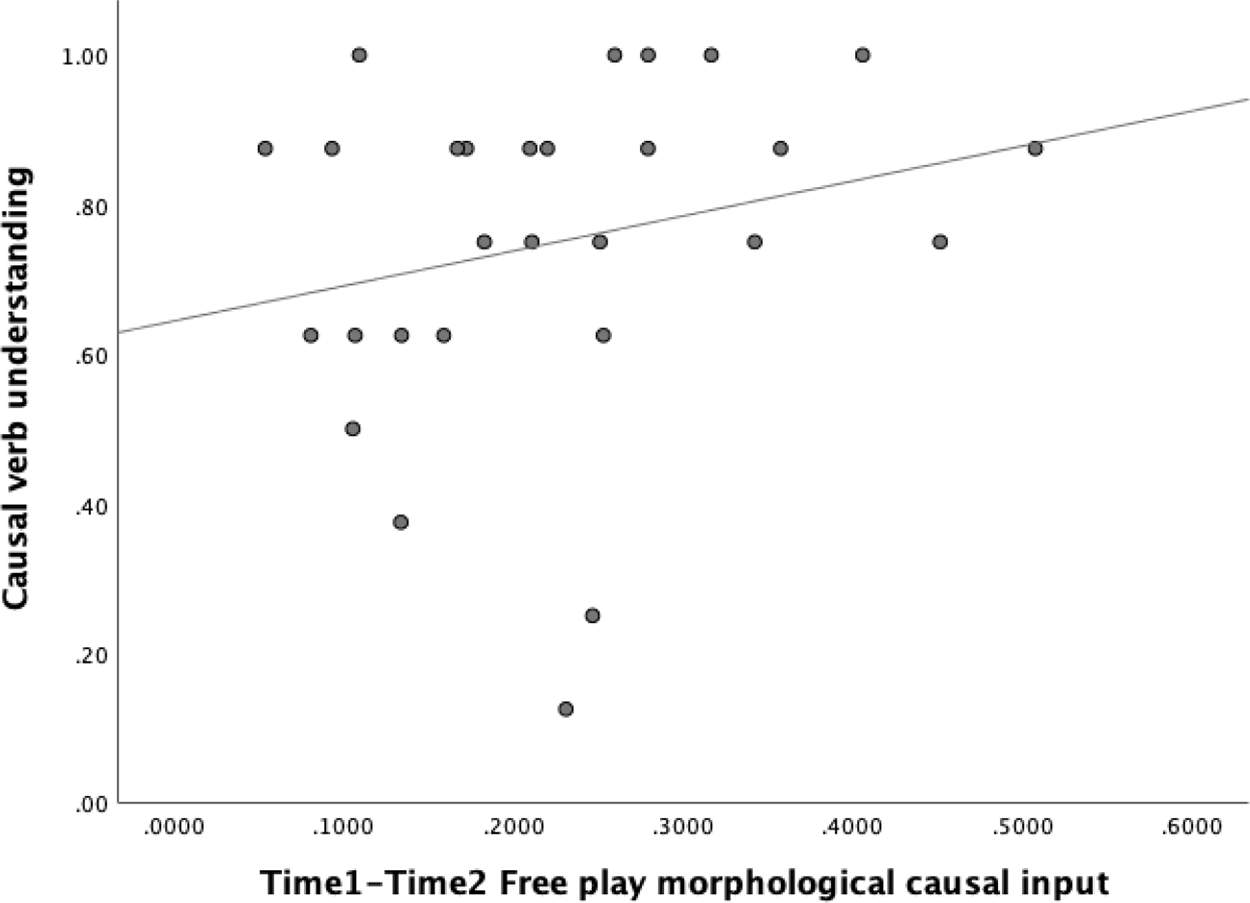
In the next two models (Model 3 and Model 4), we predicted Time 3 causal verb comprehension as outcome variables (see Tables 7 and 8). In Model 3, we predicted Time 3 causal verb comprehension through free play predictors. We included five predictors as indicated in the above section: Time 3 age, Time 3 TIFALDI scores, linguistic complexity composite score of the free play, and last morphological and lexical causal composite input variables. In the first step, Time 3 age and Time 3 TIFALDI scores did not contribute to the first model, F(2,25) = 2.53, p = .10. In the second step, we introduced free play linguistic complexity in the model. Again, the model was not significant in explaining the variance in causal verb comprehension, F(3,24) = 1.68, p = .21. Last, when lexical and morphological causal input variables were introduced, an additional 28% of the variance was explained, the model was significant in explaining 46% of the total variance (R 2 = .46, F(5,22) = 3.52, p = .02). The only significant predictor was morphological causal input (β = .57, p = .01). Results indicated that early morphological causal input in free play was positively associated with later causal verb comprehension (see Figure 3).
Parental Causal Input in Free Play Predicting Causal Verb Comprehension

Parental Causal Input in Guided Play Predicting Causal Verb Comprehension
Children’s causal verb understanding in relation to free play morphological causal input
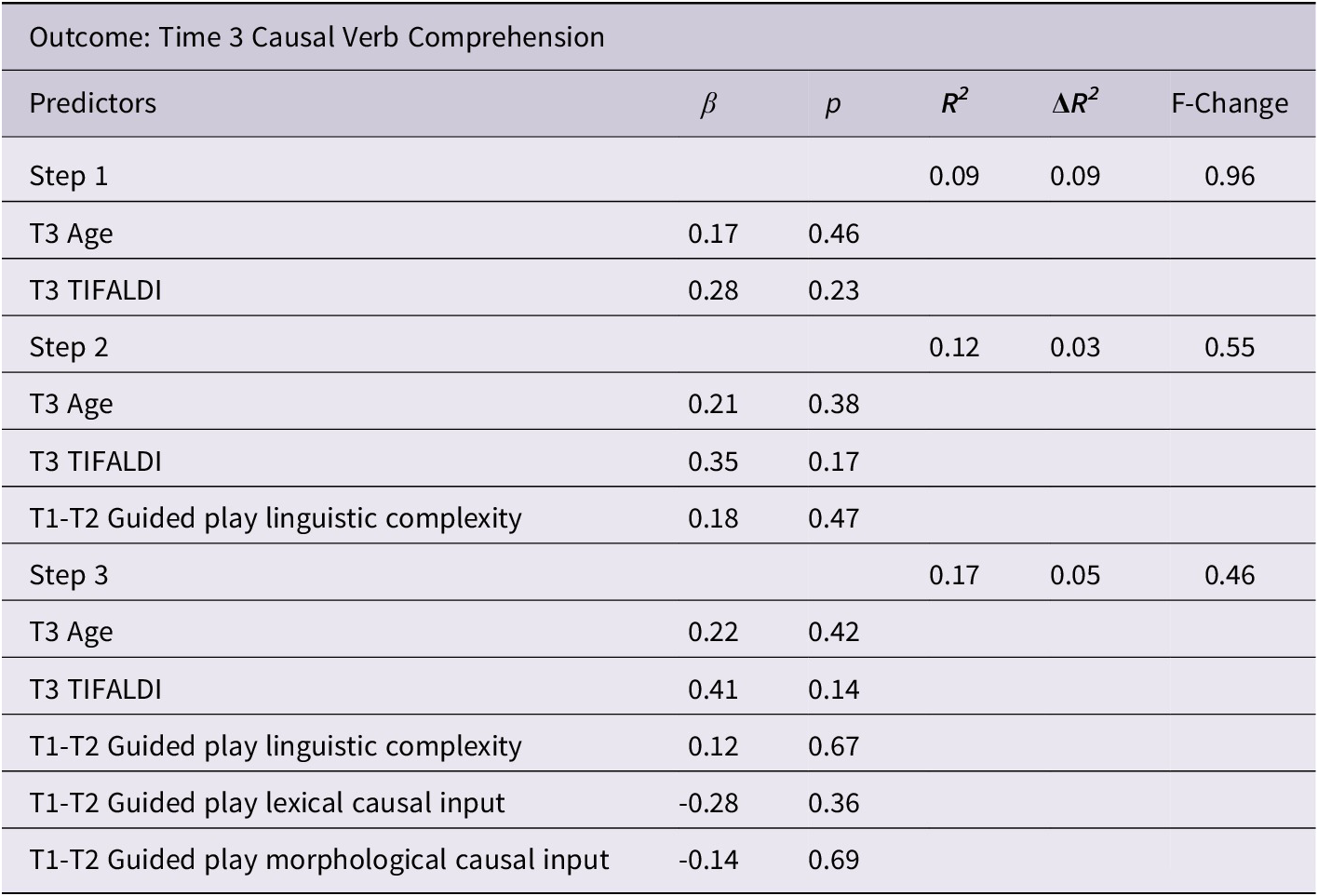
Last, in Model 4 to predict Time 3 causal verb comprehension through guided play predictors, we again included five predictors: Time 3 age, Time 3 TIFALDI scores, linguistic complexity composite score of the guided play, and last morphological and lexical causal input variables for guided play. In the first step, the model was not significant when we introduced Time 3 age and Time 3 TIFALDI scores, F(2,25) = .96, p = .40. In the second step, we introduced the linguistic complexity of guided play sessions; and the model was again not significant, F(3,24) = .81, p = .51. In the final step, guided play lexical and morphological input scores were introduced, and the model was not significant in explaining the variance in causal verb comprehension, F(5,22) = .64, p = .68 (see Table 8).
Discussion
This study investigated early parental causal input for different play contexts in the first two years of children’s lives and its relations to children’s later causal verb understanding at the end of their third year. We asked two main questions: (1) Did parental causal language input differ for different play contexts and timepoints during children’s first two years? and (2) Did early parental causal language input predict children’s later causal verb understanding? We tested children at three time points: Time 1 (12- to 16-month-olds), Time 2 (18- to 22-month-olds), and Time 3 (32- to 39-month-olds). The three-way interaction indicated that lexical causatives were more frequent than morphological ones at both time points for guided play. For free play, lexical causatives were more frequent than morphological causatives at Time 2, yet there was no difference between lexical and morphological ones at Time 1. We also showed that parental causal input for lexical causatives was greater in guided play contexts compared to free play contexts for both timepoints. However, for morphological causatives, which might be more context dependent, the same difference did not hold. Last, early parental morphological causal input from free play contexts was associated with children’s later understanding of causal verbs. No relation between either type of input and causal verb comprehension was found for the guided play contexts.
The first goal of this study was to examine whether causal language input differed based on play types and children’s age in their second year of life. Previous research indicates that different play contexts elicit different parental language input (Lewis & Gregory, Reference Lewis and Gregory1987; O’Brien & Nagle, Reference O’Brien and Nagle1987). Based on the constructivist views of learning, during free play, a learner is actively involved in the play, acting upon the environment and updating information while interacting with the environment (Piaget, Reference Piaget1954). Guided play involves both dynamic and interactive properties to the learner as it also allows guidance from the parent (Yu, Shafto, Bonawitz, Yang, Golinkoff, Corriveau, Hirsh-Pasek & Xu, Reference Yu, Shafto, Bonawitz, Yang, Golinkoff, Corriveau, Hirsh-Pasek and Xu2018). In that sense, guided play is suggested to lie between direct instruction and free play (Weisberg et al., Reference Weisberg, Hirsh-Pasek and Golinkoff2013a). Most research on guided play focuses on educational settings (Weisberg et al., Reference Weisberg, Zosh, Hirsh-Pasek and Golinkoff2013b; Weisberg, Hirsh-Pasek, Golinkoff, Kittredge & Klahr, Reference Weisberg, Hirsh-Pasek, Golinkoff, Kittredge and Klahr2016; but see Ferrara et al., Reference Ferrara, Hirsh‐Pasek, Newcombe, Golinkoff and Lam2011) or whether children benefit from guided play instructions for learning concepts such as geometric shapes (Fisher et al., Reference Fisher, Hirsh-Pasek, Golinkoff, Singer, Berk and Pellegrini2011). In this study, we examined a specific input type, i.e., causal input, in both free play and guided play. Results indicated that lexical causative input in guided play was greater than in free play for both Time 1 and Time 2. The difference was not found for morphological causatives. Findings regarding lexical causative input are in line with previous work showing that parents used less directive language during free play compared to toy play to reach a certain goal (Ferrara et al., Reference Ferrara, Hirsh‐Pasek, Newcombe, Golinkoff and Lam2011). In guided play contexts of the present study, to fulfill the common goal, parental use of causal language, especially lexical causal verbs, might be more pronounced. We used puzzles for guided play sessions, and parents directed their children for the next moves by using more causal verbs such as put, turn, place to complete the puzzles, eliciting causal language, particularly in the form of lexical causatives more for guided play than free play activities.
We also expected that overall parental causal input would increase from Time 1 to Time 2. We found an interaction between causal input and time, which indicated that although lexical causal input increased between two time points, morphological causal input decreased from Time 1 to Time 2. This unexpected finding might be a result of both the Time 2 guided play toy (i.e., nine puzzle cubes) and the Time 1 free play toys. For Time 2 guided play, the task for the parent and child was to complete a predetermined chosen picture (out of 6 alternatives) with puzzle cubes, which had 6 alternative pictures on each side. The completion of the puzzle was too difficult for almost every parent-child dyad. In fact, only a few dyads completed the puzzle correctly. The parents who found the task difficult might have avoided using morphological verbs. Instead, they predominantly produced common lexical causatives such as ‘turn’ and ‘place’. There was also a significant three-way interaction between play type, causal input, and time. Results indicated that for Time 1 free play session, there was no difference between lexical causatives and morphological causatives; however, at Time 2 for free play, lexical causatives were more frequent than morphological causatives. This might be the result of the fact that Time 1 free play toy elicited unexpectedly more morphological causal verbs, and therefore the difference between lexical and morphological input has disappeared. Time 1 free play included animate toy characters (e.g., teacher and students) and activity spots such as cafeteria and playground. Thus, parents often directed their children to make students eat (in Turkish morphological verb as ye-dir) or make them slide down (in Turkish morphological verb as kay-dır), which involved them using morphological causal verbs. However, for Time 2, this was not the case. Therefore, we conclude that this could be due to the toys we used. This finding is in line with the previous literature that regardless of the context specific toys may elicit differential language input (Lewis & Gregory, Reference Lewis and Gregory1987; O’Brien & Nagle, Reference O’Brien and Nagle1987; Thippana et al., Reference Thippana, Elliott, Gehman, Libertus and Libertus2020). Additionally, for guided play, parents used lexical causal input more than morphological at both timepoints. Overall, the present study has a limitation of using different toys at two timepoints that might elicit diverse inputs for types of play. Our decision of choosing different toys for Times 1 and 2 was motivated by avoiding parents’ familiarity with toys that might elicit similar language input; however, the context of the play (i.e., playground vs. vehicles) might also have confounded the results. Therefore, careful interpretation of these results is necessary.
We assessed how specific parental causal input (i.e., lexical vs. morphological) differed across play contexts at two timepoints. Given the scarcity of previous work on parental input and children’s production of lexical and morphological causatives, we did not have any specific predictions (see Ketrez, Reference Ketrez1999). Our results revealed a significant three-way interaction between play type, causal input type, and timepoint. Although there was no difference between lexical and morphological input for free play context for Time 1, parents used more lexical causatives than morphological causatives for guided play contexts at both timepoints and for Time 2 free play context. The lack of difference between lexical and morphological input for free play in Time 1 might be due to the toy chosen. The school toy had both a playground and a café, which elicited two dominant morphological verbs for Turkish (kay-dır ‘to make someone slide,’ and ye-dir ‘to make someone eat’) and increased the number of morphological verb inputs for this task. Parents used more lexical causal verbs than morphological ones for other play instances. Unlike the free play toys, puzzles in the guided play contexts encouraged parents to use many lexical causal verbs (e.g., çevir ‘turn,’ sok ‘insert’, koy ‘place’). This finding aligns with previous literature that certain play contexts elicit specific language input (e.g., Eason & Ramani, Reference Eason and Ramani2020). For instance, parents in guided play context used more spatial language compared to free play context while playing with blocks (Ferrara et al., Reference Ferrara, Hirsh‐Pasek, Newcombe, Golinkoff and Lam2011). Overall, results indicated that except for free play at Time 1, parents used more lexical causatives compared to morphological causatives. This might be both due to the greater frequency of lexical causal verbs than morphological causal verbs in Turkish (Göksel & Kerslake, Reference Göksel and Kerslake2005) and the role of context. For instance, Altınkamış, Kern and Sofu (Reference Altınkamış, Kern and Sofu2014) compared two typologically different languages, Turkish and French, for different contexts (object vs. action-oriented utterances). Results indicated that regardless of the language typology, mothers used more verbs compared to nouns for action-oriented utterances compared to object-oriented ones. Thus, context might override dominant language-specific use.
Our last hypothesis expected that early parental causal input would specifically predict children’s later understanding of causal verbs. As parents produced more causal language early on, children would be better at causal verb comprehension. Relying on the transparent cues of semantic causality that morphological causal verbs provide, we expected that morphological causal verb input would be a better predictor than lexical causal verb input. We found this effect only for the morphological causal input from free play sessions. Acquiring causal verbs compared to non-causal ones might be more difficult for children. First, children have to pick semantic causality either for lexical or morphological verbs either from the context or from the morphology or from both. In that case, for causal verbs, children sometimes have a cue for causality (as in the case for morphological causal verbs) or no apparent cue (as in the case for lexical causal verbs). As our results indicated, morphological cues seem to relate to causal verb comprehension. Nevertheless, our verb comprehension task included mostly lexical causal verbs (20) compared to morphological causal verbs (4). This indicates that most of the verbs did not have transparent cues to derive causality information and thus a strong way to evaluate causal verbs comprehension. The present study was conducted in Turkish, a language with flexible word order and morphological causal suffixes. As early as 2.5 years old, Turkish-learning children can extract causal meaning from morphological cues (Ger, Stuber, Küntay, Goksun, Stoll & Daum, Reference Ger, Stuber, Küntay, Goksun, Stoll and Daum2021). Children who learn languages that have a strict word order are also faster at sentence processing compared to ones who learn languages that use flexible word order (Candan et al., Reference Candan, Küntay, Yeh, Cheung, Wagner and Naigles2012); however, word order is not the only cue (i.e., case markings, morphological cues) that is taken to account by Turkish-learning children (Göksun et al., Reference Göksun, Küntay and Naigles2008). In that sense, for those languages with flexible word order, children have to rely on both case marking as well as verb morphology which further increases the importance of the input (Candan et al., Reference Candan, Küntay, Yeh, Cheung, Wagner and Naigles2012, Ilgaz & Hirsh-Pasek, Reference Ilgaz, Hirsh-Pasek, Candan, Küntay, Yeh, Cheung, Wagner and Naigles2012).
Another important finding is that only in the free play contexts we found a relation between early input and later child outcomes. However, for guided play context, none of the models were significant. Free play context might have created a more naturalistic environment for parent-child dyads. As children are more active and in the lead for free play context, they are more engaged with the play compared to guided play (Weisberg, Hirsh-Pasek & Golinkoff, Reference Weisberg, Hirsh-Pasek and Golinkoff2013a). Although the effectiveness of learning from guided play might overweigh free play in educational settings (Alfieri, Brooks, Aldrich & Tenenbaum, Reference Alfieri, Brooks, Aldrich and Tenenbaum2010; Hirsh-Pasek, Golinkoff, Berk & Singer, Reference Hirsh-Pasek, Golinkoff, Berk and Singer2009; Lillard & Else-Quest, Reference Lillard and Else-Quest2006), free play is associated with positive outcomes for language and literacy development (e.g., Lillard, Lerner, Hopkins, Dore, Smith & Palmquist, Reference Lillard, Lerner, Hopkins, Dore, Smith and Palmquist2013; Neuman & Roskos, Reference Neuman and Roskos1992). Evidence suggests that child-centered approaches in free play with adult scaffolding are more effective in teaching compared to direct instruction (Stipek, Feiler, Daniels & Milburn, Reference Stipek, Feiler, Daniels and Milburn1995). Here, we provide further evidence for the role of free play in parents’ use of causal morphological cues that can assist children’s later causal vocabulary comprehension. Future research should highlight the importance of free play using different toys that might shed light on the type of play and contexts that specific toys elicit. Our results indicate that although more causal input is elicited in the guided play context, particularly in the form of lexical causal input, the free play context and morphological causatives predict causal verb understanding. These findings can also be discussed within the frequency-based explanations of language acquisition (Lieven, Reference Lieven2010). Based on this account, the “right level of granularity for measuring frequency” should be considered (p. 2554). That is, children’s language production is not only influenced by the frequency of syntactic structures they are exposed to but also by the frequency with which they are exposed to particular structures in certain contexts. Thus, morphological input in the free play context might have greater input value to enhance causal verb understanding.
As a result of the longitudinal study in which we tested infants at three timepoints, we have a small sample size. Another limitation was that the toys chosen for both timepoints were not identical, and some differences stemming from play types may also be tied to the toys used. Each play session was 3 to 4 minutes, which might have limited the time for adapting to the contexts of play. Last, in these play sessions, children did not produce much language, and we experimentally tested verb comprehension at 3 years of age. Future research should also address causal verb production as well as comprehension of children in play contexts.
In conclusion, the present study investigated whether play contexts with different toys elicited differential causal language input and whether this early causal input was related to children’s causal verb understanding. We demonstrated that causal language input might vary depending on play contexts. Importantly, the use of morphological causative input during free play sessions, but not lexical causative input, is related to children’s later verb comprehension. Our results provide support for the link between parental causal input and causal verb comprehension in children, suggesting that learning causal verbs might be scaffolded by appropriate and more transparent causal input in certain play contexts.
Acknowledgments
This work was supported by TÜBİTAK (The Scientific and Technological Research Council of Turkey) 1001 Grant (#114K342). Tilbe Göksun is also supported by James S. McDonnell Foundation Scholar Award (Grant no: 220020510). We thank everyone at Language and Cognition Lab in Koç University for their invaluable contributions to this project. We also thank members of Studies in Language and Bilingualism Lab (SiLab) Elif Nur Atalay, Ayşe Şüheda Örengül, and Pınar Karataş for their help in data transcription and coding. We are also grateful to the children and parents who participated in the study.


 Open access

