


1.1 Introduction
Is it possible to capture an overarching continuity that connects Kelsen’s first monograph – Die Staatslehre des Dante Alighieri (1905), still to this day unavailable to Anglophone readersFootnote 1 – to his most famous and extensively mined works in legal theory and jurisprudence? Is there a fil rouge that binds together the very early years of ‘the most brilliant jurist of the twentieth century’Footnote 2 and the core of his lifelong meditation on sovereignty, democracy, and international law? In other words, does it make sense to read his debut as a legal scholar – a meticulously researched yet scholastic analysis of a prominent work in medieval political philosophy – as an anticipation of concerns and ideas that Kelsen would systematically develop in later and truly original books, such as Das Problem der Souveränität und die Theorie des Völkerrechts (1920) and Die Reine Rechtslehre (1934), and, in particular, two major writings of his early American years – Law and Peace in International Relations (1942) and Peace Through Law (1944)?
Without falling into the danger of anachronistic readings or forcing upon Kelsen’s intellectual journey any of the four mythologies (of doctrines, coherence, prolepsis, and parochialism) famously detected and chastised by Quentin Skinner,Footnote 3 this chapter unearths and explores the ancestry of Kelsen’s signature writings. In doing so, it tries to ask – and test – whether his first, least influential, volume anticipated certain key themes that would come to define his international pacifism and legal cosmopolitanism, which were at the core of the English works that he published from the early 1940s through the early 1950s, including The Law of the United Nations. A Critical Analysis of Its Fundamental Problems (1950) and Principles of International Law (1952), completed on his retirement from the University of California at Berkeley.
Going back to Kelsen’s very first book is neither a question of historiographical fetishism nor a dry exercise in legal antiquarianism. Rather, it is an exciting opportunity to read those pages from a new angle, asking whether and to what extent we can discern, in the flow of its analysis, an embryonic formulation of notions, thoughts, and frameworks that Kelsen would articulate over the following decades. Ostensibly, little can be found in this work of the scholar that would later challenge early twentieth-century jurisprudence and develop his ‘Pure Theory of Law’. However, my chapter suggests that Kelsen’s later work, with its rebuttal of the dogma of sovereignty and its emphasis on the primacy of international law,Footnote 4 pushed in new directions two concepts at the core of Dante’s De Monarchia: the unity of law, on the one hand, and the pursuit of a global legal system, on the other, that can defuse the ticking bomb of conflict and thus pave the way to a pacified world order (civitas maxima). Both elements fascinated the young Kelsen and left an enduring mark that is today worth revisiting and contextualising to recover his first steps as a political and legal theorist.
1.2 Kelsen before Kelsen: History and Historiography of an Intellectual Ancestry
Decidedly understudied,Footnote 5 Kelsen’s earliest monograph did not figure prominently in what was, for decades, the most authoritative biography of the Austrian jurist (at least until the recent publication of the colossal volume by the director of the Kelsen Institut in Vienna, Thomas Olechowski).Footnote 6 In fact, Rudolf MètallFootnote 7 devotes very little space to Die Staatslehre des Dante Alighieri, partly echoing Kelsen himself, whose 1927 Selbstdarstellung recalled very succinctly how the first work that he had penned and published while still a doctoral studentFootnote 8 was purely ‘of a historical-dogmatic nature’.Footnote 9 In his later and longer Autobiographie (1947),Footnote 10 Kelsen explained in more detail the genesis of his infatuation with Dante’s workFootnote 11:
Then, in one of Professor Leo Strisower’s lectures on the history of the philosophy of law (the only course I took regularly), I learned that the poet Dante Alighieri had also written a work on the philosophy of the state, De Monarchia. I read that work and I immediately began to think about describing Dante Alighieri’s doctrine of the state (Staatslehre), reconnecting it to the main paradigms in the state philosophy of his time. I asked Strisower whether he thought such a work advisable, but Strisower strongly advised against it, evoking the endless literature on Dante and reminding me that, first, I had to finish my studies. However, I was not deterred, especially since in the literature on Dante I had not found any monographs on the poet’s doctrine of the state; moreover, I told myself that it was better to try my hand at a work that interested me, even though I might have never published it, rather than to lose all passion for the study of law and the state by limiting myself to studying only for the sake of passing exams. Indeed, that work of mine was published in 1905, before I had even obtained my doctorate, in the series of the ‘Wiener Staatswissenschaftliche Studien’, enjoying a relatively success. It is, however, the only book of mine that has not received any negative criticism. It was well received also in Italy. However, it was unquestionably nothing more than a scholastic work with no ambition for originality ([S]icherlich nicht mehr als eine unoriginelle Schülerarbeit).Footnote 12
Die Staatslehre des Dante Alighieri was released the same year that Kelsen converted to Roman Catholicism (he was agnostic but did so strategically to prevent his academic ambitions from being crushed by prejudice against his Jewish ancestry). First published in 1905 in a volume of the prestigious Viennese series on the theory of the state,Footnote 13 it was reissued a few months later as a self-standing book of 152 pages.Footnote 14 Its preface made crystal clear the distinctively legal – rather than literary or philological – nature and purpose of the project.
If one casts a glance at the German literature on Dante, one will observe that those who have been interested in the Poet are mainly literary historians and philologists. Even the history of philosophy has established with solicitude Dante’s place in the development of the philosophical discourse of the Middle Ages. […] However, the political position of Dante has not so far been systematically studied from a legal point of view or examined in a sufficiently critical manner; the same applies to his general doctrine of the State, which underlines his political philosophy. The following work has set itself the task of filling this gap. I tried to pursue two goals with my book: on the one hand, to clarify his doctrine of the State starting from a thorough analysis of his grand vision of the world and of life; on the other, to put on the map Dante’s position in the history of the doctrine of the State in the Middle Ages.Footnote 15
In the German-speaking world, Kelsen’s book would become a reference point for the study of Dante’s political thought. The Görres-Gesellschaft – a learned society founded in 1876 to promote scholarship in Roman Catholic Germany and abolished by the Nazis in 1941 – extensively drew on it for the five-page entry on Dante in revised editions of their political dictionary (Staatslexicon).Footnote 16 The first academic to signal it to an Italian readership was the jurist and historian Arrigo Solmi, who reviewed it in 1907 in the ‘Bulletin of the Italian Dante Society’. He criticised the ‘otherwise laudable’ book for its attempt to distil ‘an organic vision of political science’ from a work focused exclusively on universal monarchy (the empire). For Solmi, Kelsen’s misunderstanding of the very nature of De Monarchia significantly affected the overall accuracy and success of his interpretation.Footnote 17
Kelsen’s book then fell into a prolonged oblivion until legal philosopher Vittorio Frosini shed new light on it in the context of an important essay titled ‘Kelsen and Dante’ in 1974. He emphasized Kelsen’s ambitious attempt to offer a reconstruction of the poet’s political thought as a wholeFootnote 18 by connecting De Monarchia to other political writings by Dante – from Book IV (the last and longest) of Convivio (1304–1307) to his letters on public affairs, such as those ‘To the Princes and Peoples of Italy’ (October 1310, written in the context of Henry VII’s Italian campaign), ‘To the Florentines’ (March 1311), and to Henry VII himself (April 1311).
Kelsen focused primarily – though (as noted by Frosini) not exclusively – on De Monarchia for legitimate reasons. Written in Latin between 1313 and 1320 (during the same years when Dante was composing Paradise),Footnote 19 it was – and still largely is – considered the most systematic theorisation of universal monarchy in the broader horizon of medieval political philosophy (as well as the most notorious due to Dante’s global reputation as the author of the Divine Comedy). It was also a work that, in the early twentieth century, had not yet been under the magnifying glass of German scholars,Footnote 20 conventionally privileging other representative figures of medieval political thought such as William of Ockham and Marsilius of Padua (two thinkers who had both died in Munich and written extensively on the conflict between the papacy and the empire). The young Kelsen understood the negative repercussions of this gap in the German literature (despite the existence of three German translations of De Monarchia, which he would reference in Die Staatslehre: 1559; 1845; 1872). Surprising for today’s readers, the neglect in which Dante’s book on world monarchy had fallen for several centuries was not surprising at all in the early twentieth century given its tortuous Rezeptionsgeschichte. Deemed a dangerous source of heretical thought, De Monarchia was condemned by Pope Paul IV and included in 1564 in the Index librorum prohibitorum – a continuously amended list of books prohibited by the Roman Catholic Church. It remained a banned reading on various iterations of the Index until it was removed in 1881 under Pope Leo XIII (the famous author of the encyclical Rerum Novarum and a committed disciple of Thomism and Aquinas, whose work he promoted and revived as the true foundation of the Catholic Church through the Editio Leonina). The condemnation by the Catholic Church inevitably cast on De Monarchia a spell that endured for centuries and led to its prolonged oblivion abroad, including in Germany.
The initial part of Kelsen’s book is devoted to an analysis of the historical and political situation of the thirteenth century, approached in gradually decreasing concentric circles. First, it describes the international situation, characterised by the struggle between the two major universal authorities of the time – the papacy and the empire. Second, it focuses on the Italian situation, pervaded by factional conflict. Finally, it undertakes a detailed scrutiny of the political conditions of Florence, which, as Kelsen recalls, Burckhardt considered ‘the first modern state in the world’. Kelsen also mentions the active political position of Dante in his native city until his ban and exile, which represents the painful personal background of the genesis of De Monarchia. Against this backdrop, the stateless Dante developed his vision of a globally pacified humanity within the borders of a universal and – most importantly – temporal monarchy as the only antidote to papalist claims and the endless factionalism that he had witnessed and personally experienced. Peace – for himself, for Florence, for Italy, and for the world at large – was Dante’s strongest desire – indeed, the central concept of his political philosophy in De Monarchia.Footnote 21
The first two chapters of Kelsen’s book succinctly but thoroughly chart this intricate context, which is of vital importance for understanding the genesis of De Monarchia and its driving impetus. After the large-scale overview of thirteenth-century factional politics in Chapter 1, Kelsen dedicates Chapter 2 to an erudite analysis of the main trajectories of late Medieval ‘state doctrine’, precisely to let readers understand the context and originality of Dante’s arguments.Footnote 22 The remaining eight chapters excavate the foundations of Dante’s state doctrine – its origins, purposes, form, and legacies; the relationships between the emperor and his subjects and between temporal and spiritual powers; and the political and legal features of Dante’s recipe for a world empire, rooted in Greek, Roman, and Christian intellectual traditions. Kelsen concludes with a survey of the sources of Dante’s state doctrine and its afterlives in later medieval jurisprudence: for him, De Monarchia represents the apogee of the medieval worldview and paves the way to legal modernity, identified with the ideas of Bodin.
Die Staatslehre des Dante Alighieri is indeed an unusual monograph for those who are used to Kelsen’s style and methodology; it is a diligent work of historical, political, and legal analysis that largely eschews the razor-sharp normativity of his later publications. It is also the first work in which Kelsen manifested an embryonic interest in questions of world older and global peace, long before he would systematically mine these topics over the following decades. Even more surprising, considering his commitment to scientific objectivity, methodological purity, and value neutrality typical of the German Neo-Kantian school, is the early Kelsen’s enquiry into the politics of Dante’s theory. As Oliver Lepsius has recently argued, ‘On Monarchy offered him the opportunity to address the political background of epistemological positions’; it provided him not only with ‘a lesson in medieval epistemology and political philosophy’ but also with a ‘training ground for the criticism of ideologies’.Footnote 23
1.3 Dante before Kelsen: World Government through and beyond Aristotle
Calling for a world government in the form of a temporal and universal monarchy, Dante’s De Monarchia outlines what, with Ernst Bloch, one could describe as a ‘concrete utopia’ – that is, a praxis-oriented vision of an alternative future rooted in an experiential critique of current and everyday configurations of power.Footnote 24 It is a work that ambitiously sits at the crossroads of theory and practice, growing out of its author’s first-hand, prolonged, and painful experience of political factionalism in the daily life of medieval Florence and Italy in the late thirteenth and early fourteenth centuries. In fact, Dante had been deeply involved in the politics of his native city and had participated directly in the vicissitudes of the Florentine Republic since the age of twenty-four (the same age Kelsen was when he wrote his book on Dante).Footnote 25 He belonged to the Florentine Guelphs (the supporters of papal primacy over public affairs, hegemonic since 1266) and, as such, participated in the famous Battle of Campaldino (1289), which not only secured Guelph dominance in Florence but also initiated the split, within the pro-papal faction, between Black and White Guelphs. Dante was a leading member of the latter, demanding limitations on the extent of the pope’s mounting ambitions over Florence and holding multiple political and diplomatic posts (including his election to the city council of the Priors in 1300) after his entry into the Florentine public arena in 1295.Footnote 26 In late 1301, while on an ambassadorial mission to Rome, he learnt that the exiled Black Guelphs had seized the city through a coup d’état, deposed the Priors, confiscated the property and burnt to the ground the houses of the Whites. This sudden turnabout was made possible by the new alliance between Pope Boniface VIII, the French (with Charles of Valois, brother of King Philip IV, dreaming of an imperial crown and thus aiding the papal cause for strategic purposes), and the exiled Black Guelphs. In early 1302, Dante was sentenced first to exile and then to death ‘in contumacia’ (i.e., without him being at court). Despite multiple attempts to make it back to his beloved Florence, he would never see his hometown (and family) again, dying in exile in 1321 and having his ban lifted by a decree of the Florentine city council only in 2008 (sic!).
The pages of De Monarchia eloquently bear evidence of Dante’s political passion and personal anguish. Indelibly burned by the fire of internecine divisions, civil unrest, and factional vengeance, he wrote a treaty exactly to process the traumatic experience – personal and collective – of losing everything and to outline a vision that could offer a way out of despair in the present and restore hope for the future.
Dante’s political theory of empireFootnote 27 rests on one fundamental axiom: the world should be governed by one sovereign, whose rule would ensure unity and peace for the multiple constellations of polities otherwise unravelled by civil war and conflict. In calling for a world monarchy (empire), Dante creatively merged ideas from different intellectual and philosophical traditions, giving a distinctively Christian twist to Stoic cosmopolitanism and making it suitable to the overarching Aristotelian framework of his political thought. As Alessandro Passerin d’Entrèves pointed out in his pioneering book Dante as a Political Thinker (1965), the three cornerstones of the poet’s political vision are Civitas, Ecclesia, and Imperium – three blocks in the construction of human society that bear some resemblance to the three steps in the unfolding of human gregariousness famously theorised by Aristotle in Book I of Politics (household, village, and city). In Dante’s view, a global empire is the ideal remedy for the fragmented landscape of kingdoms and republics that ceaselessly wage war one against the other; it also promises to conjoin political freedom (from both factions at home and foreign powers abroad) and justice as the antithesis of the inescapable corruption of regime types.Footnote 28
These two goals – as Aristotle had taught and as Dante reiterates – are deeply intertwined. It is precisely the lack of freedom that undermines governments, no matter how artfully designed, derailing them from the pursuit of the common good, precipitating them in a condition of oppression by the ruler(s), and making political power instrumental to private and/or factional interests. Grounding the need for a world empire is, for Dante, once again a quintessentially Aristotelian notion: humanity has its own goal, purpose, end – its telos. To perform this task, which is to actualise by means of reason the human potential for arts and sciences according to God’s plan, world peace is essential. Quarrelsome and, thus, short-lived, governments make human flourishing unattainable domestically and impossible globally. Human culture requires the full coordination of humanity as a whole – beyond individuals and communities – within a world order that minimises the incendiary eruption of conflict and the disruptive – and destructive – repercussions of warfare on multiple scales. Here, Dante dexterously revisits the cosmopolitanism of the ancient Greek Stoics through the lenses of Cicero and Marcus Aurelius: he finds humankind’s kinship in the shared potential for rationality (intellectus possibilis), making reason – the divine element in each of us – the foundation of law (ius) rooted in nature and theorising justice as the normal condition of life among humans. At the same time, he shares with Augustine the idea that peace is the foundation and justification of all forms of government. Accordingly, to overcome civil war and ensure planetary peace among the citizens of the universal community (what Dante calls humana civilitas), one global sovereign – a single world ruler – is needed. This sovereign’s jurisdiction and sovereignty have priority over – and indeed encompass – those of lesser rulers and their respective regimes.
As Prue Shaw has pointed out,Footnote 29 while the premises of Dante’s argument are Aristotelian and rooted in the framework of Ptolemaic astronomy, the deductions that he draws from them are distinctively his own. Just like any whole consists of and is superior to its parts, humanity, too, must rise above and embrace each of its constituent elements (ranging from families and villages to cities and kingdoms), replicating the same principles of oneness and unity that operate throughout the entire cosmos and resemble the distinctive qualities of its Creator. Dante then proceeds to apply to the microcosm of humankind the same logic that governs the macrocosm of the Primum Mobile (i.e., the outer sphere in the geocentric model of the universe): one single law, emanating from one single Maker, should regulate the motion of humans on a global scale.
To escape the quicksand of endemic conflict, it is vital that the world ruler attends to his lawgiving and peacekeeping tasks through a disinterested approach to politics and, most importantly, through an unbiased understanding of the relationship between means and ends. The unparalleled political power bestowed upon him should never be instrumental to the self-centred goal of his own aggrandisement; rather, it should be conducive to the autonomy, happiness, and self-fulfillment of human individuals and collectives alike. Once again drawing on Aristotle, Dante warns about the shortcomings of three defective regime types – tyranny, oligarchy, and democracy – equally corrupted by the self-interestedness of their respective rulers (the one, the few, and the many). He celebrates kingship for its ability to most closely resemble the natural order envisioned and enacted by God; for the ability of the monarch to refrain from the destructive drive of greed (cupiditas); and for his commitment to channel the fervours of appetition and volition into the pursuit of justice.
The Aristotelian foundations of De Monarchia are also evident in the terminology that Dante employs and in the methodological construction of his arguments. Owing extensively to ‘the Philosopher’ are the principles of causation, potentiality, and order that underpin Dante’s political vision (especially in Book I), as well as his emphasis on the importance of proceeding from first principles, reaching universal conclusions syllogistically and scrutinising the fallacious logic of possible counterarguments (including fallacia accidentis, fallacia secundum non causam ut causam, fallacia secundum quid et simpliciter, and the erroneous construction of syllogisms).Footnote 30
What is significant about De Monarchia is how it mobilises ideas of Scholastic theology to develop a distinctively secular argument for world monarchy against the universalist pretensions of the papacy to exercise ultimate control over all secular states (as in the papalism defended by Boniface VIII or Giles of Rome’s De Ecclesiastica Potestate, c. 1302).Footnote 31 This project starts already with the opening of Book I. Dante emphasises that ‘the Higher Nature’ (i.e., the first Mover, God) has gifted all men ‘with a love of truth’ – a passage that closely resembles the opening statement of Dante’s prior work, Convivio,Footnote 32 which in turn was echoing the beginning of Aristotle’s Metaphysics. In support of this statement, Dante offers a profusion of Biblica images to argue that humans have a duty to make the most of their potential for knowledge and thus actively contribute to the flourishing of future generations. Imprinted by their Maker with a natural proclivity towards knowledge (as the wax-and-seal metaphor suggests more extensively in Book II), humankind managed to coexist peacefully, albeit briefly, only when a universal monarchy ruled over the entire world according to God’s plans. As the conclusion of Book I points out, it was the time when Caesar Augustus, the first Roman emperor, reigned for almost half a century (27 BC–14 AD) and Jesus was born. While an empire also existed in Dante’s time, acknowledged by the papacy and claiming to be the successor of the Roman Empire, the source of imperial authority remained disputed. Accordingly, as Dante argues in Book II, the challenge ahead consists not in the construction of an empire but in the guarantee of its secular nature.
While Book I offers a philosophically grounded account of humans’ place in the broader horizon of cosmic order, Book II provides a selective reading of key chapters and figures in Roman history – from the city’s origins to the empire of Augustus. Dante follows in the footsteps of historians (e.g., Orosius and Livy) but draws especially on the works of classical poets, such as Lucan’s Pharsalia and Virgil’s Aeneid. The intellectual hegemony of Virgil in Book II – equivalent to that of Aristotle in Book I – is indicative of the overall project of Dante in this specific portion of De Monarchia, namely, a Christian hermeneutics of the Roman past and, at the same time, a secular interpretation of Christ’s redemption of humankind. In Dante’s account, the birth and death of Jesus become intelligible only when set against the backdrop of pagan history – that is, not merely in Biblical terms but as events that granted full legitimacy to Rome’s empire and that, accordingly, set the stage to rethink – both in theory and in practice – the form and scope of political institutions. As Dante contends, God’s will made Roman history unfold the way it did. Each chapter – 3 to 5 – of Book II presents and unpacks one argument in support of this view. The first is the natural distinction or nobility of the Romans. Syllogistically resting on two premises (major one: the noblest race should rule over the others; minor one: the Romans descended from Aeneas), the distinguished ancestry of the Roman gens ensured their excellence and, in turn, laid the grounds for their rightful lordship on a global scale, as Dante argues drawing eclectically on Aristotle, Livy, Juvenal, Virgil, and the New Testament. Second, several extraordinary events occurred at critical junctures of Roman history and should be interpreted as miracles, confirming that the glorious empire of Rome was not a contingent accident but, rather, a divinely ordained plan.Footnote 33 Third, the heroic behaviours of great Roman citizens – from Cincinnatus and Fabritius to Camillus and Cato – exemplified the civic mindedness and selflessness that elevated Rome and ensured its global hegemony in the pursuit of universal peace (once again, Dante projects Aristotle’s theory of causes onto Roman history). To revive this glorious past and refurbish the short-lived harmony that the world once enjoyed under Augustus, it is imperative to honour a natural principle: humankind should fall under the authority of the worthiest nation.
The first two books of De Monarchia set the stage for the core of the treatise, presented in Book III, namely, the relationship between the two universal authorities of the era – the pope and the emperor (the ‘two great lights’, in the words of Genesis) – and their respective claims to hegemony. Honouring the classical rules of dialectic and disputation, Dante critically engages with each of the arguments (scriptural, historical, and from reason) supporting the two sides. In his own words, he operates like a gladiator armed with a shield and adamantly fighting in the pursuit of truth against the blatant lies of papal polemicists, especially those brandishing the pope’s decretals as the only legitimate source to solve the dispute.Footnote 34 To prove, once and for all, the autonomy of ‘the Roman Prince’ from ‘the Roman Pope’, Dante resorts to an ingenious strategy: he suggests a thought experiment, imagining what (absurd) consequences would follow if the papists’ (flawed) assumptions were true (reductio ad absurdum). Specifically, he challenges the conventional hierocratic argument at the core of thirteenth- and fourteenth-century papist propaganda, namely, that the two great lights (duo magna luminaria) mentioned in the opening book of the Old Testament (one greater: the sun; one smaller: the moon) are allegories of the spiritual and the temporal powers and that, just like the sun sheds light on the moon, the authority of the vicar of God on Earth (the pope) is prior to the emperor’s.
In Dante’s account, the papalists’ interpretation of this scriptural passage is biased in terms of both the chronology and the logic of creation. Man, in fact, was created two days after God made the sun and the moon on the fourth day; therefore, envisioning a remedy before the Fall of man would entail the priority of accidents over substance (again in Aristotelian terms). Dante also nuances the astronomical argument of his opponents – the sun is not responsible for the moon’s existence or movement (based on Aristotelian-Ptolemaic cosmology) but allows it to shine more effectively – precisely to suggest a conciliatory approach to the coexistence of temporal and secular authorities.Footnote 35
Among the historical arguments advanced by papal apologists, the most incendiary one concerned the controversial ‘donation of Constantine’ – a (forged)Footnote 36 document that, at least since the eleventh century, was routinely referenced as marking the origins of the temporal authority of the Church.Footnote 37 A child of his time, Dante takes for granted the historical authenticity of the document but questions its validity on the basis of two related arguments: on the one hand, Constantine’s (lack of) authority to suddenly dispose as he pleased of territories and prerogatives that had traditionally belonged to the emperor of the Holy Roman Empire; on the other hand, the pope’s (lack of) authority to accept the (alleged) gift that he had received. Through his donation, in fact, Constantine violated the unity and indivisibility of imperial rule and thus acted against ‘human right’ (contra ius humanum), that is, ‘the foundational principle of the empire’ (the Church is Christ), prescribing one imperial government for all humankind. Not only does Dante point out that ‘nobody has the right to do things because of an office he holds which are in conflict with that office’, so that ‘to divide the empire would be to destroy it’; he also reminds his readers, including his antagonists, that ‘all jurisdiction is prior to the judge who exercise it (omnis iurisdictio prior est suo iudice), for the judge is appointed for the sake of the jurisdiction, and not vice versa’.Footnote 38
Finally, once again weaving together Aristotle (Ethics) and the Scriptures (Matthew and Luke), Dante uncovers another substantial flaw in the arguments of papal supporters, namely, that the Church was ‘utterly unsuited’ to receive the (alleged and illegitimate) donation. As he indicates in Book III of De Monarchia, a donation is legitimate only when there is ‘a suitable disposition not just in the giver, but in the recipient as well’ – or, in Aristotelian terminology (Ethics, IV), when it is present at the end of both the ‘agent’ and the ‘patient’.Footnote 39 Since ecclesiastical authorities are expressly forbidden to receive temporal goods, no bestowal of political power upon the pope would be legitimate.
1.4 In the Mirror of the Past: Kelsen and Dante between Conflict and the Quest for Global Peace
How can we make sense of the fact that the twenty-four-year-old Kelsen was instantly and stubbornly seduced by a work as dated and supposedly unattractive to young readers as Dante’s De Monarchia? Before answering this important question, it is worth noting that significant historical and existential analogies connect the turbulent biographies of the two thinkers, despite the approximately six hundred years that separated them.
As Monica Garcìa-Salmones Rovira has emphasised in her study on international legal positivism,Footnote 40 Dante (1265–1321) and Kelsen (1881–1973) lived and wrote in times of profound ruptures and transitions. The former was a child of the medieval pre-state age, a citizen of a republic torn apart by factional conflicts, and a witness to the fragmentation of the Italian peninsula into a multiplicity of independent municipalities, principalities, and kingdoms. The latter was a son of the Habsburg monarchy and lived at the dawn of the reflection on Internationalism,Footnote 41 when the Westphalian international order designed in the mid seventeenth century was beginning to crumble and the cataclysm of the First World War was looming on the horizon. Dante and Kelsen painfully experienced the political and cultural disintegration of their respective territories: both were literal outcasts, coping with the experience of ‘statelessness’ and thus trying to imagine a political and legal framework that could overcome fragmentation and ensure peace (although, in the case of the Austrian jurist, emigration occurred long after he had written and published his book on Dante). Coping with rootlessness, they turned their respective work into an opportunity to pragmatically think through the systemic causes of their exile (in the case of Dante) or escape (in that of Kelsen). They both realised that only when peace is guaranteed and maintained can humans coexist across differences (domestically) and borders (internationally) and thus set the premises for their individual, collective, and cosmopolitan flourishing.
Nevertheless, despite these important affinities as humans, Dante and Kelsen also presented significant differences as thinkers, especially in terms of the intellectual visions that they developed in response to analogous challenges. Dante’s project is robustly built upon classical and medieval foundations, evident in the constant dialectic between the temporal and the spiritual elements that underwrites his entire work. The earthly global monarchy is to be understood as one part of the divine state encompassing heaven and earth at once – a microcosm of the whole universe governed by the supreme ordering principle of unity (principium unitatis) under the lordship of God. Within this system, the world monarch exercises temporal authority over the entire human race, while the pope has the exclusivity of spiritual authority; both the emperor and the pope stand below God, the origin and ultimate foundation of law and justice. In contrast, Kelsen relies on a secularised worldview that makes him highly sceptical of theology and anything that falls beyond scientific logic. However, he glimpses in Dante a project that not only is emblematic of the medieval Weltanschauung but also anticipates important developments in legal and political thought and practice. As the young Austrian jurist puts it in one of the most significant passages of the book: ‘It is for this reason that Dante’s doctrine of the State arouses our interest, for the fact that, in it, Dante, medieval man of Scholasticism, fights against Dante, modern man of the Renaissance’.Footnote 42
Kelsen’s early interest in Dante is plausibly also conditioned by the distinctive situation of the Austro-Habsburg Empire, a geopolitical entity situated in the heart of the European continent and populated by a constellation of heterogeneous and often centrifugal identities (cultural, linguistic, religious).Footnote 43 The vivid observation of the challenges of pluralism as well as the possibility of coexisting under a unified legal framework might have motivated his historical inquiry and arguably coloured his reading of De Monarchia. Although Kelsen was never an imperialist, his later ideal of a universal legal order presents interesting affinities with Dante’s project of a world monarchy. Already in the early 1900s, for the future author of Die Reine Rechtslehre, legal unity seems to be the key to solving the puzzle of compliance. For him, as his future publications will explain, a legal system of governance is inevitably coercive, in the sense that it must always provide for sanctions in response to breaches of its norms (law differs from morality precisely because it entails sanctions).Footnote 44 International law is no exception to the notion that any system of law is essentially coercive (the main difference is that, in the former, the authority to use coercion is less centralised than it is in a municipal legal system). From this perspective, the old Dante and the young Kelsen converge in their analogous of ‘peace through law’, seeking to bring order and peaceful stability by means of a supra-state dimension that starts from legality itself.
A further element that might have fascinated the young Kelsen is Dante’s idea of the emperor as the supreme judge presiding over the universal legal order and neutralising the intrinsic contentiousness of politics. Faced with a fragmented and highly conflictual landscape, Dante believes that it is vital to identify an impartial authority – the imperator – capable of settling disputes between contending entities.Footnote 45 Owing to the emperor’s officium, the world is saved from expanding hegemonic projects that would precipitate it into a condition of permanent conflict. Dante’s emperor guarantees global peace because he alone can bring political pluralism to legal unity – a form of harmony that, according to the framework of De Monarchia, reflects the perfection of the unity of heaven. As the late Paolo Grossi explained,Footnote 46 it is the notion of autonomy, more than sovereignty, that lies at the heart of the medieval universe and its organic pluralism: the emperor lords over a broad constellation of socio-political realities, each subordinated to his authority yet possessing its autonomous juridical status according to the specific role that it plays in society.Footnote 47 The (liberal) distinction between state and society, public and private was yet to come, and the social order consisted of a cascade of loyalties among multiple levels, tied to each other by oaths of allegiance and underwritten by divine justice.Footnote 48 Within the Christian civitas maxima, multiple institutions coexisted that exercised power according to different scopes of authority and thus eschewed the later antithesis between individual freedom and collective order so familiar to modern readers. The relational co-dependency of estates and their equal subordination to the emperor placed significant constraints on the breadth and depth of their prerogatives. Accordingly, they retain a sovereignty of government over their own subjects – dictating suitable laws, administering justly, and adjudicating disputes in their respective communities – but must exercise it considering the general principles mandated by the emperor for the communal purpose of peace. Failing to do so is tantamount to usurping imperial prerogatives, violating their duty of loyalty (fidelitas) to the emperor, and thus disfiguring the divinely ordained order of things.
Kelsen would revisit this question in the face of disputes among modern states. Constituting a major hindrance to the project of legal cosmopolitanism is the sovereigntist belief that, on the chessboard of global politics, two independent states are neither subordinated to each other nor subject to a third, superior authority (à la Hobbes or à la Austin) – or, even more radically, that the factual presence of an international sphere does not necessarily entail the existence of any system of international law since state sovereignty is unreconcilable with willing subjection to a law that is imposed externally. This argument leads states to act as if they were unconstrained in their actions towards each other. For Kelsen, the problem lies precisely in the absence of a third, superior jurisdictional authority that settles interstate disputes impartially, has the authority to impose sanctions, and can ultimately restore justice. From this perspective, Dante believes that it is imperative to have an ultimate – and secular – guarantor of universal peace. The young Kelsen recuperates Dante’s call for an emperor as the supreme authority over partial powers and enhances his jurisdictional role: ‘As the head of his universal peace-making state’, Kelsen writes, ‘Dante pictured the emperor as the supreme judge of peace’.Footnote 49 In fact, global peace requires a global authority with the power to decide, and Dante’s judge-emperor performs precisely this task, in the interpretation by the Austrian jurist:
The emperor stands to the imperium like a judge stands to the jurisdictional power. The imperium is indeed the supreme jurisdictional power (imperium est jurisdictio, omnem temporalem jurisdictionem ambitu suo comprehendens), and the emperor is nothing but its vessel; he is, in fact, appointed to practice it and thus is instrumental to it, not the other way around (ad ipsum Imperator est ordinatus et non e converso) […]. Therefore, any change of this supreme jurisdictional power by the emperor qua emperor – that is, as a vessel of this very imperium - would be totally inadmissible (quod imperator ipsam permutare non potest in quantum imperator).Footnote 50
1.5 Dante and Kelsen on Sovereignty, Law, and Systemic Unity
Sceptics of Dante’s vision and of Kelsen’s sympathetic reading and interpretation might object that it possibly verges on an authoritarian scenario: in the absence of counterweights to his will, the emperor would easily turn from a global ruler into a global tyrant. In anticipation of the hazard of despotic drifts, Dante consistently emphasises that the emperor must ensure and maintain peace according to impartial and neutral standards of justice.Footnote 51 Dante’s emperor is neither an absolute sovereign nor a decisionist president tasked with constitutional guardianship. His power does not coincide with that of the state; he is its mere executor. The sovereign is accountable to standards of natural law that he has a moral duty to observe; he is the organ – and thus the guarantor – of the supreme jurisdictional power, not the source of power itself.
Indeed, the limitation of the emperor’s prerogatives by law represents an important kernel in Kelsen’s exegesis of De Monarchia. He meticulously dissects the poet’s arguments about the illegitimacy of the Donation of Constantine, emphasising how the emperor has no authority to divide the imperiumFootnote 52 (not even when it is meant as a gift to the Church), since such a division would entail its very destruction (cum ergo scindere imperium esset destruere ipsum). Kelsen thus emphasises that, for Dante, the emperor holds a simple officium monarchiae (or officium deputatum imperatori) – in other words, he is ‘employed’ in the service of humanity, for which he is subject to rights and duties: ‘The imperium stands above the emperor; the latter is only a servant, an instrument of the imperium; his position in regard to state power is an office, which certainly authorizes him, but to the same extent also obligates him’.Footnote 53 Already a few pages prior, analysing a passage from Book I, chapter 12 of De Monarchia, Kelsen makes it clear that the sovereign must operate, in Dante’s words, as ‘a servant of the collective’ (minister omnium), appointed for their good and bound by the law (echoing an argument that Dante had already illustrated in Book IV of Convivio). ‘This element’, he notes, ‘reveals the modernity of Dante’s teaching, which is reminiscent of Frederick the Great’s Anti-Machiavel’.Footnote 54
Are there connections between the Dantean and the Kelsenian understanding of sovereignty? Martti Koskenniemi believes that there are. In his classic From Apology to Utopia, he distinguishes two legal approaches to the notion of sovereignty: on the one hand, an early, ‘pre-classical’ doctrine postulated the existence of a set of rights and duties anterior to, and thus with normative priority over, the sovereignty of the prince, setting the perimeter for his liberties and powers; on the other hand, classical lawyers developed a largely opposite vision, making each state’s liberty their starting point and conceptualising interstate conduct as the result of adherence to principles functional to its preservation.Footnote 55 Koskenniemi underscores an affinity between Dante’s and Kelsen’s accounts: in both cases, the legitimacy of action – whether by the prince, the state, or international actors – is given solely by the legal order. However, it is also vital to emphasise a key difference between the two authors: Dante’s concept of law is committed to a substantive theory of natural law, whereas Kelsen claims that positive law can take any content. According to the Austrian jurist, the conditions for the legitimate use of force set by a positive system of international law need not conform to any specific set of a priori moral standards – they are contingent. Importantly, for Kelsen, the construction of a peaceful global order requires overcoming individual state sovereignty in the international arena. Sovereign states, in fact, will inevitably gravitate towards imperialist projects based on the alleged uniqueness of their own jurisdiction and, in turn, the reluctance to acknowledge the validity of other states’ legal systems.
As Kelsen makes clear in his systematic publications, sovereignty is – from the perspective of legal equality among states – nothing but an imperialist dogma that must be eradicated if one is to proceed on the path of universal peace and global legal unity.Footnote 56 This, too, Dante seems to suggest – according to Kelsen – when he entrusts the resolution of disputes among equally sovereign peers to the judge-emperor, who is himself subject to the law. One of the most authoritative references that Kelsen draws upon in his historical-political study of De Monarchia is, in fact, Dante Alighieri’s Leben und Werk (1865) by F. X. von Wegele, who praised Dante’s vision as the ‘Rechtstaat der Menschheit’, the rule of law of all mankind, a cosmopolitan project founded on the values of peace, justice, and freedom.Footnote 57 To pursue this goal, Dante’s world government also sets for itself a ‘cultural purpose’ (‘Kulturzweck’, in Wegele’s words), with ‘Rechtstaat’ and ‘Kulturstaat’ as two sides of the same coin (in Wegele’s interpretation, Dante was among the first medieval thinkers to recognise the idea of the modern cultural state). Critical of Dante’s vision of a ‘Kulturstaat’, Kelsen argues that the author of De Monarchia went too far in defining the teleological character of the state, giving it broader tasks than it should have. Through this critique, it is possible to glimpse the Kelsenian preference for a purely legal definition of the state, understood as Rechtsordnung.
Kelsen specifically addresses the question of sovereignty in chapter 7 of Die Staatslehre des Dante Alighieri, which is devoted to the relationship between the prince and the people in De Monarchia (‘Fürst und Volk’). Notably, these pages include Kelsen’s very first attempt to think through the concept of sovereignty in his published scholarship, long before his systematic treatment of the subject in Das Problem der Souveränität und die Theorie des Völkerrechts (written during the First World War but published in 1920). Accordingly, they retain an important and, thus far, under-appreciated value for anybody interested in a contextual study of the trajectory of Kelsen as a political and legal thinker. Once it is established that, for Dante, imperium is legally constrained and the sovereignty of the emperor is best understood as a concessio ad usum, the question that intrigues the young Kelsen, as a reader and interpreter of Dante, concerns its origin: does the sovereignty of the world ruler emanate from God, or does it stem from the people?Footnote 58
Despite the modernising exegesis proposed by Die Staatslehre,Footnote 59 Kelsen points out that in the context in which Dante was writing – a time when everything was believed to follow a divine plan – the key question was not whether political authority is produced by God but whether secular authorities are subject to the Church and the pope. Theorising the role of the universal sovereign as minister omnium, Dante emphasises that he must respond to the needs of the collective – neither to those of a portion alone nor to his own. According to Kelsen, the poet would even go as far as to theorise a right of resistance on the part of the community in cases of blatant violations of this golden rule.Footnote 60 Unlike the emperor’s, the sovereignty of the law as a global normative code is supreme when it is exercised in the service of the collective. Dante describes it as indivisible, unitary, and inalienable – three qualities that would become a staple of early modern theories of statehood, starting most notably with Bodin’s and Hobbes’, as Kelsen explicitly points out when unpacking the features of Dante’s notion of a global state and anticipating themes that he would develop in his discussion of sovereignty in the final pages of Das Problem der Souveraenität:
Defining this unquestionably modern notion of the state are several important features. First, Dante underscores the unity of state power (imperio in unitate Monarchiae consistente); then he underlies its indivisibility, inalienability, and inability to destroy itself. It is also independent externally, as demonstrated by the rejection of the only possible earthly authority (the Pope’s) over the imperium comprising all kingdoms and countries. The sum of all these attributes of the imperium presents us with that characteristic of state power which modern state doctrine designates as sovereignty.Footnote 61
The connection – indeed, almost the equation – between (global) state and (global) law fascinates the twenty-four-year-old Kelsen. In the fourth from last chapter of Die Staatslehre, he writes: ‘Within the horizon of this conception of the relationship between state and law, the acceptance of a determination of supreme state power by law is natural. To Dante, the fullness of power is legally bound. Its unity, indivisibility, and inalienability are requirements of law’.Footnote 62 As is well known, Kelsen would make the identification of law and state one of the signature elements of his Reine Rechtslehre, detailing that the system of the domestic law of states is partial in relation to the universality of the international legal system.Footnote 63 Drawing new attention to Kelsen’s interpretation of Dante, Koskenniemi has recently stressed the affinities between the two authors in this regard:
The emperor may not work against the law because his very office is constituted by the law and for its realization: ‘all jurisdiction is prior to the judge who exercises it … the emperor, precisely as emperor, cannot change it, because he derives from it the fact that he is what he is.’ Dante had completely accepted—so Kelsen—the Germanic idea of the internal relationship between statehood (in this case imperial statehood) and the law, each constituting and conditioning the other.Footnote 64
In other words, it is possible to suggest that the future Kelsen – that is, the champion of the equivalence of state and law as a legal system – is embryonically present in the early work on Dante, as is the principle of the unity of legal science that would later provide the foundations for Kelsen’s Stufenbaulehre – that is, the systematic account, at the core of the Pure Theory of Law, of a hierarchy of norms wherein those on a higher level authorise the creation of those on a lower level and the Grundnorm at the top guarantees the system’s unity.Footnote 65
Another fascinating element in Kelsen’s first steps as a political and legal theorist is his suggestion that underwriting Dante’s vision is a methodological search for the unity of the system. The imperial ideal of De Monarchia, the young jurist posits, is not the outcome of a blindly ideological stand but stems from a ‘scientific’ argumentation that deduces the need for a world monarchy from its unrivalled ability to ensure peace on a global scale. The young Kelsen appreciates the logical architecture and the emphasis on unity at the core of the medieval world, of which Dante is a distinguished representative: ‘The system of the medieval Weltanschauung had in Dante’s works its most lucid and consequential realization. All the merits of this system, its depth of thought, its rigorously logical coherence stand out clearly in the clear light of a great personality. The whole universe is here ideally reconstructed in a conceptual construction with grandiose architecture’.Footnote 66
These lines reveal that Kelsen had already started thinking about the possibility of developing a coherent logical system free of contradictions as early as 1905. Kelsen’s Dante, as noted by Jochen Von Bernstorff, is driven by the ideal of a unitary system and of a rigid logical consistency that foreshadows that of Kelsen himself.Footnote 67 There are obviously important differences between the two thinkers in this regard. Kelsen sets out to systematically articulate the project of a universal legal community under a binding jurisprudential system; for this reason, he inevitably departs from Dante’s call for a dual-track system of global government, wherein the Church rules over spiritual matters, the state over temporal ones, and both subject themselves to divine lordship. In contrast, the later Kelsen will notoriously defend legal monism, emphasising that there is only one kind of law (positive law), that international law and the multiple state legal systems come together in a unified normative system, and that – as seen before – international law has priority over state law within this monistic framework.
1.6 Kelsen’s Legal Cosmopolitanism and Pacifism after Dante
In 1940, thirty-five years after the publication of his book on Dante, Kelsen fled Europe – specifically Geneva – to rebuild his life and academic career in the United States. The events that had prompted his decision and the ones that he witnessed as an émigré scholar – from the end of the First World War to the beginning of the Cold War, from the Nuremberg Trials to the planning and materialising of the United NationsFootnote 68 – revived his personal and intellectual interest in questions that he already addressed in 1905 through the lenses of De Monarchia, and thus from a more historical and less involved angle. Already throughout the 1930s, while in Geneva, where he had moved in 1933 after being dismissed from his professorship at the University of Cologne, Kelsen had been working and teaching on international law at the Graduate Institute for International Studies (and, concomitantly between 1936 and 1938, at the University of Prague, where he was forced to resign due to growing anti-Semitism). Despite having to quickly learn French for his lectures, he wrote prolifically on the relationship between international law and state law, the nature and challenges of customary international law, and the revision of the Covenant of the League of Nations. In 1934 he published a short study on ‘the technique of international law and the organization of peace’ (in German and French) as well as his monumental Reine Rechtslehre, which devoted significant attention to his theory of international law. However, the transatlantic phase of his life gave renewed impetus to his long-time interest in cosmopolitanism and world peace.
The construction of a peaceful global order by means of international law and organisations, as part of the overall rebuilding of liberal constitutional democracy in the aftermath of totalitarianism, became the signature concern of his American years. In the inaugural Oliver Wendell Holmes lecture seriesFootnote 69 that he was invited to give at Harvard Law School in 1940–1941 (and published in 1942 under the title Law and Peace in International Relations), he pursued two goals. As International Court of Justice Judge Hersch Lauterpacht pointed out in his positive yet critical review,Footnote 70 the first four lectures (‘The Concept of Law’, ‘The Nature of International Law’, ‘International Law and the State’, ‘The Technique of International Law’) offered ‘the most authoritative exposition’ in English of Kelsen’s views on conceptual questions and analytical jurisprudence; the last two lectures (‘Federal State or Confederacy of States?’, ‘International Administration or International Courts?’) zoomed in on more practical issues, calling for an association of states as the first step in the construction of a legal order as well as for an international court of compulsory jurisdiction on all disputes.
In 1944, one year before he became a full professor, Kelsen published Peace through Law, detailing a formula for a pacified world order. Part I of the book pivoted around the creation of a world court authorised to solve international conflicts and ensure peace through ‘individual responsibility for violations of international law’; in Part II, he suggested that individual statesmen take personal responsibility, both moral and legal, for war crimes and other violations committed by their country. The following year, Kelsen published General Theory of Law and State (with the extensive chapter 6 of Part II dedicated to ‘National and International Law’); again in 1945, upon the conferral of his American citizenship, he became legal adviser to the UN War Crimes Commission in Washington, handling technical questions in the preparation of the Nuremberg Trials (some of which he would address in his essay ‘Will the Judgment in the Nuremberg Trial Constitute a Precedent in International Law?’, 1947). Building on these works and tasks, he deepened his interest in the UN as an institution of peace keeping and global cooperation, with a focus on the Security Council and related questions of membership, sanctions, and functions. The result of this research was the 900-page monograph The Law of the United Nations – significantly subtitled A Critical Analysis of Its Fundamental Problems, published in 1950 under the auspices of the London Institute of World Affairs and reissued several times until 1966 (with the inclusion of his 1951 supplement ‘Recent Trends in the Law of the United Nations’) – and eventually the 460-page Principles of International Law, released the year of his retirement in 1952.
Peace through Law specifically exemplified Kelsen’s ability to pursue his own legal vision without losing sight of the complexities and contingencies of political reality. Acknowledging the difficulties involved in the long-term project of a world federation, he opted for a more realistic and shorter-term programme consisting of three steps: a ‘Permanent League for the Maintenance of Peace’ (initially bringing together only the countries that had victoriously fought the Second World War); an International Court of Justice (providing a judicial solution to disputes among League state members); and a police force tasked with the application of the Court’s sentences. While combining elements drawn from Wolff’s Jus Gentium Methodo Scientifica Pertractatum (1749) and Kant’s Zum ewigen Frieden (1795), Kelsen’s proposal offered elements of originality – for instance, the emphasis on the Court as an impartial judge tasked with the neutralisation of international political conflict (a mid twentieth-century equivalent of Dante’s judge-emperor).Footnote 71 As one can observe, the extensive work that the Austrian jurist produced in the aftermath of the Second World War pushed in significantly new directions ideas that he had started considering through the prism of Dante while still a doctoral student.
1.7 Conclusion
In his introduction to the recent collection of essays International Law and Empire. Historical Explorations, Koskenniemi has drawn the attention of historians of legal and political ideas to the importance – historical, conceptual, and normative – of Kelsen’s first book, illustrating the overlooked analogies between Dante’s De Monarchia and the Reine Rechtslehre. He has also underscored the plausible influence that Dante’s call for the unity of humankind – logically derived and hierarchically arranged – had on the neo-Kantian Kelsen. In worlds and eras populated by contending authorities and similarly plagued by endemic conflict, the two authors were driven by a similar project: ‘[l]ike Kelsen, Dante, too, operated his reductio ad unum as a peacekeeping device’.Footnote 72 For both Dante and Kelsen, the empire envisioned and theorised in De Monarchia meant ‘law’s empire’ – that is, primacy of the legal system. It might sound daringly inappropriate to use this iconic formula, considering that Dworkin never subscribed to any view remotely resembling Kelsen’s monism and that his Law’s Empire systematised his critique of Hart (a towering figure – just like Kelsen – in the geography of twentieth-century legal positivism). However, it might not be entirely inappropriate to suggest that the young Kelsen – as a reader and interpreter of Dante – precociously combined the skills of both Judge Hermes and Judge Hercules – the two ideal-types of jurists at the core of Dworkin’s 1986 volume: on the one hand, attention to historical context and respect for original legal meaning, mediating – just like the God Hermes – between past and present, between the dead and the living; on the other, the surprising ability, at the age of twenty-five, to undertake the Herculean task of dissecting the architectonics of De Monarchia, thinking through and beyond Dante’s philosophy of the state while also laying the groundwork for the intellectual project of a lifetime.
2.1 Introduction
The political theory of Hans Kelsen, developed during the 1920s and early 1930s, represents a sustained attempt to provide a coherent theory of constitutional multiparty democracy for European interwar democracies.Footnote 1 Kelsenian political theory arose in the particular context of the creation of the Austrian First Republic, as a constitutional multiparty democracy, resulting from the collapse of the Austro-Hungarian Empire and the Treaty of Saint-Germain-en-Laye (1919).Footnote 2 This was combined with the debate, within Austrian social democracy over the character of the new state and the form of state intervention in its economy.Footnote 3 Thus, from its inception, Kelsenian political theory is distinguished by the elaboration of a theory of constitutional multiparty democracy that explicitly articulated itself within and against the wider political dynamics of this European interwar period.
The gradual weakening of European interwar democracies and, in particular, the transformation of a significant proportion of the democracies created after the end of the First World War into nondemocratic regimes during the 1930s, revealed the fragility of European interwar democracy. This fragility, which marked the conclusion of Kelsen’s political theory of this period, was not, however, unacknowledged by Kelsen.Footnote 4 It is a fragility that is specifically thematised by Kelsen in ‘La dictature de parti’ (1935).Footnote 5
It is this work of Kelsen that is the initial, detailed focus of the chapter in order identify the distinctively Kelsenian understanding of the underlying fragility of interwar, multiparty democracies and the capacity for this fragility to enable their internal transformation into a one-party state: the party dictatorship. The initial focus upon the distinctive Kelsenian thematisation of the fragility of interwar democracies is then broadened through a comparative examination of the contemporaneous early work of Franz Neumann, The Rule of Law: Political Theory and the Legal System in Modern Society (1936).Footnote 6 Neumann’s approach, in distinction to that of Kelsen, situates the origin and fragility of interwar democracy in a broader historical and conceptual analysis of the emergence of the notion of the Rechtstaat and the fragility of the Weimar Republic, as a social Rechtstaat, as the basis for the installation of the one-party state under National Socialism. The comparative examination enables the critical reflection upon the Kelsenian approach to be compared with that of the early work of a later member of the Institute for Social Research (Frankfurt School) and to establish the degree of affinity between these two critical reflections and their respective conceptual frameworks.Footnote 7
This comparative examination emphasises that for both Kelsen and Neumann, the collapse of the interwar democracies revealed a fragility in democracy that is to be comprehended as extending beyond the confines of a strictly historical or conjunctural approach. Democracy, in the form of a representative democracy composed of political parties, includes rather than excludes fragility. Thus, in representative democracy, there remains an inherent fragility whose exacerbation and limitation become the common focus of their critical reflections.
2.2 Kelsen: From Democracy to Autocracy
Kelsen’s ‘La dictature de parti’ (1935), presented as a report to the Institut International de Droit Public, was conceived from its inception as an explication of the gradual weakening of European interwar democracies and their increasing tendency to transform into nondemocratic regimes.Footnote 8 As a report, the format of the analysis presumes a position of detached explication, which, therefore, intersects with a broader methodological orientation. This approach is predicated upon ensuring the detachment from the recourse to or assertion of values in the analysis, which are designated as inherently subjective, in order to commence from a non-subjective foundation. The Kelsenian analysis commences not from democracy as the assertion of a subjective value but from the non-subjective foundation of democracy as the existing system of European, interwar multiparty democracy. From this foundation, the analysis then focuses upon instances where this form of multiparty democracy has been transformed into a party dictatorship.Footnote 9 Hence, it traces the internal transformation of an existing political system, and it is the description and characterisation of this transformation that provides the explication of the fragility of European interwar democracy.
The existing political system of European interwar multiparty democracies was characterised by the formation of a common willFootnote 10 from ‘the free play of different groups of interests constituted by political parties’.Footnote 11 The will of the democratic state arises solely from the formation of this common will, and it is formed through a procedure of democratic will formation in which the opposed interests of political parties are reconciled, and in this reconciliation, the common will is generated as a process of compromise. The state, as a democratic state, is distinguished by its procedure − the creation of commonality from the plurality of opposed interests of the political parties − which rests upon the continued reproduction of compromise. It is the fragility of this procedure − the absence of compromise and the assertion of the interest of a particular party as the common will − which, for Kelsen, contains the ‘risk of transformation into its opposite, into autocracy’.Footnote 12
The risk, rather than the expression of a merely conceptual possibility, is held to have had its initial, contemporary realisation in the ‘new form’ of autocracy resulting from the ‘socialist revolution which broke out in Russia, following the [first] world war’Footnote 13 and its opposed analogue of Italian fascism.Footnote 14 The designation of these two opposed party dictatorships, as Bolshevism and fascism, had by the 1930s, ceased to be confined to a particular state; each had become a ‘generic term’ describing the existence of the dictatorship of the proletarian party and the dictatorship of the bourgeois party, respectively.Footnote 15 Thus, the party dictatorships, in the form of the autocratic regimes in Russia, Italy, and Germany, become the subject of a descriptive explication that has a wider heuristic purpose: a typology and differential categorisation of modern autocracy in comparison with the political system of European interwar multiparty democracy.Footnote 16
The transformation of a political system of multiparty democracy into the dictatorship of a single party involves the forcible seizure of power by one party, the subsequent exclusion and suppression of all other existing political parties and the prevention of the organisation of new parties.Footnote 17 The capacity of this party to seize power requires that it has itself, within the framework of the preceding multiparty democracy, already undergone a preparatory transformation. The forcible seizure of power requires that the party has the capacity to exercise military force.Footnote 18 The further process of transformation is therefore differentiated by whether the seizure of power is the result of a revolution − Russia − or of an effective transfer of power by the existing institutions of the democratic political system − Italy and Germany.
The forcible transformation is accompanied by the complete disappearance of ‘the clear separation, characteristic for democracy, between the organization of the parties and the organization of the state’.Footnote 19 The organisation of the party which has assumed the position of a party dictatorship extends to the conferral of ‘state posts of any importance’: the party dictatorship creates a state party in which ‘the organization of this party is the sole determinant of the will of the state’.Footnote 20 The character of this organisation differs in accordance with the degree to which ‘the preceding formal organization of the state finds itself subordinated to the organization of the party’.Footnote 21 Russian Bolshevism engaged in a complete subordination of this preceding formal organisation to the party, distinguishing it from the ‘juxtaposition’Footnote 22 of the preceding formal organisation of the state and the party under Italian and German fascism. The primacy of the party, under Italian and German fascism,Footnote 23 was ensured by the dual role of the leader as both party leader and leader of the government − a unity of state and party through ‘personal union’.Footnote 24
These two typologies of subordination are then reflected in the approach to the preceding juridical organisation of the multiparty democracy as a constitutional order. The underlying commonality of the three-party dictatorships was to render their transformation of the preceding constitutional order − republican (Russia, Germany) or constitutional monarchy (Italy) − into an empty juridical form. The preceding constitutional order was retained as a façade for the organisation of the party and its ‘possibilities for expansion’.Footnote 25 The differentiation between the three-party dictatorships is drawn between that of Russian Bolshevism, whose constitutional façade was produced through the abolition of the preceding constitutional order and the promulgation of a new constitution,Footnote 26 and that of Italian and German fascism, whose constitutional façades involved the preservation of significant aspects of the preceding constitutional order.Footnote 27
The hollowing out of the juridical character of the constitutional order, within which the party dictatorship determines and exercises the will of the state, is the corollary of ‘the total suppression of political and personal liberty’.Footnote 28 The liberty of European interwar democracy, differentiated into political and personal spheres, is to be understood in the specifically Kelsenian sense of types of liberty which arise through their expression as legal norms of positive law within the particular domestic legal system of each European interwar democracy. The normative framework of positive law, which expresses these liberties guarantees the domains of political and personal liberty and, through this guarantee, prevents the institutions of the democratic state and the political parties from encroaching arbitrarily upon these domains. The guarantee is that provided by an entirely positive system of legal norms, which is neither the state’s self-delimitation, created by a state sovereignty which precedes the law, nor the translation of a preceding subjective right into an objective system of legal norms.Footnote 29 These domains of liberty, as demarcated by the legal norms of an autonomous legal system of positive law, are situated beyond the dualisms of state and law and subjective right and objective law. The transformation into an autocratic nondemocratic political system is the suppression − overt abrogation or loss of practical effect − of these legal norms of positive law.
Within this suppression of political and personal liberty, Kelsen considers that the primary focus of active suppression is upon political liberty, with a more differentiated approach to personal liberty. The suppression of political liberty and, in particular, that of political participation as a member of other political parties who, in turn, are elected through a process of universal suffrage is undertaken through the substitution of the dictatorship of one party. The party dictatorship, should it decide to preserve or maintain a legislative body, ensures that it is composed either ‘exclusively, or in an overwhelming majority’Footnote 30 of the members of its party. Political participation and a process of election are replaced with the prerequisite of membership of this one party and the reduction of the process of election to one of the selection and nomination of party members or those considered loyal to the party. The notion of democracy is thereby either rendered merely ideological or entirely eliminated. Under Bolshevism, in which the party dictatorship was presented as the representative of a class − the proletariat − which ‘aims at the suppression of class oppositions and consequently as the establishment of prefect freedom’, democracy ceased to be a political system and has become ‘a collective ideal’.Footnote 31 Under fascism, in both its Italian and German variants, democracy was entirely eliminated and replaced with the party dictatorship as ‘representative of the entire people unified in the nation’.Footnote 32 Insofar as the fascist party dictatorships sought to retain and present the appearance of consent, recourse was made to plebiscites. The further distinction between the Italian and German variants is, for Kelsen, German fascism’s adoption of racism as an integral element in the determination of the unification of the nation.Footnote 33
In relation to personal liberty, Kelsen considers this from the perspective of those elements of this liberty which comprise ‘the freedom of mind essential to every democracy’.Footnote 34 Here, the mind should be understood non-metaphysically as the potential for an individual’s formation of sense, meaning, and value and for its further development and expression as individual and public opinion. It is public opinion which surrounds the formal space of multiparty democracy, and it is their reciprocal interaction which shapes the political programme and interests represented by each party, the operation of universal suffrage and the selection of the party or parties of government or opposition − and, more indirectly, the character of the compromise, which determines the common will of the democratic state. The suppression of these elements thus concerns the freedom of expression in the form of freedom of the press and freedom of opinion.Footnote 35
In contrast, the freedom of religion is, for Kelsen, comparatively less affected.Footnote 36 For Bolshevism, it entailed, in place of simple legal prohibition, the privatisation of religion − the separation of a secular, atheistic one-party state and its institutions from religion.Footnote 37 For fascism, in both its Italian and German variants, an explicit, formal accommodation with religion, in the form of Christianity, was established. Christianity and its religious observance and practice were tolerated insofar as they acknowledged and supported both fascist party dictatorships. This acknowledgement and support, in relation to German fascism, were also predicated upon the acceptance and active articulation of the party dictatorship’s antisemitism.Footnote 38
This suppression, by the party dictatorships, of the space of political and personal liberty of European interwar multiparty democracies had a concomitant effect upon the formal, legal equality of those within these states, which were transformed into party dictatorships. The effect was one of the dissolution of this formal, legal equality and its replacement with generalised legal inequality: the reduction of rights to a hierarchy of statuses combined with the continued capacity for their reduction or removal and, within this hierarchy, the designation of individuals or groups with no status.Footnote 39
The imposition of generalised legal inequality was accompanied by an insistent attempt to attain a degree of equality in the form of ‘a uniformity of mind’, in which Bolshevism and fascism differed only in their ideological orientation of this uniformity.Footnote 40 The uniformity of mind is reinforced by the primacy accorded within and beyond the institutions of the party state to the ‘principle of authority’, with the attendant emphasis upon the ‘duty of discipline and blind obedience to superiors’.Footnote 41 This, in turn, has a wider effect upon schooling, higher education, and the freedom of scientific inquiry, particularly in the social sciences, which are all now organised and directed to ‘blindly serve the interest of state power’.Footnote 42
The central divergence between the two types of party dictatorship centred upon their approach to the material equality of their populations after the transformation of their preceding democratic political system. This resulted from the divergent character of their relationship to the economy and ‘the opposition between the socialist economic order which Bolshevism strives to realize and the capitalist economic order which fascism endeavours to maintain’.Footnote 43
It is in the relationship between the economy and European interwar democracy that Kelsen identifies significant internal weakness or fragility. For Kelsen, this is located in the comparatively more effective realisation by their parliamentary system of the task of legislation than that of administration.Footnote 44 The comparative difference in effectiveness was exacerbated, and the internal weakness revealed with the increasing intervention of the state in ‘all domains of economic life’.Footnote 45 In this process of increasing intervention, democracy as a ‘legislative and juridical state’, a constitutional democracy, become ‘an administrative state’, reflecting the transition from ‘the system of private capitalism, based upon free exchange’ to ‘the system of state capitalism’.Footnote 46 The transition between these two systems of capitalism is not in itself the origin of this weaknessFootnote 47 but, rather, the effect that this transition had upon the constitutional framework, the juridical foundation of these interwar democracies. The clear juridical demarcation between the domain of the legislative and juridical state and the economy was blurred with the intervention of the state in the economy. The blurring of this demarcation is, for Kelsen, the manner in which administration becomes the primary framework within which the parliamentary system of multiparty democracy operates. The primacy of administration is, therefore, a framework for the marginalisation of the preceding constitutional framework, ‘indispensable to a strong and stable government’.Footnote 48 The marginalisation becomes the effective exclusion of the constitutional framework to the extent that ‘there no longer exist more than two political parties and neither of them has a guaranteed majority’.Footnote 49 Thus, the combination of the dominance of the administrative framework and the uncertain electoral status of multiparty democracy, reduced to an essentially two-party democracy, creates a situation of governmental dysfunction. This dysfunction, because it arises within and through the parliamentary system, appears as one which is systemic rather than capable of resolution by the parliamentary system.Footnote 50 The systemic appearance of this governmental dysfunction facilitates the actions of the party, which seeks to supplant the multiparty democracy with a party dictatorship. It enables this party to equate a constitutional multiparty democracy with governmental dysfunction − ungovernability − and to present the nondemocratic political system of a party dictatorship as the solution to this apparent governmental impasse of the constitutional, parliamentary system.
The Kelsenian presentation of the transformation of European multiparty interwar democracies into autocratic regimes governed by party dictatorships provides a description of both the fragility of interwar parliamentary democracy and the contrasting configurations of these autocratic regimes. The descriptive analysis indicates that the emergence of party dictatorships is a possibility which is internal to multiparty democracies and emphasises the significance of their transformation into party dictatorships. The descriptive mode of presentation is intended to initiate and facilitate a process of reflectionFootnote 51 in conformity with the Kelsenian methodology of a legal science of positive law. The conformity relates to two aspects of this methodology by retaining, through its descriptive approach, the separation between consciousness and will and, through the utilisation of autocracy as the contrastive term to democracy, the acknowledgement that these party dictatorships remain legal systems of positive law.Footnote 52 The Kelsenian insistence upon the separation between consciousness and will establishes the non-programmatic character of the descriptive analysis: it is limited to furnishing the information from which a subsequent decision to act is taken.
2.3 Neumann: From the Rule of Law to Lawless Rule
Neumann’s The Rule of Law (1936), in contrast to Kelsen’s ‘La dictature de parti’, is a longer, conventional academic work undertaken, in exile, as a research project at the London School of Economics.Footnote 53 The question of the fragility of interwar European democracy is placed within a broader methodological framework which establishes the parameters for the consideration of the notion of the rule of law; and then proceeds to apply this framework in the work’s concluding chapters.Footnote 54 The structure and progression of the text designate these final chapters − the Weimar Constitution and its transformation into National Socialism − as the concrete example through which the coherence and plausibility of the preceding methodological framework are determined.
The further contrast with Kelsen’s ‘La dictature de parti’, is that The Rule of Law presents Kelsen, without reference to his political theory, as an exclusively legal theorist propounding a pure theory of positive law. Kelsenian legal theory is a specific focus of The Rule of Law, and the methodological advance of a pure theory of positive lawFootnote 55 is acknowledged whilst emphasising that this can only be fully realised by the adoption of a sociology of law. The basic elements of the Neumannian sociology of law are developed in the initial chapters of The Rule of Law and represent a distinct theoretical synthesis of Engels, Heller, Laski, Mannheim, Marx, Renner, and Weber.Footnote 56 The synthesis is undertaken in relation to two main, complementary aspects. The first consists of the elaboration of a sociological theory of legal sovereignty, which is then complemented by a sociological theory of the interrelationship between law and human action. These two complementary aspects of the Neumannian sociology of law respond to an understanding of the Kelsenian methodological purification of law − a legal science of positive law − as one which results in a legal theory which is ‘self-contained and self-consistent, but solves no political problem whatsoever’.Footnote 57
The purpose and character of the comparative assessment of Kelsen and Neumann proceeds otherwise than by re-examining the veracity of the Neumannian presentation and critique of Kelsenian legal positivism;Footnote 58 Rather, the focus upon Kelsen’s ‘La dictature de parti’ displaces the exclusively legal presentation by Neumann of Kelsenian theory. This enables the Neumannian approach to the question of the fragility of European interwar democracy in The Rule of Law to be compared and contrasted with that of Kelsen’s ‘La dictature de parti’. The Rule of Law is therefore analysed in order to reveal these affinities and divergences, which, in turn, determine the approach to the composition and structure of the text itself.Footnote 59
The point of transition, for Neumann, between the Kelsenian science of positive law and a sociology of law is the acceptance of the Kelsenian distinction between private and public law as non-fundamentalFootnote 60 and then to designate the state, on the basis of a sociological theory of legal sovereignty, as the entity which determines the distribution and extent of the domains of private and public law.Footnote 61 By situating the state in this manner, a dynamic theory of socio-legal change and transformation is created based upon the pattern of the distribution of the domains of private and public law.Footnote 62
Private and public law are designated as fields of legally regulated human action through which the broader relationship between the state and society is determined. The state, in the exercise of socio-legal sovereignty, regulates society through law, and the exercise of sovereignty through law renders the state’s exercise of sovereignty as predictable, legal regulation. It is in this predictability that Neumann identifies the essential characteristics of the rule of law as that which separates it from the exercise of state sovereignty in an arbitrary, unpredictable and immeasurable manner. For Neumann, this predictability − ‘measurable interference’ − creates a wider ‘compulsion of state organs to keep within the limits of the state’s own law − even if it [the state] can alter the law according to the then existing needs, [it] is preferable to a state of affairs where there is no such compulsion’.Footnote 63
The legal regulation of human action through the state’s exercising of socio-legal sovereignty is the regulation of the freedom of human action.Footnote 64 From this regulation, ‘a certain number of special liberties have emerged which are described as fundamental rights – as human rights, or as “rights of men”.’Footnote 65 Neumann further classifies these rights in accordance with ‘the legal protection which they enjoy, or from the subject-matter which they regulate’.Footnote 66 This, in turn, provides a typology of the rights to freedom in relation to subject matter, distinguishing individual/personal, political, economic and socio-economic rights.Footnote 67 This classification of rights is then combined with a descriptive theory of institutions: ‘the establishment of a relationship, intended to endure, either between men or between properties or between men and property, for the purpose of regulating social processes, either organised on a hierarchical basis or as a fellowship (herrschaftlich or genossenschaftlich) and belonging either to public or to private law’.Footnote 68
The interconnection between rights, as liberties or freedoms, and institutions is further differentiated by the main liberties and institutions, which are then surrounded by auxiliary liberties and institutions providing the ‘protection and realization’ of these main liberties or institutions.Footnote 69 The differentiation between main and auxiliary is essentially contingent and reversible; thus, a liberty or institution can operate simultaneously as both a main and an auxiliary element.Footnote 70 The descriptive framework of this sociology of law is then applied to the transformation of the constitutional multiparty democracy of the Weimar Republic into National Socialism. In this application, the Neumannian analysis enters, within this more restricted purview, the descriptive terrain of Kelsen’s ‘La dictature de parti’.
The socio-legal analysis of the Weimar Republic, as the rule of law within the constitutional framework surrounding monopoly capitalism, traces its economic, political, and legal transformation. For Neumann, this transformation is understood as both the difference between the Weimar Republic and the former German economic, political, and legal system and that among the economic, political, and legal dynamics within the Weimar Republic. It is through this analysis that Neumann identifies the elements of the Weimar Republic whose fragility created the conditions for its transformation into National Socialism.
The economy of the Weimar Republic, as a particular form of interconnection between rights and institutions, is one which combined the predominance of monopolies and increased state intervention in the economy.Footnote 71 The combined effect of these two aspects was an economic field traversed by both the progressive and regressive tendencies of monopolies and state intervention.Footnote 72 These, in turn, resulted in ‘a decisive transformation of the social stratification of society’ in which the entrepreneur increasingly became the ‘functionary of the undertaking’, and the composition of the working class became increasingly complex.Footnote 73
The transformation at the level of the economy was accompanied by a parallel transformation at the level of the political system. Here, the analysis enters the Kelsenian terrain more directly and turns to the emergence of European interwar multiparty democracies as ‘the transformation of the liberal state into a mass democracy’.Footnote 74 The transformation was reflected in the new, post-First World War constitutions ‘based upon the political principles of pluralism’ in which a ‘collectivist democracy recognized the existence of a class conflict but attempted to transform the conflict into cooperation of the classes on the basis of parity’.Footnote 75 In relation to the Weimar Constitution, Neumann identifies its unacknowledged prefiguration in five preceding social contracts: that of the First President of the Reich Erbert, as the representative of the Social Democratic Party (SPD), and General Gröner, as the representative of Supreme Army Command (10 November 1918), to restore ordered government; the Stinnes–Legien Agreement (15 November 1918) between employer organisations and trade unions; the agreement between the government and the SPD of Berlin (4 March 1919) to institute work councils in place of revolutionary soviets; the agreement between the Reich and the Federal States (26 January 1919) recognising the latter; and the agreement among the SPD, Centre Party and Democratic Party maintaining the previous bureaucracy, judiciary and the influence of the Church as aspects of the introduction of multiparty parliamentary democracy.Footnote 76 From these five social contracts arose a multiparty parliamentary democracy within a constitution, as a ‘social Rechtstaat’.Footnote 77 The characterisation of the Weimar Constitution as a social Rechtstaat therefore involved according primacy to the second part of the Constitution, as the reflection of these five social contracts of parity whose provisions concerned ‘the future activities of the state’.Footnote 78
The realisation of these future activities depends upon the character of the mass democracy in which the parliament has ‘become the stage where compromises are reached between the various partners [in] the class struggle’.Footnote 79 It is these compromises which ensure the existence and reproduction of parity, as the state situates itself between the ‘negotiating and collaborating parties as a neutral third, which should interfere only if the social opponents do not reach agreement’.Footnote 80 Thus, the position of the state and the continued existence of compromise depend upon the maintenance of a separation between economic and political conflicts.
The fragility of this multiparty democracy in Germany became evident from the position of the Parliament in relation to that of the state apparatus of the ‘ministerial bureaucracy’, whose personnel were protected by constitutional guarantees.Footnote 81 The initial situation of the state as a neutral third and the sovereignty of parliament became increasingly inverted, to the extent that all economic agreements between employers and workers effectively ceased in 1931, to be replaced by ‘compulsory enforcements of the state’.Footnote 82 The neutral state apparatus was transformed into an interventionist apparatus, and its marginalisation of multiparty democracy was reinforced by the Parliament’s ‘empowering acts, and the President of the Reich, by his emergency legislation’.Footnote 83 This, in turn, exerted a broader effect upon the status of the fundamental rights contained in the provisions of the Weimar Constitution, which were all qualified rights: ‘the bureaucracy can intervene in those fundamental rights on the basis of a law’.Footnote 84 The extent of such interventions in society increased following the significant electoral gains of the National Socialist Party in 1931 and was extended to encompass intervention in, and bureaucratic control over, the constitutional rights to the ‘freedom of meeting, freedom of press, freedom of assembly’.Footnote 85
The fragility of the political structure of the Weimar Republic was compounded by the ‘transformation of the legal structure’ based upon the attempt by German constitutional theoristsFootnote 86 to revive the essential limitation upon the supremacy of ‘the legislative power of Parliament’ by confining its role to the promulgation of ‘general laws’.Footnote 87 This limitation is the corollary of the exclusive definition of legal equality as the formal legal equality of all individual legal subjects. For Neumann,
[t]he revival of the concept of the generality of law and its indiscriminate application to the spheres of economic and political activities served, therefore, as a tool against the sovereignty of Parliament, which under the Weimar Constitution represented not only the interests of landlords and the bourgeoisie but to a large extent those of the working class. The general law was intended to be applied as a means of maintaining the existing property order, and it was used as a factor designed to discredit the sovereignty of Parliament. By this, the generality of law took the place of natural law. It was in fact nothing but a hidden natural law.Footnote 88
The constitutional theory of the generality of law found legal expression in the decision of the Supreme Court of the German Reich in 1921 to uphold and assert its authority to review the formal and material legality of enacted laws and ordinances.Footnote 89 The criteria of legal standards of conduct, which informed and guided this review sought the preservation of the ‘existing state of political, cultural and economic life’.Footnote 90 This undermined rather than preserved the ‘formal structure of law’, as its reference to legal standards of conduct refers to ‘extra-legal norms’Footnote 91; in turn, this indicates that formal, judicial decision-making was being increasingly replaced by a form of free discretion. This transformation of the judicial role in relation to the state, as a multiparty democracy, is the reflection of an alteration in the wider conceptualisation of the judicial role, as the orientation towards the preservation and absolutisation of institutions. Thus, this orientation contained the potential for the juridical transformation of a multiparty democracy into ‘the corporative state’.Footnote 92
The concluding chapter of the Rule of Law presents National SocialismFootnote 93 as the fundamental contrast − the transformation of the rule of law into the absence of law. The fragility of the Weimar Constitution was transformed into an economic, political, and legal order to which ‘the basic principles of a Rechtstaat’ could not be ascribed.Footnote 94 This order was predicated upon the explicit ‘rejection of the postulate of the rule of law’, as law had now become synonymous with the will of the leader.Footnote 95 The general character of law was replaced with commands, and law itself became retroactive, enabling ‘either the annihilation of political opponents or the legalisation of illegal measures taken during the transition period’.Footnote 96 National Socialism was therefore orientated by the sociological principles of the complete atomisation of society, the control of private affairs by public power (totality), the effective abolition of formal equality and differentiation within society in order to create ‘reliable elites’.Footnote 97 Hence, for Neumann, under National Socialism, ‘law does not exist in Germany, because law is now exclusively a technique of transforming the political will of the Leader into constitutional reality. Law is nothing but an arcanum dominationis’.Footnote 98
2.4 Conclusion
The conceptualisation of the fragility of European interwar democracy and its transformation into the nondemocratic political systems of the mid 1930s form the shared orientation of Kelsen and Neumann. The commonality of their orientation extends to their determination that the internal weaknesses of European interwar democracy comprised the preliminary stage for the thematisation of its transformation into, and the further development of, nondemocratic political systems.
In ‘La dictature de parti’, the descriptive analysis utilises class analysis in its designation of the plurality of interests represented by the different parliamentary parties, and these class-based interests continue to be the orientation for the particular party dictatorships.Footnote 99 The transformation into party dictatorship is the transition from democracy to autocracy,Footnote 100 but the absence of democracy is not the absence of a legal system. The Kelsenian notion of the Rechtstaat rejects, as unintelligible, the dualism of state and law in which the law, distinguished from the state, provides its justification.Footnote 101 The transformation of democracy into autocracy indicates not the absence of law or a legal system but the transformation of the content of the legal system. The party which assumes the party dictatorship abolishes the procedure for the formation of a common will from a plurality of interests through the parliamentary procedure of compromise and, through this abolition, creates the capacity to fundamentally change the content of the legal system. It is this fundamental change which the weakness or fragility of European interwar democracy renders possible.
The Rule of Law, whilst confining Kelsen within the parameters of a legal science of positive law and seemingly unaware of Kelsen’s ‘La dictature de parti’, proceeds to overcome the perceived limitations of Kelsenian legal theory through the elaboration of a sociology of law. Neumann therefore maintains a sociological distinction between state and law and utilises this distinction to confront the question of the fragility of the Weimar Republic and its transformation into National Socialism. For Neumann, in contrast to Kelsen, the central focus upon the distinction between state and law, through the concept of Rechtstaat, facilitates the pertinent analysis of the Weimar Republic’s economic, political and legal characteristics. This distinction enables the definition of the Weimar Republic as a social Rechtstaat and the identification of the economic, political and legal aspects which indicate its weakness and fragility. The transformation into national socialism was thus the transformation into a state without law.
The inherent fragility of representative democracy which Kelsen and Neumann identify, and the elaboration of its exacerbation and limitation through their distinct frameworks of theoretical reflection are responses to the particular development and transformation of interwar democracies apparent in the mid 1930s. This conjunctural limit, necessarily circumscribing their presentation of the further expansion and development of the nondemocratic regimes, places the focus of their critical reflections upon the initial transformation of the inherent fragility of representative democracy, a collapse into a nondemocratic political form.
The attunement of Kelsen and Neumann to this potential transformation is also derived from the specific circumstances of the emergence of interwar representative democracies from the preceding collapse of the Austro-Hungarian Empire and the German Reich. These new representative democracies, and the particular process of democratisation from which they emerged, were accompanied, from their inception, by an explicit fragility. The distinct characteristics of these interwar democracies, reinforced by the participation of Kelsen and Neumann in their respective creation and/or preservation, are reflected in their theoretical frameworks.
Their common focus upon the comprehension of the fragility of these representative democracies led to their common attempt to locate its specificity and the potential for its exacerbation and limitation. It is in this attempt that their theoretical frameworks differentiate themselves from the tradition of classical and modern political philosophy, and it is their comparative degree of differentiation that marks the divergence between Kelsen and Neumann.
For Kelsen, the fragility of democracy is traced through the characteristics of these representative democracies themselves, with minimal recourse to the preceding tradition of classical and modern political philosophy. This corresponds to the analogous approach of Kelsenian legal theory, which seeks, even more radically in this period of Kelsen’s work, to elaborate a theory of positive law from law itself. It is this Kelsenian methodological departure which Neumann qualifies and, in this qualification, continues to uphold the pertinence of a stronger recourse to this preceding tradition of political philosophy together with the retention of a theory of law which is not exclusively positivist. This, in turn, affects their respective designation of the origin of this inherent fragility of representative democracy and the selection and interpretation of the theoretical resources with which to determine the basis of its exacerbation and limitation.
The differences between Kelsen and Neumann therefore arise from within the historical limits of their common theoretical framework or problematic, which were situated between political theory and the then emerging disciplines of political science and sociology. These theoretical limits were combined with the historical character of the interwar forms of representative democracy and of the nondemocratic regimes into which a number of these democracies collapsed. Within the historical horizon of their interventions, the fragility which is thereby revealed remains their distinctive contribution, which indicates the potential for their enduring contemporary relevance. For, this inherent fragility provides a continued connection to recent considerations in political theory, which have increasingly begun to focus upon the question of democratic legitimacy as a question which is internal or inherent to contemporary democracy.Footnote 102
The notion of fragility is also one which marks a difference from this recent work. The difference relates, in particular, to the divergence from the contemporary emphasis upon democratic renewal through a broader notion of fragility as a phenomenon which includes the essential interconnection of democratic form and legal order. The broader conceptualisation of the notion of fragility in Kelsen and Neumann also contains a difference of emphasis between them with regard to this interconnection in the constitutional frameworks of the interwar democracies.
The Kelsenian perspective concentrates upon the democratic form and its interconnection with a constitutional order as a higher law which insists upon the centrality of a constitutional court. This centrality is the legal regulation, by the constitutional court, of the form and content of a multiparty democracy, which seeks to ensure the continued formation of the democratic common will between the political parties of which it is comprised. It is the combination of the separation and connection of law and politics, as that between a constitution and a multiparty democracy, which contains both the possibility and the inherent fragility of democracy.
The continued resonance of the Kelsenian perspective has itself become internally differentiated between a positive and a more reticent approach. This differentiation relates to the increasing prominence of illiberalism, as the contemporary manifestation of the inherent fragility of democracy, in which the dominance of a political party is achieved without the repetition of the forms of the party state which Kelsen delineates. The positive reception and recognition of the Kelsenian perspective arise, prior to the increasing prominence of illiberalism, from the difficulties encountered by contemporary constitutionalism. In particular, with regard to the systematic legal conceptualisation of multilevel government, the globalisation of constitutionalism and the notion of open-ended constitutionalism.Footnote 103 The positive emphasis attributed to the Kelsenian perspective is then qualified with the increasing prominence of the phenomenon of illiberalism, in which the Kelsenian connection between a constitution and multiparty democracy is held to require reconfiguration.Footnote 104 The central focus of the reconfiguration is upon the position of the constitutional court within this Kelsenian connection between a constitution and multiparty democracy. The reconfiguration is an institutional response to illiberalism which seeks to ensure the ‘maximum possible protection of democratic arrangements and human rights’.Footnote 105 This, in turn, involves the reconsideration of the co-ordination of aspects of the Kelsenian constitutional court and, in particular, the parameters of judicial review of legislation and the neutrality of the process of judicial appointments.
The inclusion of social and economic elements, which were effectively more methodologically muted in the wider Kelsenian perspective of the 1930s,Footnote 106 underlie the distinct approach of Neumann to the interconnection of a constitution and multiparty democracy.Footnote 107 The expanded conceptualisation of this interconnection is reflected in the different emphasis of the notion of the inherent fragility of democracy which arises from the analyses of Neumann. This difference results from the underlying conception of the constitution as an ‘economic constitution’ (Wirtschaftsverfassung) which had shaped Neumann’s preceding experiences and publications within the framework of the Weimar Constitution prior to the work on the Rule of Law. The central emphasis is upon the inclusion of the economy within the constitution, and this inclusion involves as an integral aspect, the inclusion of labour within the constitution. The economic constitution is a juridical framework which is not confined to a conception of private, individual economic exchange but encompasses the conditions of labour together with the legal recognition and institutionalisation of the collective and democratic organisation of labour. In this manner, the economic constitution is conceived as a juridical framework which contains the potential to facilitate social transformation.Footnote 108
The continued resonance of the Neumannian perspective centred upon this expanded notion of an ‘economic constitution’ is more diffuse. The resurgence of interest is evident in the earlier work of Rudolf Wiethölter and, in a different manner, in the work of Antonio Negri and Michael Hardt.Footnote 109 However, both approaches reflect a selective appropriation and critical reconsideration of the notion of an ‘economic constitution’ rather than an adoption of Neumann’s position and analyses. This more selective approach reflects both the theoretical differences between the early work of Neumann and Wiethölter and Hardt and Negri’s divergences from the Frankfurt School. This is combined with the subsequent and significant transformation in the social and economic realm to which any economic constitution would extend.
3.1 A Classic of Democratic Theory
If asked which text on democracy can claim the status of a global classic, one will accord a place – perhaps even first place – to the second edition of Hans Kelsen’s (1881–1973) Vom Wesen und Wert der Demokratie (The Essence and Value of Democracy), published in German in 1929.Footnote 1 Neither before nor subsequently has a theory of modern liberal democracy – of constitutional democracy – been presented that can compete with Kelsen’s as a classic or in its overarching coherence and consistency. Kelsen’s political theory of modern mass democracy is characterised both by the fact that it partly modernises, partly recalibrates and partly corrects the older concepts of democracy and by the fact that it still retains, in many aspects, an enduring timeliness marked by its singular originality.Footnote 2 These distinctive facets are the consequence and expression of the coincidence of two factors, the first of which concerns the contemporary historical context and the second of which concerns the author of the theory. On the one hand, the theory is a considered response to the challenges facing the young democracies in Central Europe of the 1920s and 1930s that had only adopted republican forms of government after their defeat in the First World War. On the other hand, Kelsen, perhaps the most creative legal scholar of ideology-critical scientific modernism, was at the same time one of the protagonists in the so-called Weimarer Richtungs- und Methodenstreit (Weimar controversy on the essence and the role of the constitution). The controversy concerned the legal and extralegal significance of the constitution in general and, more concretely, how the sociopolitical and ideological conditions and effects of the constitution could be formulated within a rigorous, juridical conceptual framework.
However, Vom Wesen und Wert der Demokratie, published in 1929 during the Great Depression, is not the great work of a lonely genius in an ivory tower or the intellectual product of a single ingenious moment. Rather, the work has a history, a prehistory and an aftermath, which presents itself as an iterative process influenced by numerous factors, spanning several decades and reflecting Kelsen’s personal experiences in Austria, the German Reich, Switzerland, and the United States of America. This story will be told here in three intertwined threads: First, it concerns Kelsen’s career, which takes place between academia and legal practice in the decade after the First World War; second, it relates to the different stages of development of his concept of democracy; and third, it involves the influence of his other scientific oeuvre on his theory of democracy.
3.2 Main Characteristics of Kelsen’s Theory of Democracy
However, before considering these different strands of development, it would be appropriate to briefly indicate the basic elements of the 1929 edition of Vom Wesen und Wert der Demokratie. It is not within the scope of this article to present and analyse Kelsen’s classic theory of democracy in detail. It must suffice to concisely summarise the essential characteristics that distinguish Vom Wesen und Wert der Demokratie from contemporaneous attempts to theorise democracy. Six aspects should be mentioned in this respect:
First, the realism underlying Kelsen’s theory of democracy, that is, its orientation towards real, concrete conditions, should be emphasised. Kelsen and his Pure Theory of Law are widely reproached for an empirically resistant and entirely abstract, if not empty, formal constructivism. In sharp contrast, Kelsen’s theory of democracy encompasses the concrete, sociocultural factors of modern large-scale and mass democracies in a particularly direct and assertive manner. Kelsen emphasises several times that the ideal or ideology of democracy must be conceived, understood and realised in light of the existing social, psychological, cultural, and political conditions for the realisation of democracy. The consideration of real, concrete sociocultural factors as well as the ideological relativism of modern democracy can be understood as positioned against democratic universalism.
Second, the central determining value of democracy is freedom, which is self-determination. However, Kelsen shows that freedom and self-determination in liberal democracies do not occur in the singular but in a twofold sense. The consequence and expression of this is that two concepts of freedom and two subjects of freedom must be distinguished from and related to each other: The individual is confronted with the public collective and with collective self-determination; from the point of view of the individual, self-determination sub specie of democracy mutates into co-determination. This ‘metamorphosis of freedom’ is fundamental to the conceptualisation of the majority principle and the protection of minorities.Footnote 3 Moreover, the distinction and juxtaposition of the two freedoms prevents the polar legitimisation of the rule of the collective (the people) on the one hand and the freedom of the individual on the other from being fused into a collectivist whole that absorbs the freedom of the individual.
Kelsen, third, does not conceive of the people in terms of any kind of substantial homogeneity, of a ‘we’ that unites all. Having been born in Prague, to Jewish parents, then a city of the multiethnic Austro-Hungarian Empire, with the family subsequently moving to the multiethnic, urban microcosm of the Imperial capital, Vienna, Kelsen does not exaggerate the nation mythically but takes it seriously in its heterogeneity and amorphousness. Accordingly, the political unity that a nation needs to understand itself as such is neither a given nor a permanent feature but a unity that must always be fought for anew in negotiation and compromise.
Fourth, Kelsen’s theory of democracy is pluralistic, accounting for the pluralism of associations and the social dynamics in which political integration can succeed but also fail. He frees parliamentary democracy from the internecine ideological conflict arising from myths of identity and representation – Kelsen unmasks the identity theorem and the idea of representation as fiction. Parliamentary democracy, with its specifically adversarial-dialectical procedure, proves to be the ‘only real form in which the idea of democracy can be fulfilled within the social reality of today’ in view of the heterogeneity, complexity and intricacy of modern, large-scale societies.Footnote 4
Fifth, Kelsen defines majority rule, which is essential for the democratic decision-making process, as based not primarily on equality, but on – equal – freedom: if not everyone can be free, that is, only subject to the rules they have agreed to establish through self-determination, then at least the majority should be. What is decisive for Kelsen, of course, is that the democratic act of decision-making is not thought of as a singular, static event but as a dynamic process in which an act of decision-making is situated within a continuum of past, present, and future decisions. This dynamic procedural view makes it apparent why the simple absolute majority is the most democratic decision-making quorum and why the majority principle is intimately connected with the protection of minorities. Majority rule presupposes the minority as a constitutive element. Kelsen’s advocacy of proportional representation, which best reflects the different political interests of the people and the interplay between majority and minority, is an essential aspect of this relationship. ‘The power of social integration’, which is inherent in the majority principle as tempered by the protection of minorities, is essentially attributed by Kelsen in parliamentary democracy to the social technique of compromise, that is, mutual yielding for the sake of togetherness. He thus rejects, from the outset, the intelligibility of the notion of an absolute majority – the impossibility of the absence of a minority – within democracy.Footnote 5
Last, his theory of democracy integrates both the political parties and the constitutional jurisdiction (with the competence of judicial review), in contrast to prevailing trends, especially in the Weimar theory of constitutional law. Kelsen’s conceptualisation holds these actors to be without either an essential or necessary opposition to popular rule; by contrast, these actors exist as facilitators of the continued stability of democracy. Additionally, in marked contrast to a significant body of political theory and jurisprudence, which advocates for a ‘democratisation of administration’, Kelsen pleads for an ‘autocratic’ administration, which is bound to – and dependent on – the will shaped by democratic legislation.
3.3 The Author: Constitutional ‘Architect’ and Constitutional Judge, Professor of Public Law, and Public Intellectual
In 1929, the year of publication, the author of Vom Wesen und Wert der Demokratie was probably by far the most famous jurist in Austria. Kelsen, who came from a modest Jewish background, had made an unprecedented career for himself in the previous decade and gained a significant reputation both within and outside academia.Footnote 6
Kelsen’s rapid rise began with the end of the First World War. He had been a Privatdozent since 1911 and an associate professor at the Vienna Faculty of Law and Political Science since 1918. He witnessed the end of the war as the assistant (Referent) of the last Imperial and Royal (k.u.k.) Minister of War, Colonel General Rudolf Stöger-Steiner (1861–1921). At the beginning of November 1918, at age thirty-seven, he was engaged by the first State Chancellor of the Republic of German Austria (Deutsch-Österreich), the Social Democrat Karl Renner (1870–1950), to be his constitutional advisor. Kelsen’s main task was to help draft the definitive constitution of the Republic of Austria. This rightly earns him the title of ‘architect’ of the so-called B-VG, the Federal Constitutional Law of 1 October 1920. In 1919, two decisive career steps followed: he succeeded his late teacher Edmund Bernatzik (1854–1919) as a member of the recently established Constitutional Court (Verfassungsgerichtshof) and became a full professor of constitutional and administrative law at the University of Vienna; he held both posts in parallel until 1930, when he left Vienna for Cologne as a result of the rapidly deteriorating political conditions, which especially affected him personally. However, until then, Kelsen experienced golden Viennese years. He was probably the most active and effective judge of the Verfassungsgerichtshof, the Austrian Constitutional Court. He saw his Vienna School of Legal Theory grow and flourish. Its diversity fostered the ideal intellectual environment for the development of the Pure Theory of Law. Important legal scholars emerged from his circle of students, such as Adolf Julius Merkl (1890–1970) and Alfred Verdross (1890–1980). Kelsen became the star of the Viennese law faculty and maintained contact with Sigmund Freud (1856–1939) and the Austro-Marxists Max Adler (1873–1937) and Otto Bauer (1881–1938). In general, the Vienna School of Legal Theory entertained diverse contacts with other Viennese circles, such as the Psychoanalytic Society around Sigmund Freud, the Viennese circle of logical empiricists around Moritz Schlick (1882–1936) and Rudolf Carnap (1891–1970) or the Austrian School of Economics around Carl Menger (1840–1921) and Friedrich von Wieser (1851–1926), to which Kelsen’s classmate Ludwig Mises (1881–1973) also belonged. Kelsen’s broad range of nonacademic engagement earned him the reputation of a public intellectual.
In 1922, the Staatsrechtslehrervereinigung, the Association of German Scholars of Public Law, was founded – the first of its kind in the German-speaking world – on the initiative of the renowned public law scholar Heinrich Triepel (1868–1949). It provided a forum for senior scholars of public law who taught constitutional or administrative law at German and Austrian universities, as well as at the German University of Prague to initiate sustained debate on contemporaneous and foundational aspects of the law in annual meetings from 1924 onwards. The Association established a community of discourse that, although dominated by German public law scholars, always encompassed the entire German-language domain of discourses on public law and was important for the development of the discipline. Here, Kelsen, who was dismissed from the Austrian Constitutional Court in 1930 and went to Cologne for three years, encountered the anti-positivists Heinrich Triepel, Carl Schmitt (1888–1985), Rudolf Smend (1882–1975), Hermann Heller (1891–1933) and Erich Kaufmann (1880–1972), as well as representatives of traditional legal positivism such as Gerhard Anschütz (1867–1948) and Richard Thoma (1874–1957). As the main representative of a critical legal positivism, Kelsen clashed with them in the Weimarer Richtungs- und Methodenstreit, in which the essence, the function, the interpretation and the application of the constitution were at stake. Kelsen’s positions included adherence to the parliamentary system and to the indispensable role of political parties and the democratic compatibility of the constitutional jurisdiction with parliamentary democracy founded on the rule of law. These stances brought him into opposition with a popular strand of Weimar constitutional jurisprudence that was critical of parliamentarism, the role of parties, and the compatibility of democracy and constitutional jurisdiction, and, ultimately, he also conflicted with the main political currents in Austria and Germany. In 1933, as a result of the introduction of the National Socialist racist law for the Restoration of the Professional Civil Service (Gesetz zur Wiederherstellung des Berufsbeamtentums), he was one of the first academics to be suspended from the University of Cologne. From then on, Kelsen had to live in exile, from 1933 in Switzerland, then from 1940 to his death in 1973 in the United States of America, whose citizenship he acquired in 1945.
3.4 The Essence and Value of Democracy in Kelsen’s Oeuvre
In contrast to Carl Schmitt, who is distinguished by a predominantly aphoristic style and situational mode of thinking, Kelsen was an emphatically systematic thinker. Rejecting the exception as leitmotif, he focused on the surrounding order as the orientation for his thought. He ran, if one may say so metaphorically, not an intellectual sprint but, rather, an intellectual marathon. It would perhaps be even more pertinent to designate Kelsen as a thinker who ‘acquired’ a definite position on topics in several stages. That is, Kelsen tended to deal with topics several times and developed the views expressed in his first works in light of recent developments and opposing views, visibly shaping them into a body of thought of high clarity, systematic coherence, and argumentative resilience. In this way, he progressively improved and perfected his views over time.
This systematic thinking can be particularly impressively observed in Kelsen’s main academic interest, legal theory: Kelsen already laid the foundation for his approach in his habilitation thesis Hauptprobleme der Staatsrechtslehre from 1911.Footnote 7 The basic rudiments, if they may be described as such, of the concept of law that would later be called ‘Pure Theory of Law’ were formed in this text. However, a whole series of elements that are today associated with the Pure Theory of Law were still missing, such as the hierarchical structure of the legal order (Stufenbau der Rechtsordnung), the doctrine of the basic norm, or the monistic concept of the interplay of legal systems. Kelsen develops these only in the following decade. He did so in collaboration with a circle of young scholars who gathered around him, known as the Vienna School of Legal Theory. At the beginning of the 1920s, the theoretical edifice was so well differentiated and consolidated that Kelsen dared to write the first complete exposition of his critical legal positivism, even though it did not yet bear the title Reine Rechtslehre; this theory emerged in Allgemeine Staatslehre (General Theory of the State) published in 1925 at the zenith of his Viennese period.Footnote 8 The much shorter first edition of Reine Rechtslehre,Footnote 9 published nine years later, was written after Kelsen had been forced to leave Nazi Germany in April 1933. The text was a compact summary of his new style of thinking condensed to the essentials. After stopovers in various places, Kelsen, who had been forced into exile, found a new home in Berkeley, California. Here, in 1945, the year of his naturalisation as a U.S. citizen, he wrote the General Theory of Law and State,Footnote 10 adapted to legal thinking in the Anglophone world. The greatest developmental thrust since 1925 came in the second edition of Reine Rechtslehre,Footnote 11 written in German in 1960. This work can be regarded as Kelsen’s mature masterpiece. However, Kelsen, by now over eighty years old, continued to tinker with his edifice of ideas and expanded the theory of law into a theory of norms; the posthumously published work Allgemeine Theorie der Normen (General Theory of Norms) bears witness to this development.Footnote 12 Accordingly, Kelsen developed and modified his critical legal positivism over more than half a century, i.e. from 1911 to 1968 (1979).
A similar approach can be demonstrated, although perhaps not quite as spectacularly, in Kelsen’s contributions to democratic theory. Here, too, a consistent, if not quite so stringent, development can be seen. It is advisable not to focus too narrowly since connections are not only conveyed via the subject sensu stricto, that is, democracy as a concept of government, but also via related topics, the underlying theoretical approach and, finally, the methodology. In this respect, three categories of relevant contributions can be distinguished, with admitted overlaps: first, writings that deal with democracy as a phenomenon in its entirety; second, those that have a direct thematic reference to democracy but only address partial aspects; and third, those that lack this direct thematic reference but that are important for Kelsen’s specific conception of the theory of democracy for other reasons – namely, methodological and epistemological reasons.
The first group can be stated quite precisely; it consists of a total of sixteen contributions written by Kelsen over three and a half decades (1920–1955). It is therefore hardly an exaggeration to say that Kelsen made a lifelong scholarly effort to explore the nature and value of democracy. The following publications are listed in chronological order:
- 1920
Vom Wesen und Wert der Demokratie (The Essence and Value of Democracy), 1st ed.Footnote 13
- 1921
Demokratisierung der Verwaltung (Democratisation of the Administration)Footnote 14
- 1924
Marx or LassalleFootnote 15
- 1925
Allgemeine Staatslehre (General Theory of the State)Footnote 16
- 1925
Das Problem des Parlamentarismus (The Problem of Parliamentarism)Footnote 17
- 1926
Staatsform als Rechtsform (Form of Government as Legal Form)Footnote 18
- 1926
Soziologie der Demokratie (Sociology of Democracy)Footnote 19
- 1926
Demokratie (Democracy)Footnote 20
- 1927
Demokratie (Democracy)Footnote 21
- 1929
Geschwornengericht und Demokratie. Das Prinzip der Legalität (Jury Court and Democracy. The Principle of Legality)Footnote 22
- 1929
Vom Wesen und Wert der Demokratie (The Essence and Value of Democracy), 2nd ed.Footnote 23
- 1932
Verteidigung der Demokratie (Defence of Democracy)Footnote 24
- 1937
Wissenschaft und Demokratie (Science and Democracy)Footnote 25
- 1937
Die Parteidiktatur (The Party Dictatorship)Footnote 26
- 1955
Democracy and SocialismFootnote 27
- 1955
Foundations of DemocracyFootnote 28
It is not only in quantitative terms that Kelsen’s Viennese years, or more precisely, the years when he served as both a professor at the University of Vienna and a member of the Austrian Constitutional Court (1919–1930), clearly stand out: In the 1920s, alone, Kelsen wrote ten articles on the theory of democracy. The short, 119-page monograph Vom Wesen und Wert der Demokratie (On the Nature and Value of Democracy) from 1929 forms the conclusion and climax both chronologically and in terms of content. This can be easily explained both in general historical and biographical terms: Democracy in the First Republic (as it is called in Austria) still has to be explained, practiced and affirmed in its essence and value from a scholarly perspective. Numerous contributions arise from Kelsen’s lectures that were never intended solely for a professional legal audience but for wider circles. Accordingly, they reflect the sociopolitical responsibility that Kelsen may have felt as a jurist, constitutional judge, and constitutional advisor to the State Chancellor. In his writings on democratic theory, one can observe how Kelsen unites his political commitment to liberal (‘constitutional’) democracy with his strict academic demands. At the same time, it becomes clear that Kelsen saw himself challenged by the circumstances of the timeFootnote 29 to establish, through rigorous methodology, a scientific foundation and encapsulation for democracy – a scientific theory that Kelsen further reshaped and perfected according to subsequent political experiences and challenges.
Whoever seeks to explain the emergence and evolution of Kelsen’s writings on the theory of democracy, however, must also consider at least two other strands of development from an earlier origin. These do not focus on the development of a theory of democracy but rather explorations towards a theory of democracy. On the one hand, there is Kelsen’s preoccupation with topics that deal with partial aspects of democracy. These contributions extend back to even the beginnings of Kelsen’s scholarly publishing activity: The first to be mentioned here are Kelsen’s contributions on questions of electoral law. His second and third publications, from 1906 and 1907, when Kelsen had only just completed his studies, were on electoral law.Footnote 30 In 1907, Kelsen presented an extensive commentary on the so-called Reichsratswahlordnung. Until 1918, the Reichsrat was the parliament of the Cisleithanian, that is, the Austrian part of the Austro-Hungarian Empire, consisting of two chambers, the Herrenhaus, the upper chamber, and the Abgeordnetenhaus, the lower chamber. The Reichsratswahlordnung regulated the election of the members of the Abgeordnetenhaus. Questions of electoral law would occupy Kelsen again in the early years of the Republic (1918–1920) and repeatedly thereafter. Kelsen regularly expressed his views in response to political events of the time, advocating for a consistent system of proportional representation.Footnote 31 The second thematic strand concerns the connection between political education and the democratic form of government. Kelsen, who became involved in workers’ education in the form of the Wiener Volksbildung (Viennese People’s Education) shortly after his habilitation, realised early on the importance of the political education of the broad masses for the functioning of a liberal mass democracy.Footnote 32 The third thematic aspect is Kelsen’s critical examination of (Austro-)Marxism and socialism, which at the time claimed to represent the new model of society and could be sure of attracting attention after the October Revolution in Russia; Kelsen summarised the most important results of his critical engagement and analysis in the monograph Sozialismus und Staat (Socialism and State), published in 1920Footnote 33 – at the same time as the first edition of Vom Wesen und Wert der Demokratie. In the same year, a third treatise by Kelsen was published: Das Problem der Souveränität und die Theorie des Völkerrechts (The Problem of Sovereignty and the Theory of Public International Law), subtitled Beitrag zu einer reinen Rechtslehre (Contribution to a Pure Theory of Law).Footnote 34 In it, Kelsen deconstructs the concept of sovereignty preceding law. From the late 1920s onwards, Kelsen’s preoccupation with the theory of constitutional jurisdiction and its compatibility with a representative democracy is particularly important.Footnote 35
This already facilitates a connection to the second strand of development, namely, Kelsen’s contributions to legal theory, in which he deconstructs numerous underlying presuppositions, conceits, and theorems that conventional democratic theory had fallen back on (and still falls back on today). In this respect, one might associate the papers in which Kelsen shows, for example, that the will of the state (Staatswillen) or of the people (Volkswillen) must not be understood as a real-psychic entity;Footnote 36 Kelsen’s work on how to deal with fictions – with representation as a fictionFootnote 37 – also comes to mind. Alternately, as mentioned previously, Kelsen’s arguments on the concept of sovereignty are also pertinent, as he stresses sovereignty is not suitable as a basis for a theory of democracy.Footnote 38
Considering Kelsen’s theory of democracy, as presented in 1929 in Vom Wesen und Wert der Demokratie, in the context of the rest of his scholarly work and output, it becomes clear that it is, to a certain extent, the mature fruit of many years of endeavours – an endeavour that is animated by considerations directly related to democracy but also by those that initially have no direct thematic nexus with democracy. At the same time, the interplay of the theoretical writings on democracy with those on legal theory provides an interpretative path to understand how the political theorist and the legal theorist are intertwined in the person himself.Footnote 39
3.5 Comparing the First and Second Editions of The Essence and Value of Democracy
In the international, mostly English-language discourse, it is easily overlooked that the 1929 version of Vom Wesen und Wert der Demokratie is the greatly expanded second edition of an article that was published originally in 1920 in Volume 47 of the Archiv für Sozialwissenschaft und Sozialpolitik, whose original animating force and editor was Max Weber (1864–1920). For that volume, Emil Lederer (1882–1939) had assumed editorship. This misperception can easily be explained by the markedly different linguistic dissemination of the first and second editions: While the second edition of 1929 has been translated sixteen times into a total of twelve languages, namely, in chronological order, into French (1932), Japanese (1932, 1966, 2015), Czech (1933), Spanish (1934, 2006), Polish (1937), Turkish (1938), Korean (1958, 1961), Italian (1955), Portuguese (1993), Hebrew (2005), Ukrainian (2013), and English (2013), the first edition of 1920 experienced just three translations, into Italian (1932), Japanese (1977), and Serbian (1999). In Kelsen’s lifetime, the first edition was translated only once, viz. into Italian; translations into English, French, and Spanish, that is, widely spread languages, are still missing. The situation is different for the second edition: By the time of Kelsen’s forced emigration to the United States in 1940, there had already been eight translations into six languages, including French, Japanese, and Spanish. A translation into English, however, took place only very late: after a partial translation appeared in 2000, the complete translation into English followed only a decade ago, that is, eighty-four years after the German edition and forty years after Kelsen’s death.Footnote 40
If we place the first and second editions, which appeared in German at intervals of just about nine years, side by side, the development of Kelsen’s thoughts in these very turbulent times for the Republic of Austria and the Weimar Republic, as well as for Kelsen himself, can be traced quite well. In terms of size, the two editions differ considerably: the first edition contains approximately 86,200 characters (including spaces; approximately 12,000 words); the second edition, with 218,900 characters (including spaces; approximately 30,000 words), is approximately two-and-a-half times as extensive – and thus more than a mere new edition within the conventional parameters of essentially minor alterations and amendments. In the outline, too, the original seven sections in 1920 become ten in the second edition, supplemented by a preface. However, despite these apparently remarkable changes, the similarities in content are so striking that it seems justified, even in retrospect, for Kelsen to have explicitly emphasised the 1929 version as the second edition of the contribution published in 1920. This is all the more so because Kelsen based the 1929 version on the text of the 1920 version, revised it stylistically, rearranged it in a few passages, omitted only a few aspects entirely, fleshed out and developed it in numerous sections, and supplemented it in other parts with entirely new content. Kelsen only revises his 1920 opinion in two rather subordinate aspects, but there are no substantial changes.
First, it is noteworthy that Kelsen more strongly emphasises the contrast between democracy as an ideal and democracy as a real form of government. The sociopolitical conditions of the realisation of a modern mass democracy are repeatedly emphasised and put up against democratic ideologies and ideals; democracy must show its essence and value through them. The most striking additions are the greatly expanded remarks on parliamentarism and related questions. Although he emphasises the fictional character of representation – thus seemingly depriving the concept of parliamentary democracy of important support – he considers parliamentarism to be ‘the only realistic from of government capable of putting the democratic ideal into practice under today’s social conditions’.Footnote 41 Both in the extraparliamentary and in the parliamentary sphere, he recognises an indispensable role for political parties – in opposition to the strong and enduring reservations against political parties as a whole that prevailed in a significant part of contemporaneous constitutional law theory and doctrine. In comparison with the first edition, compromise is accorded a significantly enhanced position as a system-stabilising element that establishes an equilibrium between political differences in a democracy based on the majority principle and the protection of minorities; it virtually becomes the foundational background. Kelsen responds to the growing criticism of parliamentarism in the 1920s – widespread discourse on a ‘crisis of parliamentarism’ – with two new chapters, namely, Die Reform des Parlamentarismus (Reforming Parliamentarism) and Die berufsständische Vertretung (Corporative Representation).Footnote 42 With greater clarity than in 1920 and with reference to a central work by his most important student, Adolf Julius Merkl,Footnote 43 Kelsen opposes the demand for comprehensive ‘democratisation’ of the administration – with the argument that the democratically formulated will of the legislature is more faithfully and reliably realised by an ‘autocratic’ ministerial hierarchy than by a ‘democratic’ decision by elected collegial bodies. In this context, Kelsen mentions both administrative jurisdiction and constitutional jurisdiction as modes for securing the legality embodied in democratic law (although without detailed elaboration). There is also an intensified discussion of the new (Austro-)Marxist ideas of the time; the Bolshevik approaches already dealt with in the first edition are newly juxtaposed with the concepts of Italian fascism – which was not yet known beyond Italy in 1920. In general, Kelsen now emphasises the ideological aspects more strongly and accordingly elaborates in more detail on what he had already stated in the first edition: ‘Der Relativismus ist daher die Weltanschauung, die der demokratische Gedanke voraussetzt’. (‘Relativism is therefore the ideology that democratic thought presupposes’.)Footnote 44
Among the few deletions Kelsen made in relation to the first edition are the critical references to the electoral provisions of the Constitution of the Russian Soviet Socialist Federative Republic of 10 July 1918.Footnote 45 Lenin’s (1870–1924) antiparliamentary remarks, which were prominent in the main text of the first edition,Footnote 46 are now shifted to a long endnote.Footnote 47 One would not be mistaken to understand this as the reflection of increasing distance of the Soviet Union, in parallel with the ascendancy of Stalin (1878–1953) within the Communist Party, from Western and Central Europe during the 1920s. It was precisely in connection with the Bolshevik developments in Russia that Kelsen referred five times to the contribution by Max Weber, whom he held in high esteem, to Parlament und Regierung im neu-geordneten Deutschland (Parliament and Government in Reorganised Germany) in the first edition.Footnote 48 This contribution is no longer mentioned in the second edition. Admittedly, this is unlikely to be because Kelsen would have seen Weber’s theses in a different light in 1929 than he did in 1920;Footnote 49 rather, the deletion could be explained by the fact that Weber’s writing stood out differently in the year of upheaval in 1918 than it did a good decade later. Max Weber is only referred to once in the second edition with the concept of autocephaly, a concept that Kelsen presents as familiar and unremarkable without further extended discussion or demonstration.Footnote 50
The extent to which the contexts diverged in 1920 and 1929 is also evident in Kelsen’s manner of dealing with literature: In 1920 – or more precisely, at the end of 1919, when the manuscript was completed – Kelsen could not yet draw on any contribution to democratic theory from constitutional doctrine. His main references – apart from the classics Plato, Cicero, Montesquieu, Kant and, again and again, Rousseau on the one hand and Marx, Lenin, and Trotsky on the other – are contemporary economists and social science scholars who had each published German-language monographs on modern democracy shortly before the outbreak of the First World War, such as the German Wilhelm Hasbach (1849–1920),Footnote 51 the Swede Gustav Frederik Steffen (1864–1929)Footnote 52 and the Ukrainian David Koigen (1879–1933).Footnote 53 Kelsen continues to refer to these three authors in the second edition. However, German-language literature from constitutional law and political science published in the years after the First World War is also included. This is undertaken in a peculiar way: With one exceptionFootnote 54 – to be specified immediately and easily explained – Kelsen does not mention the names of his antagonists in constitutional law. Nowhere in the text is there a reference to the names of Erich Kaufmann, Rudolf Smend, Carl Schmitt, or Hermann Heller. In contrast, he positions himself critically against their doctrines by referring to his own recently published writings in which he had explicitly dealt with the views of his opponents. In this regard, he refers in particular to his main work, the Allgemeine Staatslehre (General Theory of the State).Footnote 55 Of his critics, however, he only names Heinrich Triepel who had published a contribution, which, in conformity with the predominant orientation of constitutional law at the time, critically reflects on the role of political parties.Footnote 56 For his part, Kelsen treats Triepel’s position very critically in four detailed endnotes.Footnote 57 Kelsen conferred the honour of mentioning only Triepel by name in the treatise, probably because Triepel’s article was published in time for Kelsen to know it before he wrote his manuscript in mid 1928 but not in time for Kelsen to have been able to refer to it in an earlier contribution, such as his paper on democracy at the German Sociologists’ Conference.Footnote 58
The situation was different from the main works by Carl Schmitt – Verfassungslehre (Constitutional Theory) – and Rudolf Smend – Verfassung und Verfassungsrecht (On Constitution and Constitutional Law) – which were published in 1928:Footnote 59 Both books appeared too late for Kelsen to include them in the 1929 version of Vom Wesen und Wert der Demokratie. A year after the publication of the second edition, Kelsen wrote a detailed and devastating substantive critique of Smend’s On Constitution and Constitutional Law.Footnote 60 At the end of the Weimar Republic, a literary controversy that was important for the entire Weimarer Richtungs- und Methodenstreit arose between Carl Schmitt and Hans Kelsen on the issue of who should be the guardian of the constitution and, in particular, whether a constitutional court could play this role. While Schmitt considered the idea of a genuine constitutional court that could declare laws null and void for violating the constitution to be a contradictio in adiecto,Footnote 61 Kelsen comprehensively defended this idea.Footnote 62 In the second edition of Vom Wesen und Wert der Demokratie, the question of the compatibility of parliamentary democracy and constitutional jurisdiction is already addressed but not yet as elaborately as in the following years.Footnote 63
Moreover, Kelsen cited his own works to a much greater extent in the second edition than in the first edition. Whereas in 1920 Kelsen drew on only two of his own writings in four of a total of fifty footnotes, in the second edition he referred to his own works eighteen times in a total of forty-five endnotes. This self-citation was undertaken with the consistent purpose of addressing current issues that he had already dealt with in earlier writings. The eleven contributions are as follows: Kelsen’s very first publication, a small monograph on Dante Alighieri,Footnote 64 Gott und Staat (God and State),Footnote 65 the second edition of his habilitation thesis (1923), the second edition of Sozialismus und Staat (Socialism and the State) (1923),Footnote 66 a review of a work by the Austro-Marxist Otto Bauer,Footnote 67 the Allgemeine Staatslehre,Footnote 68 Das Problem des Parlamentarismus (On the Problem of Parliamentarism),Footnote 69 his paper to the German Sociologists’ Conference,Footnote 70 the second edition of Der juristische und der soziologische Staatsbegriff (The Legal and the Sociological Concept of the State),Footnote 71 Die philosophischen Grundlagen der Naturrechtslehre und des Rechtspositivismus (The Philosophical Foundations of Natural Law Doctrine and Legal Positivism)Footnote 72 and the lecture on constitutional jurisdiction at the Institut international de droit public in Paris.Footnote 73 The majority of new arguments in the second edition that extend beyond the first are attested to by Kelsen’s own works. This method of self-reference corresponds to Kelsen’s approach to his work and thought, which can be described as a building-block approach and which we will discuss in more detail below.
To summarise the findings of the comparison of the first and second editions of Vom Wesen und Wert der Demokratie, both editions strongly reflect the respective spirit of their chronological position in the decade of the 1920s. In 1919/1920, the states of Central Europe that had converted to democratic republics had hardly any experience with a democracy – in Austria, the monarchy had been abolished for only one year, and the new definitive constitution of 1 October 1920 had not even come into force. The focus of the time was on the confrontation with Marxist, Bolshevik, and socialist ideology. At the end of the decade, 1928/1929, democracy as a form of government was exposed to completely different challenges and dangers after years of practical experiences. Liberal democracy had to be defended against rampant anti-parliamentarism, compromise had to be upheld as the mode of balance between majority and minority groups, political pluralism had to be strengthened against an essentially authoritarian emphasis upon a form of thought oriented to homogeneity, and constitutional legality had to be made plausible as a democratic instrument of checks and balances. Accordingly, the second edition occasionally has a mode of presentation that has a more detailed focus upon social and legal technicalities than the first edition, but this reflects a realist intention: to thematise more directly the political reality of democracy. However, despite all the differences between the two editions, their tenor and underlying orientation remain essentially the same. Thus, the second edition appears as a version of the first edition from 1920 that has matured through numerous, subsequent experiences and insights.
The comparison could be extended at this point: we could compare Vom Wesen und Wert der Demokratie, which Kelsen wrote in one of his last years in Vienna, with his contribution Foundations of Democracy,Footnote 74 which appeared approximately a quarter of a century later in exile in the USA. This, however, would exceed the scope of this contribution. Nevertheless, this much can be said: The 1955 article differs from the 1929 paper in almost everything – in its style, in the topics taken up, and in its juxtapositions. The completely different contexts, expectations, conditions, and challenges immediately after the Second World War shape this Kelsenian text. In the USA, the justification of a social order based on freedom does not have to figure as prominently as in the young democracies after the First World War. Nor does the defence of parliamentarism or the discussion of electoral structures play a significant role here. The focus, as the title unmistakably expresses, is on the foundations – meaning the ideological foundations – of democracy. Whereas the 1929 version of Vom Wesen und Wert der Demokratie had in an explicitly pronounced manner turned to the sociopolitical, that is, the practical conditions for the realisation of modern liberal democracies, the 1955 contribution represents a certain shift back to the 1920 version, given that fundamental ideological questions shape the style of the contribution and sociotechnological perspectives recede into the background.Footnote 75 The relationship of democracy to philosophy, religion and economics determines the structure, style, and content of the contribution.Footnote 76 In contrast to the 1929 text, Foundations of Democracy contains detailed discussions of then-current concepts by scholars as diverse as Friedrich August von Hayek (1899–1992), Joseph A. Schumpeter (1883–1950), Jacques Maritain (1882–1973), Emil Brunner (1889–1966), Reinhold Niebuhr (1892–1971), and Kelsen’s former student Eric Voegelin (1901–1985). Thus, the insights of this study are more significantly bound to the zeitgeist of the 1950s than to that of the 1929 classic. In addition, Kelsen does not deny his relativist, liberal credo, which is directed towards social balance; in other words, the author of Vom Wesen und Wert der Demokratie remains recognisable in this text as well. But this is not only because Kelsen, remaining true to his style of work (see below), occasionally transposes passages from Vom Wesen und Wert der Demokratie verbatim into the text from 1955.
3.6 Kelsen’s Building Block Approach
Kelsen’s working method can be characterised as a building block approach congenial to his style of thinking, which was aimed at perfecting his own concepts. Kelsen developed his ideas further in new publications by taking over numerous formulations, sometimes even entire passages, by directly transposing them from earlier publications. Previous lines of thought were upheld in new publications and only formulated anew when they were additions or modifications of the preceding framework. The literal quotations were not labelled as such; rather, they were amalgamated with the additions to form a uniform and coherent new text. This method of production allowed him to publish a great amount very quickly. Moreover, it corresponded to Kelsen’s understanding of scientific discourse, which develops dynamically and dialectically and in which the recognisability and reactivity of positions are of particular importance. This building block approach can be paradigmatically demonstrated in the 1929 version of Vom Wesen und Wert der Demokratie.
Although the second edition, as has been seen, is more than twice the length of the 1920 edition and contains numerous new topics and theses, it can only be qualified as partially and selectively original in the context of Kelsen’s oeuvre. The second edition can certainly claim originality in composition and arrangement. Threads of thought and formulations, however, are clearly in a different situation. Kelsen’s building block approach is exemplified in Vom Wesen und Wert der Demokratie. The text draws on five sources, which are listed in chronological order below:
First, there is the 1920 edition of Vom Wesen und Wert der Demokratie.Footnote 77 The first edition not only serves as the basic structure of the second edition but is also reflected in specific literal formulations. Changes in structure and wording are found, as described in detail above, in those passages where Kelsen accounts for more recent developments and insights. Above all, Kelsen rewrites in the new edition the passages on proportional representation, parliamentarism, the Soviet constitution, the separation of powers, the selection of leaders, and the relationship between democracy and bureaucracy.
Second, Kelsen draws on passages from the first complete exposition of the Pure Theory of Law three times, namely, in relation to the metamorphosis of the concept of freedom, the majority principle, and the connection between the form of government and a Weltanschauung. This treatise sees him at the zenith of his Viennese work and reputation in Weimar constitutional law: the 1925 Allgemeine Staatslehre.Footnote 78
Third: Except for remarks on the majority principle, the relationship between parliamentarism and liberalism, and relativism as a Weltanschauung of democracy, that is, topics on which he can refer to other writings, Kelsen includes almost the entire text of Das Problem des Parlamentarismus (On the Problem of Parliamentarism) in the second edition.Footnote 79 With this short monograph, published in 1925, Kelsen responded to the then-current debate on the so-called crisis of parliamentarism, for which Carl Schmitt’s 1923 Die geistesgeschichtliche Lage des heutigen Parlamentarismus (The Intellectual-historical Condition of Contemporary Parliamentarism) can be cited as a representative.Footnote 80
Fourth: The text of the lecture on democracy given at the German Sociologists’ Congress in 1926 and published in 1927 is also largely included in the second edition.Footnote 81 Only Kelsen’s general remarks at the beginning on the dualism of ideology and reality, which Kelsen held to be especially challenging for sociology, were omitted in 1929.
Fifth and finally, Kelsen’s supplements, newly formulated especially for the second edition, are the connecting links between the other textual transpositions. However, they account for hardly more than 10 per cent of the total volume.
Kelsen’s working methods can be clearly studied in the original manuscript of Vom Wesen und Wert der Demokratie, one of the very few manuscripts by Kelsen that have been preserved from the time before his move to the USA in 1940. The manuscript pages reproduced here contain the text of VIII. Die Führerauslese (Eight. The Selection of Leaders)Footnote 82 and IX. Formale und soziale Demokratie (Nine. Formal versus Social Democracy) and Social Democracy.Footnote 83 The running text is on the right hand manuscript page; Kelsen used the left hand manuscript page for insertions. The abbreviation W stands for the first edition of Vom Wesen und Wert der Demokratie,Footnote 84 the abbreviation ASt for the Allgemeine StaatslehreFootnote 85 and the abbreviation S for the paper on democracy at the German Sociologists’ Congress;Footnote 86 with P Kelsen abbreviated Das Problem des Parlamentarismus (On the Problem of Parliamentarism),Footnote 87 which is not referred to on the manuscript page reproduced below (Figure 3.1).
A double-page spread from the autograph of Hans Kelsen’s Vom Wesen und Wert der Demokratie, second edition, 1929.
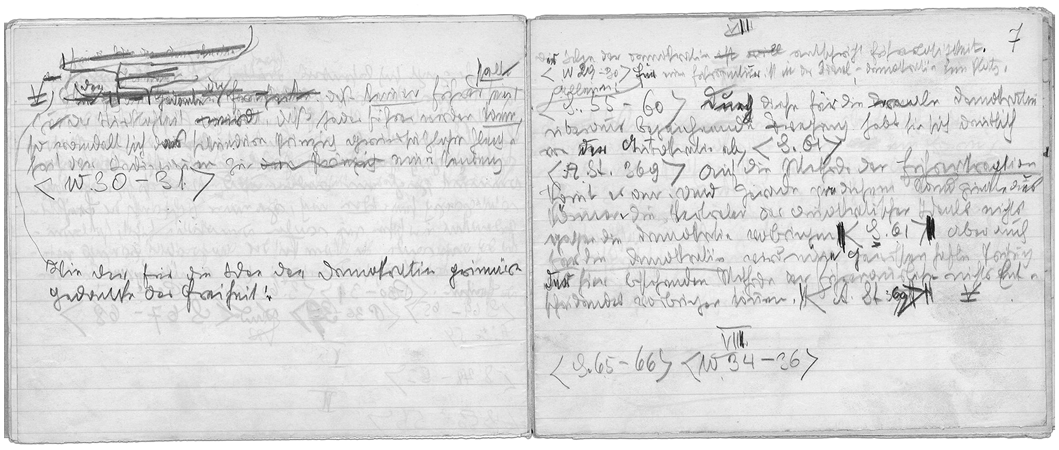
Figure 3.1 Long description
Image shows double-page spread from handwritten manuscript with dense German text written in pencil. Left page contains multiple crossed-out lines, underlines, and short marginal marks, with remaining text written across lined paper. Right page presents more crowded writing, including inserted words, corrections, arrows, and vertical strokes indicating revisions. Both pages show uneven handwriting, layered edits, and page markers at bottom center denoting manuscript structure.
In the transcription, the text in the German original reads as follows (the pages of the original print are added in square brackets, crossed-out text is not reproduced):
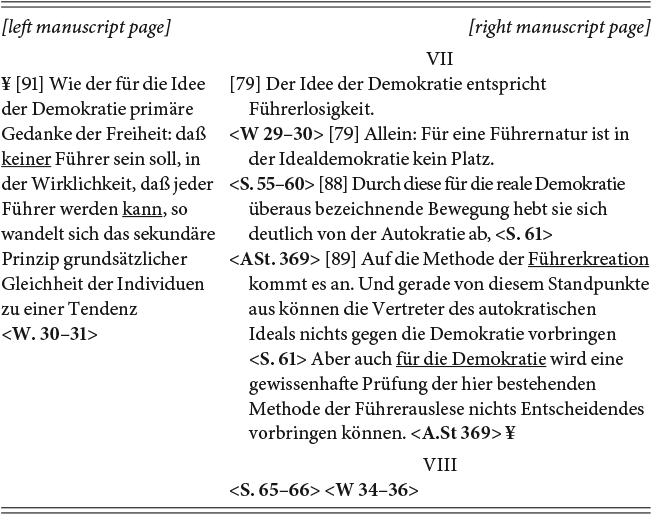
Figure 3.101 Long description
Table displays two-column comparison of manuscript pages. Left column titled “left manuscript page” lists note number 91, German sentences about Idee der Demokratie, Führer, and Gleichheit, with multiple page and marker references. Right column titled “right manuscript page” begins with Roman numeral VII, followed by numbered German text passages discussing Demokratie, Führerrolle, Führerkreation, Prüfung bestehender Methode, and additional page markers. Table ends with Roman numeral VIII at bottom right.
In the English translation, this reads as follows:
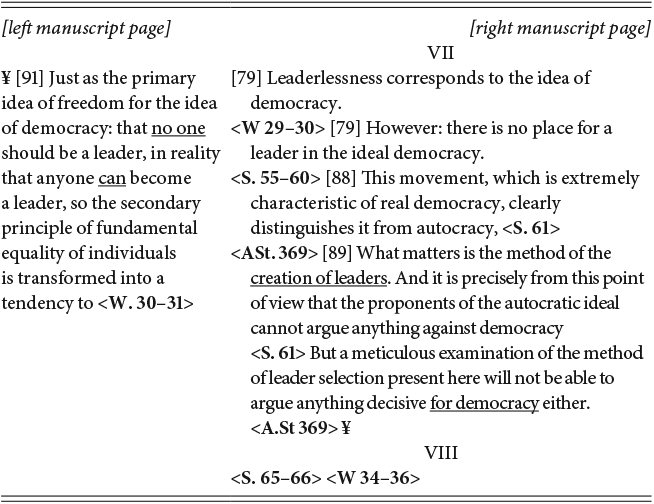
Figure 3.102 Long description
Image shows double-page spread from handwritten manuscript with dense German text written in pencil. Left page contains multiple crossed-out lines, underlines, and short marginal marks, with remaining text written across lined paper. Right page presents more crowded writing, including inserted words, corrections, arrows, and vertical strokes indicating revisions. Both pages show uneven handwriting, layered edits, and page markers at bottom center denoting manuscript structure.
Kelsen is able to cover twenty pages of the printed version on a single (double) page of the manuscript. He achieves this by proceeding as follows: separated by newly formulated interlinear sentences, he strings together passages (marked by pointed brackets) from earlier writings. For the chapter Die Führerauslese (The Selection of Leaders) (in print, VIII, in the manuscript, VII), these passages first appeared in the 1920 edition of Vom Wesen und Wert der Demokratie (pp. 29–30). They are followed by excerpts from the paper on democracy at the German Sociologists’ Congress (pp. 55–60 and 61), extracts from Allgemeine Staatslehre (p. 369) with an insertion once again from the paper on democracy at the German Sociology Conference (p. 61) and finally another passage from the first edition (pp. 30–31). For the remarks on Formale und soziale Demokratie (Formal versus Social Democracy) (in print, IX, in the manuscript, VIII), Kelsen refers to larger blocks of text from the first edition of Vom Wesen und Wert der Demokratie (pp. 65–66) as well as from the conference paper on democracy (pp. 34–36).
Kelsen’s building block approach correlates with the way he documents his remarks in the endnotes. Except for six detailed endnotes in which he deals in particular with opposing views,Footnote 88 the endnotes are kept quite brief. They contain, in no small part (to be precise, in eighteen of forty-five cases) references to his own earlier works, whereby the Allgemeine Staatslehre stands out with seven mentions.Footnote 89 Kelsen uses the reference to his own works, as already mentioned above, to indicate that the relevant question and the position formulated in relation to it had already been subjected to consideration. Accordingly, he refrains from replicating these references again to alleviate the annotation apparatus. Although the Weimarer Richtungs- und Methodenstreit is already underway, one therefore searches in vain for the explicit designation of Kelsen’s main opponents (except for Triepel).
3.7 Conclusion
The second edition of Hans Kelsen’s The Essence and Value of Democracy (Vom Wesen und Wert der Demokratie), which has been translated into a dozen languages, is certainly his best-known and most important text on the theory of democracy. This text is probably the most canonical formulation of his theory of democracy; it is certainly the most consistent version, and it can rightly be said to be of continued relevance in contemporary debates on democracy. However, it was neither born of a moment of genius nor is it a philosopher’s precise declination of a central theorem. Rather, it is the result of an iterative and deliberative process spanning a decade that was fundamentally shaped by Kelsen’s experiences with democracy as a form of government both in Austria and in Weimar Germany.
4.1 Introduction
In line with a centuries-long tradition of political thought from Niccolò Machiavelli onwards, Kelsen separated the ‘reality’ from the ‘ideal’.Footnote 1 More precisely, his intellectual production devoted to democratic theory was underpinned by a remarkable concern for identifying and distinguishing the ideal dimensions of democracy from the real dimensions, as well as for those key concepts related to democracy, such as the significance of the people and parliamentarism.
In the first instance, I will consider Kelsen’s attitude towards Jean-Jacques Rousseau, whom he defined as ‘the most significant theorist of democracy’Footnote 2; focusing on such an aspect is essential not only because Kelsen’s distinction between real and ideal democracy originated precisely from a direct comparison with Rousseau but also because – in my opinion – the theory of real democracy that Kelsen aimed to develop assumed a subtle yet relevant ideal component that owed more to the Geneva-born philosopher than has traditionally been acknowledged. I will thus argue how just starting from the distinction between ‘ideal’ and ‘reality’, Kelsen outlined a theory of real democracy that coincided with a theory of indirect democracy, centred around the provision of full fundamental rights, political parties, parliamentarism, compromises, and respect for minorities, while having a proceduralist connotation. He put such a theory against a series of historically, politically and ideologically connotated targets he considered threats to democratic institutions and coexistence: from Lenin to reactionary forces pushing for professional representation and from the resurgence of neojusnaturalism after the end of the Second World War to Joseph Schumpeter’s ‘elitist’ and ‘competitive’ theory of democracy, passing through Eric Voegelin’s theory of representation. As such, I will try to stress how approaching the issue of ideal and real democracy in Kelsen’s work and thus his theory of real democracy also implies, in some respects, confronting the ‘weight’ of the historical and political context.
4.2 Hans Kelsen with Relation to Jean-Jacques Rousseau: Defining Ideal Democracy and Its Critique
Kelsen’s interest in Rousseau dates back a long way, as does his interest in democratic and political theory. Indeed, these interests can be traced back to the late 1910s, specifically to 1918–1919. During winter 1918, soon after the establishment of the Austrian Provisional National Assembly (1918–1919), which proclaimed the birth of the first Austrian Republic, the jurist published a series of brief articles taking a clear stance in favour of political representation and the proportional voting mechanism, which, to his eyes, both embodied relevant blueprints of modern democracy and represented a true breaking point with the Habsburg past. It is interesting to observe how such articles, published for both left wing and right wing newspapers, already contained much of the political and philosophical arguments that he would later fully develop in both editions of Vom Wesen und Wert der Demokratie: Kelsen indeed outlined a theory of democracy based on the centrality of political representation, compromises and the protection of the minority.Footnote 3 Those articles were not written within a vacuum but with an eye to the precise need to intervene in crucial issues regarding the political future of his country, such as the voting system, which was one of the most relevant elements of disputes within the National Provisional Assembly.Footnote 4
It was in the article of 1918, entitled Das Proportionalwahlsystem, Kelsen mentioned Rousseau, from whom he admitted having learnt that freedom and equality – considered the two core principles upon which democracy is based – could be fully realised when people obeyed laws that they had directly given themselves.Footnote 5 Rousseau’s name returned in Kelsen’s very first version of Vom Wesen und Wert der Demokratie, which was first a conference paper for the Wiener Juristische Gesellschaft in 1919 and then, one year later, a brief yet dense essay for the publisher Mohr Siebeck. Kelsen’s reasoning was very close to that developed in the Das Proportionalwahlsystem: he affirmed that Rousseau’s merit was in defining ‘ideal’ democracy as the realisation of full ‘self-determination’, which implied, in other words, the equally full realisation of the principles of freedom and equality in terms of the identities of the people ruling and the people being ruled. For Kelsen, the Geneva-born philosopher had thus theorised a specific form of democracy, a direct form that assumed the existence of a ‘general will’ that took shape thanks to the ‘social contract’.Footnote 6
My intent is not so much to discuss the validity, or lack thereof, of Kelsen’s reading of Rousseau’s democratic theory as it is to redirect attention to the fact that Kelsen, as an interpreter of Rousseau, basically identified ideal democracy with the direct form of democracy.Footnote 7
Kelsen argued that in considering the Rousseauian concept of (ideal) democracy, some relevant controversies arose. In the first instance, Kelsen recognised that the direct participation of all citizens in public functions did not eliminate the fact that a minority in discordance with the majority could always exist: denoting a realistic approach to politics, he stressed that an ‘opposition of interests’ was always possible. Therefore, assuming that citizens were actually free because they obeyed laws that they had given themselves, what about those (the minority) who dissented from the majority? Were they not free?Footnote 8 In ‘Foundations of Democracy’ (1955), Kelsen would observe that Rousseau’s escamotage for distinguishing between the ‘general will’ and ‘opinions’, according to which the will of the ‘minority’ had to be seen as part of the ‘general will’, was totally unsatisfactory.Footnote 9
The point is that in both editions of Vom Wesen und Wert der Demokratie, Kelsen argued that nothing like Rousseau’s ‘general will’ generated through the ‘social contract’ existed in reality.Footnote 10 His critique of the Rousseauian ‘general will’ could be redirected to the systematic and radical operation of depersonalization of key concepts such as the State, sovereignty, the will of the State, and the people who Kelsen had been developing since the early 1910s with his monumental work Die Hauptprobleme der Staatsrechtslehre (1911)Footnote 11 and that could, in some respects, be ascribed to the influence of the Vienna Circle’s ‘anti-metaphysical’ logical empiricism and Sigmund Freud’s work on psychological anthropology.Footnote 12 Additionally, Kelsen considered Rousseau’s contractualism controversial because the ‘retention of the contractual order should be subject to the persistence of everyone’s consent […] allowing anyone to abandon the community spontaneously at any time […] at this point the unresolvable conflict with social order comes clearly into view […]’. Social order, which to be such, had to exist and work independently from the consensus and will of everyone.Footnote 13 This implied, for Kelsen, that social order was inherently heteronomous. If it were not – that is, if social order depended on the ‘will’ of all those who are submitted to it – at any moment, everyone could decide to avoid it.Footnote 14
Although he described Rousseau as a great theorist of democracy, Kelsen distanced himself from Rousseau’s concept of ‘general will’, his attempt to reconcile the latter with the ‘opposition of interests’ and his contractualism.Footnote 15 Against them, the Austrian jurist affirmed the inevitability both of diverse, opposite interests existing realistically per se and of the heteronomous nature of social order, which implied an insuppressible dichotomy between the rulers and the ruled. Kelsen’s idea of social order as intrinsically heteronomous was coherently in line with his concept of law as a ‘social technique’, which clearly emerges in all his writings, including those devoted to political theory.Footnote 16 Particularly emblematic is his essay, dating back to 1941, significantly titled The Law as a Specific Social Technique: ‘for the word [law] refers to that specific social technique of a coercive order which consists of bringing about the desired social conduct of men through threat of a measure of coercion which is to be applied in case of contrary conduct’.Footnote 17 In turn, both the idea of an unavoidable heteronomous social order and law as a ‘social technique’ were underpinned by a fundamentally pessimistic anthropological vision. For Kelsen, in fact – as we can still read in his essay of 1941 – we need social order and law because humans are far from being ‘good by nature’.Footnote 18
Ideal democracy as direct democracy in which the principle of ‘self-determination’ can be fully realised was, for Kelsen, infeasible mainly because it conflicted with both the ‘opposition of interests’ and the objective existence of social order, which was heteronomous per se and thus implied a persisting dichotomy between the rulers and the ruled. Kelsen’s recognition of both aspects – which also assumed, in the case of heteronomy, a certain dose of anthropological pessimism – represents for me a fundamental step that he took in developing a theory of real democracy.
4.3 The Unattainability of an Ideal Democracy due to Heteronomy Being Impossible to Overcome
The incipit of the first edition of Vom Wesen und Wert der Demokratie was an accusation and a declaration of intent: although democracy had become the ‘key-word’ of the nineteenth and twentieth centuries, and for Kelsen, this noble word had gradually lost its ‘true significance’, which he wanted to re-evaluate: indeed, he denounced that the ‘notion’ of democracy was employed for ‘all possible purposes’, which often contradict each other, contributing to making it a ‘conventional phrase’.Footnote 19
In 1920, Kelsen identified Bolshevism and, notably, Lenin’s political ‘neo-communist’ theory as forces that had completely perverted the meaning of democracy. For the jurist, it was precisely the concept of the ‘proletariat dictatorship’ that represented a threat to democracy, in both theoretical and practical terms.Footnote 20
His distinction between ideal and real democracy could be partly situated within the more general effort to understand what democracy was in practice (real democracy, precisely) and what it could never be, in opposition to a series of targets, among which was the claim by the Bolsheviks and Lenin that the ‘proletariat dictatorship’ was the most perfect and advanced form of democracy. The polemical reference to both is consistent if looking at Kelsen’s intellectual production. In his 1919 Vom Wesen und Wert der Demokratie and in Sozialismus und Staat (1920; 1923), Kelsen critically addressed Marx and his political theory, which, in his opinion, contained an ill-concealed anarchic tendency that he also attributed to Lenin: Kelsen argued that both Marx and Lenin shared a belief – which for him was inadmissible – in the possibility of going beyond the heteronomous character of social order once a true communist society made up of truly free and equal people was created.Footnote 21 This aspiration clashed – as Kelsen polemically stressed – with the profoundly oppressive nature of the Soviet system itself.Footnote 22 In 1920, Vom Wesen und Wert der Demokratie, Kelsen mentioned Lenin’s State and Revolution (1918), which he considered one of the ideological pillars of the Soviet Revolution. In the book written during his Swiss exile, Lenin defined the State in Marxist terms as an instrument for class oppression that would be eliminated through the Revolution.Footnote 23 In particular, what interested Kelsen the most was reminding us that in the State and Revolution, the Bolshevik leader had explicitly recalled Marx’s work on The Civil War in France, devoted to the Paris Commune of 1871, recognising the Treviri philosopher’s great merit of having interpreted that experience as a form of direct democracy, based on the removal of traditional bourgeoisie institutions such as parliamentarism and bureaucracy.Footnote 24
For Kelsen, when the State and Revolution were published and the Red Revolution had already flared up, Lenin looked at the Soviet system itself as an experiment of direct democracy in line with the Paris Commune. After all, as Kelsen himself stressed, the Soviets – at least at the very beginning – seemed to be animated just by the will to enact a form of direct democracy by granting ‘a short duration to the mandate, the possibility of revoking the deputies to the people in the various Soviets at any time and their consequent complete dependence on the electors’.Footnote 25
However, for Kelsen, the outcome of the Soviet experiment had been completely the opposite; for him, the Soviets were comparable to ‘microparliaments’, which, along with a plethora of ‘complementary bodies’ institutionalised by the Soviet constitution of 1918, ultimately generated a ‘hypertrophy of parliamentarism’ that testified to the unfeasibility of ‘self-government’ and thus the dichotomy, which he saw as unavoidable, between the rulers and the ruled. The illusion of overcoming the latter denoted the inability to understand an important lesson from the father of modern sociology, Max Weber, according to whom ‘labour division’ and ‘competence specialization’ in a modern society all contributed to impeding the direct practice of public functions while rendering necessary the existence of a bureaucratic apparatus.Footnote 26
Here, Kelsen adopted a sociological argumentation to sustain his idea of heteronomy and the inevitable division between the rulers and the ruled, which was not only discordant with Lenin’s claims but also with the Rousseauian concept of ‘self-determination’ in the form of a direct democracy. It is precisely within this kind of reasoning that I situate Kelsen’s peculiar definition of the parliament as an ‘organ of the State’, as he formulated it just in the 1920 Vom Wesen und Wert der Demokratie.Footnote 27 In my opinion, by defining parliament in such terms, Kelsen sought to emphasise the impossibility of overcoming the split between the rulers and the ruled, that is, the impossibility of creating an ideal democracy. From his point of view, the Soviet system had failed in its ambition not only to establish a true ‘self-government’ but also to establish a democratic one.Footnote 28 The government born from the ashes of the Romanov Empire was everything but a democracy in Kelsen’s eyes for two very precise reasons: first because equal fundamental rights were not granted and second because the Soviet constitution of 1918 had introduced a series of heavily discriminatory policies eliminating the principle of universal suffrage, which the Austrian jurist considered one of the blueprints of real and ideal democracy.Footnote 29 He defined the Soviet voting mechanism not only as discriminatory, specifically to the detriment of the bourgeoisie, but also as ‘ständisch’ (class driven) because it reintroduced political discrimination on a socioeconomic basis: he used the term ‘Ständeverfassung’ to describe the Soviet constitution of 1918.Footnote 30 For me, Kelsen’s critique of the ‘ständisch’ component of the Soviet voting system seems to echo the thoughts of German social-democrat Karl Kautsky – a fierce opponent of Lenin. After all, Karl Kautsky’s essay Die Diktatur des Proletariats (1918), which was a j’accuse against Lenin and the way in which his party had conquered power, was among the (actually very few) works quoted by Kelsen in the first edition of Vom Wesen und Wert der Demokratie. Kautsky himself harshly attacked the Russian version of the Marxist ‘proletariat dictatorship’ for drastically limiting freedom rights.Footnote 31
Additionally, I think that Kelsen’s reference to the ‘ständisch’ nature of the right to vote in Russia was perfectly in line with what he argued in his previously mentioned articles, which stressed the importance of the new Republican Austria cutting ties with its Habsburg past and, chiefly, with the ‘ständisch’ logic that had characterised the empire’s voting system. In contrast to the Soviet experiment, Kelsen thus outlined what he conceived of as real democracy: starting from the distinction between the ideal and the real through a personal interpretation of Rousseauian thought, the jurist argued why the Soviet system could not be defined as a direct democracy, and in doing so, he identified real democracy with an indirect form of government assuming the equally recognised freedom of all citizens. The true breaking point between real democracy and the Soviet system was not the principle of heteronomy and thus the split between the rulers and the ruled per se, which was present in both, but rather the peculiar form of heteronomy that took shape between the two. In Soviet Russia, heteronomy existed in the absence of freedom, which was intended as equally granted civil and political rights, and the political system in Russia was thus different from real democracy.
4.4 Heteronomy and Freedom in Real Democracy, while Subtly Approximating Ideal Democracy
Once it was established that ideal democracy as a realisation of full ‘self-determination’ in the form of a direct democracy was not feasible, a major question remained: how were freedom and heteronomy politically reconciled in real democracy? In my opinion, Kelsen developed his peculiar response through a frontal critique of one of the pillars of classical democratic theory and most importantly, of Rousseauian theory, that is, the traditional concept of the people as a unitary sovereign subject equipped with a defined will.Footnote 32
Kelsen developed a theory of democracy without the people – at least according to the abovementioned meaning of the term – starting again from a clear-cut distinction between the ideal and real dimension. Ideally, the people were in perfect unity; in reality, and more exactly from a ‘sociological’ viewpoint, they were a plural, diversified entity in which the ‘opposition of interests’ was always possible. Most importantly, in the latter, the people could not be neutralised by theorising – as Rousseau did – an alleged ‘general will’ generated by a ‘social contract’. Only legally, that is, in normative terms, did the people constitute a unity.Footnote 33 In my opinion, the emphasis put on the plural dimension of the people was in line with that process of depersonalization that the jurist initiated in Hauptprobleme der Staatsrechtslehre and within which his critique of the Rousseauian ‘general will’ can be partly reconducted. Additionally, I think that it was coherent with his personal background as a former citizen of the multinational Habsburg Empire, which was literally a puzzle of different ethnic stocks, languages, and religious denominations.Footnote 34
However, if the people were a plural entity, how did they rule in real democracy? To me, Kelsen’s response is encapsulated in the concept of ‘integration’, which I retain is crucial for understanding his way of interpreting the reconciliation between freedom and heteronomy in real democracy. The preliminary condition for the process of integration was the existence of citizens provided with civil and political rights. However, comprehending how realistically such a process functioned implied, for Kelsen, admitting the split between citizens as ‘subjects of political rights’ and those who exercised them.Footnote 35 Within the latter, Kelsen included the so-called subdifferentiations between, for example, those who exercised their right to vote influenced by the others and those who ‘give a certain direction to the formation of the state will’.Footnote 36 The latter were those gathering together in political parties, which thus helped integrate real people as a plural entity. Kelsen’s judgement was clear-cut: ‘democracy can only exist if individuals group themselves according to their political affinities, to direct the general will towards their political ends, so that between the individual and the state, […] political parties find their place’.Footnote 37
I find that Kelsen brought his reasoning to the most logical consequences, given the preconditions, when he finally argued that a people per se did not exist as long as citizens decided to form political parties ‘stirring up all those social forces that, in some respects, we can call the people’.Footnote 38 In real democracy, social, ideal, and political pluralism did not disappear; it was not even neutralised: it was instead integrated. Kelsen’s theory of real democracy left no room for Rousseauian preestablished ‘general will’ and did not express any form of hostility towards pluralism that was accepted as a matter of fact.Footnote 39 Heteronomy thus could be reconciled with freedom in the form of an indirect democracy in which, starting from the full guarantee of fundamental rights, political parties integrated real people. It was through the process of integration and thus through political parties that real people could rule. In light of this, we can understand why, for Kelsen, ‘modern democracy is entirely founded on political parties’.Footnote 40
His defence of political parties should nevertheless be put in its proper historical context, that is, as Kelsen’s personal response to the German jurist Heinrich Triepel, who had blamed political party pluralism for expressing an atomistic view of politics that threatened the State as a unitary body.Footnote 41 Unlike Triepel, Kelsen argued that there was no original unity to protect or restore as a plural condition for integration.Footnote 42
If political parties were the driving forces of the integration process, the peculiar way in which such a process took place and manifested was, for Kelsen, parliamentarism coinciding with ‘the formation of the executive will of the state through a collegial body elected by the people on the basis of universal and egalitarian suffrage, i.e., democratic, according to the principle of the majority’.Footnote 43 Regarding the concepts of democracy and the people, Kelsen drew a distinction between the ideal and real meaning of parliamentarism. Regarding the former, parliamentarism allowed the people to express their political will. In this sense, parliament itself was defined as the ‘organ of the people’. Parliament thus represented the people because it represented the will of the people. This equated to, for Kelsen, justifying parliamentarism ‘from the perspective of people’s sovereignty’.Footnote 44 He contested precisely such a definition because to him, parliamentarism was, realistically, nothing but the outcome of a compromise between the principle of freedom and the ‘division of competences’. In the second edition of Vom Wesen und Wert der Demokratie, Kelsen again recalled Weber’s sociological lesson to explain why direct democracy was materially unfeasible.Footnote 45 He could thus affirm that ‘the more numerous associated collectivity is, the less the people as such are able to directly perform the proper creative action of the formation of a state will, and all the more they are forced, also for reasons of pure social technique, to limit themselves to creating and controlling the special body for the formation of this will’.Footnote 46 The major subjects of such a body were political parties taking decisions on the basis of the majority principle, which – as Kelsen himself stressed – almost immediately evoked the ‘domination of the majority over the minority’.Footnote 47 His objective instead was to prove how such domination in real democracy did not degenerate into a form of oppression, namely, the ‘tyranny of the majority’, undermining the reconciliation between freedom and heteronomy itself.Footnote 48
‘In terms of reality’, the jurist argued that the majority did exist in relation to the minority, and both existed as the result of a complex process by means of which social and political pluralism systematically integrated first in structured political parties and, once within the parliament, in the form of a majority and a minority, whose relationship was dynamic because today’s minority could aspire to become tomorrow’s majority. In other words, he affirmed that the principle of the majority in real democracy did not correspond to a majority imposing its will (‘diktat’) on and to the detriment of the minority. For Kelsen, this embodied the ultimate essence of the whole ‘parliamentary practice’, in which the so-called principle of the majority signified not so much that decisions (laws) were made and imposed unilaterally by the majority – if it were so, for him, the effective reconciliation between freedom and heteronomy would be irremediably undermined – as such decisions resulted from a compromise between the majority and the minority dialectically confronting each other. As Kelsen himself noted, it would be more correct to define the principle of the majority acting in real democracy as the ‘majority – minority principle’.Footnote 49 For him, the principle of the majority thus implied the existence of the minority, which was recognised as a crucial component in democratically making political decisions.Footnote 50
To Kelsen, the more the role of the minority was politically consistent, the more the laws – binding the whole community – would be the result of a compromise with the majority rather than the unilateral expression and imposition of the latter, which allowed, for him, the softening of the unavoidable heteronomous character of social order. This sentiment reinforced Kelsen’s view of the proportional system as an effective means to provide the minority with articulated representation, strengthening its influence on the content of laws.Footnote 51
Kelsen’s reflection discussed thus far is doubly relevant to my work. Historically speaking, he was openly replying to those reactionary forces that, during the late 1920s, inside and outside Austria were pushing to replace Parliament with a professional chamber and a corporatist representation, which would have granted, according to its supporters, a more effective representation of the true interests of the people. Kelsen’s judgement was without appeal: a corporatist representation would have never been capable of instigating integration while reconciliating heteronomy with freedom just because – unlike what happened in real democracy – it rejected the principle that by virtue of being part of socioeconomic groups, citizens were subjects equipped with the same rights of freedom.Footnote 52 Additionally, from a theoretical point of view, I think that the way in which he delineated the majority – minority dialectic and the proportional mechanism allows critical consideration of the ideal – real democracy dichotomy. As previously seen, Kelsen drew a clear line, in contrast with Rousseau, between ideal and real democracy by stressing how heteronomy was unavoidable. However, within Kelsen’s reasoning, the minority – majority principle and the proportional granting of a resounding voice to the minority to influence the majority appeared functional in mitigating the ‘burden of heteronomy’.Footnote 53 It is here that I see a sort of subtle opening towards the ideal dimension of democracy; even though the latter, in terms of the perfect realisation of the ‘self-determination’ principle, could never be fully reached, a sort of approximation seemed partly feasible within an indirect democracy centred around political parties and based on fundamental rights and parliamentarism, in which political decisions in the form of laws did not result from the mere imposition of the majority will or, even worse, of a tyrannical majority. The ‘tyranny of the majority’ concept contributes, in my opinion, to further problematising Kelsen’s theory of real democracy. In fact, I think that he showed a twofold attitude towards the ‘tyranny of the majority’: as previously observed, when addressing the meaning and functioning of parliamentarism, Kelsen greatly emphasised the intrinsic, positive aspects of the majority – minority principle to the point that he argued that since the majority could not exist without the minority, the dialectic relationship between the two, with all the consequences that this implied, was a matter of fact.Footnote 54
Following this perspective, parliamentarism thus seemed to be a perfect antidote to the ‘tyranny of the majority’ and to assume a certain dose of trust and optimism regarding political participants’ abilities to rationally act and interact, which for me, partly underpinned the subtle opening to the ideal dimension itself that I was referring to: softening the ‘burden of heteronomy’ implied the ability to construct effective compromises that could be reached – as Kelsen stressed – through a dialectical and rational confrontation between political forces within the legislative body.Footnote 55 However, Kelsen was far from idealising parliamentary life: he admitted the relevance of clashes of ideas and interests within the parliament while arguing that they could be solved by identifying ‘meeting points’, compromises, in fact, between political players.Footnote 56 Nonetheless, the jurist was realistic enough to recognise that – regardless of the quality of the parliamentary mechanism – the ‘tyranny of the majority’ was potentially possible.Footnote 57 He indeed stressed the importance of providing fundamental rights, which he defined as a ‘bulwark’ in defence of the minority as well as being firmly in favour, for example, of the proportional system as a means to provide just the minority with a robust political voice.Footnote 58
Beyond agreeing or not agreeing with the solutions that he proposed to avoid the ‘tyranny of the majority’, his consciousness of the fact that such a peril could take shape was, for me, coherent with a certain dose of anthropological pessimism. I think that his theory of real democracy thus assumed a sort of ambivalence between optimism and pessimism, between an optimistic trust in people’s ability to rationally confront challenges on the one hand and a fundamental anthropological pessimism on the other hand. To me, the crux of the issue is not about establishing which of the two attitudes was prevalent but rather recognising that both did exist and, most importantly, how his optimistic trust in human rationality mitigated his anthropological pessimism, while the latter and his ‘polemological’ concept of political life represented two powerful antidotes against an excessive idealisation of democratic and parliamentary life.
4.5 Real Democracy as ‘Government by’
Kelsen’s last contribution to democratic theory dates to the mid 1950s when he published ‘Foundations of Democracy’, a long essay written for the U.S. journal Ethics, in which old and new polemical references were addressed.Footnote 59
Starting again by identifying the split between ideal and real democracy, with reference to Rousseau, Kelsen further elaborated on the meaning and components of real democracy as a compromise between freedom and heteronomy.Footnote 60 Already in his European writings, he had reflected on the way in which such a reconciliation took shape in real democracy, starting from a condition of granted fundamental rights and the recognition of real people as a plural entity. However, I think that in his U.S. essay, Kelsen focused on the dimension of the ‘how’, making it explicit that for him, real democracy was essentially a ‘political procedure’ by means of which political decisions in the form of laws binding the community were taken.Footnote 61 Similar to the past, Kelsen drew up such a concept that contradicted a series of doctrines, theories and intellectuals whose ambition was, he believed, to define democracy in terms of a ‘common good’, the existence of well-defined values or of an alleged better form of representation than the parliamentary one. Among these, Kelsen primarily identified the so-called Soviet doctrine of democracy.
Recalling his argumentation of 1920, Kelsen denounced the Soviet doctrine for being based on the ‘perverse’ identification between the ‘proletariat dictatorship’ and democracy, which was conceptually possible only if assuming democracy as being a ‘government for’, namely, as a government established to achieve a specific purpose considered objectively valid and true. In the case of Soviet doctrine, such a purpose was the realisation of the ‘proletariat’s interests’ by means of the Communist Party, assumed to be the only entity capable of correctly interpreting them.Footnote 62 He developed a similar reasoning against the school of neojusnaturalism that took shape during the second postwar period as a critical response to juspositivism and as an attempt to theorise a refoundation of democracy in a post-totalitarian age on the basis of well-defined values, mainly ascribable to Christian tradition.Footnote 63
Kelsen argued that in different ways, neojusnaturalists shared the belief that a true democracy corresponded to a social and political system oriented around achieving the ‘common good’, attributed to Christian values. The latter, for neojusnaturalists, had to be internalised by the legal – political system itself to avoid what they considered one of the sources of totalitarianism, namely, the separation of legality and moral principles – for them ascribable just to juspositivism.Footnote 64
I think that Kelsen saw the same forma mentis in both neojusnaturalists and the Soviets, namely, the idea that democracy was basically a ‘government for’. In his view, the ultimate meaning and legitimacy of democracy relied on both the identification of a ‘common good’ to carry out, namely, ‘proletariat interests’ for the Soviet doctrine, and the realisation of Christian values for neojusnaturalists. Kelsen’s critique followed two directions. As previously seen, his distinction between ideal and real democracy assumed the recognition of the ‘opposition of interests’ as something that could not be eliminated. In light of this, the belief in a ‘common good’ towards which the people or a whole social class tended to seem unrealistic,Footnote 65 and the belief that human intellect could objectively determine true principles or values was likewise completely unrealistic to him.Footnote 66 Most importantly, in the case of both the Soviet and neojusnaturalist doctrines, the issue of freedom, rights, their guarantee, and how to protect them became of secondary importance, as did the issue of ideal, political and even pluralism of values, with all the dangerous consequences that this might generate (and had actually produced in Soviet Russia, for example). In fact, to Kelsen, a dictator could depict him or herself as the one carrying out the supreme ‘common good’, using this as the ideological smokescreen for his or her absolute power, while suppressing any form of pluralism.Footnote 67
Interestingly, he identified the same potential peril in the work of his former pupil, Eric Voegelin, specifically in his ‘doctrine of new representation’.Footnote 68 The German political scientist – an émigré like Kelsen – distinguished between two core types of representation: the ‘elemental’ – coinciding with the political and parliamentary – and the ‘existential’, which he defined as the relationship between the ruler and society as a whole.Footnote 69 Kelsen interpreted Voegelin’s theory of ‘existential representation’ as the expression of a fundamental indifference towards the issue of freedom. In fact, for Kelsen, once it was established that the ruler represented the whole of society, any concern about rights and their preservation became of secondary importance, as did concerns about pluralism, thus opening the doors to a potentially authoritarian regime.Footnote 70
As in reality, Kelsen believed that if there were no people who existed as a unitary subject equipped with a defined will, then in reality, no ‘common good’ towards which the people leaned – as instead theorised by Rousseau himselfFootnote 71 – existed either. ‘Common good’ appeared to him to be a smokescreen for authoritarian purposes. Conversely, a just democracy as a ‘government by’ served the principle of freedom and the reconciliation between the latter and heteronomy much better than democracy as a ‘government for’: it did not untenably assume the existence of a ‘common good’ but rather a recognition of equal fundamental rights among citizens, specifically the right to vote, which made the electoral process and thus the selection of the rulers by the ruled possible. Indeed, assuming the peculiar perspective of democracy as a ‘government by’, rulers were not rulers because they possessed some ‘divine right’ or because they and only they knew what the ‘common good’ or the ‘objective interests’ of a social class were. They were rulers because they were democratically elected. This implied that rulers were responsible for their decisions and, most importantly, that the ruled could aspire to become the rulers of tomorrow. From Kelsen’s perspective, the reconciliation between freedom and heteronomy thus took the shape of a fluid relationship between the rulers and the ruled.
The procedural connotation of Kelsen’s theory of real democracy seems to bring him closer to Joseph A. Schumpeter, who was friends with Kelsen and, most importantly, one of the polemical references of ‘Foundations of Democracy’. Immediately, some interesting similarities between the two Austrians emerge: first, both clearly distinguished between real and ideal democracy. For both, addressing the ideal meaning of democracy implied a comparison with Rousseau, who, for Schumpeter, was one of the champions of the ‘classical theory of democracy’ based on the idea of the people as a unitary subject, equipped with a will and oriented towards the ‘common good’. Similar to Kelsen, Schumpeter took the distance from both concepts in the popular Section 4.4 of Capitalism, Socialism and Democracy (1942), in which he argued that a ‘common good’ objectively determined and rationally conceivable by the people could not exist in a changing world subject to ‘the habits of the bourgeoisie’.Footnote 72
In my opinion, the critique of the existence of a ‘common good’ made up, in both Kelsen’s and Schumpeter’s work, one of the conceptual premises underpinning their common definition of real democracy in terms of ‘how’ rather than ‘what’. Like the jurist, Schumpeter developed a procedural theory of real democracy and identified the dynamic relationship between the rulers and the ruled, in which the former were selected and could be ‘evicted’ by the latter as a crucial component of real democracy.Footnote 73 However, in ‘Foundations of Democracy’, Kelsen expressed a critical attitude towards Schumpeter’s political theory, which makes it relevant, I believe, to reflect again on the particular interplay between the ideal – real dimension of democracy in Kelsen’s work. The main element of controversy was Schumpeter’s procedural definition of real democracy as ‘that institutional arrangement for arriving at political decisions in which the people acquired the power to decide by means of competitive struggle for the people’s vote’.Footnote 74
Schumpeter followed the critique of the people as a unitary entity – which he shared with the jurist – to the most radical consequences of the concept: to him, there was neither democracy as ‘government for the people’ nor democracy as ‘government by the people’. There was rather democracy as ‘government by competition’. In light of this, the economist and political scientist considered free elections and the electoral mechanism itself as functional in enhancing ‘political competition’. Kelsen blamed Schumpeter for overestimating the importance of ‘political competition’, which for him instead ceased to be quite so crucial after the elections.Footnote 75
In other words, both thinkers attributed to real democracy a procedural connotation; both stressed that in real democracy, the relationship between the rulers and the ruled was determined through elections that allowed the latter to choose the former. However, for me, the similarities stop here. Schumpeter argued that political leaders competed for the elector’s vote and that the whole electoral mechanism was functional to such competition. Real democracy was thus a political procedure whose scope included selecting leaders.Footnote 76 In this sense, Schumpeter’s proceduralism had a declared and strong ‘elitist’ connotation that was absent in the work of the Austrian jurist.Footnote 77 In contrast, in Kelsen’s view, real democracy was a political procedure capable of reconciling heteronomy with freedom, in some respects while reducing the ‘burden’ of heteronomy and thus subtly opening up a road to ideal democracy, thanks to, among other things, the peculiar dialectic between the majority and minority within the parliament, based on compromises.
The distance between Kelsen’s proceduralist view of real democracy and Schumpeter’s view, here outlined using some of its components, also implied a different approach to Rousseau. For the Austrian economist, the Swiss philosopher and his work, as representative of the ‘classical doctrine of democracy’, had to be totally rejected.Footnote 78 Conversely, Kelsen’s judgement was much less one-sided and peremptory. Although, as I have tried to stress, Kelsen’s theory of real democracy was distant from the Rousseauian theory in many crucial aspects, he considered the father of the contract social as the one who – better than anybody else – had defined the ideal of democratic freedom as ‘self-determination’. The fact that, for Kelsen, the full realisation of ‘self-determination’ in the form of a direct democracy could not be fully achieved did not diminish the great importance of Rousseau’s philosophical work. Kelsen’s concern for softening the ‘burden of heteronomy’, which I interpret as a sort of tendency towards the ideal dimension of democracy, to me represents an admission of his attentive (although critical) consideration of Rousseau’s theory of democracy itself.
4.6 Conclusion
This chapter focused on Hans Kelsen’s democratic theory through the distinction that he established between ideal and real democracy. I have shown that such a distinction originated from a direct comparison with Jean-Jacques Rousseau, through which Kelsen concluded that ideal democracy as the attainment of full political freedom in terms of self-determination and thus as direct democracy was infeasible: therefore, real democracy was inevitably based on the dichotomy between the rulers and the ruled. Once this was argued, explaining the meaning and function of real democracy for Kelsen implied understanding how heteronomy, being impossible to overcome, could reconcile with the principle of freedom. By discerning the ideal dimension from the real dimension of key concepts such as the people and parliamentarism as well as by criticising the concept of ‘common good’, Kelsen stated that such reconciliation was made possible in the form of a ‘government by’ the people, centred around freedom rights, political parties, parliamentarism, respect of minorities, and compromises. However, I have stressed how, in some crucial respects, Kelsen’s theory of real democracy maintained a sort of subtle opening to an ideal dimension – in terms of softening the ‘burden of heteronomy’ – whose recognition allows us to further problematise his concept of democracy and his attitude towards Rousseau himself.
While discussing how Kelsen developed a theory of real democracy starting from the distinction between the ideal and the real, I have argued and stressed how such a theory stood in a sort of critical ‘dialogue’ with a series of ideological and political projects and visions related to precise historical and political changes and figures. From Kelsen’s viewpoint, what brought together all these projects and visions was both their critical – not to say hostile – attitude towards parliamentary democracy. In light of the serious challenge that, for Kelsen, they represented democracy and its founding principles, I think that the jurist sketched out the difference between ideal and real democracy to further reflect on what democracy was in practice and what it could never be or become if it wanted to preserve itself.
Thus, I retain that Kelsen’s distinction between ideal and real democracy and his theory of real democracy were also functional to argue that all those theories and political projects that he addressed in his works and that criticised or wanted to go beyond real democracy, as ‘government by’, based on fundamental rights, political parties, parliamentarism and the dialectic between the majority and the minority, were doomed, in his opinion, to create a political system marked by heteronomy without freedom and thus immeasurably distant not only from real but even from ideal democracy itself. In this respect, starting from the distinction between ideal and real democracy, Kelsen developed a theory of real democracy that was, at the same time, a theory of democracy as a balance between heteronomy and freedom and a defence of it against politically and ideologically connotated targets.
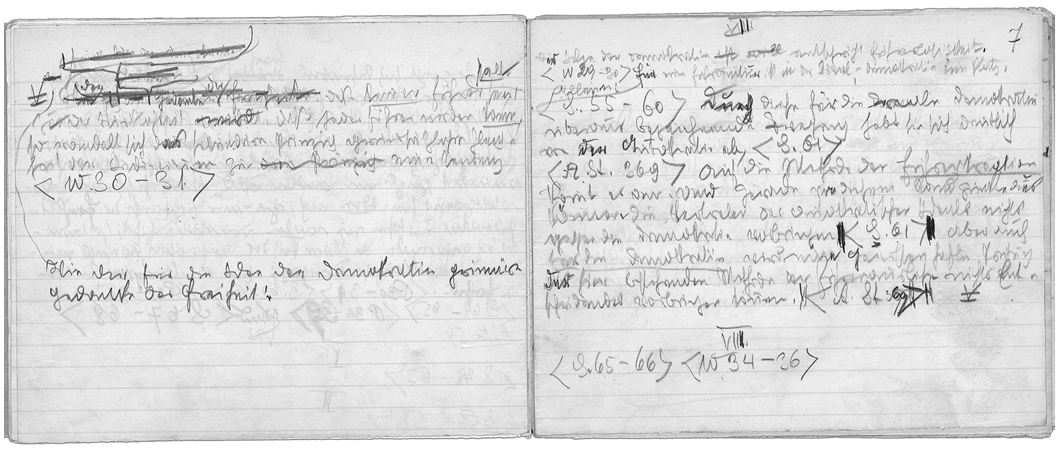

 Open access