





No CrossRef data available.
Adaptive management approach – Kansas City success story
Part of:
Cambridge Prisms: Water Perspectives
Published online by Cambridge University Press: 21 May 2025
Abstract
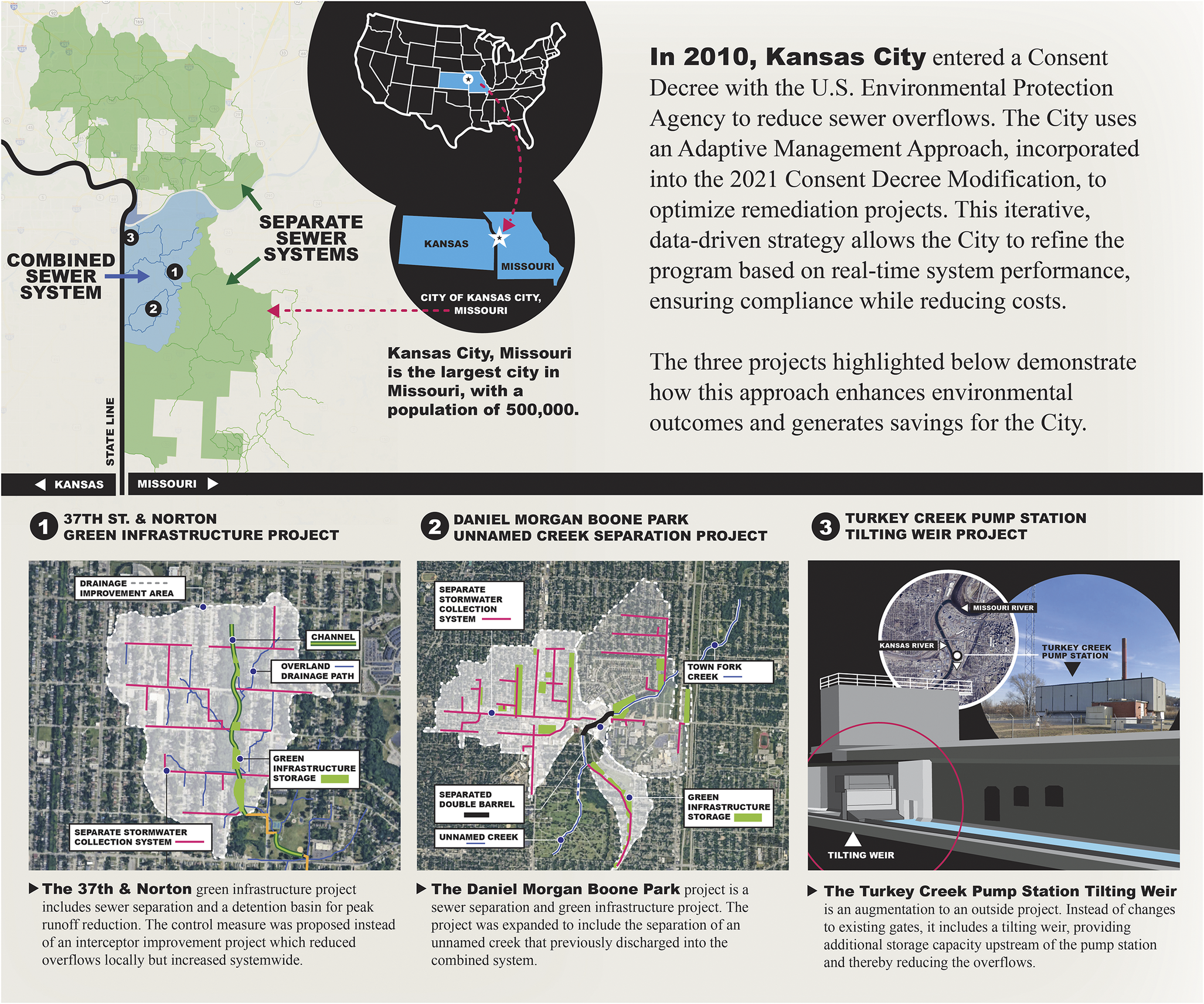
The Kansas City, Missouri Smart Sewer Program has successfully implemented an adaptive management approach to cost-effectively reduce sewer overflows. This approach was implemented under the guidance of the third Consent Decree modification, which mandates the level of sewer overflow reduction. This approach includes iterative decision-making, continuous monitoring and flexible strategies to optimize environmental outcomes while managing costs. The adaptive management framework integrates system performance and past project data into an iterative planning, implementation, monitoring and analysis cycle. This process enables cost-effective decision-making aligned with Consent Decree compliance by managing the uncertainties in sewer system data and the interdependency of proposed project outcomes. The Smart Sewer Program adopted this approach in response to financial challenges and environmental requirements, resulting in key modifications to its original Overflow Control Plan projects. The adaptive management approach, enabled by the third Consent Decree modification, has proven pivotal in optimizing project performance, reducing costs and protecting vulnerable populations. By leveraging the adaptive management approach, Kansas City has reduced program expenses by hundreds of millions of dollars while aligning with Environmental Protection Agency (n.d.) environmental justice goals. Key project modification examples from the program presented in this article illustrate the effectiveness of adaptive management in achieving better outcomes. The first example showcases a project substitution. In this example, green infrastructure replaced a proposed relief sewer project, resulting in a more cost-effective solution with enhanced overflow reduction and environmental justice benefits. The second example involves project augmentation with creek separation, resolving double-counted sewer overflows, and significantly reducing annual overflow volume at minimal cost. A third example demonstrates project modification for a City project that was not a part of the Smart Sewer Program, where alternative gate configurations increased overflow capture without additional costs, potentially eliminating the need for a costly deep tunnel project. This article demonstrates the potential of an adaptive management approach for urban wastewater management programs, offering a replicable model for other municipalities. The Kansas City Smart Sewer Program example demonstrates how adaptive management can drive cost savings, enhance environmental outcomes and ensure regulatory compliance for a Consent Decree.
Topics structure
Keywords
Information
- Type
- Perspective
- Information
- Creative Commons

 This is an Open Access article, distributed under the terms of the Creative Commons Attribution licence (http://creativecommons.org/licenses/by/4.0), which permits unrestricted re-use, distribution and reproduction, provided the original article is properly cited.
- Copyright
- © The Author(s), 2025. Published by Cambridge University Press
References
Environmental Protection Agency (EPA)
(n.d.) EJScreen Environmental Justice Screening. Available at https://www.epa.gov/ejscreen (accessed 1 November 2024). US Environmental Protection Agency. Washington, DC, USA.Google Scholar
Rist, L, Campbell, BM and Frost, P (2012) Adaptive management: Where are we now? Environmental Conservation 40(1), 5–18 https://doi.org/10.1017/S0376892912000240. Cambridge University Press, Cambridge, UK.CrossRefGoogle Scholar
Smart Sewer Program (n.d.a) Third amended Consent Decree. Available at https://www.kcsmartsewer.us/approach/third-amended-consent-decree (accessed 1 November 2024). KC Water. The City of Kansas City, MO, USA.Google Scholar
Smart Sewer Program
(n.d.b) About the Smart Sewer Program. Available at https://www.kcsmartsewer.us/about (accessed 1 November 2024). KC Water. The City of Kansas City, MO, USA.Google Scholar
Smart Sewer Program
(n.d.c) 37th Street and Norton Avenue. Available at https://www.kcsmartsewer.us/projects/37-norton (accessed 15 February 2025). KC Water. The City of Kansas City, MO, USA.Google Scholar
Smart Sewer Program
(n.d.d) 63rd Street & Daniel Morgan Boone Park. Available at https://www.kcsmartsewer.us/projects/dmb (accessed 15 February 2025). KC Water. The City of Kansas City, MO, USA.Google Scholar
Tomic, S, Shively, A and Chase, A (2023)
Kansas city smart sewer program savings using adaptive management – A case study
. In Paper Presented at the WEF Collections Systems Conference, 27–30 June, Kansas City Convention Center, Kansas City, MO. Water Environment Federation, Alexandria, VA, USA.Google Scholar
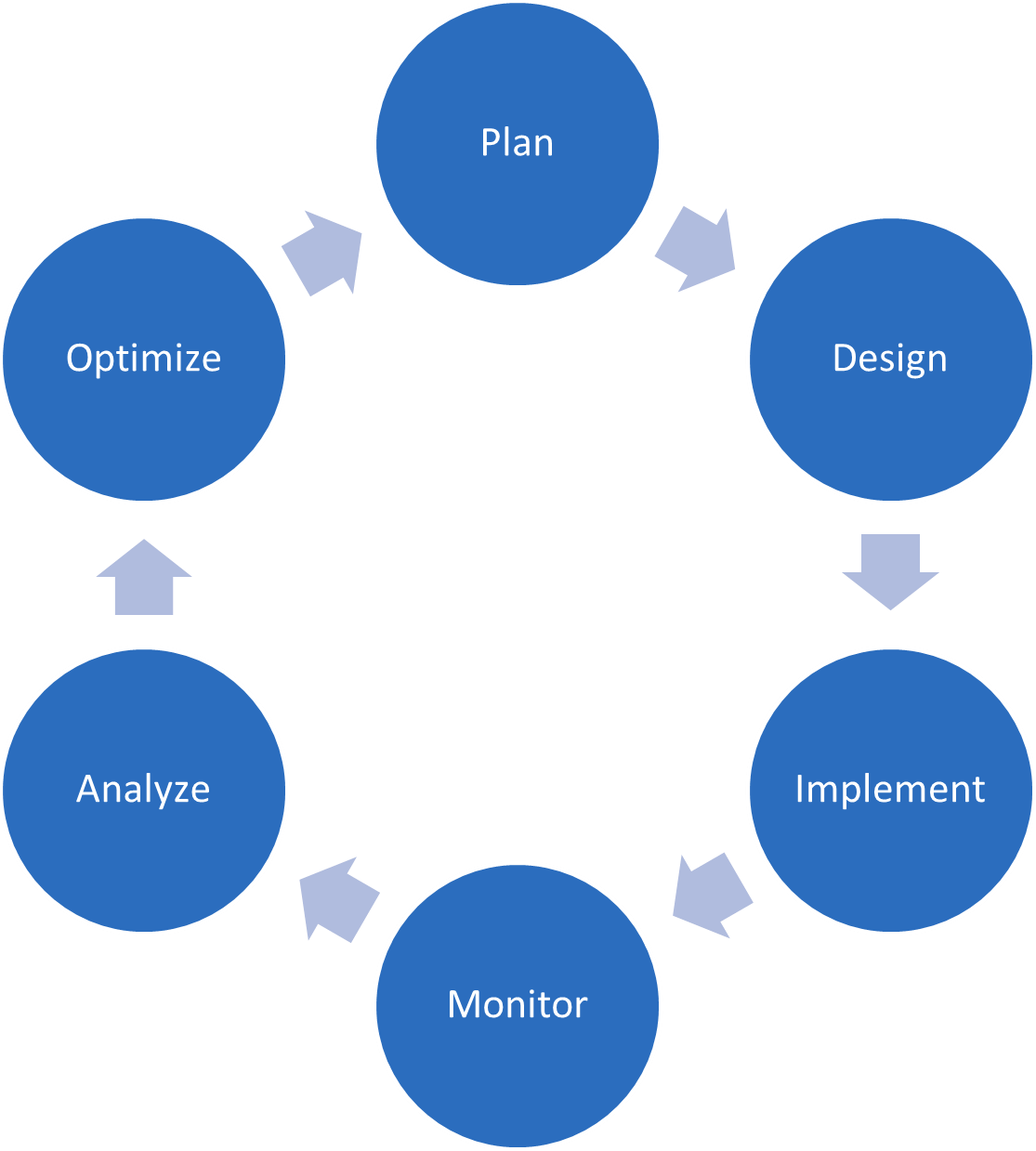
Figure 1. Adaptive management approach process.
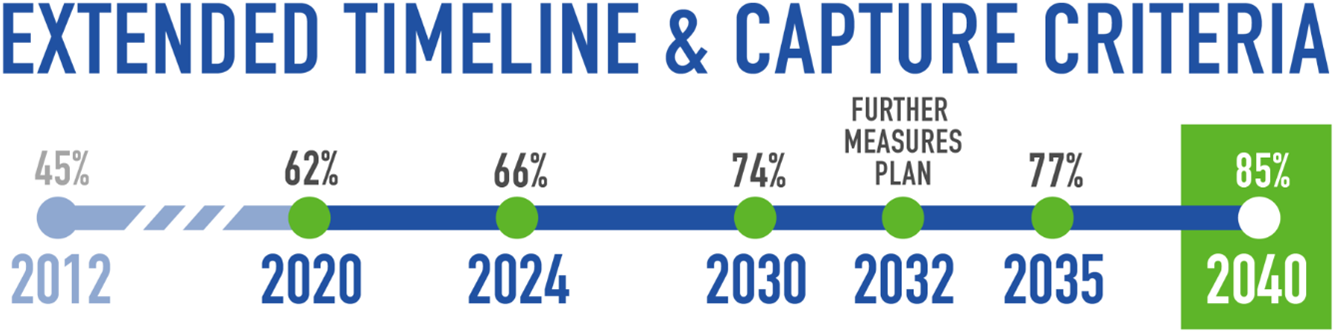
Figure 2. Kansas city consent decree timeline.
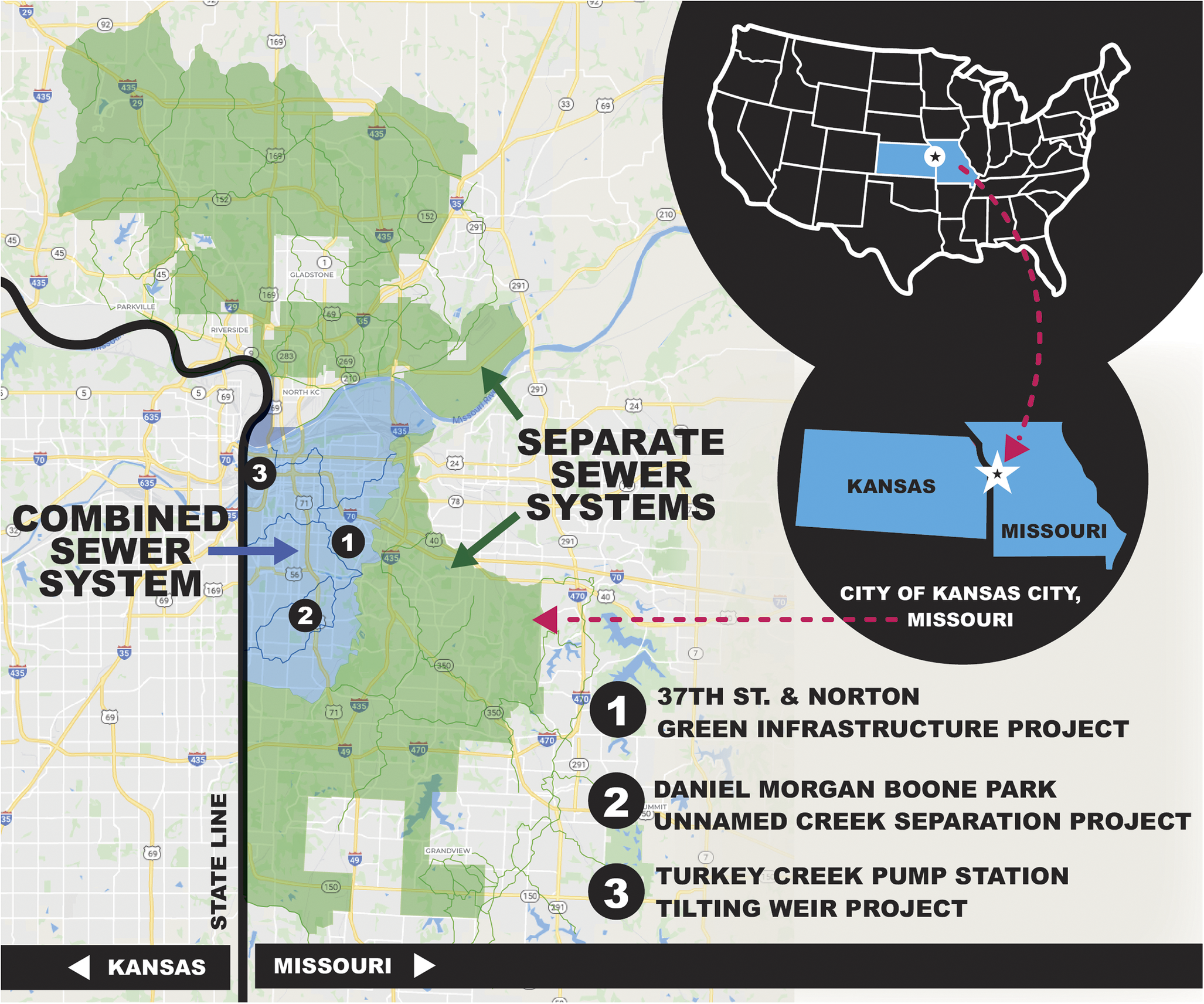
Figure 3. Project locations and KCMO combined sewer system.
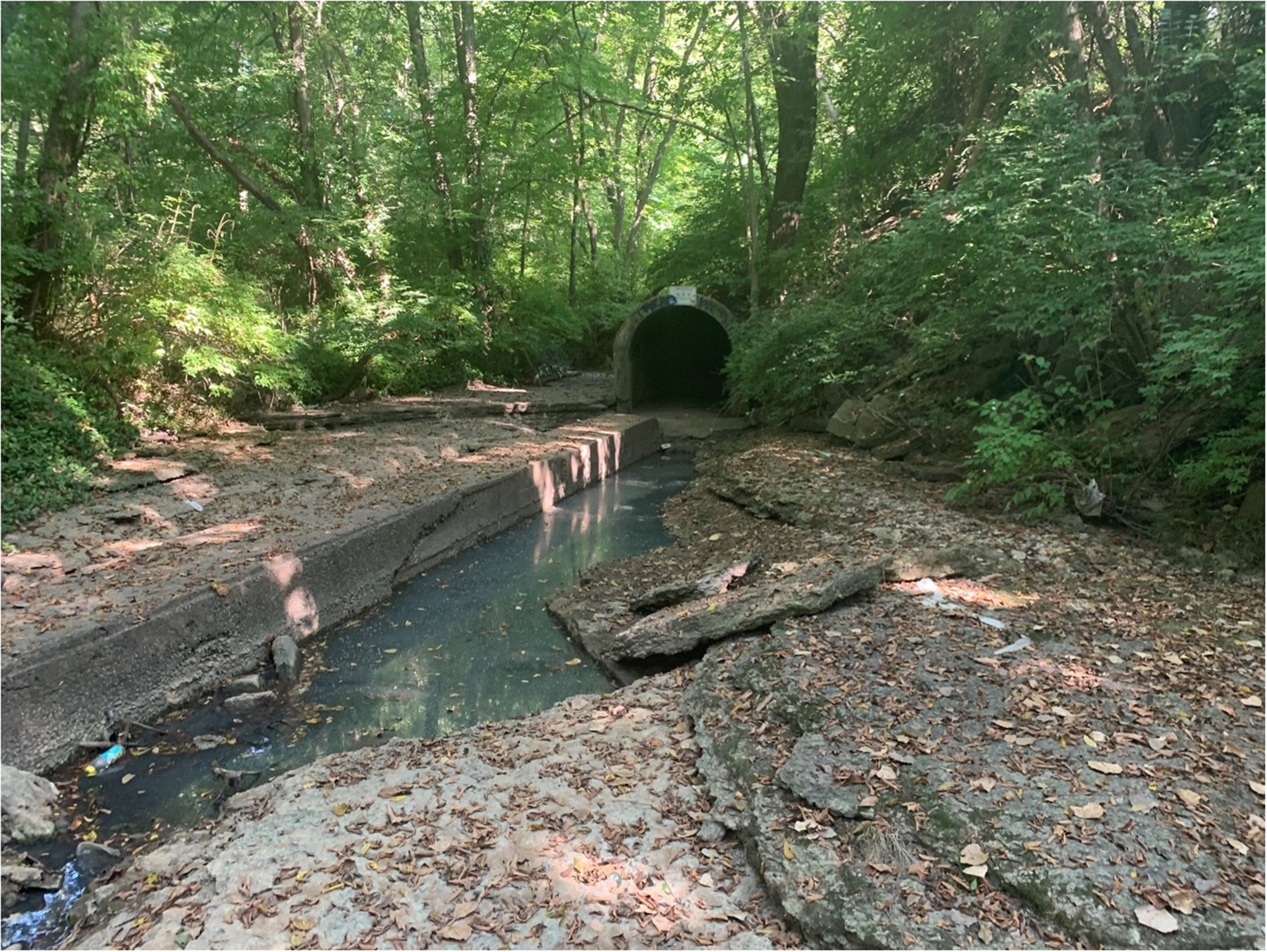
Figure 4. 37th and Norton diversion structure outfall.
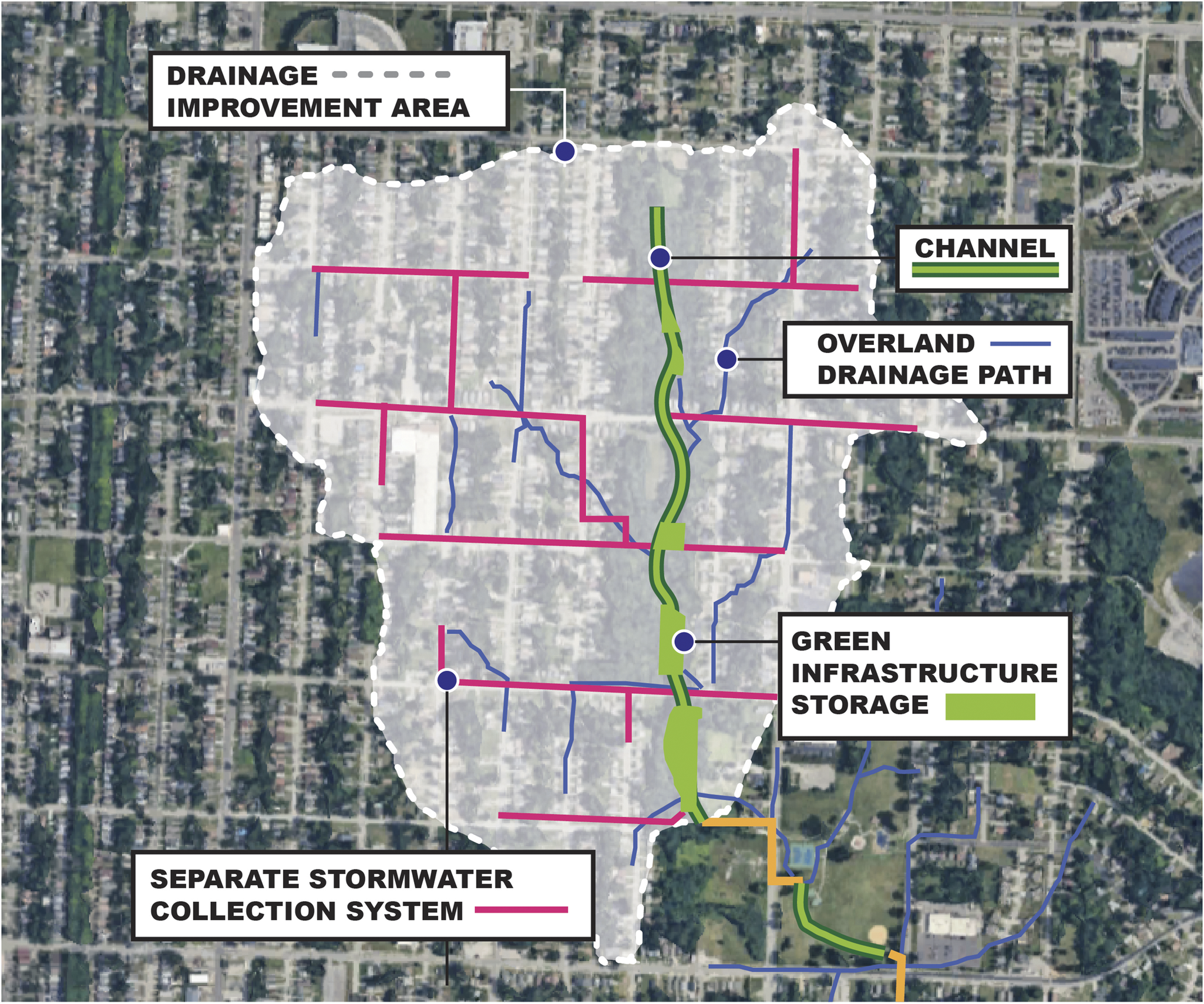
Figure 5. 37th & Norton Green Infrastructure schematic.
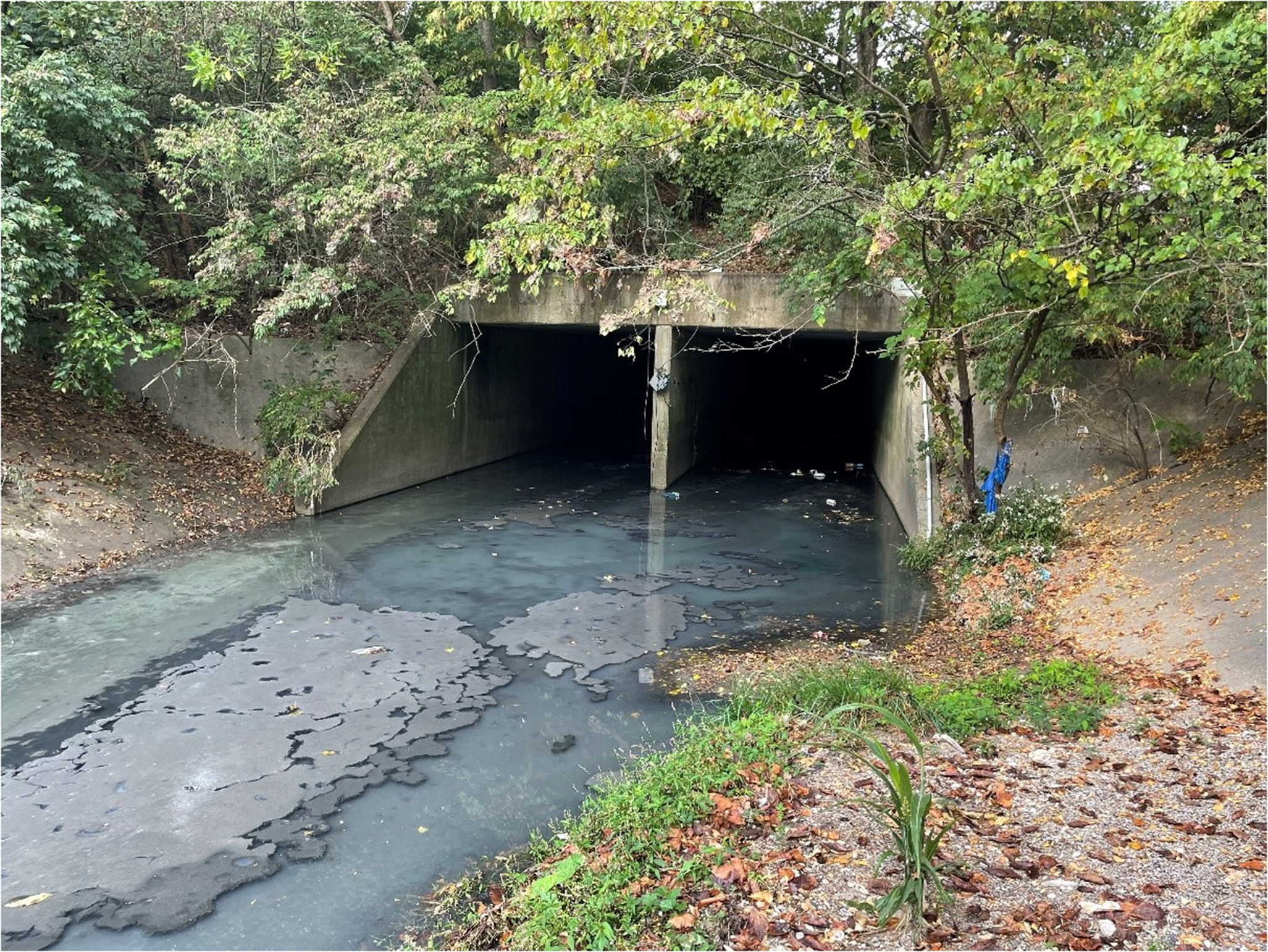
Figure 6. Town Fork Creek diversion structure outfall.
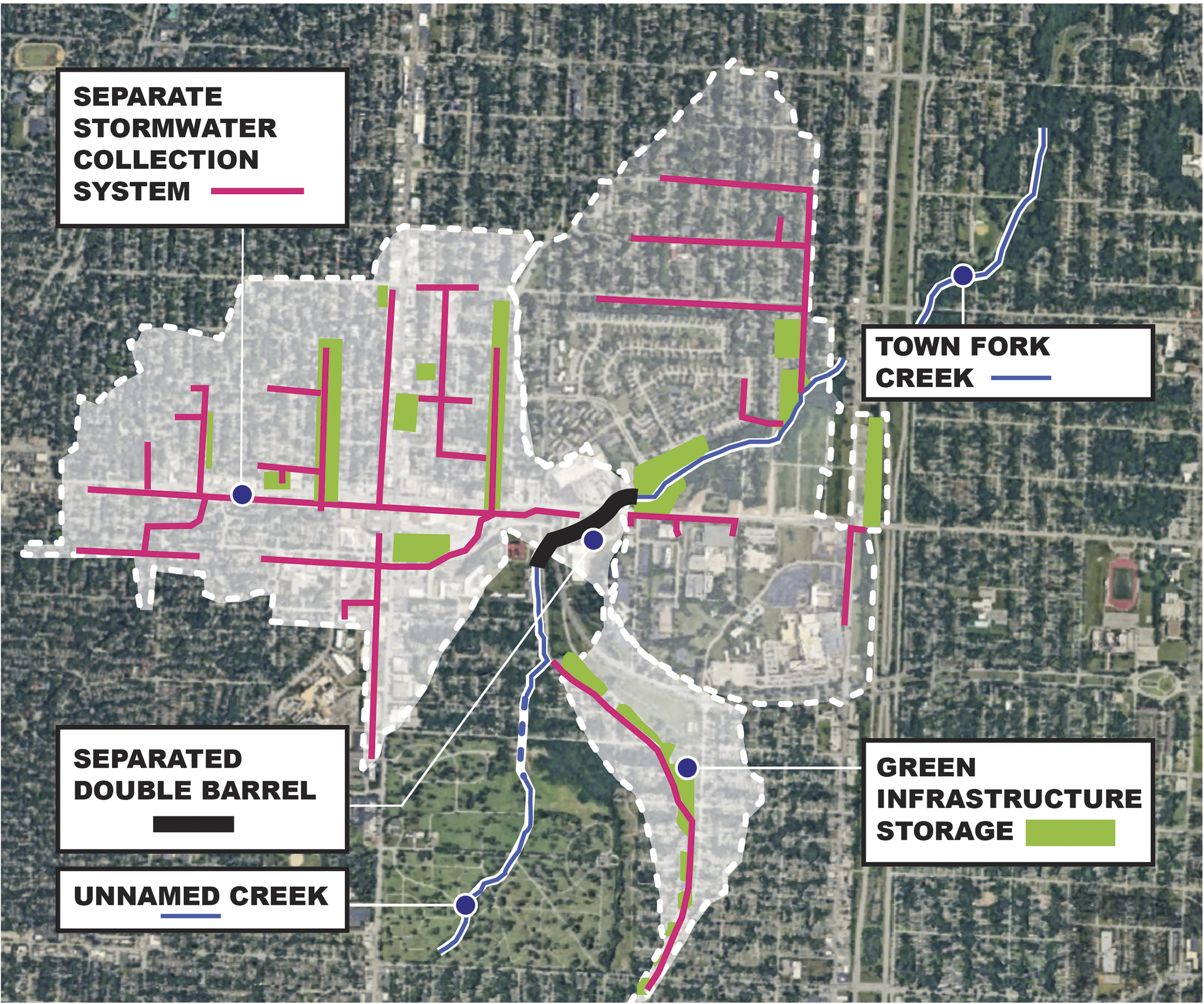
Figure 7. Unnamed creek separation schematic.
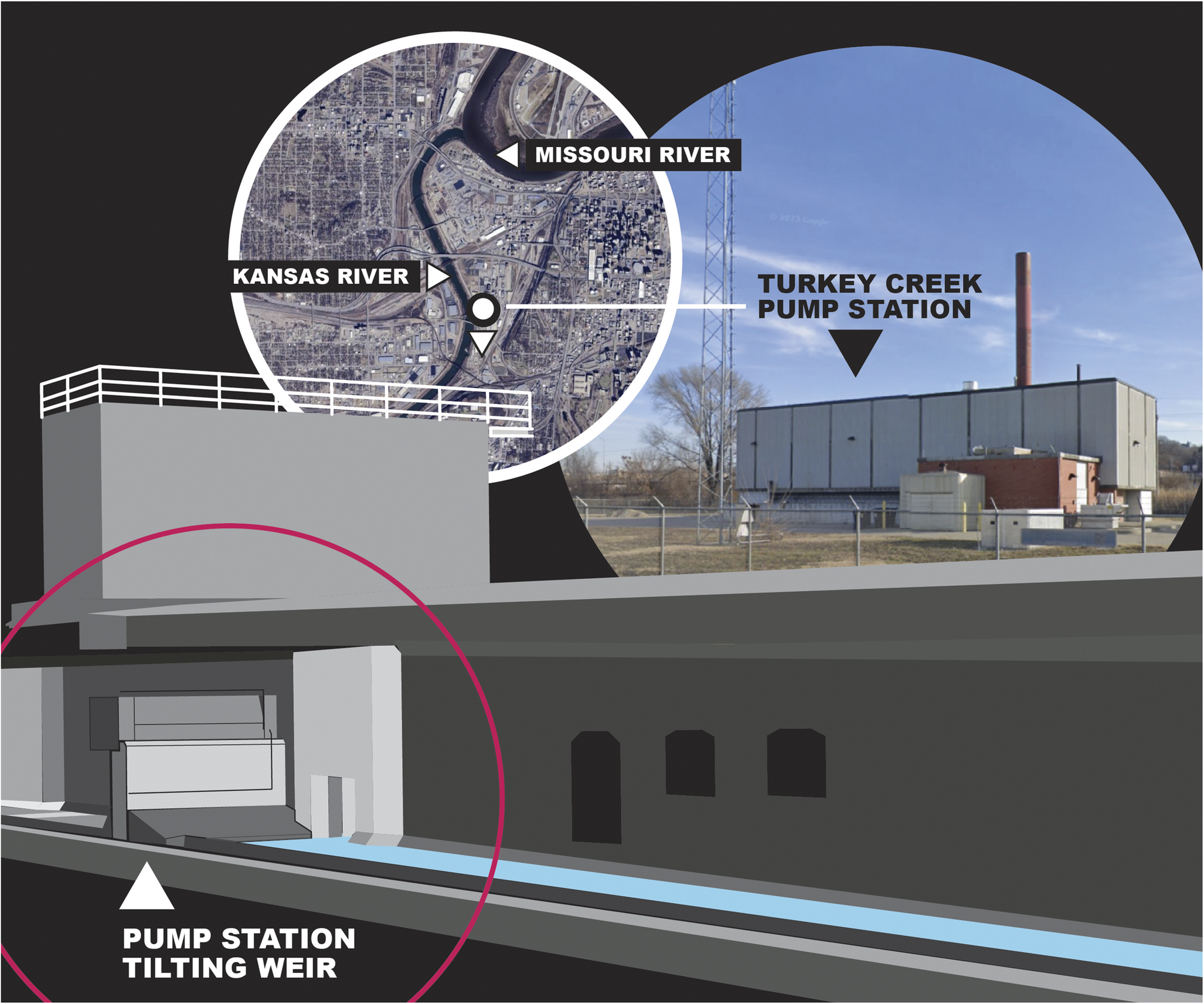
Figure 8. OK creek gate reconfiguration.
Author comment: Adaptive management approach – Kansas City success story— R0/PR1
Published online by Cambridge University Press:
21 May 2025
DOI:
https://doi.org/10.1017/S2755177625000000.pr1
[Opens in a new window] Revision round: 0
Role: author
Comments
Dear Prisms: Water Editorial Board,
I am submitting this article as an Industry Advisory Board member. The article is based on a presentation given at the WEF Collection System Conference in 2023 and included in the conference proceedings.
Review: Adaptive management approach – Kansas City success story— R0/PR2
Conflict of interest statement
Reviewer declares none.
Comments
This is an excellent paper which perfectly matches what a Perspective piece can be, and will be of great value to practitioners and researchers alike. The paper concisely describes the implementation of a new adaptive management approach to storm sewer rehabilitation and provides three practical examples of where this has been successful in Kansas City, and is carefully illustrated and concisely described throughout.
The paper would benefit from a little more details regarding what constitutes the green infrastructure solutions adopted and whether these were subject to a wider multiple benefit evaluation in which monetised environmental benefits were also taken into account. I have indicated some minor improvements and suggestions for further clarification below, but overall this is already close to being worthy of publication. The paper does not mention the use of alternative adaptation pathways ( and their comparative evaluation) and what triggers/thresholds are set to determine when adaptation requires moving from one pathway to another (in the future) (e.g if the green infrastructure solution becomes capacity constrained what alternative solutions might need to be considered to supplement what works for now?)
Specific comments
Abstract. This is quite long but clearly sets out the scope of the paper
Page 2 Introduction lines 22-24: It may also be helpful to note the flexibility implicit in an adaptive management approach and the ability to respond as future circumstances change
Page 2 Lines 28-23: If possible it would be helpful to provide a brief mention of examples where this kind of approach has been advocated and/or used elsewhere for similar purposes? How widespread has the approach been adopted in the US? ( i.e what is the level of novelty in the examples cited)
Page 2 Lines 35-43: The steps in the procedure are listed and should be cross referenced to Figure 1 which more clearly shows the iterative nature of the procedure
Page 2 Lines 45-51: To what extent is it considered that alternative adaptation pathways are comparatively evaluated and kept open to ensure future flexibility is preserved?
Page 3 Lines 6 to 9:. In addition to these three requirements , if green infrastructure and NbS solutions are adopted to what extent are wider multiple benefits also taken into account in the evaluation ( i.e. through the consideration of monetised benefits for habitat creation, recreation/amenity, biodiversity enhancement etc etc). The paper does not fully address this side of the approach.
Page 4 line 12-13 “ It was later found that the downstream interceptor has limited capacity” This repeats / restates what has already been observed on page 3 lines 45-46
Page 3 line 17-18. It would be good to reinforce the importance of seeking a whole system view (such as described here) in reaching a preferred solution. Important point.
Page 4 line 25. My major concern is that insufficient space is given to the nature of the green infrastructure solutions adopted ; of what did they constitute and how easy were they to locate etc? A brief summary description should be included. ( Also relevant to the other subsequent examples).
Page 4 line 40 social justice benefits of the green infrastructure solutions are referred to , but nothing is said of environmental benefits such as habitat creation, biodiversity enhancement, pollutant trapping/ attenuation etc ( yet the conclusion does refer t0 environmental justice)
Page 5 line 26 “ The modified control measures includes reconfiguring the outflow in Daniel Morgan Boone Park” Explain / show how. A bit more detail on the solution is again required.
Page 6 lines 14-26. Does this just describe a redesign rather than an adaptive solution?
Page 6: Conclusions. Overall the paper reports some good lessons shared from practical experience of following an adaptive management strategy and highlights such an approach’s cost effectiveness. Can the authors offer a critical evaluation on what were the barriers to taking this approach, how these were overcome and what challenges were faced. How is the approach being dynamically modified to address the future outlook. A little more on the positive environmental enhancement of the green infrastructure solutions would also to be useful to reflect on.
These points are minor observations to ponder. Overall this is an excellent perspective with some useful demonstrations of key ideas in practice.
Review: Adaptive management approach – Kansas City success story— R0/PR3
Conflict of interest statement
Reviewer declares none.
Comments
As a general comment there are references missing throughout the paper including specifically: ‘Adaptive Management Approach’, ‘Smart Sewer Program’, ‘Original Control Measures’, ‘Alternative Control Measures’, ‘OK Creek Gate Reconfiguration’. This maybe due to the format in which the reference was provided but without these there are no technical references to support the paper.
Adaptive Management is at the forefront of thinking as a practical way to manage uncertainty. This paper describes an approach that has clearly been very successful at addressing uncertainty for a combined sewer overflow system. What is doesn’t do is explain why combined sewer overflows face increasing uncertainty due to more extreme and frequent extremes in rainfall intensity and frequency due to the uncertainty of Climate Change. In USA, the National Oceanic and Atmospheric Administration (NOAA) has substantial evidence of this increasing uncertainty and could be a positive contribution to the paper. The use of the approach to embrace green infrastructure is positive. There would be benefit in expressing the 50 year comparison of cost to also take into account any maintenance or operational costs over the 50 years as green infrastructure will require this over that lifespan of the asset. I am not sure resolving engineering problems in the system of double-counted flows is an adaptive management benefit rather than good practical engineering. The process of continuous monitoring and using feedback is very good for predicting performance. Very good to see the social justice element but this needs a formal reference.
Review: Adaptive management approach – Kansas City success story— R0/PR4
Conflict of interest statement
Reviewer declares none.
Comments
This interesting paper provides concrete examples of smart management approaches to urban drainage problems. The paper is well-written and provides enough information to understand the challenges and benefits of the alternative approaches.
However, for the reader to better understand case study challenges, I would suggest that the author provide: 1) a geographical map to show the location of the study (it could be a map of the USA with the three locations indicated on the same map), and 2) a figure for each case study with a schematic of the system (similar to Figure 4), where each key element described in the paper is shown clearly on the schematic.
Furthermore, all the figures should be mentioned in the text.
Recommendation: Adaptive management approach – Kansas City success story— R0/PR5
Published online by Cambridge University Press:
21 May 2025
DOI:
https://doi.org/10.1017/S2755177625000000.pr5
[Opens in a new window]
Date of review:
09 February 2025
Revision round: 0
Role: Handling Editor
Recommendation/decision: minor-revision
Comments
Thank you for your submission. All the reviewers believe this is a very important and relevant paper. However, they all highlight some important issues that need to be addressed before being considered for publication. The paper needs additional references throughout the paper
specifically to help the readers expand their knowledge on the ‘Adaptive Management Approach’, ‘Smart Sewer Program’, ‘Original Control Measures’, ‘Alternative Control Measures’, ‘OK Creek Gate Reconfiguration’. All the figures need to be referenced in the paper. also it is important to add a map of the study location; providing a schematic of the systems and various elements that are being discussed. There are also additional comments provided by the referee that need to be closely considered. I recommend that you closely review the comments and address them diligently.
Decision: Adaptive management approach – Kansas City success story— R0/PR6
Published online by Cambridge University Press:
21 May 2025
DOI:
https://doi.org/10.1017/S2755177625000000.pr6
[Opens in a new window] Revision round: 0
Role: Editor in Chief
Recommendation/decision: minor-revision
Comments
No accompanying comment.
Author comment: Adaptive management approach – Kansas City success story— R1/PR7
Published online by Cambridge University Press:
21 May 2025
DOI:
https://doi.org/10.1017/S2755177625000000.pr7
[Opens in a new window] Revision round: 1
Role: author
Comments
Dear Richard and Newsha,
I wish to thank you for the opportunity to contribute to Cambridge Prisms: Water my submission (WAT-2024-0041). I have updated the submission to address reviewer comments and uploaded an MS Word document with changes documented using Track Changes.
Kind regards,
Sasa
Review: Adaptive management approach – Kansas City success story— R1/PR8
Conflict of interest statement
Reviewer declares none.
Comments
The authors have addressed the points raised by the three reviewers and added a reference section and additional figures showing the scheme locations, layout schematics and the OK Creek Gate Reconfiguration.
Allowing flexibility to modify solutions as new information emerges is highlighted as a benefit of the adaptive management approach. The use of the approach by other utilities elsewhere (i.e in Hampton Roads and Baltimore) is now mentioned. The description of the Smart Sewer Programme has been extended. Figures are now referenced in the text. Some of the barriers and challenges to implementation are now mentioned in the conclusions.
These minor changes all enhance the quality of the paper in line with the original feedback comments, although little further has been added on the wider multiple benefits and nature of the specific green infrastructure solutions adopted which remains a little vague. This does not detract from the central them of the Perspective which usefully and concisely demonstrates how an adaptive approach can be followed in real settings. I recommend the paper can now be published without any further amendment.
Recommendation: Adaptive management approach – Kansas City success story— R1/PR9
Published online by Cambridge University Press:
21 May 2025
DOI:
https://doi.org/10.1017/S2755177625000000.pr9
[Opens in a new window]
Date of review:
17 April 2025
Revision round: 1
Role: Handling Editor
Recommendation/decision: accept
Comments
No accompanying comment.
Decision: Adaptive management approach – Kansas City success story— R1/PR10
Published online by Cambridge University Press:
21 May 2025
DOI:
https://doi.org/10.1017/S2755177625000000.pr10
[Opens in a new window] Revision round: 1
Role: Editor in Chief
Recommendation/decision: accept
Comments
No accompanying comment.
 You have
Access
You have
Access
 Open access
Impact statement
This article highlights the transformative impact of the adaptive management approach in Kansas City’s Smart Sewer Program, offering a replicable model for wastewater utilities nationwide. By integrating iterative learning and real-time data evaluation, Kansas City continues optimizing Overflow Control Plan projects, reducing sewer overflows cost-effectively while maintaining compliance with the Environmental Protection Agency’s Consent Decree. The case studies presented demonstrate how adaptive decision-making led to more efficient infrastructure investments, eliminating costly projects and enhancing environmental outcomes. Notably, this approach has delivered significant financial and social benefits. For example, the adoption of green infrastructure solutions not only provided greater overflow reduction at a lower cost per gallon captured but also aligned with environmental justice goals by benefiting historically underserved communities. In addition, modifications to external projects and augmentations of control measures further enhanced cost efficiency without delaying compliance timelines. By embracing adaptive management, Kansas City has saved hundreds of millions of dollars, while improving water quality in the receiving streams and protecting public health. This article underscores the value of flexible, data-driven governance in large-scale infrastructure projects and provides a compelling case for broader adoption of adaptive strategies in urban water management. The findings contribute to the field of environmental engineering by demonstrating that iterative, evidence-based adjustments can lead to more sustainable, equitable and cost-effective water management solutions.
Introduction
The US Environmental Protection Agency (EPA) and state agencies enforce Combined or Sanitary Sewer Overflow elimination and reduction through a Consent Decree, an agreement specifying the required steps and timeline for managing sewer overflows. A Consent Decree outlines the implementation of an Overflow Control Plan, which must be defined before finalizing the decree. However, as the first step in the Consent Decree process, the Overflow Control Plan is often developed with limited information on overflow performance, control measures’ efficacy and mitigation strategies’ interdependence. At the same time, implementing an Overflow Control Plan can cost utilities billions (109) of dollars. An adaptive management approach offers a framework to mitigate uncertainties in system data, enhancing program success while potentially saving utility millions. Through its use, utilities can respond to new circumstances that could not have been predicted when the original response plans were developed.
Adaptive management approach
The adaptive management approach is a decision-making framework designed to manage information uncertainty through an iterative system monitoring and structured decision-making (Rist et al. Reference Rist, Campbell and Frost2012; Tomic et al. Reference Tomic, Shively and Chase2023). This approach optimizes each successive phase by leveraging past system performance data, as shown in Figure 1. With adaptive management, Consent Decree compliance can be achieved on schedule at a lower cost than the original Overflow Control Plan.
Adaptive management approach process.
The adaptive management iterative steps for sewer overflow reduction are as follows:
(1) Plan – Use available data to develop the next phase of overflow reduction solutions,
(2) Design – Select solutions and the pre- and post-construction monitoring plan,
(3) Implement – Execute the selected overflow reduction solutions,
(4) Monitor – Assess the effectiveness of the implemented overflow reduction measures,
(5) Analyze – Use the hydraulic model to evaluate the performance of implemented solutions and
(6) Optimize – Refine systemwide overflow reduction based on newly gathered information.
For an adaptive management approach to be effective, the overflow reduction program must meet specific criteria. First, program implementation must be phased, allowing flexibility to modify solutions as new information emerges. Second, continuous monitoring is required to evaluate performance and support informed decision-making. Third, a predictive model is essential for assessing the proposed solutions and forecasting their impacts and codependency. Predictive models, enhanced with the new knowledge obtained through monitoring, are periodically used to reevaluate the proposed solutions and identify cost-effective alternatives. Finally, compliance must be evaluated based on actual or model-predicted system performance.
The Kansas City Consent Decree Modification 3 (Smart Sewer Program n.d.a) established a framework for using the adaptive management approach. The modification allows for the revision, removal, or replacement of relief control measures in the Consent Decree with EPA approval. Any revised or alternative control measures must:
(1) Adhere to sound engineering practices,
(2) Provide an equal or greater level of overflow control than the original measure and
(3) Follow a timeline that meets or precedes the original target date for full operation.
Smart sewer program
Kansas City, Missouri, is the largest city in Missouri, with a population of 500,000. KC Water, the City water and wastewater utility, has implemented the Smart Sewer Program, a 30-year, multibillion-dollar (109) effort to reduce the volume of overflows, protect the environment and comply with the EPA Consent Decree (Smart Sewer Program n.d.b). KC Water developed an Overflow Control Plan in 2009 to capture 85% of the typical year combined sewer overflow volume, as shown in Figure 2. The Smart Sewer Program implemented 33 projects worth more than $750 million (about €700 M) in the first program decade. Kansas City submitted a request to modify the Consent Decree in 2017 due to the Great Recession’s impact on the City residents and the fatigue with the fast-rising sewer rates. This modification, approved in 2021, includes the adaptive management approach provision that gives the Smart Sewer Program the flexibility to reevaluate Overflow Control Plan control measures as they come for implementation and optimize systemwide, cost-effective overflow reduction (Smart Sewer Program n.d.a). Today, other utilities, such as the Hampton Roads Sanitation District and the City of Baltimore, use the adaptive management approach to better invest public funds and increase the environmental benefits of Consent Decree programs.
Kansas city consent decree timeline.
Kansas City adaptive management approach examples
This article presents examples of how the Smart Sewer Program employs an adaptive management approach to improve overflow reduction outcomes by replacing initially proposed control measures based on information collected from completed projects. The Smart Sewer Program updates the entire system’s hydrology and hydraulic model annually and reevaluates each project as it comes to design using the adaptive management approach codified in the Third Consent Decree modification (Smart Sewer Program n.d.a). Alternative projects are selected after EPA approval if they are demonstrated to be more cost-effective than the original project but provide the same or more significant environmental benefits. The flexibility provided by the adaptive management approach allows the Smart Sewer Program to respond to new circumstances that could not have been predicted in 2005 when the Overflow Control Plan was developed. The examples demonstrate control measure replacement, control measure augmentation and external project modification. Figure 3 gives a map of project locations within the KC Water combined sewer system.
Project locations and KCMO combined sewer system.
37th & Norton Green Infrastructure – Control measure replacement example
Green infrastructure is a sustainable approach to wastewater and stormwater management that uses natural or engineered systems, such as infiltration basins, permeable pavements, green roofs and rain gardens, to reduce sewer overflows, improve water quality and enhance urban resilience. The 37th & Norton Green Infrastructure project is located in the Lower Blue River Basin of the KC Water system south of the Missouri River and west of the Blue River (see Figure 3). 37th & Norton Green Infrastructure project includes detention basins for peak flow reduction and runoff purification. The Lower Blue River basin contributes to the flow of the Blue River Interceptor Sewer and the Blue River Wastewater Treatment Plant. An interceptor relief control measure was proposed to manage overflows in the 2009 Overflow Control Plan. The overflow control measures, including the interceptor relief project, were selected based on the localized, basin-wide control plan that assumed that the downstream interceptor could receive increased flows. Since 2009, the Smart Sewer Program has significantly improved the system hydraulic models and integrated them into a systemwide model. The updated systemwide model has shown that the receiving interceptor sewer has limited capacity and that the proposed relief would not provide the predicted overflow reduction systemwide. Instead, the Smart Sewer Program used an adaptive management approach to search for a cost-effective alternative. A green infrastructure solution was identified to replace the relief sewer control measure with a significantly more significant overflow reduction and a lower cost per gallon overflow removed.
The original control measure
The original control measure was to install approximately 3,400 linear feet (about 1 km) of 48-in. (about 1.2 m) relief sewer between the diversion structure and the downstream interceptor (see Figure 4). The control measure was model-predicted to reduce the typical year overflow at the diversion structure by 18 million gallons (MG) (about 68,000 m3), from 28 MG (about 106,000 m3) to 10 MG (about 38,000 m3), assuming the downstream interceptor could receive the excess flows. However, the updated systemwide model has demonstrated that this was not the case, reiterating the importance of holistic systemwide project evaluation.
37th and Norton diversion structure outfall.
The proposed relief sewer would increase the capacity of the existing system to convey additional wet-weather flow from the diversion to the interceptor, thereby reducing the overflow volume. The relief sewer increases the peak flow and volume in the downstream interceptor. Therefore, added flows would increase the annual overflow volume at several locations along the interceptor. Upon reevaluating the original control measure with the updated systemwide hydraulic model, it was determined that the systemwide overflow capture was significantly reduced due to increased overflow along the downstream interceptor. The model predicted that the systemwide annual overflow volume reduction with the proposed relief sewer would be less than 1 MG (about 3,800 m3).
Alternative control measure
An alternate control measure was proposed to separate combined sewers in approximately 195 acres (about 80 ha) and provide green infrastructure to reduce stormwater runoff and manage water quality (see Smart Sewer Program n.d.c and Figure 5). The discharge from the separated stormwater collection system and green infrastructure to Vineyard Creek would be downstream of the diversion structure and would not impact the combined system overflows. Simulations of the alternate control measure show a significant reduction in annual systemwide overflows compared to the original relief sewer control measure, as the alternative control measure would reduce overflows at the diversion structure and along the downstream interceptor.
37th & Norton Green Infrastructure schematic.
The proposed alternate control measure has a preliminary estimated construction cost of $17 million (about €15.5 million), about twice the relief sewer cost. However, from a cost-effective standpoint, the cost of the green infrastructure is much lower than that of the relief sewer based on the cost per gallon overflow captured. Based on a 50-year life-cycle cost comparison, the green infrastructure costs $1.0 per gallon of annual overflow captured (about €0.25 per liter), compared to $8.6 per gallon (€2.0 per liter) for the relief sewer.
In addition, the green infrastructure provides environmental, water quality and social justice benefits that are not accounted for in the comparison. Based on the EPA’s Environmental Justice Screening and Mapping Tool, the alternative project area is in the 95–100% range for the Demographic Index, servicing minority and low-income populations (EPA nd). The EPA has approved the alternative control measures, and the project is being designed.
Unnamed creek separation – Control measure augmentation example
This control measure augmentation is proposed for the Town Fork Creek basin, which is upstream from the Blue River Interceptor Sewer (see Figure 3). The eponymous Town Fork Creek is buried and conveyed by the KC Water combined sewer system in the upper portion of the Town Fork Creek basin. The creek daylights upstream from Daniel Morgan Boone Park, making the park a prime candidate for green infrastructure (see Figure 6).
Town Fork Creek diversion structure outfall.
The Smart Sewer Program added the creek separation project to the Daniel Morgan Boone Green Infrastructure control measure during the adaptive management approach reevaluation of the original control measure. The Daniel Morgan Boone Park project is a proposed sewer separation and green infrastructure designed to reduce combined sewer overflow and improve stormwater management upstream. The project is located at the diversion structure at the end of the channelized section of Town Fork Creek. The upstream overflow pipe comprises a double-barrel, 84-in. (2.13 m) box culvert. This double-barrel pipe conveys overflows from upstream diversion structures and has no sanitary sewer connections. The outfall at the end of the double-barrel pipe produces 134 MG (about 0.5 million m3) of model-predicted annual overflow.
About 500 ft (about 150 m) upstream from the Town Fork Creek overflow, an unnamed surface creek flows into the double-barrel overflow pipe (see Figure 7). This creek conveys discharge from six (6) upstream sewer overflows, adding approximately 11 MG (about 41,600 m3) to the annual Town Fork Creek overflow volume. The situation with a surface creek entering a combined sewer system leads to the double-counting of the sewer overflows in the unnamed creek as they are discharged in the park. In addition to the double-counted overflows, the model predicts that a similar amount of stormwater enters the system annually through this unnamed creek and is counted as a sewer overflow downstream.
Unnamed creek separation schematic.
The Smart Sewer Program used an adaptive management approach to augment the Daniel Morgan Boone control measure and resolve this problem. The modified control measure includes reconfiguring the outflow in Daniel Morgan Boone Park to eliminate about 20 MG (about 75,000 m3) of annual sewer overflows. One of the two barrels was used to convey the unnamed creek and other stormwater to the outfall while the other barrel continued to serve the combined system. An emergency connection is provided on the upstream end of the separation to allow flow sharing between the barrels during extreme events. This reduction is about 15% of the total overflow at this location. Furthermore, local stormwater systems connected to the double-barrel pipe between the current and proposed overflow structure could also be separated. This control measure augmentation would have an exceptionally low cost per gallon overflow captured, approximately $0.10 per gallon of annual overflow captured (less than €0.03 per liter), compared to $1.7 per gallon (€0.41 per liter) for the Daniel Morgan Boone control measure. Since the control measure augmentation did not affect the schedule and it did improve the control measure performance, EPA approval was not necessary. At present, the project is in the design stage.
OK creek gate reconfiguration – External project change example
Turkey Creek basin is a combined sewer system basin situated south of the Missouri River and east of the Kansas River. It follows the path of OK Creek, which is fully channelized and confined within the combined sewer system. The primary sewer overflow for the basin and the confluence of OK Creek and the Kansas River is located near the Turkey Creek Pump Station, which delivers the sewer flow to the Westside Wastewater Treatment Plant. The hydraulic model predicts 2,660 MG (about 10 million m3) of annual sewer overflow at this location. According to the Overflow Control Plan, the Smart Sewer Program needs to reduce Turkey Creek Basin overflows by about 1,500 MG (about 5.7 million m3). This reduction will be achieved through increased pumping capacity, a series of inline storages in the interceptor and a deep tunnel with a pump station for wet weather flow storage.
KC Water is implementing a separate project outside the Smart Sewer Program to better protect the interceptor from potential intrusion by the Kansas River during high river stages. The project evaluated various gate types downstream from the Turkey Creek Pump Station to prevent river backflow and allow the interceptor to release wet weather flow during rainfall. At the pump station, the interceptor consists of a double-box culvert, 17-ft (5.18-m) wide and 18-ft (5.49-m) high. The culvert boxes are connected upstream of a small weir that diverts dry weather flow to the pump station. Downstream from the weir, each culvert box has a gate that can be modulated to hold back the wet weather flow and release it when the water level in the culverts becomes too high. These gates are closed when the Kansas River stage is high to prevent river water from entering the pump station. During rainfall events coinciding with a high river stage, the gates can be opened with a positive head differential of 1 ft (about 0.3 m) to release the stored water. Two roller gates were initially proposed for this project, one in each culvert.
The Smart Sewer Program team has been asked to use the hydraulic model to evaluate the emergency level of service at the interceptor with the proposed roller gates. During the evaluation, the team used the adaptive management approach to suggest modifications to the project and improve the sewer overflow capture without increasing the project costs. The alternative design included replacing one of the roller gates with a tilting weir, providing additional storage capacity upstream of the pump station, thereby increasing the pump suction head and the wet well storage (see Figure 8). This adjustment would provide over 10 MG (approximately 38,000 m3) of additional inline storage, sufficient to eliminate overflows during smaller rainfall events (events with less than a month return interval). The roller gate in the second culvert would be closed during regular operation, opening only to evacuate extreme rainfall events. An existing downstream gate would be used for river intrusion protection in the culvert with a tilting weir.
OK creek gate reconfiguration.
The proposed tilting weir alternative increases annual overflow capture by 117 MG (about 440,000 m3). With an estimated cost of about $2.2 million (about €2 million), the alternative capture cost is about $0.02 per gallon of the annual overflow captured (less than €0.01 per liter). Since the roller gate was more expensive than the tilting weir, this modification came at no additional cost to the City. This project’s improved overflow capture performance also opened up the possibility of eliminating the deep tunnel component, estimated to cost $750 million (approximately €700 million). This project was not a Consent Decree control measure, so it did not require EPA approval. This project is currently under construction.
Conclusions
In 2009, KC Water developed an Overflow Control Plan to capture 85% of the typical year combined sewer overflow volume, as the EPA Consent Decree required. To achieve this goal, Kansas City implemented the Smart Sewer Program, a 30-year, multibillion-dollar (109) initiative focused on reducing sewer overflows, protecting the environment and complying with the Consent Decree. During its first decade, the Smart Sewer Program implemented 33 projects worth over $750 million (about €700 M). In 2017, Kansas City requested a modification to the Consent Decree to better manage program costs and schedules, which was approved in 2021. This modification included the provision of an adaptive management approach, allowing the Smart Sewer Program the flexibility to reevaluate Overflow Control Plan control measures and optimize systemwide and cost-effective overflow reduction.
The adaptive management approach has proven pivotal in the Smart Sewer Program’s efforts to manage sewer overflow through the Smart Sewer Program. By leveraging flexibility and iterative learning, the Smart Sewer Program has optimized control measures to reduce sewer overflows cost-effectively. The examples detailed in this article underscore the effectiveness of adaptive management in overcoming initial project limitations, incorporating real-time data and adapting to changing conditions without increasing costs.
Through this approach, the Smart Sewer Program replaced initially proposed control measures with more efficient alternatives, augmented projects with cost-effective solutions and modified external projects to capture additional overflow. These efforts have directly contributed to improved environmental outcomes and public health protection, especially in communities with high-risk populations, aligning with the EPA’s environmental justice goals. Despite its successes, implementing the adaptive management approach has not been without challenges. One of the primary barriers was the Consent Decree schedule, which mandates when specific projects need to be executed. The Smart Sewer Program implemented the Hydraulic Model Update Plan to align the model updates with the project design schedule. This plan ensures that the hydraulic model will be ready to reevaluate current decree projects as they come for execution. This challenge was addressed through continuous flow monitoring and iterative improvements to the hydraulic models, leading to more precise decision-making. In addition, to ensure that non-monetary benefits of green infrastructure are included in the evaluation of alternative projects, the Consent Decree has mandated the minimum number of green acres the Smart Sewer Program needs to implement. This article presents three examples demonstrating the benefits of the adaptive management approach. In the first example, while the green infrastructure project’s cost is about double that of the original proposal, the cost-effectiveness – measured as the cost per gallon of annual overflow captured – is significantly higher, providing better long-term value. Moreover, this project directly protects high-risk populations’ public health and environment, aligning with the EPA’s commitment to environmental justice.
Other examples include modifying a Consent Decree project to incorporate highly cost-effective solutions, as illustrated by the creek separation extension. The final example details modifying an external project that achieved additional overflow capture without incurring extra costs for the City. This enhanced overflow capture performance even created the opportunity to eliminate a costly deep tunnel project.
Kansas City remains committed to utilizing the adaptive management approach to generate cost savings for its ratepayers while delivering additional environmental and social benefits. The flexibility provided by the third Consent Decree modification has enabled the Smart Sewer Program to reduce program costs by hundreds of millions of dollars (€100 s million) and potentially avoid some of the most expensive underground storage projects.
Open peer review
To view the open peer review materials for this article, please visit http://doi.org/10.1017/S2755177625000000.
Data availability statement
Data sharing is not applicable to this article as no new datasets were generated during the current study.
Acknowledgments
The author would like to acknowledge Andy Shively, KC Water Deputy Director, who coauthored the presentation at the WEF Collection Systems Conference, which serves as the foundation for this article, and shared the graphics and photos developed as a part of the Smart Sewer Program.
Author contribution
The sole author conducted the conceptualization, development, writing and editing of the approved final manuscript.
Financial support
The work presented in this article was conceded as a part of the Kansas City Smart Sewer Program.
Competing interests
There are no financial or nonfinancial interests to disclose by the authors.