





Introduction
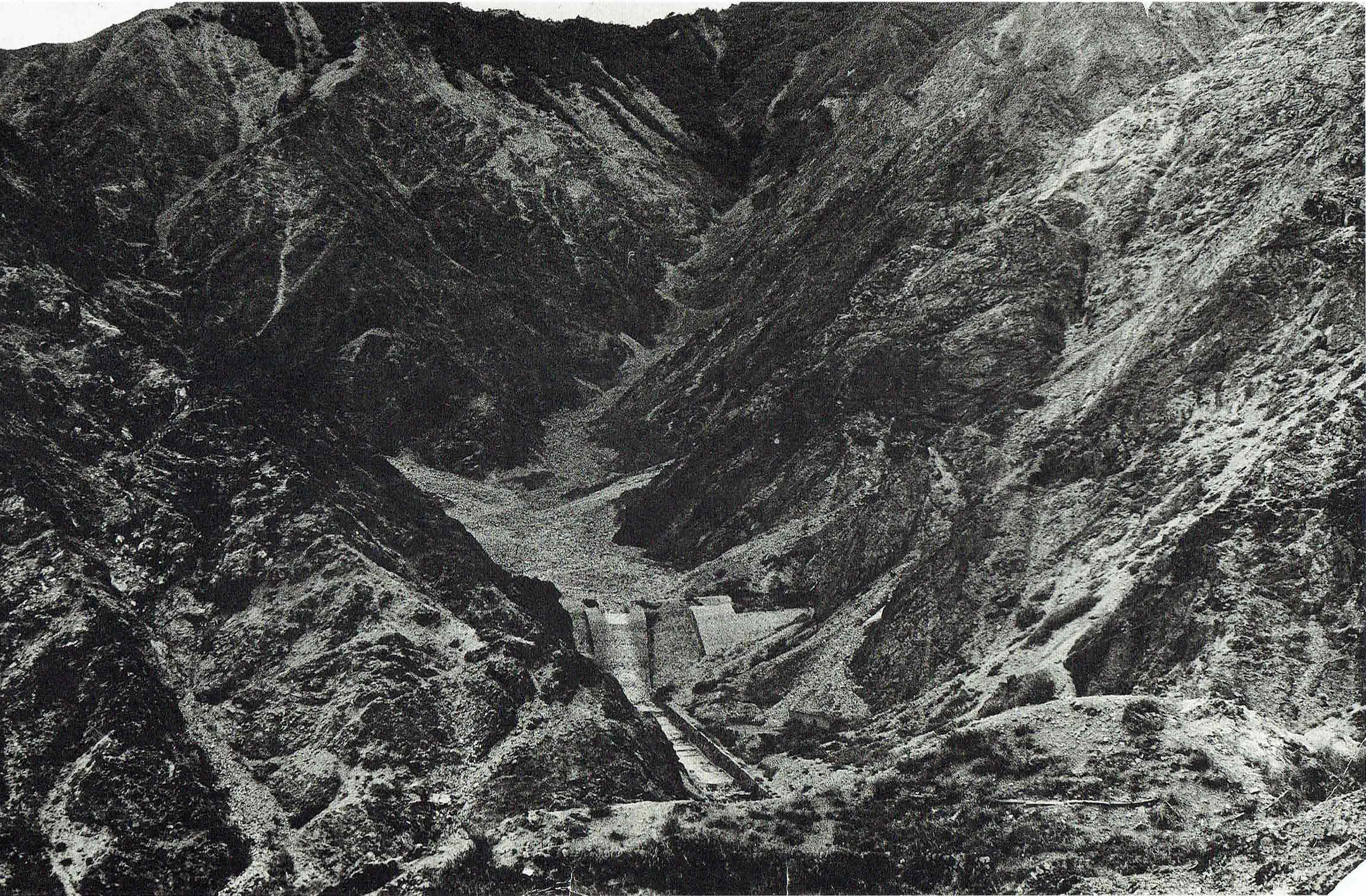
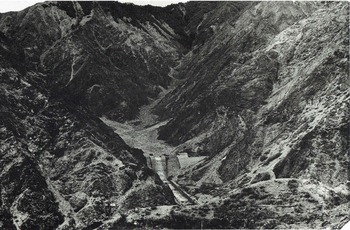
In 1969, a group of twenty women photographers arrived at the Ashio copper mine, set in the mountainous valley of Tochigi prefecture, about four hours north of Tokyo by train. At the time, the name Ashio resonated across Japan in the same way that Chernobyl, the Nevada Test Site, and Fukushima today evoke images of contamination, social activism, and tensions between private industry, the government, and the surrounding communities. Over the following two years, the young photographers returned frequently to photograph the town that had been the center of debates on nature and politics and the source of pollution for the vast Watarase River tributary system since the late nineteenth century. Their grainy, high contrast photographs, such as the first image in their series of mountains stripped bare of all life by poison sulfur gases, reveal a determination to capture the impact of industrial pollution on the environment and people of the cluster of towns around the mine (Figure 1). In this scene of devastation, the craggy surfaces of desert-like hills sift and filter eroded soil into a ravine as small shrubs cling to the surfaces of the loose rocks that would have once supported evergreen forests and ferns. Though taken from a distance, the photograph reads like a topographical close-up of the mountain’s surfaces, the graininess and contrast flattening depth into a continuous image of the earth wearing away under chemical pressure.
“Engai「aryūsan」de hage yama ani natta, motoyama no yamahada,” (The surface of the Motoyama mountain which became bald from “sulfuric acid” smoke pollution) Alumni of the Jissen Women’s College Photography Division, Ashio 1969–1971 (Tokyo, 1994), 1.
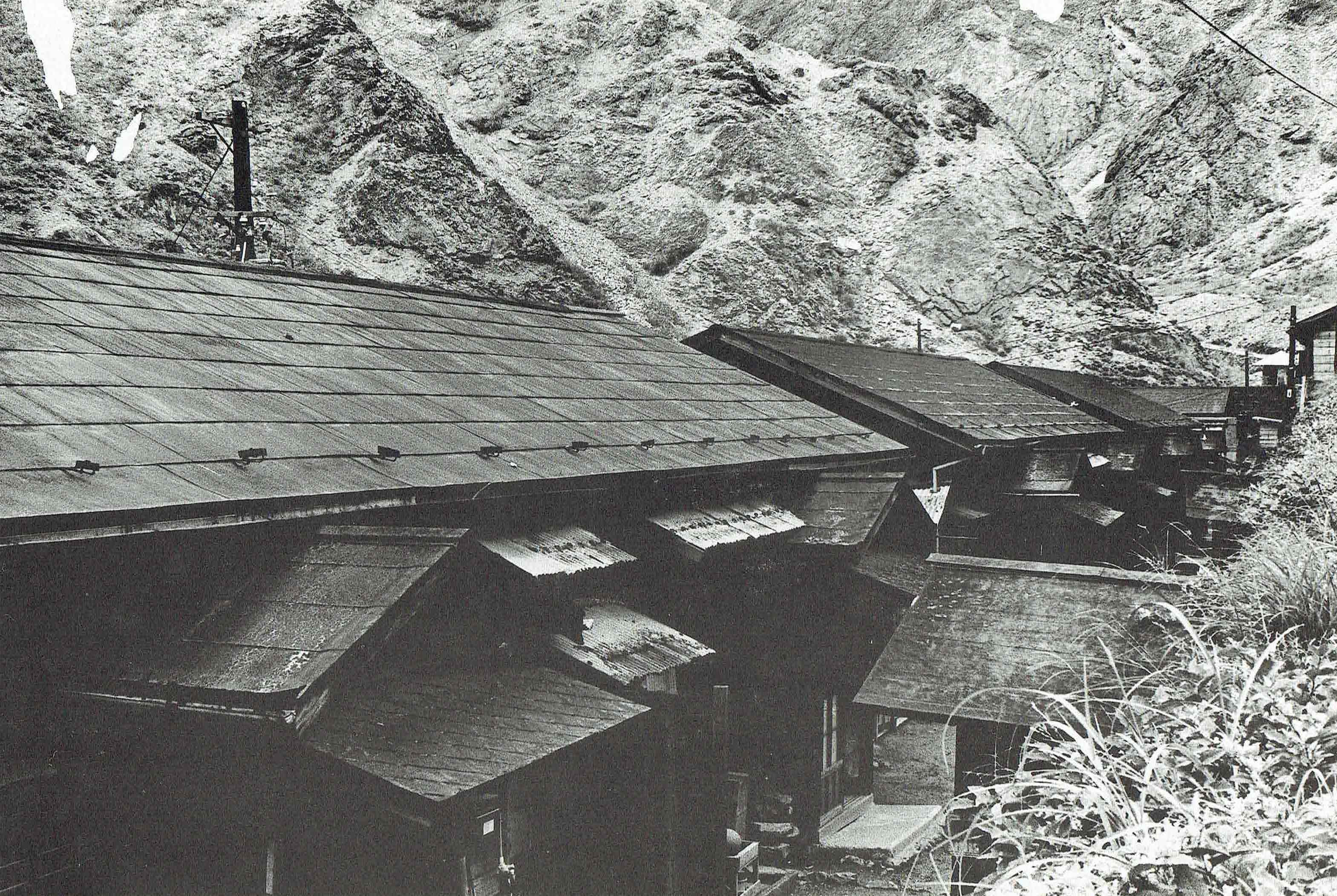
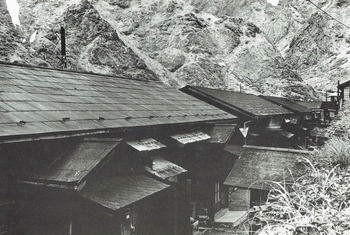
The young women photographers were part of the Tokyo Jissen Women’s College Photography Club, one of the hundreds of university photo clubs that were activated around Japan by the potential they saw in photography as a means to participate in politics. They traveled to Ashio to understand the tensions between the concerted effort of its residents and the mine’s overseers to picture the mine as a utopia and its history as the inspiration for environmental activism theory among Japanese environmental scholars and activists. The group of eighteen to twenty-year-old students, Canon and Nikon cameras in hand, embedded themselves within the town to depict these contrasts: they met with local women’s clubs, bathed at local bathhouses with residents, and discovered that inside the soot-covered row houses were cheerfully appointed homes with the newest electric refrigerators. Taken over a three-year period of many trips back and forth between Ashio and Tokyo and countless rolls of film often developed in the temple where they stayed, the photographs were published as Ashio 1969–1971 (1994).Footnote 1 The collection juxtaposes scenes of the runoff from copper extraction and refining penetrating soil and coating buildings with images of children playing in the unpaved streets and intermingles them with reproductions of historical photographs of the miners’ barracks and portraits of Tanaka Shōzō (1841–1913), the nineteenth-century pioneer of Japanese environmental activism. Ashio was a key site for the development of environmental activist discourse in the late nineteenth and early twentieth centuries, and in the 1960s it became one of many sites of environmental disaster that inspired students across Japan to develop their own photographic theory of anonymous, collective production as a means of creating politically engaged images. The Jissen Women’s Photography Club’s photographs of blackened, carbon encrusted eaves of employee houses against hillsides barren of all life guide the viewer to question what is inside, and by doing so create a sense of closeness, asking the viewer to understand the relationships pictured: the photographer’s connection to the scene and the humans living brightly amidst the mine’s darkening of the land (Figure 2). These photographs made new statements about photography’s role in the Japanese environmental movement that suture a past to the present of human struggle against contamination to create a world of photographer-activists capable of redefining the meaning of landscape in Japan in the 1970s.
“Motoyama shataku,” (Motoyama company housing) Alumni of the Jissen Women’s College Photography Division, Ashio 1969–1971 (Tokyo, 1994), 13.
This article explores the student-created documentary photography movement in Japan as an important contribution to global environmental activism and anti-pollution organizing in the 1960s and 1970s. Around the world in this period, activist images redefined the landscape as a battleground between community members, corporations, and the government. Photographs documented and communicated this struggle, fueling new awareness of the reach of pollution events and solidarity between communities impacted. At pollution sites across Japan, students created theoretically informed photographic methods prior to and in tandem with the experimental photographers of well-known collectives such as Provoke that became internationally famous for its grainy, out-of-focus style that challenged the ontological nature of the photographic document.Footnote 2 The students of the All Japan Students’ Photo Association (AJSPA) responded to the media’s skewed coverage of industrial pollution as neither the responsibility of the state nor the corporations it supported by building their own alternate media structures.Footnote 3 Prolifically publishing pamphlets, photo books, newsletters, and holding exhibitions, they demonstrated strategies for building a new visual world based on their research and political action through photographs. Their work was not only a critique of the present, but a proposition for a future founded in communally focused artistic and political production built from a collective sense that photographs could be a powerful weapon against a bourgeois individuality that led to defining a nation by how successful it was at pouring toxins into the air, land, and water.
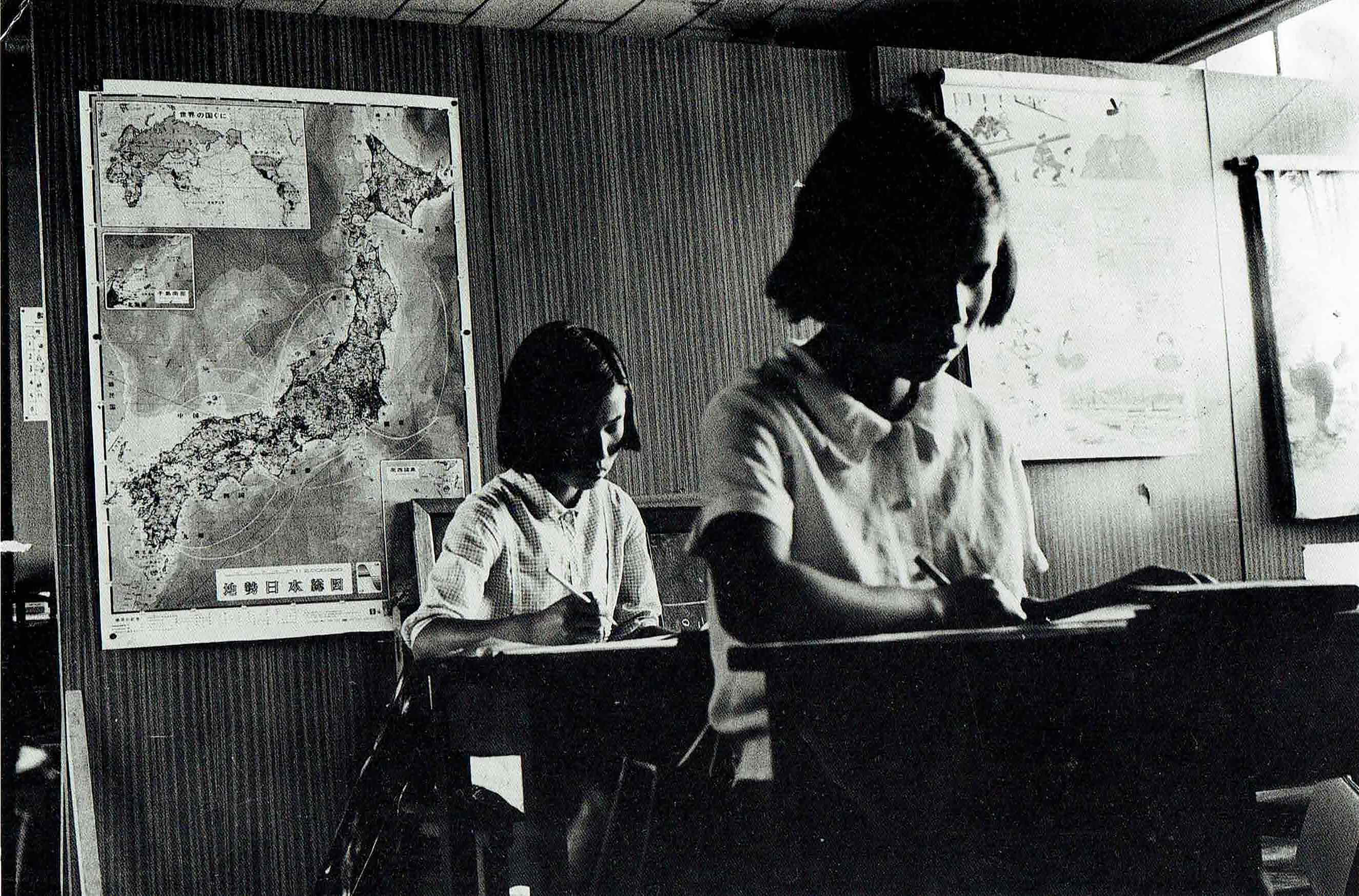
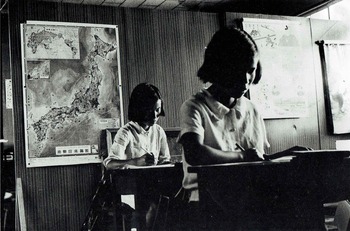
In a time when women photographers did not often make headlines in major photography magazines and were seldom featured in the Tokyo galleries that did focus on photography, by the mid-late 1960s, changing social norms around photography made it possible for women to travel to rural Japan with the conviction that they could form a powerful social critique through photographs. The composition of another photograph in the Ashio series demonstrates how these young women saw themselves and photography as part of a nationwide movement to raise consciousness about environmental devastation and the importance of documentation as a political act. In this photograph of a classroom scene in the mining town, the photographer crouches on the floor to capture two young girls bent in concentration over their desks (Figure 3). Bobbed hair, neatly buttoned blouses, and pencils in their right hands mark them as rule-following pupils; behind them, a large map of Japan places these rural students within a nationwide system of training and supposed community. Heads bent in shadows that obscure their individuality, the students are pictured as part of the larger national polity. The young woman photographer framing the scene points to everyone’s complicity in the large-scale pollution events and also their determination to make a good life in the midst of the toxic vapor. The individual photograph viewed in relationship with scenes of the devastated land creates an understanding of the conditions that need to change. At this time, including the Jissen Photography Club, tens of thousands of students used the camera in this way as their chosen form of protest in a period of national upheaval. As member Higashi Yumi recounted in an interview with me, “We had the choice between carrying cameras or violence (gebaruto). We debated whether we should put our cameras down and join protests but chose to continue with our cameras.”Footnote 4 Looking through the lenses of these students, we access the specific context of the anti-pollution movement in Japan, but more than this, a model for shifting relationships between humans and the environment through photography that cannot be contained by national borders.
“Kaitakumura no gakkō,” (A school in Kaitaku village) Alumni of the Jissen Women’s College Photography Division, Ashio 1969–1971 (Tokyo, 1994), 61.
The rise of environmental activism through photography in Japan: 1960s and 1970s
In the 1950s, the first decade following Japanese surrender and defeat after 15 years of war, the government and industrial sector aligned to propose several ambitious long-range economic programs. Then in 1960, the government adopted a plan to double the national income by 1970 and reach full employment.Footnote 5 In the extensive push to become the center of East Asian industrial manufacturing, expand the production of petrochemicals, and rapidly expand housing and transportation across Japan, there were few regulatory checks on waste products dumped into the air, water systems, or on land.Footnote 6 Increasingly, as news of the effects of industrial pollution’s impact on local communities spread, photographers began to develop critical ecological perspectives by visiting the communities most immediately affected and creating social documents of the physical effects of living amidst chemical runoff and extractions from the Earth. It was in this period that eco-photography simultaneously became a tool used around the world to create new understandings of landscape. In the North American context, art historian Karla McManus identifies this movement as “a specific ‘way of seeing’” linked to a cultural practice “with the power to contribute to a broad environmental ecological consciousness.”Footnote 7 Around the globe, eco-photography was derived as a method to forge a new understanding of humans’ effects on the Earth and provoke a critical framing to activate the viewer. Photographs of landscapes became opportunities to stand as symbols of the destructive effects of industrial capitalism not only on the Earth but also on Japanese society and culture. By the late 1960s, they envisioned not just the world in front of the camera but internal worlds of poisoning and power relations of systematic betrayal.
In Japan, the effort to turn photographs of polluted landscapes and bodies into agents of power began in the decade following the end of the war.Footnote 8 In 1959, Domon Ken turned his camera on the Chikuhō coal mining villages in Kyushu to create a social document of the lives of the young children who worked in and lived around the mines. Images of the children climbing piles of coal, carrying sacks to fill on their backs, were printed on cheap paper in small booklets and at 100 yen per copy sold over 100,000 copies in their first printing. Though Domon’s Chikuhō no kodomotachi (The children of Chikuhō) (1960), made no reference to the miners who were taking their own photographs of the conditions they worked in, it might be the first complete photobook in the postwar period dedicated to visualizing human life in the crosshairs of industrial pollution.Footnote 9 In 1960, photographer Kuwabara Shisei visited the fishing community of Minamata, Kyushu, where the chemical company Chisso Corporation was located, and throughout his career as a photojournalist continued to return to the community to document the effects of mercury poisoning and collaborate on pollution research with Ui Jun, a member of the Research Committee on Pollution.Footnote 10 Kuwabara was one of the first photographers to publish photographs in Minamata outside of Kyushu and in 1962, he held an exhibition at the Fuji Foto Salon in Tokyo of photographs focused on the lives of ten families living with the effects of mercury poisoning. With the support of ecocritical writer and activist Ishimure Michiko, Kuwabara’s photographs were again put on display at the Tsuruya Department store in Kumamoto in 1963.Footnote 11 Creating viewing spaces in proximity to the communities affected and in Tokyo, which often saw itself as separate from the issues facing rural communities, Kuwabara’s photographs played a pivotal role in bringing new information to viewers across the country. In 1965, they were published as the photobook Minamata disease: Photographs (Minamatabyō: Shashinshū).Footnote 12
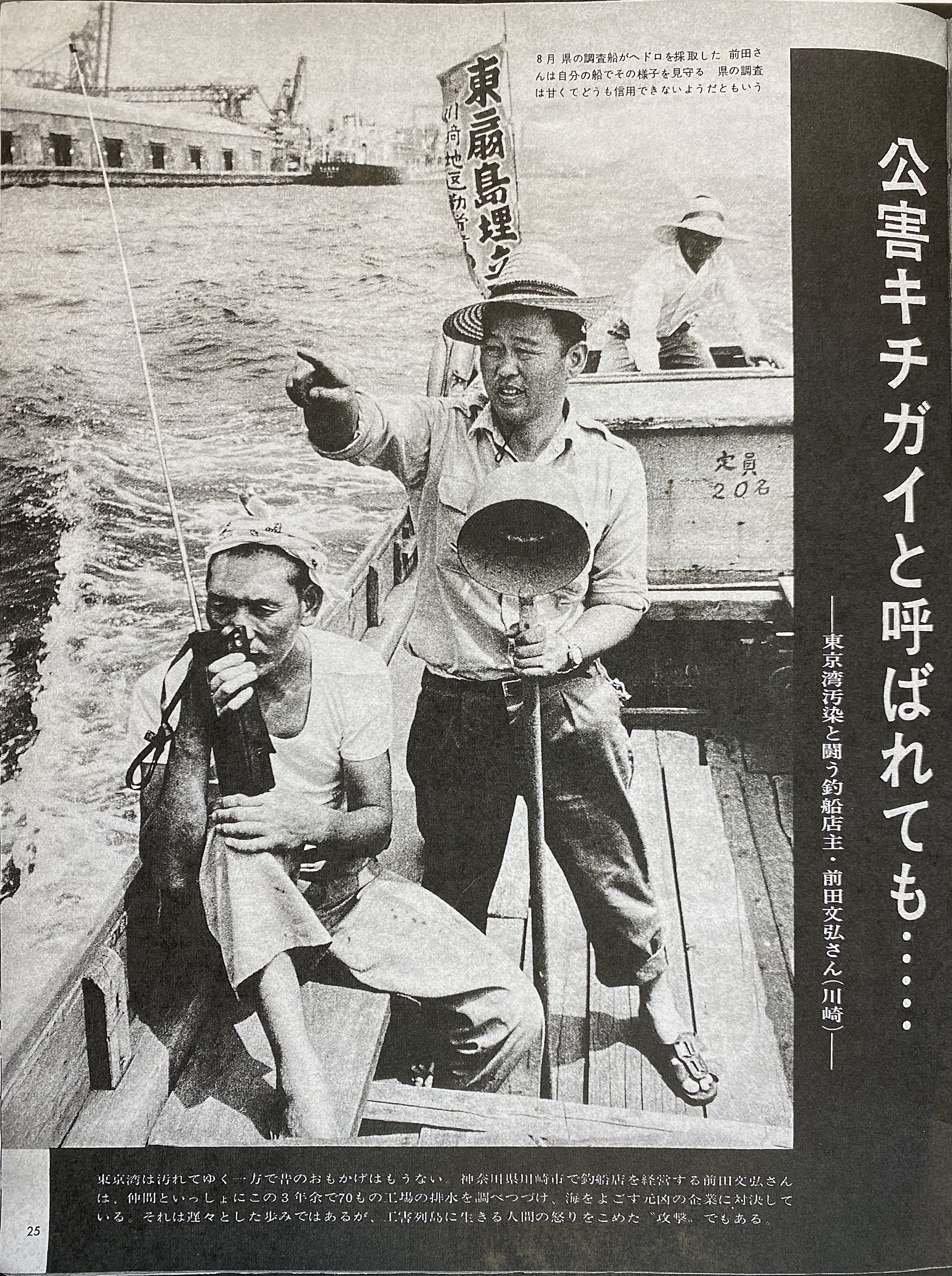
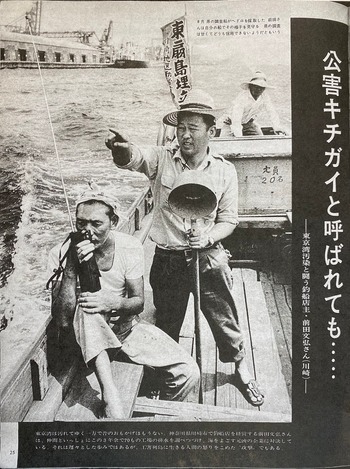
Following this work, journalists for national newspapers began to actively document and publicize incidents of pollution. Beginning with reporter Hayashi Eidai’s work covering pollution events across Japan in, This is Public Nuisance: What is the Property We Must Leave to Our Children (Kore ga kōgai da: kodomo ni nokosu isan wa nani ka) (1968), over the next decade and a half, national newspapers, local governments, and universities published targeted coverage of air, water, and land pollution caused by a range of indus tries.Footnote 13 Hayashi’s book mixed first-hand reports gathered on site with photographs treated as illustrative evidence to accompany the testimony of those he interviewed. Then, from 1969 to 1971, the left-leaning illustrated weekly Asahi Graph increasingly included photographic coverage of citizen activists, fishermen, farmers, and scientists across Japan who were pursuing evidence of unchecked pollution and those who were directly affected by it. The magazine covered what came to be called the Big Four pollution events at Minamata Bay, Yokkaichi City, and the Jinzū and Agano rivers. Asahi Graph’s photographic coverage shifted between focusing on the active bodies of those fighting to measure and expose pollution events and images of land and seascape that force the viewer to imagine these terrains as caught in a cycle of absorbing poisons and constantly belching them out on those in their wake (Figure 4). The photographs are often unattributed and treated as transparent windows through which readers of the magazine might view the world.Footnote 14 Writing for Asahi Graph in 1970 in a special issue that reflected on the 25 years since the war, novelists Maruya Saichi and Ōe Kenzaburō both reflected that pollution was a chief characteristic of the postwar period, indeed a product of the growth and downfall of the Japanese empire in the 1930s and 1940s.Footnote 15
“Kōgai kichigai to yoba rete mo… Tōkyōwan osen to tatakau tsuribune tenshu Maeda Fumihiro-san” (No matter if they call me pollution-obsessed…Fumihiro Maeda, a fishing boat shop owner who fights Tokyo Bay pollution) Asahi Graph, September/October 1969, 25.
Visualizing slow violence: Eco-critical photography and the politics of landscape
In 1970, photography magazines, too, began to feature pollution events covered by prominent photographers Tōmatsu Shōmei and the up-and-coming Fukushima Kikujiro. Signaling the photography world’s recently developed concern with industrial pollution, their photographs were nonetheless taken using the language of photojournalism, emphasizing the images as single-authored products taken on the photographer’s solo investigation of the site. In an article accompanied by photographs made at the Ashio copper mine titled “Higai no genryū o sakanoboru” (Tracing the origins of pollution), Tōmatsu, like many others in this period, looked to the Ashio copper mine’s history as one of Japan’s first major pollution sites and the combined government and industry resistance to responding to the poisoning of Earth and human bodies as the origin story of pollution events continuing to the present. The photographer begins his essay pointing to the fact that Prime Minister Satō announced on July 29th of that year to the government that “We cannot slow down economic growth just because pollution is occurring” and then two months later pledged at a city hall meeting in Utsunomiya, Tochigi (near Ashio) that the government would “boldly confront corporate pollution whose sources are clear.”Footnote 16 In the face of governmental attempts to dodge responsibility, the example of Ashio was helpful for drawing attention to the long durée of government collusion with corporate industry: the photographs represented the bodies of farmers and miners sacrificed for profit. Tōmatsu included the testimony of a farmer from the Ashio area, Onda Shoichi, whose crops were bleached and unable to hold nutrients due to high levels of copper content in the soil. In the accompanying photograph, Onda holds brittle rice stalks from his fields and explains how even the usually hearty weeds are unable to thrive in these conditions.
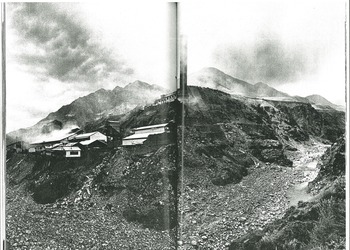
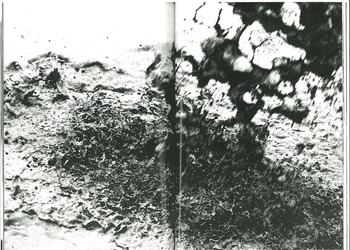
Tōmatsu’s photographs for the short essay can be understood as examples of opposing visual methods for depicting pollution in this decade (Figures 5 and 6). First, he stands on a hillside across from a ravine to capture the mine nestled in the crumbling slopes across the river. The almost panoramic capture of the crumbling shale tumbling down from the cliffs that the factory perches on communicates the scale of the site and its outflow into the river. This photograph, taken with an understanding of reality as all that is in front of the camera, seeks to communicate the visibility of pollution effects to the viewer and document the physical existence of the mine complex. Following this two-page spread is a photograph of loose, foamy mud as it is poured from above into the ground in a splattering and puddling of thick sediment (Figure 6). Though it is just about discernible what the substance is, the abstraction of the material through its capture in action pushes the viewer to consider what is invisible: the copper particulate matter embedded in the slurry and the poisonous sulfuric gases and sulfuric acid in the air all of which are poured into holding tanks eventually joining the Watarase River to flow downstream to destroy the crops of farming communities who rely on the watershed.
Tōmatsu Shōmei, “Higai no genryū o sakanoboru < 1 > Watarasegawa” (Tracing the origins of pollution), Camera mainichi, November 17/11, 1970: 44.
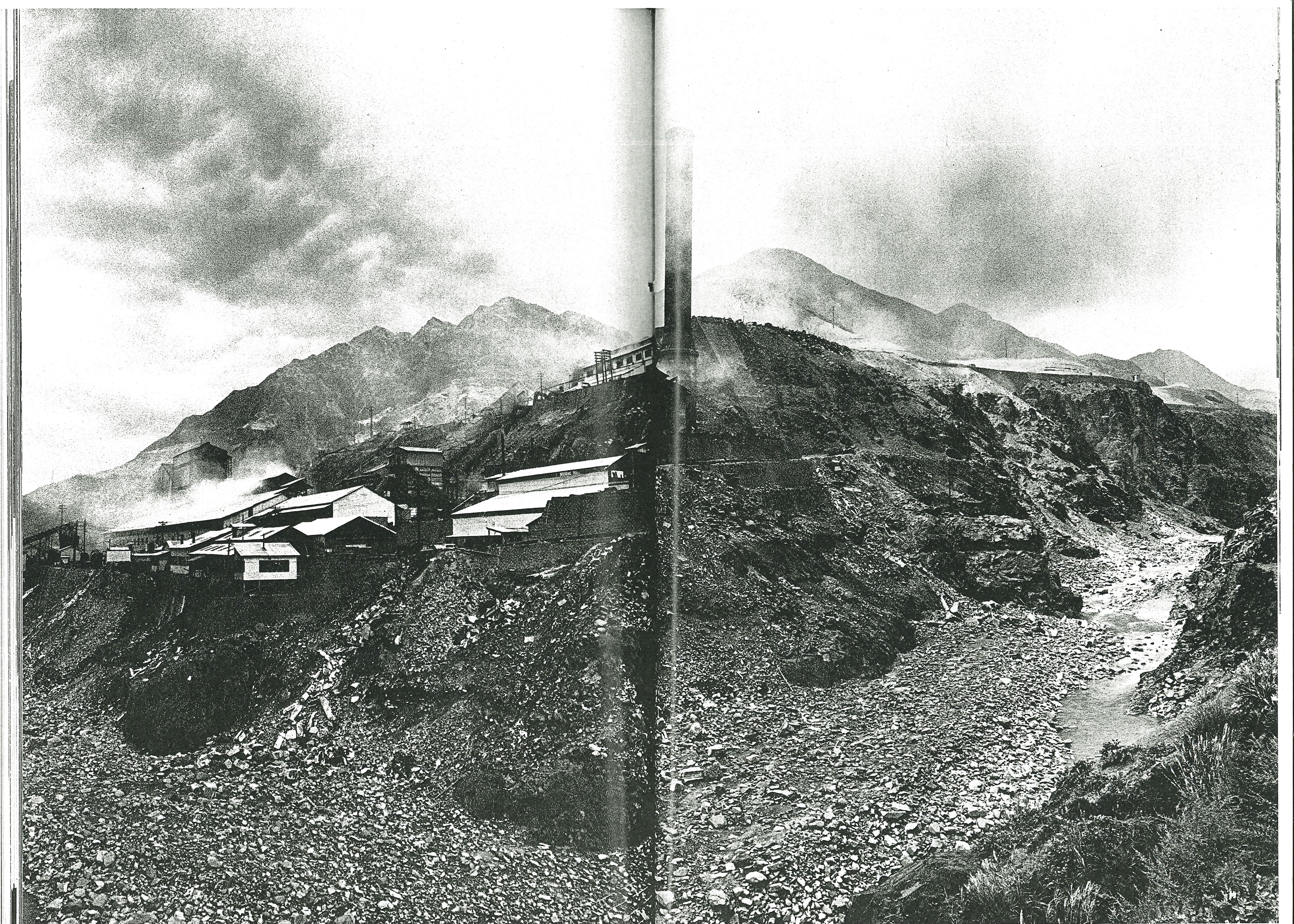
Tōmatsu Shōmei, “Higai no genryū o sakanoboru < 1 > Watarasegawa” (Tracing the origins of pollution), Camera mainichi, November 17/11, 1970: 44.
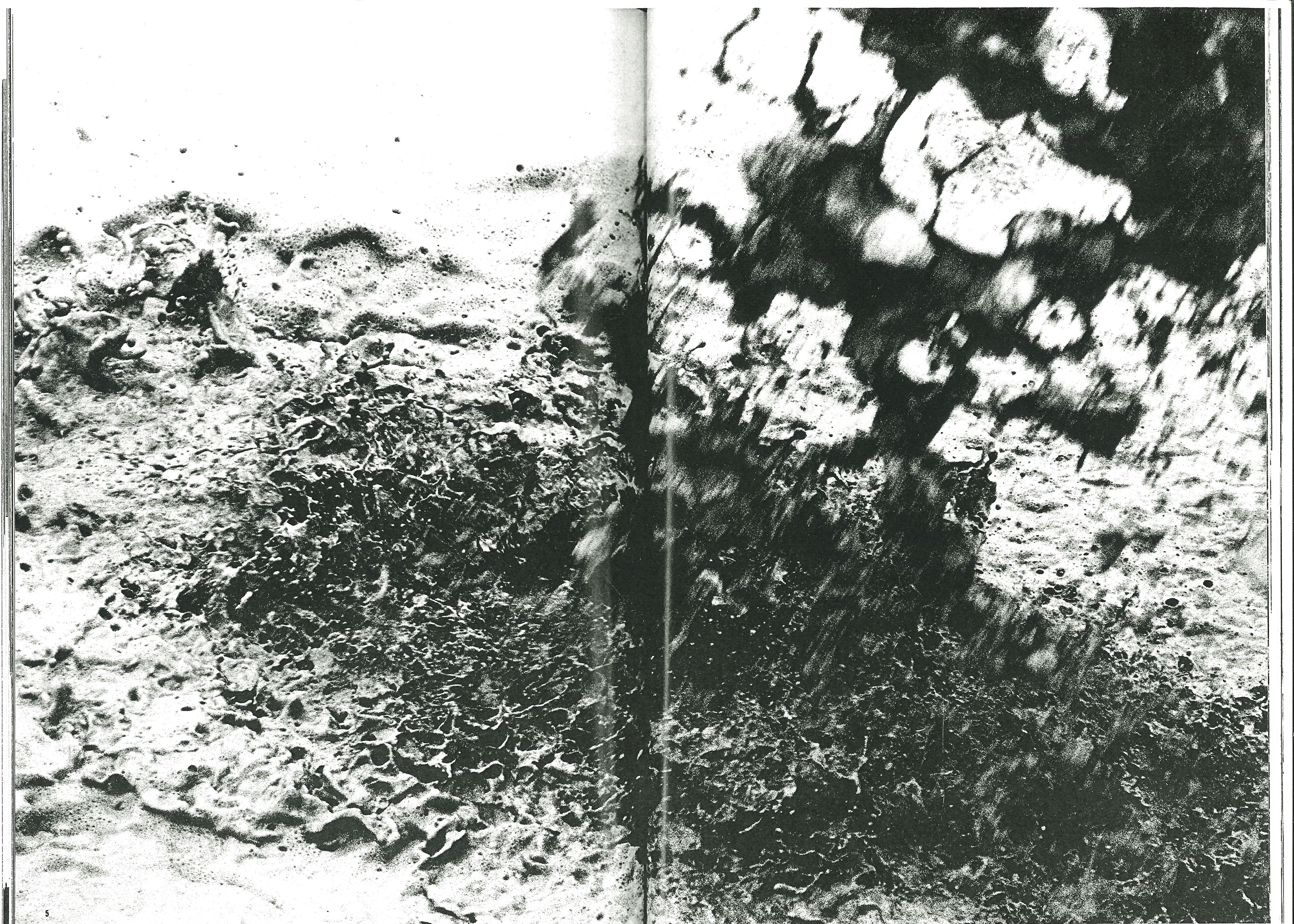
This visual coverage suggests that by 1970, photographs were crucial to the expansion of public awareness of the causes of the slow violence of pollution happening across Japan and globally.Footnote 17 In my reading of the photographs produced in Japan, I adapt Rob Nixon’s concept of “Slow violence,” a term used to describe the long-term damage inflicted upon humans, animals, and the environment that is often invisible because of the difficulty of representing pollution and the fact that pollution events often unfold slowly over time.Footnote 18 Nixon points out that there is a “representational bias” against depicting pollution due to its capacity to remain invisible until it manifests in living bodies. This representational bias is also doubled in the fact that the humans most affected are the world’s poor, and thus this doubling of invisibility leads to the marginalization of pollution as a political issue.Footnote 19
Artists and activists played a significant role in countering this representational bias by employing a range of media from film to photographs to mixed media to build a new visual relationship with the environment. This relationship sought to find a balance between the need to lean on documentary photography’s ability to represent the visible and the need to draw attention to the invisible: the poisons that seep inward, and the power structures that formed barriers to seeing and being seen. In this context, the eco-critical image was built through a new visual vocabulary for comprehending landscapes of ruin and the human bodies that could not be separated from them.Footnote 20 Throughout this article, I use the term eco-critical in relation to photography to identify photographic practices that sought to educate and emphasize issues of environmental justice and the human responsibility to the ecologies that we are a part of.Footnote 21 In its truth-telling function, eco-critical photography plays an important role in identifying existing environmental crises and proposing new social and political ways forward.
Grassroots activism and the emphasis on visualizing and reporting on the origins and perpetuation of pollution events in Japan helped to orient the producers of ecocritical visual culture toward the need for a new way to describe the experiences of living through continuous death of humans and the Earth at the hands of industry.Footnote 22 The use of documentary images in the mass media was crucial to the movement to spread information about pollution events, and yet photographers and filmmakers questioned the power dynamics of the documentary form itself. As film scholar Yuriko Furuhata shows, avant-garde cinematographers in the late 1960s created a new discourse on landscape (fūkei-ron) that resonated across media forms. In the 1950s and 1960s, filmmakers Matsumoto Toshio and Oshima Nagisa sought to disrupt the relationship between documentary realism and the viewer to use the camera to draw attention to relationships of power: between filmmaker and subject, the government and the people.Footnote 23 Furuhata describes how for Matsumoto, “The camera…could not simply be a tool that transparently mediated between the profilmic reality and its image; instead, the camera had to become a conscious means of interrogating perceptual habits.”Footnote 24 Reflecting on the ways that documentary form had easily been taken over by the wartime state and manipulated to create propaganda that claimed it was a true document, filmmakers like Matsumoto rejected a one to one relationship between the image and reality. In a related approach, the director Tsuchimoto Noriaki created a relationship between filmmaker and community that renounced authorial control of the director and included the community filmed to unsettle a clear picture.Footnote 25 Thus, it was felt that the “avant-garde documentary filmmaker, in his view, must ‘distrust the visible, external world that appears objective, and delve in to the invisible, internal world of his own subjectivity.”Footnote 26
Attention to the invisible power dynamics embedded within an image has direct resonances with the earlier environmental discourse proposed by revolutionary activist Tanaka Shōzō.Footnote 27 Through his decades of observations of the Ashio copper mine’s pollution of river tributary systems in the late nineteenth and early twentieth century, Tanaka developed an “ecological philosophy of (beneficial) ‘flow’ (nagare) and (harmful) ‘poison’ (doku)” arguing that humans could not extract themselves from a poisoned environment.Footnote 28 The invisible poison, imperceptible to the human eye, would only accumulate and expand if ignored. For the filmmakers of the 1960s, the only way to create a healthy flow between the maker of the image, the subject depicted, and the viewer of the image was to create work that revealed the toxic blockages inherent in work that did not question these relationships.
In the late 1960s, photographers increasingly questioned the invisible infrastructures of power as hyper-visible and spectacularized forms of “protest” and “resistance” were losing the struggle against massive mobilizations of state and capitalist violence. Photographer and theorist Nakahira Takuma wrote extensively on the critical discourse on landscape known as fūkei-ron (landscape discourse) as a potential space to interrogate the dynamics between an invisible unconscious that, if ignored, turned attempts at image making into false practice. As Franz Prichard compellingly demonstrates, photographer Nakahira expressed a dissatisfaction with journalism’s coverage of urbanization and its effects by mobilizing fūkei-ron to demonstrate “both the crisis of language and pursuit of a novel vocabulary capable of capturing the changing scope and scale of power that was revealed through these confrontations of powerlessness.”Footnote 29 Nakahira’s photographs of the urban landscape sought to reframe landscape as the frame through which viewers experienced monopoly capitalism spreading from urban centers to the rural: for Nakahira and many photographers in the late 1960s and early 1970s, “the discovery of landscape” was thus the realization that landscape is a form through which modern capitalism is mobilized.Footnote 30 It is this collective reckoning with relationships of power, not merely the new visual coverage of pollution, that resulted in the invention of eco-critical landscape photography in Japan.
Kōgai, the umbrella term for pollution in Japanese, broadly includes air, water, soil, noise, vibration, and odor. And yet, when invoked by the state or the industries that produce it, there was a strong possibility for the term’s meaning to be evacuated of urgency and instead filled with bureaucratic gestures at action. Photo critic and mentor to the AJSPA, Fukushima Tatsuo warned, “This word has the ability to conceal the facts of what is actually happening, to abstract and diffuse the true meaning of things, and ultimately to replace the issue with ‘countermeasures,’ ‘improvements,’ and, in some cases, ‘public safety.’ Be careful of this quality [of the term]!”Footnote 31 With full awareness of this danger, the AJSPA produced photographs to redefine each of these individual instances and link them together with real-life events. Due to their work, Kogai shashin (pollution photographs) became a conceptual category that connected the viewer to the present and included a range of genres that also extended through Japanese history.
“These photographs were not made to ‘look at’”: Student photography as environmental activism
The Jissen Women’s College photographers who photographed the Ashio copper mine mentioned at the start of this article were part of a nationwide student movement known as the Zen Nihon Gakusei Shashin Renmei (All-Japan Students’ Photo Association (AJSPA)). Questions of how the individual could be the most effective activist and how photography could be a successful form of activism were key to the AJSPA’s work on environmental pollution. In 1970, the students embarked on their “pollution campaign,” and the Asahi Newspaper reported that over the summer break, students took their rucksacks and sleeping bags to industrial towns throughout Japan to photograph cities that were the centers of environmental pollution (kōgai toshi).Footnote 32 “Blistering their feet going from schools to hospitals and city halls making surveys of local citizens,” members of the AJSPA made visits to Minamata, Yokkaichi, Fuji, Ashio, and Ashikawa, among other places hit by industrial pollution. In each of these towns, they identified the toxic rainbow of elements raining down on citizens and coating the roofs and walls of buildings. They slept in youth clubs covered in reddish brown smoke from iron factories and witnessed the white smoke of sulfuric acid gas and reds of oxidized iron powder but reported that the “yellow smoke seems to be unknown even by the factory workers.” Wherever they stayed, the students gathered together with locals to listen to their fears that change in industrial towns was difficult to initiate. Responding to the resignation of the many workers they interviewed who felt powerless to speak out against corporations backed by the government, the student photographers reported: “The camera can catch the evil which cannot be caught and is part of the means for battling environmental pollution!”
Historians such as Simon Avenell argue that during Japan’s long sixties (1959–1973), “the environment became a visible and consequential space in the consciousness of Japanese in all spheres.”Footnote 33 The AJSPA was a leader in this consciouness raising movement and in 1970 published a slim volume of forty-four pages of photographs taken on their trips across the country entitled, On this Land We Have No Country (Kono chijō ni ware no kuni wa nai) (Figures 7–18). The photobook, which they sold on street corners in Ginza for 350 yen a piece, is one of their clearest examples of Collective Production (shūdan satsuei) as “research through photography.” Collective Production was a method devised by the students in which groups within the association focused on specific themes and anonymously produced work in collaboration with one another.Footnote 34 Made from photographs taken by members who traveled to pollution sites, factories, mining towns, refineries, and fishing villages across the country overlaid with text and statistics drawn from historical documents, petitions to the Ministry of International Trade and Industry, novels, and testimony from victims, it was the first project to visually depict and connect ongoing pollution disasters across the entire Japanese archipelago as the result of the government’s high economic growth policy. In doing so, its black and white, grainy, high-contrast photographs and accompanying text formed what the group called a “pollution map” of Japan. As one member described, “When you look at this book, it is not a photobook. It is a book of photographs that tell you to go to the nearest rally or political meeting.”Footnote 35
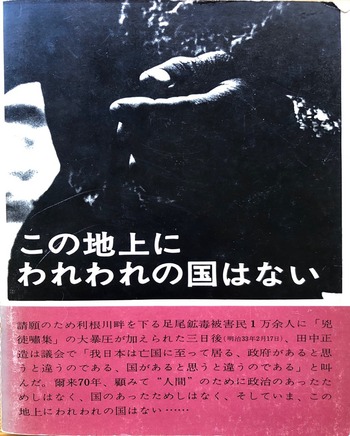
“Three days after 10,000 victims of the Ashio Copper Mine poisoning came down the Tone River in an ‘unlawful and violent gathering’ with explosive pressure, Tanaka Shōzō went before the Diet (on February 17, 1900) and said, ‘You are in a destroyed Japan. You are wrong if you think there is a government, you are wrong if you think there is a country.’ Seventy years since then, there has never been a government for ‘humans,’ there has never been a country, and now on this land we have no country.” All-Japan Students’ Photo Association Pollution Campaign Committee, Kono chijō ni wareware no kuni wa nai (On this land we have no country) (Tokyo: All-Japan Students’ Photo Association, 1970). © Archives of Another Photo Stream.
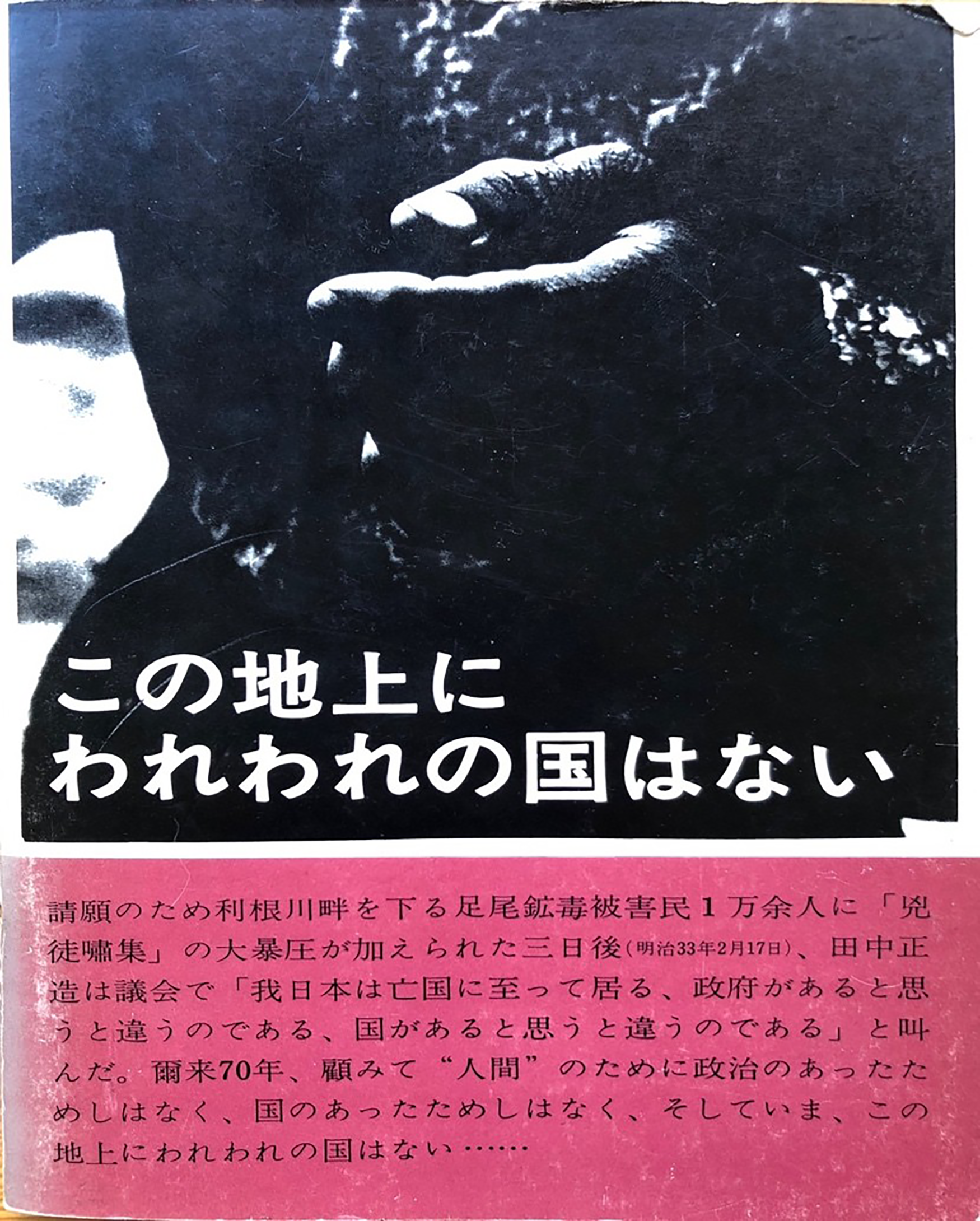
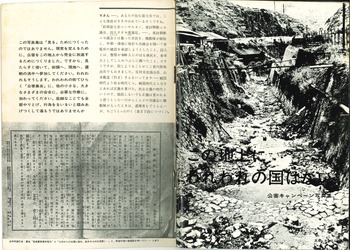
All-Japan Students’ Photo Association Pollution Campaign Committee, Kono chijō ni wareware no kuni wa nai (On this land we have no country) (Tokyo: All-Japan Students’ Photo Association, 1970) Inside cover and first page. © Archives of Another Photo Stream.
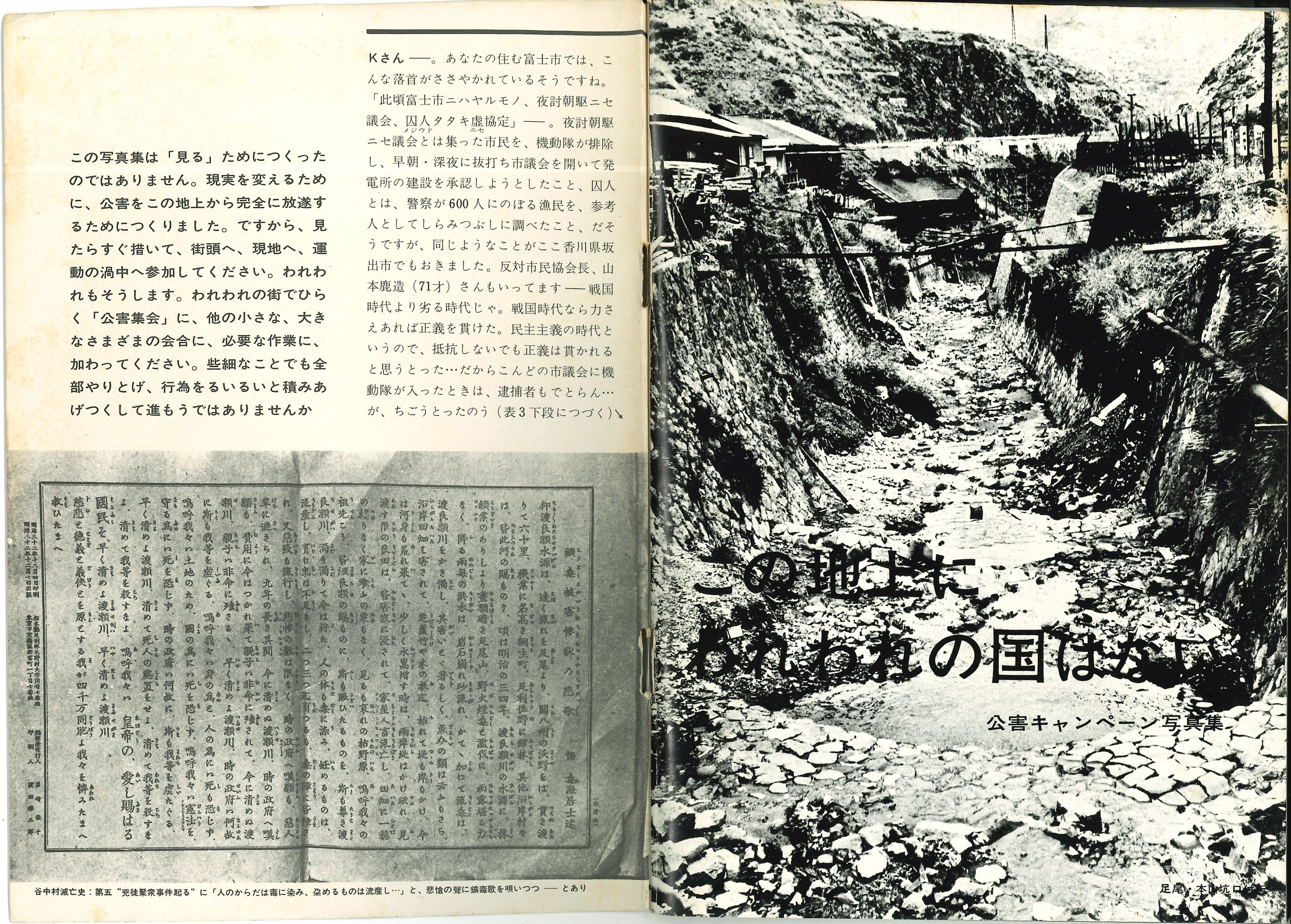
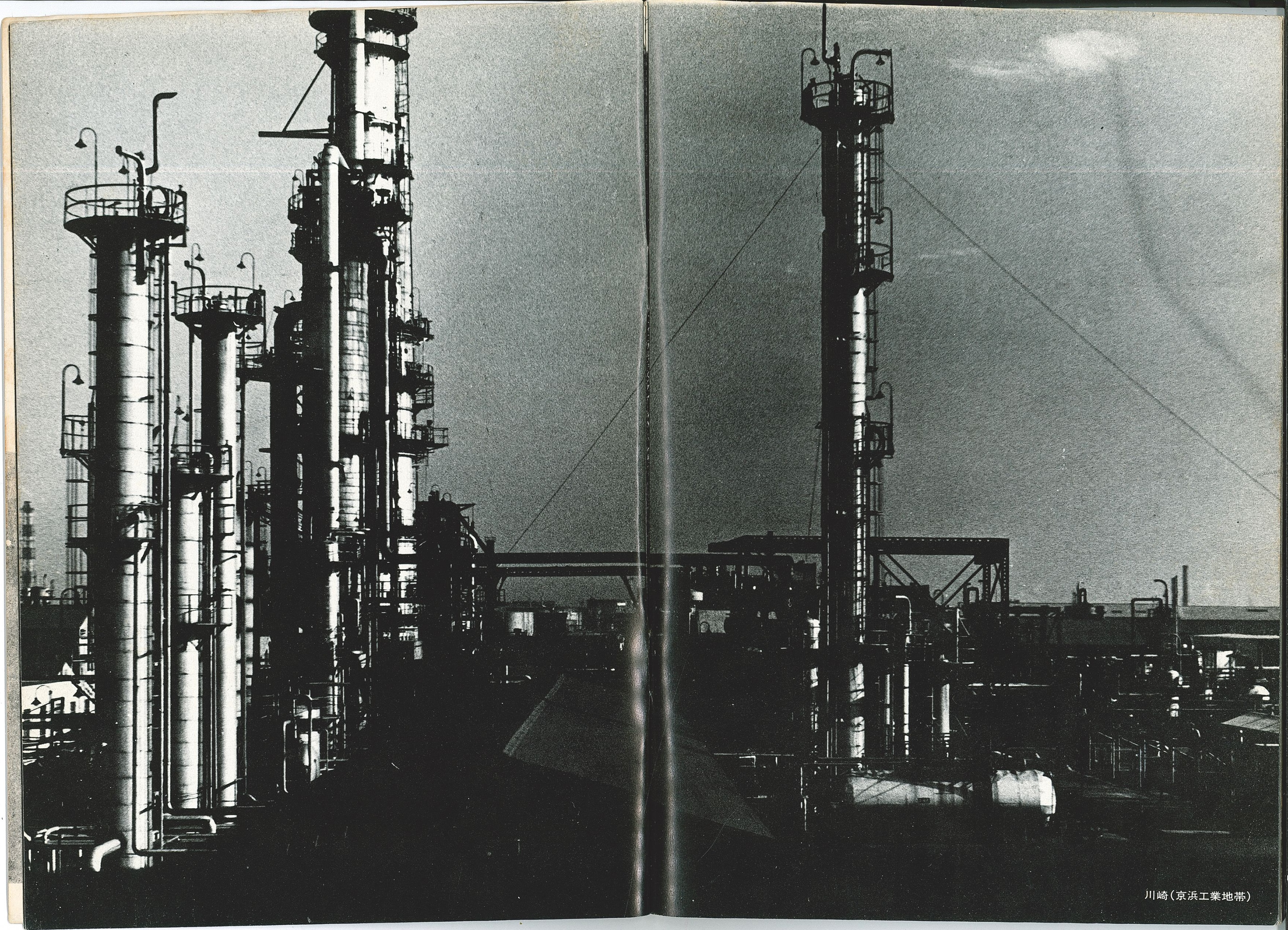
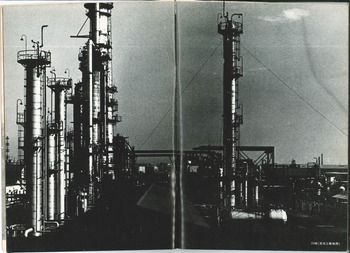
“Kawasaki (Keihin kōgyō chitai)” (Kawasaki [The Keihin industrial region]). All-Japan Students’ Photo Association Pollution Campaign Committee, Kono chijō ni wareware no kuni wa nai (On this land we have no country) (Tokyo: All-Japan Students’ Photo Association, 1970) Unpaginated. © Archives of Another Photo Stream.
Thus, the students’ goal to create a campaign to visualize environmental degradation across the Japanese archipelago was one of the first activist actions to visually connect disparate pollution events that occurred for a range of reasons: air, land, water; arsenic, methylmercury, cadmium, and sulfur dioxide. The act of visualizing pollution in national and relational terms, differentiated their work from photographers, such as Domon Ken, Kuwabara Shisei, and later Eugene Smith who, as mentioned at the start of this chapter, documented the effects of industrialization before and after them. While the clinical perspective created by Kuwabara’s photograph of a hand twisted by methyl-mercury poisoning may “divide the normal from the diseased, the healthy from the ill,” the later work of W. Eugene and Aileen Smith is most often interpreted as empathetic and insightful windows into the lives of the Japanese families they lived with during the two years they spent embedded in the community of Minamata.Footnote 36 The Smiths’ focus on individual bodies affected by methyl-mercury poisoning provides the potential for the photographs to “be used for the betterment of the human condition.”Footnote 37 As they traversed the country to build their own activist handbook, the students would have been familiar with the work of Domon and Kuwabara, and deeply driven by the desire to produce images that implicated the photographer and viewer in the subject’s experience of industrial pollution. Unlike W. Eugene Smith’s later photographs of Minamata sufferers, which were first published in the 2 June 1972 issue of Life magazine, the students did not seek to translate their work into the easily legible language of photojournalism’s photo essay but instead were searching for a form that was simultaneously more abstract and concrete, drawing the viewer’s attention to the role of the photographer.
On this Land We Have No Country begins with two declarations: one regarding the role of history and the other, the role of photographs as political action. The cover and its inside bear a reproduction of Tanaka Shōzō’s critique of the Meiji era (1868–1912) government’s limitations on the freedom for people to gather and organize in political groups and legalization of the dispossession of people from their lands, effectively making the interests of mine owners and steel magnates the foremost priority of the state (Figures 8–9). As the student photographers point out, the new aspect of pollution events since 1960 was the scale of destruction to the bodies of fishermen, farmers, urban dwellers, and children of mining towns. Their harrowing visualization asks if citizens can call a land their country if the country has so continuously abused its people. This question and the title of the volume are taken from Tanaka Shōzō, who, in 1900, upon witnessing the Meiji government wipe out a town with 400 years of history for the sake of the Ashio copper mine, noted, “Japan is destroyed. Remember this. From this time on, on this land we have no country.”Footnote 38 The students connected the cause of pollution in the 1960s with the historical trend to sacrifice people and nature for national and corporate goals, be they producing metals for wartime armaments during the Russo-Japanese War or extracting as many resources from the land as possible for the chemical, pharmaceutical, and oil industries that fueled the “economic miracle” of the 1960s and 1970s. In doing so, they developed a historical critique to argue that this was an old form of pollution in the name of nationalism brought back at an accelerated pace.
On This Land incites the viewer to action
In the inside cover of the volume, next to Tanaka Shōzō’s words, the students printed their declaration (Figure 5.16):
This photo collection was not made to “look” at. It was made to change the current state, to expel pollution from this land. And so, when you see this, immediately stop, go to the streets, the locations of pollution, and participate in the movement. That is what we will be doing. Join the “pollution rallies” in small and large gatherings in your cities. Even if you only do a small thing, it is all action that helps us to move forward.
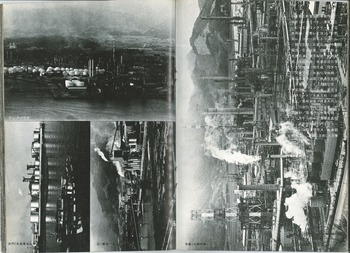
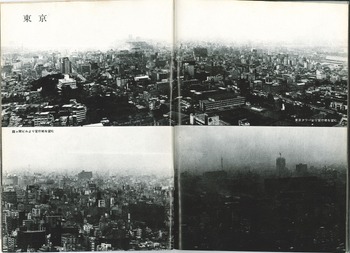
Following this invocation, the volume lays out photographs like pieces of industrially processed meat on a conveyor belt meant to successively sicken the viewer with each sampling of forms of destruction. Coal mining towns where 80–100 tons of coal send black dust up into the air and lungs of school children; the port town of Niihama, where the Sumitomo Chemical Industry, Sumitomo Electrical Power, mining, and logging plants dump liquid waste runs into the ocean, where the fish eat it, and then these factories feed the same fish to their workers. Other key examples include photographs of the Keihin Chiho industrial region (connecting Tokyo, Kawasaki, and Yokohama in one large industrial belt), photographed in high contrast so that the blacks of the factory towers appear to be disintegrating into the heavy greys of the skies, a reminder that industrial zones are often right at the edges of urban life causing smoggy skies over Tokyo (Figure 9). Landscape images of factories from around Japan are printed in serial, their repetition emphasizing how much a part of daily life these scenes of soot from factories’ smokestacks creating “black sparrows” (kuroi suzume) in the sky had become (Figure 10). Photographs taken from Tokyo Tower and the Kasumagaseki Building present a view of the city stretching out to the horizon line and disappearing into the pollution fog. In a panoramic scene, the right half of the cityscape is printed darkly so that the city is overtaken by heavy blackness that blends into the sky fog (Figure 11).
Factories from around the country in serial. © Archives of Another Photo Stream.

“Tokyo tawā yori kanchō gai wo nozomu” (Looking out over the central government buildings from Tokyo Tower). All-Japan Students’ Photo Association Pollution Campaign Committee, Kono chijō ni wareware no kuni wa nai (On this land we have no country) (Tokyo: All-Japan Students’ Photo Association, 1970). Unpaginated. © Archives of Another Photo Stream.

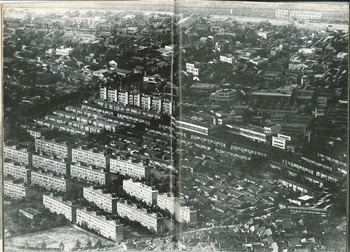
Feeding the urban sprawl, danchi, or mass housing blocks, once considered the answer to the postwar housing crisis, are photographed as they spread across wide swaths of cities like cancerous growths (Figure 12). The uniformity of their design colonizes space as they spread out through the land, replacing the older networks of smaller homes connected by small streets and filling in farmland that once interspersed neighborhoods. By 1970, many of the danchi developments built in the 1950s had already begun to lose their veneer of modern design, instead representing, as in this photograph, the excesses of unbridled development.Footnote 39
“Kitakyushu.” All-Japan Students’ Photo Association Campaign Committee, Kono chijō ni wareware no kuni wa nai (On this land we have no country) (Tokyo: All-Japan Students’ Photo Association, 1970). Unpaginated. © Archives of Another Photo Stream.

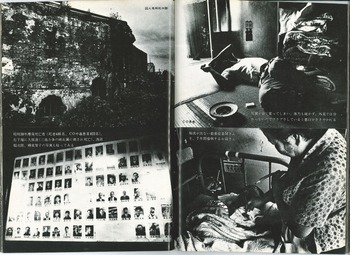
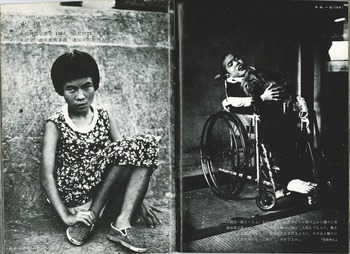
Moving deftly from depiction of the architecture and landscape of pollution events, the series often turns its focus to the human bodies tied to these scenes. A two-page spread depicting carbon monoxide poisoning presents portraits of those unable to breathe as they lie on the tatami mat floor of their home or are connected to oxygen in a hospital bed (Figure 13). On the opposite page, a wall of reproduced photographs of some of the 485 people who died in 1963 from carbon monoxide poisoning, and the other 822 who were classified as poisoned, stands as a warning and evidence of a potential future to come. On another page, the photographs of methylmercury poisoned victims in Minamata are accompanied by text from Ishimure Michiko’s novel Kugai jōdo: Waga Minamatabyō (1969) (published in English as Paradise in the Sea of Sorrow: Our Minamata Disease, 1990), which won the Ramon Magsaysay award for exposing the Chisso Corporation’s dumping of methylmercury into the Minamata Bay. Ishimure, nicknamed the “Rachel Carson of Japan,” published the following year before (Figure 14):
“We did not receive one cent. Instead, one after another those high up in the company gave us mercury to drink. From the earth, one after another, forty-two people died. Even mothers drank it. Their children were born with it. And after that, one after another, sixty-nine people had Minamata disease.”
Bottom left: Reproduced photographs of some of the 485 people who died in 1963 from CO2 poisoning and the other 822 who were classified as poisoned. Right: Individual portraits of two sufferers in their homes and hospital beds. All-Japan Students’ Photo Association Pollution Campaign Committee, Kono chijō ni wareware no kuni wa nai (On this land we have no country) (Tokyo: All-Japan Students’ Photo Association, 1970). Unpaginated. © Archives of Another Photo Stream.

Left: “Minamata: 116 confirmed cases of Minamata disease (23 fetuses, 45 deaths)” Right: “Hannaga Kazumitsu, age sixteen.” © Archives of Another Photo Stream.

Behind Ishimure’s text is a portrait of 16-year-old Hannaga Kazumitsu in his wheelchair, head tilted back and up so that he looks directly at the camera. Ishimure based one of the characters in her book Paradise in the Sea of Sorrow after Hanei. Here, her text overlaid over his portrait functions to speak for his experience.
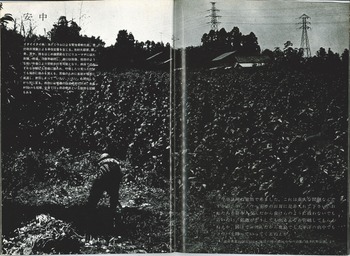
On the two-page spread dedicated to itai-itai byō (it hurts it hurts disease), a photograph of a farmer bent over their crops is printed so densely that the growing plants are obscured as they dissolve into black (Figure 15). A farmer’s words from a petition to the Ministry of International Trade and Industry Mining Safety Chief in Concealed Pollution (Kakusu sareta kōgai) are reproduced over the dark blacks of the soil:
I came prepared to die today. Because this is a huge problem, please appeal to his highness the emperor. We are Japanese so please do not treat us as worthless beings. Mineral Pollution happens everywhere, so we cannot move. It is all over the county in Kashima, in the middle of the Pacific Ocean there are small factories.
Itai byō (It hurts it hurts disease): cadmium poisoning in Toyama. (Tokyo: All-Japan Students’ Photo Association, 1970). Unpaginated. © Archives of Another Photo Stream.

The main focus of these photographs is to collectively visualize the death cycle of industrial pollution, starting with the producers of pollution (factories) and moving to the places where toxins are being embedded (water, earth, air), and ending with those who suffer from contact with it (women, farmers, fishing communities, children, the elderly). By creating this visual compendium of pollution as an ongoing process, the students connect back to photographs themselves as part of a cycle of action. On this Land is a pollution map at the same time that it might be seen as an illustrated dictionary of pollution as it is occurring across Japan. It is a compilation of the factories that produce the smoke and liquids that are discharged into the surrounding communities and an illustration of how mass pollution events, such as methylmercury and cadmium poisoning, happen when industry goes unchecked. The photographs are both documents of real events and a call to interpret them as images that break free of the documentary form itself.Footnote 40
This is why there is no aestheticization of suffering or death present in On This Land. The small format ensures that the viewer will not mistake sweeping vistas of factory smokestacks or the smoggy skylines of Tokyo and Osaka for renderings of the sublime. In some cases, up to three photographs are arranged per page; because each page is roughly 5 ¾ × 8 inches, those with multiple photographs squeezed onto a single page are visual arguments about repetition and intensity (Figure 10). Their high contrast and overly exposed shadows obscure information at the same time that they expose the extent of ruination.
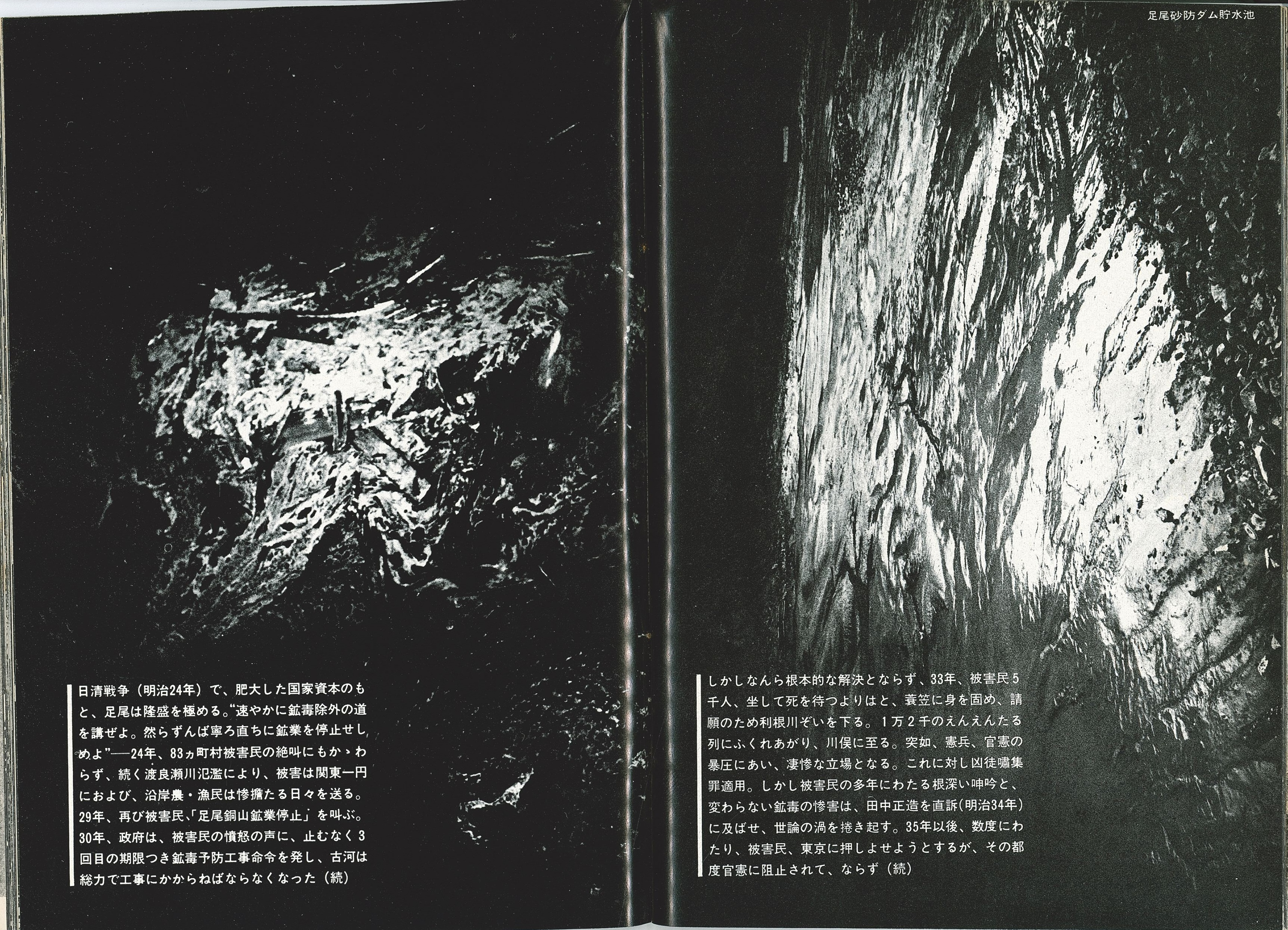
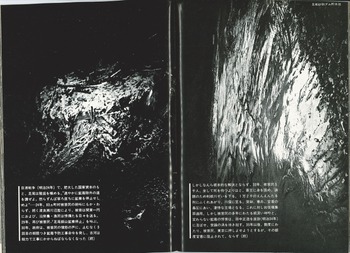
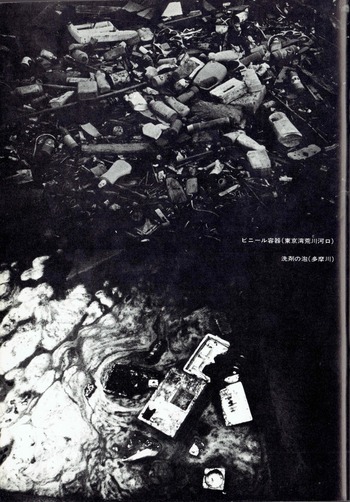
Unlike monumental photographs taken from an airplane high above the battlefield or oil field, in the student photographs, it is not possible to forget that a human is making the pictures nor is it possible to “stop thinking about those chemical and ecological realities” depicted.Footnote 41 As is the case of photographs of water, mud, and stones in the holding dam at the Ashio copper mine, some of the photographs in the collection are close-up depictions of the sites of pollution imaging the waters of the Watarase River that carried pollution downstream (Figure 16). Other photographs show the accumulation of pollution on the surface of the water: the slick shimmers of oil and trash backed up and clustered on the surface of rivers (Figure 17). The text printed over the watery surface describes the villagers who in the first decade of the twentieth century marched ino the polluted waters to protest the government’s lack of support of their livelihoods. Other photographs are so heavily overexposed that shadows take over, and white lines of dead plants and dry straw twist in bundles that mimic the bristly strands of a woman’s greying bun. In instances of such abstraction, the students anticipate the danger that the viewer might be liberated from a sense of responsibility when pollution is envisioned so beautifully. Thus, they were careful to ensure that they did not create an industrial sublime seen from a god’s eye perspective to release the viewer from connection to the soil. Rather, in these instances, the abstract forms are paired with text that describes how, in the early twentieth century in Ashio, “the screams of 83 villages were ignored. With the overflowing of the Watarase River over 5,000 people were affected.” The viewer is always brought back to the human impact on these forms to situate the viewer within a visual politics of activation.
Ashio copper mine as an example of the expansion of state capitalism beginning with the First Sino-Japanese War. All-Japan Students’ Photo Association Pollution Campaign Committee, Kono chijō ni wareware no kuni wa nai (On this land we have no country) (Tokyo: All-Japan Students’ Photo Association, 1970). Unpaginated. © Archives of Another Photo Stream.
Top: Plastic bottles. Bottom: Detergent bubbles in the Tamagawa River. All-Japan Students’ Photo Association Pollution Campaign Committee, Kono chijō ni wareware no kuni wa nai (On this land we have no country) (Tokyo: All-Japan Students’ Photo Association 1970). Unpaginated. © Archives of Another Photo Stream.

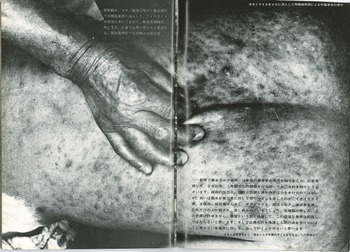
Though factories and images of industrial wastelands make up the majority of the collection, when humans are the main focus of the photographs, their bodies are also contextualized with testimony of victims and numerical quantification of suffering through the listing of numbers of fatalities and sufferers. In these photographs, the human body is the final stage of the death cycle: one photograph in particular combines the approaches of envisioning human suffering through the body with a closely framed abstraction of the flesh. This is a photograph of skin, but it is also a meditation on changes that transform the familiar into distortions of the ordinary and every day that resonates with Tōmatsu Shōmei’s photographs of the skin of atomic bomb survivors in Hiroshima-Nagasaki Document 1961.Footnote 42 Warped fingers of a sufferer of Yushō disease, or PCB poisoning, pull skin in an ambiguous part of the body tightly into crêpe paper creases, and shadows fall on skin that has been morphed by scars, changing the familiar physical body into a landscape of craters made by PCB poisoning (Figure 18). Text in black and white overlaying the photograph informs the viewer that in 1968, after rice bran oil was contaminated with PCBs, the Kanemi Corporation sold it to farmers who used it in chicken feed and for cooking.Footnote 43 At the time of publication, two people had died and 1014 were ill, and eventually 14,000 grew ill and 500 died.Footnote 44 The skin, like the photograph, can be manipulated, distorted, taken apart and re-arranged. The photograph, like the skin, becomes the site of exploration into the experience and everyday life of both the photographed and the photographer.
Left: In 1968, after rice bran oil was contaminated with PCBs, the Kanemi Corporation sold it to farmers who used it in chicken feed and for cooking. At the time of publication, two people had died and 1014 were ill, but eventually 14,000 grew ill and 500 died. All-Japan Students’ Photo Association Pollution Campaign Committee, Kono chijō ni wareware no kuni wa nai (On this land we have no country) (Tokyo: All-Japan Students’ Photo Association, 1970). Unpaginated. © Archives of Another Photo Stream.

On This Land ends with a condemnation of the last 100 years of Japanese history and an incitement to break the ongoing sequences of “madness and aggression of capital” that had led Japan to attempt to escape from Asia by colonizing it and then aggressively pursuing industrial capitalism. Calling into question anything that purports to be done “through the eye and will of the people,” or the National Diet for that matter, the students write that they seek the total destruction of a twentieth century on its path to the fictitious glittering twenty-first century. To do this, photographs are not enough, as they “reject the weak falsity of those who ask: ‘What can we initiate through photographs?’” Calling into question the very utility of photographs as “the marrow is being sucked from the bones” of the lower classes, the students seem to deny the very medium that they have been working through in the volume. And yet, we might read this as a denial of the photograph as the end goal, not the practice of photography as action as outlined in their writings and in the examples set in this very book. The book, like the wound of trauma, allows those who experience it to relive again and again the occurrence of injury. It makes possible, from one page to another, the suturing of pollution experiences into a narrative form that has no beginning or end. This book, like the scarred land and bodies it contains, is a longing to construct wholeness from the disintegrating, an attempt to understand photographs and catastrophic damage through each other.
By building a compendium of images documenting the process of pollution and human suffering that are rooted within their contexts, the students created a causal account for the abusive power of industrialization. Most importantly, at the same time, by erasing individual authors from the work, they do not reduce social and economic relations to a matter of individual resolution, but instead insist upon a collective view that demands deep structural change. In opposition to single-authored coverage of pollution events, the AJSPA’s publications make the argument that social problems and environmental pollution cannot be solved through individual action and their photographs function to raise collective awareness to demand structural change. More than this, these are photographic practices that make change through the collective labor of reimagining the totality of the forces shaping the world. Though the photographers of the Provoke group, such as Nakahira, and the students of the AJSPA both simultaneously asked, “What can be done through photography,” the work of these young students has not been visible to an art world that continues to privilege notions of the individual artist who fights for change. Provoke is internationally renowned as a highly sellable symbol of Japanese photography (much to many of the former members’ protestations), and yet the student photographer’s propositions for what participating in a democracy could look like are largely unrecognized.
Conclusion: The continuing movement
On one sunny spring day in 2023, ten of the former members of the AJSPA gathered at Higashi Yumi’s home an hour outside of Tokyo. As one by one as they arrived at Higashi’s door and were seated around a long table, they shared their stories of how they first began to take photographs as young students and the way their commitment to photographing grew as they participated in photography campaigns and produced photobooks and exhibitions with the group. The seeds for the caring ease that the members have for each other were planted as young photographers and continue to this day as they work to preserve and communicate the work of the organization.
Their connection to the places they had spent time together, such as Ashio, remained—so much so that a couple of women laughingly remembered how they returned to make photographs after they had graduated with their young children strapped to their backs. As the students involved in the organization in the 1960s and 1970s began to retire from their jobs in the 2000s, they rekindled the movement with a focus on collecting the remaining materials related to the AJSPA and embarked on an ambitious project to digitize and preserve its materials. The student’s theoretically ambitious goals of remaining anonymous through collective production meant that their work was not commodified by the art market that was just beginning in the 1970s to recognize photographic prints as unique works of art, sellable and presentable on the international gallery circuit.Footnote 45 The historically narrow classification of “art photographs” as worthy of collection and community produced photography as existing across too many discursive categorizations to make it noteworthy to fine arts institutions has meant that the AJSPA’s work has only recently been acknowledged through institutional collection of a select number of their photobooks. A much larger problem in relation to their history of activism is related to the vast body of maps, newsletters, and unpublished documentation of their campaigns that have not been collected by any institution.
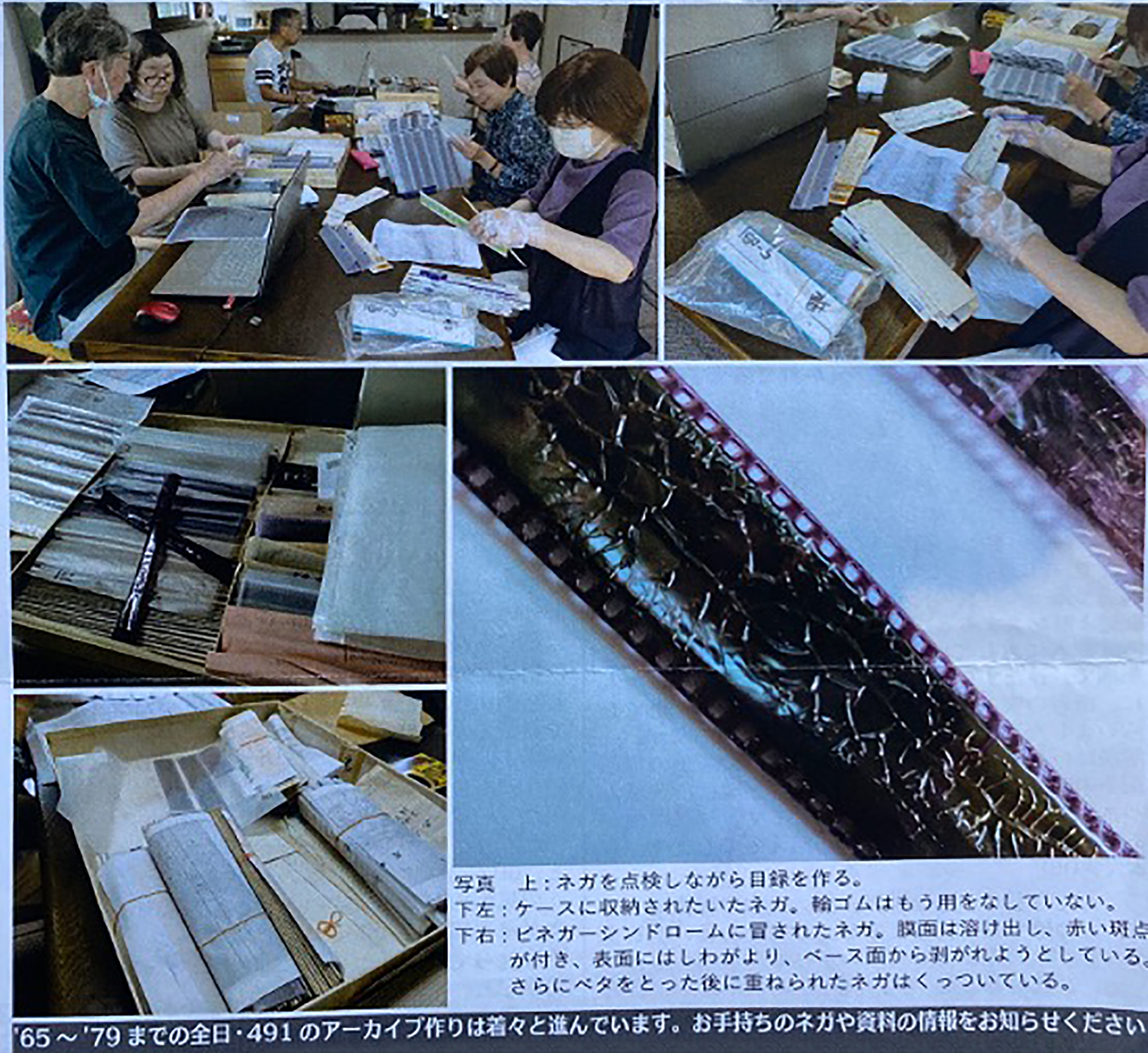
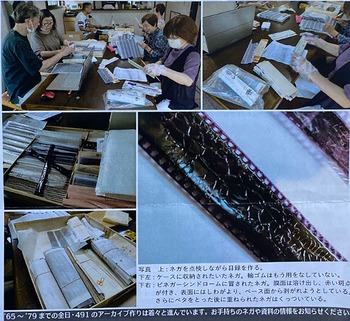
In 2013, the Tokyo Metropolitan Museum of Photography featured their work as a small part of the exhibition Japanese Photography’s 1968 (Nihon shashin no 1968).Footnote 46 The influential curator Kaneko Ryuichi, who had been a member of the AJSPA, wrote the first major piece of scholarship on the movement, contextualizing its relationship to other major photography groups of the late 1960s.Footnote 47 Mobilized by this first major moment of public recognition in years, members of the AJSPA came together in 2015 to reconstitute an archive of their work. Scouring the private collections of members, they brought together negatives, newsletters, unpublished prints, maps, and photobooks and began the process of digitizing the massive collection of fragile materials. In 2017, they established the nonprofit organization “Archives of Another Japanese Photo Stream (AAJPS)” (https://aajps.or.jp/) and launched a website to house these materials, to which they continue to add.Footnote 48 Divided into different teams based on their involvement as students, the groups are each in charge of a range of archival research activities from gathering negatives from former members, scanning and uploading them to holding exhibitions and making prints (Figure 19). Awareness of their work has grown, and in 2023, On This Land was included in the Mori Art Museum’s first major exhibition on eco-critical art, Our Ecology: Toward a Planetary Living Watashitachi no ekorojī chikyū to iu wakusei ikiru tame ni.Footnote 49 Displayed in a vitrine next to Hayashi Eidai’s This is Pollution (Kore ga kōdai da), the small booklet was opened to a page showing the Ashio copper mine factory, its dark and rusting architecture dissolving into an even darker sky. As energy gathered around their work, and in the late summer of 2025, the Tokyo-based MEM Gallery organized the exhibition, “HIROSHIMA, Hiroshima, hírou-ʃímə: The Photography and Collective Practice of the All Japan Students Photo Association,” focusing on the AJSPA’s production of work in Hiroshima that resulted in the photobook HIROSHIMA, Hiroshima, hírou-ʃímə (1972). For the first time, the original prints that were reproduced in the book could be seen hanging on a gallery wall. This is certainly not the last time their anonymous, group-produced work will be displayed as art objects in a gallery.Footnote 50
Ippan shadanhōjin (members of the organization), “Kaku sagyō chīmu kara no hōkoku” (Reports from each work team) AAJPS Newspaper Mō hitotsu no shashin kiroku No. October 17, 2022.
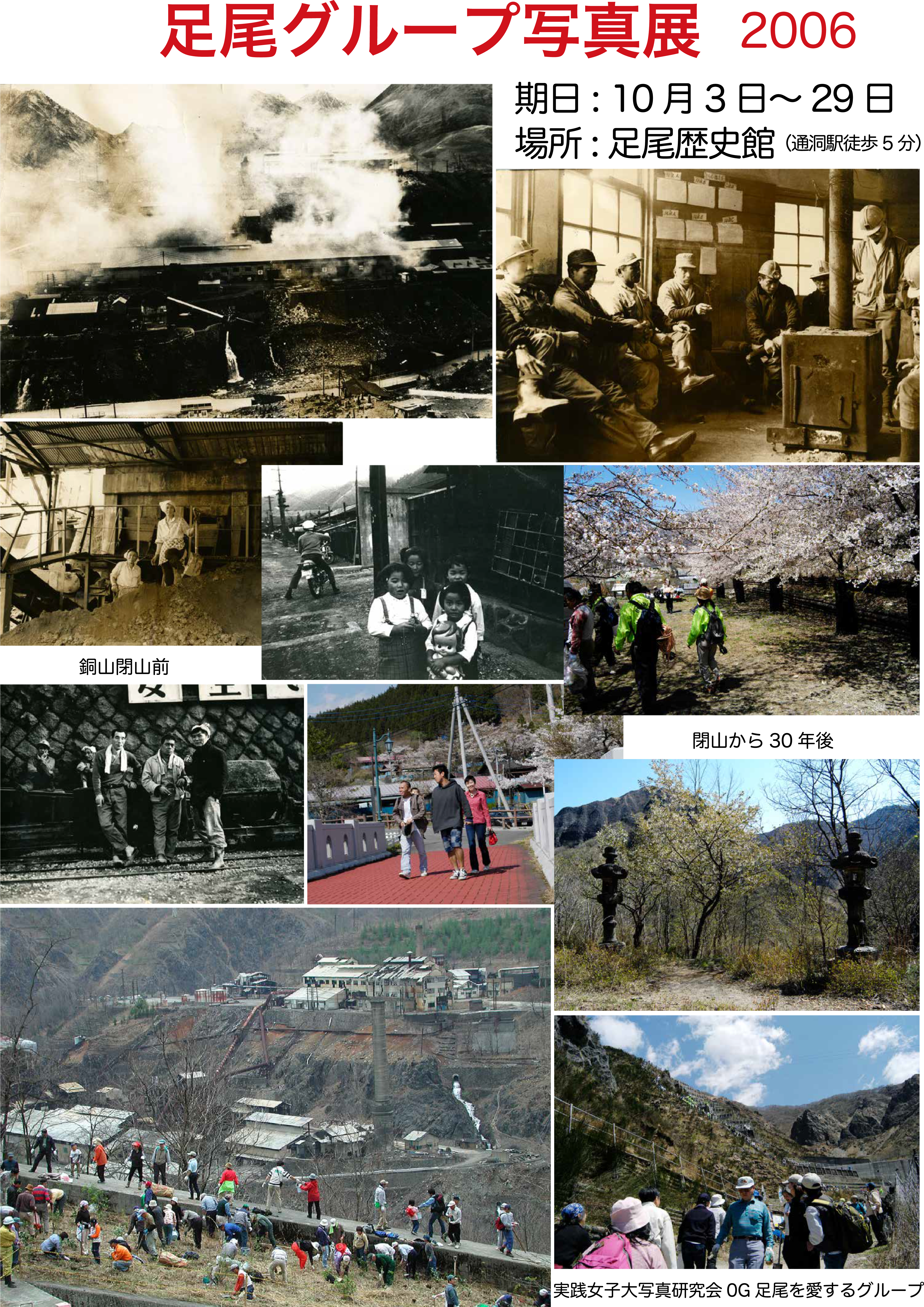
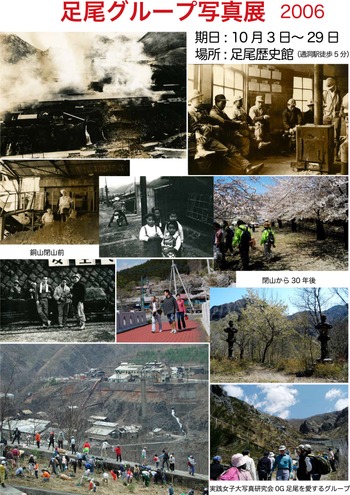
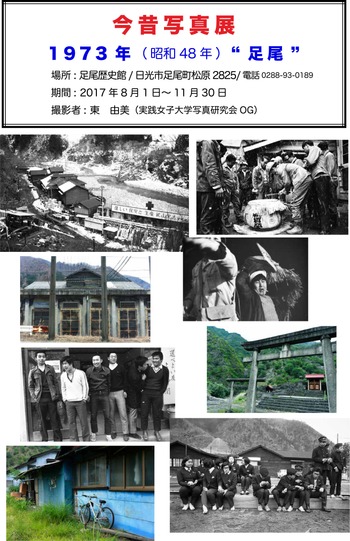
In addition to the AJSPA’s continued activities collecting and preserving the materials related to the movement, members regularly host exhibitions of their work in the communities that continue to process and push back against the effects of pollution events and social changes of Japan’s long postwar. Former Jissen Women’s College Photography Club member Higashi Yumi has worked closely with the Ashio Museum of History and the Ashio Mine Poisoning Incident Tanaka Shōzō Memorial Museum to organize exhibitions that connect historical photographs of Ashio taken by the students in the early 1970s with the subsequent movement to rehabilitate the valley and Watarase River after the closing of the mine in 1973 (Figures 20 and 21). These exhibitions offer the community a chance to connect with the last days before the mine officially closed and use the memory of the past to inform continued efforts to regrow the surrounding forest and have open dialogue within the community. Higashi recounted to me that it was through the slow process of showing their photographs to the community, printing their photographs in newspapers, and holding exhibitions that the wall (literally, kabe) between the townspeople and photographers dissolved.Footnote 51 In their continuous effort to document and make their work available, accessible and part of not only their own everyday lives but also deeply intertwined with the lives of those connected with their work, the current core members of the group are involved in what Daniel Tucker calls “immersive life practices.”Footnote 52 Their practice “aspires toward a less-alienated way of life that can combine internal and external social transformation.”Footnote 53 Through their “marriage of redistribution and representation, of the work and the image of the work, of politics and ethics,” they provide an alternate example of how to use photography to question “how to live and what to live for.” The continuation of their collective practices offers a deeper sense of the histories of environmental disaster and the possibilities that photography offers for a collective confrontation and reimagining of society.
Flier for “Ashio gurūpu shashin ten” (Ashio Group Photography Exhibition) October 3–29, 2006, Furukawa Ashio Museum of History.
Flier for “Konjaku shashin ten. 1973 ‘Ashio’” (The past and present photography exhibition. “Ashio” in 1973) August 1–November 30, 2017 Furukawa Ashio Museum of History.

The photographic work of the AJSPA transformed the photographic representation of industrial pollution into a collective form of political action that utilized photographs as the catalysts for changing society. Rather than producing single-authored work, the students built alternative media networks—pamphlets, newsletters, maps, photobooks, exhibitions, and works sold cheaply in the streets—that connected dispersed pollution sites into a national visual map of industrial harm. Their emphasis on integrating photographs with testimony, statistics, and historical critique reframed photography as a tool for structural analysis rather than individual expression, insisting that pollution was the product of systemic relations between state, capital, and everyday life. In doing so, they advanced a distinctive model of eco-critical practice in which images did not merely represent trauma but were intended to mobilize viewers, forge solidarity across communities, and redefine landscape as a field of political struggle in late-1960s and early-1970s Japan.
Acknowledgments
This research began almost ten years ago and would not have been possible without the support and collaboration of Higashi Yumi, Ōnishi Kyoko, Fukuzaki-san, Nakaya-san, Fukumuro-san, Abe-san, Imamura-san, Suzuki-san, and the members of the All-Japan Students’ Photo Association (AJSPA) who generously opened their homes, shared their photographs and exhibitions, and visited Ashio and the Tanaka Shōzō Memorial Hall together with me. I could not have done this work without your generosity of spirit and time. My deepest thanks to the mentorship and intellectual generosity of Kaneko Ryūichi, who connected me with the AJSPA and encouraged me to study their work. My thanks to the anonymous reviewers whose comments were valuable to the shaping of this article.
Financial support
This research was supported by the Fulbright IIE Program, the Association for Asian Studies Northeast Asia Council, and the Social Sciences Research Council Insight Development Grant.
Competing interests
No competing interests to report.
Kelly Midori McCormick is an Assistant Professor in the History Department at the University of British Columbia. Her research focuses on the visual culture of modern Japan, with particular emphasis on the social and cultural histories of Japanese photography. She is the co-creator of the open-source digital humanities website, Behind the Camera: Gender, Power, and Politics in the History of Japanese Photography (https://behindthecamerajapan.arts.ubc.ca/), which advances new critical approaches to the history of photography, feminist art history, and the history of modern Japan. She is a contributor to I’m so Happy You Are Here: Japanese Women Photographers from the 1950s to Now (2024) and her forthcoming single-authored book on Japanese women photographers from the 1930s–1970s will be published by Duke University Press in late 2026.

 Open access

