




Introduction
As the first country to experience the outbreak of the COVID-19 pandemic, China shocked the world with its slow, reluctant, and chaotic responses to developments in Wuhan from December 2019 to mid-January 2020. Yet China equally impressed the world with its swiftness in preventing the nationwide spread of SARS-CoV-2 – the virus that caused the pandemic – by late March 2020, through a scheme of extensive surveillance and strict quarantine. Its COVID-19 containment strategy withstood several waves of infection in late 2020 and 2021 caused by the Alpha and Delta variants of SARS-CoV-2, allowing China to become the only major economy to achieve positive growth in 2020 and to stay ahead of other major economies in recovery throughout 2021.
China’s success in preventing mass infections in 2020 and 2021, or at least in delaying the nationwide outbreak of the pandemic until December 2022, has drawn significant attention from researchers. Initially, many of them gave credit to the central government for its dominant position in hierarchical central-local relations (Jing Reference Jing2021, 640–641; Ren Reference Ren2020, 427) and for its vast bureaucracy and party organization, which could be swiftly mobilized to enforce nationwide policies (Mei Reference Mei2020, 317–320). Other researchers pointed to China’s advanced mobile platform-based big data systems, arguing that they enabled the state to track and analyze citizens’ movement trajectories for the purpose of surveillance (Boeing and Wang Reference Boeing and Wang2021; Mao et al. Reference Mao, Zou, Yao and Wu2021; Sun and Wang Reference Sun and Wang2022; Wu et al. Reference Wu, Wang, Nicholas, Maitland and Fan2020). As the pandemic continued to unfold, however, some researchers began to look beyond the central government and technology. After all, even though the central government could enforce strict policies and technology facilitated extensive surveillance, neither was capable of transferring and quarantining a huge number of patients, close-contacts, and secondary contacts. The ambitious anti-pandemic campaign could only succeed through the mobilization of Chinese citizens, especially in densely populated urban areas, where collective efforts were essential for controlling the spread of the virus.
The awareness of the critical role of mass mobilization in China’s anti-COVID campaign has directed researchers’ eyes to the Chinese regime of urban neighborhood governance, which not only extends the state’s organizational reach to individual residents but also co-opts them to carry out its policies. Despite growing attention to neighborhood governance, most scholars focus their discussion on the state when they look for the secret behind China’s success in containing the pandemic in 2020 and 2021. They argue that the Chinese state successfully deployed street offices (jiedao banshichu 街道办事处) and residents’ committees (jumin weiyuanhui 居民委员会) (Liu et al. Reference Liu, Lin, Lu, Shen and Liang2023, 1734–1745), together with professional grid managers (wangge yuan 网格员) they hired (Wei et al. Reference Wei, Ye, Cui and Wei2021), to interweave individual urban residents into a tight net for the purpose of surveillance, control, and mobilization during the pandemic. Clearly, even though these scholars look at the lowest level of the Chinese state which directly interacts with residents, they still take a top-down approach – they examine how local governments exerted influence over residents. This top-down approach pays insufficient attention to individual residents’ agency – especially their ability to negotiate with or even reject the state – and instead treats them as mere pawns of the state. Consequently, the early success of China’s anti-pandemic campaign has been attributed almost entirely to the leadership of the Chinese state in urban neighborhood governance. Meanwhile, although these researchers acknowledge the Chinese state’s reliance on extra-bureaucratic residents to implement its anti-COVID campaign, they still cling to the stereotype of an omnipresent and omnipotent Chinese state adept at mass mobilization. They rarely take into account the particular context of lockdown, in which the state’s governance capacity was significantly constrained.
In the face of the predominant scholarly focus on the role of the government in China’s anti-COVID campaign, some researchers have challenged its underlying assumption that treats residents as passive objects of surveillance, control, and mobilization. They have shown that many urban residents emerged as proactive actors during the pandemic, spontaneously collecting donations and supplies for pandemic control, offering basic daily-life support to people quarantined at home, providing accommodation to front-line medical professionals dispatched from other provinces, raising funds to purchase materials for hospitals, and offering psychological counselling and emotional support to patients and their families (Cheng et al. Reference Cheng, Yu, Shen and Huang2020, 869; Zhao and Wu Reference Zhao and Wu2020, 780–781).
The present study joins these scholarly efforts to investigate China’s urban neighborhood governance during the COVID-19 pandemic with a bottom-up approach and an updated view of residents’ agency. It pushes earlier studies further by narrowing its focus to look at Shanghai under lockdown from March to June 2022. The reason is twofold. First, the lockdown of Shanghai provided a rare extreme scenario to test entrenched assumptions about China’s urban neighborhood governance during the COVID-19 pandemic. Although the COVID-19 pandemic already created a state of emergency, pandemic-centered neighborhood governance was rapidly routinized and internalized as “the new normal” in China. Since the strict surveillance and quarantine policies managed to contain the spread of the COVID-19 pandemic from mid-2020 to the end of 2021, the order of everyday life was not seriously disrupted for most residents in spite of the imposition of some restrictions upon their mobility. It was only when a city entered lockdown – when the vast majority of residents were confined to their homes for almost the entire day – that the everyday order broke down, triggering an extreme crisis. Second, and perhaps more importantly, as the lockdown not only severely constrained the Chinese state’s ability to surveil and micro-manage residents, but also crippled its capacity to deliver public services, it created a rare opportunity to observe how urban neighborhood governance operated when residents had to rely almost entirely on themselves for survival. In fact, recent studies by Linjun Xie, Mengqi Shao, Ronghui Yang, and Yuanbo Qi have revealed the immense potential of lockdown as a crisis scenario for posing new questions. They highlight the sudden emergence of numerous spontaneous groups and autonomous activities across Shanghai under lockdown – a phenomenon seldom seen since the end of socio-political activism in 1989 (Xie and Shao Reference Xie and Shao2022; Yang and Qi Reference Yang and Qi2023).
Drawing inspiration from recent studies that adopt a bottom-up approach to analyze the role of residents’ agency in urban neighborhood governance, the present research explores Shanghai residents’ art of surviving the lockdown. Based on semi-structured interviews with eighteen residents who lived in Shanghai under lockdown, it examines their self-preserving efforts, particularly the organization of community group buying (shequ tuangou 社区团购), which were widely shared among residents across the city to avoid starvation. It argues that these practices of spontaneous organization and autonomous action were key both to the success of China’s urban neighborhood governance and to residents’ survival during the lockdown, at a time when the capacity of government authorities (street offices) and the quasi-governmental entities (resident committees) to govern residents and deliver public services was significantly curtailed. It highlights a specific expression of residents’ agency in Shanghai – and, more broadly, in China – under the extreme conditions produced by a government-imposed state of emergency. These residents rarely defied government policy or openly rejected state intervention; rather, they worked the system to minimize their disadvantage and implored the state to meet their demands.
The rest of this article is divided into five sections. Sections Two and Three introduce the current system of urban neighborhood governance in China and explain the research methods adopted for this study. Section Four examines the deterioration of the state’s governing capacity and the breakdown of everyday order in Shanghai during the lockdown. Section Five analyzes Shanghai residents’ community group buying activities as a form of spontaneous organization and autonomous action. The conclusion discusses the broader implications of this study for future research on urban neighborhood governance in China.
Urban neighborhood governance in China today
A hybrid mode of urban neighborhood governance
While urban neighborhood governance in Europe and North America is often seen as resident-led autonomous governance, its Chinese counterpart has long been characterized by ambiguous boundaries between state and civil society (Tang Reference Tang2023, 136–137). The Chinese state’s infiltration into urban neighborhood governance has been further extended in the twenty-first century as the advancement of information technology empowers it to micro-manage individual citizens. The result is the emergence of a hybrid mode of urban neighborhood governance. Some researchers (Wu and Xiong Reference Wu and Xiong2022; Wu et al. Reference Wu, Wang, Zhuang, Li and Hu2024; Zhao and Wu Reference Zhao and Wu2020; Zou and Zhao Reference Zou and Zhao2022; Zhao et al. Reference Zhao, Liu and Wang2023) characterize it as “co-production,” a concept defined as “the conjoint responsibility of lay citizens and professional government agents for the … creation of public services” (Sharp Reference Sharp1980, 105). Others (Liu et al. Reference Liu, Lin, Shen and Lu2021; Wang and Xu Reference Wang and Xu2024; Wang et al. Reference Wang, Ran and Li2022; Zhang et al. Reference Zhang, Pan and Qian2023) frame the same mode as “collaborative governance,” which refers to “the processes and structures of public policy decision making and management that engage people constructively across the boundaries of public agencies, levels of government, and/or the public, private and civic spheres” (Emerson et al. Reference Emerson, Nabatchi and Balogh2012, 2). Still others (Li et al. Reference Li, Liu and Ye2022, Reference Liu, Lin, Lu, Shen and Liang2023; Tang Reference Tang2023) describe it as “co-governance,” understood as a process in which “a collectivity works co-operatively with other collectivities in a process of mutual shaping and mutual representation” (Somerville and Haines Reference Somerville and Haines2008, 62). Despite their difference in wording, “co-production,” “collaborative governance,” and “co-governance” indicate similar practices that engage both bureaucrats and extra-bureaucratic actors in the decision-making process.
The hybrid mode of urban neighborhood governance is by no means unique to China. Similar modes of urban neighborhood governance emerged in Minneapolis (Fagotto and Fung Reference Fagotto and Fung2006) in the early 1990s through the engagement of various neighborhood associations, and later in Milton Keynes (Bailey and Pill Reference Bailey and Pill2015) in the late 1990s and in Los Angeles (Musso et al. Reference Musso, Weare, Oztas and Loges2006) in 1999 through the creation of elected neighborhood councils. Yet the Chinese hybrid mode of urban neighborhood governance far surpasses its European and North American counterparts in scale, systemization, and reach. In Europe and North America, initiatives for the reform of urban neighborhood governance typically originate from individual municipalities, varying from one place to another. In contrast, China has established a nationwide grassroots management regime, deploying millions of personnel to extend the reach of the state to virtually every urban resident.
The Chinese hybrid mode of urban governance is sustained primarily by four institutional actors: (1) the street office, (2) the residents’ committee, (3) the property management company, and (4) the homeowners’ assembly (yezhu dahui 业主大会). The street office is a legacy of the pre-1978 era, when urban neighborhood governance was organized through the work unit (danwei 单位) system, in which socialist workplaces provided housing and comprehensive welfare to its employees (Bray Reference Bray2005; Xiao et al. Reference Xiao, Liu, Chai and Zhang2020). Although the Reform and Opening-up launched in 1978 gradually phased out the socialist work unit system, the street office is retained and refashioned. Now it has been designated an outpost of the district government, the lowest tier of formal administrative units in a Chinese city (Tang Reference Tang2023, 3). While the scale of a street office varies from place to place, it maintains the same management structure. A handful of bureaucrats stands at the top, a slightly larger group of permanent extra-bureaucratic employees occupies the middle, and a much larger group of temporary workers hired on fixed-term contracts stays at the bottom. Since the temporary workers are paid much less than the other two types of employees and can be easily dismissed by not renewing their contracts, this management structure allows local governments to increase governance capacity at a relatively low cost by expanding their staff size.
Unlike the street office which is a government agency, the residents’ committee is a nominally self-governing institution. It manages a residential community (shequ 社区), which may be a few unrelated residential buildings, a section of a large residential complex, an entire complex, or several smaller complexes. Its members are not bureaucrats, but elected residents in the residential community. Despite the lack of a formal administrative hierarchy between the street office and the residents’ committee, the former institution turns the latter into a quasi-governmental organization through financial and personnel control. The street office provides primary funding for the residents’ committee (Audin Reference Audin2015, 7–8; Bray Reference Bray2006, 539) and influences the residents’ committee’s triennial election to ensure the success of its preferred candidates (Read Reference Read2012, 69–92). Like the street office, the residents’ committee hires a large number of temporary workers on fixed-term contracts to carry out its tasks (Reference AudinAudin 2015, 7–8; Bray Reference Bray2006, 541; Koga Reference Koga2007, 22–24).
Unlike the street office and the residents’ committee, the property management company is neither a government organization nor a quasi-governmental one. It is instead a provider of professional services, ranging from security to facility maintenance. It is hired first by property developers on the behalf of homeowners and then by the homeowners’ assembly after its establishment.
In contrast to the street office, the residents’ committee, and the property management company, the homeowners’ assembly is a genuinely self-governing organization established and run by residents within a residential community (Wang et al. Reference Wang, Yin and Zhou2012, 3–4). Among the four main actors in urban neighborhood governance, the homeowners’ assembly is the only one that solely represents residents’ interests. It facilitates individual residents’ participation in neighborhood governance by consolidating their horizontal ties (Chung Reference Chung2015, 17–18). However, compared to the other three actors in the Chinese regime of urban neighborhood governance, its influence remains the weakest due to legal and operational constraints (He Reference He2015, 280). The government regulations set a very high bar for the homeowners’ assembly to make its decisions: most decisions require the approval of at least half of the homeowners in a residential community while more important decisions – those regarding the collection and utilization of maintenance funds and the repair and reconstruction of buildings and accessory facilities – require the approval of at least two-thirds of the homeowners (Wang et al. Reference Wang, Yin and Zhou2012, 4). Since it is very difficult to convene a general meeting attended by more than half of the homeowners in a residential community, whose population typically ranges from several hundred to tens of thousands, the homeowners’ assembly rarely functions effectively. Due to the dysfunction of the homeowners’ assembly, the homeowners’ committee (yezhu weiyuanhui 业主委员会), which is elected by the general membership of the homeowners’ assembly, has become its de facto decision-making organ. Yet all the members of the homeowners’ committee – ranging from seven to nine – are not professionals, but resident volunteers who can deal with community affairs only in their spare time. As a result, they are generally overwhelmed by the daunting amount of community affairs and can only deal with a tiny fraction of them that are deemed critical (Wang et al. Reference Wang, Yin and Zhou2012, 5).
Probably owing to the stronger influence of the residents’ committee within the Chinese regime of urban neighborhood governance, it has long been the focus of earlier studies. Scholars have demonstrated that the residents’ committee, with the support of the street office, plays a central role in establishing and operating an extensive and pervasive nationwide system of grid governance (wanggehua guanli 网格化管理), a critical instrument for serving, surveilling, and controlling urban residents. Originally a geometric concept, the term “grid” (wangge 网格) is now used as a geographic-administrative unit to divide all residents under the control of a residents’ committee into smaller groups. A grid is typically composed of two to five residential buildings, which accommodate 300–600 households. The residents’ committee brings three types of actors into a team to manage a grid. First, it assigns to each grid at least one professional grid manager hired on the fixed-term contract. Second, the residents’ committee solicits support from residents, particularly Chinese Communist Party members, leaders of social groups, and volunteers interested in community affairs. Some of these residents serve as building managers (louzhang 楼长), each elected by residents or appointed by the residents’ committee to oversee the building in which he or she resides. The third type of actors is composed of independent organizations that have no institutional ties with the residents’ committee, such as the homeowners’ assembly, neighborhood police, and the property management company (Tang Reference Tang2023, 48–54). While the specific work and priorities of each grid management team vary due to differences in location and demographics, every team is assigned four types of key tasks: (1) collecting residents’ information, (2) identifying security hazards, (3) investigating and resolving residents’ disputes through persuasion, and (4) propaganda and mass mobilization (Mittelstaedt Reference Mittelstaedt2022, 13). In other words, a grid management team not only delivers public services to residents, but also surveils, micro-manages, and mobilizes them.
The scale, strength, and efficiency of the grid governance scheme are well illustrated by a series of numbers. The Dongcheng District in Beijing, the pilot site for grid governance that had 17 Street Offices, 205 Residents’ Committees, and around 910,000 residents in 2011, was divided into 589 grids, each governing 1545 residents on average (Tang Reference Tang2023, 49). Jiangyin, a medium-size city in Jiangsu Province with around 1.7 million residents, was divided into 1558 grids, each managing 1091 residents on average (Mittelstaedt Reference Mittelstaedt2022, 9). Shenzhen, one of the largest cities in China that had a population of about 17.6 million in 2019, was governed by 74 street offices, 815 residents’ committee, and 18,673 grids, with around 943 people managed by a grid on average (Mittelstaedt Reference Mittelstaedt2023, 43). The efficiency of the grid management team was reported to be very high. The Tianhe District in Guangzhou, which divided its around 2 million residents into 2337 grids, claimed to have received 2.6 million cases of neighborhood conflicts during the first nine months of 2018 and to have resolved 99% of them (Tang Reference Tang2023, 50). With these highly pervasive and efficient management teams proliferating across urban China, the Chinese state has managed to extend its organizational reach to virtually every urban resident in their everyday life.
Residents’ agency in the hybrid mode of urban neighborhood governance
The hybrid mode of urban neighborhood governance, which increasingly blurs the boundaries between state and non-state actors, has spurred debate about its impact. Some researchers of European and North American cities view the key institutions in this mode, such as the neighborhood council in Minneapolis, as an opportunity to empower residents to participate in urban neighborhood governance through partnership with the state and to gain access to resources and aid that they cannot otherwise obtain through other channels (Fagotto and Fung Reference Fagotto and Fung2006). Many other researchers are concerned by the state-sponsored reforms of urban neighborhood governance like those in Los Angles and Milton Keynes, pointing out that they strengthen the state’s control of society more than empowering residents to achieve self-governance (Bailey and Pill Reference Bailey and Pill2015; Fenwick et al. Reference Fenwick, Miller and McTavish2012). The same debate takes place among researchers of China. On the one side is a positive view of the state’s dominant role in the hybrid mode of urban neighborhood governance (Liu et al. Reference Liu, Lin, Lu, Shen and Liang2023; Xu and Shao Reference Xu and Shao2020); on the other is a concern about the state’s further penetration into society through this mode (Cai and He Reference Cai and He2022; Read Reference Read2012; Tomba Reference Tomba2014). When it comes to the specific issue of anti-pandemic campaign in China, the balance of the ongoing debate is tipped. While a few researchers (Zhu et al. Reference Zhu, Zhu and Jin2021, 15–18) remain suspicious of state penetration into society through the grid governance system, many more (Wei et al. Reference Wei, Ye, Cui and Wei2021, 5; Zhao and Wu Reference Zhao and Wu2020, 778–779) credit its prowess to surveil, micro-manage, and mobilize individual residents for China’s early success in containing the pandemic until late 2022.
This study does not seek to continue the ongoing debate about the state’s role in China’s urban neighborhood governance regime. Rather, it shifts attention away from the state (the street office) and its local agent (the residents’ committee) to residents, whose agency in the Chinese regime of urban neighborhood governance has long been simplified, underestimated, or even overlooked. Regardless of their assessment of the Chinese regime of urban neighborhood governance, most researchers have long assumed that the state is active while residents are passive. For those who see the state in a positive light, it is the street office and the residents’ committee that enable residents to participate in decision-making and obtain resources to solve their problems. For those who are concerned by the state-led urban neighborhood governance, it is the street office and the residents’ committee that mobilize residents to surveil and manage themselves through the extensive and pervasive system of grid governance.
The prevalent assumption about the passivity of Chinese urban residents in earlier studies may be shaped by two factors. First, impressed by the overwhelming scale, strength, and efficiency of China’s grid governance scheme, which has no parallel across the globe, many researchers naturally focus their attention on the institutional structure of China’s urban neighborhood governance. Second, and perhaps more importantly, researchers who shift their attention from the institutional structure of China’s urban neighborhood governance to the interaction between residents and governing actors tend to focus on specific scenarios where residents pursue their goals through negotiation and coordination with these actors. In other words, regardless of their differences in argument and purpose, those researchers somehow jointly promote a functionalist understanding of China’s hybrid mode of urban neighborhood governance, assuming that it enables residents and governing actors to coordinate and collaborate with each other to solve problems and ensure the smooth operation of society. This does not mean that those researchers ignore the tension between residents and governing actors or the failure of the system to address some problems afflicting residents, especially those related to property developers. Yet they believe such tension and failure can be addressed by refining the governing system, particularly by improving its primary actors’ governance capacity.
The assumed passivity of urban residents in China is now facing increasing challenge from researchers. Shenjing He compels us to reconsider the functionalist interpretation of the Chinese regime of urban neighborhood governance, reminding us that the homeowners’ assembly is often in competition with the property management company. According to He (Reference He2015, 281), the former is designed as “a grass-roots organization” in China’s urban neighborhood governance regime to “countervail” the market force represented by the property management company. Urban residents’ agency is even better revealed by the moments when they fail to solve problems through the grid governance team. A few studies (Yip Reference Yip2019; Yip et al. Reference Yip, Huang and Sun2014) have demonstrated that residents in big cities spontaneously organized themselves and took autonomous collective action – ranging from less confrontational or institutionalized forms (negotiation, appeals to government authorities, and litigation) to more confrontational forms (banner or signature campaigns, letter petitions, demonstrations, or other more violent actions) – to solve disputes when they could not obtain necessary support from the grid management team.
Researchers’ increasing attention to residents’ role in China’s urban neighborhood governance has helped us better understand their expression of agency. While residents seldom attempted to reject state intervention or sought structural change to the incumbent urban neighborhood governance regime, they often invited state intervention to address their problems and, after obtaining the state’s support, continued to coordinate with other actors in the grid governance team. When urban residents found that the street office and the residents’ committee were reluctant and unable to solve their disputes with property developers – one of the most common and serious problems confronting individual residents (Wang Reference Wang, Blandy, Dixon and Dupuis2010, 134) – partly due to property developers’ close ties with local governments, they turned to government authorities at higher levels, rather than asking the state to leave them alone (Wang Reference Wang2014, 333). Even when residents took collective confrontational action, they were not protesting against the incumbent regime of urban neighborhood governance and demanding a change to it. Rather, they were pressuring the state to intervene to solve their problems with little intention to bring about any structural change to the existing urban neighborhood governance system.
This specific expression of agency is neither a new phenomenon in contemporary China nor uniquely Chinese. First, it reflects a well-established historical pattern in China. Military households in Ming China (1368–1644) worked the conscription system – both a source of their privileges and a threat to family survival – to minimize their costs, more often than they resorted to desertion or mutiny (Szonyi Reference Szonyi2017, 22–24). Faced with required relocation, a family in Beijing during the Mao era used deferment, rather than outright rejection, to maximize their interest, successfully trading their old apartment for two houses (Maye-Banbury Reference Maye-Banbury2015, 65–67). Second, similar expressions of agency can also be found among powerless groups in other countries. To resist those who sought to “extract labor, food, taxes, rents, and interests from them,” Malaysian peasants tended to adopt “everyday forms of resistance” – “foot dragging, dissimulation, desertion, false compliance, pilfering, feigned ignorance, slander, arson, sabotage” – rather than “changing the larger structures of the state and the law” (Scott Reference Scott1985, xv–xvi). Workers in Magnitogorsk under Soviet rule responded to the oppressive terms of work through “absenteeism, turnover, slow-downs (volynka), and removal of tools and material in order to work at home for private gain,” rather than through “strikes” or “riots” (Kotkin Reference Kotkin1995, 199, 223).
This article continues and extends emerging reflection on the expression of individual agency – both in urban China and across globe – by presenting a case study in a crisis scenario. In contrast to most existing studies that examine residents’ agency under ordinary circumstances, when the state’s governance capacity remains intact, the lockdown provides an opportunity to explore this issue in a unique context in which the state’s governance capacity is crippled. A few pioneering studies have revealed residents’ proactive role in Shanghai’s neighborhood governance during the lockdown, though their focus differs from mine. Xie and Shao (Reference Xie and Shao2022, 5–6) briefly survey the establishment of various “off-line location-based residents’ mutual aid groups” – ranging from communication and testing teams for pandemic prevention and control to teams organizing community group buying and delivery – by residents living in the same buildings or residential communities in Shanghai during the lockdown, as well as their rapid integration into the existing regime of urban neighborhood governance. Ronghui Yang and Yuanbo Qi (Reference Yang and Qi2023, 6–8) focus on only one type of activities initiated by these spontaneous groups during the lockdown – community group buying, explaining how it was organized using media applications like WeChat and Kuaituantuan.
The present study builds on and extends earlier research by Xie, Shao, Yang, and Qi. It narrows the analytical focus from the broader range of spontaneous groups in Shanghai during the lockdown surveyed by Xie and Shao to the community group buying network. It also departs from Yang and Qi’s emphasis on the organization of community group buying to examine its actual operation during lockdown conditions. In doing so, it illustrates various challenges confronting Shanghai residents and the strategies they adopted to address these challenges. Moreover, the study tests recent hypotheses concerning the expression of residents’ agency under China’s urban neighborhood governance regime. It explores how Shanghai residents leveraged their agency to save themselves from starvation during the lockdown without rejecting state intervention or demanding structural changes to the state of emergency.
Methodology
This study goes beyond a structural analysis of China’s urban neighborhood governance regime, which has been the focus of many earlier studies. It instead presents a dynamic analysis of the operation of neighborhood governance in Shanghai before and during the lockdown, with a focus on community group buying organized by residents to address supply shortages. I choose to focus on this issue because it enables me to observe how residents’ agency played out when the state was unable to lead neighborhood governance or deliver necessary public services.
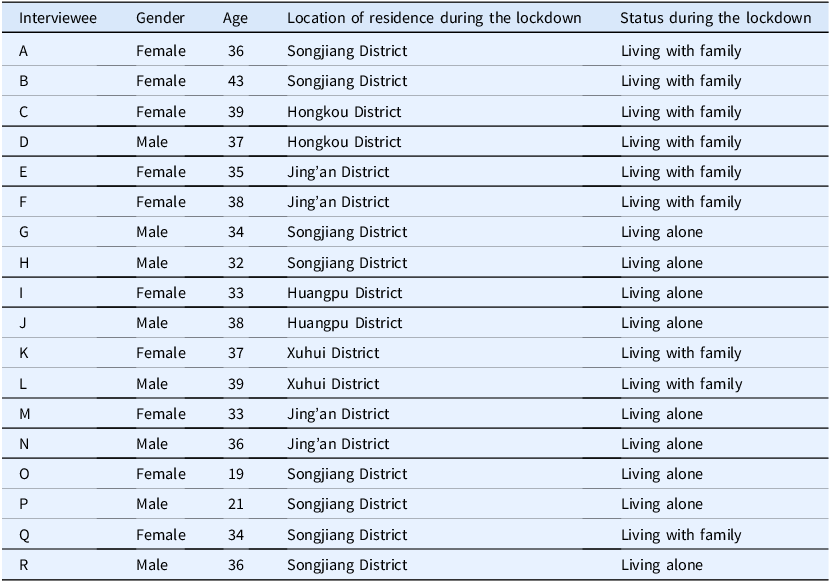
I examine the operation of neighborhood governance in Shanghai during the lockdown and residents’ spontaneous self-preserving activities using the semi-structured interviews that I conducted online with eighteen residents living in Shanghai during the lockdown (see Table 1). I interviewed eight of them twice – first during the period of lockdown and again in February and March 2023. The remaining ten interviewees were interviewed only once after the lockdown. Each of these interviews took 1.5 hours to 3 hours to complete and was focused primarily on interviewees’ everyday experiences during the lockdown, including their daily routine, the specific challenges they faced, and the solutions they adopted to address these challenges.
Profiles of Interviewees during the Shanghai Lockdown

It is important to emphasize that the eighteen interviewees are not meant to be representative of Shanghai residents during the lockdown. As the lockdown of Shanghai has become a highly sensitive issue in China, residents are reluctant to be interviewed about their experiences during this crisis. All the informants who agreed to be interviewed were either my friends or friends of my friends. As a result of this snowball sampling, all eighteen interviewees belong to the middle or upper class and are geographically distributed across six of Shanghai’s sixteen districts. The lack of representativeness, however, does not necessarily undermine the significance of the present study, as its purpose is not to contrast Shanghai residents’ varied experiences of the lockdown. Rather, it aims to draw on these interviewees’ insider views to facilitate a better understanding of the common challenges that Shanghai residents confronted during the crisis, as well as the similar strategies they adopted to address these challenges.
Neighborhood governance in Shanghai before and during the lockdown
Shanghai’s neighborhood governance regime effectively served its anti-pandemic campaign prior to the lockdown in late March 2022. Street offices and residents’ committees worked closely together to mobilize residents for surveillance and control. The former formulated anti-pandemic policies according to the guidelines laid out by the Shanghai Municipal Government and instructed the latter to implement their policies. Residents’ committees enlisted resident volunteers and property management companies to fulfill duties assigned by street offices.
One can better understand the operation of urban neighborhood governance during the pandemic through the experience of interviewee R, who owned a property in Shanghai. Interviewee R flew to Shanghai from Tokyo in January 2022 when the Shanghai Municipal Government implemented a 14 + 7 scheme – 14-day collective quarantine and 7-day home quarantine. At Shanghai Pudong International Airport, he was required to report his home address before his transfer to the quarantine hotel, so that the residents’ committee in charge of his residential community would be informed of his arrival. During the first week of his quarantine at the hotel, he was instructed to contact the residents’ committee to obtain permission for the 7-day home quarantine, which was needed for his release from collective quarantine. After receiving his request, the residents’ committee deliberated for a day in accordance with the policies set by the street office, and decided to allow him to return to his home for self-health monitoring. He was transferred to his home by a coach on the fifteenth day after landing in Shanghai. The residents’ committee sent volunteers to help him enter his home, ensuring that his entire movement trajectory took place within a closed loop. On the second and seventh days of the home quarantine week, the residents’ committee sent volunteers to his home to collect samples for the polymerase chain reaction (PCR) tests. He was allowed to leave his home only after testing negative on both tests.
Shanghai’s neighborhood governance regime, which had worked effectively to contain the COVID-19, faced mounting challenges during the lockdown. First, both street offices and residents’ committees immediately found that they could no longer maintain the same level of surveillance and control as they did before the lockdown due to the surge of their workload. Street offices and residents’ committees needed to keep around 24 million Shanghai residents at home, organize the PCR tests for all residents at least once a week, and arrange the transfer of infected people, close contacts, and secondary contacts to sites of collective quarantine. The daunting challenge confronting street offices and residents’ committees can be better understood if one looks at the jurisdiction of Zhenru Zhen Street Office in Putuo District of Shanghai. During the lockdown, this street office was run by 52 bureaucrats, 60 extra-bureaucratic permanent employees, and a larger number of grid managers on fixed-term contracts. Under its jurisdiction was a total of 162,113 residents managed by 36 residents’ committee (Zhenru Zhen Jiedao Banshi Chu jianjie 2023). This means that, on average, each permanent employee (including both bureaucrats and non-bureaucrats) at the street office was in charge of more than 1400 residents, and each member of the residents’ committee (usually composed of seven to nine people) needed to micro-manage 500 to 643 residents. As a result, even though most members of street offices and residents’ committees worked from early morning to late night every single day during the lockdown, they could no longer effectively implement surveillance and control as they previously had.
The governing capacity of street offices and residents’ committees was further undermined by the widespread infection among their staff. Standing at the forefront of the battle with the COVID-19 pandemic, members of both organizations were vulnerable to the virus due to their frequent contact with a diverse range of people. As a result, many of them were infected and put in collective quarantine at the early stage of the lockdown. In the extreme case shared by interviewee M, all members of the residents’ committee in charge of her residential community were infected and put under collective quarantine during the first two weeks of the lockdown.
The surge of workload related to surveillance and control and the widespread infection of the staff of street offices and residents’ committees crippled the state’s leadership over urban neighborhood governance at the early stage of the lockdown. Residents across Shanghai found that they could not count on street offices and residents’ committees to meet their basic needs. In order to survive the lockdown, they took initiatives to organize themselves to provide mutual aid and support. The following two sections examine the most serious challenge – supply shortages – confronting Shanghai residents and their self-preservation efforts to address it.
The supply crisis
Supply shortages were the challenge that almost every interviewee immediately confronted after the lockdown commenced. While the Shanghai Municipal Government initially announced a nine-day lockdown plan from March 28 to April 5, the lockdown period actually exceeded 2 months and ended, for most Shanghai residents, only in early June. Due to the unexpected extension of the lockdown, few Shanghai residents could procure enough supplies in advance. After they were quarantined at home, they could only rely on online shopping platforms to buy food and everyday necessities. Yet goods, especially produce (fresh meat, fruit, vegetables, rice etc.), were running out rapidly on major online groceries like JD.COM, Hema, Dingdong Maicai, Meituan Maicai, and Meiri Youxian (Huang Reference Huang2022). Buying produce essentially became a race against time. The race typically began 10 to 20 minutes before each inventory update by online grocery platforms, which created a fleeting window of time during which desired items momentarily appeared as “in stock”. As platforms updated inventories multiple times a day at different hours, this race played out again and again.
Interviewees B and C struggled bitterly in the online race for supplies. Their earliest race started between 5:40 am and 5:50 am when they logged into their account on Dingdong Maicai, one of the most frequently used online groceries for Shanghai residents. In order to get up in time, they set multiple alarms with 10-minute intervals. Yet they often either failed to log into their account due to the surge of users’ attempts to access the website at the same time or found omnipresent “out of stock” labels when they finally managed to log in. The same race took place multiple times a day and lasted for nine days in the case of interviewee B, and a week in the case of interviewee C. In most instances, both interviewees failed. Even when they finally managed to place orders, their efforts were often met with frustration, as more than half of their orders were later cancelled due to online groceries’ limited delivery capacity. Consequently, interviewees B and C achieved only minimal and sporadic success: they were able to obtain a few basic items – some carrots, potatoes, or cabbages – but never managed to hit their main targets like fresh meat, green vegetables, dairy, and eggs. Eventually, they gave up: they still occasionally checked online groceries in the following weeks, but no longer set alarms to wake them up in the early morning or regularly logged into their accounts before each inventory update.
Severe supply shortages resulted from restrictions on mobility imposed by the Shanghai Municipal Government. As the largest city in China with a population of 24 million, Shanghai heavily relied on the neighboring regions for supplies. The stringent restrictions on the traffic into and out of Shanghai created a paramount challenge for online groceries to maintain a sufficient stock of goods. Online groceries were equally affected by the strict restrictions on intra-city mobility. During the first weeks of lockdown, many delivery workers were confined to their homes, just like other Shanghai residents. When the Shanghai Municipal Government finally allowed them to return to work, many of them found that they were still unable to step out of their residential communities because they could not obtain the pass certificate (tongxing zheng 通行证), a permit issued by the government to allow intra-city mobility during the lockdown. It is only during May that the pass certificate became accessible to most delivery workers (Hao Reference Hao2022; Lin and Jie Reference Lin and Jie2022; “Shanghai: Residents ‘Running Out of Food’ in Covid Lockdown” 2022). The lack of delivery workers produced a frustrating outcome: many residents like interviewees B and C struggled through repeated races for supplies, only to find their hard-won gains revoked later.
In anticipation of supply shortages, street offices and residents’ committees followed guidelines of the Shanghai Municipal Government to arrange the delivery of supplies to residents as a form of public service immediately after the lockdown began. Street offices procured supplies and arranged their delivery to residential communities under their jurisdiction; residents’ committee organized the distribution of supplies in each residential community. Their efforts, however, could not alleviate the shortage crisis. According to all interviewees, supplies were distributed every ten to twenty days and far from enough for one to survive the lockdown. Interviewee F, who lived with her husband, kept a record of the food she received from the street office during the lockdown. She was allocated a barrel of cooking oil and a bag of rice in April and received, on average, from each round of distribution, four to five carrots, four to five potatoes, four to five green leafy vegetables, two to three zucchinis, a small chunk of salted meat, and several cans of luncheon meat. This amount of food could barely keep a family of two alive for ten to twenty days.
The failure of street offices and residents’ committees to provide sufficient supplies – a key public service during the state of emergency – primarily arose from two factors. One is the strict restrictions on inter-city and intra-city mobility, which made it difficult for street offices and residents’ committees to procure enough supplies and arrange frequent deliveries. The other factor is a financial one. As the supplies were distributed free to residents, they imposed an immense financial burden on street offices.
Confronting supply shortages and the failure of street offices and residents’ committees to deliver needed public services during the lockdown, residents across Shanghai realized that they had to rely on themselves to survive the crisis. All interviewees recalled that many residents in their residential communities made efforts to look for suppliers of food and everyday necessities. Some of these residents were merchandisers who could request their clients to provide supplies. Many more were simply well-connected residents who harnessed their social resources to look for potential suppliers. Many of their attempts were successful – every interviewee confirmed that some residents in their residential community were able to find suppliers of food and everyday necessities. Given the large population of each residential community – ranging from several hundred to tens of thousands – this outcome is hardly surprising. After all, it is not uncommon for a residential community of this scale to include dozens of merchandisers or well-connected residents.
While securing suppliers was not an impossible mission for many residential communities in Shanghai, arranging purchase, delivery, and distribution turned out to be much more challenging. Due to the very limited delivery capacity during the lockdown, suppliers refused to take individual residents’ orders. They only dealt with community group buying, which typically requires residents in the same residential community to purchase large quantities of the same products so that the suppliers can minimize delivery cost. The minimum quantity required for purchase varies according to the types and prices of goods as well as the idiosyncratic features of suppliers. According to the eighteen interviewees, it can be as low as 50 and as high as 200. This feature of community group buying requires a group leader (tuanzhang 团长) to identify residents’ needs, secure enough orders, and manage payment. Such requirements were demanding during the lockdown because residents now relied almost entirely on community group buying for food and everyday necessities. The group leader was thus nearly tantamount to a full-time job.
Delivery of supplies posed an even greater challenge during the lockdown. Suppliers had to either hire professional delivery service providers or obtain pass certificates for their own delivery staff. Both are tough tasks. The capacity of professional delivery service providers was crippled by strict mobility restrictions, to the point that they could process only a small portion of the enormous number of orders they received every day. The Shanghai Municipal Government did grant pass certificates to people who delivered supplies (“Shanghai: Fangyi baozhang linshi tongxing zheng congyan fafang, weifan jiang yansu zhuize” 2022). Yet they were, in principle, granted to either professional delivery service providers, such as SF Express and ZTO Express, or designated enterprises that generally took orders from the government. Consequently, many residents found that although they could find suppliers, they had no way to arrange delivery to their residential communities.
The last problem – distribution – arose due to the restrictions on intra-community mobility imposed during the lockdown. Before the lockdown, goods purchased through community group buying were first sent to the group leader who organized the purchase. Most purchasers picked up their purchases from the group leader (Wu and Yang Reference Wu and Yang2021); some paid the group leader to deliver their purchases to their home. Yet both methods became impossible during the lockdown. The principle of minimizing face-to-face contact between residents rendered it very difficult for individual residents to pick up their purchases. The enormous volume of goods – the result of the emergence of community group buying as the primary channel for residents to access food and everyday necessities during the lockdown – made it impossible for any group leader to handle home delivery on their own.
Addressing the supply crisis
In the face of the supply crisis during the lockdown, residents in Shanghai took a variety of initiatives to save themselves. First, they leveraged social network services to spontaneously organize community group buying. According to the eighteen interviewees, WeChat (a Chinese instant messaging, social media, and mobile payment application) was the most important tool for community group buying. Before the outbreak of the COVID-19 pandemic, China’s neighborhood governance scheme already started to connect homeowners and tenants in the same residential community by inviting them into the same WeChat groups (Ji and Yin Reference Ji and Yin2020; Yu Reference Yu2019; Zhang Reference Zhang2020). While many residents were initially reluctant to join the community-wide WeChat groups due to their disinterest in community affairs, the outbreak of the pandemic motivated them because it created an urgent need for information sharing and behavior coordination among residents in the same residential communities. As a result, many residents in the same residential communities had already been connected to each other before Shanghai entered lockdown. By leveraging the WeChat-based, community-wide information-sharing infrastructure, group leaders collected neighbors’ needs, coordinated purchases, and pooled payments. Interviewee B offered a detailed account of her experience with community group buying during the lockdown. She would typically begin by searching for information about available goods in the community-wide WeChat group. Once she found posts about the items she wanted to purchase, she contacted the group leader who had posted the relevant information. The group leader then invited her to join a WeChat group that brought together residents interested in purchasing the same goods. As soon as the number of orders reached the minimum threshold for community group buying, the group leader collected money from residents via WeChat and transferred the funds to the suppliers.
The WeChat group offered an effective solution to organize community group buying during the lockdown, but it was inefficient and put immense pressure on group leaders by engaging them in every step during each resident’s purchase process. Each group leader had to collect and verify residents’ orders and mailing addresses and manage a large amount of money. In response to the surging demand for community group buying and efficient ways to place orders, online shopping sites soon developed tools that could smooth the purchase process. According to the eighteen interviewees, Kuaituantuan, a WeChat-based mini-program developed by Dingdong Maicai, soon replaced the WeChat group as the primary channel for community group buying in their residential communities. Kuaituantuan was an online platform that allowed group leaders to post information about goods for community group buying and enabled individual buyers to place orders and make payments directly to the suppliers. This online platform benefited both individual purchasers and group leaders. It provided a more efficient tool for individual residents to obtain information about community group buying and complete the purchase process. It also took the weight off group leaders’ shoulders by automatically putting together purchase information and releasing them from the burden and risk of keeping other residents’ payments.
Having utilized digital instruments to resolve the issue of purchase, Shanghai residents then spontaneously worked with suppliers to ensure the delivery of goods. They first tried professional delivery service providers, but were almost always frustrated. They then made efforts to obtain pass certificates through informal channels for suppliers, most of which were not designated enterprises, or even for themselves. According to interviewee N, a resident in his residential community obtained a pass certificate for his supplier through “a friend” in the government, though he disclosed no detail due to the sensitivity of this issue. Interviewee D provided a more detailed story about obtaining a pass certificate. One of his male friends obtained a pass certificate from “a good friend” who worked at a designated enterprise contracted by the government to provide supplies and delivery services. They made an interesting arrangement: interviewee D’s friend became a nominal employee of the designated enterprise, though it remained unclear whether he had signed any form of employment contract. Despite that he did not actually work for the enterprise – receiving neither tasks nor salary – he was given a pass certificate that allowed him to drive within Shanghai. With intra-city mobility, he managed to purchase and deliver food and everyday necessities to his friend, interviewee D, during the lockdown.
After the principal obstacles to delivering goods from suppliers to residential communities were cleared, group leaders still needed to solve the distribution problem. Well aware of the limit of their capacity, they solicited aid from other actors in residential communities, especially those who have already engaged themselves in neighborhood governance under residents’ committees’ leadership before the lockdown. Most interviewees acknowledged that resident volunteers played a central role in distributing group-bought goods. Typically, goods were dropped off outside residential communities and group leaders were notified to confirm receipt. After verifying the deliveries, they would enlist resident volunteers to distribute the goods to purchasers. It is, however, worth noting that resident volunteers were not necessarily in charge of the distribution process in every residential community. According to interviewees E, I, and M who lived in upper-class residential communities, the distribution process was handled primarily by professional property management staff, rather than by resident volunteers. This difference stemmed from income gaps among residents in Shanghai. An average middle-class residential community in Shanghai is served by a relatively small property management team due to the low management fees paid by residents. An upper-class residential community, by contrast, pays much higher management fees to the property management company and is thus served by a much larger team.
All of the eighteen interviewees agreed that community group buying helped them survive the shortage crisis by meeting their basic needs for food and necessities. However, they also emphasized that community group buying had limitations. First, individual residents’ access to community group buying was contingent upon their social networks. Such contingency can be better understood through interviewee Q’s experience. Unlike other seventeen interviewees who joined community-wide WeChat groups, interviewee Q and her husband were not included in this kind of group during the first few weeks of lockdown. In fact, they joined the community-wide WeChat group when they first moved into their apartment in suburban Shanghai a few years earlier, but soon withdrew after encountering many posts they found irrelevant or uncomfortable. As no infection appeared in their residential community prior to the lockdown, even the COVID-19 pandemic failed to bring them back to the community-wide WeChat group. Neither did them maintain any form of close contact with other residents in the residential community prior to the lockdown. Consequently, they were unaware of community group buying in their residential community during the first three weeks, a period in which they were frustrated daily by repeated races on online grocery platforms. Relying entirely on food purchased before the lockdown and on supplies provided by the street office, they experienced significant hardship. They reduced the size of each meal to conserve food, but often found themselves so hungry at 10 am or 4 pm that they were unable to concentrate on their work. The situation improved only in mid-April when interviewee Q finally found information about community group buying on Kuaituantuan.
Second, the effectiveness of community group buying was limited also because minimum order quantity requirements allowed residents to purchase only a narrow range of goods – those widely regarded as necessities within a given residential community. This posed a challenge, as even residents’ essential needs varied significantly. Interviewee F, who lived with her husband and newborn baby in a large residential community of more than 2000 apartments, was unable to gather enough orders to meet the minimum order quantity of 50 units required for infant formula, as few households in the residential community had babies. Interviewee H, who “could not live without coffee,” encountered a similar difficulty, since few residents shared with him what was jokingly referred to as “a bourgeoise taste”.
Third, the preceding discussion may give the impression that community group buying operated solely as a form of mutual aid benefiting all residents, but it also gave rise to suspicion, dispute, and even exploitation. Shanghai residents generally had to pay more for community group buying during the lockdown (Yuguan cheshi 2022). This is certainly neither surprising nor unreasonable, as the gaps between the declining supply and the surging demand naturally drove up price. A closer look at this issue, however, reveals a factor beyond the law of supply and demand. According to the eighteen interviewees, multiple group leaders in their residential communities launched community group buying for the same goods, but at different prices. The price difference could stem from the suppliers’ side – they offered goods of different quality and arranged delivery over different distances. Yet, according to interviewee B, group leaders perhaps held greater sway over the price. Interviewee B organized community group buying for vegetables via a WeChat group during the lockdown. Compared to the other two group leaders in the same WeChat group who organized community group buying for vegetables, she offered better goods at lower prices, though they all collaborated with suppliers in suburban Shanghai. Interviewee B suggested that the price difference probably arose from the fact that she did not seek to profit from community group buying, whereas the other two group leaders did – perhaps by overcharging residents or demanding high commission fees from suppliers.
Overcharges or commission fees easily incurred disputes among residents. As few, if any, group leaders disclosed the existence of commission fees, many residents considered them unpaid volunteers. Residents would thus naturally feel cheated or betrayed when they found out that group leaders profited from their transactions. Even residents who recognized community group buying as a business for group leaders would still be infuriated if group leaders overcharged them or demanded high commission fees from suppliers. According to the eighteen interviewees, the suspicion of group leaders was not uncommon in their residential communities and often escalated into disputes. Although they held different views on whether group leaders should profit from community group buying, they all agreed that such profit should remain within reasonable limits. For them, any significant price increase amounted to an attempt to capitalize on the crisis.
These limitations meant that community group buying could not function as a panacea for all Shanghai residents during the lockdown, as they varied significantly in their social networks, everyday needs, and economic status. The failure to resolve the shortage crisis often directed residents’ frustration, anxiety, and anger to the state, sometimes leading to the rise of community-based protests. Interviewee H offered precious insight into a protest of this kind. Unlike other interviewees, interviewee H lived in a residential complex primarily composed of small built-to-rent apartments. Most residents in his residential complex were not locals, but immigrants from other provinces who sought for better career opportunities in Shanghai. They were often in their twenties and generally had to share apartments with friends, colleagues, or strangers due to their limited budget. They were very different from both interviewee H – he owned an apartment in the residential complex and worked for a big company that regularly arranged delivery of supplies to him – and seventeen other interviewees who lived typical middle-class or upper-class lives. As new immigrants, they had little social connection in Shanghai: they rarely knew their neighbors or even their co-tenants. Not many of them joined the community-wide WeChat group. Even the residents’ committee was unable to build a weak connection between them, as it was nearly dysfunctional due to committee members’ busy work schedule and the rapid change of tenants. These residents also had little in savings as they were generally at the start of their careers. Consequently, it was difficult for them to organize community group buying – they not only encountered difficulty in securing suppliers and arranging delivery, but also found it difficult to persuade each other to purchase goods at higher prices during the lockdown.
The unresolved shortage crisis ultimately prompted residents in interviewee H’s residential complex to get out of their apartments to protest. While interviewee H did not participate in the protest, he observed the entire process from his window. The protest was not a planned one because residents – not many of them joined the community-wide WeChat group – lacked effective means to communicate with each other or coordinate their actions. Instead, the protest emerged as a few residents stepped out of their apartments to express their frustration, anxiety, and anger. They first shouted “Give Us Supplies” (fawuzi 发物资) in front of their own buildings and then gathered at the gate of their residential complex in the hope that their voices would be heard by government authorities. They were soon joined by other residents who shared their frustration, anxiety, and anger. The spontaneous expression of feeling by a few individuals rapidly escalated into a protest by several hundred residents who shouted the same slogan while banging pots, pans, and other kitchen utensils. The residents’ committee attempted to stop the protest by persuading the crowd to go back to their apartments, but their efforts were in vain as they were far outnumbered by protesters. The protest lasted for several hours and finally drew attention from government authorities. The police came and dispersed the protesting crowd with the promise that they would help them obtain supplies as soon as possible. Although this kind of promise was rarely fulfilled immediately in China, these residents’ request was satisfied the following day, apparently out of concern that their discontent might escalate further and trigger chain reactions across the city. The Shanghai Municipal Government sent several truckloads of food to the residential complex and allocated to each apartment a bag of vegetables, a sack of rice, a package of snacks, and some meat.
Conclusion
This article presents a case study for reconsidering China’s success in containing the COVID-19 pandemic until late 2022 through its hybrid mode of urban neighborhood governance. Earlier studies attribute such a success largely to the Chinese state’s dominant role in urban neighborhood governance without due recognition of residents’ significant contribution. The eighteen interviewees’ experiences during the lockdown, however, compel us to reappraise the popular assumption about the omnipresent and omnipotent state in China’s urban neighborhood governance. In the extreme crisis examined in this study, the state’s governing capacity was significantly undermined, to the point that it could neither effectively surveil and micro-manage individual residents in Shanghai, nor deliver basic public services for emergency relief. In the face of the plummet in the state’s governing capacity and the subsequent supply crisis during the lockdown, residents in Shanghai took up leadership over neighborhood governance. They spontaneously organized themselves and took autonomous collective actions to address supply shortages, eventually succeeding in surviving the lockdown.
Beyond the particular context of COVID-19 pandemic, this study offers a crisis scenario to examine hypotheses proposed by recent studies on China’s hybrid mode of urban neighborhood governance. First, it contributes to emerging reflection on the portrayal of residents as passive actors in China’s urban neighborhood governance, as well as on the assumption that its smooth operation relies primarily on the organization, instruction, and supervision by the Chinese state. It affirms recent studies’ arguments about the significance of residents’ agency in urban neighborhood governance by examining an extreme scenario in which the state’s governance capacity was crippled and residents were largely left to address the supply crisis on their own.
Second, the present study corroborates recent scholarly observations regarding the expression of residents’ agency under China’s urban neighborhood governance regime. Recent studies suggest that when urban residents in China fail to resolve problems or achieve their goals through negotiation and coordination with the grid management team, they rarely resort to confrontational or violent actions, let alone demand structural change to the incumbent urban neighborhood governance regime. Even when they do take confrontational or violent actions, they typically aim to invite state intervention, rather than reject it. The experiences of the eighteen interviewees and other residents in Shanghai during the lockdown affirm this observation. When the Chinese state’s governing capacity was significantly constrained during the lockdown, Shanghai residents did not seek to alter the emergency mode of urban neighborhood governance. Instead, they made efforts to attract the state’s attention and pressure it to deliver much-needed relief services. Especially revealing were the actions of Shanghai residents who were unable to resolve supply shortages on their own. Like many people facing acute crisis, they protested. Yet their protests were aimed at compelling the state to provide supplies, not at terminating the lockdown that had precipitated the supply crisis in the first place. Their choice reflected a long-standing pragmatic orientation in state-society relations in China: rather than evading the state like the people in the Southeast Asian highlands (Scott Reference Scott2009), ordinary people often chose to protect their interests by working the system.
Shanghai residents’ impressive efforts to lead neighborhood governance and negotiate with the government during the lockdown demonstrate the potential of an alternative mode of urban neighborhood governance, one that grants residents a more proactive role and greater influence. However, this mode of urban neighborhood governance has not materialized in post-lockdown Shanghai, let alone in post-pandemic China, for several reasons. Most evidently, the state’s governing capacity, which was weakened during the lockdown, was rapidly restored once the lockdown ended. Even more important impediments to the immediate emergence of an alternative mode of urban neighborhood governance lie with the residents themselves. Shanghai residents were united, organized, and mobilized by a shared crisis, rather than by any concrete political objective. Despite their extensive participation in community-wide governance during the lockdown, few were politically active. They aligned with one another to overcome the crisis, not to pursue any kind of political change that might enhance their influence over urban neighborhood governance. Furthermore, even intra-community solidarity during the lockdown was not necessarily as robust as it appeared. Although residents were temporarily aligned under crisis conditions, their alignment was fragile and contingent on the persistence of the emergence. As illustrated by the eighteen interviewees’ experience with community group buying, residents were divided by disparities in social status and economic resources, as well as by competition for material benefits. The fragile bond between residents was further weakened in the post-lockdown period. According to the eighteen interviewees, while the lockdown created opportunities to become acquainted with their neighbors, their contact diminished to a minimal level once the order of everyday life resumed. The absence of a shared political pursuit and the failure to develop durable mutual identification thus make it difficult for Shanghai residents’ temporary alignment to evolve into a socio-political movement capable of reshaping the structure of urban neighborhood governance in post-pandemic China. Both barriers would need to be overcome before an alternative mode of urban neighborhood governance – one that empowers residents vis-à-vis the state – can emerge in post-pandemic China.
Competing interests
The author declares none.

 Open access

