

Introduction
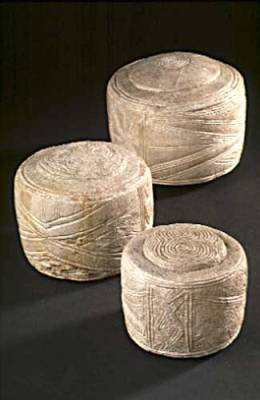
A certain air of mystery has surrounded these three rather enigmatic stone cylinders (Figure 1) since they were found in the late nineteenth century by William Greenwell, a Canon of Durham Cathedral (see Kinnes & Longworth 1985). They were discovered within a round barrow, associated with a child's burial but with no closely datable grave goods. The barrow was situated in the parish of Folkton, near Filey in northeast Yorkshire, and because of this and their distinctive shape, they have come to be known as the Folkton Drums. The largest of the three has a maximum diameter of 146 mm, the smallest 104 mm and the intermediate-sized drum 125 mm. These 'grave offerings' are exceptional and presumably indicate something about the status of the child in the burial. No similar objects are known, either in stone or in any other material, and their use is unclear.
The Folkton Drums. The largest drum has a maximum diameter of 146 mm. British Museum Registration Nos.: 1893.12-28.15, 16 and 17 (in order from back of image).

Each of the drums bears a unique incised design, which covers the curved sides of the cylinders and also the slightly domed upper surfaces. The bases of the drums were carefully shaped and smoothed but appear to have been undecorated. Visual examination suggests that the designs were made by chipping and abrasion of the stone; the designs remain generally quite 'sharp'. The decoration (see Reference LongworthLongworth 1999) is organised in panels and is essentially geometric but stylised human faces look out from two of the drums. All three have concentric circle decoration on the tops and in two cases pairs of eyes are suggested. Similar motifs are well known in Passage Grave art, but the strongest resemblances taking the drums as a whole are to the decoration found on Later Neolithic Grooved Ware pottery. There is a nod in the direction of the geometric decoration on Beaker pottery and on some Early Bronze Age gold work. It seems likely that their maker(s) drew upon a pool of motifs current at the time, c.2500-2000BC.
At the time of their excavation, the drums were recorded as being 'made of chalk', material which is readily available locally. However, based upon a subsequent visual examination they were tentatively identified as Magnesian Limestone. Because of restrictions on sampling, it was not possible to confirm this identification but nevertheless the drums have been referred to widely as being made from Magnesian Limestone in Museum information panels and in publications (see for example Reference CaygillCaygill 1985: 113). The use of Magnesian Limestone rather than chalk would imply a more distant source, for the nearest in situ outcrops of the Magnesian Limestone lie c.45 miles away, to the west, near Ripon and to the north-west in County Durham. It would also imply a higher level of carving skills, since Magnesian Limestone is substantially harder than even well-lithified chalks. This note presents observations made using modern techniques which require very little or no sample to be removed for analysis; the tests show clearly that the drums were made from chalk, typical of that to be found locally.
Analysis and Results
Careful observation of the drums with aid of a binocular microscope showed that they are made from a relatively soft, white stone, similar in appearance to samples of local chalk. The material is relatively hard for a chalk but this is in fact often the case with chalks from NE England which show a higher degree of lithification than those from SE England. Two samples of Magnesian Limestone available for examination were more yellowish in colour.
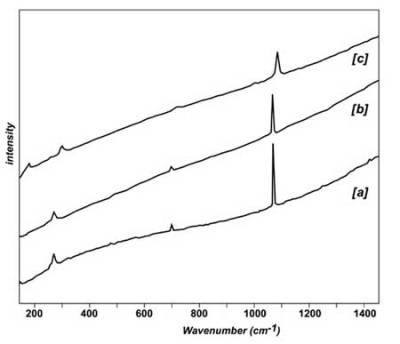
Magnesian Limestone is mineralogically distinctive because typically it is dolomitic (i.e. contains the mineral dolomite, a calcium magnesium carbonate; Reference EastwoodEastwood 1953, Edwards & Trotter 1954), whereas chalk is composed of calcite (calcium carbonate). Thus mineralogical analysis offered a way to determine which of the two materials was used, chalk (probably from a local source) or Magnesian Limestone (from a more distant source). Raman microscopy (Dilor LabRam Infinity, equipped with a Nd:YAG laser (532 nm)) offered the possibility to do this non-destructively: it was possible to record Raman spectra from a few grains of material, without inflicting any damage to the object. The spectra obtained from each of the drums, along with those of two samples of local chalk, were compared with standard data and found to match calcite (Figure 2a,b). Spectra from the samples of Magnesian Limestone were superficially similar to calcite but each of the peaks is shifted to a slightly higher wavenumber, and it can be seen on close examination that they match a published spectrum for dolomite (Hubble et al. 2002) (Figure 2c). Thus, the mineralogical analysis supported the interpretation based upon visual examination that the drums had been made from chalk rather than Magnesian Limestone. However, the observations do not entirely rule out the possibility that some other, rather soft, limestone, similar to chalk, was used for the drums.
Raman spectra of (a) material of drum 1893.12-28.16; (b) calcite; (c) Magnesian Limestone.

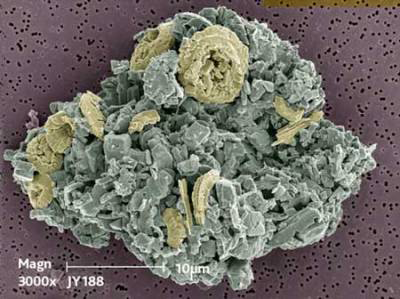
For this reason we removed a very small amount of material from an existing blemish on the base of the smallest drum (BM Registration No.1893.12-28.17) in order to test for the presence of coccoliths (minute plate-like calcite fossils formed by planktonic algae). The chalk is essentially a lithified coccolith ooze and so coccoliths are highly characteristic of it; moreover coccoliths can be used to determine the geological age of a sample and so constrain the possible source rock. The sample was crushed then suspended in water and strew preparations made from it for examination by light and electron microscopy. The sample was examined using a Zeiss Axioplan light microscope with cross-polarised illumination. This revealed common coccoliths, although somewhat overgrown and low diversity. The observations were then confirmed by scanning electron microscopy (Philips XL 30 FEG). The rock shows the typical texture of moderately lithified chalk, being formed of a mixture of coccoliths, coccolith debris and fine grained micrite, probably derived from breakdown of coccoliths (Figure 3). With the small amount of material used, a full floral assemblage analysis could not be undertaken but the sample contains a typical late Cretaceous assemblage, dominated by Watznaueria barnesae, Biscutum constans and Prediscosphaera cretacea. The most useful age-diagnostic fossil observed was Micula staurophora, which has a range that is restricted to the Coniacian to Maastrichtian stages of the Cretaceous, a time period which in the UK is represented by the Upper Chalk. These observations essentially prove that the material is chalk, consistent with a source in the vicinity of Folkton.
SEM micrograph of a fragment of the sample showing typical chalk fabric of coccoliths, coccolith debris and fine micrite (probably derived from diagenesis of coccoliths).

Conclusion
The observations show conclusively that the Folkton Drums were made from chalk and not from Magnesian Limestone. The results suggest, but do not prove, that these enigmatic objects were made locally to their findspot on Folkton Wold.
Acknowledgements
We are grateful to Gillian Varndell for her enthusiastic support of this project and for contributions to the text. We are grateful also to Ian Freestone for helpful comments on an earlier draft, to Tony Milton and Tony Simpson for assistance with the illustrations, and to Terry Manby and Peter Makey for their interest and the provision of samples of local chalk.