




A core body of law and society scholarship sheds light on how formal law, and law-in-action, reproduce racial and other inequalities through multiple means, from limiting access to justice (Sandefur Reference Sandefur2008; Reference Sandefur2019) to how legal matters are adjudicated across civil (Best et al. Reference Best, Edelman, Hamilton Krieger and Eliason2011; Edelman et al. Reference Edelman, Smyth and Rahim2016) and criminal contexts (Murakawa and Beckett Reference Murakawa and Beckett2010), including in jury trials (Clair and Winter Reference Clair and Winter2022; Hunt Reference Hunt2015). Inherent in this work is a widely held, empirically supported understanding that law’s ability to mitigate inequality and advance social and racial justice is limited at best, raising important questions about whether and how the law can effect social change (see Galanter Reference Galanter1974 for a classic inquiry in socio-legal studies). Yet as several scholars working at the intersection of Critical Race Theory (CRT) and empirical law and society have pointed out (Barnes Reference Barnes2016; Gómez Reference Gómez and López2004; Reference Gómez2010; Reference Gómez2012; Obasogie Reference Obasogie2013), socio-legal scholarship on law and racial inequality would benefit from a deeper engagement with CRT’s insights on law and race, including “how law and race are mutually constitutive” (Gómez Reference Gómez2010: 488), to enrich theorizations of race as well as its operationalization in empirical studies (Gómez Reference Gómez2010).
To that end, one of CRT’s central goals is to deconstruct the “jurisprudence of color-blindness” that pervades contemporary constitutional case law and shapes legal processes (Crenshaw et al. Reference Crenshaw, Gotanda, Peller, Thomas and Crenshaw1995: xxviii). Color-blind jurisprudence is infused with the language of equality while operating to maintain racial hierarchies, in part through an unspoken commitment to white values and norms (Carlin Reference Carlin2016; Crenshaw et al. Reference Crenshaw, Gotanda, Peller, Thomas and Crenshaw1995). Color-blind logic extends to the composition and functioning of criminal juries, despite the jury trial being held up as the epitome of democratic institutions. The procedures used to assemble jury pools and select jurors for criminal cases ensure that the seated bodies are disproportionately white, while constraining the diversity of perspectives on key aspects of law and evidence (Frampton Reference Frampton2018; Johnson Reference Johnson2014).
Nowhere does this play out more than with views of law enforcement. Potential jurors are frequently dismissed, peremptorily or for cause, due to their opinions of and experiences with police, which disproportionately removes Black and Latinx individuals (Frampton Reference Frampton2018; Reference Frampton2020; Semel et al. Reference Semel, Downard, Tolman, Weis, Craig and Hanlock2020). This form of exclusion represents a classic example of color-blind policy, in that it construes legitimate concerns about, and experiences with, police racism and mistreatment, disproportionately experienced by Black Americans (Carbado Reference Carbado2002), as an acceptable justification for removal, while treating blind trust in and support for police, disproportionately expressed by white Americans, as the implicit standard for lack-of-bias toward police (Johnson Reference Johnson2014). Consequently, not only are criminal juries “white-washed” (Semel et al. Reference Semel, Downard, Tolman, Weis, Craig and Hanlock2020) via this exclusion, but police testimony is given oversized credence in the decision-making process.
In this article, we merge CRT insights about color-blindness and race-consciousness in both the criminal jury context (Butler Reference Butler1995; Reference Butler2020) and in the Fourth Amendment law governing policing (Carbado Reference Carbado2002; Reference Carbado2017) to advance empirical socio-legal scholarship on race and jury decision-making. Specifically, we examine how mock jury groups assess law enforcement testimony during deliberations in a federal drug conspiracy case scenario where the race of the defendant (Black or white) was varied. We elucidate the role of “race-conscious reasonable doubt,” which recognizes that jurors’ varied “commonsense theories of justice and social meaning” in making judgments legitimately include recognition of racism in policing and the criminal legal system (Do Reference Do2000: 1882), in the decision-making.
In our quantitative analyses, we find that there were more critical discussions about the law enforcement testimony when the defendant was Black, as well as when the jury group included at least one Black member, and that these negative discussions were associated with shifts toward acquittal. Our qualitative analysis reveals how Black jurors, in particular, shared information about law enforcement treatment of Black citizens, including experiences of “driving while Black,” as well as broader concerns about the criminal legal system. They often tied those concerns to the legal standards at issue in the case in a manner that constitutes race-conscious reasonable doubt. We argue that robust Black representation on juries is necessary to ensure that a diversity of perspectives and life experiences, especially regarding policing, realistically informs the witness assessment and decision-making process, and blunts the dual harms of color-blind Fourth and Sixth Amendment jurisprudence that impact many criminal trials.
CRT, white-washed juries, & the “color-blind” criminal trial
Despite the American criminal legal system’s racist history and racially unequal practices, critical race theorists rarely addressed the criminal legal system in early CRT scholarship (Delgado and Stefancic Reference Delgado and Stefancic2007), much less the role of criminal juries in sustaining – or challenging – structural racism. This is paradoxical given that the criminal legal system became an oversized engine of racial inequality in the post-Civil Rights era (Alexander Reference Alexander2010; Van Cleve and Mayes Reference Van Cleve and Mayes2015). Indeed, the increasingly punitive and racialized criminal legal system itself was rendered “racially innocent” (Murakawa and Beckett Reference Murakawa and Beckett2010: 697) via the proliferation of color-blind ideology that shapes contemporary legal norms and principles, and extends to mainstream empirical scholarship on racial inequalities in the system (Van Cleve and Mayes Reference Van Cleve and Mayes2015).
Beginning in the mid-1990s, CRT analyses expanded to key criminal law and procedural issues, including social constructions of threat and danger (Delgado Reference Delgado1994), and definitions of “reasonableness” in self-defense claims (Armour Reference Armour1994; Lee Reference Lee1996). Paul Butler’s (Reference Butler1995) essay on “racially based jury nullification” was an early and influential CRT consideration of how criminal juries, and Black jurors specifically, could advance racial justice. The essay suggested that Black jurors should consider using their power as jurors to acquit in certain kinds of criminal cases involving Black defendants (such as drug cases), even when the evidence supported a guilty verdict. Butler (Reference Butler1995) argued against the “willful blindness” to race that characterizes how legal actors idealize jury trials, and suggested it is morally right for Black jurors to use their power to acquit, as a vote of conscience against the extreme racial inequality in the system. This strategy would “dismantle the master’s house with the master’s tools” and help mitigate the harms imposed by the criminal legal system (Butler Reference Butler1995: 680).
Butler’s (Reference Butler1995) essay produced a flurry of debate over whether criminal juries might serve as a means to achieve justice, as well as some pointed critiques (e.g., Leipold Reference Leipold1996). It also served as a jumping-off point to revisit the legality and morality of jury nullification (e.g., Brown Reference Brown1997; Grant Reference Grant2004; Marder Reference Marder1999; Warshawsky Reference Warshawsky1996), and it spurred subsequent CRT engagement with criminal juries (Butler Reference Butler2020; Delgado Reference Delgado2014; Grant Reference Grant2004; Johnson Reference Johnson2014; Lee Reference Lee2014). The proposal garnered widespread media attention, potentially alerting prosecutors and trial judges to be especially vigilant in cases involving Black defendants, and heightening the risk that juries would have even less Black representation via prosecutorial challenges for cause against potential nullifiers (Do Reference Do2000; Marder Reference Marder1999).
Indeed, outside of a small number of urban jurisdictions with Black-majority jury pools, Black citizens and other persons of color are typically a minority in jury pools, and White citizens are in the majority (Gau Reference Gau2016; Rose et al. Reference Rose, Casarez and Gutierrez2018). The legal processes governing jury administration systematically exacerbate this pattern (Rose et al. Reference Rose, Casarez and Gutierrez2018) despite defendants’ constitutional right to a jury drawn from a “fair cross section of the community,” and considerable case law (e.g., Batson v. Kentucky 1986; Strauder v. West Virginia 1880) that formally outlaws the exclusion of potential jurors on the basis of race.
First, the way eligibility to serve is defined in most jurisdictions shapes the universe of potential jurors in a manner that disproportionately excludes people of color. Language and citizenship requirements ensure under-representation of Latinx and jurors of other ethnicities (Gonzales Rose Reference Gonzales Rose2014; Johnson Reference Johnson, Coleman, Malveaux, Pedro and Porter2022), and disability exclusions disproportionately exclude Black potential jurors (Johnson Reference Johnson, Coleman, Malveaux, Pedro and Porter2022). The widespread exclusion of people with felony convictions also contributes to under-representation of Black citizens (Binnall Reference Binnall2021; Johnson Reference Johnson, Coleman, Malveaux, Pedro and Porter2022). Moreover, the processes used by jury commissioners to assemble jury pools systematically under-include both Black and Latinx potential jurors (Fukurai et al. Reference Fukurai, Butler and Krooth1993; Rose et al. Reference Rose, Casarez and Gutierrez2018).
Next, as noted in the introduction, those summoned to jury service may be removed for bias when they express unfavorable views of, or experiences with, the criminal legal system, further excluding jurors of color in criminal cases (Frampton Reference Frampton2018; Reference Frampton2020; Semel et al. Reference Semel, Downard, Tolman, Weis, Craig and Hanlock2020). Beyond statutory exclusions of those with felony convictions, court officials sometimes seek to remove potential jurors for bias based on misdemeanor convictions, as well as those who are associated with people who have criminal legal contact in a manner that disproportionately removes people of color (Clair and Winter Reference Clair and Winter2022). More broadly and insidiously, prosecutors disproportionately use their peremptory challenges to remove Black potential jurors, under the thin veil of “race-neutral” reasons offered to satisfy Batson’s (1986) dictates, including for expressions of concern about police or system bias (Butler Reference Butler2020; DeCamp and DeCamp Reference DeCamp and DeCamp2020; Frampton Reference Frampton2018; Johnson Reference Johnson2014; O’Brien and Grosso Reference O’Brien and Grosso2013; Parson and McLaughlin Reference Parson and McLaughlin2011; Semel et al. Reference Semel, Downard, Tolman, Weis, Craig and Hanlock2020).
Jurors, once selected, experience a nominally color-blind but implicitly racialized trial context that systemically disadvantages defendants of color. The criminal courtroom is a “white space” (Carlin Reference Carlin2016) where jury service was historically limited to white men, and people of color were barred from serving as witnesses against whites. Even when non-whites were granted testimonial rights, they were regularly denied the opportunity on the grounds they were not credible and/or competent (Carlin Reference Carlin2016; Gonzalez Rose Reference Gonzalez Rose2017). This historical exclusion ensured the adoption of white standards and traditions in the courtroom that live on, resulting in the implicit discrediting of non-white witnesses and other participants (Capers Reference Capers2018; Carlin Reference Carlin2016).
Among those standards are those governing assessments of “reasonableness” that juries are to apply when considering certain kinds of evidence and testimony (Gonzalez Rose Reference Gonzalez Rose2017). For instance, the way that “reasonable belief” of danger is presented in some self-defense or “stand-your-ground” defenses plays on racial tropes, implicitly and even explicitly, to justify violence against Black victims (Armour Reference Armour1994; Barnes Reference Barnes2015; Capers Reference Capers, Dubber and Hornle2014; Reference Capers2018; Gonzalez Rose Reference Gonzalez Rose2017; Lee Reference Lee1996; see also Roman Reference Roman2013). As Carodine (Reference Carodine2014: 679) suggests, “race itself is evidence – character evidence” that devalues the lives of Black victims, discredits Black witnesses, and demonizes Black defendants. At the same time, trial processes enhance the credibility of police as witnesses, first via the aforementioned processes that ensure juries do not include those who have prior negative experiences with police, and second by treating law enforcement as unmotivated to lie despite a well-documented record of systemic police perjury (Capers Reference Capers2008; Dunkle Reference Dunkle2021; Johnson Reference Johnson2017).
Guilt beyond a reasonable doubt? Race, race consciousness, & evidentiary assessment
The legal myth of color-blind criminal jury trials extends beyond how juries are composed and evidentiary matters, to include the legal standards governing decision-making. Guilt is assumed to be something that will objectively be found, or not, based on a uniform assessment of the case. This presumption of a homogenous jury flattens the diverse subjective experiences and understandings about the world that jurors bring to the role, and that shape how they interpret evidence and make sense of the law. Those diverse perspectives and experiences challenge both the color-blind mythology of the legal system and its unrealistic ideals about objectivity for jurors (Do Reference Do2000; Kang and Lane Reference Kang and Lane2010; Kassin and Wrightsman Reference Kassin and Wrightsman2013). Thus, a vast body of psychological research confirms that all people, including those serving as jurors, understand and respond to the world through their own subjective cognitive lenses (see generally, Bless and Forgas Reference Bless and Forgas2000). Individual- and group-level identities shape those lenses, so what constitutes sufficient evidence to convict a given defendant will vary considerably between individuals and groups, including as a function of decision-makers’ racial identities (Ellis and Diamond Reference Ellis and Diamond2003).
In that regard, Do (Reference Do2000) argues that jurors who consider the role of racial bias in the criminal legal system, including in policing, when assessing evidence are acting legitimately, within the scope of reasonable doubt determinations. Referred to as “race-conscious reasonable doubt,” this concept incorporates race-consciousness within a broader recognition that jury decision-making is always the product of varied, subjective interpretation. Race-conscious reasonable doubt can, for instance, bring added scrutiny to assessments of police testimony, but “does not mean automatic disbelief” without consideration of the evidence in the context of the case (Do Reference Do2000: 1867). Because jurors contextualize facts and evidence to make narrative sense of them, understandings and experiences of biased treatment by police and other criminal legal system actors against Black citizens can appropriately shape that contextualization process (Do Reference Do2000). Given widespread problems with police perjury that especially harm Black people (Capers Reference Capers2008; Dunkle Reference Dunkle2021), such critical scrutiny of police testimony is wholly reasonable.
To that point, socio-legal research indicates that Black laypersons generally find law enforcement witnesses less credible than do white laypersons (Abshire and Bornstein Reference Abshire and Bornstein2003; Lynch and Shaw Reference Lynch and Shaw2023; Shaw et al. Reference Shaw, Lynch, Laguna and Frenda2021), which is in part shaped by their perceptions of and experiences with police (Farrell et al. Reference Farrell, Pennington and Cronin2013; Lynch and Shaw Reference Lynch and Shaw2023). Because Black citizens are disproportionately subject to police contact and profiling, their direct and vicarious experiences erode trust and confidence in police (Brunson Reference Brunson2007). Indeed, as Carbado (Reference Carbado2017: 129) argues, the Supreme Court’s “colorblind” interpretation of the Fourth Amendment “‘pushes’ police officers to target African Americans and ‘pulls’ African Americans into contact with the police,” resulting in multiple negative impacts including deadly police violence. This colorblind jurisprudence “both legitimizes and renders invisible a particular kind of precarity: racial insecurity” experienced by Black Americans, from which whites are generally protected (Carbado Reference Carbado2017: 142).
Conversely, white Americans view police more positively across a range of dimensions than Black Americans do (Gramlich Reference Gramlich2019; Peck Reference Peck2015; Weitzer and Tuch Reference Weitzer and Tuch2005), which extends to assessments of law enforcement witnesses (Abshire and Bornstein Reference Abshire and Bornstein2003; Lynch and Shaw Reference Lynch and Shaw2023). And while Black Americans’ views of police are substantially shaped by direct or vicarious experience with law enforcement, white Americans’ support for police is often more symbolic, and can reflect racial bias and resentment (Carter et al. Reference Carter, Corra and Jenks2016; Matsueda and Drakulich Reference Matsueda and Drakulich2009). As Hetey and Eberhardt (Reference Hetey and Eberhardt2018) argue, because white Americans are more immune from experiencing biased treatment than Black Americans, they develop a form of blindness to system bias that is difficult to overcome.
Black jurors are also generally less likely to support conviction than white jurors (Abshire and Bornstein Reference Abshire and Bornstein2003; Flanagan Reference Flanagan2018; Garvey et al. Reference Garvey, Hannaford‐Agor, Hans, Mott, Thomas Munsterman, Wells and T2004; Shaw et al. Reference Shaw, Lynch, Laguna and Frenda2021), and some research finds Black jurors are especially likely to support acquittal in Black defendant cases (Garvey et al. Reference Garvey, Hannaford‐Agor, Hans, Mott, Thomas Munsterman, Wells and T2004; Sommers and Ellsworth Reference Sommers and Ellsworth2000). Sommers and Adekanmbi (Reference Sommers, Adekanmbi, Parks, Jones and Cardi2008) suggest this likely reflects concerns about the racial fairness of the criminal legal system that particularly harms Black defendants, rather than simply in-group favoritism. In contrast, white jurors and white-dominated juries exhibit bias against Black and Latinx defendants in some case scenarios (e.g., Anwar et al. Reference Anwar, Bayer and Hjalmarsson2012; Bowers et al. Reference Bowers, Steiner and Sandys2001; Eberhardt et al. Reference Eberhardt, Davies, Purdie-Vaughns and Lynn Johnson2006; Espinoza and Willis-Esqueda Reference Espinoza and Willis-Esqueda2015; Flanagan Reference Flanagan2018; Lynch and Haney Reference Lynch and Haney2011; Sommers and Ellsworth Reference Sommers and Ellsworth2001; Sweeney and Haney Reference Sweeney and Haney1992; Williams and Burek Reference Williams and Burek2008), including when the crime is consistent with racial stereotypes (Jones and Kaplan Reference Jones and Kaplan2003; Smalarz et al. Reference Smalarz, Madon and Turosak2018), and when Black defendants appear more stereotypically Black (Eberhardt et al. Reference Eberhardt, Davies, Purdie-Vaughns and Lynn Johnson2006). Bias is also more likely when white jurors have an ostensible non-racial reason to find the defendant guilty (Espinoza and Willis-Esqueda Reference Espinoza and Willis-Esqueda2015) or when they have established their “non-racist” credentials (Salerno et al. Reference Salerno, Kulak, Smalarz, Eerdmans, Lawrence and Dao2023).
Not surprisingly, then, a growing body of socio-legal research finds that jury racial diversity decreases discriminatory jury outcomes. Anwar et al. (Reference Anwar, Bayer and Hjalmarsson2012) found that even the inclusion of Black potential jurors in Florida’s jury pools decreased anti-Black bias against defendants, as did the inclusion of Black jurors on seated juries. In the capital case context, juries dominated by white men were disproportionately likely to sentence Black defendants who killed white victims to death, whereas the presence of at least one Black man on those juries remediated that bias (Bowers et al. Reference Bowers, Steiner and Sandys2001; see also Lynch and Haney Reference Lynch and Haney2011). Experimental research also indicates that racial diversity improves group decision-making processes (Bergold and Bull Kovera Reference Bergold and Bull Kovera2022; Peter-Hagene Reference Peter-Hagene2019; Sommers Reference Sommers2006). Diverse groups deliberate longer, discuss more case facts, and are more accurate than all-white groups (Sommers Reference Sommers2006). Both white and Black participants engage in higher quality information processing when on diverse juries, compared to same-race juries (Bergold and Bull Kovera Reference Bergold and Bull Kovera2022).
Yet socio-legal scholarship on race and juries has primarily focused on predictors of verdict outcomes, with limited research on decision-making processes. Moreover, the bulk of experimental research has focused on individual decision-makers, completely omitting deliberations (Devine Reference Devine2012). The few studies that have analyzed deliberations typically examine the quality of deliberations rather than their substantive content (e.g., Bergold and Bull Kovera Reference Bergold and Bull Kovera2022; Sommers Reference Sommers2006).
At the same time, while critical race scholarship has been essential for theorizing how color-blind ideology works to exacerbate and sustain racial inequalities within the criminal legal system, empirical work on CRT remains limited (Gómez Reference Gómez and López2004; Obasagie Reference Obasogie2013), especially regarding jury decision-making. In this arena, psychological studies of white decision-makers predominate (Lynch and Shaw Reference Lynch and Shaw2023), and race is generally reduced to unelaborated independent variables to which those decision-makers respond (see Gómez Reference Gómez and López2004; Reference Gómez2012 for CRT critiques).
The present study
The present analysis aims to advance both the growing body of work on CRT and empirical methods (eCRT) and socio-legal research on race and jury decision-making, in two ways. First, in contrast to research focused on the quality of deliberations, we explore the substantive content of deliberations to assess how jurors talk about, interpret, and consider testimony by law enforcement witnesses. Within that broader analysis, and inspired by critical race scholarship on how Fourth Amendment law “racializes suspicion,” thereby burdening people of color with disproportionate and hostile contact by police (Carbado Reference Carbado2002; Reference Carbado2017), we specifically explore how our participants’ understandings of and experiences with police stops contribute to their interpretation of the law enforcement testimony in this case. Examining how jurors talk about law enforcement also constitutes a novel contribution to the jury decision-making literature. Despite the ubiquity of police testimony in criminal cases, very little empirical research has been conducted on the impact of such testimony on trial outcomes (Lynch and Shaw Reference Lynch and Shaw2023), much less on how decision-makers discuss it.
Second, our analysis is framed by the recognition that individual interpretations of evidence and testimony can legitimately and substantially diverge as a function of racial identity and racialized experiences (Carbado Reference Carbado2002; Rose et al. Reference Rose, Casarez and Gutierrez2018). We specifically explore how Black participants introduce race-conscious considerations of the law enforcement testimony into the deliberations, ultimately contributing to articulations of race-conscious reasonable doubt (Do Reference Do2000) that are true to the law that participants were asked to follow. As such, we empirically demonstrate how race-consciousness, as opposed to color-blindness, can enhance robust credibility-testing of law enforcement testimony, thereby advancing justice.
We present new findings from an experiment wherein racially-diverse small groups considered and decided upon a verdict in a mock criminal trial (Shaw et al. Reference Shaw, Lynch, Laguna and Frenda2021). The experiment was designed to test whether the race of the defendant (Black or white), and/or the race of a law enforcement-cultivated informant witness (Black or white), influenced individual- and group-level verdict judgments in a federal drug conspiracy case scenario.Footnote 1 As we report in Shaw et al. (Reference Shaw, Lynch, Laguna and Frenda2021), contrary to original predictions, the Black defendant was significantly less likely to be convicted than the white defendant, and a leniency effect was produced by deliberation, benefitting the Black defendant. Thus, while across conditions, jurors moved more toward acquittal than toward conviction, this was especially pronounced in the Black defendant condition. Black participants were also significantly less likely to convict relative to other participants.
Here, we analyze the small-group deliberation data to explore whether and how discussions of the law enforcement testimony shaped the group decision-making. We assess whether jurors’ racial identity and/or jury groups’ racial composition was related to how that testimony was discussed. We also examine whether discussion of the police testimony differed depending upon the defendant’s race, given the leniency effect we obtained. While we have previously reported post-deliberation outcome findings, including individual-level post-deliberation perceptions of the witnesses (Shaw et al. Reference Shaw, Lynch, Laguna and Frenda2021), we did not analyze the deliberations themselves, as we do here.
First, we empirically address three inter-related questions in quantitative analyses of the coded deliberations data: (1) Does the frequency of positive and/or negative comments about the law enforcement testimony predict final group verdicts and/or shifts toward acquittal?; (2) Do jury groups talk about law enforcement more critically when the defendant is Black versus when he is white?; and (3) Does the presence of jurors who identify as Black in the individual groups predict the valence of discussions about law enforcement? We then qualitatively explore a subset of deliberations that moved toward acquittal to explore how the law enforcement testimony and relevant law was discussed, including the role of jurors’ racial identity in those discussions.
Participants & study site
The study was conducted at two locations that drew on the Central District of California federal court jurisdiction’s jury pool. In total, 378 jury-eligible adults (forming 65 groups) participated in Long Beach (Los Angeles County), and 444 jury-eligible adults (forming 79 groups) participated in Newport Beach (Orange County). We recruited participants through business cards left in local businesses and libraries, newspaper advertisements, and through online listings on Craigslist and other outlets. Potential participants called the study’s designated phone number and were screened for federal jury eligibility. Eligible participants were then assigned to one of 144 jury groups that were randomly assigned to one of the experimental conditions. Jury groups ranged from 4 to 7 participants, with an average size of 6. Sessions took place at multiple times of day throughout the week.
The mean participant age was 46 years (range = 18–87), and 59% identified as women. The participant pool was racially and ethnically diverse, with 39% identifying as white, 26% as Black/African-American, 13% as Hispanic/Latino/a, 7% as Asian, and the remaining 15% as other identities or multiracial. Consequently, the groups were also diverse. Just 10% of the groups had more than two-thirds of the members identifying as white, while 9% had no white members. The percentage of participants identifying as Black was significantly higher than the general population in both counties from which we recruited (Los Angeles County = 9%; Orange County = 2%), allowing us to obtain jury groups with robust Black representation. Overall, 69% of the groups had at least one Black juror, and 40% had two or more Black jurors (see Shaw et al. Reference Shaw, Lynch, Laguna and Frenda2021 for breakdown by condition).
Procedure
Participants took seats around a conference table in a simulated jury room with a television screen at the front of the room. The researcher distributed and reviewed a study information sheet outlining the study procedure and informing participants of their rights and protections as research subjects. Participants then viewed the trial video, after which each completed a private paper straw vote, indicating their personal verdict preference (guilty or not guilty) and their confidence in that choice. Next, the researcher provided copies of the jury instructions, and instructed the group to select a foreperson and deliberate to a unanimous verdict. Groups deliberated behind closed doors for up to 90 minutes; those that could not reach a unanimous verdict were declared mistrials. The mean deliberation time was 26.5 minutes.
When a unanimous verdict was reached, the foreperson recorded the group verdict and individual confidence measures from each juror on a verdict form. When the group did not reach a unanimous verdict, the foreperson collected and recorded each juror’s verdict preference and verdict confidence score on a “mistrial polling form.” Participants then individually completed a survey on their perceptions of the case (e.g., about the defendant, witnesses, etc.), comprehension of the jury instructions, attitudes about social issues, and demographic measures. Once finished, participants were thanked, debriefed, and paid $100. The entire procedure took 3–4 hours.
Stimulus materials
Four versions of the audio–visual trial presentation were constructed to capture the experimental conditions: white defendant/white informant witness (WD/WI); white defendant/Black informant witness (WD/BI); Black defendant/Black informant witness (BD/BI); and Black defendant/white informant witness (BD/WI). Each 64-minute trial presentation consisted of a fast-moving slide show of approximately 350 still photographs overlaid with an audio file of the trial proceedings. The photographs were shot in a courtroom, and included wide shots, medium shots, and close-up shots of actors playing the witnesses testifying, the prosecutor and defense attorneys asking questions, the judge listening and reading instructions, and the defendant at the defense table.
Voice actors were used to re-enact the trial. We used the same voice actor for the informant across conditions, controlling for variations in speech that would occur if using two separate voice actors. We manipulated the race of the informant by photographing two different actors (one Black, one white), who were posed identically and wore identical clothing. Another set of actors portraying the defendant (one Black, one white) were similarly photographed with matched poses and clothing to create our defendant race manipulation. The shots were then matched in the slideshows across the conditions to control for any variations in the visual presentation other than defendant and informant race.
Actors for the roles were recruited through a casting call. For the double-cast (Black and white) informant role, actors were screened then selected based on matched age, size, and appearance. An acting coach worked with the selected pair to synchronize their movements and gestures so we could match their photos on posture and expression. We pretested photographs of several potential Black and white defendants with 12 independent raters on weight, age, attractiveness, dangerousness, and appearance of remorsefulness. The two selected defendants were the most closely matched. A pretest of the matched photos revealed no meaningful differences on any measured dimension.
The case was derived from a transcript of an actual federal narcotics conspiracy trial. The defendant, Harold Williams, was charged with a single count of conspiracy to distribute more than 100 grams of heroin. The trial began with the prosecution and defense opening statements, followed by the testimony of three prosecution witnesses: a California Highway Patrol (CHP) officer, an FBI agent, and the cooperating informant. On direct examination, the CHP officer described assisting the FBI in the case by intercepting the defendant on the way to delivering 120 grams of heroin to the informant. He testified that he made a pretext traffic stop of the defendant for speeding, that the defendant seemed nervous and was ready with his license and registration; that a single key was in the ignition, which was deemed suspicious; and that an odor of marijuana came from the car. The defendant was asked to exit the car and a K-9 unit was summoned, which detected the drugs. The FBI agent testified about her experience managing informants, how she deemed the informant reliable, and about how the informant in this case got the defendant to agree to sell him the 120 grams of heroin. The informant testified about his history of selling drugs for the defendant, his own prior and ongoing criminal legal system involvement, and about the planned heroin purchase, which constituted the conspiracy for which the defendant was charged.
The defense did not dispute that heroin was found in the defendant’s car; the strategy was to create reasonable doubt about whether an agreement (i.e., the conspiracy) was made between the defendant and the informant about the heroin sale. During cross-examination, the defense elicited that the FBI agent did not have formal training in managing informants despite such training opportunities, that she had not published anything on informants, and that the informant had been illicitly dealing drugs on the side when he was working for her. The informant’s cross-examination focused on his previous criminal record and lies to police, and his motivation to get a good outcome on his own case by informing on the defendant. The case concluded with the judge reading the relevant jury instructions and closing arguments from both sides.
Deliberations coding and analytic strategy
The video-recorded deliberations were transcribed by a professional transcription service. Due to corruption of a memory card, we did not capture deliberations for 27 groups, resulting in 117 recorded deliberations. To code the deliberations, we first developed a coding frame that included both theoretically-driven and data-driven qualitative coding categories (Schrierer Reference Schreier2012) covering, for example, aspects of jurors’ discussions about the law enforcement and informant testimony; the defendant; the attorneys; the jury instructions; and non-case-relevant matters. The coding frame included 67 distinct indicators across 21 coding categories. The transcripts were then systematically coded by a team of 10 trained undergraduate research assistants, supervised by the second author. Coding units were arguments, exchanges, and/or statements made in the deliberations that pertained to one or more of the developed coding categories; a single unit could be coded in more than one category.
Our approach followed Campbell et al. (Reference Campbell, Quincy, Osserman and Pedersen2013) and O’Connor and Joffe’s (Reference O’Connor and Joffe2020) recommendations for coding qualitative data, using a combination of an experienced coder as an arbiter, and a shared consensus process. Each transcript was initially coded by an undergraduate assistant and then reviewed by the second author who added or changed codes when warranted. The entire team met monthly over a 22-month period to discuss coding issues and spot-check consistency across coders, to ensure reliability in the coding. We used Dedoose online software to excerpt, track, and code the transcripts. A total of 7878 codes were applied across 4250 excerpts.
In this analysis, we focus on the coded excerpts regarding the FBI agent and the CHP officer witnesses. To conduct our quantitative analyses, we imported the count data into our group-level SPSS file to examine the relationships between verdict outcomes, defendant race, jury composition, and the tenor of the excerpts. First, using binary logistic regression, we tested whether frequency of positive, then negative discussions of the law enforcement witnesses’ credibility was associated with group verdicts and shifts toward acquittal. Second, we tested whether there were more negative and/or fewer positive comments about the law enforcement witnesses when the defendant was Black compared to when he was white. Finally, we tested whether the presence of one or more Black jurors in the group predicted differences in discussions of law enforcement testimony. We used negative binomial regression for the last two sets of analyses, given that the dependent variables are count variables with a share of jury groups having zero mentions in any given coding category.
Based on our quantitative findings, presented below, we then qualitatively analyzed a subgroup of 50 transcripts that met two criteria: 1) net movement toward acquittal within the group and 2) one or more negative discussions of the law enforcement testimony occurred. At least one member of the group shifted their vote toward acquittal after deliberation in 65 of the 117 available deliberations. Of those, 50 groups (77%) had at least one negative discussion of the law enforcement testimony. This subgroup had higher numbers of groups in the Black defendant condition (60% versus 48% of the 117 deliberations), and more groups with at least one Black juror (86% versus 77%).Footnote 2
Our first goal in the qualitative analysis was to assess how discussions of the law enforcement witnesses unfolded, and, in line with CRT approaches (Barnes Reference Barnes2016; Rolón-Dow and Bailey Reference Rolón-Dow and Bailey2022), to explore the role of narratives in these processes, especially regarding experiences with police. We explored whether and how participants critically assessed these witnesses’ credibility and raised reasonable doubt or, conversely, made nullification arguments and/or disregarded the law in discussing the case. On that point, we examined whether and how jurors referenced the legal principles governing their decision-making more generally, to explore whether any decisions were driven by either nullification or generalized anti-police bias, since these justifications underpin racially exclusionary practices in jury selection (Do Reference Do2000; Frampton Reference Frampton2020).
To do this, we returned to the full transcripts and began with an open coding process that first mapped how each deliberation progressed, then captured variations in the negative comments made about each law enforcement witness and more general discussions of police, and how participants engaged with the law they were instructed to follow. This was followed by focused coding that fleshed out themes that emerged in open coding. We then drafted a detailed analytic memo producing a summary of each transcript’s progression on the key themes of interest from which we compared cases to find variations and consistencies across the different groups, and participants therein, in how they assessed the law enforcement testimony and the law they were instructed to follow.
Results
Quantitative analyses
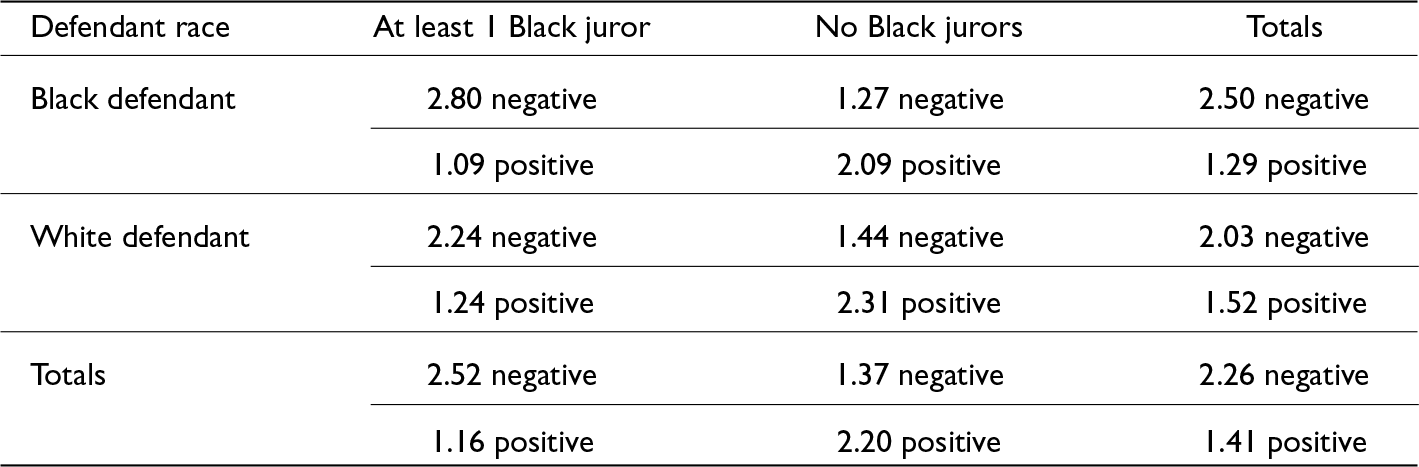
Overall, 53% of the groups had at least one positive discussion about one or both law enforcement witnesses, and 69% had at least one negative discussion.Footnote 3 Table 1 shows the breakdown of the mean number of positive and negative comments about the law enforcement testimony by defendant race and by presence or absence of at least one Black juror in the group. Those groups with at least one Black juror and who viewed the Black defendant had the highest number of negative comments about the law enforcement testimony. However, those groups with one or more Black jurors also had a higher rate of negative comments in the white defendant condition when compared to the groups with no Black jurors.
Mean law enforcement discussions per deliberation: defendant race × presence of Black juror
We first hypothesized that the frequency of favorable comments about the CHP officer’s and FBI agent’s testimony would be positively associated with convictions, while the inverse would be the case for negative comments. Contrary to expectations, the frequency of positive comments was not associated with guilty verdicts for either the FBI agent (OR = 1.22 [0.96, 1.60]; p = .16) or the CHP officer (OR = 1.31 [0.89, 1.91]; p = .17). The frequency of negative comments about the FBI agent (OR [95% CI] = .511 [0.33, 0.79]; p = .002) and the CHP officer (OR = .548 [0.33, 0.91]; p = .02) was significantly and negatively associated with a guilty verdict, as predicted. We followed up by examining whether the frequency of negative comments about the law enforcement witnesses predicted actual movement toward acquittal. The negative comment count about the law enforcement witnesses was associated with a net movement toward acquittal (OR = 1.22 [1.03, 1.44]; p = .019).
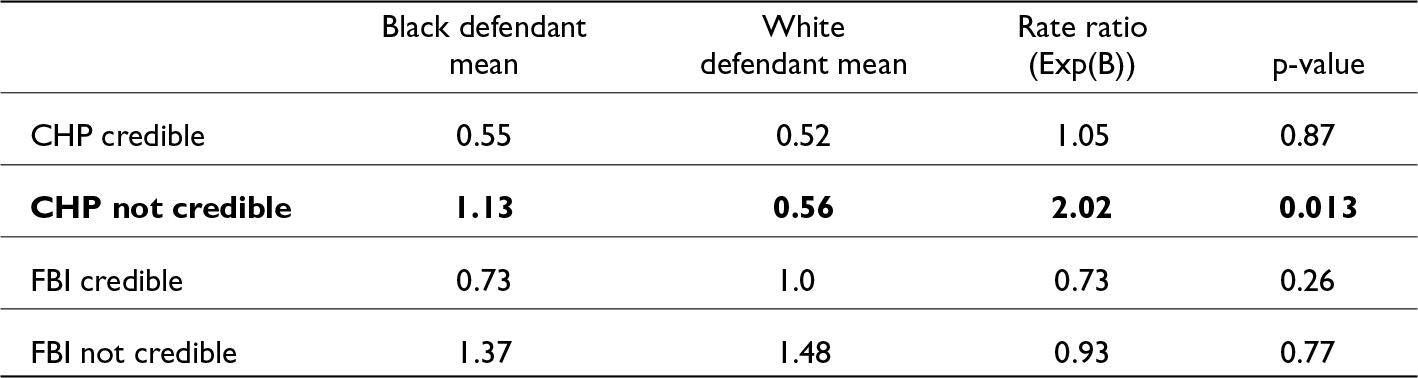
Because groups who viewed the Black defendant were significantly more likely to acquit (Shaw et al. Reference Shaw, Lynch, Laguna and Frenda2021), our second hypothesis posited that the groups in the Black defendant conditions were more likely to raise skepticism about the two law enforcement witnesses’ testimony, and conversely, have fewer positive comments about them. As indicated in Table 2, there were more than double the mean number of negative comments about the CHP officer’s testimony when the defendant was Black, compared to when he was white, which was statistically significant. Otherwise, contrary to expectations, there were no meaningful differences for either negative comments about the FBI agent or positive comments about either witness.
Defendant race × law enforcement credibility mentions per group
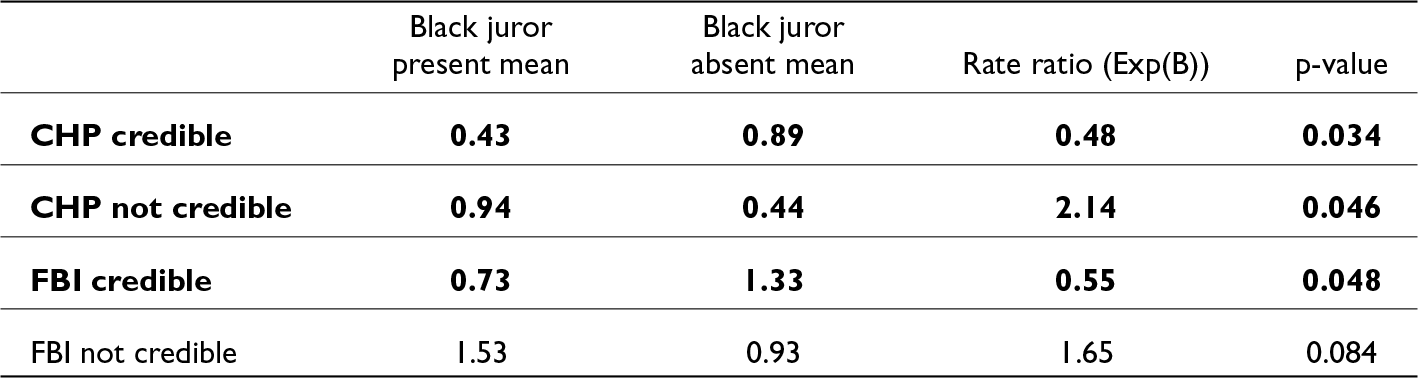
Our final set of quantitative analyses examined whether the presence of one or more Black jurors in the group was associated with positive and/or negative law enforcement testimony discussions, relative to those groups with no Black jurors. We first ran a binary logistic regression to see if the presence of at least one Black juror significantly predicted verdict across conditions. Across all conditions, 71% of those groups that included at least one Black juror acquitted the defendant, whereas only 51% of the groups with no Black jurors did so (OR = 2.32 [1.02, 5.26]; p = .04). We then ran a series of negative binomial regressions to test whether jury composition was associated with the law enforcement comment counts. As illustrated in Table 3, the frequency of law enforcement comments substantially and significantly differed as a function of jury group composition for all except negative comments about the FBI agent’s testimony. Even in that case, there were about 65% more mean negative comments per group when one or more Black jurors was present (p = .084).
Black juror presence x law enforcement credibility mentions per group
Qualitative analyses
The quantitative findings indicated that negative assessments of the law enforcement witnesses moved participants toward acquittal, and were more frequent among those groups including one or more Black participants, and in groups who viewed the Black defendant. Our qualitative analysis was thus limited to groups that moved toward acquittal and had at least one negative discussion of the law enforcement testimony to explore how movement toward acquittal was shaped by discussions of the law enforcement testimony, and how discussions addressed the law jurors were instructed to follow. In the next two sections, we detail the substantive themes that emerged in our analysis of the negative comments about each law enforcement witness, including how those comments were tied to both credibility assessments and burden-of-proof considerations. In the third section, we broaden out to illustrate more generally the ways the groups considered the law they were instructed to follow, and conversely when jurors strayed from the law and evidence.
The CHP officer’s “reasonable suspicion”
As previously described, the CHP officer testified that he stopped the defendant for speeding, then smelled marijuana, and observed a single key in the ignition, which raised suspicion that the car was stolen. He also testified that the defendant appeared nervous and had his license and registration ready to hand to the officer as soon as he approached the car.
The testimony about the defendant’s nervous compliance in producing the documents drew the most skepticism in this subgroup of deliberations. These discussions were always initiated by jurors who identified as non-white, most often Black jurors, and the testimony was typically evaluated in light of jurors’ own experiences and understandings of police stops. As such, these exchanges elucidated “black people’s collective consciousness” (Carbado Reference Carbado2002: 952) around encounters with police through their personal narratives, and represented both implicit and explicit expressions of race-conscious reasonable doubt.
In Group 74 (BD/BI), the two white jurors supported conviction going into deliberations, and a multi-racial juror and three Black jurors supported acquittal. About 17 minutes into the deliberations, Juror 74-2, a Black man, brought up the testimony about the defendant being nervous, then Juror 74-5, a Black woman, related it to her own traffic stop experience. Juror 74-4, a woman who identified as multiracial, then broadened back out to highlight the risk of being killed by the police. Immediately after this exchange, the one remaining guilt-supporting juror switched her vote to not guilty.
74-2 (Black man): He said [the defendant] was nervous and he handed his license and registration.
74-7(white woman): Yeah, he was shaky …
74-2: Right. They pulling you over here.
74-7: And he had it [registration and license] ready.
74-2: Yeah, right.
74-5 (Black woman): That’s automatic, okay? … Because I’m not about to move around when the police stop me. I just got stopped by the police the other day.
74-4 (multiracial woman): Had your paper ready.
74-5: I was so scared, because I didn’t know what was going on. So I was like – when he pulled me over, I got my driver’s license.
74-7: You have everything ready.
74-5: I got my insurance. And my registration, and handed it to him. And so went, here … [gestures handing over papers]
74-4: So, how they do people. You know how police do people, now. You got to be cautious and stuff. You don’t want to get shot or killed.
In some of these discussions, race was explicitly invoked, as in Group 66’s deliberations (also BD/BI condition). Juror 66-6, a Black woman, felt the characterization of his nervousness as suspicious was “not fair, because of the historical relationship between police officers and black men.” Juror 66-1, who identified as a multi-racial woman, added: “As far as him having his driver’s license [ready], you know, sometimes cops are, like, boom, boom, boom, boom, so some people, you know, have their stuff ready, you know. Specifically – I’m sorry, like, Black men in general, you know, about the shootings. Black people get shot.”
The concerns about the CHP officer’s testimony regarding the defendant’s behavior seemed to implicitly raise skepticism about the whole arrest process, casting some doubt over the case itself. In Group 95 (BD/WI) this was made explicit, in that Juror 95-1, a Black man, described the “driving while Black” experience to refute Juror 95-7, a Latina who supported a guilty verdict, and to raise the issue of reasonable doubt.
95-7 (Latina woman): But when he was arrested, pulled over, he automatically gave his identification. I mean, he had that all ready, like he wanted to hurry up and get it over with. And even though the CHP said there was one key, he did smell the odor of marijuana. So, those kind of things, I was thinking, well, he knew he had to have something in his car because, like the officer said, he had everything ready, and he [the CHP officer] found that that was unusual …
95-1 (Black man): I will say something about that, and I respect where you’re coming with that.
95-7: Oh, yeah, everyone has their views.
95-1: But it’s all about understanding different cultures. You know what I mean? Like, we get pulled over so much. We already know, oh, we just go and have it. Man, come on, let’s get this over because that’s just our mindset. If we’re at a certain place, we’re going to get pulled over, so we’re going to have it ready, because if you’re fumbling, if you’re tripping, it’s a problem, and that’s just coming from a Black man that grew up in that type of environment, and I’ve gone to college and done that. I’ve been everywhere, and they just pull you over sometimes, and if you take a long time, it could be a problem. So, I mean, it could go either way. You know what I mean?
95-7: Yeah.
95-1: But I know that my experience is, is that it’s better to say, “Here, it’s right here.” Bam. I ain’t got to go look for it… ‘cause see, the thing is, once you’re reaching, they don’t know if you’re reaching for a gun and all that. Then they could shoot me. You know, they could say I was reaching for a gun, but I was reaching for my stuff. I’ll be scared to death, so I just have it ready. “Here, you ain’t got no reason to shoot me.” You know, you have to think -
95-7: I see that.
95-1: I mean, you don’t have to, but that’s, for the most, the brothers that I talk to, they’re going to have it ready. They’re not going to wait until he come. They’re not … Reasonable doubt. If you have any reasonable doubt, you’re supposed to vote not guilty.
The concerns voiced about police treatment of Black citizens, and the fear it engenders, most often occurred in the groups viewing the Black defendant. Group 22 (WD/WI), where two of seven jurors supported guilt at the outset, was an exception. Juror 22-2, a Black woman, raised concerns about the CHP officer’s testimony regarding the defendant’s nervousness, also relating it to her own personal experience.
22-2 (Black woman): The detective said, “The peculiar thing is that he had his insurance and his…”
22-6 (Black man): In his hand already.
22-2: … in his hand, nervous. Well, anybody gets stopped by the police, they know what the police is going to do. [crosstalk]
22-6: Yeah. You’re scared you’re going to get beat up.
22-5 (multiracial woman): And it’s a normal act, for all of us. If you get nervous …
22-2: I’ve been stopped and I have – I’m a diabetic. You know, I’m getting ready to go through, you know, my lows… And I know I had my information for the policemen ready. And I was all crazy. So, it doesn’t mean I’m on drugs – you know, I’m driving to school.
22-4 (Black man): Or, you’re just being Black. That’s the reason you’re nervous. For real.
Ten minutes later, the deliberations returned to jurors’ own experiences of being nervous when stopped by the police, and whether it was appropriate for them to discuss it as a racialized experience. Juror 22-2 asked a white juror if she got nervous when stopped by the police, who said she did. Juror 22-2 responded: “Okay. So, I just wanted to ask that, you know, because we’re Black, we’re going to be nervous, ‘cause the police pull us over.” Juror 22-5, one of the two who supported guilt, objected that “we don’t want to bring color out into this right now” to which Juror 22-2 replied, “But color is important at this table.” The group continued to deliberate, putting the race discussion aside, and eventually came to a not guilty verdict largely due to the credibility issues with the informant.
In four groups (all in the BD/BI condition), Black jurors explicitly raised the issue of racial profiling while discussing the CHP testimony. In two of these groups, jurors suggested the CHP officer engaged in profiling. In the other two groups, Black jurors shared their own experiences of being profiled. For instance, in Group 38’s discussion of whether the CHP officer was justified in stopping the defendant’s car, Juror 38-5, a Black man, shared his experience just days earlier of being pulled over while driving with a friend to a club, for no reason other than the officers “decided” to pull them over. Juror 38-1, another Black man, said it was “profiling.” Conversely, there were a handful of discussions where guilt-supporting jurors expressed unquestioned faith in police honesty. For instance, in Group 12 (also BD/BI), Juror 12-5, an Asian woman, pushed back on Juror 12-2’s concern that the CHP officer was lying about the defendant’s behavior in the stop by insisting that police “can’t really lie, because they’d perjure themselves.”
There were also multiple instances of jurors dismissing the suspiciousness of the single key. For instance, in Group 66 (BD/BI), Juror 66-3, a Black man, suggested the officer engaged in racial stereotyping by testifying the single key car meant the car may be stolen. Jurors frequently relied on their own experiences to cast doubt on this testimony, with some even pulling out their own single car keys/fobs to discount the “suspicious” claim.
In Group 32 (BD/BI), most of the jurors said they had single car keys. Juror 32-6, a Black woman, then pointed out the inconsistency in the CHP officer describing this as suspicious even though the defendant provided the car registration and his identification, proving the car was not stolen. Later in the deliberation, during a round-robin discussion of whether this witness was credible, several jurors specifically pointed out how the key testimony damaged his credibility:
Juror 32-7 (Black man): I think he was credible as far as the initial stop. He was found speeding. And as far as maybe the shaking and that, that may be not so credible, and the one key thing …
Juror 32-5 (Black man): And I say no because he could’ve been credible had he left out the other part.
Juror 32-6 (Black woman): The single key.
Juror 32-5: [nodding] They have a single key – especially with newer cars … What you going to put on besides this? [waving his own key]
Using commonsense logic to assess the likelihood of the events unfolding as the officer described, jurors in multiple deliberations also suggested that if the defendant was knowingly transporting drugs, he would not have been speeding, nor smoking marijuana. In a more forceful argument for acquittal, Juror 84-4, a Black man, explicitly argued that this testimony was untrue and that it cast doubt on the whole theory of the crime. Group 84’s (BD/WI) deliberations began evenly split on guilt. About 7 minutes into the deliberations, Juror 84-4 accused the officer of lying on the stand about why he stopped and searched the defendant’s car: “If the original officer that made the stop would’ve said, ‘I stopped him because McClure [the FBI agent] told me…’ [Instead] he made an excuse. He lied on the reason why he stopped him.” He then raised specific doubts that the defendant did what the CHP officer claimed. “Let me say this. If he’s driving with that much drugs in his car, he’s not fitting to be driving fast. He’s not going to be smoking weed. You see what I’m saying?” This line of argument resonated with Juror 1, a multiracial woman who originally supported a guilty verdict.
84-1 (multiracial woman): So, what I understand is, you’re saying so that -
84-4 (Black man): That’s grounds for dismissal.
84-1: If you know you’re meeting someone, with 120 grams of heroin in your car, you are purposely going to make sure you are not speeding.
84-4: And I’m not smoking marijuana.
84-1: You are not putting yourself out there in front of the police.
84-4: And I’m not smoking marijuana.
84-1: You’re not smoking weed.
While Juror 84-4 incorrectly referred to “dismissal” as the appropriate outcome given the troubling testimony, the effect was to create reasonable doubt. After six more minutes of deliberation, largely led by Juror 84-4, the group voted unanimously to acquit. After the vote, another juror who had supported guilt credited Juror 84-4: “You had some excellent points.”
The FBI agent’s competence
The negative discussions of the FBI agent’s testimony typically elaborated upon several points made in the defense’s cross-examination of the agent, regarding her lack of formal training on informants and her unsound judgment about the informant’s honesty. The use of the informant as the primary evidence of a conspiracy was critiqued in all of the groups due to his credibility issues, and this critique was frequently linked to the FBI agent’s insufficient training and failure to do her job in garnering direct evidence of an agreement between the informant and the defendant to conspire. At the same time, some jurors were not convinced by the defense attorney’s efforts to paint the agent as inadequately expert since she does not publish in her field.
For example, Group 23 (BD/WI) began with concerns about the informant’s credibility, with a juror letting the group know the informant faced a long prison sentence so was likely lying for his own benefit. That led Juror 23-5 to pivot to the FBI agent’s testimony.
23-5 (Black woman): I love that she said something about like, “I feel like Sheldon Smith [the informant] didn’t have the sophistication [to lie]” -
23-4 (white man): Sophistication. [laughing]
23-5: What an elaborate line.
23-6 (white woman): They said he wouldn’t do that.
23-5: And I was like – that part I had to write down.
23-2 (Latina woman): We both laughed at that part. That was hilarious.
23-5: It was …
23-6: I thought the defense attorney was kind of a dick too. I mean, the way he was with the informant, but also with the FBI agent. I mean, she’s talking about her 21 years of experience, “Well, did you ever publish anything?”
23-7 (Black man): Did she go to training? Had she been trained in that?
23-6: “Did you publish anything? Did you publish anything?” It’s like -
23-5: That was obnoxious. Yeah.
23-6: People don’t publish stuff. Give it a rest.
The two white jurors in Group 37 (BD/BI), Jurors 37-1 and 37-3, initially voted guilty, while the other four jurors supported acquittal. Juror 37-1 changed his vote early on, but Juror 37-3 maintained her commitment to a guilty verdict. About 10 minutes into the deliberations when several other jurors raised questions about the FBI agent’s competence, Juror 37-3 came around to agree with them on the training issue.
37-2 (Black woman): She claims she’s an expert.
37-6 (multiracial woman): How can you be an expert if you don’t take the training that they offer for informant training?
37-7 (Black woman): She got played …
37-2: She got manipulated.
37-6: She was more manipulated than anything. She had all these chances to undergo training for undercover officers she didn’t take.
37-2: I would think it would be mandatory. That’s kind of strange.
37-7: Some of it was optional though, and she didn’t sign up for that one.
37-2: Right, but even optional -
37-6: You should be taking that.
37-3 (white woman): If you’re in that position.
37-6: If you’re an FBI agent. If I was an FBI agent, and they gave me the option to take training for undercovers and informants, I’d be right up in every class I could be in so I could be the best.
37-3: Exactly.
This then led to a discussion about the FBI agent’s failure to record the conversations between the defendant and informant, which would have corroborated the informant’s testimony. After another 12 minutes of deliberation, Juror 37-3 let the others know that she was changing her vote after listening to everybody, resulting in a unanimous acquittal.
There were several instances when some participants speculated well beyond the evidence, including suggesting that the FBI agent may have participated in falsely setting up the defendant. In Group 33 (BD/WI), Juror 33-1, a Black woman, first suggested that the informant may have set up the defendant to get a lesser charge in his own case. A few minutes later, Juror 33-2 raised the possibility that the agent herself set up the defendant, which was then endorsed by Juror 33-1.
33-2 (Black woman): I’m saying that the FBI could have known something beforehand and just used the informant as a scapegoat, so who knows where it started.
33-1 (Black woman): Because I know they’re [the FBI] shady too, to be honest, very shady.
Juror 33-6, who identified as a multiracial woman, pushed back on this comment and asserted her belief that the defendant is guilty. About 9 minutes later, Juror 33-1 reiterated that “the FBI is shady;” Juror 33-5 then redirected the discussion to say the defendant should be found not guilty due to “the lack of solid proof.” Juror 33-6 began to come around, stating “if they would have had a recording…” to which Juror 33-1 agreed, “that would have been perfect.” About 4 minutes later, after further discussion about the actual evidence and whether they proved the conspiracy, Juror 33-6 indicated that she would switch her vote to not guilty, followed soon after by the other guilt supporter. In this case, the generalized suspicion of law enforcement did not sway toward acquittal; it took the group working through the evidence and testimony itself to sway the guilt voters to switch.
There was also one instance when the critique of the FBI agent moved from credibility assessment to a possible nullification argument. In Group 82 (WD/BI), the agent’s reliance on the informant in this case was framed by one juror as a larger issue of morality and justice. Juror 82-3, a Latino man, began at the very start of the deliberations by stating “the only thing that bothers me is that, you know, like, the guy [informant], man, he’d say he’s Jesus Christ if he thought he could get a lesser sentence.” He went on to critique the FBI agent and the system more generally for their overreliance on informants, leading other acquittal-supporting jurors to speculate that the FBI agent might have engaged in unethical behavior.
82-3 (Latino man): The lady? The FBI agent? Okay, let’s face it … She doesn’t have any experience. As far as I’m concerned, she barely got on the force and she uses 90% rats for her, you know, to make her cases.
82-1 (Native Hawaiian/Pacific Islander man): Right.
82-3: Okay, so, she’s depending mostly on just this guy [the informant]. Did it work? Yeah, I mean, obviously, it did, but the thing that gets me is, is that right? Is that right putting guys in jail? You know, I don’t know.
82-1: It’s like, do your job.
82-3: Yeah, it becomes a question of morality to me. It does, man. You know what I mean? I mean, are we just going to start, you know, turning into a police state where, hey, you know, where everybody just starts, you know, doing what everybody says. But, I mean, I don’t know …
82-4 (Asian woman): Would she tweak the system so that it could lean in her favor?
82-1: Totally, yeah …
82-4: I think she would. She hasn’t had any official training, official teachings, and if they were provided, she didn’t take them, you know? She didn’t go into those classes. She wasn’t taught what’s right and wrong. What she’s putting on the case, is that she had hands-on training, where she would put rats in just, like, just to put them in, and then see what the outcome is, and then do it again, and again, and again, and that’s her training. I don’t think that’s cool. I don’t like her off the bat.
Yet, neither the morality argument nor the speculation about malfeasance appeared to be deciding factors in swaying the lone guilt supporter to acquit. About 5 minutes later, Juror 82-3 himself read aloud the instructions defining reasonable doubt and specifying the elements that must be found for a conspiracy conviction, then linked those instructions to the informant’s credibility problems. The group then engaged in a serious discussion of the specific evidence regarding the conspiracy. After another few minutes, the guilt supporter proclaimed, “It’s not enough evidence,” indicating her switch to not guilty.
Legal principles as detailed in jury instructions
Given our interest in assessing how the jurors used the specific legal criteria in their decision-making, and/or whether groups disregarded the law, we also explored more generally how the groups talked about the law and legal procedure that the participants were instructed to follow, beyond just in reference to the law enforcement testimony. As noted in the previous section, some individual jurors did stray from the evidence and law they were instructed to follow. There were 12 deliberations where at least one juror speculated that the defendant was set up by the informant, as an alternate explanation for how the drugs were in the car, given his motivation to lessen the severity of his own case. As such, it was a plausible counter-narrative that might logically be inferred from the defense cross-examination and argument. Speculation about police misdeeds was less frequent, occurring in six deliberations. Such comments were typically ineffective, often garnering explicit pushback that the evidence did not support such conjecture, as in Group 33, highlighted previously.
Similarly, in Group 25 (WD/WI) half the jurors went well beyond the law and evidence in arguing for a not guilty verdict. Jurors 25-5 and 25-6, both Black women, and Juror 25-4, a white man, dismissed their peers’ arguments that the drugs found in the car was evidence for guilt and speculated about the witnesses’ malfeasance, untethered from actual testimony in the case, to argue for acquittal.
25-5 (Black woman): [Finding the drugs] doesn’t mean anything. The policemen, FBI, frame people all day long.
25-2 (Asian woman): What? Really? I don’t know about that.
25-6 (Black woman): You’re so cute. Of course, they do.
25-1 (Black woman): I didn’t see evidence that he was framed. They said look at all the evidence. Saying it might have been this or it might have been that. I’m basing mine [guilty vote] on circumstantial evidence …
25-4 (white man): So you don’t think it’s possible Sheldon [the informant] could’ve put the drugs in his car?
25-1: Where was the evidence? I didn’t see any evidence to that.
25-4: Well, but you don’t know – what evidence do you have to who the drugs belong to?
This group was initially split 3-3 on guilt, and this speculation seemed to harden that division as jurors argued about what constituted evidence and what was conjecture. Later in the deliberation, however, Juror 25-3, an American Indian woman who supported a guilty verdict, began reading the instructions out loud, including about what needed to be proved to convict on conspiracy, and about the assessment of witnesses’ credibility. This allowed the group to reorient the discussion to how the evidence spoke to these considerations. The jurors began to coalesce around the serious issues with the informant’s credibility. About 30 minutes into the deliberation, Juror 25-1, who had been the most vocal in her commitment to a guilty verdict, asked the group, “You want to revote?” She then indicated she would change to not guilty. Juror 4 asked her what changed her mind. She indicated it was the jury instructions they read and discussed about witness credibility. Jurors 25-2 and 25-3 then came around to support acquittal on the same reasoning.
Indeed, the groups that had shifts toward leniency were overwhelmingly attentive to the law that they were supposed to follow to render a verdict. Overall, 90% of the juries that moved toward leniency referred to and discussed the jury instructions at least once in their deliberations, which was significantly more than the prevalence (68%) among those groups that moved toward guilt (OR [95% CI] = .253 [0.09, 0.75]; p = .01). The references to the law first focused on distinguishing conspiracy from drug possession, since the only charge they were deciding on was conspiracy. Second, members of these juries frequently discussed the concept of reasonable doubt, and often directly linked that discussion to the problems with the evidence, especially the informant’s credibility and the FBI agent’s failure to produce corroborating evidence. In the sub-sample of 50 deliberations, 84% had at least one (and as many as 9) explicit mentions and/or discussions of the reasonable doubt standard. Finally, members of some groups reminded others of the seriousness of their duty and severity of the charges, should the defendant be found guilty. These jurors seemed to call on their peers to meaningfully engage with the law and evidence.
The issue of proving the elements of the conspiracy charge was most frequently discussed, and was generally key to moving guilt voters to acquittal. Because 120 grams of heroin was found in the defendant’s car, some jurors felt that was sufficient, in conjunction with the witnesses’ testimony, to convict. An effective argument used by those supporting acquittal was to point out that had the defendant been charged with possession, it would be an easy conviction, but the evidence was lacking on the agreement to sell drugs, as required by the conspiracy charge. Central to this was distinguishing what they recognized as a bad act – possessing a large quantity of heroin – and their duty to determine guilt on the charge. As Juror 138-6 (WD/WI) bluntly put it, “my duty … is to make sure I listen to the facts. I’m not going to put him away because I think he’s a scumbag, right? I wish I could, but I wouldn’t be doing my civic duty to do that.”
Group 30 (WD/BI), which began 4-3 for conviction, also illustrates this pattern. Juror 30-4, a Black man who served as the foreperson, first asked those who supported guilt to share their reasoning. He then offered his view, highlighting the distinction between possession and conspiracy:
30-4 (Black man): I don’t think he’s an innocent person. I don’t think they have him for the right crime because they didn’t provide the proper evidence to prove … that it’s conspiracy. Their only evidence for their conspiracy is the testimony of a proven liar with a motivation to lie again. You know? They have no other evidence, there’s nothing to corroborate his story that they entered into an agreement.
30-7 (white/Latino man): So you don’t think that the fact that the heroin was in his car is evidence?
30-4: That is evidence of possession, but I’m saying in all likelihood, he probably committed this crime. But that’s not the way the court system works.
30-7: Right, but …
30-4: They didn’t prove beyond a reasonable doubt that he entered into an agreement to sell those drugs to [the informant].
Juror 30-4 repeatedly came back to the need for the government to prove beyond a reasonable doubt that an agreement was made, emphasizing how serious the charges were so they needed to be sure of guilt: “Because [with] these crimes, you face serious time … In order to take somebody out of their life for decades, you have to be sure. We have to be sure.” Immediately after this statement, two guilt jurors switched to not guilty. Then, following a heated debate between Juror 30-4 and the two remaining holdouts over the lack of evidence of an agreement, the holdouts agreed to change their votes to not guilty.
Group 58 (BD/WI) was evenly split, 3-3, at the start of deliberations. Juror 58-5, a Latino man who served as foreperson kept others from speculating beyond the evidence, in part by reorienting the discussion to the burden of proof, arguing that the government did not make its case beyond a reasonable doubt. When another juror speculated that the defendant was framed, Juror 58-5 responded, “No, but that doesn’t even matter. What matters is that the prosecution has burden of proof that it was conspiracy, not possession, but conspiracy. So, it doesn’t matter what might have happened with whatever. He probably is a drug dealer, you know … but there’s no proof that there’s conspiracy.” This became the theme of the deliberations, and after 15 more minutes of discussion, the group unanimously voted not guilty.
Group 4 (BD/WI) elucidates all of these themes. The deliberations began with the 3 white jurors all raising their hands to indicate they voted for guilt, then talking to each other about their votes. Juror 4-3, the white foreperson, then pointed to the other two jurors and said, “You don’t think he’s guilty. What’s your reason?” Juror 4-5, a Black woman, began with the elements of the crime, and lack of credible evidence:
Well, one of the things that stood out to me was that conspiracy is just the agreement. And there was never a direct link between Sheldon Smith, who was the informant and Williams [the defendant]. I mean I can’t do a conviction based upon the testimony of a third-time-convicted felon. The federal criminal system is known for wiretapping. I find it interesting that they didn’t present any evidence of a wiretap that stated explicitly what the agreement was between Smith and Williams.
Several minutes later, she linked her points to the reasonable doubt standard. Juror 4-7, a white man who had been arguing for guilt, appeared to shift:
4-5 (Black woman): I mean these are the feds. Usually when the feds come with a case, they have to come with a really, really strong case. I’m not going to put somebody away for 10, 15, 20 years off of a weak case. I mean, you have to prove your case. What’s the whole purpose of saying beyond a reasonable doubt? This is a criminal case. It’s not a civil case.
4-7 (white man): Somebody’s life.
4-5: When somebody’s life is at stake, they have to really come strong with it. You know, you either come strong with it, or go back and get–
4-7: Get more evidence.
4-5: Yeah, get more evidence.
After another few minutes of discussion about the specifics of the CHP traffic stop, and some speculation about the defendant’s role in the drug trade, the foreperson called for another vote. The group was unanimously not guilty.
Discussion & conclusion
In this analysis, we drew on insights from CRT that challenge color-blind ideology and foreground race-consciousness to advance socio-legal scholarship on race and jury decision-making, toward a goal of “embracing a normative orientation towards racial justice that [empirically] questions inequalities produced by social and legal structures” (Obasogie Reference Obasogie2013: 185). Specifically, we demonstrated how racially diverse mock jury groups evaluating a criminal case can provide more robust, defendant-protective justice by carefully scrutinizing law enforcement testimony and law enforcement-generated evidence in light of racialized policing (Carbado Reference Carbado2017), and the widespread problem of law enforcement “testilying,”Footnote 4 including in criminal trials (Capers Reference Capers2008; Dunkle Reference Dunkle2021).
Our study benefitted from substantial Black representation in our participant pool, offering a window into the functioning of juries that are not “white-washed” via the jury selection process. Consequently, we advance socio-legal research on race and juries by prioritizing Black decision-makers, and not just in relation to white decision-makers, as is the norm in this body of work. We do so in part by empirically operationalizing the CRT commitment to narrative (Barnes Reference Barnes2016), highlighting Black jurors’ voices and stories in the deliberations, rather than simply treating their identity as an independent variable (Gómez Reference Gómez and López2004).
Thus, as we illustrated, the CHP testimony about the car search elicited explicitly race-conscious reasonable doubt. Black jurors led in describing the very real problem of driving while Black, including the disproportionate likelihood of being pulled over, and the risks of being harmed or killed in those encounters (Carbado Reference Carbado2017). These jurors explained why the CHP officer’s multiple justifications for searching the car should be viewed skeptically, in part by questioning the color-blind ideology about what constitutes “reasonable” suspicion and revealing how that is racialized (see Carbado Reference Carbado2002; Reference Carbado2017). They sometimes did so by sharing their own narratives of being stopped, including the fear generated in those encounters. To that point, our findings suggest that the systemic problem of police abuse-of-power against Black citizens, facilitated by color-blind Fourth Amendment jurisprudence (Carbado Reference Carbado2017), has concrete, spillover effects into the context of criminal trials, bringing more critical and reality-based scrutiny to credibility assessments of law enforcement testimony by Black jurors.
Beyond raising concerns about law enforcement, Black jurors shared other information about how the system worked, including about what kind of evidence could have been collected in a federal drug conspiracy case, in their critiques of the FBI agent. They also urged their peers to consider how the informant could be motivated by his own punishment exposure, thereby helping their groups carefully assess the credibility of that specific testimony in the case. This information-sharing process was not limited to groups that viewed the Black defendant; the white defendant also benefitted from the shared knowledge.
Acquittal-supporting jurors, again dominated by Black jurors, also correctly explained the government’s burden to prove an actual agreement was made; that then allowed the groups to appropriately focus on whether the witnesses supplied that proof, including through critical assessments of their credibility. Black jurors overwhelmingly took the lead in articulating the standard of proof – beyond a reasonable doubt – and whether it was met in this case. And while jurors are generally not supposed to consider potential punishment when deciding guilt, the concern raised by several Black jurors about the importance of their decision due to the severe consequences of a conviction served as a call to their peers to take the guilt decision-making task seriously (rather than as a substantive factor to consider).
While we did not closely examine the conviction-prone groups, we did find they were significantly less likely to attend to and discuss the jury instructions in their deliberations. And we found little evidence that the acquittal-moving groups were engaging in nullification or motivated by generalized bias against the police. Thus, although there were instances where individual jurors speculated beyond the evidence or expressed nullifying views, and this occurred in both the Black and white defendant conditions, other juror-leaders were able to redirect them back to the law and evidence to come to an acquittal verdict.
Taken together, our findings suggest that sometimes-implicit, sometimes-explicit, race-conscious reasonable doubt (Do Reference Do2000) played a role in the acquittal-leaning juries. This happened through careful scrutiny of the evidence that did not just blindly accept the law enforcement witnesses’ accounts as unquestionably true, especially in the Black defendant condition where the CHP officer’s testimony was subject to heightened scrutiny, both in regard to his veracity and in offering alternative explanations for the “suspicious” conduct. As reflected in our qualitative analysis, these groups were able to coalesce around decisions that were grounded in the legal principles that govern criminal trials, including those regarding credibility assessments and burden of proof.
Our findings advance law and society scholarship on the role of jury diversity, not only for defendants in the criminal legal system, but also for those called to service. Socio-legal research suggests that Black and Latinx jurors subjectively experience marginalization during deliberations, relative to white jurors, across jury composition (Winter and Clair Reference Winter and Clair2018). This is enhanced by “tokenism” (Gau Reference Gau2016) wherein lone members of minority groups are marginalized or become alienated from the group. It is also enhanced by witnessing disproportionate peremptory removal of Black potential jurors wherein the remaining Black jurors view the system as unfair and feel they themselves are targeted. This effect is mitigated when jury groups are robustly diverse and not subject to disproportionate exclusion (Abromowitz and Bradford Douglass Reference Abromowitz and Bradford Douglass2023). On robustly diverse juries, not only are deliberations of higher quality (Bergold and Bull Kovera Reference Bergold and Bull Kovera2022; Sommers Reference Sommers2006), but Black jurors also actively participate in deliberations (Cornwell and Hans Reference Cornwell and Hans2011). Our qualitative findings add to this body of work by elucidating how robust Black representation contributes to the careful scrutiny of law enforcement evidence via the participatory process of deliberation, thus suggesting one avenue to counter the criminal legal system’s perpetuation of racial inequality via colorblind ideology (Van Cleve and Mayes Reference Van Cleve and Mayes2015). In that regard, racially-inclusive juries may be able to serve as one check on system bias through their fact-finding role.
Our findings also have important implications for racial justice in the jury context. As CRT scholar Paul Butler (Reference Butler2020) has argued, despite the “obstinate” colorblind rhetoric of contemporary Sixth and Fourteenth Amendment case law pertaining to juries, system actors are aware that jurors’ racial identity matters in criminal trials, especially for Black defendants. Prosecutors’ systematic removal of Black jurors in criminal trials need not – and does not necessarily – stem from personal bias or racial animus; it is precisely because racial identity shapes individuals’ interpretive lenses that prosecutors are strategically motivated to remove Black potential jurors and retain white ones (Butler Reference Butler2020). More pointedly, given the Fourth Amendment jurisprudence that “racializes suspicion” such that Black citizens are disproportionately subject to police encounters (Carbado Reference Carbado2002), this prosecutorial strategy compounds the damage by knowingly removing the very people who can critically assess police testimony about such encounters. Ultimately, ineffectual, individual-level remedies like those prescribed in Batson (1986) cannot address the structural discrimination that is built into the American criminal trial process. Under current law, there is no constitutional problem with all-white juries deciding the fate of Black defendants, despite their historic role in maintaining white supremacy, so long as the removal of Black citizens can be plausibly deemed “race-neutral” (Roberts Reference Roberts2019).
Laws prohibiting peremptory removals of jurors based on views of and experiences with police, as recently enacted in several jurisdictions, offer a broader-based tool to mitigate this problem. The Washington State Supreme Court led on this effort, when it adopted General Rule 37, declaring that the use of peremptory challenges to remove venire members for “having prior contact with law enforcement officers; expressing a distrust of law enforcement or a belief that law enforcement officers engage in racial profiling; [or] having a close relationship with people who have been stopped, arrested, or convicted of a crime” is presumptively invalid, since those reasons unfairly exclude jurors based on race or ethnicity (Washington Courts, n.d.: 1–2). The California legislature subsequently enacted A.B. 3070, modeled after General Rule 37, to strengthen protections against discriminatory juror exclusion on the basis of race or ethnicity. It includes the same language, declaring peremptory challenges used to excuse potential jurors for views of, and experiences with, police to be presumptively invalid (California Legislature 2020a). More broadly, California’s Racial Justice Act, enacted at the same time, gives defendants the right to challenge their convictions or sentences upon evidence of implicit or explicit racial bias. This includes challenges based on the removal of jurors of color, as well as instances of discriminatory language in the criminal trial context, including by jurors (California Legislature 2020b).
Even further reaching would be policies disallowing prosecutors from having any peremptory strikes, while maintaining defendants’ rights to peremptory challenges (Butler Reference Butler2020) as well as prohibitions against all-white juries deciding the fate of defendants of color (Roberts Reference Roberts2019). While one state, Arizona, has eliminated peremptory strikes for both sides, ostensibly to address the racial effects of their use, this remedy may ultimately harm defendants by limiting the defense’s ability to remove jurors with less blatant biases (Anderson Reference Anderson2022). Finally, given the fact that jury trials represent the rare exception in how criminal cases are adjudicated, and that the mass-produced racialized injustices that attend the coercive plea “bargain” process are at an astronomically higher scale, fixing the criminal jury process is just one small step toward racial justice in the criminal legal system.


 Open access

