


6.1 IntroductionFootnote *
In the wake of social and economic structural transformation, the composition of social democratic party electorates in Western Europe has changed profoundly over the past thirty years. Today, most social democratic parties find themselves torn between different social and electoral constituencies they want to address simultaneously, and for whose votes they compete with an increasing number of competitor parties (green and left-libertarian parties, radical left, different moderate right parties, as well as radical right parties) in an increasingly fragmented partisan space. Hence, social democratic party leaders find themselves in highly controversial debates about both the historical and contemporary “mission” of their parties, as well as the electoral challenges and possible strategies to face them. In this context, the question that other parties Social Democrats are in competition with – and over which voter segments – has gained massive academic and political saliency. Patterns of competition can be studied through vote switching data or panel data on voter trajectories (as in Chapter 3 by Abou-Chadi and Wagner, Chapter 5 by Bischof and Kurer, and Chapter 7 by Kitschelt and Rehm in this volume), but they can also be gauged by studying voters’ voting propensities, that is, their self-reported probability to ever vote for particular parties. These voting propensities allow us to identify the electoral potential of parties, as well as inward overlaps with competitors (i.e., voters of other parties who consider voting social democratic) and outward overlaps (i.e., social democratic voters who are inclined to give their vote to a different party).
Knowing about these inward and outward overlaps is key to evaluate the likely implications of different programmatic strategies. Indeed, much of the literature suspects a number of electoral trade-offs social democratic parties may face when deciding on electoral appeals to rival parties’ voters. The assumption is that these trade-offs result from an increasing heterogeneity of the social-democratic electorate: If it is true that social democratic electorates today range from culturally liberal urban professionals to conservative suburban pensioners, and from unionized blue-collar workers to middle-class managers (see the chapter by Jane Gingrich in this volume), then it may well be that these voters also diverge with regard to their consideration sets (e.g., Oscarsson and Rosema Reference Oscarsson and Rosema2019; Steenbergen and Willi Reference Steenbergen and Willi2019), that is, the menu of alternative electoral options they are likely and willing to consider. If inward and outward overlaps are of similar magnitude with competitors from different ideological sides, then social democratic parties’ strategic options would be severely constrained by substitution effects between potential gains and losses on different sides of the ideological spectrum. However, it seems unlikely that the electoral overlaps (inward and outward) are indeed of similar size in all ideological directions. Hence, knowing more about the composition and magnitudes of these inward and outward overlaps can allow us to identify patterns of proximity and overlap that might make some programmatic appeals more promising than others. This is what this chapter is about.
To study these potentials and overlaps empirically, I use data from the European Election Surveys (EES) (four waves between 2004 and 2019, cf. Egmond et al. Reference Egmond, Brug, Hobolt, Franklin and Sapir2017) on individual voting propensities for different parties in ten West European countries. In line with the framework of this volume, I group time periods in decades and countries into regions: Continental and Nordic European countries on the one hand and Southern European countries on the other hand. I exclude the UK as the only Anglo-Saxon majoritarian system from the analyses, because both consideration sets, as well as probabilities for vote switching follow very different – and for our purposes less instructive – logics in majoritarian electoral systems dominated by two main parties.
By studying the voting propensities and comparing them to vote choice, I answer four questions: (a) Is there at all room for social democratic parties to (re-)grow? (b) With which parties do social democratic parties share the largest overlaps? (c) Do social democratic parties compete over middle- or working-class voters? And (d) what seem to be likely payoffs of the four programmatic strategies identified in this volume (see the introductory chapter by Häusermann and Kitschelt)?
The main findings of this chapter are as follows: Voting for social democratic parties has remained a considered option for very many voters: On average about half of all voters can imagine voting for the social democratic party. Jointly with the mainstream right parties, this is the highest potential among all party families. However, the electoral potential has declined over the past two decades, while it has increased massively for green and radical right parties. Also, it is notable that outward overlaps to other parties are substantively higher than inward overlaps from competitor parties, and outward oriented voters of the social democratic parties have on average a higher voting propensity for the competitor than vice versa. Generally, overlaps concentrate with the electorates of green and radical left parties and to a lesser extent with the voters of moderate right parties, but only to a marginal extent with the electorate of radical right parties. Hence, contrary to what is often suggested, I find little empirical indication of an actual electoral trade-offs between green and radical right voters in either direction: Potential voter gains from radical right parties are very low, but the likely cost of appealing to them seems high given the high shares of social democratic voters who can just as well imagine voting green (or radical left). Rather, New Left programmatic appeals toward green and left-libertarian voters appear more promising from the perspective of social democratic parties, since (a) inward overlaps from green/left-libertarian parties are clearly higher than outward overlaps toward radical right and moderate right parties and (b) the voting propensities for social democratic parties are highest among inward overlaps from the greens. Finally, I find that social democratic parties, especially in Nordic and Continental Europe, experience the staunchest competition over middle- and highly educated middle-class voters, rather than over working-class voters. All these findings underline that social democratic parties today mainly compete within the left field over middle-class voters, rather than competing with the right over the working class.
The chapter is structured as follows: Section 6.2 explains why we might expect electoral trade-offs for social democratic parties along both ideological dimensions of the political spectrum. After presenting data and indicators, the empirical part of the chapter proceeds in three steps: I first evaluate the electoral potential and mobilization performance of social democratic parties to evaluate whether there indeed is room to (re-)grow. I then proceed by region to comparatively assess inward and outward overlaps – by country, and by class and education level – before discussing more specifically the four programmatic strategies in terms of their net balance, that is, comparing potential gains and losses and the proximity of rival party electorates.
6.2 Potential Electoral Trade-offs
On average, social democratic parties across Western Europe have lost 10–15 percentage points of their vote shares over the past three decades, dropping from 30–35% to 20–25% of the votes in national general elections (cf. Figures 1.1 and 1.2 in the introductory chapter to this volume). Losses were strongest in Nordic and Continental European countries (even dramatic in some of them, such as France or the Netherlands), but more recently, they were equally strong in Southern European countries. Importantly, this electoral crisis is specific to social democratic parties, rather than being a crisis of the “left field” overall, or of the “social democratic project” (Frega Reference Frega2018). Indeed, the combined vote share of green, radical left, and social democratic parties has remained largely stable.
In the discussion of the reasons for this development, both the long-term trend of electoral decline and the near ubiquity of the social democratic crisis direct the attention to structural developments rather than country-specific, more situational variables. Among the structural changes, electoral realignments in the wake of sociostructural change toward a postindustrial knowledge economy are a key trend. As many contributions building on Kitschelt (Reference Kitschelt1994) have shown, this societal and economic transformation – with its technological, demographic, institutional, and political dimensions – has changed social structure, as well as policy challenges and agendas, thereby leading to a profoundly restructured political preference space in Western Europe along at least two dimensions, one dimension dividing parties with regard to economic-distributive questions and the other dividing them with regard to sociocultural policy questions (e.g., Kriesi et al. Reference Kriesi, Grande, Lachat, Dolezal, Bornschier and Frey2008; Bornschier Reference Bornschier2010; Rydgren Reference Rydgren2013; Beramendi et al. Reference Beramendi, Häusermann, Kitschelt, Kriesi, Beramendi, Häusermann, Kitschelt and Kriesi2015; Ares Reference Ares2017; Manow et al. Reference Manow, Palier and Schwander2018; Oesch and Rennwald Reference Oesch and Rennwald2018; Rovny and Polk Reference Rovny and Polk2019; Benedetto et al. Reference Benedetto, Hix and Mastrorocco2020).
More specifically, occupational upgrading, the educational expansion, as well as the changing role of women in society have expanded the social democratic “project” or “idea” beyond its twentieth century focus on the economic class compromise, toward the inclusion of new social groups and concern in the egalitarian universalistic project that is at the core of Social Democracy. Thereby, the appeal and ambition of the “social democratic project” has extended toward new voter groups and – also – toward new political parties. Demands for progressive sociocultural policies in particular have fueled support for various radical left, as well as green and left-libertarian parties in the expanded new middle classes (e.g., Kitschelt Reference Kitschelt1994; Oesch Reference Oesch2006; Gingrich and Häusermann Reference Gingrich and Häusermann2015; Häusermann and Kriesi Reference Häusermann, Kriesi, Beramendi, Häusermann, Kitschelt and Kriesi2015). Most social democratic parties have over time integrated to various extents these programmatic demands for further – both socioeconomic and sociocultural – inclusion, and thereby diversified their electorate, so that they now gather votes from very different social milieus, which emphasize different aspects of inclusion (Abou-Chadi et al. Reference Abou-Chadi, Häusermann, Mitteregger, Mosimann and Wagner2022). In terms of electoral sociology, a lot of studies have highlighted the changing class composition of the social democratic electorate (Evans Reference Evans1999; Knutsen Reference Knutsen2006; Ares Reference Ares2017; Evans and Tilley Reference Evans and Tilley2017), which has roughly shifted from a working-to-middle class ratio of 2:1 to the reverse (Gingrich and Häusermann Reference Gingrich and Häusermann2015; Häusermann Reference Häusermann, Manow, Palier and Schwander2018). Much of this class shift is due to structural change (i.e., deindustrialization and occupational upgrading), but it also reflects a declining propensity of working-class voters to vote Left. Reversely, on the opposite end of the spectrum, working-class voters today constitute the core constituency of radical right parties in Europe (Kriesi et al. Reference Kriesi, Grande, Lachat, Dolezal, Bornschier and Frey2008; Rydgren Reference Rydgren2013; Oesch and Rennwald Reference Oesch and Rennwald2018).
The upshot of these developments is that social democratic parties today draw their votes from different sociostructural groups/milieus, whose average policy preferences vary in important regards, both in terms of position and saliency. Ample research has evidenced this claim time and time again, especially for sociocultural policy preferences, with attitudes regarding immigration control, minority rights, and environmental protection diverging strongly along the lines of education and class (e.g., Bornschier Reference Bornschier2010; Kitschelt and Rehm Reference Kitschelt and Rehm2014; Rennwald and Evans Reference Rennwald and Evans2014; Häusermann and Kriesi Reference Häusermann, Kriesi, Beramendi, Häusermann, Kitschelt and Kriesi2015; Ares Reference Ares2017; Bornschier et al. Reference Bornschier, Haffert, Häusermann, Steenbergen and Zollinger2024). Hence, it is today largely established that in terms of social classes, working-class voters (in particular production workers), and voters of the new middle class (especially sociocultural professionals) – the old vs. new sociostructural core constituencies of the social democratic parties (Oesch and Rennwald Reference Oesch and Rennwald2018) – hold the most opposite and pronounced attitudes on these issues. From this observation, many observers have concluded that social democratic parties are likely to face an electoral dilemma “on the sociocultural, second dimension” of electoral competition.
On the other hand, many studies have argued that social democracy is less conflicted when it comes to economic-distributive policy questions, as both their middle- and working-class voters should continue to agree on generous welfare state policies and generally extensive market correction by the state (Kitschelt and Rehm Reference Kitschelt and Rehm2014; Häusermann and Kriesi Reference Häusermann, Kriesi, Beramendi, Häusermann, Kitschelt and Kriesi2015; Ares Reference Ares2017; Elsässer Reference Elsässer2018). However, more recent contributions also point to a new and growing potential divide regarding distributive policies, namely regarding the allocation of resources to social policies that either replace income (social consumption) or create and mobilize human capabilities and earnings potential (social investment). These studies show that middle- and working-class voters are indeed divided over these two orientations of postindustrial social policy, with working-class voters preferring consumption over investment and the new middle class being the strongest supporter of social investment (Beramendi et al. Reference Beramendi, Häusermann, Kitschelt, Kriesi, Beramendi, Häusermann, Kitschelt and Kriesi2015; Gingrich and Häusermann Reference Gingrich and Häusermann2015; Garritzmann et al. Reference Garritzmann, Busemeyer and Neimanns2018; Häusermann et al. Reference Häusermann, Pinggera, Ares and Enggist2021, Reference Häusermann, Abou-Chadi, Bürgisser, Enggist, Mitteregger, Mosimann and Zollinger2022; Bremer Reference Bremer, Garritzmann, Häusermann and Palier2022).
The upshot of these voter and preference realignments is that for all the different programmatic profiles social democratic parties could credibly advocate in the knowledge economy, each is likely to come at a price.
However, all these diagnoses regarding potential trade-offs and dilemmas rely on average preference profiles of these sociostructural groups, disregarding their voting propensities and consideration sets. In other words, they imply that social democratic parties (want to) appeal to the “average” production worker or sociocultural professional, not to those subsets of voters in these classes that actually include social democratic parties in their consideration sets. Yet, in increasingly realigned and segmented electoral spaces, the actual, empirical trade-offs parties face will depend on precisely these realigned voting propensities (Bartolini and Mair Reference Bartolini and Mair1990; Abou-Chadi et al. Reference Abou-Chadi, Häusermann, Mitteregger, Mosimann and Wagner2022). Hence, the “price” may vary depending on consideration sets and voting propensities, which is why we need to include those in our estimations.
In the following, I briefly discuss the expected trade-off associated to each of the four programmatic strategies developed in this volume. The first scenario – “Old Left” – would be to turn “back” to traditional left-wing policies of the twentieth century (in particular consumption and market correction) while de-emphasizing sociocultural questions. This is a strategy many critics of the so-called Third Way have proposed, based on the assumption that social democracy has lost voters to the Radical Left as a consequence of economic-centrist policies (e.g., Arndt Reference Arndt2013; Karreth et al. Reference Karreth, Polk and Allen2013). However, not only have radical left alternative options already firmly established in many countries, but it is also unclear how high the cost of such a strategy would be in terms of losing voters to the Moderate Right. The strategy may also entail a cost in terms of neglecting sociocultural issues that are particularly salient in the wider electorate.
Two further programmatic strategies imply a clear and distinctive position also on the sociocultural dimension of programmatic electoral competition. One of them could be called “Left-National,” combining traditional left-wing economic positions (mostly on social consumption and market correction) with more conservative positions when it comes to sociocultural policy issues (e.g., Eatwell and Goodwin Reference Eatwell and Goodwin2018). This strategy has received a lot of attention from political commentators, as it can be seen as a “remedy” to alleged previous mistakes made by social-democratic parties in terms of neglecting working-class concerns. The payoffs of such a strategy, however, depend on the share of radical right voters who can actually realistically imagine voting social democratic, as well as on the losses toward green and left-libertarian parties in particular, which such a move toward more socioculturally conservative positions may entail.
The opposite strategy is, of course, to move toward more culturally liberal positions, that is, a “New Left” agenda, emphasizing socioculturally liberal positions, while highlighting social investment when it comes to social and distributive policies, given that social investment concerns resonate strongly with green voters (Häusermann et al. Reference Häusermann, Pinggera, Ares and Enggist2019). Abou-Chadi and Wagner (Reference Abou-Chadi and Wagner2019) have recently published findings that show such a strategy to be electorally promising. Its payoffs depend, again, on the share of green and left-libertarian voters that are receptive to a social democratic appeal to cultural liberalism, as well as on the share of voters that it may oust to radical right parties, and potentially to parties of the Moderate Right.
Aside from these three scenarios, which all imply the Social Democrats moving toward more extreme programmatic positions, a fourth strategic programmatic option would be to emphasize “Centrist” positions both in terms of economic-distributive and sociocultural issues, thereby appealing to voters of the moderate right parties. This strategy comes closest to the idea of acting as a policy broker on the broader left spectrum of an increasingly fragmented party landscape, enabling and bridging policy coalitions for progressive policies, both economic and cultural. But there is also a risk to this position, of course: Its payoffs depend on the potential vote gains among moderate right parties as compared to potential losses toward either radical left or green parties.
Few studies so far have started to try to evaluate these potential trade-offs and scenarios empirically (e.g., van der Brug et al. Reference Van der Brug, Meindert, de Lange, Baller and Rydgren2012; Abou-Chadi and Wagner Reference Abou-Chadi and Wagner2019; Häusermann et al. Reference Häusermann, Pinggera, Ares and Enggist2019; Abou-Chadi et al. Reference Abou-Chadi, Häusermann, Mitteregger, Mosimann and Wagner2022) at the individual level. Relying on individual-level data on electoral and programmatic preferences is important, because of class heterogeneity: While it is true that sociocultural professionals are on average most culturally liberal, those of them voting social democratic may be less so. And while it has been shown clearly that production workers are on average the most culturally conservative class, it may well be that those workers who include the Social Democrats in their consideration set deviate from their class mean on precisely these issues.
The sketched trade-offs are rooted in sociostructural transformations and in the electoral realignment that has transformed European party politics over the past thirty years. Therefore, they are likely to exist across all countries. However, given the differences in both sociostructural development (i.e., differing sizes of sociostructural occupational potentials, cf. Beramendi et al. Reference Beramendi, Häusermann, Kitschelt, Kriesi, Beramendi, Häusermann, Kitschelt and Kriesi2015) and democratic, as well as welfare institutions in Nordic, Continental European, and Southern European countries, we would suppose the payoffs to vary across these regions to some extent. In particular, given the development of the knowledge economy and the politicization of second dimension politics in the PR systems of Nordic and Continental European countries, we expect the trade-offs social democratic parties face to be strongest in this region: Strong challengers have emerged on all sides of the ideological spectrum, and electoral realignment has progressed furthest, with the dominant position of social democratic parties in the left field having become contested. In Southern European countries, the left field has differentiated in a different way: The emergence of new left parties (think of, e.g., Podemos in Spain or Syriza in Greece) has occurred with an equally strong emphasis on progressive sociocultural issues and strong claims for welfare expansion, as well as with a stronger dimension of protest voting, rather than purely programmatic differentiation. Hence, overlaps may on average be lower than in Nordic and Continental Europe.
The conceptual interpretation of voting propensities is not straightforward. Voting propensity data indicates the self-reported evaluation of how probable it is that the respondent will ever vote for a particular party, on a scale from 0 to 10. Are these propensities really distinct from vote choice? Conversely, are they specific and “narrow” enough to measure meaningful consideration sets? Are they situational or stable? The evidence suggests that distinctive voting propensities are widespread, different from vote choice, relatively stable over time and that they reflect rather consistent ideological commitments rather than short-term programmatic appeals. If voting propensities reflected simply vote choice, we would expect a concentration of responses at the extremes of the answer scale. However, about 50% of respondents answer 0, 5, or 10, while another 50% distribute along the scale. Moreover, between two-third and 80% of voters do indeed have a second preference (i.e., they indicate at least one propensity of 60% or higher to vote for a different party than the one they actually voted for). In other words, most voters do have consideration sets including several parties. At the same time, these consideration sets are specific enough: Only 10–30% of voters in our data have large consideration sets, that is, three or more parties. In other words, voting propensities identify meaningful, specific consideration sets of 2–3 parties for the overwhelming majority of voters. When comparing aggregate electoral potentials based on propensities over time, there is much stability in the relative size of these potentials, which supports the interpretation of propensities as ideologically motivated (rather than situational and strategic). Based on all these empirical patterns, I assume that voting propensities reflect relatively stable, ideologically grounded electoral “consideration sets” which allow us to validly estimate overlaps and payoffs.
These voting propensity data allow me to provide empirical answers to four sets of questions that structure the empirical analysis in this chapter:
(a) How large is the mobilization potential of social democratic parties (relative to other party families)? Is there room to (re-)grow?
(b) How large are the inward overlaps (i.e., voters of rival parties who can also realistically imagine voting for social democratic parties) and where are they to be found? How large are the outward overlaps (i.e., social democratic voters who can also realistically imagine voting for a rival party) and to which parties?
(c) Do these inward and outward overlaps concentrate within the middle or the working classes? In particular, is there a middle- vs. working-class trade-off associated to the four strategies?
(d) What seem to be the likely payoffs of the four programmatic strategies identified in this volume, depending on the relative magnitude of overlaps, as well as the average voting propensities for the other party of inward and outward overlapping voters?
6.3 Data and Indicators
I use data from four waves of the EES 2004–19 (Schmitt et al. Reference Schmitt, Bartolini, van der Brug, van der Eijk, Franklin, Fuchs, Toka, Marsh and Thomassen2009, Reference Schmitt, Hobolt, Popa and Teperoglou2016, 2020; Egmond et al. Reference Egmond, Brug, Hobolt, Franklin and Sapir2017). The EES Voter Studies are fielded regularly right after the general elections to the European Parliament in the EU member states to a population-representative sample via face-to-face interviews. In this chapter, I focus on ten Western European countries for which data was available for all time points: Austria, Germany, Denmark, Spain, Finland, France, Italy, the Netherlands, Portugal, and Sweden.
Voting propensities and vote choice in the most recent national general election are the main variables I use in the analyses. They are available for all major parties per country. In order to conduct the study comparatively, I recoded all national parties into five party families, in line with the party recoding scheme of the overall volume: social democratic parties, radical left parties, green and left-libertarian parties, moderate right parties, and radical right parties.
Voting propensities are measured as follows: “We have a number of political parties in (COUNTRY) each of which would like to get your vote. How probable is it that you will ever vote for the following parties? Please answer on a scale where ‘0’ means ‘not at all probable’ and ‘10’ means ‘very probable.’” Frequencies are highest for 0, 5, and 10, but on average about half of the respondents also choose values in between these three. Potential voters are coded as those indicating a voting propensity of 6 and higher (for at least one party of the party family in case there are several parties in one category). All analyses are replicated for robustness with a cutoff point of 7. While average potential are, of course, lower with the higher cutoff threshold (by about 25% lower on average), all main findings hold with both cutoff points.
Party choice is measured as follows: “Which party did you vote for in these last parliamentary elections?” This variable also allows me to capture abstention as one answer category. I measure party choice with this question referring to the last national election (even though this might be 2–3 years prior to the interview), rather than with the vote choice at the European elections, because I am interested in a comparative assessment of national party systems.
For some of the analyses, respondents are categorized into social classes. EES do not provide ISCO codes for class classification. The available indicators are education and subjective class (as either three class-scale [WC, MC, and UC] or five class-scale [including lower and upper middle class]). For this chapter, I rely on these two indicators of social stratification. “Working class” includes respondents who self-identify as working class or lower middle class; “middle class” encompasses voters who identify as middle class, upper middle class, or upper class. Education is measured in terms of the age at which respondents completed full-time education. I recode it into “low” (<17 years), “medium” (17–19 years), and “high” (>19 years) levels of education. As expected, the distribution concentrates in middle to upper levels of education in Nordic and Continental European countries, with higher shares of medium and low education respondents in Southern European countries. In terms of subjective class, middle-class voters prevail in terms of class size in Nordic and Continental European countries, while the shares of working- and middle-class respondents are more balanced in Southern Europe.
6.4 Empirical Analysis
6.4.1 Room to (Re-)grow? Mobilization Potential of Social Democratic Parties
Figure 6.1 plots the share of respondents in each country who indicate that they can well imagine (≥6) voting at some point for the social democratic party, that is, the mobilization potential. The figure also indicates (darker area) the vote share in the last national general elections. All numbers are averaged per decade. The ratio between the vote share and the potential can be interpreted as the “electoral yield,” that is, the extent to which the party managed to mobilize and realize its potential. For seven out of ten countries, the yield of social democratic parties ranges on average between 60% and 85% of their potential. Only in France, the Netherlands, and Italy are yields markedly lower, which makes sense in terms of the massive electoral losses the social democratic parties had experienced in the national elections.
Social democratic electoral potential (voting propensity ≥ 6) and mobilization (vote) in ten European countries, 2000s and 2010s
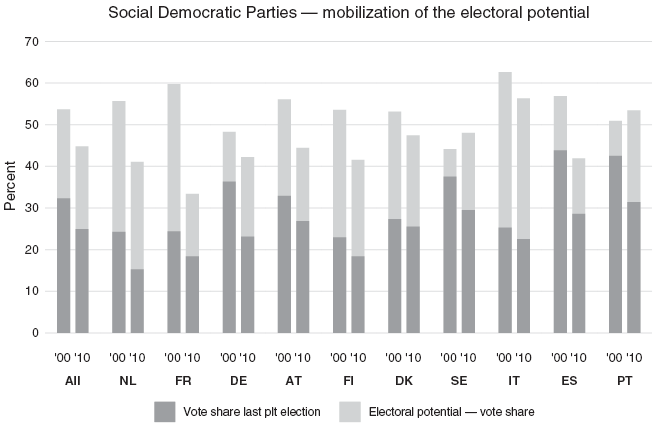
The main insight from Figure 6.1 is that social democratic parties in Western Europe are generally a viable electoral option for many more voters than those who actually gave them their vote. On average, around 50% of all voters can imagine voting for the social democratic party at some point in their life. Importantly, the unrealized potential is not simply a function of the electoral performance but on average remains rather stable over time (with the exception of France). However, Figure 6.1 also shows that in all countries, the electoral potential of social democratic parties has rather declined, in almost half of them by more than 10 percentage points.
Regarding robustness, there are two important observations: First, the findings are robust to a cutoff point of 7 instead of 6. Potentials are on average about 10 percentage points lower with the higher cutoff point, but the comparative pattern of (realized and unrealized) potentials remains robust. The observation of declining potentials between the first and second decades of the 2000s is also robust. I conducted a second robustness test by excluding respondents with large and less specific consideration sets of three or more parties. Thereby, I want to see if I overestimate the potential because some (especially younger) respondents may be open to voting for many different parties. When excluding these respondents with larger choice sets, the “unrealized potentials” decline quite sharply (from 20–40% on average to 10–20%) in those countries with very fragmented left party spectrums – especially the Netherlands, France, Germany, Finland, and to some extent Spain. This indicates that the high electoral potentials for social democratic parties indicate a general predisposition of very many voters to choose a party of the left-wing spectrum. However, it seems less indicative of a specific preference for the social democratic party in particular.
Figure 6.2 pools the countries by regions and compares electoral potentials and electoral yields across party families for the two decades. We notice that the electoral potential of social democratic parties is actually on average among the highest, together with the potentials of moderate right and green/left-libertarian parties in Nordic and Continental European Countries. In Southern European countries, the high potential of social democratic parties stands out even more, clearly outnumbering the electoral potential of green/left-libertarian and radical left parties.
Electoral potential (voting propensity ≥6) and mobilization (vote) for different party families in ten European countries, 2000s and 2010s
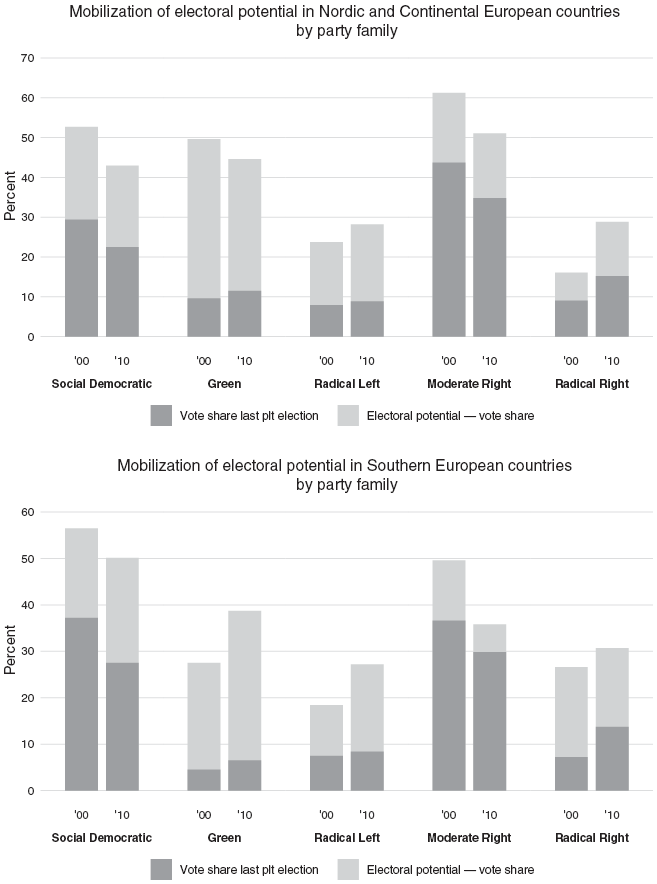
Hence, Figures 6.1 and 6.2 combined show that there indeed seems to be room to (re-)grow for social democratic parties, since actual vote shares do not exhaust their potentials by far. There does not seem to be a sort of a “ceiling” of social democratic voting in particular and left voting in general.
However, the competitive situation of social democratic parties seems challenging, and increasingly so: While the potential of radical left parties seems more narrowly confined, the massive, and massively increasing potentials of green/left-libertarian and radical right parties are striking. In Nordic and Continental European countries, the electoral potential of green and left-libertarian parties equals the one of the Social Democrats, but a much larger share of it is (still) unrealized. At the same time, the electoral potential of radical right parties has almost doubled in this region between the first and the second decades of the current century. In Southern Europe, both green and radical right parties have strongly increased their electoral potential over the same period. Hence, these numbers clearly show that the competitive environment for social democratic parties has markedly intensified both within the left field and at the conservative end of the ideological spectrum.Footnote 1
6.4.2 Inward and Outward Overlaps with Rival Parties: By Region, Class, and Education
Now that we have established that there is in most countries a substantial unrealized electoral potential, where are these voters to be found? In other words, which rival parties have voters who also include the Social Democrats in their consideration set? And which other parties to social democratic parties include in their consideration sets?
I define as inward resp. outward overlaps those voters of rival resp. social democratic parties who at the same time report a voting propensity for the social democratic party resp. a rival party of 6 or higher (with robustness analyses for a threshold of 7). Importantly, there are two ways to estimate the size of these overlaps. On the one hand, one can ask between which parties the overlaps are largest. This information is important, as is reflects which other party electorates are “closest in reach.” However, if such “close” parties are very small, a valid estimation of the magnitude of the overlaps requires a calibration by party size. Consequently, in order to compare inward and outward overlaps across parties, they need to be calibrated by a common denominator.
I take the first perspective in this section – to show the prevalence of overlaps with other party families – and the second perspective in Section 6.4.3 – to compare potential gains and losses of different programmatic strategies across the entire party spectrum.
Table 6.1 presents inward and outward overlaps for the regions of Nordic and Continental Europe. The table above (inward overlaps) indicates the share of respondents who have actually voted for green/left-libertarian, radical left, moderate right, or radical right parties, or who have abstained, but who at the same time indicate that they can just as well imagine voting for social democratic parties. The table below shows outward overlaps, that is, the shares of respondents who have voted for the social democratic parties but report a high voting propensity for a different party family, as well. Region means are weighted averages.
| All countries | Greens | Radical Left | Moderate Right | Radical Right | Abstentionists | ||||||
|---|---|---|---|---|---|---|---|---|---|---|---|
| ‘00 | ‘10 | ‘00 | ‘10 | ‘00 | ‘10 | ‘00 | ‘10 | ‘00 | ‘10 | ||
| 52 | 47 | 59 | 36 | 21 | 21 | 21 | 15 | 32 | 27 | ||
| % of “X”voters who are potential SD voters | Austria | 52 | 46 | – | – | 18 | 21 | 20 | 13 | 25 | 34 |
| Denmark | 52 | 49 | – | – | 25 | 19 | 19 | 24 | 44 | 39 | |
| Finland | 45 | 38 | 55 | 50 | 22 | 18 | 49 | 22 | 35 | 19 | |
| France | 44 | 38 | 57 | 34 | 12 | 14 | 9 | 5 | 33 | 19 | |
| Germany | 53 | 39 | 24 | 23 | 16 | 25 | – | 13 | 24 | 19 | |
| Netherlands | 58 | 49 | 64 | 41 | 27 | 22 | 20 | 17 | 36 | 33 | |
| Sweden | 52 | 54 | – | – | 17 | 22 | 27 | 16 | 20 | 41 | |
| All countries | Greens | Radical Left | Moderate Right | Radical Right | |||||
|---|---|---|---|---|---|---|---|---|---|
| ‘00 | ‘10 | ‘00 | ‘10 | ‘00 | ‘10 | ‘00 | ‘10 | ||
| 49 | 47 | 24 | 32 | 27 | 26 | 7 | 13 | ||
| % of SD voters who are potential “X” voters | Austria | 31 | 39 | – | – | 23 | 22 | 11 | 16 |
| Denmark | 57 | 50 | – | – | 15 | 21 | 7 | 15 | |
| Finland | 39 | 35 | 21 | 34 | 37 | 30 | 15 | 21 | |
| France | 60 | 49 | 17 | 23 | 16 | 27 | 2 | 14 | |
| Germany | 44 | 46 | 15 | 27 | 37 | 30 | – | 6 | |
| Netherlands | 69 | 64 | 43 | 46 | 30 | 39 | 8 | 12 | |
| Sweden | 43 | 55 | – | – | 29 | 25 | 2 | 11 | |
We see that overlaps are highest with green and radical left parties. About half of left-libertarian voters on average can as well see themselves voting social democratic and vice versa. The inward overlaps are similarly high with radical left parties, but with more variation. Hence, both inward and outward overlaps concentrate within the left field.
These high inward overlaps in the left field are followed by the group of abstentionists, among whom about a third could also imagine voting for the social democratic party. They are lower for moderate right and – very clearly – radical right parties. On average less than a fifth of radical right voters would consider ever voting social democratic and even fewer (7–13%) of social democratic voters can imagine ever voting radical right. There is quite some variation in the levels across countries (with Finland in the 2000s being an extreme case), but the rank ordering of overlaps is very consistent.
Table 6.1 already casts doubt on the widespread assumption that social democratic parties mainly compete with radical right parties over the votes of lower social classes. These doubts are further confirmed by the disaggregation of inward and outward overlaps into different education groups in Figure 6.3 (and different subjective classes in the Appendix of this chapter).Footnote 2 In Northwestern Europe, about 70–80% of all respondents on average are in the categories of the medium and highly educated. The overlaps with green and left-libertarian parties, moderate right parties, as well as abstentionists exceed this baseline level by far: With these party families, overlaps clearly concentrate among the middle and highly educated voters. With green/left-libertarian parties, the overlaps even concentrate among the most highly educated category (i.e., respondents who studied on after the age of 20). With the Radical Left and Radical Right, the shares are closer to the distribution in society, but even there, we see that overlapping voter potentials are found mostly among medium- and highly educated voters. This picture is confirmed when looking at subjective social class (see Appendix Figures 6.A1 and 6.A2): Overlaps, especially inward overlaps, exceedingly concentrate among middle-class voters.
Inward and outward overlaps by education, Nordic and Continental Europe (AT, DK, FR, FI, DE, NL, and SE)
Note: “Residual” denotes nonresponses and students.
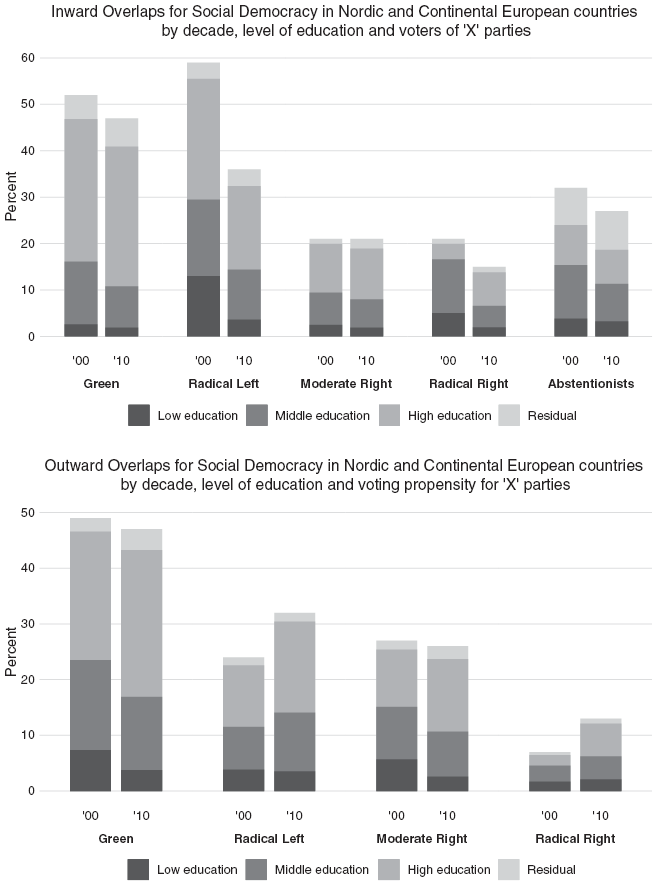
Moreover, it is important to note that the distributions look strikingly similar when it comes to inward and outward overlaps. In other words, it is not the case that social democratic parties “asymmetrically” risk losing working-class voters, while they may win over middle-class votes. Rather, both potential gains and losses concentrate in the middle and upper classes, especially when it comes to those political parties that the overlaps are highest with. This finding is consistent with what Abou-Chadi and Wagner find with regard to vote switching (see their chapter in this volume).
Moreover, Figure 6.3 shows a somewhat gloomy overall picture from the perspective of social democratic parties: Potential gains from other party families have on average declined over time, whereas potential losses tend to have increased. In an increasingly realigned and differentiated party landscape, the social democratic parties, on average, seem to lose the favors of other party voters, even within the left field.
The picture we find for Southern Europe is similar in rank order to Nordic and Continental Europe but at a lower level of overlaps (see Table 6.2). Both inward and outward overlaps are strongest with green/left-libertarian and radical left parties (i.e., within the left field) and on average lower with moderate and radical right parties. Abstentionists rank between the Left and the Right when it comes to inward overlaps. Inward and outward overlaps are on average relatively similar in size, but outward overlaps are overall smaller, especially to the Radical Left (probably indicating that those social democratic voters who wanted to join the new left parties have mostly done so). There is one exception to point out, that is, the strongly increased inward overlaps from radical right parties in the 2010s (stemming mostly from Portugal and Spain), which are not at all matched by symmetrical outward overlaps. It may be too early to tell if these overlaps are sustainable over time.
| All countries | Greens | Radical Left | Moderate Right | Radical Right | Abstentionists | ||||||
|---|---|---|---|---|---|---|---|---|---|---|---|
| ‘00 | ‘10 | ‘00 | ‘10 | ‘00 | ‘10 | ‘00 | ‘10 | ‘00 | ‘10 | ||
| 37 | 28 | 35 | 25 | 11 | 20 | 8 | 11 | 27 | 23 | ||
| % of “X” voters who are potential SD voters | Italy | 0 | 42 | – | – | 7 | 16 | 6 | 7 | 23 | 25 |
| Portugal | 25 | 28 | 35 | 25 | 17 | 46 | 11 | 29 | 30 | 22 | |
| Spain | 44 | 27 | – | – | 9 | 13 | – | 6 | 25 | 23 | |
| All countries | Greens | Radical Left | Moderate Right | Radical Right | |||||
|---|---|---|---|---|---|---|---|---|---|
| ‘00 | ‘10 | ‘00 | ‘10 | ‘00 | ‘10 | ‘00 | ‘10 | ||
| 30 | 36 | 14 | 20 | 12 | 13 | 6 | 9 | ||
| % of SD voters who are potential “X” voters | Italy | 13 | 19 | – | – | 2 | 6 | 4 | 12 |
| Portugal | 26 | 34 | 14 | 20 | 22 | 16 | 7 | 8 | |
| Spain | 35 | 51 | – | – | 10 | 16 | – | 3 | |
Hence, the pattern and rank order of overlaps is similar to Northwestern Europe, but it is important to notice that, as expected, levels of overlaps (especially with green and left-libertarian parties) are smaller, in line with the overall relatively recent reconfiguration of the left field and with the antiestablishment appeal of the new parties on the left in Southern Europe.
The share of lower-class voters in the sample is on average higher in the Southern European than in Nordic and Continental European countries, both in terms of education years and subjective class. Still, overlaps with the green and left-libertarian parties (including new left parties such as Podemos or Sinistra e Libertà) overproportionally concentrate among the middle classes and highly educated voters (see Figure 6.4). Beyond that, however, it is important to note that in Southern Europe, overlaps with the Radical Left, the Radical Right, and abstentionists are more concentrated among the lower- to medium educated and working-class voters.
Inward and outward overlaps by education, Southern Europe (IT, ES, and PT)
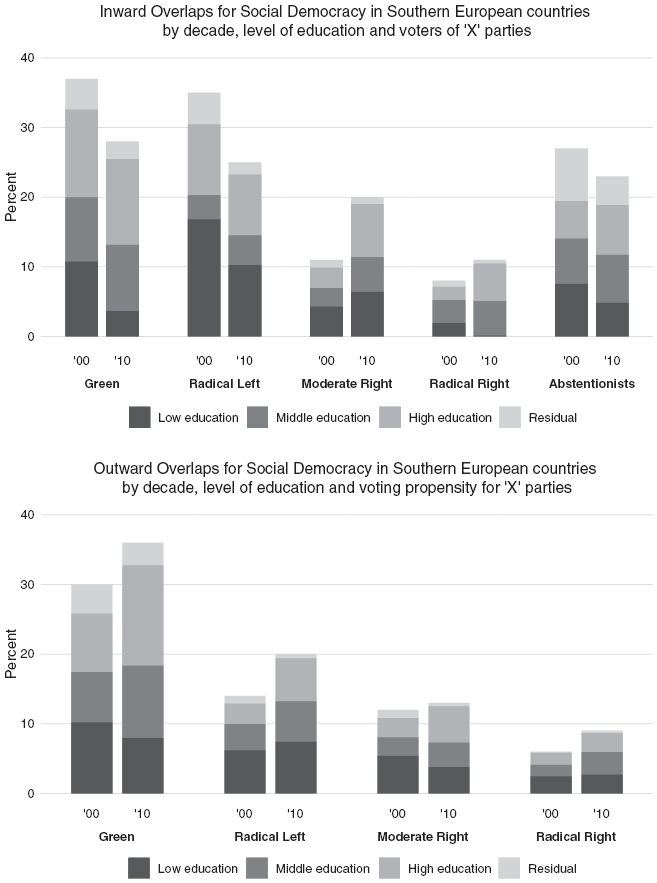
In sum, we see across the regions mainly commonalitiesFootnote 3: Overlaps are highest within the left field, both with regard to inward and outward overlaps. Overlaps with the right, and particularly with the Radical Right are on average much lower. In particular, hardly any social democratic voters indicate they are tempted to vote for the Radical Right. Finally, the Figures 6.3, 6.4, 6.A1, and 6.A2 show that the electoral competition social democratic parties face does not concentrate around voters from lower social classes. Rather, where we observe the highest overlaps, competition revolves around middle-class voters with medium and high education. Finally, a last consistent finding across all countries and regions is that – especially within the left field – inward overlaps tend to decline over time, while outward overlaps tend to increase. This corroborates the increased competitive challenges social democratic parties face.
6.4.3 Programmatic Strategies and Electoral Payoffs
In this section, I integrate the comparison of inward and outward overlaps – in terms of both magnitude and respective voting propensities – to arrive at a very approximative evaluation of likely payoffs of the four possible programmatic strategies. The most important change with regard to the previous analyses is that from now on, I present inward and outward overlaps relative to the same denominator – the entire electorate (i.e., all respondents who indicate having voted for a party in the sample or abstained). This calibration is important, since the relative size of the respective potential gains and losses electorates obviously matters for gauging payoffs: Even if a very high share of, for example, green voters can imagine voting social democratic, this implies very different payoffs depending on whether the green party electorate is small or large.
I will subsequently discuss specific comparisons of party overlaps: When discussing the likely payoffs of a New Left strategy, I will compare inward overlaps from the green and left-libertarian parties to outward overlaps toward radical right parties and to moderate right parties. For the Old Left strategy, I compare inward overlaps from the Radical Left to outward overlaps to the Moderate and Radical Right. A Centrist strategy is supposed to appeal mainly to moderate right voters but may entail potential losses to radical left (and possibly green) parties. Finally, a Left National strategy appeals to inward overlap voters from the Radical Right, at the cost of potential losses to green/left-libertarian and possibly radical left parties. The comparison of these overlaps relies on two parameters: first, the magnitude of the groups, indicated as a share of the overall electorate; second, the average voting propensity among the voters in the overlap. These two indicators provide information on the likely balance of potential gains and losses, as well as on the likeliness that such gains and losses might actually be realized.
Figure 6.5 provides the empirical foundation for the discussion of overlap magnitudes. It displays the percentage of voters of one party who include the relative other party in their consideration set. Inward and outward overlaps are indicated by means of directed arrows and the weight of the lines is proportional to the size of the overlap. I have pooled numbers by region and decade, but the estimates still rely on relatively limited numbers of observations, especially when it comes to overlaps with the Radical Left and the Radical Right. Hence, our focus is on tendencies and regularities, rather than on precise point estimates. The average voting propensities among the overlaps are reported in Figure 6.A3 in the appendix of this chapter.
Inward and outward overlaps as a share of the overall electorate, comparison of magnitudes
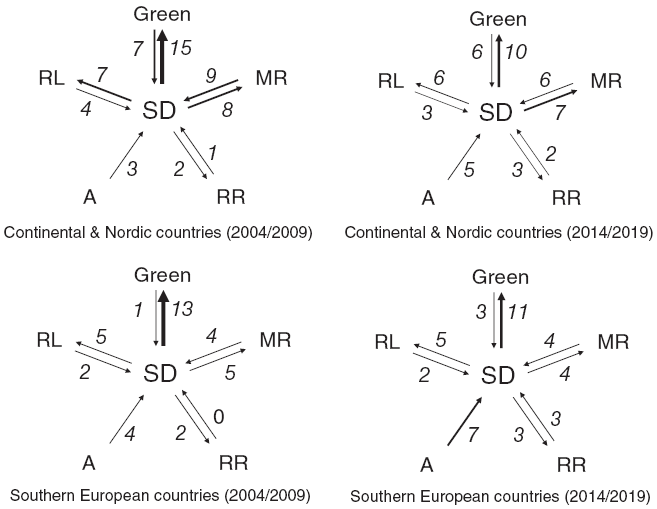
To gauge the implications of a New Left programmatic strategy, we want to know whether inward overlaps from green/left-libertarian parties outweigh outward overlaps to the Radical Right. Figure 6.5 shows the potential gains from green and left-libertarian parties compared to the potential losses to radical right parties as a share of the overall electorate and differentiated by region and decade. We see that on average, potential gains seem to outweigh potential losses in Nordic and Continental European countries (7% vs. 2–3%) but not in Southern European countries. For Nordic and Continental European countries, inward overlaps amount to twice or three times the outward overlaps. The average voting propensity of green overlap voters for the Social Democrats is about the same as the voting propensity of social democratic overlap voters for the Radical Right (i.e., about 6.5–6.7 on the scale 1–10). The question, of course, is, whether such a strategy would also lose voters to the Moderate Right, to which outward overlaps are larger. Given the relatively conservative attitudes of centrist voters especially in the field of immigration (cf. the chapter by Abou-Chadi et al. in this volume), one might expect at least some effect in this direction, which might, however, be partly compensated by additional gains from the Radical Left. Hence, overall, a New Left strategy appears likely to yield positive payoffs for social democratic parties in Continental and Nordic Europe.
The same does not hold for Southern Europe. While estimated outward overlaps to the Radical Right are very low, so are inward overlaps from within the left field. Given that the new alternative parties in the left field have mostly mobilized against the mainstream (establishment) parties, it makes sense that their voters are reluctant to consider the mainstream left as an electoral option. This somewhat lower inward potential within the left field explains why the New Left strategy seems less promising in Southern Europe than in the Continental and Nordic countries.
To evaluate likely payoffs of an Old Left strategy, we compare inward overlaps from the Radical Left to outward overlaps to the Moderate Right.Footnote 4 From Figure 6.5, it appears that an Old Left strategy would on balance seem highly risky, as inward overlaps at the left end of the spectrum amount to only about half of the outward overlaps at the centrist end of the spectrum in both Northwestern countries (3–4% vs. 5–8%) and in Southern European countries (2% vs. 4–5%). A comparison of average voting propensities reinforces this conclusion for Northwestern Europe: Radical left voters who do include the Social Democrats in their consideration set on average rate their propensity to vote for them only at 6.17, that is, it seems that they would be hard to “win over,” whereas the propensity of outward overlapping voters for the Moderate Right is slightly higher (6.36). On this basis, the (small) potential gains from the Radical Left seem indeed hard to realize, in comparison with the more likely losses to the Moderate Right they may entail. In Southern Europe, by contrast, outward overlapping voters on average have a rather low voting propensity for the Moderate Right.
A Centrist strategy is supposed to appeal to moderate right voters by means of more moderate policy positions mainly on the socioeconomic dimension but entails the risk of shying away voters to radical left parties in particular, and – given the very progressive policy preferences of green and left-libertarian voters on both economic and social issues – also to some extent to green and left-libertarian voters. Figure 6.5 indicates that potential gains from the mainstream right parties are indeed on average somewhat lower than potential losses to the Radical Left parties but certainly much lower than potential losses within the left field overall (i.e., green/left-libertarian and radical left parties). Inward overlaps from moderate right parties amount on average to 6–9% in Northwestern Europe and 4% in Southern Europe, which are relatively low numbers given the size of the moderate right party family. In addition, the average voting propensity of these overlapping moderate right voters for the Social Democrats is very low (6.1–6.2). On the other hand, the combined outward overlaps to green/left-libertarian and radical left parties amount to 16–22% in Northwestern Europe and 17–18% in Southern Europe, with much higher average propensities (6.3–6.85). Hence, on balance, there is reason for skepticism whether a Centrist strategy would attract large vote shares to social democratic parties and/or the Left field.
Finally, a Left National strategy would seek to appeal to inward overlapping voters of the Radical Right, at the risk of losing outward overlapping voters within the left field to green/left-libertarian and radical left parties. The assessment of the likely payoffs of such a strategy is quite straightforward: Potential losses are likely to outweigh potential gains by far. While inward overlaps from the Radical Right amount to 0–2% of the electorate in both regions, potential ensuing losses to the green/left-libertarian parties alone go in the numbers of 10–15% relative to the entire electorate. Outward voting propensities for the green/left-libertarian parties are also higher than among inward overlapping voters, at least in Northwestern Europe where outward overlapping voters to the Greens have on average very high propensities. Even if we include orthogonal additional potential gains and losses (from the Moderate Right and toward the Radical Left) into the assessment, the likely balance of a Left National strategy still seems to remain negative. This approximative assessment of payoffs is consistent with analyses of vote switching (see the chapters by Abou-Chadi and Wagner, as well as by Kitschelt and Rehm in this volume), as well as experimental survey evidence on the resonance of programmatic appeals within the potential electorate (see the chapter by Abou-Chadi et al. in this volume).
6.5 Conclusion
In this chapter, I have assessed electoral potentials of social democratic parties, overall, as well as in terms of inward and outward overlaps, in order to gauge the potential for social democratic parties to (re-)grow, the profile of their overlaps with other parties, as well as likely payoffs of some of the strategic programmatic options that are currently on the table for social democratic parties.
The EES voter propensity data from 2004 to 2019 show a number of patterns that are strikingly consistent across countries and time: First, social democratic parties still enjoy a large electoral potential in almost all countries. Social democratic parties have remained a viable electoral alternative for 40–50% of all voters or even more across countries. Hence, there is both demand and room for social democratic politics. However, the competitive environment for social democratic parties has clearly intensified, because the electoral potentials of green, radical left, and also radical right parties have increased over time, while the electoral potential of social democratic parties has declined in most of the countries. Green parties in particular clearly start to close the gap toward social democratic parties when it comes to the electoral potential.
The analysis also supports the idea of a “left field” across countries. Overlaps between either green and left-libertarian and/or radical left parties and Social Democrats are much higher than between social democratic party electorates and the Right. In particular the rank order in the extent of overlaps with other party families is consistent across regions and time: Overlaps are generally strongest with green and left-libertarian parties, followed by overlaps with the Radical Left, inward overlaps from abstentionists, followed by overlaps with moderate right parties and – eventually – radical right parties. Overall, however – and this is also consistent across countries – overlaps within the left field are not symmetrical: Outward overlaps to the alternative parties within the left field largely exceed inward overlaps from these same parties, and this asymmetry increases over time. This indicates that we see a growing differentiation within the left field, with the social democratic parties’ dominant position becoming more and more contested in many countries. In line with these findings, we see that – especially in Northwestern Europe – outward overlapping social democratic voters have a higher voting propensity for the rival parties than the corresponding inward overlaps. In other words, potential losses seem more likely than potential gains. In terms of classes, our findings show that competition over voters revolves around middle-class voters as much as around working-class voters. Especially in the countries of Continental and Northern Europe, overlaps concentrate among the middle class and the more highly educated voters.
Within a largely consistent picture, the analyses also show a number of regional differences: It appears that social democratic parties face the sharpest trade-offs in the countries of Continental and Northern Europe: Inward overlaps from other party families consistently decline while outward overlaps tend to increase. This seems to indicate a particularly fragile situation for social democratic parties, because potential losses in most directions are substantial, while potential gains remain generally smaller. When it comes to the class profile of potential voter flows, Social Democrats seem to mainly compete over middle-class voters with their left-libertarian rivals but over working-class votes with the Radical Left and the Radical Right in Southern Europe. Hence, it seems that if at all, the working vs. middle-class trade-off exists in Southern Europe. In Nordic and Continental Europe, we do not find such a class trade-off, as both inward and outward competition focuses on voters in higher education categories and in the middle classes.
Finally, we have gauged the potential payoffs of different programmatic strategies by comparing inward and outward overlaps across the ideological spectrum. The main finding is that no programmatic strategy in any of the regions is associated with a decidedly positive net payoff. This results from the fact that in most instances, outward overlaps in any direction outweigh inward overlaps, and outward voting propensities are on average higher than inward voting propensities. Two findings stand out quite clearly, however: First, the New Left strategy on average seems to hold the most positive, or at least balanced payoffs, at least in Continental and Northern Europe. In Southern Europe, this strategy is limited by the weak propensity of green and left-libertarian voters to support the Social Democrats. Second, a Left National strategy is impaired by both very small inward overlaps from radical right parties, as well as massive outward overlaps within the left field.


 Open access