


Introduction
Approximately 500 000 adult ‘patient pathways’ (from General Practitioner (GP) referral to receipt of a hearing aid) are completed by the National Health Service in England annually, and on average in the South West, in 2006, patients were waiting 16 weeks (The House of Commons Health Committee, 2007). A preliminary study by Davis et al. (Reference Davis, Smith, Ferguson, Stephens and Gianopoulos2007) looked at the acceptability, benefit and costs of early screening for hearing loss and stated that it can take 10 years for people to seek help for hearing loss, despite the loss being apparent to their significant others (Davis et al., Reference Davis, Smith, Ferguson, Stephens and Gianopoulos2007). There are audiological advantages in using amplified sound to assist hearing sooner rather than later, including improved neural processing of sound and better speech perception (Davis et al., Reference Davis, Smith, Ferguson, Stephens and Gianopoulos2007). A new framework, ‘Improving Access to Audiology Services in England’ (Department of Health, 2007a; 2007b), proposes the one-stop assessment and fitting of hearing aids (www.18weeks.nhs.uk).
Evaluations of ‘assess and fit’ services have focussed on clinical efficacy (Smith et al., Reference Smith, Mack and Davis2008); however, such evaluations are lacking insight into the patient's perspective, which is generally limited to a basic measure of satisfaction with the aid. Indeed, it is noted that careful triage is key to successful delivery of the service, as some need time to accept their hearing loss and adjust to the idea of hearing aids (Smith et al., Reference Smith, Mack and Davis2008). Motivation has been identified as a key factor in successful uptake of hearing aids (Humphrey et al., Reference Humphrey, Herbst and Faurqi1981; Gatehouse, Reference Gatehouse1994). Interventions that may affect motivation such as counselling have been identified as important components to a hearing-aid service (Humphrey et al., Reference Humphrey, Herbst and Faurqi1981; Field and Haggard, Reference Field and Haggard1989; Meadow-Orlans, Reference Meadow-Orlans1991; Gomez and Madey, Reference Gomez and Madey2001). However, the process by which these interventions assist adjustment to hearing loss and hearing aids is not well understood. The relationship between acceptance of hearing loss and use of hearing aids is also unclear, yet often treated in the literature as synonymous. Therefore, when patients report using alternative coping methods without uptake of services they are described as underestimating their problems or being ‘in denial’, rather than as enacting emotion-focussed coping behaviours (Rosenhall and Karlsson Epsmark, Reference Rosenhall and Karlsson Epsmark2003). Relatively, little work has sought to understand the process of adjusting to a hearing loss from the patient's perspective, but it can lead to important insights such as the work of Hallberg and Carlsson (Reference Hallberg and Carlsson1991) who identified the need for individuals to maintain a normal identity and the use of humour as a means to coping. They highlighted the presence of stigmatising attitudes to hearing that make adjustment difficult and a complex process.
This paper presents data from a pilot study using qualitative research methods to learn about the patient's perspective when seeking help with hearing. Our aim was to explore the patients’ expectations in help-seeking and to consider how prepared they were for a hearing-aid issue.
Methods
A qualitative inquiry provides insights from individual participant's perspectives, thus leading to improved understanding of the process through the patient's eyes (Creswell, Reference Creswell2007; Sweet, Reference Sweet2008). It builds an understanding through which similarities and differences can be highlighted (Marshall and Rossman, Reference Marshall and Rossman2006) and is informed by the epistemological notion that meanings and experiences are innately subjective and rely on human interpretation (Sweet, Reference Sweet2008). The design and methods were peer-reviewed and ethics and governance consents were obtained from Wiltshire Research Ethics Committee and the University of Bristol.
Population studied
The population comprised adults who were referred into the audiology department of Salisbury District Hospital by their GPs because of hearing difficulties. The first 100 new cases who were over 50 years old with fluent spoken English were sent a consent form and a participant information sheet. The participants were purposefully selected from the consenting group to provide a rich contrast amongst the sample. As the study progressed, cases were sought to provide more atypical experiences or contrast (Coyne, Reference Coyne1997). In this pilot study, six participants were selected in this manner, three were female participants and three were male participants. One man and one woman still worked, the rest were retired. The age range was 65–77 years. This sample was diverse because they varied in age, background, working history, gender and the social activities that they undertook. These factors were considered by the researchers to be possible influences on their experience of help-seeking and readiness for hearing aids (Table 1).
Participant details

Interview process
The data were obtained from interviews conducted with the participants before their first visit to the audiology department. The time taken for each interview was limited to 1 h and they were visited individually at home, at a time that was negotiated to suit them.
The interview took the form of a ‘conversation with purpose’ (Mason, Reference Mason2002). The interviews were audio taped, then transcribed verbatim, and the tapes were anonymised. Transcripts were analysed using thematic analysis, looking at similarities and differences between accounts, thus producing themes. Participants were given the transcript and audiotape afterwards for their records and personal reflection. They were telephoned after receiving the transcript to check that they were happy with it; this took approximately 15 min. Participants were encouraged to share their own stories in their own way, describing aspects that were important to them.
Analysis of data
The researcher aimed to discover and interpret the concealed meaning embedded in the words of the transcripts. Each transcript was analysed line by line by the researcher using a coding technique outlined by Burnard (Reference Burnard1996). These codes are then grouped to form themes that provide a descriptive summary of the meanings communicated in each transcript.
Findings
Six participants described their symptoms, articulated reasons for help-seeking and outlined some of their expectations.
The social construction of hearing loss symptoms is apparent in their descriptions so that individuals may not consider themselves to have a problem but, nonetheless, notice communication difficulties. These difficulties are attributed to hearing loss by others. This in turn creates a tension in expectations of help-seeking. In seeking help, participants are looking for solutions to the communication difficulties, to assume some responsibility for the problems (especially with partners). They do not describe help-seeking with a view to acquiring a hearing aid.
Symptom construction
Hearing loss symptoms are described by participants as problems they encounter in communication and also as other's interpretations of their behaviour in communication. The descriptions of symptoms vary according to the interpretation of them as coherent signs of hearing loss. For Ava, Joan, George and Susan, hearing problems are recognised as indicating a hearing loss. For Arthur, the problem refers to the behaviour of others. He notes that particular voices are difficult to hear and particular sound quality will affect his hearing, but does not consider himself to have a difficulty. Fred, however, is clear that the hearing loss is a health problem, which has worsened over time (Table 2).
Attributions of hearing loss symptoms
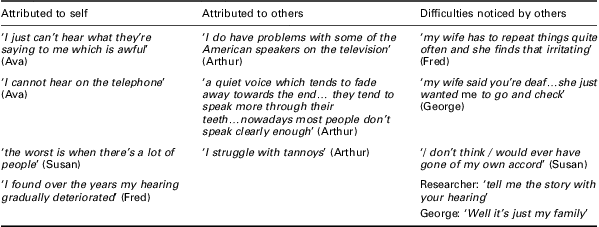
All participants report that others influence their perceptions of the difficulties. As a result, he reported that his wife coerced him into seeking help:
I was forced into it (Arthur)
Likewise, for George, the decision to seek help followed further complaints from his wife.
Susan feels that her family and spouse have influenced her to go to the doctor.
This highlights that hearing loss is a shared problem between the affected individual and their communication partners. In seeking help, these individuals are appeasing others and responding to their own concerns about symptoms.
Help-seeking
Help-seeking is a coping behaviour with both a bio-medical and social function. In seeking clinical help, participants describe hoping for a medical solution to the difficulties. They describe a clear preference for such a solution over a hearing-aid issue.
It would be wonderful if they could solve the problem but/don't really expect that (Ava)
Joan mentions a lack of optimism about what may happen when she seeks help: ‘/ don't feel optimistic really to be quite honest…a hearing aid/ assume would be the answer and being vain I suppose and female I don't particularly want a hearing aid but there you go I will just have to take advice and see’. (Joan)
Hearing aids and stigma
The biggest themes to occur across all the accounts were: first, concerns over having a hearing aid, and, second, the stigma associated with hearing loss and hearing aids. Concerns over having a hearing aid can be seen as an internal factor that influences help-seeking, and stigma can be seen as an external factor.
Arthur sums it up by saying ‘I would have to be desperate to wear it’.
Joan associated wearing a hearing aid with ‘old age’ and likened it to wearing ‘continence pads’. Ava felt there should not be a stigma to wearing an aid as ‘everyone wears glasses but there is’ and ‘they're not very attractive’.
Researcher: What do you associate wearing a hearing aid with?
Ava: Old age.
Participant descriptions of hearing aids focus on negative associations with ageing and participants refer to distancing themselves from this solution as a means of preserving self-esteem and social identity. As George states: ‘I don't want a blasted hearing aid’ because ‘I wouldn't say I'm deaf’.
Likewise Joan describes how a hearing aid would be a stigmatising symbol of difference ‘I don't have a friend with a hearing aid – it's just going to be me …I'd be different’.
Social support appears to offer protection to self-esteem, and women are considered to have higher levels of social support than men (Zimet et al., Reference Zimet, Dahlem, Zimet and Farley1988). Theoretically, this social support may furnish women with communication partners who mediate the stressor of the hearing loss by adjusting their communication behaviour or by moderating the social meaning of hearing loss. It is interesting that Joan notes that being the only one in her social group to have a hearing aid would make it more difficult to cope with. How this mediation occurs in this context is not clear and there is scope to consider how gender differences may mediate detection of hearing loss symptoms and uptake of hearing aids.
Fred had considered that the solution to managing this stigma was to preserve secrecy about the hearing aid. He suggested that he could ‘wear it without anybody knowing’. He considers that the size of the hearing aid will help this ‘I don't think they're particularly noticeable’. He reinforces the notion that visibility of hearing aids are associated with stigma and spoiled identity (Goffman, Reference Goffman1963). These findings echo previous work into stigma and help-seeking for hearing aids (Wallhagen, Reference Wallhagen2009) in which hearing aids are considered by participants to be unattractive and ageing.
Responsibility for communication
Participants describe seeking help with hearing as a means of assuming responsibility for communication difficulties.
In every case, the impact of hearing loss on those around them is what prompts help-seeking. Joan describes increasing frustration in communicating at work.
‘/ just can't hear what they're saying to me which is awful… particularly if they're talking in a confidential way/ cannot hear at all… it's just frustrating …… well/ thought either/ just quit or/ try and get something done’ because if ‘/ can't hear well then I'm useless aren't I?’
The dimensions including feeling a lack of empathy from the people they were interacting with, a withdrawal from social situations and a feeling of being bothersome to others. Fred for example said, ‘I don't find it too much of a problem but other people do’.
This responsibility is taken as a direct attempt to appease others.
For Arthur this concern is related to his wife:
my wife threatened me with divorce and I explained to her that if I didn't like the hearing aid, she could have the divorce
Expectations
The participants were aware of hearing aids as a possible treatment option, but they are considered an undesirable solution. The social impact of hearing loss was a recurring theme that affected all the participants. The properties of this theme included isolation, embarrassment, blame and public incidents. The hearing loss affected their concentration and enjoyment of social activities, it was deemed a ‘nuisance’ by Ava. The hearing aid is seen as an acknowledgement of failure in providing better treatment options to the difficulties they experience. The range of views extends from pragmatic: ‘I just hope it helps’ (Ava) to resistant: ‘I don't really need the hearing aid’ (Arthur).
Conclusions
This study presents some viewpoints from people who are routinely prescribed hearing aids. This highlights how, in the view of the participant, to accept a routine treatment for hearing loss in fact implies a significant challenge to their social identity. Hearing aids are associated in these data with older age and are regarded as a stigmatising feature of acknowledging hearing loss. The participants describe managing self-esteem in the presence of hearing difficulties. This is achieved in part by acknowledging the social construction of the difficulties, that is, participants notice that environmental factors are key in determining how well they will be able to function. One participant considers that environmental factors are the cause of the difficulties, whereas the others refer to a combination of environmental and individual difficulties. The act of help-seeking is a coping behaviour to elicit support and to appease close friends and family. Help-seeking assumes responsibility for the problems in communication and provides legitimate entry to a ‘sick role’ as a hearing impaired person (Parsons, Reference Parsons1964). The ‘sick role’ has been defined by sociologists as the role that a patient adopts through help-seeking in which their complaint is validated through acquiring a clinical label and identity. It is also a socially sanctioned state from which one is obliged to make efforts to comply with clinical help and, in doing so, to ‘get better’. Therefore, help-seeking can be seen as fulfilling an important social role for participants.
This report highlights that even when patients seek help, patient motivations are frequently to appease others or to acknowledge responsibility in communication breakdown. Previous studies have noted that people regard stages of help-seeking as discreet and that acceptance of hearing needs did not link directly to seeking hearing aids and that seeking hearing aids did not predict use of hearing aids in either United Kingdom, United States of America or Danish healthcare systems (Laplante-Lévesque et al., Reference Laplante-Lévesque, Knudsen, Preminger, Jones, Nielsen, Öberg, Lunner, Hickson, Naylor and Kramer2011). Reasons for subsequent rejection of hearing aids include stigma and a sense that current coping is adequate (Wallhagen, Reference Wallhagen2009; Lockey et al., Reference Lockey, Jennings and Shaw2010; Laplante-Lévesque et al., Reference Laplante-Lévesque, Knudsen, Preminger, Jones, Nielsen, Öberg, Lunner, Hickson, Naylor and Kramer2011).
The presence of stigma influences decisions to seek help and attitudes towards hearing aids. This has been documented elsewhere as presenting a barrier to help-seeking (Wallhagen, Reference Wallhagen2009).
Social identity theory suggests that we draw social capital and esteem from the social groups we belong to. Where hearing loss is present, this challenges group membership. Low status groups (such as older or disabled people) are thought to demonstrate more in-group bias than high status groups. People may attempt to leave the low status group by engaging in social competition such as attributing hearing symptoms to other causes and comparing self with other people (Doosje et al., Reference Doosje, Ellemers and Spears1995). Treatment options are still associated with social stigma and individuals often distance themselves from the stigmatised group (ie, hearing-aid wearers) to preserve self-esteem. This presents difficulties for providers of hearing services as the treatment for social exclusion is in itself a source of social stigma. Help-seeking should not be considered to represent readiness for hearing aids. It highlights the fact that people seek help for numerous psycho-social reasons (including family pressure) and that this needs to be considered when expecting rapid issue of hearing aids. These issues will need to be addressed in order for hearing aids issued during ‘assess and fit’ appointments to be used. Recommendations include better information for patients, GPs and significant others regarding audiological and social services, lip-reading classes, communication training and hearing aids. This study suggests that time is needed to explore the reasons people seek help so that their needs and wants can be addressed satisfactorily. Therapeutic services such as hearing therapy advice and counselling may be useful resources for patients who are not prepared for a hearing aid.



