


… for a people to survive in struggle it must be on its own terms: the collective wisdom which is synthesis of culture and the experience of that struggle. (Cedric Robinson, Black Marxism, “preface”)
The history of the Negro is illustrated by charts and photographs; there is, for instance, a series of striking models of the progress of the colored people, beginning with the homeless freedman and ending with the modern brick schoolhouse and its teachers … [t]his is the exhibit of American Negroes, planned and executed by Negroes. (W. E. B. Du Bois, “The American Negro at Paris”)
Epistemological contention is integral to any crisis. At the turn of the century, as Du Bois sought to communicate the crisis of Black lives situated alongside deep-seated racism, physical violence, poverty, crime, social dislocation, and more, he also sought new methods of representation and ways to conceive of how sociology could be utilized for emancipatory ends. Using sociological methods, Du Bois described the “progress” of African Americans after Emancipation in the global arena during the 1900 Paris Exposition Universelle. As Euro-American empires flaunted their territories, represented their colonies as exotic spaces for consumption, and projected a certain epistemological understanding of the organization of the world along the color line, Du Bois brought a different reality to the Exposition. He situated the United States in a global space of inter-imperial exchange (i.e., the Exposition) by beginning the exhibit with a visualization of the slave trade across the Atlantic. Du Bois emphasized the sovereignty Footnote 1 of Black Americans and the amount of “progress” achieved despite conditions of persistent white supremacy. With a plethora of images, statistics, books written by Black authors, photographs, and cultural artifacts, he provided a narrative of social development that challenged racial stereotypes and the developmental model favored by empire-states, in effect asserting and reclaiming Black people’s sovereignty stripped off in the US empire-state (see Jung Reference Jung2015).
Centering Du Bois’ embeddedness in collaborative epistemic communities and his socio-political context, we read his work for the Paris Exhibition of 1900 as a strategic response to the double crisis of social science and post-Reconstruction Black America. Rather than revisiting well-covered debates about the limits and evolution of his thought (Appiah Reference Appiah1985; Connell Reference Connell1997; Gooding-Williams Reference Gooding-Williams2011; Itzigsohn and Brown Reference Itzigsohn and Brown2020: 67), we focus on his responses to this double crisis to gain insights into how contemporary historical social scientists can give meaning to their own crisis-ridden present.
First, we show that in collaboration with Black American and Pan-African activists, Du Bois dislocated the concept of “progress” from a teleological, abstract, and ahistorical universe, and rearticulated it as a contextualized, historicized, and multidirectional postulation. While doing so, he deployed the unit of “nation” strategically to unsettle preconceived notions of national development and comparisons resting on Social Darwinist measurements of progress toward whiteness. Instead, he developed a relational approach to comparison. We argue that while Du Bois used the imperially charged terminologies of “progress” and “civilization” and was himself inescapably embedded in an imperial context, he was subverting these concepts through his usage of visual data, statistical demonstration, and historical contextualization. Consequently, as he used the concepts enabling inter-imperial legibility at the Exposition, Du Bois also confronted prevailing social scientific methods and an imperial epistemeFootnote 2 in the very center of the French Empire. He was in effect carving out a public sociological space that challenged the epistemological hegemony of imperial white sociology. Challenging both a nation-state model that restricted his analysis of the colonial/imperial slave trade and a comparative model based on an ahistorical and categorical understanding of supposedly equivalent units of analysis, Du Bois put forward a new comparative historical sociology (also see Hammer and Itzigsohn Reference Hammer and Itzigsohn2025).
Second, we underscore how “Du Bois feeds off and feeds into the movements of his time – socialist, Pan-African, Harlem Renaissance, civil rights, African independence, and international peace movements – showing us how sociology undergoes permanent revolution” (Burawoy Reference Burawoy2022: 195). Transforming sociology through collaborative engagements with communities of political resistance, Du Bois unsettled and wrested meaning out of imperially charged concepts in worldly ways. Third, we discuss how reading Du Bois’ engagement with the 1900 Exhibition through a framework of “reverse tutelage” (Meghji Reference Meghji2024) provides us with tools to rethink our contemporary position as historical social scientists facing another historical conjuncture defined by a double crisis of social sciences and empire. This consideration also pertains to the vexing question of how histories can yield insights into the present – including contemporary crises.
The contemporary crisis of historical social sciences
Today, social sciences in general and historical sociology in particular are once again experiencing an institutional and epistemological crisis. Research that has immediate translatability for policy recommendations and practical action is elevated above others in a neoliberal university field in cooperation with the state and market (Mohanty Reference Mohanty2003), devaluing historical investigations that do not produce immediate solutions to problems. Thus, historical social scientists find themselves not in demand and under pressure to produce in competition with other branches of sociology, with significantly faster academic output, such as demography. The “powerful illusion of a meaning-free social science,” “the repression of historical thinking within the human and social sciences” (Steinmetz Reference Steinmetz2017: 2), and a pull toward presentist approaches that seek policy solutions to immediate problems – even when they are rooted in large-scale and deeper crises – threaten the field’s legitimacy. Combined with the aforementioned pressures of the neoliberal university, Anglo-American institutional hegemony (Connell Reference Connell1997; Kennedy Reference Kennedy2014) in social sciences has meant that researchers from, based in, or conducting research on the Global South and other non-Western histories have been particularly precarious, facing market and institutional pressures to make themselves useful for, or at the very least translate their findings for American audiences. As Kennedy (Reference Kennedy2014: 155) observes, the costs of this includes shrinking of the publics with whom social sciences are associated; “To the extent inequalities within the global system of knowledge production are exacerbated, and knowledge wealth is concentrated ever more in the 1 percent of universities and their most proximate publics, public knowledge actually diminishes.” This shrinking of publics goes hand in hand with contemporary state encroachment and repression upon universities, forcing funding cuts and ideological conformity in the social sciences. The disposability of historical social scientists becomes especially acute under these circumstances.
Yet, historical social sciences are uniquely situated to explain, analyze, and provide tools to deeply understand and engage with today’s predicaments – ranging from authoritarianism and automation-driven labor precarity to climate change. They are intimately connected with concept formation and, in the past decades, have made visible the imperial, racialized, and gendered subtexts of many concepts we use (see Patil Reference Patil2022). Thus, we know that “[r]ace and racism inform not only the way the history of the modern world is narrated, or the way social change is explained; rather they are intrinsic to the epistemological foundations of the conceptual apparatus of social theory” (Ascione and Chambers Reference Ascione and Chambers2016: 307). In this vein, Magubane (Reference Magubane2016) has questioned the racialized ontology of US sociology, Go (Reference Go2014) has unpacked the occlusion of global power relations and the parochiality of American sociology, Bhambra (Reference Bhambra2016) has demonstrated how the Weberian concept of the “state” is a product of imperial relations, and the edited volume Sociology and Empire (Steinmetz Reference Steinmetz2013) has questioned the relationship between sociological knowledge and imperial power. Postcolonial, decolonial, and global historical sociology has thus sought to deconstruct the power relations embedded in the concepts we use, in the process dismantling the assumptions behind “grand narratives” and units of analysis. Social science methodologies are part and parcel of what Ascione and Chambers (Reference Ascione and Chambers2016: 312) call the “colonial matrix of power,” which “operates not only through narratives and explanations in history and the social sciences; it is also profoundly inscribed inside methodological strategies, extending and reproducing concept formations on the back of earlier colonial biases.”
While these critiques have been raised, imperial epistemological legacies have not been dismantled in our sociological imaginations, and the need for new analytical categories has been voiced by many authors highlighting this vacuum. In this context, Steinmetz has written about the “two crises that are often experienced as separate but are actually interwoven: ‘the crisis of the universities’ and the ‘crisis of empire’” (Reference Steinmetz2013: xiii). These imperial epistemological legacies are activated through mundane vicissitudes of research in Anglo-American institutions, exacerbating the epistemological and institutional crises together in historical social sciences.
Steinmetz (Reference Steinmetz and Steinmetz1999) calls for a recovery of the meaning and context of our “data” in historical sociology as opposed to the elements of neo-positivism (Steinmetz Reference Steinmetz and Steinmetz2005) and nomothetic thinking developed in the imperial episteme(s) of the nineteenth century, which still undergird sociological thinking and our “epistemological unconscious.” He names the approach that assumes instrumental rationality as a universal human nature as “foundational decontextualization”: “defined as a view of human subjectivity as determinable outside its social and historical context” (Steinmetz Reference Steinmetz and Steinmetz1999: 20).
A focus on lived experience and layered relations of power, situated within global history, is one way to recover this meaning. About a century before Steinmetz’s identification of the problem of foundational decontextualization, Du Bois was already wary of the same tendency in normative social sciences. On the difficulty of researching the plight of newly freed Black people, Du Bois (Reference Du Bois1898: 18–19) noted in “The Study of the Negro Problems”:
[T]hese problems, so vast and intricate, demanding trained research and expert analysis, touching questions that affect the very foundation of the republic and of human progress. … Nothing makes intelligent discussion of the Negro’s position so fruitless as the repeated failure to discriminate between the different questions that concern him. If a Negro discusses the question, he is apt to discuss simply the problem of race prejudice; if a Southern white man writes on the subject he is apt to discuss problems of ignorance, crime and social degradation; and yet each calls the problem he discusses the Negro problem, leaving in the dark background the really crucial question as to the relative importance of the many problems involved. … [T]o study the Negro intelligently, we must realize definitely that not only is he affected by all the varying social forces that act on any nation at his stage of advancement, but that in addition to these there is reacting upon him the mighty power of a peculiar and unusual social environment which affects to some extent every other social force.
Taking Du Bois’s concerns seriously, we aim to highlight how he contextualized the data illustrations he presented at the Exposition, just two years after the essay cited above. Du Bois’s scholarly practice in 1900 offers a meaningful lesson for historical social scientists today, prompting reflection on how we might confront contemporary epistemological and imperial crises.
Second, recovering meaning through adequate contextualization is also deeply entwined with understanding the meaningfulness of research practices in their historical moments. One premise of this approach is to take into account the political commitments of authors. Indeed, understanding Du Bois’s political commitments and the field of contention he was embedded in is crucial to analyzing the visual and statistical data he presented at the 1900 Exposition, which were situated within, yet subversive of, the imperial conceptual field organized around notions of “progress,” “science,” and “civilization.” We understand concept formation not only from “data” but also through Du Bois’s political commitments underlying his knowledge production.
Under conditions of the neoliberal university and Anglo-American hegemony in knowledge production, making our commitments and concept usage legible as researchers becomes ever more important to unsettle Eurocentric categories we inevitably utilize in our research. In this sense, we should recognize that “[t]he globalization of sociology across the world(s) changes not only the adequacy of existing responses to the questions that the relation between narratives and concepts raises” but “[i]t also asks new uncanny questions, and radically interrogates both the vocabulary and the grammar in which such questions and answers are formulated” (Ascione and Chambers Reference Ascione and Chambers2016: 303).
Meaning and meaningfulness of data
Following the aforementioned line of reasoning, we understand the meaning of Du Bois’s data by contextualizing his presentation at the 1900 Paris Exposition within his political biography and tease out the meaningfulness of his data presentation by situating his politics within the socio-political conditions at the turn of the century – that is, (1) the imperial episteme produced through inter-imperial exchanges among Euro-American empires and (2) the transformative episteme he adopted through his embeddedness in politically active communities.
Meghji (Reference Meghji2024) reconceptualizes Burawoy’s concept of “public sociology” through Gopal’s (Reference Gopal2019) notion of “reverse tutelage.” Knowledge production in this transformative public sociology is not conceived as one of benevolence and gift-giving on the part of the sociologist, but rather the sociologist transforming their sociological vision through learning new ways of knowing in a dialogic relationship with community activists. Du Bois’s subversive usage of sociological concepts likewise stemmed from sustained engagement with activist communities. Wright (Reference Wright2009: 707–8) emphasizes, for instance, “researchers associated with the Atlanta Sociological Laboratory, who were not professionally trained social scientists but were community activists who were deeply committed to engaging in activities directed at understanding and improving the condition of Blacks in America.” Also, Du Bois’s work in the Paris Exposition of 1900 cannot be read apart from his involvement in the Pan-African Congress on July 23–25, 1900, where with fellow activists, he famously declared “the problem of the 20th century is the problem of the color line” (Walters et al. 1900: 12). In this sense, it would provide us only with half the picture to focus solely on the individual sociologist and their thought insulated from their community.
We draw extensively on Du Bois’s writings from the period, including “The Study of the Negro Problems” (1898) and The Souls of Black Folk (Reference Du Bois1903 [2007]), for gauging his reasoning at the 1900 Paris Exposition. As Smith (Reference Smith2004) demonstrates, Du Bois became a visual theorist through experiencing the Jim Crow regime – its starkly visible racist segregation – fully instituted from the late nineteenth century. He had already developed the conceptual core of “double consciousness” without the exact wording by the time of the Exposition. Thus, the essays from 1897 to 1902, later collected in Souls, are integral to his thinking around 1900. We also interpret the data portraits through a contrapuntal reading of Du Bois’s knowledge politics vis-à-vis the intellectual culture of his contemporaries, attending to his social positionality: his intellectual production and representation of Black Americans constituted a political struggle against Euro-American spectators’ imperial episteme. Alongside selected primary evidence, we engage secondary literature on Du Bois and empire studies. Primary visual materials were obtained from the Library of Congress, and we also consulted the Du Bois Center archive at the University of Massachusetts to examine their curation. All other primary materials come from the Du Bois Center.
The crisis of emancipation
Du Bois prepared the 1900 Exhibit at a time when institutionalized political and physical violence against African Americans intensified after the end of the Reconstruction. At the time when he was conducting his research in Georgia and Philadelphia, Jim Crow laws were being passed in the South, lynching “reached a climax in 1892,” and “between 1895 and 1909 the whole South disenfranchised its Negro voters by unfair and illegal restrictions” (Du Bois Reference Du Bois1940 [2007]: 55). Within this context, Du Bois sought to communicate the plight of African Americans to a global audience, shifting the positionality of Black people in the United States “from historical victim to historical actor” (Fisher Reference Fisher2005: 741). The Colored American put the political importance of having a separate exhibit for the Black community in the United States in Paris thus:
We do not agree with our esteemed contemporary The Africo-American Presbyterian that the plan for a distinctively Negro exhibit at Paris is unwise. It is the height of wisdom under the circumstances existing in the United States. Disguise the matter as we may, the colored man is on trial before the civilized world. American newspapers filled with ill reports and prejudiced utterances relative to our people reach the leading centers of thought among the people of Europe and it is a question in their minds as to whether we are guilty or not as charged in the indictment. They are watching for evidences of our progress. They want to see something we have done upon which to base a verdict. If the exhibits are merged there will be nothing to serve as testimony for the defense. The white people would monopolize the credit for everything accomplished. Since the separation is not designed as a mark of contemptuous discrimination we should approve of the plan for a race exhibit and do all we can to make it thoroughly representative. (The Colored American, January 6, 1900: 8, emphasis added)
As he was developing new approaches to empirical sociology, Du Bois found the universalist-positivistic methods of his contemporary social sciences limiting, overly generalizing, pathologizing, and serving the interests of imperial ends. Consequently, “Du Bois’s exhibit emerges as an example of his insistence on analyzing and revising sociological theory and practice” and “reveals to us the problems inherent in the discipline at the turn of the century” (Fisher Reference Fisher2005: 743). Three years after the Exhibition, Du Bois would write: “While sociologists gleefully count his bastards and his prostitutes, the very soul of the toiling, sweating black man is darkened by the shadow of a vast despair” (Du Bois Reference Du Bois1903 [2007]: 12), exposing the complicity of his contemporary sociologists in naturalizing disparities in social development as ontological difference rather than a consequence of socio-economic processes.
The methods and aims of social sciences were thus inseparable from “linear-progressive historiography” that posited the inherent and racial superiority of white Western empires while imagining “civilization” as a stagist path of development. Racialized peoples of the world, colonized and disenfranchised, were relegated to a “savage” status to become “civilized” at a non-arriving future date. The irony, as Chatterjee (Reference Chatterjee2006) points out, was that those racial ideologies, supported by social science and eugenics, ensured that the colonized and racialized could never be admitted into white civilization, even as they should strive for it. This stagial and linear historical thinking underlying developmental ideas at the time, combined with the political division of the world through empires between metropoles and colonies, undergirded social scientific thinking and methodology (see Connell Reference Connell1997). As Ascione and Chambers (Reference Ascione and Chambers2016: 312) contend, “from the interlacing of modernity, progress and development, there emerges a teleology that, in turn, becomes a theology, endorsing Occidental superiority in all manner of ways – from epistemological to cultural and racial violence.” This discourse of development/progress naturalized ahistorical comparisons across races and nation-states, ossifying social categories and methodological nationalism, and constrained the politics of representation and comparison within a limited lexicon (Hammer and Itzigsohn Reference Hammer and Itzigsohn2025). Elements of this matrix survive today in social sciences, for example, leading to developmental comparisons across post-communist states or between North and South Korea, where proximity to Western European states is measured as a yardstick of progress and European integration (Kennedy Reference Kennedy2002; Kim Reference Kim2024).
Since 1851, world expositions have been among the quintessential arenas in which the linear-progressive historiography was visually and experientially presented. Under the historiographic paradigm, as Smith (Reference Smith2004: 16–17) observes, white imperialists “scientifically” took the position of “civilizers,” while Black people were sequestered to the position of “savages.” Just a few years before the 1900 Paris Exposition, Black Americans were also excluded from participating in the 1893 Chicago Exposition. Mocking Black Americans’ desire to participate, cartoonist Frederick Opper produced the pamphlet “Darkies’ Day at the Fair” (see Figure 1).Footnote 3
“Darkies’ day at the fair” by F. Opper.

Opper even scribbled a story on his drawing: Major Moon, an African American from Georgia, prepared a watermelon stall since Africans from all over the world visited the exposition. However, the African visitors simply looted Moon’s stall, and he ended up saddened for “no payment,” as Moon’s facial expression shows at the bottom right corner. The racial representation in this drawing represented hegemonic ideas and corresponded to Social Darwinist thought among the dominant white public in the late nineteenth century (see Taylor Reference Taylor1981). Black people were represented as impulsive and instinct-driven, and their behavior in the cartoon was legible as an accurate “scientific” depiction.
For Du Bois, the presence of this “science”-backed racism represented a crisis not only for social science but also for human civilization itself. As a young scholar, he held a theological faith in the potential of social science to advance racial justice, provided that mainstream social scientists could overcome their racist bias (Du Bois Reference Du Bois1903 [2007]: 175):
Through all the sorrow of the Sorrow Songs there breathes a hope – a faith in the ultimate justice of things. … But whichever it is, the meaning is always clear: that sometime, somewhere, men will judge men by their souls and not by their skins. … The silently growing assumption of this age is that the probation of races is past, and that the backward races of today are of proven inefficiency and not worth the saving. Such an assumption is the arrogance of peoples irreverent toward Time and ignorant of the deeds of men … So woefully unorganized is sociological knowledge that the meaning of progress, the meaning of “swift” and “slow” in human doing, and the limits of human perfectability, are veiled, unanswered sphinxes on the shores of science.
Du Bois’s teleology and political investment in “progress” were distinct from the dogmatic belief that the white public held since he was attentive to the “crazy imperialism” (ibid.: 67) that dispossessed Black people:
Your country? How came it yours? Before the Pilgrims landed we were here. Here we have brought out three gifts and mingled them with yours: a gift of story and song …; the gift of sweat and brawn to beat back the wilderness, conquer the soil, and lay the foundations of this vast economic empire two hundred years earlier than your weak hands could have done it; the third, a gift of the Spirit. (ibid.: 175)
For young Du Bois, Black people were resoundingly soulful – by contrast to the racist belief that they were soulless and savage – and thus agentic, and they deserved their rights as modern citizens with sovereign rights. In this sense, when the white public imagined white-only modernization, Du Bois envisioned a progressive modernization that included Black people.Footnote 4
Interlaced with this commitment was his view on the “crisis” of Emancipation. The latter half of the nineteenth century was particularly formative to racial domination in his time, and he remained preoccupied with this period even toward the later period of his life. For instance, published in 1935, Black Reconstruction Reference Du Bois(1935) devoted its hundreds of pages entirely to the critical juncture of the 1850s–1880s. In his early intellectual life, he characterized this period with the term “crisis.” In The Philadelphia Negro, Du Bois (Reference Du Bois1899 [2007]: 6) stated the “crisis in the city” of Philadelphia was “brought on” by “the inpouring of the newly emancipated blacks from the South,” who were excluded from employment and civic lives due to the “intensified prejudice of whites.” When Du Bois (Reference Du Bois1903 [2007]: 17–18) wrote “Of the Dawn of Freedom,” originally drafted in 1901, the understanding of “crisis” above expanded:
All they [i.e., the philanthropic associations] did was needed, for the destitution of the freedmen was often reported as “too appalling for belief,” and the situation was daily growing worse rather than better. And daily, too, it seemed more plain that this was no ordinary matter of temporary relief, but a national crisis; for here loomed a labor problem of vast dimensions. Masses of Negroes stood idle, or, if they worked spasmodically, were never sure of pay; and if perchance they received pay, squandered the new thing thoughtlessly. In these and other ways were camp-life and the new liberty demoralizing the freedmen.
We can see glimpses of his much-discussed vanguardism in this passage, a stance Du Bois reiterated in “The Talented Tenth” essay. However, also central to the passage and the “Talented Tenth” essay (ibid.: 189) is the Black masses’ lived experiences of racist exclusion. Du Bois particularly pronounced their exclusion from secure economic lives, which was inextricably associated with questions of education and political sovereignty.Footnote 5 He was concerned that the perpetual economic and social crisis of displacement, economic and political disenfranchisement, and white supremacy would lead Black people to lose hope for progression toward eventual racial equity despite the accomplishments of the Emancipation (“new liberty demoralizing the freedmen”), confronted by continued experiences of insecure lives.Footnote 6
Du Bois was aware that he used the term “crisis” in a way radically different from his white imperialist contemporaries. For white planters and slave-owners, the 1863 Emancipation itself was the “crisis” of their economic practices; for Du Bois, the uncanny sameness that the ex-enslaved experienced in the Georgian “Black Belt” was the existential “crisis” of the freed Black humans who might internalize servitude and worthlessness (Reference Du Bois1903 [2007]: 94–95).Footnote 7 It should also be noted that Du Bois’s (ibid.: 39) response to Booker T. Washington’s Atlanta Compromise (made in 1895) was thus: “[a]t such crises … manly self-respect is worth more than lands and houses.” In this sense, Du Bois’s notion of “crisis” was closer to Spillers’s (Reference Spillers2018: 26, emphasis in original) theorization: thinking of Black people and culture, “crisis” should be conceived not “as a state of exception, but rather, as a steady state, given historical pressures that bear in on it and that become, as a result, intramural pressures” – “[racist] messages that originate elsewhere are assumed as a symptom of my [i.e., Black individuals’] own becoming.” Du Bois’s problematization of this process of becoming was the substance of his “crisis,” understood in a holistic manner with connected socio-economic and political aspects, in contrast to white planters’ simple profit-driven reasoning. Furthermore, Du Bois (Reference Du Bois1903 [2007]: 88) was acutely aware that white imperialists gradually introduced some structural arrangements (e.g., convict lease system) to put Black people into the same subordinate – or enslaved – status.Footnote 8
His understanding of crisis was a major driving force for Du Bois to take political action via intellectual products (or public sociology in today’s terms), including the materials curated for the 1900 Paris Exposition. It is telling that a decade after the Exposition, in 1910, he committed to another form of public sociology: the publication of The Crisis magazine. As a collective decision with fellow The National Association for the Advancement of Colored People (NAACP) leaders Mary White Ovington and William English Walling, Du Bois adopted the name of James Russell Lowell’s poem The Present Crisis for the NAACP’s official periodicals.Footnote 9 Written in 1845, Lowell’s poem was widely known as the anthem for the abolitionist movements, and it held a biblical conviction of the judgment of history.Footnote 10
Du Bois’s negotiation with the imperial episteme
Crisis and progress
In seeking a different type of sociology armed with a versatile methodological arsenal that could address Black lived experience in the United States, Du Bois approached his presentation in 1900 with an emancipatory sociology in mind. In his 1905 essay “Sociology Hesitant,” he critiqued “the present plight of sociology” by challenging abstract, generalized, and static concepts oft-employed by his contemporaries (Du Bois Reference Du Bois1905 [2000]: 37, 39):
“Society” was but an abstraction. It was as though Newton, noticing falling as characteristic of matter and explaining this phenomenon as gravitation, had straightway sought to study some weird entity known as Falling instead of soberly investigating Things which fall. So Comte and his followers noted the grouping of men, the changing of government, the agreement in thought, and then, instead of a minute study of men grouping, changing and thinking proposed to study the Group, the Change and the Thought and call this new created Thing, Society.
Du Bois instead approached sociology empirically, while highlighting the “Ought and May and Choice,” in other words, conscience, contingency, and agency in his sociology. He also underlined “the essential unity of the various studies of human activity and of effort to discover and express that unity” (Du Bois Reference Du Bois1905 [2000]: 43). For Du Bois, “to truly study racial inequality, one must employ an interdisciplinary approach that integrates historical study, statistical investigation, anthropological measurement, and sociological interpretation. … The African American experience in the United States could not be divorced from race, the legacy of slavery, and the ongoing unjust experience of ‘the color line’” (Wortham Reference Wortham2022).
It appears like a contradiction that Du Bois curated the exhibition materials without troubling the imperial ideology of linear-progressive worldview (see Connell Reference Connell1997: 1521; cf. Morris Reference Morris2015: 22–23) while he presented the social realities of Black people in the US South, an exemplary predicament of colonial domination (Jung Reference Jung2015: 67). He presented Black Americans as a nation-like community comparable to other Western nations, and he emphasized the educational attainment and wealth accumulation of middle-class Black people.
Appiah (Reference Appiah1985), Connell (Reference Connell1997), and Gooding-Williams (Reference Gooding-Williams2011) comment that, in this period, Du Bois had paternalistic notions of development and presented Black people in accordance with the imperial logic of linear-progressive history, a stance he later self-criticized in his autobiography Dusk of Dawn. In a similar vein, Smith (Reference Smith2004: 23) suggests that during the Exposition:
Du Bois anchors his antiracist critique in a patriarchal model of an African American elite, envisioning a restrained and disciplined African American manhood in critical contrast to the images of black manhood figured in the discourses enabling lynching at the turn of the century. … By heralding class to challenge race, Du Bois reinscribes the constraints of a (middle-class) gender hierarchy.
Indeed, in the Exhibit, education and domestic life are singled out as pillars of civilization and indicators of progress, signaling the limits of the imperial discourse within which Du Bois was operating. Calloway’s Report to the US Commissioner thus highlighted these aspects of the exhibit: “These models illustrated the various phases of negro life through which Southern slaves have passed since their emancipation and gave a clear insight into the advancement made with regard to domestic and educational life as a result of the new-born aspirations of the race” (Calloway Reference Calloway1901: 467, emphasis added).
Despite the limitations of his liberal pragmatism in 1900 – three decades before he adopted Marxism (Itzigsohn and Brown Reference Itzigsohn and Brown2020: 67) – it is still fruitful to focus on Du Bois’ engagement with the imperial episteme and his attempts to transform the practice and methods of sociology. In this sense, we read his commitment to science, first, as his response to the double crisis discussed previously and, second, his contention against white supremacist contemporaries – that is, those who subscribed to Social Darwinism and eugenic science as the universal “scientific” truth.
We situate his usage of linear-progressive imageries as part of his political effort to alleviate the “crisis,” which he understood as pronounced after the Emancipation due to the structural persistence of historical racial hierarchy that might demoralize Black people’s aspiration of racial equity. Thus, Du Bois’s deployment of the conceptual imageries of “progress,” “science,” “crisis,” “nation,” “mass education,” and “wealth” was not equivalent to the lexica prevailing among the white public and racist social scientists, but rather, they functioned as subversions of them through his attempts to disentangle these racially charged concepts from their anchoring in white imperiality. Smith (Reference Smith2004: 14) presents a nuanced approach to the contradictions contained within Du Bois’s emancipatory discourse, inflected by sociology’s imperial concepts:
[T]he American Negro Exhibit participated ideologically in the celebration of Western European ‘civilization’ and ‘progress.’ Further, as one of the most ‘scientific’ of the exhibits within the Palace of Social Economy the American Negro Exhibit claimed a place at the forefront of a Western advance, offering evidence of African American ability and leadership. … However, the American Negro Exhibit’s narrative of progress and success was also easily appropriated for varied, and even contradictory, purposes. … Within the larger context of the 1900 Paris Exposition as a whole, the American Negro Exhibit existed in complicated relation to other racialized displays.
In this context, it would be a mistake to read Du Bois’s “ideological participation” in the Exhibit as a passive internalization of imperial concepts. In fact, the Black intelligentsia aspired to combat scientific racism precisely with their own science that had to be more rigorous so that the wider public could be convinced (e.g., Du Bois Reference Du Bois1899 [2007]). For the Black intellectuals, the world expositions were the stage where they could showcase their “progress,” just like European imperialists did for decades, but with much more refined scientific rigor. Shortly after their exclusion from the 1893 exposition, Ida B. Wells-Barnett compiled writings of several Black intellectuals and published them as a pamphlet, The Reason Why the Colored American Is Not in the World’s Columbian Exposition. She wrote that “[t]he exhibit of the progress made by a race in 25 years of freedom as against 250 years of slavery, would have been the greatest tribute to the greatness and progressiveness of American institutions which could have been shown the world” (Wells-Barnett Reference Wells-Barnett1893: 1, emphasis added) and pointed out that Black people arrived at Jamestown in 1619 in a slave ship before the white settlement in Plymouth formed in 1620. Wells-Barnett additionally noted that it was Black people who contributed “so large a share to American greatness,” and hence they deserve visibility in the exposition. Frederick Douglass, in concordance with Wells-Barnett, added “[s]o when it is asked why we [Black people] are excluded from the World’s Columbian Exposition, the answer is slavery” (Douglass Reference Douglass and Wells-Barnett1893: 6). Then he declared, despite hegemonic race prejudice and political violence, Black people continuously resisted by making progress: “The enemies of the Negro see that he is making progress and they naturally wish to stop him and keep him in just what they consider his proper place” (ibid.: 19). In 1900, in the context in which white social sciences and the Black intelligentsia conflicted over the scientific knowledge on Black racial inferiority, Du Bois took his turn to make use of the opportunity afforded by the Exposition. Indeed, just four years later, Du Bois underscored the importance of using the language of progress:
[I]f the Negroes are not ordinary human beings, if their development is simply the retrogression of an inferior people, and the only possible future for the Negro, a future of inferiority, decline and death, then it is manifest that a study of such a group, while still of interest and scientific value is of less pressing and immediate necessity than the study of a group which is distinctly recognized as belonging to the human family, whose advancement is possible, and whose future depends on its own efforts and the fairness and reasonableness of the dominant and surrounding group. (Du Bois Reference Du Bois1904: 87)
The Exhibition also coincided with the political rift between Du Bois and Booker T. Washington around the role of education and strategies for progress. Washington’s accommodationist position was bolstered by white elites’ support for the “Tuskegee Machine” (Du Bois Reference Du Bois1940 [2007]: 36). The imperial and racially charged episteme underlying the projects of the Tuskegee Machine and similar developmentalist schools is elaborated on by Magubane’s (Reference Magubane2016) work on the “racial ontology” of American sociology. Drawing on Zimmerman’s (Reference Zimmerman2010) research into the colonialist projects of the Tuskegee school, notably the cotton development project in Togo, Magubane (Reference Magubane2016: 378) contends,
Projects like this one, with concrete methods and aims and well-known advocates, by miracles of abstraction and de-contextualization, morphed into ‘data’ that formed the basis for conceptual abstractions like ‘modernization.’ Variables, theories, and methods were plucked out of the transnational histories that generated them in the first place. ‘Plucking’ was followed by ‘erasure’; thus authorizing a comparative sociology premised on the idea that societies are distinct, nationally bounded entities wherein social change is generated by endogenous mechanisms.
In protest, Du Bois asserted that Black people had already made significant progress, signaling that his people did not need the paternalistic benevolence of white patrons – hence asserting self-sovereignty and independence. Therefore, Du Bois’s way of curating materials, presenting data, and arranging photographs of Black people was a political statement on multiple fronts. These political projects are intimately tied to Du Bois’s epistemological and methodological assumptions. Du Bois held distinctive understandings with regard to the concepts of “progress,” “science,” and “crisis.” In Du Bois’s worldview, the “crisis” arose due to the persistence of the substantial structural inequity that Black people confronted. For him, “progress” was not an abstraction but movement toward racial equity, which “science” – such as his sociology – must accompany. White plantation owners and racist social scientists conceived the “crisis” as the one brought by the Emancipation,Footnote 11 and hence they imagined the solution to the “crisis” alongside nostalgia over the pre-Emancipation period. By contrast, Du Bois conceived of a future-oriented solution for his people, wherein sovereign “national subjecthood,” “education,” and “wealth” were crucial components.
Global historical contextualization
Du Bois’s conceptual usage cannot be divorced from the global context of Pan-Africanism, in which Black peoples across the Atlantic envisioned their future with sovereignty. While the project was first conceived toward the end of the nineteenth century (Adi Reference Adi2018: 7), the first Pan-African Conference was held from July 23 to 25, 1900, in London as the Paris Exposition was ongoing. The conference participants and speakers included prominent Black (and white) anticolonial activists across the political spectrum – such as John Archer, Anna Julia Cooper, Catherine Impey, Jane Cobden-Unwin, Henry Sylvester Williams, and Alexander Walters – some of whom also attended the Paris Exposition.Footnote 12 Booker T. Washington, too, was an influential figure within this network (ibid.: 21). Du Bois took the leading role in drafting the address, and he had to navigate the tension between the urge to call attention to the compromised sovereignty of the colonized ex-enslaved Black peoples and the necessity of using imperially loaded language such as “progress.” The address is excerpted here:Footnote 13
The problem of the twentieth century is the problem of the colour line … the millions of black men in Africa, America, and the Islands of the Sea, not to speak of the brown and yellow myriads elsewhere, are bound to have great influence upon the world in the future … If now the world of culture bends itself towards giving negroes and other dark men the largest and broadest opportunity for education and self-development, then this contact and influence is bound to have a beneficial effect upon the world and hasten human progress. … Let the world take no backward step in that slow but sure progress which has successfully refused to let the spirit of class, of caste, of privilege, or of birth, debar from like liberty and the pursuit of happiness a striving human soul. … Let the nations of the World respect the integrity and independence of the free negro states of Abyssinia, Liberia, Hayti, etc., and let the inhabitants of these States, the independent tribes of Africa, the Negroes of the West Indies and America, and the black subjects of all nations take courage, strive ceaselessly, and fight bravely, that they may prove to the world their incontestable right to be counted among the great brotherhood of mankind.
It was this global historical context in which Du Bois was embedded that compelled him to begin his presentation at the Paris Exposition by situating the local experiences of Black Americans within the broader framework of the Trans-Atlantic slave trade. As the first graphic of the entire exposition materials, Du Bois presented the one in Figure 2Footnote 14. By situating the social scientific messages of the exhibition in the global history of the slave trade, Du Bois emphasized the unique position of the Black people in Georgia.
The Georgia Negro: A social study.
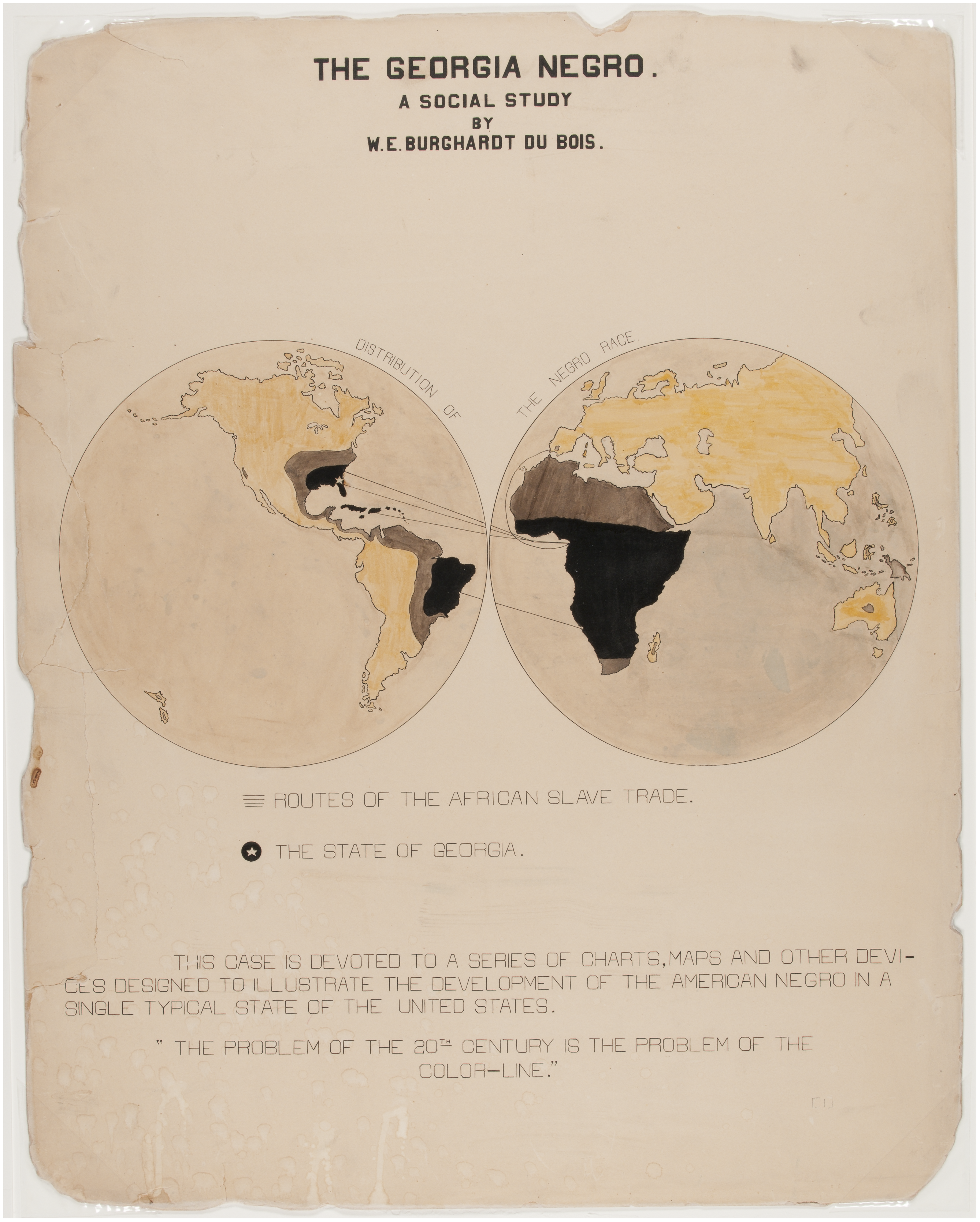
Rejecting abstract generalizations, Du Bois presented a deeply historical and contextual sociology, redefining and deploying concepts associated with imperial epistemes. While using the terms “progress” and “civilization,” Du Bois constructed a meaning of social development addressing the concrete experiences of Black people distinct from the abstract imagery of “progress” that had become a buzzword at the turn of the century. As Figure 2 promulgated, European imperial “progress” was one that was built on the exploitation and dispossession of racialized bodies. Three years after the Exposition, Du Bois wrote “On Progress” in Souls of Black Folk, conveying his own experience of teaching Black children in a poor Southern village where “progress” never came, even though all the white world talked about it. Thus, Du Bois dislocated “progress” from the realm of abstract generalizations and naturalizations to what “progress” looks like on the ground: incremental, painstaking, contested, and struggling action on the part of the progressing actors themselves. Du Bois rectified the white imperial imagination of Black people as an insular social group that failed to accomplish progress due to some endogenous factors by enunciating that those whites are the very hindrance of Black progress, recognizing these racial groups as relationally identifiable and mutually constitutive, rather than as comparable objective categories.
Du Bois also emphasized how white social scientists, and white sociology, studied the Black population only in their relationship to whites, as an “object of information, never a subject in communication” (Foucault Reference Foucault1979: 200). In his essay, “Study of the Negro Problems,” Du Bois (Reference Du Bois1898: 79) wrote:
A college graduate sees the slums of a Southern city, looks at the plantation field hands, and has some experience with Negro servants, and from the laziness, crime and disease which he finds, draws conclusions as to eight millions of people, stretched from Maine to Texas and from Florida to Washington. We continually judge the whole from the part we are familiar with; we continually assume the material we have at hand to be typical; we reverently receive a column of figures without asking who collected them, how they were arranged, how far they are valid and what chances of error they contain; we receive the testimony of men without asking whether they were trained or ignorant, careful or careless, truthful or given to exaggeration, and, above all, whether they are giving facts or opinions. … The widespread habit of studying the Negro from one point of view only, that of his influence on the white inhabitants, is also responsible for much uncritical work.
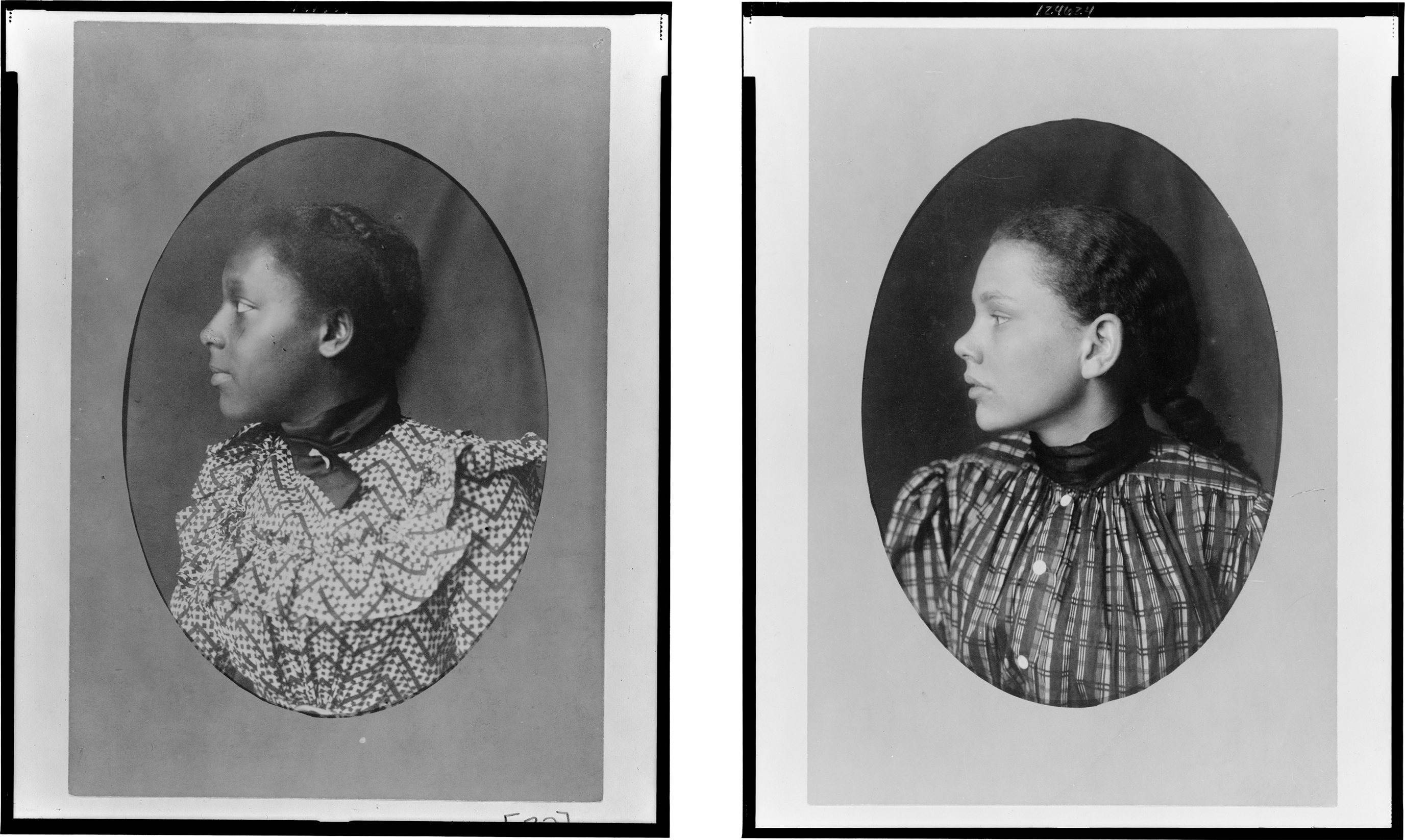
Itzigsohn and Brown (Reference Itzigsohn and Brown2015: 232) state that Du Bois’s work, particularly in his later writing,Footnote 15 “goes beyond treating race as a discrete concept and instead situates the process of racializing and racialization (i.e., the process of intersubjectively constructing racial categories and meanings that structure the experiences of groups and individuals) at the core of the formation and the organization of the modern world.” This trait was also reflected in the photographic album he presented to the Exposition in 1900. In these albums, Du Bois selected Black people with a wide range of skin-tones, highlighting the socially determined aspect of the concept of “race” and confronting stereotypical depictions of Black Americans. Levering Lewis (Reference Lewis2003: 24) states thus:
The range of Du Bois’s photographs also betrays a decided preference for African Americans of lighter hue. Indeed, many of them portray people of such idealized European appearances that, as intended, they must have confounded the aesthetics, affronted the self-esteem, and trumped the civilizationist assumptions of the white people who came to see the Negro section.
Du Bois also carefully collected data on racial mixing, which he presented at the Exposition, showing the lack of empirical basis for abstracting ontologically different races. In addition, Smith (Reference Smith2000: 582) interprets the photos Du Bois presented as imitating mugshots that were prevalent at the time (see Figure 3), “replicating the formal characteristics of both the middle-class portrait and the criminal mugshot, Du Bois’s ‘American Negro’ photographs subvert the visual registers and cultural discourses that consolidated white middle-class privilege in opposition to an imagined ‘negro criminality’ at the turn of the century.”Footnote 16
African American woman, head-and-shoulders portrait, left profile, and African American girl, head-and-shoulders portrait, left profile.
Sovereignty with nation, education, and wealth
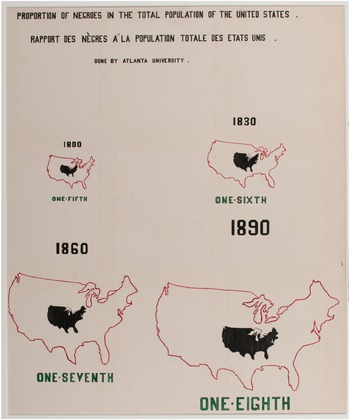
In his newspaper piece on the Exposition, Du Bois introduced Black people in the US South as “a small nation of people,”Footnote 17 conferring on them a sovereign subjecthood distinct from, rather than subsumed under, the United States. Presented in Figure 4Footnote 18, Du Bois’s Atlanta Sociological Laboratory prepared the map of the US mainland proportional to the total number of the US population and that of the Black population for each census year. By displaying these differently sized maps side by side, Du Bois visually asserted Black sovereignty nested within the larger US polity.
Proportion of Negroes in the total population of the United States.

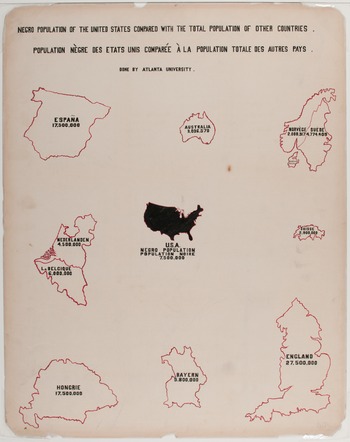
Du Bois wrote in 1897 that if the Black people in the United States “are a nation stored with wonderful possibilities of culture, then their destiny is not a servile imitation of Anglo-Saxon culture, but a stalwart originality which shall unswervingly follow Negro ideals” (Du Bois Reference Du Bois1897). Du Bois’s representation of Black people with national sovereignty is also visible in Figure 5: his team showed the Black population as a comparable entity to those of other Western countries, such as Spain, Australia, Norway, and so on. Again, just like the one in Figure 5, Du Bois’s team presented the sizes of the maps to be proportional to the number of populations.Footnote 19
Negro population of the United States compared with the total population of other countries.

By showing how populous the Black “nation” was, Du Bois did not just assert that Black people matter in history as much as Hungarians and Belgians do. While white imperialists frequently used such visual data to emphasize their superiority over non-white peoples, Du Bois was operating under a different interpretive framework. When Du Bois presented his comparative graphics, he was challenging the imperial episteme to uphold Black subjectivity and sovereignty, which were long denied by imperial and epistemological violence since European colonial domination of Africa and the slave trade. Du Bois, with the term “nation,” dreamed of progressing toward acquiring human self-sovereignty untethered from dehumanizing racism.Footnote 20
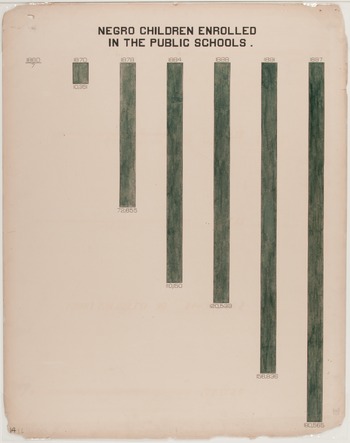
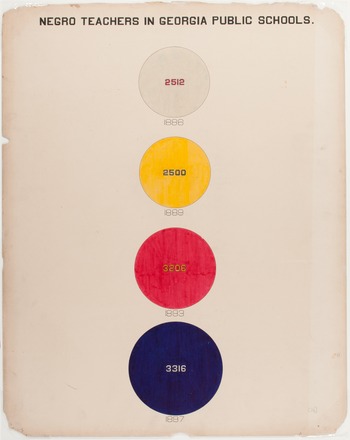
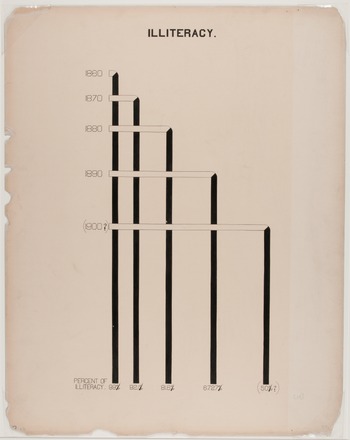
Du Bois’s team also showed education-related statistics in a progressive imagery. The percent of illiteracy kept declining from 1860 – the year of the Emancipation – for the next four decades (Figure 6), public school enrollment of Black pupils dramatically increased from 10,351 in 1870 to 180,565 in 1897 (Figure 7), and the number of Black teachers increased from 2,512 in 1886 to 3,316 in 1897 (Figure 8).Footnote 21, Footnote 22, Footnote 23
Negro children enrolled in the public schools.

Negro teachers in Georgia public schools.

Illiteracy.

This linear-progressive presentation of the educational accomplishment of Georgian Black people must also be understood in relation to the unique historical position that Du Bois depicted, presented in Figures 4 and 5 earlier. In other words, this progress in Black education took place despite the immediate past (and present) of violence, colonialism, and enslavement.
Furthermore, this way of situating Black education was a direct challenge against widely accepted Social Darwinism. Social Darwinist social scientists presumed that Black people were less capable of learning and thinking than whites, thereby supporting colonial and paternalistic approaches to Black people’s “progress,” and ultimately refusing to recognize Black sovereignty. Countering this racism, Du Bois’s team showed evidence of a Black public who were educated, educating, and literate in Figures 6, 7, and 8 above. The team also compared the literate Black public with its European counterparts, as in Figure 9.Footnote 25 Comparing the literacy rates of Black Americans in 1890 with those of other “nations” in the world, Du Bois, in effect, situated the social development of Black Americans as comparable to the Russian Empire and recently formed Romania, an inter-imperial region that had been the target of imperial aggression for centuries.Footnote 24 Thus Du Bois writes that he conducts “a comparison of the size of the Negro population with European countries bringing out the striking fact that there are nearly half as many Negroes in the United States as Spaniards in Spain … their illiteracy is less than that of Russia, and only equal to that of Hungary” (Du Bois Reference Du Bois1900: 577). This presentation was not simply about Black progress but was an anti-racist refutation of Social Darwinism. Despite its history of dispossession, the Black “nation” took the mid-rank position among those white peoples and even above some national groups who were not systematically deprived of their sovereign rights.
Illiteracy of the American Negroes compared with that of other nations.

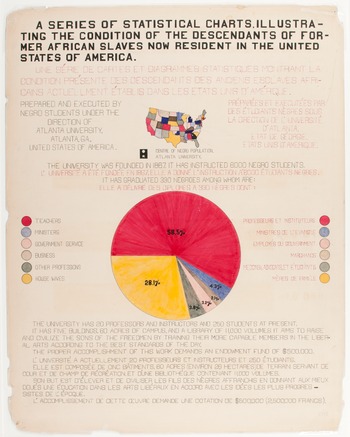
This anti-racist message was further enunciated through the graphic in Figure 10, which clearly stated, “[a] series of statistical charts illustrating the condition of the descendants of former African slaves….” The graphic also emphasized that Black people were capable of sophisticated and “scientific” reasoning. As presented in the pie chart below, Atlanta University housed 20 professors and 250 students, “aim[ing] to raise and civilize the sons of the freemen by training their more capable members in the liberal arts according to the best standards of the day.”Footnote 26
A series of statistical charts illustrating the condition of the descendants of former African slaves now resident in the United States of America.

As in Figure 11, Du Bois’s team also presented the dramatically increased wealth owned by Black people in Georgia. In this graphic, the team emphasized progress despite the past quite explicitly. The violence noted on the graphic includes “Ku-Kluxism” (1870–1875), “political unrest” (1875–1880), “lynching” (1890–1895), “financial panic” (1893–1894), and “disfranchisement and proscriptive laws” (i.e., Jim Crow laws, 1895–1900). Except for “the rise of new industrialism” (1885–1890), all those historical trends annotated on the graphic brought about challenges for the livelihoods of Black people more disproportionately than for whites. For many Black people, these challenges were matters of life and death, infringing on their sovereign rights. Taken together, we can interpret that Du Bois meant to show Black Georgians’ wealth accumulation despite all odds.Footnote 27
Valuation of town and city property owned by Georgia Negroes.

One noteworthy fact is that Du Bois was quite cautious about the ramifications of wealth accumulation in his other writings, although the graphic in Figure 11 may look quite straightforward. In fact, we can read his opinion on simple wealth accumulation in his debate with Booker T. Washington. Du Bois opposed Washington’s accommodationist position that steered Black children toward industrial education instead of a liberal arts education. He argued that the short-term promise of immediate wealth would legally put Black people at “a distinct status of civil inferiority” (Du Bois Reference Du Bois1903 [2007]: 36),Footnote 28 exacerbating the already looming Jim Crow segregation. Thus, the relatively simple presentation in Figure 10 reflects Du Bois’s knowledge politics, primarily countering the Social Darwinist argument that Black people cannot attain wealth due to their lazy and impulsive nature.
Towards a Du Boisian public historical sciences
In her autobiography, hooks (Reference hooks1997: xii–xiii) wrote about how self-esteem during girlhood should be understood in context:
Many feminist thinkers writing and thinking about girlhood right now like to suggest that black girls have better self-esteem than their white counterparts. The measurement of this difference is often that black girls are more assertive, speak more, appear more confident. Yet in traditional southern-based black life, it was and is expected of girls to be articulate, to hold ourselves with dignity. Our parents and teachers were always urging us to stand up right and speak clearly. These traits were meant to uplift the race. They were not necessarily traits associated with building female self-esteem. An outspoken girl may still feel that she was worthless because her skin was not light enough or her hair the right texture. These are the variables that white researchers often do not consider when they measure the self-esteem of black females with a yardstick that was designed based on values emerging from white experience. White girls of all classes are often encouraged to be silent. But to see the opposite in different ethnic groups as a sign of female empowerment is to miss the reality that the cultural codes of that group may dictate quite a different standard by which female self-esteem is measured.
The passage above repudiates decontextualized comparisons (Steinmetz Reference Steinmetz and Steinmetz1999: 20) of outspoken Black girls and silent white girls, which simplistically conclude that Black girls have higher self-esteem than their white counterparts. Violently decontextualized here is the centuries-long racial oppression that urged Black women to “stand up right and speak clearly.”
About a century before, in 1900, in the heart of imperial Europe, Du Bois sought to tackle this same tendency amid the widespread racist belief that Black people are inherently lazy, impulsive, instinct-driven, and incapable of intellectual reasoning. Interestingly, however, Du Bois challenged this racist belief with the very yardsticks that the imperial Euro-American audiences were familiar with. Doing so, Du Bois subverted the imageries of “progress,” “science,” “nation,” “education,” and “wealth,” which were exclusively associated with whiteness among his contemporaries. With his data portraits, statistical charts, and global comparisons, Du Bois meant to convey the message that Black people in the US were a modern historical subject with distinctive forms of sovereignty – his efforts to alleviate the “crisis” that his people were trapped in, in his worldview. This knowledge politics of Du Bois is meaningful, not only in spite of but also precisely because of the imperial episteme he was encapsulated within – turning its own logic and language back to subvert its underpinning assumptions. Du Bois’s concept usage becomes legible in relation to the activism he was embedded in and grounded in, rather than emanating solely from the imperial episteme.
While Du Bois negotiated the imperial episteme amid the crisis of the Emancipation confronting freed Black people, contemporary historical social scientists have had difficulty negotiating the yardstick of the “powerful illusion of a meaning-free social science” (Steinmetz Reference Steinmetz2017: 2) amid the crisis of our discipline, crisis of universities under neoliberal pressure, and also that of the US empire (Steinmetz Reference Steinmetz2013: xiii). Many historical social scientists feel this crisis substantially. As our departments are closed down and historical works are marginalized within social science disciplines, we feel ever more pressure to conform to the prevalent standard. In other words, rather than being encouraged to actively challenge and unsettle the imperial episteme that has persisted, we are pressured to advance immediate solutions useful for policymakers and businesses.
Admittedly, our contemporary conjuncture differs markedly from Du Bois’s time. Yet we can learn from how Du Bois used the Paris Exhibition as a stage to redefine historical social science and notions of progress, while simultaneously building on existing alliances and forging new ones during what he understood as crisis ridden times. As the public and academic spheres shrink today, historical social scientists are also revisiting the practice and ethics of academic work. Instead of a retreat to academic silos, endogenous variables, and a parochial focus on the United States, Du Bois’s practice alerts us to the importance of redefining concepts, global connections, public engagement, and adopting a subversive episteme in conversation with activist communities addressing structures of oppression to mount an effective critical historical social sciences. Imperial epistemes are flexible assemblages; they are not merely reflected in concepts and words but in a whole host of relations and associations. Global historical social sciences attain a new importance in this conjuncture in unmaking and remaking those relations.
We have argued that, first, contrary to how his contemporaries used the term, “progress” in Du Bois’s usage is neither ahistorical nor natural – rather it shows how inequalities in “progress” are socially contingent. For him, progress is not a single variable – or even an aggregate of variables – but a web of relations across social life. There is no necessary teleological arc here, and thus, he rejects the Social Darwinist relegation of non-white peoples to the historical stage of unending savagery. A similar move appears in Getachew’s (Reference Getachew2019) account of anticolonial nationalists, who turned the concept of “nation” into an internationalist strategy rather than a parochial Western form. Getachew warns against the prevailing diffusionist thesis that assumes the “nation” originated in the West and spread throughout the world in the same form and content, erasing both the radical implications and grassroots development of the concept in the (ex-)colonized world. In a similar vein, Gopal (Reference Gopal2019: 16) criticizes a tendency in postcolonial approaches to view complex concepts such as "freedom" as the property of Western lineages of thought. This can lead to, for example, conceiving of “black abolitionists (…) (as) ‘often persuaded’ to use the same terms of appeal as white abolitionists,” erasing contestation and agency from historical narratives. She instead emphasizes the transformative aspects of encounter, political engagement, and building coalitions. Attribution of an intrinsic Western-ness to concepts can lead scholars to mistakenly identify, for example, “race” as a Western imperial export that has no local relevance, foreclosing meaning-making and dialogic processes (see Bourdieu and Wacquant Reference Bourdieu and Wacquant1999 for a much-debated example of this approach). In short, understanding the underlying political strategies behind the usages of such concepts is crucial to grasp radical potentialities or imperial subtexts they may have under certain circumstances. This is akin to “[reconstructing] theoretical categories – their relations and objects – to create new understandings that incorporate and transform previous ones” (Bhambra Reference Bhambra2014: 4).
Second, Du Bois’s global outlook alerts us to the interconnections across global forms of oppression – in his case, processes of racialization between the colonized in Africa and (ex-)enslaved in the United States. We should make fruitful use of this global sensibility to provide a critical acumen and to engage with the wider public. For example, the construction of the US–Mexico border wall, while usually considered a domestic concern, is not isolated from Israel’s occupation of Palestine: “The US–Mexico border has become a major site of Israeli security and surveillance companies, and their work in Palestine is used as a recruitment tool” (Loewenstein Reference Loewenstein2023: 137). Indeed, Native American activists in Arizona, whose ancestral burial sites and daily lives are disturbed by border wall construction, “understand how oppression against them is increasingly tied to the Israeli occupation of Palestine” (ibid.: 139). Similarly, the criminalization of Palestine solidarity groups in the United States and the arbitrary ICE detention of pro-Palestine protestors such as Mahmoud Khalil show the limits of apprehending racial and state violence in the United States solely through a domestic lens. All of this, in turn, intertwines with the crisis of academia as the US government targets academic funding, suppressing diversity programming and student protests for Palestinian lives. In this context, slogans such as “None of us are free until Palestine is free” can act as a guiding sociological insight.
Third, historical social scientists should not only take their social positions into consideration but also take the sociological insights of the communities in which they are embedded seriously. In 1900, confronting the imperial episteme reducing Black people into primitive and instinct-driven beings, Du Bois – himself a Black person – stood before the imperial public with sophisticated scientific data. Du Bois was aware that his audience was the same type of public who attended the 1893 Chicago Exposition, where racist caricaturing had been rather rampant. His project was to present his people, in line with his oft-criticized vanguardism and Talented Tenth idea. Nonetheless, his stance meaningfully differed from that of the accommodationist position (e.g., Booker T. Washington). This difference largely stemmed from his commitment to the movement communities, including community-researchers of the Atlanta Sociological Laboratory (Wright Reference Wright2009) and the activists at the Pan-African Conference. By reckoning with our own positionalities and engaging in dialogic relationships with community activists, we can cultivate the anticolonial/decolonial episteme needed to address the current crisis in historical social sciences. This methodological-political stance makes our historical work impactful. Du Bois’s subversive social science was made possible precisely due to his lived experience as a Black person in academia and the relationships he forged with local and global political communities.
Academia still features various types of exclusion, and historical social sciences are especially in danger of being represented as an elitist endeavor. The collective of historical social scientists, therefore, should conceive of substantive measures to be further responsive to diverse voices, especially those from movement communities. To understand, contextualize, and historically situate our current predicaments, then, we need to enlarge our focus to comprehend global realities and interconnections, all the while forging alliances and learning from political communities resisting oppression: in short, taking reverse tutelage (Meghji Reference Meghji2024) as a practice seriously, considering ourselves not as individual researchers but parts of the (global) communities we live in and through, while unearthing the connections between critical social theory and political communities.




 Open access

