

Background
The archaeological occurrence of obsidian in Poland was brought to the attention of prehistorians by Krukowski (Reference Krukowski1920, Reference Krukowski1922) and later to a broader audience by Kostrz-ewski (Reference Kostrzewski1930). This material, a natural volcanic glass, was used sparingly for making tools in Poland during the Palaeolithic and Mesolithic (see Hughes et al., Reference Hughes, Werra and Sulgostowska2018), whereas during the Neolithic the inflow of Carpathian obsidian increased with the development of the Linearbandkeramik culture (c. 5300–4900/4800 cal bc) and continued through the Middle Neolithic (c. 4900/4800–4000 cal bc). Obsidian was also used in lower proportions until around 3700–3500 cal bc in the Late Neolithic (Kulczycka-Leciejewiczowa, Reference Kulczycka-Leciejewiczowa, Wiślański and Hensel1979: 136; Szeliga, Reference Szeliga, Kozłowski and Raczky2007; Oberc et al., Reference Oberc, Czekaj-Zastawny, Rauba-Bukowska, Grygiel and Obst2022).
Over the years, attempts have been made to use macroscopic features such as transparency and colour to link obsidian artefacts to ‘sources’ (i.e. a chemically distinctive variety of volcanic glass) in Poland. More recently, instrumental methods (Hughes & Werra, Reference Hughes and Werra2014; Kabaciński et al., Reference Kabaciński, Sobkowiak-Tabaka, Kasztovszky, Pietrzak, Langer, Biró and Maróti2015; Sobkowiak-Tabaka et al., Reference Sobkowiak-Tabaka, Kasztovszky, Kabaciński, Biró, Maróti and Gméling2015) yielding quantitative composition data (i.e. parts per million and weight per cent composition) allow different laboratories to compare data directly to investigate prehistoric obsidian acquisition and conveyance. Most obsidian found in early archaeological contexts in Poland comes from sources in Slovakia and Hungary (Hughes et al., Reference Hughes, Werra and Sulgostowska2018). Here, we present geochemical data on artefacts from Silesia in Poland, including Racibórz-Ocice and an unknown site. These artefacts suggest long-distance contact between Poland and the Nemrut Dağ volcanic complex in Turkey (southwest Asia) during the Neolithic.
The Sites
Racibórz-Ocice
Racibórz-Ocice is located on the western terrace of the river Oder in south-western Poland (Czeppe et al., Reference Czeppe, Kozłowski and Krysowska1963) (Figure 1). Information about the initial archaeological investigations at the site of this Neolithic settlement comes from a Wrocław-based researcher of Silesian antiquities, Robert Biefel, who reports that excavations were conducted at this site as early as 1878 (Biefel, Reference Biefel1881: 405–07). These excavations were undertaken by Rudolf Stöckel, a resident of Racibórz and the custodian of archaeological monuments in the districts of Racibórz, Głubczyce, and Kędzierzyn (Demidziuk, Reference Demidziuk2015: 425). Stöckel continued his excavations at Racibórz-Ocice in 1879 (Stöckel, Reference Stöckel1881: 477–78) and five years later decided to transfer the excavated material to the Museum of Silesian Antiquities in Wrocław (Demidziuk, Reference Demidziuk2010: 206–17). He did this in two stages, first in 1885 (Grempler, Reference Grempler1888: 529; Czihak, Reference Czihak1894: 64), then in 1893 (Seger, Reference Seger1896: 26).

Figure 1. Europe and southwest Asia, showing the location of the archaeological sites and obsidian sources discussed. Numbers 1, 2, and 3 indicate the approximate locations of Carpathian geological sources. The pink shaded area comprises the province of Silesia in Poland. Base map by permission of S. Dmowski; graphic design by Ł. Figura.
Programmed excavations at this site were resumed in 1909–1910 by the Wrocław archaeologist Johann Richter. Two rescue excavations had, however, taken place before Richter’s work (Richter, Reference Richter1912: 33); one in 1891 by Oskar Mertins (Demidziuk, Reference Demidziuk2020), and one in 1903 by Hans Seger (Demidziuk, Reference Demidziuk, Lipman and Nowosielska-Sobel2007). After Mertins’ and Seger’s excavations concluded, the artefacts recovered were housed in the Wrocław museum, as were Richter’s finds (Kurtz, Reference Kurtz1931: 5). The final excavations at Racibórz-Ocice, from 1960 to 1962, by Janusz K. Kozłowski were summarised some years later (Kozłowski, Reference Kozłowski1972).
Determining when, and under what circumstances, two obsidian artefacts (Figure 2a & 2b) from this settlement found their way into the collections of another Silesian museum, the Museum in Gliwice (Nelken, Reference Nelken1963) proved a challenge. There are two different versions of this event in the scientific community. According to the literature (see Tomczak, Reference Tomczak and Tomczak2013: 284), specifically Heinrich Kurtz, these artefacts were discovered by Stöckel (Kurtz, Reference Kurtz1931: 5) during his excavations in 1879 (Stöckel, Reference Stöckel1881: 477–78). This statement may, however, be questioned. According to the inventory book of archaeological artefacts in the Museum in Gliwice, compiled in 1944, the geodesist Max Grundey discovered these artefacts (listed as two flint tools) and donated them to the museum at some unknown date but certainly before 1930 (Syniawa, Reference Syniawa2019: 153–55). The circumstances of the two artefacts’ discovery and their location in the Neolithic settlement in Racibórz-Ocice, as well as the time of acquisition by the Museum in Gliwice before 1930, fit both versions.

Figure 2. Obsidian artefacts from Racibórz-Ocice (a and b) and Silesia (c). Photograph of items a and b by permission of M. Jórdeczka and of item c by permission of M. Osiadacz; drawing by E. Gumińska.
Despite various historical events, especially World War II and the period immediately after its conclusion, marked by destruction and looting (Trudzik, Reference Trudzik and Sarnowska1971: 9) and subsequent multiple reorganizations of archaeological museums, especially in Wrocław (Demidziuk, Reference Demidziuk2000: 11–15), fifty-five obsidian artefacts from the German archaeological excavations at Racibórz-Ocice have survived to the present day. For the Gliwice and Racibórz museums, this represents the status quo before WWII, while for the Wrocław museum, the quantities of obsidian artefacts from Racibórz-Ocice decreased from ninety-two to fifty-one pieces. Thus, the still extant artefacts represent about fifty-seven per cent of the presumed original total obsidian assemblage from Racibórz-Ocice: fifty-one in the Archaeological Museum in Wrocław, two in the Museum in Gliwice, and two in the museum in Racibórz; to this total of fifty-five artefacts, we must add a single artefact (a small black core) in the Institute of Archaeology’s Wrocław University collection (Kozłowski, Reference Kozłowski1972). The fifty-one obsidian artefacts from the Wrocław museum were analysed using portable X-ray fluorescence (pXRF); this indicated that all were made from obsidian of the Carpathian 1 chemical type, whose outcrops are located in the Zemplén Mountains in south-eastern Slovakia (Siuda, Reference Siuda2023). Of direct interest here are two green-coloured obsidian artefacts from the Museum in Gliwice (Figure 2a & 2b), linked with the Ocice group of the Lengyel culture (c. 4500–3500 cal bc).
Only one radiocarbon date exists for Racibórz-Ocice: 5690±55 bp (4688–4374 cal bc at 95.4% confidence, modelled in OxCal v.4.3, using the IntCal 13 calibration curve) from pit 9, but no information exists about the material dated (Nowak, Reference Nowak2009: 140; Kurgan-Przybylska, Reference Kurgan-Przybylska2013: 60). Mirosław Furmanek (Reference Furmanek and Gancarski2010: 179–80) suggested, however, that the obsidian artefacts reported by Kurtz (Reference Kurtz1931) should be dated to 4900–4800 cal bc, partly because they were associated with pottery stylistically related to phase IVa of the Stroked Pottery culture (Kulczycka-Leciejewiczowa, Reference Kulczycka-Leciejewiczowa, Wiślański and Hensel1979: 98).
Silesia
A third green-coloured obsidian artefact was found between 1961 and 1970 during a surface survey in Silesia by Włodzimierz Wojciechowski of the Department of Polish Archaeology (Demidziuk, Reference Demidziuk2012: 222–23; Furmanek, Reference Furmanek2018). This obsidian blade (Figure 2c) is currently stored in the Archaeological Museum, a branch of the City Museum of Wrocław. It has been continuously exhibited in the permanent exhibition of the Archaeological Museum in Wrocław for over fifty years, next to the obsidian artefacts from Racibórz-Ocice. This artefact has its own catalogue card but the information given is very terse: Silesia, location unknown, and that the blade was borrowed from the Department of Archaeology (implicitly the University of Wrocław). An ink drawing at a scale of 1:1 features on the top side of the record card.
The Obsidian Artefacts
Kurtz described the artefacts from Racibórz-Ocice as two ‘blades of dark grey obsidian, one of considerable size. Both pieces display traces of use on the cutting edges’ (‘Klingen aus dunkelgrauen Obsidian, die eine von beträchtlicher Größe. Beide Stücke weisen Gebrauchspurren an den Schneiden’; Kurtz, Reference Kurtz1931: 5). Although described as dark grey, the artefacts are actually dark greenish grey. The artefact illustrated in Figure 2a (44 mm long, 11 mm wide, 4 mm thick, 2.7 g) is a broken middle part of a blade, with the striking platform and tip intentionally broken. Its trapezoidal profile has a slightly bent lower part and likely was knapped from a single platform core using a pressure technique (Altınbilek-Algül et al., Reference Altinbilek-Algül, Astruc, Binder, Pelegrin and Desrosiers2012: 159). Kurtz (Reference Kurtz1931: 5) notes it was originally broken only at the distal end, now also in the middle. The second artefact (21 mm long, 11 mm wide, 3 mm thick, 1 g) is also broken at both ends (Figure 2b). The blade was knapped using a pressure technique, and wear traces are visible on the left edge of both sides.
The isolated artefact from Silesia is a 60 mm blade (15–17 mm wide, 4 mm thick, 5.3 g), lacking its distal section (Figure 2c). It is straight with parallel edges and knapped using pressure from a single platform core. The comparison of the results from the technological and metrical analysis suggests a connection to the knapping technique of obsidian in southwest Asia (Altınbilek-Algül et al., Reference Altinbilek-Algül, Astruc, Binder, Pelegrin and Desrosiers2012: 159; Carter et al., Reference Carter, Dubernet, King, Le Bourdonnec, Milić, Poupeau and Shackley2008, Reference Carter, Campeau and Streit2020).
These three artefacts were analysed using non-destructive energy dispersive X-ray fluorescence (EDXRF) to determine the geological parent source for each.
EDXRF Instrumentation and Analysis Results
The laboratory analysis of these three obsidian artefacts was undertaken by Richard E. Hughes on a QuanX-EC™ (Thermo Electron Corporation) EDXRF spectrometer equipped with a silver (Ag) X-ray tube, a 50 kV X-ray generator, digital pulse processor with automated energy calibration, and a Peltier cooled solid state detector with 145 eV resolution (FWHM) at 5.9 keV. The X-ray tube was operated at differing voltage and current settings with different primary beam filters to optimize excitation of the elements selected for analysis. In this case, analyses were conducted for aluminium (Al2O3), rubidium (Rb), strontium (Sr), yttrium (Y), zirconium (Zr), niobium (Nb), barium (Ba), iron (Fe2O3T), titanium (Ti), and manganese (Mn). Iron vs manganese (Fe/Mn) ratios also were generated for each artefact, and X-ray tube current was scaled automatically to the physical size of each specimen. Further details pertaining to X-ray tube operating conditions, calibration, and element-specific measurement precision appear in Hughes (Reference Hughes1994, Reference Hughes2015).
Measurements (except Fe/Mn ratios) for the artefacts in Table 1 are expressed in quantitative units (i.e. parts per million [ppm] by weight), and these were compared directly to values for obsidian sources in the Carpathians (Rosania et al., Reference Rosania, Boulanger, Biró, Ryzhov, Trnka and Glascock2008; Hughes & Werra, Reference Hughes and Werra2014), as well as those in Armenia, Georgia, and Turkey (e.g. Macdonald et al., Reference MacDonald, Smith and Thomas1992: app. III, 162; Frahm, Reference Frahm2023a, Reference Frahm2023b: suppl. tabs; Oddone et al., Reference Oddone, Yeğingil, Özdoğan, Meloni and Bigazzi2003: tab. 5; Binder et al., Reference Binder, Gratuze, Mouralis and Balkan-Atli2011: tab. 2; Boulanger et al., Reference Boulanger, Davis and Glascock2012: tab. 4; Carter et al., Reference Carter, Grant, Kartal, Coşkun and Öskaya2013: tab. 2; Biagi et al., Reference Biagi, Gratuze, Kiosak, Tubolze and Popandopulo2014; Chataigner & Gratuze, Reference Chataigner and Gratuze2014: tab. 4; Chataigner et al., Reference Chataigner, Işikli, Gratuze and Çil2014: tab. 1; Frahm et al., Reference Frahm, Campbell and Healey2016: tab. 2; Frahm & Brody, Reference Frahm and Brody2019: tab. 3), the western Mediterranean and southwest Asia (e.g. Dixon, Reference Dixon and Taylor1976: tab. 1; Terradas et al., Reference Terradas, Gratuze, Bosch, Enrich, Esteve, Oms and Ribé2014: tab. 2), and Sardinia, mainland Italy, and Greece (e.g. Francaviglia, Reference Francaviglia1984: tabs 1 & 2, Reference Francaviglia1988: tabs 1–5; Macdonald et al., Reference MacDonald, Smith and Thomas1992: app. III, 160; Tykot, Reference Tykot2002: tab. 1; Vargo, Reference Vargo2003). Artefacts were matched to a parent obsidian type (geochemical type, sensu Hughes, Reference Hughes, Ramenofsky and Steffen1998) if diagnostic trace element concentration values (i.e. ppm values for Rb, Sr, Y, Zr, and, when necessary, Ba, Ti, Mn, and Fe2O3T) for artefacts fell within two standard deviations of mean values for geological source standards. ‘Diagnostic’ trace elements are those well-measured by EDXRF whose concentrations show low intra-source variability and marked variability across sources (see Hughes, Reference Hughes1993).
Table 1. Selected major, minor, and trace element composition of obsidian artefacts from Racibórz-Ocice (MG1 sample prefixes) and Silesia, Poland. Values in parts per million, except Al and Fe (in weight per cent) and Fe/Mn (as ratio); ± values are 2-sigma error estimates. Recommended values for USGS RGM-1 standard are from Govindaraju, Reference Govindaraju1994.

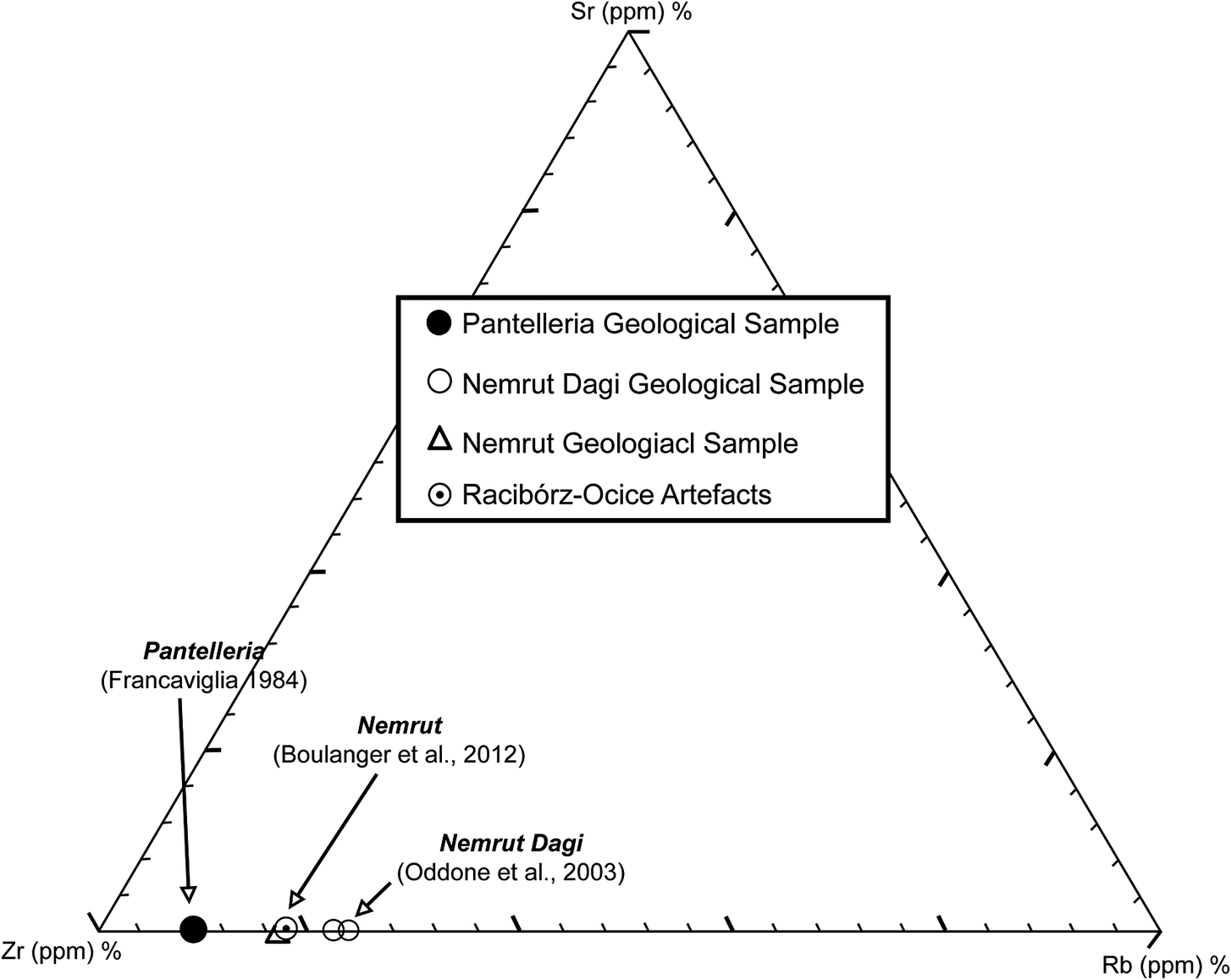
All three artefacts are of peralkaline composition (i.e. Al2O3 > Na2O + K2O; Macdonald & Bailey, Reference MacDonald and Bailey1973) and the attendant high concentration of Zr (900–1000 ppm) distinguishes them from lower-Zr composition volcanic glasses from the Carpathians, as well as those in Armenia, Georgia, and Turkey. When obsidians containing > c. 800 ppm are considered, few chemical type alternatives remain. Zr/Rb ppm values for archaeologically significant obsidian from the Mediterranean and southwest Asia show that only obsidian from Pantelleria in Italy and Nemrut (Nemrut Dağ) and Bingöl in Turkey have similar compositions. Zr/Rb plots show that distinctive chemical types exist within the Pantelleria area, and Francaviglia’s (Reference Francaviglia1988: tab. 5, fig. 6) data also reveal that Pantelleria obsidian contains lower Rb concentrations (with Zr, Y and Nb values much higher) than reported for Nemrut Dağ (Boulanger et al., Reference Boulanger, Davis and Glascock2012: tab. 4), and Vargo (Reference Vargo2003: fig. 52) reports Mn values for Pantelleria (at Balata dei Turchi) > 400 ppm higher than Nemrut.
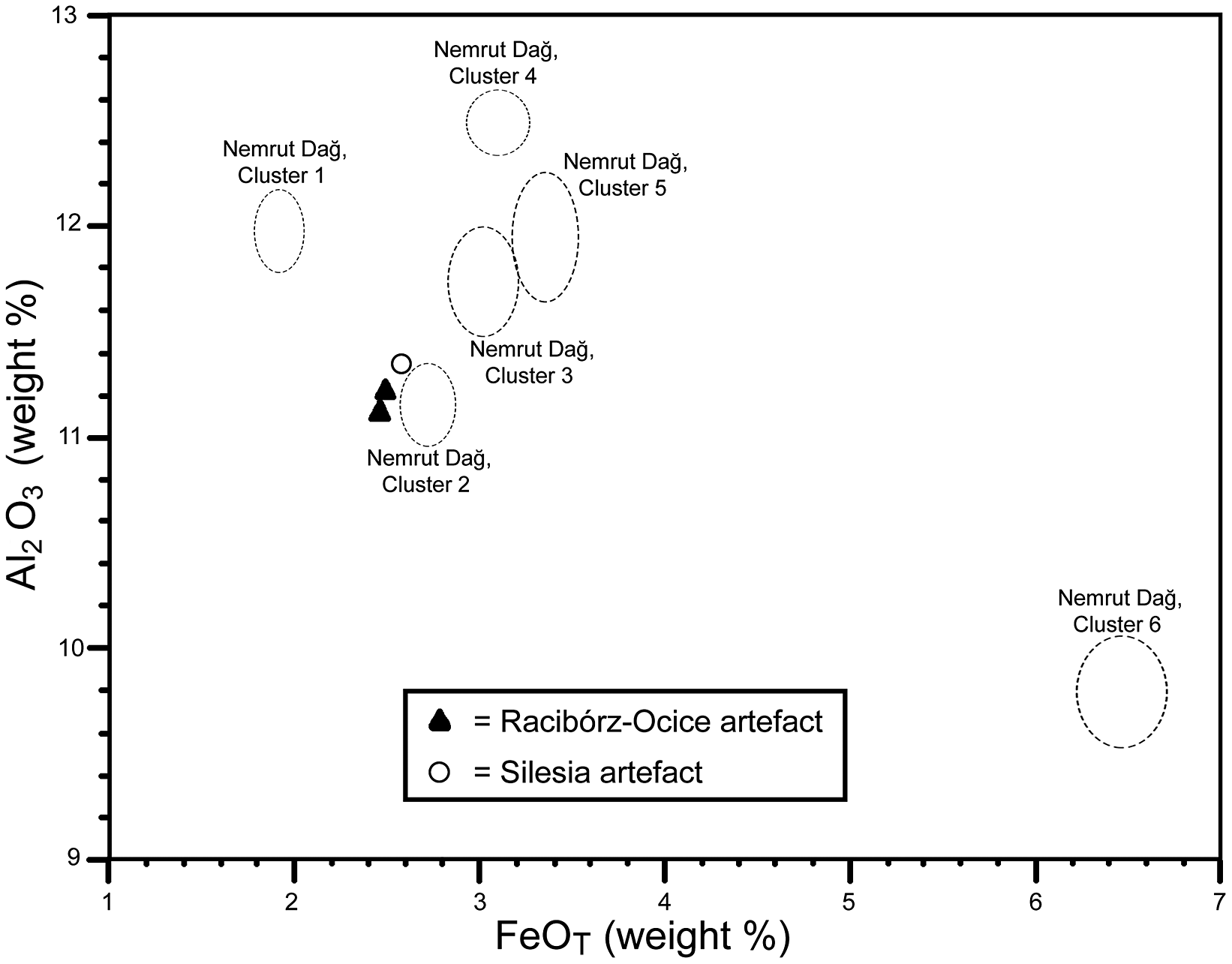
These elemental contrasts (Figure 3) show that Pantelleria can be eliminated as a source for the artefacts, but that there is a geochemical similarity between these artefacts and Nemrut Dağ and Bingöl A obsidians from south-eastern Turkey (e.g. Chataigner, Reference Chataigner1994; Frahm, Reference Frahm2012; Robin et al., Reference Robin, Mouralis, Akköprü, Gratuze, Kuzucuoğlu and Nomade2016). Frahm (Reference Frahm2012: tab. 1, fig. 3) employed aluminium and iron data to discriminate between the latter two chemical types, and our Figure 4 compares the Al2O3 and FeOT composition of Nemrut geological samples with data derived from the Racibórz-Ocice and Silesia artefacts (Table 1).

Figure 3. Diagram showing the normalized Rb/Sr/Zr composition of Pantelleria and Nemrut area geological obsidians in relation to artefacts from Racibórz-Ocice and Silesia.

Figure 4. Al2O3 vs FeOT composition of Nemrut Dağ geological obsidians (dashed lines parameters plotted from Frahm, Reference Frahm2012: tab. 1) and artefacts from Racibórz-Ocice and Silesia (see Table 1).
In addition to similarities in Al2O3 and FeOT composition, the Racibórz-Ocice artefacts align with the Zr and Rb composition of geological obsidians from Nemrut (Boulanger et al., Reference Boulanger, Davis and Glascock2012: tab. 4; Khazaee et al., Reference Khazaee, Glascock, Masjedi, Khademi Nadoshan, Soleimani Farsani and Delfan2014: fig. 2), and to the Zr/Nb vs Rb/Sr profile for glass from this area (cf. Boulanger et al., Reference Boulanger, Davis and Glascock2012: fig. 7). Particle induced X-ray emission (PIXE) analysis (Poupeau et al., Reference Poupeau, Le Bourdonnec, Carter, Delerue, Shackley and Barrat2010: tab. 3) for Nemrut Dağ obsidian yielded Y and Zr values overlapping the artefacts analysed here. In addition, unpublished chemical data for Nemrut and Bingöl peralkaline obsidians (T. Carter, pers. comm. 17 May 2019; Frahm, Reference Frahm2023a) subsume and overlap with the Rb, Sr, Y, Zr, and Nb values for artefacts in our Table 1. However, in light of ongoing work on the number of chemical types yet to be discovered in the Nemrut area (e.g. Frahm, Reference Frahm2012; Robin et al., Reference Robin, Mouralis, Akköprü, Gratuze, Kuzucuoğlu and Nomade2016; Campbell & Healey, Reference Campbell and Healey2018), we are hesitant to ascribe any of our three artefacts to a specific chemical type, in part because of possible discrepancies among measurements determined by different analytical techniques (see Frahm, Reference Frahm2023a, Reference Frahm2023b). At the scale of analysis relevant here, we are content to view these artefacts as originating from the Nemrut volcanic province, although an alignment with Nemrut Dağ seems probable.
Use-Wear Analysis and Results
The use-wear analysis on our three artefacts was conducted by Jolanta Małe-cka-Kukawka using a Nikon SMZ 745T stereomicroscope with a DeltaPix camera. Optical observations on the tools were carried out with a Zeiss Axiotech in reflection mode equipped with an AxioCam 105C digital camera. For identifying the use-wear profile of the tools, the instrument was focused on the working edges and areas adjacent to the use-worn zone, using optical imaging in reflected light mode (Małecka-Kukawka, Reference Małecka-Kukawka, Capote, Consuegra, Díaz-del-Río and Terradas2011).
Experimental use-wear patterns made in the Traceology Laboratory of the Institute of Archaeology of the Nicolaus Copernicus University in Toruń were used for comparison, and the use-wear analysis, identifications, and interpretations made here follow the method described by Hurcombe (Reference Hurcombe1992). We noted the following:
a) Blade from Silesia, location unknown (Figure 5). Abrasions are on the angular edge and adjacent surfaces, with deep scratches (Figure 5a & 5b). Scratches run parallel on the transverse edge, both on the dorsal and ventral sides (Figure 5c & 5d). Surface abrasion appears on both sides of the platform (Figure 5e & 5f ).

Figure 5. Blade from Silesia, location unknown. a, b) angular edge of burin, abrasion and linear traces, indicating use as a burin for hard material; c, d) transverse edge of burin, linear traces; e, f) abrasion from hafting in organic material (a and d: magnification 100× Nikon SMZ245T microscope; b, c, e and f: 10× objective magnification, Zeiss Axiotech microscope). Graphic design (left) by permission of Ł. Kowalski (as also Figures 6 and 7, top left).
b) Longer blade from Racibórz-Ocice (Figure 6). This specimen is shown on the front cover of Kurtz’s Reference Kurtz1931 monograph (see below). An abrasion is visible on the transverse top edge, with linear traces perpendicular and oblique to the edge (Figure 6a, 6b & 6c). The right edge shows chippings and perpendicular traces as parallel scratches (Figure 6d & 6e). Abrasions are in the platform and bulbar part (Figure 6f & 6g), along with random scratches (Figure 6h & 6i) and crushing (Figure 6j). The angled edge is ground off or sanded (Figure 6k & 6l).

Figure 6. Longer blade from Racibórz-Ocice. a) rounded edge, indicating use as a scraper for skin; b, c) edge and linear traces of the scraper; d, e) crumbling on the edge and linear traces, indicating use as a knife for planing hard material; f, g, h, i, j) surface abrasions and linear traces, indicating hafting in organic material; k, l) sanding of angular edge (a, b, c, e, h, j, l: objective magnification 20×; d, k: objective magnification 10×; g, i: objective magnification 50x, Zeiss Axiotech microscope).
c) Smaller blade from Racibórz-Ocice (Figure 7). The transverse, oblique edge shows rounding with perpendicular and oblique traces (Figure 7a). Functional retouch is visible as negative flake scars on the right edge. Parallel scratches run along the entire edge, with linear traces on the dorsal (Figure 7b & 7c) and ventral (Figure 7d & 7e) sides. The ventral surface has random linear traces and light abrasion (Figure 7f & 7g).

Figure 7. Smaller blade from Racibórz-Ocice. a) rounded edge and line traces, indicating use as a scraper for skin; b, c, d, e) edge and line traces, indicating use as a small saw for hard material; f, g) post-depositional damage (a, g: objective magnification 20×; b, d, f, objective magnification 10×; c, e: objective magnification 50×, Zeiss Axiotech microscope).
We acknowledge that the marks observed on these blades may have resulted from different causes and processes at various times. Some marks are very distinctive signatures of cutting and/or scratching of soft material (animal hide?), and some traces are consistent with tool hafting in organic material (see Figure 6f & 6g). Nevertheless, the marks should be interpreted with caution; the biography of these blades is very long and complex, and some of the marks on artefacts that were evident to Kurtz nearly 100 years ago may not reflect ancient use.
Discussion
We begin by acknowledging that the archaeological significance of these Racibórz-Ocice artefacts depends on Kurtz’s (Reference Kurtz1931) report. The museum inventory ledger, consulted in 2016 by archaeologist Monika Michnik at the Museum in Gliwice, contained minimal information about the obsidian. A search at the National Archive in Wrocław yielded no additional details. During the war, documentation and inventories were often incomplete; additionally, the fragmentary and small size of the artefacts analysed here contrasts with museums’ usual aim to acquire only the most complete and intact specimens for display.
In summary, in light of the identified manufacturing techniques and documentation, we find no compelling reason to reject the authenticity of the reported provenance of the Racibórz-Ocice artefacts, particularly since Kurtz (Reference Kurtz1931) illustrated one of the analysed blades on the cover of his monograph (Figure 8). The unprovenanced find from a survey in Silesia shares technological hallmarks as the Racibórz-Ocice artefacts, but without a datable context its Neolithic attribution is less secure.

Figure 8. Front cover of Kurtz’s (Reference Kurtz1931) book. The obsidian blade appears as fig. 2a in that volume and as Figure 6 in the present article.
In the Middle Neolithic, connections between Silesia and the upper Tisza basin in Hungary are evidenced by ceramic assemblages, including pots, decorated ceramics, and clay rattles with incised ornamentation (Furmanek, Reference Furmanek and Gancarski2010). The conveyance of southwest Asian materials into south-eastern Europe in the sixth millennium bc is also documented, the most spectacular example probably being a hole-mouth jar and iconographic motifs found at Ein el-Jarba in Israel and originating from the northern Levant or even Caucasia or south-eastern Europe (Streit, Reference Streit2015: 264). Longer distance connections are also evident in the so-called mobile art (i.e. clay anthropomorphic figurines and rattles) known from many archaeological sites in Silesia, from sites belonging to the Cucuteni-Trypillia culture, from Lengyel culture sites in Moravia, and from the Bajč-Retz group of the Lengyel culture in Slovakia (Seger, Reference Seger1916; Kulczycka-Leciejewiczowa, Reference Kulczycka-Leciejewiczowa, Wiślański and Hensel1979: 161; Sobkowiak-Tabaka et al., Reference Sobkowiak-Tabaka, Bobrowski, Kurgan-Przybylska and Anioła2014). The Cucuteni site in Romania, dated to the Eneolithic (4100/3900–2300/2200 cal bc), yielded one obsidian artefact traced to outcrops on the island of Melos in Greece (Althaus, Reference Althaus1977: 82; Willms, Reference Willms1983: 334). These contacts or long-distance exchanges (Chapman & Gaydarska, Reference Chapman, Gaydarska, Ch. Flower and Hofmann2015) are further supported by the presence of burials containing goods made of ‘exotic’, non-local materials such as an ornamented Mediterranean Spondylus gaederopus shell from Brześć Kujawski (Jażdżewski, Reference Jażdżewski1938) and another such shell from Karsko (Kunkel, Reference Kunkel and Ebert1927), found some 2000 km from the source of the shell. Séfériadès (Reference Séfériadès1995) recognized that spondylus shells were valued in central Europe because of their origin in the south-eastern ancestral lands of Linearbandkeramik communities (Kurzawska & Sobkowiak-Tabaka, Reference Kurzawska and Sobkowiak-Tabaka2024). Likewise, jade studies (e.g. Pétrequin, et al., Reference Pétrequin, Errera, Cassen, Gauthier, Hovorka, Klassen and Sheridan2011, Reference Pétrequin, Cassen, Errera, Klassen, Sheridan and Pétrequin2012; Pétrequin & Rzepecki, Reference Pétrequin and Rzepecki2016; Biró et al., Reference Biró, Szakmány, Szilágyi, Kovács, Kasztovsky and Harsányi2021) also document long-distance contacts between and among Neolithic communities.
Obsidian from Armenian sources has been reported in western Belarus, over 1990 km distant from geological sources (Asheichyk et al., Reference Asheichyk, Kuzmin, Glascock, Kryvaltsevich, Girya and Vashanau2018: 3) and in south-eastern Ukraine (Biagi et al., Reference Biagi, Gratuze, Kiosak, Tubolze and Popandopulo2014: 4, 6). The Göllüdağ obsidian blade from an Early Copper Age site in Hungary (Kasztovszky et al., Reference Kasztovszky, Markó, Sándor and Biró2024) broadens understanding of long-distance transport. It supports the idea that obsidian came from Anatolia to eastern Europe and then moved further north and west.
The presence in Poland of obsidian artefacts likely to have come from Nemrut Dağ in prehistoric times, more than 2200 km from the geological source, is, to date, the westernmost occurrence of this material. The three finds from Silesia, and their history, fit into a broader narrative. At present, the westernmost site containing Nemrut Dağ obsidian is Çatalhöyük, located 660 km away from Nemrut Dağ by linear distance. Tristan Carter et al. (Reference Carter, Dubernet, King, Le Bourdonnec, Milić, Poupeau and Shackley2008) suggest that the presence of Nemrut Dağ obsidian at Çatalhöyük may indicate that a reconfiguration of the exchange network occurred in the middle to late seventh millennium bc. They suggest that, before then, blades made of Nemrut Dağ and/or Bingöl obsidian were procured by communities in south-eastern Anatolia, Upper Mesopotamia, and the Zagros region. Furthermore, the appearance of items made from such obsidian at Çatalhöyük is linked to the arrival of new people in the community, as well as changes in obsidian working. These changes are also evident in contemporaneous ceramic, cooking, and building technologies, leading Carter and colleagues to suggest that the change of ‘trade patterns’, proposed by Colin Renfrew for the later sixth/fifth millennium bc, took place earlier than previously believed (Carter et al., Reference Carter, Dubernet, King, Le Bourdonnec, Milić, Poupeau and Shackley2008: 905–06).
Based on present data, we cannot speculate meaningfully as to whether or not—or the extent to which—the presence in Poland of obsidian blades likely to have come from Nemrut Dağ obsidian is the result of changes in trade routes. Nevertheless, the rare occurrence of such obsidian and absence at geographically intermediary sites may indicate that its arrival at Racibórz-Ocice was not a result of ‘down-the-line’ exchange but perhaps more of a directional mode of exchange or conveyance (Renfrew, Reference Renfrew, Sabloff and Lamberg-Karlovsky1975; Carter et al., Reference Carter, Dubernet, King, Le Bourdonnec, Milić, Poupeau and Shackley2008: 906).
The presence of ‘exotic’ materials like obsidian, supported by the data here, could have been a consequence of population movements from southwest Asia into Europe during the Neolithic (see e.g. Haak et al., Reference Haak, Balanovsky, Sanchez, Koshel, Zaporozhchenko and Adler2010; Skoglund et al., Reference Skoglund, Malmström, Raghavan, Stora, Hall and Willerslev2012; Lipson et al., Reference Lipson, Szécsényi-Nagy, Mallick, Pósa, Stégmár and Keerl2017). However, we cannot currently determine whether these obsidian artefacts were moved over a short period or several generations, as people may have brought or shared them with others. Hughes et al. (Reference Hughes, Werra and Sulgostowska2018) note that ‘exotic’ materials can reflect personal desires or outsiders’ gifts, in addition to serving as visible signs marking differences in social status and ranking. Carter et al. (Reference Carter, Campeau and Streit2020: 16) highlight that obsidian gifting and exchange were essential social processes integral to Neolithization. Such ‘unique’ items like obsidian and spondylus shells no doubt served as important media for transmitting and reinforcing new value systems and meanings and could symbolize exclusive networks that reinforced elite positions within local communities (e.g. Carter et al., Reference Carter, Dubernet, King, Le Bourdonnec, Milić, Poupeau and Shackley2008: 906–07, Reference Carter, Contreras, Campeau and Freund2016: 26, 30, Reference Carter, Campeau and Streit2020: 16, 18; Furholt et al., Reference Furholt, Grier, Spriggs and Earle2020: 173; Kurzawska & Sobkowiak-Tabaka, Reference Kurzawska and Sobkowiak-Tabaka2024).
Our obsidian tools, as supported by use-wear data, suggest use as burins and for hide scraping, but we can’t determine when tasks occurred. These blades may have been used at various times and at different sites during their probable conveyance from the Lake Van area (where Nemrut Dağ is located) or perhaps not have been used until reaching their final destinations in Poland. Although we suspect that the visual characteristics alone would have marked these obsidian artefacts as ‘special’ and ‘exotic’, we have no way of knowing how, or how far, our contemporary observations align with those of Neolithic communities in Poland. Until now, relatively few Neolithic obsidian artefacts have undergone microwear examination, but the use-wear found on our three artefacts, especially for hide processing, is also seen on other local Carpathian obsidian blades from Neolithic contexts in Poland (e.g. Szeliga et al., Reference Szeliga, Kasztovszky, Osipowicz and Szilágyi2021: 29–30; Werra et al., Reference Werra, Szeliga, Pyżewicz and Burgert2024).
Conclusions
We conclude that the two artefacts from Racibórz-Ocice were found in bona fide archaeological context and were reported as such by Stöckel and Kurtz. Both researchers worked with the material before World War II, when the inventories were intact, so we believe that when Kurtz (Reference Kurtz1931) put an obsidian blade on the cover of his book (Figure 8), he was absolutely certain that it came from the Racibórz-Ocice site. Likewise, we have no reason to question the context of the artefact from the surface survey in Silesia, although its attribution to the Neolithic is based solely on technological similarity. The use-wear analysis shows all blades were used by prehistoric communities, but when that was is impossible to determine.
The geochemical data generated from our EDXRF analyses support the attribution of the two artefacts from Racibórz-Ocice and the surface specimen from Silesia to obsidian from the Nemrut Dağ area in south-eastern Turkey, located over 2200 km to the south-east. Regardless of the mechanisms that may have been involved in the conveyance of these artefacts, this is the first geochemically documented report of Turkish obsidian at any Neolithic site in Poland. We are now conducting additional geochemical analyses of obsidian from other Neolithic sites in Poland to evaluate and contextualize the broader implications of this new finding.
Acknowledgements
Special thanks to A.K. Robin for providing geological sample splits of Nemrut obsidians, to Tristan Carter, Ellery Frahm, and Steve Shackley for sharing unpublished EDXRF data on Nemrut volcanic glass, and to Michael Glascock for additional assistance. We thank Monika Michnik (Museum in Gliwice) and Romuald Turakiewicz (Museum in Racibórz) for their invaluable help and for sharing their knowledge with us. We are also grateful to Magdalena Szczecińska (City Museum in Wrocław), Beata Badura-Wituła (Upper Silesian Museum in Bytom), and Professor Jerzy Piekalski (Institute of Archaeology, University of Wrocław). All provided essential support, but we take full responsibility for the conclusions presented here. We are particularly grateful to Ellery Frahm and two anonymous reviewers for providing detailed, critical, and constructive comments on the manuscript. This research was funded by the Polish National Science Centre, within the project ‘Investigation of the Sources and Uses of Obsidian During the Neolithic in Poland’ led by D.H. Werra (grant no. OPUS 15 2018/29/B/HS3/01540).




 Open access

