





1 Introduction
Weihrauch reducibility is a notion of reducibility between partial multi-valued functions that is useful to calibrate their uniform computational strength. The theory of Weihrauch reducibility has often been studied in connection with reverse mathematics, as it can be used to analyze the computability-theoretical content of
$\forall \exists $
 -statements.
Many results in the literature on Weihrauch degrees focus on characterizing the degree of specific problems. In contrast, several natural questions on the structure of Weihrauch degrees are still open. In this article, we study the existence of chains and antichains in the Weihrauch degrees.
In a given partial order
$(P,\le )$
 , a chain is a linearly ordered subset of P. Conversely, an antichain is a set of pairwise incomparable elements of P. We use
$\{a_i\}_{i\in I}$
, a chain is a linearly ordered subset of P. Conversely, an antichain is a set of pairwise incomparable elements of P. We use
$\{a_i\}_{i\in I}$
 to denote a family indexed with elements in some set I. We stress that, for example, a chain
$\{a_i\}_{i\in \omega }$
to denote a family indexed with elements in some set I. We stress that, for example, a chain
$\{a_i\}_{i\in \omega }$
 of elements of P could be ill-founded or even dense. On the other hand, if L is a linear order, we write
$(a_x)_{x \in L}$
of elements of P could be ill-founded or even dense. On the other hand, if L is a linear order, we write
$(a_x)_{x \in L}$
 if the chain
$\{a_x\}_{x\in L}$
if the chain
$\{a_x\}_{x\in L}$
 is order-isomorphic to L via the map
$x \mapsto a_x$
is order-isomorphic to L via the map
$x \mapsto a_x$
 .
.
A set
$S\subseteq P$
 is called cofinal (in P) if for every
$p\in P$
is called cofinal (in P) if for every
$p\in P$
 there is
$q \in S$
there is
$q \in S$
 such that
$p\le q$
such that
$p\le q$
 . The cofinality of P, denoted
$\mathrm {cof}(P)$
. The cofinality of P, denoted
$\mathrm {cof}(P)$
 , is the least cardinality of a cofinal chain. A cardinal
$\kappa $
, is the least cardinality of a cofinal chain. A cardinal
$\kappa $
 is called regular if it is equal to its cofinality. The dual notion of cofinality is coinitiality: a set
$S\subseteq P$
is called regular if it is equal to its cofinality. The dual notion of cofinality is coinitiality: a set
$S\subseteq P$
 is called coinitial if for every
$p\in P$
is called coinitial if for every
$p\in P$
 there is
$q \in S$
there is
$q \in S$
 such that
$q\le p$
such that
$q\le p$
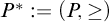
 . Equivalently, a coinitial set in P is a cofinal set in
$P^*:=(P,\ge )$
. Equivalently, a coinitial set in P is a cofinal set in
$P^*:=(P,\ge )$
 . The coinitiality of P, denoted
$\mathrm {coinit}(P)$
. The coinitiality of P, denoted
$\mathrm {coinit}(P)$
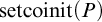
 , is the least cardinality of a coinitial chain. Both cofinality and coinitiality need not be well-defined for an arbitrary partial order (e.g., if the partial order is only made of two incomparable elements). A generalization of cofinality (resp. coinitiality) that is well-defined for every partial order P is set-cofinality (resp. set-coinitiality), namely the least cardinality of a cofinal (resp. coinitial) subset of P. The set-cofinality and the set-coinitiality of P are denoted by
$\mathrm {setcof}(P)$
, is the least cardinality of a coinitial chain. Both cofinality and coinitiality need not be well-defined for an arbitrary partial order (e.g., if the partial order is only made of two incomparable elements). A generalization of cofinality (resp. coinitiality) that is well-defined for every partial order P is set-cofinality (resp. set-coinitiality), namely the least cardinality of a cofinal (resp. coinitial) subset of P. The set-cofinality and the set-coinitiality of P are denoted by
$\mathrm {setcof}(P)$
 and
$\mathrm {setcoinit}(P)$
and
$\mathrm {setcoinit}(P)$
 , respectively. The two notions clearly agree on linear orders.
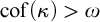
In this article, we study the existence and extendibility of chains in the Weihrauch degrees. While we are mostly interested in the extendibility of chains of order type
$\kappa $
 or
$\kappa ^*$
or
$\kappa ^*$
 , for some cardinal
$\kappa $
, for some cardinal
$\kappa $
 with
$\mathrm {cof}(\kappa )>\omega $
with
$\mathrm {cof}(\kappa )>\omega $
 , many techniques apply to partially ordered families of degrees as well. We characterize when a chain of Weihrauch degrees has an upper bound (Theorem 3.5) and, for every
$\eta \le \mathfrak {c} := 2^{\omega }$
, many techniques apply to partially ordered families of degrees as well. We characterize when a chain of Weihrauch degrees has an upper bound (Theorem 3.5) and, for every
$\eta \le \mathfrak {c} := 2^{\omega }$
 with uncountable cofinality, we provide an explicit example of a chain of order type
$\eta $
with uncountable cofinality, we provide an explicit example of a chain of order type
$\eta $
 with no upper bound (Theorem 3.7). This can then be used to show that there are no cofinal chains in the Weihrauch degrees of any order type (Theorem 3.17).
In contrast, the picture of the coinitiality of the Weihrauch degrees looks quite different: while there are descending chains of order type
$\mathfrak {c}$
 with no non-zero lower bound, the existence of a coinitial sequence in the Weihrauch degrees is independent of
$\mathrm {ZFC}$
with no non-zero lower bound, the existence of a coinitial sequence in the Weihrauch degrees is independent of
$\mathrm {ZFC}$
 and equivalent to
$\mathrm {CH}$
and equivalent to
$\mathrm {CH}$
 (Theorem 3.19). We also characterize when chains of order type
$\kappa +\lambda ^*$
(Theorem 3.19). We also characterize when chains of order type
$\kappa +\lambda ^*$
 , for cardinals
$\kappa $
, for cardinals
$\kappa $
 and
$\lambda $
and
$\lambda $
 with uncountable cofinality, admit an intermediate degree (Theorem 3.11), and show that each interval in the Weihrauch lattice is either finite or uncountable (Theorem 3.12).
Finally, we study the extendibility of antichains: we show that every non-trivial antichain of size
$<\mathfrak {c}$
 can be extended (Corollary 4.4), and provide a necessary condition for an antichain to be maximal (Theorem 4.6).
1.1 Background
We now briefly recall the main notions and fix the notation that will be needed in the rest of the article. With a small abuse of notation, we will often identify a Turing/Medvedev/Weihrauch degree with one of its representatives.
Given two partial multi-valued functions
$f,g:\subseteq \mathbb {N}^{\mathbb {N}} \rightrightarrows \mathbb {N}^{\mathbb {N}}$
 , we say that f is
Weihrauch reducible to g, and write
$f\le _{\mathrm {W}} g$
, we say that f is
Weihrauch reducible to g, and write
$f\le _{\mathrm {W}} g$
 , if there are two computable functionals
$\Phi :\subseteq \mathbb {N}^{\mathbb {N}} \to \mathbb {N}^{\mathbb {N}}$
, if there are two computable functionals
$\Phi :\subseteq \mathbb {N}^{\mathbb {N}} \to \mathbb {N}^{\mathbb {N}}$
 and
$\Psi :\subseteq \mathbb {N}^{\mathbb {N}}\times \mathbb {N}^{\mathbb {N}} \to \mathbb {N}^{\mathbb {N}}$
and
$\Psi :\subseteq \mathbb {N}^{\mathbb {N}}\times \mathbb {N}^{\mathbb {N}} \to \mathbb {N}^{\mathbb {N}}$
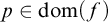
 such that, for every
$p\in \operatorname {dom}(f)$
such that, for every
$p\in \operatorname {dom}(f)$
 ,
,

We use
$(\mathcal {W}, \le _{\mathrm {W}})$
 to denote the degree structure of the
Weihrauch degrees, namely, the partial order induced by
$\le _{\mathrm {W}}$
to denote the degree structure of the
Weihrauch degrees, namely, the partial order induced by
$\le _{\mathrm {W}}$
 on the equivalence classes. As a notational convenience, we also use
$(\mathcal {W}_0, \le _{\mathrm {W}})$
on the equivalence classes. As a notational convenience, we also use
$(\mathcal {W}_0, \le _{\mathrm {W}})$
 for the restriction of the Weihrauch degrees to non-empty problems. For a more comprehensive presentation of Weihrauch reducibility, we refer the reader to [Reference Brattka, Gherardi, Pauly, Brattka and Hertling2]. We mention that while Weihrauch reducibility is often defined in the more general context of partial multi-valued functions on represented spaces, every Weihrauch degree has a representative which is a partial multi-valued function on
$\mathbb {N}^{\mathbb {N}}$
for the restriction of the Weihrauch degrees to non-empty problems. For a more comprehensive presentation of Weihrauch reducibility, we refer the reader to [Reference Brattka, Gherardi, Pauly, Brattka and Hertling2]. We mention that while Weihrauch reducibility is often defined in the more general context of partial multi-valued functions on represented spaces, every Weihrauch degree has a representative which is a partial multi-valued function on
$\mathbb {N}^{\mathbb {N}}$
 (see [Reference Brattka, Gherardi, Pauly, Brattka and Hertling2, Lemma 11.3.8]). In other words, in order to study the structure
$(\mathcal {W}, \le _{\mathrm {W}})$
(see [Reference Brattka, Gherardi, Pauly, Brattka and Hertling2, Lemma 11.3.8]). In other words, in order to study the structure
$(\mathcal {W}, \le _{\mathrm {W}})$
 , there is no loss of generality in restricting our attention to problems on the Baire space. With a small abuse of notation, we can talk about multi-valued functions on spaces like
$\mathbb {N}$
, there is no loss of generality in restricting our attention to problems on the Baire space. With a small abuse of notation, we can talk about multi-valued functions on spaces like
$\mathbb {N}$
 ,
$\mathbb {N}^{<\mathbb {N}}$
,
$\mathbb {N}^{<\mathbb {N}}$
 , or
$(\mathbb {N}^{\mathbb {N}})^{\mathbb {N}}$
, or
$(\mathbb {N}^{\mathbb {N}})^{\mathbb {N}}$
 , as their elements can be canonically represented with elements in
$\mathbb {N}^{\mathbb {N}}$
, as their elements can be canonically represented with elements in
$\mathbb {N}^{\mathbb {N}}$
 .
.
The Weihrauch degrees form a distributive lattice with a bottom element (the empty set) and no top element. The join and meet operators can be obtained, respectively, by lifting the following two operators on multi-valued functions to the degree structure:
-
• $(f_0\sqcup f_1)(i,x):=f_i(x)$
 , where
$\operatorname {dom}(f_0\sqcup f_1):=\bigcup _{i<2} \{i\}\times \operatorname {dom}(f_i)$
.
, where
$\operatorname {dom}(f_0\sqcup f_1):=\bigcup _{i<2} \{i\}\times \operatorname {dom}(f_i)$
. -
• $ (f_0\sqcap f_1)(x_0,x_1):= \bigcup _{i<2} \{i\}\times f_i(x_i)$
, where
$\operatorname {dom}(f_0\sqcap f_1):=\operatorname {dom}(f_0) \times \operatorname {dom}(f_1)$
.




We observe that neither of the above two operators can be generalized to obtain a countable join/meet. Indeed, while the operators
$(f_i)_{i\in \mathbb {N}}\mapsto \bigsqcup _{i\in \mathbb {N}} f_i$
 and
$(f_i)_{i\in \mathbb {N}}\mapsto \unicode{x2A05} _{i\in \mathbb {N}} f_i$
and
$(f_i)_{i\in \mathbb {N}}\mapsto \unicode{x2A05} _{i\in \mathbb {N}} f_i$
 defined as
$\bigsqcup _{i\in \mathbb {N}} f_i(i,x):=f_i(x)$
defined as
$\bigsqcup _{i\in \mathbb {N}} f_i(i,x):=f_i(x)$
 and
$\unicode{x2A05} _{i\in \mathbb {N}} f_i((x_j)_{j\in \mathbb {N}}):=\bigcup _{i\in \mathbb {N}} \{i\}\times f_i(x_i)$
and
$\unicode{x2A05} _{i\in \mathbb {N}} f_i((x_j)_{j\in \mathbb {N}}):=\bigcup _{i\in \mathbb {N}} \{i\}\times f_i(x_i)$
 , respectively, are well-defined and identify an upper and a lower bound for the family, they do not lift to the Weihrauch degrees and are not, in general, the supremum or the infimum of
$\{f_i {}\,:\,{} i\in \mathbb {N}\}$
, respectively, are well-defined and identify an upper and a lower bound for the family, they do not lift to the Weihrauch degrees and are not, in general, the supremum or the infimum of
$\{f_i {}\,:\,{} i\in \mathbb {N}\}$
 .
.
As a simple counterexample, let
$f_i:=f:=p\mapsto 0$
 and observe that
$f\equiv _{\mathrm {W}} (p\mapsto 1)$
and observe that
$f\equiv _{\mathrm {W}} (p\mapsto 1)$
 . Now, for every non-computable set A, we can consider the family
$\{g_i\}_{i\in \mathbb {N}}$
. Now, for every non-computable set A, we can consider the family
$\{g_i\}_{i\in \mathbb {N}}$
 defined as
$g_i:=p\mapsto 1$
defined as
$g_i:=p\mapsto 1$
 if
$i\in A$
if
$i\in A$
 and
$g_i:=f_i$
and
$g_i:=f_i$
 otherwise. In other words, we are replacing some of the
$f_i$
otherwise. In other words, we are replacing some of the
$f_i$
 ’s with Weihrauch-equivalent problems. However, while
$\bigsqcup _{i\in \mathbb {N}} f_i=(i,p)\mapsto 0$
’s with Weihrauch-equivalent problems. However, while
$\bigsqcup _{i\in \mathbb {N}} f_i=(i,p)\mapsto 0$
 , and hence is constant and computable,
$\bigsqcup _{i\in \mathbb {N}} g_i$
, and hence is constant and computable,
$\bigsqcup _{i\in \mathbb {N}} g_i$
 computes the characteristic function of A. This shows that
$\bigsqcup _{i\in \mathbb {N}}$
computes the characteristic function of A. This shows that
$\bigsqcup _{i\in \mathbb {N}}$
 is not a degree-theoretic operator.
With a similar strategy, we can show that
$\unicode{x2A05} _{i\in \mathbb {N}}$
 is not degree-theoretic: let
$f_i:=f$
is not degree-theoretic: let
$f_i:=f$
 be such that
$\operatorname {dom}(f):=\{0\}$
be such that
$\operatorname {dom}(f):=\{0\}$
 and, for a fixed non-computable set A, define
$g_i$
and, for a fixed non-computable set A, define
$g_i$
 with
$\operatorname {dom}(g_i):=\{1\}$
with
$\operatorname {dom}(g_i):=\{1\}$
 if
$i\in A$
if
$i\in A$
 and
$g_i:=f$
and
$g_i:=f$
 otherwise. By definition, both
$\unicode{x2A05} _{i\in \mathbb {N}} f_i$
otherwise. By definition, both
$\unicode{x2A05} _{i\in \mathbb {N}} f_i$
 and
$\unicode{x2A05} _{i\in \mathbb {N}} g_i$
and
$\unicode{x2A05} _{i\in \mathbb {N}} g_i$
 only have one input, but the former has a computable input, while the only input for the latter is the characteristic function of A, hence
$\unicode{x2A05} _{i\in \mathbb {N}} f_i \not \le _{\mathrm {W}} \unicode{x2A05} _{i\in \mathbb {N}} g_i$
only have one input, but the former has a computable input, while the only input for the latter is the characteristic function of A, hence
$\unicode{x2A05} _{i\in \mathbb {N}} f_i \not \le _{\mathrm {W}} \unicode{x2A05} _{i\in \mathbb {N}} g_i$
 .
.
It is known that
$(\mathcal {W},\le _{\mathrm {W}})$
 is not an
$\omega $
is not an
$\omega $
 -complete join/meet semilattice [Reference Higuchi and Pauly6, Corollary 3.17]. In fact, it is also known that no non-trivial countable suprema exist.
Theorem 1.1 [Reference Higuchi and Pauly6, Proposition 3.15]
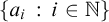
A family
$\{ a_i {}\,:\,{} i\in \mathbb {N}\}$
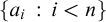
 of Weihrauch degrees has a supremum iff it is already the supremum of
$\{ a_i {}\,:\,{} i<n\}$
of Weihrauch degrees has a supremum iff it is already the supremum of
$\{ a_i {}\,:\,{} i<n\}$
 for some
$n\in \mathbb {N}$
for some
$n\in \mathbb {N}$
 . In particular, no (strictly ascending) chain
$(a_i)_{i\in \omega }$
. In particular, no (strictly ascending) chain
$(a_i)_{i\in \omega }$
 has a supremum.
The dual result for infima does not hold: the infimum of a countable family does not always exist, but there are chains
$(a_i)_{i\in \omega ^*}$
 with a greatest lower bound [Reference Higuchi and Pauly6, Example 3.19].
When studying the order-theoretic properties of a reducibility lattice, it is natural to discuss its density. Given two degrees
$\mathbf {a} < \mathbf {b}$
 , we say that
$\mathbf {b}$
, we say that
$\mathbf {b}$
 is a minimal cover of
$\mathbf {a}$
is a minimal cover of
$\mathbf {a}$
 if there is no degree
$\mathbf {c}$
if there is no degree
$\mathbf {c}$
 such that
$\mathbf {a}<\mathbf {c}<\mathbf {b}$
such that
$\mathbf {a}<\mathbf {c}<\mathbf {b}$
 . In other words,
$\mathbf {b}$
. In other words,
$\mathbf {b}$
 is a minimal cover of
$\mathbf {a}$
is a minimal cover of
$\mathbf {a}$
 if the interval
$(\mathbf {a},\mathbf {b})$
if the interval
$(\mathbf {a},\mathbf {b})$
 is empty. We say that
$\mathbf {b}$
is empty. We say that
$\mathbf {b}$
 is a strong minimal cover of
$\mathbf {a}$
is a strong minimal cover of
$\mathbf {a}$
 if, for every
$\mathbf {c}<\mathbf {b}$
if, for every
$\mathbf {c}<\mathbf {b}$
 ,
$\mathbf {c}\le \mathbf {a}$
,
$\mathbf {c}\le \mathbf {a}$
 . In other words, the difference between the lower cones of
$\mathbf {b}$
. In other words, the difference between the lower cones of
$\mathbf {b}$
 and
$\mathbf {a}$
and
$\mathbf {a}$
 is
$\{\mathbf {b}\}$
is
$\{\mathbf {b}\}$
 .
.
Recently [Reference Lempp, Miller, Pauly, Soskova and Valenti8], the existence and distribution of (strong) minimal covers in the Weihrauch degrees have been fully characterized. In particular, it has been shown that the Weihrauch degrees do not have minimal degrees above
$\emptyset $
 but are dense (all the non-degenerate intervals are non-empty) only in the cone above the identity problem
$\operatorname {id}$
but are dense (all the non-degenerate intervals are non-empty) only in the cone above the identity problem
$\operatorname {id}$
 . Empty intervals exist above every problem g with
$\operatorname {id}\not \le _{\mathrm {W}} g$
. Empty intervals exist above every problem g with
$\operatorname {id}\not \le _{\mathrm {W}} g$
 , while strong minimal covers only exist in the cone below
$\operatorname {id}$
, while strong minimal covers only exist in the cone below
$\operatorname {id}$
 .
.
2 Some results on Medvedev reducibility
There is a close connection between Weihrauch and Medvedev reducibility, and some structural results on the Weihrauch lattice can be obtained by analyzing the properties of the Medvedev degrees. In this section, we briefly recall the definition and the main properties of Medvedev reducibility. We also state and prove some results on the Medvedev degrees that, while being generalizations of already known facts, have not been explicitly observed in the literature before and are useful to obtain the main results on Weihrauch reducibility. For a more thorough introduction to Medvedev reducibility, the reader is referred to [Reference Hinman7, Reference Sorbi, Cooper, Slaman and Wainer12].
Given
$A,B\subseteq \mathbb {N}^{\mathbb {N}}$
 , sometimes referred to as mass problems, we say that A is Medvedev reducible to B, and write
$A\le _{\mathrm {M}} B$
, sometimes referred to as mass problems, we say that A is Medvedev reducible to B, and write
$A\le _{\mathrm {M}} B$
 , if there is a computable functional
$\Phi :\subseteq \mathbb {N}^{\mathbb {N}} \to \mathbb {N}^{\mathbb {N}}$
, if there is a computable functional
$\Phi :\subseteq \mathbb {N}^{\mathbb {N}} \to \mathbb {N}^{\mathbb {N}}$
 such that
$B \subseteq \operatorname {dom}(\Phi )$
such that
$B \subseteq \operatorname {dom}(\Phi )$
 and
$\Phi (B)\subseteq A$
and
$\Phi (B)\subseteq A$
 . The Medvedev degrees are denoted by
$(\mathcal {M}, \le _{\mathrm {M}})$
. The Medvedev degrees are denoted by
$(\mathcal {M}, \le _{\mathrm {M}})$
 . They form a distributive lattice with a top element (the degree of
$\emptyset $
. They form a distributive lattice with a top element (the degree of
$\emptyset $
 ) and a bottom element (the degree of
$\mathbb {N}^{\mathbb {N}}$
) and a bottom element (the degree of
$\mathbb {N}^{\mathbb {N}}$
 or, equivalently, the degree of any mass problem that contains a computable point). As for the Weihrauch degrees, we use
$(\mathcal {M}_0, \le _{\mathrm {M}})$
or, equivalently, the degree of any mass problem that contains a computable point). As for the Weihrauch degrees, we use
$(\mathcal {M}_0, \le _{\mathrm {M}})$
 for the restriction of the Medvedev degrees to non-empty problems. Since
$\emptyset $
for the restriction of the Medvedev degrees to non-empty problems. Since
$\emptyset $
 is not the immediate successor of any mass problem, there are no maximal elements in
$\mathcal {M}_0$
is not the immediate successor of any mass problem, there are no maximal elements in
$\mathcal {M}_0$
 . The join and the meet are induced from the following two operations, respectively:
-
• $A \vee B:= \{ \langle{p,q}\rangle {}\,:\,{} p\in A \text { and } q\in B \} $
; -
• $A \wedge B:= ({0}) \unicode{x2322} A \cup ({1}) \unicode{x2322} B$
,


where
$ \langle{\cdot ,\cdot}\rangle$
 denotes the standard pairing function in the Baire space and
$({0}) \unicode{x2322} A$
denotes the standard pairing function in the Baire space and
$({0}) \unicode{x2322} A$
 denotes the set obtained by concatenating the string
$({0})$
denotes the set obtained by concatenating the string
$({0})$
 with all the strings in A.
Observe that we can restate the definition of Weihrauch reducibility as follows:
$f\le _{\mathrm {W}} g$
 iff there are two computable functionals
$\Phi ,\Psi $
iff there are two computable functionals
$\Phi ,\Psi $
 such that
$\Phi (\operatorname {dom}(f))\subseteq \operatorname {dom}(g)$
such that
$\Phi (\operatorname {dom}(f))\subseteq \operatorname {dom}(g)$
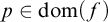
 and, for every
$p\in \operatorname {dom}(f)$
and, for every
$p\in \operatorname {dom}(f)$
 ,
$\Psi (p,g(\Phi (p))) \subseteq f(p)$
,
$\Psi (p,g(\Phi (p))) \subseteq f(p)$
 . In particular, this shows that
$f\le _{\mathrm {W}} g$
. In particular, this shows that
$f\le _{\mathrm {W}} g$
 implies
$\operatorname {dom}(g)\le _{\mathrm {M}} \operatorname {dom}(f)$
implies
$\operatorname {dom}(g)\le _{\mathrm {M}} \operatorname {dom}(f)$
 . This suggests that the relation between the domains of two multi-valued functions can be used to define an order-reversing embedding of the Medvedev degrees in the Weihrauch degrees.Footnote
1
Indeed, it is straightforward to show that
$A \le _{\mathrm {M}} B$
. This suggests that the relation between the domains of two multi-valued functions can be used to define an order-reversing embedding of the Medvedev degrees in the Weihrauch degrees.Footnote
1
Indeed, it is straightforward to show that
$A \le _{\mathrm {M}} B$
 iff
$\operatorname {id}_B \le _{\mathrm {W}} \operatorname {id}_A$
iff
$\operatorname {id}_B \le _{\mathrm {W}} \operatorname {id}_A$
 , where
$\operatorname {id}_X$
, where
$\operatorname {id}_X$
 is the restriction of the identity problem
$\operatorname {id}$
is the restriction of the identity problem
$\operatorname {id}$
 to the set
$X\subseteq \mathbb {N}^{\mathbb {N}}$
to the set
$X\subseteq \mathbb {N}^{\mathbb {N}}$
 .
.
Remark 2.1. We highlight that the mapping
$d:=A\mapsto \operatorname {id}_A$
 induces an isomorphism between
$\mathcal {M}^*=(\mathcal {M},\ge _{\mathrm {M}})$
induces an isomorphism between
$\mathcal {M}^*=(\mathcal {M},\ge _{\mathrm {M}})$
 and the lower cone of
$\operatorname {id}$
and the lower cone of
$\operatorname {id}$
 in the Weihrauch degrees. This is an important fact that will be frequently used in the rest of the article.
The existence and distribution of minimal covers in the Medvedev degrees have been fully characterized. To describe them, let us define
$\{ p\}^+:=\{({e}) \unicode{x2322} q {}\,:\,{} \Phi _e(q)=p \text { and } q\not \le _{\mathrm {T}} p \}$
 .
.
Theorem 2.2 [Reference Dyment5, Corollary 2.5]
For every
$A<_{\mathrm {M}} B$
 , B is a minimal cover of A iff

Besides, for every
$p\in \mathbb {N}^{\mathbb {N}}$
 ,
$\{p\}$
,
$\{p\}$
 is a strong minimal cover of
$\{ p\}^+$
is a strong minimal cover of
$\{ p\}^+$
 in
$\mathcal {M}^*$
in
$\mathcal {M}^*$
 . In other words, for every
$A\subseteq \mathbb {N}^{\mathbb {N}}$
. In other words, for every
$A\subseteq \mathbb {N}^{\mathbb {N}}$
 ,
$\{p\}<_{\mathrm {M}} A$
,
$\{p\}<_{\mathrm {M}} A$
 implies
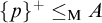
$\{ p\}^+\le _{\mathrm {M}} A$
implies
$\{ p\}^+\le _{\mathrm {M}} A$
 . In particular, since the bottom of
$\mathcal {M}$
. In particular, since the bottom of
$\mathcal {M}$
 is equivalent to
$\{p\}$
is equivalent to
$\{p\}$
 for every computable p, this implies that there is a first non-bottom degree in
$\mathcal {M}$
for every computable p, this implies that there is a first non-bottom degree in
$\mathcal {M}$
 , namely, (the degree of)
$\{ 0^{\mathbb {N}}\}^+$
, namely, (the degree of)
$\{ 0^{\mathbb {N}}\}^+$
 . Moreover, being a degree of solvability (i.e., being Medvedev-equivalent to a singleton) is equivalent to being the top of a strong minimal cover in
$\mathcal {M}^*$
. Moreover, being a degree of solvability (i.e., being Medvedev-equivalent to a singleton) is equivalent to being the top of a strong minimal cover in
$\mathcal {M}^*$
 , which proves the first-order definability of the Turing degrees in
$(\mathcal {M},\le _{\mathrm {M}})$
, which proves the first-order definability of the Turing degrees in
$(\mathcal {M},\le _{\mathrm {M}})$
 [Reference Dyment5, Corollary 2.1].
It is known that there are only three mass problems that are Medvedev-comparable with every other mass problem: these are
$\{0^{\mathbb {N}}\}$
 ,
$\{ 0^{\mathbb {N}}\}^+$
,
$\{ 0^{\mathbb {N}}\}^+$
 , and
$\emptyset $
, and
$\emptyset $
 . In other words, for every mass problem
$A\notin \{ \{0^{\mathbb {N}}\}, \{ 0^{\mathbb {N}}\}^+, \emptyset \}$
. In other words, for every mass problem
$A\notin \{ \{0^{\mathbb {N}}\}, \{ 0^{\mathbb {N}}\}^+, \emptyset \}$
 , there is
$B\subseteq \mathbb {N}^{\mathbb {N}}$
, there is
$B\subseteq \mathbb {N}^{\mathbb {N}}$
 that is Medvedev-incomparable with A [Reference Dyment5, Theorem 1.1]. The antichains in
$\mathcal {M}$
that is Medvedev-incomparable with A [Reference Dyment5, Theorem 1.1]. The antichains in
$\mathcal {M}$
 can have any cardinality up to
$2^{\mathfrak {c}}$
can have any cardinality up to
$2^{\mathfrak {c}}$
 , the size of the whole lattice [Reference Sorbi, Cooper, Slaman and Wainer12, Theorem 4.1]. However, maximal (non-trivial) antichains need not be infinite.
Proposition 2.3. For every
$\kappa $
 with
$1 \le \kappa \le \mathfrak {c}$
with
$1 \le \kappa \le \mathfrak {c}$
 , there is a maximal antichain in
$\mathcal {M}$
, there is a maximal antichain in
$\mathcal {M}$
 of size
$\kappa $
of size
$\kappa $
 .
.
In the following, we combine the cases of a finite and an infinite cardinal
$\kappa $
 into one, so for convenience, we will use
$\sup \kappa $
into one, so for convenience, we will use
$\sup \kappa $
 to denote
$\kappa -1$
to denote
$\kappa -1$
 for finite
$\kappa>0$
for finite
$\kappa>0$
 , and
$\kappa $
, and
$\kappa $
 itself for infinite
$\kappa $
itself for infinite
$\kappa $
 .
.
Proof. The case
$\kappa =1$
 was discussed just before the statement. For
$\kappa>1$
was discussed just before the statement. For
$\kappa>1$
 , we generalize the technique used in [Reference Sorbi, Cooper, Slaman and Wainer12, Example 4.2]: let
$\{p_\alpha \}_{\alpha <\sup \kappa }$
, we generalize the technique used in [Reference Sorbi, Cooper, Slaman and Wainer12, Example 4.2]: let
$\{p_\alpha \}_{\alpha <\sup \kappa }$
 be a non-maximal antichain in the Turing degrees. We define:
-
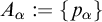
• for every $\alpha <\sup \kappa $
,
$A_{\alpha }:=\{p_\alpha \}$
; -
• $A_{\sup \kappa }:=\{ q \in \mathbb {N}^{\mathbb {N}} {}\,:\,{} (\forall \alpha <\sup \kappa )(q\not \le _{\mathrm {T}} p_\alpha )\}$
.


It is easy to check that the sequence
$(A_\alpha )_{\alpha \le \sup \kappa }$
 is an antichain in
$\mathcal {M}$
is an antichain in
$\mathcal {M}$
 of size
$\kappa $
of size
$\kappa $
 . Indeed, for every
$\alpha < \beta < \sup \kappa $
. Indeed, for every
$\alpha < \beta < \sup \kappa $
 ,
$A_\alpha ~|_{\mathrm {M}~} A_\beta $
,
$A_\alpha ~|_{\mathrm {M}~} A_\beta $
 follows trivially from the fact that
$\{p_\alpha \}_{\alpha <\sup \kappa }$
follows trivially from the fact that
$\{p_\alpha \}_{\alpha <\sup \kappa }$
 is a Turing-antichain. By definition,
$A_{\sup \kappa } \not \le _{\mathrm {M}} A_{\alpha }$
is a Turing-antichain. By definition,
$A_{\sup \kappa } \not \le _{\mathrm {M}} A_{\alpha }$
 , hence we only need to show that
$A_{\alpha }\not \le _{\mathrm {M}} A_{\sup \kappa }$
, hence we only need to show that
$A_{\alpha }\not \le _{\mathrm {M}} A_{\sup \kappa }$
 . Since
$\{p_\alpha \}_{\alpha <\sup \kappa }$
. Since
$\{p_\alpha \}_{\alpha <\sup \kappa }$
 is not maximal, there is q such that, for every
$\alpha <\sup \kappa $
is not maximal, there is q such that, for every
$\alpha <\sup \kappa $
 ,
$q \,|_{\mathrm {T}}\, p_\alpha $
,
$q \,|_{\mathrm {T}}\, p_\alpha $
 . Clearly any such q belongs to
$A_{\sup \kappa }$
. Clearly any such q belongs to
$A_{\sup \kappa }$
 , hence
$A_{\alpha }\not \le _{\mathrm {M}} A_{\sup \kappa }$
, hence
$A_{\alpha }\not \le _{\mathrm {M}} A_{\sup \kappa }$
 .
.
To show that the antichain is maximal, fix
$C\subseteq \mathbb {N}^{\mathbb {N}}$
 and assume that
$(\forall \alpha < \sup \kappa )(C \not \le _{\mathrm {M}} A_\alpha )$
and assume that
$(\forall \alpha < \sup \kappa )(C \not \le _{\mathrm {M}} A_\alpha )$
 . In particular, for every
$q\in C$
. In particular, for every
$q\in C$
 and every
$\alpha <\sup \kappa $
and every
$\alpha <\sup \kappa $
 ,
$q\not \le _{\mathrm {T}} p_\alpha $
,
$q\not \le _{\mathrm {T}} p_\alpha $
 . This implies that
$C\subseteq A_{\sup \kappa }$
. This implies that
$C\subseteq A_{\sup \kappa }$
 , which in turn implies
$A_{\sup \kappa } \le _{\mathrm {M}} C$
, which in turn implies
$A_{\sup \kappa } \le _{\mathrm {M}} C$
 .
.
2.1 Chains in the Medvedev degrees
We now give an overview of some results on the existence of “long” chains in the Medvedev degrees. In [Reference Terwijn13], it was observed that the existence of a chain of size
$\kappa $
 in
$(2^{\mathfrak {c}}, \subseteq )$
in
$(2^{\mathfrak {c}}, \subseteq )$
 implies the existence of a chain of the same size in
$\mathcal {M}$
implies the existence of a chain of the same size in
$\mathcal {M}$
 (see the proof of [Reference Terwijn13, Theorem 4.2]). The converse direction was established in [Reference Shafer11, Theorem 4.3.1]. Upon closer inspection, the proof of this equivalence can be adapted to obtain a slightly stronger theorem. We first highlight the following simple fact.
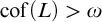
Proposition 2.4. Let L be a linear order with
$\mathrm {cof}(L)>\omega $
 . A chain
$(A_x)_{x\in L}$
. A chain
$(A_x)_{x\in L}$
 in
$\mathcal {M}_0$
in
$\mathcal {M}_0$
 has an upper bound iff there is a cofinal subsequence
$(A_{x_\alpha })_{\alpha <\mathrm {cof}(L)}$
has an upper bound iff there is a cofinal subsequence
$(A_{x_\alpha })_{\alpha <\mathrm {cof}(L)}$
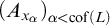 such that
$\bigcap _{\alpha <\mathrm {cof}(L)} A_{x_\alpha } \neq \emptyset $
such that
$\bigcap _{\alpha <\mathrm {cof}(L)} A_{x_\alpha } \neq \emptyset $
 .
.
Proof. Assume first that
$B\neq \emptyset $
 is an upper bound for
$(A_x)_{x\in L}$
is an upper bound for
$(A_x)_{x\in L}$
 . Then, there is
$e\in \mathbb {N}$
. Then, there is
$e\in \mathbb {N}$
 and a cofinal subsequence
$(A_{x_\alpha })_{\alpha <\mathrm {cof}(L)}$
and a cofinal subsequence
$(A_{x_\alpha })_{\alpha <\mathrm {cof}(L)}$
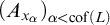 such that for every
$\alpha <\mathrm {cof}(L)$
such that for every
$\alpha <\mathrm {cof}(L)$
 ,
$A_{x_\alpha }\le _{\mathrm {M}} B$
,
$A_{x_\alpha }\le _{\mathrm {M}} B$
 via
$\Phi _e$
via
$\Phi _e$
 . In particular, this implies that
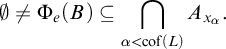
Conversely, assume that there is a cofinal subsequence
$(A_{x_\alpha })_{\alpha <\mathrm {cof}(L)}$
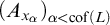 such that
$C:=\bigcap _{\alpha <\mathrm {cof}(L) } A_{x_\alpha }\neq \emptyset $
such that
$C:=\bigcap _{\alpha <\mathrm {cof}(L) } A_{x_\alpha }\neq \emptyset $
 . Then, for every
$\alpha <\mathrm {cof}(L)$
. Then, for every
$\alpha <\mathrm {cof}(L)$
 ,
$A_{x_\alpha }\le _{\mathrm {M}} C$
,
$A_{x_\alpha }\le _{\mathrm {M}} C$
 , hence C is an upper bound for
$(A_x)_{x\in L}$
, hence C is an upper bound for
$(A_x)_{x\in L}$
 .
.
Theorem 2.5 (Essentially [Reference Shafer11, Theorem 4.3.1])
For any linear order L, the following are equivalent:
-
1. there is a chain in $(2^{\mathfrak {c}}, \supseteq )$
of order type L; -
2. there is a chain in $\mathcal {M}$
of order type L; -
3. above every non-top Medvedev degree, there is a chain in $\mathcal {M}$
of order type L.


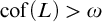
Moreover, if
$\mathrm {cof}(L)>\omega $
 , then the existence of a chain of order type L in
$(2^{\mathfrak {c}}, \supseteq )$
, then the existence of a chain of order type L in
$(2^{\mathfrak {c}}, \supseteq )$
 implies the existence of an order-isomorphic chain in
$\mathcal {M}$
implies the existence of an order-isomorphic chain in
$\mathcal {M}$
 with no (non-trivial) upper bound.
Proof. The implication
$(3)\Rightarrow (2)$
 is trivial, while
$(2)\Rightarrow (1)$
is trivial, while
$(2)\Rightarrow (1)$
 can be readily obtained by inspecting the proof of [Reference Shafer11, Theorem 4.3.1]. For
$(1)\Rightarrow (3)$
can be readily obtained by inspecting the proof of [Reference Shafer11, Theorem 4.3.1]. For
$(1)\Rightarrow (3)$
 , let
$(\mathcal {C}_x)_{x\in L}$
, let
$(\mathcal {C}_x)_{x\in L}$
 be a chain in
$(2^{\mathfrak {c}}, \supseteq )$
be a chain in
$(2^{\mathfrak {c}}, \supseteq )$
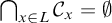
 . Without loss of generality, we can assume that
$\bigcap _{x\in L} \mathcal {C}_x = \emptyset $
. Without loss of generality, we can assume that
$\bigcap _{x\in L} \mathcal {C}_x = \emptyset $
 (otherwise we can just replace
$\mathcal {C}_x$
(otherwise we can just replace
$\mathcal {C}_x$
 with
$\mathcal {C}_x\setminus \bigcap _{y\in L} \mathcal {C}_y$
with
$\mathcal {C}_x\setminus \bigcap _{y\in L} \mathcal {C}_y$
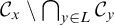 ). Fix a non-empty
$A\subseteq \mathbb {N}^{\mathbb {N}}$
). Fix a non-empty
$A\subseteq \mathbb {N}^{\mathbb {N}}$
 and let
$p\in A$
and let
$p\in A$
 . Let also
$\{p_\alpha \}_{\alpha <\mathfrak {c}}$
. Let also
$\{p_\alpha \}_{\alpha <\mathfrak {c}}$
 be the set of
$\le _{\mathrm {T}}$
be the set of
$\le _{\mathrm {T}}$
 -minimal degrees above p. Clearly, for every
$\alpha $
-minimal degrees above p. Clearly, for every
$\alpha $
 ,
$A <_{\mathrm {M}} \{p_\alpha \}$
,
$A <_{\mathrm {M}} \{p_\alpha \}$
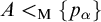 . For
$x \in L$
. For
$x \in L$
 , let
$A_x:= \{ p_\alpha {}\,:\,{} \alpha \in \mathcal {C}_x\}$
, let
$A_x:= \{ p_\alpha {}\,:\,{} \alpha \in \mathcal {C}_x\}$
 . As in the proof of [Reference Shafer11, Theorem 4.3.1], the family
$\{A_x {}\,:\,{} x\in L\}$
. As in the proof of [Reference Shafer11, Theorem 4.3.1], the family
$\{A_x {}\,:\,{} x\in L\}$
 is a chain in
$\mathcal {M}$
is a chain in
$\mathcal {M}$
 of order type L.
Observe also that
$\bigcap _{x\in L} A_x = \emptyset $
 . If
$\mathrm {cof}(L)>\omega $
. If
$\mathrm {cof}(L)>\omega $
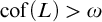 then
$(A_x)_{x\in L}$
then
$(A_x)_{x\in L}$
 has no (non-trivial) upper bound. Indeed, for every cofinal subsequence
$(A_{x_\alpha })_{\alpha <\mathrm {cof}(L)}$
has no (non-trivial) upper bound. Indeed, for every cofinal subsequence
$(A_{x_\alpha })_{\alpha <\mathrm {cof}(L)}$
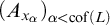 of
$(A_x)_{x\in L}$
of
$(A_x)_{x\in L}$
 ,
$\bigcap _{\alpha <\mathrm {cof}(L) } A_{x_\alpha } = \bigcap _{x\in L} A_{x} = \emptyset $
,
$\bigcap _{\alpha <\mathrm {cof}(L) } A_{x_\alpha } = \bigcap _{x\in L} A_{x} = \emptyset $
 , hence the claim follows from Proposition 2.4.
Corollary 2.6. There is a chain in
$\mathcal {M}_0$
 of order type
$\omega _1$
of order type
$\omega _1$
 with no upper bound.
An explicit example of such a sequence can be built as follows: let
$(d_\alpha )_{\alpha <\omega _1}$
 be a
$\le _{\mathrm {T}}$
be a
$\le _{\mathrm {T}}$
 -chain of order type
$\omega _1$
-chain of order type
$\omega _1$
 . Clearly, this sequence does not have an upper bound, as lower Turing cones are countable. This also shows that the sequence of mass problems
$(\{d_\alpha \})_{\alpha <\omega _1}$
. Clearly, this sequence does not have an upper bound, as lower Turing cones are countable. This also shows that the sequence of mass problems
$(\{d_\alpha \})_{\alpha <\omega _1}$
 has no upper bound in
$\mathcal {M}_0$
has no upper bound in
$\mathcal {M}_0$
 , as there are only countably many singletons in the lower Medvedev cone of every (non-empty) mass problem.
We highlight that we cannot fully characterize (in
$\mathrm {ZFC}$
 ) the cardinals
$\kappa $
) the cardinals
$\kappa $
 for which there is a chain of size
$\kappa $
for which there is a chain of size
$\kappa $
 in
$\mathcal {M}$
in
$\mathcal {M}$
 .
.
Theorem 2.7 [Reference Shafer11, Corollary 4.3.2]
The existence of a chain of cardinality
$2^{\mathfrak {c}}$
 in the Medvedev degrees is independent of
$\mathrm {ZFC}$
in the Medvedev degrees is independent of
$\mathrm {ZFC}$
 .
.
A natural problem is to characterize the cofinality of the Medvedev degrees. The question is only interesting when considering
$\mathcal {M}_0$
 , as there is a top element in
$\mathcal {M}$
, as there is a top element in
$\mathcal {M}$
 . We first recall the following well-known fact about the Turing degrees.
Theorem 2.8 [Reference Odifreddi9, Example V.2.4(c)]
The following are equivalent:
-
• $\mathrm {CH}$
; -
• there is a cofinal chain in $\mathcal {T}$
; -
• there is a cofinal chain in $\mathcal {T}$
of order type
$\omega _1$
.


Recall also that
$\omega _1$
 -chains in the Turing degrees can be built in
$\mathrm {ZFC}$
-chains in the Turing degrees can be built in
$\mathrm {ZFC}$
 . However, under
$\mathrm {ZFC}+\lnot \mathrm {CH}$
. However, under
$\mathrm {ZFC}+\lnot \mathrm {CH}$
 , no such chain can be cofinal. We now show that the analogue of Theorem 2.8 holds for
$\mathcal {M}_0$
, no such chain can be cofinal. We now show that the analogue of Theorem 2.8 holds for
$\mathcal {M}_0$
 . To this end, we first prove the following lemma.
Lemma 2.9. If
$(A_\alpha )_{\alpha <\kappa }$
 is a cofinal chain in
$\mathcal {M}_0$
is a cofinal chain in
$\mathcal {M}_0$
 , then
$\mathrm {cof}(\kappa )=\omega _1$
, then
$\mathrm {cof}(\kappa )=\omega _1$
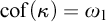 .
.
Proof. Recall first of all that for every mass problem A, there are
$\omega $
 many singletons that are Medvedev-reducible to A (as there are only countably many computable functionals). Assume that
$(A_\alpha )_{\alpha <\kappa }$
many singletons that are Medvedev-reducible to A (as there are only countably many computable functionals). Assume that
$(A_\alpha )_{\alpha <\kappa }$
 is a cofinal sequence in
$\mathcal {M}_0$
is a cofinal sequence in
$\mathcal {M}_0$
 and that
$\mathrm {cof}(\kappa )>\omega _1$
and that
$\mathrm {cof}(\kappa )>\omega _1$
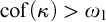 . Let
$(d_\beta )_{\beta <\omega _1}$
. Let
$(d_\beta )_{\beta <\omega _1}$
 be a
$\le _{\mathrm {T}}$
be a
$\le _{\mathrm {T}}$
 -chain. For every
$\beta <\omega _1$
-chain. For every
$\beta <\omega _1$
 , there is
$\alpha _\beta < \kappa $
, there is
$\alpha _\beta < \kappa $
 such that
$\{d_\beta \}\le _{\mathrm {M}} A_{\alpha _\beta }$
such that
$\{d_\beta \}\le _{\mathrm {M}} A_{\alpha _\beta }$
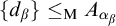 . Since
$\mathrm {cof}(\kappa )>\omega _1$
. Since
$\mathrm {cof}(\kappa )>\omega _1$
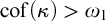 ,
$\eta :=\sup \{ \alpha _\beta {}\,:\,{} \beta < \omega _1\}<\kappa $
,
$\eta :=\sup \{ \alpha _\beta {}\,:\,{} \beta < \omega _1\}<\kappa $
 , and therefore, for every
$\beta <\omega _1$
, and therefore, for every
$\beta <\omega _1$
 ,
$\{d_\beta \}\le _{\mathrm {M}} A_{\eta + 1}$
,
$\{d_\beta \}\le _{\mathrm {M}} A_{\eta + 1}$
 , contradicting the fact that there can be only countably many singletons in the lower cone of
$A_{\eta + 1}$
, contradicting the fact that there can be only countably many singletons in the lower cone of
$A_{\eta + 1}$
 .
.
To conclude the proof, notice that no countable family (and, in particular, no countable chain) can be cofinal in
$\mathcal {M}_0$
 (the union of their lower cones does not contain all the singletons). If
$(A_\alpha )_{\alpha <\kappa }$
(the union of their lower cones does not contain all the singletons). If
$(A_\alpha )_{\alpha <\kappa }$
 is a cofinal chain and
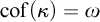
$\mathrm {cof}(\kappa )=\omega $
is a cofinal chain and
$\mathrm {cof}(\kappa )=\omega $
 , then there is a countable cofinal chain in
$\mathcal {M}_0$
, then there is a countable cofinal chain in
$\mathcal {M}_0$
 , which is a contradiction.
Theorem 2.10. The following are equivalent:
-
1. $\mathrm {CH}$
; -
2. there is a cofinal chain in $\mathcal {M}_0$
; -
3. there is a cofinal chain in $\mathcal {M}_0$
of order type
$\omega _1$
.


Proof. Let us first show that
$(1)\Rightarrow (3)$
 . By Theorem 2.8, there is a cofinal chain
$(d_\alpha )_{\alpha <\omega _1}$
. By Theorem 2.8, there is a cofinal chain
$(d_\alpha )_{\alpha <\omega _1}$
 in the Turing degrees (identifying a Turing degree with one of its representatives). Define the sequence
$(A_\alpha )_{\alpha <\omega _1}$
in the Turing degrees (identifying a Turing degree with one of its representatives). Define the sequence
$(A_\alpha )_{\alpha <\omega _1}$
 as
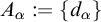
$A_\alpha := \{ d_\alpha \}$
as
$A_\alpha := \{ d_\alpha \}$
 . Clearly, for every
$\alpha <\beta <\omega _1$
. Clearly, for every
$\alpha <\beta <\omega _1$
 ,
$A_\alpha <_{\mathrm {M}} A_\beta $
,
$A_\alpha <_{\mathrm {M}} A_\beta $
 . To prove that
$(A_\alpha )_{\alpha <\omega _1}$
. To prove that
$(A_\alpha )_{\alpha <\omega _1}$
 is cofinal in
$\mathcal {M}_0$
is cofinal in
$\mathcal {M}_0$
 , let
$C\subseteq \mathbb {N}^{\mathbb {N}}$
, let
$C\subseteq \mathbb {N}^{\mathbb {N}}$
 be non-empty and let
$p\in C$
be non-empty and let
$p\in C$
 . Since the sequence
$(d_\alpha )_{\alpha <\omega _1}$
. Since the sequence
$(d_\alpha )_{\alpha <\omega _1}$
 is cofinal in
$\mathcal {T}$
is cofinal in
$\mathcal {T}$
 , there is
$\alpha <\omega _1$
, there is
$\alpha <\omega _1$
 such that
$p\le _{\mathrm {T}} d_\alpha $
such that
$p\le _{\mathrm {T}} d_\alpha $
 , which implies that
$C\le _{\mathrm {M}} A_\alpha $
, which implies that
$C\le _{\mathrm {M}} A_\alpha $
 .
.
The implication
$(3)\Rightarrow (2)$
 is trivial, hence we only need to show that
$(2)\Rightarrow (1)$
is trivial, hence we only need to show that
$(2)\Rightarrow (1)$
 . Let
$(B_\alpha )_{\alpha <\kappa }$
. Let
$(B_\alpha )_{\alpha <\kappa }$
 be a cofinal chain in
$\mathcal {M}_0$
be a cofinal chain in
$\mathcal {M}_0$
 . By Lemma 2.9, we can assume that
$\kappa =\omega _1$
. By Lemma 2.9, we can assume that
$\kappa =\omega _1$
 . For each
$\alpha $
. For each
$\alpha $
 , choose
$p_\alpha \in B_\alpha $
, choose
$p_\alpha \in B_\alpha $
 . Observe that the set
$\{p_\alpha {}\,:\,{} \alpha < \omega _1\}$
. Observe that the set
$\{p_\alpha {}\,:\,{} \alpha < \omega _1\}$
 is cofinal in
$\mathcal {T}$
is cofinal in
$\mathcal {T}$
 . Indeed, for every
$d\in 2^{\mathbb {N}}$
. Indeed, for every
$d\in 2^{\mathbb {N}}$
 , there is
$\alpha < \omega _1$
, there is
$\alpha < \omega _1$
 such that
$\{ d \} \le _{\mathrm {M}} B_{\alpha }$
such that
$\{ d \} \le _{\mathrm {M}} B_{\alpha }$
 , hence in particular
$d \le _{\mathrm {T}} p_\alpha $
, hence in particular
$d \le _{\mathrm {T}} p_\alpha $
 . We now exploit the set
$\{p_\alpha {}\,:\,{} \alpha < \omega _1\}$
. We now exploit the set
$\{p_\alpha {}\,:\,{} \alpha < \omega _1\}$
 to define a cofinal sequence
$(q_\alpha )_{\alpha <\omega _1}$
to define a cofinal sequence
$(q_\alpha )_{\alpha <\omega _1}$
 in the Turing degrees. By Theorem 2.8, this suffices to conclude the proof.
For every
$\alpha $
 such that
$0<\alpha <\omega _1$
such that
$0<\alpha <\omega _1$
 , we fix a fundamental sequence for
$\alpha $
, we fix a fundamental sequence for
$\alpha $
 , i.e., a sequence
$(\alpha [n])_{n\in \mathbb {N}}$
, i.e., a sequence
$(\alpha [n])_{n\in \mathbb {N}}$
 such that
-
• $(\forall n\in \mathbb {N})(\alpha [n]\le \alpha [n+1]< \alpha )$
; -
• $\alpha = \sup \{ \alpha [n]+1 {}\,:\,{} n\in \mathbb {N} \}$
.


We then define
$q_0:=p_0$
 and, for every
$\alpha>0$
and, for every
$\alpha>0$
 ,
$q_\alpha := \left ( \bigoplus _{n\in \mathbb {N}} q_{\alpha [n]} \right )\oplus p_\alpha $
,
$q_\alpha := \left ( \bigoplus _{n\in \mathbb {N}} q_{\alpha [n]} \right )\oplus p_\alpha $
 .
.
Observe that, if
$\alpha < \beta $
 , then there are
$n_0,\ldots , n_k$
, then there are
$n_0,\ldots , n_k$
 such that
$\alpha = \beta [n_0][n_1]\ldots [n_k]$
such that
$\alpha = \beta [n_0][n_1]\ldots [n_k]$
 , which implies that
$q_\alpha \le _{\mathrm {T}} q_\beta $
, which implies that
$q_\alpha \le _{\mathrm {T}} q_\beta $
 . Moreover, for every
$\alpha $
. Moreover, for every
$\alpha $
 ,
$p_\alpha \le _{\mathrm {T}} q_\alpha $
,
$p_\alpha \le _{\mathrm {T}} q_\alpha $
 , hence the sequence
$(q_\alpha )_{\alpha <\omega _1}$
, hence the sequence
$(q_\alpha )_{\alpha <\omega _1}$
 is cofinal in
$\mathcal {T}$
is cofinal in
$\mathcal {T}$
 , and this concludes the proof.
Theorem 2.11.
$\mathrm {setcof}(\mathcal {M}_0) = \mathfrak {c}$
 .
.
Proof. Under
$\mathrm {CH}$
 , this is a corollary of Theorem 2.10 (as no countable family can be cofinal), so assume
$\lnot \mathrm {CH}$
, this is a corollary of Theorem 2.10 (as no countable family can be cofinal), so assume
$\lnot \mathrm {CH}$
 . Notice first of all that the family of singletons is cofinal in
$\mathcal {M}_0$
. Notice first of all that the family of singletons is cofinal in
$\mathcal {M}_0$
 , hence
$\mathrm {setcof}(\mathcal {M}_0)\le \mathfrak {c}$
, hence
$\mathrm {setcof}(\mathcal {M}_0)\le \mathfrak {c}$
 . Let
$\{A_\alpha \}_{\alpha <\kappa }$
. Let
$\{A_\alpha \}_{\alpha <\kappa }$
 be a cofinal family of non-empty mass problems with
$\kappa \le \mathfrak {c}$
be a cofinal family of non-empty mass problems with
$\kappa \le \mathfrak {c}$
 . Let
$\varphi $
. Let
$\varphi $
 be the function that maps
$p\in \mathbb {N}^{\mathbb {N}}$
be the function that maps
$p\in \mathbb {N}^{\mathbb {N}}$
 to the least
$\alpha <\kappa $
to the least
$\alpha <\kappa $
 such that
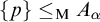
$\{p\} \le _{\mathrm {M}} A_{\alpha }$
such that
$\{p\} \le _{\mathrm {M}} A_{\alpha }$
 . The cofinality of
$\{A_\alpha \}_{\alpha <\kappa }$
. The cofinality of
$\{A_\alpha \}_{\alpha <\kappa }$
 implies that

Since every non-empty mass problem has countably many singletons in its lower cone, for every
$\alpha <\kappa $
 the set
$\varphi ^{-1}(\alpha )$
the set
$\varphi ^{-1}(\alpha )$
 is countable. This implies
$\kappa = \mathfrak {c}$
is countable. This implies
$\kappa = \mathfrak {c}$
 because

3 Chains in the Weihrauch degrees
We now turn our attention to the study of chains in the Weihrauch degrees. As mentioned, some structural properties of the Weihrauch degrees are immediate consequences of the results obtained for the Medvedev degrees. For example, it is observed in [Reference Terwijn13, Proposition 4.2] that under
$\mathrm {ZFC} + 2^{<\mathfrak {c}} = \mathfrak {c}$
 , there are chains of size
$2^{\mathfrak {c}}$
, there are chains of size
$2^{\mathfrak {c}}$
 in
$\mathcal {M}$
in
$\mathcal {M}$
 , and hence in
$\mathcal {W}$
, and hence in
$\mathcal {W}$
 . This follows from Theorem 2.5, as
$2^{<\mathfrak {c}} = \mathfrak {c}$
. This follows from Theorem 2.5, as
$2^{<\mathfrak {c}} = \mathfrak {c}$
 implies that there are chains of size
$2^{\mathfrak {c}}$
implies that there are chains of size
$2^{\mathfrak {c}}$
 in
$(2^{\mathfrak {c}}, \subseteq )$
in
$(2^{\mathfrak {c}}, \subseteq )$
 [Reference Terwijn13, Proposition 3.2].
While the following observation is not an immediate consequence of what happens in the Medvedev degrees, its proof can be obtained by adapting the technique used in Corollary 2.6.
Proposition 3.1. There is a chain in
$\mathcal {W}$
 of order type
$\omega _1$
of order type
$\omega _1$
 with no upper bound.
Proof. Let
$(d_\alpha )_{\alpha <\omega _1}$
 be a
$\le _{\mathrm {T}}$
be a
$\le _{\mathrm {T}}$
 -chain. For every
$\alpha $
-chain. For every
$\alpha $
 , define
$f_\alpha : {\mathbb {N}^{\mathbb {N}}} \to {\mathbb {N}^{\mathbb {N}}}$
, define
$f_\alpha : {\mathbb {N}^{\mathbb {N}}} \to {\mathbb {N}^{\mathbb {N}}}$
 as the constant map
$p\mapsto d_\alpha $
as the constant map
$p\mapsto d_\alpha $
 . Clearly, for every
$\alpha < \beta $
. Clearly, for every
$\alpha < \beta $
 ,
$f_\alpha <_{\mathrm {W}} f_\beta $
,
$f_\alpha <_{\mathrm {W}} f_\beta $
 . Assume there is g such that for every
$\alpha < \omega _1$
. Assume there is g such that for every
$\alpha < \omega _1$
 ,
$f_\alpha \le _{\mathrm {W}} g$
,
$f_\alpha \le _{\mathrm {W}} g$
 . Since there are only countably many computable functionals, there are computable functionals
$\Phi ,\Psi $
. Since there are only countably many computable functionals, there are computable functionals
$\Phi ,\Psi $
 and distinct ordinals
$\alpha , \beta $
and distinct ordinals
$\alpha , \beta $
 such that the reductions
$f_\alpha \le _{\mathrm {W}} g$
such that the reductions
$f_\alpha \le _{\mathrm {W}} g$
 and
$f_\beta \le _{\mathrm {W}} g$
and
$f_\beta \le _{\mathrm {W}} g$
 are witnessed by
$\Phi ,\Psi $
are witnessed by
$\Phi ,\Psi $
 . In particular, for every
$p\in g(\Phi (0^{\mathbb {N}}))$
. In particular, for every
$p\in g(\Phi (0^{\mathbb {N}}))$
 we have
$d_\alpha = \Psi (0^{\mathbb {N}}, p) = d_\beta $
we have
$d_\alpha = \Psi (0^{\mathbb {N}}, p) = d_\beta $
 , which is a contradiction.
It is not hard to see that the previous proof can be adapted to show more than what is claimed. In the following, we will generalize the previous proposition and provide a characterization of when a chain of multi-valued functions admits an upper bound. We first observe the following fact.
Proposition 3.2. Let
$\mathcal {F}$
 be an uncountable family of multi-valued functions. If

then the family has no upper bound, i.e., for every g there is
$f\in \mathcal {F}$
 such that
$f \not \le _{\mathrm {W}} g$
such that
$f \not \le _{\mathrm {W}} g$
 .
.
Proof. Assume towards a contradiction that there is g such that for every
$f\in \mathcal {F}$
 ,
$f\le _{\mathrm {W}} g$
,
$f\le _{\mathrm {W}} g$
 . Since
$|\mathcal {F}|>\omega $
. Since
$|\mathcal {F}|>\omega $
 , there are distinct
$f_0, f_1 \in \mathcal {F}$
, there are distinct
$f_0, f_1 \in \mathcal {F}$
 and computable functionals
$\Phi ,\Psi $
and computable functionals
$\Phi ,\Psi $
 such that the reductions
$f_0\le _{\mathrm {W}} g$
such that the reductions
$f_0\le _{\mathrm {W}} g$
 and
$f_1\le _{\mathrm {W}} g$
and
$f_1\le _{\mathrm {W}} g$
 are witnessed by
$\Phi ,\Psi $
are witnessed by
$\Phi ,\Psi $
 . By hypothesis, we can fix
$p\in \operatorname {dom}(f_0) \cap \operatorname {dom}(f_1)$
. By hypothesis, we can fix
$p\in \operatorname {dom}(f_0) \cap \operatorname {dom}(f_1)$
 such that
$f_0(p)\cap f_1(p)=\emptyset $
such that
$f_0(p)\cap f_1(p)=\emptyset $
 . Clearly, for any solution
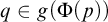
$q\in g(\Phi (p))$
. Clearly, for any solution
$q\in g(\Phi (p))$
 ,
$\Psi (p,q)$
,
$\Psi (p,q)$
 cannot belong to both
$f_0(p)$
cannot belong to both
$f_0(p)$
 and
$f_1(p)$
and
$f_1(p)$
 , contradicting the definition of Weihrauch reduction.
We show that a “long” chain (a chain whose order type has uncountable cofinality) admits an upper bound iff, roughly speaking, there is a cofinal subchain all of whose problems have common solutions for their inputs (Theorem 3.5). The proof is obtained by combining the following two lemmas.
Lemma 3.3. Let L be a linear order with
$\mathrm {cof}(L)>\omega $
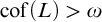 and let
$(f_x)_{x\in L}$
and let
$(f_x)_{x\in L}$
 be a chain of partial multi-valued functions (i.e., order-isomorphic to L). If
$(f_x)_{x\in L}$
be a chain of partial multi-valued functions (i.e., order-isomorphic to L). If
$(f_x)_{x\in L}$
 has an upper bound, then there is
$E\subseteq L$
has an upper bound, then there is
$E\subseteq L$
 cofinal in L such that, letting
$I_p^E:=\{y \in E {}\,:\,{} p\in \operatorname {dom}(f_y)\}$
cofinal in L such that, letting
$I_p^E:=\{y \in E {}\,:\,{} p\in \operatorname {dom}(f_y)\}$
 ,
,

Proof. Let g be an upper bound for
$(f_x)_{x\in L}$
 . For every
$e,i$
. For every
$e,i$
 , let
$E_{e,i}:=\{x \in L {}\,:\,{} f_x \le _{\mathrm {W}} g \text { via }\Phi _e, \Phi _i\}$
, let
$E_{e,i}:=\{x \in L {}\,:\,{} f_x \le _{\mathrm {W}} g \text { via }\Phi _e, \Phi _i\}$
 . Since
$\bigcup _{e,i\in \mathbb {N}} E_{e,i} = L$
. Since
$\bigcup _{e,i\in \mathbb {N}} E_{e,i} = L$
 and
$\omega < \mathrm {cof}(L)$
and
$\omega < \mathrm {cof}(L)$
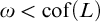 , there are
$e,i\in \mathbb {N}$
, there are
$e,i\in \mathbb {N}$
 such that
$E_{e,i}$
such that
$E_{e,i}$
 is cofinal in L. For the sake of readability, let
$E:=E_{e,i}$
is cofinal in L. For the sake of readability, let
$E:=E_{e,i}$
 ,
$\Phi :=\Phi _e$
,
$\Phi :=\Phi _e$
 , and
$\Psi :=\Phi _i$
, and
$\Psi :=\Phi _i$
 .
.
Notice that, by definition of Weihrauch reducibility, for every
$p\in \bigcup _{z \in E} \operatorname {dom}(f_z)$
 ,
$\Phi (p)\in \operatorname {dom}(g)$
,
$\Phi (p)\in \operatorname {dom}(g)$
 . Moreover, for every
$y \in I^E_p$
. Moreover, for every
$y \in I^E_p$
 and every
$q\in g(\Phi (p))$
and every
$q\in g(\Phi (p))$
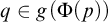 ,
$\Psi (p,q)\in f_y(p)$
,
$\Psi (p,q)\in f_y(p)$
 . In particular,
$\bigcap _{y \in I^E_p} f_y(p) \neq \emptyset $
. In particular,
$\bigcap _{y \in I^E_p} f_y(p) \neq \emptyset $
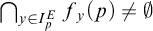 , which concludes the proof.
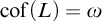
If
$\mathrm {cof}(L) =\omega $
 then the conclusion of Lemma 3.3 may fail. Given a chain
$(f_n)_{n \in \omega }$
then the conclusion of Lemma 3.3 may fail. Given a chain
$(f_n)_{n \in \omega }$
 such that
$\bigcap _{n} \operatorname {dom}(f_n)\neq \emptyset $
such that
$\bigcap _{n} \operatorname {dom}(f_n)\neq \emptyset $
 (e.g., as in Proposition 3.1), for every n, let
$h_n$
(e.g., as in Proposition 3.1), for every n, let
$h_n$
 be defined as
$\operatorname {dom}(h_n) := \operatorname {dom}(f_n)$
be defined as
$\operatorname {dom}(h_n) := \operatorname {dom}(f_n)$
 and
$h_n(p) := \{n\}\times f_n(p)$
and
$h_n(p) := \{n\}\times f_n(p)$
 . Clearly
$h_n \equiv _{\mathrm {W}} f_n$
. Clearly
$h_n \equiv _{\mathrm {W}} f_n$
 , but, for any
$p \in \bigcap _{n} \operatorname {dom}(f_n)$
, but, for any
$p \in \bigcap _{n} \operatorname {dom}(f_n)$
 and
$n\neq m$
and
$n\neq m$
 ,
$h_n(p) \cap h_m(p) = \emptyset $
,
$h_n(p) \cap h_m(p) = \emptyset $
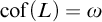
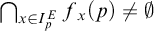
 . However, the proof of Lemma 3.3 can be adapted to obtain that when L is uncountable and
$\mathrm {cof}(L) =\omega $
. However, the proof of Lemma 3.3 can be adapted to obtain that when L is uncountable and
$\mathrm {cof}(L) =\omega $
 , for every cardinal
$\lambda <|L|$
, for every cardinal
$\lambda <|L|$
 , there is
$E\subseteq L$
, there is
$E\subseteq L$
 with
$|E|=\lambda $
with
$|E|=\lambda $
 such that for every
$ p\in \bigcup _{z \in E}\operatorname {dom}(f_z)$
such that for every
$ p\in \bigcup _{z \in E}\operatorname {dom}(f_z)$
 ,
$\bigcap _{x \in I_p^E} f_x(p)\neq \emptyset $
,
$\bigcap _{x \in I_p^E} f_x(p)\neq \emptyset $
 .
.
We now provide a sufficient condition for a family of problems
$\{f_x\}_{x\in P}$
 , ordered as the partial order P, to have an upper bound. We do not need to require that P has uncountable cofinality. However, the statement is trivial if
$\mathrm {setcof}(P)=\omega $
, ordered as the partial order P, to have an upper bound. We do not need to require that P has uncountable cofinality. However, the statement is trivial if
$\mathrm {setcof}(P)=\omega $
 , as every countable family of problems has an upper bound.
Lemma 3.4. Let P be a partial order and let
$\{f_x\}_{x\in P}$
 be a family of partial multi-valued functions that is order-isomorphic to P. For every
$A\subseteq P$
be a family of partial multi-valued functions that is order-isomorphic to P. For every
$A\subseteq P$
 and every
$p\in \mathbb {N}^{\mathbb {N}}$
and every
$p\in \mathbb {N}^{\mathbb {N}}$
 , let
$I_p^A:=\{x \in A {}\,:\,{} p\in \operatorname {dom}(f_x)\}$
, let
$I_p^A:=\{x \in A {}\,:\,{} p\in \operatorname {dom}(f_x)\}$
 .
.
If there is a cofinal
$E\subseteq P$
 such that

then
$\{f_x\}_{x\in P}$
 has an upper bound.
Proof. Notice first of all that, since E is cofinal in P, it is enough to show that
$\{f_z\}_{z\in E}$
 has an upper bound. Let
$g:\subseteq \mathbb {N}^{\mathbb {N}} \rightrightarrows \mathbb {N}^{\mathbb {N}}$
has an upper bound. Let
$g:\subseteq \mathbb {N}^{\mathbb {N}} \rightrightarrows \mathbb {N}^{\mathbb {N}}$
 be the problem with
$\operatorname {dom}(g):=\bigcup _{z\in E} \operatorname {dom}(f_z)$
be the problem with
$\operatorname {dom}(g):=\bigcup _{z\in E} \operatorname {dom}(f_z)$
 defined as

Observe that, for every
$z \in E$
 and every
$p\in \operatorname {dom}(f_z)$
and every
$p\in \operatorname {dom}(f_z)$
 ,
$\emptyset \neq g(p)\subseteq f_z(p)$
,
$\emptyset \neq g(p)\subseteq f_z(p)$
 . This shows that
$(\forall z \in E)(f_z \le _{\mathrm {W}} g)$
. This shows that
$(\forall z \in E)(f_z \le _{\mathrm {W}} g)$
 .
.
Combining the previous two lemmas, we obtain the following characterization.
Theorem 3.5. Let L be an infinite linear order and let
$(f_x)_{x\in L}$
 be a chain of partial multi-valued functions. The following are equivalent:
-
1. $(f_x)_{x\in L}$
has an upper bound in
$\mathcal {W}$
; -
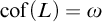
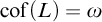
2. $\mathrm {cof}(L)=\omega $
or there is a cofinal
$E\subseteq L$
such that for every
$p\in \bigcup _{z \in E}\operatorname {dom}(f_z)$
,
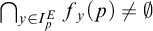
$\bigcap _{y \in I_p^E} f_y(p)\neq \emptyset $
, where
$I_p^E:=\{y \in E {}\,:\,{} p\in \operatorname {dom}(f_y)\}$
.





Proof.


A natural question is whether Theorem 3.5 can be extended to the case where P is just a partial order and in place of cofinality we consider set-cofinality. A partial order P is called lean if every subset of cardinality
$\ge \mathrm {setcof}(P)$
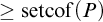 is cofinal in P. The notion of lean poset of arbitrary cardinality was studied by Diestel and Pikhurko in [Reference Diestel and Pikhurko4]. It is easy to extend the proof of Lemma 3.3, and hence Theorem 3.5, to posets with a lean cofinal subset. However Diestel and Pikhurko proved that an infinite poset has a lean cofinal subset if and only if it contains a cofinal chain, so that the generalization to posets with lean cofinal subsets is only apparent.
For the sake of readability, we highlight the following particular case of Theorem 3.5.
Corollary 3.6. Let
$\kappa>\omega $
 be a regular cardinal and let
$(f_\alpha )_{\alpha <\kappa }$
be a regular cardinal and let
$(f_\alpha )_{\alpha <\kappa }$
 be a chain of multi-valued functions. The following are equivalent:
-
1. $(f_\alpha )_{\alpha <\kappa }$
has an upper bound in
$\mathcal {W}$
; -
2. there is a cofinal subsequence $(\overline {f}_\alpha )_{\alpha <\kappa }$
such that for every
$p \in \bigcup _{\alpha <\kappa } \operatorname {dom}(\overline {f}_\alpha )$
, $$ \begin{align*} \bigcap \{ \overline{f}_\alpha(p) {}\,:\,{} p \in \operatorname{dom}(\overline{f}_\alpha) \}\neq \emptyset.\\[-35pt] \end{align*} $$




While Theorem 3.5 characterizes precisely when a chain of problems has an upper bound, we only have presented an example of a chain of order type
$\omega _1$
 with no upper bound (Proposition 3.1). However, explicit examples can be easily obtained for every
$\eta \le \mathfrak {c}$
with no upper bound (Proposition 3.1). However, explicit examples can be easily obtained for every
$\eta \le \mathfrak {c}$
 with uncountable cofinality. The same strategy can be used to obtain a chain (with no upper bound) isomorphic to any subchain of
$(2^{\mathfrak {c}}, \supseteq )$
with uncountable cofinality. The same strategy can be used to obtain a chain (with no upper bound) isomorphic to any subchain of
$(2^{\mathfrak {c}}, \supseteq )$
 with uncountable cofinality.
Theorem 3.7. For every ordinal
$\eta \le \mathfrak {c}$
 with
$\mathrm {cof}(\eta )>\omega $
with
$\mathrm {cof}(\eta )>\omega $
 , there is a chain
$(f_\alpha )_{\alpha <\eta }$
, there is a chain
$(f_\alpha )_{\alpha <\eta }$
 in
$\mathcal {W}$
in
$\mathcal {W}$
 without upper bound.
Proof. Let
$\{p_\alpha \}_{\alpha <\eta }$
 be a
$\le _{\mathrm {T}}$
be a
$\le _{\mathrm {T}}$
 -antichain. For every
$\alpha <\eta $
-antichain. For every
$\alpha <\eta $
 , let
$f_\alpha $
, let
$f_\alpha $
 be the problem with
$\operatorname {dom}(f_\alpha ):=\{0^{\mathbb {N}}\}$
be the problem with
$\operatorname {dom}(f_\alpha ):=\{0^{\mathbb {N}}\}$
 defined as
$f_\alpha (0^{\mathbb {N}}):=\{ p_\delta {}\,:\,{} \delta \ge \alpha \}$
defined as
$f_\alpha (0^{\mathbb {N}}):=\{ p_\delta {}\,:\,{} \delta \ge \alpha \}$
 .
.
Clearly, for every
$\beta <\alpha $
 ,
$f_\beta \le _{\mathrm {W}} f_\alpha $
,
$f_\beta \le _{\mathrm {W}} f_\alpha $
 (as
$f_\alpha (0^{\mathbb {N}}) \subset f_\beta (0^{\mathbb {N}})$
(as
$f_\alpha (0^{\mathbb {N}}) \subset f_\beta (0^{\mathbb {N}})$
 ) and
$f_\alpha \not \le _{\mathrm {W}} f_\beta $
) and
$f_\alpha \not \le _{\mathrm {W}} f_\beta $
 (as, by construction,
$p_\beta $
(as, by construction,
$p_\beta $
 does not compute any element in
$f_\alpha (0^{\mathbb {N}})$
does not compute any element in
$f_\alpha (0^{\mathbb {N}})$
 ). Hence,
$(f_\alpha )_{\alpha <\eta }$
). Hence,
$(f_\alpha )_{\alpha <\eta }$
 is a strictly increasing chain in
$\mathcal {W}$
is a strictly increasing chain in
$\mathcal {W}$
 of order type
$\eta $
of order type
$\eta $
 . The fact that
$(f_\alpha )_{\alpha <\eta }$
. The fact that
$(f_\alpha )_{\alpha <\eta }$
 does not have an upper bound follows from Theorem 3.5. Indeed, for every
$E\subseteq \eta $
does not have an upper bound follows from Theorem 3.5. Indeed, for every
$E\subseteq \eta $
 cofinal in
$\eta $
cofinal in
$\eta $
 ,
$\bigcap _{\alpha \in E} f_\alpha (0^{\mathbb {N}})=\emptyset $
,
$\bigcap _{\alpha \in E} f_\alpha (0^{\mathbb {N}})=\emptyset $
 .
.
We now turn our attention to studying when a sequence of problems admits a lower bound. Since the Weihrauch degrees have a bottom element, the question is only interesting when working in
$\mathcal {W}_0$
 , i.e., when restricting our attention to non-trivial lower bounds. Observe that, analogously to what happens for the upper bounds, every family
$\{f_x\}_{x\in P}$
, i.e., when restricting our attention to non-trivial lower bounds. Observe that, analogously to what happens for the upper bounds, every family
$\{f_x\}_{x\in P}$
 with
$\mathrm {setcoinit}(P)=\omega $
with
$\mathrm {setcoinit}(P)=\omega $
 has a (non-zero) lower bound.
As already mentioned,
$\mathcal {M}^*$
 is (isomorphic to) an initial segment of
$\mathcal {W}$
is (isomorphic to) an initial segment of
$\mathcal {W}$
 . As such, examples of chains in
$\mathcal {W}_0$
. As such, examples of chains in
$\mathcal {W}_0$
 with no lower bound can be readily obtained using Theorem 2.5. In particular, we highlight the following corollary.
Corollary 3.8. For every cardinal
$\kappa \le \mathfrak {c}$
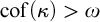
 with
$\mathrm {cof}(\kappa )>\omega $
with
$\mathrm {cof}(\kappa )>\omega $
 , there is a descending sequence
$(f_\alpha )_{\alpha < \kappa }$
, there is a descending sequence
$(f_\alpha )_{\alpha < \kappa }$
 in
$\mathcal {W}_0$
in
$\mathcal {W}_0$
 with no lower bound.
At the same time, it is not hard to show that there are descending sequences with no lower bound that do not intersect the lower cone of
$\operatorname {id}$
 . As an explicit example, consider the following: let
$\{p_\alpha \}_{\alpha <\omega _1}$
. As an explicit example, consider the following: let
$\{p_\alpha \}_{\alpha <\omega _1}$
 and
$q\in \mathbb {N}^{\mathbb {N}}$
and
$q\in \mathbb {N}^{\mathbb {N}}$
 be such that
$(p_\alpha )_{\alpha <\omega _1}$
be such that
$(p_\alpha )_{\alpha <\omega _1}$
 is a
$\le _{\mathrm {T}}$
is a
$\le _{\mathrm {T}}$
 -chain and, for every
$\alpha $
-chain and, for every
$\alpha $
 ,
$q \not \le _{\mathrm {T}} p_\alpha $
,
$q \not \le _{\mathrm {T}} p_\alpha $
 . Define
$f_\alpha :=p_\alpha \mapsto q$
. Define
$f_\alpha :=p_\alpha \mapsto q$
 . Clearly,
$\alpha <\beta $
. Clearly,
$\alpha <\beta $
 implies
$f_\beta <_{\mathrm {W}} f_\alpha $
implies
$f_\beta <_{\mathrm {W}} f_\alpha $
 . The fact that
$(f_\alpha )_{\alpha \in \omega _1^*}$
. The fact that
$(f_\alpha )_{\alpha \in \omega _1^*}$
 has no lower bound in
$\mathcal {W}_0$
has no lower bound in
$\mathcal {W}_0$
 follows from the fact that, if
$g\le _{\mathrm {W}} f_\alpha $
follows from the fact that, if
$g\le _{\mathrm {W}} f_\alpha $
 then
$\{p_\alpha \} \le _{\mathrm {M}} \operatorname {dom}(g)$
then
$\{p_\alpha \} \le _{\mathrm {M}} \operatorname {dom}(g)$
 . However, every mass problem only has countably many singletons in its lower cone. Finally, for every
$\alpha $
. However, every mass problem only has countably many singletons in its lower cone. Finally, for every
$\alpha $
 ,
$f_\alpha \not \le _{\mathrm {W}} \operatorname {id}$
,
$f_\alpha \not \le _{\mathrm {W}} \operatorname {id}$
 (as
$q\not \le _{\mathrm {T}} p_\alpha $
(as
$q\not \le _{\mathrm {T}} p_\alpha $
 ).
).
This example suggests the following simple observation.
Proposition 3.9. Let
$\{f_\alpha \}_{\alpha <\kappa }$
 be a chain in
$\mathcal {W}_0$
be a chain in
$\mathcal {W}_0$
 and for each
$\alpha $
and for each
$\alpha $
 , let
$D_\alpha :=\operatorname {dom}(f_\alpha )$
, let
$D_\alpha :=\operatorname {dom}(f_\alpha )$
 . The chain
$\{f_\alpha \}_{\alpha <\kappa }$
. The chain
$\{f_\alpha \}_{\alpha <\kappa }$
 has a lower bound in
$\mathcal {W}_0$
has a lower bound in
$\mathcal {W}_0$
 iff the chain
$\{D_\alpha \}_{\alpha <\kappa }$
iff the chain
$\{D_\alpha \}_{\alpha <\kappa }$
 has an upper bound in
$\mathcal {M}_0$
has an upper bound in
$\mathcal {M}_0$
 .
.
Proof. If g is a lower bound for
$\{f_\alpha \}_{\alpha <\kappa }$
 , then
$\operatorname {dom}(g)$
, then
$\operatorname {dom}(g)$
 is a lower bound for
$\{D_\alpha \}_{\alpha <\kappa }$
is a lower bound for
$\{D_\alpha \}_{\alpha <\kappa }$
 . On the other hand, if B is an upper bound for
$\{D_\alpha \}_{\alpha <\kappa }$
. On the other hand, if B is an upper bound for
$\{D_\alpha \}_{\alpha <\kappa }$
 , then
$g:=\operatorname {id}_B$
, then
$g:=\operatorname {id}_B$
 is a lower bound for
$\{f_\alpha \}_{\alpha <\kappa }$
is a lower bound for
$\{f_\alpha \}_{\alpha <\kappa }$
 .
.
Despite the fact that a chain with no lower bound in
$\mathcal {W}_0$
 can live outside the lower cone of
$\operatorname {id}$
can live outside the lower cone of
$\operatorname {id}$
 , we now show that, when restricting our attention to chains of order type
$\kappa ^*$
, we now show that, when restricting our attention to chains of order type
$\kappa ^*$
 for some regular
$\kappa $
for some regular
$\kappa $
 , there is a precise correspondence between the existence of chains in
$\mathcal {W}_0$
, there is a precise correspondence between the existence of chains in
$\mathcal {W}_0$
 with no lower bound and the existence of chains in
$\mathcal {M}_0$
with no lower bound and the existence of chains in
$\mathcal {M}_0$
 with no upper bound.
Theorem 3.10. For every regular cardinal
$\kappa $
 , the following are equivalent:
-
1. there is a sequence in $\mathcal {W}_0$
of order type
$\kappa ^*$
which is unbounded below; -
2. there is a sequence in $\mathcal {M}_0$
of order type
$\kappa $
which is unbounded above.


Proof. The implication
$(2)\Rightarrow (1)$
 is trivial as the lower cone of
$\operatorname {id}$
is trivial as the lower cone of
$\operatorname {id}$
 in
$\mathcal {W}_0$
in
$\mathcal {W}_0$
 is reverse isomorphic to
$\mathcal {M}_0$
is reverse isomorphic to
$\mathcal {M}_0$
 . For the direction
$(1)\Rightarrow (2)$
. For the direction
$(1)\Rightarrow (2)$
 , let
$(f_\alpha )_{\alpha \in \kappa ^*}$
, let
$(f_\alpha )_{\alpha \in \kappa ^*}$
 be a descending sequence in
$\mathcal {W}_0$
be a descending sequence in
$\mathcal {W}_0$
 with no lower bound. In particular,
$\kappa>\omega $
with no lower bound. In particular,
$\kappa>\omega $
 . Let
$D_\alpha :=\operatorname {dom}(f_\alpha )$
. Let
$D_\alpha :=\operatorname {dom}(f_\alpha )$
 . It follows from the definition of Weihrauch reducibility that the family
$\{D_\alpha \}_{\alpha < \kappa }$
. It follows from the definition of Weihrauch reducibility that the family
$\{D_\alpha \}_{\alpha < \kappa }$
 is a chain in
$\mathcal {M}_0$
is a chain in
$\mathcal {M}_0$
 . If
$\{D_\alpha \}_{\alpha < \kappa }$
. If
$\{D_\alpha \}_{\alpha < \kappa }$
 has order type
$\kappa $
has order type
$\kappa $
 , then we are done (by Theorem 2.5). Assume towards a contradiction that
$\{D_\alpha \}_{\alpha < \kappa }$
, then we are done (by Theorem 2.5). Assume towards a contradiction that
$\{D_\alpha \}_{\alpha < \kappa }$
 is order-isomorphic to L with
$|L|<\kappa $
is order-isomorphic to L with
$|L|<\kappa $
 . In other words, let
$(D_x)_{x\in L}$
. In other words, let
$(D_x)_{x\in L}$
 be a subchain of
$\{D_\alpha \}_{\alpha < \kappa }$
be a subchain of
$\{D_\alpha \}_{\alpha < \kappa }$
 such that for every
$\alpha <\kappa $
such that for every
$\alpha <\kappa $
 , there is
$x\in L$
, there is
$x\in L$
 such that
$D_x \equiv _{\mathrm {M}} D_\alpha $
such that
$D_x \equiv _{\mathrm {M}} D_\alpha $
 . For every
$x\in L$
. For every
$x\in L$
 , let
$M_x:=\{ \alpha < \kappa {}\,:\,{} D_x \equiv _{\mathrm {M}} D_\alpha \}$
, let
$M_x:=\{ \alpha < \kappa {}\,:\,{} D_x \equiv _{\mathrm {M}} D_\alpha \}$
 . Since
$\kappa $
. Since
$\kappa $
 is regular, there is
$x\in L$
is regular, there is
$x\in L$
 such that
$|M_x|=\kappa $
such that
$|M_x|=\kappa $
 . In particular, since
$M_x$
. In particular, since
$M_x$
 is cofinal in
$\kappa $
is cofinal in
$\kappa $
 and
$\{D_\alpha \}_{\alpha < \kappa }$
and
$\{D_\alpha \}_{\alpha < \kappa }$
 is a chain, there is
$\alpha _0$
is a chain, there is
$\alpha _0$
 such that for every
$\alpha>\alpha _0$
such that for every
$\alpha>\alpha _0$
 ,
$D_x \equiv _{\mathrm {M}} D_\alpha $
,
$D_x \equiv _{\mathrm {M}} D_\alpha $
 . This implies that x is the top element of L, and therefore the sequence
$(D_x)_{x\in L}$
. This implies that x is the top element of L, and therefore the sequence
$(D_x)_{x\in L}$
 has an upper bound in
$\mathcal {M}_0$
has an upper bound in
$\mathcal {M}_0$
 . We have now reached a contradiction, as Proposition 3.9 implies that the sequence
$(f_\alpha )_{\alpha \in \kappa ^*}$
. We have now reached a contradiction, as Proposition 3.9 implies that the sequence
$(f_\alpha )_{\alpha \in \kappa ^*}$
 has a lower bound in
$\mathcal {W}_0$
has a lower bound in
$\mathcal {W}_0$
 .
.
Having discussed the conditions under which a chain possesses an upper bound or a lower bound, we now briefly examine when two families of problems admit an intermediate degree.
Theorem 3.11. Let
$L,M$
 be two linear orders with
$\mathrm {cof}(L)>\omega $
be two linear orders with
$\mathrm {cof}(L)>\omega $
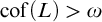 and
$\mathrm {coinit} (M)>\omega $
and
$\mathrm {coinit} (M)>\omega $
 . Let also
$(f_x)_{x\in L}$
. Let also
$(f_x)_{x\in L}$
 and
$(h_z)_{z\in M}$
and
$(h_z)_{z\in M}$
 be two chains in
$\mathcal {W}$
be two chains in
$\mathcal {W}$
 that are order-isomorphic, respectively, to L and M, and such that, for each
$x\in L$
that are order-isomorphic, respectively, to L and M, and such that, for each
$x\in L$
 and
$z\in M$
and
$z\in M$
 ,
$f_x\le _{\mathrm {W}} h_z$
,
$f_x\le _{\mathrm {W}} h_z$
 . Then the following are equivalent:
-
1. there is g such that for every $x\in L$
and
$z\in M$
,
$f_x \le _{\mathrm {W}} g \le _{\mathrm {W}} h_z$
; -
2. there are two computable functionals $\Phi ,\Psi $
and two sets
$X\subseteq L$
and
$Z\subseteq M$
cofinal in L and coinitial in
$M,$
respectively, such that, for every
$x\in X$
and
$z\in Z$
,
$f_{x} \le _{\mathrm {W}} h_{z}$
via
$\Phi ,\Psi $
.





Proof. For
$(1)\Rightarrow (2)$
 , the set X can be obtained as in the proof of Lemma 3.3 using the upper bound g for the family
$(f_x)_{x\in L}$
, the set X can be obtained as in the proof of Lemma 3.3 using the upper bound g for the family
$(f_x)_{x\in L}$
 . In particular, there are
$e,i\in \mathbb {N}$
. In particular, there are
$e,i\in \mathbb {N}$
 such that for every
$x\in X$
such that for every
$x\in X$
 ,
$f_x\le _{\mathrm {W}} g$
,
$f_x\le _{\mathrm {W}} g$
 via
$\Phi _e,\Phi _i$
via
$\Phi _e,\Phi _i$
 . The argument for obtaining Z is symmetrical: since g is a lower bound for
$(h_z)_{z\in M}$
. The argument for obtaining Z is symmetrical: since g is a lower bound for
$(h_z)_{z\in M}$
 and
$\mathrm {coinit}(M)>\omega $
and
$\mathrm {coinit}(M)>\omega $
 , there are
$n,k\in \mathbb {N}$
, there are
$n,k\in \mathbb {N}$
 and a coinitial set
$Z\subseteq M$
and a coinitial set
$Z\subseteq M$
 such that for every
$z\in Z$
such that for every
$z\in Z$
 ,
$g\le _{\mathrm {W}} h_z$
,
$g\le _{\mathrm {W}} h_z$
 via
$\Phi _n,\Phi _k$
via
$\Phi _n,\Phi _k$
 . The maps
$\Phi :=\Phi _n\circ \Phi _e$
. The maps
$\Phi :=\Phi _n\circ \Phi _e$
 and
$\Psi :=(p,q)\mapsto \Phi _i(p, \Phi _k (\Phi _e(p),q))$
and
$\Psi :=(p,q)\mapsto \Phi _i(p, \Phi _k (\Phi _e(p),q))$
 (the compositions of the functionals witnessing the reductions
$f_x\le _{\mathrm {W}} g$
(the compositions of the functionals witnessing the reductions
$f_x\le _{\mathrm {W}} g$
 and
$g\le _{\mathrm {W}} h_z$
and
$g\le _{\mathrm {W}} h_z$
 ) are the desired functionals.
To show that
$(2)\Rightarrow (1)$
 , fix
$\Phi $
, fix
$\Phi $
 ,
$\Psi $
,
$\Psi $
 , X, and Z as in the hypotheses. We can define g as follows:
$\operatorname {dom}(g):=\bigcup _{x\in X} \operatorname {dom}(f_x)$
, X, and Z as in the hypotheses. We can define g as follows:
$\operatorname {dom}(g):=\bigcup _{x\in X} \operatorname {dom}(f_x)$
 and
$g(p):=\bigcup _{z\in Z} h(\Phi (p))$
and
$g(p):=\bigcup _{z\in Z} h(\Phi (p))$
 . Observe that for every
$x\in X$
. Observe that for every
$x\in X$
 ,
$f_x\le _{\mathrm {W}} g$
,
$f_x\le _{\mathrm {W}} g$
 via the maps
$\operatorname {id}$
via the maps
$\operatorname {id}$
 and
$\Psi $
and
$\Psi $
 . Moreover, for every
$z\in Z$
. Moreover, for every
$z\in Z$
 ,
$g\le _{\mathrm {W}} h_z$
,
$g\le _{\mathrm {W}} h_z$
 via
$\Phi $
via
$\Phi $
 and
$\pi _2:=(p,q)\mapsto q$
and
$\pi _2:=(p,q)\mapsto q$
 . The claim follows from the fact that X and Z are cofinal in L and coinitial in
$M,$
. The claim follows from the fact that X and Z are cofinal in L and coinitial in
$M,$
 respectively.
Observe that, unlike what happens when studying upper/lower bounds, the statement is not trivial if
$\mathrm {cof}(L)=\omega $
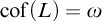 or
$\mathrm {coinit}(M)=\omega $
or
$\mathrm {coinit}(M)=\omega $
 . In particular, while there are chains of order type
$\omega +1+\omega ^*$
. In particular, while there are chains of order type
$\omega +1+\omega ^*$
 in
$\mathcal {W}$
in
$\mathcal {W}$
 , it is not clear whether every
$\omega +\omega ^*$
, it is not clear whether every
$\omega +\omega ^*$
 chain is extendible to an
$\omega +1+\omega ^*$
chain is extendible to an
$\omega +1+\omega ^*$
 chain.
We mention, however, that no interval in the Weihrauch degrees can have cardinality
$\omega $
 .
.
Theorem 3.12. Every infinite interval in
$\mathcal {W}$
 is uncountable.
Proof. Fix
$h<_{\mathrm {W}} f$
 and assume that the interval
$(h,f)$
and assume that the interval
$(h,f)$
 is infinite. If the interval
$(\operatorname {dom}(f), \operatorname {dom}(h))$
is infinite. If the interval
$(\operatorname {dom}(f), \operatorname {dom}(h))$
 in
$\mathcal {M}$
in
$\mathcal {M}$
 is infinite, then, by [Reference Terwijn13, Theorem 2.10], there is an antichain of size
$2^{\mathfrak {c}}$
is infinite, then, by [Reference Terwijn13, Theorem 2.10], there is an antichain of size
$2^{\mathfrak {c}}$
 between
$\operatorname {dom}(f)$
between
$\operatorname {dom}(f)$
 and
$\operatorname {dom}(h)$
and
$\operatorname {dom}(h)$
 . Fix any such antichain
$\{A_\alpha \}_{\alpha <2^{\mathfrak {c}}}$
. Fix any such antichain
$\{A_\alpha \}_{\alpha <2^{\mathfrak {c}}}$
 . We can define
$2^{\mathfrak {c}}$
. We can define
$2^{\mathfrak {c}}$
 many problems
$\{g_\alpha \}_{\alpha <2^{\mathfrak {c}}}$
many problems
$\{g_\alpha \}_{\alpha <2^{\mathfrak {c}}}$
 between h and f as follows: for every
$\alpha $
between h and f as follows: for every
$\alpha $
 , define
$g_\alpha: {\mathrm{dom}(f)\times A_\alpha} \rightrightarrows {\mathbb {N}^{\mathbb {N}}}$
, define
$g_\alpha: {\mathrm{dom}(f)\times A_\alpha} \rightrightarrows {\mathbb {N}^{\mathbb {N}}}$
 as
$g_\alpha (p,q):=f(p)$
as
$g_\alpha (p,q):=f(p)$
 . Observe that
$\operatorname {dom}(g_\alpha )=\operatorname {dom}(f)\vee A_\alpha \equiv _{\mathrm {M}} A_\alpha $
. Observe that
$\operatorname {dom}(g_\alpha )=\operatorname {dom}(f)\vee A_\alpha \equiv _{\mathrm {M}} A_\alpha $
 , hence
$f \not \le _{\mathrm {W}} g_\alpha $
, hence
$f \not \le _{\mathrm {W}} g_\alpha $
 and
$g_\alpha \not \le _{\mathrm {W}} h$
and
$g_\alpha \not \le _{\mathrm {W}} h$
 . On the other hand,
$g_\alpha \le _{\mathrm {W}} f$
. On the other hand,
$g_\alpha \le _{\mathrm {W}} f$
 (trivially) and
$h\le _{\mathrm {W}} g_\alpha $
(trivially) and
$h\le _{\mathrm {W}} g_\alpha $
 via the maps
$t\mapsto (\Phi (t),\Gamma _\alpha (t))$
via the maps
$t\mapsto (\Phi (t),\Gamma _\alpha (t))$
 and
$\Psi $
and
$\Psi $
 , where
$\Phi $
, where
$\Phi $
 and
$\Psi $
and
$\Psi $
 are the functionals witnessing
$h\le _{\mathrm {W}} f$
are the functionals witnessing
$h\le _{\mathrm {W}} f$
 and
$\Gamma _\alpha $
and
$\Gamma _\alpha $
 witnesses
$A_\alpha \le _{\mathrm {M}} \operatorname {dom}(h)$
witnesses
$A_\alpha \le _{\mathrm {M}} \operatorname {dom}(h)$
 . Moreover, the family
$\{g_\alpha \}_{\alpha <2^{\mathfrak {c}}}$
. Moreover, the family
$\{g_\alpha \}_{\alpha <2^{\mathfrak {c}}}$
 is a
$\le _{\mathrm {W}}$
is a
$\le _{\mathrm {W}}$
 -antichain (because their domains are Medvedev-incomparable). This implies that the interval
$(h,f)$
-antichain (because their domains are Medvedev-incomparable). This implies that the interval
$(h,f)$
 has size
$2^{\mathfrak {c}}$
has size
$2^{\mathfrak {c}}$
 .
.
Assume now that the interval
$(\operatorname {dom}(f),\operatorname {dom}(h))$
 is finite. Assume towards a contradiction that
$|(h,f)|=\omega $
is finite. Assume towards a contradiction that
$|(h,f)|=\omega $
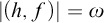 , and choose a representative
$g_n$
, and choose a representative
$g_n$
 for each intermediate degree.
Claim. Without loss of generality, we can assume that f is not the minimal cover of any
$g_n$
 .
.
Indeed, assume that this is not the case and let
$I:=\{ i\in \mathbb {N} {}\,:\,{} f$
 is a minimal cover of
$g_i\}$
is a minimal cover of
$g_i\}$
 . In particular, for every
$i\neq j$
. In particular, for every
$i\neq j$
 ,
$f\equiv _{\mathrm {W}} g_i \sqcup g_j$
,
$f\equiv _{\mathrm {W}} g_i \sqcup g_j$
 (negating this would lead to a contradiction with the fact that f is a minimal cover of
$g_i$
(negating this would lead to a contradiction with the fact that f is a minimal cover of
$g_i$
 ). As a consequence of [Reference Lempp, Miller, Pauly, Soskova and Valenti8, Theorem 1.4], if f is a minimal cover of
$g_i$
). As a consequence of [Reference Lempp, Miller, Pauly, Soskova and Valenti8, Theorem 1.4], if f is a minimal cover of
$g_i$
 , then
$\operatorname {dom}(f)<_{\mathrm {M}} \operatorname {dom}(g_i)$
, then
$\operatorname {dom}(f)<_{\mathrm {M}} \operatorname {dom}(g_i)$
 . If
$\operatorname {dom}(g_i)\equiv _{\mathrm {M}} \operatorname {dom}(g_j)$
. If
$\operatorname {dom}(g_i)\equiv _{\mathrm {M}} \operatorname {dom}(g_j)$
 then
$\operatorname {dom}(f)\equiv _{\mathrm {M}} \operatorname {dom}(g_i) \wedge \operatorname {dom}(g_j) \equiv _{\mathrm {M}} \operatorname {dom}(g_i)$
then
$\operatorname {dom}(f)\equiv _{\mathrm {M}} \operatorname {dom}(g_i) \wedge \operatorname {dom}(g_j) \equiv _{\mathrm {M}} \operatorname {dom}(g_i)$
 , against the fact that
$\operatorname {dom}(f)<_{\mathrm {M}} \operatorname {dom}(g_i)$
, against the fact that
$\operatorname {dom}(f)<_{\mathrm {M}} \operatorname {dom}(g_i)$
 . This implies that for every
$i\neq j$
. This implies that for every
$i\neq j$
 ,
$\operatorname {dom}(g_i)\not \equiv _{\mathrm {M}} \operatorname {dom}(g_j)$
,
$\operatorname {dom}(g_i)\not \equiv _{\mathrm {M}} \operatorname {dom}(g_j)$
 , and therefore
$|I|<\omega $
, and therefore
$|I|<\omega $
 (otherwise, the Medvedev-interval
$(\operatorname {dom}(f),\operatorname {dom}(h))$
(otherwise, the Medvedev-interval
$(\operatorname {dom}(f),\operatorname {dom}(h))$
 would be infinite). By the pigeonhole principle, there must be
$i\in I$
would be infinite). By the pigeonhole principle, there must be
$i\in I$
 such that the Weihrauch-interval
$(h,g_i)$
such that the Weihrauch-interval
$(h,g_i)$
 is countable. If
$g_i$
is countable. If
$g_i$
 is not the minimal cover of any problem in the interval
$(h,g_i)$
is not the minimal cover of any problem in the interval
$(h,g_i)$
 , then we are done, as we can replace f with
$g_i$
, then we are done, as we can replace f with
$g_i$
 and conclude the proof of the claim. Otherwise, we repeat the same argument with
$g_i$
and conclude the proof of the claim. Otherwise, we repeat the same argument with
$g_i$
 in place of f. We observe that this procedure is bound to terminate. Indeed, if not, we are defining a sequence of minimal covers
$f>_{\mathrm {W}} g_{i_0} >_{\mathrm {W}} g_{i_1} >_{\mathrm {W}} \ldots $
in place of f. We observe that this procedure is bound to terminate. Indeed, if not, we are defining a sequence of minimal covers
$f>_{\mathrm {W}} g_{i_0} >_{\mathrm {W}} g_{i_1} >_{\mathrm {W}} \ldots $
 . In particular, since
$\operatorname {dom}(f)<_{\mathrm {M}} \operatorname {dom}(g_{i_0})<_{\mathrm {M}} \operatorname {dom}(g_{i_1}) <_{\mathrm {M}} \ldots $
. In particular, since
$\operatorname {dom}(f)<_{\mathrm {M}} \operatorname {dom}(g_{i_0})<_{\mathrm {M}} \operatorname {dom}(g_{i_1}) <_{\mathrm {M}} \ldots $
 , this would imply that the Medvedev-interval
$(\operatorname {dom}(f),\operatorname {dom}(h))$
, this would imply that the Medvedev-interval
$(\operatorname {dom}(f),\operatorname {dom}(h))$
 is infinite, which is a contradiction, and hence the claim is proved.
This implies that the family
$\{g_n{}\,:\,{} n \in \mathbb {N}\}$
 does not have a supremum (otherwise, by Theorem 1.1, there would be
$m\in \mathbb {N}$
does not have a supremum (otherwise, by Theorem 1.1, there would be
$m\in \mathbb {N}$
 such that
$g_m = \sup _n \{g_n{}\,:\,{} n \in \mathbb {N}\} <_{\mathrm {W}} f$
such that
$g_m = \sup _n \{g_n{}\,:\,{} n \in \mathbb {N}\} <_{\mathrm {W}} f$
 is a minimal cover). In particular, since f is not the supremum of
$\{g_n{}\,:\,{} n \in \mathbb {N}\}$
is a minimal cover). In particular, since f is not the supremum of
$\{g_n{}\,:\,{} n \in \mathbb {N}\}$
 , there is
$\overline {f} \not \ge _{\mathrm {W}} f$
, there is
$\overline {f} \not \ge _{\mathrm {W}} f$
 such that, for every n,
$g_n \le _{\mathrm {W}} \overline {f}$
such that, for every n,
$g_n \le _{\mathrm {W}} \overline {f}$
 , so
$g_n <_{\mathrm {W}} \overline {f}$
, so
$g_n <_{\mathrm {W}} \overline {f}$
 .
.
Consider now the problem
$f\sqcap \overline {f}$
 : clearly,
$f\sqcap \overline {f}<_{\mathrm {W}} f$
: clearly,
$f\sqcap \overline {f}<_{\mathrm {W}} f$
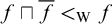 and for every n,
$g_n <_{\mathrm {W}} f\sqcap \overline {f}$
and for every n,
$g_n <_{\mathrm {W}} f\sqcap \overline {f}$
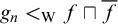 (otherwise
$g_n$
(otherwise
$g_n$
 would be the supremum of
$\{g_m{}\,:\,{} m \in \mathbb {N}\}$
would be the supremum of
$\{g_m{}\,:\,{} m \in \mathbb {N}\}$
 ). This contradicts the fact that every degree in the interval
$(h,f)$
). This contradicts the fact that every degree in the interval
$(h,f)$
 was represented by some
$g_n$
was represented by some
$g_n$
 , and therefore concludes the proof.
Observe that examples of finite intervals can be easily obtained as a corollary of [Reference Lempp, Miller, Pauly, Soskova and Valenti8, Corollary 2.6]: indeed, for every
$n\in \mathbb {N}$
 , there is a problem h with exactly n minimal covers. The Boolean algebra obtained by considering the joins of the finitely many minimal covers of h yields an interval of size
$2^n$
, there is a problem h with exactly n minimal covers. The Boolean algebra obtained by considering the joins of the finitely many minimal covers of h yields an interval of size
$2^n$
 .
.
Notice also that the previous proof uses Theorem 1.1 in a critical way to run a classical diagonal argument. However, the following result shows that Theorem 1.1 cannot be extended to
$\mathfrak {c}$
 -sized chains, and hence the above strategy does not immediately yield that no
$\mathfrak {c}$
-sized chains, and hence the above strategy does not immediately yield that no
$\mathfrak {c}$
 -sized interval exists in the Weihrauch degrees.
Proposition 3.13. For every
$\kappa \le \mathfrak {c}$
 with
$\mathrm {cof}(\kappa )>\omega $
with
$\mathrm {cof}(\kappa )>\omega $
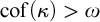 , there is a chain of order type
$\kappa $
, there is a chain of order type
$\kappa $
 in
$\mathcal {W}$
in
$\mathcal {W}$
 that admits a supremum.
Proof. Let
$\{p_\alpha \}_{\alpha <\kappa +1}$
 be a
$\kappa $
be a
$\kappa $
 -sized
$\le _{\mathrm {T}}$
-sized
$\le _{\mathrm {T}}$
 -antichain. For every
$\alpha \le \kappa $
-antichain. For every
$\alpha \le \kappa $
 , define
$A_\alpha :=\{ p_\gamma {}\,:\,{} \gamma < \alpha \}$
, define
$A_\alpha :=\{ p_\gamma {}\,:\,{} \gamma < \alpha \}$
 . Observe that
$\{A_\alpha \}_{0<\alpha <\kappa }$
. Observe that
$\{A_\alpha \}_{0<\alpha <\kappa }$
 is a chain in
$\mathcal {M}_0$
is a chain in
$\mathcal {M}_0$
 of order type
$\kappa ^*$
of order type
$\kappa ^*$
 and
$A_\kappa = \inf _{\le _{\mathrm {M}}} \{ A_\alpha {}\,:\,{} \alpha <\kappa \}$
and
$A_\kappa = \inf _{\le _{\mathrm {M}}} \{ A_\alpha {}\,:\,{} \alpha <\kappa \}$
 . Indeed, whenever
$0<\alpha <\beta <\kappa $
. Indeed, whenever
$0<\alpha <\beta <\kappa $
 , the reductions
$A_\kappa \le _{\mathrm {M}} A_\beta \le _{\mathrm {M}} A_\alpha $
, the reductions
$A_\kappa \le _{\mathrm {M}} A_\beta \le _{\mathrm {M}} A_\alpha $
 are trivial and the separation
$A_\alpha \not \le _{\mathrm {M}} A_\beta $
are trivial and the separation
$A_\alpha \not \le _{\mathrm {M}} A_\beta $
 follows from the fact that
$\{p_\alpha \}_{\alpha <\eta }$
follows from the fact that
$\{p_\alpha \}_{\alpha <\eta }$
 is an antichain (in particular,
$A_\alpha \not \le _{\mathrm {M}} \{p_\beta \})$
is an antichain (in particular,
$A_\alpha \not \le _{\mathrm {M}} \{p_\beta \})$
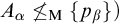 . Similarly,
$A_\beta \not \le _{\mathrm {M}} A_\kappa $
. Similarly,
$A_\beta \not \le _{\mathrm {M}} A_\kappa $
 . To show that
$A_\kappa $
. To show that
$A_\kappa $
 is the greatest lower bound, assume that for every
$\alpha <\kappa $
is the greatest lower bound, assume that for every
$\alpha <\kappa $
 ,
$B\le _{\mathrm {M}} A_\alpha $
,
$B\le _{\mathrm {M}} A_\alpha $
 . Then, since
$\mathrm {cof}(\kappa )>\omega $
. Then, since
$\mathrm {cof}(\kappa )>\omega $
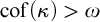 , there is
$e\in \mathbb {N}$
, there is
$e\in \mathbb {N}$
 and a coinitial subsequence
$(\overline {A_\alpha })_{\alpha <\mathrm {cof}(\kappa )}$
and a coinitial subsequence
$(\overline {A_\alpha })_{\alpha <\mathrm {cof}(\kappa )}$
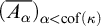 such that, for every
$\alpha $
such that, for every
$\alpha $
 ,
$B\le _{\mathrm {M}} \overline {A_\alpha }$
,
$B\le _{\mathrm {M}} \overline {A_\alpha }$
 via
$\Phi _e$
via
$\Phi _e$
 . Since
$A_\kappa = \bigcup _{\alpha <\kappa } A_\alpha = \bigcup _{\alpha <\mathrm {cof}(\kappa )} \overline {A_\alpha }$
. Since
$A_\kappa = \bigcup _{\alpha <\kappa } A_\alpha = \bigcup _{\alpha <\mathrm {cof}(\kappa )} \overline {A_\alpha }$
 , it follows that
$B\le _{\mathrm {M}} A_\kappa $
, it follows that
$B\le _{\mathrm {M}} A_\kappa $
 .
.
For every
$\alpha \le \kappa $
 , we define
$f_\alpha: {A_\alpha} \rightrightarrows {\mathbb {N}^{\mathbb {N}}}$
, we define
$f_\alpha: {A_\alpha} \rightrightarrows {\mathbb {N}^{\mathbb {N}}}$
 as
$f_\alpha (p):=\{p_\delta {}\,:\,{} \delta \ge \alpha \}$
as
$f_\alpha (p):=\{p_\delta {}\,:\,{} \delta \ge \alpha \}$
 . It is easy to see that
$\{f_\alpha \}_{\alpha \le \kappa }$
. It is easy to see that
$\{f_\alpha \}_{\alpha \le \kappa }$
 is a chain of order type
$\kappa +1$
is a chain of order type
$\kappa +1$
 . Indeed, if
$\alpha <\beta \le \kappa $
. Indeed, if
$\alpha <\beta \le \kappa $
 , then
$f_\alpha \le _{\mathrm {W}} f_\beta $
, then
$f_\alpha \le _{\mathrm {W}} f_\beta $
 is straightforward (for every
$p\in A_\alpha $
is straightforward (for every
$p\in A_\alpha $
 ,
$f_\alpha (p)\supset f_\beta (p) \neq \emptyset $
,
$f_\alpha (p)\supset f_\beta (p) \neq \emptyset $
 ), while
$f_\beta \not \le _{\mathrm {W}} f_\alpha $
), while
$f_\beta \not \le _{\mathrm {W}} f_\alpha $
 follows from
$A_\alpha \not \le _{\mathrm {M}} A_\beta $
follows from
$A_\alpha \not \le _{\mathrm {M}} A_\beta $
 .
.
To conclude the proof, let h be an upper bound for
$(f_\alpha )_{\alpha <\kappa }$
 . As in the proof of Lemma 3.3, there are
$e,i\in \mathbb {N}$
. As in the proof of Lemma 3.3, there are
$e,i\in \mathbb {N}$
 and a cofinal subsequence
$(\overline {f}_\alpha )_{\alpha <\mathrm {cof}(\kappa )}$
and a cofinal subsequence
$(\overline {f}_\alpha )_{\alpha <\mathrm {cof}(\kappa )}$
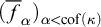 such that for every
$\alpha <\mathrm {cof}(\kappa )$
such that for every
$\alpha <\mathrm {cof}(\kappa )$
 ,
$\overline {f}_\alpha \le _{\mathrm {W}} h$
,
$\overline {f}_\alpha \le _{\mathrm {W}} h$
 via
$\Phi _e,\Phi _i$
via
$\Phi _e,\Phi _i$
 .
.
We claim that
$f_\kappa \le _{\mathrm {W}} h$
 via
$\Phi _e,\Phi _i$
via
$\Phi _e,\Phi _i$
 . Indeed, for every
$p\in \operatorname {dom}(f_\kappa ) = \bigcup _{\alpha <\mathrm {cof}(\kappa )} \operatorname {dom}(\overline {f}_\alpha )$
. Indeed, for every
$p\in \operatorname {dom}(f_\kappa ) = \bigcup _{\alpha <\mathrm {cof}(\kappa )} \operatorname {dom}(\overline {f}_\alpha )$
 ,
$\Phi _e(p)\in \operatorname {dom}(h)$
,
$\Phi _e(p)\in \operatorname {dom}(h)$
 . Moreover, for every
$\alpha <\mathrm {cof}(\kappa )$
. Moreover, for every
$\alpha <\mathrm {cof}(\kappa )$
 and every
$q\in h(\Phi _e(p))$
and every
$q\in h(\Phi _e(p))$
 ,
$\Phi _i(p,q) \in \overline {f}_\alpha (p)$
,
$\Phi _i(p,q) \in \overline {f}_\alpha (p)$
 , hence

3.1 Cofinality and coinitiality
In this section, we study the cofinality and the coinitiality of the Weihrauch degrees. We first observe that, while for the Turing and the Medvedev degrees the existence of a cofinal chain is independent of
$\mathrm {ZFC}$
 and equivalent to
$\mathrm {CH}$
and equivalent to
$\mathrm {CH}$
 , it is provable in
$\mathrm {ZFC}$
, it is provable in
$\mathrm {ZFC}$
 that there are no cofinal chains (of any order type) in
$\mathcal {W}$
that there are no cofinal chains (of any order type) in
$\mathcal {W}$
 . To prove this, we first show that
$\mathrm {setcof}(\mathcal {W})>\mathfrak {c}$
. To prove this, we first show that
$\mathrm {setcof}(\mathcal {W})>\mathfrak {c}$
 .
.
Lemma 3.14. For every family
$\mathcal {F}$
 of multi-valued functions with
$|\mathcal {F}|\le \mathfrak {c}$
of multi-valued functions with
$|\mathcal {F}|\le \mathfrak {c}$
 and every infinite
$A\subseteq \mathbb {N}^{\mathbb {N}}$
and every infinite
$A\subseteq \mathbb {N}^{\mathbb {N}}$
 with
$|A|\ge |\mathcal {F}|$
with
$|A|\ge |\mathcal {F}|$
 , there is
$g: {A} \rightrightarrows {\mathbb {N}^{\mathbb {N}}}$
, there is
$g: {A} \rightrightarrows {\mathbb {N}^{\mathbb {N}}}$
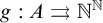 such that for every
$f\in \mathcal {F} $
such that for every
$f\in \mathcal {F} $
 ,
$g\not \le _{\mathrm {W}} f$
,
$g\not \le _{\mathrm {W}} f$
 .
.
Proof. Let
$X\subseteq \mathbb {N}^{\mathbb {N}}$
 be such that
$|X|= |\mathcal {F}|$
be such that
$|X|= |\mathcal {F}|$
 and let
$\mathcal {F}=\{ f_x {}\,:\,{} x \in X\}$
and let
$\mathcal {F}=\{ f_x {}\,:\,{} x \in X\}$
 . Let also
$\varphi : {\mathbb {N}\times \mathbb {N}\times X} \to {A}$
. Let also
$\varphi : {\mathbb {N}\times \mathbb {N}\times X} \to {A}$
 be an injective function.
Intuitively, we define
$g: {A} \rightrightarrows {\mathbb {N}^{\mathbb {N}}}$
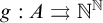 so that
$\varphi (e,i,x)$
so that
$\varphi (e,i,x)$
 is the input for g witnessing the fact that
$g\not \le _{\mathrm {W}} f_x$
is the input for g witnessing the fact that
$g\not \le _{\mathrm {W}} f_x$
 via
$\Phi _e,\Phi _i$
via
$\Phi _e,\Phi _i$
 . More precisely, for every
$e,i\in \mathbb {N}$
. More precisely, for every
$e,i\in \mathbb {N}$
 and every
$x\in X$
and every
$x\in X$
 , we define g on
$p:=\varphi (e,i,x)$
, we define g on
$p:=\varphi (e,i,x)$
 as follows: if
$\Phi _e(p) \notin \operatorname {dom}(f_x)$
as follows: if
$\Phi _e(p) \notin \operatorname {dom}(f_x)$
 or there is
$q\in f_x(\Phi _e(p))$
or there is
$q\in f_x(\Phi _e(p))$
 such that
$(p,q) \notin \operatorname {dom}(\Phi _i)$
such that
$(p,q) \notin \operatorname {dom}(\Phi _i)$
 then
$g(p):=\mathbb {N}^{\mathbb {N}}$
then
$g(p):=\mathbb {N}^{\mathbb {N}}$
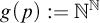 . Otherwise, fix
$q\in f_x(\Phi _e(p))$
. Otherwise, fix
$q\in f_x(\Phi _e(p))$
 and define
$g(p):=\mathbb {N}^{\mathbb {N}}\setminus \{ \Phi _i(p,q) \}$
and define
$g(p):=\mathbb {N}^{\mathbb {N}}\setminus \{ \Phi _i(p,q) \}$
 . Finally, define
$g(p):=\mathbb {N}^{\mathbb {N}}$
. Finally, define
$g(p):=\mathbb {N}^{\mathbb {N}}$
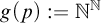 for every
$p\notin \operatorname {ran}(\varphi )$
for every
$p\notin \operatorname {ran}(\varphi )$
 .
.
By construction, it is immediate to check that for every
$x\in X$
 and every
$e,i \in \mathbb {N}$
and every
$e,i \in \mathbb {N}$
 ,
$g\not \le _{\mathrm {W}} f_p$
,
$g\not \le _{\mathrm {W}} f_p$
 via
$\Phi _e,\Phi _i$
via
$\Phi _e,\Phi _i$
 as witnessed by the input
$\varphi (e,i,x)$
as witnessed by the input
$\varphi (e,i,x)$
 for g.
As an immediate consequence of Lemma 3.14, we obtain the following corollary.
Corollary 3.15.
$\mathrm {setcof}(\mathcal {W})>\mathfrak {c}$
 .
.
Corollary 3.16. No embedding of
$\mathcal {M}_0$
 in the Weihrauch degrees can be cofinal in the Weihrauch degrees.
Proof. This follows from the previous result and the fact that
$\mathrm {setcof}(\mathcal {M}_0)=\mathfrak {c}$
 (Theorem 2.11).
Theorem 3.17. There are no cofinal chains in
$\mathcal {W}$
 .
.
Proof. Observe first of all that every cofinal chain contains a well-ordered cofinal chain, hence, without loss of generality, we can restrict our attention to well-ordered chains.
Let
$(f_\beta )_{\beta < \kappa }$
 be a cofinal chain in
$\mathcal {W}$
be a cofinal chain in
$\mathcal {W}$
 . Notice that if
$\mathrm {cof}(\kappa )<\kappa $
. Notice that if
$\mathrm {cof}(\kappa )<\kappa $
 , then the chain
$(f_\beta )_{\beta < \kappa }$
, then the chain
$(f_\beta )_{\beta < \kappa }$
 contains a cofinal chain of size
$\mathrm {cof}(\kappa )$
contains a cofinal chain of size
$\mathrm {cof}(\kappa )$
 . Assume therefore that
$\kappa $
. Assume therefore that
$\kappa $
 is a regular cardinal. Since
$\mathrm {setcof}(\mathcal {W})>\mathfrak {c}$
is a regular cardinal. Since
$\mathrm {setcof}(\mathcal {W})>\mathfrak {c}$
 (Corollary 3.15),
$\kappa>\mathfrak {c}$
(Corollary 3.15),
$\kappa>\mathfrak {c}$
 . Fix a chain
$(g_\alpha )_{\alpha <\omega _1}$
. Fix a chain
$(g_\alpha )_{\alpha <\omega _1}$
 in
$\mathcal {W}$
in
$\mathcal {W}$
 with no upper bound (as in Proposition 3.1 or Theorem 3.7). Since the chain
$(f_\beta )_{\beta <\kappa }$
with no upper bound (as in Proposition 3.1 or Theorem 3.7). Since the chain
$(f_\beta )_{\beta <\kappa }$
 is cofinal in
$\mathcal {W}$
is cofinal in
$\mathcal {W}$
 , for every
$\alpha <\omega _1$
, for every
$\alpha <\omega _1$
 there is
$\beta _\alpha < \kappa $
there is
$\beta _\alpha < \kappa $
 such that
$g_\alpha \le _{\mathrm {W}} f_{\beta _\alpha }$
such that
$g_\alpha \le _{\mathrm {W}} f_{\beta _\alpha }$
 . Since
$(g_\alpha )_{\alpha < \omega _1}$
. Since
$(g_\alpha )_{\alpha < \omega _1}$
 has no upper bound, the sequence
$(\beta _\alpha )_{\alpha <\omega _1}$
has no upper bound, the sequence
$(\beta _\alpha )_{\alpha <\omega _1}$
 must be cofinal in
$\kappa $
must be cofinal in
$\kappa $
 , contradicting the fact that
$\kappa =\mathrm {cof}(\kappa )> \mathfrak {c}$
, contradicting the fact that
$\kappa =\mathrm {cof}(\kappa )> \mathfrak {c}$
 .
.
Finally, we observe that the coinitiality of the Weihrauch degrees is closely connected with the cofinality of the Medvedev degrees. We first highlight the following fact.
Proposition 3.18. There is a continuum-sized family
$\{f_p\}_{p\in \mathbb {N}^{\mathbb {N}}}$
 such that for every p,
$f_p\le _{\mathrm {W}} \operatorname {id}$
such that for every p,
$f_p\le _{\mathrm {W}} \operatorname {id}$
 and for every non-empty g, there is
$p\in \mathbb {N}^{\mathbb {N}}$
and for every non-empty g, there is
$p\in \mathbb {N}^{\mathbb {N}}$
 such that
$f_p\le _{\mathrm {W}} g$
such that
$f_p\le _{\mathrm {W}} g$
 .
.
Proof. For every
$p\in \mathbb {N}^{\mathbb {N}}$
 , we define
$f_p: {\{p\}} \rightrightarrows {\mathbb {N}^{\mathbb {N}}}$
, we define
$f_p: {\{p\}} \rightrightarrows {\mathbb {N}^{\mathbb {N}}}$
 as
$f_p(p):=\mathbb {N}^{\mathbb {N}}$
as
$f_p(p):=\mathbb {N}^{\mathbb {N}}$
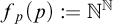 . It is trivial to see that
$f_p\le _{\mathrm {W}} \operatorname {id}$
. It is trivial to see that
$f_p\le _{\mathrm {W}} \operatorname {id}$
 and, for every non-empty g and for every
$p\in \operatorname {dom}(g)$
and, for every non-empty g and for every
$p\in \operatorname {dom}(g)$
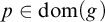 ,
$f_p\le _{\mathrm {W}} g$
,
$f_p\le _{\mathrm {W}} g$
 .
.
Theorem 3.19. The set-coinitiality of
$\mathcal {W}_0$
 is
$\mathfrak {c}$
is
$\mathfrak {c}$
 . Moreover, the following are equivalent:
-
1. $\mathrm {CH}$
; -
2. there is a coinitial chain in $\mathcal {W}_0$
; -
3. there is a coinitial chain in $\mathcal {W}_0$
of order type
$\omega _1^*$
.


Proof. As a corollary of Proposition 3.18, the lower cone of
$\operatorname {id}$
 is a coinitial subset of
$\mathcal {W}_0$
is a coinitial subset of
$\mathcal {W}_0$
 . Since the lower cone of
$\operatorname {id}$
. Since the lower cone of
$\operatorname {id}$
 is isomorphic to
$\mathcal {M}^*$
is isomorphic to
$\mathcal {M}^*$
 , and every coinitial set in
$\mathcal {W}_0$
, and every coinitial set in
$\mathcal {W}_0$
 must, a fortiori, be coinitial in the lower cone of
$\operatorname {id}$
must, a fortiori, be coinitial in the lower cone of
$\operatorname {id}$
 , we immediately have
$\mathrm {setcoinit}(\mathcal {W}_0)=\mathrm {setcof}(\mathcal {M}_0)=\mathfrak {c}$
, we immediately have
$\mathrm {setcoinit}(\mathcal {W}_0)=\mathrm {setcof}(\mathcal {M}_0)=\mathfrak {c}$
 .
.
The second part of the statement is a simple consequence of Theorem 2.10, as the existence of a coinitial chain in
$\mathcal {W}_0$
 is equivalent to the existence of a cofinal chain in
$\mathcal {M}_0$
is equivalent to the existence of a cofinal chain in
$\mathcal {M}_0$
 .
.
4 Antichains
In this section, we prove some results on the size and extendibility of antichains in the Weihrauch degrees. Clearly, given that the Medvedev degrees embed as a lattice in the Weihrauch degrees, every antichain in the Medvedev degrees immediately gives an antichain in the Weihrauch degrees. In particular, since there are antichains of size
$2^{\mathfrak {c}}$
 in
$\mathcal {M}$
in
$\mathcal {M}$
 [Reference Platek10], we immediately obtain that the same holds for
$\mathcal {W}$
[Reference Platek10], we immediately obtain that the same holds for
$\mathcal {W}$
 as well. In fact, such antichains can be found “everywhere” in the Weihrauch lattice.
Proposition 4.1. For every problem
$f\neq \emptyset $
 , there is an antichain
$\mathcal {A}$
, there is an antichain
$\mathcal {A}$
 in
$\mathcal {W}$
in
$\mathcal {W}$
 of size
$2^{\mathfrak {c}}$
of size
$2^{\mathfrak {c}}$
 with
$f\in \mathcal {A}$
with
$f\in \mathcal {A}$
 .
.
Proof. Fix a problem f and let
$p\in \mathbb {N}^{\mathbb {N}}$
 be such that
$\operatorname {dom}(f)<_{\mathrm {M}} \{p\}$
be such that
$\operatorname {dom}(f)<_{\mathrm {M}} \{p\}$
 . Let also
$\{p_\alpha {}\,:\,{} \alpha <\mathfrak {c}\}$
. Let also
$\{p_\alpha {}\,:\,{} \alpha <\mathfrak {c}\}$
 be the set of minimal degrees above p. As in [Reference Platek10] (see also [Reference Sorbi, Cooper, Slaman and Wainer12, Theorem 4.1]), we can define a
$\le _{\mathrm {M}}$
be the set of minimal degrees above p. As in [Reference Platek10] (see also [Reference Sorbi, Cooper, Slaman and Wainer12, Theorem 4.1]), we can define a
$\le _{\mathrm {M}}$
 -antichain
$\{A_\beta \}_{\beta <2^{\mathfrak {c}}}$
-antichain
$\{A_\beta \}_{\beta <2^{\mathfrak {c}}}$
 where
$A_\beta \subset \{p_\alpha {}\,:\,{} \alpha <\mathfrak {c}\}$
where
$A_\beta \subset \{p_\alpha {}\,:\,{} \alpha <\mathfrak {c}\}$
 . For every
$\beta < 2^{\mathfrak {c}}$
. For every
$\beta < 2^{\mathfrak {c}}$
 , define
$g_\beta $
, define
$g_\beta $
 as the problem obtained applying Lemma 3.14 to
$\mathcal {F}=\{f\}$
as the problem obtained applying Lemma 3.14 to
$\mathcal {F}=\{f\}$
 and
$A=\{ ({e,i}) \unicode{x2322} p {}\,:\,{} e,i\in \mathbb {N} \text { and } p \in A_\beta \}$
and
$A=\{ ({e,i}) \unicode{x2322} p {}\,:\,{} e,i\in \mathbb {N} \text { and } p \in A_\beta \}$
 . In particular, this guarantees that
$g_\beta \not \le _{\mathrm {W}} f$
. In particular, this guarantees that
$g_\beta \not \le _{\mathrm {W}} f$
 .
.
To conclude the proof, observe that, for every
$\beta \neq \gamma $
 ,
$g_\beta ~|_{\mathrm {W}~} g_{\gamma }$
,
$g_\beta ~|_{\mathrm {W}~} g_{\gamma }$
 because
$\operatorname {dom}(g_\beta ) \equiv _{\mathrm {M}} A_\beta ~|_{\mathrm {M}~} A_{\gamma } \equiv _{\mathrm {M}} \operatorname {dom}(g_{\gamma })$
because
$\operatorname {dom}(g_\beta ) \equiv _{\mathrm {M}} A_\beta ~|_{\mathrm {M}~} A_{\gamma } \equiv _{\mathrm {M}} \operatorname {dom}(g_{\gamma })$
 . Similarly,
$f \not \le _{\mathrm {W}} g_\beta $
. Similarly,
$f \not \le _{\mathrm {W}} g_\beta $
 because
$A_\beta \not \le _{\mathrm {M}} \operatorname {dom}(f)$
because
$A_\beta \not \le _{\mathrm {M}} \operatorname {dom}(f)$
 .
.
At the same time, it is trivial to observe that the image of a maximal antichain in
$\mathcal {M}$
 need not be maximal in
$\mathcal {W}$
need not be maximal in
$\mathcal {W}$
 . In fact, while there are finite maximal antichains in
$\mathcal {M}$
. In fact, while there are finite maximal antichains in
$\mathcal {M}$
 (Proposition 2.3), Dzhafarov, Lerman, Patey, and Solomon proved the following.
Proposition 4.2. For every countable family
$\{f_n\}_{n\in \mathbb {N}}$
 of non-trivial problems, there is g such that for every n,
$g ~|_{\mathrm {W}~} f_n$
of non-trivial problems, there is g such that for every n,
$g ~|_{\mathrm {W}~} f_n$
 .
.
This result was presented by Dzhafarov during the Luminy meeting “New directions in computability” in 2022.
In particular, this implies that every countable antichain in
$\mathcal {W}$
 is not maximal, hence the analog of Proposition 2.3 does not hold for the Weihrauch degrees.
However, observe that the previous proposition cannot be extended to
$\mathfrak {c}$
 -sized families. This is an immediate consequence of Proposition 3.18. At the same time, the set of problems defined in the proof of Proposition 3.18 is far from being an antichain. This is because no antichain can be coinitial in
$\mathcal {W}_0$
-sized families. This is an immediate consequence of Proposition 3.18. At the same time, the set of problems defined in the proof of Proposition 3.18 is far from being an antichain. This is because no antichain can be coinitial in
$\mathcal {W}_0$
 , as the bottom
$\emptyset $
, as the bottom
$\emptyset $
 is meet-irreducible (in other words, the meet of any two elements of the antichain is always a non-empty problem that is not above any element of the antichain).
We now provide some sufficient conditions that guarantee the extendibility of an antichain in
$\mathcal {W}$
 . For the sake of the presentation, we first state and prove the following Theorem 4.3, while weaker sufficient conditions will be provided in Theorem 4.6.
Theorem 4.3. Let
$\kappa \le \mathfrak {c}$
 . If
$\{f_\alpha \}_{\alpha <\kappa }$
. If
$\{f_\alpha \}_{\alpha <\kappa }$
 is an antichain in
$\mathcal {W}$
is an antichain in
$\mathcal {W}$
 of non-trivial problems such that
$\{\operatorname {dom}(f_\alpha )\}_{\alpha <\kappa }$
of non-trivial problems such that
$\{\operatorname {dom}(f_\alpha )\}_{\alpha <\kappa }$
 is not cofinal in
$\mathcal {M}_0$
is not cofinal in
$\mathcal {M}_0$
 , then there is g such that for every
$\alpha <\kappa $
, then there is g such that for every
$\alpha <\kappa $
 ,
$g ~|_{\mathrm {W}~} f_\alpha $
,
$g ~|_{\mathrm {W}~} f_\alpha $
 .
.
Proof. Since the family
$\{\operatorname {dom}(f_\alpha )\}_{\alpha <\kappa }$
 is not cofinal in
$\mathcal {M}_0$
is not cofinal in
$\mathcal {M}_0$
 , there is a non-empty
$D\subset \mathbb {N}^{\mathbb {N}}$
, there is a non-empty
$D\subset \mathbb {N}^{\mathbb {N}}$
 such that for every
$\alpha <\kappa $
such that for every
$\alpha <\kappa $
 ,
$D\not \le _{\mathrm {M}} \operatorname {dom}(f_\alpha )$
,
$D\not \le _{\mathrm {M}} \operatorname {dom}(f_\alpha )$
 . Without loss of generality, we can assume that
$|D|=\mathfrak {c}$
. Without loss of generality, we can assume that
$|D|=\mathfrak {c}$
 (as
$D\equiv _{\mathrm {M}} D\times \mathbb {N}^{\mathbb {N}}$
(as
$D\equiv _{\mathrm {M}} D\times \mathbb {N}^{\mathbb {N}}$
 ).
).
Thus, if g is a problem with
$\operatorname {dom}(g)=D$
 , then for every
$\alpha <\kappa $
, then for every
$\alpha <\kappa $
 ,
$f_\alpha \not \le _{\mathrm {W}} g$
,
$f_\alpha \not \le _{\mathrm {W}} g$
 . To conclude the proof, it is enough to define g as the problem obtained applying Lemma 3.14 to
$\mathcal {F}=\{f_\alpha \}_{\alpha <\kappa }$
. To conclude the proof, it is enough to define g as the problem obtained applying Lemma 3.14 to
$\mathcal {F}=\{f_\alpha \}_{\alpha <\kappa }$
 and
$A=D$
and
$A=D$
 .
.
Corollary 4.4. No antichain
$\{f_\alpha \}_{\alpha <\kappa }$
 in
$\mathcal {W}$
in
$\mathcal {W}$
 with
$1<\kappa <\mathfrak {c}$
with
$1<\kappa <\mathfrak {c}$
 is maximal.
Proof. This follows from the fact that no family of size
$<\mathfrak {c}$
 is cofinal in
$\mathcal {M}_0$
is cofinal in
$\mathcal {M}_0$
 (Theorem 2.11). There is a trivial maximal antichain in
$\mathcal {W}$
(Theorem 2.11). There is a trivial maximal antichain in
$\mathcal {W}$
 of size
$1$
of size
$1$
 , namely
$\{\emptyset \}$
, namely
$\{\emptyset \}$
 .
.
Observe also that no antichain
$\mathcal {A}$
 can be cofinal in
$\mathcal {M}_0$
can be cofinal in
$\mathcal {M}_0$
 . Indeed, since there is no maximal element in
$\mathcal {M}_0$
. Indeed, since there is no maximal element in
$\mathcal {M}_0$
 , for every
$A\in \mathcal {A}$
, for every
$A\in \mathcal {A}$
 there is a non-empty mass problem B with
$A <_{\mathrm {M}} B$
there is a non-empty mass problem B with
$A <_{\mathrm {M}} B$
 . In particular, since
$\mathcal {A}$
. In particular, since
$\mathcal {A}$
 is an antichain, for every
$C\in \mathcal {A}$
is an antichain, for every
$C\in \mathcal {A}$
 we have
$B \not \le _{\mathrm {M}} C$
we have
$B \not \le _{\mathrm {M}} C$
 . This simple observation, together with Theorem 4.3, immediately yields the following corollary.
Corollary 4.5. For every antichain
$\mathcal {F}$
 in
$\mathcal {W}$
in
$\mathcal {W}$
 with
$1<|\mathcal {F}|\le \mathfrak {c}$
with
$1<|\mathcal {F}|\le \mathfrak {c}$
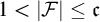 , if
$\{\operatorname {dom}(f) {}\,:\,{} f\in \mathcal {F}\}$
, if
$\{\operatorname {dom}(f) {}\,:\,{} f\in \mathcal {F}\}$
 is an antichain in
$\mathcal {M}$
is an antichain in
$\mathcal {M}$
 , then
$\mathcal {F}$
, then
$\mathcal {F}$
 is not maximal.
We conclude this section by stating and proving the following generalization of Theorem 4.3. In light of Theorem 2.11, it is enough to consider antichains of size
$\mathfrak {c}$
 .
.
Theorem 4.6. Let
$\{f_\alpha \}_{\alpha <\mathfrak {c}}$
 be an antichain in
$\mathcal {W}$
be an antichain in
$\mathcal {W}$
 of non-trivial problems and let
$D_\alpha :=\operatorname {dom}(f_\alpha )$
of non-trivial problems and let
$D_\alpha :=\operatorname {dom}(f_\alpha )$
 . If the set
$\mathcal {B}:=\{ D_\beta {}\,:\,{} (\forall x\in D_\beta )(f_\beta (x) \text { has an } x\text {-computable element})\}$
. If the set
$\mathcal {B}:=\{ D_\beta {}\,:\,{} (\forall x\in D_\beta )(f_\beta (x) \text { has an } x\text {-computable element})\}$
 is not cofinal in
$\mathcal {M}_0$
is not cofinal in
$\mathcal {M}_0$
 , then
$\{f_\alpha \}_{\alpha <\mathfrak {c}}$
, then
$\{f_\alpha \}_{\alpha <\mathfrak {c}}$
 is not maximal.
Proof. Assume first of all that
$\{D_\alpha \}_{\alpha <\mathfrak {c}}$
 is a cofinal set in
$\mathcal {M}_0$
is a cofinal set in
$\mathcal {M}_0$
 (otherwise, the claim follows by Theorem 4.3). Let
$\mathcal {C}:=\{ D_\delta {}\,:\,{} (\forall \alpha )( D_\alpha \not \equiv _{\mathrm {M}} D_\delta \rightarrow D_\alpha \not \le _{\mathrm {M}} D_\delta ) \}$
(otherwise, the claim follows by Theorem 4.3). Let
$\mathcal {C}:=\{ D_\delta {}\,:\,{} (\forall \alpha )( D_\alpha \not \equiv _{\mathrm {M}} D_\delta \rightarrow D_\alpha \not \le _{\mathrm {M}} D_\delta ) \}$
 be the set of
$\le _{\mathrm {M}}$
be the set of
$\le _{\mathrm {M}}$
 -minimal elements in
$\{D_\alpha \}_{\alpha <\mathfrak {c}}$
-minimal elements in
$\{D_\alpha \}_{\alpha <\mathfrak {c}}$
 .
.
Fix
$\gamma $
 so that
$D_\gamma \notin \mathcal {C}$
so that
$D_\gamma \notin \mathcal {C}$
 and for every
$D_\beta \in \mathcal {B}$
and for every
$D_\beta \in \mathcal {B}$
 ,
$D_\gamma \not \le _{\mathrm {M}} D_\beta $
,
$D_\gamma \not \le _{\mathrm {M}} D_\beta $
 . Observe that such
$\gamma $
. Observe that such
$\gamma $
 exists: since
$\{D_\alpha \}_{\alpha <\mathfrak {c}}$
exists: since
$\{D_\alpha \}_{\alpha <\mathfrak {c}}$
 is a cofinal set in
$\mathcal {M}_0$
is a cofinal set in
$\mathcal {M}_0$
 ,
$\mathcal {C}$
,
$\mathcal {C}$
 cannot be cofinal in
$\{D_\alpha \}_{\alpha <\mathfrak {c}}$
cannot be cofinal in
$\{D_\alpha \}_{\alpha <\mathfrak {c}}$
 , as the
$\le _{\mathrm {M}}$
, as the
$\le _{\mathrm {M}}$
 -minimal elements in
$\{D_\alpha \}_{\alpha <\mathfrak {c}}$
-minimal elements in
$\{D_\alpha \}_{\alpha <\mathfrak {c}}$
 form a
$\le _{\mathrm {M}}$
form a
$\le _{\mathrm {M}}$
 -antichain, and no antichain can be cofinal in
$\mathcal {M}_0$
-antichain, and no antichain can be cofinal in
$\mathcal {M}_0$
 . This implies that
$\mathcal {B}\cup \mathcal {C}$
. This implies that
$\mathcal {B}\cup \mathcal {C}$
 is not cofinal in
$\mathcal {M}_0$
is not cofinal in
$\mathcal {M}_0$
 (in an upper semilattice, the union of two non-cofinal sets is not cofinal), and hence we can find
$\gamma $
(in an upper semilattice, the union of two non-cofinal sets is not cofinal), and hence we can find
$\gamma $
 as above.
Let
$D\equiv _{\mathrm {M}} D_\gamma $
 be such that
$|D|=\mathfrak {c}$
be such that
$|D|=\mathfrak {c}$
 , and fix a bijection
$\varphi : {\mathbb {N}\times D_\gamma \times \mathfrak {c} \times \mathbb {N}\times \mathbb {N}} \to {D}$
, and fix a bijection
$\varphi : {\mathbb {N}\times D_\gamma \times \mathfrak {c} \times \mathbb {N}\times \mathbb {N}} \to {D}$
 . We define the problem
$g: {D} \to {\mathbb {N}}$
. We define the problem
$g: {D} \to {\mathbb {N}}$
 as follows: fix
$p\in D_\gamma $
as follows: fix
$p\in D_\gamma $
 ,
$\alpha <\mathfrak {c}$
,
$\alpha <\mathfrak {c}$
 , and
$e, i \in \mathbb {N}$
, and
$e, i \in \mathbb {N}$
 . If, for every
$n\in \mathbb {N}$
. If, for every
$n\in \mathbb {N}$
 ,
$\Phi _e(\varphi (n,p,\alpha ,e,i))\downarrow \in D_\alpha $
,
$\Phi _e(\varphi (n,p,\alpha ,e,i))\downarrow \in D_\alpha $
 and there is
$b=b(n)$
and there is
$b=b(n)$
 such that

then define
$g(\varphi (n,p,\alpha ,e,i)):=1-b(n)$
 . Otherwise, for every n, we define
$g(\varphi (n,p,\alpha ,e,i)):=0$
. Otherwise, for every n, we define
$g(\varphi (n,p,\alpha ,e,i)):=0$
 .
.
We now show that, for every
$\alpha <\mathfrak {c}$
 ,
$g~|_{\mathrm {W}~} f_\alpha $
,
$g~|_{\mathrm {W}~} f_\alpha $
 . We first show that for every
$\alpha $
. We first show that for every
$\alpha $
 ,
$f_\alpha \not \le _{\mathrm {W}} g$
,
$f_\alpha \not \le _{\mathrm {W}} g$
 . Observe that if
$D_\alpha \notin \mathcal {B}$
. Observe that if
$D_\alpha \notin \mathcal {B}$
 , then
$f_\alpha $
, then
$f_\alpha $
 has an input x with no x-computable solution (while g only has computable solutions), hence
$f_\alpha \not \le _{\mathrm {W}} g$
has an input x with no x-computable solution (while g only has computable solutions), hence
$f_\alpha \not \le _{\mathrm {W}} g$
 . If
$D_\alpha \in \mathcal {B}$
. If
$D_\alpha \in \mathcal {B}$
 , then
$f_\alpha \not \le _{\mathrm {W}} g$
, then
$f_\alpha \not \le _{\mathrm {W}} g$
 follows immediately from
$\operatorname {dom}(g)\equiv _{\mathrm {M}} D_\gamma \not \le _{\mathrm {M}} D_\alpha $
follows immediately from
$\operatorname {dom}(g)\equiv _{\mathrm {M}} D_\gamma \not \le _{\mathrm {M}} D_\alpha $
 .
.
It remains to prove that for every
$\alpha $
 ,
$g\not \le _{\mathrm {W}} f_\alpha $
,
$g\not \le _{\mathrm {W}} f_\alpha $
 . Fix
$\alpha $
. Fix
$\alpha $
 and assume that
$g\le _{\mathrm {W}} f_\alpha $
and assume that
$g\le _{\mathrm {W}} f_\alpha $
 via
$\Phi _e,\Phi _i$
via
$\Phi _e,\Phi _i$
 . Observe that, if for every
$n\in \mathbb {N}$
. Observe that, if for every
$n\in \mathbb {N}$
 there is
$b=b(n)$
there is
$b=b(n)$
 such that for every
$y\in f_\alpha \circ \Phi _e\circ \varphi (n,p,\alpha ,e,i)$
such that for every
$y\in f_\alpha \circ \Phi _e\circ \varphi (n,p,\alpha ,e,i)$
 ,
$\Phi _i(\varphi (n,p,\alpha ,e,i),y)=b(n)$
,
$\Phi _i(\varphi (n,p,\alpha ,e,i),y)=b(n)$
 , then by construction,
$g(\varphi (n,p,\alpha ,e,i))\neq b(n)$
, then by construction,
$g(\varphi (n,p,\alpha ,e,i))\neq b(n)$
 . On the other hand, let
$n\in \mathbb {N}$
. On the other hand, let
$n\in \mathbb {N}$
 and
$y_1,y_2\in f_\alpha \circ \Phi _e\circ \varphi (n,p,\alpha ,e,i)$
and
$y_1,y_2\in f_\alpha \circ \Phi _e\circ \varphi (n,p,\alpha ,e,i)$
 be such that
$\Phi _i(\varphi (n,p,\alpha ,e,i),y_1)\neq \Phi _i(\varphi (n,p,\alpha ,e,i),y_2)$
be such that
$\Phi _i(\varphi (n,p,\alpha ,e,i),y_1)\neq \Phi _i(\varphi (n,p,\alpha ,e,i),y_2)$
 . Since g is single-valued, at least one of the two produced solutions is incorrect, and this concludes the proof.
5 Open questions
In this article, we explored some questions on the existence of chains and antichains in the Weihrauch degrees, but many more remain open and require further investigation. In Section 3, we provided a characterization of when “long” chains are extendible (Corollary 3.6). However, Theorem 3.7 and Proposition 3.13 only provide explicit examples of chains of size
$\mathfrak {c}$
 . While it follows from the results on the Medvedev degrees that the existence of a chain of size
$2^{\mathfrak {c}}$
. While it follows from the results on the Medvedev degrees that the existence of a chain of size
$2^{\mathfrak {c}}$
 is consistent with
$\mathrm {ZFC}$
is consistent with
$\mathrm {ZFC}$
 , a natural question is the following.
Open Question 5.1. Under
$\mathrm {ZFC}$
 , is there a chain of size
$2^{\mathfrak {c}}$
, is there a chain of size
$2^{\mathfrak {c}}$
 in
$\mathcal {W}$
in
$\mathcal {W}$
 ? More generally, is every chain of size
$\kappa <2^{\mathfrak {c}}$
? More generally, is every chain of size
$\kappa <2^{\mathfrak {c}}$
 extendible?
Likewise, while we established a connection between chains with no lower bound in
$\mathcal {W}_0$
 and chains with no upper bound in
$\mathcal {M}_0$
and chains with no upper bound in
$\mathcal {M}_0$
 (Theorem 3.10), this only applies to well-founded sequences. It is known that there are no well-founded sequences in
$\mathcal {M}$
(Theorem 3.10), this only applies to well-founded sequences. It is known that there are no well-founded sequences in
$\mathcal {M}$
 of size
$2^{\mathfrak {c}}$
of size
$2^{\mathfrak {c}}$
 (as a consequence of Theorem 2.5). This suggests the following question.
Open Question 5.2. What are the possible order types of chains in
$\mathcal {W}_0$
 with no lower bound? Is there an order type L such that the existence of a chain in
$\mathcal {W}_0$
with no lower bound? Is there an order type L such that the existence of a chain in
$\mathcal {W}_0$
 of order type L with no lower bound is independent of
$\mathrm {ZFC}$
of order type L with no lower bound is independent of
$\mathrm {ZFC}$
 ?
?
Another interesting question concerns the chains of order type
$\omega +\omega ^*$
 . Theorem 3.11 characterizes when two families of problems
$\{f_x\}_{x\in P}$
. Theorem 3.11 characterizes when two families of problems
$\{f_x\}_{x\in P}$
 and
$\{h_z\}_{z\in Q}$
and
$\{h_z\}_{z\in Q}$
 have an intermediate degree (i.e., some g such that, for every x and z,
$f_x\le _{\mathrm {W}} g\le _{\mathrm {W}} h_z$
have an intermediate degree (i.e., some g such that, for every x and z,
$f_x\le _{\mathrm {W}} g\le _{\mathrm {W}} h_z$
 ). However, this only applies to families with uncountable cofinality/coinitiality.
Open Question 5.3. Is there an
$\omega +\omega ^*$
 chain in
$\mathcal {W}$
chain in
$\mathcal {W}$
 with no intermediate degree?
In Section 3.1, we showed that there are no cofinal chains in
$\mathcal {W}$
 (Theorem 3.17) and that the existence of coinitial chains is equivalent to
$\mathrm {CH}$
(Theorem 3.17) and that the existence of coinitial chains is equivalent to
$\mathrm {CH}$
 (Theorem 3.19). While the set-coinitiality of
$\mathcal {W}_0$
(Theorem 3.19). While the set-coinitiality of
$\mathcal {W}_0$
 is
$\mathfrak {c}$
is
$\mathfrak {c}$
 , we only obtained a lower bound for its set-cofinality.
Open Question 5.4. Is
$\mathrm {setcof}(\mathcal {W})=2^{\mathfrak {c}}$
 ?
?
In Section 4, we studied the extendibility of antichains in
$\mathcal {W}$
 and provided some sufficient conditions under which a
$\mathfrak {c}$
and provided some sufficient conditions under which a
$\mathfrak {c}$
 -sized antichain is extendible (Theorem 4.6). A natural question that has proven challenging to fully resolve is the following.
Open Question 5.5. Characterize the maximal antichains in the Weihrauch degrees. Is there a maximal antichain of size
$\mathfrak {c}$
 ?
?
Acknowledgments
A significant part of this work was carried out while the third author was affiliated with the University of Udine and the University of Wisconsin-Madison. The authors would like to thank Paul Shafer for useful conversation on the topics of the article. The authors also thank the anonymous referee for their careful reading of the article and their valuable comments.
Funding
The first author’s research was partially supported by AMS-Simons Foundation Collaboration Grant 626304. The second and third authors’ research was partially supported by the Italian PRIN 2017 Mathematical Logic: models, sets, computability. The second author was also partially supported by the Italian PRIN 2022 Models, sets and classifications, prot. 2022TECZJA, funded by the European Union – Next Generation EU.

 Open access

