




One of the results of our recent archaeological surveys in eastern and central parts of the Mexican state of Campeche (Šprajc Reference Šprajc2023, Reference Šprajc2025; Šprajc et al. Reference Šprajc2021, Reference Šprajc, Marsetič, Štajdohar, Góngora, Ball, Olguín and Kokalj2022) was the discovery of many rather unusual architectural complexes composed primarily of low, elongated, and narrow structures arranged in roughly concentric circles or rectangles. Ruhl et al. (Reference Ruhl, Dunning and Carr2018) previously identified several compounds of this type in southwestern Campeche, suggesting that they represent a regional variant of ancient Maya marketplaces. The present study supports their interpretation but also shows that these complexes were distributed across a broader area of the Maya Lowlands.
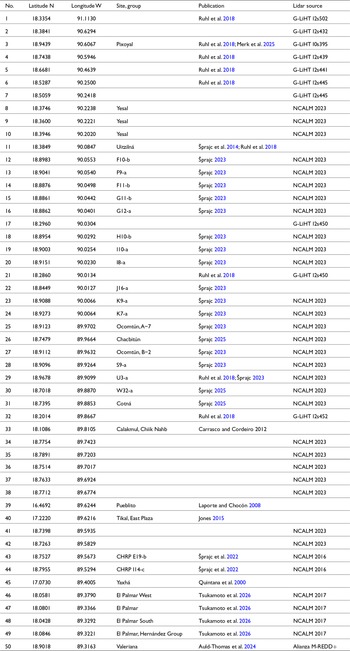
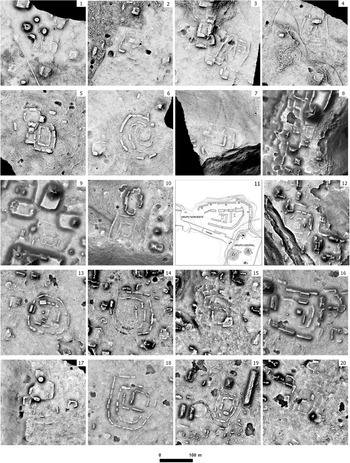
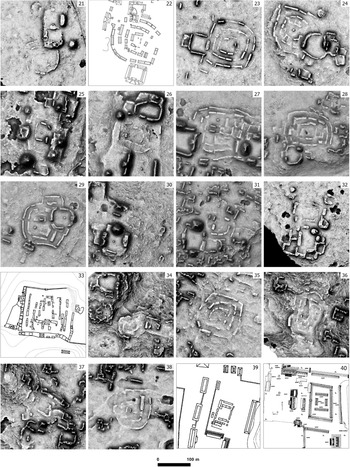
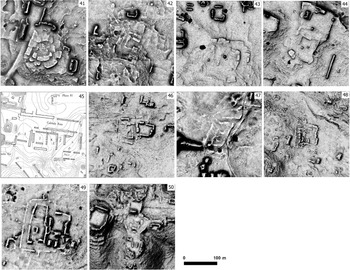
Ruhl et al. (Reference Ruhl, Dunning and Carr2018) detected most of these complexes—referred to as nested constructions—on NASA G-LiHT (Goddard’s LiDAR, Hyperspectral & Thermal Imager) lidar transects covering the Yucatán Peninsula. By examining these swaths and some other airborne laser scanning (ALS) datasets, I identified 50 nested constructions and numbered them consecutively from west to east. Their distribution is shown in Figures 1 and 2. Their locations and other data are given in Table 1, whereas their layouts appear in Figures 3a, 3b, and 3c (visualizations of lidar-derived digital terrain models in these and other figures were generated with Relief Visualization Toolbox, using Visualization for Archaeological Topography: Kokalj et al. Reference Kokalj, Zakšek, Oštir, Pehani, Čotar and Somrak2019).
Map of the area with nested complexes.

Figure 1 Long description
The map displays the locations of nested complexes across the Yucatán Peninsula, Mexico and parts of Guatemala. Each site is marked with a red dot and numbered consecutively from 1 to 50. Notable sites include Escárcega, Uitzilná, Yesal, Chacbitún, Cotná, Calakmul, El Palmar, Tikal, Yaxhá, Pueblito and Valeriana. The map includes a green box highlighting a concentrated area of sites, with numbers 12 to 44. An inset map in the bottom left corner provides a broader geographical context, showing the location of the main map area within the region. A scale bar at the bottom indicates distances in kilometers and a north arrow is present for orientation. The map covers parts of Mexico, including Campeche and Quintana Roo and extends into Guatemala, with labeled borders and major sites.
Map of the area with higher density of nested complexes. Also marked are the zones for which lidar data were acquired in 2016 (Chactún region, in blue) and 2023 (in orange).
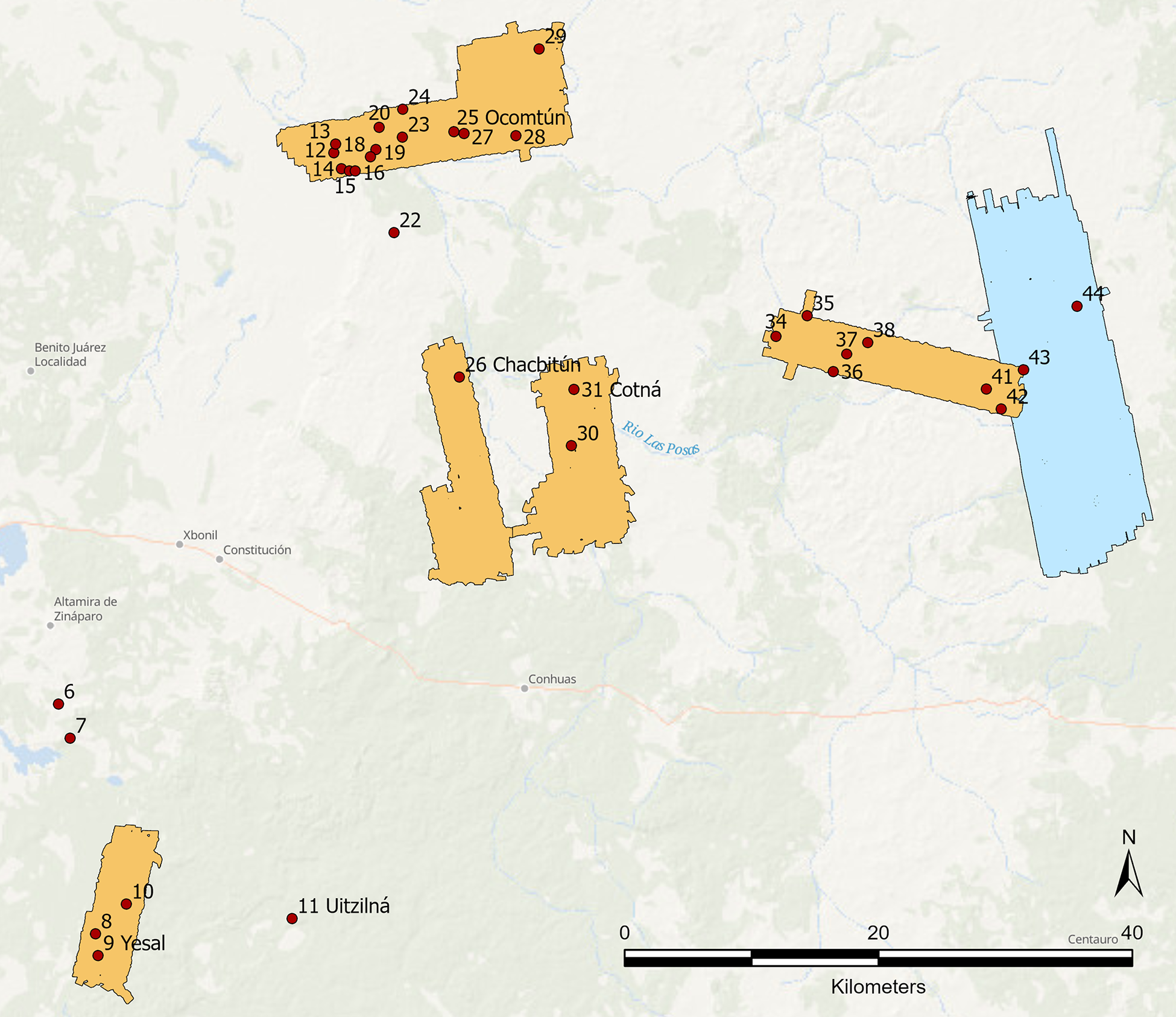
Figure 2 Long description
The map displays the distribution of nested complexes in the Yucatán Peninsula. Zones marked in orange indicate areas where lidar data were acquired in 2023, while the blue zone represents data from 2016. The map includes numbered sites from 6 to 44, with specific locations such as Yesal, Uitzilná, Ocomtún, Chacbitún and Cotná. The sites are marked with red dots and the map includes a scale bar indicating distances in kilometers. The distribution of complexes is concentrated in specific regions, with clusters around Ocomtún and Chacbitún. The map also features labeled geographic locations such as Benito Juárez Localidad, Altamira de Zinaparo and Río Los Pozos. An arrow indicates north for orientation.

Table 1 Long description
The table content is missing, so it is not possible to describe what variables are listed, how many complexes are included, or what the main patterns are. Based on the surrounding context, the table likely catalogs nested architectural complexes with site or group names, geographic coordinates in decimal degrees, citations to earlier publications, and the lidar source and acquisition year or tile identifier. Without the actual rows and columns, I cannot report any key data points, rank sites, compare locations, or describe trends such as clustering by region or differences by lidar dataset. Please provide the table data or an image of the table so I can write WCAG-compliant short and long that reflects the specific entries and any notable outliers.
Notes: Geographic coordinates (datum WGS84) are in decimal degrees; those of the site of Pueblito are from: Chocón et al. Reference Chocón, Reyes and Corzo2011. Where applicable, the site and/or architectural group containing the complex is given, previous publications are cited, and the lidar source is provided, accompanied by the year of acquisition by NCALM or the G-LiHT tile name (transects AMIGACarb_Chiap_Campeche_NFI_Apr2013, AMIGACarb_Yuc_South_GLAS_Apr2013, and AMIGACarb_Yuc_South_NFI_Apr2013).
It should be noted, however, that the sample of nested constructions discussed here is necessarily incomplete. Because these complexes consist mostly of low platforms, they are difficult to detect through field inspections only. They are relatively easy to identify in lidar imagery, but my sample—aside from including a few previously explored and published cases (Table 1)—is based on lidar datasets to which I had access. Kenichiro Tsukamoto generously shared lidar data for the area of El Palmar, a major site in southeastern Campeche (Tsukamoto et al. Reference Tsukamoto, López Camacho, Fernández-Diaz, Shrestha, Hernández Gómez, Jiménez Delgado, López Mejía, Colin, Chase, Stanton, Hutson, Schroeder and Tsukamoto2026). I also examined publicly available G-LiHT (https://gliht.gsfc.nasa.gov/) and Alianza M-REDD+ (Walker Reference Walker2015) lidar datasets. Additionally, for a few zones in the Calakmul and Balam Ku Biosphere Reserves, we acquired ALS data as part of our research projects. In 2016, the National Center for Airborne Laser Mapping (NCALM, Houston, USA) conducted lidar flights in the Chactún area and, in 2023, in five zones to the west (Figure 2). Field surveys were carried out in the Chactún area (Šprajc Reference Šprajc2015, Reference Šprajc2021; Šprajc et al. Reference Šprajc2021, Reference Šprajc, Marsetič, Štajdohar, Góngora, Ball, Olguín and Kokalj2022) and in four other zones (Šprajc Reference Šprajc2023, Reference Šprajc2025). Fieldwork in the zone stretching west of the Chactún area and the one around the site of Yesal (mentioned by Grube Reference Grube2023:24) is planned for the near future.
Given the limited amount of data this study is based on, there is no doubt that nested complexes, while apparently most common in the central Maya Lowlands, were also built beyond that area. A few constructions of this type were found in the Puuc region to the north (Hill Reference Hill2023: Figure 9.1). It is also clear that even in the central Maya Lowlands, their distribution was denser than what is shown in Figures 1 and 2. Some were found in the area around Calakmul (Kathryn Reese-Taylor, personal communication November 2025). One was discovered 9 km southeast of the village of Constitución, Campeche, during archaeological rescue works for the Maya Train project (Alejandro Cañas Ortiz, personal communication September 2025), and yet another one at a site near Nicolás Bravo, Quintana Roo (Javier López Camacho, personal communication September 2025). Since their exact locations and shapes have not been published, these constructions are not included in the sample discussed here. Although further research will undoubtedly detect more compounds of this type, those studied here provide a reasonable basis for proposing their most likely functions.
Layouts of nested complexes 1 to 20 (map of complex 11 after Šprajc et al. Reference Šprajc, Esquivel, Čaval and Isabel García López2014:plano 2).
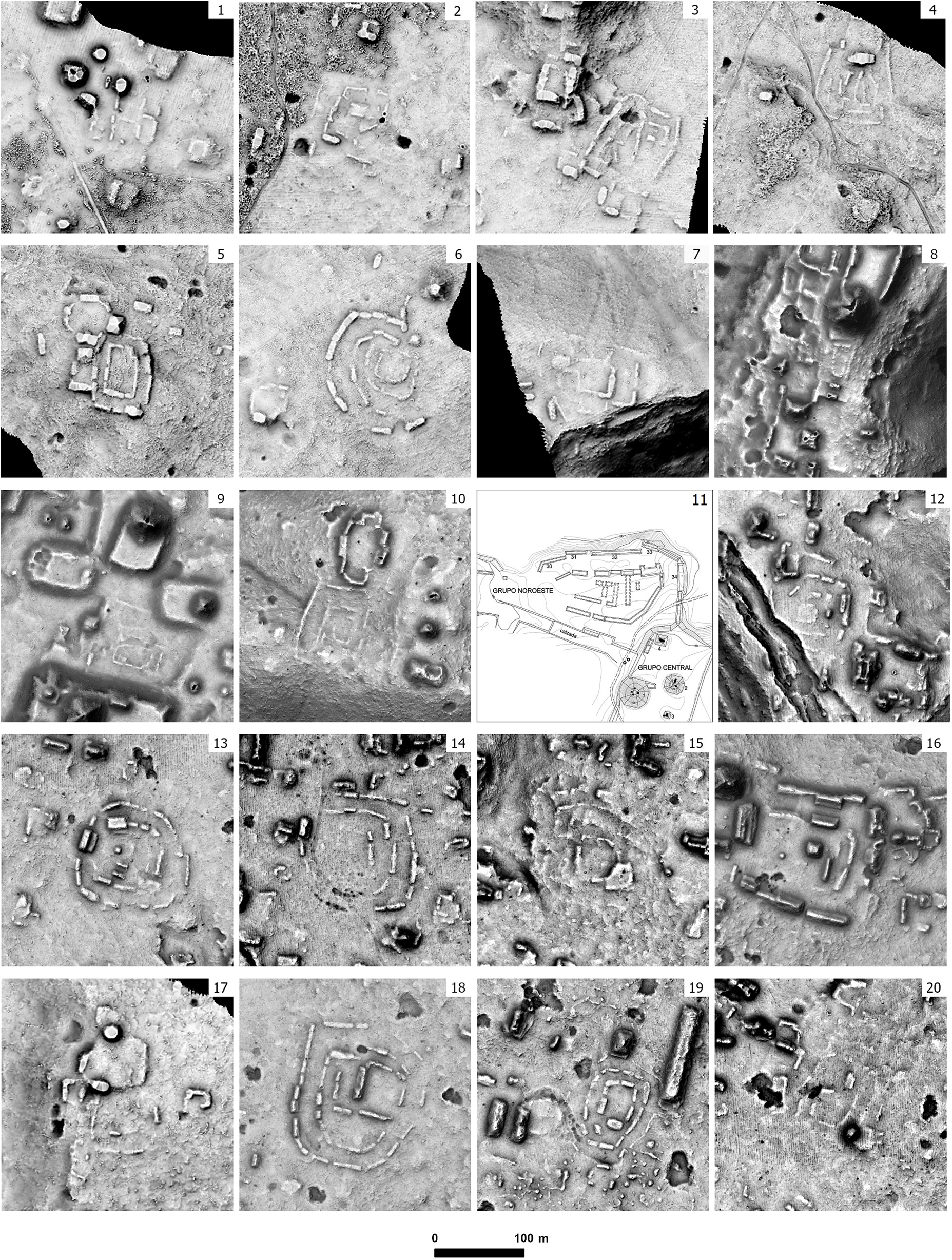
Figure 3a Long description
Twenty numbered map-like relief views are arranged in a grid, labeled 1 through 20. Each view shows ground-surface relief with sharp-edged raised and sunken forms that outline rectilinear and curving enclosures, platforms and small mound-like features. No legend is shown. Only one sub-image contains place-style labels: the view numbered 11 is a line-drawn plan with the labels “GRUPO NOROESTE” and “GRUPO CENTRAL.” The plan shows multiple outlined shapes and internal divisions, with several thin lines running across and around the outlined areas. Across the other numbered views, the mapped features vary in layout. Several views show nested, roughly rectangular enclosures with interior partitions. Several views show nested, rounded or ring-like enclosures made of segmented raised arcs. Some views show clusters of small, separate raised forms around a larger central enclosure. Some views include long, straight linear features that cross the scene. A scale bar centered along the bottom margin is labeled “0” at the left end and “100 m” at the right end.
Possible marketplaces in the Maya Lowlands
During recent decades, the ancient Maya commerce has become an increasingly important subject of archaeological research. Based on different approaches and criteria, possible markets have been identified at various Maya sites. Among the features considered indicative of marketplaces are the types of structures or architectural complexes, their location within settlements and association with other types of buildings, the distribution of certain ceramic types and artifacts, as well as the traces detectable in soils through geochemical analyses (Anaya Hernández et al. Reference Anaya Hernández, Reese-Taylor, Walker and Dunning2021; Becker Reference Becker and King2015; Cap Reference Cap and King2015, Reference Cap2019; Chase and Chase Reference Chase and Chase2014; Dahlin et al. Reference Dahlin, Bair, Beach, Moriarty, Terry, Staller and Carrasco2010; Hirth Reference Hirth1998, Reference Hirth2009; Hirth and Pillsbury Reference Hirth and Pillsbury2013; Hutson Reference Hutson2017; Jones Reference Jones and King2015; King and Shaw Reference King, Shaw and King2015; Masson et al. Reference Masson, Freidel and Arthur A.2020; Paris Reference Paris2021; Shaw Reference Shaw2012; Shaw and King Reference King and King2015; Terry et al. Reference Terry, Bair, Coronel and King2015).
However, identifying Maya markets archaeologically is notoriously difficult. On one hand, there is little information about their characteristics in documentary sources, which are, moreover, from the colonial period and may not be directly relevant to times before the Late Postclassic. On the other, activities in a market did not necessarily require durable constructions recoverable through archaeological methods. Any open space could have functioned as a marketplace (Becker 2013–Reference Becker2014, Reference Becker and King2015; Cap Reference Cap and King2015:114; Cobos Reference Cobos2024; Hirth Reference Hirth1998:453). This is also suggested by the Yucatec Maya term k’iwik, which refers to both a plaza and a market (King Reference King and King2015:35; Shaw Reference Shaw2012:130; Speal Reference Speal2014; Tokovinine and Beliaev Reference Tokovinine, Beliaev, Hirth and Pillsbury2013:171); this polysemy may not be an exception in Mesoamerican languages, as the same applies to the Mixtec term ya’vi (Cobos Reference Cobos2024:974). An additional problem is that different activities may have left very similar traces, including soil chemical composition (Becker 2013–Reference Becker2014; King and Shaw Reference King, Shaw and King2015; Dahlin et al. Reference Dahlin, Bair, Beach, Moriarty, Terry, Staller and Carrasco2010:197).
Therefore, it is clear that efforts to identify Maya markets can only result in solid proposals through the application of multiple approaches and analyses conducted with proper methodological rigor (Becker 2013–Reference Becker2014; Eppich and Freidel Reference Eppich, Freidel and King2015; Hirth Reference Hirth1998, Reference Hirth2009; Hutson et al. Reference Hutson, Terry, Dahlin and Hutson2017; King Reference King and King2015:64). Hirth (Reference Hirth1998, Reference Hirth2009) outlined several approaches for studying Prehispanic markets. The contextual, spatial, and distributional approaches, with different scales of analysis (cf. Chase and Chase Reference Chase, Chase, Masson, Freidel and Demarest2020; Hutson Reference Hutson, Masson, Freidel and Demarest2020), have been applied in several compelling arguments, but their utility for determining the function of nested construction is severely limited due to the paucity of relevant data (see below). More productive, at this stage of research, is the configurational approach. The most important criteria will be discussed in the next section, but this approach essentially relies on spatial and architectural configurations most likely shaped by market behavior (Hirth Reference Hirth1998:453). Among the various architectural layouts that have been interpreted as ancient Maya marketplaces, the East Plaza of Tikal and the Chiik Nahb complex of Calakmul are particularly relevant to the present discussion because of their striking similarities to the formal characteristics of other nested constructions.
The Chiik Nahb complex of Calakmul, with a roughly square ground plan, has a number of small structures along its perimeter and several rows of low mounds in the inner space (Figure 3b: complex 33; Carrasco Vargas and Cordeiro Baqueiro Reference Carrasco Vargas, Cordeiro Baqueiro, Golden, Houston and Skidmore2012:Figure 2). The only major building is Structure 1, which is particularly interesting because of the murals found in its substructure. The paintings represent various persons engaged in different activities related to a range of comestibles and other goods, such as basketry, ceramics, textiles, and wood (Carrasco Vargas and Cordeiro Baqueiro Reference Carrasco Vargas, Cordeiro Baqueiro, Golden, Houston and Skidmore2012; García Barrios Reference García Barrios, Paxton and Cicero2017). While it is a prevalent opinion that these murals depict activities in a marketplace (Dahlin et al. Reference Dahlin, Bair, Beach, Moriarty, Terry, Staller and Carrasco2010:196; Hull Reference Hull, Staller and Carrasco2010; Jones Reference Jones and King2015:70, 86; Martin Reference Martin, Golden, Houston and Skidmore2012:80; Tokovinine and Beliaev Reference Tokovinine, Beliaev, Hirth and Pillsbury2013; Wurtzburg Reference Wurtzburg and King2015), some researchers contend that they represent food consumption or a ritual feast attended by high-ranking individuals (Boucher and Quiñones Reference Boucher and Quiñones2007; Carrasco et al. Reference Carrasco Vargas, Vázquez López and Martin2009; Cobos Reference Cobos2024:984; García Barrios and Carrasco Vargas Reference García Barrios, Carrasco Vargas, Laporte, Arroyo and Mejía2008; Vázquez L. Reference Vázquez and Verónica2006:108). However, Tokovinine and Beliaev (Reference Tokovinine, Beliaev, Hirth and Pillsbury2013) point out that these murals differ from depictions of courtly life on vessels and monuments in a number of ways. The setting seems to be some kind of open space, some of the many products shown are almost never mentioned or portrayed in courtly settings, and the baskets stacked with clay vessels and other containers are absent in the Classic Maya depictions of palace environments. Furthermore, several characters wear wide-brimmed hats, which are commonly associated with trade, and the individuals represented are not identified by personal names. Instead, the accompanying hieroglyphic captions are generic terms associating the characters with the goods depicted (Martin Reference Martin, Golden, Houston and Skidmore2012). Since each caption begins with the agentive prefix aj (“one of,” “one who”), followed by the name of a particular product, Hull (Reference Hull, Staller and Carrasco2010:251) draws attention to the fact that in the present-day Ch’orti’ Mayan, the names of certain goods preceded by this prefix regularly designate the persons who sell them at markets. By this analogy, labels aj-ul, aj-waaj, aj-ixi’m, or aj-atz’aam, appearing in Calakmul murals, likely refer to persons selling atole, tamales, maize, and salt, respectively. In addition, it seems significant that the murals show a number of female figures engaged in commercial transactions, considering that women play a prominent role in modern Maya markets (Eppich and Freidel Reference Eppich, Freidel and King2015:199; Wurtzburg Reference Wurtzburg and King2015).
Layouts of nested complexes 21 to 40 (maps of complexes 22, 33, 39, and 40 after Šprajc Reference Šprajc2023:Figure 3.20, Carrasco Vargas and Cordeiro Baqueiro Reference Carrasco Vargas, Cordeiro Baqueiro, Golden, Houston and Skidmore2012:Figure 2, Laporte and Chocón Reference Laporte, Chocón, Laporte, Arroyo and Mejía2008:Figure 5, and Jones Reference Jones and King2015:Figure 2.1, respectively).

Figure 3b Long description
The image presents a thematic grid of 20 panels numbered 21 to 40, each showing the layout of a nested architectural complex. Panels 21, 23 to 32 and 34 to 38 are LiDAR hillshade relief images. Panels 22, 33, 39 and 40 are line drawings showing detailed architectural layouts with outlines of rectangular and curved structures. No legend is present. No orientation indicator or north arrow is shown, so orientation is not indicated. No place names or geographic labels are visible within any panel. The scale bar at the bottom reads 0 to 100 m. In the LiDAR hillshade panels, bright linear ridges and raised rectangular forms are visible against darker surrounding areas. The overall patterns visible across panels vary: some complexes show roughly circular or oval arrangements of raised linear features forming nested rings, while others show rectilinear enclosures with attached annexes or subsidiary structures. Some panels show a single dominant enclosure, while others show multiple concentric or adjacent enclosures. The four line drawing panels show structures rendered as open rectangular outlines arranged in clustered or linear groupings, with some curved wall segments visible. Panel 32 has a large area of solid black in one corner, which appears to be a data gap in the source imagery. All 20 panels are arranged in a five-row by four-column grid.
In light of this information, the proposal that the Chiik Nahb complex served as a marketplace seems compelling. However, the various interpretations may not be mutually exclusive and may apply to the nested constructions in general. To judge by the ethnographic evidence, marketplaces must have been regularly used for various purposes, including craft production, food preparation, feasting, and other activities that served for promoting different types of social relations (Cap Reference Cap and King2015:113–115; Cobos Reference Cobos2024:973–974; Dahlin et al. Reference Dahlin, Bair, Beach, Moriarty, Terry, Staller and Carrasco2010:198–199; Hirth Reference Hirth2009; Shaw Reference Shaw2012:132; Valencia Rivera Reference Valencia Rivera2020:32).
Tikal’s East Plaza (Figure 3b: complex 40; Jones Reference Jones and King2015:Figure 2.1) has a layout similar to that of the Chiik Nahb complex. It consists of several long and narrow buildings that form two rectangles, one inscribed within the other, larger one. As described by Jones (Reference Jones and King2015), it was the abundant information about the Postclassic Tlatelolco market in central Mexico given in early colonial sources (Feldman Reference Feldman, Lee and Navarrete1978) that initially suggested the presence of a marketplace in the East Plaza of Tikal, but this interpretation is supported by the very characteristics of its structures. Whereas other gallery buildings, which are typically long, multiroomed and multidoorway structures, are often interpreted as having had a residential and/or administrative function, those in the East Plaza are distinctive because “they are characterized by long narrow rooms with façades of close-set doorways separated by wall segments that are narrower than the doorways themselves” (Jones Reference Jones and King2015:72–73). Furthermore, “the buildings lacked the interior curtain tie holders, seating-height benches, or transverse dividing walls found in other Tikal buildings, with the exception of secondary transverse walls that line a passageway through the center of the medial wall of the quadrangle” (Jones Reference Jones and King2015:80). Jones (Reference Jones and King2015:85) concludes:
It is hard to imagine a use for this huge set of buildings other than as a marketplace. A school or convent would be a possible alternative, except for the fact that the inward-facing façades of the quadrangle are no different from the outward-facing ones. The fact that similar activities therefore likely took place both inside and outside the quadrangle argues against a cloistered function.
While Jones (Reference Jones and King2015:86) agrees that the murals in the Chiik Nahb complex may depict either marketplace activities or ritual feasting, he argues that their location at the entrance to the complex with a layout similar to that of the East Plaza of Tikal favors the marketplace interpretation.
Based on their similarities with the East Plaza of Tikal and the Chiik Nahb complex of Calakmul, a few other architectural assemblages in the Maya Lowlands have been interpreted as marketplaces: a nested complex in the central part of the site of Pueblito, Petén, Guatemala (Figure 3b: complex 39; Laporte and Chocón Reference Laporte, Chocón, Laporte, Arroyo and Mejía2008); the arrangement of elongated structures south of the East Causeway and west of Group A at Yaxhá, Petén, Guatemala (Figure 3c: complex 45; Becker Reference Becker and King2015:104; Jones Reference Jones and King2015:86); and a few nested constructions in the El Palmar area, Campeche, Mexico (Figure 3c: complexes 46–49; Tsukamoto et al. Reference Tsukamoto, López Camacho, Fernández-Diaz, Shrestha, Hernández Gómez, Jiménez Delgado, López Mejía, Colin, Chase, Stanton, Hutson, Schroeder and Tsukamoto2026). Another space located north of El Palmar site core may also have been a marketplace (Tsukamoto et al. Reference Tsukamoto, López Camacho, Fernández-Diaz, Shrestha, Hernández Gómez, Jiménez Delgado, López Mejía, Colin, Chase, Stanton, Hutson, Schroeder and Tsukamoto2026), but is not included here because, being enclosed by a single quadrangle of elongated structures, it is not strictly a nested construction.
Layouts of nested complexes 41 to 50 (map of complex 45 after Quintana et al. Reference Quintana, Wurster and Hermes2000:Figure 16).

Figure 3c Long description
The image contains ten aerial views of nested complexes, each labeled with numbers from 41 to 50. Each complex displays distinct architectural layouts. Complex 41 shows a circular arrangement with surrounding structures. Complex 42 features several rectangular buildings. Complex 43 has a central square structure. Complex 44 displays elongated formations. Complex 45 includes a detailed map with labeled areas. Complex 46 shows multiple rectangular formations. Complex 47 has a mix of square and circular structures. Complex 48 features scattered small buildings. Complex 49 displays a large rectangular enclosure. Complex 50 shows a central structure with surrounding formations. A scale at the bottom indicates 100 meters.
Nested constructions: Chronology and archaeological contexts
The chronological data obtained through excavations of nested complexes at Calakmul and Tikal suggest that they were not built before the Classic period (ca. a.d. 250–900). The East Plaza of Tikal was dated to the Late Classic (Jones Reference Jones and King2015:70), whereas Structure 1 of the Calakmul’s Chiik Nahb complex and its murals have several stages; the earliest pertains to the late phase of the Early Classic, but most of the ceramics excavated and depicted on the murals is from the Late Classic (Boucher and Quiñones Reference Boucher and Quiñones2007; Carrasco Vargas and Cordeiro Baqueiro Reference Carrasco Vargas, Cordeiro Baqueiro, Golden, Houston and Skidmore2012).
The nested construction at Pueblito, Guatemala, consists of several low and elongated platforms that seem to have supported a series of small rooms (Figure 3b: complex 39). All of the three construction stages correspond to the Late and Terminal Classic periods (Laporte and Chocón Reference Laporte, Chocón, Laporte, Arroyo and Mejía2008).
Test excavations in the nested complex of the Hernández Group of El Palmar (Figure 3c: complex 49) identified a single occupation phase corresponding to the Late Classic period (ca. a.d. 600–850), although parts of the group may have been built earlier, to judge by Early Classic and Preclassic sherds recovered in the construction fill. Considering that, unlike in other plazas of El Palmar, no plaster floors were detected in the Hernández Group, its plazas seem to have had earthen floors, which would have been appropriate for a marketplace, absorbing rainfall and other fluids spilled on the plazas. Significant amounts of chert microdebitage and an apparently unworked piece of jade, recovered in test pits, are additional features that make the Hernández Group quite different from others at El Palmar (Tsukamoto and Camacho Reference Tsukamoto and López Camacho2018:101–119; Tsukamoto et al. Reference Tsukamoto, López Camacho, Fernández-Diaz, Shrestha, Hernández Gómez, Jiménez Delgado, López Mejía, Colin, Chase, Stanton, Hutson, Schroeder and Tsukamoto2026).
During our recent field surveys in central Campeche, Mexico, we inspected complexes 11, 14, 15, 16, 18, 19, 20, 22, 23, 25, 26, 27, 30, 31, 43, and 44, and excavated test pits in some of them (Šprajc Reference Šprajc2023, Reference Šprajc2025; Šprajc et al. Reference Šprajc, Marsetič, Štajdohar, Góngora, Ball, Olguín and Kokalj2022). Also in these cases, few stratigraphic layers and no remnants of plaster floors were detected.
One test pit was excavated in complex 19, which is part of Group I10-a surveyed in 2023 (Op. I10-2; Hernández Gómez Reference Hernández Gómez and Šprajc2023:66–68). The ceramic sherds recovered are of the Early and Late Classic types, with 71.06 percent pertaining to the Early Classic period (Dzul Reference Dzul G. and Šprajc2025a:116).
In complex 23, part of Group K9-a, also inspected during the 2023 field surveys, two test pits were excavated, yielding ceramics from the Late Preclassic through the Terminal Classic periods. In the test pit excavated at the center of the inner space, a concentration of ceramic fragments associated with a stone altar was found (Op. K9-1; Hernández Gómez Reference Hernández Gómez and Šprajc2023:57–62). Most of the sherds are from the Late (67.54 percent) and Terminal Classic (29.46 percent of the total) periods (Dzul Reference Dzul G. and Šprajc2025a:116–117). The other test pit, excavated in front of a major structure (Op. K9-2; Vujanović Reference Vujanović and Šprajc2023:79), contained mostly Early (46.46 percent) and Late Classic ceramics (25.20 percent) (Dzul Reference Dzul G. and Šprajc2025a:117).
The ceramics obtained in the test pit excavated in complex 27, corresponding to group B-2 of Ocomtún surveyed in 2023 (Op. O9-1, Hernández Gómez Reference Hernández Gómez and Šprajc2023:53–57), are of the Late Preclassic to Terminal Classic types, but mostly from the Late Classic (70.99 percent) (Dzul Reference Dzul G. and Šprajc2025a:117).
In the test pit excavated at the center of the nested compound 26, located at the site of Chacbitún surveyed in 2024 (Op. O27-1; Hernández Gómez Reference Hernández Gómez and Šprajc2025:49–52), the material from the Late Preclassic to the Terminal Classic periods was found, including fragments of a Terminal Classic censer of the Miseria Aplicado type. However, most sherds are from the Late Preclassic period (51.58 percent) (Dzul 2025b:175).
Given the dimensions of our test pits (2 x 2 m), it is not surprising that the material recovered does not shed much light on the use of nested complexes. It can only be mentioned that small fragments of unidentified bones were found in complex 27, perhaps remains of an animal consumed in the space (Op. O9-1, Hernández Gómez Reference Hernández Gómez and Šprajc2023:53–57), and a flint core and a projectile point, both apparently of the same material, were recovered in complex 19 (Op. I10-2; Hernández Gómez Reference Hernández Gómez and Šprajc2023:66–68). If these cases reflect food consumption and craft production within these spaces, it may be recalled that marketplaces may well have also served for this kind of activities (cf. Cap Reference Cap and King2015:113–115; Hirth Reference Hirth2009; Shaw Reference Shaw2012:132). The production of lithic artifacts is also suggested by material found in the nested complex of Pueblito (Figure 3b: complex 39; Laporte and Chocón Reference Laporte, Chocón, Laporte, Arroyo and Mejía2008:699).
The chronological data exposed above indicate that most of the nested constructions were in use during the Classic period. However, the material recovered in complex 26 of Chacbitún suggests that some of these compounds may well have been built earlier.
Characteristics suggesting a marketplace function for nested constructions
Considering the scarcity and ambiguity of contextual data summarized above, the attempt at evaluating whether the nested constructions served as marketplaces can rely primarily on the configurational approach (Hirth Reference Hirth1998, Reference Hirth2009), specifically on the architectural grammar considered typical of built marketplaces, including features that conceivably reflect activities related to market exchange. Following are the criteria most often cited as indicative of built markets (Becker Reference Becker and King2015:92; Dahlin et al. Reference Dahlin, Bair, Beach, Moriarty, Terry, Staller and Carrasco2010:197–198; Hirth Reference Hirth1998:453, Reference Hirth2009:90; Hutson et al. Reference Hutson, Terry, Dahlin and Hutson2017:248–253; King Reference King and King2015; Ruhl et al. Reference Ruhl, Dunning and Carr2018:84; Shaw Reference Shaw2012:130–132):
• structures and layouts suggesting the existence of a marketplace (low, linear platforms organized in rows within a plaza with relatively easy access);
• presence of a major a building or attached space for storage or administrative control;
• ceremonial features;
• presence of a ballcourt;
• strategic location with features facilitating access (streets, causeways);
• proximity of water sources.
These criteria rely heavily on sixteenth-century descriptions of marketplaces in central Mexico, particularly that of Tlatelolco, and on ethnographic studies of present-day or recently documented indigenous markets (Feldman Reference Feldman, Lee and Navarrete1978; Hirth Reference Hirth1998, Reference Hirth2009; King Reference King and King2015). The ethnohistorical data on Maya markets, in comparison with those from central Mexico, are scarce and vague (King Reference King and King2015:34), but there is linguistic and epigraphic evidence for merchants, including those trading in marketplaces (King Reference King and King2015:46–53; Tokovinine and Beliaev Reference Tokovinine, Beliaev, Hirth and Pillsbury2013).
In his critical examination of previous publications on trade and market exchange in the Maya area, Cobos (Reference Cobos2024) questions the relevance of the data they present for interpreting ancient Maya markets, arguing that ethnohistorical and linguistic evidence does not support the existence of spaces used specifically as markets among the pre-Postclassic Maya. Cobos is skeptical about interpreting the Chiik Nahb complex at Calakmul as a marketplace, suggesting that the murals in Structure Sub 1-4 might well represent other activities. He proposes that the exchange of goods may have taken place in plazas that, from the fifteenth century onwards, gradually became places used specifically as marketplaces and were not associated with festivities (Cobos Reference Cobos2024:988). Cobos’s skepticism seems to stem largely from the absence of Maya markets unequivocally identified through archaeological methods. However, given the considerable degree of both regional and temporal continuity in the Mesoamerican area, ethnographic and ethnohistorical analogies should not be dismissed outright. Instead, they can stimulate hypotheses to be tested against archaeological data. As the following discussion shows, the characteristics of nested complexes satisfy the criteria outlined above.
Structures and layouts suggesting the existence of a marketplace
The nested constructions fit the descriptions of central Mexican marketplaces at the time of the Conquest, which were in special areas and included stalls and shops organized in rows (Hirth Reference Hirth1998:453, Reference Hirth2009:90). Most of the nested complexes are only partially enclosed. Multiple openings in their perimeters allowed relatively easy public access, while fewer entrances in some cases would have served to control or tax both vendors and consumers (Shaw Reference Shaw2012:128). As noted by Ruhl et al. (Reference Ruhl, Dunning and Carr2018:86), all nested constructions, with concentric arrangements of low, elongated platforms separated by intermediate open spaces, share their sizes and architectural grammar with the East Plaza of Tikal and the Chiik Nahb complex of Calakmul. These two architectural compounds exhibit approximately rectangular layouts, as do many others in our sample, whereas others tend to have circular or oval plans. Although their shapes often cannot be described as purely circular or rectangular, the most clearly round compounds are concentrated in the area shown in Figure 2, perhaps representing a regional version of the same concept.
The similarities in shape, size, and distribution of structures integrated in all nested complexes suggest that these are all generically related forms. It thus seems reasonable to suppose that they also had comparable functions. Since the low, elongated, and narrow mounds can hardly be attributed a residential function (cf. Jones Reference Jones and King2015), it is much more likely that they are remains of platforms that once supported perishable stalls for displaying goods, with isles between the nested rings of structures serving as walkway areas.
Presence of a major building or attached space for storage or administrative control
Several nested complexes include at least one larger structure, which may have served for storing goods or as a residence or office for the authority overseeing the market activities (cf. Cap Reference Cap and King2015:114; Jones Reference Jones and King2015:81; King Reference King and King2015:37, 59–60; Ruhl et al. Reference Ruhl, Dunning and Carr2018:84; Shaw Reference Shaw2012:131). Also common are smaller annexed courtyards, which have roughly circular or rectangular layouts and are enclosed by minor or major structures (Figures 3a–3c). These may have been areas with restricted access to certain goods (Shaw and King Reference King and King2015:172) or residences suggesting elite involvement in market activities (Ruhl Reference Ruhl, Dunning and Carr2018:87; Shaw Reference Shaw2012:129). By way of analogy, the central Mexican marketplaces at the time of the Conquest included buildings or precincts occupied by magistrates who supervised and regulated economic transactions (Hirth Reference Hirth1998:453). Major and minor nested complexes might reflect different degrees of elite involvement or supervision, as also suggested by ethnohistorical sources (King Reference King and King2015).
Ceremonial aspects
At least some of the annexed compounds must have had both civic and ceremonial functions, since their larger versions appear to be the plazas attached to several nested constructions and surrounded by some clearly religious buildings (Figures 3a–3c: complexes 8, 9, 16, 26, 27, 30, 31, 45, 50, Figures 4–6).
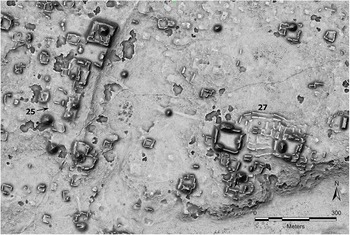
Locations of nested complexes 25 and 27 in Ocomtún.

Location of nested complex 26 in Chacbitún.

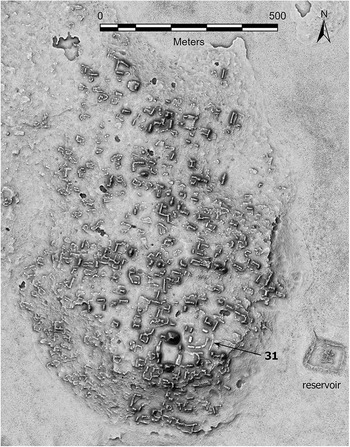
Location of nested complex 31 in Cotná.

Figure 6 Long description
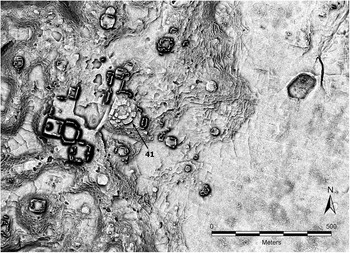
A grayscale remote-sensing style site map of an area labeled Cotná, showing many rectilinear outlines and linear features spread across an irregular, mound-like shape. Map elements: A scale bar at the top is labeled Meters, with endpoints labeled 0 and 500. A north arrow marked N is at the top right. Labels and markers: The number 31 is printed near the lower-right portion of the main cluster, with a pointer line indicating a specific rectilinear feature within the dense outlines. The word reservoir is printed on the right side of the map near a separate, square-shaped feature. Spatial layout: Rectilinear outlines are densest across the central and lower portions of the mound-like area, with additional scattered outlines toward the upper portion. The labeled 31 feature lies in the southeast part of the dense cluster. The reservoir label and the square feature lie east of the main mound-like cluster. No legend is shown for the rectilinear outlines or tonal differences.
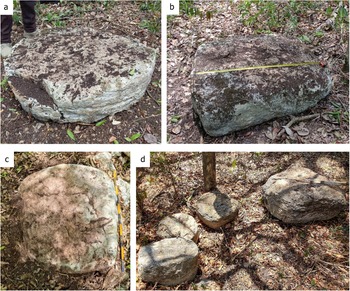
The spatial relationship of nested constructions with ceremonial buildings and compounds is in line with the evidence indicating that trade and markets included religious aspects and were associated with ritual activities (Becker Reference Becker and King2015; King Reference King and King2015:61–62; Shaw Reference Shaw2012:131; Shaw and King Reference King and King2015:172–173). On one hand, merchant gods figure prominently in visual and written narratives revealing the supernatural and mythical side of trade (Tokovinine and Beliaev Reference Tokovinine, Beliaev, Hirth and Pillsbury2013). On the other, according to some ethnohistorical sources, markets were near temples (King Reference King and King2015:35, 57). Also in modern towns, the market is regularly found next to the church (Shaw Reference Shaw2012:128). While this might be a tradition of colonial origin, there are evident similarities between Prehispanic and early colonial markets, suggesting continuity to some extent (Villegas Reference Villegas2010). Furthermore, central Mexican markets had an altar (momoztli) where the god of the market had his place (Berdan and Anawalt Reference Berdan and Anawalt1997:156; Shaw Reference Shaw2012:131). Accordingly, stone altars were found in several nested complexes inspected in the field (Figure 7; Šprajc Reference Šprajc2023, Reference Šprajc, Olguín and Hernández Gómez2025). As already mentioned, in the test pit excavated at the center of complex 23, a ritual deposit consisting of a concentration of ceramic fragments associated with a stone altar was found (Hernández Gómez Reference Hernández Gómez and Šprajc2023:57–62). Furthermore, stone heaps, most likely remains of shrines, can be seen in many nested constructions, usually in their centers (Figures 3a–3c). Whether these central structures also served for punishing transgressors, as in the Tlatelolco market (Villegas Reference Villegas2010:93–94), is of course a question that cannot be answered with the data at hand.
Stone altars found in nested complexes 19 (a), 23 (b), 25 (c), and 26 (d).

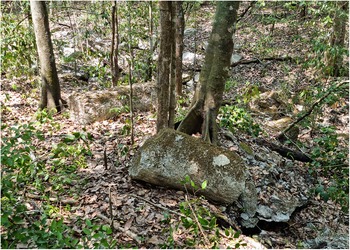
A special case is complex 16. A partially collapsed cave system in its southern part may well have conditioned the location of this assemblage, considering many analogous cases and the well-known religious and ritual importance of caves in the Maya worldview (Bassie-Sweet Reference Bassie-Sweet1996; Brady Reference Brady1997; Brady and Bonor Reference Brady, Villarejo, de León and Perramon1993; Brady and Prufer Reference Brady and Prufer2005; Romero Sandoval Reference Romero Sandoval2016). The position in which two stone columns were found suggests that they originally pertained to a shrine associated with the caves (Figure 8; Šprajc Reference Šprajc2023:21–23).
Stone columns on the edge of a collapsed cave system in nested complex 16.

Presence of a ballcourt
One of the criteria for identifying markets is the proximity of a ballcourt, as these are found in or near the complexes for which a market function seems particularly likely (at Tikal, Calakmul, and Yaxhá: Becker Reference Becker and King2015:92, 94, 103, 105; Jones Reference Jones and King2015). It may be noted that the ballcourt of Calakmul, included among these cases by Becker (Reference Becker and King2015:103), is located 190 meters southwest of the Chiik Nahb complex, as part of the Great Acropolis; its conceptual connection with the nested complex is thus questionable. Nonetheless, ballcourts are indeed found within or in the immediate vicinity of several nested constructions (Figures 3a–3c: complexes 7, 8, 9, 13, 16, 19, 27, 30, 31, 39, 43, 49, 50; Figures 4–6). As suggested by Becker (Reference Becker and King2015:94), “trade can easily be related to intercity competition in the Maya ballgame, with the movement of goods among various polities. Merchants as well as ‘fans’ may have traveled in tandem with their teams.”
Strategic location and connectivity
It has been assumed that markets occupied central or strategic locations within settlements, with easy access via streets or causeways that would have facilitated the transport of goods (Becker Reference Becker and King2015:92, 105; Dahlin et al. Reference Dahlin, Bair, Beach, Moriarty, Terry, Staller and Carrasco2010:198; Hirth Reference Hirth2009:90; King Reference King and King2015:57; Shaw Reference Shaw2012:128–129; Shaw and King Reference King and King2015:170). Peripheral locations connected to site centers with causeways have also been proposed, as in the cases of Caracol, Chichén Itzá, and Palenque (Chase and Chase Reference Chase and Chase2014; Reference Chase, Chase, Masson, Freidel and Demarest2020; Shaw Reference Shaw2012:129).
As already noted by Ruhl et al. (Reference Ruhl, Dunning and Carr2018:84), nested constructions are placed in both major and minor settlements, and this has also been suggested for Maya markets (Shaw and King Reference King and King2015:178–179). Several nested complexes are located in urban cores of major centers of Yesal (8 and 9), Uitzilná (11), Chacbitún (26), Ocomtún (25 and 27), Cotná (31), Calakmul (33), Tikal (40), Yaxhá (45), El Palmar (47), and Valeriana (50) (Figures 3a–3c and 4–6). Many others are placed within or in immediate vicinity of minor residential clusters, while for some of those visible in G-LiHT transects, which are barely 380 m wide, their possible association with settlements remains unclear.
Regarding causeways, the core area of Pueblito, with nested complex 39, has intra-site causeways (Laporte and Chocón Reference Laporte, Chocón, Laporte, Arroyo and Mejía2008). At Ocomtún, a sacbé connects the eastern and western sectors of the site, in which nested constructions 25 and 27 are located (Figure 4). In addition, some narrow but evidently constructed paths extend from Ocomtún to the north, crossing a large wetland or bajo (Šprajc et al. Reference Šprajc2025:16, Figure 2). Except in these cases, causeways are not visible, but their absence does not necessarily imply the nonexistence of walkways, especially on elevated grounds where no major infrastructural investments of this kind were required.
Proximity of water sources
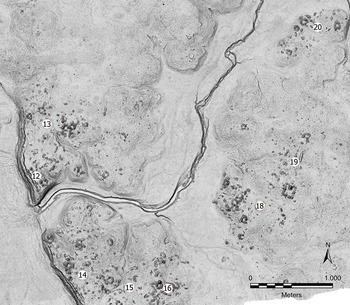
Based largely on ethnographic data, it has been assumed that a marketplace should have been located near a water source (Becker Reference Becker and King2015:92; Dahlin et al. Reference Dahlin, Bair, Beach, Moriarty, Terry, Staller and Carrasco2010:197–198; King Reference King and King2015:57; Shaw Reference Shaw2012:132). The nested constructions situated in major centers are all relatively near aguadas, some of which were artificially modified (Figures 5, 6, 11, and 12). Several complexes lie near La Rigueña River, which is one of the very few perennial streams in the area; the most distant is located 1 km away (Figure 9). But it should be noted that water was also available in numerous chultuns and small depressions, as well as in some of the ubiquitous quarries that were eventually adapted to function as water storage facilities (Akpinar et al. Reference Akpinar Ferrand, Dunning, Lentz and Jones2012; Brewer Reference Brewer2018; Šprajc et al. Reference Šprajc2021:6; Weiss-Krejci and Sabbas Reference Weiss-Krejci and Sabbas2002).
Northwestern part of the surveyed area, with several nested constructions near La Rigueña River.

Distribution of nested complexes: Possible reasons
Considering that the nested constructions have been identified in a limited though extensive part of the Maya Lowlands, they seem to represent a regional phenomenon, as already noted by Ruhl et al. (Reference Ruhl, Dunning and Carr2018:88). However, as mentioned earlier, complexes of this type most likely had a wider and, in some parts, denser distribution, but so far have not been detected (or have been documented, but are not included here because their exact locations have not been published). While they are clearly visible in lidar imagery, the low platforms can hardly be noticed in the generally overgrown environment through field inspections only. The apparent gap in northern Petén, for example, may thus not correspond to reality. There is no doubt that additional nested constructions will eventually be detected by inspecting further lidar datasets, where/when available. Furthermore, Harrison (Reference Harrison and Ashmore1981:281, Figure 10.7) observed that, despite some differences, the complexes he labeled contained rectangles, which characterize some Maya sites in Quintana Roo, are reminiscent of the East Plaza of Tikal. In addition, the constructions he named vias (Harrison Reference Harrison and Ashmore1981:Figure 10.6) appear to be a version of nested constructions. A similar compound, interpreted as a marketplace, was recently detected on lidar-derived images of Dzibanché, one of the largest sites in that area (Estrada-Belli and Balanzario Reference Estrada-Belli and Balanzario2025: Figure 3). It is thus possible that this tradition, with somehow modified variants of the same concept, extended farther east (cf. Ruhl et al. Reference Ruhl, Dunning and Carr2018:88).
Nonetheless, in light of the available data, it is unlikely that nested constructions were widespread much beyond the area shown in Figure 1. The evidence examined strongly suggests that they were built marketplaces. However, the utter unlikelihood that only complexes of this type served this purpose implies that different open spaces must have been used for market activities elsewhere in the Maya Lowlands, although most of them, as it appears, have not left so clearly distinguishable architectural features.
If the high number of nested constructions in central and western Campeche nonetheless calls attention, how can we explain it? Following are a few possible answers to this question.
According to Ruhl et al. (Reference Ruhl, Dunning and Carr2018:87), the locations of the nested constructions they identified suggest a network of marketplaces extending between the Gulf Coast and Calakmul. Considering that the distribution of markets would have been partly conditioned by important trade routes (King Reference King and King2015:57, 64; Shaw Reference Shaw2012), Ruhl et al. (Reference Ruhl, Dunning and Carr2018:88) recall that much of southwestern Campeche was, during the Postclassic, under the domain of Acalán, a political entity controlled by the Chontal Maya, known for their role in both coastal and inland trade. Significantly, the divine patron of one of the divisions of Itzamkanac, the capital of Acalán, was Ik’ Chawa, god of merchants (Tokovinine and Beliaev Reference Tokovinine, Beliaev, Hirth and Pillsbury2013:171). Since the archaeological site of El Tigre, identified with Itzamkanac, had a long history and reached monumental size as early as the Late Preclassic (Vargas Pacheco Reference Vargas Pacheco2001, Reference Vargas Pacheco2010), the trade system in this region most likely had older roots. Regarding regional variations in trade intensity during early colonial times, Tokovinine and Beliaev (Reference Tokovinine, Beliaev, Hirth and Pillsbury2013:171) mention that “to the north and west of the Guatemala Highlands, commerce sometimes appeared to be the primary occupation of entire communities,” with some people dedicated exclusively to trade. Discussing early colonial reports, Cobos (Reference Cobos2024:986–988) also suggests that in the area extending from Soconusco and Campeche over Chiapas and Guatemala to the east, there were several trade ports at strategic locations where long-distance merchants conducted transactions using different facilities. If a comparable scenario can be projected back to the Classic period, it would be consistent with the concentration of nested constructions—assuming they were markets—in central and southwestern Campeche. In addition, the sites with nested compounds in eastern Petén may well have been integrated into a trade network connecting them with Caracol in Belize: the metamorphic resources in the Maya Mountains, located relatively close to this site, provided it with a distinct economic benefit, as they “were used for creating ground-stone artifacts like manos and metates that were in demand in the Maya lowlands” (Chase and Chase Reference Chase, Chase, Masson, Freidel and Demarest2020:144).
It is highly likely that markets operated at different levels, being involved in local, regional, or long-distance trade (King and Shaw Reference King, Shaw and King2015:18). According to Tokovinine and Beliaev (Reference Tokovinine, Beliaev, Hirth and Pillsbury2013:169–170), ethnohistorical sources distinguish among local, itinerant, and professional long-distance traders. There is hardly any doubt that distinctions of this sort also existed in Prehispanic times. As shown by Ardren et al. (Reference Ardren, Hutson, Hixson, Lowry and Hutson2017) in relation to Chunchucmil, certain commodities, such as obsidian and nonlocal ceramic wares, were by necessity distributed through long-distance trade. Another obvious case is salt, represented in the murals of Calakmul’s Chiik Nahb complex (Valencia Rivera Reference Valencia Rivera2020). It is thus reasonable to assume that nested constructions in major residential clusters characterized by monumental architecture were intended for long-distance trade supervised by the elites, whereas those in smaller communities may have been used for local exchange and redistribution.
Since many nested complexes are located close to one another, they may have specialized in different types of goods or functioned periodically (Cobos Reference Cobos2024:973; King Reference King and King2015:58, Reference King, Masson, Freidel and Demarest2020:22; King and Shaw Reference King, Shaw and King2015:18), much like some modern-day tianguis (open-air markets). Population growth would have likely created a need for multiple and diverse markets (Becker Reference Becker and King2015:93; Ruhl et al. Reference Ruhl, Dunning and Carr2018:84; Shaw and King Reference King and King2015:190–192). Drawing on central Mexican written sources, Hassig (Reference Hassig1982) argues that the Aztecs had both daily markets in large cities and those scheduled at intervals that corresponded to elementary calendrical periods, a scenario that, in spite of the lack of supporting evidence, is not unlikely for the Maya area. As stated by Hassig (Reference Hassig1982:347), periodic markets, “which generally meet in smaller population centers, have three interlocking advantages: they allow exploitation of low demand areas by mobile traders, they offer consumers a greater variety of goods by periodically concentrating supply, and by meeting on different days they facilitate the redistribution of commodities in the marketing system to and from higher-level centers.”
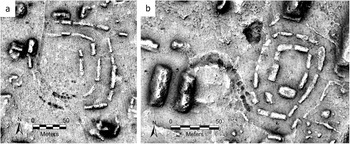
A particularly high density of nested constructions is observed in the northwestern lidar-scanned zone of 121 km2, where 15 cases were detected (Figure 2). While it may well reflect the diversity of market types, it should also be noted that probably not all of these complexes were in use simultaneously. Although the available chronological data suggest that most of them were built and used during the Classic period, some may have been established after nearby ones had fallen into disuse. It is possible that, with the growth of settlements and increasing commercial exchange, larger spaces were required for that purpose. At Ocomtún, for example, it appears that the nested construction barely visible in the western sector of the site (25) was at some point remodeled and partially covered by major structures, whereupon a new market (27) was built in the eastern sector, occupying a much larger space (Figure 4; Šprajc et al. Reference Šprajc2025). Likewise, complexes 14 and 19 seem to have been partially dismantled at some point. In the southern part of complex 14, small cavities up to 0.5 m deep can be seen precisely where, based on the group’s layout, platforms of two outer circles should be. Although the platforms of the inner circle may have been destroyed by the modern trail that crosses the complex, this does not explain the cavities along the outer circle of structures (Figure 10:a). Similarly, a segment of the outer circle of platforms in complex 19 appears to have been destroyed by extraction of material, resulting in a shallow trench (Figure 10:b). If these details suggest that the two complexes fell into disuse at some point, the function of complex 14 may have been transferred to the much more elaborate nested construction 16, located a kilometer to the east, while complex 19 could have been replaced by complex 18, barely half a kilometer to the southwest (Figure 9) (for more information on architectural groups F11-b, G12-a, H10-b, and I10-a, in which these nested constructions are located, see Šprajc Reference Šprajc2023). Clearly, only systematic excavations in relevant locations could clarify the chronological relationships among such closely spaced compounds.
Nested constructions 14 (a) and 19 (b).

If the nested constructions were markets, as seems very likely, one factor contributing to their density in central Campeche may have been environmental constraints (cf. Eppich and Freidel Reference Eppich, Freidel and King2015; Hutson and Dahlin Reference Hutson, Dahlin and Hutson2017:14). Commercial transactions would have supplied nonlocal items that were harder to obtain (King and Shaw Reference King, Shaw and King2015:18). Significantly, the Chactún area and the adjacent strip of land extending westward (Figure 2) are characterized by remarkable extents of terraces and field boundaries in the uplands and by canals and ridges in low-lying wetlands (bajos), features clearly related to agricultural techniques (Šprajc et al. Reference Šprajc2021). In sharp contrast, these landscape modifications are virtually absent in the lidar-scanned areas to the west (Šprajc Reference Šprajc2023, Reference Šprajc2025). Since no systematic analyses of soil samples have been done, it remains unknown whether these regional differences reflect variations in soil fertility. However, this possibility is suggested by the largely rocky terrain with thin layers of soil in the area lacking agricultural features, as well as by comments from our local workers regarding its low agricultural potential. If these environmental conditions contributed to regional specializations in subsistence activities, we can infer that areas less suitable for cultivation had a greater need to import and redistribute agricultural products (cf. Beach et al. Reference Beach, Luzzadder-Beach, Sweetwood, Farrell, Mazeau, Terry and Hutson2017); one consequence would have been the establishment of a denser network of markets. It should be recalled that storing maize was not a viable option in the humid tropical environment; an alternative would have been to move surplus from productive areas to areas of scarcity through exchange networks (Eppich and Freidel Reference Eppich, Freidel and King2015:221–222). Needless to stress, verifying this hypothesis would require systematic research on regional variations in soil fertility (cf. Sedov et al. Reference Sedov, Rivera-Uria and Ibarra-Arzave2023; Walden et al. Reference Walden, Ebert and Fedick2025). However, it may not be coincidental that a few nested constructions in the polygon extending west of the Chactún area are located in close proximity to extensively terraced slopes and canals in the bajos (Figures 11 and 12).
Nested complex 38 is located in a settlement cluster near an extensively terraced area.

Figure 11 Long description
The topographic map displays a region with settlement clusters and varied terrain features. The map includes a scale bar at the top center, marked ′Meters′, ranging from ′0′ to ′500′. An arrow labeled ′N′ indicates north is at the top. The area labeled ′38′ is part of a settlement cluster near the top left. The map shows dark, clustered shapes representing settlements, primarily in the upper left quadrant. The right side features rugged terrain with visible ridges and depressions. No legend is present to explain symbols or patterns. The map illustrates the distribution of settlements relative to the terrain.
Nested complex 41 is located in a civic and ceremonial center surrounded by terraced slopes and canals in the nearby wetland.

A related question concerns the products or goods that would have been exported in exchange for agricultural products. Again, our regional surveys focused on surface inspection have not yielded sufficient evidence to this effect, but some clues can be mentioned. Examining lidar imagery, we detected concentrations of very low, circular platforms at the site of Cotná and in the surrounding residential clusters, as well as in the area northeast of Ocomtún. Field inspections of several features of this type revealed that they measure less than five meters in diameter and are bordered by rows of stones reaching heights of up to 50 cm. Given their sizes and large numbers, nondomestic functions of these structures are utterly unlikely. While only excavations could provide more reliable answers, it seems most likely that they were workshops of some sort (Šprajc Reference Šprajc, Olguín and Hernández Gómez2025:9–10). Perhaps significantly, one nested construction (31) is located at Cotná (Figure 6), and another (29) lies about eight kilometers northeast of Ocomtún, just west of a concentration of circular platforms.
Another detail that might also relate to environmental peculiarities is that no fewer than eight nested constructions are placed in the proximity of La Rigueña River, with the most distant one (19) a kilometer away (Figure 9). During our 2023 surveys, we observed an elongated accumulation of stones obliquely crossing the river. In light of archaeological and ethnographic analogies (Barrett and Guderjan Reference Barrett and Thomas H.2006; Palka Reference Palka2024), it seems quite likely that this feature was a dam designed to manage fish populations for large-scale harvesting (Šprajc Reference Šprajc2023:17, Figures 3.1–3.3). If so, and if nested constructions were marketplaces, this might explain their concentration in the area, where fish would have been available from the locals in exchange for other goods.
Concluding remarks
Recent research, based largely on available lidar datasets for the Maya Lowlands, has revealed numerous assemblages composed of narrow, low, and elongated platforms arranged in roughly concentric circles or rectangles. While not conclusive, the evidence presented here strongly suggests that these nested constructions were ancient Maya built marketplaces. They exhibit several features that have been commonly associated with markets and for which alternative explanations are difficult to propose. Their formal characteristics correspond not only to ethnohistorical descriptions of markets in central Mexico but also with layouts of the East Plaza of Tikal and the Chiik Nahb complex of Calakmul, two architectural compounds whose marketplace function is indicated by various types of evidence. The East Plaza complex of Tikal consists of gallery buildings with long and narrow rooms, each accessible through a series of closely spaced doorways. Based on this distinctive layout and other contextual data, Jones (Reference Jones and King2015:85) concluded that “a use for this huge set of buildings other than as a marketplace” is difficult to imagine. The Chiik Nahb complex at Calakmul has a similar configuration, but even more eloquent are the murals in one of its structures, which most researchers interpret as depicting activities in a marketplace.
In most cases, however, the low, elongated platforms that compose the nested constructions do not appear to have been topped by masonry buildings with rooms. A likely explanation is that they supported stalls made of perishable materials, while the spaces separating the nested rings of structures can be interpreted as corridors that facilitated the circulation of people. Although the compounds are relatively open, the limited number of entrances may have served to control or tax vendors and consumers, while the larger structures or annexed patios would have functioned as storage facilities or spaces for supervisors. Shrines and altars within the nested complexes, as well as ballcourts and religious structures and compounds associated with many of them, are consistent with the ethnographically and ethnohistorically documented relationship between market and ceremonial activities. In sum, the idea that the complexes with this distinctive configuration represent the remnants of built markets appears to be the most viable interpretation in light of the available data, although this function may well have been combined with ritual activities, craft production, and food consumption.
I have also attempted to explain the distribution and regionally variable densities of nested complexes in terms of environmental constraints, regional economic specializations, important trade routes, different types of markets, and chronological differences. It should be reiterated, however, that the distribution of these compounds shown in Figure 1 does not present a complete picture. As noted earlier, a few others have been found, both in the Puuc region to the north and in the central Maya Lowlands, but were not included here due to the lack of published data on their precise locations and shapes. Furthermore, since the characteristics of nested constructions make them difficult to detect with field inspections alone, most of them have been recognized on lidar-derived relief models. Yet lidar data have been acquired only for limited portions of the Maya Lowlands and not all of these datasets are publicly accessible.
Although further research will undoubtedly provide a more accurate picture of the distribution of nested constructions and variations in their regional densities, it seems unlikely that they were equally common throughout the Maya Lowlands. However, their absence, if they indeed functioned as marketplaces, does not imply that markets did not exist in regions lacking them. As mentioned in the introductory text, several architectural compounds in the Maya area have been convincingly interpreted as marketplaces based on different types of evidence. Given the known regional variability in diverse cultural expressions, it seems obvious that the same activities could have taken place in compounds with different architectural configurations or even in spaces without permanent structures, thus leaving few archaeologically detectable traces.
Due to the limitations of the available data, my interpretation of nested constructions as a variant of ancient Maya built markets relies mainly on the configurational approach and must remain tentative. To assess its validity, it will be essential to apply other approaches, including systematic excavations of some these complexes, accompanied by geochemical analyses and detailed studies of associated artifacts and organic remains.
Data availability statement
All data needed to evaluate the conclusions in the paper are present in the paper and/or in cited publications
Acknowledgements
Archaeological surveys in central and eastern Campeche were authorized by the Consejo de Arqueología of the Instituto Nacional de Antropología e Historia (INAH), Mexico, and funded by the Slovenian Research and Innovation Agency (ARIS program P6-0079 and projects J6-7085 and J6-50195). Additional financial support was provided by Ken and Julie Jones (KJJ Charitable Foundation), Milwaukee Audubon Society, Peter Thornquist, Leslie Martin (USA), and Slovenian companies Adria Kombi, Ars longa, Založba Rokus Klett, and Kreditna družba Ljubljana. For various kinds of support, I am also indebted to Adriana Velázquez Morlet, Director of the Centro INAH Campeche, José Adalberto Zúñiga Morales and Carlos Enrique Coutiño Cal y Mayor, Director and Subdirector, respectively, of the Calakmul Biosphere Reserve, and Rodolfo Pineda Pérez, Director of the Balam Ku Biosphere Reserve.
Competing interests
The author declares none




 Open access

