


The history of overseas Indian commercial migrants has focused primarily on the role of specific trading groups outside the subcontinent.Footnote 1 These groups, based on language, religion, caste, or other ties, formed connections within and across India. Marwaris across multiple regions in North India, Chettiars in colonial Myanmar and Malaysia, and Gujaratis in eastern and southern Africa are just a few prominent examples of such traditional merchant communities. Many groups traded and expanded within the greater Indian Ocean economy and in Central Asia.Footnote 2 As Markovits points out, transnational Indians working in commerce were found all over the globe by the early twentieth century, and many of them belonged to these traditional trading groups.
However, these transnational Indian trading communities were largely absent in a core part of the British Empire: the West Indies. For instance, as late as 1921, Barbados reported only thirteen people born in India out of a total population of 156,312.Footnote 3 Sindhi and Gujarati migration to Barbados was limited before World War II to a few dozen traders who mostly migrated in the 1930s.Footnote 4 Similarly, the Sindhi Kirpalani family, which operated multiple stores in Trinidad in the twentieth century, only moved there in 1927.Footnote 5 A Kirpalani store opened in Dutch Guiana (Suriname) later, in 1936.Footnote 6 Some Indians worked in the Panama Canal Zone in the early twentieth century, including some in commerce, but this was a late development that reflected the importance of the canal after it opened in 1914.Footnote 7 Apart from colonies that relied on indentured labor, an imperial project that moved over a million Indians around the globe, there were very few West Indies–India migration connections. This raises several linked questions. First, if there were Indian businesspeople in the West Indies prior to World War I, who were they? Second, what was the role of indentureship in creating and sustaining an Indian business class?
This article examines the West Indian island of Trinidad as a case study of a location with Indian businesspeople who did not emanate from traditional transnational merchant groups such as Gujaratis, Marwaris, and Chettiars.Footnote 8 Trinidad’s high-quality data led to this choice, but nearby British Guiana and Dutch Guiana experienced the same dynamic. Indians in Trinidad represented 5% of the entire Indian diaspora in 1910 and were active in shopkeeping there, but traditional Indian merchant groups were effectively absent prior to World War I and even as late as the 1930s.Footnote 9 Instead of being a transplanted merchant group, Trinidad’s Indian commercial community—mostly shopkeepers—originated largely organically out of former indentured laborers like one of Trinidadian V. S. Naipaul’s characters in his magnum opus, A House for Mr Biswas. Trinidad was thus a site of agriculture-to-commerce social mobility.
This article argues that Indian shopkeepers in Trinidad arose out of and because of Indian indentureship, a government-run labor migration that transported over 147,000 Indians to Trinidad to work in agriculture. Indentureship provided both the personnel—the people who became shopkeepers—and the demand for their services—the population whom they largely served. Trinidad’s isolation from India formed a large barrier for traditional merchant groups.
This article first establishes that colonial Trinidad lay outside the traditional migration destinations and financial connections of transnational Indian merchants prior to indentureship. Second, the origins of Indians in Trinidad show that migration consisted almost exclusively of new and former indentured laborers, rather than self-funded merchants, and the caste composition did not include castes traditionally associated with commerce. Third, tracing the identities of a sizable number of Indian shopkeepers shows that they had transitioned from agricultural work to commerce or had come from similar agricultural destinations nearby in the West Indies. Additionally, money transfers did not follow patterns associated with traditional Indian overseas merchant groups. Indian shopkeepers generally stayed close to (or even on) agricultural estates (i.e., plantations) to serve this new Indian population, though a small commercial group began to coalesce in San Fernando, Trinidad’s second city near many agricultural areas. Finally, India–Trinidad economic and non-indentured migration ties were generally weak after the end of indentureship. This lack of long-lasting ties is consistent with an organic commercial class of former agricultural laborers rather than a transplanted, transnational community that formed a node in a larger trading network.
The picture of Indians in Trinidad emerges due to indentureship and the considerable imperial bureaucracy dedicated to gathering data about Indians on the island. Individual laborer demographics, aggregate reports on immigration, remittance registers, census reports, and government commissions reconstruct the picture of Indian merchants in the colony. Qualitative data on Indians and indentureship, correspondence from government archives in India, and local commercial reports from Trinidad supplement the quantitative data. The small size of shops and their possibly transient nature—ex-indentured laborers could opt for a free return passage after ten years—mean data created during and around indentureship provide a lens through which shopkeepers can be analyzed.
This article makes several key contributions to economic and business history. First, it provides a case study of how a new merchant class can arise organically in a population and, by extension, how commerce can provide an avenue for social mobility. In this, it follows the classic work of Casson.Footnote 10 Trinidad is also a context in which migrant laborers could change industry and move up socially.Footnote 11 The shift from agricultural labor under indentureship to commerce also parallels Black businesses in the US following the abolition of slavery.Footnote 12 Shopkeepers remained spatially close to their new Trinidadian social networks forged during the voyage from India (“jahaji bahin/bhai,” literally, “ship sister/brother”) and during indentureship to build local trust and respond to the needs of the burgeoning Indian population.Footnote 13 Network connections within markets, rather than across them, mattered.Footnote 14
Second, this article forms part of the recent and growing interest in commerce and entrepreneurship in the Global South during the first wave of globalization by showing the impact of South–South migration on businesses. For the economic history of India and its diaspora, Trinidad’s case shows that areas further away from merchant networks and locations, unlike traditional migration areas such as East Africa, could afford opportunities to outsiders without prior commercial backgrounds.Footnote 15 This paper thus serves as a foil for the larger body of research and shows that the business history of Indians is not solely the history of traditional merchant groups. The long distance and high cost of travel to the West Indies along with the existence of more desirable locations closer to India cut Trinidad off from historical Indian trade networks. Thus, in contrast to much of the economic history of India (and other colonial areas) but just as Markovits hypothesizes, there was fluidity and a possibility to move up from agriculture to commerce. However, despite some social mobility, upper castes were disproportionately represented in the new Indian shopkeeping class.Footnote 16 Additionally, many Indian shopkeepers operated in rural areas, not cities, and occupied a lower rung in the commercial ladder below major merchant houses operated by Europeans.
Finally, this article fills a major gap in business history in the West Indies, another part of the Global South. The West Indies were one of the first sites of major international business in the modern world, but studies of businesses and businesspeople in these economies, particularly after the abolition of slavery, are limited in economics, economic history, and business history.Footnote 17 Most research on Indians’ economic roles in the West Indies emphasizes their role in agriculture or on the growth of education, which leaves a gap for studying businesses.Footnote 18 Other scholars have seen them as a numerically large but economically marginal group in the period leading up to World War I (and sometimes even up to Trinidad’s independence in 1962).Footnote 19 Research on overseas Chinese merchants in the West Indies, as well as on other small ethnic groups such as the Portuguese and Syrian-Lebanese, often focuses on the concept of a “middleman minority” group.Footnote 20 Interestingly, many Chinese shopkeepers and other commercial workers in the colonial West Indies were not indentured but came as free immigrants.Footnote 21 An added twist in studying Trinidad is an analysis of shopkeepers and business in an English-speaking colony apart from the US, Canada, and other British dominions. The West Indies provide an interesting counterpoint to such locations as part of the larger “alternative” business history.Footnote 22
An Island Isolated from India
Until the late eighteenth century, Trinidad was a marginal colony in the Spanish Empire. Overshadowed by other colonies on the mainland, it was largely agricultural and sparsely populated. Spanish law prohibited the settlement of non-Spaniards until 1776, when the colony accepted non-Spanish Roman Catholics.Footnote 23 Commercial cultivation of sugar began in 1787 with the arrival of settlers, including many enslaved Africans, from French colonies.Footnote 24 Trinidad remained small, with a population of under 18,000 at the end of the eighteenth century, of which roughly 10,000 were enslaved.Footnote 25
In 1797, in the West Indian theater of the French Revolutionary Wars, British forces quickly captured the island after minimal Spanish resistance. The transfer from the Spanish to the British was formalized in 1802. As in most of the other British West Indian colonies, the Trinidadian economy oriented itself to commercial agriculture for the British market. Overall Trinidadian sugar production grew rapidly in the first few decades of the nineteenth century, from 8.4 million pounds in 1799 to over 44 million pounds in 1835. Trinidad’s second-most-important crop, cocoa, also rose in production from a quarter of a million pounds to over two million in the same time frame.Footnote 26
On the eve of the abolition of slavery in the British Empire in 1834, Trinidad was still a minor but productive colony dependent on enslaved labor. Its population of roughly 20,000 enslaved people comprised roughly half of the population, with the remainder mostly free non-whites and whites.Footnote 27 Indians were notably absent from Trinidad through this point. The only early Asian community consisted of 192 Chinese laborers who arrived in 1806 in an experiment to recruit agricultural laborers. Most quickly left the island, and only seven of them remained by 1831.Footnote 28
Halfway around the world, Indian trading networks had developed in the greater Indian Ocean economy by the mid-eighteenth century before European colonialism.Footnote 29 Indian traders from coastal areas such as Gujarat formed long-distance trade networks with key ports in South Asia, the Middle East, and East Africa.Footnote 30 Before and during colonialism, Indian merchant communities abroad maintained strong ties with India itself. Cyclical migration and financial connections reinforced these ties and lowered the cost of business. Indian merchant communities long operated in and around the subcontinent. However, Indian merchants did not venture into the Atlantic trade and were connected only indirectly to the West Indies.
East and West Indies, Connected by Labor
The lack of ties between India and Trinidad and the dominant role of agriculture in the Trinidadian economy in the early nineteenth century frame the importance of indentured labor migration to Trinidad. An analysis of these indentured laborers shows that most came from areas in the Indian hinterland without strong overseas trade ties. Furthermore, trading castes were mostly absent in the indentured population, and very little free migration occurred.
As final emancipation loomed in 1838, planters in Mauritius and the West Indies sought sources of low-wage labor to replace the formerly enslaved population.Footnote 31 India emerged as the dominant source, and Indian immigration to Trinidad began in 1845 with the arrival of 225 indentured laborers aboard the Futtle Rozack. Over the next seventy-plus years, over 147,000 Indians entered the colony as indentured immigrants to work in agriculture, predominantly in sugar. Due to concerns regarding cost and a distrust in London of the old plantation system built on slavery, Indian indentureship was run as a government enterprise from the start. Trinidad built a state-run apparatus to recruit workers in India, transport them to the ports of Calcutta and Madras, and from thence convey them halfway around the world. Private indentured labor was banned by law.Footnote 32
After a slow start, annual inflows remained mostly consistent until tapering off in the twentieth century and stopping completely in 1917 owing to nationalist pressure on the imperial Indian government. Figure 1 shows the pattern of inflows.
Annual inflows of Indian indentured laborers, 1845–1917. (Source: National Archives of Trinidad and Tobago, “List of the General Registers of Indian Indentured Labourers, 1845–1917.”)

Individual emigration passes from approximately 60,000 of Trinidad’s indentured laborers (over 40% of the total) supplemented by several general registers provide more details on district and caste origins. Emigration passes listed vital information, including native districts and castes. General registers aggregated key pieces of information from passes into a single volume for easy administrative use. The sample reflects the availability of data and has extensive coverage through the height of immigration from the 1860s through the 1880s.
Figure 2 shows a map of the origin districts of the sample. The vast majority of indentured immigrants came originally from the Hindi- and Bhojpuri-speaking North-Western Provinces and Oudh (later the United Provinces) and western part of Bengal (Bihar), in part owing to recruitment rules set by the Government of India. The sample thus reflects the aggregate: Almost 96% of Trinidad’s Indian indentured immigrants departed from the north via Calcutta.Footnote 33 These sending locations in India were not often sources for migration except for overseas indentureship and Assam’s tea gardens. Furthermore, these sending locations were not associated with major transnational trading groups. Intra-Indian overland merchants such as Marwaris emanated further west. Inland commercial trading groups along the Indo-Gangetic Plain had declined in response to coastal trade routes and the rise of European, especially British, activity.Footnote 34 The port city of Calcutta was itself not a key sending source.
Origins of Trinidad’s Indian indentured laborers. (Source: Author’s calculation from a sample of 60,225 [40.8% sample] from Emigration Passes of Indian Immigrants [1851–1917], National Archives of Trinidad and Tobago; General Registers of Indian Indentured Labourers [1845–1917], National Archives of Trinidad and Tobago. In all, 57,295 passes have a legible district that can be correctly identified.)

Indentured immigrants to Trinidad reflected the caste makeup of North India. An analysis of several major groups in the sample in Table 1 shows that migration was not tilted toward trading castes (Banias and other related groups). On the contrary, trading castes comprised over 2.7% of the Northwest Provinces and Oudh in 1901 but only 1.5% of the Trinidadian sample. Upper castes, though, were highly represented: Brahmans and other high castes together comprised more than 14% of the sample.
Caste Representation among Indentured Laborers and in North India

Source: Percentages for North India are calculated from Census of India, vol. 16, N-W Provinces and Oudh, Part 1 (Allahabad, India, 1902), 63, 248–252. Percentages for Trinidad are calculated from 59,067 emigration passes in Emigration Passes of Indian Immigrants (1851–1917), National Archives of Trinidad and Tobago; General Registers of Indian Indentured Labourers (1845–1917), National Archives of Trinidad and Tobago. “Brahmans and upper castes” include Brahmans and Group 3 castes. Banias equal the sum of Group 5 and 6 castes. Columns do not sum to 100% and omit other castes. Percentages for Trinidad with verifiable castes or caste groups. Aggregated data printed in government reports reported that Brahmans and upper comprised just over 14.2% from 1873 to 1917. Unfortunately, owing to ambiguity in reporting other categories, official printed statistics are not comparable to other groups.
Focusing solely on records of indentured immigrants may miss paying passengers. Taking advantage of the imperial ties for labor and purchasing passage on ships carrying indentured laborers was one of the few ways to travel from India to the West Indies. Based on an analysis of official migration reports from 1879–1880 to 1917, just over 1% of the 57,000-plus Indians arriving on indentureship voyages paid their own passage.Footnote 35 Colonial administrators noted that many paying passengers had previously been indentured in Trinidad or other destinations.Footnote 36 They had returned briefly to India and then paid for a new passage to Trinidad.
Overseas indentured immigration was just one part of a much larger movement of Indians within and outside India. Indian merchants joined (and often funded) labor migrants to popular destinations close to India such as modern-day Malaysia, Myanmar, and Sri Lanka, where private labor recruitment such as the kangani and maistry systems predominated.Footnote 37 Mauritius and South Africa attracted large numbers of free immigrants in addition to indentured laborers. For example, Mohandas Gandhi lived and worked for decades in South Africa as part of the large Indian expatriate population there. Although Uganda and Kenya attracted some workers, especially those employed on railroad construction and operation, they also were key destinations for merchants.Footnote 38 Indian migrants in Tanganyika and Nyasaland were almost solely commercial.Footnote 39 Travel to all of these destinations fits into traditional trade patterns for transnational Indian merchant groups, namely, expansion in the greater Indian Ocean economy.
In contrast to destinations within the greater Indian Ocean, travelling to and from the West Indies was expensive and thus less accessible to self-funded migrants. This factor, rather than indentureship per se, was a key barrier to Indian merchants. As noted above, travelling from India to Trinidad was difficult except on indentureship voyages. The cost of travel decreased the incentive for merchants to accompany indentured laborers. In the mid-nineteenth century, passage costs on indentureship voyages to the West Indies were 2.5 times the cost to Mauritius.Footnote 40 Passage costs to the West Indies were also several magnitudes higher than average income in India.Footnote 41 Even Fiji, farther than Africa but closer to India than the West Indies, was more affordable. Return passage fares to India were almost £10 from Trinidad in 1896 and 1897 but under £5 and £6, respectively, for Fiji.Footnote 42 Rather than long-distance routes, developments in West Indian transportation in this period served to link West Indian colonies together and tighten connections to the UK itself.Footnote 43
High passage costs reflected the long distances ships travelled. The fastest sailing from India to the West Indies in the mid-nineteenth century took almost ninety days versus forty to Natal (South Africa), thirty to Mauritius, and even less to East African trading ports. The replacement of sailing ships with steamers, a transition completed by the early twentieth century, did not reduce voyage times to the West Indies enough to bring them in line with trips to closer destinations. The last indentureship voyage to Natal in 1911 took twenty-two days and the last to Fiji in 1916 took twenty-five days, but the last voyage to Trinidad in 1917—a steamship rather than a sailing ship—still took fifty-one days.Footnote 44
The process of returning to India also reinforced the near total preponderance of labor migration to Trinidad. By law, the government of Trinidad was required to provide return passages to India for former indentured laborers who had spent at least ten years in the colony. These ships also catered to paying passengers who were not eligible for colony-paid repatriation. The Immigration Department’s report of 1870–1871 illustrates the lack of shipping options to India.Footnote 45 First, the only paying passengers out of 358 returners on the official, government-arranged voyage were ex-indentured laborers who opted to pay early before becoming eligible for a return passage. Second, as the only alternative to the official voyage back, four ex-indentured laborers paid their own way to India on mail steamers making stops in Europe. This latter option was rarely taken, though. The census of returners from 1869 to 1897 shows that approximately 50 people opted for mail ships out of over 14,100 Indians who returned to India.Footnote 46 Only a handful of returners have notes indicating that they entered as passengers, and most of these are noted as migrants from other West Indian colonies that received indentured laborers. Instead, the vast majority of Indians registered as returning to India were ex-indentured laborers and their Trinidad-born children.
Therefore, the migration connection between India and Trinidad consisted almost entirely of indentured laborers. They came predominantly from geographic areas and castes not associated with trade. The barriers to entering the West Indies were high for Indian merchants (and free laborers). The long distance and concomitant high costs of transportation in both directions explain the extremely low amounts of any form of self-paid, non-government migration from India to the West Indies.
A New Class of Shopkeepers
Having shown that Indian migration to Trinidad consisted almost exclusively of indentured laborers from non-merchant castes, this section turns to Indians’ rise into commerce: Who were Indian shopkeepers, how did indentureship shape shopkeeping, and where did Indians fit in Trinidadian commerce? Census records reveal the growing importance of Indians in commerce, and remittance records show that the overwhelming majority of Indian shopkeepers had been indentured laborers in Trinidad or had come from nearby colonies. Finally, this section contextualizes the rise of Indian shopkeepers and argues that they did not break into the higher echelons of Trinidad’s business groups.
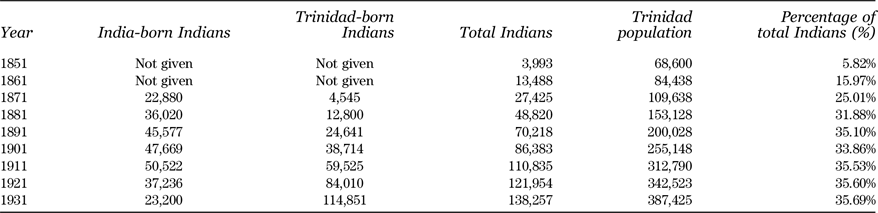
The Indian population grew rapidly after 1845, which confirms the trend in in-migration illustrated in Figure 1. Table 2 gives the number of Indians in the decennial census from 1851 to 1931. The Indian population jumped from just a few percentage points in 1851 to roughly a third of Trinidad’s population by 1891, after which it remained roughly the same proportionally.
Numbers of Indians per the Census of Trinidad

Source: 1851 and 1931: Census of the Colony of Trinidad and Tobago, 1931 (Port of Spain, Trinidad and Tobago, 1933), 7, 31; 1861–1891: Census of the Colony of Trinidad, 1891 (Port of Spain, Trinidad and Tobago, 1892), 7, 21; 1901: Census of the Colony of Trinidad, 1901 (Port of Spain, Trinidad and Tobago, 1903), Appendix D; 1911: Census of the Colony of Trinidad, 1911 (Port of Spain, Trinidad and Tobago, 1913), 12, 26, and 28; 1921: Census of the Colony of Trinidad, 1921 (Port of Spain, Trinidad and Tobago, 1923), 12, 123, 145. All numbers are for Trinidad only. In 1911, 1921, and 1931, the census distinguished between Indians from India, from Trinidad, and from other locations in the West Indies. Therefore, the “Total Indians” column does not equal the sum of “India-born Indians” and “Trinidad-born Indians” in those years.
The Census of 1891 provides the clearest picture of Indians in shopkeeping of all census years. It was the first to examine occupation and place of origin carefully, and it also differentiated between India-born and Trinidad-born Indians. Census officials noted the difficulty of distinguishing between primary and secondary occupations. Fortunately for the classification of commercial occupations, the census takers privileged occupations such as shopkeeper as the primary one for individuals who farmed part-time or rented out properties. Table 3 gives both the raw numbers and percentages by sex for shopkeepers. In 1891, Indians formed over 42% of shopkeepers overall and over 50% of all female shopkeepers.
Shopkeepers in the Census

Source: 1891: Census of the Colony of Trinidad, 1891 (Port of Spain, Trinidad and Tobago, 1892), Appendix F and Part V; 1901: Census of the Colony of Trinidad, 1901 (Port of Spain, Trinidad and Tobago, 1903), Appendix E; 1911: Census of the Colony of Trinidad, 1911 (Port of Spain, Trinidad and Tobago, 1913), 45, 75; 1921: Census of the Colony of Trinidad, 1921 (Port of Spain, Trinidad and Tobago, 1923), 61, 181; 1931: Census of the Colony of Trinidad and Tobago, 1931 (Port of Spain, Trinidad and Tobago, 1933), 36. All numbers are for Trinidad only. In 1891, Indians are split into India- and Trinidad-born groups. The numbers here combine them. The disaggregated numbers are 115 (female) and 398 (male) from India plus 50 (female) and 42 (male) born in Trinidad. No numbers are given by ethnicity or nativity in 1901. In 1911, the Indian numbers appear to refer only to India-born Indians. In 1921 and 1931, the census reported only overall numbers for Indians not disaggregated by nativity and used a combined category “Shopkeepers and Hucksters.” In 1931, the census only reported numbers for Indians and not for the total population.
Inconsistencies in reporting in later census years muddy the picture of Indians in shopkeeping. No disaggregation by nativity or ethnicity appears in the 1901 census volume. In 1911, only natives of India—already a minority in the Indian population, as Table 2 shows—were disaggregated. In 1921, a new category of “Shopkeepers and Hucksters” was created, and this category saw a dramatic increase in the number of women. In 1931, in recognition of the importance of shopkeeping to the Indian population, the census report calculated the number of Indian shopkeepers but explicitly omitted the number for Trinidad as a whole.Footnote 47
Despite the inconsistent reporting, several facts emerge. Indians were not a “middleman minority” but instead comprised a large, important segment of Trinidad. In 1891, the percentage of Indians in shopkeeping (42%) slightly exceeded that of Indians in the population (35%). Similarly, in 1911, the percentage of shopkeepers who were natives of India (almost 25%) exceeded the percentage of natives of India in the population overall (16%). Even with changes in the category definition in 1921, Indians were still strongly represented in shopkeeping: Almost 20% of all shopkeepers were Indian, which rose to over a quarter for men.
Interestingly, large numbers of Indian women participated in shopkeeping. In 1891, among Trinidad-born Indian shopkeepers, women outnumbered men.Footnote 48 Because Indian women faced discrimination in the labor market, both during and after indentureship, and earned lower wages on average than men, shopkeeping may have offered a way to earn income away from agriculture and allowed some autonomy, even if shops were subsumed into a larger family unit’s income.Footnote 49 Married women controlled shops in the absence of husbands, as in the case of the wife of a prominent shopkeeper in Tunapuna.Footnote 50 The substantial representation of women in 1931—over 40% of all of Trinidad’s Indian shopkeepers and the outright majority in San Fernando—also contrasts with the experiences of most traditional overseas Indian trading communities, which at that time were almost exclusively male-dominated.Footnote 51
However, Indians were barely represented in the large, wealthy merchant houses of Trinidad. Of the 430 people identified as merchants in 1891, only thirty (7%) were Indian, including one Anglo-Indian. Three decades later, the percentage was unchanged: Only 70 of the more than 1,000 merchants listed in 1921 were Indian.Footnote 52 The transition from indentured laborer to commercial worker led Indians to a lower rung of the commercial ladder, often a village or agricultural-estate shopkeeper.
Remittances sent by Indians to friends and relatives back in India expand on the census results. These remittances were one of the only financial ties between India and Trinidad. Government officials themselves utilized the same remittance mechanism as Indian immigrants, and the government kept meticulous records on remittance transactions. Because of this, remittances are a crucial source of information in analyzing the identities of Trinidad’s Indian shopkeepers.
The colonial government created a mechanism in the mid-nineteenth century to remit money to India in response to the demands of laborers and the argument by planters and officials that the desire to remit money to India fueled return migration, which deprived planters of labor and raised costs.Footnote 53 The Colonial Bank in Trinidad formed ties with the Indian Oriental Bank Corporation (OBC) to remit laborers’ money to recipients in India starting in the 1850s. However, this process was complicated, and the OBC was not allowed to set up branches at all in the Western Hemisphere.Footnote 54 Into the early 1870s, the Colonial Bank noted some of the difficulties in remitting money to India, including higher costs associated with drawing a bill of exchange with an Indian bank.Footnote 55 The colony finally accepted a money order scheme late in the 1870s that resembled the postal money orders available in Britain, Canada, and other locations.
The census of individual remittances from January 1885 to March 1891 traces the flow of money from India to Trinidad and answers the intertwined questions of who sent the money and to whom.Footnote 56 Figure 3 shows the map of remittance destination districts in India by number of transactions. Remittance flows mimicked the pattern of out-migration shown in Figure 2. Most remittances went back to inland areas of North India, with some clustered around Madras (modern-day Chennai) in the south. The map of rupees remitted, rather than the number of remittances, shows a similar pattern. Of the thousands of remitters, only one person from a distinct overseas merchant group, Kani Chetty, appears. Money flows back to India do not show evidence of traditional merchants, who would have remitted back to coastal and other trading areas, but instead provide further evidence that the Indian population emanated from indentured laborers.
Destinations of remittances, 1885–1891. (Source: Author’s calculation using data from the Register of Indian Immigrants’ Remittances to Relations and Friends in India [1885–1891], National Archives of Trinidad and Tobago. The data cover the time period from January 1, 1885, to March 31, 1891. Each observation is an individual remittance to India.)

Because of the overlap in timing, the detailed demographics in the remittance data partly reconstruct who the Indian shopkeepers in the 1891 census were. A total of 166 unique shopkeepers appear in the remittance data, roughly a quarter of all Indian shopkeepers at that time. Sex was not recorded in the remittance folios, but of the 104 shopkeepers matched to emigration passes, which did list sex, 98 were men. Table 4 gives a cross-tabulation of caste and origin.
Backgrounds of Shopkeeper-Remitters

Source: Register of Indian Immigrants’ Remittances to Relations and Friends in India (1885–1891), National Archives of Trinidad and Tobago; subcaste information for matching comes from the Census of India, 1891, vol. 18, The Northwestern Provinces and Oudh, Part III: Imperial Caste Tables (Allahabad, India, 1891), i–ccxxi. A total of 163 individuals listed shopkeeper as occupation, 1 listed merchant, 1 listed proprietor at a commercial location in San Fernando, and 1 listed merchant in one record and shopkeeper in another. Other proprietors are excluded due to the ambiguity of the term, and one additional shopkeeper was excluded for remitting on behalf of a deceased man’s estate. For origin, “Other” includes three from British Guiana, one from Grenada, one from St. Vincent, and one born in Trinidad. The caste determination rule has four pieces. First, if the recipient is a family member and has an obvious caste, then the shopkeeper’s caste is set (130 cases). Second, if the recipient is a family member and does not have an obvious caste, information from the emigration pass plus the remitter’s name in the remittance folio are used if the recipient and remitter information do not contradict one another (seven cases). Third, if the recipient is not a family member, information from the emigration pass plus the remitter’s name in the remittance folio are used (four cases). Finally, the remainder are left as unmatched. The largest caste in “Other” is Teli (five cases). Of the unmatched cases, many recipients have ambiguous or non-caste names, e.g., “Ram.” However, one remitter is a Pillay, which is often used by high castes in South India; two are Roys, a name often associated with upper castes; one payee–recipient pair are likely Bhumihars, which is an upper-caste group in Bihar; one remitter has the name Singh but remitted to his brother, a Kahar; and one remitter is a Maharaj without an emigration pass who remitted to an Ahir listed as a friend. No unmatched shopkeepers or their recipients have names similar to “Chamar.”
Several key facts emerge from the remittance data. First, most of the Indian shopkeepers were former indentured laborers in Trinidad, since 134 (81%) of them have indentureship registration numbers issued by the Immigration Department. Of the remainder, twelve arrived as paying passengers from India, five came from other colonies, one was born in Trinidad, and fourteen have no indication as to origin. D. W. D. Comins, a British civil servant examining Indian emigration to Trinidad in 1891, also noted the large representation of former indentured laborers in shopkeeping.Footnote 57 The information on origin is consistent with high barriers to entry for non-indentured laborers.
Second, approximately a third of shopkeepers were Brahmans or other high castes. When focusing on just Trinidad’s former indentured laborers, the representation of Brahmans and other high castes among shopkeepers was over double that of their representation in entrants, as seen in Table 1. They form an even larger proportion of shopkeepers who had not been indentured in Trinidad. The disproportionately high representation of upper castes is also striking if Trinidad’s Brahmans and upper castes returned to India at higher rates as they did in British Guiana and Fiji.Footnote 58 Only a handful of Banias became shopkeepers. While their incoming numbers were low in the indentured population from India, only a few appear in the remittance data, and all were former indentured laborers in Trinidad. Representation from Ahirs, a middle caste, and lower-caste Chamars is conversely disproportionately low. Chamar representation is almost four times lower among shopkeepers than the entrant population. The large presence of upper castes in shopkeeping may have signaled their stronger ties in the Indian community and greater respect or trust afforded them. Although the degree to which caste persisted in Trinidad is debated, the remittance data are consistent with previous work showing the continued salience of upper-caste status and thus an advantage that such individuals had in shopkeeping.Footnote 59
Third, although upper castes were strongly represented, the geographic distribution of shops highlights some of the barriers to further mobility within commerce. Seventy-five shopkeepers in this sample gave their address simply as a village, and twenty-one listed an agricultural estate. Only thirty-two shopkeepers gave addresses in a town, with a cluster of shops on Coffee and High Streets in San Fernando. There were very few Indian shopkeepers in the capital, Port of Spain, or in the other larger towns.
Other contemporaneous records reinforce the main findings from the remittance data. In its business directory, the island’s 1894 almanac lists only one business clearly owned by an Indian, A. H. Gopaul’s dry goods store in San Fernando.Footnote 60 In 1896, a longer list of businesses appears with several more Indian shops—still all in San Fernando—and ownership of the Gopaul store passed on to C. H. Gopaul.Footnote 61 The 1891 Comins report includes two lists of “Indians of considerable means” supplied by Canadian Presbyterian missionaries who lived in south Trinidad.Footnote 62 Clarence (C. H.) Gopaul appears in one list. All of the people on the lists appear to have been men, and some of their occupations reflected their importance for missionaries (e.g., Presbyterian ministers and catechists).Footnote 63 However, the report also echoes the remittance data: There was a small community of shopkeepers in San Fernando town but many more shopkeepers in smaller villages and on estates. Three shopkeepers on the lists—Jankey Maharaj (who also appears in the remittance list), Mahip, and Juppy—appeared in San Fernando’s civic life with non-Indian leaders as promoters of a race course to increase commerce to San Fernando in 1889, though Jankey Maharaj declared bankruptcy a decade later.Footnote 64 Interestingly, the lists indicated that shopkeepers on estates often engaged in both agriculture and shopkeeping; commerce may be seen as part of an ongoing labor-market transition out of agriculture while still remaining in it.
Comins’ diary, which was published alongside the report, noted shops owned by Indians on estates and in rural villages. These were often general stores that sold “the usual food, grains, and other commodities” as well as rum shops; the colony granted 195 licenses to Indians for spirit, wine, and beer in 1890.Footnote 65 A few of the proprietors highlighted in the diary, all former indentured laborers, were quite successful: Dehul maintained a shop in south Trinidad for several years before returning to India with $4,000 in colonial money (approximately £830), and two others, Bookhun and Terrabula, kept several valuable shops in north-central Trinidad.Footnote 66 Another shopkeeper not mentioned by Comins, Mahabir Marajh, owned several lucrative shops in rural, overwhelmingly Indian villages in south Trinidad at the same time.Footnote 67
The rise of Indian shopkeepers is intertwined with indentureship as an institution and occurred in areas with large numbers of Indians: agricultural estates, villages, and even to a degree in San Fernando town. On the one hand, indentureship created a supply of shopkeepers. Despite pressure to keep wages low and abuses by employers, some indentured laborers were able to save, sometimes amassing large amounts of money and buying land soon after completing their contracts.Footnote 68 Some positions, particularly estate sirdars (headmen), offered ways to earn more money during indentureship, from operating rotating credit associations to lending money to control over paying others’ wages and assigning tasks.Footnote 69 This position was coveted and was a logical stepping stone to opening a shop, and at least three shopkeepers in the remittance data were ex-sirdars.Footnote 70 Wages for former indentured laborers remained high through the mid-1880s, which allowed some to accumulate capital even after indentureship.Footnote 71 The administrative barriers to opening shops were low: Comins noted that only shops selling liquor required a license, and moneylending was largely unregulated until the early twentieth century.Footnote 72 There were few frictions in language, culture, and preferences between sellers and buyers, which benefitted Indian shopkeepers.Footnote 73 Upper-caste Indians specifically could leverage their caste status to their advantage in building trust and establishing themselves as shopkeepers. For instance, V. S. Naipaul’s Brahman grandfather Capildeo came to Trinidad as an indentured laborer and married the daughter of a shopkeeping sirdar; the sirdar chose Capildeo because his background would make him successful in shopkeeping.Footnote 74
On the other hand, indentureship generated its own demand in areas poorly served by existing shops. Possibly due to its outgrowth from slavery, indentureship featured movement restrictions on indentured Indians and criminal penalties for desertion as part of the colony’s attempt to keep the agricultural labor force readily available.Footnote 75 Additionally, Indians who left estates after indentureship often continued to work in agriculture and settled near estates in villages or on newly opened Crown Lands, which were initially given (“commuted,” in official parlance) to Indians in lieu of a return passage but were replaced by outright sales by the end of the nineteenth century.Footnote 76 Almost 44% of Indians lived on estates in 1891, not including nearby settlements or villages.Footnote 77 Demand from these largely captive consumers was high and seemingly inelastic.Footnote 78 Shopkeepers branched out from retail into other services such as extending store credit, lending money, and pawnbroking.Footnote 79 Finally, until 1917, there was a constant influx of new indentured laborers moving onto estates and demanding goods and services; already-settled Indians benefitted from a first-mover advantage with greater time in Trinidad.Footnote 80 However, apart from some advancement in San Fernando, Indians did not break into the more valuable commercial enterprises in the island.
The overarching racial-economic structure of late-nineteenth-century Trinidad as laid out by Brereton frames the rise of Indians into shopkeeping and illustrates the importance of indentureship in it.Footnote 81 The white elite, both English- and French-speaking, remained the main commercial group in the colony and dominated the large trading houses and Port of Spain businesses. Chinese and Portuguese people often owned shops and engaged in commerce in more liminal areas, with the former sometimes found in rural villages and agricultural estates. The growing Black and mixed-race middle class formed an important part of the professional or skilled labor in the civil service, education, and smaller businesses (both agricultural and artisanal). Against this backdrop, the influx of Indians into rural areas—and the concomitant rise in demand—allowed some Indians to move into new markets to serve this new population shaped by indentureship but not tied to the traditional, racialized hierarchies created during and after slavery.
Overall, the evidence points to Indians starting to climb the commercial ladder. By 1891, Indians formed a large part of Trinidad’s shopkeeping sector. As the remittance records show, some Indian former indentured laborers were able to make the transition from agricultural laborer to shopkeeper. However, they were often geographically bound to the rural areas where indentured and later free Indians were settling in large numbers and mostly operated on a small scale, and their rise did not pose a challenge to the major trading elites in cities.
After Indentureship
The start of World War I decreased ties between Trinidad and India. Changes in economic conditions and the difficulty for all colonies, not just Trinidad, in arranging shipping due to the war led to fewer new indentureships and fewer voyages. In 1917, following years of pressure by Indian nationalists, the government of India abolished new indentureship contracts and suspended recruitment in India. This unforeseen cessation drastically reduced the number of Indians who entered the colony from 1918 onwards. The West Indies remained largely isolated from India. Some migrants from India, such as the Sindhi Kirpalanis mentioned in the introduction and other salespeople, did come to Trinidad as part of a newer wave of transnational Indian merchants.Footnote 82 However, only seventy-eight Indians arrived in Trinidad in 1939 from any external location, including other West Indian colonies.Footnote 83
Changes in transportation technology did not lead to stronger ties between Trinidad (or the West Indies generally) and India but rather to better local connections. Intra-West Indian travel continued, including travel by Indians and their descendants already present in the West Indies. Travel connections to the US deepened during the interwar period, with commercial airline service between Trinidad and the US commencing in the winter of 1929/1930.Footnote 84
The end of indentureship eliminated frequent, easily available transportation from India to Trinidad. There were few transportation options from India to the West Indies as a whole, and mail service between India and Trinidad appears to have taken upwards of five weeks in 1935.Footnote 85 British officials in Bombay estimated the cost of sea travel from Bombay to British Guiana at Rs. 800 (approximately £60) per person in 1939.Footnote 86 This cost was over 70% of the airfare between Karachi and London at the same time.Footnote 87 There was no regular steamship connection between Trinidad (or British Guiana) to Bombay in 1939, only occasional special charters.Footnote 88
Travel in the opposite direction showed the same pattern of difficulty in finding transport and high costs. Occasional voyages from Trinidad, including ones jointly conducted with British Guiana, took return migrants back to India in the interwar period as part of the colonies’ continued obligations under the original indentureship agreements.Footnote 89 Some paying passengers were allowed on board these ships, though passage was expensive and options few. In the case of repatriating two indigent Indians, the Governor of Trinidad reported that per capita passage on the specially chartered return ship Hughli in 1926 cost £25 7s. 3d. For context, the annual salary of low-level government office employees in Trinidad was £35 in 1926.Footnote 90 Furthermore, the pair had to wait almost six months for a voyage.Footnote 91 A salesman named Shaik Soleman Mondal, who wound up a destitute peddler in eastern Cuba after several years in Trinidad, required British and Indian governmental assistance in traversing back to his home in Calcutta in 1937. His journey also illustrates the difficulty a decade after the Governor’s report, with port calls at Havana, Marseille, Colombo, and Madras and expensive fares paid in US dollars, French francs, and Indian rupees.Footnote 92
The larger financial history of Trinidad also points to the colony’s lack of connections with India. Canadian banks, not Indian ones, moved into the Trinidadian market in the early twentieth century. Prior to the entry of Canadian banks, only the local Colonial Bank operated in Trinidad.Footnote 93 The Union Bank of Halifax, later merged into the Royal Bank of Canada (RBC), established a Trinidadian office in 1902. The Canadian Bank of Commerce, a forerunner of the present-day Canadian Imperial Bank of Commerce (CIBC), opened a branch in Port of Spain in 1921 and another in San Fernando in 1922. As noted above, ties with an Indian bank only existed for remittances in the mid-nineteenth century, and the mechanism was replaced within a few decades owing to costs and confusion. Direct postal money orders to India, finally allowed in 1902, remained low.Footnote 94 In the fiscal year 1931/1932, when Trinidad’s Indian population exceeded 138,000, the Indian post office paid out just 528 money orders from Trinidad with an average value of £3. In contrast, that same year it paid out 1,594 money orders with an average value of £11 from Nyasaland, a mercantile destination with only 1,591 Indians.Footnote 95
Indians in commerce made some progress locally in the years after indentureship, although many village shops continued to operate on a small scale selling basic goods and liquor.Footnote 96 The Trinidad Yearbooks of the 1920s indicate a greater presence of Indian businesses. Although their lists were not complete (and did not pretend to be so), Indian shopkeepers appear more frequently by 1924 in Port of Spain and Princes Town, in addition to San Fernando.Footnote 97 The transition from an Indian population consisting largely of India-born, former indentured laborers to one consisting of their Trinidad-born descendants meant that new shopkeepers emerged from the latter group. Jang Bahadoorsingh, son of indentured laborers and father of housing magnate Krishna Bahadoorsingh, began his commercial life as a peddler and shopkeeper.Footnote 98 Interestingly, he formed connections in the 1930s with Trinidad’s last prominent immigrant group, the Syrian-Lebanese immigrants, when they entered the colony. Others, such as Latchan Jaggernauth and Mohammed Yakub Khan, were born in Trinidad and started up the shop ladder through clerkships at San Fernando stores.Footnote 99 Jaggernauth even started in the Rahamut shop, a large and popular store featured in the 1924 Trinidad Yearbook.
A volume celebrating the centennial of Indians in Trinidad gives a glimpse, albeit still selected, into the mid-1940s.Footnote 100 It featured thirty-eight merchants and shopkeepers in its “who’s who” of prominent Indians: Thirty-two were born in Trinidad, two in India (including one of the Sindhi Kirpalanis), and two in British Guiana, with two more not specified. San Fernando was still the most popular location for businesses (twelve), though Port-of-Spain was second.Footnote 101 Despite this urban growth, almost half of all merchants and shopkeepers still reported living on estates or in small towns serving rural populations.
Overall, the abrupt end of indentureship did not usher in a new era of large-scale private migration from India or greater economic ties between India and Trinidad. On the contrary, the lack of support that indentureship voyages had provided increased the barriers to travel even as other forms of travel and new technology increased connections around the world. Similar to Barbados, only a handful of enterprising Indians arrived in Trinidad during this period of time. Travel and mail times to India did not fall far enough to bring the West Indies into the orbit of transnational Indian businesses and businesspeople.
Conclusion
Far from India during the first wave of globalization, a new group of Indian shopkeepers arose out of a laboring population. Indian indentureship formed the connection between Trinidad and India and brought the laborers, some of whom became shopkeepers and all of whom generated demand for goods in their new colony. Once indentureship ended, the connection between Trinidad and India became more tenuous. The long distances and high travel costs between India and the West Indies created barriers that were too high for established Indian merchant communities to transplant themselves prior to World War I, with only minimal growth in those communities in the interwar period. This created a vacuum of Indian merchants that meant that former laborers could themselves rise to commerce, specifically, shopkeeping.
Trinidad’s Indians were not initially, and did not become over time, a distinct ethnic-commercial group. Unlike traditional Indian merchant groups, there were possibilities—in theory—for broader participation in commerce. Women were more represented in Trinidadian Indian commerce than in other locations.Footnote 102 However, the skew toward upper castes in shopkeeping captured in the remittance data points to the persistence of other forms of social capital that enabled movement out of agricultural labor. Shopkeepers were known as “big men” locally, and upper-caste status may have helped developed trust and respect.Footnote 103 Even in the early 1960s, a third of San Fernando’s Indian-owned shops were run by upper castes.Footnote 104 Many shopkeepers remained in rural areas close to or on agricultural estates. Nevertheless, local prosperity in rural areas did not translate into a major rise of Indians into the upper echelons of commerce, which were dominated by the English and French elites.
While indentureship created the conditions in Trinidad for some Indians to rise into commerce, Trinidad’s experience differed from other areas where indentured immigrants journeyed. Traditional Indian merchant communities that were long active in the Indian Ocean, such as Gujaratis, formed major parts of the commercial communities in Mauritius and Natal (South Africa), locations closer to India that recruited overseas indentured laborers.Footnote 105 Gujarati merchants expanded into Fiji when migration costs fell enough in the early twentieth century.Footnote 106 Internal trust and social ties reduced moral hazard problems in long-distance trade, but the high costs of migrating and the lack of pre-existing networks reduced the desirability of migrating further afield to the West Indies and inhibited all but a few Indian merchants.Footnote 107
Indian shopkeepers partly resembled other groups in the West Indies, especially the Chinese and Portuguese ethnic groups. Much of the initial migration of both groups was, as it was for Indians, indentured labor. Unlike for Indians, merchant migration was more common for both the Chinese and Portuguese immigrants, and both groups remained small numerically although they were heavily represented in commerce. For instance, in 1891, one in three Chinese men were shopkeepers. In the aggregate, natives of China formed almost a quarter of all Trinidadian shopkeepers despite being only 0.5% of the total population.Footnote 108 In contrast, the large number of Indians meant that Indian shopkeepers roughly reflected their representation in the overall population. The influx of Syrian-Lebanese merchants into the Americas starting at the end of the nineteenth century was initially more muted in Trinidad than in other locations, with only 108 people listing Arabia as their birthplace in 1921.Footnote 109 Travel costs for this later group were relatively low in nearby areas, which spurred chain migration there, and Trinidad’s racial dynamics may have dissuaded large-scale migration.Footnote 110 Large European merchant firms perceived Syrian-Lebanese entrants, not Indians, as their main rivals in the 1920s and 1930s, and lobbied for legislation against small businesses that was widely perceived as a response to Syrian-Lebanese shops.Footnote 111
In the study of the Global South, Trinidad’s Indian organic shopkeeper community stands as an example of the crossover from labor to commerce rather than an offshoot of an existing trading community. It also provides a contrast to research on larger firms, as opposed to individuals, and to a focus in the Indian diaspora on transnational merchant groups. The use of administrative data created around indentureship allows researchers to delve into an understudied “alternative” business history that may not be studied otherwise due to the paucity of sources, the small scale of many shops, and a sometimes short lifespan of shops, further exacerbated by optional return passages built into the legal framework of indentureship.Footnote 112 Further work on the long-run trajectory of Indians in West Indian commerce and industry later in the twentieth century, particularly after independence, can address long-run social mobility and the development of deeper, larger-scale businesses.
Professor Persaud’s research focuses on the intersection of development economics and economic history. He was awarded the Economic History Society’s Best New Researcher Prize (2017) and the Economic History Association’s Arthur H. Cole Prize (2019) for best paper in the Journal of Economic History.




 Open access

