


Introduction
Gram-negative bacilli bloodstream infections (GNB-BSI) pose a significant threat in healthcare settings. Reference Gaynes and Edwards1 GNB-BSI accounts for 40% to 60% of community-acquired and 30% to 40% of healthcare-associated BSI, with mortality ranging from 12% to 25%, and is particularly high among elderly populations and those with antimicrobial resistance, sepsis, and comorbidities. Reference Diekema, Beekmann, Chapin, Morel, Munson and Doern2–Reference Verway, Brown and Marchand-Austin5 GNB-BSI is a clinical and public health concern given its burden and unfavorable prognosis.
Much attention has been given to strategies for managing GNB-BSI, particularly antimicrobial use. Recently, early transition to oral antimicrobial therapy (OSAT) for uncomplicated GNB-BSI originating from urinary tract infections (UTI) has emerged as a promising approach, offering potential benefits such as reducing healthcare costs, earlier hospital discharge, and improving patient tolerability without compromising outcomes. Reference Tamma, Conley and Cosgrove6–Reference Mouwen, Dijkstra, Jong, Buijtels, Pasker-de Jong and Nagtegaal10
However, the effectiveness of OSAT must be evaluated through clinical outcomes such as treatment success, treatment failure, and length of hospital stay (LOHS) to ensure it is comparable to intravenous antimicrobial therapy (IVAT). Existing systematic reviews also have notable gaps: one did not include a recent randomized trial and high-quality observational studies, Reference Punjabi, Tien, Meng, Deresinski and Holubar11 while another examined BSI broadly, rather than focusing on GNB-BSI. Reference Li, Zhou and Fan12
To address these limitations, we conducted a systematic review and meta-analysis comparing OSAT with IVAT for GNB-BSI. The primary meta-analysis included studies that adjusted for confounding variables affecting these outcomes, while a sensitivity (expanded) analysis incorporated all relevant studies, regardless of whether the aforementioned adjustments had been made. This review aimed to determine whether OSAT is an appropriate and effective alternative to IVAT for GNB-BSI.
Methods
The present systematic review and meta-analysis was conducted in accordance with the Cochrane Handbook for Systematic Reviews of Interventions. Documentation of reports followed the Preferred Reporting Items for Systematic Reviews and Meta-analyses (PRISMA) statement. Reference Page, McKenzie and Bossuyt13 The protocol of the present systematic review was prospectively registered in PROSPERO (CRD420251005994) and updated to the latest version. 14
Data sources and searches
Studies published on Medline (Ovid) and Embase (Ovid) between January 1980 and March 2025 were reviewed for information relevant to OSAT for GNB-BSI. The Cochrane Central Register of Controlled Trials and ClinicalTrials.gov. were also searched to identify potentially eligible trials. In addition, the reference lists of the relevant systematic reviews, narrative reviews, and articles subsequently included in the present systematic review and meta-analysis were scrutinized. The search terms incorporated multiple, controlled vocabularies (eg, Medical Subject Headings), including “oral stepdown therapy,” “bacteremia,” and “gram-negative bacilli” (Supplementary Table 1). A search of the reference list, Cochrane Central Register of Controlled Trials, and ClinicalTrials.gov was conducted by the primary reviewer (H.H.). Potentially eligible articles were initially uploaded to EndNote 21, and the data were then converted for uploading to the Rayyan Systematic Review software. 15,16
Study selection
Eligible studies for this systematic review were comparative investigations evaluating the clinical efficacy of IVAT versus OSAT for treating adult patients with GNB-BSI, including those caused by Enterobacterales and lactose-nonfermenting organisms. Using the PI(E)CO framework, (P) the population consisted of adults aged ≥15 years; (I or E) the intervention or exposure was OSAT; (C) the comparator was continuous IVAT; and (O) the outcomes were mortality and treatment failure. Only English-language studies were included. Duplicates were removed by the primary reviewer (H.H.) with the assistance of a duplication and systematic resolver tool included in the Rayyan software. In the screening process, three reviewers (H.H., T.M., and A.T.) independently vetted titles and abstracts of all the potentially eligible items. Abstracts not conforming to the eligibility criteria were excluded. After the initial screening, all the selected research articles were retrieved for a full-text review, which three reviewers (H.H., T.M., and A.T.) independently vetted to determine which articles should be included in the systematic review. The reviewers resolved any differences through discussion and simultaneous, full-text reviews in an online meeting.
Data extraction and quality assessment
The primary reviewer (H.H.) extracted all data relevant to the systematic review, and three reviewers (H.H., T.M., A.T.) independently extracted all the outcome data of each study. Outcome data included event counts and sample sizes for dichotomous variables. The three reviewers independently assessed observational studies using the Risk Of Bias In Non-randomized Studies of Exposures (ROBINS-E: 7 domains) and randomized trials using the Risk Of Bias 2 (RoB 2: 5 domains). Reference Higgins, Morgan and Rooney17,Reference Sterne, Savovic and Page18 ROBINS-E ratings were “low,” “some concerns,” “high,” or “very high,” while RoB 2 used “low,” “some concerns,” or “high.” Domain ratings were aggregated to determine overall risk of bias, and disagreements were resolved through discussion. Three studies with a conference abstract were not assessed for risk of bias because of insufficient information about these studies.
The primary reviewer (H.H.) rated the overall certainty of the evidence of the key outcomes in the primary meta-analysis using the Grading of Recommendations Assessment, Development and Evaluation (GRADE) framework. 19 Evidence quality was graded across five domains: study design, risk of bias, inconsistency, indirectness, and imprecision as defined by the guidance in the Cochrane Handbook for Systematic Reviews of Interventions. Reference Schuenemann, Vist and Glasziou20 Since the GRADE framework assessment could not be applied for the meta-analysis compiling different types of studies (ie, both RCTs and observational studies), it was separately applied to meta-analyses by including only RCTs and observational studies for each outcome. GRADEpro GDT was used to create the GRADE evidence profile. 21
Data synthesis and analysis
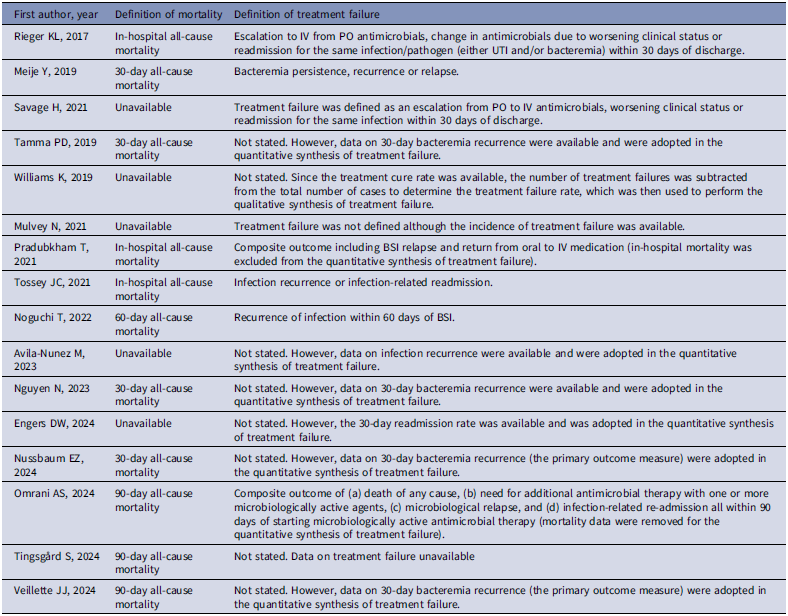
A meta-analysis incorporating dichotomous and continuous outcomes was conducted as sufficient outcome data became available. Mortality data were synthesized as reported despite the varying timeframes (eg, in-hospital, 30-, 60-, or 90-day mortality). Although the definition of treatment failure also varied (eg, recurrence or antimicrobial resumption), it was adapted to the specific needs of this study. Table 1 provides the definition of mortality and treatment failure found in the selected studies.
Definition of outcomes of interest in each study eligible for the systematic review and meta-analysis

IV, intravenous; PO, per os; UTI, urinary tract infection; BSI, bloodstream infection.
Data synthesis was conducted using Cochrane’s Review Manager (RevMan). 22 The risk ratio (RR) with 95% confidence intervals (CIs) were calculated for dichotomous outcomes using the Mantel-Haenszel random-effects model. All models employed the Hartung-Knapp-Sidik-Jonkman approach, which applies to the DerSimonian-Laird estimator to obtain less biased estimated effects and 95% CI. Reference Langan, Higgins and Jackson23 P < .05 was considered to indicate statistical significance. To minimize the bias from confounding, the primary meta-analysis included only a RCT and confounders-adjusted observational studies. Due to the small number of studies (n = 3) in the primary analysis, publication bias was not assessed. Heterogeneity was evaluated using forest plots and the I 2 statistic interpreted as 0%–40% (unimportant), 30%–60% (moderate), 50%–90% (substantial), and 75%–100% (considerable). Reference Deeks J.J., Altman, McKenzie and Veroniki24
Sensitivity (expanded) analyses and subgroup analyses
Sensitivity and subgroup analyses were conducted to assess model robustness for key outcomes. The sensitivity (expended) analysis also incorporated studies whose findings had not been adjusted for confounders. Publication bias was evaluated using Funnel plot with visual inspection. Additional, discrete, subgroup analyses examined 1) studies involving immunocompromised patients, 2) studies only including drug-resistant pathogens (Amp C or extended-spectrum beta-lactamase-producing Enterobacterales), 3) studies with oral transition within 5 days of IVAT, 4) studies assessing 30-day mortality, and 5) studies focusing solely on GNB-BSI originating from UTIs.
Results
The initial database search identified 6,068 studies that were potentially eligible for inclusion in the present systematic review and meta-analysis. After independent title and abstract screening, 83 remained for full-text review. Before the review was conducted, a review article, a protocol study, and a pediatric study (n = 3) were excluded. Of the remaining 80 articles, 11 met the inclusion criteria. Also identified as potentially eligible for the systematic review and meta-analysis were 17 additional studies found in reference lists and trial registries, of which five were included, yielding 16 total studies. Supplementary Table 2 summarizes the reasons for exclusion. Supplementary Figure 1 shows the PRISMA flow diagram, which identified 16 studies. Supplementary Table 3 shows the PRISMA statement.
Characteristics of the included studies
A total of 16 studies (9,819 patients) subsequently met the inclusion criteria for the present systematic review and meta-analysis, and those were published from 2017 to 2024. Of these, one (6%) was a multi-center, open-label RCT, Reference Omrani, Abujarir and Ben Abid7 six (38%) were multi-center, retrospective cohort studies, Reference Tamma, Conley and Cosgrove6,Reference Tingsgard, Bastrup Israelsen, Jorgensen, Ostergaard and Benfield25–Reference Engers, Tamma and Fiawoo29 and the remaining nine (56%) were single-center, retrospective cohort studies. Reference Pradubkham, Suwanpimolkul, Gross and Nakaranurack30–Reference Tossey, El Boghdadly and Reed38 Seven studies (44%) included a mixed population (with immunocompromised patients [ie, hematologic malignancies, solid organ and bone marrow transplant, and human immunodeficiency virus infection] accounting for >10% of the overall study population), Reference Tamma, Conley and Cosgrove6,Reference Tingsgard, Bastrup Israelsen, Jorgensen, Ostergaard and Benfield25,Reference Veillette, May and Alzaidi26,Reference Engers, Tamma and Fiawoo29,Reference Pradubkham, Suwanpimolkul, Gross and Nakaranurack30,Reference Meije, Pigrau and Fernandez-Hidalgo34,Reference Tossey, El Boghdadly and Reed38 four studies (25%) included only non-immunocompromised patients, Reference Omrani, Abujarir and Ben Abid7,Reference Noguchi, Shinohara and Tsuchido27,Reference Rieger, Bosso, MacVane, Temple, Wahlquist and Bohm36,Reference Avila-Nunez, Lima and Sousa37 and two (13%) included only immunocompromised patients. Reference Nussbaum, Koo and Kotton28,Reference Savage, Vu, Mitchner and Zaki31 The primary source of BSI varied to include UTI, intra-abdominal infection, and catheter-related bloodstream infection (CRBSI). Of these, UTI was the most common, and four studies (25%) solely included patients with bacteremic UTI. Reference Veillette, May and Alzaidi26,Reference Noguchi, Shinohara and Tsuchido27,Reference Mulvey, Doan and Nadi33,Reference Rieger, Bosso, MacVane, Temple, Wahlquist and Bohm36 Escherichia coli was the most common causative pathogen of GNB-BSI. Eight (50%) studies revealed that patients with IVAT had more severe GNB-BSI (eg, a higher Pitt bacteremia score or ICU admission) and a higher proportion of underlying illnesses (ie, a higher Charlson comorbidity index) than those with OSAT. Differences in patients’ characteristics between IVAT and OSAT are shown in Supplementary Table 4.
Only six studies (38%) had a precisely defined cut-off ranging from three to ten days for the transition to OSAT. Reference Tamma, Conley and Cosgrove6,Reference Omrani, Abujarir and Ben Abid7,Reference Tingsgard, Bastrup Israelsen, Jorgensen, Ostergaard and Benfield25–Reference Noguchi, Shinohara and Tsuchido27,Reference Engers, Tamma and Fiawoo29 Twelve studies documented the actual duration to the transition from IVAT to OSAT, ranging from 2.5 days (IQR: 0, 6) to 7.0 days (IQR: 5.8, 9.4). Reference Tamma, Conley and Cosgrove6,Reference Omrani, Abujarir and Ben Abid7,Reference Tingsgard, Bastrup Israelsen, Jorgensen, Ostergaard and Benfield25–Reference Engers, Tamma and Fiawoo29,Reference Meije, Pigrau and Fernandez-Hidalgo34–Reference Rieger, Bosso, MacVane, Temple, Wahlquist and Bohm36,Reference Tossey, El Boghdadly and Reed38 Fluoroquinolones were the most common oral stepdown antimicrobial, followed by trimethoprim-sulfamethoxazole (Supplementary Table 4). Eleven studies (69%) reported mortality outcomes: four on 30-day, Reference Tamma, Conley and Cosgrove6,Reference Nussbaum, Koo and Kotton28,Reference Meije, Pigrau and Fernandez-Hidalgo34,Reference Nguyen, Jayachandran, Mui and Olson35 three on 90-day, Reference Omrani, Abujarir and Ben Abid7,Reference Tingsgard, Bastrup Israelsen, Jorgensen, Ostergaard and Benfield25,Reference Veillette, May and Alzaidi26 three on in-hospital, Reference Pradubkham, Suwanpimolkul, Gross and Nakaranurack30,Reference Rieger, Bosso, MacVane, Temple, Wahlquist and Bohm36,Reference Tossey, El Boghdadly and Reed38 and one on 60-day mortality. Reference Noguchi, Shinohara and Tsuchido27 Fifteen studies (94%) provided treatment failure rates, which varied across studies. All eleven studies reporting hospitalization duration showed shorter LOHS in the OSAT group. Reference Tamma, Conley and Cosgrove6,Reference Omrani, Abujarir and Ben Abid7,Reference Veillette, May and Alzaidi26–Reference Pradubkham, Suwanpimolkul, Gross and Nakaranurack30,Reference Nguyen, Jayachandran, Mui and Olson35–Reference Tossey, El Boghdadly and Reed38 Supplementary Table 5 summarizes crude mortality, treatment failure and LOHS. Funnel plot inspection revealed no significant publication bias (Supplementary Figure 2 [2A, 2B]).
Among 16 studies, three (19%) were included in the primary analysis: (1) a multicenter, open-label RCT in which E. coli comprised 65% of GNB-BSI and UTIs were the source in 60% of cases; (2) a multicenter retrospective cohort study in which E. coli comprised 43% of GNB-BSI and 40% originated from UTIs, using propensity score matching to adjust baseline characteristics; and (3) a single-center retrospective cohort study in which E. coli comprised 60% of GNB-BSI and 60% originated from UTIs, also using propensity score matching.
Risk of bias assessment
Of the sixteen studies, three studies Reference Tamma, Conley and Cosgrove6,Reference Omrani, Abujarir and Ben Abid7,Reference Tingsgard, Bastrup Israelsen, Jorgensen, Ostergaard and Benfield25 had a low risk of bias, four studies Reference Noguchi, Shinohara and Tsuchido27,Reference Pradubkham, Suwanpimolkul, Gross and Nakaranurack30,Reference Meije, Pigrau and Fernandez-Hidalgo34,Reference Tossey, El Boghdadly and Reed38 had “some concerns” for a risk of bias, and the remaining six studies Reference Veillette, May and Alzaidi26,Reference Nussbaum, Koo and Kotton28,Reference Engers, Tamma and Fiawoo29,Reference Nguyen, Jayachandran, Mui and Olson35–Reference Avila-Nunez, Lima and Sousa37 had a “critical” risk of bias. The last two groups did not control confounders and were biased in their choice of the findings they reported. Moreover, a considerable proportion of single-center, retrospective studies contained some risk of bias. Supplementary Figure 3 shows the domain level of the risk of bias.
Main analysis
Mortality
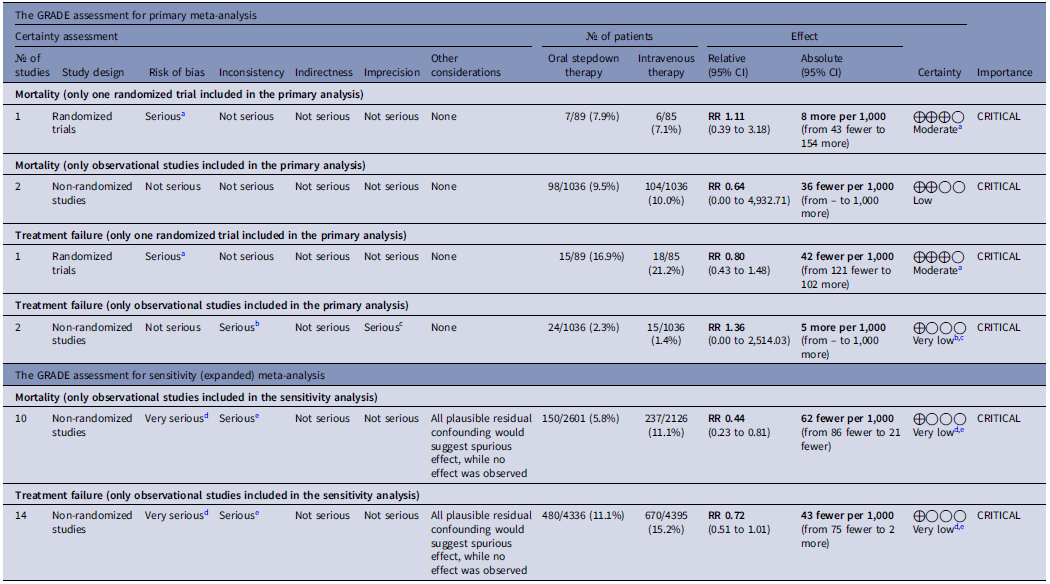
The primary meta-analysis for all-cause mortality included only cohorts that had been adjusted for confounders (n = 3). Reference Tamma, Conley and Cosgrove6,Reference Omrani, Abujarir and Ben Abid7,Reference Pradubkham, Suwanpimolkul, Gross and Nakaranurack30 The pooled estimate for OSAT versus IVAT had a RR of .95 ([95% CI: .42, 2.14]; I 2 = 8%; moderate certainty of evidence from RCT and low certainty of evidence from observational studies), indicating that OSAT was not associated with increased mortality. In the sensitivity analysis, which included studies irrespective of adjustment for confounders, (n = 11), the pooled estimate of mortality favored OSAT (RR: 0.49 [95% CI: 0.27, 0.88]; I 2 = 68%; moderate certainty of evidence from RCT and very low certainty of evidence from observational studies). Reference Tamma, Conley and Cosgrove6,Reference Omrani, Abujarir and Ben Abid7,Reference Tingsgard, Bastrup Israelsen, Jorgensen, Ostergaard and Benfield25–Reference Nussbaum, Koo and Kotton28,Reference Pradubkham, Suwanpimolkul, Gross and Nakaranurack30,Reference Meije, Pigrau and Fernandez-Hidalgo34–Reference Rieger, Bosso, MacVane, Temple, Wahlquist and Bohm36,Reference Tossey, El Boghdadly and Reed38 Figure 1 shows the forest plots for both analyses and Table 2 shows the GRADE assessment for the meta-analysis of mortality.
Forest plots of the random-effect meta-analysis for the mortality rate in patients with a bloodstream infection due to gram-negative bacilli which was treated with either oral step-down antimicrobial therapy or intravenous antimicrobial therapy.

Grading of Recommendations Assessment, Development and Evaluation (GRADE) of oral stepdown therapy versus intravenous antimicrobial therapy for bloodstream infection due to gram-negative bacilli

CI, confidence interval; MD, mean difference, RR, risk ratio.
a The risk of bias was downgraded because an open-label trial was included.
b Precision was downgraded because few events occurred in either group.
c, e Inconsistency was downgraded because the results of the studies varied.
d Risk of bias was downgraded due to a lack of adjustment for potential confounders.
Treatment failure
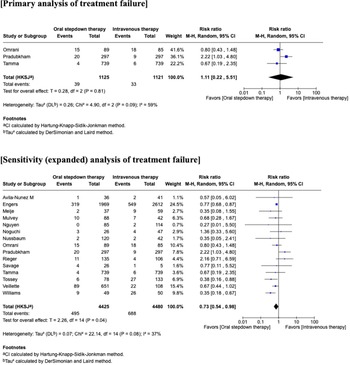
Treatment failure was evaluated in fifteen studies (94%). Reference Tamma, Conley and Cosgrove6,Reference Omrani, Abujarir and Ben Abid7,Reference Veillette, May and Alzaidi26–Reference Tossey, El Boghdadly and Reed38 The pooled RR for OSAT versus IVAT in the primary analysis (n = 3) was 1.11 (95% CI: 0.22–5.51; I 2 = 59%; moderate certainty evidence from RCT and very low certainty evidence from observational studies). Reference Tamma, Conley and Cosgrove6,Reference Omrani, Abujarir and Ben Abid7,Reference Pradubkham, Suwanpimolkul, Gross and Nakaranurack30 In the sensitivity analysis, which included studies irrespective of adjustment for confounders (n = 15), the pooled RR favored OSAT (RR: 0.73 [95% CI: 0.54–0.98]; I 2 = 37%; moderate certainty evidence from RCT and very low certainty evidence from observational studies). Reference Tamma, Conley and Cosgrove6,Reference Omrani, Abujarir and Ben Abid7,Reference Veillette, May and Alzaidi26–Reference Tossey, El Boghdadly and Reed38 Figure 2 shows forest plots for the primary and sensitivity analyses. Table 2 shows the GRADE assessment for the meta-analysis of the treatment failure rate.
Forest plots of the random effects meta-analysis for the treatment failure rate in patients with bloodstream infection due to gram-negative bacilli which was treated with either oral step-down antimicrobial therapy or intravenous antimicrobial therapy.

Subgroup analysis
We performed five subgroup analyses. First, studies in which immunocompromised patients comprised more than 10% of the population showed a pooled mortality RR for the OSAT was 0.60 (95% CI: 0.34–1.11; I 2 = 59%). Reference Tamma, Conley and Cosgrove6,Reference Tingsgard, Bastrup Israelsen, Jorgensen, Ostergaard and Benfield25,Reference Veillette, May and Alzaidi26,Reference Nussbaum, Koo and Kotton28–Reference Savage, Vu, Mitchner and Zaki31,Reference Meije, Pigrau and Fernandez-Hidalgo34,Reference Tossey, El Boghdadly and Reed38 Second, studies limited to drug-resistant pathogens revealed a pooled mortality RR of 0.72 (95% CI, 0.00–564.30; I 2 = 0%). Reference Noguchi, Shinohara and Tsuchido27,Reference Meije, Pigrau and Fernandez-Hidalgo34 Third, subgroup analysis focusing on studies with transition to OSAT within 5 days (median or mean) demonstrated a pooled mortality RR of 0.60 (95% CI, 0.25–1.43; I 2 = 75%). Reference Tamma, Conley and Cosgrove6,Reference Omrani, Abujarir and Ben Abid7,Reference Tingsgard, Bastrup Israelsen, Jorgensen, Ostergaard and Benfield25,Reference Nussbaum, Koo and Kotton28,Reference Meije, Pigrau and Fernandez-Hidalgo34,Reference Rieger, Bosso, MacVane, Temple, Wahlquist and Bohm36 The fourth subgroup analysis for studies with 30-day mortality revealed a pooled mortality RR of 0.95 (95% CI, 0.61–1.49; I 2 = 0%). Reference Tamma, Conley and Cosgrove6,Reference Nussbaum, Koo and Kotton28,Reference Meije, Pigrau and Fernandez-Hidalgo34,Reference Nguyen, Jayachandran, Mui and Olson35 The fifth subgroup analysis was stratified by studies focused solely on bacteremic UTI, revealed a pooled mortality RR of 0.49 (95% CI, 0.02–10.91; I 2 = 57%) for the OSAT group. Reference Veillette, May and Alzaidi26,Reference Noguchi, Shinohara and Tsuchido27,Reference Rieger, Bosso, MacVane, Temple, Wahlquist and Bohm36 Supplementary Table 6 and Supplementary Figures 4, 5, 6, 7, and 8 summarize the remaining pooled results and forest plots in the subgroup analyses. Supplementary Table 7 shows the GRADE assessment.
Discussion
The present systematic review compared the efficacy of OSAT with that of IV antimicrobial therapy in treating GNB-BSI. Due to significant variations in the outcome measurements, study methodology, and clinical characteristics of the study populations, previous studies were able only to ascertain whether OSAT could be as effective as IVAT without compromising patient outcomes. Our systematic review comprehensively assessed 16 studies, including a recently published RCT and various observational studies focusing solely on GNB-BSI. Moreover, multiple sensitivity and subgroup analyses enhanced result granularity, providing a clearer understanding of OSAT effectiveness relative to IVAT.
Our primary analysis found that OSAT was not associated with increased mortality. Sensitivity and subgroup analyses, one incorporating all eligible studies and another focusing on 30-day mortality also did not demonstrate an increase in mortality in the OSAT cohort, which may corroborate the clinical efficacy of this treatment for GNB-BSI. Differences in the mortality effect size in the results of the primary and sensitivity analyses likely stemmed from unadjusted baseline characteristics and severity of BSI. Nevertheless, the true effect size for OSAT in treating GNB-BSI comparing with IVAT in the primary analysis remains uncertain. This uncertainty reflected the inclusion of only three studies (one RCT and two observational studies), its effect size with wide confidence interval, low to moderate overall certainty of the evidence, despite the low heterogeneity. These findings represent inconclusive evidence rather than the definitive proof of a compatible efficacy of OSAT to IVAT.
While concerns remained about vulnerable populations having poorer outcomes, our subgroup analysis of involving immunocompromised patients found no statistical difference in the mortality rate between the OSAT and IVAT cohorts. These findings suggested that OSAT may be safe also for high-risk groups. However, caution is warranted because studies with a low risk of bias required hemodynamic stability and adequate source control before effecting the transition to oral therapy, indicating that these are important considerations in clinical decision-making. Reference Tamma, Conley and Cosgrove6,Reference Omrani, Abujarir and Ben Abid7
The pooled risk of treatment failure in the primary analysis did not statistically differ between the OSAT and IVAT. Conversely, the sensitivity analysis found that OSAT conferred some protection against treatment failure. However, interpretation of OSAT treatment failure risk also requires caution, as primary studies may contain residual confounding, including inadequate empiric therapy, while sensitivity analyses may overestimate effects because of a lack of adjustment for key confounders that could influence outcome estimates in comparative analyses.
With respect to the LOHS, although all eleven studies reporting hospitalization duration showed shorter LOHS in the OSAT, these findings warrant cautious interpretation because the link between the duration of hospitalization and clinical outcomes is complex and subject to multiple confounding factors. Nevertheless, since a short duration may lower the risk of healthcare-associated complications, Reference Rojas-Garcia, Turner, Pizzo, Hudson, Thomas and Raine39–Reference Bueno, Ross and Wang41 OSAT may be considered to improve outcomes and reduce healthcare costs and complications, given the large number of patients with a GNB-BSI in the healthcare setting.
The strengths of this systematic review include the use of a recent randomized trial and high-quality observational studies, standardized methodology with the use of objective risk-of-bias tools, GRADE-based certainty of evidence assessments, and multiple sensitivity and subgroup analyses to enhance robustness and precision. Our findings align with a recent guideline endorsing early OSAT for bacteremic UTI patients who are afebrile, hemodynamically stable, and have achieved source control. Reference Trautner, Cortes-Penfield and Gupta42 Its limitations include considerable variation in the definition of outcomes, particularly the mortality time frame and treatment failure, which may have biased the pooled estimates. Although OSAT efficacy should be stratified by infection source, causative organisms, and resistance patterns to optimize treatment across diverse clinical scenarios, the substantial heterogeneity of the studies prevented this detailed analysis. The relationship between changes in antimicrobial resistance rates to oral antimicrobial agents, especially fluoroquinolones on clinical outcomes remains unevaluated. The subgroup results focusing on GNB-BSI from a urinary source or involving multidrug-resistant pathogens may still offer a beneficial understanding of OSAT’s effectiveness in these selected populations. The optimal strategy for administering OSAT, including its choice of antimicrobial agent, remains unclear due to the small number of RCTs and high-quality observational studies. Moreover, prescribing patterns, including duration of OSAT, antimicrobial dosage, and selections, were highly heterogenous across the included studies. Determining the ideal timing of transitioning to oral therapy on the basis of current evidence was challenging. In fact, one multi-center, observational study found considerable variation in the timing of OSAT. Reference Engers, Tamma and Fiawoo29 Finally, the findings do not apply to GNB-BSI caused by highly drug-resistant organisms, such as carbapenem-resistant Enterobacterales. Of note, two ongoing randomized controlled trials (RCTs) are investigating the efficacy of OSAT, with the aim of addressing unresolved clinical questions. Reference Lee, Tong and Davis43,44
In conclusion, Although the observed imbalances in baseline characteristics among patients with GNB-BSI across the included studies required more careful consideration, OSAT may be as effective against GNB-BSI as IVAT without increasing the mortality rate. As antimicrobial stewardship programs continue to evolve, the strategic implementation of OSAT becomes more pivotal in optimizing patient outcome. OSAT may also be administered to immunocompromised patients if they are clinically stable with the following empiric IVAT. Patients with bacteremic UTI, who comprise a significant proportion of patients with GNB-BSI, may be ideal candidates for OSAT. Nevertheless, given the limited availability of the strong evidence in the present meta-analysis, high-quality RCTs are needed to confirm the efficacy of OSAT.
Supplementary material
The supplementary material for this article can be found at https://doi.org/10.1017/ash.2026.10742.
Acknowledgements
The authors thank Katharine Ker, Ph.D. of the London School of Hygiene and Tropical Medicine and Yohei Doi, M.D., Ph.D. of the University of Pittsburgh School of Medicine for their critical review.
Financial support
None.
Competing interests
All the authors reported no conflicts of interest relevant to this article.
Reproducible research statement
The study protocol may be viewed at https://www.crd.york.ac.uk/PROSPERO/view/CRD420251005994. The statistical data set are available from Hitoshi Honda, M.D. (hitoshi.honda@fujita-hu.ac.jp).
AI statement
We used Rayyan Systematic Review software (AI-assisted systematic resolver tool) to remove duplicated articles for systematic review.



 Open access

