

Introduction
Death anxiety has been proposed as a transdiagnostic construct underlying numerous mental health conditions (Iverach et al., Reference Iverach, Menzies and Menzies2014). Experimental research has indicated that death anxiety has a causal role in anxiety-related conditions, including obsessive compulsive disorder, panic and health anxiety, social anxiety and specific phobias, and post-traumatic stress disorders (for review, see Menzies and Menzies, Reference Menzies and Menzies2022). Hence, novel psychological treatments that target death anxiety may address common anxiety-related conditions. Moreover, by targeting a transdiagnostic construct that is causally implicated in many mental health conditions, such interventions may address the ‘revolving door’ of mental health, by which people tend to develop different diagnoses post-treatment (Iverach et al., Reference Iverach, Menzies and Menzies2014).
Death anxiety responds to psychological interventions. In particular, meta-analytic research of randomized controlled trials (RCTs) has demonstrated that cognitive behavioural therapy (CBT) can effectively reduce death anxiety. However, few studies have examined this in clinical samples with mental health diagnoses. Furthermore, no studies have examined whether treating death anxiety produces improvements in mental illness symptoms, consistent with theoretical predictions (Iverach et al., Reference Iverach, Menzies and Menzies2014). Given the high prevalence of anxiety-related conditions globally, there is an imperative to develop scalable and effective interventions that can reduce the burden of these conditions.
To address the significant burden of anxiety-related conditions, an online stand-alone, CBT-based treatment for death anxiety, was developed: Overcome Death Anxiety (ODA). A phase I pilot of this intervention in those with different anxiety-related conditions demonstrated that ODA may be an acceptable and effective intervention for reducing death anxiety. Notably, 60% of program completers reported a clinically significant reduction in overall death anxiety, with no adverse events or deteriorations on primary or secondary measures. However, the small sample size (n=20) and uncontrolled design limits the conclusions we can draw regarding the program’s efficacy. Considering these promising findings, this paper outlines a protocol for a phase II RCT to further evaluate ODA. To our knowledge, this is the first RCT aiming to reduce death anxiety in a sample diagnosed with anxiety-related disorders. In addition, it is the first RCT to examine whether targeting death anxiety also produces improvements in broader mental health symptoms.
The primary aim of the phase II trial is to evaluate whether ODA significantly reduces death anxiety in people diagnosed with anxiety-related conditions. It is hypothesized that death anxiety scores will be significantly reduced pre- to post-intervention in the ODA group, compared with a waitlist control. Additionally, it is expected that ODA will result in reduced depression, anxiety and stress. Exploratory analyses will be conducted to examine whether ODA produces any change in meaning in life, insomnia, or suicidality, and whether any changes in outcome measures are partially explained by self-esteem. A secondary objective is to gather feedback on ODA to guide development of the intervention and future clinical trial phases. Based on the results of the phase I trial (Menzies et al., Reference Menzies, Julien, Sharpe, Menzies, Helgadóttir and Dar-Nimrod2023), we hypothesize that the phase II trial will further demonstrate that ODA is perceived as user-friendly, clear, acceptable, and efficient.
Method
Design and setting
The study of ODA for the online treatment of death anxiety is a two-arm parallel, randomized, unblinded waitlist-control, phase II clinical trial. Participants will access the ODA intervention via a website on any personal device (e.g. home computer). This trial has been registered with the Australian New Zealand Clinical Trials Registry (Trial ID: ACTRN12623000544673p).
Participants
A priori power analyses conducted in G*Power indicates 128 participants are required to achieve 80% power to detect a moderate effect (F=.25). To account for a potential drop-out rate of 50% (i.e. non-completion of all modules), we aim to recruit a total of 256 participants (128 ODA; 128 waitlist control). To be included in the study, participants must: (1) be at least 18 years old; (2) meet diagnostic criteria for an anxiety-related disorder as per the Anxiety and Related Disorders Interview Schedule (ADIS-5; Brown and Barlow, Reference Brown and Barlow2014); (3) have regular access to internet and email; (4) be currently living in Australia; (5) have functional written and verbal English; (6) score in the clinical range for death anxiety (≥55) on the Death Anxiety Beliefs and Behaviours Scale (DABBS; Menzies et al., Reference Menzies, Sharpe and Dar-Nimrod2022). Lastly, if currently taking an anti-depressant medication, participants must have been on a stable dose for more than 8 weeks. Participants will be excluded if they: (1) endorse frequent suicidal thoughts on the Patient Health Questionnaire (PHQ-9; Kroenke et al., Reference Kroenke, Spitzer and Williams2001); (2) have received consistent psychotherapy within the last 6 months; (3) are diagnosed with a psychotic illness, or (4) have current substance abuse or dependence.
Procedure
Recruitment is expected to continue between July 2025 and February 2026. The trial will be advertised on various social media platforms, including paid advertisements and anxiety-related support groups. After accessing the participant information statement, and providing consent to participate via the online consent form, participants complete an initial survey to assess eligibility. Following this, those identified as potentially eligible will be contacted by a researcher who will administer the ADIS-5 via telephone or video conferencing software. This will establish whether they meet diagnostic criteria for an anxiety-related disorder (e.g. anxiety disorders, trauma and stressor-related disorders, somatic symptom-related disorders, and obsessive compulsive and related disorders). Afterwards, participants will be randomly assigned to the treatment or waitlist control condition by a researcher using an electronic random number generator, with randomization concealed until allocation. During the waitlist period, participants will be aware they are not receiving an intervention, thus they will not be blinded. However, they will be asked to continue their treatment as usual. Those allocated to the treatment condition will receive a link to the ODA website and unique log-in details.
Prior to beginning treatment, participants will complete the revised Collett Lester Fear of Death Scale (CLFD-R; Lester and Abdel-Khalek, Reference Lester and Abdel-Khalek2003), the DABBS (Menzies et al., Reference Menzies, Sharpe and Dar-Nimrod2022), Depression Anxiety and Stress Scale (DASS-21; Lovibond and Lovibond, Reference Lovibond and Lovibond1995), Suicidality Scale (Harris et al., Reference Harris, Wang, Mu, Lu, So, Zhang, Ma, Liu, Wang and Zhang2023), Meaning in Life Questionnaire (MLQ; Steger et al., Reference Steger, Frazier, Oishi and Kaler2006), Insomnia Severity Index (ISI; Morin et al., Reference Morin, Belleville, Bélanger and Ivers2011); Rosenberg Self-Esteem Scale (RSES; Rosenberg, Reference Rosenberg1965), and the Credibility-Expectancy Questionnaire (CEQ; Devilly and Borkovec, Reference Devilly and Borkovec2000) to measure expectancy of efficacy. Those in the waitlist control condition complete the same measures, except the CEQ. In addition, participants complete measures of other constructs known to be associated with death anxiety, including the Big Five Aspects Scales neuroticism subscale (DeYoung et al., Reference DeYoung, Quilty and Peterson2007) and Adult Attachment Scale (Hazan and Shaver, Reference Hazan and Shaver1990).
Following completion of these baseline measures, participants have a 5-month access period to commence and complete the treatment program at their own pace. During each trial week, participants will be sent the PHQ-9 to complete, to monitor mood and suicide risk. If a participant reports a significant worsening of mood, and score in the clinical depression range (score ≥22), a researcher will contact the participant and encourage them to access their general practitioner or a mental health professional. If their PHQ-9 score indicates a potential risk of harm to self, i.e. score ≥2 on suicidality item (Kroenke et al., Reference Kroenke, Spitzer and Williams2001) they will be instructed to contact a crisis support telephone service, or the emergency department of their nearest hospital. Beyond this, participants will receive no further contact from researchers.
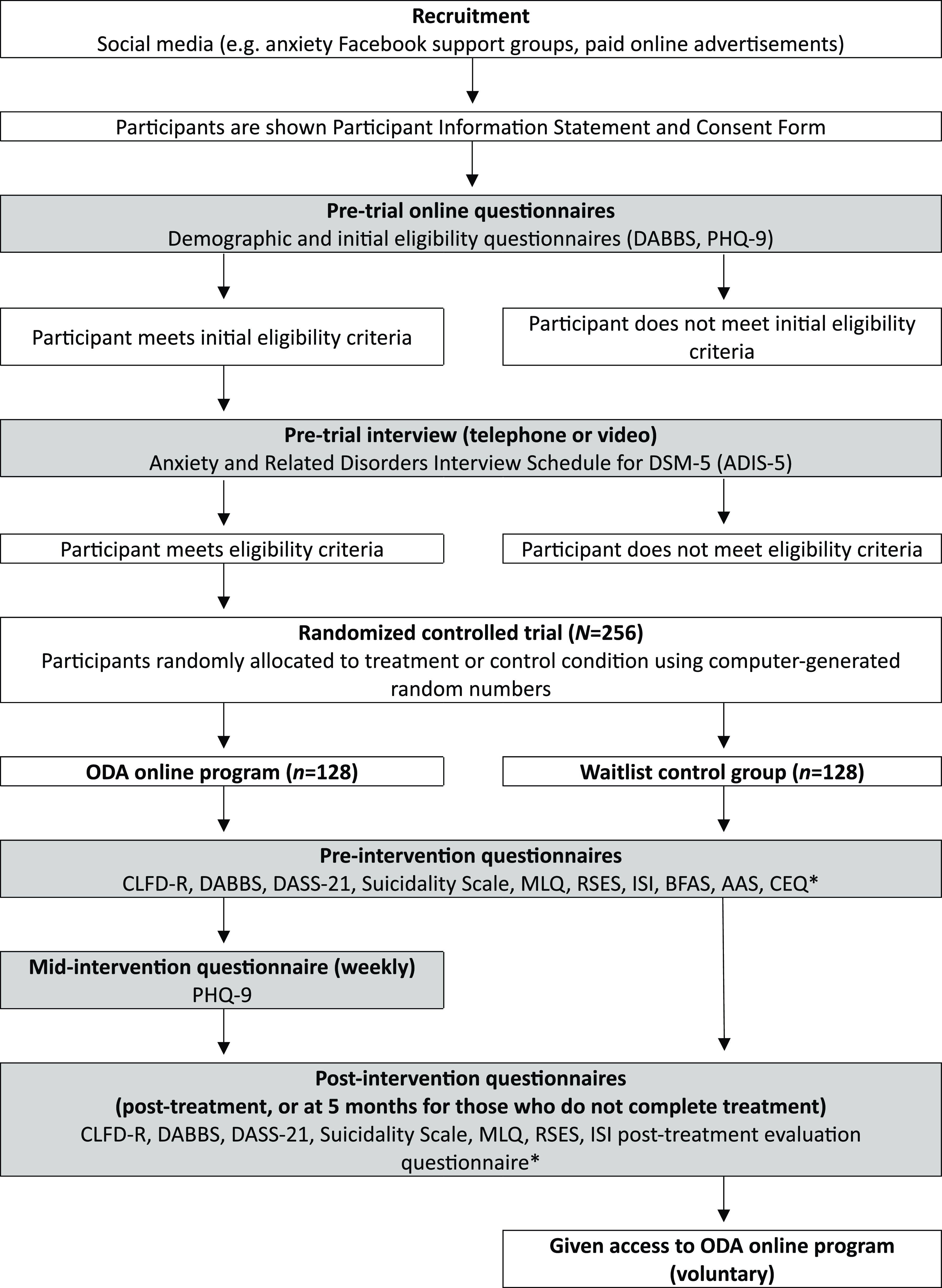
Participants in the treatment condition will be yoked to a control participant. After completing all ODA modules, the participant will be contacted via email to re-complete the baseline outcome measures, apart from the CEQ. A post-treatment evaluation questionnaire will be administered to those in the treatment condition. Specifically, participants will rate the treatment usability, such as ease of website navigation, clarity, efficiency, and overall acceptability, as well as provide qualitative feedback to guide improvement of ODA. To evaluate outcomes in those that drop out of treatment, participants that do not complete the program within the 5-month access period will be emailed these same post-treatment measures. Once a treatment participant has either finished treatment, or exceeded the access period, the control participant they are yoked to will receive a link to the outcome measures. Afterwards, the control participant may commence the treatment program. See Fig. 1 for a diagrammatic representation of the study procedure.
Outline of schedule of events. AAS, Adult Attachment Scale; BFAS, Big Five Aspects Scales (Neuroticism subscale); CEQ, Credibility/Expectancy Questionnaire; CLFD-R, Collett-Lester Fear of Death Scale-Revised; DABBS, Death Anxiety Beliefs and Behaviours Scale; DASS-21, Depression Anxiety and Stress Scale; ISI, Insomnia Severity Index; MLQ, Meaning in Life Questionnaire; PHQ-9, Patient Health Questionnaire; RSES, Rosenberg Self-Esteem Scale. *The CEQ and post-treatment evaluation questionnaires will only be completed by the treatment group.
Measures
Revised Collett-Lester Fear of Death Scale (CLFD-R; Lester and Abdel-Khalek, Reference Lester and Abdel-Khalek2003)
The CLFD-R is a 32-item measure that assesses death anxiety across four subscales: Death of Self, Death of Others, Dying of Self, and Dying of Others. Each item is rated on a 5-point response scale ranging from 1 (‘not’) to 5 (‘very’). The CLFD-R has demonstrated good psychometric properties, and has been demonstrated to be responsive to treatment (Zuccala et al., Reference Zuccala, Menzies, Hunt and Abbott2022).
Death Anxiety Beliefs and Behaviours Scale (DABBS; Menzies et al., Reference Menzies, Sharpe and Dar-Nimrod2022)
The DABBS is an 18-item measure that assesses death anxiety across three subscales: Affect, maladaptive Beliefs, and avoidance Behaviours. Each item is rated on a 5-point response scale. The DABBS has been demonstrated to have good internal consistency, test–retest reliability, and was developed and validated in clinical samples (Menzies et al., Reference Menzies, Sharpe and Dar-Nimrod2022).
Depression Anxiety and Stress Scale (DASS-21; Lovibond and Lovibond, Reference Lovibond and Lovibond1995)
The DASS-21 is a 21-item measure with three subscales, each containing seven items: Depression, Anxiety, and Stress. Each item is rated on a 4-point scale, ranging from 0 (‘never’) to 3 (‘almost always’). In studies using clinical samples, the DASS-21 has shown good internal consistency (Page et al., Reference Page, Hooke and Morrison2007).
Suicidality Scale (SS; Harris et al., Reference Harris, Wang, Mu, Lu, So, Zhang, Ma, Liu, Wang and Zhang2023)
The SS is a unidimensional 8-item measure of suicidality. Each item is measured on a 5-point response scale. The SS has shown good internal consistency and test–retest reliability in both clinical and non-clinical samples (Harris et al., Reference Harris, Wang, Mu, Lu, So, Zhang, Ma, Liu, Wang and Zhang2023).
Meaning in Life Questionnaire (MLQ; Steger et al., Reference Steger, Frazier, Oishi and Kaler2006)
The MLQ is a 10-item measure of current presence of meaning in life (five items), and the search for a meaning in life (five items). Each item is rated on a 7-point response scale ranging from 1 (‘absolutely true’) to 7 (‘absolutely untrue’). The MLQ has been shown to have good validity and internal consistency (Steger et al., Reference Steger, Frazier, Oishi and Kaler2006).
Insomnia Severity Index (ISI; Morin et al., Reference Morin, Belleville, Bélanger and Ivers2011)
The ISI is a 7-item measure of insomnia, with each item rated on a 5-point response scale. The ISI has been shown to have good validity and internal consistency (Morin et al., Reference Morin, Belleville, Bélanger and Ivers2011).
Rosenberg Self-Esteem Scale (RSES; Rosenberg, Reference Rosenberg1965)
The RSES is a unidimensional 10-item measure of global self-esteem. The RSES was included given a large body of research indicating that greater self-esteem is associated with reduced death anxiety (see further, Iverach et al., Reference Iverach, Menzies and Menzies2014). Each item is rated on a 4-point scale, ranging from 0 (‘strongly disagree’) to 3 (‘strongly agree’). The RSES has been shown to have good test–retest reliability and internal consistency (Fleming and Courtney, Reference Fleming and Courtney1984).
Credibility-Expectancy Questionnaire (CEQ; Devilly and Borkovec, Reference Devilly and Borkovec2000)
The CEQ is a brief 6-item questionnaire measuring the creditability of treatment and patient expectancies (e.g. estimated symptom improvement). The response options vary from 1 (‘not at all’) to 9 (‘very’), in addition to an 11-point symptom improvement estimate ranging from 0 to 100%. Previous studies have demonstrated that the CEQ has good test–retest reliability and internal consistency (Devilly and Borkovec, Reference Devilly and Borkovec2000).
Patient Health Questionnaire (PHQ-9; Kroenke et al., Reference Kroenke, Spitzer and Williams2001)
The PHQ-9 is a 9-item measure of depressive mood. Participants indicate how often in the last 2 weeks they have experienced each of nine depressive symptoms. Each item is rated on a 4-point response scale ranging from 0 (‘not at all’) to 3 (‘nearly every day’). The PHQ-9 has demonstrated good psychometric properties (Kroenke et al., Reference Kroenke, Spitzer and Williams2001).
Big Five Aspects Scales: Neuroticism subscale (BFAS; DeYoung et al., Reference DeYoung, Quilty and Peterson2007)
The BFAS is a 20-item subscale of the BFAS that measures trait neuroticism. Each item is rated on a 5-point scale ranging from 1 (‘strongly disagree’) to 5 (‘strongly agree’). The BFAS has been shown to have good psychometric properties (DeYoung et al., Reference DeYoung, Quilty and Peterson2007).
Adult Attachment Scale (AAS; Hazan and Shaver, Reference Hazan and Shaver1990)
The AAS is a single-item, categorical measure of attachment style. This question asks participants to select which of three descriptors they most relate to in the context of their own relationships, to indicate a secure, avoidant, or anxious/ambivalent attachment style. The AAS has been shown to have acceptable test–retest reliability.
Treatment
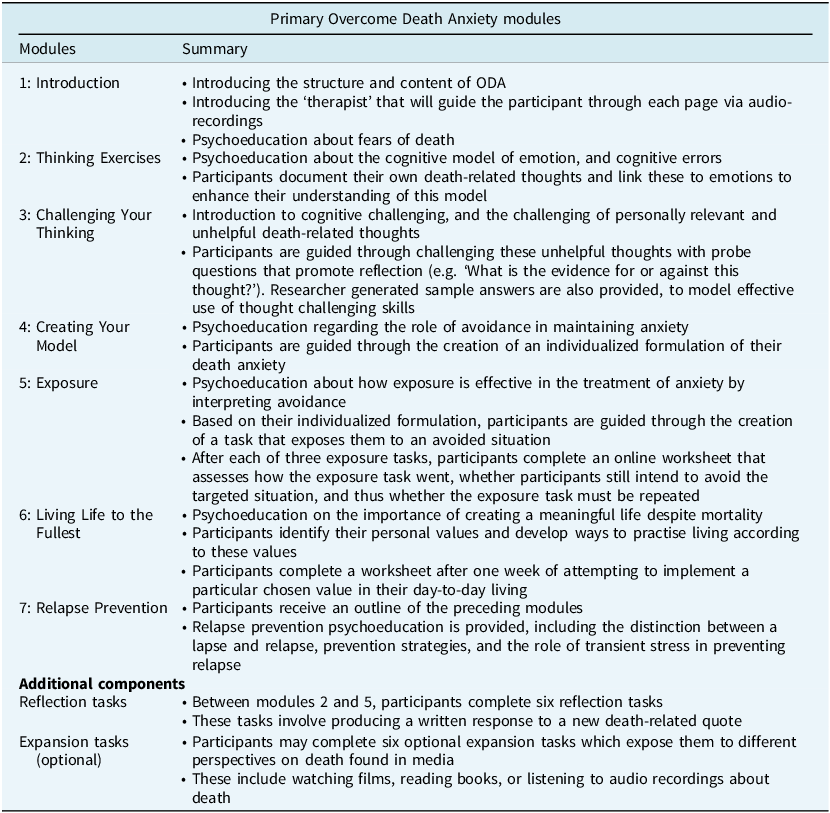
The online ODA website is composed of seven CBT-based modules to be completed at one’s own pace. The content of each ODA module is summarised in Table 1.
Overcome Death Anxiety treatment modules
Analysis plan
An intention-to-treat approach with multiple imputation will be used to analyse the data. Treatment efficacy will be assessed using analysis of covariance, with baseline treatment outcomes included as covariates. The primary outcome is death anxiety, measured by both the DABBS (Menzies et al., Reference Menzies, Sharpe and Dar-Nimrod2022) and the CLFD-R (Lester and Abdel-Khalek, Reference Lester and Abdel-Khalek2003). These two measures have been chosen as the CLFD-R has been shown to be responsive to treatment, and the DABBS is designed for clinical samples. Importantly, the two measures assess different elements of death anxiety. That is, the CLFD-R assesses the particular subject of death-related fears (e.g. fears of one’s own death vs fears of a loved one’s death, and fears of non-existence vs fears of the dying process). In contrast, the DABBS distinctly assesses affective, cognitive and behavioural processes relating to death anxiety. Thus, each measure will be analysed separately, in order to examine specific changes in either the topic of death-related fears (using the CLFD-R), or maladaptive beliefs and behaviours (using the DABBS). The outcome data for both measures will be reported, irrespective of the findings.
The secondary outcomes pertaining to the main hypotheses are: the DASS-21 subscales, depression, anxiety and stress (Lovibond and Lovibond, Reference Lovibond and Lovibond1995), and participant feedback and satisfaction regarding the intervention. Additional secondary outcomes for exploratory analyses include the Suicidality Scale (Harris et al., Reference Harris, Wang, Mu, Lu, So, Zhang, Ma, Liu, Wang and Zhang2023), Insomnia Severity Index (Morin et al., Reference Morin, Belleville, Bélanger and Ivers2011) and meaning in life assessed by the MLQ (Steger et al., Reference Steger, Frazier, Oishi and Kaler2006). Analysis of the clinical significance of changes in treatment outcomes will be conducted as per the guidelines proposed by Dworkin et al. (Reference Dworkin, Turk, Farrar, Haythornthwaite, Jensen, Katz, Kerns, Stucki, Allen and Bellamy2005). The proportion of participants that improve by ≥30% (moderate improvement) and ≥50% (substantial improvement) will be reported post-treatment. Adherence to the treatment, operationalised by the number of online modules completed, will also be recorded.
Discussion
Anxiety-related disorders are highly prevalent. The economic burden of anxiety disorders is mounting, as increasing numbers of people seek treatment. Furthermore, evidence for the ‘revolving door’ highlights the tendency for people to experience different disorders across their lifespan (Iverach et al., Reference Iverach, Menzies and Menzies2014). Consequently, there is a dire need for treatments that target transdiagnostic constructs underlying psychopathology.
Death anxiety has been argued to underpin anxiety-related disorders, emphasizing the need for effective treatments for this condition (Iverach et al., Reference Iverach, Menzies and Menzies2014). However, given the relative recency of this argument, clinical training programs do not typically address this construct. Online treatments are therefore an ideal solution, given their superior scalability and cost-effectiveness compared with traditional therapist-delivered treatments.
The current study is the first RCT of a stand-alone online intervention to reduce death anxiety in a clinical sample. Its design possesses several strengths. Firstly, the inclusion of participants with different anxiety-related disorders, including anxiety, obsessive-compulsive, somatic symptom, and trauma-stressor related conditions, facilitates evaluation of the efficacy of ODA in a diverse range of clinical presentations, and thus transdiagnostic applicability. Secondly, the online nature of ODA itself aligns with most recent Lancet Commission on global mental health, which emphasized the need for further research into transdiagnostic psychosocial interventions, as well as digital interventions, to address the global burden of mental health conditions. Furthermore, the vast majority of existing online treatments for anxiety disorders are not stand-alone, thereby limiting their real-world feasibility. ODA addresses this issue by requiring no therapist input, ensuring maximum scalability.
Despite these notable strengths, the planned trial has some limitations that must be considered. One limitation is that there will not be follow-up data gathered that could evaluate the stability of outcome. This is beyond the scope of the current study, and further research will be needed to address this question. It will also remain to be seen which disorders benefit most from ODA, an evaluation that will be constrained by the sample size recruited within each disorder group.
In conclusion, this proposed RCT will provide critical evidence to not only evaluate the efficacy of ODA, but also to guide future clinical research and practice that aims to reduce the significant burden of death anxiety. In addition, it will be among the first studies to empirically test the hypothesis that treating death anxiety leads to broader improvements in general health. Should ODA prove to be effective, this would potentially offer a highly accessible and cost-effective supplement to standard treatments.
Supplementary material
The supplementary material for this article can be found at https://doi.org/10.1017/S1352465824000493
Data availability statement
Data will be anonymised and analyses will be published in an aggregated manner, such that the confidentiality of individual participants is assured. A deidentified version of the dataset, and the full version of the trial protocol (Version 5, dated 23rd August 2024) will be made available upon reasonable request to the first author. The results of the study will be disseminated through national and international scientific conferences, and will be published in peer-reviewed journals, irrespective of the final findings.
Acknowledgements
None.
Author contributions
Rachel E. Menzies: Conceptualization (lead), Funding acquisition (lead), Methodology (lead), Writing - review & editing (lead); Daelin Coutts-Bain: Investigation (equal), Writing - original draft (lead); Bethany Richmond: Investigation (equal), Writing - original draft (supporting); Fjola D. Helgadottir: Methodology (supporting), Resources (equal), Software (lead), Writing - review & editing (supporting).
R.M. led the conception and design of the study, and secured the funding. F.H. contributed to and provided feedback on the study design, and provided software for the intervention. D.C.-B. and B.R. will assist with methodology and recruitment. F.H. and D.C.-B. led the drafting of the initial manuscript, with editing from R.M. All authors contributed to the revision of the draft and have read and approved the final version.
Financial support
This work was supported by a National Health and Medical Research Council Investigator Grant awarded to R.M. (grant number: G215120 2017628). The funding body had no role in the study design, and will have no role in the study management, data analysis, or manuscript preparation.
Competing interests
F.H. is a director of AI-Therapy, the company that created Overcome Social Anxiety, on which Overcome Death Anxiety is based. F.H. is a registered psychologist, and provided critical input for the design of the intervention. She neither provided funding for the study nor will have access to the data. All other authors declare no competing interests.
Ethical standards
The authors assert that this work complies with the ethical standards of the Helsinki Declaration of 1975, as revised in 2013. All procedures involving human participants were approved by the University of Sydney Human Research Ethics Committee [2023/351]. Beyond the oversight of the institutional ethics committee, there will be no independent auditing of the trial, given resource constraints and the relative low risk to participants given the nature of the intervention.


 Open access


Comments
No Comments have been published for this article.