

On 31 October 1854, a traveling troupe of minstrel performers took to the stage in Richmond, Virginia, for a weeklong series of shows (Richmond Dispatch 1854). The self-styled Parrow’s Southern Opera Troupe performed every evening in Odd Fellows Hall for a 25-cent admission fee. While one of the numerous blackface minstrel ensembles that toured the United States during the antebellum period, part of their production was distinct: A.M. Hernandez, the “great Spanish Knife Thrower, India Rubber Man, and Guitarist.” Hernandez received top billing in the advertising for the performance, which highlighted his polyvalent capabilities as an entertainer available to anyone willing to pay the price of a ticket.
Also known as Tony Hernandez and as the Great Hernandez, Hernandez was born in Cuba in 1831 or ’32 and migrated to the United States as a young adult in the late 1840s after participating in a failed insurrection against Spanish imperial rule. He returned to the island as part of Narciso López’s final filibustering mission in 1851 and was subsequently captured by Spanish colonial authorities. After escaping from imprisonment, he returned to the US where he spent most of his adult life as a professional performer in East coast cities ranging from New Orleans to New York.
From the 1850s to the 1870s Hernandez was active in various minstrel troupes, including Matt Peel’s Campbell’s Minstrels, Sniffen’s Campbell’s Minstrels, and Rumsey and Newcomb’s Minstrels; he even organized some of his own short-lived troupes. His engagement with minstrelsy only composed part of this career, but his participation in the form was an important vehicle for his success as a performer and theatre impresario. Hernandez produced and managed traveling shows, collaborating with other performers to establish touring productions. People he worked with who might be more familiar to us today include Tony Pastor, George Washington “Pony” Moore, and Frank Converse. Hernandez died on 25 October 1874 at the age of 42 in Montevideo, Uruguay, while touring South America as part of a traveling production of The Black Crook (Times-Picayune 1875). As a performer, Hernandez operated in artistic traditions within and beyond blackface minstrelsy. He was an actor, comedian, guitarist, acrobat, lyricist, dancer, magician, knife thrower, and pantomimist lauded for his virtuosity across various genres. Hernandez took part in ensemble performances, and he was also a featured act for minstrel shows, usually involving his guitar or acrobatic skills (Times-Picayune 1857a). While largely unknown to present-day scholars and artists, his activities during his lifetime received notable attention from audiences across the country. And importantly, his career during the middle of the 1800s came well before the more pronounced migration of Cuban blackface performers to locations like Florida and New York during the late 19th and early 20th centuries (Dworkin y Méndez 1996; Dworkin y Méndez 2002; López Reference López2012).
Hernandez’s presence in Parrow’s Southern Opera Troupe defies common assumptions about blackface minstrelsy in the 19th century. The US minstrel show is generally characterized as having its origins in the urban North during the 1840s, although individual performers popularized racial impersonations of African Americans in the 1820s and 1830s (Toll Reference Toll1974). Its participants were usually white men with Anglophone names, and not one with a Hispanic surname such as Hernandez. His characterization as Spanish was also unique among minstrel acts of the era, especially in the face of increased tensions between the United States and Spain as imperial powers in the middle part of the century. Hernandez was distinct even at the level of instrumentation; ads highlighting his prowess with a guitar signaled something distinctive when most minstrel performers used fiddles and banjos. Amidst the plethora of performers who took to the minstrel stage in the mid-19th century, the presence of Hernandez necessitates a reconfiguration of the genre to better attend to the global underpinnings of its aesthetic features and racial politics.
The performance repertoire of Hernandez prompts a more global approach to studies of blackface minstrelsy that tracks how the logics of race and antiblackness worked across borders and nations through performance. Central to understanding Hernandez’s motivations for a career in blackface minstrelsy was his status as a migrant who found common currency in the logics of race and antiblackness as he moved from Cuba to the United States. In contrast to the performers who were part of an explicit nation-based tradition of racial impersonation (whether in their home country or in an adopted one), Hernandez engaged in minstrelsy on a global scale. Hernandez’s performances cannot be limited to either a strictly US or Cuban tradition of blackface minstrelsy; rather, his performance trajectory was informed by a global logic of racial impersonation that allowed him to translate his experiences as a white Cuban person into US minstrel traditions with relative ease. While the discrete national projects of Cuba and the United States informed Hernandez’s actions, limiting considerations of his career to just one nation obfuscates the transits between imperial powers that were central to his performances. Therefore, Hernandez’s performance history necessitates a richer historiography for how immigrants to the United States utilized blackface minstrelsy—and racialized performance more broadly—to locate themselves within existing racial hierarchies during the 19th century.
Like much minoritized performance in the 19th century, Hernandez’s minstrel acts are recorded in traces across varied archives with no singular collection dedicated to his individual history. Much of what we know about him comes through the accounts of his minstrel contemporaries, a handful of photographs, and newspaper advertisements about his performances. These fragmented archival objects and the performances they capture necessitate interpretation of crucial information about his life. Attending to various details—from the biographical facts of his Cuban background to the aesthetic features of his theatrical acts—reveals the form and impact of his minstrel performances.
This recuperation of Hernandez’s engagement in blackface minstrelsy adds to a growing body of scholarship that looks to decenter the United States as the focus of the genre (Cole and Davis Reference Cole and Davis2013; Thelwell Reference Thelwell2020; Hoxworth Reference Hoxworth2024). As a Cuban migrant who found his place within US troupes while still maintaining his identity as someone of Hispanophone descent, Hernandez’s story is different from studies that trace how blackface minstrelsy circulated in non-US spaces or consider traditions of minstrelsy that have no ties to the United States. Individual performers like Hernandez complicated the norms of who was allowed into these spaces and ultimately transformed their characteristics.
Detailing the Archives of Blackface Minstrelsy
Scrapbooks, diaries, broadsides, newspaper clippings—such materials are among the source materials for reconstituting performance histories of the past, and racialized performance such as blackface minstrelsy is no exception. But what happens when such sources are tasked with capturing a performer’s experiences as they traverse national boundaries and diverse geographies? The biases that traditionally orient the field of blackface studies towards the singular nation as a metric for understanding the meanings behind a given performance start with how sources are interpreted. In other words, to think beyond the United States as the locus for blackface scholarship requires looking to different kinds of archival sources and geographical locations; moreover, such approaches must draw from new methods used to trace transnational stories.
Hernandez’s performance repertoire prompts the question: How can we read for a performer’s global activities when most extant archival materials about his life come from US sources? Crucial to understanding the significance of Hernandez’s life as a minstrel performer is reckoning with how his performances, at least on the surface, do not manifest any substantial engagement with his identity as a Cuban, his history of migration, and the broader experiences of Latinx people who were being incorporated into the United States as part of its imperial designs. From his participation in various troupes to his musical compositions, Hernandez’s history as a performer does not register with what one might expect of someone with his ethnic and racial background—at least, not on the surface. Instead of writing off these omissions as inconsequential, the case of A.M. Hernandez requires a different approach that looks toward and reads with the anecdotal, the trace, and other minor details of Hernandez’s presence in the archives to understand and emphasize the importance of his minoritarian status.
This methodology takes inspiration from theorist Alexandra Vazquez’s study on 20th-century Cuban music and performance cultures. She stresses the importance of listening in detail to understand and problematize “the ways that music and the musical reflect—in flashes, moments, sounds—the colonial, racial and geographic past and present of Cuba as much as the creative traditions that impact and impart from it” (2013:4). Vazquez emphasizes attuning oneself to the asides, gestures, and other ephemeral acts that typically get ignored in dominant narratives of Cuban expressive cultures, yet offer “a different set of scenarios through which Cuban music might be experienced” (10). By doing so, she insists on a hermeneutics of unknowing Cuban popular music that complicates popular understanding of the island’s culture and politics.
Instead of taking the omissions of his Cuban identity as evidence that he lacked any identification with Cuba or Hispanophone culture, it is more important to attune one’s attention to the Cuban details of his background wherever they exist to make sense of his activities as a minstrel performer. Reading with these details allows for a deeper consideration of the impact of the aesthetic, social, and political contexts surrounding Cubans in the diaspora during this time. Engaging with Hernandez’s history means contending with the often-fragmentary archives that exist around migrant performers of the 19th century within and beyond the spaces of blackface minstrelsy.
Hernandez’s Cuban details arise along two overlapping registers: the biographical and the aesthetic. The biographical detail attends to the information about Hernandez’s background as a Cuban that exists in accounts of his life by those around him. The other details crucial to Hernandez’s performances are aesthetic: the choices he made as a performer and musician within blackface minstrelsy. Reading the archives for these details in the various ways they manifest across newspaper accounts, diary entries, posters, photographs, and other ephemera is essential for understanding how Hernandez’s ethno-racial identity informed his decisions as a performer.
Biographical Details and Cuban Legacies
In the fall of 1866, A.M. Hernandez began performing for a short period with Newcomb and Arlington’s Minstrels, an ensemble of blackface performers “composed of the highest order of talent—gentlemen of versatility, and selected from the best performers in the country” (“Newcomb & Arlington’s Minstrels and Brass Band” 1866). In cities from Philadelphia to New York, Newcomb & Arlington’s Minstrels entertained audiences with a minstrel repertoire that boasted a string orchestra, vocalists, comedians, brass bands, and dancers. Hernandez was a featured performer alongside established performers such as W.W. Newcomb, W. Arlington, Billy Emerson, and Bobby Newcomb. He played multiple roles during his time with Newcomb and Arlington, from a comedian in skits to a featured guitar act in the olio, or second act.
Hernandez’s 1866 performances in Newcomb & Arlington’s Minstrels reflect his commitment to establishing himself within the realm of blackface minstrelsy throughout his time on the stage. His first interaction with US blackface came through his early years with the Hayworth and Horton traveling variety show starting in 1852, where he became associated with George Washington “Pony” Moore. Moore was originally from New York; he made his debut in the minstrel world in 1844 with the Virginia Serenaders and went on to perform with other troupes in the 1840s and 1850s. Hernandez and Moore became tied together from their time with Hayworth and Horton, continuing together over the years with Matt Peel’s and Sniffen’s Campbell’s Minstrels (New York Clipper 1875). He was also successful in other troupes, such as La Rue’s Carnival Minstrels and Campbell’s Minstrels.
Hernandez demonstrated a desire to create his own theatrical enterprise. Before his minstrel career began, he established the Hernandez Ravel troupe, a variety ensemble that performed in fall and winter of 1864 in New York’s Bowery district and highlighted acting, clog dancing, singing, and music along with blackface acts (New York Clipper 1864). He eventually ventured into the realm of creating and managing his own minstrel troupes, including Mardo and Hernandez’s Campbell Minstrels, Hernandez and Morningstar’s Minstrels, and Hernandez & Smith’s Minstrels (Slout Reference Slout2007:168–69). These groups had varied amounts of success, most lasting a few months or so before switching names or before Hernandez moved on to another venture in the circuit.
Across these interventions in the world of blackface minstrelsy, Hernandez was committed to establishing himself as a fixture in the industry. His central performance strategy relied on balancing his desire to be seen as successful among his peers with strategically maintaining his ethnic difference as a Cuban migrant to the United States. Spectators at his performances with Newcomb and Arlington’s Minstrels in the fall of 1866, and indeed any of his other shows, would have seen Hernandez in his blackface attire with the other performers, a familiar sight made distinct only by his Hispanic surname. After the establishment of the standard three–part minstrel show in the 1840s by groups such as the Virginia Minstrels and Christy’s Minstrels, there was an increase of touring groups across the country and abroad (Thelwell Reference Thelwell2020). This expansion included the participation of immigrants in blackface minstrelsy, particularly those of Irish descent, who used the art form to consolidate themselves as white amidst shifting racial hierarchies in the mid-19th-century United States (Green Reference Green1970; Roediger Reference Roediger1991). Some of the most prominent minstrel performers of Irish descent from this period included Dan Bryant, George Christy, Matt Campbell, and Matt Peel—a number of whom shared the stage with Hernandez at various points in his career (Toll Reference Toll and Annemarie Bean1996:97).
While Hernandez’s status as Cuban made him unique among the Anglophone participants in blackface ensembles, his identity as Cuban is not strongly emphasized in any of the ephemera from his performances on the minstrel stage but instead appears primarily in biographical accounts written by others. These include the 1875 obituary published about Hernandez in the New York Clipper after his death in 1874; a recollection by famed banjoist Frank Converse published in the stringed-instrument publication The Cadenza (1901:12–13); and a reiteration of the New York Clipper obituary in minstrel historian and performer Edwin LeRoy Rice’s Monarchs of Minstrelsy: From “Daddy” Rice to Date (Rice Reference Rice1911:82). These second-hand accounts of his Cuban background become, from a cursory consideration, a peculiar aspect about Hernandez’s minstrel repertoire: while his performances never overtly marked him as Cuban, it was understood by his contemporaries in the world of minstrelsy that he was Cuban.
These details, while ostensibly at the periphery of the minstrel acts, are in fact crucial to understanding the importance of his Cuban background to his place within US blackface minstrelsy. Two biographical facts are of importance: first, the concurrent aesthetic tradition of Cuban blackface, or teatro bufo, that Hernandez would have been in contact with prior to his migration to the United States in the late 1850s; second, his political leanings as a member of the exile Cuban filibuster community. These aspects of his Cubanness concretize some of the likely motivations for his entrance into the US minstrel circuit and how it became a vehicle for incorporating himself in the racial and political fabric of the mid-19th-century United States.
Hernandez’s decision to participate in US blackface minstrelsy circuits during the middle part of the 19th century reflects his engagement with teatro bufo. Teatro bufo refers to the vernacular practices of blackface minstrelsy and racial impersonation in Cuba that reached their peak during the 19th and early 20th centuries across theatre, literature, and other forms of popular culture (Lane Reference Lane2005). The art form was centered around the figure of the negrito, a satirical caricature of blackness and the enduring representation of Blacks on the Cuban stage (Lane Reference Lane2005:2). For the white Cubans who were teatro bufo’s greatest advocates, the cultural practice informed their development of a national Cuban identity during the island’s transition from a Spanish colony to an independent nation (Lane Reference Lane1998).
While teatro bufo is popularly conceived of as having its formal establishment in 1868 with the performances of the theatre company Bufos Habaneros at the Teatro Villanueva in Havana, there was a longer practice of racial impersonation on the stage and in narrative form that influenced Cuban politics and racial identities (Moore [Reference Moore2014] 2016). In the 1840s, the period in which Hernandez resided in Cuba before his migration to the United States, these representations centered on the figure of the bozal, or African-born slave, and were popularized by the poetry and plays of Bartolomé José Crespo y Borbón. These immensely popular characterizations of blackness became part of what Jill Lane has termed discursive blackface, or “narrative practices of racial impersonation,” and instrumental in the establishment of a national Cuban identity for the white elite class (2005:19).
Given this context, someone like Hernandez would have been exposed to a wide array of blackface practices that would inform his work on the minstrel stage, and by extension, his racial and political identity as a Cuban migrant in the United States. Even though the archival record does not show any formal engagement with extant teatro bufo troupes during his lifetime, the discursive blackface that informed his upbringing prior to his migration would be pivotal to his decision to participate in a similar practice in his adopted country. Details from his performances allow us to glimpse these connections, such as a shared use of the guitar. In the 1847 blackface play Un ajiaco, o la boda de Pancha Jutía y Canuto Raspadura (A Cuban stew, or the wedding of Pancha Jutía and Canuto Raspadura), Crespo y Borbón included Spanish-origin stringed instruments such as the bandurria and tiple (Lane Reference Lane2005:41). Hernandez’s blackface performances with Newcomb and Arlington’s Minstrels in 1866 repeatedly highlighted his guitar skills as a novel feature of his minstrel act—a practice, advertisements announced, “in which he stands without a rival” (“Newcomb & Arlington’s Celebrated and Famous Minstrels” 1866). This act underscores how Hernandez translated the guitar as a Cuban-Spanish theatrical feature into the world of US blackface minstrelsy with commercial success.
Another biographical detail—Hernandez’s status as a political exile from the island—explains why he performed in the US blackface minstrelsy circuit. Hernandez left Cuba due to his participation in “the first rebellion in that island,” which occurred in the late 1840s (Poyo Reference Poyo1989:8). He came to the United States as part of the exodus of Cubans who found themselves in conflict with Spanish imperial rule and who often integrated themselves within US expansionist discourse about Cuba (Lazo Reference Lazo2005:10). Cubans such as Félix Varela and José María Heredia organized newspapers, literature, and other public forms of redress against Spanish rule while based in New York, Philadelphia, New Orleans, and other US cities (12–13). Racially and economically, these individuals were part of the white Cuban elite who negotiated their desires for freedom from Spanish rule with the promises and pitfalls of a US takeover of the island, chief among them the question of their racial status in Cuba and in the diaspora.
Hernandez’s dissatisfaction with Spanish control of the island led not only to his immigration to the US but also his participation in filibustering campaigns, the pinnacle of political actions during this period (Times-Picayune 1875). As Rodrigo Lazo notes, Cuban exiles in the 1850s took part in filibustering campaigns to free the island of Spanish rule as part of a broader political culture of critiquing Spanish imperial control. Supporters of filibuster activities came from all walks of US political life, including Northerners who sought to expand the US empire, pro-slavery Southerners, and exiled Cuban patriots who wanted to rid the country of its Spanish rulers (Lazo Reference Lazo2005:27).
Hernandez’s desire to liberate Cuba from Spanish dominion led him to join one of Venezuelan-born General Narciso López’s filibustering expeditions. López fled the island due to his anti-Spanish allegiance but returned through a series of four filibustering campaigns to Cuba during the late 1840s and early 1850s. Two of his campaigns never made it to Cuba due to US intervention, but the last two, which left from New Orleans in May of 1850 and August of 1851, succeeded in traveling to the island. While neither of these campaigns succeeded in their goals and ultimately ended with López’s capture and execution, they were essential in catalyzing a sentiment for Cuban independence that inspired political activities in the United States (Lazo Reference Lazo2005:99–100). Hernandez was one of the 49 Cubans who participated in López’s final expedition in 1851 (Richmond Times 1851).Footnote 1 As a consequence of his involvement in the campaign, he was imprisoned by Spanish troops in Cuba but managed to escape by killing his guards. He eventually made it to the shore and, with the help of local fishermen, escaped to Mexico where he began performing for the first time as part of a circus troupe (New York Clipper 1875). Hernandez eventually returned to the United States by 1852, where he began performing in traveling variety and minstrel shows (Times-Picayune 1875).
The detail of Hernandez’s Cuban background and especially his political activities as a filibuster illuminate some of the rationale behind his decisions to engage in blackface minstrel troupes upon his return to the United States. His investments in minstrelsy indicate a continuation of his Cuban exile politics and his ethnic and racial identities translated into the world of US popular entertainment. The Cubans in these filibustering campaigns were predominantly those of the elite criollo class (those of Spanish descent living in a current or former colony) who fled Cuba as a result of increased repression by the Spanish government (Lazo Reference Lazo2005:10). These Cubans were joined in the expeditions by proslavery US Americans who sought to annex Cuba to promote, among other things, the continued subjugation of Black Americans (144). As one of the few Cubans who participated in the López expeditions, Hernandez was part of a mélange of individuals who sought to substantiate their racial power through the promotion of slavery, thus making the decision to participate in blackface minstrelsy upon his arrival to the United States a logical one.
This connection between filibustering and minstrelsy underscores a common ground for those who used filibustering to solidify their status and those who participated in blackface minstrelsy.Footnote 2 In other words, the racial politics undergirding filibustering and blackface minstrelsy were much more intertwined than previously considered. Just as white Cuban exiles saw filibustering and annexation as part of a process of solidifying their racial superiority in relation to those of African descent on the island, so too did blackface minstrelsy provide a way for white US Americans to reaffirm their status in the shifting racial landscape of the antebellum United States. For Hernandez, someone who not only had an interest in establishing himself as a successful performer in his adopted country but also embodied the racial politics of an exile Cuban filibusterer, blackface minstrelsy provided an opportunity to incorporate himself into the United States through a theatrical practice supportive of his aspirations. His translation from a filibusterer to a minstrel performer is affirmed by the biographical details of his identity, manifested in his relatively seamless ability to integrate himself into the US minstrel circuit.
Hernandez’s Cuban identity can also be glimpsed through his association with US minstrel troupes that toured the island in 1860 and 1861. During this period, US and British minstrel troupes were increasingly taking their productions abroad, as part of what historian Chinua Thelwell characterizes as the second major wave of the global dissemination of blackface minstrelsy (Thelwell Reference Thelwell2020:8). As part of this export of US blackface into global contexts, several ensembles began to travel to Cuba in the late 1850s and early 1860s. Hernandez participated in one of these tours as part of Rumsey and Newcomb’s Minstrels, the first-ever US troupe to visit the island (New York Clipper 1860). The group had already been to Cuba earlier in 1860, performing to great acclaim in Havana, Matanzas, Cardenas, and other cities throughout the country. Hernandez took part in a second iteration of this tour, which left from New Orleans on 15 August 1860. They performed for a few months before returning to the United States in January 1861 when several troupe members contracted yellow fever (New York Clipper 1861).
Extending back to their origins as European colonies, Cuba and the United States have been linked culturally, economically, and politically, a connection made even more relevant by shared practices of enslavement and racialized popular entertainment (Ferrer Reference Ferrer2021:12–13). The tours of US minstrel troupes to Cuba reflect this shared migratory history between the two nations, a process facilitated by intermediary figures such as Hernandez. Hernandez’s participation in this second iteration of Rumsey & Newcomb’s Caribbean troupe suggests that his personal history as a Cuban functioned as an asset to hemispheric performances. His inclusion likely helped to dispel doubts with the success of a Cuban tour by having someone fluent in Spanish to serve as a cultural ambassador between US Americans and local theatre troupes (Cleveland Morning Leader 1860). The project of exporting US minstrelsy to Spanish-speaking countries like Cuba in Latin America and the Caribbean benefited from mediators like Hernandez who could navigate cultural mores better than their non-Hispanophone contemporaries.
Spanishness and the Aesthetic Details of US Blackface Minstrelsy
In December 1858, audience members at the American Theatre in New York City witnessed daily the “new and original acts” of Campbell’s Minstrels. Among various songs, dancers, and burlesques performed by blackface performers was a minstrel pantomime, The Magic Guitar, or the Wandering Minstrel, created and headlined by A.M. Hernandez. Hernandez’s work in this ensemble, which played to crowded houses for weeks and “never fail[ed] to elicit enthusiastic applause,” was highlighted in reviews that touted his “unsurpassed performance” as “alone worth the admission fee” (New York Herald 1858).
In the numerous minstrel acts that Hernandez would perform in over the course of his career, his guitar performance was a key feature of his repertoire. His self-stylization as a spectacular Spaniard brought Spanish aesthetic practices to US blackface. Hernandez was not referred to as Cuban in any of the accounts of his performances in minstrelsy or other theatrical forms apart from biographical notes; instead, he was typically characterized as Spanish in advertisements and descriptions of his various theatrical feats. As described in reviews, in his 1858 New York performances, Hernandez’s guitar was a novelty for a minstrelized body. His Cuban identity was translated into Spanishness—both an aesthetic choice and a marker of racial and ethnic difference that was growing in legibility in 19th-century US performance culture and racial formations. Hernandez negotiated the inscrutability of Spanishness as a category of difference that classified him as white enough to participate in these American troupes while fashioning an exoticized aesthetic that captivated spectators across the country. The Spanish elements of Hernandez’s performance repertoire also gestured towards a more global understanding of minstrelsy and defied conventional ideas about who participated in it.
The enactments of Spanish identity that characterized Hernandez’s minstrel performances speak to the broader formations of Spanishness in the United States during the second half of the 19th century. The tension between the US and Spain increased as their imperial efforts collided in places like Cuba. These conflicts would come to a head at the end of the century with the outbreak of the Spanish-American War, a months-long conflict that led to the US acquisition of Guam, Puerto Rico, and the Philippines. Amid these political transformations came the question of how those from Spain and its attendant colonies were understood within the racial and ethnic formations of the 19th-century United States. In the US popular and cultural imaginary, Spanishness, Spain, and its derivations came to index people from a variety of countries with distinct racial and ethnic schemas. Migrants from the Iberian Peninsula, criollos, and mestizos were all routinely grouped together in the broader category of “Spanish.” Fueling these classifications as well was the long-standing Black Legend of Spain, the centuries-long Anglophone defamation of Spain and Spanish culture that worked to associate the figure of the Spaniard with vice, immorality, and metaphors of darkening (DeGuzmán Reference DeGuzmán2005:4–5).
In US popular culture, Spanish ethno-racial typologies oscillated throughout the 19th century reflecting both the United States’ increasing imperial sway over territories held by Spain and attendant anxieties over the place of the ethnic and racially heterogeneous people from Spanish colonies in existing US racial hierarchies. One popular example was the figure of the white Spaniard, most often represented as the nobleman or conquistador/explorer—a manifestation of Spain’s long history as a colonial power (DeGuzmán Reference DeGuzmán2005:75–77). Another popular Spanish type came in the form of the racially mixed and eroticized Spaniard, often depicted through the figurations of the Gypsy, the Moor, and the Indian (DeGuzmán Reference DeGuzmán2005:78–79). Related to the so-called exotic Spaniard were the white, Black, and racially mixed figures who all stylized themselves as Spanish. Literary critic Rosa Martínez has characterized these transformations as Spanish masquerade, which captures acts of passing in US literature and culture that use the racially inscrutable category of Spanishness to achieve a variety of effects (2023:637–39).
It thus follows that in the world of 19th-century theatre and performance culture in which Hernandez entered as a minstrel performer, Spanishness and the figure of the Spaniard maintained itself as a mercurial, embodied category that allowed for performers on the stage and in everyday life to traverse various racial, social, and cultural mores. These Spanish typologies influenced not only live performances but also the mediated representations of performances in rapidly developing print and visual technologies of the era. Two manifestations of Spanishness on the stage are especially important to contextualize Hernandez’s figurations as a Spanish minstrel performer: one, the theatrical practice of self-stylization as Spanish to achieve commercial success; and two, the rise of the Spanish gentleman as a spectacular figure of racial and ethnic malleability.
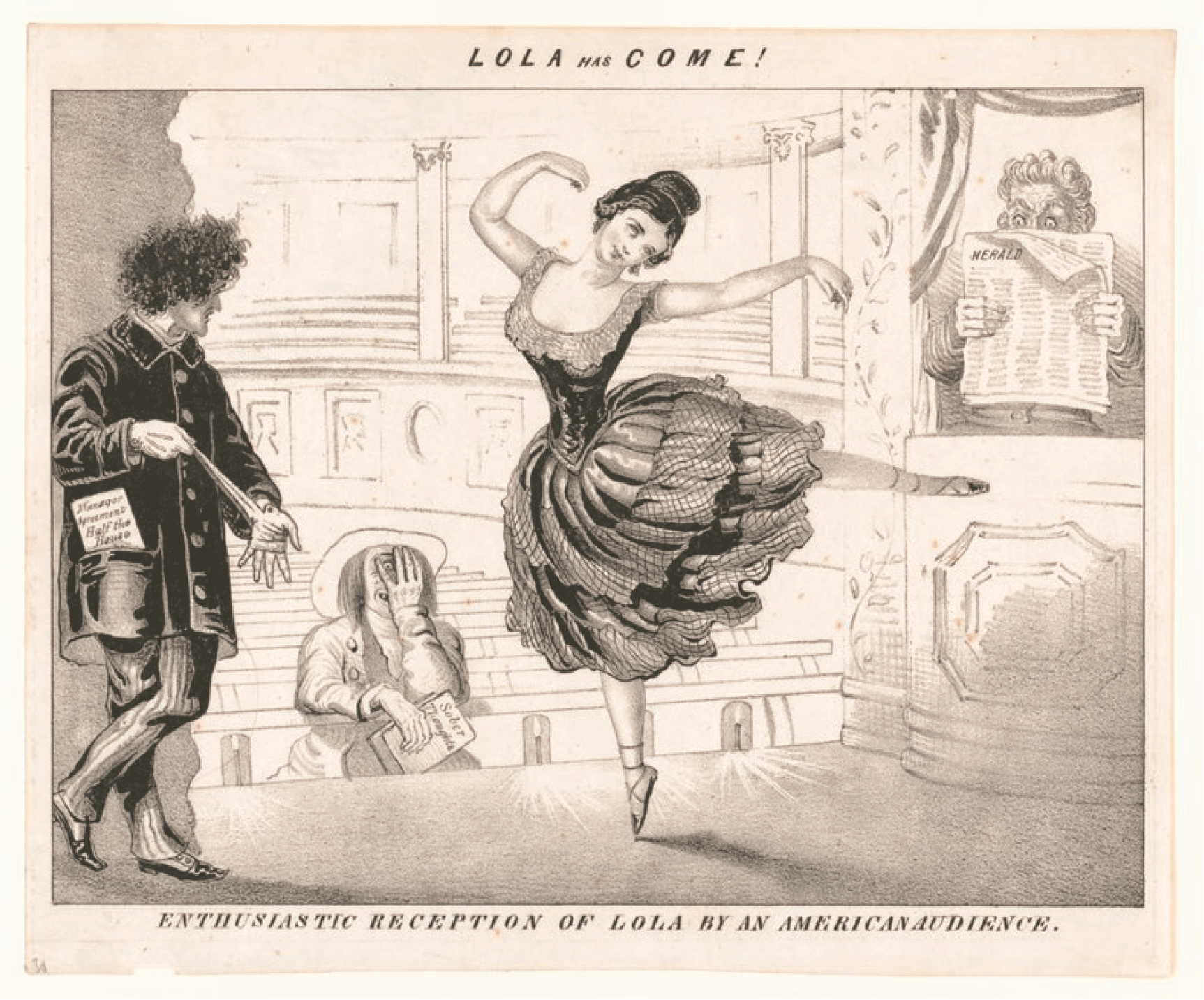
The broader shift from ensemble performance to celebrity figures in the world of 19th-century US theatre culture advanced with the increase in visual and communication technologies and the rise of individual actors who presented themselves as Spanish subjects in their biographical and aesthetic acts (Shaffer Reference Shaffer2010). Among them were Lola Montez, an Irish-born dancer who adopted a Spanish alias on the stage (Seymour Reference Seymour1996); and Adah Isaacs Menken, an actress who claimed Spanish heritage as one of her many fabricated origin stories and her ever-shifting claims to various racial identities (Sentilles Reference Sentilles2003; Brooks Reference Brooks2006). For instance, Montez’s performances of the Spider Dance, an erotic dance in which she imitated a woman who had a spider on her dress, was a sensation across her travels in Europe, the United States, and Australia (Seymour Reference Seymour1996:300). Reviews and advertisements touting her US performances captured the fascination with her body’s movement style, underscoring the spectacularity of her falsified Spanish heritage. In an 1852 lithograph by David Claypoole Johnston entitled Lola Has Come! Enthusiastic reception of Lola by American audience, Montez is displayed in her famous Spider Dance (see fig. 1). The fascination with Montez’s performances was catalyzed by her masquerade as a Spaniard. The audience for her May 1853 rendition of the Spider Dance at the American Theatre in San Francisco was characterized as having “an anxious flutter and intense interest” in her performance that was “said to be her favorite” (Daily Alta California 1853). The dance, which was understood as “thoroughly Spanish,” was central to her masquerade’s success as a theatrical act, which in turn demonstrated the broader cultural fascination with Spanish culture during this period, perceived as embodying an alluring and erotic aesthetic sensibility (Lippert Reference Lippert2018:337–38).
David Claypoole Johnston. Lola has come! Enthusiastic reception of Lola by American audience. United States, 1852. (www.loc.gov/item/93511938/)

Alongside these acts of Spanishness in the theatrical world came the formation of the Spanish gentleman as an elusive yet spectacular figure that indexed shifting racial politics and anxieties during the middle decades of the 19th century. This figure manifested across various works of US literature in the 1850s, including Harriet Beecher Stowe’s Uncle Tom’s Cabin (1852), William Wells Brown’s Clotel (1853), and Herman Melville’s Benito Cereno (1855).Footnote 3 But it was in everyday forms of Black corporeality tied to modes of escape from enslavement that the Spanish gentleman made its most spectacular mark. Take for example the history of Ellen Craft, an antebellum Black woman who escaped from slavery by donning the attire of a disabled Southern plantation owner and eventually became a key figure in the transatlantic abolitionist lecture circuit during the 1850s and 1860s.Footnote 4 Craft’s character in her passing performances was seen by some as a Spanish gentleman (Martinez Reference Martinez2023).
Amid these shifting discursive spaces of Spanish masquerade, Hernandez found himself as a minstrel performer and migrant in the United States. As a Cuban person from a Spanish colony in a new country that was uncertain of what he was supposed to signify racially or ethnically, Hernandez’s performances represent a translation of his identity through the racial discourses and theatrical conventions of blackface minstrelsy. His Cubanness and criollo identity were more legible as Spanish to a US audience that was becoming more accustomed to seeing representations of the Spaniard on the stage. Hernandez’s performances transcended the usual scripts of who participated in US blackface minstrelsy at the time while transforming its aesthetic forms in the process.
His decision to keep his surname reflects his self-making as a Spanish minstrel performer. Other minstrel performers with ethnically distinct surnames would adapt Anglo-sounding stage names to better approximate a normative whiteness, such as Dave Carson, who was born David Nuñez Cardozo to Jewish and Spanish parents in New York City (Hoxworth Reference Hoxworth2024:200). Hernandez’s choice underscores his negotiation of the possibilities afforded to him as a white Cuban migrant in US popular theatre. Rather than change his name to better assimilate, he made a concerted effort to capitalize on a burgeoning understanding of Spanishness as an aesthetic form and ethnic marker to stylize himself as a unique and productive performance maker.
A published reflection on Hernandez’s place within the world of early minstrelsy captures the connections between the spectacular performer, his Spanish identity, and its place within the cultural form itself. The article “A Reminiscence of Minstrelsy,” published in the Norfolk Virginian, mentions Hernandez as part of an early assemblage of fellow performers in the late 1850s that included John P. Smith, Bill Parrow, and Pony Moore. The author shares this fantastical account of Hernandez’s origins:
The precise age of Tony Hernandez is not known, but it is variously estimated from two to three hundred years, and he is reported to have amused Christopher Columbus with his antics on the return of that voyager to Spain. Whatever his age may be time dims not the lustre of his genius. There’s fun in his every action, and a glance from his quiet eye convulses an audience. Grace hangs upon his toes, and harmony upon his fingers. (Norfolk Virginian 1871:1)
As part of a periodization of an older era of minstrelsy, Hernandez’s Spanishness is manifested through the humorous claim of being old enough to have participated in the colonial conquest of the Americas in the 15th century. But more importantly, the characterization positions Hernandez as the archetypal Spanish gentleman whose origins are incoherent but nonetheless spectacular. It is unclear if this fantastical narrative imagined Hernandez as part of the colonizing mission or someone who was encountered en route and later joined Columbus’s entourage; regardless, his virtuosity as a performer is relayed through his assumed Spanish identity. The recognition of his Spanishness, even when sensationalized, within a chronicle of minstrelsy’s history speaks to the ways his minstrel acts were understood by his contemporaries through the transformation of his Cubanness into the figure of a Spaniard. The ridiculousness of Hernandez accompanying Christopher Columbus on his expedition to the Americas also draws parallels with other contemporaneous theatrical productions in which the conquistador figure was presented to audiences through satire. For instance, the burlesque Columbus El Filibustero!!: A New and Audaciously Original Historico-Plagiaristic, Ante-National, Pre-Patriotic, and Omni-Local Confusion of Circumstances, Running through Two Acts and Four Centuries was debuted by playwright and actor John Brougham in New York City in December 1857.
A popular show that ran for 150 performances, its anachronistic aesthetic, from the placing of Columbus’s arrival to the Americas in 19th-century New York to a display of his “Fruits of His Discovery” to the Spanish court that included P.T. Barnum, minstrel performers, Pocahontas, and the Almighty Dolla was beloved by spectators (Mielke Reference Mielke2021:23–25). The humor with which Brougham introduces Columbus to his 19th-century audiences parallels Hernandez’s fantastical origin story. The significance of Columbus as a Spanish typology added to the spectacularity of Hernandez’s own enactment of Spanishness.
Yet, Columbus was not the only figure that undergirded Hernandez’s Spanishness. The Norfolk Virginian “Reminiscence of Minstrelsy” article ends with a gesture hinting at a key feature of Hernandez’s performances as a minstrel of “Spanish” descent: his musical ability on the guitar. The banjo was a mainstay of the 1840s and 1850s as part of blackface minstrel productions popularized by performers such as Joel Walker Sweeney, Billy Whitlock, and Dan Emmett (Winans Reference Winans1976:417–18; Winans and Kaufman Reference Winans and Kaufman1994:1–2). An instrument derived from the musical practices of enslaved Black communities, the banjo was a crucial part of the racial and racist impersonations promulgated by white actors in blackface minstrelsy that later became associated as a more generic US American instrument by the late 19th and early 20th centuries (Meredith Reference Meredith2003). In contrast, guitars were featured significantly less frequently in minstrel shows and were more popular among the white US American middle class who favored them for their affordability and portability in contrast to the piano (Danner Reference Danner2021:4). The Spanish guitar, distinct for its six-string construction, experienced a certain degree of popularity in the 19th century with the migration of performers from Spain beginning in the 1810s and 1820s (Mora Reference Mora2015:337–39). Musicians such as Celestine Bruguera, Trinidad Huerta, and Dolores De Goñi took to US stages in solo guitar performances during the first half of the 19th century. Their success with US audiences reflected both a fascination and uncertainty about Spanish identity that typified “notions of ‘primitive’ Spain as seductive and charming on the one hand and as base, unsophisticated, irrational, and incapable of the highest artistic merit on the other” (Mora Reference Mora2015:343).
Given this context, Hernandez’s performance of the guitar would have been familiar to audience members and promoters aware of an increased presence of Spanish aesthetic forms in US performance venues. However, his use of the guitar was unique in that of the many instruments he could play, it was the guitar that became part of his stage persona.Footnote 5 His solo guitar act during the olio was routinely characterized as “wonderful”; he was praised as “the most accomplished guitarist in existence,” and “the wonder of the world” (Daily American Organ 1854). While on tour, he even offered lessons, an extension of his performances even more accessible to his audiences (Times-Picayune 1857b).
Hernandez’s guitar playing cemented him within the period’s shifting discourses of Spanishness, and in doing so influenced the standards of the minstrel repertoire. To return to his successful run with the Campbell’s Minstrels in 1858, his minstrel acts were a hybridized performance that combined Spanish aesthetic tropes with the repertoires of US blackface minstrelsy. His spectacular Spanish body, accentuated by his Hispanophone surname and guitar, resulted in performances exotic enough to elicit audience intrigue but also familiar in their placement within existing US minstrel troupes.
Hernandez’s guitar as the quintessential sign of his performance of Spanishness was central to how his contemporaries recalled his life story. Converse recounts a tale in which Hernandez escaped capture in Cuba after his participation in López’s filibuster through the power of performance:
While in prison, having induced his guard to procure for him a guitar, he composed what he called his death song. It so happened that on the day preceding the one set for his execution the wife and daughter of one of the officials were visiting the prison, when they were attracted by the sounds of a guitar and the voice of Hernandez who, having observed them, began singing his mournful refrain. The pathos of the situation—a prisoner about to die calmly and resignedly chanting his own dirge—so impressed these sympathetic women that they hastened to the authorities and, pleading for his life, succeeded in securing a respite during which they successfully planned for his escape. (1901:13)
In what may be the earliest chronological record of his guitar performance, Hernandez is remembered as a figure whose talent with the instrument was enough to beat death itself. The audiences of the performance, from the women visiting the prison to Converse retelling it decades later, are linked through their fascination with Hernandez as a larger-than-life figure. The accuracy of the story is impossible to corroborate and perhaps it never happened, but one can imagine it retold by Hernandez to his peers as a strategic mode of self-fashioning that characterized his transformation into a figure of Spanish grandiosity.
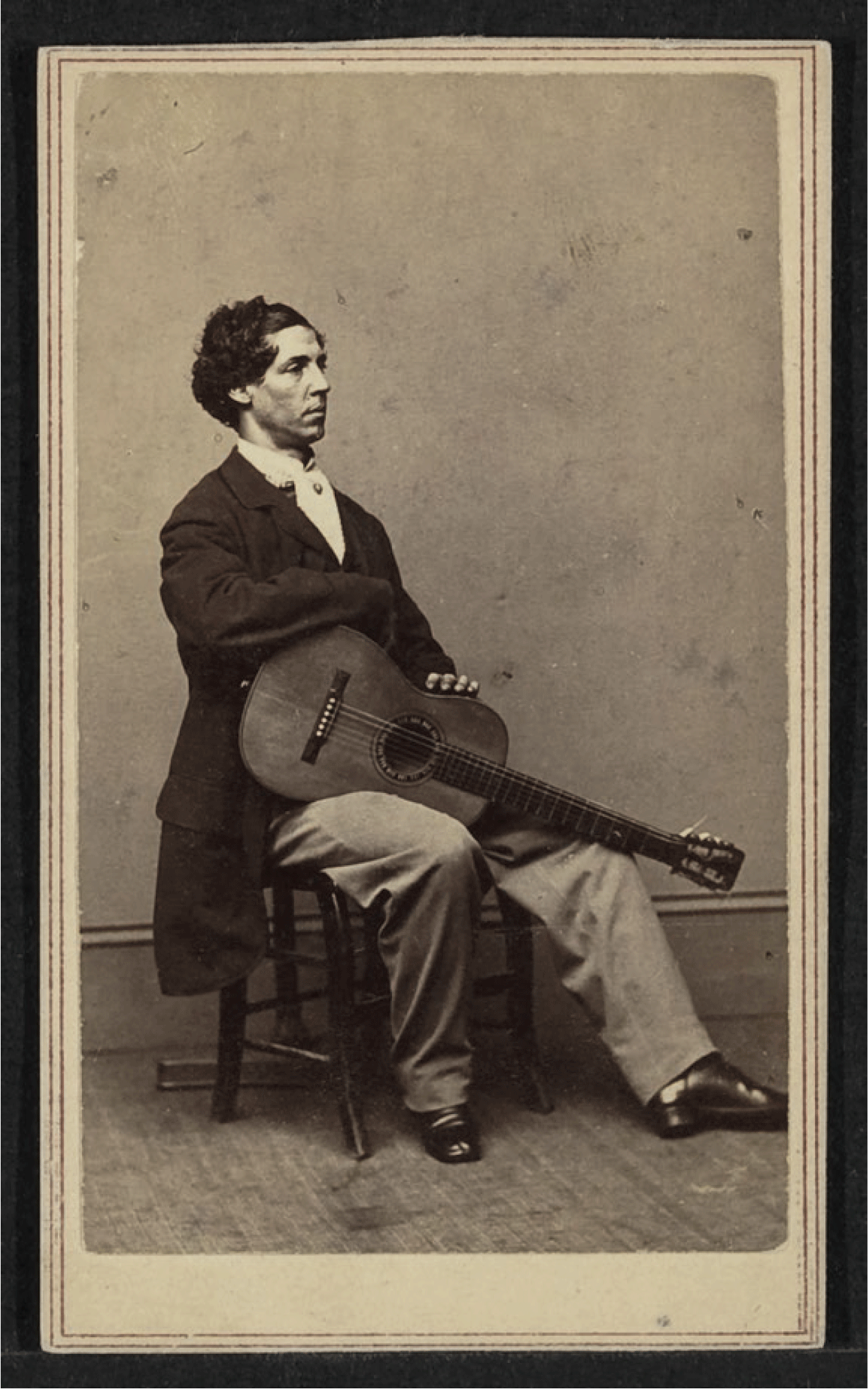
Tony Hernandez, undated, Harvard Theatre Collection MS THR 1848, Houghton Library, Harvard University. (https://hollisarchives.lib.harvard.edu/repositories/24/archival_objects/3488388)

Indeed, Hernandez’s efforts to maintain a connection to the detail of the guitar manifested in his engagement with visual representations of his performances. In a photograph of Hernandez, one of the very few that exist in the archive, Hernandez is seated on a chair, wearing a black suit jacket with gray slacks and a white shirt. His guitar rests in his lap with its six strings facing outwards (fig. 2). Likely taken in the late 1850s, the image is a carte-de-visite, a new photographic technology of the era and a tool used by performers as a way to advertise their craft, not just a representation of a given act but “evidence of a complex commercial and social transaction that implicates management, production, performer, venue, and a range of theatrical consumers” (Mayer Reference Mayer2002:232). Hernandez’s decision to hold his guitar while posing for the photograph underscores the extent to which he saw it as a crucial aspect of his presentation as Spanish within the blackface minstrelsy scene and the United States as a whole.
The repetition of the guitar across his career as a performer also demonstrates the influence that Hernandez, as a transnational subject, had in transforming the nature of blackface minstrelsy in a subtle but enduring way. It speaks to a shift within existing instrumentation and cultural expectations about what the minstrel shows of the 1850s and 1860s were supposed to represent. If part of this era of US blackface minstrelsy involved an expansion of US performers to other parts of the globe, Hernandez’s success within the industry through the adoption of a Spanish aesthetic identity also signals that those transformations happened at home as well. Adopting Spanishness as a performance persona was not useful only for Hernandez’s integration into the popular entertainment industry of the mid-19th century but also for shaping blackface minstrelsy’s identity into a more hemispheric one.
Legacies of Blackface on Contemporary Latinx Racial Politics
It is important to reflect on how Hernandez’s status as a white Cuban expatriate informed his decisions to enter the US blackface minstrelsy circuit—with consideration for the broader implications of his activities on the history of Latinx performance culture and racial formation as a whole. Any serious consideration of Hernandez’s significance as one of the first, if not the first, Latinx person to participate in US blackface minstrelsy cannot avoid the fact that his success as a performer came through his engagement with a racist form of performance, a legacy that influences Latinx performance practices to this day (Pérez Reference Pérez2016; Power-Sotomayor Reference Power-Sotomayor2019). The privileges afforded him as a member of the elite white Cuban class to enter blackface minstrelsy reflect broader dynamics of white Latinx participation in antiblack institutions to substantiate their own place in the United States (Hernández Reference Hernández2022). The hope here is to illuminate new genealogies of how Latinx people understood themselves in relation to racial hierarchies and other minoritarian subjects in the United States in all their complexity. Doing so invites a more rigorous look at performance cultures of the past to provide a more nuanced context for Latinx identity formation.

 Open access

