


1 Introduction
Estimating members’ preferences from roll-call votes in parliaments and legislatures is crucial for theory-testing in political science (Krehbiel Reference Krehbiel1990; Theriault Reference Theriault2006). Significant progress has been made in the methodology of ideal point estimation since the seminal work of Poole and Rosenthal (Reference Poole and Rosenthal1985) and Poole and Rosenthal (Reference Poole and Rosenthal2000), with early contributions from Aldrich and McKelvey (Reference Aldrich and McKelvey1977) and others. However, methodological challenges remain when comparing ideal points over time, across domains, or between chambers. While many challenges have been addressed in the literature (e.g., Jessee Reference Jessee2016; Poole Reference Poole2005; Shor, Berry, and McCarty Reference Shor, Berry and McCarty2010), issues persist, particularly in theory-testing settings. These issues include scaling ideal points for comparisons and explaining variation in estimated ideal points. This article focuses on developing methodology that enables both tasks simultaneously.
More concretely, we are interested in settings where legislators vote on motions in various domains and might exhibit different revealed preferences across them. These domains could be issue areas (e.g., defense, housing, government operations, etc., as in Jones and Baumgartner Reference Jones and Baumgartner2005 or Moser, Rodriguez, and Lofand Reference Moser, Rodriguez and Lofand2021), dimensions (e.g., social versus economic, as in Poole and Rosenthal Reference Poole and Rosenthal2000; Poole and Rosenthal Reference Poole and Rosenthal2011), or types of vote (e.g., procedural versus final passage, as in Jessee and Theriault Reference Jessee and Theriault2014).Footnote 1 For instance, Jessee and Theriault (Reference Jessee and Theriault2014) found that party polarization is greater in the procedural domain, meaning that when using roll call data only from votes on procedural motions, party polarization is greater than when legislators vote on amendments or final passage motions. This pattern is similar to the findings of Kirkland and Slapin (Reference Kirkland and Slapin2017) when looking at defections in the minority party.
Understanding the consistency of legislative voting across different domains provides insights into the principles guiding legislators’ decisions. This study aims to answer the research question: “What explains (in)consistency of legislative voting across different voting domains?” By examining this question, we can gain insights into the factors that drive legislators to either align their votes consistently or deviate based on the type of vote. Consistent voting is significant because it often indicates strong party discipline and loyalty, essential for maintaining a unified party stance on legislative matters. Party leaders exert considerable influence to ensure members vote consistently, especially on procedural motions that determine legislative agendas (Cox and McCubbins Reference Cox and McCubbins2005). This unified front is crucial for predictable legislative outcomes and clear party positions. Furthermore, consistent voting can signal a coherent policy stance, suggesting stable and predictable policy preferences that enhance a legislator’s credibility with constituents and interest groups (Poole Reference Poole2007). These dynamics are not unique to the United States. For instance, in parliamentary systems such as those in the United Kingdom and Canada, strong party discipline is often reflected in consistent voting patterns, which are crucial for the stability and functionality of government (Kam Reference Kam2009). Conversely, inconsistent voting exposes potential tensions between multiple interests (e.g., re-election versus party loyalty in the U.S. context). For example, legislators may vote differently on procedural versus final passage votes to reconcile personal or constituency preferences with party loyalty (Krehbiel Reference Krehbiel1992). This behavior is prevalent among legislators from competitive districts who balance party loyalty on procedural votes with constituency preferences on final passage votes to secure electoral support (Mayhew Reference Mayhew1974). Inconsistency can also arise from the complexity of legislation and the need for compromise, reflecting the iterative nature of the legislative process (Sinclair Reference Sinclair2014). In multi-party systems such as those in Germany and The Netherlands, coalition dynamics can further complicate voting patterns, as legislators navigate the competing demands of coalition agreements and party loyalty (Dorussen and Taylor Reference Dorussen and Taylor2001; Schmitt-Beck et al. Reference Schmitt-Beck, Roßteutscher, Schoen, Weßels and Wolf2022). Understanding inconsistent voting patterns provides a window into the strategic maneuvers and compromises inherent in legislative decision-making.
Various approaches have been proposed to test for consistency of preferences across domains. Clinton, Jackman, and Rivers (Reference Clinton, Jackman and Rivers2004) fitted independent IRT models to each domain and then compared the standardized ideal points. However, because the latent scales are not identifiable, such standardization does not ensure that the scales are comparable and can lead to misleading results. An alternative, used in Roberts (Reference Roberts2007), is to compare the ideological rankings of the legislators instead of the raw ideal points. Unlike the ideal points, the rank order of the legislators is identifiable. However, comparing the rank order of individual legislators is difficult because the ranks are, by definition, dependent. A third alternative is to obtain simultaneous DW-NOMINATE scores for both domains. However, testing in this context is complicated by the need to use bootstrap to generate estimates of the standard deviation of the differences and to account for multiple comparisons. Another appealing alternative is to assume that a small number of legislators (often referred to as “bridges”) have the same revealed preferences across domains (Shor and McCarty Reference Shor and McCarty2011; Shor et al. Reference Shor, Berry and McCarty2010; Treier Reference Treier2011). The obvious drawback of this approach is that the choice of bridges is not always clear (e.g., see Roberts Reference Roberts2007). This assumption was relaxed by Lofand, Rodriguez, and Moser (Reference Lofand, Rodriguez and Moser2017) and Moser et al. (Reference Moser, Rodriguez and Lofand2021), who estimated the identity of the bridges. These models produce posterior distributions for the identity of each legislator as a bridge (the expected bridging probability) and, in the case of more than two voting domains, a clustering of legislators with similar patterns of changing revealed preferences across domains. Their use of a Bayesian approach to inference automatically addresses multiple comparison issues (Scott and Berger Reference Scott and Berger2006, Reference Scott and Berger2010).
Building on this work, this article develops a fully Bayesian hierarchical model that jointly addresses the questions of how to properly scale ideal points across two voting domains to estimate the identity of bridge legislators and identify factors that might explain why preferences vary across domains. This allows for testing hypotheses such as “Does covariate X matter for explaining differences in voting patterns across domains?” For example, our approach allows for testing claims such as “constituency characteristics have no effect on the probability that a member will exhibit different revealed preferences across domains” or “being in the minority party has no effect on the probability of having the same revealed preference across all domains.” The use of a joint model has several advantages over a two-step procedure, in which a point estimate of the bridge identities is first obtained from the voting data and then a regression model is fitted using these point estimates as the response variables. Two-step procedures are potentially sensitive to the way the point estimator of the bridge identities is constructed (e.g., in the context of Lofand et al. Reference Lofand, Rodriguez and Moser2017, the threshold used for the posterior probabilities that an individual legislator is a bridge). Furthermore, because the ideal points of the legislators and the identity of the bridges are estimated from the voting records and therefore subject to uncertainty, two-step procedures can lead to biased point estimators and undercoverage of interval estimates (Fernández-Val and Vella Reference Fernández-Val and Vella2011; Murphy and Topel Reference Murphy and Topel2002). Correctly specified Bayesian hierarchical models avoid both of these issues (Gelman et al. Reference Gelman, Carlin, Stern and Rubin2013).
We illustrate our joint model through a study of the factors that explain why legislators vote differently on procedural and final passage votes in the modern U.S. House of Representatives. That is, we consider two voting domains: votes on procedural motions and votes on final passage. As discussed, the literature views procedural votes separately from substantive ones (e.g., see Carson, Crespin, and Madonna Reference Carson, Crespin and Madonna2014; Goodman and Nokken Reference Goodman and Nokken2004; Jessee and Theriault Reference Jessee and Theriault2014; Patty Reference Patty2010; Theriault Reference Theriault2006 and Kirkland and Lucas Williams Reference Kirkland and Lucas Williams2014). Our empirical analysis builds on this literature by simultaneously considering a panel of constituency-level, legislator-level, and chamber-level factors over an extended period of 42 years ending in 2014. While our primary demonstration utilizes data from the U.S. Congress, the applicability of our methodology extends far beyond this specific context. The versatility of the hierarchical Bayesian model allows it to be applied to various legislative systems, including those with different party structures and electoral rules. We discuss possible applications outside of our specific example in Section 5.
The remainder of the article is organized as follows. Sections 2 and 3 present the model and discuss its computational implementation and the identifiability of model parameters. Section 4 applies the model to voting in the U.S. House of Representatives. Section 5 discusses additional possible research applications of the proposed method. Finally, Section 6 discusses limitations and future research directions.
2 The Model
2.1 Spatial Voting in Multiple Domains
Let $y_{i,j}\in \{0,1\}$
correspond to the vote of legislator
$y_{i,j}\in \{0,1\}$
correspond to the vote of legislator $i=1,\dots ,I$
on measure
$i=1,\dots ,I$
on measure $j=1,\dots ,J$
, with
$j=1,\dots ,J$
, with $y_{i,j} = 0$
representing a negative (“nay”) vote and
$y_{i,j} = 0$
representing a negative (“nay”) vote and $y_{i,j}=1$
representing a positive (“yay”) vote. In the spirit of Jackman (Reference Jackman2001) and Clinton et al. (Reference Clinton, Jackman and Rivers2004), we assume that
$y_{i,j}=1$
representing a positive (“yay”) vote. In the spirit of Jackman (Reference Jackman2001) and Clinton et al. (Reference Clinton, Jackman and Rivers2004), we assume that
 $$ \begin{align} y_{i,j} \mid \mu_j, \boldsymbol{\alpha}_j, \boldsymbol{\beta}_{i,0}, \boldsymbol{\beta}_{i,1}, \gamma_j \sim \mathsf{Ber} \left(y_{i,j} \, \Bigg | \, \frac{1}{1 + \exp \left\{ -\left(\mu_j+\boldsymbol{\alpha}_j^T\boldsymbol{\beta}_{i,\gamma_j} \right)\right\}} \right), \end{align} $$
where $\mu _j \in \mathbb {R}$
and
$\mu _j \in \mathbb {R}$
and $\boldsymbol {\alpha }_j \in \mathbb {R}^d$
are unknown parameters that can be interpreted, respectively, as the baseline probability of an affirmative vote and the discrimination associated with measure j,
$\boldsymbol {\alpha }_j \in \mathbb {R}^d$
are unknown parameters that can be interpreted, respectively, as the baseline probability of an affirmative vote and the discrimination associated with measure j, $\gamma _j \in \{ 0,1\}$
is a known indicator variable of whether the j-th vote corresponds to a procedural (
$\gamma _j \in \{ 0,1\}$
is a known indicator variable of whether the j-th vote corresponds to a procedural ( $\gamma _j = 0$
) or final passage (
$\gamma _j = 0$
) or final passage ( $\gamma _j = 1$
) vote,
$\gamma _j = 1$
) vote,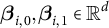 $\boldsymbol {\beta }_{i,0} , \boldsymbol {\beta }_{i,1} \in \mathbb {R}^d$
are unknown parameters representing the ideal point of legislator i on procedural and final passage votes, respectively, and d is the (maximum) dimension of the latent policy space, which is assumed to be known. This statistical model can be derived from a spatial voting model (Davis, Hinich, and Ordeshook Reference Davis, Hinich and Ordeshook1970; Enelow and Hinich Reference Enelow and Hinich1984) using the random utility framework of McFadden (Reference McFadden and Zarembka1973). It also mimics the structure of a logistic item response theory (IRT) model (Fox Reference Fox2010). However, unlike traditional IRT models, it allows for each legislator to have (in principle) different ideal points on each of the two voting domains.
$\boldsymbol {\beta }_{i,0} , \boldsymbol {\beta }_{i,1} \in \mathbb {R}^d$
are unknown parameters representing the ideal point of legislator i on procedural and final passage votes, respectively, and d is the (maximum) dimension of the latent policy space, which is assumed to be known. This statistical model can be derived from a spatial voting model (Davis, Hinich, and Ordeshook Reference Davis, Hinich and Ordeshook1970; Enelow and Hinich Reference Enelow and Hinich1984) using the random utility framework of McFadden (Reference McFadden and Zarembka1973). It also mimics the structure of a logistic item response theory (IRT) model (Fox Reference Fox2010). However, unlike traditional IRT models, it allows for each legislator to have (in principle) different ideal points on each of the two voting domains.
As we take a Bayesian approach to inference, we need to specify priors for the model parameters. Our approach to prior elicitation is similar to that in Bafumi et al. (Reference Bafumi, Gelman, Park and Kaplan2005), who advocate for the use of hierarchical priors. In particular, for the intercepts $\mu _1, \ldots , \mu _J$
, we let
$\mu _1, \ldots , \mu _J$
, we let
 $$ \begin{align*} \mu_j \mid \rho_\mu, \kappa^2_\mu & {\,\, \overset{\text{iid}}\sim} \,\, \mathsf{N}(\mu_j \mid \rho_\mu, \kappa^2_\mu), & j&=1, \ldots, J, \end{align*} $$
where $\mathsf {N}(\cdot \mid a, b^2)$
denotes the normal distribution with mean a and variance
$\mathsf {N}(\cdot \mid a, b^2)$
denotes the normal distribution with mean a and variance $b^2$
. The hyperparameters
$b^2$
. The hyperparameters $\rho _\mu $
and
$\rho _\mu $
and $\kappa ^2_\mu $
are then given normal and inverse gamma hyperpriors, respectively. On the other hand, for the discrimination parameters
$\kappa ^2_\mu $
are then given normal and inverse gamma hyperpriors, respectively. On the other hand, for the discrimination parameters $\boldsymbol {\alpha }_1, \ldots , \boldsymbol {\alpha }_J$
, we set
$\boldsymbol {\alpha }_1, \ldots , \boldsymbol {\alpha }_J$
, we set
 $$ \begin{align*} \alpha_{j,k} \mid \omega_\alpha, \kappa^2_\alpha &{\,\, \overset{\text{iid}}\sim} \,\, \omega_{\alpha,k} \delta_{0}(\alpha_{j,k}) + (1-\omega_{\alpha,k})\mathsf{N}(\alpha_{j,k} \mid 0,\kappa^2_\alpha), & j&=1,\ldots, J , & k=1,\ldots, d, \end{align*} $$
where $\delta _0$
is a point mass at
$\delta _0$
is a point mass at $0$
. This prior is completed by assigning an inverse gamma hyperprior on
$0$
. This prior is completed by assigning an inverse gamma hyperprior on $\kappa _{\alpha }^2$
and independent beta hyperpriors on
$\kappa _{\alpha }^2$
and independent beta hyperpriors on $\omega _{\alpha ,1}, \ldots , \omega _{\alpha ,d}$
. The use of zero-inflated Gaussian distributions for the discrimination parameters allows us to automatically handle unanimous votes without having to explicitly remove them from the dataset.
$\omega _{\alpha ,1}, \ldots , \omega _{\alpha ,d}$
. The use of zero-inflated Gaussian distributions for the discrimination parameters allows us to automatically handle unanimous votes without having to explicitly remove them from the dataset.
2.2 Testing Sharp Hypothesis About Differences in Ideal Points
We need to assign prior distributions to the ideal points of each legislator in each voting domain. The simplest alternative, independent priors across both legislators and domains, has several shortcomings. Most importantly, such an approach is (roughly) equivalent to fitting independent IRT models of the kind described in Jackman (Reference Jackman2001) for each domain. Under such an approach, the two latent spaces—the two sets of estimated ideal points in each domain—are unlinked and are therefore incomparable. Indeed, while an absolute scale can be created for each one of them independently by, for example, fixing the position of a small number of legislators on each of the scales separately or standardizing the ideal points, the only way to ensure comparability is to assume we know how the position of these legislators changes (or not) when moving from voting on procedural to final passage motions. While assumptions of this kind have been successfully used in the past (for example, by Shor et al. Reference Shor, Berry and McCarty2010), they are very strong. In particular, some of the natural bridge legislators (such as the party leaders) are those whose behavior might be of interest to study (e.g., see Roberts Reference Roberts2007).
Hence, in this article, we adopt an approach similar that of Lofand et al. (Reference Lofand, Rodriguez and Moser2017) and elicit a joint prior on the pairs $(\boldsymbol {\beta }_{i,0}, \boldsymbol {\beta }_{i,1})$
that explicitly accounts for the possibility that
$(\boldsymbol {\beta }_{i,0}, \boldsymbol {\beta }_{i,1})$
that explicitly accounts for the possibility that $\boldsymbol {\beta }_{i,0} = \boldsymbol {\beta }_{i,1}$
. In words, this condition means that legislator i has the same revealed preference in both voting domains. More specifically, we introduce a set of binary indicators
$\boldsymbol {\beta }_{i,0} = \boldsymbol {\beta }_{i,1}$
. In words, this condition means that legislator i has the same revealed preference in both voting domains. More specifically, we introduce a set of binary indicators $\zeta _1, \ldots , \zeta _I$
such that
$\zeta _1, \ldots , \zeta _I$
such that $\zeta _i = 1$
if and only if
$\zeta _i = 1$
if and only if $\boldsymbol {\beta }_{i,0} = \boldsymbol {\beta }_{i,1}$
, i.e., legislator i exhibits the same ideal point on both final passage and procedural votes, and
$\boldsymbol {\beta }_{i,0} = \boldsymbol {\beta }_{i,1}$
, i.e., legislator i exhibits the same ideal point on both final passage and procedural votes, and $\zeta _i=0$
otherwise. We call legislators for which
$\zeta _i=0$
otherwise. We call legislators for which $\zeta _i = 1$
bridges. Then, conditionally on
$\zeta _i = 1$
bridges. Then, conditionally on $\zeta _i \in \{0, 1\}$
, we let
$\zeta _i \in \{0, 1\}$
, we let
 $$ \begin{align} (\boldsymbol{\beta}_{i,0},\boldsymbol{\beta}_{i,1}) \mid \boldsymbol{\rho}_{\beta}, \boldsymbol{\Sigma}_{\beta}, \zeta_i & {\,\, \overset{\text{iid}}\sim} \,\, \begin{cases} \mathsf{N}\left(\boldsymbol{\beta}_{i,0} \mid \boldsymbol{\rho}_{\beta}, \boldsymbol{\Sigma}_{\beta} \right) \, \delta_{\boldsymbol{\beta}_{i,0}}\left(\boldsymbol{\beta}_{i,1}\right) & \zeta_i=1 , \\ \mathsf{N}\left(\boldsymbol{\beta}_{i,0} \mid\boldsymbol{\rho}_{\beta}, \boldsymbol{\Sigma}_{\beta}\right)\mathsf{N}\left(\boldsymbol{\beta}_{i,1}\mid\boldsymbol{\rho}_{\beta}, \boldsymbol{\Sigma}_{\beta}\right) & \zeta_i=0 \\ \end{cases} \end{align} $$
where, as before, $\delta _{a}(\cdot )$
denotes a point mass at a. When
$\delta _{a}(\cdot )$
denotes a point mass at a. When $\zeta _i=1$
, the prior is constructed by assigning a normal distribution to
$\zeta _i=1$
, the prior is constructed by assigning a normal distribution to $\boldsymbol {\beta }_{0,i}$
and then setting
$\boldsymbol {\beta }_{0,i}$
and then setting $\boldsymbol {\beta }_{1,i}=\boldsymbol {\beta }_{0,i}$
. On the other hand, when
$\boldsymbol {\beta }_{1,i}=\boldsymbol {\beta }_{0,i}$
. On the other hand, when $\zeta _i = 0$
and
$\zeta _i = 0$
and ${\boldsymbol {\beta }_{i,0} \ne \boldsymbol {\beta }_{i,1}}$
, the two ideal points
${\boldsymbol {\beta }_{i,0} \ne \boldsymbol {\beta }_{i,1}}$
, the two ideal points $\boldsymbol {\beta }_{i,0}$
and
$\boldsymbol {\beta }_{i,0}$
and $\boldsymbol {\beta }_{i,1}$
are assigned independent (albeit identical) priors. Using the same values of
$\boldsymbol {\beta }_{i,1}$
are assigned independent (albeit identical) priors. Using the same values of $\boldsymbol {\rho }_{\beta }$
and
$\boldsymbol {\rho }_{\beta }$
and $\boldsymbol {\Sigma }_{\beta }$
for both domains reflects the idea that all these ideal points live in linked latent policy spaces. The hyperparameters
$\boldsymbol {\Sigma }_{\beta }$
for both domains reflects the idea that all these ideal points live in linked latent policy spaces. The hyperparameters $\boldsymbol {\rho }_{\beta }$
and
$\boldsymbol {\rho }_{\beta }$
and $\boldsymbol {\Sigma }_{\beta }$
are learned from the data and given conditionally conjugate multivariate normal and inverse Wishart hyperpriors.
$\boldsymbol {\Sigma }_{\beta }$
are learned from the data and given conditionally conjugate multivariate normal and inverse Wishart hyperpriors.
When reliable prior information about the identity of the bridge legislators is available, then the indicators $\zeta _1 , \ldots , \zeta _I$
can be treated as known covariates. Furthermore, as long as at least
$\zeta _1 , \ldots , \zeta _I$
can be treated as known covariates. Furthermore, as long as at least $d+1$
bridges are available, the two latent scales (for procedural and for final passage votes) are comparable, addressing the remaining identifiability issues that anchoring is not able to address on its own. As we indicated before, this strategy is at the core of Shor et al. (Reference Shor, Berry and McCarty2010). Instead, in this article, we treat the indicators
$d+1$
bridges are available, the two latent scales (for procedural and for final passage votes) are comparable, addressing the remaining identifiability issues that anchoring is not able to address on its own. As we indicated before, this strategy is at the core of Shor et al. (Reference Shor, Berry and McCarty2010). Instead, in this article, we treat the indicators $\zeta _1 , \ldots , \zeta _I$
as unknown and devise a hierarchical prior that allows us to learn the identity of the bridge legislators and, more importantly for our goals, identify explanatory variables that are associated with revealing identical preferences on both voting domains.
$\zeta _1 , \ldots , \zeta _I$
as unknown and devise a hierarchical prior that allows us to learn the identity of the bridge legislators and, more importantly for our goals, identify explanatory variables that are associated with revealing identical preferences on both voting domains.
A consequence of this hierarchical formulation is that, for legislators that are determined to be bridges with very high probability, our model recovers a single ideal point that is quite close to what you would get if you were to fit (a logit, univariate version of) the model described in Jackman Reference Jackman2001. On the other hand, for legislators for which the bridging probability is very low, the model recovers ideal points that are different for procedural and final passage votes, with estimates within each domain based mostly (but not exclusively!) on the votes that were taken in that domain alone. For legislators in the middle, we recover a weighted average between these two extremes. To illustrate this feature of the model, we present in Figure 1 a comparison of the ideological ranks of legislators in procedural and final passage votes in the 111th U.S. House recovered from the ideal points estimated by our joint model, as well as by fitting independent models within each voting domain. Note that the right panel of Figure 1 is very noisy and it is hard to visually identify which legislators show consistent preferences across domains. On the other hand, the left panel shows a much cleaner picture, with legislators with high bridging probabilities (the vast majority) falling on a clear diagonal line.
Comparison of the ideological ranks of legislators in the 111th U.S. House of Representatives in procedural (x-axis) and final passage (y-axis) votes. The left panel shows the estimated obtained by fitting our joint model, while the right panel shows estimates obtained by fitting independent models within each voting domain. Blue circles represent Democrats, while red triangles represent Republican legislators.

2.3 Explaining Differences in Ideal Points
Previous approaches to identifying bridge legislators from data (e.g., Lofand et al. Reference Lofand, Rodriguez and Moser2017 and Moser et al. Reference Moser, Rodriguez and Lofand2021) have used exchangeable priors on the vector $\boldsymbol {\zeta } = (\zeta _1, \ldots , \zeta _I)$
to control for multiplicities (Scott and Berger Reference Scott and Berger2006, Reference Scott and Berger2010). Instead, this article considers a hierarchical prior that allows us to introduce explanatory variables and formally test whether they are associated with the probability that a particular legislator is a bridge. More specifically, let
$\boldsymbol {\zeta } = (\zeta _1, \ldots , \zeta _I)$
to control for multiplicities (Scott and Berger Reference Scott and Berger2006, Reference Scott and Berger2010). Instead, this article considers a hierarchical prior that allows us to introduce explanatory variables and formally test whether they are associated with the probability that a particular legislator is a bridge. More specifically, let $\boldsymbol {X}$
be an
$\boldsymbol {X}$
be an $I \times p$
design matrix of (centered) explanatory variables, with
$I \times p$
design matrix of (centered) explanatory variables, with $\boldsymbol {x}_i^T$
denoting the i-th row of
$\boldsymbol {x}_i^T$
denoting the i-th row of $\boldsymbol {X}$
, which in turn corresponds to the vector of observed explanatory variables associated with legislator
$\boldsymbol {X}$
, which in turn corresponds to the vector of observed explanatory variables associated with legislator $i=1,\ldots ,I$
. We model the individual
$i=1,\ldots ,I$
. We model the individual $\zeta _i$
s using a logistic regression of the form
$\zeta _i$
s using a logistic regression of the form
 $$ \begin{align} \zeta_i \mid \boldsymbol{x}_i, \eta_0, \boldsymbol{\eta} \sim \mathsf{Ber}\left( \zeta_i \, \Bigg | \, \frac{1}{1 + \exp\left\{ - \left( \eta_0 + \boldsymbol{x}_i^T \boldsymbol{\eta} \right)\right\}} \right) , \end{align} $$
where $\eta _0$
is an intercept and
$\eta _0$
is an intercept and $\boldsymbol {\eta } = (\eta _1, \ldots , \eta _p)^T$
is a p-dimensional vector of unknown regression coefficients.
$\boldsymbol {\eta } = (\eta _1, \ldots , \eta _p)^T$
is a p-dimensional vector of unknown regression coefficients.
In order to identify explanatory variables that affect the probability that a particular legislator is a bridge, we adopt a prior for $\boldsymbol {\eta }$
that allows for some coefficients to be exactly zero, effectively incorporating point mass priors. With this goal in mind, let
$\boldsymbol {\eta }$
that allows for some coefficients to be exactly zero, effectively incorporating point mass priors. With this goal in mind, let $\boldsymbol {\xi } = (\xi _1, \ldots , \xi _p)$
be a binary p-dimensional vector such that
$\boldsymbol {\xi } = (\xi _1, \ldots , \xi _p)$
be a binary p-dimensional vector such that $\xi _k = 1$
if variable k is included in the model (i.e., if
$\xi _k = 1$
if variable k is included in the model (i.e., if $\eta _k \ne 0$
) and
$\eta _k \ne 0$
) and $0$
otherwise (i.e., if
$0$
otherwise (i.e., if $\eta _k = 0$
). Also, let
$\eta _k = 0$
). Also, let $\boldsymbol {X}_{\boldsymbol {\xi }}$
be the matrix created by retaining the columns of
$\boldsymbol {X}_{\boldsymbol {\xi }}$
be the matrix created by retaining the columns of $\boldsymbol {X}$
for which the corresponding entries of
$\boldsymbol {X}$
for which the corresponding entries of $\boldsymbol {\xi }$
are equal to 1 and, similarly, let
$\boldsymbol {\xi }$
are equal to 1 and, similarly, let $\boldsymbol {\eta }_{\boldsymbol {\xi }}$
be the vector made of the entries of
$\boldsymbol {\eta }_{\boldsymbol {\xi }}$
be the vector made of the entries of $\boldsymbol {\eta }$
for which the corresponding entries of
$\boldsymbol {\eta }$
for which the corresponding entries of $\boldsymbol {\xi }$
are equal to 1. Then, conditional on
$\boldsymbol {\xi }$
are equal to 1. Then, conditional on $\boldsymbol {\xi }$
, the prior for
$\boldsymbol {\xi }$
, the prior for $\boldsymbol {\eta }$
takes the form
$\boldsymbol {\eta }$
takes the form
 $$ \begin{align*} f(\boldsymbol{\eta} \mid \boldsymbol{\xi}, \boldsymbol{X}) = f(\boldsymbol{\eta}_{\boldsymbol{\xi}} \mid {\boldsymbol{\xi}}, \boldsymbol{X}_{\boldsymbol{\xi}}) \prod_{\{ k : \xi_k = 0\}} \delta_{0} (\eta_k) , \end{align*} $$
where $\delta _0(\cdot )$
again denotes a point mass at zero, and
$\delta _0(\cdot )$
again denotes a point mass at zero, and $f(\boldsymbol {\eta }_{\boldsymbol {\xi }})$
corresponds to a g-prior of the form
$f(\boldsymbol {\eta }_{\boldsymbol {\xi }})$
corresponds to a g-prior of the form
 $$ \begin{align} \eta_{\boldsymbol{\xi}} \mid g, \boldsymbol{\xi}, \boldsymbol{X}_{\boldsymbol{\xi}} \sim N\left(\eta_{\boldsymbol{\xi}} \, \Big | \, 0, 4 g \left(\boldsymbol{X}_{\boldsymbol{\xi}}^T \boldsymbol{X}_{\boldsymbol{\xi}} \right)^{-1}\right). \end{align} $$
In the sequel, we work with $g=I$
, which means that (4) can be interpreted as an (approximately) unit information prior under an imaginary training sample (see Sabanés Bové, and Held Reference Sabanés Bové and Held2011 and Porwal and Rodriguez Reference Porwal and Rodriguez2023 for additional details).
$g=I$
, which means that (4) can be interpreted as an (approximately) unit information prior under an imaginary training sample (see Sabanés Bové, and Held Reference Sabanés Bové and Held2011 and Porwal and Rodriguez Reference Porwal and Rodriguez2023 for additional details).
Finally, we follow Scott and Berger (Reference Scott and Berger2010) and use a Beta-Binomial prior for $\boldsymbol {\xi }$
,
$\boldsymbol {\xi }$
,
 $$ \begin{align} f(\boldsymbol{\xi}) = \frac{\Gamma\left(p^*_{\boldsymbol{\xi}} + 1 \right)\Gamma\left(p - p^*_{\boldsymbol{\xi}} + 1\right)}{\Gamma( p + 2)} = \int_0^1 \upsilon^{p^*_{\boldsymbol{\xi}}} (1 - \upsilon)^{p - p^*_{\boldsymbol{\xi}}} d \upsilon, \end{align} $$
where $p^*_{\boldsymbol {\xi }}=\sum _{k=1}^p \xi _k$
is the size of the model. This prior has several advantages. One of them is interpretability. As the last equality in (5) shows, it can be interpreted as the result of assuming a common (but unknown) prior probability of inclusion
$p^*_{\boldsymbol {\xi }}=\sum _{k=1}^p \xi _k$
is the size of the model. This prior has several advantages. One of them is interpretability. As the last equality in (5) shows, it can be interpreted as the result of assuming a common (but unknown) prior probability of inclusion $\upsilon $
for every variable in the model, and then assigning
$\upsilon $
for every variable in the model, and then assigning $\upsilon $
a uniform distribution. Hence, it implies that the marginal probability of inclusion for each variable is
$\upsilon $
a uniform distribution. Hence, it implies that the marginal probability of inclusion for each variable is $1/2$
. However, because the entries of
$1/2$
. However, because the entries of $\boldsymbol {\xi }$
are correlated, the prior induces multiplicity control by assigning a uniform distribution on the size of the model
$\boldsymbol {\xi }$
are correlated, the prior induces multiplicity control by assigning a uniform distribution on the size of the model $p^*_{\boldsymbol {\xi }}$
(see Scott and Berger Reference Scott and Berger2010 for additional details).
$p^*_{\boldsymbol {\xi }}$
(see Scott and Berger Reference Scott and Berger2010 for additional details).
The model is completed by specifying the prior for the intercept $\eta _0$
. Because of the hierarchical nature of our model, we avoid the use of improper flat priors and instead adopt a standard logistic prior with density
$\eta _0$
. Because of the hierarchical nature of our model, we avoid the use of improper flat priors and instead adopt a standard logistic prior with density
 $$ \begin{align*}f(\eta_0) = \frac{\exp\left\{ \eta_0 \right\}}{ \left( 1 + \exp\left\{ \eta_0 \right\} \right)^2}. \end{align*} $$
Employing a prior for $\eta _0$
that is independent of the prior on
$\eta _0$
that is independent of the prior on $\boldsymbol {\eta }_{\boldsymbol {\xi }}$
is natural in this case because we work with a centered design matrix
$\boldsymbol {\eta }_{\boldsymbol {\xi }}$
is natural in this case because we work with a centered design matrix $\boldsymbol {X}$
. The choice of a logistic prior implies that, under the null model where none of the variables affect the bridging probabilities, the implied prior on
$\boldsymbol {X}$
. The choice of a logistic prior implies that, under the null model where none of the variables affect the bridging probabilities, the implied prior on $\Pr (\zeta _i = 1)$
reduces to a uniform distribution on the
$\Pr (\zeta _i = 1)$
reduces to a uniform distribution on the $[0,1]$
interval. Hence, under the null model, this approach is roughly equivalent to that of Lofand et al. (Reference Lofand, Rodriguez and Moser2017). Another important feature of this prior is that it typically leads to stable estimates in the presence of separation (e.g., see Boonstra, Barbaro, and Sen Reference Boonstra, Barbaro and Sen2019). This is important because separation is a potential concern in our setting (particularly for Houses in which the number of bridges is very high), and because the latent nature of
$[0,1]$
interval. Hence, under the null model, this approach is roughly equivalent to that of Lofand et al. (Reference Lofand, Rodriguez and Moser2017). Another important feature of this prior is that it typically leads to stable estimates in the presence of separation (e.g., see Boonstra, Barbaro, and Sen Reference Boonstra, Barbaro and Sen2019). This is important because separation is a potential concern in our setting (particularly for Houses in which the number of bridges is very high), and because the latent nature of $\boldsymbol {\zeta }_i$
makes it impossible to check for the presence of separation before fitting our model.Footnote
2
$\boldsymbol {\zeta }_i$
makes it impossible to check for the presence of separation before fitting our model.Footnote
2
3 Computation
Posterior inference is carried out using a Markov chain Monte Carlo (MCMC) algorithm. Our approach relies heavily on the data augmentation approach introduced in Polson, Scott, and Windle (Reference Polson, Scott and Windle2013). More specifically, we rely on the fact that the Bernoulli likelihood can be written as a mixture of the form
 $$ \begin{align*} \frac{\exp\left\{ z_i \psi_i \right\}} {1+\exp{\left\{\psi_i\right\}}} & \propto\exp\left\{(z_i - 1/2) \psi_i \right\}\int_0^\infty \exp \left\{- \frac{\omega_i}{2} \psi_i^2 \right\}f_{PG}(\omega_i \mid 1,0) d\omega_i , \end{align*} $$
where $f_{PG}(\omega \mid a,b)$
denotes the density of a Pòlya-Gamma random variable with parameters a and b. We use this data augmentation twice in our algorithm: once for the likelihood of the observed data in (1), and then again for the distribution of the bridge indicators in (3).
$f_{PG}(\omega \mid a,b)$
denotes the density of a Pòlya-Gamma random variable with parameters a and b. We use this data augmentation twice in our algorithm: once for the likelihood of the observed data in (1), and then again for the distribution of the bridge indicators in (3).
Introducing Pòlya-Gamma auxiliary variables dramatically simplifies the formulation of our computational algorithm. As a consequence, most of the full conditionals of interest can be sampled directly (i.e., most of the steps of our MCMC algorithm reduce to Gibbs sampling steps). The only two exceptions are the full conditional posterior distribution for $\eta _0$
, which does not belong to a known family, and the full conditional posterior distribution for
$\eta _0$
, which does not belong to a known family, and the full conditional posterior distribution for $(\boldsymbol {\xi }, \boldsymbol {\eta })$
, which is a mixture with an unmanageable number of components. For
$(\boldsymbol {\xi }, \boldsymbol {\eta })$
, which is a mixture with an unmanageable number of components. For $\eta _0$
, we develop a Metropolis–Hastings algorithm with heavy-tailed independent proposals (as opposed to a random-walk Metropolis–Hastings) that has a very high acceptance rate. For
$\eta _0$
, we develop a Metropolis–Hastings algorithm with heavy-tailed independent proposals (as opposed to a random-walk Metropolis–Hastings) that has a very high acceptance rate. For $(\boldsymbol {\xi },\boldsymbol {\eta })$
, we use a random walk Metropolis–Hastings proposal for the marginal full conditional of
$(\boldsymbol {\xi },\boldsymbol {\eta })$
, we use a random walk Metropolis–Hastings proposal for the marginal full conditional of $\boldsymbol {\xi }$
obtained after integrating out
$\boldsymbol {\xi }$
obtained after integrating out $\boldsymbol {\eta }$
, and then sample
$\boldsymbol {\eta }$
, and then sample $\boldsymbol {\eta }$
directly from its Gaussian full conditional distribution. For additional details, please see the implementation available at https://github.com/e-lipman/ProcFinalUSHouse.
$\boldsymbol {\eta }$
directly from its Gaussian full conditional distribution. For additional details, please see the implementation available at https://github.com/e-lipman/ProcFinalUSHouse.
As is customary, we use the empirical averages of the posterior samples to approximate posterior summaries of interest. An aggregate assessment of the similarity in voting patterns across domains on a given dataset can be obtained by computing the bridging frequency (BF), defined as
 $$ \begin{align} BF = \frac{1}{I} \sum_{i=1}^{I} \zeta_i. \end{align} $$
Note that the posterior mean of the BF is simply $\mathbb {E}\left ( BF \mid \mbox {data}\right ) = \frac {1}{I} \sum _{i=1}^{I} \Pr (\zeta _i=1 \mid \mbox {data})$
, the average posterior probability that a legislator is a bridge. Given S samples from the posterior distribution,
$\mathbb {E}\left ( BF \mid \mbox {data}\right ) = \frac {1}{I} \sum _{i=1}^{I} \Pr (\zeta _i=1 \mid \mbox {data})$
, the average posterior probability that a legislator is a bridge. Given S samples from the posterior distribution, $\boldsymbol {\zeta }^{(1)}, \ldots , \boldsymbol {\zeta }^{(S)}$
,
$\boldsymbol {\zeta }^{(1)}, \ldots , \boldsymbol {\zeta }^{(S)}$
,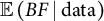 $\mathbb {E}\left ( BF \mid \mbox {data}\right )$
can be estimated as
$\mathbb {E}\left ( BF \mid \mbox {data}\right )$
can be estimated as $\frac {1}{SI}\sum _{s=1}^{S}\sum _{i=1}^{I}\zeta _i^{(s)}$
. It is important to distinguish
$\frac {1}{SI}\sum _{s=1}^{S}\sum _{i=1}^{I}\zeta _i^{(s)}$
. It is important to distinguish $\Pr (\zeta _i=1 \mid \mbox {data})$
from the posterior mean of the covariate-adjusted prior probability that a legislator characterized by the covariate vector
$\Pr (\zeta _i=1 \mid \mbox {data})$
from the posterior mean of the covariate-adjusted prior probability that a legislator characterized by the covariate vector $\boldsymbol {x}_i$
is a bridge (recall equation (3)). See Section 1 of the Supplementary Material for further discussion. Similarly, we can summarize the posterior distribution on the various logistic regression models through the posterior inclusion probabilities (PIPs) associated with each variable in the design matrix
$\boldsymbol {x}_i$
is a bridge (recall equation (3)). See Section 1 of the Supplementary Material for further discussion. Similarly, we can summarize the posterior distribution on the various logistic regression models through the posterior inclusion probabilities (PIPs) associated with each variable in the design matrix $\boldsymbol {X}$
. The PIP for variable k is the posterior probability that such variable is included in the regression model, and it is estimated as
$\boldsymbol {X}$
. The PIP for variable k is the posterior probability that such variable is included in the regression model, and it is estimated as
 $$ \begin{align} \Pr(\xi_k=1 \mid \mbox{data})=\mathbb{E}\left\{ \xi_k \mid \mbox{data} \right\} \approx \frac{1}{S} \sum_{s=1}^{S} \xi_k^{(s)} , \end{align} $$
where, as before, S represents the total number of samples drawn from the posterior distribution and $\xi _k^{(s)}$
denotes the s-th sampled value for the parameter
$\xi _k^{(s)}$
denotes the s-th sampled value for the parameter $\xi _k$
. PIPs provide a measure of the uncertainty associated with the influence of any given explanatory variable on the probability that a legislator is a bridge. Point and interval estimates of other quantities of interest can be obtained in a similar way.
$\xi _k$
. PIPs provide a measure of the uncertainty associated with the influence of any given explanatory variable on the probability that a legislator is a bridge. Point and interval estimates of other quantities of interest can be obtained in a similar way.
3.1 Parameter Identifiability
Since (1) is invariant to translations, rescaling, and rotations of the policy space, the $\mu _i$
s,
$\mu _i$
s, $\alpha _j$
s,
$\alpha _j$
s, $\beta _{i,0}$
s, and
$\beta _{i,0}$
s, and $\beta _{i,1}$
s are not identified. Hence, if we are interested in performing inferences on them, we need to be careful with how the samples from the MCMC algorithm are used to construct the empirical averages that serve as posterior summaries.
$\beta _{i,1}$
s are not identified. Hence, if we are interested in performing inferences on them, we need to be careful with how the samples from the MCMC algorithm are used to construct the empirical averages that serve as posterior summaries.
In this article, three sets of identifiability constraints are enforced to ensure that parameters are identifiable. We note that these are enforced after each iteration of the MCMC algorithm rather than through constrained priors. This approach is often referred to in the literature as parameter expansion (Liu and Wu Reference Liu and Wu1999; Schliep and Hoeting Reference Schliep and Hoeting2015). The first set of constraints refers to the need to have at least $d+1$
bridges, where d is the dimension of the policy space. This ensures that the scales associated with the two voting domains are comparable (e.g., see Rivers Reference Rivers2003). In practice, the posterior distributions puts all of its mass on much larger numbers of bridges for all the datasets discussed in Section 4.2, which means that the constraint is never binding and no adjustment to the posterior samples was required in any of the datasets we analyzed. A second set of identifiability constraints requires that both scales should point in the “same direction” (e.g., Republican legislators should tend to have positive values on both scales). This can be easily accomplished by enforcing a common sign (but not necessarily a common value) for the two ideal points (procedural and final passage) associated with a small number of carefully selected legislators. A third set of constraints is associated with identifying the absolute scale, and is enforced by translating and scaling the ideal points of the legislators so that
$d+1$
bridges, where d is the dimension of the policy space. This ensures that the scales associated with the two voting domains are comparable (e.g., see Rivers Reference Rivers2003). In practice, the posterior distributions puts all of its mass on much larger numbers of bridges for all the datasets discussed in Section 4.2, which means that the constraint is never binding and no adjustment to the posterior samples was required in any of the datasets we analyzed. A second set of identifiability constraints requires that both scales should point in the “same direction” (e.g., Republican legislators should tend to have positive values on both scales). This can be easily accomplished by enforcing a common sign (but not necessarily a common value) for the two ideal points (procedural and final passage) associated with a small number of carefully selected legislators. A third set of constraints is associated with identifying the absolute scale, and is enforced by translating and scaling the ideal points of the legislators so that $d+1$
of them (the anchors) are fixed to specific values in one of the voting domains. Again, see Rivers Reference Rivers2003.
$d+1$
of them (the anchors) are fixed to specific values in one of the voting domains. Again, see Rivers Reference Rivers2003.
In our application, we consider a one-dimensional latent space (i.e., $d=1$
). In that case, identifiability is guaranteed by enforcing the presence of exactly two anchors and at least two bridges, and by restricting the sign of the Republican whip to be positive on both scales. Intuitively, fixing the position of the first bridge/anchor addresses invariance to translations, fixing the position of the second addresses invariance to rescaling, and fixing the sign of a legislator in both scales addresses invariance to rotations (which, in a one-dimensional setting, reduce to reflexions).
$d=1$
). In that case, identifiability is guaranteed by enforcing the presence of exactly two anchors and at least two bridges, and by restricting the sign of the Republican whip to be positive on both scales. Intuitively, fixing the position of the first bridge/anchor addresses invariance to translations, fixing the position of the second addresses invariance to rescaling, and fixing the sign of a legislator in both scales addresses invariance to rotations (which, in a one-dimensional setting, reduce to reflexions).
4 Example Application: Procedural and Final Passage Voting in the U.S. House of Representatives, 1973–2014
In this section, we apply our model to voting in the U.S. House of Representatives across two distinct domains: procedural motions and final passage motions.
Procedural and final passage votes represent distinct phases of the legislative process, each shaped by differing strategic and substantive motivations. Procedural votes, often structured by party leadership to manage the legislative agenda, are strategic tools used by the majority party to control the legislative process and ensure that only bills with majority support reach the floor (Cox and McCubbins Reference Cox and McCubbins2005). These votes are more susceptible to strategic voting, as legislators may align with party strategy to secure procedural advantages or preserve future bargaining power (Roberts and Smith Reference Roberts and Smith2003), and therefore tend to exhibit higher levels of party discipline and polarization. Final passage votes, on the other hand, concern the actual approval of legislation and reflect substantive policy decisions. While these votes can still be partisan, they often showcase individual legislators’ ideological positions and constituency interests more directly and present fewer opportunities for strategic maneuvering (Jessee and Theriault Reference Jessee and Theriault2014). This distinction makes the application of our model across these two domains particularly valuable. Consistent voting patterns on final passage votes reveal the majority party’s ability to maintain support from the procedural stage to the final passage (Schickler Reference Schickler2001), as legislators might break with their party on final passage votes to align more closely with their constituents’ preferences or personal ideological beliefs (Carson et al. Reference Carson, Crespin and Madonna2014).
Scholars have long been interested in the influences on legislators’ voting in the U.S. Congress. We focus on three classes of explanations. Broadly, scholars have studied three classes of covariates when explaining legislative voting behavior: constituency-level characteristics (how conservative/liberal is a member’s district? Are there military bases located in their district? How much agricultural activity takes place?) (Ansolabehere, Snyder Jr., and Stewart III Reference Ansolabehere, Snyder and Stewart2001; Carson, Koger, and Lebo Reference Carson, Koger and Lebo2006); legislator-level characteristics (is the member male or female? Is the member from a “safe district?”) and; what we call chamber-level characteristics (is the member in the majority party? Was electronic voting used in the chamber or not? Under what rule was the roll call taken?).Footnote 3
In general, legislators must balance the competing interests of their constituents, their political parties, interest groups, and their own ideological beliefs. Constituent interests play a significant role in legislative voting (López and Todd Jewell Reference López and Todd Jewell2007). Political parties also strongly influence how legislators vote (Hix and Noury Reference Hix and Noury2016). Public interest lobbies, ideology, and PAC contributions also predict legislative voting (Kau and Rubin Reference Kau and Rubin2013). Constituency matters (Bond and Fleisher Reference Bond and Fleisher2002; Fleisher and Bond Reference Fleisher and Bond2004), while gender does not seem to have an effect on legislative voting (Schwindt-Bayer and Corbetta Reference Schwindt-Bayer and Corbetta2004). We return to these general findings when discussing our results (Section 4.2).
By estimating (potentially) separate ideal points for procedural and final passage votes, our model captures differences in legislators’ behavior that arguably stem from strategic versus sincere voting. These differences are not necessarily indicative of distinct ideological biases, but instead reflect the differing incentives faced at each stage of the legislative process. Importantly, the model allows us to identify “bridging” legislators who exhibit consistency across both domains, thereby highlighting those who maintain stable preferences despite the strategic nature of procedural voting. This approach provides a framework for understanding how factors such as party discipline and constituency pressures influence behavior in contexts where voting incentives may vary.
4.1 Data
This section describes the data that serves as the basis for our illustration and provides a brief descriptive analysis. Similar to Jessee and Theriault (Reference Jessee and Theriault2014), we consider the roll-call voting records in the U.S. House of Representatives over an extended period of 42 years that starts with the 93rd Congress (in session between January 1973 and January 1975). This coincides with the introduction of electronic voting in the House, which led to a marked increase in the number of roll-call votes, as well as a change in their nature (Jessee and Theriault Reference Jessee and Theriault2014). Our analysis extends to the 113th Congress, which is as far as our data sources on potential covariates extend (please see below).
In our analysis, we consider a broad panel of 21 variables as potentially explaining the tendency of individual legislators to reveal identical preferences across both procedural and final passage votes, many of which had not been considered before in the context of this application.Footnote 4 The constituency-level covariates include measures of racial diversity and economic inequality, as well as the political leaning of the constituency. Political leaning is measured by the percentage of the district’s vote that went to the Republican candidate in the most recent presidential election. The legislator-level covariates include age, gender, and race, as well as measures of activity while in office, such as the number of sponsored bills. The chamber-level covariates include whether the legislator’s party was in the majority. Figure 2 presents the correlation matrices for the covariates associated with four different Houses. Overall, correlations seem to be low, and the highest appear to be among constituency-related covariates.
Correlation plots for the regression matrices associated with four Houses under study: the 93rd, 98th, 103rd, and 108th Houses.

Finally, in order to explore the role that party affiliation might play in voting behavior on procedural and final passage votes, Figure 3 presents the median (across legislators) of the proportion of times that each legislator voted with their party, broken down by vote type and party. We can see that the value has been historically high (generally over 80%), and that there is also evidence of an increasing trend over time. This increase is particularly dramatic for the Republican party during the 104th House, when the percentage jumps by about 10% for both types of votes. This observation is consistent with previous literature pointing out that party influence on legislator’s voting behaviors has been variable over time (e.g., see Aldrich Reference Aldrich1995 and Sinclair Reference Sinclair2006). We also observe that the percentage is often (but not always) slightly higher for procedural than for final passage votes. Again, this observation is consistent with previous literature suggesting that party influence in the U.S. House of Representatives tends to be higher on procedural votes (e.g., see Lee Reference Lee2009; Roberts Reference Roberts2007; Roberts and Smith Reference Roberts and Smith2003 and Gray and Jenkins Reference Gray and Jenkins2022)Footnote 5 . Finally, we note that vote cohesion has tended to be higher (for both vote types) for the party in the majority.
Percentage of legislators in each party voting with the party majority. Shown separately for procedural and final passage votes. Shaded regions represent sessions with a Republican majority and unshaded regions represent sessions with a Democratic majority.

4.2 Results
This section reports the results obtained by applying the model described in Section 2 to the data just described. We verify convergence of our algorithm by running four chains for each House, started at over-dispersed initial values. For each chain, we monitor the trace plot and the Gelman-Rubin statistic (Gelman and Rubin Reference Gelman and Rubin1992; Vats and Knudson Reference Vats and Knudson2021) of the (unnormalized) joint posterior distribution of all parameters, the total number of bridge legislators, $\zeta _{\cdot } = \sum _{i=1}^{I} \zeta _i$
(as well as the number of bridge legislators broken down by party affiliation), the value of the linear predictor
$\zeta _{\cdot } = \sum _{i=1}^{I} \zeta _i$
(as well as the number of bridge legislators broken down by party affiliation), the value of the linear predictor $\eta _0 + \boldsymbol {x}_i^T\boldsymbol {\eta }$
for each legislator, and the number of predictors in the model,
$\eta _0 + \boldsymbol {x}_i^T\boldsymbol {\eta }$
for each legislator, and the number of predictors in the model, $p^{*}_{\xi }$
. Most of the posterior distributions seem to be unimodal and the MCMC algorithm seems to converge reasonably quickly in almost all cases. The one exception is the 105th House. Unlike the other Houses under study, the posterior distribution of the model size
$p^{*}_{\xi }$
. Most of the posterior distributions seem to be unimodal and the MCMC algorithm seems to converge reasonably quickly in almost all cases. The one exception is the 105th House. Unlike the other Houses under study, the posterior distribution of the model size $p^{*}_{\boldsymbol {\xi }}$
appears to be bimodal in this case. The dominant mode favors relatively small models that include between 2 and 5 variables, while the second mode favors large models that can have up to 15 explanatory variables. These two modes also manifest themselves in the posterior distribution of
$p^{*}_{\boldsymbol {\xi }}$
appears to be bimodal in this case. The dominant mode favors relatively small models that include between 2 and 5 variables, while the second mode favors large models that can have up to 15 explanatory variables. These two modes also manifest themselves in the posterior distribution of $\boldsymbol {\zeta }$
, with the dominant mode supporting what appears to be a superset of the bridges supported by the lower-probability one. The results discussed below are based on 25,000 samples for each House, obtained after a burn-in period of 15,000 iterations and after thinning the chain every three iterations.
$\boldsymbol {\zeta }$
, with the dominant mode supporting what appears to be a superset of the bridges supported by the lower-probability one. The results discussed below are based on 25,000 samples for each House, obtained after a burn-in period of 15,000 iterations and after thinning the chain every three iterations.
In this analysis, we utilize a one dimensional policy space, i.e., $d=1$
. We assign
$d=1$
. We assign $\rho _{\mu }$
and
$\rho _{\mu }$
and $\rho _{\beta }$
standard Gaussian priors, and
$\rho _{\beta }$
standard Gaussian priors, and $\kappa ^2_{\mu }$
,
$\kappa ^2_{\mu }$
, $\kappa ^2_{\alpha }$
, and
$\kappa ^2_{\alpha }$
, and $\Sigma _{\beta }^2$
inverse Gamma priors with shape parameters 2 and scale parameter 1 (so that they have mean 1 and infinite variance). This choice is consistent with the logic underlying the logistic scale and with the recommendations in Bafumi et al. (Reference Bafumi, Gelman, Park and Kaplan2005). Furthermore, we assign
$\Sigma _{\beta }^2$
inverse Gamma priors with shape parameters 2 and scale parameter 1 (so that they have mean 1 and infinite variance). This choice is consistent with the logic underlying the logistic scale and with the recommendations in Bafumi et al. (Reference Bafumi, Gelman, Park and Kaplan2005). Furthermore, we assign $\omega _{\alpha }$
a uniform distribution. To investigate the sensitivity of the model to prior choices, we consider a few alternative prior specifications for the key regression parameters
$\omega _{\alpha }$
a uniform distribution. To investigate the sensitivity of the model to prior choices, we consider a few alternative prior specifications for the key regression parameters $\eta _0$
and
$\eta _0$
and $\boldsymbol {\eta }_{\boldsymbol {\xi }}$
. In particular, we explored replacing the logistic prior for
$\boldsymbol {\eta }_{\boldsymbol {\xi }}$
. In particular, we explored replacing the logistic prior for $\eta _0$
with a standard Gaussian prior and replacing the g-prior on
$\eta _0$
with a standard Gaussian prior and replacing the g-prior on $\boldsymbol {\eta }$
with a mixture of g-priors that relies on the robust prior developed in Bayarri et al. (Reference Bayarri, Berger, Forte and Garcıa-Donato2012). The results were quite robust to these changes, although we do note that the mixture of g-priors tended to favor slightly lower inclusion probabilities for most of the variables. To explore the sensitivity of the model to mis-specification of the linking regression, we also compare the bridging frequencies and the identity of the bridges identified by our model with those generated by a version of the model that does not incorporate any covariates. Again, the results seem reasonably robust. Details of this comparison can be seen in Section 2 of the Supplementary Material.
$\boldsymbol {\eta }$
with a mixture of g-priors that relies on the robust prior developed in Bayarri et al. (Reference Bayarri, Berger, Forte and Garcıa-Donato2012). The results were quite robust to these changes, although we do note that the mixture of g-priors tended to favor slightly lower inclusion probabilities for most of the variables. To explore the sensitivity of the model to mis-specification of the linking regression, we also compare the bridging frequencies and the identity of the bridges identified by our model with those generated by a version of the model that does not incorporate any covariates. Again, the results seem reasonably robust. Details of this comparison can be seen in Section 2 of the Supplementary Material.
4.2.1 Aggregate Analysis
We begin with a chamber-level analysis that provides some context for the legislator-level analysis discussed in the next section. Figure 4 shows the posterior mean and 95% credible intervals for the BF for each House (recall Equation (6)). Figure 4 suggests a decline in bridging frequencies during the 1970s and 1980s (roughly the 96th–100th Houses), followed by a steady increase starting perhaps with the 102nd House (1991–1992). The decrease in the number of legislators that vote differently on procedural and final passage votes has at least two potential explanations, each one addressing a different aspect of the competing principals dilemma (e.g., see Carey Reference Carey2007 and Maltzman Reference Maltzman1998). One explanation, which is consistent with the arguments in Jessee and Theriault (Reference Jessee and Theriault2014), is that party influence on final passage votes has increased since the early 1990s. Under this interpretation, our results provide support for the “procedural cartel” theory of political parties (e.g., see Cox and McCubbins Reference Cox and McCubbins2005 and Clark Reference Clark2012). An alternative explanation is provided by constituency pressure. Increasing polarization within congressional districts driven (among other factors) by the sorting of political identities along the urban/rural divide and by aggressive gerrymandering, has resulted in fewer competitive districts overall. There is evidence that fewer competitive districts have meant fewer opportunities for moderate candidates (Barber and McCarty Reference Barber, McCarty, Mansbridge and Martin2015; Thomsen Reference Thomsen2014, Reference Thomsen2017). This has, in turn, led to primary elections having an outsized impact on the final outcome of congressional elections (Abramowitz and Saunders Reference Abramowitz and Saunders2008; Bafumi and Herron Reference Bafumi and Herron2010; Hall and Thompson Reference Hall and Thompson2018; Kaufmann, Gimpel, and Hofman Reference Kaufmann, Gimpel and Hofman2003). In this context, there are strong incentives for legislators to vote consistently across domains, independently of any leadership pressure.
Posterior means and 95% credible intervals for the BF in the U.S. House of Representatives from the 93rd through 113th sessions of congress. Shaded regions represent sessions with a Republican majority and unshaded regions represent sessions with a Democratic majority.

4.2.2 Legislator-Level Analysis: Explaining the Bridges
The inclusion of constituency-level covariates in our model allows for a detailed examination of how constituency characteristics influence legislators’ voting behavior across domains. This approach builds on the work of Fleisher and Bond (Reference Fleisher and Bond2004), who highlighted the importance of constituency characteristics in legislative voting. Our model’s ability to incorporate such covariates enables a nuanced analysis of the trade-offs legislators make between party pressures and constituency interests, especially in swing or moderate districts. For example, legislators representing moderate or swing constituencies may exhibit variation in their ideal points across different voting domains, reflecting a need to balance party pressures with constituency interests. Hence, we turn our attention now to the identification of variables that explain bridging. Figure 5 shows the number of variables with a posterior inclusion probabilities (PIPs) greater than 0.5 for each House (recall Equation (7)). In almost all cases, this number is between 0 and 5 variables. The only outlier is the 109th House, in which 13 variables appear to be significant. This result was surprising. While the 109th House met for only 242 days (the fewest since World War II), neither the absolute nor the relative number of procedural and final passage votes appear to be particularly out of the ordinary. One notorious fact about this House is the large number of political scandals that affected its members, and particularly those in the Republican party. We speculate that the Republican majority leader Tom DeLay’s campaign finance scandal and his eventual resignation from Congress (along with the Bob Ney, Randy Cunningham, and Mark Foley scandals) might have led to a breakdown in Republican party discipline in the House. This breakdown in party discipline may have opened the way for other factors to explain bridging. In other words, the reduced influence of party cohesion during this period allowed for an interesting window into how extra-party factors, such as constituency characteristics, individual legislator attributes, and external political pressures, influenced (in)consistency in voting. This hypothesis seems consistent with the procedural cartel theory we discussed in the previous section, and supports the idea that party discipline might be the main driver behind the higher bridging frequencies, and not the smaller number of competitive districts.
Number of covariates included in the posterior median model for each House under consideration. Shading indicates congresses with a Republican majority.

Figure 6 shows the PIPs for each covariate in each House under study. The variable most commonly included in the model is belto.partyControl, the indicator of whether a given legislator belongs to the party in control of the House (its PIP is greater than 0.5 in 15 of the 21 Houses we studied, and is greater than 0.9 in all of these). Except for the 95th House, the coefficient associated with this variable is positive, with the model indicating that belonging to the party in control of the House increases the odds of being a bridge by a factor of anywhere between 3 and 375 (see Figure 7a). Another way to visualize this pattern is by reviewing raw bridging frequencies (recall Equation (6)) computed separately for each party (see Figure 8). Starting in 1985 (the 99th House), there is a clear pattern in which the BF of the party in control of Congress is higher (and, in some cases, much higher) than the BF for the minority party. This result should not be surprising in light of our previous discussions. For the majority party to have any hope of passing legislation, it needs to achieve a certain level of party cohesion not only on procedural, but also on final passage votes. Except perhaps in cases of very small majorities, the level of pressure on legislators from the minority party to toe the party line can be expected to be much lower (Pinnell Reference Pinnell2019; Ramey Reference Ramey2015; Roberts Reference Roberts2005).
Heatmap showing PIPs for each covariate in each House under study. Plus and minus signs indicate covariates with positive and negative posterior medians, respectively. Horizontal lines divide the covariates into groups: the three most commonly-selected covariates are in the top group, followed by legislator characteristics (middle), and the remaining constituency characteristics (bottom).

Posterior median and 95% credible intervals for the increase in odds ratios of being a bridge legislator for the three most important variables identified by our analysis.

Posterior mean and 95% credible intervals for the BF calculated separately for legislators in each party. Shaded regions represent sessions with a Republican majority and unshaded regions represent sessions with a Democratic majority.

The next two variables that are most commonly included in the model correspond to p_R_D and p_R_R, the interactions between the party affiliation of a legislator and the percentage of their district’s vote gathered by the Republican candidate in the most recent presidential election. The interaction associated with members of the Democratic party is included in the model in 8 of the 21 Houses under study and, in each of these cases, the associated coefficient is negative (indicating that, as their district leans more Republican, Democrats are less likely to be bridges). Over these eight Houses, a 5% increase in the percentage of the Republican vote in the most recent presidential election decrease the odds of a Democratic legislator being a bridge by a factor of between 1.4 and 4.3 (see Figure 7b). On the other hand, the coefficient for members of the Republican party is included in the model for nine Houses. In 8 of those cases, the coefficient is now positive. The exception is the 109th House which, as we mentioned above, seems to be an overall outlier. A 5% increase in the percentage of the Republican vote in the most recent presidential election increases the odds of a Republican legislator being a bridge by a factor of between 1.3 and 3.4, roughly in line with what we observed for Democratic legislators (see Figure 7c). Taken together, these two results suggest that legislators representing more competitive districts are more likely to vote differently in procedural and final passage votes. This observation is consistent with the hypothesis that these legislators are subject to greater pressure from their constituents than legislators in safe districts.
The results we just discussed have similarities with those obtained from a regression analysis that uses as response variable the difference in log-odds of the frequency with which each legislators votes with is party on procedural and final passage votes (see Section 3 of the Supplementary Material). In particular, both approaches suggest that very few variables consistently explain the difference in voting behavior, and that party control of the House is a consistently significant variable. However, there are also key differences. One is the lack of consistency in the sign of the effect associated with party control. More troubling, of the 15 Houses for which this effect appears to be significant in the alternative analysis, it is positive only in six of them. The second one is the fact that the effect of the percentage of vote for the Republican candidate in the most recent presidential election only appears to be significant for two Houses under this alternative analysis. That is, an exclusive focus on party-line vote “misses” the importance of p_R_D—the interaction between Democratic party membership and percent of constituency voting Republican (in previous presidential election) in explaining consistency of voting (across procedural and final passage voting domains). Unlike the results generated by our model, those from this alternative analysis would seem to contradict some of the literature discussed above.
5 Further Applications
The hierarchical Bayesian model developed in this article offers a robust and flexible framework for analyzing legislative behavior across various contexts. Its ability to simultaneously scale ideal points and identify explanatory covariates makes it a valuable tool for researchers studying the complexities of legislative decision-making. This model can significantly enhance our understanding of legislative voting patterns by allowing for the identification of covariates that explain differences in legislators’ ideal points across different voting domains. The versatility of the model makes it applicable to numerous research areas, some of which we discuss here. This section outlines several potential applications of our methodology, demonstrating its versatility and relevance to existing literature.
Researchers can use our model to evaluate the impact of specific policies or events on legislative behavior. Analyzing voting patterns before and after significant political events or policy changes can reveal how these factors influence legislators’ consistency in different voting domains. For instance, examining voting behavior in response to major legislative reforms or political scandals can provide insights into how external events shape legislative decision-making and party cohesion (Norpoth Reference Norpoth1976).
Our model can also be used to study drivers of (in)consistent voting behavior between floor and committees (e.g., see Hamm Reference Hamm1982; Unekis Reference Unekis1978). Given the importance of committees in shaping legislation, understanding how decisions are made within them and why legislators might vote differently once measures get to the floor is of utmost importance in the study of legislatures.
While our primary demonstration utilizes data from the U.S. Congress, the methodology can be applied to multiparty systems, proportional representation systems, and other legislative contexts with different party structures and electoral rules. Researchers can use our model to study legislative behavior in these comparative contexts, exploring how factors such as coalition memberships and electoral thresholds influence voting behavior. For example, in multiparty systems or those with proportional representation, the model can be used to include context-specific covariates, such as coalition memberships and electoral thresholds (Hix and Noury Reference Hix and Noury2016; Hixon and Marshall Reference Hixon and Marshall2007). This adaptability underscores the broader applicability of our methodology beyond the specific context of the U.S. Congress.
In conclusion, by applying this model to different legislative systems, voting contexts, and time periods, scholars can gain a deeper and more nuanced understanding of the factors driving legislative behavior, enhancing the broader literature on political science and legislative studies.
6 Discussion
We have introduced a new class of hierarchical models that can be used to identify covariates that might explain why legislators vote differently across voting domains, and illustrated it by studying the differences in voting patterns between procedural and final passage votes in the U.S. House of Representatives. Our approach fully accounts for all the uncertainty associated with learning legislator’s revealed preferences across the multiple domains when testing for determinants of (in)consistent voting behavior.
Our empirical results add to the literatures on competing principals in legislative voting and on substantive versus procedural voting in the U.S. Congress. Like Carson et al. (Reference Carson, Crespin and Madonna2014), we find that party matters. This is also consistent with Fleisher and Bond (Reference Fleisher and Bond2004) and Bond and Fleisher (Reference Bond and Fleisher2002). We also find evidence that the constituency’s partisan leaning plays a role, which is consistent with Jessee and Theriault (Reference Jessee and Theriault2014). In as much as this translates into electoral considerations, our results are also consistent with Goodman and Nokken (Reference Goodman and Nokken2004). It is notable that we found that legislator-level characteristics such as gender and ethnicity do not seem to explain bridging behavior. As far as we know, this is a novel insight, which is nonetheless in line with the results of Schwindt-Bayer and Corbetta (Reference Schwindt-Bayer and Corbetta2004).Footnote 6 Our joint model seems to perform satisfactorily in most of the datasets we considered in Section 4. The one possible exception is the 109th House, where the model identifies a large number of variables as being potentially influential on the bridging probability. In our discussion of the results, we attributed this outlier to the unique nature of the political scandals that arose during this period. Indeed, while scandals of some sort are (sadly) not uncommon in the U.S. Congress, the nature of those occurring during the 109th House have a very particular significance in the context of our application, as they involved the highest echelons of the leadership of the party in control of the House. Nonetheless, there are potential alternative explanations for this outlier. One of them is model mis-specification. Our hierarchical model can be conceived as being made of two “modules” (roughly speaking, one that learns the bridges, and one that determines which factors explain those bridges). Recently, there has been growing interest on the impact that the mis-specification of one of the modules might have on overall model performance (e.g., see Jacob et al. Reference Jacob, Murray, Holmes and Robert2017 and Nott, Drovandi, and Frazier Reference Nott, Drovandi and Frazier2023). In our case, the most likely misspecified module is the one that recovers the preferences of legislators from their voting records. Indeed, recent evidence (e.g., see Duck-Mayr and Montgomery Reference Duck-Mayr and Montgomery2022; Yu and Rodriguez Reference Yu and Rodriguez2021 and Lei and Rodriguez Reference Lei and Rodriguez2025) suggests that standard IRT models such as that in Jackman (Reference Jackman2001) might fail to accurately capture the preferences of some legislators when those located at different extremes of the political spectrum tend to vote together against the more moderate legislators. Solutions to potential mis-specifications issues include the use of more flexible models for capturing revealed preferences, as well as the use of so-called “cut” inference (Jacob et al. Reference Jacob, Murray, Holmes and Robert2017; Plummer Reference Plummer2015). These approaches will be explored elsewhere. There is another type of misspecification one might be concerned about: incorrect functional forms or missing covariants in the linking regression. These concerns are partially ameliorated by our priors. Functional form concerns are mainly relevant for non-categorical variables, which are not abundant in our example. While specific assumptions about the linking regression can lead to variations in estimates, the overall patterns and substantive conclusions remain robust. The largest deviations occurred with overly simplified or excessively complex specifications.
The approach developed in this article is appropriate for situations in which voting happens across two domains. A future area of research is how to extend the approach to situations in which there are more than two voting domains. The most obvious approach (extending the latent logistic regression for binary data to a multinomial regression) quickly becomes impractical, even for a relatively small number of voting domains. An alternative is to employ a covariate-dependent prior on partitions (e.g., see Dahl, Day, and Tsai Reference Dahl, Day and Tsai2017; Müller, Quintana, and Rosner Reference Müller, Quintana and Rosner2011 or Page and Quintana Reference Page and Quintana2018) to implicitly define a prior distribution on the probability that legislators reveal the same preferences across any pair of voting domains. As suggested by one of the referees, another useful extension of our approach is to a dynamic model in which the legislator’s preferences and bridging probabilities across multiple Houses are modeled jointly using approaches similar to that in Martin and Quinn Reference Martin and Quinn2002. Such extensions would allow us, for example, to study voting consistency across time and/or across chambers (House/Senate) or sessions, perhaps as a function of district and state similarity. These extensions will be explored elsewhere.
Appendix 1 Explanatory Variables Considered
Demographic and socioeconomic data for the legislators and constituencies was obtained from Foster-Molina (Reference Foster-Molina2017). Data on the results of the presidential elections between 1970 and 2008 was generously provided by Stephen Jessee and Sean Theriault (personal communication), while data for the 2012 and 2016 elections was obtained from Daily Kos Staf (2022).
-
1. Covariates related to party affiliation
-
belto.partyControl: Indicator for whether the legislator is a member of the party that has the majority in the current House.
-
p_R_R and p_R_D: These two covariates are interactions between the two party membership indicators and a measure of partisan political ideology for the legislator’s district. The Republican share of the two-party presidential vote (p_R) is the percentage of the two-party vote won by the Republican candidate in the most recent presidential election (centered so that $0$
indicates that the two parties received an equal percentage of the vote).
$p\_R\_R=I(Republican)\times p\_R$
is equal to the Republican voteshare
$p\_R$
for legislators belonging to the Republican party and
$0$
for legislators belonging to the Democratic party. The other interaction
$p\_R\_D=I(Democrat)\times p\_R$
is defined an analogous way.
$0$
indicates that the two parties received an equal percentage of the vote).
$p\_R\_R=I(Republican)\times p\_R$
is equal to the Republican voteshare
$p\_R$
for legislators belonging to the Republican party and
$0$
for legislators belonging to the Democratic party. The other interaction
$p\_R\_D=I(Democrat)\times p\_R$
is defined an analogous way.
-
-
2. Legislator characteristics
-
age: Age at time of being sworn into congress for current session.
-
gender: Gender of legislator.
-
black: Indicator for membership to the Congressional Black Caucus. The authors of the data note that to their knowledge, all self-identifying Black members of congress are members of the caucus.
-
hispanic: Indicator for membership to the Congressional Hispanic Caucus. The authors of the data note that to their knowledge, all self-identifying Hispanic members of congress are members of the caucus.
-
numberTerms: Number of terms served in the House.
-
numSpon: Number of bills sponsored by the legislator in the current term.
-
numCosp: Number of bills co-sponsored by the legislator in the current term.
-
numPassH: Number of bills sponsored by the legislator that were approved by a full House vote in the current term.
-
-
3. Constituency characteristics (based on data from Census)
-
recentArrivalPrcnt: Percentage of the district that recently moved to the district from another county (note that the census does not track how many people have moved into a district from within the same county).
-
prcntForeignBorn: Percentage of the district that was born in a foreign country.
-
gini: Index of economic inequality calculated based on the percentage of the population in each income bracket.
-
ses: Measure of socioeconomic status calculated based on the income and education level of the district.
-
prcntUnemp: Percentage of the district’s population that is unemployed but still in the labor force.
-
prcntBA: Percentage of the district with a bachelor’s degree or higher.
-
prcntHS: Percentage of the district with a high school degree or higher.
-
prcntBlack: Percentage of the district that is Black, including those who are Black and Hispanic.
-
prcntHisp: Percentage of the district that is Hispanic (both Black and White).
-
prcntAsian: Percentage of the district that is Asian.
-





Acknowledgements
We would like to thank Stephen Jessee and Sean Theriault for providing access to their data, as well as the Editor and three anonymous referees for their thoughtful feedback on an earlier version of the manuscript.
Funding Statement
This research was supported by grants from the National Science Foundation, 2114727 and 2023495.
Data Availability Statement
Replication code for this article is available at Lipman, Rodríguez and Moser (2025). A preservation copy of the same code and data can also be accessed via Dataverse at https://dataverse.harvard.edu/dataset.xhtml?persistentId=doi%3A10.7910%2FDVN%2FKUEXLW.
Author Contributions
All three authors participated in the conceptual development of the model and methods. E. L. led the computational implementation and data analysis, while A. R. and S. M. led the writing of the manuscript.
Conflicts of Interests
None.
Ethical Standards
No Large Language Model (LLM) was employed in the writing of this manuscript.
Supplementary Material
For supplementary material accompanying this paper, please visit https://doi.org/10.1017/pan.2025.10014.
Author biographies
Erin Lipman is a Ph.D. student in the Department of Statistics at the University ofWashington, Seattle, USA.
Scott Moser is a Professor at the School of Politics and International Relations at the University of Nottingham, UK.
Abel Rodríguez is a Professor in the Department of Statistics at the University of Washington, Seattle, USA.


 Open access

