


How distinctive and hard should the conceptual boundaries be that scholars draw in their research on major political questions, such as democracy versus nondemocracy, and major mechanisms for undermining or destroying democracy, such as coups? Comparativists have long disagreed on this important question. Qualitatively oriented scholars embrace a classificatory approach and draw sharp, categorical borderlines (Sartori Reference Sartori1970). In this view, polities are democratic or not; there is an identifiable line of separation. By contrast, quantitative researchers think in terms of fine gradations or continua and measure how democratic different polities are – where they lie on a spectrum ranging from democracy to autocracy (see, e.g., Elkins Reference Elkins2000).
In the twenty-first century, this long-standing debate has skewed increasingly to the gradational position. The Zeitgeist highlights – indeed celebrates – hybridity and fluidity, even on basic issues hitherto regarded by many as naturally binary, such as gender. This flexibilizing spirit has also pervaded political science. In the study of democracy, for instance, the most vibrant and productive agenda has been the discussion of hybrid regimes, especially “competitive authoritarianism” (Levitsky and Way Reference Levitsky and Way2010). Historical researchers have also embraced hybridity, for instance by emphasizing moves toward fascism among the authoritarian dictatorships proliferating during the interwar years (Pinto and Kallis 2014) and by applying the term “fascism” ever more broadly to contemporary phenomena such as Vladimir Putin’s Russia and right-wing populism, especially that of Donald Trump (Snyder Reference Snyder2021, Reference Snyder2022). The emphasis on hybridity has affected the analysis of specific political mechanisms as well. For instance, scholars have broadened the notion of coups by labeling politicized impeachments as “legislative coups” (Helmke Reference Helmke2017: 102–25), “parliamentary coups” (Santos and Guarnieri Reference Santos and Guarnieri2016), or “neo-coups” (Pereira da Silva Reference Pereira da Silva2021).
A principal reason for this hybridization, that is, the softening and broadening of previously delimited categories via the attenuation or erasure of qualitative distinctions, is the intense normative concern about the contemporary threats to democracy, which have arisen especially from right-wing populism, even in the West.Footnote 1 Because liberal pluralism faces worldwide challenges, academics see the need for effective warnings and the mobilization of counterforces. Yet in the current marketplace of ideas, sober, differentiated analyses risk getting drowned out. There is a high premium on stark alerts and attention-grabbing language, reinforced by the proliferation of social media. Now that more scholars act as public intellectuals, they increasingly prefer dramatic, charged terms. Calling Trump a populist, while accurate and fully justified, lacks impact – but accusing him of fascist tendencies and of coup mongering may shock citizens into defensive action. Scholars’ growing activism not only affects public discourse but also filters back into their academic pursuits, as reflected in recent American Political Science Association journals.
Specifically, concerns about democracy’s fate have motivated an asymmetrical form of hybridization, namely the broader, looser usage of harm-related, negatively charged terms. What psychology calls “concept creep” (Haslam Reference Haslam2016) has also affected political science: stark terms for especially serious problems, such as fascism and coup, as well as crisis, genocide, racism, terrorism, and violence, have been extended beyond their original sphere of denotation. They are now applied to a wider set of cases, which are seen as partaking in the problem as “diminished subtypes” marked by qualifying labels (cf. Collier and Levitsky Reference Collier and Levitsky1997), such as “legislative coups” (Helmke Reference Helmke2017: 102–25) or “pre-fascism” (Snyder Reference Snyder2021: 32, 36, 39). Thus, definitional criteria have been softened, based on the claim of underlying equivalences.
This broader, looser usage of dramatic terms and the asymmetrical embrace of conceptual hybridity are problematic, however, especially given current threats to democracy. The attenuation of conceptual boundaries jeopardizes descriptive precision and analytical clarity; treating different phenomena as essentially similar, without regard for qualitative differences, hinders valid inference. Imprecise diagnoses in turn risk suggesting misleading advice on remedial action, which threatens the very normative goals that help fuel conceptual softening and broadening. Contesting Trump as a fascist, rather than the populist he really is, may prove not only ineffective but also counterproductive.
How so? The move toward hybridization and the corresponding dilution of qualitative conceptual differences are analytically problematic. Thorough understanding requires precise categorization that accurately captures similarities and differences. Extending terms such as fascism, coup, genocide, and terrorism beyond their core meaning and labeling a widening range of phenomena as their diminished subtypes suggests essential equivalences that are questionable. “Concept creep” (Haslam Reference Haslam2016) overrates similarities and downplays relevant differences, for instance between a presidential ouster imposed by military force versus a rushed impeachment decided exclusively by civilian politicians. Similarly, Trump differs fundamentally from fascists, who eagerly fueled mass terror. Given political science’s rich, differentiated set of concepts, there is no analytical justification or benefit in calling the US populist some version of fascist, and neologisms such as “pre-fascism” (Snyder Reference Snyder2021: 32, 36, 39) remain nebulous.
Furthermore, concept creep is problematic for the normative goals that drive concerned academics’ move toward public intellectualism. After all, the effective defense of liberal pluralism requires an accurate assessment of the real threat. To design proper countermeasures, one needs a precise understanding of the danger. Fascism, for instance, constitutes a very different threat than populism. Indeed, disqualifying a populist leader as a monstrous fascist risks backfiring and producing the opposite of the intended result. Populists thrive on grievances about exclusion by the political establishment; exaggerated counterattacks “prove” their complaints and foster their recruitment of followers. Thus, the use of overly stark language, a product of concept creep, may inadvertently strengthen the threat to democracy, rather than bringing relief.
In the long run, the growing overuse of stark terms also risks exhausting countermobilizational energies. As Albert Hirschmann (Reference Hirschmann1982) and Sidney Tarrow (Reference Tarrow2011: chap. 10) show, citizen engagement is cyclical, not constantly sustainable. If democracy’s defenders proclaim emergencies all the time, participation will soon drop. As Aesop warned, one should not cry wolf too easily. Equating current problems to much bigger threats that prevailed in the past also risks demoralization. For instance, notions of “legislative coup” suggest that the international community’s efforts to prohibit full-scale coups, which has led to a striking decline in military interventions, did not bring qualitative improvement (for a similar argument, see Wimmer Reference Wimmer2015: 2192–94). Why, then, continue to mobilize, if all the prior work did not make a real difference? In sum, concept creep may – paradoxically – hinder the normative goals that its promoters pursue.
Given the present threats to democracy, it is especially important to recognize and respect qualitative differences and avoid the conceptual softening and broadening that has spread with asymmetrical hybridization. Even for scholars who shy away from Giovanni Sartori’s categorical rigor, who rejected conceptual hybrids out of hand as incongruous “cat-dogs” (Reference Sartori1991: 247–49; see Van Kessel Reference Van Kessel2014 on populism), the global conjuncture suggests strong reasons for a return to careful conceptual differentiation, terminological soberness, and circumspection in the usage of dramatic, charged labels. In the pragmatic spirit of Collier and Adcock (Reference Collier and Adcock1999), my chapter invokes two of their arguments to advocate the strictly delimited usage of major terms that speak to democracy’s contemporary predicament. To cover a range of phenomena, this discussion focuses both on a major autocratic ideology and regime type, namely fascism, and on a specific democracy-destroying mechanism, namely coups. These threats are particularly relevant during the global wave of populism, which in its right-wing versions has often been associated with fascism and which has been accused of spearheading coups, as in Trump’s incitement of the invasion of Congress in January 2021 (Calhoun Reference Calhoun2021; Snyder Reference Snyder2021). Consequently, a number of authors focus on both of these threats to contemporary democracy (e.g., Santos and Guarnieri Reference Santos and Guarnieri2016; Archondo Reference Archondo2020; Snyder Reference Snyder2021).
In their open and pluralistic discussion of the reasons for embracing conceptual gradations or preferring “dichotomies,” Collier and Adcock (Reference Collier and Adcock1999) highlight two important arguments that can sustain qualitative distinctions and solid conceptual boundaries.Footnote 2 For analytical and normative reasons, these two arguments seem especially important for the proper, narrow delimitation of notions such as fascism and coup. After explaining and applying these two points, I mention a corollary (Adcock and Collier Reference Adcock and Collier2001: 534–36) that further strengthens the case for well-bounded concepts.
Collier and Adcock’s (Reference Collier and Adcock1999) first argument concerns the empirical distribution of cases: Do they spread out fairly evenly along a spectrum, or do they cluster in distinctive, largely separate groupings? As regards fascism, there is clear clustering, most visible at the regime level. During the so-called era of fascism in the interwar years, right-wing regimes fell into two separate groupings: the totalitarian fascism of Mussolini’s Italy and Hitler’s Germany versus the conservative authoritarianism prevailing in many other countries. The two fascist regimes arose from the state’s mobilizational takeover by bottom-up mass movements, rather than the top-heavy intra-regime machinations, self-coups, or military impositions that imposed the other dictatorships (Weyland Reference Weyland2021: chaps. 5, 7–8). Those dictatorships embodied static, exclusionary authoritarianism, whereas fascism was a variant of energetic, coercively inclusionary totalitarianism, a qualitatively different regime type in Juan Linz’s valuable classification (Reference Linz2000).
Owing to these basic differences, there was no viable fusion and true hybrid. The quick demise of the only attempt to join conservative authoritarianism and fascist totalitarianism on fairly equal terms proves those regimes’ incompatibility. In 1940, Romania’s military leader Ion Antonescu sought to overcome the unbreakable stalemate between the preceding royal dictatorship and the fascist Legion of the Archangel Michael by forming a full co-government, the National Legionary State. But inherent and uncontrollable divergences quickly erupted into civil war. After suppressing the fascists with military force, Antonescu imposed typical authoritarianism (Sandu Reference Sandu2014: 323, 329–57; Weyland Reference Weyland2021: 22–23, 197–98, 272–74). Thus, the National Legionary mule was not only infertile but decomposed right after birth.
Similarly, instances of executive removal tend to follow distinct modes: They are either initiated and executed by the military in openly illegal and unconstitutional ways, or decided by courts or the legislature without substantial military involvement. In Latin America, a region with large numbers of presidential ousters, coups clearly prevailed until the end of the Cold War; thereafter, by contrast, the frequent impeachments and other evictions have been civilian-led (Pérez-Liñán Reference Pérez-Liñán2007), without any military interference even in controversial cases such as the politicized removal of Brazil’s Dilma Rousseff (2016) and the “express impeachment” of Paraguay’s Fernando Lugo (2012). The only intermediate case, the Congress-approved and allegedly court-ordered detention of Honduras’ Manuel Zelaya by the military (2009) (Ruhl Reference Ruhl2010), has remained exceptional. Thus, there are mostly coups or noncoups, no hybrids.
The underlying reason for this distinctive, bifurcated clustering is that many political phenomena constitute “bounded wholes,” another important argument mentioned by Collier and Adcock (Reference Collier and Adcock1999). Accordingly, fascism constituted a syndrome: A comprehensive, codified ideology of extremist millenarianism designed by a supremely charismatic leader inspired total mass mobilization and drove widespread violence and systematic terror. The leader’s monopolistic position and fervent support and the brutal suppression of alternative voices sustained this totalitarian dynamic. All the constitutive elements of fascism reinforced each other and formed interlocking parts of a bounded whole.
Conservative authoritarianism, by contrast, lacks this expansive, transformational impetus and energetic dynamism. This fundamental difference precluded its hybridization with fascism. Although interwar dictators often imported fascist innovations in bits and pieces, these alien elements did not “work” when transplanted into the arid soil of authoritarianism; devoid of mobilizational energy, they remained empty shells and soon withered away. The youth movements, monopolistic regime parties, and government-controlled leisure organizations that right-wing dictators copied from fascist Italy and Germany lacked vibrancy and clout; members mostly went through the motions. For instance, whereas fascist regimes rested on voluntary, fervent mass mobilization from the bottom up, conservative authoritarians formed regime-supporting parties from the top down. But these stale replicas, filled by political opportunists and state-dependent bureaucrats, lacked commitment and dynamism (Weyland Reference Weyland2021: 220–22, 225–27). Outside their original regime context, fascist elements played little role and failed to transform the functioning and character of conservative authoritarianism.
The notion of bounded wholes applies not only to ideological systems and regimes but also to interlocking processes. As regards presidential ousters, in contexts where the usage of organized coercion is feasible, actors concentrate on knocking at the barracks’ doors; even when other institutions get involved (such as Chile’s Congress in its anti-Allende declaration of August 1973), they merely signal support for, or opposition to, military intervention, the decisive mechanism. Thus, actors focus on one mode of presidential removal, which follows a distinctive dynamic (Singh Reference Singh2014). By contrast, where open coercion for removing a president is infeasible, for instance owing to international prohibition, the logic of civilian politics holds sway. In congressional impeachments or declarations of impairment, a different dynamic takes over as voting alignments become crucial and electoral politicians turn pivotal (Pérez-Liñán Reference Pérez-Liñán2007: chaps. 3, 6).
Collier and Adcock’s (Reference Collier and Adcock1999) two arguments have an important corollary (Adcock and Collier Reference Adcock and Collier2001: 534–36): For proper conceptualization, the simple listing and addition of specific elements and indicators is insufficient; instead, it is crucial to consider the contribution and meaning of these elements. Researchers therefore need to go beyond a checklist approach and employ qualitative judgments. The same element can play different roles, depending on the systemic context (bounded whole).
Authors who proclaim the hybridization of authoritarianism and fascism in interwar dictatorships are overly impressed by the number of fascist elements that conservative authoritarians imported. But this quasi-empirical assessment is misleading because these elements operated deficiently in authoritarian systems; they lacked the energetic dynamism of fascism and largely remained empty shells. Mass organizations, for instance, did not thrive on genuine bottom-up participation but limped along, based on reluctant compliance with government directives. Implanted in infertile soil, the imported bits and pieces of fascism did not come together into a functioning whole. Despite these external trappings, the importing regimes remained thoroughly authoritarian (Weyland Reference Weyland2021: 225–27). Rather than simply pointing to these observable elements, scholars need to assess their actual operation and systemic role.
The same need for qualitative judgment applies to processes. It is potentially misleading to point to specific steps or stages, especially to regard one aspect as decisive. Instead, observers need to examine where an element appears in the sequential unfolding of events, what role it plays in the overall process, and whether it makes a causal contribution to the eventual outcome (Pérez-Liñán Reference Pérez-Liñán2021).
For instance, scholars who label the resignation of Bolivian president Evo Morales in November 2019 as a coup point to the fact that this step followed the military leadership’s public pronouncement “suggesting” the president’s abdication (Levitsky and Murillo Reference Levitsky and Murillo2020: 5–6). But this simple piece of evidence is inconclusive. A military pronouncement can play a fundamentally different role depending on timing and context. Is it the first step that sets in motion a government’s downfall or merely the proverbial straw that breaks the camel’s back? Bolivia’s commanders spoke only after weeks of massive citizen protests over an unconstitutional reelection bid and a suspicious, widely questioned vote count. Eventually, police forces refused to repress the protests, and even the Bolivian workers’ confederation, which had long supported Morales, recommended the president’s resignation. Thus, the military commanders only came forth when the government’s hold was already collapsing (Serrano Mancilla Reference Serrano Mancilla2022: 64–66). Because the camel’s back had already broken, the military “suggestion” lacked significant impact. Calling Morales’ ouster a coup thus seems unjustified, as country experts agree (Archondo Reference Archondo2020; Lehoucq Reference Lehoucq2020; Wolff Reference Wolff2020).
This much-discussed case shows that pointing to a specific element or step in a process is insufficient. Instead, scholars must ascertain the causal impact of this step. Similarly, they need to analyze the functional contribution of specific elements to a system and bounded whole, as explained in my assessment of fascist transplants into authoritarianism. While straightforward and seemingly objective, a checklist approach risks superficiality; instead, observers must consider sequence and context to grasp the actual effect, role, and meaning of various steps and elements. Proper conceptualization requires qualitative judgment.
In conclusion, this chapter draws on Collier and Adcock’s (Reference Collier and Adcock1999) pragmatic approach to advocate circumspect concept formation and the avoidance of concept creep. Recent threats to democracy have induced scholars to soften and extend dramatic terms and employ notions such as fascism and coup more broadly in order to sound effective alarm and shock concerned citizens into democracy-defending actions. But this eagerness to attenuate or dissolve important conceptual boundaries, downplay the underlying qualitative differences, promote hybrid categories, and introduce nebulous neologisms such as “pre-fascism” or “neo-coup” is problematic not only for analytical purposes but for normative reasons as well. If Sartori (Reference Sartori1991: 247–49) adopted Collier and Adcock’s (Reference Collier and Adcock1999) pragmatism, he would highlight that cat-dogs are neither good for catching mice nor for guarding sheep; what use, then, are pre-cats or neo-dogs?
Careful conceptualization shows, instead, that Vladimir Putin is not a fascist but a conservative authoritarian: He gained power through top-down appointment, not bottom-up mass mobilization; he does not employ widespread domestic terror and murder; he lacks a transformational, millenarian ideology; and he has not installed dynamic, utterly oppressive totalitarianism. Similarly, Trump is a right-wing populist, not a fascist. Despite his autocratic personality, he has not unleashed mass murder nor sought to impose a totalitarian dictatorship; and he certainly lacks a comprehensive, systematic ideology. Furthermore, the invasion of Congress in January 2021 was not a (self-)coup attempt. While Trump incited this haphazard assault, he did not centrally guide and direct it. The heterogeneous, not-well-coordinated participants had no operational plan nor realistic prospect for taking power. The police and military, decisive actors in any illegal, unconstitutional takeover, did not participate in the attack but first sought to stop it, and later evicted the invaders. With their excessively broad usage of dramatic terms such as fascism and coup, recent commentators (prominently Snyder Reference Snyder2021, Reference Snyder2022) do not enlighten the public but create additional confusion.
Today’s dire conjuncture calls not for further concept creep but the exact opposite: Scholars must reaffirm definitional distinctions that reflect qualitative differences and that are crucial for accurate diagnoses and the design of promising countermeasures. The defenders of liberal pluralism need levelheaded assessments of the actual danger, which emerges from populism – not fascism, a very different phenomenon; and this danger advances via electoral manipulation – not coups, a very different mechanism. Crying wolf when one faces snakes, nowadays incarnated as snake-oil salesmen, is not a promising recipe. Relativizing criteria, broadening previously well-defined concepts, eroding fundamental differences, and postulating strained equivalences may have shock value and draw attention. But these hybridizing tendencies risk misguiding scholars and citizens alike, suggesting ill-targeted strategies and tactics, and exhausting valuable energies. A return to clear qualitative distinctions and to strict, fairly hard conceptual boundaries is crucial for coping successfully with this age of democratic anxiety.
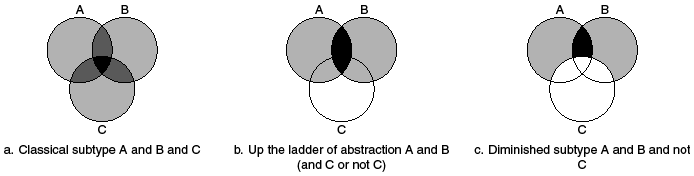
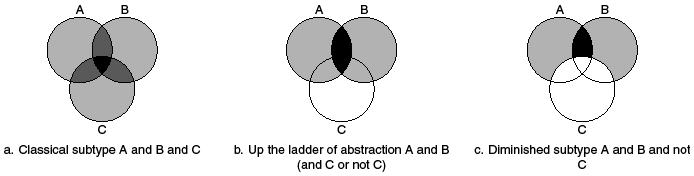
In a seminal article, Giovanni Sartori (Reference Sartori1970) explored the problem of “concept stretching.” His proposed solution was to omit an attribute from a definition in order to make it apply to a larger and more diverse set of cases. He hewed to a classical approach to conceptualization in which adding attributes to a concept – descending the ladder of abstraction – increased its intension (the richness and precision of its meaning) while limiting its extension (the set of objects to which it could be applied). The black area in Figure 5.1a represents the result of adding attribute C to the intersection of attributes A and B. Sartori argued that removing an attribute from the concept – ascending the ladder of abstraction, as in Figure 5.1b – necessarily broadened its extension and decreased its intension, sometimes leading to concept stretching. The discussion of diminished subtypes in the “Democracy with Adjectives” article (Collier and Levitsky Reference Collier and Levitsky1997, revised 2009 and again in this volume, Chapter 2) offers a useful corrective to Sartorian thinking about conceptualization, and the new version of “Democracy with Adjectives” (Collier and Levitsky Reference Collier, Levitsky, Collier and Gerring2009) further clarifies Sartori’s contribution. There is a crucial difference between identifying a diminished subtype (Figure 5.1c) and moving up the ladder of abstraction. Moving up the ladder entails moving from attributes “A and B and C” to “A and B and either C or not C.” Diminished subtypes entail moving from attributes “A and B and C” to “A and B and not C.” Diminished subtypes are more precise and do not necessarily increase the extension of a concept vis-à-vis the classical subtype, as it depends on how many cases belong to these two completely distinct subsets. It is interesting to note that moving up the ladder of abstraction yields the union (1b) of the mutually exclusive classical (1a) and diminished (1c) subtypes.
Both classical and diminished subtypes, however, are grounded in categorical thinking. Here I contrast them with the conceptual approach used by the Varieties of Democracy (V-Dem) project, which conceives of democracy as an aggregate of multiple continuous dimensions. Thus, the analysis achieves a high degree of granularity. I map conceptual innovations based on adding and removing attributes onto V-Dem’s continuous multidimensional framework. This mapping elucidates the strengths and weaknesses of each approach to conceptualization. The development of typologies was cutting edge for its time, but more is possible now.
Moving from a categorical approach and a continuous approach requires three steps: first, reconceptualizing attributes as thresholds on dimensions; second, removing the thresholds; and third, using different techniques to combine the dimensions. Examples using V-Dem data suggest that it is possible to create measurements of specific concepts that are both qualitatively rich and quantitatively precise. However, the measurement of very general concepts such as democracy, which may be useful for some broad-brush analyses, comes at the cost of some quantitative information and conceptual clarity.
From Categories to Dimensions with Thresholds
Conceptualization based on categorical thinking takes its inspiration from Sartori’s dictum, in his critique of the concept stretching in structural-functionalism, that “concept formation stands prior to quantification” (Sartori Reference Sartori1970, 1038). I do not believe that acknowledging the primacy of differences in kind logically requires focusing on categories to the exclusion of differences of degree, but scholars tend to take one road or the other. Perhaps it is true that “there may be said to be two classes of people in the world; those who constantly divide the people of the world into two classes, and those who do not” (Benchley Reference Benchley1920). Sartori paid lip service to quantification in his 1970 article, but he clearly preferred categories. Rather than quantify the number of political parties, for example, his elaborate counting rules resulted in a sevenfold typology of party systems rather than a count (Sartori Reference Sartori1976).
Thinking of attributes as continuous dimensions rather than membership in sets or categories requires setting aside categorical concepts, such as belonging to the set of “democracies,” and replacing them with different concepts, such as placement on a dimension ranging from democracy to nondemocracy. This was explicitly Robert Dahl’s approach in Polyarchy (Reference Dahl1971): identifying contestation and inclusiveness as two qualitatively distinct dimensions that jointly define degrees of polyarchy. If our concept development never leads to dimensional concepts, we are stuck endlessly dividing and subdividing categories. Not every categorical concept can be recast as a continuum, but many questions that researchers consider binary can be redefined as matters of degree. One might declare that an election either took place or it did not, but for some applications it is relevant to take into account how closely the election complied with the law, what proportion of the seats were uncontested, the extent to which votes were counted accurately, and how many winners were allowed to assume office. Researchers are free to declare that their concept is inherently categorical and that any continuous measure of it is invalid or riddled with error (Alvarez et al. Reference Alvarez, Cheibub, Limongi and Przeworski1996), but by doing so, they risk ignoring kinds of variation that are relevant to other observers and that could be useful for measurement.
In order to reconceptualize a category as a dimension, some additional conceptual work is needed beyond listing the attributes that are present at the positive pole of the concept. Gary Goertz (Reference Goertz2006, 30–35) argued that continuous concepts also require defining the negative pole and “theorizing the continuum” (specifying what changes as a case moves from one pole toward the other). Specifying these elements often requires choices. For example, what is the negative pole of “there is little or no self-censorship among journalists,” and what changes along this dimension: the proportion of journalists who self-censor? How common self-censorship is? The range of issues on which journalists self-censor? Defining these dimensions is conceptual innovation – a kind of precising (Collier and Levitsky Reference Collier and Levitsky1997).
Continuously defined attributes contain all the information contained in categories only when we add thresholds to them to distinguish between cases that belong to the top category and those that do not. Placing thresholds requires some judgment. If properly chosen, such thresholds would establish a one-to-one correspondence between the categorical definition and a definition based on continuous dimensions. However, adding thresholds can only detract from the continuous information because it reduces the variation within categories to a single value. The damage can be minimized to the degree that two conditions hold. First, if within-category variance is just noise, then losing that variation does no harm. Second, if values are tightly clustered in the center of the range of each category, then there is natural clustering that clearly separates ranges of values, and this clustering ensures that cases within categories are more similar to each other than to cases in other categories. In other words, less quantitative information is lost by using thresholds when cases are tightly clustered inside each category and distant from clusters of cases in other categories.
As a side note, it is important to observe at this point that the only way to assess whether these conditions are met by a particular indicator is to measure concepts continuously, which makes it possible to see how much clustering there is. Beginning with categorical measures deprives one of the more precise quantitative variation needed to ascertain whether clusters exist.
V-Dem makes it possible to examine whether the conditions that would justify categorizing in measures of democracy are met, as it provides continuous and ordinal versions of all the variables that are expert-coded (Coppedge et al. Reference Coppedge, Gerring and Knutsen2023a, Pemstein et al. Reference Pemstein, Marquardt and Tzelgov2023, Marquardt and Pemstein Reference Marquardt and Pemstein2018). It is unlikely that the variation within any possible category is pure noise. For example (not shown here), line graphs of trends in indicators show that the continuous version of V-Dem data can document gradual trends within a category, such as the gradual improvement in electoral management body capacity in Mexico from 1974 to 1989 even though all those values fall within the range of an ordinal score of 3.
Venn diagrams contrasting three set-based definitions.
Note: Black areas correspond to the property space of the subtype defined each way.
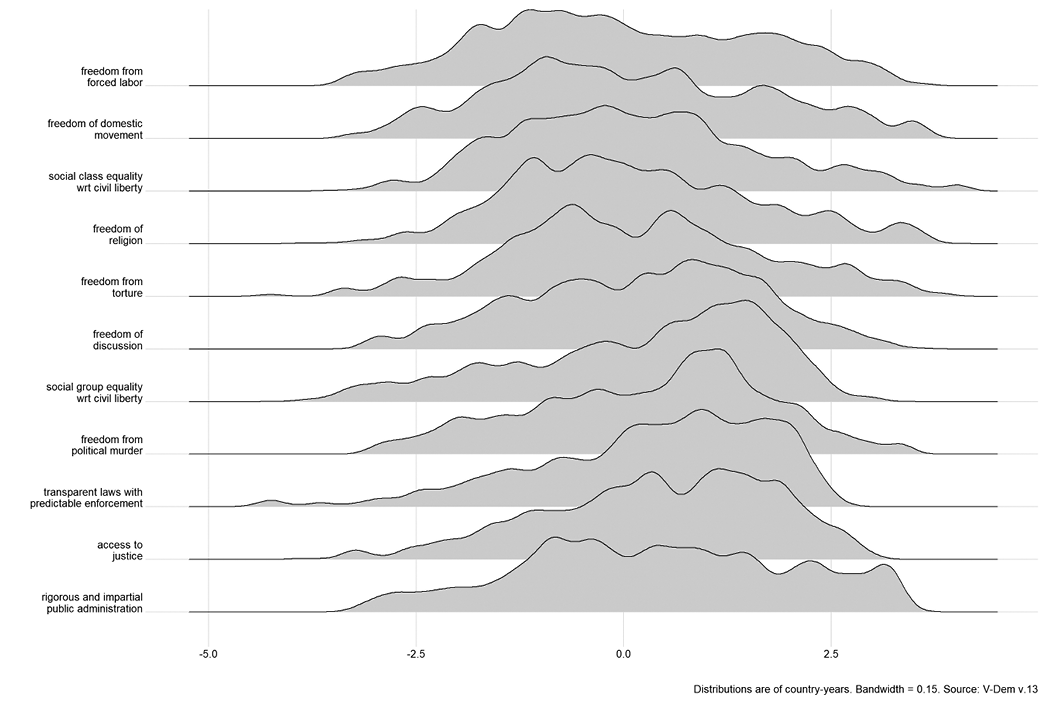
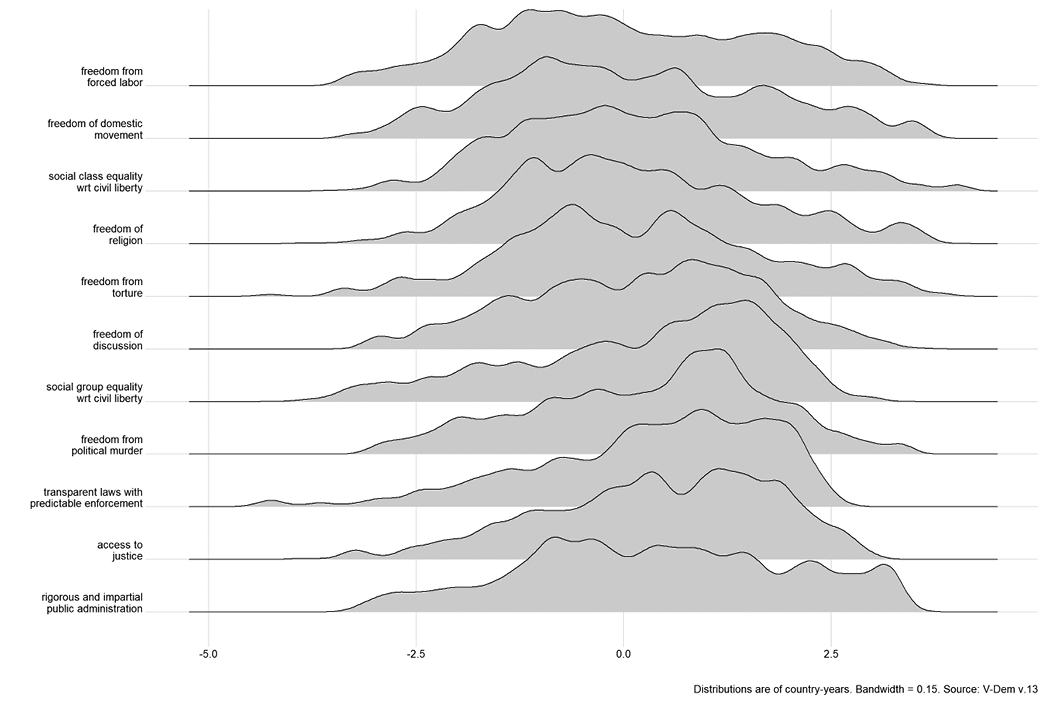
Moreover, there are not clusters that would define discrete categories. Figure 5.2 shows the distributions of continuous values for eleven of V-Dem’s measures of civil liberties. It should be immediately evident that although the distributions are somewhat lumpy, they are not clustered distinctly enough to divide the cases into discrete categories in any defensible way. Any proposed thresholds dividing categories are likely to be arbitrary.
Distributions of continuous scores on eleven civil liberties variables (nearly all countries, 1900–2022).
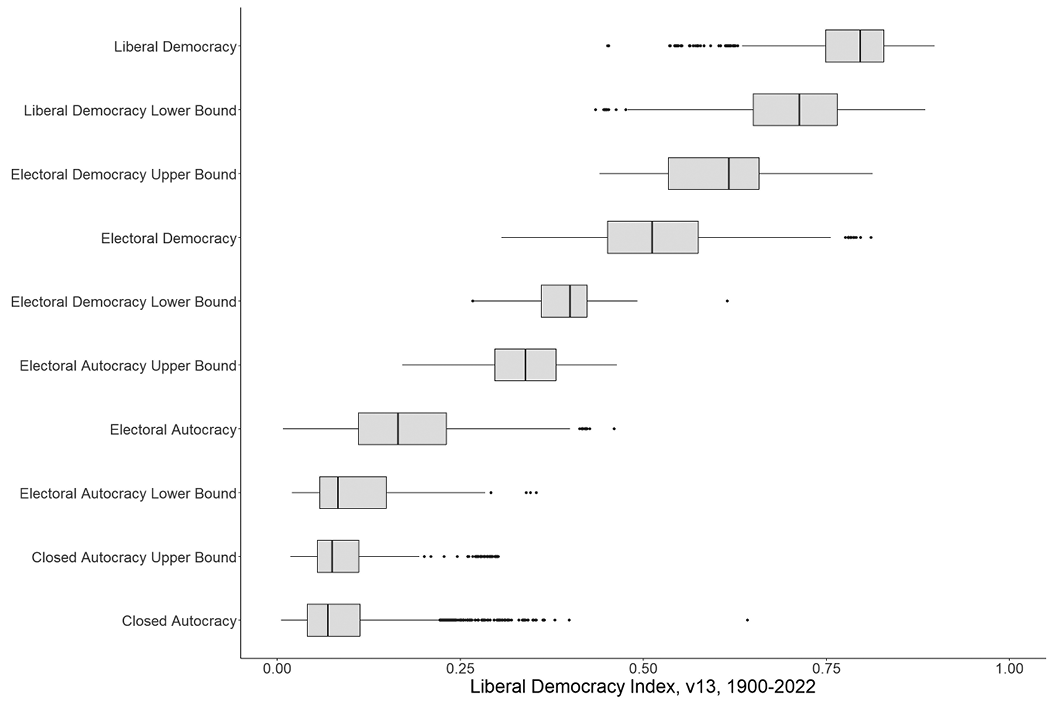
Some of the researchers at the V-Dem Institute in Gothenburg developed a “Regimes of the World” classification to meet a perceived need from the policy community (Lührmann, Tannenburg, and Lindberg Reference Lührmann, Tannenburg and Lindberg2018). This typology of liberal democracy, electoral democracy, electoral autocracy, and closed autocracy has been widely used, although it lacks the endorsement of the larger V-Dem project. The typology gives the impression that all cases of the same type are similar, and very different from all cases of other types. Yet often a country has more in common with countries just barely over the nearest threshold than it does with countries at the other end of its type. Figure 5.3 shows the range of the Liberal Democracy Index, which contains all of the variables used to define the typology, for each category of the typology (including intermediate categories that the creators recognize as ambiguous). The clusters are far from clear. In fact, 17.5 percent of the cases lie in ambiguous ranges between the four regime types (v2x_regime_amb). Taking such typologies seriously requires overzealous policing of arbitrary borders. Such typologies may help users feel that they understand the data better, but in fact they provide only the illusion of understanding.
Range of liberal democracy index for regimes of the world types, including ambiguous types.
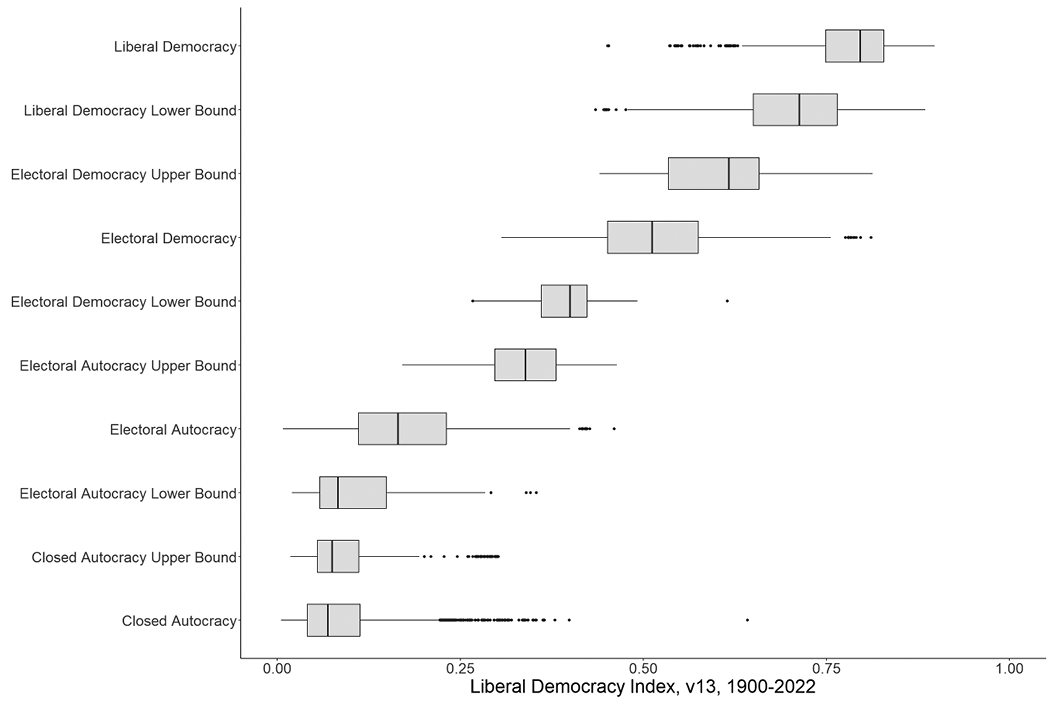
Figure 5.3 Long description
The box plot presents regime types: Liberal Democracy, Electoral Democracy (with upper and lower bounds), Electoral Autocracy (with upper and lower bounds), and Closed Autocracy (with upper and lower bounds). The X-axis is labeled “Liberal Democracy Index” ranging from 0.00 to 1.00, while the Y-axis lists the regime types. Each box represents the interquartile range, with horizontal lines indicating the median. The graph demonstrates a positive correlation with regimes placed lower having a lower liberal democracy index and regimes placed higher having a higher liberal democracy index.
An alternative justification for categorical measurement would be a claim that even attributes that vary on a continuum can have discontinuous consequences. For example, one might argue that there are phase changes in political regimes that are analogous to the rapid transitions of water from solid to liquid to gas as temperature rises continuously. Essentially, phase changes involve a tight relationship between a continuous attribute and a nominal or ordinal attribute. I doubt that the analogy is apt for democracy because there are few truly discrete attributes of democracy, and their relationship to the continuous attributes is not sufficiently tight. For example, 27 percent of the time, bans on political parties from 1900 to 2022 fail to predict whether elections were on course, even over the full span of the independent variable’s values.
Removing Thresholds
There are good reasons, then, to consider removing the thresholds. It may feel unsettling to lose the qualitative benchmarks that thresholds provide, as without them there are no discrete subtypes (diminished or otherwise). The cases that would belong to them simply become off-the-line cases: cases that deviate marginally from the expected relationship among dimensions. However, there are benefits to abandoning types and subtypes, beyond not having to defend them. First, continuous data make use of all the variation that can be measured, both within categories and across categories. Discarding fine-grained quantitative variation wastes potentially useful information that could help researchers to describe more precisely and get closer to inferences about causal mechanisms, which tend to operate at a microlevel. Second, when there are no thresholds separating cases that belong to a category from those that do not, increasing intension no longer decreases extension. Some cases’ scores differ, but they do not leave the sample. Dropping thresholds enables us to keep using all the data. There may be sound scope conditions that require not using all the data: Middle-range theory is still a good idea. However, dropping arbitrary conceptual thresholds prevents the unnecessary loss of cases to compare.
Furthermore, V-Dem offers three ways of using the continuous data without losing touch with differences of kind. First, its codebook is transparent and explicit, and the online graphing interfaces at v-dem.net display codebook definitions – the texts of questions, clarifications, and response categories – for every variable included in a graph. Second, the project makes available for download both interval and ordinal versions of all of the hundreds of expert-coded variables, which make it possible to ascertain the range of continuous values that correspond to each ordinal category. Third, its variable line graph interface by default plots the continuous measurement model values but also uses gridlines to separate the range of values corresponding to each codebook category. Users can see at a glance what the continuous variation is within categories as well as across them. In addition, because V-Dem rates so many countries and years, it is always possible to find a well-known prototype that can aid interpretation: “My case rated slightly worse than Germany in 1940,” for example.
Combining Dimensions
Once we remove thresholds, we can no longer think in terms of unions and intersections of categories, such as in cross-tabulation. What we can do is analyze covariance, using techniques such as correlations, principal component or factor analysis, or latent variables. Without membership in categories, combining dimensional attributes no longer results in a loss of extension. However, we can analyze the loss of variance. If we are, for example, combining two continuous variables into an index, each variable has a variance that measures the amount of quantitative information it contains. When the two variables are combined with factor analysis, the variance that is common to the two variables is preserved, but the unique variance of each variable is lost. The trade-off involved in combining dimensions is not between intension and extension but between intension and the retention of variance.
Thinking in terms of covariance between variables highlights a crucial point that applies to aggregations of both categorical and continuous attributes: The degree to which the aggregation of attributes leads to either reductions of extension or loss of variance depends on the correlations among attributes. It is possible that if the positive pole of a discrete concept is defined by many perfectly correlated attributes, its intension can be increased with no loss of extension or variance. Using continuous measures, we can thicken the meaning of an index by including more and more variables in it without losing information about the components as long as all the variables are perfectly correlated. With perfect correlation, knowing the score on one variable would reveal exactly what the score is on others. Of course, perfect correlations rarely occur in nature. It is the lack of perfect correlation that creates subtypes and the loss of variance when aggregating attributes into indices.
V-Dem data illustrate how these relationships work with continuous data. The project aggregates many specific variables to construct indices of thicker concepts and often aggregates indices to generate higher-level indices. The electoral democracy index contains five components, which are built from forty-three specific variables. The liberal democracy index uses three components and the electoral democracy index, for a total of sixty-six indicators. The deliberative, egalitarian, and participatory democracy indices draw on forty-eight, fifty-three, and eighty-six indicators, respectively. No qualitative conception of democracy considers such a detailed set of attributes. V-Dem’s high-level indices are both quantitative and conceptually richer and more detailed than any alternative.
How much information is lost in the construction of these indices? Again, it depends on how correlated their component variables are. As Table 5.1 shows, the freedom of expression and alternative sources of information index preserves the most information from specific indicators: It explains 85 percent of the variance in its nine component variables. The unique variances of these nine variables are left on the cutting-room floor. The five most general indices, of the five varieties of democracy V-Dem creates, preserve a great deal of the variance contained in the four components and the electoral democracy index. However, each level of aggregation explains less and less of the variance in the most specific indicators. They account for only 40 to 56 percent of the variance in the indicators used to construct them.
| Explained variance in … | ||||||
|---|---|---|---|---|---|---|
| Components | Sub components | Indicators | ||||
| k | percent | k | percent | k | Percent | |
| Liberal democracyFootnote * | 2 | 93% | 8 | 67% | 66 | 52% |
| Liberal componentFootnote * | 3 | 83% | 23 | 64% | ||
| Equality before the law and individual liberty | 14 | 69% | ||||
| Legislative constraints on the executive | 4 | 81% | ||||
| Judicial constraints on the executive | 5 | 76% | ||||
| Participatory democracyFootnote * | 2 | 94% | 9 | 62% | 65 | 40% |
| Participatory componentFootnote * | 4 | 59% | 22 | 30% | ||
| Civil society participation | 4 | 63% | ||||
| Direct popular vote (indicators with N>10k)Footnote * | 12 | 32% | ||||
| Local government | 3 | 78% | ||||
| Regional government | 3 | 82% | ||||
| Egalitarian democracyFootnote * | 2 | 88% | 8 | 68% | 53 | 48% |
| Egalitarian componentFootnote * | 3 | 86% | 10 | 67% | ||
| Equal distribution of resources | 4 | 78% | ||||
| Equal access | 3 | 76% | ||||
| Equal protection | 3 | 74% | ||||
| Deliberative democracyFootnote * | 2 | 94% | NA | 48 | 47% | |
| Deliberative componentFootnote * | 5 | 83% | ||||
| Electoral democracy (indicators with N>10k)Footnote * | NA | 5 | 72% | 33 | 56% | |
| Freedom of association | 6 | 81% | ||||
| Freedom of expression and alternative sources of information | 9 | 85% | ||||
| Clean elections | 8 | 67% | ||||
| Elected officialsFootnote * | 9 | 21% | ||||
| Suffrage | 1 | 100% | ||||
* Indices that V-Dem does not aggregate by Bayesian factor analysis.
Percentages are the percentage of the variance that is explained by the first principal component. These figures differ marginally from percentages explained by the first factor in the Bayesian factor analyses used by V-Dem. “k” is the number of components, subcomponents, or indicators used in each analysis. The sample size varies across analyses owing to missing data, largely due to years without elections or a legislature.
Because the indices are constructed from variables that are not perfectly correlated, the index scores have somewhat ambiguous interpretations in the sense that the aggregated score does not reveal exactly what the scores of all the variables are. However, for the indices that are very unidimensional such as legislative constraints, regional government, the deliberative component, and freedom of association, all the variables would be found within a small range. V-Dem’s interactive line graphs also provide a feature that helps users discover which variables are responsible for the value of an index. In any line graph of an index, clicking on the index line drills down to the variables that comprise the index, making it easy to see which ones have high or low values or are trending up or down.
When indicators are believed to measure a concept but are only weakly correlated, the concept is empirically multidimensional. In such instances, V-Dem provides a theoretical justification for a more complex aggregation formula. For instance, Table 5.1 shows that the nine variables considered relevant for constructing the elected officials index share only 21 percent of their variance. The formula V-Dem uses to combine them operationalizes the reasoning that officials are as “elected” as the most “elected” procedure of selecting the legislators and the most powerful chief executive (Coppedge et al. Reference Coppedge, Gerring and Glynn2020: 92–93). Another example is the electoral democracy index, which is treated as multidimensional because the contributions of some components to election democracy are to some extent conditional on other components and to some extent components compensate for one another. V-Dem therefore calculates both a multiplicative and a weighted average additive polyarchy index, and averages them. This same formula is used to combine electoral democracy with the liberal, participatory, egalitarian, and deliberative components to create the other four high-level indices (Coppedge et al. Reference Coppedge, Gerring and Glynn2020: chap. 5).
Aggregating all of the indicators into a single big-D index of Democracy as though they were unidimensional would retain only 57 percent of the variance; 43 percent would be lost. This trade-off suggests that we pay a steep price if we try to reduce democracy to a single dimension. A single dimension of democracy is still somewhat meaningful and useful, but there is so much more that we could learn if we ended our collective fixation on a vague, narrow, reductionist notion of democracy and focused instead on its many revealing components.
We have come a long way from the premature quantification and rampant concept stretching that Sartori decried in 1970. V-Dem shows that, in democracy measurement, we can respect qualitative differences of kind by conceptualizing multiple dimensions, while measuring differences of degree by measuring each of those dimensions as a continuum. We can also move up the ladder of abstraction to some extent without losing information, to the degree that dimensions are correlated.
In fact, the V-Dem Institute has repeatedly used this approach in a series of spin-off projects to measure a widening range of concepts. They include Historical V-Dem (extending back to 1789, including many concepts about the state), the Digital Society Project (on the use of social media for political influence), Academic and Civic Space (academic freedom, pro- and antidemocracy protests, inclusion and exclusion, and polarization), Regime Legitimation (how governments attempt to justify their authority), the Pandemic Backsliding Project, Varieties of Autocracy and Autocratization, V-Party (data on orientations of political parties historically and around the world, with special attention to populism and anti-pluralism), and Varieties of Indoctrination (political socialization through education).
Introduction
Writing in the mid 1990s in “Trajectory of a Concept,” Collier observes that the concept of corporatism would possibly be less relevant moving into the twenty-first century for a number of reasons, including its empirical decline in the region, the dominance of other more relevant concepts in the democratic neoliberal context, and the fact that scholars had already analyzed it in depth (Reference Collier and Smith1995: 153).Footnote 1
Indeed, we must ask whether “corporatism” as a concept has gone the way of bureaucratic authoritarianism, largely used to describe a finite period of Latin American political history. Toward the end of the twentieth century into the early twenty-first century, scholars and observers of Latin America widely remarked that corporatism, or the widespread incorporation of civil society groups into state bodies and state processes, was largely incompatible with the neoliberal political economies and democratic regime types that had come to dominate the region. Scholarly works with titles such as “After Corporatism” (Palmer-Rubin Reference Palmer-Rubin, Kapiszewski, Levitsky and Yashar2021) and observations about a delimited corporatist period of the past (e.g., Yashar Reference Yashar2005; Lucero Reference Lucero2008), as opposed to a contemporary “post-corporatist period” (Rossi Reference Rossi2015), were telling in this regard. They suggested that, indeed, the empirical state–society relationship of corporatism was disappearing, and the concept would no longer be relevant to contemporary analysis. Such analyses drew attention to the fact that paradigmatic cases of labor organization and incorporation into the state, such as those associated with Presidents Juan Perón in Argentina and Getúlio Vargas in Brazil, had given way to wide-scale labor exclusion and disempowerment as evidence of the faded phenomenon.
I argue that, in fact, corporatism is not dead empirically, conceptually, or theoretically. Rather, I contend that political-economic, regime, and civil-society changes have often led to new forms of corporatism, and with them, the need for conceptual innovation on the part of scholars studying the region. To be sure, I am not arguing that corporatism is the modal way that states currently relate to social groups, as it was in mid-twentieth-century Latin America, but rather that it constitutes one form of state–societal intermediation at play in the range of contemporary institutional arrangements.
Another contention here is that corporatism has expanded from centrally bringing economic or class-based social forces into particular structural relationships with and within the state. We now see a pattern in which salient social groups and organizations from a more diverse set of social domains are a part of such systems. This chapter thus helps elucidate the fact that there can be, and in fact are, multiple modes of interest intermediation that have existed often simultaneously in the same countries since the late twentieth century, that the concept of corporatism ultimately helps make sense of some of these modes, and that often we need to look beyond labor groups to see those multiple modes of interest intermediation.Footnote 2
In this chapter, I illustrate various ways that the concept of corporatism is still quite relevant, even if it exists alongside other forms of interest intermediation that were not present during the mid twentieth century. To begin, I briefly review the creation of diminished subtypes and discuss how their use helps us understand the landscape of contemporary interest intermediation, particularly given the reduced toolbox of post-Third Wave democratic regimes, involving their more limited options in terms of repression. In the following section, I examine two diminished subtypes with illustrative cases where the empirical evidence comes close to fulfilling all characteristics of the root concept of corporatism, albeit still with some divergences.Footnote 3 I discuss what I call liberal sectoral corporatism with the illustrative case of Indigenous movement incorporation in Ecuador, and what Sebastián Etchemendy and Ruth Berins Collier (Reference Etchemendy and Berins Collier2007) have called “segmented neo-corporatism,” with the illustrative case of Argentina’s wage policy (Etchemendy Reference Etchemendy2019). Following the discussion of these diminished subtypes and their illustrative cases, in the third section I suggest several other contemporary subtypes, including societal party corporatism, state party corporatism, and local societal corporatism, and briefly present empirical examples of these subtypes and the way their formation adds distinctive analytical leverage in the study of interest intermediation. The final section places the diminished subtypes of corporatism in the context of the emerging literature on new modes of incorporation in the region, where I discuss the need to (1) look to the changing political, social, and economic context to understand this conceptual innovation; (2) notice multiple modes of state–society linkages existing simultaneously; and (3) look beyond economic class incorporation to find these various modes.
Table 6.1 provides an overview of the cases and comparisons that are the foundations of this analysis. The table enumerates the noteworthy spectrum of contexts in which the idea of corporatism has proved to be a valuable analytic tool.
| TermFootnote a | Overall domains | Specific contexts | Distinctive analytic leverage | Associated authors/citations |
|---|---|---|---|---|
| Classical Latin American corporatism | Economic forces (primarily labor, but also business, and sometimes peasantry)Footnote b |
| Defines corporatist interest intermediation as state structure, subsidy, and control of social groups and movements.Footnote c Describes state relationship with labor and other economic groups | Schmitter Reference Schmitter1974; R. Collier and D. Lehmbruch Reference Lehmbruch1977; Collier Reference Collier and Collier1979; Collier Reference Collier and Smith1995 |
| “Associational neo-corporatism” | Interest groups and associations based on contemporary salient societal cleavages (including informal sectors) | Chavismo in Venezuela (1998–2013) |
| R. Collier and Handlin Reference Collier and Handlin2009; Silva Reference Silva2017; Etchemendy Reference Etchemendy2019, Reference Etchemendy2020, 2021 |
| Societal party corporatism | Interest groups and social movements (coca growers; Indigenous movements, informal workers) |
|
| R. Collier and Handlin Reference Collier and Handlin2009; Silva Reference Silva2017; Etchemendy Reference Etchemendy2020, 2021; Palmer-Rubin Reference Palmer-Rubin, Kapiszewski, Levitsky and Yashar2021 |
| “Liberal sectoral corporatism”Footnote d | Social (movement) organizations based on ethnicity, gender, health status, employment status, etc. |
|
| Doctor Reference Doctor2007; R. Collier and Handlin Reference Collier and Handlin2009; Chartock Reference Chartock2013; Mayka and Rich Reference Mayka, Rich, Kapiszewski, Levitsky and Yashar2021Footnote e |
| “Civic corporatism” | Social (movement) organizations based on various salient social demands | Brazil:
| Calls attention to the causal role of civil servants in often creating and maintaining liberal sectoral corporatism | Rich Reference Rich2019 |
| “Local societal corporatism” | Participatory budgeting; decentralized institutions | Territorial Base Organizations (OTBs) in Bolivia (1994–2015) | Official recognition of local organizations and federations as semi-state representatives; subsidies through control of local budgets | Chartock Reference Chartock2013Footnote f |
| “Segmented neo-corporatism” | Income policies, employment policies, some state resource distribution (e.g., civil society organizations as agents of state policy implementation) | Argentina and Uruguay wage policy (2005–15) |
| Etchemendy and Collier Reference Etchemendy and Berins Collier2007; Etchemendy Reference Etchemendy2019, Reference Etchemendy2021b |
a Terms without quotation marks are mine or come from studies on the root concept/phenomenon in mid-twentieth-century Latin America (à la Schmitter Reference Schmitter1974; D. Collier Reference Collier and Smith1995). Terms with quotation marks are associated with contemporary observations that corporatism is an ongoing phenomenon.
b While most of the literature on classic corporatism in Latin America highlights the way that the state structured, subsidized, and controlled labor groups, others have pointed out the way that peak business associations and peasant federations were sometimes part of these relationships (see, e.g., Shadlen Reference Shadlen2004; Wuhs Reference Wuhs2010).
c While corporatism remains a contested concept, much of the literature on Latin American politics has accepted this definition. Those working in the European politics literature, however, often include in the definition both the actual social sectors this model generally applies to as well as ideological underpinnings and policy-making processes.
d Collier and Handlin’s (Reference Collier and Handlin2009) description of their concept of “Statal Web” bears some resemblance to this concept, even if not given a corporatist moniker.
e I created this term for this chapter, whereas the works cited here discuss applicable phenomena as a form of corporatism without the “liberal sectoral” label attached.
f Roper (Reference Roper2003) shows evidence of this diminished subtype of corporatism without naming it as such.
g Schmitter (Reference Schmitter1974) and D. Collier (Reference Collier and Smith1995) discuss concertation as belonging to a different root concept than corporatism – policy making. This contrasts with Katzenstein (Reference Katzenstein1984, Reference Katzenstein1985) and others observing corporatism in Europe in the later twentieth century, who incorporate concertation into their very definition of “democratic corporatism.”
Conceptualizing Diminished Forms of Corporatism
Among the central contentions of this chapter is that using corporatism to recognize contemporary dynamics between state and society helps us understand what we have observed even after the era of paradigmatic corporatism, even if what currently exists does not exactly mirror phenomena to which the term was applied in previous historical periods. I thus agree with a key argument of Collier’s “Trajectory of a Concept”: that creating diminished subtypes can make the use of corporatism as a concept more elucidating than harmful. As Collier discusses, diminished subtypes fundamentally differ from classical subtypes of a root concept (see also D. Collier and Levitsky Reference Collier and Levitsky1997).Footnote 4 Whereas in classical subtypes, the use of adjectives adds specificity to the root concept with all of its definitional dimensions, the added adjectives of diminished subtypes show where it does not conform to the original set of dimensions of the classical subtype (D. Collier Reference Collier and Smith1995: 149). Indeed, with most of the adjectives I (and the other scholars who use them) add to contemporary forms of corporatism, I claim not that these represent corporatism plus some more specific dimensions; rather, they represent corporatism minus some indicators of the root concept.Footnote 5 Using the root concept of corporatism to illustrate some of the linkages between states and civil society in Latin America can nevertheless help us understand these relationships more fully, both descriptively and analytically.
Thus, throughout the beginning of the twenty-first century, there remain (and we have seen new forms of) linkages between state and society that conform for the most part to Schmitter’s widely used definition of corporatism whereby “Constituent units are organized into a number of singular, compulsory, noncompetitive, hierarchically ordered and functionally differentiated categories, recognized or licensed (if not created) by the state and granted a deliberate representational monopoly within their respective categories in exchange for observing certain controls on their selection of leaders and articulation of demands and supports” (Reference Schmitter1974: 93–94). Or, as R. Collier and D. Collier (Reference Collier and Collier1979) summarize,Footnote 6 there exist relationships between the state and civil society that include structuring of interest groups, subsidies to those groups, and a degree of control by the state of those groups.
The creation of diminished subtypes of corporatism here draws attention first to the fact that the structuring, subsidy, and control differ in strength and formality from earlier paradigmatic cases of corporatism in Latin America (particularly in the degree and form of control by the state over societal groups). Their creation secondly points to the fact that many, but not all, scholars find corporatism’s use as a concept more enlightening than the creation of wholly new concepts to understand various existing state–society arrangements. Indeed, other concepts have been created to understand the “post-corporatist” landscape of state–society relations, as in the creation of concepts such as the associational network, or “A-Net,” which Handlin and R. Collier (Reference Handlin, Berins Collier, Berins Collier and Handlin2009) use to understand more informal contemporary interest representation formations. However, again, many scholars argue that using corporatism “with adjectives” provides more analytical leverage than starting the conceptualization of contemporary forms of interest intermediation from scratch.
Liberal Sectoral Corporatism in Ecuador
Perhaps the closest contemporary subtype of corporatism to both the root concept and to the empirically modal form of interest intermediation of twentieth-century Latin America comes in what I call liberal sectoral corporatism.Footnote 7 While the adjective “liberal” as applied to corporatist relationships is itself contested,Footnote 8 here I follow the tradition of using the term to refer to civil liberties as a defining attribute of democracy and to denote the fact that post-Third Wave electoral democracies are largely limited in the types of control that they can and do use to limit the activities of societal groups that are part of corporatist relationships. Indeed, in cases of this diminished form of corporatism, structuring and subsidy often coexist with protest against the state by the very federations that have been brought in to exercise quasi-state functions (Handlin and R. Collier Reference Handlin, Berins Collier, Berins Collier and Handlin2009; Chartock Reference Chartock2011, Reference Chartock2013; Rich Reference Rich2020). Adding the adjective “sectoral” draws attention here to the fact that across the region, corporatist forms of interest intermediation have expanded to include sectors that reflect the most salient contemporary social cleavages, in addition to, and sometimes rather than, organized labor and the various forces of the economy (see Table 6.1).Footnote 9
In the case that most clearly illustrates the addition of both adjectives “sectoral” and “liberal” – Indigenous incorporation in late twentieth- and early twenty-first-century Ecuador – the structuring and subsidizing of these groups came quite close to that seen in mid-twentieth-century Latin American state–labor relations, while the control the state was able to exercise over the groups was far more limited and, when it existed, informal in nature.Footnote 10 Specifically, liberal sectoral corporatism in the case of Ecuador was particularly in evidence when it came to the creation, and especially the implementation, of policies that targeted Indigenous community marginalization, that did so with a recognition of culture, and that mandated oversight and participation on the part of Indigenous communities themselves, or so-called ethnodevelopment policy (Chartock Reference Chartock2011, Reference Chartock2013).Footnote 11
The Confederation of Indigenous Nationalities of Ecuador (CONAIE) came together “from below” over decades, far before any formal relationships it would eventually come to have with the Ecuadorian state (Yashar Reference Yashar2005). By the late 1980s, CONAIE helped to create the most significant laws impacting Indigenous communities, aiding in the establishment of two ministry-level bureaucratic agencies that oversaw all intercultural bilingual education and ethnically targeted development funds in the country (Chartock Reference Chartock2011, Reference Chartock2013). Credibly claiming to represent approximately 75 percent of Indigenous communities in the country at the time, CONAIE was formally codified as having a leadership role over these bureaucratic agencies within the policies that established these new arms of the state (Brysk Reference Brysk2000: 73n14; Van Cott Reference Van Cott2005: 99; Chartock Reference Chartock2013). By the time the agencies were implementing the law, Indigenous communities had to be a part of CONAIE in order to work with these state agencies and receive the benefits and services they provided.Footnote 12 In definitional corporatist fashion, the relationship saw the social movement organization become a quasi-state entity.
Thus, CONAIE held a virtual monopoly over representation of its stated constituency, controlled multimillion-dollar budgets, and was ensured robust membership by virtue of the fact that all who interacted with these state agencies needed to be part of the Indigenous federation. While, again, liberal corporatism precludes certain types of state repression, Ecuadorian elected officials nevertheless managed to use the relationship to exact more informal types of control over Indigenous groups. For example, when CONAIE leaders vocally opposed President Lucio Gutiérrez’s (2003–05) turn toward neoliberal policy, Gutiérrez used the agencies over which CONAIE had power to split the federation’s leadership, thereby weakening the federation itself.Footnote 13
This liberal sectoral corporatist relationship lasted from the late 1980s until the early 2010s, meaning that even under formal democratic rule, and even at the height of neoliberal policy making, Ecuador was not fully pluralist but instead contained various forms of interest intermediation defining its state–societal relationships.
“Segmented Neo-corporatism” in Argentina and Uruguay
Cases such as ethnodevelopment policy implementation in Ecuador forced scholars to recognize that earlier styles of Latin American corporatism were in fact not dead, just coming in a different form and including different groups. Similarly, certain types of more classical state–economic sector relationships in the Southern Cone in the early twenty-first century have shown that European-style “neo-corporatism” or “democratic corporatism” remains relevant, and so too do debates between scholars defining the term “corporatism” based on the European versus Latin American experiences.
In work regarding the inclusion of labor and business sectors in state processes in Argentina (Etchemendy and R. Collier Reference Etchemendy and Berins Collier2007; Etchemendy Reference Etchemendy2019) and Uruguay (Etchemendy Reference Etchemendy2019), Etchemendy and others have argued that there exists “segmented neo-corporatism,” whereby some South American peak labor and business organizations have partnered with the state to establish policies and processes that affect their constituencies. Though not necessarily codified into law as the representatives of their members or constituencies, these peak level organizations nevertheless have effective monopolies of representation, serve on specific councils within these states, and are functionally differentiated, in the sense of being representative of specific sectors.Footnote 14 Etchemendy (Reference Etchemendy2019) thus describes how these characteristics definitional of corporatism have operated in Argentina and Uruguay, with the most powerful labor and business representatives dealing with trade-offs regarding wage policy and related processes.
Though differing in many ways from the sectoral liberal corporatism described earlier in the case of Ecuador, the two forms nevertheless share various components. Thus, just as in sectoral liberal corporatism, there is far less capacity for states to control these societal organizations and sectors, and Etchemendy and others make explicit the fact that labor and business organizations remain autonomous from the state, enough so that they can and do challenge (including organizing protests against) government processes at times, without repression (Etchemendy Reference Etchemendy2019: 1439).
The work of those studying segmented neo-corporatism not only documents the continued empirical relevance of the concept of corporatism but implicitly revives debates about what is to be included in definitions of the root concept of corporatism itself. Thus, while I follow Schmitter (Reference Schmitter1974), D. Collier (Reference Collier and Smith1995), and R. Collier and D. Collier (Reference Collier and Collier1979), among many others, in limiting the root concept’s definitional characteristics to those describing institutional characteristics of the state–society relationship (i.e., structure, subsidy, and control), those reviving the concept of neo-corporatism (or what others studying twentieth-century northern and western Europe have called “democratic corporatism”) implicitly suggest that political scientists ought to add more than institutional aspects to the root concept. They thus follow Katzenstein’s (Reference Katzenstein1984) classic works on countries such as Austria and Switzerland when he argues that the term corporatism (1) necessarily refers to economic sector inclusion; (2) includes what Schmitter, Collier, and others have instead referred to as “concertation,” or the bringing together of various sectors for the purpose of policy-making; and (3) includes an ideology or culture of cooperation between sectors. Collier in “Trajectory” explicitly argues that at least 2 and 3 should in fact not be considered part of the root definition of corporatism. Regardless of the conceptual debate that recent work on segmented neo-corporatism revives, most importantly for this chapter, it shows the continuing relevance of the concept.
Varieties of Corporatism in Twenty-first-century Latin America: A Further Look at Table 6.1
The liberal sectoral corporatism of Ecuador and segmented neo-corporatism of Argentina and Uruguay from 2005 to 2015 perhaps come closest to the root concept(s) of corporatism that helped analyze the empirical reality of Latin America and parts of Europe’s twentieth-century-modal type of interest intermediation. Yet scholars observing contemporary Latin America have noticed and/or documented diminished subtypes in other contexts as well.Footnote 15 While this short chapter precludes a full exploration of these other subtypes, I include several of these in Table 6.1.
As Table 6.1 shows, the incorporation of interest groups into governing parties has meant that both Venezuela under Chavista rule and Bolivia under MAS leadership have been the sites of corporatism. The Venezuelan subtype comes closer to the paradigmatic “state” corporatism, whereby the state has a heavy hand in shaping, if not creating, civil society groups. By contrast, the Bolivian subtype comes closer to “societal” corporatism, where such groups exist prior to their incorporation into the state (Handlin and R. Collier Reference Handlin, Berins Collier, Berins Collier and Handlin2009; Silva Reference Silva2017; Etchemendy Reference Etchemendy, Kapiszewski, Levitsky and Yashar2021a). While much of the twenty-first-century Brazilian council structure fits conceptually within the liberal sectoral corporatist category applied to Indigenous movement incorporation noted earlier, Jessica Rich (Reference Rich2019) has argued that an even more specific label of “civic corporatism” should be applied to similar phenomena when we see the involvement of bureaucratic entrepreneurs in creating such relationships. Finally, decentralization reforms alongside local participatory policies have meant that countries such as Bolivia saw a type of local corporatism taking shape in some sectors, where local councils were sometimes fully constituted by particular interest federations (Roper Reference Roper2003; Chartock Reference Chartock2013).
Table 6.1 also highlights variations that can aid in future research on corporatism and state–society intermediation more broadly. Thus, among the characteristics that differentiate the various subtypes in Table 6.1 are the following:
(1) The segment of civil society with the corporatist relationship to the state. This involves newly salient sectors, such as Indigenous movement representatives in Ecuador, versus traditional corporatist sectors, such as labor federations in Uruguay.
(2) The setting of the corporatist relationship involving national-level interest intermediation, as in much of Brazil’s council structure, versus local-level interest intermediation, as in Bolivian OTBs.
(3) The role of specific political parties. This involves continuous mediation through one political party, as in Venezuelan corporatism, versus lack of formal connection to a particular party, as in ethnodevelopment policy implementation in Ecuador.
While there are other sources of variation among contemporary forms of corporatism in need of future research and analysis, the forms here show that, in almost all cases, earlier authoritarian forms of control are off the table.
It is thus clear that a number of diminished subtypes of corporatism have characterized the relationships between states and societies in Latin America since the turn toward neoliberalism and democracy, making corporatism a trend that should continue to be on the scholarly radar if we want to understand these relationships thoroughly.
Corporatism in the Context of New Modes of Incorporation in Latin America
Since the beginning of the twenty-first century, scholars of Latin America have noticed and analyzed the way that states have begun to incorporate new (and old) actors into the political process in new (and old) ways.Footnote 16 Much of this scholarship has insightfully documented the important observation that alternative modes of interest intermediation are not mutually exclusive within or between countries in the region, a fact that was even true when more structured and regionwide forms of corporatism abounded.Footnote 17
That said, there is a perhaps natural tendency to assume that because the “century of corporatism” may be over, all forms of interest intermediation must be post-corporatist, an idea belied by the evidence cited earlier. In an effort to juxtapose the “new” forms of incorporation and inclusion to the “old” mode of corporatism, there has also been a tendency to conflate various concepts with corporatism, concepts that do not align with Schmitter’s or Collier’s definitions. Thus, there has been a tendency to (1) discuss corporatism as incorporation into a nongoverning party (a process that has certainly led to corporatism at times, although not itself a form of interest intermediation between state and society); (2) describe corporatism as a form of civil society participation (which by itself it is not); and (3) define twentieth-century corporatism solely as state corporatism, as a nod to states holding power relative to social groups. This is misleading conceptually and empirically. Conceptually, the state/societal distinction concerns the origins and timing of social groups’ organization, not the balance of power. Empirically, many twentieth-century corporatist cases featured groups whose organization predated their ties to the state and are examples of societal corporatism. There has also been a tendency to claim that because the forms of interest intermediation particular scholars are examining are noncorporatist, corporatism must be a thing of the past. The analysis and evidence given here serves as an important reminder that simply because all forms of interest intermediation in the current period are not corporatist, and even if most are not, that does not mean that corporatism has died out as a relevant form of incorporating societal actors into the state.
Conclusion
I have argued that, contrary to the interpretation offered by several scholars, the concept of corporatism is still relevant in discussing states and societies after the turn to neoliberal economies and democratic regimes in the late twentieth and early twenty-first centuries. Indeed, the chapter documents various subtypes of corporatism that have arisen across various country cases in the region and shows that scholars specializing in quite different countries, interest group areas, and policies have noticed this as well.
Using corporatism as a concept not only helps us understand some of the relationships between states and societies, but it also helps us to locate explanatory factors for the arrival of such relationships, their strength, their continuation, and their disappearance. For example, studies of earlier iterations of corporatism suggested that when social movement organizations were strong vis-à-vis the state, these groups received more subsidies than control and vice versa (R. Collier and D. Collier Reference Collier and Collier1979). The same appears to be true in more contemporary subtypes of the relationship (Chartock Reference Chartock2013).
If one causal connection is clear within this analysis alone, it is that major changes in politics, society, and the economy have meant that the empirical form in which corporatism could arrive would necessarily be different from those that had come before, and that this has also forced scholars to adapt, rather than throw out, the valuable concept of corporatism. Thus, specific changes such as the dominance of democracy (or at least of elections), the appearance of social movements in realms such as ethnicity and gender, and the shift to neoliberal economies have led scholars to use adjectives such as “informal,” “sectoral,” and “civic” to make new use of a classic concept of comparative politics.

 Open access