

Archaeologists have long worked to find optimal ways to disseminate heritage and new discoveries to the public and increase engagement, learning, and visitor numbers in museums. Different strategies have been used for these purposes, including recorded videos of researchers appearing on-screen; for example, at Moesgaard Museum in Aarhus, Denmark. The National Museum of Denmark (2022) announced on its Facebook page a (scripted) speaking avatar of the Egtved Girl on a black background, in collaboration with the company Khora and the software Metahuman. It also hired the artist Jim Lyngvild to interpret the Viking Age in a temporary exhibition, which spurred debate about weighing accuracy versus entertainment in museum exhibitions (Sindbæk Reference Sindbæk2018). This underlines the importance of finding a balance between these two aspects in heritage dissemination when external actors deliver the dissemination format, which sometimes features anachronisms or stereotypical reconstructions. Some museum exhibitions have found a good balance between accuracy and entertainment—from our own experiences, the archaeological museum in Nimes, France, and Moesgaard Museum in Denmark. In the latter museum, the visitor can stand between two large screens sandwiched between approaching armies representing the Iron Age Illerup Ådal battlefield.
Gaming companies, particularly commercial ones, have a long history of portraying archaeology or prehistory through video games (Politopoulos et al. Reference Aris, Mol and Lammes2023; Reinhard Reference Reinhard2018). For commercial companies, strategy games focusing on societal and technological developments or battle tactics form a popular archaeogaming genre, such as Sid Meier’s Civilization (Mol et al. Reference Mol, Politopoulos and Ariese-Vandemeulebroucke2017), Total War, and Age of Empires real-time strategy game. Immersive first- and third-person archaeogames by commercial companies include Ubisoft’s Far Cry Primal (2016) in collaboration with archaeologist David Anthony and linguist Andrew Byrd, which is set in 10,000 BC and features characters speaking different Proto-Indo-European-inspired dialects. Kingdom Come II: Deliverance, set in medieval Bohemia, has greater historical accuracy than its first iteration and features a complex gameplay system of interactions, status, and the like. Ubisoft’s Assassin’s Creed series has impressively accurate historical buildings (with educational pop-ups) and has integrated historical figures and events in its portrayal of pre-/protohistoric times in ancient Greece, Hellenistic Egypt (Politopoulos et al. Reference Politopoulos, Ariese, Boom and Mol2019), and Viking Age Northern Europe. In Ubisoft’s 3D action game Ancestors: The Human Odyssey, the player initially controls a “missing link” ape kin group surviving in the rainforest and evolves until conquering the savannah and reaching the Homo erectus stage. Yet, all these (otherwise great) games feature scripted dialogue (if any) and are created by commercial gaming companies with entertainment and profit as their priorities; they were also created beyond the control of the archaeologists, potentially detracting from their (pre-)historical accuracy.
Archaeologists, however, have collaborated with game developers to disseminate their research results (Mittnik et al. Reference Mittnik, Massy, Knipper, Wittenborn, Friedrich, Pfrengle and Burri2019) through some games. For example, the Age of Empires-style strategy game BRONZEON for mobile devices is set in the German Bronze Age. Long-distance trading and ultimately marrying off one’s daughter to form an alliance are the players’ main goals (Stockhammer Reference Stockhammer2020). Murtas and Lombardo (Reference Murtas and Lombardo2024) and Mariotti (Reference Mariotti2021) present more examples of primarily educational archaeogames (termed “serious games”).
Archaeologists have also used existing platforms, including virtual reconstructions of prehistoric settings (Douglass et al. Reference Douglass, Day, Brunette, Bleed and Scott2019), community “game-modding” (modification of existing games) in RoMeincraft (Politopoulos Reference Politopoulos, Ariese, Boom and Mol2019), acoustic simulation in virtual Greek theaters (Rindel Reference Rindel2025), and several other examples of applied archaeogaming (Reinhard Reference Reinhard2024). Others have focused on agent-based modeling (Bengtsson et al. Reference Bengtsson, Montenegro, Green, Tomasini, Prince, Wåhlstrand Skärström, Austvoll, Ling and Lindhé2025; Graham Reference Graham2022) which can be seen as a hybrid of simulation gaming and statistics.
Although these examples were important developments in gaming, no game has yet combined oral, unscripted, large-language model (LLM) driven, non-playable character (NPC) conversations with immersive 3D environments for archaeological learning. Morgan (Reference Morgan2019) calls for a “cyborg archaeology” in which the interface between humans and machines—for example, in the form of avatars—may offer new perspectives about our view of the past through playful experimentation. In this article, we show that new technology now enables museums, research groups, and higher education institutions to carry out Morgan’s ideas and independently create their own immersive and interactive audiovisual experiences in a flexible digital format with LLM integration. Our focus is on the role of avatars in immersive 3D scenes with whom players can engage in unscripted but guardrailed oral conversation. The flexibility of the characters’ backstories makes it easy to update them with the newest research results and provide increasingly engaging experiences with digital content.
A vast number of archaeological and heritage topics can be disseminated creatively in this way and can integrate existing resources. We envision that these more accessible game development tools will foster a culture of playful experimentation with this format and will generate new uses for archaeological 3D assets. We advise starting small and gradually adding to scene development and game mechanics while having realistic dissemination goals tied to the skills of the individual creator(s). Using the LLM setup as the main driver for dissemination ensures its feasibility. For conversational content, anything that can be described in a prompt (the “backstory” of each character) can be the focus of the narrative when talking to NPCs, and these backstories can be linked to each other, to the game environment, and to specific events during the game using Convai’s Narrative Design framework. Thus, any period, event, monument, site or find, and (almost) any story can be told with the visitors/users directly participating in a way that is unscripted but guided by the narratives from the NPCs in the game.
The results of small-scale preliminary testing of engagement with such games indicate that they could fundamentally change how people relate to heritage and research-based dissemination in a variety of settings—on site, at home, in teaching environments, and in museums. Users are set inside the world of the NPCs that disseminate the story and information via two-way unscripted conversation. They are also able to explore the environment, archaeological monuments, and artifacts freely, either on a screen or in Virtual Reality. The conversational NPCs can also be set in the real museum environment using Augmented Reality on a phone or other screens.
Our case study serves as a model for others to create their own use cases. The first author built the case from our current research project, with no formal training. He had no experience in any of the techniques used to create a game, and it only took him about three months of autodidact training (spread intermittently over a year) to learn basic photogrammetry, researched technical solutions to problems, and customize certain elements of the game. He learned these skills primarily from YouTube tutorials. Those with prior photogrammetry training may only require one to two months of training. How to create a simple example with preset (but customizable) scenes and existing 3D models could be learned in one day, with most of the time taken up by the passive download and installation of software and 3D assets.
Here, we share the experiences that the first author gained in building and testing a game. For those who wish to build their own game in this format—a 3D game with archaeological assets and conversational NPCs—supplemental materials (https://doi.org/10.5281/zenodo.15383656) give a more detailed description of the workflow and links to the YouTube tutorials consulted. The extremely quick pace at which game development, AI, and LLM technology are developing means that creating such resources will only become easier and more accessible. It also means that the technical specifics in this article are only a snapshot of the status of “archaeogaming for beginners” in early 2025. Nevertheless, we emphasize that digital heritage dissemination can now be undertaken by heritage professionals and academics who are new to game development, just as the first author was when he made this game: you do not have to depend on commercial gaming companies.
Case Study
Mikkel Nørtoft developed the ideas and carried out all the technical and practicalities of creating this game, and Daniela Hofmann and Rune Iversen helped with feedback and writing this article. The experimental use case is the site of Lindeskov Hestehave on Funen, Denmark, in which sit two Neolithic long dolmens (about 3500–3300 BC; Danish site numbers 090603.26 and 090603.28), we recorded on video for the purpose of 3D photogrammetry in early March 2024. The site is part of the dataset of our current research project “Deep Histories of Migration” (Iversen et al. Reference Iversen, Hofmann, Cummings, Bjørnevad-Ahlqvist and Nørtoft2021). Its good preservation makes it an ideal case for exploring the potential of digital public outreach. This site has additional mounds that were not 3D-recorded, and there are more dolmens in the area, including one of the longest in Denmark. Two conversational NPC characters—“Dolmen Guy” and “Dolmen Debbie”—were created to guide the narrative in level 1 through conversations with the player. These conversations are unscripted but guided by the NPCs’ backstories that drive the narrative, and the NPCs relate to specific places and things in the game.
Development of this game is ongoing, with new functionalities and features being added gradually because it is primarily a proof-of-concept and was not made for direct implementation in the public domain. However, a demonstration of the gameplay can be found on Mikkel Nørtoft’s YouTube channel: https://youtu.be/7e2cPdwWBfo.
In another video, the characters have a discussion with each other and with the player about Neolithic dolmen construction, providing an example of how scientific and spiritual perspectives of dolmen building can be discussed. This is done by adding contrasting perspectives to the character backstories in the Convai web interface, the player asking the characters to move within physical conversation range, and starting their discussion with a trigger (e.g., by pressing a key or having spatial proximity; see example here: https://youtu.be/7e2cPdwWBfo).
The Dolmen Game Narrative and Aim
The main aim of the game is for players to learn about dolmens (in level 1) and cave paintings (in level 2) through live conversation; it also illustrates this format as a proof-of-concept. The first level takes place in a small universe at Lindeskov Hestehave where modern and prehistoric times have converged and ancestors from the past are haunting the area around the Neolithic dolmens. The narrative is driven by free conversation with the NPCs—Dolmen Guy, an archaeologist, and Dolmen Debbie, a reincarnated Neolithic woman. The player can freely move around and experience the dolmens up close in first-person mode and later in third-person mode in the Otherworld level. In addition to 3D scans of the long dolmens and other 3D assets providing the environment relating to the Neolithic, it is the prompting of the backstory in the Convai interface that drives much of the gaming experience and narrative and makes this type of gaming interesting, educational, and fun. The game’s narrative can easily be changed or updated by re-prompting the backstories. The NPCs also use retrieval-augmented generation (RAG; Lewis et al. Reference Lewis, Perez, Piktus, Petroni, Karpukhin, Goyal and Küttler2020) to draw on “knowledge banks” (.txt files with up to 1 MB additional information) in Convai, greatly enhancing the accuracy of their responses.
The goal of the game is for the player is to learn about the site, experience the long dolmens up close, and feel the liminal ambience in the sense of van Gennep’s (Reference van Gennep, Vizedom and Caffee1960) stage between life and death. The player can escape in two ways: to the Underworld by floating on a “Divine Axe” of flint (dropping from the sky in the beginning of the game) on a river out to the underworldly sea or by collecting Debbie’s grave goods and moving through a dolmen portal to the Otherworld, which opens a new level (see Figure 6, and last half of the gameplay video by Mikkel Nørtoft).
The Otherworld was created primarily to test out technical possibilities and less to enhance the accuracy of the scene. In the Otherworld, the player has become Dolmen Debbie in third-person mode and can explore an idyllic meadow with animals running around, as well as a field of grain and her husband and daughter (although they do not talk yet because lip sync works best for Metahumans). The Otherworld also has a completely AI-generated Ötzi-inspired character (who is bald following Wang et al. Reference Wang, Prüfer, Krause-Kyora, Childebayeva, Schuenemann, Coia, Maixner, Zink, Schiffels and Krause2023; see the later discussion) and an AI-generated Funnel Beaker culture-inspired house,Footnote 1 as well as a customizable day/night sequence. Finally, this level has a mountain with a cave (built by manually placing various rock assets together) with cave paintings and fireplaces casting shadows on the paintings. A talking shaman NPC inside the cave gives an overview of the major European hunter-gatherer cultures, with more detail on the Ertebølle culture in Denmark (contrasting Debbie’s perspective as a farmer). He also guides the player, providing information about each cave painting. To create the shaman’s knowledge banks, we wrote some material and also used Perplexity, which condenses many different sources for each knowledge bank about the individual caves and their paintings and the relevant literature on hunter-gatherers of Europe and Denmark (see supplemental materials for all the shaman's knowledge bank references). To illustrate the aesthetic and immersive possibilities, we made the scene quite dramatic; for instance, there are skeletons, fog, and eerie sounds in level 1. We also gave the characters quite pronounced personas; for example. Dolmen Guy spouts “archaeology pun” catchphrases. These dramatic elements can be toned up or down to the liking of the creators.
Technical Requirements and Setup
Figure 1 shows both a simplified and more detailed workflow in creating the game. The main software driving the conversational NPCs is the online service Convai, which is linked to an LLM, such as ChatGPT, for speech processing and text generation. It has a free tier subscription with limited usage and basic functionalities; the least expensive tier to which we eventually upgraded is currently $22–29/month, depending on the payment plan and additional features. In all likelihood, there will be numerous alternatives to Convai in the next few years. Nvidia published similar NPC conversation software ACE in April 2024, and the Danish company Raw Power Tools is developing very small language models (about 10–300 MB each) for running locally in video games.
Workflow of game development for the case study: left, most essential workflow; right, our customized workflow. Several steps are marked as optional (lighter colors) and depend on the desired game environment or interaction modes (drawing by Mikkel Nørtoft in MindMaple).

Figure 1 Long description
The flowchart outlines the process of game development with several interconnected steps. Starting with ′Create Convai character,′ it involves writing backstory, choosing voice, language and getting the Convai plugin in UE 5. The next step is ′Create and Import Metahuman into UE 5.′ This leads to ′Open Metahuman Blueprint,′ where elements like Convai Chatbot, FaceSync, Convai character ID and Convai Body/FaceAnimation are added and dragged into the game scene. The ′Game scene creation′ step involves creating a UE 5 project and importing desired 3D models/levels/characters into the project. The ′PLAY GAME′ section instructs holding ′T′ to talk to NPCs, using arrows to move and space to jump. Another branch starts with ′Create Convai character,′ leading to importing Metahuman/ReadyPlayerMe character into UE 5. The game scene creation involves loading elevation data from map service into QGIS, exporting as image and importing elevation image into UE 5 as landscape layer. Material texture creation, 3D model export and standard 3D photogrammetry follow. Importing 3D models as photomeshes into UE 5 and integrating into game mechanics are included. Optional steps involve creating POG blueprint, adding collisions and linking Metahuman to Convai character with LipSync and animation. The final ′PLAY GAME′ section recommends optimizing graphics for less heavy loads.
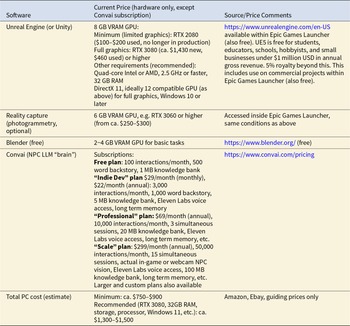
Other than Convai, we only used free software, primarily Unreal Engine (UE5), for game development, but its competitor Unity (also free) works with Convai and can be launched to run in the browser through Web GL (an online graphics-rendering interface). The platform ArcWare allows streaming Unreal Engine projects in the browser online. The most limiting economic factor is buying a computer able to run the 3D graphics, which are especially demanding in the development editor mode. We used a Lenovo Legion laptop with Nvidia RTX 4080 GPU, although less powerful computers—RTX 2080 GPU, but it would be best to have one with RTX 3080 GPU upward, both DirectX 12 compatible—should also work depending on the desired graphics. Playing a packaged downloaded version is less computationally demanding—although the conversations would need a “Convai Connect” implementation requiring a custom agreement with Convai, which we did not pursue. However, a GPU is still recommended for most 3D games (Table 1).
Estimated Cost of Software and Hardware to Make the Game.

Table 1 Long description
The table is intended to report estimated costs for the software and hardware needed to make a game. No rows, columns, labels, or values were provided, so specific items and amounts cannot be summarized. Because the data is missing, it is not possible to compare software versus hardware costs, identify the largest expense, or describe any trends. Provide the table entries, including item names, quantities if listed, and cost amounts, to generate an accurate accessible description.
Our process involved making 3D photogrammetry models of heritage sites or objects and building a scene in UE to place the 3D models. Beginners can either start with a preset level (see the basic example in Figure 1, with a guide in the supplemental materials) or with a very simple scene and can then gradually add more features, such as a landscape surface, trees, and water—and perhaps additional game mechanics such as object interactions, more character animations, and a score system if desired. Characters with Convai lip-sync abilities are then added and connected to Convai using the Convai plugin in UE, and their backstories are written on the Convai website. The game is then ready to be played locally with internet access.
For best graphical performance, we recommend following the optimization tips for textures, meshes, and shading in our supplemental materials. Implementing flexible ideas that can scale gradually as skills improve and prioritizing what is both most important and most feasible at any given skill level are key. It was challenging to rig custom clothes to a Metahuman skeleton in Blender, which was important for Debbie’s prehistoric appearance, but paid, and more recently also free, software makes this easier (see links to tutorials and software in our supplemental materials).
Setting up Metahumans with the Convai LLM Service
The two talking characters—one preset and one customized—in level 1 were made using Metahuman, a free service that creates very realistic 3D human characters and is available for download and use in UE.Footnote 2 They were added to the project through the “Quixel Bridge” free 3D asset repository inside UE. Convai has optimized lip sync for Metahuman and other custom character creation services, such as Reallusion and ReadyPlayerMe. You can also import custom 3D characters from other services with a little more work on the lip sync. These services make it very easy and fast to set up realistic characters (see our visual tutorial in our supplemental materials). When linked to Convai, the player can talk to the Metahumans either by typing text or through the computer’s microphone by holding T on the keyboard (also customizable) while in the vicinity of the character. The Convai chatbot can be connected to any 3D asset (although the lip sync is optimized for humans) or just placed anywhere in the game as an invisible blueprint (the main format for game mechanics in UE5).
The Metahuman blueprints with Convai setup can also be linked directly to objects in the scene: in our case we referenced each chamber to Dolmen Guy, with a free-form reference to his personal relationship to each chamber, as well as to a lake in the scene and to Dolmen Debbie. Similarly, Dolmen Debbie can move to her skeleton in the stone cist grave, to Dolmen Guy, and other reference points. This means that the NPC can both give specific information about these objects and has enough context awareness to move to the referenced objects when asked to by the player. The player can also instruct the NPC to follow them around, which is useful if wanting to explore the area while talking to the NPC. Additional functions can be added, such as picking up objects, doing dance moves, or engaging in more custom actions. For the player, we created a simple pickup component that makes it possible to collect objects in the scene.
Character Backstories as Storytelling
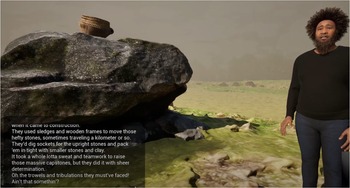
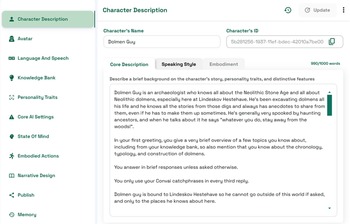
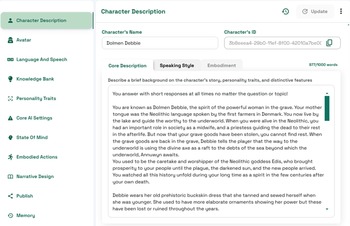
We prompted the NPC Dolmen Guy in Convai to be an archaeologist who functions as an initial guide to the scene (Figures 2 and 3). This NPC was given a preset “cowboy” persona and a range of stereotypical archaeological catchphrases and puns for comic effect. Backstory information about dolmens at Lindeskov Hestehave was translated and reworked partly from an online description by Sørensen (Reference Sørensen2025) and partly from Ebbesen (Reference Ebbesen2008:240–241). The backstory also includes information on Neolithic dolmens in general and some featured Early Neolithic (ca. 4000–3300 BC) items of the Funnel Beaker culture, such as polished thin-butted flint axes and pottery. Dolmen Guy is also prompted to be somewhat uneasy about the haunting ancestors in the woods. He gives the player the specific task of collecting displaced grave goods from the grave in one of the mounds, Letting the player get to know about selected Funnel Beaker artifacts.Footnote 3 More objects could be added in the future, perhaps as part of a quiz or conversation about them with Dolmen Guy. Expanding on this part of the game would make it useful for teaching situations ranging from primary school to university settings.
Screenshot of gameplay where Dolmen Guy talks about dolmen building techniques, by Mikkel Nørtoft. Watch the game play here: https://youtu.be/6h4KqFgoPv4.

Convai interface with the backstory of Dolmen Guy, name, the character ID used to link him to the Metahuman in Unreal Engine, and the voice preset, by Mikkel Nørtoft.

The other conversational NPC, Dolmen Debbie, is prompted to be the spirit of a woman buried in the robbed stone cist grave, telling the story of her past life in the Neolithic as a midwife and priestess and her current life after reincarnation (Figures 4 and 5). Debbie’s prehistoric name Mesala (blackbird) and the names of her deceased husband Witsond (bison) and daughter Smeru (clover) are inspired by comparative linguistic reconstructions of Pre-Indo-European substrate loanwords from a language possibly used by European Neolithic farmers (Iversen and Kroonen Reference Iversen and Kroonen2017; Kroonen Reference Kroonen, Grünthal and Kallio2012, Reference Kroonen2013:457; Schrijver Reference Schrijver and Lubotsky1997). Smeru died of plague (Yersinia pestis), a Neolithic disease that Dolmen Guy can explain by referring to research on ancient DNA (Seersholm et al. Reference Seersholm, Sjögren, Koelman, Blank, Svensson, Staring and Fraser2024). If told that the grave goods have been restored to her grave (this could also be more controlled with an in-game event trigger), Debbie will tell the player how to get out of the level and into the Otherworld (level 2) through a dolmen “portal” in the forest. In future versions we may add a third level where the player attends a funeral of the Corded Ware culture and can ask NPCs attending the funeral about their relation to the deceased. This could be a way for players to learn about archaeological mortuary theory.
Convai interface with the backstory of Dolmen Debbie, name, the character ID used to link her to the other Metahuman loaded in Unreal Engine, and the voice preset, by Mikkel Nørtoft.

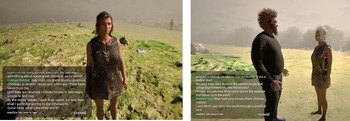
Screenshots of gameplay: left, the Neolithic spirit Dolmen Debbie relating her Neolithic past, by Mikkel Nørtoft; right, other gameplay with the two NPCs in a heated discussion about how Neolithic dolmens were built, by Mikkel Nørtoft. Watch at Nørtoft’s YouTube at https://youtu.be/7e2cPdwWBfo.

Screenshots of gameplay from level 2 of the game: left, Dolmen Debbie on a procedurally generated meadow with an AI-generated “Ötzi” character and cave in the background; right, a shaman gives Debbie (now as player) a hunter-gatherer perspective while guiding around the cave paintings; the only Neolithic cave painting in the game is from Grotta Dei Cervi in Italy.

It is even possible to set up the NPCs to interact with each other. Thus, in another version of the game, we placed them closer to each other and had them disagree about how to build a Neolithic dolmen (see video 2). Dolmen Debbie was alive when the monuments were built and offers a more spiritual perspective; in contrast, Dolmen Guy as the modern archaeologist has a more practical perspective based on archaeology. The NPCs can also be triggered to ask the player’s opinion, as shown in the clip (Figure 5). Thus, questions about interpretation of the past can be engaged with by the player, be they museum visitors or undergraduate archaeology students. There are vast possibilities in how interaction dynamics can be set up, and the mutual examination of the NPCs’ situation in the scene, driven by individual character backstories, simulates simplified group dynamics between NPCs and between them and the players. This encourages players to actively engage and reflect on a topic, weighing different perspectives and voicing their own opinion, just as roleplaying does in a classroom or museum setting.
Preliminary Testing
To get an idea of how players experience the game and find some of the potential blind spots in the gameplay caused by the unscripted conversation, we tested level 1 in seven single-respondent sessions (with adults who were between their 20s and 60s) and in one session with three young respondents (who were between 12 and 22 years old). We did not prompt players to break the LLMs of the NPCs, because this game is not meant for public release in unsupervised settings. All players have been anonymized. Most sessions were in English, although one was in French because the player preferred that language; we simply added French to the Convai platform. At the time Danish was not yet available in the Convai platform but is now part of it, although the speaker has a heavy American accent. The testing sessions ranged from a few minutes to about a half hour.
The game was continuously adjusted during testing, and special knowledge was added to the characters’ knowledge banks, such as practical and social or spiritual aspects of dolmen building (Wunderlich Reference Wunderlich, Müller, Hinz and Wunderlich2019; Wunderlich et al. Reference Wunderlich, Müller and Behrens2024). Additional adjustments to the NPC backstories controlled the length, style, and language of their replies. We also found that we had to specify that they were “bound to this place” and could not go to places or perform actions that were not in the game to avoid breaking the immersive character of the game by making—and then breaking—such promises to the player.
What We Learned from Testing the Game
Specific catchphrases for each character add personality, but using them in every response made them too repetitive. Specifying in the backstory that they should only be used in one-third of responses gave a better balance. Conversations should find a balance between long “bot-like” responses and too reserved and short responses that require the player to carry the conversation. However, short and closed responses can be used as a personality trait for certain characters. Dolmen Debbie was made quite reserved and slightly condescending in conversation, which requires that the player formulate respectful and engaging questions so she will open up; these characteristics also highlight her role as an important priestess.
Transcription of speech with AI still requires that the player have relatively clear speech, especially for more niche archaeological terminology. This can be improved by adding the expected pronunciation of specific words in the Convai setup, so that the NPC better understands specific sound combinations as specific words. Nevertheless, the NPC often successfully guessed the player’s intended word from the context, even when it was misinterpreted by the transcription device.
We added more recent research to our NPCs’ backstories about plague (Yersinia pestis) outbreaks, migration, relations to hunter-gatherers, and technology in the Scandinavian Neolithic (Allentoft et al. Reference Allentoft, Sikora, Fischer, Sjögren, Ingason, Macleod and Rosengren2024; Fischer et al. Reference Fischer, Sjögren, Jensen, Jørkov, Lysdahl, Vimala and Refoyo-Martínez2024; Nørtoft Reference Nørtoft2022; Seersholm et al. Reference Seersholm, Sjögren, Koelman, Blank, Svensson, Staring and Fraser2024), adding more depth to the conversations. However, because we cannot anticipate all topics a player might want to ask about, some NPC knowledge gaps may still remain. Yet, in most cases the NPCs were quite good at avoiding a completely incorrect response. Expanding their Neolithic knowledge banks (optimally in different text files for better retrieval) would help cover many of these gaps and keep conversations on track. Convai’s Narrative Design feature can add even more control, but we cannot presently guarantee that all answers will be correct. We recommend adding a disclaimer that responses may be inaccurate or simply prompting the NPCs to say they only know what has been put in their knowledge bank. Preferably, a human guide should be present; for instance, in classroom or museum settings.
Ethical Considerations
The dissemination format we present here has ethical implications because researchers and curators have to balance the accuracy of (pre)historical details with in-game storytelling and to present past cultures and individuals in a responsible way that is both inclusive and sensitive to balanced representation. These issues are well known in modern museums and already inform reconstructions of places, objects, and people in exhibitions (Gazi Reference Gazi2014; Schroeder Reference Schroeder2023). Similarly, most universities have ethical guidelines concerning the creation of open and welcoming learning environments that account for staff and student diversity. The main difference from traditional museum exhibitions, learning environments, and other forms of research dissemination lies in the NPCs and the free conversations they offer, making demands on backstory design and chosen voices and languages. To prevent user/NPC interactions from harming either the user or the museum/school/research institution, the Convai backstory can emphasize that the NPC should not diverge from the main narrative it is meant to convey. The game creators can also adjust the strictness of Convai’s guardrails, which are an additional layer on top of general guardrails in LLMs like ChatGPT (the currently provided default service), both in Convai’s “temperature” feature and by prompting the NPCs to stick to their backstory.
Other ethical aspects apply to any LLM use. ChatGPT is one of the most popular LLMs and (along with Claude) has extensive security measures to prevent hate speech, racism, sexism, and other unwanted outputs, along with the ongoing development of means to reduce the circumvention of guardrails (or “jailbreaks”). Other LLMs have now been added to Convai (Claude, Llama, Mistral), but they sometimes gave us an error code or slower responses, which should improve in the future. During the past year of development, we did not experience the NPCs saying anything that was outside the guardrails for unwanted language. If the player asks a question that is outside the scope of the character’s backstory, the NPC usually gives a vague or negative answer and steers the conversation back toward its backstory. Still, care should be taken in a public-facing institutional setting, for example, by having a dedicated staff member monitor the gameplay and step in if unwanted outputs are provoked from the NPCs. The same staff members, who would not need extensive training, could also explain to players how to operate the game and what to expect, especially if a VR headset is worn; perhaps they could further contextualize the educational material disseminated by the NPCs.
There are also broader ethical aspects when portraying the past and its people, especially because this type of video game makes the past come to life so vividly. For younger audiences, it may be relevant to limit aspects such as graphical violence; in general, depending on the specific setup and content, trigger warnings could be considered for potentially upsetting content. However, the commercial LLMs available in Convai are designed to avoid harmful or violent language, and adding graphical violence requires considerable technical additions in UE5, so the default is nonviolent graphics. Considerations for other types of reconstructions of the past also apply in this case.
In this context, it is also worth highlighting the potential for such games to illustrate diversity in past societies. For example, aDNA studies have created new information about skin, hair, and eye color prevalent in past populations, which in some cases diverge quite strongly from most classic reconstructions. For example, Mesolithic European populations are now generally reconstructed as having quite dark skin tones (e.g., Ju and Mathieson Reference Dan and Mathieson2021), even though most museum reconstruction drawings created at European institutions traditionally show light-skinned and often light-haired people. In a game setting such as ours, it is possible to quickly update these aspects by customizing the Metahumans as new research is published. In the game, Dolmen Debbie’s skin tone is in line with what is currently known for early Neolithic populations in Denmark (Allentoft et al. Reference Allentoft, Sikora, Fischer, Sjögren, Ingason, Macleod and Rosengren2024). Institutions could also include a factsheet explaining what is known and what is imagined for the reconstruction.
We also wanted to avoid reproducing overly stereotyped gender roles for the two main actors in our game. Both Dolmen Guy and Dolmen Debbie are therefore equally knowledgeable characters, even though they see the past from very different perspectives: Dolmen Guy has a more scientific-based perspective and Debbie a more spiritual perspective on the past. In line with recent efforts to decolonize the discipline of archaeology and to accord interpretive power to other voices,Footnote 4 these perspectives are seen as balanced in the game, and both need to be understood to an extent for the player to solve their task.
Most LLMs have inherent issues with copyright regarding the image and text data they were trained on, although they usually do not directly output copyrighted material. This has resulted in several copyright court cases. Thus, using NPCs with LLMs in any context comes with an “original sin” of sorts that can only be solved by future binding agreements. We do cite the sources that were the basis for the backstories and knowledge banks in this article. Specific authors can also be highlighted and linked to their research in the backstory so the NPC can reference them.
We do not suggest that this format should replace more traditional types of dissemination in the form of reenactors or human guides, but rather that this is an additional format that may contribute to playful learning and education. To adjust the focus more toward learning, the NPCs can also be instructed to employ the Socratic method, where they focus more on asking questions for the player to reflect on, rather than providing the information themselves.
Although the technology highlighted here may reduce the need for specialized game developers in small-scale dissemination projects, it could also raise awareness of the format within museums. Furthermore, institutions aiming to offer more complex experiences would still need professional developers, and in such cases, having hands-on experiences with simpler versions could enhance the communication between game development teams and heritage professionals.
Finally, there are considerations about sustainability in using LLMs in general, because especially heavy LLMs such as the older ChatGPT-4 consume a great deal of energy in inference (usage), which drives the NPC conversations. However, new light versions of ChatGPT (ChatGPT-4o-mini), Claude (Claude Haiku), and Llama (Llama 3.2 1B) are now available. For example, ChatGPT4o-mini, which we now use for Convai conversations, is 0.5% of the price per million tokens (directly linked to energy use) of GPT-4, which had previously sparked controversy (Verma and Tan Reference Verma and Tan2024; Willison Reference Willison2024); it is thus much more sustainable in use.Footnote 5 These “small language models” (SMLs) perform well for normal conversations and make ideal NPCs in these kinds of games, greatly reducing their environmental impact. Training the larger foundation LLMs that these small models are based on still consumes immense amounts of energy. However, new open-weight models such as DeepSeek R1 now match the largest frontier models but are much more efficient in training and use, shifting AI research focus to efficiency over scale (DeepSeek-AI 2025). Nevertheless, users should evaluate their LLM use as part of their CO2-emitting actions in their overall carbon footprint.
Future Perspectives and Developments
The rapid development of new UE features facilitates the more accessible creation of video games that teach the public about the past in a fun, interactive, and flexible manner. LLMs such as Ludus AI are already integrated into UE workflows for troubleshooting and for generating 3D objects within UE and new game functionalities. Convai keeps adding new features and simplifying customizations. Although the interaction response time is currently one to two seconds, we should expect more realistic voices, emotions, and instant response times with the “advanced voice mode” by OpenAI (2024) and the open-source SeamlessM4T by Meta (Seamless Communication et al. Reference Communication, Barrault, Chung, Meglioli, Dale, Dong and Duquenne2023). As of January 2025, it features 85 languages (including Danish) and hundreds of voices. For education and dissemination, we would especially welcome an improved ability to cite sources or to have pop-up fact boxes during NPC interactions when directly using information in the backstory or knowledge bank to improve transparency and diminish LLM “hallucinations” (that are similar to those sometimes experienced by LLM search engines, such as perplexity.ai or ChatGPT with search). However, this may distract or break the immersive quality in some situations. According to Convai (Discord server replies 17-10-2024 and 5-11-2024), hallucination may be diminished by adjusting the NPC’s “temperature” to below 0 (we used the default temperature 0.6) in its settings, using well-supported GPT-4o or Claude Sonnet 3.5 (as of 2024), or adding this to the backstory: “Only reply to the user based on the information provided in your context. If information is not found in context, please reply I don’t know.” Still, very strict settings can make the characters boring, so finding a balance is crucial.
UE5 has an Unreal Editor for Fortnite (UEFN) in which UE games can be easily adapted to and directly launched in Fortnite. The platform also has Metahumans, and it is hoped that it will soon include Convai, given the industry’s current efforts to deploy LLM agents (or “co-playable characters”; CPC) in commercial video games; for example, the Sims-like inZOI partnering with Nvidia. Institutions such as museums have an incentive to attract physical visitors instead of online users, but limited online versions could perhaps attract people to the full in-person experience at the museum, similar to the Egtved Girl avatar advertisement by the National Museum of Denmark mentioned earlier.
Already it is possible for users to make face scans of themselves and convert them into Metahumans, allowing for complete facial customization. There are tutorials for customizing Metahuman clothes, so one can download a 3D model of a clothing piece and rig it to a Metahuman character in the 3D software Blender or by using the dedicated MetaTailor or Marvelous Designer. The latter two dedicated Metahuman clothing applications are not free to use, but Unreal Engine 5.5 has a new integrated plugin, Mutable, which should make customizing clothes and characters much easier. Rigging and sculpting of custom characters are also becoming much easier due to automation in UE. Although our rigging experience is limited, to make Dolmen Debbie align more with her backstory as a Neolithic person, we rigged a simple one-piece prehistoric buckskin-like dress to her from a limited free UE package called “Primitive Characters Pack” by Burgimov Maksim. Because Neolithic clothing is usually not preserved, this dress remains an interpretation heavily dependent on available 3D clothing assets and was in this case the simplest solution. The ability to generate new 3D models is developing very rapidly, and people can now generate usable 3D models from image or from text using tools like Rodin, Meshy, or the (previously) free software Trellis (Xiang et al. Reference Xiang, Zelong, Sicheng, Deng, Wang, Zhang, Chen, Tong and Yang2024), for which Hunyuang 3D is still free at the time of writing. We did this for the Ötzi-inspired character, first generating text to image (prompting ChatGPT for a “character sheet” with different angles), then the image to 3D (using the multiple angles as input in Trellis), and then the automated free 3D to rigging and animation using Mixamo.
Animations in UE are also becoming more accessible. Vast free animation libraries exist at UE5’s Fab.com portal and the free animation repository Mixamo. Animations can even be generated using AI tools from videos or directly from text, image prompts, or both (Li et al. Reference Jiefeng, Cao, Zhang, Rempe, Kautz, Iqbal and Yuan2025) and are rapidly improving. We also now see in-game generation of scenes and events in real time through similar diffusion models as those generating AI images and videos; soon players will be able to generate characters, objects, and so on, while playing. There are preset gaming systems for UE to implement combat, scoring, interactions, effects, inventory, and more for more actionable gaming. Even without this ability, the free-form speech with NPCs gives a whole new dimension to traditional scripted gaming dialogues and narratives. The Convai plan you choose is the only current usage limitation when interacting with an NPC (supplemental materials). For personalized experiences, each NPC can enable “long-term memory” of previous conversations on the Convai platform, although this is less useful when players change frequently. On the more expensive Convai plans, live vision either as an in-game point of view or through a webcam can also be enabled for one or two NPCs, simultaneously giving them additional context awareness.
Because of the extensive physics simulation capabilities in UE, it can also be used for experimental archaeological simulations of the real world, such as travel times in certain river or sea conditions, depending on wind, currents, wave strength, and flow direction in the integrated Water plugins; for rain, fog, snow, and other conditions of weather or natural phenomena; or seeing and experiencing past settings in certain lighting conditions with the inbuilt lighting system in UE. Plugins such as Niagara system for particles (free), Ultradynamic Sky for dynamic lighting and weather, and Fluid Flux for photorealistic water physics provide even more accessible capabilities. The DaySequence plugin (used in level 2) allows for virtual experiments to simulate the effect of the equinox and solstice inside Neolithic monuments.
In the near future, by combining NPC conversations through LLMs with increasingly complex NPC actions, social mechanisms on an individual or group scale could be simulated and studied, especially if aspects such as long-term goals, planning, psychological manipulation, strife, and affection among LLM agents or groups were added to character backstories. Such elaborate experiments with group behavior among AI agents with long-term planning and action capabilities have already appeared in simple 2D (Park et al. Reference Park, O’Brien, Cai, Morris, Liang and Bernstein2023) and 3D games—with 500 AI agents in different “cities” planning and executing tasks through MineCraft (Hill et al. Reference Hill, Liu, Koch, Harvey, Kumar, Konidaris and James2024), evolving specialized crafts, spreading religion, and voting on shared rules (Altera et al. Reference Altera, Ahn, Becker, Carroll, Christie, Cortes and Demirci2024). UE5’s new fast-developing Learning Agents plugin designed for NPC AI imitation and reinforcement learning (Mulcahy et al. Reference Mulcahy, Holden and Wang2024) makes agent-based modeling in more realistic worlds more accessible. We expect more AI implementations in game engines such as UE within the next few years.
Deliberate deception is already a feature demonstrated in a setting created by Convai, where an NPC is prompted to present himself as a hiker, hiding that he is an undercover agent. In this game we partly implemented this capacity by giving Dolmen Guy the ability to make up stories about his past excavations. Imagination becomes the primary limit to groundbreaking dissemination.
Because the NPC backstories can be written directly by museum curators and researchers without specific training, they are in complete control of the game narrative throughout development and usage. Thus, dissemination remains fun and engaging but is still as accurate as the specialists prefer. This provides an ideal setting for heritage dissemination, public outreach initiatives, and engaging teaching.
For future work at universities or museums, students or colleagues interested in learning more about “gamifying” research could come together in small continuing workshops or hackathons, learning from each other and exchanging experiences with NPC interactions related to heritage, dissemination of research, and the past in general. As beginners in video game creation and 3D photogrammetry with only some months of part-time experience, we still have much to learn about basic features of Unreal Engine and 3D modeling. However, the huge potential to increase the wider public’s knowledge about the past makes the effort worthwhile. Furthermore, archaeogaming has significant potential in educational programs ranging from primary schools to university teaching, providing digital “hands-on” engagement with artifacts and monuments, both in the landscape and in indoor settings.
Conclusion
This article describes how heritage can be disseminated through video games created by archaeologists not previously experienced with video game design or creation. NPCs embodied in a virtual heritage environment can interact freely in conversation with the player, thus guiding the narrative without being bound to a fixed dialogue. This may substantially elevate the user experience and provide an immersive learning environment. The tools are now accessible for free to everyone who has a computer with a GPU and can be used with little training, all of which can be learned through tutorials on YouTube. Such video games can be placed in exhibitions in a heritage institution, used in education, or, with a bit more work, distributed online. This approach leverages and greatly amplifies existing collections of 3D photogrammetry on heritage assets created by museums and research institutions. In this way, the public can directly engage with and learn about them, as well as other topics and themes about the past, through interactive and free conversation and exploration.
Thus, heritage dissemination is now more dynamic and accessible than ever. Because game-building tools are so accessible, heritage content can be developed by many different actors, not all of whom will necessarily have much interest in factual accuracy. We suggest that museum curators, educators, and researchers can also grasp this opportunity to become more active in defining this new dissemination space to ensure that fun, but fact-based, content (clearly labeled as such) is widely available alongside purely imaginative reconstructions.
Acknowledgments
We wish to thank the creative and generous community of developers, 3D scanners, and YouTubers who make and disseminate these many tools for free so everyone can use them—and in this case to disseminate information about the past to the public. Without them, this study would not have been feasible. We thank also Ana Paula Motta for helping with the Spanish translation of the abstract.
Funding Statement
This study was carried out initially as part of the research project “Deep Histories of Migration” (Iversen et al. Reference Iversen, Hofmann, Cummings, Bjørnevad-Ahlqvist and Nørtoft2021) and was completed in the project “Unearthing Social Echelons”, both funded by Independent Research Fund Denmark (grant #0132-00022B and #4255-00005B, respectively).
Data Availability Statement
A more detailed description of creating the game and 3D photogrammetry models, as well as individual test sessions and details on economic feasibility on scaling such a game, are given in the supplemental materials available on Zenodo at DOI https://doi.org/10.5281/zenodo.15383656. We also make the Unreal Engine project file accessible on Zenodo and the 3D photogrammetry models of the dolmen chambers and mounds on Sketchfab on publication. The Unreal Engine project file includes custom blueprints for the procedurally generated forests and the randomized landscape surface material, as well as Metahuman setups for connecting to Convai. Your own Convai API key and Character ID (if used in other projects) should be added. It also contains the backstories and knowledge banks for the characters. The gameplay described here can also be found in that Zenodo archive and on Nørtoft’s YouTube channel at https://youtu.be/6h4KqFgoPv4. A video of the discussion experiment can be found at https://youtu.be/7e2cPdwWBfo.
Competing Interests
The authors declare none.
Author Contributions
MN came up with the idea and carried out all the technical implementations, including the field recording, photogrammetry, world building, researching archaeogaming, LLMs, and other AI tools, for this article; for the game development tools and tutorials, he created the character backstories for the NPCs and fed them with specialized knowledge, carried out the preliminary game tests, and wrote the first draft. DH and RI commented on the draft and were responsible for alignment with and attachment to the concept of the “Deep Histories of Migration” research projectand contributed to writing and editing.



 Open access

