
Skip to main content Accessibility help
×
  • Cited by 40
    • Show more authors
    • You may already have access via personal or institutional login
    • Select format
    • Publisher:
      Cambridge University Press
      Publication date:
      05 June 2020
      02 July 2020
      ISBN:
      9781108873994
      9781108836586
      9781108812603
      Dimensions:
      (229 x 152 mm)
      Weight & Pages:
      0.6kg, 410 Pages
      Dimensions:
      (229 x 152 mm)
      Weight & Pages:
      0.604kg, 410 Pages
    You may already have access via personal or institutional login
  • Selected: Digital
    Add to cart View cart Buy from Cambridge.org

    Book description

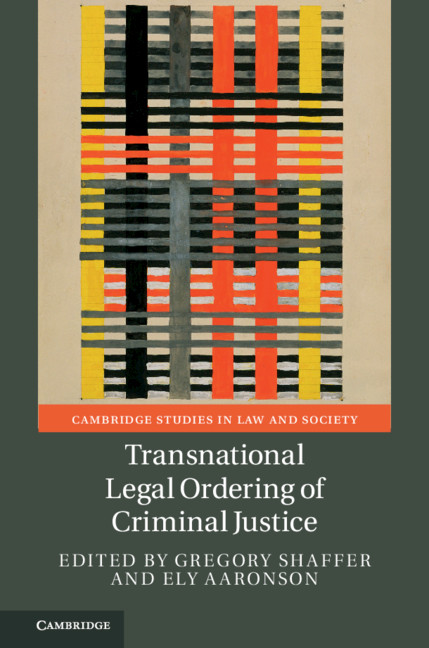
    Hard and soft law developed by international and regional organizations, transgovernmental networks, and international courts increasingly shape rules, procedures, and practices governing criminalization, policing, prosecution, and punishment. This dynamic calls into question traditional approaches that study criminal justice from a predominantly national perspective, or that dichotomize the study of international from national criminal law. Building on socio-legal theories of transnational legal ordering, this book develops a new approach for studying the interaction between international and domestic criminal law and practice. Distinguished scholars from different disciplines apply this approach in ten case studies of transnational legal ordering that address transnational crimes such as money laundering, corruption, and human trafficking, international crimes such as mass atrocities, and human rights abuses in law enforcement. The book provides a comprehensive treatment of the changing transnational nature of criminal justice policymaking and practice in today's globalized world.

    Reviews

    'This important book mounts a fundamental challenge to the nation-state paradigm of criminal justice scholarship. Wide ranging, theoretically rigorous, and consistently readable, it moves the study of transnational legal ordering of criminal justice to a new level of sophistication.'

    Nicola Lacey - School Professor of Law, Gender and Social Policy, London School of Economics

    'There is sway and sweep in the comprehension of translational legal ordering in this fine book. It exposes diversity, incoherence, yet patterns in regimes ranging from criminal regulation of human trafficking to corruption, war crimes, sexual violence, money laundering, human rights, and more. This is a landmark instantiation of a big picture socio-legal framework.'

    John Braithwaite - Australian National University

    'A path-breaking set of essays that examines the driving forces and consequences of the transnationalization of criminal justice law and policy, with reference to criminalizing global social problems, tackling impunity for serious international crimes, and efforts to build human rights penal standards. The work is guided by a coherent theory of the varying roles of states in transnational legal orders. No student of contemporary criminal justice should miss the chance to learn from the theory and case studies.'

    David Nelken - King’s College London

    'Norms of criminal justice, no less than crime itself, refuse to remain neatly contained within national jurisdictions. Gregory Shaffer and Ely Aaronson’s collection of essays illustrates the ways in which a reasonably distinct transnational order has developed, become elaborated, and in some cases encountered contradiction and resistance. One of the book’s great insights is that the transnational legal ordering of criminal law has in some ways empowered the state to reclaim its own legal authority. Read this book, and you will appreciate the impossibility of dichotomizing the study of modern ‘national’ and ‘international’ criminal law.'

    Beth A. Simmons - Andrea Mitchell University Professor of Law, Political Science and Business Ethics, University of Pennsylvania

    'The norms, institutions, and practices of criminal justice systems around the world have been deeply transformed in the last few decades by globalization and many new international and transnational legal regimes. Criminal justice, comparative law, and international law scholars are still grappling with these changes. By applying the illuminating theory of transnational legal orders to criminal justice, this impressive group of top scholars gathered in this book provides crucial insights to make sense of these changes. This book is an essential tool for anyone interested in them.'

    Máximo Langer - Professor of Law and Director of the Transnational Program on Criminal Justice, UCLA School of Law

    Refine List

    Actions for selected content:

    Select all | Deselect all
    • View selected items
    • Export citations
    • Download PDF (zip)
    • Save to Kindle
    • Save to Dropbox
    • Save to Google Drive

    Save Search

    You can save your searches here and later view and run them again in "My saved searches".

    Please provide a title, maximum of 40 characters.
    ×

    Contents

    Metrics

    Altmetric attention score

    Full text views

    Total number of HTML views: 0
    Total number of PDF views: 0 *
    Loading metrics...

    Book summary page views

    Total views: 0 *
    Loading metrics...

    * Views captured on Cambridge Core between #date#. This data will be updated every 24 hours.

    Usage data cannot currently be displayed.

    Accessibility standard: Unknown

    Why this information is here

    This section outlines the accessibility features of this content - including support for screen readers, full keyboard navigation and high-contrast display options. This may not be relevant for you.

    Accessibility Information

    Accessibility compliance for the HTML of this book is currently unknown and may be updated in the future.
