
Skip to main content Accessibility help
×
  • Cited by 30
    • Show more authors
    • You may already have access via personal or institutional login
    • Select format
    • Publisher:
      Cambridge University Press
      Publication date:
      09 October 2020
      29 October 2020
      ISBN:
      9781108769716
      9781108477376
      9781108708623
      Dimensions:
      (228 x 152 mm)
      Weight & Pages:
      0.85kg, 490 Pages
      Dimensions:
      (229 x 152 mm)
      Weight & Pages:
      0.651kg, 490 Pages
    You may already have access via personal or institutional login
  • Selected: Digital
    Add to cart View cart Buy from Cambridge.org

    Book description

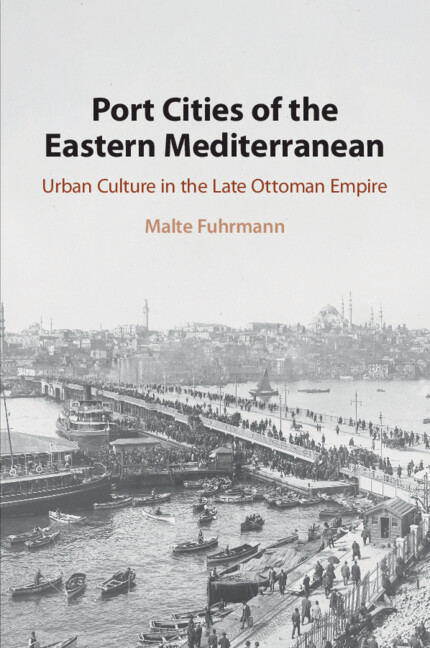
    Eastern Mediterranean port cities, such as Constantinople, Smyrna, and Salonica, have long been sites of fascination. Known for their vibrant and diverse populations, the dynamism of their economic and cultural exchanges, and their form of relatively peaceful co-existence in a turbulent age, many would label them as models of cosmopolitanism. In this study, Malte Fuhrmann examines changes in the histories of space, consumption, and identities in the nineteenth and early twentieth century while the Mediterranean became a zone of influence for European powers. Giving voice to the port cities' forgotten inhabitants, Fuhrmann explores how their urban populations adapted to European practices, how entertainment became a marker of a Europeanized way of life, and consuming beer celebrated innovation, cosmopolitanism and mixed gender sociability. At the same time, these adaptations to a European way of life were modified according to local needs, as was the case for the new quays, streets, and buildings. Revisiting leisure practises as well as the formation of class, gender, and national identities, Fuhrmann offers an alternative view on the relationship between the Islamic World and Europe.

    Reviews

    ‘Malte Fuhrmann’s richly nuanced and elegantly theorized study explores the late-Ottoman port-cities’ sites of cultural exchange and adaptation, ranging from balls and opera to beer halls, cafés and brothels. The complex and fluid interactions revealed force us to rethink the dominant narrative of Westernization and identity-formation in the Eastern Mediterranean.’

    Benjamin C. Fortna - University of Arizona

    'An essential read for historians of the Eastern Mediterranean. Α wealth of material captures vividly contemporary voices and shows how people in the most emblematic ports of the Ottoman Empire tried, consumed, became part of and in some ways rejected ‘Europe’ while constructing Eastern Mediterranean modernity.'

    Sakis Gekas - York University, Toronto

    ‘Port Cities of the Eastern Mediterranean is a richly detailed comparative history of cultural exchange and urban modernity in the eastern Mediterranean. … the book-cinemas, opera houses, gymnastics clubs, boulevards, beer gardens, cafés, and brothels together support a remarkable study that poses a stunning (if gently argued) challenge to existing work in Ottoman, urban, and cultural history. A rewarding read.’

    R. A. Miller Source: Choice

    ‘… a delight to read … Fuhrmann’s is an achievement for revisiting a subject that is often considered exhausted in known frameworks, and indeed for reopening discussions of urbanity at new levels. This is welcome not only to those in the field but to readers outside the field who are interested in the many and ongoing facets of what it means to be urban.’

    Meltem Toksoz Source: American Historical Review

    ‘… I would compare Fuhrmann’s achievement to a challenging, but very successful balancing act. He uses textual sources of a dominantly anecdotal and often subjective nature, but with a rigor that wards off most of the dangers inherent to this kind of material. He navigates back and forth in a period of about a century with some liberty, but manages to maintain the required level of consistency while doing so. He focuses on a number of individual cases and moments in the life and culture of these port cities, yet he also manages to provide them with a theoretical and historiographical framework, which is extremely useful for the readers, especially if they are not familiar with this complex and multilayered context.’

    Edhem Eldem Source: H-Soz-Kult

    ‘Fuhrmann’s ambitious undertaking looks at modern Ottoman culture in relation to 'the West' in Salonica, Smyrna, and Constantinople. An unusual array of archival material, supplemented by the author’s vast knowledge of literature, is called upon to depict the urban space as a site of ambivalence and as a stage for the multitude of identities intimately intertwined with the European landscape. … Through examples and extensive analysis, Fuhrmann’s study attempts to achieve what great art does (to paraphrase Orhan Pamuk) - to change the landscape of our minds.’

    Esra Almas Source: Studies in Contemporary Jewry

    Refine List

    Actions for selected content:

    Select all | Deselect all
    • View selected items
    • Export citations
    • Download PDF (zip)
    • Save to Kindle
    • Save to Dropbox
    • Save to Google Drive

    Save Search

    You can save your searches here and later view and run them again in "My saved searches".

    Please provide a title, maximum of 40 characters.
    ×

    Contents


    Page 1 of 2


    Page 1 of 2


    Metrics

    Altmetric attention score

    Full text views

    Total number of HTML views: 0
    Total number of PDF views: 0 *
    Loading metrics...

    Book summary page views

    Total views: 0 *
    Loading metrics...

    * Views captured on Cambridge Core between #date#. This data will be updated every 24 hours.

    Usage data cannot currently be displayed.

    Accessibility standard: Unknown

    Why this information is here

    This section outlines the accessibility features of this content - including support for screen readers, full keyboard navigation and high-contrast display options. This may not be relevant for you.

    Accessibility Information

    Accessibility compliance for the HTML of this book is currently unknown and may be updated in the future.
