


1. Introduction & background
Product teardown tasks, also known as dissection or disassemble/analyse/assemble (D/A/A) activities, are common and widely established educational practices within engineering design courses, often closely coupled with reverse engineering and redesign tasks (Reference Abe and StarrAbe & Starr, 2003; Reference Aglan and AliAglan & Ali, 1996; Reference Dalrymple, Sears and EvangelouDalrymple et al., 2011; Reference Fazelpour, Joshi, Mocko, Morkos, Mozaffar, Murphy, Patel, Ramnath, Renu, Righter, Sen, Gill and SummersFazelpour et al., 2025; Reference Kohlweiss, Auberger, Ketenci and RamsauerKohlweiss et al., 2020; Reference Otto and WoodOtto & Wood, 2001; Reference Wood, Jensen, Bezdek and OttoWood et al., 2001). Product teardowns are valued as they provide students with essential hands-on experience, facilitate a deeper understanding of how products work and what the internal components needed to achieve the overall product function are, as well as enabling insight into the manufacturing processes and materials used for their fabrication. Reference Dym, Little and OrwinDym et al. (2014) have stated: “We do this [product teardown] to find out in detail just how it [product] works so we can then apply what we learn to our own design problem”.
Previous studies indicate that product teardowns offer several benefits for enhancing engineering design education. Primarily, the product teardowns are used in design courses to facilitate the learning process of core engineering design principles (Reference Freeman, Bern and MickelsonFreeman et al., 2000). However, beyond fundamental engineering knowledge, product teardowns can provide a broad spectrum of educational gains. For instance, Reference Marchese, Ramachandran, Hesketh, Schmalzel and NewellMarchese et al. (2003) used product teardown to conduct consumer product benchmarking and reported benefits such as understanding the value of multidisciplinary teamwork, hands-on experience of applied engineering principles, insight into cost, safety, and aesthetic aspects of product design, as well as improvements in communication skills among team members. Furthermore, as teardown tasks provide practical experience for students, researchers have reported that teardown tasks had a significant influence on students’ motivation, engagement, and enjoyment in the tasks, as well as improved sense of learning and perception of task helpfulness (Reference Calderon, Marjanovic, Storga, Pavkovic and BojceticCalderon, 2010; Reference Dalrymple, Sears and EvangelouDalrymple et al., 2011). Additionally, teardown tasks have been successfully applied in specialised areas, such as to bridge the gap between design and physics, which helped students to gain a deeper understanding of physics principles embedded into the design of products (Reference Tan, Cheah and LeeTan et al., 2021, Reference Tan, Kwan, Koh, Pee, Lur and Yeo2022) or for educating designers about principles of circular design (Reference Wang, Harsuvanakit, Mincey and CordellaWang et al., 2022). However, product teardown does not always improve all educational benefits listed above. For example, Reference Furiato and MurphyFuriato and Murphy (2024) reported improvement in products’ component identification after conducting a teardown task, but no improvement in students’ mental models of the given product.
To structure the learning process through product teardown, various frameworks have been proposed in the literature. One of the first systematic teardown frameworks was developed by Reference Otto and WoodOtto and Wood (2001). In their approach, they emphasise the need for clear reasoning why teardown is conducted in order to collect data on important factors about the design of the disassembled product. The general steps of their teardown framework include the disassembly of the products, taking pictures of the disassembly process, and measuring all the parts and subassemblies. Furthermore, they advocate for filling out the bill of materials form during product teardown, capturing parts name, quantity, functions, mass, dimensions, manufacturing process, and materials. They also argue that different methods can be applied to facilitate the product teardown, such as subtract and operate procedure or force flow diagrams. Similarly, Reference UllmanUllman (2010) emphasises the role of product teardown in understanding functions of existing devices achieved through careful observation of product components, their interfaces, interaction with other components, and examination of flows of energy, information, and materials. Reference Ogot, Okudan, Simpson and LamancusaOgot et al. (2008) proposed a framework for classifying disassemble/analyse/assemble activities in engineering design education built upon four key activities occurring during the teardown: exposition, inspiration, inquiry, and exploration. Reference Akerdad, Aboutajeddine and ElmajdoubiAkerdad et al. (2022) developed a framework for product redesign based on the product teardown with the goal of enabling students to gain a broad set of design skills through elaborated hands-on activities. In their framework, the objective of product teardown is to gain an understanding of how a product or a system works, through deliverables of exploded view, functional structure, and force flow diagram.
Besides the benefits of teardown and frameworks for their application, it is also important to emphasize the resources needed for conducting teardown activities in the classroom. Traditionally, product teardown involves physical disassembly of various electromechanical products, often small household appliances and power tools. However, this kind of product teardown requires significant resources, first and foremost the physical products themselves, but also dedicated workshop facilities, tools, and supervision (Reference McKenna, Chen and SimpsonMcKenna et al., 2008; Reference Ogot, Okudan, Simpson and LamancusaOgot et al., 2008). Hence, in recent years, multiple papers have been published on investigating the application of virtual product teardown in engineering education to overcome these resource limitations (Reference Knowles, Mills, Jur and ShenKnowles et al., 2022; Reference Perković, Martinec, Škec and ŠtorgaPerković et al., 2024; Reference Tan, Kwan, Koh, Pee, Lur and YeoTan et al., 2022).
Lastly, the reviewed literature shows the benefits of using product teardown to teach engineering design principles and emphasise the value of teardowns for skill acquisition (Reference Dalrymple, Sears and EvangelouDalrymple et al., 2011). However, the above reviewed studies were mostly conducted in the context of educating engineering design students. To fully understand the role and influence of product teardown across the full breadth of students’ engineering education, not only in the education of future engineering designers, but also in other disciplines that require engineering design in their education, such as industrial design, further investigations are needed.
This paper, therefore, aims to explore the role of product teardown on students’ engineering education in the context of industrial designers’ education. Specifically, we investigate the influence of product teardown of small electromechanical products on students’ technical and engineering knowledge acquisition, with the focus on their understanding of products’ working principles, component identification, as well as material and manufacturing processes needed for creating such products. Through an exploratory, qualitative study, we analyse the changes in students’ mental models and bill of materials (BOM) tables before and after the conducted product teardown. In section 2, we present the context of the teardown, methodology, and protocol used for data collection. Results of the study are presented in section 3. Section 4 discusses the findings of the study and addresses the study’s limitations. Finally, section 5 concludes the study and outlines lessons learned and directions for future research.
2. Methodology & product teardown
2.1. Context of teardown task
The conducted study and product teardown activity were carried out as a regular part of the curriculum for a master’s level course focused on material selection within the industrial design programme. The teardown is conducted every year in the 6th week of the semester, after students have had lectures about different engineering materials and their applications. The aim of the teardown is for students to gain hands-on experiences with materials typically found in small house appliances or handheld power tools, as well as to gain a deeper understanding of product internal components, their work principles, and functions. As the teardown is a regularly conducted course activity, there was no experimental intervention in the teardown task itself. The only addition was the data collected before and after the task.
The teardown presented in this study was conducted in the 2025 autumn semester, and it was a group activity. One group disassembled a handheld mixer, while another disassembled a cordless power drill.
2.2. Participants
The cohort during the semester when the study was carried out consisted of only 6 students, who all volunteered to participate in the experimental part of the teardown task. Five participants had completed three obligatory engineering courses on their bachelor’s industrial design programme covering topics of engineering drawings, calculations, and polymer processing. One participant did their bachelor’s in a different programme and didn’t take any formal engineering courses during their previous studies. All participants had 5 weeks of theoretical lectures on engineering materials prior to the teardown task. Participants didn’t have any formal hands-on training in material and manufacturing identification prior to the study.
2.3. Protocol
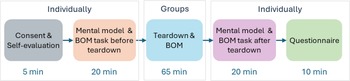
Since a small number of participants participated in the study, the study adopted an exploratory, qualitative approach, focusing on rich descriptive data and indicative trends rather than quantitative data and statistical analysis. The protocol for data collection and teardown started with a consent & self-evaluation questionnaire. Here, participants were introduced to the protocol and data collection procedure, as well as asked to review a consent form and decide if they wanted to participate in the study. Next, participants were randomly allocated to two three member groups. One group was assigned the task of disassembling a handheld mixer, and the other a cordless power drill. Participants were then asked to fill in the self-evaluation form about their experiences of conducting the teardown process, as well as their experience of using the assigned product. Four participants reported they had previous experience with product disassembly. Regarding experience with using the assigned product, participants with a hand mixer reported they use it 1-2 times a month, while participants with a cordless drill reported they use the cordless drill rarely, only a few times a year.
Protocol for product teardown task

In the following stage, participants were given a task of creating a mental model of how the assigned product works by filling in the outline of a product shape. Mental models have been used previously by researchers and educators to evaluate conceptual knowledge of various systems (Reference Furiato, Kado and MurphyFuriato et al., 2024; Reference LawsonLawson, 2006; Reference Murphy, Banks, Nagel and LinseyMurphy et al., 2019). In this study, participants were instructed to sketch, label, and describe how the products work, what components are inside, and where they are located, as well as what the inputs and output flows of the products are. This task was influenced by the work of Reference Furiato and MurphyFuriato and Murphy (2024), who conducted a similar study. Furthermore, participants were given a blank Bill of Materials (BOM) table and instructed to fill in the components they think will be in their products. For each listed component, they were expected to fill in the material and manufacturing method. This task was conducted individually, and the allocated time was 20 minutes.
The teardown was conducted as a group activity. The participants were instructed to disassemble a given product to a component level or a subassembly that cannot be disassembled further. Parallel with the disassembly, they were asked to fill in the BOM as a group using the same template as in the previous stage. As mentioned previously, the teardown task didn’t include any intervention but rather was treated as a regular curriculum activity. Crucially, participants were able to ask the lecturer for help with a disassembly but also ask questions regarding the functions and working principles of the internal components, the materials they are made of, and the manufacturing technologies needed for their production. This task didn’t have a time limit, but both groups finished the task in approximately 65 minutes.
Afterward, an individual mental model & BOM task was repeated under identical conditions to gather data regarding the influence of the teardown task on participants’ understanding of a given product function and production methods. Prior to conducting this task, disassembled products and group crated BOM tables were removed from the participants, hence they were completing the task from their memory. The final part of the study was a final questionnaire where participants were asked to self-evaluate the influence of teardown on their knowledge of how the product works, as well as what materials and processes are used for its manufacturing. Furthermore, the questionnaire had open-ended questions where participants could list what they liked or didn’t like during the teardown, as well as give suggestions for modifying the teardown task in the future.
3. Results
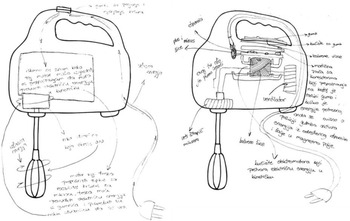
Due to the small number of participants, the obtained results are limited and cannot be statistically analysed; rather, they will be presented for qualitative analysis and discussion. During the product teardown task, each participant created a mental model & BOM table prior to the teardown task, as well as afterwards. Figure 2 shows the examples of mental models for a hand mixer, while Figure 3 shows the examples of mental models for a cordless drill. In total, 12 mental models were generated.
While mental models vary in detail and clarity among participants, by observing the before and after examples and all other created mental models, a clear qualitative increase in participants’ understanding of how a given product works can be observed, as the quality of sketches, the number of details, and the accurate spatial placement of internal components have improved. For instance, all mental models had a sketch or schematic of an electric motor, but it was often wrongly placed in the before models. Significantly, some essential components like gears for torque transmission were often omitted in the initial models but were correctly identified and placed in the post-teardown models, indicating a substantial gain in system-level understanding of a product and its components.
Mental models of the hand mixer before and after product teardown (participant 2)

Mental models of cordless drill before and after product teardown (participant 4)

Figure 3 Long description
A diagram of a cordless drill. Panel A: The diagram shows the external view of a cordless drill with labeled parts including the battery, motor, and drill bit. The battery is located at the bottom, the motor is at the top near the drill bit, and there is a note indicating the flow of impulses from the battery to the motor. Panel B: The diagram shows the internal structure of the cordless drill with labeled parts including the electric motor, transformer, battery, and various other components. The electric motor is centrally located, with the transformer positioned below it. The battery is at the bottom, and there are notes indicating the flow of electricity and the interaction between different components.
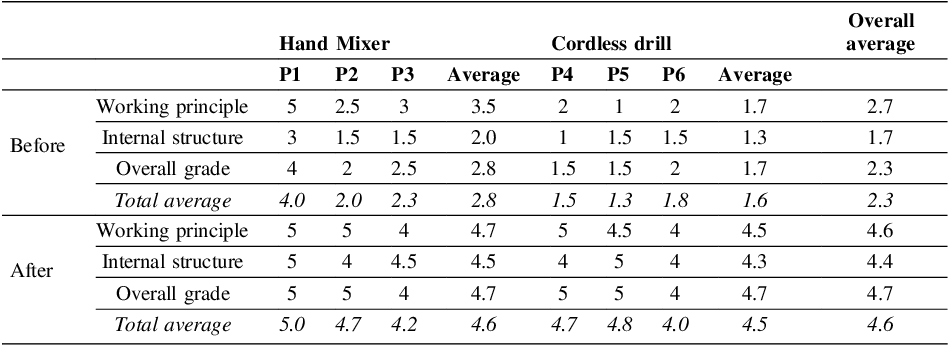
To evaluate the mental models, they were formally evaluated by two graders on three criteria using a 1-5 grading scale. The criteria for evaluation were clarity of the working principles of the product, correctness of internal structure (presence and correct spatial placement of components), as well as an overall grade for the quality and number of details of the model. The graders gave grade 1 for the worst model on each criterion and grade 5 for the best model. The rest of the models were graded in between those two limits. Graders first agreed on the criteria for evaluation, then evaluated all the models individually. In no case was the grade between two graders more than one. Table 1 shows the average grade for each model and criterion, as well as the overall average grades.
The evaluation showed the participants had a better understanding of the working principles of the hand mixer over the cordless drill before the product teardown, with an average grade 3.5 vs 1.7. Similarly, the hand mixer group had a better understanding of the internal structure of the product, but with less difference (average grade 2.0 vs 1.3).
For the mental models after the product teardown, evaluation revealed a significant improvement in understanding of the product’s working principle, as well as comprehension of the internal product structure. Participants from both groups scored an average grade of 4.6 for the working principles of a product and an average grade of 4.4 for the internal structure of a product.
Grading scores for mental models before and after product teardown

Grading scale 1 to 5 where 1 = worst and 5 = best
Similar observations were noted in filled BOM tables as well. BOM tables were evaluated by a single grader, who marked each entry either correct or wrong. The graph (Figure 4) depicts the number of correctly identified product components, the materials they are made of, and the main manufacturing process before and after the teardown. This shows a consistent, positive increase in correctly identified components, materials, and manufacturing processes across every participant. For the hand mixer, the average number of identified components increased from 6.3 to 9.3, identified materials from 3.0 to 7.7, and manufacturing process from 0.7 to 4.3. For the cordless drill, the average number of identified components increased from 5.7 to 11.3, materials from 2.0 to 7.0, and the manufacturing process from 0.3 to 7.3.
Number of identified components, materials, and manufacturing processes per participant before and after the teardown task

Figure 4 Long description
Panel A: A bar graph showing the number of identified components, materials, and manufacturing processes for hand mixers. The horizontal axis is labeled with participant groups P 1, P 2, P 3, and Average. The vertical axis ranges from 0 to 14. The bars are grouped into three categories: identified components, identified materials, and identified manufacturing processes, both before and after the teardown task. Before the teardown, identified components are shown in blue with diagonal stripes, identified materials in orange with diagonal stripes, and identified manufacturing processes in green with diagonal stripes. After the teardown, identified components are shown in solid blue, identified materials in solid orange, and identified manufacturing processes in solid green. Panel B: A bar graph showing the number of identified components, materials, and manufacturing processes for cordless drills. The horizontal axis is labeled with participant groups P 1, P 2, P 3, and Average. The vertical axis ranges from 0 to 14. The bars are grouped into three categories: identified components, identified materials, and identified manufacturing processes, both before and after the teardown task. Before the teardown, identified components are shown in blue with diagonal stripes, identified materials in orange with diagonal stripes, and identified manufacturing processes in green with diagonal stripes. After the teardown, identified components are shown in solid blue, identified materials in solid orange, and identified manufacturing processes in solid green.
4. Discussion
The conducted product teardown, as hypothesised, had a positive influence on the students’ understanding of a given product and knowledge about its components, manufacturing processes, and materials used for their production, which is in accordance with similar studies (e.g., Reference Abe and StarrAbe & Starr, 2003; Reference Furiato and MurphyFuriato & Murphy, 2024; Reference Ogot, Okudan, Simpson and LamancusaOgot et al., 2008). However, there was a difference in the rate of improvement between groups working on different products. Notably, participants who were assigned a cordless drill had a lower understanding of product working principles, as well as a lower number of identified components, manufacturing processes, and materials before the teardown, compared to participants from the hand mixer group. These differences can be attributed to two factors. Firstly, there is the familiarity with the product gained through interaction and use of a product, as participants with a hand mixer reported they use it 1-2 times a month, while participants with a cordless drill reported they use the cordless drill rarely, only a few times a year. Secondly, the majority of participants had, in their previous studies, projects regarding the redesign of small household appliances, through which they had an opportunity to familiarize themselves with working principles and components of similar kitchen products. On the other hand, after the conducted product teardown, average scores over all metrics were levelled between groups, indicating that product teardown helps students gain new knowledge about the product regardless of previous experience.
Next, from the collected data, one can observe the increase in average scores across all evaluated metrics before and after product teardown, indicating once more the usefulness of the product teardown task in engineering design education. However, in this evaluation, we noted a smaller number or even complete absence of identified manufacturing processes in BOM tables created before the product teardown in comparison to the number of identified components and materials. We attribute this observable fact to the lack of dedicated lectures on manufacturing processes in participants’ previous education on engineering design, in contrast to lectures on engineering materials they had prior to the product teardown. This metric improved after the product teardown, as during the activity, participants had an interaction with the lecturer who explained how the components they observed are made.
Another benefit of product teardown previously reported is the positive influence on students’ motivation, engagement, and enjoyment in the tasks, as well as an improved sense of learning (Reference Calderon, Marjanovic, Storga, Pavkovic and BojceticCalderon, 2010; Reference Dalrymple, Sears and EvangelouDalrymple et al., 2011). Similar observations were also noted in this study. In the questionnaire after the task, participants reported a positive influence of product teardown on understanding of products’ working principles, as well as improvement in knowledge about materials and manufacturing processes. Participants also had a positive opinion on using the teardown process to teach engineering topics to industrial designers, as they can combine theoretical knowledge with hands-on experience. Some of the responses on the open question about positive things about product teardown were:
“I gather knowledge visually and haptically better than through reading.”
“… practical experience and dirty hands…”
“I was able to understand how the product works and what it is made of. Also, I learned a lot about manufacturing processes for a lot of small components.”
“…interaction with a product, feeling the material through [my] hands…”
The conducted product teardown and associated study had some limitations, and during the study, a few drawbacks of the used approach were revealed. First, the number of participants was very low, with only six participants. Thus, proper statistical analysis of the gathered data was not possible. Nevertheless, the obtained results and qualitative analysis indicate a positive influence of product teardown on the educational process, but a broader study with a larger sample is required for their validation. Secondly, the study was conducted within a regular class setting without any experimental intervention in the teardown activity. Hence, the lecturer was in interaction with the participants during the task. The interaction is an important variable that couldn’t be completely controlled, but could have an influence on the results of the task. Hence, a repeated study with a control group would be desirable in the future.
Furthermore, during the protocol design, the time for the creation of mental models before and after the product teardown was allocated at 20 minutes for each task. We noticed that this time was enough for the creation of mental models and BOM tables before the product teardown. However, it was not enough for the same activity after the product teardown, as we observed some participants were still working on their mental models and BOM tables when the lecturer was gathering working materials, as the allocated time ended. While there is no indication that additional time would have a significant influence on the quality of the final mental models, the BOM tables would probably have more details because not all components found in disassembled products were listed in the reviewed BOM tables. In the future, more time should be allocated for this activity.
Due to limited resources, the task was conducted in groups, and a few participants reported afterward that they would prefer to work individually, as they felt not everyone had the same opportunity to work on a disassembly. We also noticed during the teardown that not all participants worked equally on all aspects of the task. Some were more involved in the physical disassembly of a product, while others were taking notes. As we didn’t capture data on who was doing what, we cannot know if that had any influence on the mental models and BOM tables created afterwards. This needs to be avoided in future studies, either through the allocation of enough resources for conducting teardown individually, or through additional data collection about the roles inside the groups during the teardown.
Interestingly, in the questionnaire, one participant reported problems with remembering theoretical knowledge from the lectures conducted in the weeks prior to the product teardown:
“I think most of us couldn’t remember [during the product teardown] all the materials and their names (although we had lectures on the topic), so it was hard to follow the lecturer [when the lecturer was explaining materials and manufacturing processes for individual components]. Nevertheless, we learned a lot.”
In future studies, this issue could be addressed with the implementation of additional reference materials available during the product teardown task. For example, an inclusion of reference materials, notes, and models about the theoretical engineering knowledge one can easily access during the teardown to explain the specific aspects of the dissembled product (e.g., one-page handouts about materials, manufacturing processes, etc.).
5. Conclusion
The specificity of the conducted study, in comparison with similar studies found in the literature, is the application of product teardown in teaching engineering design to students of the industrial design programme who do not possess a strong engineering background. The results of the study indicate that inclusion of hands-on product teardown activities into the curriculum is a highly effective educational tool for teaching students the basic principles of engineering design, regardless of their engineering background knowledge. Therefore, the results of the conducted study indicate the positive influence of product teardown on students’ engineering education, which is in accordance with similar previous studies (e.g., Reference Abe and StarrAbe & Starr, 2003; Reference Furiato and MurphyFuriato & Murphy, 2024; Reference Ogot, Okudan, Simpson and LamancusaOgot et al., 2008).
Furthermore, the study points to three important effects of product teardown on students’ engineering knowledge. Firstly, it indicates the positive knowledge gain as evaluated metrics improved after the conducted teardown, showing the suitability of the method for technical knowledge acquisition. Secondly, product teardown levelled the students’ knowledge base, as the difference in mental models scores between the two groups, which was a consequence of different prior familiarity with a product, disappeared after the product teardown. Thirdly, there is an indication that product teardown could be used for targeted knowledge intervention, as we observed substantial proportional knowledge gains on the manufacturing processes, about which participants had very little formal education prior to the study.
Future research should address the above discussed limitations of the study, primarily the small sample size and control of the variables. It is also advisable to conduct the product teardown as an individual activity when available resources enable such an approach. Furthermore, additional interventions in the teardown activity could be implemented and evaluated, especially one for referencing theoretical engineering knowledge. Further investigation of the role of product teardown activity should also include comparison with other methods of examining the internal structure of the products and its working principles, e.g. virtual teardown and detailed CAD models, technical drawings, etc.
In conclusion, the product teardown is a dynamic, tactile, and motivational educational tool that enables students to grasp core engineering principles and improve their technical knowledge. It provides valuable hands-on experience for students regardless of their major and bridges the gap between theoretical engineering knowledge and physical product realisation.
Acknowledgement
This work was supported by the Croatian Science Foundation under the project DATA-MATION number [IP-2022-10-7775].
The authors would like to thank all the participants who took part in this study for their time and valuable contributions.



 Open access

