








1. Introduction and main results
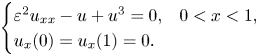
We are concerned with the Neumann problem of a reaction–diffusion equation

and its linearized eigenvalue problem associated with a positive solution $u(x)$

where $\varepsilon >0$ is a parameter and $f$
 is smooth enough. We denote $F(u)$
 by
by

Precise information of eigenvalues is crucial not only in a stability analysis of a stationary solution of the associated parabolic problem but also in a study of dynamics. The goal of the present paper is to obtain a rather explicit expression of all the eigenvalues of (1.2) in the case

The equation $\varepsilon ^2u_{xx}-u+u^p=0$ , $p>1$
 , is called the scalar field equation which appears in the study of a standing wave of a nonlinear Schrödinger equation [Reference Berestycki and Lions2], of elastic curves in differential geometry [Reference Langer and Singer6] and of the Gierer–Meinhardt model in mathematical biology [Reference Gierer and Meinhardt5]. This equation has attracted much attention for these three decades. A complete bifurcation diagram of the positive solutions for (1.1) with $f(u)=-u+u^p$
 , $p>1$
 , was obtained in [Reference Miyamoto and Yagasaki7, Reference Yagasaki16]. See Fig. 1. Let $p>1$
 and $\varepsilon _n:=\sqrt {p-1}/n\pi$
 . For each $n\ge 1$
 , (1.1) has exactly two $n$
 -mode solutions $u^{\pm }_{n,\varepsilon }$
 if $0<\varepsilon <\varepsilon _n$
 . Here,

In particular, if $n=2k+1$ , then both $u^+_{n,\varepsilon }$
 and $u^-_{u,\varepsilon }$
 have $k$
 interior peaks and $1$
 boundary peak. On the other hand, if $n=2k$
 , then $u^+_{n,\varepsilon }$
 (resp. $u^-_{n,\varepsilon }$
 ) has $k$
 interior peaks and no boundary peak (resp. $k-1$
 interior peaks and $2$
 boundary peaks). Each peak becomes sharp as $\varepsilon \to 0$
 .
.
The complete bifurcation diagram for (1.1) with $f(u)=-u+u^3$ .
.

Hereafter, we consider the case $f(u)=-u+u^3$ . Then

All the solutions of (1.1) can be written in terms of elliptic functions:
Proposition 1.1 Let $n\ge 1$ be fixed and let $0<\varepsilon <\varepsilon _n$
 . Let $k_{\varepsilon }=k_{n,\varepsilon }\in (0,1)$
 be a solution of

Note that $k_{\varepsilon }$ is uniquely determined. Then ${u^+_{n,\varepsilon }}$
 and ${u^-_{n,\varepsilon }}$
 can be written as follows:

where

The proof of proposition 1.1 is given in §2.
In this paper, we frequently use Jacobi's elliptic functions ${\rm sn}(x,k)$ and ${\rm dn}(x,k)$
 and complete elliptic integrals $K(k)$
 , $E(k)$
 and $\Pi (\nu,k)$
 . The definitions and various properties are summarized in Appendix A of the present paper.
The linearized eigenvalue problem (1.2) associated with $u^{\pm }_{n,\varepsilon }$ is as follows:

Hereafter, $\lambda ^{\pm }_{j,\varepsilon }$ , $j\ge 0$
 denotes the $j+1$
 -th eigenvalue of (LP±) and $\varphi ^{\pm }_{j,\varepsilon }$
 denotes an associated eigenfunction. It is well known that each eigenvalue $\lambda ^{\pm }_{j,\varepsilon }$
 is simple.
The following three exact eigenvalues of (LP±) were obtained in the previous paper of the third author [Reference Wakasa11]:
Proposition 1.2 Let $n\ge 1$ ,
,

The following hold$:$
(i) The problem (${\rm LP}_+$
 ) has the following two pairs of eigenvalues and eigenfunctions$:$
$$\begin{align*} & \lambda^+_{0,\varepsilon}={-}1-\frac{2\sqrt{1-k_{\varepsilon}^2+k_{\varepsilon}^4}}{2-k_{\varepsilon}^2},\quad \varphi^+_{0,\varepsilon}(x)=1\\& \quad -\left(1+k_{\varepsilon}^2-\sqrt{1-k_{\varepsilon}^2+k_{\varepsilon}^4}\right){\rm SN}_n^+(x,k_{\varepsilon})^2,\\ & \lambda^+_{n,\varepsilon}={-}1+\frac{2\sqrt{1-k_{\varepsilon}^2+k_{\varepsilon}^4}}{2-k_{\varepsilon}^2},\quad \varphi^+_{n,\varepsilon}(x)={-}1\\& \quad +\left(1+k_{\varepsilon}^2+\sqrt{1-k_{\varepsilon}^2+k_{\varepsilon}^4}\right){\rm SN}_n^+(x,k_{\varepsilon})^2. \end{align*}$$Moreover, if $n$
is even, then (LP$_+$) has one more pair$:$
\[ \lambda^+_{n/2,\varepsilon}={-}\frac{3(1-k_{\varepsilon}^2)}{2-k_{\varepsilon}^2},\quad \varphi^+_{n/2,\varepsilon}(x)={\rm SN}_n^+(x,k_{\varepsilon}){\rm DN}_n^+(x,k_{\varepsilon}). \]
) has the following two pairs of eigenvalues and eigenfunctions$:$
$$\begin{align*} & \lambda^+_{0,\varepsilon}={-}1-\frac{2\sqrt{1-k_{\varepsilon}^2+k_{\varepsilon}^4}}{2-k_{\varepsilon}^2},\quad \varphi^+_{0,\varepsilon}(x)=1\\& \quad -\left(1+k_{\varepsilon}^2-\sqrt{1-k_{\varepsilon}^2+k_{\varepsilon}^4}\right){\rm SN}_n^+(x,k_{\varepsilon})^2,\\ & \lambda^+_{n,\varepsilon}={-}1+\frac{2\sqrt{1-k_{\varepsilon}^2+k_{\varepsilon}^4}}{2-k_{\varepsilon}^2},\quad \varphi^+_{n,\varepsilon}(x)={-}1\\& \quad +\left(1+k_{\varepsilon}^2+\sqrt{1-k_{\varepsilon}^2+k_{\varepsilon}^4}\right){\rm SN}_n^+(x,k_{\varepsilon})^2. \end{align*}$$Moreover, if $n$
is even, then (LP$_+$) has one more pair$:$
\[ \lambda^+_{n/2,\varepsilon}={-}\frac{3(1-k_{\varepsilon}^2)}{2-k_{\varepsilon}^2},\quad \varphi^+_{n/2,\varepsilon}(x)={\rm SN}_n^+(x,k_{\varepsilon}){\rm DN}_n^+(x,k_{\varepsilon}). \]
(ii) The problem (${\rm LP}_-$
) has the following pairs of eigenvalues and eigenfunctions$:$
$$\begin{align*} & \lambda^-_{0,\varepsilon}={-}1-\frac{2\sqrt{1-k_{\varepsilon}^2+k_{\varepsilon}^4}}{2-k_{\varepsilon}^2},\quad \varphi^-_{0,\varepsilon}(x)=1\\& \quad-\left(1+k_{\varepsilon}^2-\sqrt{1-k_{\varepsilon}^2+k_{\varepsilon}^4}\right){\rm SN}_n^-(x,k_{\varepsilon})^2,\\ & \lambda^-_{n,\varepsilon}={-}1+\frac{2\sqrt{1-k_{\varepsilon}^2+k_{\varepsilon}^4}}{2-k_{\varepsilon}^2},\quad \varphi^-_{n,\varepsilon}(x)={-}1\\& \quad +\left(1+k_{\varepsilon}^2+\sqrt{1-k_{\varepsilon}^2+k_{\varepsilon}^4}\right){\rm SN}_n^-(x,k_{\varepsilon})^2. \end{align*}$$Moreover, if $n$
is even, then (LP$_-$) has one more pair$:$
\[ \lambda^-_{n/2,\varepsilon}={-}\frac{3}{2-k_{\varepsilon}^2},\quad \varphi^-_{n/2,\varepsilon}(x)={\rm CN}_n^-(x,k_{\varepsilon}){\rm DN}_n^-(x,k_{\varepsilon}). \]


Singularly perturbed problems have attracted great attention, because of a wide variety of applications. It follows from (1.3) that a singularly perturbed problem corresponds to the case where $k$ is close to $1$
 . The main result of the paper is the following asymptotic formula of the other eigenvalues as $k\to 1:$
Theorem 1.3 Let $n\ge 1$ and $j>0$
 be fixed. Let $k_{\varepsilon }$
 be as in proposition 1.1. The following hold for (${\rm LP}_{\pm }$
 )$:$
)$:$
(i) For $0< j< n/2$
,
\[ \lambda_{j,\varepsilon}^{{\pm}}={-}3+3(1-k_{\varepsilon}^2)+\frac{3}{4}\left(\sin^2\frac{j\pi}{n}-5\right)(1-k_{\varepsilon}^2)^2\!+\!o\left((1-k_{\varepsilon}^2)^2\right)\ \textrm{as}\ k_{\varepsilon}\!\to\! 1. \]
(ii) For $n/2< j< n$
,
\[ \lambda_{j,\varepsilon}^{{\pm}}={-}3\left(\sin^2\frac{j\pi}{n}\right)(1-k_{\varepsilon}^2)+o(1-k_{\varepsilon}^2)\ \textrm{as}\ k_{\varepsilon}\to 1. \]
(iii) For $j>n$
,
\[ \lambda_{j,\varepsilon}^{{\pm}}=1+\frac{(j-n)^2\pi^2}{n^2}\frac{1}{K(k_{\varepsilon})^2}+o\left(\frac{1}{K(k_{\varepsilon})^2}\right)\ \textrm{as}\ k_{\varepsilon}\to 1, \]where $K(k_{\varepsilon })\to \infty$
as $k_{\varepsilon }\to 1$.


Combining proposition 1.2 and theorem 1.3, we can relate locations of eigenvalues with the number of the peaks of $u^{\pm }_{n,\varepsilon }$ as follows: All the eigenvalues can be classified into three categories, i.e.,

The number of the near $-3$ eigenvalues is equal to the number of the interior and boundary peaks of $u^{\pm }_{n,\varepsilon }$
 . The number of the near $0$
 eigenvalues is equal to the number of the interior peaks of $u^{\pm }_{n,\varepsilon }$
 .
.
Example 1.4
(i) The solution $u^+_{10,\varepsilon }$
has $5$ interior peaks and no boundary peak. Hence, (${\rm LP}_+$) has $5$ eigenvalues near $-3$ and $5$ eigenvalues near $0$ when $\varepsilon >0$ is small. On the other hand, $u^-_{10,\varepsilon }$ has $4$ interior peaks and 2 boundary peaks. Hence (${\rm LP}_-$) has 6 eigenvalues near $-3$ and 4 eigenvalues near $0$ when $\varepsilon >0$ is small.(ii) Each of $u^+_{11,\varepsilon }$
and $u^-_{11,\varepsilon }$ has $5$ interior peaks and 1 boundary peak. Hence, (${\rm LP}_{\pm }$) has 6 eigenvalues near $-3$ and 5 eigenvalues near $0$ when $\varepsilon >0$ is small.In figures 2–4 profiles of eigenfunctions on (${\rm LP}_\pm$
) with $u^\pm _{10,\varepsilon }$ and profiles of eigenfunctions on (${\rm LP}_+$) with $u^+_{11,\varepsilon }$ are shown. In each figure (a-0), (a-1) and (a-2) belong to category (a) in (LP±), and so on.


Profiles of eigenfunctions for (${\rm LP}_+$ ) with $u_{10,\varepsilon }^+(x)$
 ; (a-0) $\varphi ^+_0$
 , (a-1) $\varphi ^+_1$
 , (a-2) $\varphi ^+_2$
 , (b-0) $\varphi ^+_5$
 , (b-1) $\varphi ^+_6$
 , (b-2) $\varphi ^+_7$
 , (c-0) $\varphi ^+_{10}$
 , (c-1) $\varphi ^+_{11}$
 and (c-2) $\varphi ^+_{12}$
 .
.

Profiles of eigenfunctions for (LP$_-$ ) with $u_{10,\varepsilon }^-(x)$
 ; (a-0) $\varphi ^-_0$
 , (a-1) $\varphi ^-_1$
 , (a-2) $\varphi ^-_2$
 , (a-5) $\varphi ^-_5$
 , (b-1) $\varphi ^-_6$
 , (b-2) $\varphi ^-_7$
 , (c-0) $\varphi ^-_{10}$
 , (c-1) $\varphi ^-_{11}$
 and (c-2) $\varphi ^-_{12}$
 .
.

Profiles of eigenfunctions for (${\rm LP}_+$ ) with $u_{11,\varepsilon }^+(x)$
 ; (a-0) $\varphi ^+_0$
 , (a-1) $\varphi ^+_1$
 , (a-2) $\varphi ^+_2$
 , (a-5) $\varphi ^+_5$
 , (b-1) $\varphi ^+_6$
 , (b-2) $\varphi ^+_7$
 , (c-0) $\varphi ^+_{11}$
 , (c-1) $\varphi ^+_{12}$
 and (c-2) $\varphi ^+_{13}$
 .
.

Let us consider the stretched problem

and the limit problem

Here $\tilde {u}(y):=u(x)$ , $y:=(x-x_{\ell,\varepsilon })/\varepsilon$
 and $x_{\ell,\varepsilon }\in (0,1)$
 is a position of an $\ell$
 -th interior peak. Then $\bar {u}(y)=\frac {\sqrt {2}}{\cosh (y)}$
 is a solution of (1.6) which has a one-peak at $y=0$
 . The associated eigenvalue problem is as follows:

It is known that the spectral set consists of two eigenvalues $-3$ and $0$
 and the continuous spectrum $[1,\infty )$
 . The near $-3$
 eigenvalues of (LP$_{\pm }$
 ) come from the $-3$
 eigenvalue of (1.7). Figures 2–4 indicate that an eigenfunction in category (a) can be approximated by a linear combination of translations of a compressed first eigenfunction of (1.7). The near $0$
 eigenvalues of (LP$_{\pm }$
 ) come from a translation invariance of the one-peak solution $\bar {u}(y)$
 , which is indicated by a shape of an eigenfunction of category (b), e.g., (b-0), (b-1) and (b-2) of figure 2. Specifically, an eigenfunction is close to $cu'(x)$
 , $c\in \mathbb {R}$
 , near each peak of $u(x)$
 . The other eigenvalues converge to $1$
 which is an end point of $[1,\infty )$
 . The spectrum $1$
 of (1.7) is not an eigenvalue, since a corresponding eigenfunction is not in $H^1(\mathbb {R})$
 . Indeed, a graph of an eigenfunction of category (c) in figures 2–4 is close to $\cos (m\pi x)$
 for most $x\in (0,1)$
 , and hence its stretched function is not in $H^1(\mathbb {R})$
 or $0$
 .
.
Remark 1.5 If $n$ is odd, then the eigenvalue sets of (${\rm LP}_+$
 ) and (${\rm LP}_-$
 ) are the same, i.e., $\lambda ^+_{j,\varepsilon }=\lambda ^-_{j,\varepsilon }$
 for all $j\ge 0$
 , since $u^-_{n,\varepsilon }(x)=u^+_{n,\varepsilon }(1-x)$
 . However, if $n$
 is even, then $\lambda ^+_{j,\varepsilon }=\lambda ^-_{j,\varepsilon }$
 for $j\neq n/2$
 , but $\lambda ^+_{n/2,\varepsilon }\neq \lambda ^-_{n/2,\varepsilon }$
 . In the even case the number of all the peaks of $u_{n,\varepsilon }^+$
 is different from that of $u_{n,\varepsilon }^-$
 .
.
Corollaries 1.6 and 1.7 are asymptotic formulas with respect to ${\rm e}^{-2/n\varepsilon }$ .
.
Corollary 1.6 Let $n\ge 1$ be fixed. The following hold for (LP±):
(i) $\displaystyle \lambda ^{\pm }_{0,\varepsilon }=-3+48\,{\rm e}^{-\frac {2}{n\varepsilon }}+o({\rm e}^{-\frac {2}{n\varepsilon }})$
as $\varepsilon \to 0$.(ii) If $n$
is even, then as $\varepsilon \to 0$,
\[ \lambda^+_{n/2,\varepsilon}={-}48\,{\rm e}^{-\frac{2}{n\varepsilon}}+o({\rm e}^{-\frac{2}{n\varepsilon}}),\quad \lambda^-_{n/2,\varepsilon}={-}3+48\,{\rm e}^{-\frac{2}{n\varepsilon}}+o({\rm e}^{-\frac{2}{n\varepsilon}}). \]
(iii) $\displaystyle \lambda ^{\pm }_{n,\varepsilon }=1-48\,{\rm e}^{-\frac {2}{n\varepsilon }}+o({\rm e}^{-\frac {2}{n\varepsilon }})$
as $\varepsilon \to 0$.


Corollary 1.7 Let $n\ge 1$ and $j\ge 0$
 be fixed. The following hold for (${\rm LP}_{\pm }$
 ):
):
(i) For $0< j< n/2$
,
\[ \lambda_{j,\varepsilon}^{{\pm}}={-}3+\left\{1+4\left(\sin^2\frac{j\pi}{n}\right){\rm e}^{-\frac{2}{n\varepsilon}}+o({\rm e}^{-\frac{2}{n\varepsilon}})\right\}(\lambda^{{\pm}}_{0,\varepsilon}+3) \ \textrm{as}\ \varepsilon\to 0. \]
(ii) For $n/2< j< n$
,
\[ \lambda_{j,\varepsilon}^{{\pm}}={-}48\left(\sin^2\frac{j\pi}{n}\right){\rm e}^{-\frac{2}{n\varepsilon}}+o({\rm e}^{-\frac{2}{n\varepsilon}})\ \textrm{as}\ \ \varepsilon\to 0. \]
(iii) For $j>n$
,
\[ \lambda_{j,\varepsilon}^{{\pm}}=1+(j-n)^2\pi^2\varepsilon^2+o(\varepsilon^2) \ \textrm{as}\ \varepsilon\to 0. \]


It follows from corollary 1.7 (i) that $\lambda ^{\pm }_{j,\varepsilon }$ , $0< j< n/2$
 , can be also written as follows:

However a $j$ -dependence does not appear in the first two terms.
Let us recall known results. It is difficult to obtain exact expressions of eigenvalues of an elliptic differential operator even if a domain is a finite interval. Only few examples are known for elliptic differential operators with variable coefficients. A model case is the linearization problem for the Allen–Cahn equation (1.1) with $f(u)=u-u^3$ . The problem (1.1) with $f(u)=u-u^3$
 has $n$
 -mode solutions $u^{\pm }_{n,\varepsilon }$
 for small $\varepsilon >0$
 which has $n$
 transition layers in the interval. In [Reference Carr and Pego4] the so-called very slow dynamics of a transition layer solution of an associated parabolic problem were studied. Then the first $n$
 eigenvalues of (LP±), $\{\lambda ^{\pm }_{j,\varepsilon }\}_{j=0}^{n-1}$
 , play a crucial role. It was shown in [Reference Carr and Pego4, Corollary 4.2] that for $0\le j< n$
 ,
,

These near $0$ eigenvalues come from translation invariance of each transition layer. Later exact expressions of three special eigenvalues $\lambda ^{\pm }_{j,\varepsilon }$
 , $j=0,n,2n$
 , were obtained in [Reference Wakasa9]. Using these three exact eigenvalues, one can obtain

Note that these three eigenvalues correspond to $\lambda ^{\pm }_{j,\varepsilon }$ , $j=0,n/2,n$
 , in our case $f(u)=-u+u^3$
 . Then an exact representation formula of eigenvalues for general $f$
 , which is lemma 2.2 in our case, was obtained in [Reference Wakasa and Yotsutani12]. The authors of [Reference Wakasa and Yotsutani12] applied it to the case $f(u)=\sin u$
 and obtained an asymptotic formula for every eigenvalue. After that in [Reference Wakasa and Yotsutani14] asymptotic formulas of all the eigenvalues for the Allen–Cahn case $f(u)=u-u^3$
 were established. Specifically,

These formulas show that (1.8) holds for $0\le j< n$ .
.
Detailed studies of all the eigenfunctions were made for the case $f(u)=\sin u$ in [Reference Wakasa and Yotsutani13] and for the case $f(u)=u-u^3$
 in [Reference Wakasa and Yotsutani15]. The authors of [Reference Miyamoto and Wakasa8] obtained exact eigenvalues and eigenfunctions of a one-dimensional Gel'fand problem $f(u)=e^u$
 , using the method developed in [Reference Wakasa and Yotsutani12]. In this paper, we apply the method developed in [Reference Wakasa and Yotsutani14] to the scalar field equation (1.1) with $f(u)=-u+u^3$
 to establish asymptotic formulas. This method seems to work for other nonlinearities and other boundary conditions. They may be future works.
The paper consists of five sections. In §2 we prove proposition 1.1. We obtain asymptotic formulas for three special eigenvalues $\lambda ^{\pm }_{0,\varepsilon }$ , $\lambda ^{\pm }_{n/2,\varepsilon }$
 and $\lambda ^{\pm }_{n,\varepsilon }$
 (corollary 1.6). We recall an exact representation formulas for the case $f(u)=-u+u^3$
 in lemma 2.2. In particular, the other eigenvalues are given by a unique solution of

where $\mathcal {A}_0$ is given in lemma 2.2. Let $\mu :=(2-k^2)\lambda$
 . We use $\mu$
 instead of $\lambda$
 , since various formulas becomes simple. We define $\mathcal {A}(k,\mu ):=A_0(k,\lambda )$
 . We see in lemma 2.3 that the characteristic function $\mathcal {A}(k,\mu )$
 can be written in terms of the complete elliptic integral of the third kind. In § 3 we study the shape of the graph of $\mathcal {A}(k,\mu )$
 , since the graph of $\mathcal {A}(k,\mu )$
 is directly related to the $j+1$
 -th eigenvalue by the equation

Specifically, we show that $\mathcal {A}(k,\mu )$ is increasing in $\mu$
 and that for each $j$
 , (1.9) has a unique solution. See figure 5 in § 2 for a graph of $\mathcal {A}(k,\mu )$
 . In § 4 we prove theorem 1.3 and corollary 1.7, using results proved in § 3. In Appendix A we recall definitions and basic properties of Jacobi's elliptic functions ${\rm sn}(x,k)$
 , ${\rm cn}(x,k)$
 and ${\rm dn}(x,k)$
 . Then we recall basic properties of the complete elliptic integrals $K(k)$
 , $E(k)$
 and $\Pi (\nu,k)$
 . We also recall various asymptotic formulas for $K(k)$
 and $\Pi (\nu,k)$
 which are used in proofs of lemmas in § 3 and theorem 1.3.
A graph of $\mathcal {A}(k,\mu )$ with $k=3/4$
 . $\mathcal {A}(k,\mu )$
 is defined on $\Sigma$
 and monotone increasing in $\mu$
 .
.

2. Preliminaries
2.1 Exact solutions of the nonlinear problem
Proof of proposition 1.1 Let $y={\rm dn}(x,k)$ . Then, $y(x)$
 satisfies $y''-(2-k^2)y+2y^3=0$
 . We can find a solution, assuming $u(x)=c_0y(c_1x)$
 and fixing $c_0$
 and $c_1$
 . However, we take a different approach here.
We apply a change of variables $\tau =\sqrt {1-k^2s^2}$ to (A.1). We have

where (A.2) is used. Let ${\rm dn}^{-1}(y,k)$ denote the inverse function of $y={\rm dn}(x,k)$
 . Substituting $x={\rm dn}^{-1}(y,k)$
 into (2.1), we obtain

We consider only the case $u^-_{n,\varepsilon }(x)$ , since the case $u^+_{n,\varepsilon }(x)$
 is similar. For simplicity, $u$
 stands for $u^-_{n,\varepsilon }$
 . By (1.1) we have

where

Since $2\varepsilon ^2u'^2=(\alpha ^2-u^2)(\alpha ^2-2+u^2)$ , we have

where we use the fact that $u'(x)<0$ for $0< x<1/n$
 . Let $k$
 be defined by the relation

Using a change of variables $\tau :=u/\alpha$ , we have

where (2.2) is used in the last equality. Thus,

Since $K(k)$ is a half-period of ${\rm dn}(x,k)$
 and $1/n$
 is a half-period of $u(x)$
 , we have

and hence (1.3) is obtained. Substituting $\varepsilon =1/\sqrt {2-k^2}nK(k)$ into (2.3), we have (1.4).
2.2 Three special eigenvalues
Proposition 1.2 says that there are three (resp. two) exact eigenvalues of (LP±) if $n$ is even (resp. odd). These three or two eigenvalues are special and play a key role in this paper. Proposition 1.2 can be proved by direct calculation. We define $\lambda _{\pm }(k)$
 by
by

Then it is obvious that $\lambda ^{\pm }_{0,\varepsilon }=\lambda _-$ and $\lambda ^{\pm }_{n,\varepsilon }=\lambda _+$
 .
.
Lemma 2.1 Let $k_{n,\varepsilon }$ be the unique solution of (1.3). Then,

Proof. By lemma A.3 we have

and hence $(1-k^2)K(k)\to 0$ as $k\to 1$
 . By (1.3) we have

Using $K(k)=1/\sqrt {2-k^2}n\varepsilon$ , we have

We obtain the desired result.
Using lemma 2.1, we obtain asymptotic expansions of three special eigenvalues.
Proof of corollary 1.6 First we prove (i) and (iii). By lemma 2.1 we have

Then

Next we prove (ii). If $n$ is even, then

2.3 Exact representation of the other eigenvalues
Before we consider the scalar field equation, let us briefly explain a theory for a general nonlinear term developed in Wakasa–Yotsutani [Reference Wakasa and Yotsutani12].
Let $u(x)$ be a solution of (1.1), and let $\alpha$
 denote the maximum value of $u(x)$
 . Substituting $\varphi (x)=\sqrt {\psi (x)}$
 into the equation in (1.2), we see that $\psi (x)$
 satisfies

Let us consider the following function:

We have

We look for a solution of the equation

of the form $\psi (x)=h(u(x))$ , where $h(\,\cdot \,)$
 is an unknown positive function. Substituting $\psi (x)=h(u(x))$
 into (2.6), we obtain a key equation

where we use the following relations:

We assume that an exact expression $h(u)$ of a positive solution of (2.7) can be obtained. Then, $h(u)$
 is also a solution of (2.6). Thus, $\Psi '(x)\equiv 0$
 and $\Psi$
 is constant. Substituting $h(u)$
 into (2.5), we see that there exists $\rho \in \mathbb {R}$
 such that

Now, we construct an eigenfunction of the form

using a solution $h(u)$ of (2.7). Here, $W(\,\cdot \,)$
 and $\theta (x)$
 are defined later. Using (2.8), we have

Substituting (2.9) into (1.2), we have

where (2.10) is used in the last equality. We assume that $\rho >0$ . We define $\theta (x)$
 by a solution of

Specifically, the following function is a solution of (2.12):

Moreover, it follows from (2.11) that $W''(\theta )+W(\theta )=0$ , and hence $W(\theta )=C \cos (\theta +\theta _1)$
 . By (2.9) we obtain

where $x_0:=\theta _0+\theta _1$ . In other words, a general solution of $\varepsilon ^2\varphi ''+f'(u)\varphi +\lambda \varphi =0$
 can be written in terms of a solution $u(x)$
 of the nonlinear problem (1.1). Readers can find more details of (2.7) and (2.13) in [Reference Miyamoto and Wakasa8, Reference Wakasa and Yotsutani12, Reference Wakasa and Yotsutani14].
In our case the maximum value of $u^{\pm }_{n,\varepsilon }(x)$ , which is denoted by $\alpha$
 , is given by

and (2.7) becomes

There seems to be no solution formula of (2.7) for general nonlinearities. In the case (2.15) every coefficient is a polynomial of $u$ . We substitute $h(u)=u^p$
 into (2.15). Then it does not vanish, and the top term becomes

This suggests that a bi-quadratic polynomial is a candidate of a solution, since (2.16) vanishes for $p=4$ . Actually, $h$
 defined by (2.19) is a solution of (2.15). We evaluate (2.8) at a maximum point of $u$
 . Then,

which yields (2.18). Using $h(u)$ and $\rho _0$
 , we can construct a general solution of $\varepsilon ^2\varphi ''+f(u)\varphi +\lambda \varphi =0$
 . We take the Neumann boundary condition into account. Let $x_0=0$
 in (2.13). Since $1/n$
 is a half-period of $u^{\pm }_{n,\varepsilon }(x)$
 , the following holds:

Eigenvalues can be found by solving the above equation.
Finding a solution of (2.7) is key in this theory. A solution for (2.7) was found for

We summarize these results in the following lemma:
Lemma 2.2 Let $j\neq 0,n$ and $j\neq n/2$
 if $n$
 is even. Let $k_{\varepsilon }$
 be the unique solution of (1.3). We define $\mathcal {A}_0$
 by
by

for $\lambda \in \{\lambda \in \mathbb {R};\ \rho _0(\lambda,k)>0\}$ , where


(i) Let $\alpha$
be defined by (2.14). If $\rho _0(\lambda,k)>0$, then either $h(u,\lambda,k)>0$ or $h(u,\lambda,k)<0$ for $u\in \left [\sqrt {2-\alpha ^2},\alpha \right ]$.(ii) If the equation for $\lambda$
(2.20)$$ \mathcal{A}_0(k_{\varepsilon},\lambda)=\frac{j\pi}{n} $$has a solution $\lambda \in \{\lambda \in \mathbb {R}|\ \rho _0(\lambda,k)>0\}$
, then $\lambda$ is a $j+1$-th eigenvalue of $({\rm LP}_{\pm })$ and
\[ \varphi^{{\pm}}_{j,\varepsilon}(x)=\sqrt{|h(u^{{\pm}}_{n,\varepsilon}(x),\lambda,k_{\varepsilon})|}\cos\left(\frac{1}{\varepsilon}\int_0^x\frac{\sqrt{\rho_0(\lambda,k_{\varepsilon})}\,{\rm d}\xi}{|h(u^{{\pm}}_{n,\varepsilon}(\xi),\lambda,k_{\varepsilon})|}\right) \]is an associated eigenfunction.


Proof. Here, we directly prove the lemma.
(i) By direct calculation we can check that $h(u)$
satisfies
(2.21)$$ (F(\alpha)-F(u))(2hh''-h'^2)-f(u)hh'+2(f'(u)+\lambda)h^2=2\rho_0. $$Suppose the contrary, i.e., there exists $\bar {u}\in [\sqrt {2-\alpha ^2},\alpha ]$
such that $h(\bar {u})=0$. Since $F(\alpha )-F(\bar {u})\ge 0$, it follows from (2.21) that
\[ 0\ge -(F(\alpha)-F(\bar{u}))h'^2=2\rho_0>0, \]which is a contradiction. This contradiction leads to the assertion (i).
(ii) Without loss of generality, we can assume that $h(u^{\pm }_{n,\varepsilon }(x))>0$
for $x\in [0,1]$. Let
\[ \varphi(x):=\sqrt{h(u^{{\pm}}_{n,\varepsilon}(x))}\cos\left(\frac{1}{\varepsilon}\int_0^x\frac{\sqrt{\rho_0}\,{\rm d}\xi}{h(u^{{\pm}}_{n,\varepsilon}(\xi))}\right). \]For simplicity, we write $u^{\pm }_{n,\varepsilon }$
and $h(u^{\pm }_{n,\varepsilon })$ as $u$ and $h$, respectively. Then,
$$\begin{align*} & \varepsilon^2\varphi_{xx}+f'(u)\varphi+\lambda\varphi\\ & =\frac{1}{2h^{3/2}}\left\{\frac{\varepsilon^2u'^2}{2}(2hh''-h'^2)+\varepsilon^2u''hh'-2\rho_0+2f'(u)h^2+2\lambda h^2 \right\}\\& \quad \cos\left(\frac{1}{\varepsilon}\int_0^x\frac{\sqrt{\rho_0}\,{\rm d}\xi}{h(u(\xi))}\right)\\ & =\frac{1}{2h^{3/2}}\left\{ (F(\alpha)-F(u))(2hh''-h'^2)-f(u)hh'-2\rho_0+2f'(u)h^2+2\lambda h^2 \right\}\\& \quad\cos\left(\frac{1}{\varepsilon}\int_0^x\frac{\sqrt{\rho_0}\,{\rm d}\xi}{h(u(\xi))}\right)=0. \end{align*}$$By (2.20) we see that $\varphi (x)$
has exactly $j$ zero(s) in $0\le x\le 1$. It follows from Sturm–Liouville theory that $\varphi (x)$ is a $j+1$-th eigenfunction and $\lambda$ is the associated eigenvalue.


Since $\sqrt {2-\alpha ^2}\le u^{\pm }_{n,\varepsilon }(x)\le \alpha$ for $0\le\! x\le\! 1$
 (proposition 1.1), either $h(u^{\pm }_{n,\varepsilon }(x))\!>\!0$
 or $h(u^{\pm }_{n,\varepsilon }(x))<0$
 holds in the case $\rho _0(\lambda,k)>0$
 . Hence, $\mathcal {A}_0(k,\lambda )$
 is well defined. It follows from lemma 2.2 that the $j+1$
 -th eigenvalue is determined by (2.20) and that the other eigenvalues are on $\{\rho _0>0\}$
 . Hence, it is important to study the function $\mathcal {A}_0(k,\lambda )$
 .
.
Let

We sometimes use $\mu$ instead of $\lambda$
 , since various formulas become simple. We define

We will show that the other eigenvalues are on $\{\lambda \in \mathbb {R}|\ \rho _0(\lambda,k)>0\}$ . The set $\{(k,\lambda )|\ k\in (0,1), \rho _0(\lambda,k)>0\}$
 corresponds to

The set $\Sigma$ is split into three components, i.e., $\Sigma =\Sigma _0\cup \Sigma _1\cup \Sigma _2$
 , where

Let

where $\mathcal {A}_0$ is defined by (2.17). Then the characteristic equation (2.20) becomes

Figure 5 shows the graph of $\mathcal {A}(k,\,\cdot \,)$ . In § 3 we rigorously study the graph of $\mathcal {A}(k,\,\cdot \,)$
 . Specifically, end points of $\mathcal {A}(k,\,\cdot \,)$
 are obtained in lemma 3.1 and the monotone increase of $\mathcal {A}(k,\mu )$
 in $\mu$
 is proved in lemma 3.4.
We would like to obtain a more simple expression of $\mathcal {A}(k,\mu )$ . The following lemma indicates that $\mathcal {A}(k,\mu )$
 can be decomposed into two complete elliptic integrals of the third kind.
Lemma 2.3 Suppose that the assumptions of lemma 2.2 hold. Then the following hold$:$
(i) If $(k,\mu )\in \Sigma _0\cup \Sigma _1$
, then
(2.26)$$ \mathcal{A}(k,\mu)=|{\rm sgn}(\nu_+)\mathcal{M}(\nu_+,k)-{\rm sgn}(\nu_-)\mathcal{M}(\nu_-,k)|, $$where ${\rm sgn}(\,\cdot \,)$
denotes the sign function,
(2.27)$$\begin{align} \mathcal{M}(\nu,k)& :=\sqrt{\frac{(1+\nu)(k^2+\nu)}{\nu}}\Pi(\nu,k),\quad \Pi(\nu,k)\nonumber\\ & :=\int_0^1\frac{{\rm d}s}{(1+\nu s^2)\sqrt{(1-s^2)(1-k^2s^2)}}, \end{align}$$
(2.28)$$ \nu_{{\pm}}(k,\mu):=\frac{3k^2}{2}\frac{\mu-3k^2\pm\sqrt{-3\mu^2+6(k^2-2)\mu+9k^4}}{\mu(\mu+3-3k^2)}. $$
(ii) If $(k,\mu )\in \Sigma _2$
, then
\[ \mathcal{A}(k,\mu)=\frac{1}{9k^4}\sqrt{\mu(\mu+3)(\mu+3-3k^2)(\mu-\mu_+)(\mu-\mu_-)}\tilde{\Pi}(a,b,k), \]where
(2.29)$$\begin{align} \tilde{\Pi}(a,b,k):=\int_0^1\frac{{\rm d}s}{\sqrt{(1-s^2)(1-k^2s^2)}\{a+(b-s^2)^2\}}, \end{align}$$
(2.30)$$\begin{align} a(k,\mu):=\frac{1}{12k^2}(\mu-\mu_+)(\mu-\mu_-),\quad b(k,\mu):=\frac{3k^2-\mu}{6k^2}. \end{align}$$


Proof. (i) We consider the case $h(u^{\pm }_{n,\varepsilon }(x))>0$ for $x\in [0,1]$
 . In both cases ${u^+_{n,\varepsilon }}$
 and ${u^-_{n,\varepsilon }}$
 by lemma 2.2 we see that

because

Using the change of variables $w={u^-_{n,\varepsilon }}(\xi )$ , we have

where we use

In order to bring the integral closer to the expression of the complete elliptic integral of the third kind, we let $s=w/\alpha$ . Since

we have

We define $\sigma _{\pm }$ by
by

Then

Note that $-(\lambda -\lambda _+)(\lambda -\lambda _-)>0$ for $(k,\mu )\in \Sigma _0\cup \Sigma _1$
 . Using (2.33), we have

Using (2.18), which is the definition of $\rho _0$ , and
, and

we have

where

Using the change of variables $s:=\sqrt {1-k^2\tau ^2}$ , we have

Therefore,

Since $\lambda =\mu /(2-k^2)$ , we can check that

Here $\sigma _{\pm }$ are given by (2.32) and $\nu _{\pm }$
 are given by (2.28). Using

by lemma 2.4 below we have

Here $\mathcal {M}$ and $\Pi$
 are defined by (2.27). When $h({u^-_{n,\varepsilon }}(x))<0$
 for $x\in [0,1]$
 , we have

We obtain (2.26).
(ii) We can check that if $(k,\mu )\in \Sigma _2$ , then $h(u^{\pm }_{n,\varepsilon }(x))>0$
 for $x\in [0,1]$
 . By the same way as in (i) we have (2.31). Using the change of variables $s:=\sqrt {1-k^2\tau ^2}$
 , we have

where

In this case the polynomial $a+(b-\tau ^2)^2$ cannot be factored into two real quadratic polynomials. We have

The proof of (ii) is complete.
The following equality, which is somewhat nontrivial, is left in the proof of lemma 2.3.
Lemma 2.4 Let $\sigma _{\pm }$ and $\nu _{\pm }$
 be defined by (2.32) and (2.28), respectively. If $(k,\mu )\in \Sigma _0\cup \Sigma _1$
 , then

Proof. By (2.28) we can check that

Using (2.37), we have

On the other hand, we consider the right-hand side of (2.36). Let $\gamma _{\pm }:=\alpha ^2/\sigma _{\pm }$ . Then $\gamma _{\pm }$
 satisfies

Since

we have

By (2.39) we have

It follows from (2.40) and (2.38) that

Multiplying both sides by $\nu _{\pm }^2$ , we have

The assertion holds.
Now the proof of lemma 2.3 is complete.
3. Fundamental properties of $\mathcal {A}$

Let $\mathcal {A}(k,\mu )$ be defined by (2.25), and let $\Sigma$
 be defined by (2.23).
Lemma 3.1 Let $k\in (0,1)$ be fixed and $(k,\mu )\in \Sigma$
 , and let $\mu _{\pm }$
 be defined by (2.22). Then the following hold$:$
(i) $\mathcal {A}(k,\mu )\to 0$
as $\mu \to \mu _-$.(ii) $\mathcal {A}(k,\mu )\to {\pi }/{2}$
as $\mu \to -3$.(iii) $\mathcal {A}(k,\mu )\to {\pi }/{2}$
as $\mu \to -3+3k^2$.(iv) $\mathcal {A}(k,\mu )\to \pi$
as $\mu \to 0$.(v) $\mathcal {A}(k,\mu )\to \pi$
as $\mu \to \mu _+$.(vi) $\mathcal {A}(k,\mu )\to \infty$
as $\mu \to \infty$.


Proof.
(i) In this case we can check that $h(u^{\pm }_{n,\varepsilon }(x))>0$
for $x\in [0,1]$. Let $\nu _{\pm }$ be defined by (2.28). We see that there exists $\nu _*$ such that
\[ \lim_{\mu\to\mu_-}\nu_+{=}\nu_*,\quad \lim_{\mu\to\mu_-}\nu_-{=}\nu_*. \]By direct calculation we can check that $-1<\nu _*<0$
. Let $\mathcal {M}$ be defined by (2.27). Since
\[ \lim_{\nu_+\to\nu_*}\mathcal{M}(\nu_+,k)=\mathcal{M}(\nu_*,k),\quad \lim_{\nu_-\to\nu_*}\mathcal{M}(\nu_-,k)=\mathcal{M}(\nu_*,k), \]we have
\[ \lim_{\mu\to\mu_-}\mathcal{A}(k,\mu)=0. \]
(ii) In this case we can check that $h(u^{\pm }_{n,\varepsilon }(x))>0$
for $x\in [0,1]$. We see that $\nu _+\to -k^2$ ($\mu \to -3$) and $\nu _-\to -1$ ($\mu \to -3$). By lemma A.9 we have
\[ \lim_{\nu_+\to -k^2}{\rm sgn}(\nu_+)\mathcal{M}(\nu_+,k)=0,\quad \lim_{\nu_-\to-1}{\rm sgn}(\nu_-)\mathcal{M}(\nu_-,k)={-}\frac{\pi}{2}. \]Then,
\[ \lim_{\mu\to -3}\mathcal{A}(k,\mu)=0-\left(-\frac{\pi}{2}\right)=\frac{\pi}{2}. \]
(iii) In this case we can check that $h(u^{\pm }_{n,\varepsilon }(x))<0$
for $x\in [0,1]$. We see that $\nu _+\to -k^2$ $(\mu \to -3+3k^2)$ and $\nu _-\to \infty$ ($\mu \to -3+3k^2$). By lemma A.9 we have
\[ \lim_{\nu_+\to -k^2}{\rm sgn}(\nu_+)\mathcal{M}(\nu_+,k)=0,\quad \lim_{\nu_-\to\infty}{\rm sgn}(\nu_-)\mathcal{M}(\nu_-,k)=\frac{\pi}{2}. \]Then,
\[ \lim_{\mu\to -3+3k^2}\mathcal{A}(k,\mu)={-}\left(0-\frac{\pi}{2}\right)=\frac{\pi}{2}. \]
(iv) In this case we can check that $h(u^{\pm }_{n,\varepsilon }(x))<0$
for $x\in [0,1]$. We see that $\nu _+\to -1$ ($\mu \to 0$) and $\nu _-\to \infty$ ($\mu \to 0$). By lemma A.9 we have
\[ \lim_{\nu_+\to -1}{\rm sgn}(\nu_+)\mathcal{M}(\nu_+,k)={-}\frac{\pi}{2},\quad \lim_{\nu_-\to\infty}{\rm sgn}(\nu_-)\mathcal{M}(\nu_-,k)=\frac{\pi}{2}. \]Then,
\[ \lim_{\mu\to 0}\mathcal{A}(k,\mu)={-}\left(-\frac{\pi}{2}-\frac{\pi}{2}\right)=\pi. \]
(v) In this case we can check that $h(u^{\pm }_{n,\varepsilon }(x))>0$
for $x\in [0,1]$. Let $a,b$ be defined by (2.30). By lemmas 2.3 and A.7 we have
$$\begin{align*} \mathcal{A}(k,\mu) & =\frac{1}{9k^4}\sqrt{\mu(\mu+3)(\mu+3-3k^2)(\mu-\mu_+)(\mu-\mu_-)}\tilde{\Pi}(a,b,k)\\ & =\frac{2}{3\sqrt{3}k^2}\sqrt{\mu(\mu+3)(\mu+3-3k^2)}\sqrt{a}\tilde{\Pi}(a,b,k)\\ & \to \frac{2}{3\sqrt{3}k^2}\sqrt{\mu_+(\mu_+{+}3)(\mu_+{+}3-3k^2)}\\ & \qquad \frac{\pi}{2\sqrt{b_0(1-b_0)(1-k^2b_0)}}\ \ \textrm{as}\ \ \mu\to\mu_+. \end{align*}$$Here, $b_0:=(3k^2-\mu _+)/6k^2$
. Since
\[ \frac{2}{3\sqrt{3}k^2}\sqrt{\mu_+(\mu_+{+}3)(\mu_+{+}3-3k^2)} =\frac{2}{3\sqrt{3}k^2}\sqrt{(1-k^2+k^4)\mu_+{+}3k^4(2-k^2)}, \]
\[ \frac{\pi}{2\sqrt{b_0(1-b_0)(1-k^2b_0)}} =\frac{3\sqrt{3}\pi k^2}{2\sqrt{(1-k^2+k^4)\mu_+{+}3k^4(2-k^2)}}, \]we have
\[ \lim_{\mu\to\mu_+}\mathcal{A}(k,\mu)=\pi. \]
(vi) Let $\lambda _{\pm }$
be defined by (2.4). We see that $\lambda _+:(0,1)\to \mathbb {R}$ is increasing in $k$,
\[ \lim_{k\to 0}\lambda_+(k)=0,\ \ \lim_{k\to 1}\lambda_+(k)=1. \]Hence, $0<\lambda _+<1$
for $k\in (0,1)$.
Let $a(k,\mu )$
, $b(k,\mu )$ be defined by (2.30). Since $\lambda >\lambda _+>0$, we have see $\mu >\mu _+>0$ and
\[ (b(k,\mu)-1)^2-b(k,\mu)^2=\frac{\mu}{3k^2}>0. \]Hence,
\[ 0< a(k,\mu)+b(k,\mu)^2< a(k,\mu)+(b(k,\mu)-1)^2. \]Using the inequality
\[ \tilde{\Pi}(a,b,k)\ge\min\left\{\frac{1}{a+b^2},\frac{1}{a+(b-1)^2}\right\}K(k) \]for any $a>0$
, $b\in (0,1)$, $k\in (0,1)$, we have
$$\begin{align*} \mathcal{A}(k,\mu) & =\frac{1}{9k^4}\sqrt{\mu(\mu+3)(\mu+3-3k^2)(\mu-\mu_+)(\mu-\mu_-)}\tilde{\Pi}(a(k,\mu),b(k,\mu),k)\\ & \ge\frac{1}{9k^4}\sqrt{\mu(\mu+3)(\mu+3-3k^2)(\mu-\mu_+)(\mu-\mu_-)}\\ & \qquad\frac{K(k)}{a(k,\mu)+(b(k,\mu)-1)^2}\\ & =\sqrt{\frac{(\mu+3-3k^2)(\mu-\mu_+)(\mu-\mu_-)}{\mu(\mu+3)}}K(k)\\ & \ge c\sqrt{\mu-\mu_+}K(k), \end{align*}$$because there exists $c>0$
such that $\sqrt {\frac {(\mu +3-3k^2)(\mu -\mu _-)}{\mu (\mu +3)}}>c$ for $\mu >\mu _+$. Since
\[ \mathcal{A}(k,\mu)\ge c\sqrt{\mu-\mu_+}K(k)\to \infty\ \ \textrm{as}\ \ \mu\to\infty, \]the assertion (vi) holds.


Let $\nu _{\pm }$ be defined by (2.28). We need two lemmas to prove a monotonicity of $\mathcal {A}(k,\mu )$
 in $\mu$
 .
.
Lemma 3.2 Let $\nu _{\pm }$ be defined by (2.28). Then the following hold$:$

Proof. By (2.28) we can check that

Then by direct calculation we obtain the conclusion. We omit details.
We define

since a sign of $\mathcal {B}(k,\mu )$ is important in the study of ${\partial \mathcal {A}}/{\partial \mu }$
 .
.
Lemma 3.3 The following holds$:$

Proof. It is obvious that $\mathcal {B}(0,0)=0$ . By lemma A.1 (i) and (ii) we have

for $k\in (0,1)$ . Thus, the assertion holds.
Lemma 3.4 Let $\Sigma _i$ , $i=0,1,2$
 , be defined by (2.24). For each $i=0,1,2$
 ,
,

Proof. We consider the case $(k,\mu )\in \Sigma _0$ . Let $\nu _{\pm }$
 be defined by (2.28). By (2.37) and (2.40) we can see that

Then, $\mathcal {A}(k,\mu )=-\mathcal {M}(\nu _+,k)+\mathcal {M}(\nu _-,k)$ . By lemma A.1(iv) we have

By (3.3) we have

By (2.40) we have

Then,

By lemma 3.2 we have

where $\mathcal {B}(k,\mu )$ is defined by (3.1). Since $(k,\mu )\in \Sigma _0$
 , we see that $-3(\mu -k^2+2)>0$
 . By lemma A.2 we have

Thus, (3.2) holds for $(k,\mu )\in \Sigma _0$ .
.
We consider the case $(k,\mu )\in \Sigma _1$ . By (2.37) and (2.40) we can see that

Then, $\mathcal {A}(k,\mu )=\mathcal {M}(\nu _-,k)+\mathcal {M}(\nu _+,k)$ . By a similar calculation as in (i) we have

We show that $\mathcal {B}(k,\mu )<0$ for $(k,\mu )\in \Sigma _1$
 . Since $\mathcal {B}(k,\mu )$
 is convex in $\mu$
 , it is enough to show that $\mathcal {B}(k,-3+3k^2)<0$
 and $\mathcal {B}(k,0)<0$
 . By lemma A.2 we have

for $k\in (0,1)$ . By lemma 3.3 we see that $\mathcal {B}(k,0)<0$
 for $k\in (0,1)$
 . Thus, (3.2) holds for $(k,\mu )\in \Sigma _1$
 .
.
We consider the case $(k,\mu )\in \Sigma _2$ . In this case by (2.35) we see that $\mathcal {A}(k,\mu )=\mathcal {M}(\nu _+,k)-\mathcal {M}(\nu _-,k)$
 , where we consider $\mathcal {M}(\nu _+,k)$
 and $\mathcal {M}(\nu _-,k)$
 as complex-valued functions. Then by a similar calculation as in (i) we obtain

Since $\mathcal {R}<0$ and $-\mu ^2+(2k^2-4)\mu +3k^4<0$
 , we have

Thus, we show that $\mathcal {B}(k,\mu )>0$ for $\mu >\mu _+$
 . Since $\mu -k^2+2>0$
 for $\mu >\mu _+$
 , by lemma A.2 we have

Thus, (3.2) holds for $(k,\mu )\in \Sigma _2$ .
.
4. Asymptotic formulas
In this section let $\lambda _j(k)$ , $j\ge 0$
 , denote the $j+1$
 -th eigenvalue of (LP$_{\pm }$
 ) and let $\mu _j(k):=(2-k^2)\lambda _j(k)$
 .
.
We know the following:
• $\mathcal {A}(k,\mu )$
is defined on $\Sigma _0\cup \Sigma _1\cup \Sigma _2$ (lemma 2.2),• $\mathcal {A}(k,\mu )$
is increasing in $\mu$ (lemma 3.4),• the range of $\mathcal {A}(k,\,\cdot \,)$
is $\mathbb {R}_{+}\setminus \{\pi /2,\pi \}$, where $\mathbb {R}_{+}:=\{x|\ x>0\}$ (lemma 3.1).


The equation

has a unique solution $\mu _j$ in $\Sigma _0$
 for $0< j< n/2$
 , in $\Sigma _1$
 for $n/2< j< n$
 and in $\Sigma _2$
 for $j>n$
 . Then, $\lambda _j=\mu _j/(2-k^2)$
 is the $j+1$
 -th eigenvalue for $j\neq 0,n/2,n$
 . In this section we obtain an asymptotic expansion of $\lambda _j$
 as $k\to 1$
 for $j\neq 0,n/2,n$
 .
.
Proof of theorem 1.3(i) Let $\lambda _{\pm }$ be defined by (2.4). We consider the case $\lambda _-<\lambda _j<-3/(2-k^2)$
 , which corresponds to the case $0< j< n/2$
 . Because of the definition of $\lambda _-$
 we have

and hence

We define $r_j(k)$ by
by

It follows from corollary 1.6(i) that $\lambda _-+3>0$ for $k$
 close to $1$
 . Since $r_j={(\lambda _j-\lambda _-)}/{(\lambda _-+3)}>0$
 , We have

Therefore,

Then there exists $r^*_j\in [0,{1}/{4}]$ such that

with a suitable monotonically increasing sequence $\{k_m\}_{m=1}^{\infty }$ satisfying $k_m\to 1$
 as $m\to \infty$
 .
.
Let $\sigma _{\pm }(k_m)$ be defined by (2.32) with $k_m$
 and $\lambda _j(k_m)$
 . Let $\nu _{\pm }(k_m)$
 be defined by (2.28) with $k_m$
 and $\mu _j(k_m)$
 . Next we calculate the limit $\lim _{m\to \infty }{(1+\nu _{\pm })}/{(1-k_m^2)}$
 . By (2.4) we see that

Using (4.2), we have

Since


Moreover,

Thus, by (4.5), (4.4) and (2.34) we have

Similarly we have

By lemma A.5 with (4.6) and (4.7) we have

Solving the equation

with respect to $r^*_j$ , we have $r^*_j=\frac {1}{4}\sin ^2(\frac {j\pi }{n})$
 , which implies

By (4.2) we have

Proof of theorem 1.3(ii) We consider the case $(-3+3k^2)/(2-k^2)<\lambda _j<0$ , which corresponds to the case $n/2< j< n$
 . We define $r_j(k)$
 by
by

It is obvious that $\lambda _j\to 0$ as $k\to 1$
 . Since

there exists $r_j^*\in [-3,0]$ such that

with a suitable monotonically increasing sequence $\{k_m\}_{m=1}^{\infty }$ satisfying $k_m\to 1$
 as $m\to \infty$
 .
.
Let $\sigma _{\pm }(k_m)$ be defined by (2.32) with $k_m$
 and $\lambda _j(k_m)$
 . Let $\nu _{\pm }(k_m)$
 be defined by (2.28) with $k_m$
 and $\mu _j(k_m)$
 . We calculate the limit $\lim _{m\to \infty }{(1+\nu _+)}/{(1-k_m^2)}$
 . Since

we have

Moreover,

Hence, by (4.10), (4.9) and (2.34) we have

Since

and $\sigma _+<1$ , we have

Since

by lemma A.3 we have

Let $\mathcal {A}$ and $\mathcal {M}$
 be given in lemma 2.3. By lemma A.5 with (4.11) and lemma A.6 we have

Solving the equation

with respect to $r^*_j$ , we have $r^*_j=-3\sin ^2(\frac {j\pi }{n})$
 , which implies

Since $\lambda _j/(1-k^2)=r^*_j+o(1)$ , we have

Proof of theorem 1.3(iii) Let $\lambda _{\pm }$ be defined by (2.4). We consider the case $\lambda _j>\lambda _+$
 , which corresponds to the case $j>n$
 . Let $\mathcal {A}$
 be given in lemma 2.3 and let $\mu _{\pm }$
 be defined by (2.22). By the same argument as in the proof of lemma 3.1(vi) we have

This implies that

and in particular $\lim _{k\to 1 }\mu _j(k)=1$ ,
,

where $a(k,\mu _j)$ and $b(k,\mu _j)$
 are defined by (2.30). Using

by lemma A.8 we have

Here we used


By lemmas 2.1 and (1.3) we see that $1-k^2=16\,{\rm e}^{-2/n\varepsilon }(1+o(1))$ and $K(k)=1/(1+o(1))n\varepsilon$
 . Hence,

Using this relation, we have

Proof of corollary 1.7 (i) By (4.8) and lemma 2.1 we have

(ii) By theorem 1.3(ii) and lemma 2.1 we have

(iii) By theorem 1.3(iii), corollary 1.6(iii) and (1.3) we have

Acknowledgements
The authors are grateful to referees for helpful comments which improve the presentation of the paper.
Y. M. was supported by JSPS KAKENHI Grant Numbers 19H01797, 19H05599.
T. W. was supported by JSPS KAKENHI Grant Numbers 18K03374, 21H00993.
A Appendix A. Elliptic integrals and functions
A.1 Elliptic functions
Let $k\in (0,1)$ . We denote the complete elliptic integrals of the first kind by

Jacobi's elliptic function ${\rm sn}(x,k)$ is an odd, periodic and analytic function with the period $4K(k)$
 as a function for the real domain, and is defined locally by

for $x\in [0,K(k)]$ . The function ${\rm cn}(x,k)$
 is an even and $4K(k)$
 -periodic function defined locally by

for $x\in [0,K(k)]$ and ${\rm dn}(x,k)$
 is an even and $2K(k)$
 -periodic function defined by

In particular,

for $x\in \mathbb {R}$ and $k\in (0,1)$
 .
.
A.2 Complete elliptic integrals
Let $k\in [0,1)$ and $\nu \in \mathbb {C}\setminus (-\infty,-1]$
 . The complete elliptic integrals of the second and third kind are defined by

respectively. The function $K(k)$ is monotonically increasing in $k$
 ,
,

and $E$ is monotonically decreasing in $k$
 ,
,

In [Reference Wakasa10] the following modified complete integral of the third kind was introduced

for $k\in (0,1)$ and $\nu \in \mathbb {C}\setminus ((-\infty,-1]\cup [-k^2,0])$
 . The function $\mathcal {M}$
 appears in (2.27).
We give standard formulas for $K(k)$ , $E(k)$
 and $\Pi (\nu,k)$
 in lemmas A.1–A.3 without proofs. See [Reference Byrd and Friedman3] for details.
Lemma A.1 Let $k\in (0,1)$ and $\nu \neq 0,-1,-k^2$
 . Then,
(i) $\displaystyle \frac {{\rm d}E}{{\rm d}k}(k)=\frac {E(k)-K(k)}{k}$
.(ii) $\displaystyle \frac {{\rm d}K}{{\rm d}k}(k)=\frac {E(k)-(1-k^2)K(k)}{k(1-k^2)}$
.(iii) $\displaystyle \frac {\partial \Pi }{\partial k}(\nu,k)=\frac {k(E(k)-(1-k-2)\Pi (\nu,k))}{(k^2+\nu )(1-k^2)}$
.(iv) $\displaystyle \frac {\partial \Pi }{\partial \nu }(\nu,k)=-\frac {K(k)}{2\nu (1+\nu )}+\frac {E(k)}{2(1+\nu )(k^2+\nu )}+\frac {(k^2-\nu ^2)\Pi (\nu,k)}{2\nu (1+\nu )(k^2+\nu )}$
.


Lemma A.2 Let $k\in (0,1)$ . Then

Lemma A.3 Let $k\in (0,1)$ . Then

Lemmas A.4–A.6 are formulas for $\Pi (\nu,k)$ . Proofs can be found in [Reference Wakasa and Yotsutani14].
Lemma A.4 Let $k\in (0,1)$ and $\nu >-1$
 . Then,
(i) $\displaystyle \lim _{\nu \to -1}\sqrt {1+\nu }\Pi (\nu,k)=\frac {\pi }{2\sqrt {1-k^2}}$
.(ii) $\displaystyle \lim _{\nu \to \infty }\sqrt {1+\nu }\Pi (\nu,k)=\frac {\pi }{2}$
.


Lemma A.5 Let $k\in (0,1)$ . Suppose that $\nu$
 is a continuous function on $(0,1)$
 with $-1<\nu (k)<-k^2$
 for $k\in (0,1)$
 . Assume that there exists $\nu ^*\in [0,1]$
 such that

Then, for each $\nu ^*\in [0,1]$ ,
,

and

Lemma A.6 Let $J(\nu,k):=\sqrt {1+\nu }\Pi (\nu,k)-\frac {1}{\sqrt {1+\nu }}K(k)$ . Then,

In [Reference Wakasa and Yotsutani14] a kind of a complete elliptic integral $\tilde {\Pi }(a,b,k)$ defined by (2.29) was introduced. Lemmas A.7 and A.8 are formulas for $\tilde {\Pi }$
 and proofs can be found in [Reference Wakasa and Yotsutani14].
Lemma A.7 Suppose that $a>0$ and $b,b_0\in (0,1)$
 . Then for each $k\in (0,1)$
 ,
,

Lemma A.8 Suppose that $a>0,\ b,\ b_0\in (0,1)$ and $k\in (0,1)$
 . Let
. Let

Then,

Lemma A.9 is a formula for $\mathcal {M}(\nu,k)$ .
.
Lemma A.9 Let $k\in (0,1)$ and $\nu \in (-1,-k^2)\cup (0,\infty )$
 . Then,
(i) $\displaystyle \lim _{\nu \to -1}\mathcal {M}(\nu,k)=\frac {\pi }{2}$
.(ii) $\displaystyle \lim _{\nu \to -k^2}\mathcal {M}(\nu,k)=0$
.(iii) $\displaystyle \lim _{\nu \to \infty }\mathcal {M}(\nu,k)=\frac {\pi }{2}$
.


Lemma A.9(i) (resp. (iii)) follows from Lemma A.4(i) (resp. (ii)). Lemma A.9(ii) is trivial.


 Open access

