





Introduction
In recent years, democracy seems to have come under threat from different angles. Scholars and experts warn of the fading allure of liberal democracy and are increasingly concerned about democratic deconsolidation and increasing authoritarian rule in many countries across the world, including long-established democracies (Levitsky and Ziblatt Reference Levitsky and Ziblatt2019; Lührmann and Lindberg Reference Lührmann and Lindberg2019; Lührmann et al. Reference Lührmann2020; Wuttke et al. Reference Wuttke, Gavras and Schoen2022). Crises like the financial turmoil in the wake of the Great Recession 2007/2008, the European migrant crisis 2015, and rising socio-economic inequality have given rise to anti-system parties and actors that openly challenge the foundations of liberal democracy.
In addition to objective instances of material inequality and economic hardship, scholars have argued that perceptions of unfair disadvantage explain the support for authoritarian populists such as Brazil’s Jair Bolsonaro, Marine Le Pen in France, or Donald Trump in the United States. While the politics of these figures seems to be at odds with liberal democracy, it remains unclear whether their success implies a decline in support for democracy (Erhardt and Filsinger Reference Erhardt and Filsinger2024).
Against this backdrop, we aim to shed light on whether expressions of subjective relative deprivation translate into waning diffuse – that is, principled – support for democracy. Following the idea of political culture research that democracies without democrats are prone to fail, we examine whether subjective perceptions of disadvantage negatively influence citizens’ commitment to democracy. Referring to Easton’s (Reference Easton1965) seminal work, we understand diffuse support for democracy as a preference for a democratic regime and its institutions and norms in general, including a specific rejection of authoritarian forms of government (Magalhães Reference Magalhães2014). This form of support is crucial for democracies’ legitimacy, stability, and long-term survival (Almond and Verba Reference Almond and Verba1963; Claassen Reference Claassen2020a). As opposed to short-term factors such as voting for populist parties, incumbent approval, or political trust, diffuse support directly concerns the legitimacy of democratic institutions and thus goes beyond mere expressions of discontent with those currently in power. Instead, a lack of diffuse support signals a clear departure from the democratic status quo and a wavering commitment to democratic ideas in general (Claassen Reference Claassen2020a). Consequently, we ask whether subjective relative deprivation dismantles citizens’ commitment to democracy, often considered as the backbone of democracy (Almond and Verba Reference Almond and Verba1963; Easton Reference Easton1965, Reference Easton1975; Claassen Reference Claassen2020a).
Taking a comparative and longitudinal perspective, we argue that those perceiving their in-group as relatively deprived should be less likely to support democracy. We expect that subjective group relative deprivation (SGRD) fuels disaffection with and resentment against the prevailing democratic system as said regime fails to deliver on its fundamental promises of welfare and equal treatment. Individuals aim to remedy an unfair disadvantage by overcoming the status quo through different alternatives. For people who feel subjectively deprived, democracy has lost its legitimacy while autocratic regimes offer a viable alternative to the status quo through perceived benefits and competitive intergroup relations. Given that autocratic episodes are a distant past for many citizens in established democracies, negative aspects of autocratic regimes seem remote (Frederiksen Reference Frederiksen2022).
To test our arguments empirically, we rely on original survey data from six established democracies in Europe, that is, France, Germany, Italy, Spain, Switzerland, and the United Kingdom. Our empirical approach is twofold. First, using three repeated cross-sectional surveys (2020, 2021, and 2022), we show that perceptions of subjective disadvantage relate negatively to individuals’ average preferences for democracy. Yet, subjective deprivation does not undermine democracy as the most preferred form of government in general but rather increases citizens’ overall openness toward authoritarian alternatives. Second, we leverage panel data based on a subset of respondents in all three surveys to investigate the relationship over time. Our fixed-effects regression models confirm that SGRD decreases democratic support by fostering openness toward authoritarian alternatives.
Our study contributes to previous research by uncovering a negative relationship between perceptions of subjective disadvantage and individuals’ support for democracy. Thereby, we highlight the negative impact of subjective perceptions of unfair disadvantage on the attitudinal backbone of liberal democracy, citizens’ principled support for democracy as the best form of government. In this vein, our study goes beyond support for radical parties or low political trust as distinct expressions of specific support by directly investigating whether unfair disadvantages make citizens reconsider their country’s system of government. As diffuse support is democracy’s reservoir of legitimacy, even small changes in support have significant implications for the health of democracy (Claassen Reference Claassen2020a; Devine and Valgardsson Reference Devine and Valgardsson2024).
In this vein, our study adds to the demand-side study of democratic deconsolidation (Wunsch and Gessler Reference Wunsch and Gessler2023; Wunsch et al. Reference Wunsch, Jacob and Derksen2025), as our results provide clear evidence that citizens’ perceptions of disadvantage affect their regime preferences and thus need to be taken into account more systematically. Whereas several studies have highlighted the detrimental effect of objective economic inequality and hardship on democratic support in general (Kotzian Reference Kotzian2011; Andersen Reference Andersen2012; Krieckhaus et al. Reference Krieckhaus2014; Cordero and Simón Reference Cordero and Simón2016; Miller Reference Miller2017; Bienstman et al. Reference Bienstman, Hense and Gangl2024), subjective perceptions have seen little theorizing or empirical tests so far. By combining literature from political psychology and political economy and taking a comparative and longitudinal view, we provide an encompassing and interdisciplinary view of the consequences of group-based resentment for democratic preferences. Our findings emphasize how subjective perceptions of unfair disadvantage undermine democratic support in a setting where deviations from a settled norm are rather unlikely.
Conceptualizing democratic support
Questions about the quality and survival of democracy have been at the forefront of political science research for a long time. Democracy can be understood as a combination of different institutions such as free and fair elections with universal suffrage, election of key decision-makers, accountability of legislature and executive as well as individual rights such as freedom of expression (Lindberg et al. Reference Lindberg2014; Pérez-Liñán Reference Pérez-Liñán and Caramani2023; Claassen et al. Reference Claassen2024). Autocracies are often harder to define given the myriad of different forms, yet they all share the absence of meaningful elections, limited individual rights and representation, no executive turnover, and concentrated decision-making (Lindstaedt Reference Lindstaedt and Caramani2023).
While research on democratization includes a large number of different aspects, political culture research focuses on public support for democracy as a principle or an ideal (Almond and Verba Reference Almond and Verba1963; Linde and Ekman Reference Linde and Ekman2003). Understood as an unconditional preference for a democratic system with its institutions and norms, democratic support has been identified as a crucial criterion for democratic survival (Linz and Stepan Reference Linz and Stepan1996). In this regard, we build on Easton’s (Reference Easton1965, Reference Easton1975) seminal work which distinguishes between diffuse and specific support for democracy to study public support for democracy in principle (see also Norris Reference Norris1999; Inglehart Reference Inglehart2003).
Specific support is concerned with a specific evaluation of the current functioning of a country’s institutions and actors (Norris Reference Norris1999; Armingeon and Guthmann Reference Armingeon and Guthmann2014), that is, it relates to how satisfied citizens are with the way democracy works in their country and whether the political actors fulfill their (policy) expectations. Withdrawal of this form of support is often seen as a strategy to hold political actors and institutions accountable, thereby signifying a need for change in government rather than a change in the system (Mattes Reference Mattes and Mattes2018; Wuttke et al. Reference Wuttke, Gavras and Schoen2022).
Diffuse support relates to support for a democratic system of government in principle, implying an unconditional preference for a democratic regime with democratic norms and institutions in general rather than support for specific political actors and institutions such as the current government or parliament (Easton Reference Easton1965, Reference Easton1975; Linz and Stepan Reference Linz and Stepan1996; Magalhães Reference Magalhães2014). To ensure that democracy is ‘the only game in town’ the overwhelming majority of people should see democracy as the best type of regime (Linz and Stepan Reference Linz and Stepan1996: 15). In this vein, diffuse support implies not only a preference for democratic forms of government and institutions but also importantly requires a rejection of non-democratic or authoritarian forms of government (Magalhães Reference Magalhães2014; Claassen Reference Claassen2020a, Reference Claassen2020b). Hence, diffuse support is considered to protect a country against the risk of democratic backsliding, given its inherent rejection of authoritarian alternatives. To that end, a waning of diffuse support is seen as a clear warning sign of potential democratic backsliding (Easton Reference Easton1965, Reference Easton1975; Linz and Stepan Reference Linz and Stepan1996; Claassen Reference Claassen2020a).
While early research considered that diffuse regime preferences are ‘stable cognitive value[s]’ (Huang et al. Reference Huang, Chang and Chu2008: 56; see also Dalton Reference Dalton1994), a substantive body of recent research shows that diffuse regime preferences can also be substantially affected in the short term (Magalhães Reference Magalhães2014; Miller Reference Miller2017; Erhardt et al. Reference Erhardt, Wamsler and Freitag2021; Erhardt et al. Reference Erhardt, Freitag and Filsinger2023). For example, Miller (Reference Miller2017) and Xuereb et al. (Reference Xuereb2021) show that democratic support is substantially negatively affected by macro-economic trends, in particular lower economic development and income inequality. Magalhães (Reference Magalhães2014) shows that government effectiveness crucially predicts support for a democratic form of government in democracies, and Erhardt et al. (Reference Erhardt, Wamsler and Freitag2021) find that individual-level economic hardship strengthens the negative relationship between ethnic national identities and support for democracy.
In this paper, we focus on diffuse support for democracy for four main reasons. First, political culture studies have put particular emphasis on the importance of a diffuse reservoir of democratic support for the health of democracy (Almond and Verba Reference Almond and Verba1963). Diffuse support provides legitimacy to the democratic regime as citizens consider it the best approach to govern the country (Magalhães Reference Magalhães2014). In this view, as opposed to specific support, diffuse support is not based on partisan considerations (Linde and Ekman Reference Linde and Ekman2003; but see Bryan Reference Bryan2023). Second, diffuse support provides democracies with a stable reservoir in times of social turmoil or crisis (Miller Reference Miller2017). Third, research has shown that in democracies, diffuse support can function as democratic demand, potentially encapsulating democracy against the risk of backsliding (Claassen Reference Claassen2020a). Last, compared to short-term evaluations of regime performance such as specific support or voting for populist parties, diffuse support concerns the very foundation of democratic governance rather than a combination of protest and absent policy representation. Even more so, previous research has not offered a straightforward answer to whether voting for populist parties does indeed imply lower levels of support for democracy (Heinisch and Wegscheider Reference Heinisch and Wegscheider2020; Erhardt and Filsinger Reference Erhardt and Filsinger2024).
Consequently, to capture the foundation of democratic support and stability, we study diffuse regime support in a comparative setting. Given the significant implications of diffuse support for the health of democracy, our study is particularly relevant in a context of ongoing democratic deconsolidation (Claassen Reference Claassen2020a; Malka et al. Reference Malka2020). The next section deals with how SGRD might significantly erode the basis of diffuse support for democracy, thus increasing the risk of democratic deconsolidation. After, we introduce our dataset and elaborate on the operationalization of our variables before turning to the presentation of results and a subsequent discussion thereof.
The relationship between subjective group-based relative deprivation and democratic support
Socio-economic inequality and economic hardship have been identified as crucial drivers of political protest behavior and support for far-right, extremist, and anti-system parties (Burgoon et al. Reference Burgoon2019; Jay et al. Reference Jay2019; Engler and Weisstanner Reference Engler and Weisstanner2021), declining social trust and cohesion (Ivarsflaten and Strømsnes Reference Ivarsflaten and Strømsnes2013; Fu et al. Reference Fu, Exeter and Anderson2015) as well as declining political trust (Armingeon and Guthmann Reference Armingeon and Guthmann2014; Bienstman et al. Reference Bienstman, Hense and Gangl2024). And while some scholars argue that objective conditions are more crucial in influencing political preferences (Abou-Chadi and Kurer Reference Abou-Chadi and Kurer2021; Armingeon and Weisstanner Reference Armingeon and Weisstanner2022), there is increasing evidence that subjective perceptions of decline and disadvantage have important political ramifications, in particular when it comes to support for populist and radical attitudes and parties (Gidron and Hall Reference Gidron and Hall2020; Kurer Reference Kurer2020; Filsinger Reference Filsinger2023; Ferwerda et al. Reference Ferwerda, Gest and Reny2024). In this vein, it has been argued that ‘subjective comparisons and not objective circumstances’ (Smith and Pettigrew Reference Smith and Pettigrew2014: 755) shape individuals’ perceptions of their status in society, which in turn affects their political preferences (see also Schneider Reference Schneider2019). Consequently, subjective perceptions of disadvantage have increasingly been used to explain citizens’ political behavior and attitudes (Gest et al. Reference Gest, Reny and Mayer2018; Abrams et al. Reference Abrams2020; Gidron and Hall Reference Gidron and Hall2020; Wamsler Reference Wamsler2022; Filsinger Reference Filsinger2023).
To capture subjective perceptions of disadvantage, we use subjective relative deprivation as originally developed by Stouffer et al. (Reference Stouffer1949). As opposed to relative deprivation centered on the individual, group-based relative deprivation has become a particularly powerful tool for explaining a wide range of political attitudes as well as collective actions (Rüdig and Karyotis Reference Rüdig and Karyotis2014; Fu et al. Reference Fu, Exeter and Anderson2015; Pettigrew Reference Pettigrew2015; Griffin et al. Reference Griffin, Kiewiet de Jonge and Velasco-Guachalla2021; Wamsler Reference Wamsler2022; Filsinger Reference Filsinger2023; Versteegen Reference Versteegen2024).
Subjective relative deprivation refers to ‘a judgment that one or one’s in-group is disadvantaged compared to a relevant referent and that this judgment invokes feelings of anger, resentment, and entitlement’ (Pettigrew Reference Pettigrew2015: 12). Such judgment occurs either by comparison to a relevant other or to expectations of oneself in temporal perspective (Mummendey et al. Reference Mummendey1999; Versteegen Reference Versteegen2024). SGRD combines cognitive and affective evaluations of the in-group’s status vis à vis other groups. This combination emphasizes that individuals do not only need to perceive inequality or a disadvantage but also must view it as unfair in order for it to become consequential for attitudes and behavior.
Following the tenets of social identity theory (Tajfel and Turner Reference Tajfel, Turner, Worchel and Austin1979), SGRD is the result of an unfavorable in-group-out-group comparison and thus an unpleasant feeling (Mummendey et al. Reference Mummendey1999). As individuals strive for a positive image of their in-group to bolster their self-esteem, such situations should prompt them to engage in different coping strategies aimed at overcoming the status inferiority associated with the status quo (Tajfel and Turner Reference Tajfel, Turner, Worchel and Austin1979; Mummendey et al. Reference Mummendey1999; Abrams and Grant Reference Abrams and Grant2012).Footnote 1 As perceived disadvantages are difficult to redress directly, respondents engage in coping strategies, which may be attitudinal – for example, by distinguishing themselves or their in-group from the out-group or by withdrawing legitimacy from the current regime – or behavioral – for example, by engaging in protest.
Research has consistently shown that relative deprivation increases intergroup prejudice (Pettigrew et al. Reference Pettigrew2008; Yoxon et al. Reference Yoxon, van Hauwaert and Kiess2019; Meuleman et al. Reference Meuleman2020). Furthermore, relative deprivation fosters political participation in the form of protest participation and political activism (Rüdig and Karyotis Reference Rüdig and Karyotis2014; Grasso et al. Reference Grasso2019). In terms of conventional political behavior, relative deprivation boosts support for (radical right-wing) populism (Gest et al. Reference Gest, Reny and Mayer2018; Urbanska and Guimond Reference Urbanska and Guimond2018; Filsinger Reference Filsinger2023; Ferwerda et al. Reference Ferwerda, Gest and Reny2024; Versteegen Reference Versteegen2024) as well as (exclusionary) nationalism (Abrams and Grant Reference Abrams and Grant2012; Abrams et al. Reference Abrams2020; Wamsler Reference Wamsler2022).
It has become evident that despite this forceful explanatory power for a range of political outcomes with crucial implications for the health of democracy, to date, we are still missing a comprehensive account of linking SGRD to citizens’ diffuse support for democracy. Yet, such an investigation is crucial as diffuse support is considered to be conceptually distinct from specific support or voting for populist parties. Diffuse support concerns the very foundation of democratic governance. Hence, a decline in support for democracy goes beyond mere dissatisfaction with the current government but implies a shift away from democracy as ‘the only game in town’ (Linz and Stepan Reference Linz and Stepan1996: 15). Put differently, investigating the relationship between SGRD and diffuse support constitutes a missing mosaic piece in our understanding of democratic deconsolidation in established democracies.
We argue that SGRD is negatively related to democratic support. Simultaneously, SGRD is positively related to citizens’ openness toward autocratic alternatives. Perceptions of disadvantage generally undermine the legitimacy of the democratic system (Krieckhaus et al. Reference Krieckhaus2014; Miller Reference Miller2017; Huang and Zuo Reference Huang and Zuo2021; Lilly et al. Reference Lilly, Sibley and Osborne2023). From a political economy perspective, perceptions of being systematically disadvantaged should fuel disaffection with and resentment against the prevailing democratic system, as it is unable to realize its most fundamental pledges of fairness and equality (Bedock and Panel Reference Bedock and Panel2017). Individuals suffering from SGRD blame the political system for their disadvantage (Smith and Pettigrew Reference Smith and Pettigrew2014). As they judge democracy in a retrospective and sociotropic perspective, perceived disadvantages of the in-group should induce a negative evaluation of democracy (Krieckhaus et al. Reference Krieckhaus2014) as ‘the lack of effectiveness weakens state authority and, as a result, its legitimacy’ (Linz and Stepan Reference Linz and Stepan1978: 54, see also Dahl Reference Dahl1971).
Yet rather than withdrawing from politics, SGRD prompts individuals to search for alternatives to the status quo (Smith et al. Reference Smith2012). In a democracy, democratic support can be equated with support for the status quo. As SGRD implies that individuals do not benefit from the social and political order, they should look for alternative political systems (Ceka and Magalhães Reference Ceka and Magalhães2020).Footnote 2 Put differently, such a negative evaluation of the status quo should prompt individuals to consider alternative forms of government, including authoritarian ones.
Withdrawing support for democracy and shifting support toward an authoritarian regime can be considered as a coping strategy when faced with group-based status inferiority. Signaling a departure from the status quo toward alternatives of the (perceived) ineffective decision-making procedures of democratic governance should provide a starting point to overcome relative deprivation.
Autocratic alternatives are attractive to individuals suffering from SGRD for two important reasons. While these systems lack procedural legitimacy, they employ alternative strategies to endure and gain political legitimacy (Gerschewski Reference Gerschewski2023; Lindstaedt Reference Lindstaedt and Caramani2023). Research has shown that performance-driven legitimacy and the politicization of intergroup conflict are two important logics employed by authoritarian regimes (Gerschewski Reference Gerschewski2023). Both strategies make autocratic alternatives attractive in the eyes of individuals suffering from SGRD in democratic regimes.
First, autocratic regimes often appear attractive through economic performance (Beloshitzkaya Reference Beloshitzkaya2020) including wide socio-economic redistribution (Neundorf et al. Reference Neundorf, Gerschewski and Olar2020) or generous welfare transfers as a tool of co-optation in order to keep citizens and elites in line (Eibl and Hertog Reference Eibl and Hertog2023). Such economic and social measures imprint a strong antidemocratic legacy on citizens (Neundorf et al. Reference Neundorf, Gerschewski and Olar2020; Eibl and Hertog Reference Eibl and Hertog2023; Gerschewski Reference Gerschewski2023). However, these strategies make such systems particularly attractive for citizens who feel subjectively deprived and perceive that democracy does not give them their fair share as well. Thus, individuals suffering from SGRD may prefer autocratic forms of government because they expect heavy interventions in the economy that promise to alleviate their disadvantaged situation and benefit their in-group’s status (Huang and Zuo Reference Huang and Zuo2021; Gerschewski Reference Gerschewski2023; Kosec and Mo Reference Kosec and Mo2023). Illustrating such a mechanism, Kosec and Mo (Reference Kosec and Mo2023) demonstrate that Pakistani citizens experiencing relative deprivation are more supportive of their government when receiving monetary benefits.
Such mechanisms of trading economic benefits for democracy have also been shown in democracies. Elites ensure support for their anti-democratic policies by providing different forms of benefits to different groups in society, including direct financial aid to those less well-off (Wunsch and Gessler Reference Wunsch and Gessler2023). For example, ahead of the 2022 Brazilian presidential election run-off, Jair Bolsonaro offered additional social security to poor Brazilians to secure their electoral support (Viotti Beck Reference Viotti Beck2022). Thus, citizens may be open to exchange procedural legitimacy for an authoritarian regime as they expect substantive gains in terms of economic and social status. In other words, people who experience subjective relative deprivation outweigh procedural against substantive concerns, resulting in lower levels of principled support for democracy and higher openness to authoritarian alternatives.Footnote 3
Second, autocratic regimes are particularly attractive to individuals who express SGRD as their logic of governance allows for more confrontational in-group-out-group relations (Gerschewski Reference Gerschewski2023; Lindstaedt Reference Lindstaedt and Caramani2023). As opposed to democratic regimes that hinge on pluralist interest representation and compromise, authoritarian regimes may more readily follow a strategy of social competition (Gerschewski Reference Gerschewski2023). Social competition is based on the logic of aggressively improving one’s in-group’s self-image by means of engaging in intergroup conflict. To that end, social competition may function as a coping strategy to overcome relative deprivation, in particular by degrading the out-group or by devaluing the current system of government. Authoritarian regimes can be considered as attractive in this regard, as they mobilize support by inflating dualistic friend-foe distinctions (Gerschewski Reference Gerschewski2023). Thus, people who perceive their in-group to be unfairly disadvantaged may find this confrontational logic of politics particularly attractive.
While democratic systems of government focus on compromise and the balancing of different interests, authoritarian regimes are based on strongmen leadership that views intergroup relations as a zero-sum game. Those who perceive an unfair disadvantage in a system that balances interests could prefer an alternative, much more competitive system as it would provide them the opportunity to overcome their perceived status inferiority through social competition. Authoritarian pledges of a stronger protection of the in-group promise alleviation of the unpleasant situation of a negative out-group comparison. In other words, a systemic change of how politics is conducted potentially promises an elevation of the status of the individuals’ in-group. Consequently, we argue that those who feel subjectively disadvantaged withdraw their support for democracy and are rather open to authoritarian alternatives.
Taken together, we argue for a negative relationship between SGRD and preferences for democratic as compared to autocratic governance. For people who feel subjectively deprived, democracy has lost its legitimacy while authoritarian alternatives offer a viable alternative to the status quo through perceived benefits and competitive intergroup relations. As in many established democracies, autocratic episodes are a distant memory, the negative sides of authoritarianism such as a lack of procedural legitimacy or potential repression may not play a role in these considerations (Frederiksen Reference Frederiksen2022). Thus, we formulate our hypothesis as follows:
Hypothesis: Individuals who experience SGRD are less likely to prefer a democratic to an authoritarian regime.
Research design
In the following, we describe our empirical approach to test our hypothesis that subjective relative deprivation undermines diffuse support for democracy. To extend previous research, we aim to test this relationship across different countries and over time. Our data are drawn from three original web-based surveys in France, Germany, Italy, Spain, Switzerland, and the United Kingdom in 2020, 2021, and 2022. For each country and wave, around 1,000 respondents were surveyed. More detailed information is provided in the online Supplemental Material in Table S1. As the respondents were recruited through SurveyEngine’s access panels, we set quotas for sex, age, and education (taken from the OECD (2019) and WKO (2020)) as this makes the sample more comparable to the general population. In the online Supplemental Material, we show the distributions of our main variables in the respective samples (Section A Tables S1–2 to S1–4). Importantly, all three surveys contain the same items.
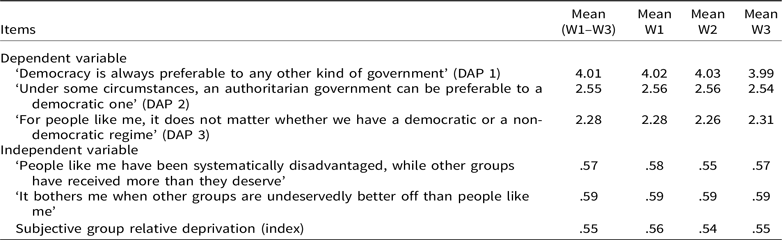
To measure our dependent variable – diffuse support for democracy – we employ an item battery that has been established by previous research (Morlino and Montero Reference Morlino, Montero and Gunther1995; ABS 2016) to capture respondents’ regime preferences and in particular, their preference for democratic as opposed to autocratic systems of government. Previous research has increasingly relied on these items and similar items when investigating respondents’ preference for democracy (Mattes and Bratton Reference Mattes and Bratton2007; Chu et al. Reference Chu2008; Diamond and Plattner Reference Diamond and Plattner2008). In total, we use three items that ask respondents whether they agree or disagree with the first three statements displayed in Table 1. In our surveys, scale reliability scores for the three items display relatively low levels (Cronbach’s α in Survey 1: .66, Survey 2: .66, Survey 3: .64; see online Supplemental Material section B for country-specific values). The correlations between the three variables are also lower than expected with correlations between the three items being consistently below .5 across the board with a few exceptions between DAP2 and DAP3 (see online Supplemental Material section B, Tables S1–7 to S1–9).
Item wordings for regime preferences and SGRD

Notes: Statements DAP 2 and DAP 3 are reversed in the formation of the averaged index. Answer scales range from (1) strongly disagree to (5) strongly agree. See ABS, 2016.
Thus, for the analyses, we proceed in two ways. First, to remain comparable to previous research, we analyze a composite measure of regime preferences, which is built as a mean index summing up item DAP1 with the reverse of items DAP2 and DAP3 (see also Erhardt et al. Reference Erhardt, Freitag and Filsinger2023). Higher values imply a preference for democracy. Second, we investigate the items separately to uncover differences when it comes to individuals’ explicit support for democracy and their potential openness toward authoritarian forms of government. While conceptually both aspects are subsumed as diffuse support for democracy, the variation in how the items are formulated should allow us to tease out differences in how steadfast respondents are in their support for democracy. Thus, the separation follows empirical as well as theoretical considerations.
A first descriptive glance at the data reveals interesting differences. From Table 1, it becomes evident that while large shares of the population regard democracy as always preferable to other kinds of government (only 6 percent do not agree with this statement), openness to other forms of government – even authoritarian ones – can be found as well. Around 23 percent of respondents in our full sample agree or somewhat agree with the statement that an authoritarian government can be preferable to a democratic one under some circumstances. Last, around 16 percent of respondents in our full sample believe that for them it would not make a difference if they lived in an autocracy or democracy indicating that a significant share of the population does not believe that the system of government meaningfully impacts their lives.Footnote 4 Thus, our approach allows us to investigate support for democracy from two sides of the same coin, by tapping into the direct support for democracy as the preferred form of governing and by teasing out whether citizens reject authoritarian alternatives (Easton Reference Easton1975; Magalhães Reference Magalhães2014). In this regard, we might alleviate problems of lip-service to democracy and uncover whether citizens fulfill the idea of a democratic citizen by supporting democracy and rejecting authoritarian alternatives (Inglehart Reference Inglehart2003; Kaftan Reference Kaftan2024).Footnote 5 We are also confident that our measure is conceptually and empirically distinct from instances of dissatisfaction and protest, such as, satisfaction with democracy and voting for the populist radical right given the low correlations, we report in Figure S6.
We measure our main independent variable – subjective group-based relative deprivation – as follows (see Table 1). Research in social psychology has proposed that relative deprivation has two important elements. While the perception of group-based disadvantage is considered the cognitive component, a negative emotional reaction to this perceived disadvantage constitutes its affective component (Smith et al. Reference Smith2012; Smith and Pettigrew Reference Smith and Pettigrew2014).
We use two items that have been used in previous research. The statement ‘People like me have been systematically disadvantaged, while other groups have received more than they deserve’ allows us to capture the cognitive aspect of whether a respondent perceives herself as a representative of her in-group as disadvantaged (Wamsler Reference Wamsler2022; Filsinger Reference Filsinger2023). Second, ‘It bothers me when other groups are undeservedly better off than people like me’ captures the emotional reaction to the perceived disadvantage through angry resentment (Smith and Pettigrew Reference Smith and Pettigrew2014).
Our measures do not ask about a concrete reference group for the disadvantage. Instead, Filsinger (Reference Filsinger2023) argues that this has the advantage of not prompting respondents toward certain groups in society, thereby being a less obtrusive measure. In this vein, Wamsler (Reference Wamsler2022) shows little difference in the relationship between relative deprivation based on distinct comparison groups and exclusionary attitudes. Furthermore, research in social psychology is unclear about the role of different reference groups (Festinger Reference Festinger1954; Vanneman and Pettigrew Reference Vanneman and Pettigrew1972). For relative deprivation to matter analytically, the reference group is of less importance as it should matter more to what extent they perceive their in-group as unfairly disadvantaged compared to an out-group. The disadvantage would be irrelevant if the out-group did not matter (Walker and Pettigrew Reference Walker and Pettigrew1984).Footnote 6
Given the sufficient Spearman-Brown reliability coefficient of .74 in Survey 1, .70 in Survey 2, and .69 in Survey 3 (see online Supplemental Material Table S10 for country-specific values), we combine both statements. To account for the conceptual structure that the cognitive and affective components must be present, we use the geometric mean of both components and rescale our variable to range from 0 to 1. This procedure has been used in the study of populist attitudes to adequately depict necessary conditions (Mohrenberg et al. Reference Mohrenberg, Huber and Freyburg2021) and thus allows us to account for the fact that both components are necessary. This follows the call from social psychology to include both cognitive and affective components in any analyses of relative deprivation to capture its influence appropriately (Smith et al. Reference Smith2012).
In our analyses, we control for several potential covariates that could affect relative deprivation as well as democratic regime preferences. We control for socio-demographic factors through sex and age of respondents. Moreover, as social and economic factors, we include education and income situation of a respondent as they might influence their diffuse support for democracy as well as SGRD. For political control variables, we use ideological self-placement and political interest. For the former, one might argue that being more rightist on the left–right scale may be negatively related to support of democracy (Malka et al. Reference Malka2020) or alter effects of relative deprivation (Lilly et al. Reference Lilly, Sibley and Osborne2023). To account for more extreme views, we square left-right self-placement to account for such a potentially U-shaped relationship. For the latter, one could argue that more politically interested respondents may be in favor of a democratic instead of an authoritarian regime. Descriptive statistics can be found in Table S1–2 to S1–5 in the online Supplemental Material.
Methodologically, our approach is twofold. First, to establish the overall relationship between SGRD and regime preference, we estimate linear regression models with robust standard errors with both country and survey-wave fixed-effects as respondents are nested within countries and survey waves. While pooling the six surveys allows us to report the general relationship, marginal effects for each country and survey wave by means of interaction terms, offer the possibility to take a more comparative, in-depth perspective as well.
Second, as a subset of the respondents is surveyed in all three survey waves, we can make use of a three-wave panel (more information is reported in Table S1–1). This allows us to investigate the relationship between subjective relative deprivation and regime preferences over time. More precisely, we can make use of regression models that allows us to identify within-person changes while controlling for individual-level heterogeneity.
To do so, we use all respondents who took part in all three waves (‘true panel’). This amounts to around 2,000 respondents, a subset of the respondents of waves 1, 2, and 3. We account for attrition by using specific survey weights (age, gender, and education) to add further precision to our results. The advantage is that we can observe all respondents over the entire period rather than just in one or two waves. This balances the panel and makes the estimation more straightforward.
In order to account for the data structure, which includes several observations for each respondent, the model is specified as an individual-level fixed-effects regression model (Allison Reference Allison2009). Regime preference $R{P_{it}}$
is regressed on subjective group relative deprivation
$R{P_{it}}$
is regressed on subjective group relative deprivation $SGR{D_{it}}\;$
and a vector of control variables
$SGR{D_{it}}\;$
and a vector of control variables ${C_{it}}$
, while allowing for individual and time-specific intercepts
${C_{it}}$
, while allowing for individual and time-specific intercepts ${\alpha _{i\;}}\;$
and
${\alpha _{i\;}}\;$
and ${\alpha _t}$
:
${\alpha _t}$
:
 $$R{P_{it}} = {\rm{\;}}{\beta _1}SGR{D_{it}} + {\beta _2}{C_{it}} + {\alpha _i} + {\alpha _t} + {u_{it}}$$
One of the key advantages of this approach is that all time-invariant heterogeneity between individuals is controlled for. Thus, we supplement our cross-sectional analyses with a more longitudinal analysis of whether changes in perceived disadvantages are accompanied by a change in regime preference. More importantly, this analysis gives us additional confidence in the proposed direction of our theoretical argument.
Empirical analyses
We start our empirical analyses with an investigation of our main independent variable, SGRD. This is important to ascertain whether subjective relative deprivation only captures objective inequalities or whether it touches upon additional subjective concerns. We expect that objective economic factors such as education shape subjective relative deprivation, but that there is a significant portion of variation that remains unexplained. If objective economic factors are the main or sole driver of subjective relative deprivation, subjective and objective deprivation could not be distinguished. Yet, we think that subjective deprivation deviates, in part, from objective deprivation. For example, Versteegen (Reference Versteegen2024: 262) shows that group-based nostalgia (e.g., traditions or customs from the past) can lead to subjective relative deprivation ‘even if the present is objectively better than the past’. Thus, to investigate some of the sources of relative deprivation and to separate the objective from the subjective, we report linear regression models with country- and survey-wave fixed-effects for SGRD as dependent variable (see Table S1–11).
In this regard, Table S1–11 shows that socio-economic factors, such as education and income situation, are negatively related to subjective relative deprivation. This implies that people with an objectively better economic situation are less likely to feel subjectively deprived. Yet, the model only explains around 15 percent of the variation, meaning that there is a considerable amount of unexplained variation (85%), showing that subjective relative deprivation cannot be explained sufficiently by education, income, or other forms of objective economic inequality. Consequently, our measure of SGRD captures more than just economic hardship and instead seems to touch upon a perception of disadvantage that is not (necessarily) grounded in objective instances.
While this analysis reveals potential correlates of relative deprivation, another question is how many respondents actually feel relatively deprived. This is a difficult question to answer since we are talking about perceptions of disadvantage, which makes it difficult to set a threshold where individuals are considered as feeling deprived. We approach this by showing the distribution of subjective relative deprivation in Figure S5, which reveals variation in subjective relative deprivation across and within countries, but also that around 49 percent of the respondents situate themselves below or at the midpoint of the scale. The boxplot in Figure S5 reveals that the median of the distribution in all countries is at least .5 indicating that half of our sample feel relatively deprived rather than not. Furthermore, at least a quarter of respondents in all countries express subjective relative deprivation above .7 on the scale from 0 to 1. This value indicates agreement with the statements that one feels deprived compared to a relevant referent and is angry about such as a disadvantage. Consequently, we find that at least half of our sample feels at least somewhat relatively deprived while a quarter of our sample rather strongly feels that they are disadvantaged. This is a rather substantial share of the population, which implies that our following analyses have critical implications for democratic stability if our hypotheses are supported.
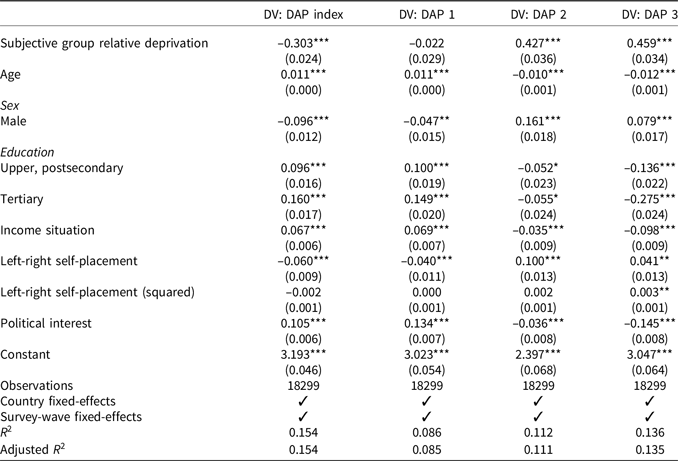
Turning to our main analyses, we first look at the repeated cross-sectional survey data in France, Germany, Italy, Spain, Switzerland, and the United Kingdom, and how SGRD relates to democratic regime preferences. We start with the composite index of democratic regime preferences (left column in Table 2). We observe that SGRD relates negatively and significantly to democratic regime preferences, indicating a lower preference for democracy vis-à-vis an authoritarian regime. The difference in democratic support between those who perceive no unfair disadvantage and those who perceive their in-group as highly disadvantaged is .3 (3.9 vs. 3.6), which is around a quarter of a standard deviation and thus a very modest difference.
This relationship is consistent in the pooled sample across the three survey waves (see Figure 1). To exploit the richness of our data, we hone in on whether the relationship also stays consistent across the different countries and survey waves. Indeed, the relationship between subjective relative deprivation and democratic support is negative and significant in France, Germany, Spain, and the United Kingdom in all three survey waves. This provides strong support for our conclusions from the pooled sample analyses.Footnote 7
Marginal effects of subjective relative deprivation on democratic regime preferences (composite index). Note: Marginal effects calculated from a linear regression model with robust standard errors, 95% confidence intervals, N = 18,299. Source: original survey data.

However, we find less consistent evidence for the relationship between SGRD and democratic regime preferences in Italy and Switzerland as the significant coefficients disappear in waves 2 and 3. This is puzzling but might have country-specific reasons. In Italy, one might argue that the change in government that took place in February 2021 might have acted as a political valve. A change in government might offset the resentment produced by perceived disadvantage decreasing the desire for systemic change (Huang and Zuo Reference Huang and Zuo2021). Regarding Switzerland, the explanation might be found in its institutional peculiarities and direct-democratic traditions. For example, direct democracy is often considered as a valve for Swiss citizens as it offers direct influence on political decision-making (Vatter Reference Vatter2018). Further, Switzerland’s institutional configuration is focused on consensual decision-making, which might make a shift toward an authoritarian form of government much more difficult.
Thus far, our analysis has generally provided support for our expectations. Yet, in order to investigate not only citizens’ explicit support for democracy but also their potential openness to authoritarian alternatives, we look at the individual components of our composite measure. The second to left column in Table 2 shows the regression model for the statement that ‘Democracy is always preferable to any other kind of government’ as the most straightforward and direct measure of support for democracy.
OLS-regression subjective group relative deprivation and democratic regime preferences

Note: Linear regression coefficients, robust standard errors in parentheses, * P < 0.05, ** P < 0.01, *** P < 0.001. DAP 1: ‘Democracy is always preferable to any other kind of government.’; DAP 2: ‘Under some circumstances, an authoritarian government can be preferable to a democratic one’; DAP 3: ‘For people like me, it does not matter whether we have a democratic or a non-democratic regime’. Reference Category (RF) for sex: female; RF Education: lower secondary or less Source: Original survey data.
While the coefficient for SGRD is negative as expected, it is very small and not significantly different from zero, indicating that respondents who express subjective relative disadvantage are not less likely to see democracy as the most preferable form of government. This null effect is also largely replicated across countries and survey waves as evidenced by Figure 2.Footnote 8 While in five out six countries SGRD does not undermine the notion that democracy is always preferable, Germans seem to turn away from democracy if they perceive to be disadvantaged, which might be due to the Socialist legacy of the country’s Eastern part (Landwehr and Leininger Reference Landwehr and Leininger2019; Stallbaum Reference Stallbaum2024).
Marginal effects of subjective relative deprivation on democratic regime preferences (DAP 1). Note: Marginal effects calculated from a linear regression model with robust standard errors, 95% confidence intervals, N = 18,299. Source: original survey data.

Although the analysis of this item adds important nuances to our analysis, the two remaining indicators offer additional insights and paint a less optimistic picture. In the second to right column in Table 2 SGRD positively relates to agreement to the idea that under some circumstances autocracy is preferable to democracy, indicating a less principled rejection of autocracy and thus a turn away from democracy being ‘the only game in town’ (Linz and Stepan Reference Linz and Stepan1996: 15). The coefficient amounts to a difference of .4 between those with no SGRD and those with high levels of SGRD.
Figure 3 shows the analyses for this item for each country and survey wave separately. We consistently find a positive and significant coefficient of SGRD in Germany, Italy, and the United Kingdom in all three surveys and a positive and significant coefficient in France and Spain in two out of three surveys. Again, Switzerland can be considered an outlier as we only find one significant coefficient, potentially traceable to the peculiar institutional setting. These findings generally undergird the notion that SGRD prompts people to consider authoritarian forms of government as alternatives to democracy in Germany, Italy, the UK, and to a lesser extent in France and Spain. Considering that principled support for democracy implies an explicit rejection of authoritarian alternatives, this is worrisome.
Marginal effects of subjective relative deprivation on democratic regime preferences (DAP 2). Note: Marginal effects calculated from a linear regression model with robust standard errors, 95% confidence intervals, N = 18,299. Source: original survey data.

Investigating our third item, which taps into respondents’ impression that it does not matter whether they live in a democratic or a non-democratic regime, produces fairly similar results. The right column in Table 2 shows that SGRD relates positively to this perception, which can be considered a strong turn away from democracy. The difference between those with no SGRD and those with high levels of SGRD amounts to around 40 percent of the standard deviation. These results imply that SGRD might stir people toward alternative forms of government that are not compatible with contemporary understandings of liberal democracy. People with higher levels of SGRD are more likely to have the impression that it does not matter whether they live in a democracy or an autocracy in France, Germany, Spain, the United Kingdom, and to a lesser extent in Italy (Figure 4). Switzerland, again, seems to be an outlier with only one positive and significant coefficient in the first survey wave.
A short note on the control variables, which are mostly in line with previous research and consistent across the composite index and the respective single items. We find that older respondents are more supportive of democracy, while men are less supportive. Furthermore, respondents who live more comfortably on their income are also in favor of democracy as are people with upper-secondary and tertiary education. With regard to the attitudinal control variables, we find that people who are interested in politics are more supportive of democratic forms of government as are people situated to the political left.
Overall, our cross-sectional analyses provide mixed support for our hypothesis. Our composite measure reveals a consistently negative and significant relationship between SGRD and democratic support in the pooled sample, France, Germany, Spain, and the UK. Yet, SGRD does not seem to undermine citizens’ preference for democracy as the most preferable system of government. Instead, our analyses reveal that citizens expressing SGRD are more open to authoritarian alternatives to democracy in Germany (9/9 coefficients significant and in the expected direction), the UK (6/9 coefficients), France, Italy, and Spain (5/9 coefficients), but not in Switzerland. The uncovered relationships are modest in size. However, we consider them important as even small shifts in aggregate changes in support can have a decisive impact on democratic quality, for example, by shaping election results at the margin (Claassen Reference Claassen2020a; Devine and Valgardsson Reference Devine and Valgardsson2024).
Marginal effects of subjective relative deprivation on democratic regime preferences (DAP 3). Note: Marginal effects calculated from a linear regression model with robust standard errors, 95% confidence intervals, N = 18,299. Source: original survey data.

Thus, even in a setting of generally high levels of democratic support, we find a negative relationship between SGRD and democratic support. Given the significant share of respondents who express subjective disadvantage, this may imply a significant challenge for the attitudinal foundation of democracy. These conclusions remain robust for the inclusion of specific support into the model, thus indicating that we do not just capture mere discontent but attitudes that concern the core of democratic support (see section D in the online Supplemental Material).
In the following, we test our contentions over time by leveraging panel data and individual-level fixed-effects regressions to see whether individual changes in subjective disadvantage are accompanied by a subsequent change in regime preferences. This provides us with additional confidence in our results, given that our model specification allows us to identify within-person changes while controlling for individual-level heterogeneity.
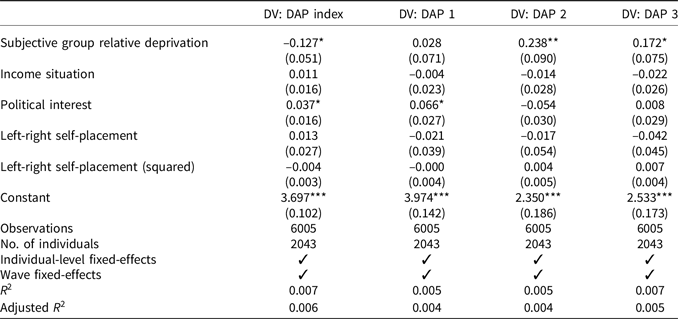
Table 3 presents the coefficients of the individual-level fixed-effects regression models in our three-wave panel. In line with our hypothesis and our cross-sectional findings, we find that SGRD significantly decreases an individual’s principled support for democracy. An increase of around two standard deviations in an individual’s subjective relative deprivation is followed by a decrease in support for democracy of around 12 percent of a standard deviation. This relationship is relatively small, yet nonetheless important given the generally high levels of stability of democratic support, the short time period, and the significant share of respondents that express subjective disadvantage. Moreover, small statistical results may imply aggregate changes in support that can have a decisive impact on democratic quality, for example, by shaping election results at the margin (Claassen Reference Claassen2020a; Devine and Valgardsson Reference Devine and Valgardsson2024). Since our analyses reveal that a quarter of the respondents express rather strong feelings of disadvantage, such changes are probable and could bear significant implications for democratic stability.
Fixed-effects regression on democratic regime preferences (‘true panel’)

Notes: Robust standard errors in parentheses: * P < 0.05, ** P < 0.01, *** P < 0.001. DAP 1: ‘Democracy is always preferable to any other kind of government.’; DAP 2: ‘Under some circumstances, an authoritarian government can be preferable to a democratic one’; DAP 3: ‘For people like me, it does not matter whether we have a democratic or a non-democratic regime’. Source: Original survey data.
When we turn our attention to the separate items of democratic support, the fixed-effects analyses show no significant relationship between SGRD and the statement that democracy is always preferable to any other form of government. As in the cross-sectional analyses, SGRD does not reduce respondents’ overall preference for democracy. The null finding for this item may be due to two different reasons. First, this item has a strong normative component, making social desirability issues particularly relevant here. Second, the very strong item wording, which refers to two absolute terms and does not propose alternatives to democratic governance, may make it very difficult for respondents to answer the question or at least make it very difficult to imagine change as the statement is perceived as law-like. However, when we look at the remaining two items, we again see that SGRD significantly increases an individual’s position that under some circumstances, an authoritarian regime might be preferable to a democratic one. The coefficient implies that an increase of around two standard deviations in an individual’s subjective relative deprivation is followed by an increase of around 8 percent of a standard deviation in an individual’s perception that autocracies might be better than democracies under certain circumstances. Last, we also find a significant positive coefficient of SGRD on an individual’s perception that it does not matter whether they live in a democracy or an autocracy. The size of the relationship is around 11 percent of a standard deviation for an increase of around two standard deviations in an individual’s subjective relative deprivation.
Overall, our empirical analyses lend support for our general contention that respondents who feel subjectively disadvantaged compared to an out-group are less supportive of democracy and seem to be more open toward authoritarian alternatives. While this is certainly an alarming finding for the stability of democratic systems, the silver lining lies in the rather modest effect sizes and the generally high levels of support for democracy in all six countries under study.
Yet, given that an overwhelming majority of citizens should see democracy as the best type of regime and ‘the only game in town’ (Linz and Stepan Reference Linz and Stepan1996: 15), the increasing openness to authoritarian alternatives of parts of the population might be cause for concern. This is particularly true in contexts where democratic support is usually considered a settled norm. In this vein, recent research has shown that authoritarian leaders in democracies might draw on support from different segments of the citizenry to bolster their regimes (Wunsch and Gessler Reference Wunsch and Gessler2023). As SGRD constitutes a mobilizing force (Rüdig and Karyotis Reference Rüdig and Karyotis2014; Grasso et al. Reference Grasso2019), our results imply that a non-negligible group of citizens perceiving relative deprivation grows open to authoritarian modes of governance. This is even more troubling, given that support for democracy seems to be increasingly subject to partisan-motivated reasoning, including in established democracies (Graham and Svolik Reference Graham and Svolik2020; Fossati et al. Reference Fossati, Muhtadi and Warburton2022; Bryan Reference Bryan2023).
Discussion
Perceptions of disadvantage and deprivation seem to be crucial predictors of support for populist and authoritarian politicians and parties. Yet, we do not know whether subjective relative deprivation also undermines citizens’ principled support for democracy. The aim of this paper was to evaluate whether SGRD undermines citizens’ preference for democracy and strengthens their desire for strongmen rule under an authoritarian system of government. This is a crucial question in times of an ongoing debate about democratic deconsolidation (Wuttke et al. Reference Wuttke, Gavras and Schoen2022),
Tying together insights from political economy and political psychology, we argue and empirically show that SGRD significantly undermines support for democracy. Our analyses of repeated cross-sectional surveys reveal that SGRD consistently undermines support for democracy in most of the six countries between 2020 and 2022. While subjective deprivation might not push citizens to abandon democracy as the most preferred form of government altogether, it nevertheless increases citizens’ openness to authoritarian alternatives to democracy. Putting our hypotheses to a longitudinal test by leveraging a subset of panel data, fixed-effects regression models support these cross-sectional findings. Although the effect sizes are overall of modest size, they are still meaningful given the general stability of democratic regime preferences and the fact that the share of respondents who express strong SGRD is around a quarter of our sample.
While our evidence for a democracy-undermining effect of SGRD is relatively robust, this should be scrutinized in additional depth in future studies. First, studies may incorporate more countries in the analyses to add additional contextual variation increasing the external validity of our findings. Within Europe, the prevalence of democratic backsliding in Eastern Europe might prove a useful extension (Gessler and Kyriazi Reference Gessler, Kyriazi, Hutter and Kriesi2019). Such a more diverse sample of countries might also allow for modeling the role of political ideologies, partisanship, or increasing polarization in more detail (Gidengil et al. Reference Gidengil, Stolle and Bergeron-Boutin2022; Lilly et al. Reference Lilly, Sibley and Osborne2023). Including more countries might also allow modeling macro-economic aspects such as income inequality, which was unfortunately not possible with the data at hand. Similarly, such analyses might also shed some light on how ‘objective’ and ‘subjective’ inequality interact and how this interplay affects democratic support (Bolet Reference Bolet2020, Reference Bolet2021; Bienstman et al. Reference Bienstman, Hense and Gangl2024).
Second, although we use panel data to solidify our claims, our analyses are based on a rather short period. While we find a decreasing effect of subjective deprivation on democratic support over time, we do not know whether this effect gets stronger if deprivation persists over a longer time span. This question, however, is crucial as our findings suggest a small to modest democracy-undermining effect of SGRD that does not (yet) turn citizens away from democracy for good but rather increases their openness toward authoritarian alternatives. We know from previous research that openness to alternative forms of government and non-liberal conceptions of democracy can be problematic for democratic quality in the long run (Kirsch and Welzel Reference Kirsch and Welzel2019; Chapman et al. Reference Chapman2023). Thus, expanding on our fixed-effects regression models, which control for individual-level and time-invariant heterogeneity, longer panels may help us understand whether the effects of perceived unfair disadvantage might culminate over time and then lead to a turn away from democracy in the long run. While experimental approaches to manipulate subjective perceptions of unfair disadvantage may prove difficult, using long-term panel data may also provide more confidence in the causal nature of the relationship under study, thereby accommodating the fact that our approach does not offer a causal identification strategy for the relationship between SGRD and support for democracy.
Third, although we rely on established items to measure democratic support, they are unable to uncover different conceptions of democracy (Chapman et al. Reference Chapman2023), nor are they able to circumvent social desirability and lip-service to democracy (Kaftan Reference Kaftan2024). In particular, this concerns item DAP1, which bears the strongest connotations of democratic governance as an almost law-like statement. In this vein, future research may take up recent advances in the measurement of support for democracy to provide a more detailed and in-depth look at the relationship between relative deprivation and support for liberal democracy (Claassen et al. Reference Claassen2024). Improving the measurement approach also relates to our independent variable, where future studies could make use of recent advances (eg Ferwerda et al. Reference Ferwerda, Gest and Reny2024; Versteegen Reference Versteegen2024). This may also include looking at the respective content of subjective relative deprivation and the different out-groups that people compare themselves to.
Last, our current study provides several theoretical arguments about the mechanisms linking SGRD and diffuse regime support but is unable to empirically test these. Yet, future research might provide more nuanced empirical evidence on whether these mechanisms drive the relationship between relative deprivation and democratic support or whether there are different factors at play.
Despite these challenges for future research, our paper enriches the research field on democratic support by showing that subjective relative deprivation does not only affect support for populism and radical right-wing parties but also challenges principled support for democracy. Rather than focusing on citizens’ economic position in society, we focus on whether they perceive their in-group to be unfairly disadvantaged and how this affects their support for democracy. Our study also has crucial implications for the discussion on the political repercussions of rising inequality in modern societies. By honing in on a rather understudied threat to democracy and by tying together insights from political psychology and political economy, we provide an encompassing and interdisciplinary view on the consequences of group-based resentment for democratic support. Using cross-sectional and panel data from original surveys for six established democracies, we enrich recent research and show how citizens’ perceptions of unfair disadvantage undermine democratic support in a setting where deviations from a settled norm are considered rather unlikely.
Supplementary material
The supplementary material for this article can be found at https://doi.org/10.1017/S1475676525100029.
Data availability statement
The data and code that support the findings of this study are openly available on the Open Science Framework under the following the https://doi.org/10.17605/OSF.IO/RCEPA.
Acknowledgements
An earlier version of this paper was presented at the ECPR General Conference 2022, the New Challenges to Democracy Workshop in Montreal 2022, the SPSA 2023, EPSA 2023, and the IPW Research Seminar at the University of Bern. The authors would like to thank Ruth Dassonneville, Jean-Francois Daoust, Julian Erhardt, Daphne Halikiopoulou, Romain Lachat, Dieter Stiers, Fabio Wasserfallen, Théoda Woeffray, Alina Zumbrunn, and all participants for their critical and helpful comments. We would also like to thank Markus Freitag for supporting the data collection. Last but not least we would like to thank the anonymous reviewers and editors of EJPR for their constructive comments and suggestions that significantly improved our paper.
Financial support
This study did not receive financial support.
Competing interests
The authors declare that they have no conflict of interest.
Ethical standards
The research design was approved by the Research Ethics Committee at the Faculty of Business, Economics and Social Sciences of the University of Bern (approval number 092020).





 Open access

