


1. Introduction
Pedestrians are involved in almost 21% of road traffic injuries and their safety embodies a societal relevant issue (WHO, 2023). They are the primary victims of road accidents as they have a more vulnerable position on the road compared to other transport modes (European Commission, 2021), regardless of whether the vehicle is conventional, electric or autonomous. If in the former case it may be a matter of visibility, in the other two the problem is compounded by the absence of auditory cues (Reference CaiCai, 2024) and technology reliability (Reference LittleLittle, 2021), respectively.
Indeed, pedestrians use engine sound to detect and localise vehicles, and the lack of noise creates safety issues (Reference Karaaslan, Noori, Lee, Wang, Tatari and Abdel-AtyKaraaslan et al., 2018). This is particularly evident in low-speed traffic scenarios (Reference Faas and BaumannFaas & Baumann, 2021) and in ambient with high sound levels where electric vehicles (EVs) are more likely to have a collision with a pedestrian (Reference Karaaslan, Noori, Lee, Wang, Tatari and Abdel-AtyKaraaslan et al., 2018). Consistently, statistics show that in Europe, up to 2021, EVs were responsible for 17.9% of accidents involving pedestrians, while in the US the accident rate is double that of traditional vehicles (Reference CaiCai, 2024).
Following the increase in pedestrian crashes, governments have mandated artificial sound emission systems (European Commission, 2019) and established minimum sound requirements (NHTSA, 2018). With analogous intent, autonomous vehicles (AVs) equipped with sensors have been introduced to reduce traffic accidents due to human errors (Reference Guo, Yuan, Yu, Chen, Yu, Cheng, Wang, Luo and JiangGuo et al., 2022). However, AVs may lack a human driver (levels 4 and 5; SAE, 2021), hence all the information is provided by formal communication of the vehicle, missing nonverbal cues from the driver (Reference Song, Lehsing, Fuest and BenglerSong et al., 2018).
Therefore, whether it is for the lack of engine sound or the absence of the driver, innovative vehicles should be equipped with a communication interface that ensures interaction flexibility in response to a variety of traffic conditions (Reference Tran, Parker and TomitschTran et al., 2023). Moreover, recent technological advancements allow to foresee the potential future concept of vehicle: the electric autonomous vehicle (EAV) (Reference Kovačić, Mutavdžija and BuntakKovačić et al., 2022). However, being an immature technology, the research on EAVs still focuses mainly on technological developments, so to accelerate the emergence of the dominant design (Reference León and AoyamaLeón & Aoyama, 2022), and less on design aspects, as this study does.
This paper intends to contribute to the design of EAV interfaces by providing insights about effective interaction with pedestrians, by answering the following research questions:
-
How does the emotional response of pedestrians change when interacting with EVs and AVs?
-
What are the preferred communication methods by pedestrians to interact with EVs and AVs?
The literature presents many experiments and literature reviews to investigate the problem of human-machine interaction in autonomous vehicles, but only a limited spectrum of emotions has been investigated up to this point, mostly perception of safety, trust and confidence or relaxation. This study aims to expand the scope by considering additional emotions with both negative and positive connotations, such as stress or adrenaline. Moreover, adopting a combined research perspective of both electric and autonomous vehicles is important for the EAV concept to become established, yet rarely evaluated (Reference Kovačić, Mutavdžija and BuntakKovačić et al., 2022). This indeed represents the main element of originality of this paper.
The document consists of 5 sections. The first explores the background of this study, detailing the interaction of EVs and AVs with pedestrians. Subsequently, the research method is explained by a description of the questionnaires and of the analyses carried out. Finally, results are first presented and then discussed to serve as guidelines; conclusions then highlight the answers to the research questions.
2. Background
Societal growing interest in environmental sustainability is supporting the adoption of electric vehicles (Reference Kovačić, Mutavdžija and BuntakKovačić et al., 2022). Replacing the combustion engine with an electric one brings numerous benefits in reducing emissions (Reference Pardo-Ferreira, Torrecilla-García, Heras-Rosas and Rubio-RomeroPardo-Ferreira et al., 2020), but the resulting quietness might make pedestrians less aware of the vehicle’s proximity.
At the same time, vehicles have been integrated with digital modules with advanced functions supporting autonomous driving aiming at preventing accidents due to human errors (Reference Brill, Debnath, Payre, Horan and BirrellBrill et al., 2024).
Both these types of vehicles have led to novel approaches to human-vehicle interaction, both on board and in shared areas, bringing new design requirements. With the intent of better comprehending the nature of EV and AV concepts, the next two paragraphs separately examine their features, in terms of pedestrian interaction and emotional perception.
2.1. Interacting with silent vehicles: the challenges of the electric engine
Eye-contact is the main communication method between pedestrians and drivers in crossing situations. As such, when vehicles are out of the pedestrians’ field of vision, the engine noise becomes crucial, providing valuable insights into their proximity, speed and trajectory of their next manoeuvre (Reference Faas and BaumannFaas & Baumann, 2021). While engine noise is a common feature of ICE vehicles, it is absent in EVs, especially during vehicle restarts or at low speeds, limiting the detectability of the vehicles (Reference Karaaslan, Noori, Lee, Wang, Tatari and Abdel-AtyKaraaslan et al., 2018). These EV limitations have negative emotional consequences on pedestrians, in terms of perceived safety (Reference Faas and BaumannFaas & Baumann, 2021) and fear (Reference CaiCai, 2024), and their attitude in crossing situations. In particular, depending on their age and familiarity with the vehicles, individuals tend to assume risky behaviour (Reference Oliveira, Bastos Silva and RibeiroOliveira et al., 2024; Reference Pardo-Ferreira, Torrecilla-García, Heras-Rosas and Rubio-RomeroPardo-Ferreira et al., 2020), as they often tend to overestimate the collision time of an electric vehicle (Reference Wessels, Kröling and OberfeldWessels et al., 2022). This of course poses critical safety concerns for pedestrians, as they may decide to cross the road unaware of the danger (Reference CaiCai, 2024).
With the aim of deterring pedestrians from crossing in front of an approaching vehicle, the literature has started to focus on alternative communication interfaces and, the resulting new way of interaction, through the introduction of additional cues. For example, Reference Bazilinskyy, Merino-Martínez, Özcan, Dodou and de WinterBazilinskyy et al. (2023) examined acoustic signals and compared continuous with intermittent sounds. Complementary to this analysis, Reference DemirciDemirci (2024) specified sounds’ effectiveness also needs to be tested with varying vehicle size, as heavy and thus bigger vehicles have more blind spots as well as longer braking distances. Despite the efficacy of adding noise to EVs, other non-acoustic cues deserve further investigation (Reference Pardo-Ferreira, Torrecilla-García, Heras-Rosas and Rubio-RomeroPardo-Ferreira et al., 2020).
2.2. From human-robot interaction to human-vehicle interaction
Human-AV interaction represents a specific case of human-robot interaction, in a context with high variability and only brief instants of time to communicate (Reference Carmona, Guindel, Garcia and De La EscaleraCarmona et al., 2021). Moreover, such interaction can be thought as a cycle of two phases: firstly, the AV must recognise and predict pedestrians’ intention, then communicate their recognition via interface (Reference Saleh, Hossny and NahavandiSaleh et al., 2017).
The design of the interface to communicate with road users in a simple, effective and efficient way still represents a core issue to address (Reference Bonneviot, Coeugnet and BrangierBonneviot et al., 2023), especially in terms of selection of the appropriate type of signal to integrate (Reference Carmona, Guindel, Garcia and De La EscaleraCarmona et al., 2021). Text, also combined with symbols, are found to improve pedestrians’ decision-making when crossing in front of an AV (Reference Guo, Yuan, Yu, Chen, Yu, Cheng, Wang, Luo and JiangGuo et al., 2022), but LED light bars, visual projections close to the vehicle and human eye-contact simulation are the main solutions proposed in the literature (e.g., Reference Dey, Matviienko, Berger, Pfleging, Martens and TerkenDey et al., 2021). Other cues might include audio commands or musical tones, although they may be difficult to listen in heavy traffic (Reference Mahadevan, Somanath and SharlinMahadevan et al., 2018). Physical messages, such as moving parts, might be incorporated as well, but are not always easily visible (Reference Mahadevan, Somanath and SharlinMahadevan et al., 2018). Finally, the combination of several signals could lead to pedestrian information overload, generating confusion and losing its benefits (Reference Tran, Parker and TomitschTran et al., 2023).
Although a wide variety of different types of interfaces are being studied and validated as effective ways of communication, Reference HulseHulse (2023) suggests that the results of the interaction must be evaluated also looking at not visible consequences, such as the pedestrians’ emotions. In the literature, the main investigated emotions are safety and trust. Reference Bonneviot, Coeugnet and BrangierBonneviot et al. (2023) also included distrust, anticipation, uncertainty, usability, usefulness, attraction and intention to use. Reference Brill, Debnath, Payre, Horan and BirrellBrill et al. (2024) also focused on feelings of relaxation and calm. Finally, among socio-demographic factors, gender may influence willingness to cross the roads, along with age (Reference Brill, Debnath, Payre, Horan and BirrellBrill et al., 2024), cultural background and country of residence (Reference Wang, Hespanhol and TomitschWang et al., 2021) and experience with the vehicles (Reference HulseHulse, 2023).
The literature shows a variety of studies contributing to improve human-AV interaction, while underestimating the problems previously detected in human-EV interaction. Nevertheless, a combined perspective may be useful in finding suitable solutions that satisfy both and contribute to technology development and societal acceptance of the new EAV concept.
3. Method
Studies about people’s behaviours, typically include questionnaires, interviews and/or observations. Due to the impossibility of realising on-site observations in Italy, and with the intent of conducting quantitative analysis, this study relies on questionnaires to measure people’s attitudes towards various aspects of pedestrian-vehicle interaction during crossing situations.
Two distinct, yet comparable, questionnaires were created, one focused on AVs and another about EVs.
Each questionnaire includes 16 questions, divided into two sections. The first about socio-demographic aspects (Reference Brill, Debnath, Payre, Horan and BirrellBrill et al., 2024), the second comprising crossing emotional response and preferences on methods of vehicle interactions (Reference Carmona, Guindel, Garcia and De La EscaleraCarmona et al. 2021), after the provision of a common definition of AVs (level 5; SAE, 2021) and EVs (Reference Kovačić, Mutavdžija and BuntakKovačić et al., 2022).
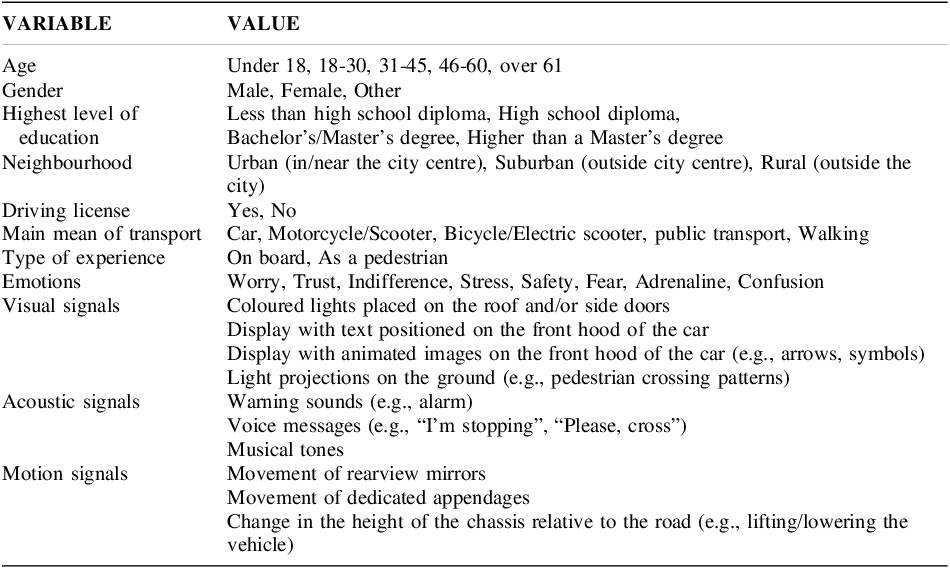
The intensity of the perceived emotions was measured using a 5-points Likert scale (e.g., “On a scale from 1 to 5 (1=not at all and 5=very intense), how intense do you think the following emotions are when crossing the road/a junction in front of an autonomous vehicle?”), and investigated also in relation to the vehicles’ size. The same scale was used for the importance of vehicles’ communication ability (from 1=not important at all to 5=very important) and the perceived effectiveness of different types of signals (from 1=least effective and 5=most effective). Signals description was provided in text as in Table 1.
Respondents have been informed about the goal of the study and the data treatment.
Investigated variables

The EV questionnaire was submitted solely to the Italian population, whereas the AV questionnaire targeted an international audience since the limited diffusion of autonomous vehicles in Italy made the collection of local data unfeasible. A total of 174 and 178 valid and complete responses were obtained from the two questionnaires, respectively. The international sample reached with the AV questionnaire included a majority of people answering from Europe (84 out of 178) followed by Asia (60 out of 178). In addition, 17 respondents live in America, 14 are from Africa and only 3 from Oceania. Data of respondents are shown in Table 2.
Composition of the samples in %

Answers from the questionnaires allowed testing several hypotheses for EVs and AVs. In both cases, after a first round of demographic and qualitative analysis, the Kruskal-Wallis test and the Chi-square test were performed. The former is used to identify statistically significant differences between independent groups, the second to determine whether two categorical variables are associated. Indeed, the Kruskal-Wallis test was used to investigate the effects of demographic and social characteristics on the different emotional responses to crossing situations and on the recognised importance of vehicles’ communication ability. The Chi-square test, instead, enabled to evaluate the influence on the preference and effectiveness of the different signals, and the perception of the quietness and road crossing problem.
Data analyses were conducted on Minitab® 20. Statistical significance was set at α<0.05.
4. Results
4.1. Electric vehicles
The majority of the sample (74%) perceives the quietness of electric vehicles as problematic, while a similar proportion (66%) reported to be concerned about pedestrian crossing. These perceptions appear to be related, as greater awareness of the issues posed by vehicle quietness corresponds to heightened apprehension about pedestrian safety (p-value≈0.00). It is interesting to note that who had an experience on board of an EV reported a significantly heightened perception of the crossing issue (p-value=0.015).
In order to gain a deeper understanding of the crossing problem, the emotional response of pedestrians was investigated, and results are presented in Figure 1.
Intensity of the respondents’ emotions when crossing in front of an EV

In addition, respondents’ emotions were analysed according their demographics and experience with EVs. The gender, the level of education, the living neighbourhood, as well as the ownership of a driving licence and the primarily used means of transport, do not have any influence on the emotions experienced when crossing. Conversely, age and the type of experience emerged as two significant influencing factors. Individuals within the 31-45 age group and those over the age of 60 are the most confused (p-value≈0.00). At the same time, prior experience on board reduces the perception of worry (p-value=0.033), stress (p-value=0.035) and confusion (p-value=0.027), while experience as a pedestrian in crossing contexts enhances trust (adj. p-value=0.049) and indifference (p-value=0.039).
The perceived emotions remain largely unchanged when crossing in front of a larger electric vehicle, except for fear and worry, which reduce for respondents with prior experience as pedestrians in crossing situations (adj. p-value=0.035) or for regular cyclists (adj. p-value=0.002).
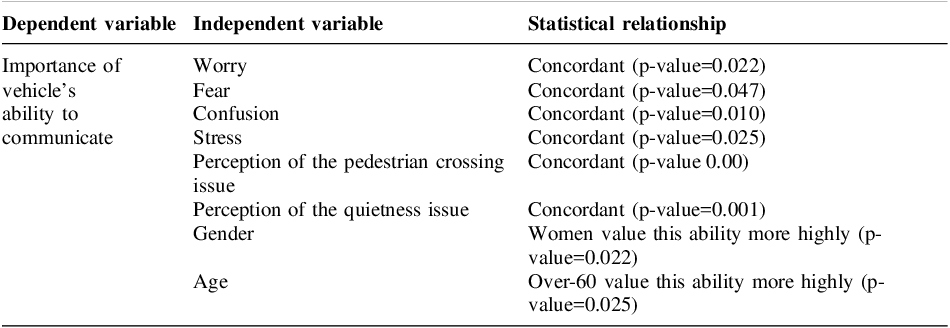
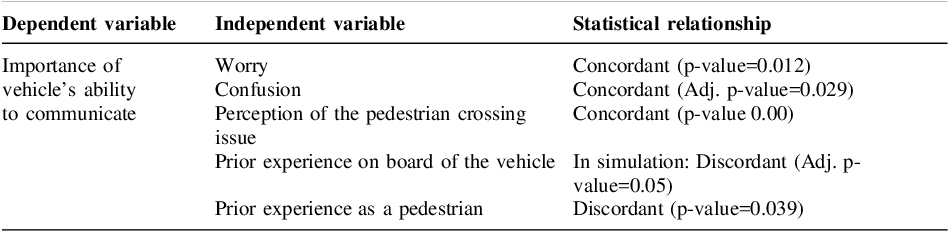
Emotions were also explored in relation to the importance that respondents assign to vehicles’ communicating their intentions. Experiencing negative emotions such as worry, confusion, or fear seems to accentuate this value. The awareness of both pedestrian crossing issue and vehicles’ quietness were found to also have an influence. Finally, socio-demographic variables were included in the analysis. Significant results are presented in Table 3.
Factors influencing the importance of EV communication ability

In order to understand the preferences about signals, the perceived effectiveness of visual, acoustic and motion signals was investigated. At a general level, the respondents’ evaluations of the three different categories were all significantly different (p-value<0.05), with a preference for visual signals. However, when examined in relation to the intensity of the individual emotions, the effectiveness of acoustic signals is comparable to the visual, for both positive and negative emotions.
The superior effectiveness of visual signals becomes less visible when analysing respondents’ area of residence separately (rural, suburban and urban). Specifically, the ratings for the effectiveness of visual signals have an average value of 3.83, while that of acoustic signals is 3.45. Besides being comparable, the perceived effectiveness of these two categories of signals is also similar across the different neighbourhoods (s.d. of means=0.11 for visual signal; s.d. of means=0.10 for acoustic signal). Finally, motion signals were rated as the least effective, with an average effectiveness score of 2.18.
Respondents’ preferences on the type of signals have been deepened within the visual, acoustic and motion categories. Figure 2 shows the percentages of respondents that selected each signal (multiple options were allowed), depicting with similar colour tones the signals of the same category (blue for visual signals, orange for acoustic signals and green for motion signals). To ensure comparability of results, values have been standardised on the total number of people residing in each area. Values for ‘turn signal and ‘eye contact’ have been deleted because lower than 2%.
Comparing the respondents’ perceptions across the neighbourhoods, coloured lights are preferred anywhere. In the remaining categories, more ratings were attributed to warning sounds and the movement of dedicated appendages concerning the acoustic and motion signals, respectively.
Preference of signals for EVs across neighbourhoods

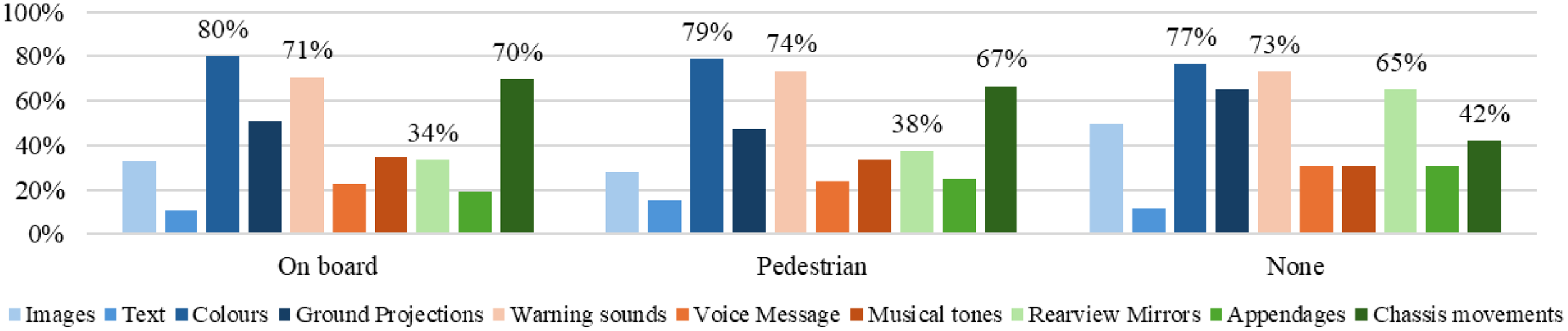
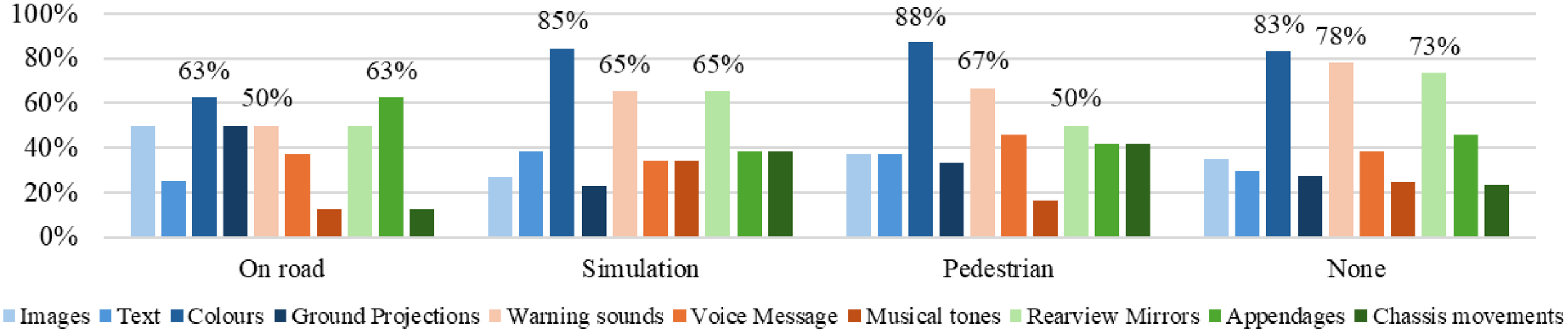
The preferences for specific types of signals were investigated also according to the type of experience the respondents have with electric vehicles. Differences are not so evident, as the preferred cues result to be the coloured lights and the warning sounds in all cases. Motion signals represent an exception, as individuals with prior experience and those who have never interacted with an EV exhibit inverted preferences for the signals involving the movement of rearview mirrors and chassis.
Figure 3 presents the distribution of such preferences across the type of experience with the vehicle. Also in this case, values have been standardized on the number of people having the same experience.
Preference of signals for EVs depending on the respondents’ experience

4.2. Autonomous vehicles
The perception of the crossing issue appears to be more pronounced when in front of autonomous vehicles, compared to electric ones. Indeed, the problem was recognised by 88% of the respondents.
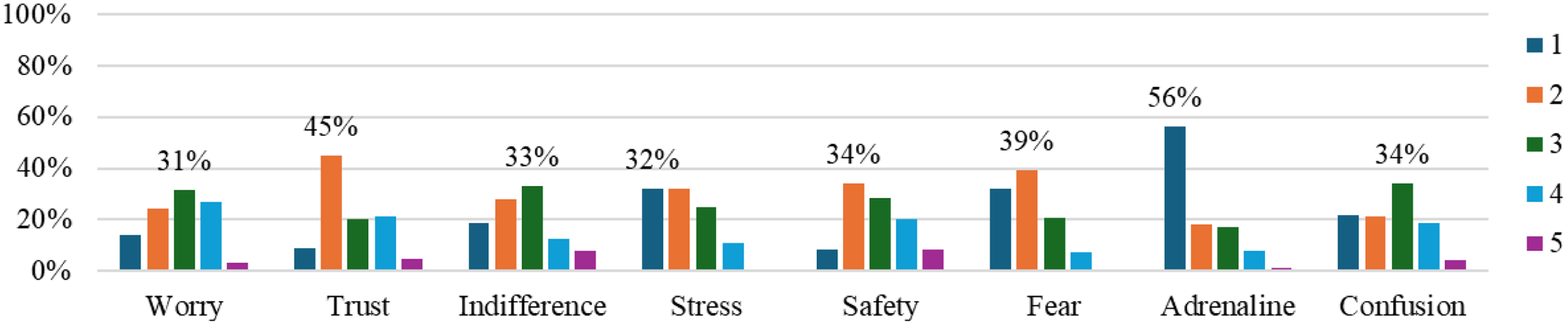
The emotions reported by the respondents were qualitatively analysed, and are shown in Figure 4.
Intensity of the respondents’ emotions when crossing in front of an AV

As for EVs, gender, level of education and the primarily used means of transport do not show any influence on the perceived emotions. Whereas age, living neighbourhood and the ownership of a driving license, together with the different types of experience, have distinct roles in the emotional response. The over-60 age group reported a lower level of safety (adj. p-value=0.047) and adrenaline (adj. p-value=0.040) when crossing; living in the city centre is associated with a higher level of adrenaline (p-value=0.005), while holding a driving licence seems to reduce the fear (p-value=0.049). Moreover, experience with AV in a real-world setting and simulation often results in a different emotional response. In particular, both types of experience reduce worry (p-value=0.039 on road; p-value=0.045 in simulation), but while simulation experience builds trust (p-value=0.024), road experience undermines it (adj. p-value=0.049). Simulation experience also increases the perception of safety (p-value=0.015) and, coherently, decreases fear (p-value=0.045). Finally, prior experience as a pedestrian in crossing situations is related with higher levels of indifference (adj. p-value=0.047) and adrenaline (p-value=0.026), along with reduced worry (p-value= 0.022).
Similarly to EV, as the size of the vehicle increases, perceived emotions remained largely unchanged.
The emotional response and the perception of the crossing issue in turn were found to influence the individuals’ perceived importance for AVs to communicate their next actions. In particular, the stronger the experience of negative emotions and the awareness of the crossing problem, the greater the value assigned to the vehicle’s communication ability. Table 4 presents significant results.
Factors influencing the importance of AV communication ability

With regard to the effectiveness of the various signal types, the majority of respondents assigned higher ratings to visual signals. Such preference results quite pronounced also when investigated in relation to the intensity of the specific emotions, as the average effectiveness of visual signals invariably exceeds that of acoustic and motion signals in both positive and negative emotions.
Exploring the living neighbourhoods of the respondents, the superiority of visual signals is clearly evident in all areas (rural, suburban, urban). Indeed, not only the ratings of the effectiveness of visual cues are on average (mean=4.5) higher than those of acoustic (mean=3.12) and motion signals (mean=2.62), but also exhibit less variation across the different types of neighbourhoods (average s.d.=0.7 for visual signal; average s.d=1.18 for acoustic signal; average s.d.=1.06 for motion signals).
To conclude the analysis on the living areas, the preferences for specific signals, within each type of visual, acoustic and motion category, were investigated. To ensure comparability of results, values have been standardised. Values for “turn signal” have been deleted as lower than 2% (Figure 5).
Comparing respondents’ perceptions across neighbourhoods reveals a preference for the coloured lights in urban and suburban contexts. In contrast, those who live in rural areas reported a preference for warning sounds. Finally, the preferred motion signal is the movement of rearview mirrors.
Preference of signals for AVs across neighbourhoods

Along with the crossing context, preferences about the type of signals were studied in relation to the experience of the respondent with the vehicle, since individuals who have never interacted with an AV may hold different expectations to those who have. Figure 6 shows the results.
Coloured lights are the most commonly preferred type of signal, although respondents with prior experience in real-world scenarios selected this cue less frequently. An analogous reasoning is valid for many of the other cues, including the warning sounds. On the contrary, images, ground projections and movement of appendages were valued more by people with experience on the road and less by others.
Signals’ preference depending on the respondents’ experience

5. Discussions
The primary aim of this study is to explore pedestrians’ interaction with EVs and AVs and their emotions when crossing in front of them. The parallelism between these vehicles has been insufficiently explored in the literature (Reference Kovačić, Mutavdžija and BuntakKovačić et al., 2022), yet it cannot be neglected in light of future developments.
From the questionnaires, the interaction between vehicles and pedestrians emerged as problematic in the presence of both EVs and AVs, also in relation to quietness in the former case. However, the emotions perceived in crossing situations do not perfectly reflect the declared awareness of the issue. In the case of EV, the perception of negative emotions such as fear, worry, stress and confusion is rated as extremely low. Concerns were more pronounced for AVs, as ratings for the intensity of positive and negative emotions were respectively lower and higher than EVs. In particular, respondents with prior experience in a real-world setting tend to have lower trust compared to those who have only engaged with AV in simulations, possibly due to a heightened awareness of potential risks.
For both types of vehicles, concern and awareness of the pedestrian crossing problem increase the importance of vehicles communicating their intentions. In case of interacting with AVs, people who typically rely on cars and motorbikes value the vehicle’s communication ability more than individuals who regularly walk. This suggests the existence of two distinct perspectives of the crossing problem, that of the driver and that of the pedestrian.
The analysis of the vehicle’s communication has been complemented with an investigation of the perceived effectiveness of the different types of signals, distinguishing between visual, acoustic and motion categories. For EVs, both visual and acoustic signals were rated as the most effective, independently from the emotions perceived when crossing, the neighbourhood, and the experience of the respondents. In particular, coloured lights and warning sounds are preferred. Among motion signals, the movement of appendages was the most rated, although their effectiveness is comparatively lower.
For AVs, visual cues are invariably considered as the most effective, except in the rural neighbourhood where the warning sounds are preferred, possibly due to a lower noise level of traffic. Regarding motion signals, it is noteworthy that those who have engaged with AV on the road reported a preference for the movement of appendages, as was the case for EVs.
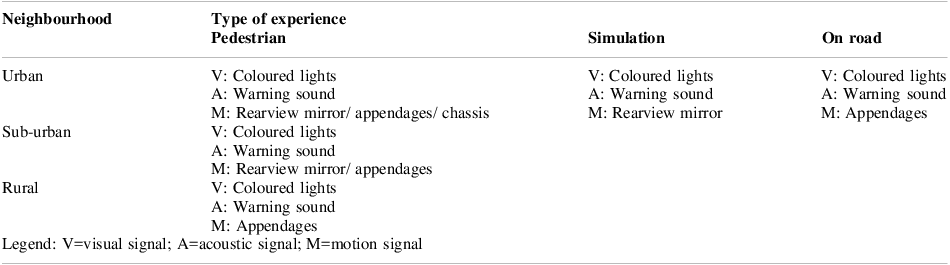
Respondents’ preferences about visual, acoustic and motion signals for the interaction with EVs and AVs have been compared and integrated to suggest the most appropriate design of the interface of future electric autonomous vehicles. Table 5 presents the most rated options depending on the areas in which the vehicles are used and the possible individuals’ experience with the vehicle. Indeed, preferences may change when increasing familiarity with vehicles, meaning interacting first in simulations and then as passengers or pedestrians in real context.
EAVs interaction signals

6. Conclusions
Reflecting upon the future technological developments in the automotive sector, which will integrate the two concepts of EVs and AVs, the present study analyses the human-vehicle interactions by adopting a combined perspective of the two. The influence of demographic factors, living and driving habits, as well as the familiarity with the vehicles has been explored, in relation to perceived emotions when crossing.
Evidence suggests pedestrians experience different levels of worry, trust and confusion when crossing in front of EVs and AVs. Specifically, trust is commonly perceived when interacting with electric vehicles, whereas the other two are primarily evident in the autonomous vehicle experience. For both types of vehicles, the communication of the next manoeuvre is relevant. In particular, visual signals are invariantly considered the most effective; the acoustic signals are more relevant when interacting with EVs; finally, motion signals are in any case viewed as the least useful.
The results enabled for guidelines to stand out to inform the design of the interface of future EAVs. Coloured lights and warning sounds should always be considered, while modification of motion signals should be based on the area of vehicles deployment and the level of experience of the local population.
Limitations about the different populations to which the questionnaires have been submitted cannot be ignored. In particular, the restricted cultural diversity of the EV sample, with exclusively Italian participants, limits results generalisability. Finally, self-reported data can be biased, resulting in disparities between participants reported and real-world behaviours.
Acknowledgments
The authors thank Lorenzo Aidala for contributing to data collection. This publication is part of the project PNRR-NGEU which has received funding from the MUR – DM 118/2023.





 Open access

