


This article interrogates the modalities through which the legitimacy of certain social groups’ claims to justice is foreclosed. It attends, in particular, to the processes by which such claims are discredited, dismissed, or rendered unworthy of serious consideration, producing conditions that resemble a form of “slow death.”
The past three decades have seen “a sharp growth in the number of people and places expelled from the core social and economic order of our time” (Sassen Reference Sassen2014, 1). This project examines one of the social groups affected by the logic of expulsion: traditional working-class men who have experienced the decline of heavy manufacturing and a consequent rise in unemployment within this industrial sector. Specifically, we draw on an ethnographic study of those who moved from skilled industrial labor into low-skilled or unskilled service work and found themselves in waste collection, jobs which are often branded “dirty” or physically tainted due to their association with garbage, death, and effluent (Ashforth and Kreiner Reference Ashforth and Kreiner1999; Deery et al. Reference Deery, Kolar and Walsh2019). As such, this group witnessed what could be described as the “death” of the industrial working class as “a concrete historical entity which had developed out of … political representation, group specific solidarity and shared experiences and values” (Raphael Reference Raphael2023, 88, emphasis added). For instance, the language of “class struggle” which once highlighted this group’s position has largely disappeared from contemporary discussions of social issues (Raphael Reference Raphael2023, 72; Embery Reference Embery2021). Instead, where these workers are discussed, UK media accounts tend to portray them as though they are “all our yesterday’s Britain,” people who are “going nowhere,” so that politically speaking, it becomes easier to “be careless of their opinions” (Embery Reference Embery2021).
To explore the context of this group of workers, we interrelate three theoretical frameworks, namely those of Reckwitz, Fricker, and Povinelli. Following a short exposition of their perspectives below, we then examine the nuances of their conjecture in greater depth, prior to outlining our research method and findings. All of these writers speak to the experience of our research sample by addressing (1) social descent, (2) the marginalization of a social group from “collective processes of meaning-making” (Fricker Reference Fricker2013, 51), and (3) the temporalities surrounding this marginalization.
Taking the first of these writers, Reckwitz’s concept of “social descent” is particularly relevant to our analysis, as it captures not only participants’ movement into “unskilled, dirty” jobs and their resulting economic hardship but also their profound loss of social standing. As Reckwitz (Reference Reckwitz2021, 10) writes, social descent reflects “the massive social downgrading” of industrial workers and the “cheapening” of the values and interpretive frameworks they once relied upon. Their “lifeworlds have been displaced from the centre to the periphery,” leading to devaluation and a cultural asymmetry between those in “simple,” standardized jobs and those with “more intellectual, tailored or unique skills”—in effect, between the “winners and losers” of this new world (Reckwitz Reference Reckwitz2021, 10, 53). The setting of our study, London and the South East, exemplifies this asymmetry, where “privileged groups often claim a sense of moral ownership over the city at the expense of the disadvantaged” (Koch et al. Reference Koch, Fransham, Cant, Ebrey, Glucksberg and Savage2021, 5). This is reflected in a growing divide between those in “comfortable middle-class homes in the leafy suburbs” and those who enter these spaces only to perform basic services (Tyler Reference Tyler2013, 25).
To further understand how this cultural asymmetry may produce new forms of disadvantage, we turned to Miranda Fricker’s reading of epistemic injustice. From Fricker’s perspective, cultural asymmetry can lead to hidden forms of epistemic disadvantage since it implies a lack of interpretive tools shared between these workers and those who prosper in the postindustrial urban space. For Fricker (Reference Fricker2007, 148), this asymmetry arises because “relations of unequal power can skew shared hermeneutical resource (concepts and conceptualizations that different social groups [hold] in common) so that the powerful tend to have appropriate understandings of their experiences ready to draw upon, whereas the powerless are more likely to find themselves having some social experiences … with at best ill-fitting meanings to draw on in the effort to render them intelligible.” Following Fricker (Reference Fricker2007), we want to think about whether this epistemic disadvantage might result in delegitimating workers’ claims to justice.
Yet what is missing from Fricker and Reckwitz’s analyses is closer attention to the significance of temporality. It is here that Povinelli’s (Reference Povinelli2008; Reference Povinelli2011; Reference Povinelli2016) perspective becomes useful because of the way that she focuses on the temporal context in which the speaker is sociopolitically and psychosocially situated, and how this may become a “silent force” in the production of new forms of disadvantage. Building on Povinelli’s work (Reference Povinelli2011), we wish to address how epistemic disadvantage could be produced by temporal norms and the attribution of social tense. By interrelating Povinelli with Fricker and Reckwitz, we can see how a specific imaginary of the social tense of the “other” may occasion Fricker’s “credibility deficit” or exacerbate Reckwitz’s sense of social descent because of the way that different groups’ lifestyles and interpretive models become more relevant to our past than our future.
For us, Povinelli’s (Reference Povinelli2011, 3) social tense opens an avenue for “critically engaging with practical relationships of subjects to the unequal distribution of life and death, of hope and harm, and of endurance and exhaustion.” Echoing Biehl’s work on zones of social abandonment, Povinelli notes that labor markets can generate “wealth and misery,” “movement and immobility” (Biehl Reference Biehl2005, 49), “suffering and striving” (Povinelli Reference Povinelli2011, 14), since some groups find themselves in a space “no longer valued by the market and its cultural forces,” or in Povinelli’s (Reference Povinelli2011, 95) words, in “zones of slow death.” For these people, “softer forms of letting die will do” (Povinelli Reference Povinelli2011, 14); they will be allowed to persist, “until they exhaust themselves” (Povinelli, Reference Povinelli2011, 95).
Povinelli (Reference Povinelli2008, 521) contrasts this slow death with more “spectacular” forms of death, such as “devastating images of airplanes, … or towers exploding …,” that tend to attract attention and inflame the moral imagination. Great waves of empathy are stirred by reports of wars, earthquakes, tsunamis, or hurricanes; we recoil at images of dismembered bodies or buildings torn apart. However, more uneventful and endemic forms of misery and lethality that gradually erode a population’s resilience and vitality (Foucault Reference Foucault1976) are far more easily overlooked. “There is nothing spectacular to report … as life drifts into a form of death that can be certified as due to natural causes” (Povinelli Reference Povinelli2008, 511). In these zones of slow death “any ethical impulse dependent on a certain kind of event and eventfulness flounders …” (Povinelli Reference Povinelli2008, 511). This perspective matters to our research because our sample tends to occupy a space where the injustices they experience are ordinary, chronic, or grimy rather than cataclysmic or eventful—giving rise to what Povinelli (Reference Povinelli2008, 510) describes as “a quieter form of abjection, despair, and impoverishment.”
By framing our analysis in this way, it becomes possible to extend the existing work on temporality and injustice and interrelate it with the ethics of ordinariness, uneventfulness, and “slow death.”
DIRTY WORK, RECKWITZ, AND SOCIAL DESCENT
Dirt designates “matter out of place,” or “being on the margin;” it is therefore tied up with social ordering (Law Reference Law1993) and processes of othering (Douglas Reference Douglas1966) that serve as signifiers of moral evaluation (Skeggs Reference Skeggs and May2004). In this sense, objects, tasks, or jobs are not inherently dirty but are perceived in this way if they transgress social boundaries, disrupt orderings or notions of cleanliness (Douglas Reference Douglas1966). This suggests that what makes a job “dirty” is culturally and historically contingent, with processes of social stigmatization or normalization central to how the work is experienced by workers and evaluated by the general public (Ashforth et al. Reference Ashforth, Kreiner, Clark and Fugate2007). Thus, those doing “dirty work” often experience disadvantage that, as Goffman (Reference Goffman1963, 3) noted, can diminish an individual “from a whole … person to a tainted, discredited one.”
Research on tainted occupational identities predominantly emphasizes that those doing dirty work are able to cultivate alternative, positive conceptions of the self (Hamilton et al. Reference Hamilton, Redman and McMurray2019; Johnston and Hodge Reference Johnston and Hodge2014), thereby developing a sense of self-worth (Costas Reference Costas2022) and empowerment (Shepherd et al. Reference Shepherd, Maitlis, Parida, Wincent and Lawrence2021). What characterizes this approach, then, is the argument that the taint associated with proximity to dirt can at least partially be overcome by highlighting workers’ craft and effort (Costas Reference Costas2022; Tweedie and Holley Reference Tweedie and Holley2016), autonomy (Stacey Reference Stacey2005; Deery et al. Reference Deery, Kolar and Walsh2019), and their sense of purpose (Hansen Löfstrand et al. Reference Löfstrand, Cecilia and Loader2016). Taken together, this body of literature, while acknowledging the challenges workers face in managing the negative connotations associated with dirty work (Shepherd et al. Reference Shepherd, Maitlis, Parida, Wincent and Lawrence2021), primarily focuses on subjective dignity and workers’ efforts to claim honor. It emphasizes how identity processes can shape, and potentially restore, an individual’s sense of self-worth (Zhang et al. Reference Zhang, Wang, Toubiana and Greenwood2021).
Yet in contrast with this “positive” tone, we wish to question whether workers’ self-enhancing strategies actually work in practice. In particular, we want to challenge the way in which the existing tradition in dirty work implies that the meanings workers attach to their work operate on an equal footing with other occupational groups, even with those described as “high status” (such as professional work). Applying Reckwitz (Reference Reckwitz2021), can cultural and discursive resources be treated in an equivalent manner when they may differ radically from one another in terms of their social prestige?
Reckwitz’s work, especially The End of Illusion, is valuable to our study because of its nuanced analysis of the shift from “industrial” to “cognitive-cultural” capitalism, with its resultant transformation in cultural values, and in how work and workers are socially recognized. For Reckwitz, this shift is characterized by simultaneous processes of social ascent—through the formation of a new class of highly qualified and educated people oriented toward prestige—and social descent—the “massive social downgrading” (Reference Reckwitz2021, 10) of those finding themselves in “so-called simple services” involving routine and repetitive work (Reference Reckwitz2021, 35). Reckwitz (Reference Reckwitz2021, 9) describes these changes as a move to a “society of singularities” where “uniqueness, non-exchangeability, incomparability, and superlatives are expected, … positively evaluated …” (Reference Reckwitz2021, 7) and it is only these qualities that are “attributed value in true sense” (Reference Reckwitz2021, 9).
This new social configuration poses clear disadvantages for those who are either unable or unwilling to exhibit distinct, individualized qualities. As Reckwitz (Reference Reckwitz2021, 9) notes, they are “disdained; they remain invisible in the background and receive only minimum—if any—recognition.” Ultimately, society’s valorization of the singular entails the devaluation of that which is “standardized and common” (Reckwitz Reference Reckwitz2021, 10). This disappearance into the background is not merely a matter of invisibility, it is accompanied by the loss of potency of previous ways of being. For example, those involved in dirty work and who experience social descent often hold a particular set of life maxims or understandings, such as adherence to traditional gender roles and family values. Yet cultural questioning and devaluation renders these workers’ traditional commitments and lifestyles “deficient” (Reckwitz Reference Reckwitz2021, 38). In other words, the social descent of these workers doesn’t just reflect shrinking job markets, redundancies, or impoverished living conditions, it also signifies that an “industrial” way of life with its shared cultural values is “no longer socially influential” within postindustrialist landscapes (Reckwitz Reference Reckwitz2021, 54).
In sum, while the postindustrial economy is often described as heterogeneous, it is nevertheless marked by a stark and deepening divide: on one side, “the privileged knowledge-based and cultural labor of highly qualified individuals;” on the other, “the routinized,” low-status service work assigned to “the so-called service class” (Reckwitz Reference Reckwitz2020, 132). As Reckwitz (Reference Reckwitz2020) observes, these groups inhabit increasingly disconnected cultural worlds, with little shared meaning as to how they understand their lives, aspirations, or social value.
Interrelating this argument with Fricker and Povinelli leads to the following key question: what role do temporal processes (Povinelli Reference Povinelli2011; Reference Povinelli2016) play in the production of “epistemic disadvantage” (Fricker Reference Fricker2007) among workers who experience “social descent” (Reckwitz Reference Reckwitz2020, Reference Reckwitz2021)? In particular, does it constitute a situation akin to “letting die”?
FRICKER’S EPISTEMIC INJUSTICE AND SOCIAL DESCENT
Fricker’s concept of epistemic injustice is useful because it draws attention to how social credibility is granted or denied to a speaker, especially how such denial can impact participation in collective sense-making (Goetze Reference Goetze2018). For Fricker (Reference Fricker2007), epistemic injustice occurs when a hearer gives a speaker less credibility due to prejudicial assumptions. In the case of historically marginalized groups—such as women, people of color, or the working classes—there are often implicit generalizations and stereotypes associating them with attributes “inversely related to competence or sincerity,” such as “inferior intelligence, evolutionary inferiority, or lack of moral fibre,” a situation that can produce systemic epistemic injustice (Fricker Reference Fricker2007, 32).
To date, most research engaging with this concept has focused on how “identity prejudicial” associations—related to gender, race, class, or other stigmatized identities—can lead to reduced credibility. Reflecting the division between the West and non-West, North and South, this literature invites attention to “the conquest of identities through [Western] knowledge” (Ibarra-Colado Reference Ibarra-Colado2006, 463) and the forms of resistance available to marginalized groups who suffer from such conquest (Islam Reference Islam2012; Muzanenhamo and Chowdhury Reference Muzanenhamo and Chowdhury2023; Chowdhury Reference Chowdhury2021; Alcadipani Reference Alcadipani2017). A key concern of these studies is encouraging these groups to “wake up from their oppressed states” (Abreu-Pederzini and Suárez-Barraza Reference Abreu-Pederzini and Suárez-Barraza2020, 41) and move toward a broader ontological and epistemological plurality that transcends their marginalized condition (Ibarra-Colado Reference Ibarra-Colado2008; Jammulamadaka et al. Reference Jammulamadaka, Faria, Jack and Ruggunan2021).
Yet epistemic injustice is also applicable to current social divisions within the West, especially concerning issues of temporality. In particular, Fricker’s idea of hermeneutical injustice helps us understand how some social groups experience a loss of comprehensibility to, and credibility with, others. In relation to our research sample, a “credibility deficit” can result from processes of social descent and cultural devaluation. In Fricker’s (Reference Fricker and Hull2015) terms, hermeneutical injustice occurs when someone makes an unsuccessful attempt to render an experience communicatively intelligible to others due to their “hermeneutical marginalization.” Fricker (Reference Fricker and Hull2015, 167) points out that because our interpretive tools are products of historical circumstance, people often find themselves limited to a restricted range of understandings that may not be “sufficiently shared across wider social space,” especially with higher-status groups. The shareability of these meanings and interpretations, or the “hermeneutic resource,” may hinge on how social groups are implicated in sets of shared or divergent meanings, which can involve antagonism over desired values and futures (Reckwitz Reference Reckwitz2021). Such processes may also influence who prospers in the future and who might be effectively consigned to “zones of slow death.”
EPISTEMIC INJUSTICE AND POVINELLI’S TEMPORALITY
To further understand temporality and temporal displacement, the work of Elizabeth Povinelli is especially pertinent. Her approach stands in the tradition of those analyzing the way that movement across time and space can produce a clash between historical sensibilities amid changing economic and social landscapes (e.g., Elias Reference Elias and Jephcott1994). In particular, Povinelli shows how social groups can be assigned contrasting “social tenses.” For Povinelli (Reference Povinelli2011; Reference Povinelli2016), the social tense of the subject is indicative of its position in relation to late liberal understandings of choice and determination. For example, the merit of a social group is increasingly judged on their potentiality to “stop being what they are” and display “an almost infinite plasticity” (Povinelli Reference Povinelli2011, 108, emphasis added) in relation to contemporary demands of space and time, given the need for increased geographical mobility, or the adaption to accelerating change within a “go-faster” world where “time-horizons … dramatically shrink” (Urry Reference Urry2000, 125). As importantly for Povinelli, these political imaginaries promote a belief in a future world where everyone can fully realize their potential, grounded in ideals of infinite self-advancement and life enhancement. Yet, this inclusivity, in Povinelli’s view, carries a hidden judgment: those who fail to thrive within this promise may be portrayed as harboring anachronistic desires that pull us back toward the past, thereby embodying prejudicial histories of constraint. In this manner, political narratives that surround our “redemptive” futures can form the ground upon which “making live” or “letting die” are decided, rationalized, and justified (Povinelli Reference Povinelli2016).
Interrelating Povinelli with Fricker is particularly useful since it allows us to address the way that epistemic marginalization may be interwoven with temporally located evaluations of particular groups of workers. For Povinelli (Reference Povinelli2011), it is the temporal attribution of “social tense” to a group that can serve to weaken or to strengthen its epistemic credibility, whether it is sociopolitically “heard,” or very largely forgotten.
METHOD
Context and Participants
Our sample provided an opportunity to explore the epistemic consequences of social descent among those involved in waste collection. The study was conducted in two phases, comprising a total of ninety-five interviews. Phase 1, an ethnographic project, “Working Class Men Doing Dirty Work,” involved participant observation and fifty-three interviews and took place over a six-month period from May to December 2017. Phase 2, consisting of forty-two interviews, was conducted during and after the pandemic when we revisited the sites to examine if, and how, the pandemic had affected the recognition of this group of workers (May–June 2020; January–February 2021).
The fieldwork in Phase 1 was carried out in London, one of the most expensive cities in which to live and work, with the UK’s widest wealth gap, reflected in a Gini coefficient of 70 percent (Office for National Statistics 2020). London also has one of the highest rates of English insecure employment at 13.3 percent (Creagh Reference Creagh2023), and twenty-four of its thirty-two boroughs include some of England’s most income-deprived neighborhoods (Trust for London 2020). As of 2022, cleaning and maintenance—central to our study—was among the top three sectors for minimum wage employment, with most jobs paid at or below the national living wage (Francis-Devine Reference Francis-Devine2023). Importantly, London is divided not only economically but also culturally, with elite groups often asserting moral ownership of the city at the expense of more marginalized communities (Butler and Robson Reference Butler and Robson2003; Koch et al. Reference Koch, Fransham, Cant, Ebrey, Glucksberg and Savage2021).
Phase 2, conducted during and after the pandemic, relied solely on interviews due to Covid health restrictions. We revisited two original London sites and added two new sites in the South East which were selected for similar patterns of inequality and low-paid, insecure work (Xu Reference Xu2023; Creagh Reference Creagh2023; Cuming Reference Cuming2020).
Across both phases, participants shared similar profiles: most had 5–40 years’ experience, 98 percent were male, and 96 percent UK-born, aligning with national demographics for the sector (Office for National Statistics 2018). This article focuses on sixty-three interviews with participants aged 54–79 who had experienced “social descent,” a move from skilled to unskilled jobs—younger workers were excluded from the analysis (Reckwitz Reference Reckwitz2021).
Data Collection
Phase 1 was designed using an ethnographic approach that combined participant observation, in situ interviews, and follow-up discussions with fifty-three participants. After securing access to three London councils, two researchers accompanied workers on their daily shifts—participating in work activities, conducting interviews during tasks, sharing breaks, and building trust through close engagement. In some instances, one researcher worked alongside participants while the other conducted interviews; in others, both carried out interviews with different teams. Observational notes were taken during and after shifts, capturing interactional episodes, informal exchanges inside the trucks, and interactions with members of the public.
All interviews were recorded with consent and lasted an average of 35 minutes. Although the relatively short interview length could be seen as a challenge to data reliability, we used an ethnographic style designed to encourage participation and build trust, which also allowed us to complement interview data with conversations that emerged during shared work, as well as with our own observations. Notably, working-class men are often affected by conventional gender norms that discourage self-disclosure and make them reluctant to share negative experiences or emotions (Skeggs Reference Skeggs and May2004). They may also lack what Skeggs (Reference Skeggs and May2004) calls “status-generated” confidence. Acknowledging these factors allowed us to address reservations arising from perceived social differences between researchers and participants. In addition, working alongside participants helped the researchers develop closer relationships (Van Maanen Reference Van Maanen2011), and conducting interviews in familiar work environments also enhanced participants’ confidence in the researchers’ intentions (Watson Reference Watson2011). The quality of the data was further enhanced through follow-up discussions with participants, which provided opportunities to probe more emotionally complex themes, including experiences of redundancy, blocked mobility, and sociocultural devaluation.
Throughout the process, the researchers prioritized transparency, shared field notes and findings with participants, and also co-produced a short documentary film to help participants feel able to share their experiences and perspectives with the public (Rosteius et al. Reference Rosteius, De Boer, Staudacher and Verbeek2022). These practices helped to mitigate perceived social distance and foster trust (Oliffe and Bottorff Reference Oliffe and Bottorff2007), ultimately facilitating follow-up access in Phase 2.
In Phase 2 of the study, researchers followed crews in separate vehicles and conducted socially distanced interviews on breaks or while walking with litter pickers. Both researchers participated in interviewing. We asked participants to reflect on and compare past experiences (pre-pandemic, e.g., “before the pandemic, what were your interactions like with the public while you are working?”), present experiences (during the pandemic, e.g., “have you noticed any changes in your interactions with the public since the pandemic began?”), and how they think this may impact them in the future (post-pandemic, e.g., “do you think the pandemic will impact your future interactions with the public?”).
In both Phases 1 and 2, we also adopted a “relationally reflective practice” approach to interviewing (Hibbert et al. Reference Hibbert, Sillince, Diefenbach and Cunliffe2014). In particular, we used open-ended questions and elicited stories designed to allow participants a more independent voice in their exploration of the occupational journeys. We were mindful of the fact that the ways in which we study the workplace might advantage some members of society and disadvantage others (Amis and Silk Reference Amis and Silk2008) and therefore sought ways of “democratizing” the research project by adopting a dialogic approach (Gabbidon and Chenneville Reference Gabbidon and Chenneville2021), such as by encouraging respondents to “steer” the direction of our conversations.
Data Analysis
In the spirit of Pullen and Rhodes (Reference Pullen and Rhodes2008), we also wanted to resist more rationalist accounts where seeking recognition represents a linear process from misrecognition, through struggle, to recognition (Schick Reference Schick and Frueh2020), so that any withdrawal of recognition is somehow straightforwardly solved. In other words, we aimed to shy away from positioning ourselves as those “on the white horses who can correct all the wrongs” (Pullen and Rhodes Reference Pullen and Rhodes2008, 242) and, instead, considered the messier issue of what happens when there is no alternative or solution on offer. In actualizing this mode, we adopted Fricker’s (Reference Fricker and Hull2015, 73, emphasis added) “failure-first” approach that focuses attention on “how things tend, under the relevant social-historical circumstances, to go wrong.”
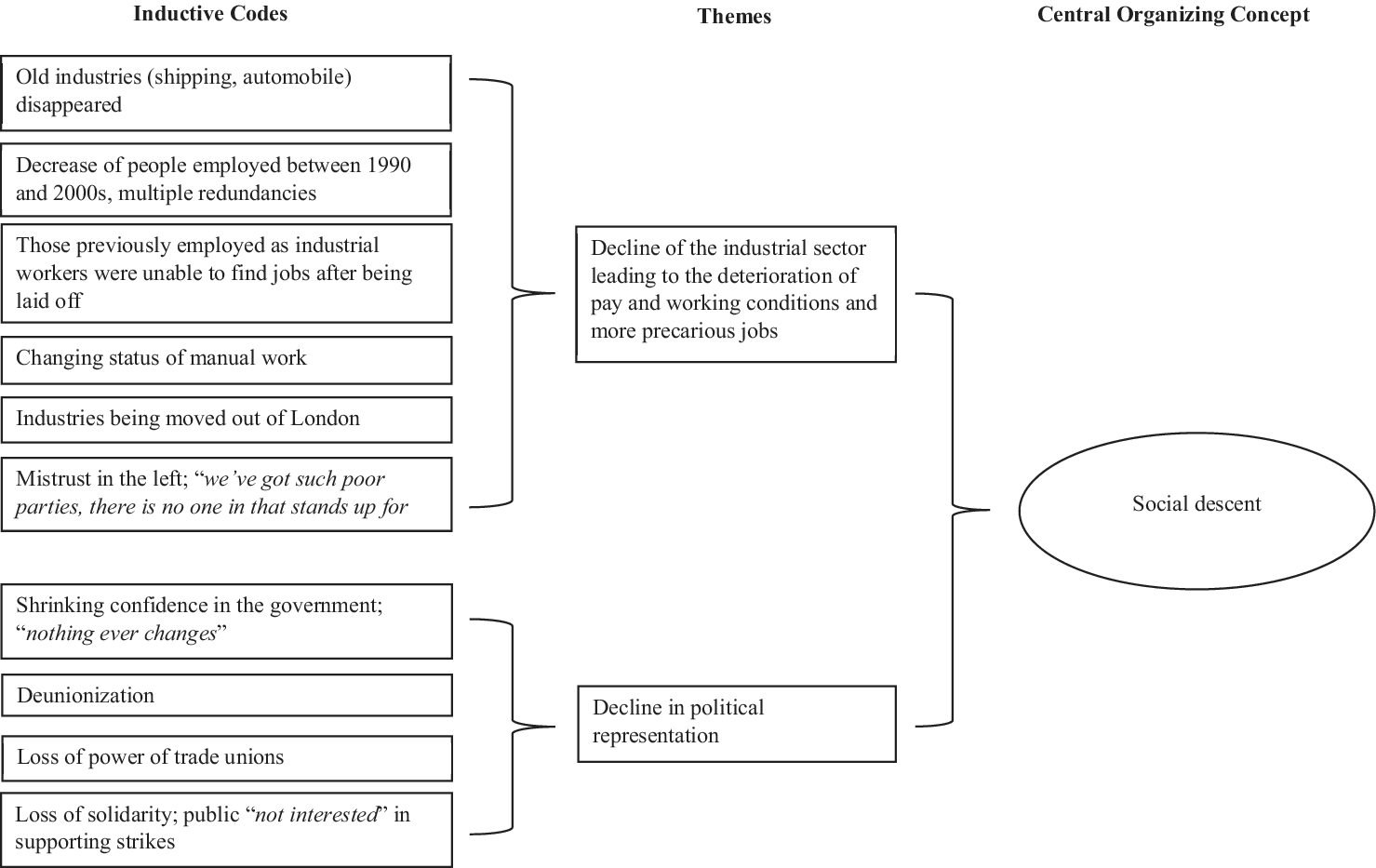
Our analysis took two steps. Following Fricker (Reference Fricker and Hull2015), we initially developed coding categories to document forms of devaluation and failures to gain recognition. We used thematic analysis to code the interviews (Braun and Clarke Reference Braun and Clarke2022). Initial codes were generated independently by each of the researchers. Through discussion and multiple readings of the transcripts, we arrived at a consensus on our set of codes with themes capturing the shared meanings among the codes, and the organizing concepts (see Figure 1 for examples of our coding). For instance, such initial codes as “less competent,” “less clever,” “being doubted,” “not being spoken to,” “being disregarded as a witness” and being rendered “invisible” led to themes which aligned broadly with Fricker’s (Reference Fricker and Hull2015) notion of credibility deficit and resulted in an organizing concept entitled, “Doubting Waste Collectors as Knowers and Testifiers.” In the second step, we became interested in how destigmatization resources could be temporarily dislocated and whether this might represent an example of temporal misalignment (where things used to work but now might fail). This interest encouraged us to reflect on the way that Fricker’s account of hermeneutical injustice could be complemented by Povinelli’s treatment of temporality.
Thematic Coding Example

The intention in our analysis was to resist universalization, romanization, or simplification of participants’ experiences and characters. Equally, we were aware of the dangers of reinforcing some manual occupations’ stereotypes, many of which have become synonymous with the working class and working-class masculinity (Gater Reference Gater2024). We also acknowledge that there are some potential dangers in reducing participants’ experiences mainly to the narratives of crisis and struggle, suffering or “despair.” One might discover some hope in our participants’ perseverance, in their continuous attempts to find a job or to remain “a good worker,” yet we found that their perseverance tended to “run up against limits” (Han Reference Han2013, 232), or put differently, it was frequently nearing exhaustion. Workers in this study always seemed to “stare in the face of the question of how to endure” (Povinelli Reference Povinelli2011, 103).
FINDINGS
In presenting our findings, we firstly consider social descent prior to analyzing how it contributes to credibility deficit and hermeneutical marginalization. We then address how, in Povinelli’s terms, those experiencing social descent may simultaneously find themselves consigned to a “past tense.” In other words, to a space no longer valued by the market and its cultural forces, with little promise of any future improvement. In the final section, we reflect on how these workers might thereby be facing a “softer” form of “letting die.”
Social Descent
As noted above, many in our research sample have long experienced a deterioration of social and economic conditions tied to the decline of “old industries,” such as automobile plants, mills, and consumer goods factories. Between 1975 and 2012, industrial jobs in Britain shrank by more than half (Raphael Reference Raphael2023, 19), and by 2012, the industrial sector’s share of the economy was among the smallest in the EU (OECD 2018). This shift to a postindustrial society marked the end of “the proud old working class” (Reckwitz Reference Reckwitz2021, 57), with the loss of stable “good” jobs and associated work identities, especially for men like our participants. Many in our study witnessed the decline of industry in the UK and the outsourcing of production from London to other regions or overseas, without corresponding new opportunities in related sectors (Embery Reference Embery2021). As a result, the majority underwent repeated periods of being “laid off,” as the following quotations show:
Um, I went and worked for Spillers down Houghton Road there, delivering flour … It done us proud …, I got a day job and was working for Spillers, Monday to Friday, home weekends … There for seven years, got made redundant, went to Allied Mills and walked out of a job on a Friday and went into a job on a Monday … it was a lot easier, a hell of a lot easier then, you could leave one job, go straight onto the next one, start the next day.
I left there [Allied Mills] nineteen years later when I got made redundant … It’s quite upsetting …
We’ve had other jobs in the past, we’ve earned good money so … I was in manufacturing with CAV Lucas at Acton … That was for 30 years … they moved the factory, so they gave me redundancy …, I came here …
For many, the decision to join the local council was shaped by a preference for stable, secure employment, as public sector jobs were historically seen as a safeguard against labor market insecurity. This is illustrated by one of the oldest litter pickers, who remembered the relief he felt at finding steady work after being made redundant three times:
The road sweepers, refuse collectors … there used to be job security, you would come and join the Local Authority many years back and think you’d got a job for life etc., … we had that security, and it had the benefit …
Yet for our participants, the sense of security gained by joining local councils was often short-lived. The introduction of market discipline through commercialization and privatization gradually eroded the stability once associated with public sector employment. In waste management, these reforms brought about competitive tendering and outsourcing, significantly reducing opportunities for long-term work. More than half of the participants ended up on agency contracts, facing heightened job insecurity. This precarious employment was closely linked to declining living standards, as reflected in one participant’s comment: “People are only working to pay bills now, that’s it, desperate times.” As a result, our participants found themselves confined to low-paid, low-skilled service jobs, experiencing deepening precarity and a sense of being “left behind” by society (Reckwitz Reference Reckwitz2021, 57), with little to no access to upward mobility (Léné Reference Léné2019) or employment in skilled roles.
The majority of participants partly attributed these deteriorating conditions to the falling number of those who were still union members. The unlikelihood of union support and the precariousness of the workers’ situation often triggered a recollection of the “old days” of union power. Many commented on the positive effect that trade unions had in the past on the reduction of wage inequality and the acceleration of wage growth, alongside improvement in working conditions. Yet from our participants’ perspective, trade unions ceased to be a powerful resource, typified by comments such as, “So they’re generally, you know, less sort of powerful really as they used to be.”
Workers also observed the diminishing support from the public in their struggle for recognition and better pay. In the view of many, navigating the challenges of postindustrialism became an individual endeavor rather than a collective project of political representation and worker solidarity:
I think this government have been particularly skillful at attacking the trade unions through the print [media] … Years ago, people, the public would stick up for people on strike, you’d get a lot of public support, now they’re not interested because they’re thinking, why should they get more money …
Many remarked on their sinking confidence in government, disillusionment with the politics of the left, and frustration at the inability of any political party to represent their interests, or restore their lost status, dignity, and economic power:
we vote the same political parties in each time who do the same things to us … we’re very lucky to have a democracy but unfortunately we’ve got such poor parties, there is none in that stand up for us and so nothing ever changes. I would like to have seen an alliance of trade unions get together and form their own political party.
we laugh at the government phrase “we’re all in it together,” we say, “we’re not in it together, we’re at the bottom of the food chain.”
Faced with diminishing job prospects, unaffordable housing, economic precarity, and limited political representation, participants found it increasingly difficult to envision a viable future for themselves, as reflected in the following quotations:
Yeah, I think years ago people left school, got a job, got married, had children and had a nice little house … the aspiration is now, have I got enough for my rent, can I afford my fuel bills, can I afford food, can I afford school trips for the children. So my aspirations have come down because I am never going to achieve what I want … I think nowadays the poorer people, their aspirations are dropping …
No, I don’t make plans for the future, I just go by day by day, … so I don’t look at the future now, used to, used to think to myself, “yes, I’m going to do this, I’m going to do that.”
Workers’ anxiety towards the future was also displayed through the worries about their children:
as I say obviously you’ve seen the youth, … the youths today feel that they’re being left behind, … I always said, “if you give me a chance and I mess it up I can’t come back to you and say give me another chance, but obviously if you don’t give me a chance how can I show what I’m worth,” but obviously that just fell on deaf ears.
In this manner, our data trace a trajectory of social descent marked by the loss of skilled employment, growing job insecurity, and the erosion of political representation and collective solidarity. Those working in “simple services” increasingly struggle to imagine a future for themselves or their children, constrained by limited access to stable employment, worsening working conditions, and a lack of political voice. In Povinelli’s (Reference Povinelli2011, 78) terms, they occupy “the part that has no part” in shaping dominant visions of the future.
Waste Collection, Credibility Deficit and Hermeneutical Marginalization
In the section that follows, we examine how a “credibility deficit” was linked to workers’ class position as well as the hermeneutical marginalization associated with social descent. In particular, credibility deficit, where a “speaker” suffers a “prejudiced understanding” from the “hearer,” was closely tied to the class position and occupational status of our research sample (Fricker Reference Fricker and Hull2015). More specifically, the cultural devaluation of “ordinary” or “average” jobs in late modernity (Reckwitz Reference Reckwitz2021) made it more difficult for those in “dirty” work to have their experiences either recognized or understood. It also contributed to a loss of shared interpretive resources, resulting in hermeneutical marginalization and the sense that those affected are excluded from socially desirable futures.
First, respondents appeared sensitive to how their class position and occupational status disadvantage them as “reliable” witnesses and testifiers. Those carrying out waste collection repeatedly stressed that their voice and claims were epistemically undervalued in a world where multiple conscious or unconscious prejudices regarding class remain. This is demonstrated by a quote from one of the refuse collectors who had an opportunity to compare different locations, having worked in two separate boroughs:
They [the public] believe we’re just there, almost like a servant, you know, and that changes as you go through the borough though, so you’ll probably get that attitude more at the Chiswick end of the borough, more affluent people there and the more middle class type people, so you get the different complaint from them, so they’re very good at writing emails and they’re very good at writing to the top people and in turn when that comes down, they become the bigger issues … You can actually also see the way the Council who run the contract will give much more credibility to a complaint from a posh house.
For many, working in middle-class neighborhoods intensified feelings of being doubted and distrusted—of being the “wrong person” in the “wrong place.” Although their labor was essential to maintaining cleanliness, workers sensed that residents remained suspicious of their intentions. Wearing high-visibility jackets often provoked hostile remarks, including comments such as “I’m watching you,” and some reported being accused of theft when entering local shops. As one street cleaner put it when asked if he would live in the area: “I wouldn’t be welcome here; they’d report me to the police.” Following Fricker (Reference Fricker2007), trust in a speaker is often aligned with sociopolitical privilege, meaning testimonial disadvantage can produce unjust epistemic outcomes. As Fricker (Reference Fricker and Hull2015) notes, such conditions are far from ideal for sustaining discursive exchanges on equal terms.
Despite being acutely aware of public skepticism toward the jobs they found themselves in, mistrust rooted in their class position, and the repeated dismissal of their choices and opinions, the majority of our participants continued to uphold the values of the traditional industrial working class. For them, securing a “goes-without-saying” ordinary job represented a genuine aspiration amid the struggle for stable employment. Holding down a job, finding satisfaction in mundane repetitive tasks, and being “a good worker” were treated by our sample as qualities that remained salient and still deserving of merit.
I’m doing what I’m doing … I will appreciate it if you appreciate me, but I’m still going to do the job because actually I know it’s an important job, I get a lot of self-satisfaction out of it, I get satisfaction out of doing a good job actually … I don’t put myself down as poor or whatever, I’m just a normal working person.
Yet, most respondents remarked on the disconnect between their own outlook on life and the values and aspirations they felt were held by the broader public.
And I can remember a time you know, I mean I went and started working for a Council, … public servants used to be at one time regarded as really, really important jobs, now they won’t look at you because they’re looking down on you, they don’t, they’ve got no respect for public service anymore, you’re not doing an important job to them, your job’s not important, you’re a nobody to them, you’re out here picking up rubbish, anyone can do that, that’s their attitude.
According to our participants—and in a similar vein to Reckwitz (Reference Reckwitz2020, 133)—this gap was reinforced by the perception that their “repetitive, standardized, and functional activities” are viewed as “requiring no qualifications, few aspirations, and little intrinsic motivation.”
People think most, you know, blue collar workers are there because they don’t have either the aspirations or the qualifications to go into anything else …
As Reckwitz (Reference Reckwitz2020, 133) argues, expecting recognition for simply “doing a job” is now seen as anachronistic, since it is “no longer enough;” instead, what is valued are qualifications, “tailored,” or unique skills, along with an ambition for personal success. Workers’ comments resembled Reckwitz’s (Reference Reckwitz2021) observations regarding the intensifying duality between those who are highly versus lowly qualified, and the increasing “antagonism between the valuable and the valueless” (Reckwitz Reference Reckwitz2020, 288, emphasis added). For example, various groups within our sample agreed that those working in “simple services” were frequently overlooked:
Well some people once they are educated, they get a suit and tie on … they think they’re the bee’s knees you know, but at the same token all the cogs in the wheel make the job go, flow round sort of thing, you know.
Yeah, so that story was, I was working in Redbridge at the time for a waste collections team over there, and I was walking up the road, the footpath behind the crew and a member of the public, a father was walking his young son, probably about 7 or 8 to school, … so they passed the collections crew as they were going up the road, and the father was walking down the street towards me and as he passed me I heard the father say to the son, “I don’t want to see you ever turn out like them.” And while I can understand sort of like the father having ambitions for his son to do well at school, it is that perception they’re the lowest of the low, you know, that I won’t say the dregs of society …, but the lowest rank in society, you know, no aspirations or qualifications to go into anything else …
The story above told by one of the road sweepers illustrates how the perceived absence of educational qualifications and aspirations undermines one’s legitimate place in a society increasingly geared toward the appreciation of intellectual capabilities, and striving for individual achievement (Powell and Snellman Reference Powell and Snellman2004). Without membership of the educationally qualified, workers sensed that they could not be associated with “the good life,” as illustrated by a father’s warning to his son in the above quotation—“I don’t want to see you ever turn out like them.”
Following Fricker (Reference Fricker and Hull2015), the privileged within cognitive-cultural capitalism hold a disproportionate influence over shaping collective understandings of who and what is deemed desirable or worthwhile. As a result, the workers in our study—who continued to adhere to traditional, gendered working-class norms and values—found themselves at an interpretive disadvantage. In line with Fricker’s (Reference Fricker2007, 148) concept of hermeneutical injustice, they were “more likely to find themselves having … at best ill-fitting meanings to draw on in the effort to render them intelligible.” Their ways of being and valuing, once central to industrial economies, now struggle to find recognition in the postindustrial era.
In effect, the loss of shared interpretive tools for those undergoing social descent reinforces the misalignment between themselves and the historic moment they inhabit. For us, it is here that Povinelli’s (Reference Povinelli2011; Reference Povinelli2016) concept of “social tense” becomes especially relevant, particularly where she stresses how narratives of ever-enlightening futures can generate temporal divisions, such as that between “making live,” “letting suffer,” and “letting die.”
In sum, our participants’ reliance on the interpretive tools appropriate for the industrial era can be seen, in Povinelli’s (Reference Povinelli2011) terms, as failing to reformulate themselves as a vehicle “for the future” since they do not exhibit desirable characteristics, such as educational capital, self-advancement, mobility, uniqueness, singularity, and so on. Equally, their approach could be read as an outdated, and almost obstructive, attachment to the past. Following Povinelli (Reference Povinelli2011), their claims are rendered increasingly “dismissible” as they represent a historical “remnant” that still “lives on even as we let them die.”
Postscriptum: Pandemic and After
Yet during the pandemic, it initially seemed that the perceived irrelevance of our participants’ lifestyles and interpretive frameworks to the future might be reversed. As society came to recognize that workers in waste collection—like other “key” workers—were, in fact, indispensable, Covid-19 appeared to underscore both their societal contribution and the “vital” importance of public services. For our participants, this moment carried the potential to restore cultural values that once afforded them greater recognition. It seemed possible that traditional industrial-era ideals of hard graft and community support might regain relevance. In this way, the pandemic briefly generated optimism for a future in which their labor would be respected once again, and they might be regarded “on a par” with others as important fellow subjects.
However, many participants quickly became disillusioned. Most respondents did not think that the new forms of recognition prompted by the pandemic would produce a long-lasting effect on their status, as reflected in the comment, “now things are easing off we’re the arseholes of the planet again … .” Litter pickers’ skepticism is captured in the quote below:
In the pandemic they were clapping us right, now they treat you like dirt again, … you get abuse, you get threatened, we did the bulky bins around the corner, we had silly little notes in the bins threatening us, calling us lazy bastards, we’ve heard it all …
Workers confessed that these attitudes were not unexpected because they didn’t have any expectations anymore, they gave up on “them dreams”:
I have a view of what happened in life happens, there’s not much you can do about it so no I don’t think about righting the world or anything. I get on with what I’ve got to do.
Most admitted that there were times (“bad days” as one of the litter pickers described them) when they would consider quitting the job:
[I think] … sack me or something, you know, sack me, sack me, sack me but after a day or so it’s alright and you calm down a bit, you know what I mean … Yeah, leave me alone, leave me alone, let me go, but I know if I left this job I wouldn’t get another one now, not after this one I wouldn’t, so it’s alright. I don’t mind you know if you don’t work you don’t get nothing …
But for all of them, work was the main source of income, “money is part of life … because without money you cannot survive you know, yeah so I do it for, it’s about, because you know, the money it can put food on the table … .” That being so, participants in our study continued working. Yet, they increasingly stopped viewing their jobs as a viable route to a better life. Instead, it appeared that the choice was between what Berlant (Reference Berlant2011, 164) describes as “the routinized rut and ominous cracks,” with participants facing the constant threat of unemployment, housing insecurity, or being forced to move away from their families, as reflected in the comment below:
I find now that the working class, I believe personally, are being moved out of London and dispersed to make it an area for extremely rich people, foreign businessmen etc.
They sensed that London and areas close to London are not places that welcome them anymore. In this manner, London and the South East did not serve merely as a neutral backdrop in our study but played an active role in shaping participants’ experiences of work. In the eyes of many workers, London symbolized a deeply divided society–one that valorizes globalization, self-advancement, and acceleration, while relegating those experiencing social descent to the margins.
The pandemic demonstrated that it was no longer the case that someone who did hard, laborious, yet essential work would receive an acceptable degree of social status and recognition. This deal was “no longer in place” as “the exchange of sweat for status” (Reckwitz Reference Reckwitz2021, 56) had become relegated to the past. Perhaps not surprisingly, the temporal horizon of our respondents appeared “necessarily short term,” as reflected in their comments that “we are a dying breed.” Those who experienced social descent believed that the prospect of recognition became almost unattainable and, at best, “the art of living … consists of tenacious … perseverance” until they exhaust themselves (Reckwitz Reference Reckwitz2021, 56).
DISCUSSION AND CONCLUSION
Based on Povinelli (Reference Povinelli2011), major crises and catastrophes immediately demand political and civil engagement, and our ethical reflection. Yet the quotidian and mundane injustices of everyday life tend to lack our ethical attention (Povinelli Reference Povinelli2011). Our study attempted to remedy this gap by focusing on the forms of injustice that are ordinary and uneventful, not easily discernible or sayable. In particular, we focused on workers in “dirty jobs” or “simple services” who experienced social descent through the loss of income and status once associated with industrial labor, while simultaneously holding on to lifestyles and ways of being tied to the “old” traditional working class.
To a very large extent, our findings concur with Reckwitz’s (Reference Reckwitz2021) reading of social descent. In our research, this was observed in three distinct, yet interrelated, ways. Firstly, participants mentioned the rapid decline in manufacturing industries, and the irreversible labor market changes that occasioned multiple redundancies, growing precarity due to the near impossibility of finding new good jobs, and deteriorating pay and working conditions. Secondly, workers’ accounts documented the diminishing bargaining power of industrial workers as a result of decreased unionization and trade union power, as well as a lack of support from the public for those on strike. Many in this study also expressed skepticism toward existing forms of political representation, feeling that no major political party adequately addressed their needs or concerns.
Lastly, social descent was accompanied by a cultural devaluation of their lifestyles that resulted in two principal forms of epistemic injustice. Firstly, in line with the findings of Mahalingam et al. (Reference Mahalingam, Jagannathan and Selvaraj2019) and Zulfiqar and Prasad (Reference Zulfiqar and Prasad2022), workers’ attempts to restore dignity in our study were undermined by a credibility deficit—rooted in the public’s tendency to pre-judge and “doubt” them, both for performing low-skilled “dirty” jobs and because of their social class position. In this manner, our findings illustrate how workers’ claims for restored dignity could be disqualified “before they speak,” resulting in what Fricker describes as testimonial injustice.
Our findings also show how the interpretive tools our participants had “at hand” (such as endurance in hard, physical, honest “masculine” work, being breadwinners, etc.) did not operate on an equal footing with those utilized by “upwardly aligned” knowledge workers. In effect, our study reveals that many of the meanings and understandings prevalent during industrial modernity—and on which our sample relied—became outdated, or, in Reckwitz’s terms, “deficient” (Reference Reckwitz2021, 56) and even “widely scorned in late-modern society” (Reference Reckwitz2021, 57). This is not to suggest that our participants lacked the interpretive tools to make sense of their experiences; rather, these tools were “ill-fitting” because they were not sufficiently shared across the broader social space (Fricker Reference Fricker, Peels and Blaauw2016, 167). In our study, the case of hermeneutical injustice manifested as a consequence of workers’ attachment to meanings and cultural understandings that could be conceived as historically obsolete. Workers’ commitments to traditional working-class lifestyles, values, and norms serve only to deepen the cultural divide between the privileged, who experience social ascent, and those undergoing social descent.
Following Povinelli’s temporal lexicon (Reference Povinelli2011), hermeneutical injustice can be seen as a consequence of the classificatory power of assigning “social tense.” Povinelli (Reference Povinelli2011; Reference Povinelli2016) argues that temporal marginalization processes in late liberalism divide social groups into those who are characterized by their “relevance” to our collective (better) futures, and those who are not. Interrelating her argument with that of Reckwitz (Reference Reckwitz2021) and Rosa (Reference Rosa2014), we need to ask what happens to those groups who are perceived as failing to live up to contemporary demands for self-determination, singularization, or acceleration. By consigning those who fail to a “past perfect” tense, and defining them as anachronistic, political narratives may form the ground upon which “making live” or “letting die” are decided, rationalized, and justified. In this sociopolitical context, the mundane sufferings of those who are rendered obsolete may be dismissed as “unfortunate” yet “functionally necessary” for our “better future” (Rosa Reference Rosa2016). Thus, for Povinelli (Reference Povinelli2011, 22), the political distribution of life and death happens through a division of tense, determining whose worldviews are here to stay, and whose claims for justice can be safely ignored and “allowed to die.”
The loss of an industrially defined working class has, in Povinelli’s terms, resulted in a “slow death” within “zones of abandonment” for those experiencing social descent, such as the workers in our sample. Their stories reveal a gradual erosion of life choices and opportunities over time, so that “bare necessity” increasingly guided their decisions. Their accounts were characterized by daily commonplace struggles, repressed emotions, and a reluctance to “make explicit some of the things that they accept simply as “there” and unalterable” (Charlesworth Reference Charlesworth2000, 142). Factors such as low income, unmanageable debt, unemployment, and poor housing among these occupations have been argued to contribute to high suicide rates. Among men in the UK from this socioeconomic background, the risk of dying by suicide appears ten times higher than for those in professional jobs (Samaritans 2012; 2017), and they are significantly more likely to experience depression than men in more affluent areas (Remes et al. Reference Remes, Lafortune, Wainwright, Surtees, Tee-Khaw and Brayne2019). Between 2012 and 2020, deaths from alcohol, drugs, and suicide among men from this socioeconomic background also rose more than fivefold (Office for National Statistics 2022).
In general terms, they didn’t perceive “a better life in store” or think “about righting the world” anymore. The majority smoked and drank, too many (especially the drivers of the vehicles) were unhealthily overweight, some used to gamble, others used to get into fights or suffered job-related injuries. In sum, many in this study experienced what Giroux (Reference Giroux2012, 5) describes as “a kind of social death”—feeling disposable, left behind and consigned to the periphery. As Povinelli puts it, “they will be allowed to persist … until they exhaust themselves” (Reference Povinelli2011, 95) because “softer forms of letting die will do” (Reference Povinelli2011, 14).
Natalia Slutskaya (N.Slutskaya@sussex.ac.uk, corresponding author), PhD, is professor of work and organization studies at the University of Sussex. Her current research focuses on issues of stigma, status, and recognition at work. She has recent publications in Sociology, Work, Employment and Society, Sociological Review, Organization, Gender, Work & Organization, and Organizational Research Methods. Natalia co-authored the book Gender, Class and Occupation: Working Class Men doing Dirty Work (Palgrave Macmillan, 2016). She is also one of the editors of Dirty Work: Concepts and Identities (Palgrave Macmillan, 2012).
Tim Newton is an emeritus professor at the University of Exeter, having previously taught at Exeter, Birkbeck (University of London) and the University of Edinburgh. Tim is also an honorary member of the Egenis Centre for the Study of Life Sciences at Exeter, and an honorary visiting fellow at the School of Criminology, Sociology and Social Policy, University of Leicester. His texts include Nature and Sociology (Routledge, 2007) and “Managing” Stress: Emotion and Power at Work (SAGE, 1995), and he has served on the editorial boards of Sociology and Organization Studies.
Jessica Horne is a research fellow in management at the University of Sussex Business School. Her PhD uses visual methods to explore the social and aesthetic dimensions of formal voluntary work in the cultural sector. She is interested in conceptual debates about paid and unpaid work and explores these through co-production and participatory research. She is currently collaborating with colleagues at the Universities of Reading, Cranfield, Plymouth, and Kent for her postdoctoral research on food systems transformation for disadvantaged communities.
Ramaswami Mahalingam is the Barger Leadership Institute Professor and the director for the Barger Leadership Institute at the University of Michigan, Ann Arbor. He is a professor of psychology at the psychology department and an affiliated faculty in the Psychology and Women’s Studies Program. He has published in many interdisciplinary journals such as Business Ethics Quarterly, Sex Roles, Journal of Social Issues, Journal of Health Psychology, Annals of Health Behaviour, Journal of Immigrant and Minority Health, and Journal of Transformative Education.
Ruxandra Monica Luca is an assistant professor in the department of marketing at HEC Montréal, Canada. Her interdisciplinary research bridges psychology and digital marketing. She investigates the adoption of technologies such as AI and their ethical design, and broader workplace psychology, including the societal consequences of digital transformation. She also investigates online consumer behavior and visual attention related to decision-making. She holds a PhD in marketing from Imperial College London and an MSc in psychology from the University of Toronto. Her work has been published in Technological Forecasting & Social Change and Applied Psychology: An International Review.

 Open access

