


Individuals with borderline personality disorder have severely troubled interpersonal relations. To date there has been little research on how mothers with this diagnosis relate to their infants, and whether any difficulties in mother–infant communication might have untoward consequences for the infants' development. Such study is important not only for identifying mother–infant dyads at risk and for informing intervention, but also for shedding light on the patterns of moment-to-moment interpersonal relatedness to which women with borderline personality disorder are prone when facing stressful circumstances such as may occur during childrearing.
Background to the study
Borderline personality disorder and interpersonal relations
The condition of borderline personality disorder is one of the more distinctive psychiatric syndromes of adulthood. According to DSM–III–R, the diagnostic approach employed at the time the study began, individuals are said to have borderline personality disorder when they meet five out of eight diagnostic criteria: a pattern of intense, unstable relationships; impulsiveness in at least two areas that are potentially self-damaging; affective instability; inappropriate, intense anger or lack of control of anger; recurrent suicidal threats or self-mutilating behaviour; marked and persistent identity disturbance; chronic feelings of emptiness or boredom; and frantic efforts to avoid real or imagined abandonment. 1 Although there is tentative evidence that temperamental factors such as impulsive aggression and affective instability may act as risk factors for the disorder, there is, as Posner et al conclude from reviewing their own and others' research, ‘currently no strong evidence that BPD [borderline personality disorder] is heritable’. Reference Posner, Rothbart, Vizueta, Thomas, Levy and Fossella2 Much stronger evidence suggests that environmental factors such as child sexual abuse and other family influences such as maternal overinvolvement and inconsistency may have a role in its pathogenesis. Reference Bezirganian, Cohen and Brook3,Reference Weaver and Clum4
The condition of borderline personality disorder is of special interest and importance for the study of mother–infant relations. First, clinical experience as well as more formal research suggests that individuals who have this pattern of emotional and relationship difficulties also have characteristic and potentially disturbing ways of relating to other people at the level of moment-to-moment interactions. For example, Hobson et al reported a controlled study that demonstrated how, compared with a group of women with dysthymia, those with borderline personality disorder tended to show forms of relatedness to a psychotherapist that entailed clear or subtle indications of locked-in hostility and intense, idealising or denigrating exchanges. Reference Hobson, Patrick and Valentine5 If such patterns of relatedness are a feature of these individuals' relations with their infants, there might be serious implications for the children's development. Second, there is evidence from controlled studies employing the Adult Attachment Interview that women with borderline personality disorder tend to be ‘enmeshed’ in representations of their early attachments, and perhaps especially prone to ‘confused, fearful and overwhelmed’ states of mind, as well as being unresolved with respect to trauma and loss. Reference George, Kaplan and Main6–Reference Patrick, Hobson, Castle, Howard and Maughan9 There is evidence that these attachment-related characteristics may influence mothers' relations with their infants, and in the case of unresolved trauma, predispose to the kinds of ‘frightened/frightening’ behaviour thought to increase the likelihood of disorganised infant attachments. Reference Main, Hesse, Greenberg, Cicchetti and Cummings10,Reference Schuengel, Bakermans-Kranenburg and van IJzendoorn11 In addition, a recent study involving masked ratings of Adult Attachment Interviews in groups of women with borderline personality disorder or depression suggested that the group with personality disorder had a high prevalence of hostile/helpless states of mind, Reference Lyons-Ruth, Melnick, Patrick and Hobson12 conflictual states in mothers that have been associated with infant disorganised attachment in offspring. Reference Lyons-Ruth, Yellin, Melnick and Atwood13 Therefore there is much to be gained from studying mothers with this disorder as they relate to their infants in the early months of life.
Maternal psychopathology and mother–infant relations
There is evidence that various forms of maternal psychopathology may be associated with patterns of mother–infant interaction that have an impact on infant development. The most extensive body of literature (e.g. Murray & Cooper) Reference Murray and Cooper14 concerns the effects of maternal depression, where there are now several reports of negative affect and insensitivity in mother–infant interactions among women with depression. Yet there has been little research of this type involving women with borderline personality disorder. In the first study of this kind, Crandell et al reported that such mothers were ‘intrusively insensitive’ in face-to-face play with their 2-month-old infants. Reference Crandell, Patrick and Hobson15 In response to a maternal still-face challenge, infants of these mothers showed more dazed looks and more looks away from the mother than did infants of women without borderline personality disorder, and they were relatively depressed in mood subsequently.
A second study provides the immediate background to the present investigation. Hobson et al assessed 12-month-old infants of women with and without borderline personality disorder in three settings: first, when the infants faced an initially unresponsive (still face) stranger who subsequently tried to engage the infant in a game of give-and-take; second, in the standard test of mother–infant attachment patterns (the Strange Situation); Reference Ainsworth, Blehar, Waters and Wall16 and third, a situation in which mothers were requested to teach their infants to play with miniature figures and a toy train. Reference Hobson, Patrick, Crandell, García-Pérez and Lee17 In accordance with predictions, there were three sets of group differences. Towards the stranger, the infants of women with borderline personality disorder showed lower levels of ‘availability for positive engagement’, lower ratings of ‘behaviour organisation and mood state’ and a lower proportion of interpersonally directed looks that were positive. Second, a higher proportion of infants from the personality disorder group (8 out of 10, v. 6 out of 22 mothers with no psychopathological diagnosis) were categorised as ‘disorganised’ in attachment, and the remaining two mother–infant pairs in this group also showed some signs of disorganisation. Disorganised attachment is characterised by fearful, odd or contradictory forms of infant behaviour when reuniting with a parent, and is associated with a range of behavioural difficulties later in childhood such as hostile–aggressive relations with peers. Reference Lyons-Ruth, Alpern and Repacholi18–Reference Lyons-Ruth, Bronfman and Parsons20 Third, the women with personality disorder were rated as more intrusively insensitive towards their infants in the teaching task. The study also yielded evidence that individual differences in infant–stranger relations and organised/disorganised infant attachment could not be ascribed to maternal intrusive insensitivity per se. As Hobson et al concluded:
‘… motherswith borderline personality disorder tend to be intrusively insensitive, but insofar as maternal relatedness is causally related to infant sociability, it appears to be the manner or quality of this intrusive form of relatedness that is most important for infant development’. Reference Hobson, Patrick, Crandell, García-Pérez and Lee17
Especially given that intrusiveness had been assessed in a single (prompted) teaching task rather than in natural interactions, it remained to apply more refined measures of the qualities of interpersonal relatedness that characterised the mother–infant interactions. In the previous study the Strange Situation test was used to evaluate the infants' patterns of relatedness to their mothers and with the advent of an appropriately focused measure of maternal behaviour, we now had the opportunity to rate maternal contributions to the videotaped mother–infant exchanges in this situation.
Our hypothesis was that in virtue of relatively specific configurations of mental representations of relations with significant others (or what psychoanalysts call ‘internal object relations’), women with borderline personality disorder are prone to relate to other people – and in the present context, their infants – with particular intense, inconsistent and often self-oriented styles of engagement. Reference Hobson, Patrick, Crandell, García-Pérez and Lee17 Anticipating that these patterns of dysregulated affective and communicative exchange were likely to be reflected in ratings on the Atypical Maternal Behavior Instrument for Assessment and Classification (further information available from the authors). We made a single, directional prediction: that compared with two groups of mothers, one with depression and the other without a psychiatric diagnosis, a higher proportion of mothers with borderline personality disorder would manifest disrupted affective communication with their infants.
Method
Measure of maternal relatedness
The Atypical Maternal Behavior Instrument for Assessment and Classification (AMBIANCE) was developed by Lyons-Ruth and her colleagues to code disrupted forms of maternal affective communication with an infant. Reference Lyons-Ruth, Bronfman and Parsons20 It delineates unusual aspects of maternal responsiveness that are not adequately described in generalised coding systems for warmth or sensitivity, by focusing upon the breakdown of affective communication and the disruptive effects of unintegrated fear, hostility and anxiety. The measure has yielded consistent results across samples varying widely in socioeconomic status. A recent meta-analysis has confirmed the validity of the measure in relation to infant disorganised attachment (r = 0.35, n = 384) and to maternal unresolved loss or trauma on the Adult Attachment Interview (r = 0.20, n = 311). Reference Madigan, Bakermans-Kranenburg, van IJzendoorn, Moran, Pederson and Benoit21 In test–retest studies the AMBIANCE measure exhibited significant stability over periods ranging from 8 months to 5 years, covering a range of infant ages from 4 months to 6 years (r = 0.56, n = 203). Reference Grienenberger, Kelley and Slade22 Lyons-Ruth et al reported that disrupted maternal communication on this measure mediated the relation between hostile/helpless parental states of mind with respect to attachment, and infant disorganisation. Reference Lyons-Ruth, Yellin, Melnick and Atwood13 Finally, Grienenberger et al reported that among 45 women with infants aged 10–14 months, high AMBIANCE scores were inversely correlated with a measure of maternal reflective functioning. Reference Grienenberger, Kelley and Slade22 Therefore there is substantial evidence for the validity and stability of this measure, as well as its applicability to the phenomena and range of infant ages and socioeconomic status we wished to study.
Participants
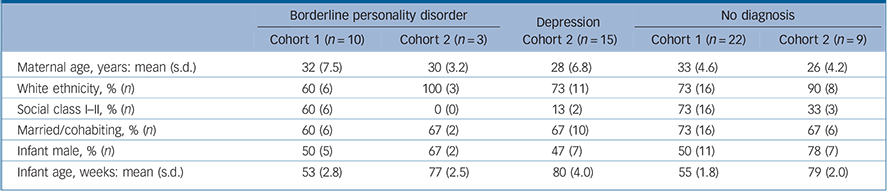
There are difficulties in recruiting adequate samples of women with borderline personality disorder together with a comparison group of women with other psychopathological disorders during the relatively brief times when they are parenting an infant. In order to overcome these difficulties, we combined data from two existing cohorts of mothers and infants for whom both parenting behaviour and Axis II data were available. The first cohort (see Hobson et al for full details) Reference Hobson, Patrick, Crandell, García-Pérez and Lee17 comprised 10 mothers with borderline personality disorder and a control group of 22 mothers who had no clinical feature of borderline personality disorder, nor other history of psychiatric disorder, and who were similar in age, ethnicity, social class, marital status and education (Table 1). In five cases care was shared, but mothers were always among the primary caregivers.
Table 1 Demographic details of cohort by diagnostic group
| Borderline personality disorder | Depression Cohort 2 (n = 15) | No diagnosis | |||||
|---|---|---|---|---|---|---|---|
| Cohort 1 (n = 10) | Cohort 2 (n = 3) | Cohort 1 (n = 22) | Cohort 2 (n = 9) | ||||
| Maternal age, years: mean (s.d.) | 32 (7.5) | 30 (3.2) | 28 (6.8) | 33 (4.6) | 26 (4.2) | ||
| White ethnicity, % (n) | 60 (6) | 100 (3) | 73 (11) | 73 (16) | 90 (8) | ||
| Social class I—II, % (n) | 60 (6) | 0 (0) | 13 (2) | 73 (16) | 33 (3) | ||
| Married/cohabiting, % (n) | 60 (6) | 67 (2) | 67 (10) | 73 (16) | 67 (6) | ||
| Infant male, % (n) | 50 (5) | 67 (2) | 47 (7) | 50 (11) | 78 (7) | ||
| Infant age, weeks: mean (s.d.) | 53 (2.8) | 77 (2.5) | 80 (4.0) | 55 (1.8) | 79 (2.0) | ||
Screening of potential participants included the collection of demographic data and administering the questionnaire version of the Structured Clinical Interview for DSM–III–R Non-Patient Version (SCID–NP), Reference Spitzer, Williams, Gibbon and First23 and a questionnaire version of the SCID overview and module A, focusing on mood syndromes, and module B/C (the ‘psychotic screen’). Women who met the criteria for borderline personality disorder and no other disorder were invited for interview and were given the Structured Clinical Interview for DSM–III–R Personality Disorders (SCID–II) interview, Reference Spitzer, Williams, Gibbon and First24 supplemented with the interview version of the SCID overview and modules A and B/C. Only women meeting the diagnostic criteria for borderline personality disorder and no other diagnostic category were recruited for the personality disorder group. Women were accepted into the control group provided that on screening and interview they showed no feature of borderline personality disorder and did not meet diagnostic criteria for any other DSM–III–R disorder, either current or past.
The second cohort of mothers and infants were participants in a longitudinal study of attachment and mother–infant interaction in 65 families at or below poverty level (see Lyons-Ruth et al for full details). Reference Lyons-Ruth, Connell, Grunebaum and Botein25 When the children were 18 months old, their mothers received diagnostic screening for Axis I disorders with the semi-structured Diagnostic Interview Schedule. Reference Robins, Helzer, Croughan and Ratcliff26 Sixteen mothers had no psychiatric diagnosis, and 27 mothers met criteria for depressive disorder (major depression or dysthymia) with or without anxiety disorder, but without other psychiatric comorbidity. Twenty-two mothers with other diagnoses were excluded from the sample for the purposes of the present study.
A diagnostic screen for Axis II disorders was not available at the time of the infant study. When the infants had grown and reached 20 years of age, their mothers were administered the SCID–II for diagnosis of personality disorders. For the study reported here, all women with any personality disorder were excluded from the groups previously diagnosed with depression, and those previously without diagnosis. The rationale was that interpersonal aspects of borderline personality disorder are relatively stable over time, Reference Zanarini, Frankenburg, Reich, Silk, Hudson and McSweeney27 and were likely to have been present earlier when these women's children were in infancy. The final groups from this sample were 15 mothers with depression, 9 mothers without a diagnosis and a third group comprising 3 mothers who met criteria for borderline personality disorder on the SCID–II at 20-year follow-up. It should be noted that if any women in the depression group had met criteria for borderline personality disorder at the time of mother–infant testing but did not meet criteria at the 20-year follow-up, this would introduce a conservative bias into testing the predicted group differences. In three cases, care was shared with grandmothers but in all cases the mother was the primary caregiver.
Combining both study cohorts yielded a final sample of 13 mothers with a diagnosis of borderline personality disorder, 15 mothers with a diagnosis of depression and 31 mothers with no psychiatric diagnosis. Although the two samples differed in socioeconomic status and infant age, our dependent variable, the AMBIANCE measure, has been shown to be stable over this range of participant characteristics as noted earlier. Reference Madigan, Bakermans-Kranenburg, van IJzendoorn, Moran, Pederson and Benoit21
Measures
Maternal disrupted affective communication
The Strange Situation procedure for assessing infant attachment behaviour under the stress of two separation–reunion episodes was conducted and videotaped according to standard procedures in both cohorts (see Hobson et al Reference Hobson, Patrick, Crandell, García-Pérez and Lee17 and Lyons-Ruth et al Reference Lyons-Ruth, Connell, Grunebaum and Botein25 for details). Maternal interactive behaviour over the course of the Strange Situation procedure was rated from these videotapes using AMBIANCE. There are two stages to the rating procedure: first, counts are made of particular forms of disrupted maternal affective communication when mother and baby are together; second, based on both the frequency and seriousness of the observed forms of disrupted communication, a rating is given on a seven-point scale for overall level of disrupted affective communication. Parents rated at 5 or above on the scale are classified as disrupted in parent–infant communication. Since our single prediction concerned the disrupted classification, we shall consider this first.
-
(a) Partial criteria for a score of 5 are as follows: the parent displays persistent mixed affective signals, persistent errors in responding to infant needs, intrusive behaviour, confusion, disorientation, lack of responsiveness, and/or role-reversing behaviour with the infant. The parent often attempts to engage with the infant but may have a difficult time diverting from [her] own style or needs, particularly when attachment affects are heightened as at reunions.
-
(b) A score of 6 represents a predominance of disrupted communication in which the parent's responses frequently fail to match the infant's signalling. Relevant behavioural features include ‘Demonstrates significant difficulty around most physical contact with the infant’, ‘Affective response to the infant may include indirect (or masked) expression of negative affect, a lack of affect, or inauthentic affect’, and ‘Parent's response to the infant may include confusion, disorientation, fear, or unusual voice quality’.
-
(c) A score of 7 is given when, in addition to the above, there is almost no positive ameliorating behaviour.
Prior to rating the overall level of disrupted communication, the coder reviewed the videotape and made a count of instances of the following forms of maternal behaviour, using itemised examples in the coding manual:
-
(a) affective communication errors, coded when the parent gives contradictory affective signals to the infant (e.g. using a sweet voice with a derogatory message or with a threatening posture) or makes inadequate or inappropriate responses to the infant's signals (e.g. fails to comfort a distressed infant);
-
(b) role confusion, coded when the mother calls the infant's attention to herself in ways that override or ignore the infant's cues (e.g. asking the infant for a kiss when the infant is distressed);
-
(c) frightened/disoriented behaviour, as shown in fearful, hesitant or deferential behaviour towards the infant (e.g. asking permission of the infant) or as expressed in disoriented behaviour, including loss of affect and movement (e.g. ‘freezing’), frenetic and uncoordinated overtures toward the infant, or sudden and unusual shifts in voice tone;
-
(d) negative–intrusive behaviour, either in physical interaction (e.g. pulling the infant by the wrist) or in verbal communication (e.g. attributing negative feelings or motivation to the infant, as in ‘He/she hates me’);
-
(e) withdrawing behaviour, as shown by creating physical distance from the infant (e.g. directing the infant away from herself through the use of toys) or creating verbal distance (e.g. interacting silently).
In both cohorts, the videotapes were rated by one of the originators of the AMBIANCE measure (E.B.), who was unaware not only of participant diagnoses but also of the overall nature and predictions of the study. Previously reported interrater reliabilities involving this rater (n = 15) were as follows: disrupted classification (κ = 0.73), overall level of disrupted affective communication (κ = 0.93), frequencies for items on each of the five dimensions (intraclass correlations) 0.73–0.84. Reference Lyons-Ruth, Bronfman and Parsons20
Results
Comparability of mother–infant ratings across cohorts
We compared ratings of mother–infant interactions for the 22 mothers without a psychopathological diagnosis in the Hobson et al study (cohort 1) Reference Hobson, Patrick, Crandell, García-Pérez and Lee17 with those for the 9 mothers without a psychopathological diagnosis in the Lyons-Ruth et al study (cohort 2). Reference Lyons-Ruth, Connell, Grunebaum and Botein25 These two groups were similar with regard to total frequency counts of disrupted behaviour (cohort 1: mean 19.1, s.d. = 14.8, range 3–49; cohort 2: mean 19.9, s.d. = 16.5, range 1–41; t(1,29) = 0.13, NS). They were also similar for level of disrupted communication (cohort 1: mean 3.4, s.d. = 1.8, range 1–6; cohort 2: mean 3.9, s.d. = 2.2, range 1–7; t(1,29) = 0.58, NS). In these two groups, 8 participants (36%) in cohort 1 and 5 participants (55%) in cohort 2 were classed as having disrupted communication (Fisher's exact test, P = 0.43).
The data from the mothers with borderline personality disorder in each cohort were also comparable, although with only 3 such mothers in cohort 2, statistical tests were not applied. The data for the 10 mothers with this diagnosis in cohort 1 and the 3 mothers in cohort 2 were as follows: for frequency counts of total disrupted behaviour, cohort 1 had a mean count of 35.6 (s.d. = 23.0, range 4–87), whereas in cohort 2 the counts were 14, 19 and 60; for levels of disrupted communication, in cohort 1 the mean score was 4.8 (s.d. = 1.6, range 2–6) and in cohort 2 the scores were 5, 5 and 6. Eight participants with borderline personality disorder (80%) in cohort 1 and all three participants (100%) in cohort 2 were classified as having disrupted communication. Given these similarities in AMBIANCE scores within diagnostic categories across the two cohorts, data from the two studies were combined to test for group differences.
Disrupted affective communication
Our single directional prediction was that compared with both comparison groups (i.e. those with depression and those without diagnoses) a higher proportion of the women with borderline personality disorder would manifest disrupted affective communication with their infants (i.e. score 5 or above). Eleven out of 13 (85%) of the women with borderline personality disorder, 7 of the 15 women with depression (47%) and 13 of the 31 women without a formal psychopathological diagnosis (42%) fell into the disrupted category (χ2 = 6.97, P<0.05). Follow-up analyses revealed that this difference was specific to the borderline personality disorder group, in which there were more women classified as having disrupted communication than in the group with depression (Fisher's exact test, P = 0.027, one-tailed), as well as those without psychopathological disorder (Fisher's exact test, P = 0.009, one-tailed). It is noteworthy that the only two women with borderline psychopathology who were not rated as above the threshold for disrupted affective communication had infants who were rated as ‘disorganised’ by Hobson et al, Reference Hobson, Patrick, Crandell, García-Pérez and Lee17 raising the likelihood that in these cases, too, mother–infant relations were problematic.
There was complementary evidence for the prevalence of episodes of disrupted communication among women with borderline personality disorder in the counts of such behaviour across the procedures of the Strange Situation. Here the respective data were as follows: for the borderline disorder group the mean was 35.5 (s.d. = 22.5, range 4–87), for the group with depression it was 17.7 (s.d. = 10.5, range 2–38) and for the group with no diagnosis it was 19.3 (s.d. = 15.0, range 1–49); F (2,56) = 4.92, P<0.05. Follow-up planned comparisons revealed that the women in the borderline disorder group had significantly higher scores than either those with depression (t(26) = 2.59, P<0.05) or those without diagnoses (t(42) = 2.63, P<0.05).
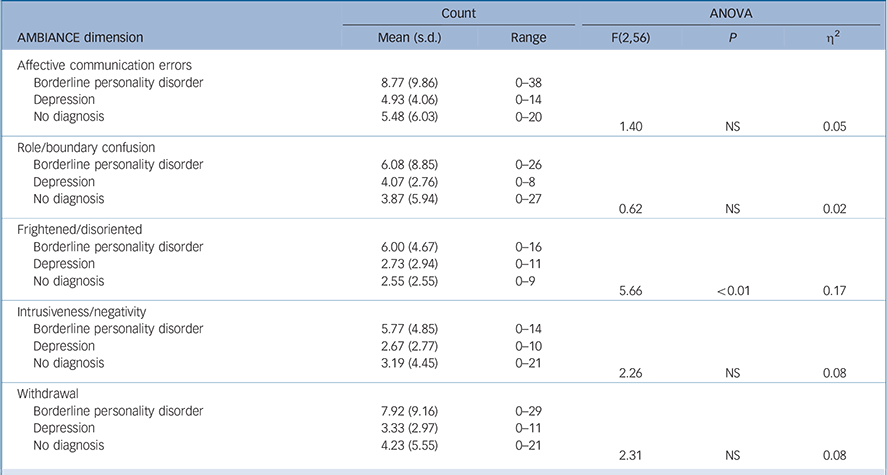
The results on each of the dimensions of the AMBIANCE are given in Table 2, together with data from a series of five 3 (group)×1 (AMBIANCE dimension) univariate analyses of variance. The only significant main effect for diagnostic group was on fearfulness/disorientation: F (2,56) = 5.66, P<0.01, η2 = 0.17. Follow-up contrasts revealed that frightened/disoriented behaviour was more frequent in the borderline personality disorder group than in either the depression group (t(26) = 2.25, P<0.05) or the group without diagnosis (t(42) = 3.16, P<0.01). Frightened/disoriented behaviour was rare among women who did not have the diagnosis of borderline personality disorder, even among those whose communication was judged to be disrupted.
Table 2 Counts of each form of disrupted communication, categorised by group
| Count | ANOVA | |||||||
|---|---|---|---|---|---|---|---|---|
| AMBIANCE dimension | Mean (s.d.) | Range | F(2,56) | P | η2 | |||
| Affective communication errors | ||||||||
| Borderline personality disorder | 8.77 (9.86) | 0-38 | ||||||
| Depression | 4.93 (4.06) | 0-14 | ||||||
| No diagnosis | 5.48 (6.03) | 0-20 | ||||||
| 1.40 | NS | 0.05 | ||||||
| Role/boundary confusion | ||||||||
| Borderline personality disorder | 6.08 (8.85) | 0-26 | ||||||
| Depression | 4.07 (2.76) | 0-8 | ||||||
| No diagnosis | 3.87 (5.94) | 0-27 | ||||||
| 0.62 | NS | 0.02 | ||||||
| Frightened/disoriented | ||||||||
| Borderline personality disorder | 6.00 (4.67) | 0-16 | ||||||
| Depression | 2.73 (2.94) | 0-11 | ||||||
| No diagnosis | 2.55 (2.55) | 0-9 | ||||||
| 5.66 | <0.01 | 0.17 | ||||||
| Intrusiveness/negativity | ||||||||
| Borderline personality disorder | 5.77 (4.85) | 0-14 | ||||||
| Depression | 2.67 (2.77) | 0-10 | ||||||
| No diagnosis | 3.19 (4.45) | 0-21 | ||||||
| 2.26 | NS | 0.08 | ||||||
| Withdrawal | ||||||||
| Borderline personality disorder | 7.92 (9.16) | 0-29 | ||||||
| Depression | 3.33 (2.97) | 0-11 | ||||||
| No diagnosis | 4.23 (5.55) | 0-21 | ||||||
| 2.31 | NS | 0.08 | ||||||
AMBIANCE, Atypical Maternal Behavior Instrument for Assessment and Classification; ANOVA, analysis of variance; NS, not significant.
Discussion
The results of this study illuminate the ways in which the interpersonal psychopathology of borderline personality disorder is manifest in mothers faced with the challenge of relating to their potentially needy and distressed infants under the conditions of the Strange Situation test. As predicted, a higher proportion of women with borderline personality disorder were classified as showing disrupted affective communication than was the case for women with depression or those without a psychiatric diagnosis. In addition, these mothers were significantly more likely to exhibit fear/disorientation in response to the infant's attachment bids, a pattern strongly associated with infant disorganised attachment. Reference Hesse and Main28,Reference Abrams, Rifkin and Hesse29
Our study has two principal limitations. The first is that the groups were constituted by combining two cohorts of mother–infant dyads who differed with respect to the ages of the infants (approximately 12 months and 18 months respectively) and demographic status (one of relatively high socioeconomic status, and the other of low socioeconomic status and high at-risk status). Three considerations offset the potential problems here. First, the AMBIANCE data from each cohort of mothers without psychopathological diagnosis and of mothers with borderline personality disorder were similar. Second, there is no prime facie reason to suppose that the kinds of maternal disrupted communication assessed through AMBIANCE should alter substantially, whether mothers are relating to 12-month-old or 18-month-old offspring. Reference Madigan, Bakermans-Kranenburg, van IJzendoorn, Moran, Pederson and Benoit21 Third, given the enhanced risks associated with economic stress, the higher mean socioeconomic status of the women in the borderline disorder group compared with those in the depression group would tend to decrease the chance of finding the predicted group differences.
A further limitation is that insofar as the majority of the women with borderline personality disorder lacked comorbidity, this group was not necessarily representative of the broader range of individuals with this diagnosis. Yet this also means that the findings were more likely to reflect maternal characteristics associated with the diagnosis, rather than arising from sources such as low socioeconomic status or comorbid conditions. It remains open to question how far disrupted affective communication, and fearful/disoriented behaviour in particular, might be prevalent among women with psychiatric diagnoses other than borderline personality disorder or depression.
Overall, these findings provide substantive support for the perspective that individuals with borderline personality disorder who manifest clinical features such as impulsivity, self-damaging behaviour and affective instability also have troubled patterns of affective communication and relatedness in their moment-to-moment interactions with significant others. Reference Hobson, Patrick and Valentine5,Reference Ainsworth, Blehar, Waters and Wall16 Separate lines of evidence also suggest that individuals with borderline personality disorder are often confused, fearful and overwhelmed when recalling their childhood relationships; Reference Patrick, Hobson, Castle, Howard and Maughan9 they show lapses in their discourse or their reasoning when discussing losses or traumatic events; Reference Barone7,Reference Patrick, Hobson, Castle, Howard and Maughan9 they describe caregivers in globally devalued terms and maintain unintegrated hostile and helpless attitudes towards them; Reference Patrick, Hobson, Castle, Howard and Maughan9,Reference Lyons-Ruth, Melnick, Patrick and Hobson12 and they are limited in their reflective self-functioning. Reference Fonagy, Leigh, Steele, Steele, Kennedy and Mattoon8 Such styles of thinking and feeling appear to have correspondence with these individuals' qualities of observed relations with other people, including their infants. This is likely to be very significant for the high prevalence of disorganised attachment also reported among infants of mothers with borderline personality disorder. Reference Hobson, Patrick, Crandell, García-Pérez and Lee17
It remains to be determined how far infant constitutional characteristics might play a part in shaping these mother–infant relations. Although there are likely to be mutual and transactional influences between maternal and infant characteristics over the course of early development, our results point to a maternal contribution to these dysregulated interactions. The AMBIANCE coding system focuses on the caregiver's responses to clear infant cues and on the caregiver's failure to take a parental role in structuring the interaction with the infant, and these do not appear to be driven by the infant's behaviour. Moreover, a recent meta-analysis reported that disrupted communication predicted infant disorganisation whether or not it was coded concurrently in the Strange Situation or in an independent play session. Reference Madigan, Bakermans-Kranenburg, van IJzendoorn, Moran, Pederson and Benoit21 Therefore it is unlikely that the infant's behaviour is driving the mother's disrupted communication. Given the evidence that disorganised infant attachments prefigure aggressive behaviour problems into middle childhood, Reference Van IJzendoorn, Schuengel and Bakermans-Kranenburg19 and that maternal disrupted communication is predictive of the infant growing up to show dissociation in young adulthood, Reference Dutra, Bureau, Holmes, Lyubchik and Lyons-Ruth30 there appears to be a risk of the intergenerational transmission of disorder among the children of women with borderline personality disorder.
The clinical implications of our findings are twofold. First, the results suggest that we need to consider borderline personality disorder in terms of the disturbances in interpersonal affective communication seen in individuals who present with the syndrome. We might better understand these interpersonal disturbances if we were to adopt a developmental perspective. Second, we need to consider whether intervention might be indicated to support the mothers and foster more optimal mother–infant relations.




eLetters
No eLetters have been published for this article.