

1. Introduction
International law is continuously changing and yet it is perceived of as providing the stability of a framework in which the international community acts. How is this process of continuous change happening in detail – and how does a continuously changing law provide stability? And is this change process always or even necessarily a universal one? Thinking of legal change as a process of knitting helps to answer those questions.
To make sense of the link between stability and change in international law, it is useful to understand law as a continuous process with circular and interacting phases of selection, construction, and reception.Footnote 1 In the selection phase, actors select how to proceed about a possible norm change:Footnote 2 actors select where and how to place and present their norm change attempt in the hope that this will be taken up or selected by construction actors. In the construction phase, actors engage with the norm by rejecting, accepting or re-modelling it. In the reception phase, actors engage with the changed norm in a broader setting. They deal with its applicability.
It is important to highlight that in my understanding, there is not one selection, construction, and reception phase, but many small and often entangled phases. Much like knitting: (i) the needle selects where to put the thread through and how; (ii) depending on what the pre-existing stitches are, the effect of that one stitch varies;Footnote 3 (iii) the next stitch may receive the previous stitch in different ways, as well.Footnote 4
While this micro-perspective visualizes well the circularity of the phases, we have those phases also in a broader scheme: (i) depending on how the needle engages what kind of thread, (ii) the broader construction varies, and (iii) depending on the larger outcome of that knitting project, its applicability in the reception phase may vary considerably – i.e., a sock has a different field of applicability than a blanket.
We can now think of this knitting process in terms of actors and resources implicated in the process of (incrementally) changing a norm of international law: the needles are different actors, and the threads different resources through which legal change can be achieved. Patterns are the different norm types, and colours vary depending on resources’ origins in different fields of law. Depending on collaboration of the needles (actors), shape – the norm’s form – and the conciseness of the norm (in knitting terms: the tension) vary.
Thus, in diverse and flexible, yet structured entanglements, norms are constructed. This captures processes of change with more nuance than the diverse approaches that have been relying on the idea of weaving: in the weaving process, threads always have to be straight and perpendicular to each other.Footnote 5 Knitting allows for much more flexibility in the construction phase. While a simple project may indeed be quite square in shape, decreasing or adding stitches (intentionally or un-intentionally) can lead to many variations in form. In the European context, for instance, the concept (pattern) of ‘prior informed consent’ has been transplanted quite directly from the Aarhus Convention on Access to Information, Public Participation in Decision-making and Access to Justice in Environmental Matters (Aarhus Convention) into the European Court of Human Rights (ECtHR) jurisprudence.Footnote 6 However, in terms of what is protected substantively, the European environmental human right varies depending on how closely it is entangled with the right to family or the right to life.Footnote 7
Before diving deeper into the details of ‘norm-knitting’ and the norm change of the environmental human right (in Sections 3 to 9), in Section 2, I will provide some background on the theoretical resources my conceptualization draws on.
2. A knitted concept: Entangling theoretical scholarship
Much indebted to Michel Foucault’s thought, this article sets out to produce a tool for analysing international legal change – thus, to provide for a conceptualization and not a theory. In Foucault’s words: ‘Since a theory assumes a prior objectification, it cannot be asserted as a basis for analytical work. But this analytical work cannot proceed without an ongoing conceptualization.’Footnote 8 Thus, in order to provide a tool for the analysis of legal change, I keep entangling – or rather knitting together – different strands of legal theory.
Similar to literature on norm-weaving, scholarship on systems of discourse looks much more at the interface between two, more-or-less, stable bodies of discourse.Footnote 9 For instance, Gunther Teubner provides a compelling account of how a norm changes when transplanted from one legal system into another.Footnote 10 However, in his theoretical frame the home and host system both remain fairly stable and bounded. In contrast, I argue that norm-change resembles much more a knitting process in the sense that the clear sewing together of two knitted norms is a rather rare occasion, while more often, the interaction between needles (actors) continues to produce an ongoing norm-knitting project with various possible forms and colours.
There is a growing literature using metaphors of ‘network’, ‘weaving’, and ‘entangling’ in order to analyse law and legal phenomena – in particular in relation to society.Footnote 11 Those accounts vary widely with regard to the question what it is exactly that is entangled, interwoven or networked.Footnote 12 Bruno Latour combines the notion of entanglement with his Actor-Network Theory and points in a similar direction as ‘norm-knitting’ – but the knitted ‘net’ is of quite a different conceptualization.Footnote 13 When describing ‘strange entanglements’ Latour’s concern is ‘Jurimorphs’: he looks at the way in which a legal trajectory semiotically reconfigures the various entities and agents at stake.Footnote 14 Conversely, ‘norm-knitting’ focuses on the way in which entanglements of norms change (without denying the non-static character of entities and agents). Albeit limiting the extent to which actors can be analysed, the norm-knitting conceptualization sheds light on a great variation in the way actors’ collaboration produces linkages, entanglements, and changing norms.
In some ways, conceptualizations of entanglements prove useful in order to explain how the entanglement through knitting takes place.Footnote 15 After all, knitting is a structured way to entangle wool in order to produce a fabric. However, instead of situating entanglement between the separation and integration of bodies of norms,Footnote 16 the conceptualization of norm-knitting highlights separation, entanglement, and integration with regard to a norm-development that is an ongoing process. Norm-knitting requires continuous interaction of actors, and only comes to a standstill if the actors (needles) stop engaging or run out of resources (threads).
My conceptualization builds on ideas of norm-cycles, and the relevance of recursivity when thinking about international legal change.Footnote 17 It is important to highlight that norm-knitting relies on reiterations and entanglements of different phases of norm-construction, but this recursivity is not circular. The image of a life-cycle of a norm is misleading insofar as there is never a return to where the norm started from. Instead, international law continuously develops through interaction;Footnote 18 much like two needles have to interact in order to knit.
Scholarship describing international law as a continuous process allows for this idea of law that is not entirely stable and makes legal change an integral part of the picture. However, its proponents often hold on to surprisingly stable – and universal – values underpinning this process.Footnote 19 This can, in part, be explainable with different degrees of emphasis on national law,Footnote 20 which in my conceptualization is just one of many threads.
In a similar vein, in constructivist theories, the origin of norm-creation or norm-change is often considered in a more or less obscure society that is concerned with harmonious interpretation or norms.Footnote 21 Thinking in terms of norm-knitting allows us to investigate diversity in participation and background assumption in far greater detail – although the concern here is less with the analysis of society and more with the way in which international legal change comes about. According to Latour, we should understand constructivism as ‘social’, not in the sense of the social being as ‘an ingredient, a material, a type of fabric’.Footnote 22 Instead, ‘social’ is ‘the process through which anything, including matters of fact, has been built’.Footnote 23 In other words, the knitting, not the wool, accounts for the social element of norm-knitting. This has crucial implications for the use of ‘norm’ and ‘law’: depending on the way in which a norm is knitted, it may qualify as law or not – not a rule of recognition but collaboration between actors and normative resources determines the degree of legality of a norm.
Thus, in line with Latour, I hold that there cannot be enough emphasis on the importance of the collaborative dimension of constructivism.Footnote 24 However, Latour’s choice of metaphor – construction –Footnote 25 is of limited help for thinking about norm change. Relying on the construction metaphor allows to highlight that the builder and matter are linked,Footnote 26 while thinking in terms of knitting emphasizes additionally how different resources, patterns, and colours are elements that provide for much diversity in the way in which linkages come about. Latour highlights the existence of linkages and their impact on the way agents and entities in society ‘are’.Footnote 27 The concept of norm-knitting allows for going beyond that and to investigate how (some of) those links take form – how legal change is ‘knitted’.
The reader may by now notice that my conceptualization can be qualified as entangled in different fields – a knitted concept so to say. The use of a metaphor in order to investigate a legal phenomenon would position this argument in the law and humanities field. The use of a metaphor based on typically female handiwork as opposed to, for instance, construction – incidentally drawing our focus away from international law as crisis – would put it into the feminism box. However, this article aims at contributing to a question that has been approached by international relations scholars and sociologists as well. Thus, depending on the reader’s standpoint, the argument may be boxed in the international relations, sociology, law and literature, and feminism fields – or maybe, and that would be my preference, just as an analytical tool for thinking about legal change.
I will develop my conceptualization of norm-knitting through the example of the norm-emergence of an environmental human right.Footnote 28 While I hold the conceptualization of norm-knitting to be applicable generally, in order to demonstrate its versatility in detail, I find it useful to exemplify the conceptualization relying on one specific example. The case of the environmental human right is a particularly fitting candidate: while the field of human rights law is already quite fragmented due to strong regional courts, environmental law is even more decentralized – thus, a panoply of actors, interests, and resources become entangled in the emergence of the environmental human right. At the same time, with climate change and pollution being a particularly looming risk with transnational character, and human rights being a very widespread language, the environmental human right is on the agenda of many actors – often with quite divergent interests and values.
Thus, drawing on the example of the environmental human right, I will detail the conceptualization of norm-knitting with view to needles as the actors producing norm change (Section 3), patterns as norm types (Section 4), tension as determining the conciseness of the norm (Section 5), wool as normative resources (Section 6), shape as the norm’s form (Section 7), colours as the origins of normative resources (Section 8), and finally I will look at layers of knitted norms (Section 9).
Different elements of the conceptualization can be highlighted at different points of the norm-change. Chronologically and very broadly, the process is divided in three steps: (i) the norm emerging with the Stockholm Declaration providing a link between international environmental law and human rights; (ii) regional human rights knitting within their regional contexts, leading to the divergence of environmental human rights; and (iii) the Special Rapporteur (SR) on Human Rights and the Environment receiving the different regional approaches and attempting to initiate the construction of a more universal environmental human right – which has then recently been recognized by the United Nations General Assembly (UNGA).Footnote 29 Much of this development is driven by social movements continually pushing for the norm-development – in other words being the second, necessary needle.
3. Needles – actors
Perceiving of actors as needles highlights the co-operative dimension of legal change. One can start the knitting project with one needle, but to construct anything, more than one needle is necessary: at least two actors need to collaborate and build upon each other’s work (see figures 1 and 2).
Casting on stitchesFootnote 30

Knitting onto the first rowFootnote 31

In this perspective, it is the continuous collaboration, much more than crisis that drives the change in international law.Footnote 32 I understand this collaboration as an analogy to Michel Foucault’s elaboration on the function of commentary, where he identifies the reciprocal necessity of original and commentary for each other.Footnote 33 A code is only a code when actors rely on it in order to direct behaviour. By relying on that code, actors do not exactly copy/paste the code, but comment on it. They construct a new stitch. Depending on the process, other stitches will be lined up at the side – commenting on the original text, or stitches will take up that commentary – that will lead to different knitting projects or norm constructions.
In fact, in domestic law, the two central needles (actors) would be quite clear: parliament and court. Depending on continental or Anglo-Saxon understanding, the roles may be inversed but they regularly are the basis or centre of legal change.Footnote 34 Conversely, in international law, the first two needles are not as clear. Depending on the issue area there may not even be a court, or the courts’ competence may have a less central role.Footnote 35 Furthermore, the collaboration of states is seldom really comparable to the functioning of a parliament.Footnote 36
If we look at the environmental human right, the Stockholm Declaration on Human Environment of 1972, in its first principle, endorses for the first time an explicit link between human rights and environmental law.Footnote 37 This norm is the result of actors, (i) setting up the Stockholm conference, (ii) actors appearing at the Stockholm conference, then (iii) one actor proposing a norm – here the United States of America a human right to a clean environment, (iv) actors supporting the proposition (here Non-Governmental Organizations (NGOs)) and opposing that proposition (here most states), and then (v) those actors finding a compromise formulation to be included in the final document.Footnote 38 In this classical description of how the environmental human right emerged, all states are assumed to be collaborating somewhat in the creation of this norm. However, it has also been argued that the Stockholm conference is actually the starting point for a divide between states of Global North and Global South.Footnote 39 In that sense, the lack of consideration for Global South countries led the Global North countries to create a norm that is much less fitting for the nations of the Global South.Footnote 40
While the Stockholm Conference as the starting point for the norm emergence of an environmental human right is a classical description of international law-making, it is not necessarily the way in which a norm has to be started. Another way may be for an international organization to set out some guiding principles that are increasingly used as a reference point by other actors. If no other actor were to reference either those guiding principles or that conference outcome, we would not have much of a norm. For instance, the World Charter of Nature (1982) is a pretty document, that has, however, barely been taken up by other actors.Footnote 41 Put forward by the World Commission on Environment and Development Expert Legal Group,Footnote 42 a proposition for a ‘fundamental right to an environment adequate for the health and well-being of all human beings’ appeared on the UN agenda in 1987.Footnote 43 Its impact is, however, hard to pin down. Apart from the UNGA endorsing these draft articles, they seem not to have gained much attention.Footnote 44 In other words, these may be nicely cast on stitches that, however, have barely been the basis for a first row. It is here where it becomes interesting: seeing how different actors take up a norm and knit along.
4. Pattern – norm types
Knitting patterns vary widely. For the conceptualization of norm-knitting, this corresponds firstly to the different types of norms as in individual or group right or minority right. Secondly, it also corresponds to the different types of norms in substantial terms – in the example of the environmental human right, most prominently the right to life and the right to privacy. In terms of norm-knitting, if two actors (needles) neatly agree upon the pattern to be knitted, the resulting product may be uniform and dense, able to cover all situations it is intended for, and to leave holes for what it is intended not to cover (see figure 3).
Voluntary holes in a cardiganFootnote 45

In the context of the environmental human right this is seldom the case. The neatest, nicely knitted pattern might be in the procedural branch of the right in the European context, where the concept (pattern) of ‘prior informed consent’ has been transplanted quite directly from the Aarhus Convention into the discourse around the European Convention on Human Rights (ECHR).Footnote 47 However, this remains quite the exception, because it is not that easy for several actors to knit in exactly the same pattern. The constructed law may not fit perfectly all situations it is intended for, since the different actors may have had different patterns in their head (see figure 4).
Involuntary hole due to a knitting mistakeFootnote 46

It is here where this conceptualization’s divergence from other accounts on legal change may be most explicit. Jutta Brunnée and Stephen Toope, for instance, posit that criteria of legality constitute necessary common background-knowledge for practices of legality, and that ‘stable practices of legality are required to maintain specific norms as law and that lack of congruence can erode the law or, by partaking in the practices that produce new normative understandings, shift the law’.Footnote 48 In contrast, I argue that divergence in background-knowledge, and divergence in background-assumptions about the type of the norm, about the pattern in which the norm should be further developed, leads to erosion only in extreme cases. In most cases, the knitted norm becomes a mix of different ‘patterns’, and less legible for the legal harmony and coherence desiring lawyer. In other words, in general, incongruent practices of legality do not lead to an erosion of the norm but to inconsistencies and messiness in the patterns of the knitted norm.
This becomes evident for the example of the environmental human right, where we have, first and foremost, diverging ideas about the right concept itself: Latin-American and African conceptualizations have a group right dimension, while European and United Nations bodies rely on the perspective of individual rights. Furthermore, there is also considerable divergence on which substantial human right provides the basis for the introduction of environmental considerations. Thus, in the following subsections, I will flesh out how different conceptualizations of rights serve as knitting patterns for environmental human rights, and how those different patterns lead to divergence in the conceptualizations of the environmental human right. I will start with contrasting the more abstract conceptualizations of (i) group rights; (ii) individual rights, and (iii) minority rights and I will conclude the section with (iv) a contrast of the substantial norms on which the environmental human right is based – the right to water, the right to life or the right to privacy – and lay out how those differences lead to environmental human rights being knitted in disparate patterns.
4.1 Group rights
The Inter-American Court of Human Rights (IACtHR) has reviewed a considerable number of cases with concerns related to the protection of the environment. The court found the basis for the introduction of such concerns in the right to property (Article 21 Inter-American Convention on Human Rights (IACHR)), in particular when linked to the rights of indigenous communities. Most importantly, the court held in 2001, in the Awas Tigni v. Nicaragua case, that logging concessions awarded by Nicaragua to private investors in an area claimed by a tribal community constituted a violation of the petitioners’ property rights.Footnote 49 The Court’s considerations inserted a group right pattern into the conceptualization of property rights as protected by the IACHR.
More succinctly, the African Charter on Humans’ and Peoples Rights (1981) provides in Article 24 for a specific group dimension regarding environmental concerns:
All people shall have the right to a general satisfactory environment favourable to their development … all peoples shall freely dispose of their wealth and natural resources. This right be exercised in the exclusive interest of the people. In no case shall a people be deprived of it.Footnote 50
In 1996, two NGOs, the Social and Economic Rights Action Centre (based in Nigeria) and the Centre for Economic and Social Rights (based in New York) lodged a complaint regarding the violation of a number of human rights of the Ogoni people, as a result of environmental degradation and health problems caused by activities of the Nigerian National Petroleum Company and the Shell Petroleum Development Corporation. Six years later, the African Commission issued its landmark decision in the Ogoniland case, considering the environmental devastation caused by the oil extraction industry in Nigeria, holding that Articles 16 (right to health) and 24 (right to satisfactory environment) of the Banjul Charter ‘recognise the importance of a clean and safe environment that is closely linked to economic and social rights in so far as the environment affects the quality of life and safety of the individual’.Footnote 51 In a way, the Convention’s group right pattern took in a stitch from the individual right pattern.
4.2 Individual rights
In the jurisprudence of the European Court of Human Rights it is the right to life (Article 2 ECHR) and the right to private and family life (Article 8 ECHR) that provide for the link to environmental concerns – as individual rights. The specific facts of Lopez Ostra v. Spain (1994) carved out the surprising candidate Article 8 ECHR as an entry door for environmental concerns: A high concentration of tanneries, all belonging to one corporation, were malfunctioning and continued to pollute the environment to a degree that the health of residents was possibly endangered.Footnote 52 The court held that:
regard must be had to the fair balance that has to be struck between the competing interests of the individual and of the community as a whole, and in any case the State enjoys a certain margin of appreciation. Furthermore, even in relation to the positive obligations flowing from the first paragraph of Article 8 [ECHR], in striking the required balance the aims mentioned in the second paragraph may be of a certain relevance.Footnote 53
Ideally, the perspective of all three continents would be somehow reflected in the UN bodies’ norm-knitting, but it is hard to pin that down (up until the most recent developments). Rather, there are different knitting projects, and the UN’s, unsurprisingly, fits the European and North American continents best.
The Covenants (International Covenant on Civil and Political Rights (ICCPR) and the International Covenant on Economic Social and Cultural Rights (ICESCR)) do not provide for a specific human right linked to environmental concerns. However, from the 1990s onwards, the Covenants’ Committees interpreted several norms in ‘a green light’. In particular, in relation to minority protections, some jurisprudence linking human rights and environmental concerns was developed. Drawing on different existing norms, the ICCPR committee’s jurisprudence on the one side and the ICESCR committee’s General Comment 15 (2002), on the other sideFootnote 54 endow the emerging environmental right with features of all the ‘generations’ of human rights. More precisely, minority rights, the right to water, the right to life, and the right to privacy have been taken up (to different degrees) for the knitting of an international environmental human right.
4.3 Minority rights
With respect to minority rights, in 1989, the UN Sub-Commission on Prevention of Discrimination and Protection of Minorities named Fatma Zohra Ksentini as Special Rapporteur on Human Rights and the Environment.Footnote 55 In her final report, in 1994, she finds a right to a healthy and flourishing environment evolving, and provides a Draft Declaration of Principles on Human Rights and the Environment.Footnote 56 The impact of this report is not exactly clear. The facts of the key case of the ICCPR Committee on the Länsmann case would have lent themselves perfectly to taking the SR’s findings into account. While the final report was published (only) two months before the Länsmann decision, the SR’s interim reports would have been publicly available for the decision-makers.Footnote 57 Thus, through the lens of norm-knitting, one can see that not taking-up the report made the ongoing knitting project a different one, and decreased the relevance of the SR’s findings for the creation of an environmental human right.
While the ICCPR Committee included some environmental considerations into its rulings in the EHP v. Canada case (1982),Footnote 58 and the Ominayak and Lubicon Lake Band v. Canada case (1990),Footnote 59 the landmark case is Länsmann and Others v. Finland (1994), finding no violation of Article 27 ICCPR because Finland had taken adequate measures to minimize the impact of stone quarrying activities on reindeer herding in the traditional lands of the Sami people.Footnote 60 It is noteworthy that – contrary to the regional developments in the Americas and Africa – the committee continues to rely on the perspective of ‘individual rights’ of minority members. In line with the Länsmann case, in Apriana Mahuika and Others v. New Zealand (2000), the ICCPR committee balanced indigenous rights to fishing resources with governmental efforts to conserve these resources, and held that government actions neither interfered with the rights of the Maori people to self-determination under Article 1 ICCPR nor were in violation of Article 27 ICCPR.Footnote 61 In short, the norm-pattern of individual rights, predominant in the countries of the Global North, is considered to be the universal one.
Thus, in the perspective of the image of a knitting pattern, it is interesting to note how the pattern of indigenous rights is crucial, and interpretation pushes the boundaries of the right towards the protection of environment – but not in the direction of a group right dimension as we find in the African or Inter-American development. In other words, the pattern fits well for the European context, but the needs of other geographical regions may fall more easily through the holes. Given that the Inter-American and the African conceptualizations diverge considerably from the European and UN ones, it remains questionable to what extent that pattern fits for all parts of the world in the same way.
4.4 Right to water, right to life or right to privacy
The finding of diverse knitting patterns can be further nuanced by zooming in on specific rights that structure the pattern according to which the norm is knitted. Those specific rights have increasingly diversified the knitting projects for environmental human rights.
From the 2000s on, the right to water and the right to life were interpreted in a ‘green light’. Similar attempts regarding the right to privacy have not been successful so far.Footnote 62 As for the right to water, the ICESCR Committee recognizes in its General Comment 15 (2002) a state obligation to ensure adequate and accessible supply of water for drinking, sanitation and nutrition, based on Articles 11 and 12 of the ICESCR.Footnote 63 In 2010, through Resolution 64/292, the UNGA explicitly recognized the human right to water and sanitation and acknowledged that clean drinking water and sanitation are essential to the realization of all human rights.Footnote 64
Regarding the right to life, in 1996, the ICCPR committee dismissed a complaint about French nuclear tests in the South Pacific, alleged to interfere, inter alia, with the right to life.Footnote 65 However, in its General Comment 36 on the right to life (2019) the ICCPR Committee emphasizes environmental degradation as both an enabler of threats and a direct threat to the right to life.Footnote 66 Most recently, in Portillo Cáceres v. Paraguay (2019) and Teitiota v. New Zealand (2020) the ICCPR Committee explicitly recognized the connection between the right to life and environmental protection.Footnote 67
The right to privacy was the basis for considerations of an environmental human right in Brun v. France (2006), when the ICCPR considered the question whether the use of genetically modified crops violates the right of the complainants to live in a healthy environment. In addition to the right to life, the complaint was based on the argument that Brun had acted out of necessity to protect the environment and health from the impacts of the open-field trials of genetically modified organisms, and that the legitimacy of his actions should have been recognized by local courts. Their failure to do so was considered to have breached his rights of privacy under Article 17 ICCPR. However, the court found no violation of either right.Footnote 68 Unlike in the ECHR context, this norm pattern was not seen fit for the construction of an environmental human right. In other words, while the broad pattern of individualistic human rights conceptualizations also determines the UN’s norm-knitting, divergence occurs on the level of the specific norms serving as knitting patterns.
Indicative of the regional and international processes of norm change being different knitting projects is also the varying denomination of the human right to a ‘clean’, ‘healthy’, ‘sustainable’, … right to environment. In the European context, the environmental human right is predominantly linked to the qualifier ‘healthy’,Footnote 69 while the Arab Charter on Human Rights codifies a right to a safe environment,Footnote 70 and the appointment of the UN Special Rapporteur on Human Rights and the Environment has been directly linked to the ensuring of environmental sustainability.Footnote 71 It is, however, important to keep in mind that the knitting on the domestic level does not necessarily follow the regional pattern. For instance, the constitution of Mali provides for a right to a healthy environment, while the constitution of Malawi links the environmental human right to the right to development.Footnote 72
5. Tension – loose and tight norms
It is not easy to knit at the same pace – with the correct tension of the wool. Sometimes, the wool is held too tightly, and the net becomes too dense; sometimes the wool is held too loosely, and the fabric will have holes. Indeed, there are techniques for open weave that resemble more nets than fabrics – it is here where the difference of this conceptualization to that of networks becomes most evident: it is not the direct relation between the actors, but the way in which they engage, collaborate, and entangle the resources that determines the norm created.
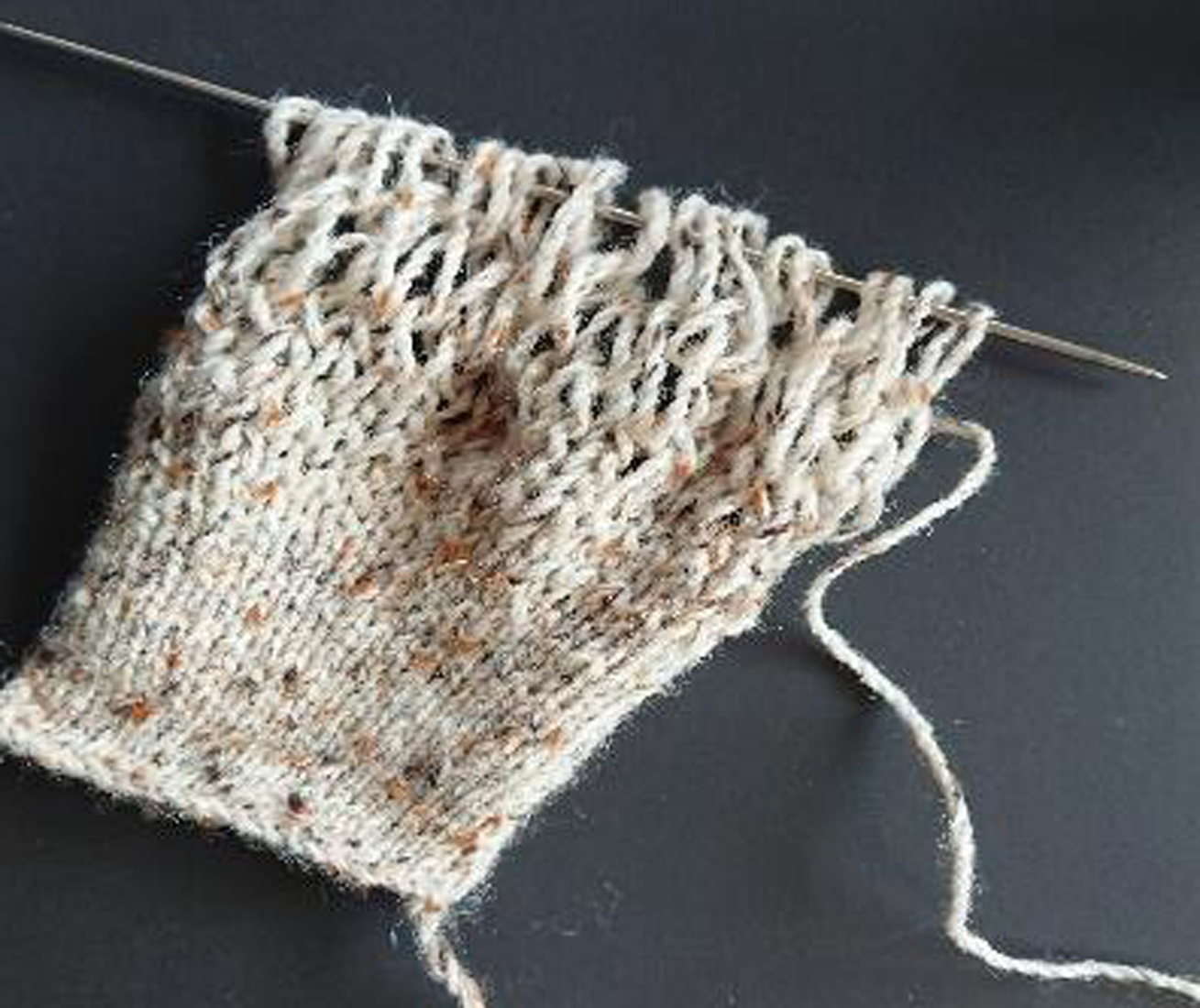
Regarding the knitting metaphor, it is important to highlight that wide stitches can be unintentional or intentional (see figures 5 and 6).
Intentionally loose and tight stitchesFootnote 73

Too loose and too tight stitches due to knitting mistakeFootnote 74
In the knitting of human rights more generally, intentionally loose stitches are quite a regular occurrence. For instance, states are reluctant to address the responsibility of multinationals, in particular with respect to direct human rights obligations. This reluctance leads to a loosely knitted norm when it comes to the applicability of human rights obligations to those non-state actors. This is particularly striking with the right to environment where most of the big environmental disasters have been caused by multinational corporations. For instance, the Bhopal disaster or the Deepwater Horizon incidents were followed by decade-long lawsuits that did not exactly result in the affirmation of an environmental human right.Footnote 75
In the discourse criticizing the environmental human right, the vagueness of the norm is at the forefront of arguments.Footnote 76 Günther Handl, for instance, has repeatedly argued that any environmental human right lacks the degree of certainty of the normative status necessary, and hence it can only be considered as a human right in the stage of possible emergence.Footnote 77
The ECtHR of course, has been criticized for the opposite, too: for being too limited in its reliance on the right to family as the basis for an environmental human right, and for then minimalizing the environmental dimension in the balancing of interests.Footnote 78 In other words, the ECtHR has been accused of knitting its environmental human rights norm too tightly.
On the international level, the UN Human Rights Committee’s General Comment 36 provides for a particularly loose and thereby general construction:
The duty to protect life also implies that State parties should take appropriate measures to address the general conditions in society that may give rise to direct threats to life or prevent individuals from enjoying their right to life with dignity. These general conditions may include … degradation of the environment.Footnote 79
‘General conditions’ in itself can cover everything and nothing – and that ‘may’ include the degradation of environment. So, a specific circumstance can fall through holes already as not being considered a ‘general condition’ and if that is not the case, the conditional form allows for a second hole, for a certain activity not to be covered by the norm creation of the UN Human Rights Committee.
6. Wool – resources
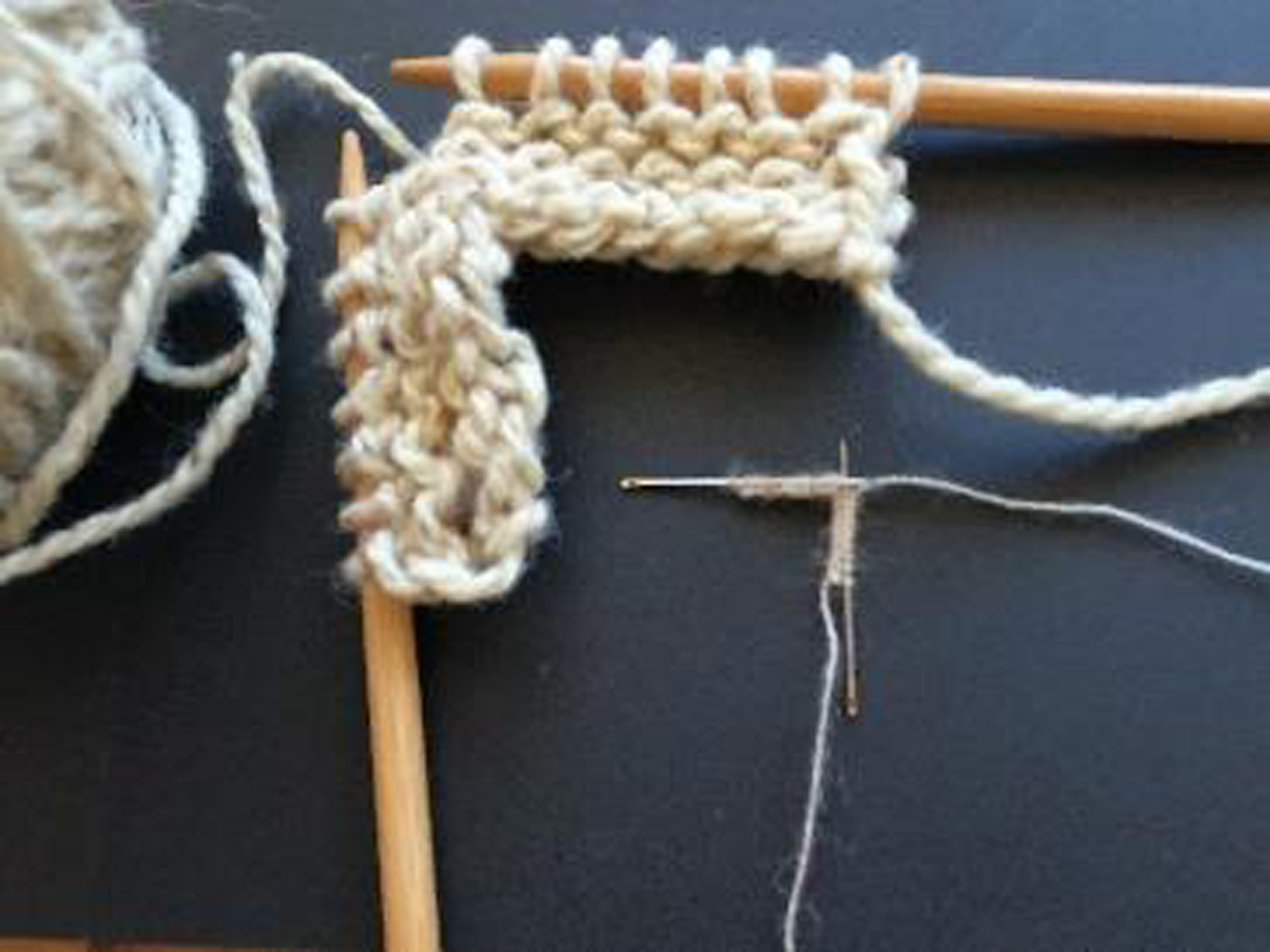
Resources for legal change vary widely from conventions over formal judgments and informal statements to individual, local activism. Not every resource is available for every actor. If we understand the actors as needles, and resources as wool, the crucial observation is that one needs the appropriate needle for the available wool or vice versa (see figures 7 and 8). A special rapporteur trying to pronounce an ECHR judgment may be a funny sight but will have quite a different effect on norm change than the ECtHR pronouncing that judgment.
Small needle and thin threadFootnote 81
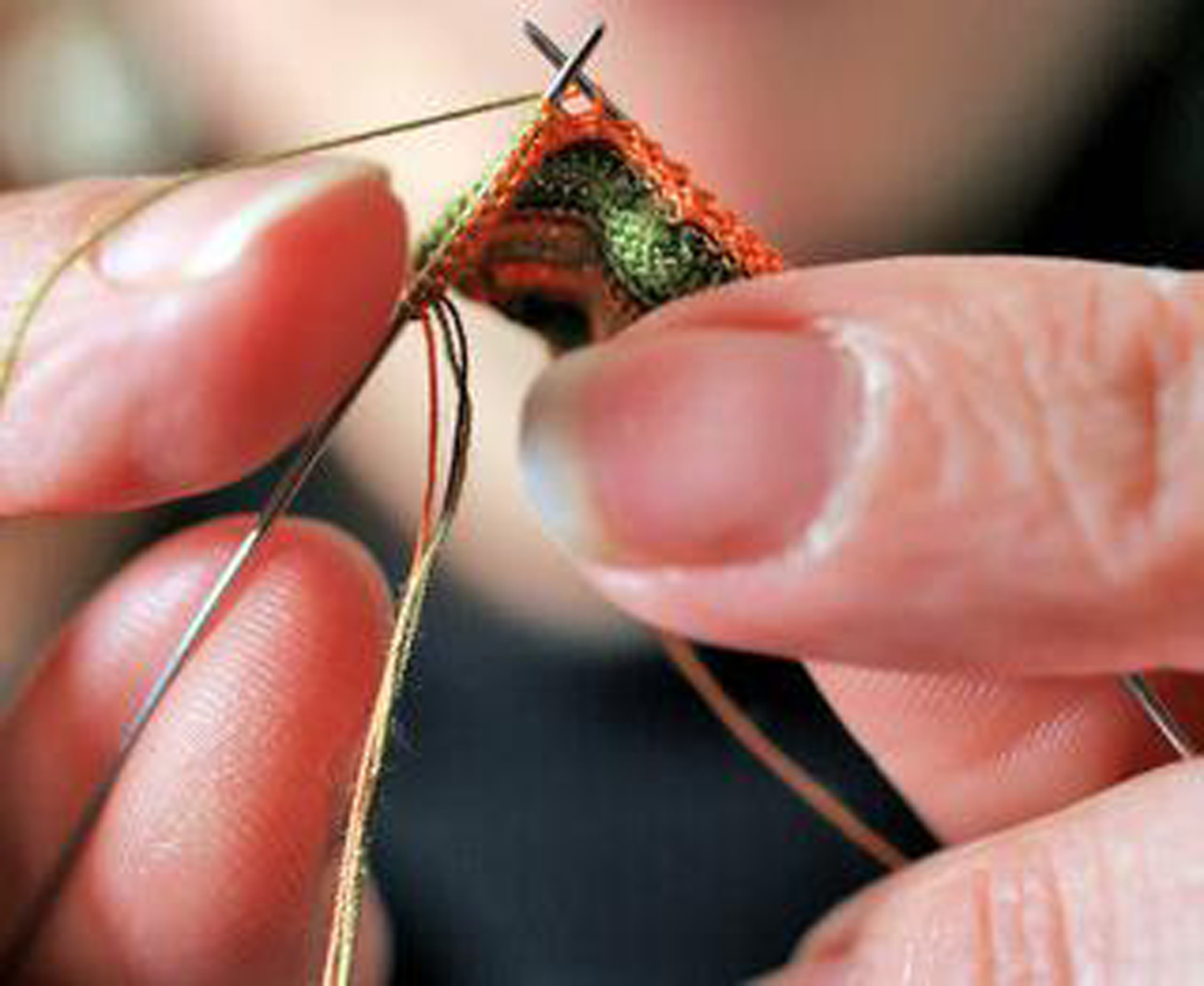
Contrast big needle versus small needleFootnote 82
In order to visualize the different resources, we can think of them as different materials: international law is generally knitted with different kinds of wool, each material representing one resource for change.Footnote 80 Roughly, there can be (i) law-making, mostly nationally, in particular when states insert an environmental fundamental right into their constitution; but similarly (ii) internationally through convention-making; (iii) international organizations’ action, for instance the production of guidelines, handbooks or reports; (iv) international courts’ action, i.e., judgments and decisions; and (v) academics’ or non-governmental organizations’ activity, like the creation of analyses, reports or targeted activism.
Depending on who and what is involved, the final product may be patchy or one material may be predominant. With regard to the environmental human right we can see a knitting together of the right to family and the environmental concerns highly dominated by the ECHR.Footnote 83 Interestingly, years before the ECtHR came up with its construction of an environmental human right, the Indian Supreme Court had followed the same road, when reading the right to a clean environment into Article 21 of the Indian Constitution which establishes that ‘no one shall be deprived of his life or personal liberty except according to procedure established by law’.Footnote 84 If the ECtHR was aware of norm developments in that part of the world, it does not state it.Footnote 85 In other words, that piece of wool, the extra-European national law, was not used for the ECtHR’s norm knitting.
If we look at the resources used in the Inter-American legal system, the norm is knitted with a higher diversity of material: Already with the San Salvador Protocol, the Court, from early on, had a solid resource. Then, an advisory opinion provided a good first pattern according to which subsequent court decisions could knit along. Furthermore, the jurisprudence on indigenous rights allowed for the introduction of environmental concerns with a group dimension.
As pointed out in Section 4.1, the IACtHR has produced an interesting body of case law addressing the protection of the environment, including a group right pattern.Footnote 86 In that process, the IACtHR drew on an interesting combination of resources (wool).
In 2017, on the request of Colombia, the IACtHR issued an Advisory Opinion on the environment and human rights.Footnote 87 Colombia had presented the request in relation to environmental concerns regarding the construction of major infrastructure projects in the Caribbean. The request was limited to concerns in the context of the 1984 Convention for the Protection and Development of the Marine Environment of the Wider Caribbean Region (Cartagena Convention). However, the Court exercised its discretion and reformulated the request to cover the ‘general environmental obligations arising out of the obligations to respect and ensure human rights’, ‘and in relation to the rights to life and personal integrity in particular’.Footnote 88 Thus, drawing on resources – wool – beyond the Convention, the IACtHR distilled and detailed sets of obligations from the right to life and personal integrity in the context of environmental protection. It distinguished obligations of prevention, obligations of co-operation, the precautionary principle, and procedural obligations.
More recently, in February 2020, the IACtHR ruled in Indigenous Communities Members of the Lhaka Honhat Association v. Argentina – for the first time in a contentious case – on the rights to a healthy environment, indigenous community property, cultural identity, food, and water based on Article 26 of the ACHR (progressive development of economic, social, and cultural rights). The Court found Argentina in violation of these rights of the Lhaka Honhat indigenous groups and ordered measures including actions for access to adequate food and water, for the recovery of forest resources, and to maintain indigenous culture.Footnote 89
This demonstrates also how shape, needle, and wool ought to fit: Since 1988, the Protocol of San Salvador provides, in Article 11, that ‘everyone shall have the right to live in a healthy environment and to have access to basic public services’.Footnote 90 However, the only way to ensure implementation of this right is via annual reports.Footnote 91 For this reason, most norm development took place later – based on the Convention, via the individual complaint mechanism.Footnote 92 Yet, Article 11 of the San Salvador Protocol served as a transplanted pattern – as an element for the jurisprudential development of the environmental human right.Footnote 93
In sum, the Inter-American human rights system has been particularly active in the construction of an environmental human right. Note the role of indigenous rights in the creation of the right to a healthy environment as a particularity of this pathway: since the 1970s, with the modern indigenous rights movement gaining momentum, especially drawing on the International Labour Organization (ILO) Convention of 1989 and various UN related activities, the Inter-American human rights system proved to be highly responsive to concerns of indigenous peoples.Footnote 94 Its focus was thereby on the central demand of the indigenous human rights movement: the protection of indigenous peoples’ rights over traditional lands and natural resources.Footnote 95
In contrast to the regional human rights courts’ jurisprudence, the Sustainable Development Goals (SDGs) are of a quite different ‘thread’ quality. As the name already indicates, the ‘goals’ are of inherently progressive character, a quality that would categorize a human right as only (possibly) emerging. And yet, entangling the two types of resources benefits the norm-knitting envisaged through the SDGs as much as the environmental human rights knitting project.Footnote 96 On the one side, the SDGs ‘seek to realize the human rights of all’ and claim to be ‘grounded in the Universal Declaration of Human Rights [and] international human rights treaties’.Footnote 97 On the other side, SDG targets may provide for precision in the interpretation of an environmental human right.Footnote 98
For instance, Target 14.5 is very specific in requiring: ‘By 2020, conserve at least 10 per cent of coastal and marine areas, consistent with national and international law and based on the best available scientific information.’Footnote 99 While this brings precision into the broad human rights formulations, at the same time, the 2022 SDG Progress Report cannot confirm that the target has been reached.Footnote 100 Such ‘breach’ is of different character than the disrespect of a right – and arguably this goes beyond the distinction between protect, respect and remedy elements versus the frame of progressive realization of a target. In contrast to individual constitutional rights, which are designed to protect a certain scope around individual humans (or exceptionally groups), targets or goals are of a different quality in the sense that they define a point towards which a society or a group of society should strive (which in this case is also not environmental protection per se but sustainable development).Footnote 101 Thus, the SDGs are another resource for knitting the norm of an environmental human right.
So, from the perspective of norm-knitting, we can see how the entanglement of qualitatively different threads may produce a more stable product. Much like merino wool, a wool with fantastic breathing qualities, cooling in warm and warming in cold temperatures,Footnote 102 but also tearing quite quickly, by itself – the SDGs are quite comfortable: signing up to them feels good, is adaptable to different circumstances, but if an actual incident occurs, the SDGs by themselves may be of limited use. Their fabric tears quite quickly. However, much as merino wool combined with more stable wool is marginally less comfortable, but also does not tear that quickly,Footnote 103 the SDGs entangled in the human rights discourse on the environment make the environmental human right a much more reliable one. Intermingling different kinds of resources (wool) increases the norm’s stability.
As a consequence, qualifying a norm as law or not becomes much more a question of degree, process, and circumstance than traditional, positivist theories assume. The question is not only which actors engage in which kind of process, it is also what kind of resources are combined and how they are selected and used.
Advocates of an environmental human right have been criticized for redefining the evidence of what constitutes ‘acceptance and recognition’ of the right.Footnote 104 This assumes the definite and fixed categories that constitute ‘threads’ to knit human rights. When Handl criticizes Rodriguez-Rivera for not taking the ‘will of the people’ seriously by citing soft law instruments,Footnote 105 he disregards that the traditional resources of ‘the will of the people’ were possibly even more inconsiderate of large parts of the world’s population. In other words, the quality of resources or threads must not be considered stable over time. However, Handl is correct in criticizing the kind of resources that are considered by advocates of an environmental human right. The whole SR process does not engage with any shortcoming of any of the sources. For instance, when enumerating the existence of national environmental human rights, the actual implementation or non-implementation of often very broadly defined norms is not considered.
This is, indeed, a common strategy in norm-making that is often side-lined. Sometimes, norm-change becomes possible because the conflicting resources are not taken up. Such practice becomes particularly obvious when we do not look at fragments of international law or politics as distinct fields or systems but consider actors (needles) engaging in diverse knitting projects – sometimes within one field and sometimes drawing on resources from different fields.
7. Shape – norm’s form
The process is, of course, further complicated when more needles are introduced, even if maybe not necessary, or if there are fewer needles available than needed. Then, for instance, one cannot knit a sock (since the usual way to knit socks implicates more than two needles),Footnote 106 but one must knit a blanket which can also cover feet but will never work as well as socks (see figures 9 and 10). It is indeed easier to knit small squares and sew them together than to engage in knitting techniques for shapes other than squares.Footnote 107
Sock knittingFootnote 108

Knitted blanketFootnote 109

So, it may not be possible to actually make the convention intended because too many actors are unwilling or un-interested or unable to participate. In that case, a guidance or report endorsed by the actor most interested in the legal change may be issued. For instance, in his reports, the Special Rapporteur on Human Rights and Environment knits together all sorts of sources that advance support for a human right to a healthy environment and does not take up the resources that contest such right. Consequently, the resulting norm remains disconnected from those ‘realities’.
This knitting enterprise is actually quite artistic and deserves a closer look: the SR proceeds in three steps:
-
1. Mapping report: provides for the available wool;
-
2. Framework principles: entangles the existing resources;
-
3. Best practices: provides a pattern that could be used in order to start the ‘universal’ knitting project.
In 2021, this process resulted in the United Nations General Assembly (UNGA) taking that project up and starting such a ‘universal knitting project’ when recognizing an environmental human right in its Resolution 48.Footnote 110
7.1 Mapping report: Identifying the available wool
In 2014, the SR, John Knox, presented a mapping report to the HRC, identifying three branches of environmental human rights:Footnote 111
-
1. Procedural obligations of states to assess environmental impacts on human rights and to make environmental information public, to facilitate participation in decision-making, and to provide access to remedies for harm;
-
2. Substantive obligations of states to adopt legal and institutional frameworks which protect against environmental harm that interferes with the enjoyment of human rights, including harm caused by private actors;
-
3. Non-discrimination and other obligations of states relating to the protection of members of groups in vulnerable situations, including women, children and indigenous peoples.
Those branches were the available resources or, in our metaphor, wool.Footnote 112 Interestingly, the SR draws on statements from very diverse sources (from universal periodic review statements relating to other SRs’ reports to Conference of the Parties’ decisions), and ‘encourages States to accept these statements as evidence of actual or emerging international law’.Footnote 113 Regarding the substantive element, the report finds that: ‘States have obligations to protect against environmental harm that interferes with the enjoyment of human rights’,Footnote 114 and proceeds to hold that. Although the contours of the specific environmental obligations are still evolving, some of their principal characteristics have become clear. In particular, states have obligations:
-
(a) to adopt and implement legal frameworks to protect against environmental harm that may infringe on enjoyment of human rights; and
-
(b) to regulate private actors to protect against such environmental harm.Footnote 115
This document evidences the coming together of diverse regional strands: the Environmental Impact Assessment for instance travelled from the Espoo Convention to the ECHR jurisprudence, while group rights and in particular indigenous rights gained much momentum in the Inter-American human rights system. In the development of the following two key documents of the SR, those strands seem to become a little more intermingled.
7.2 Framework Principles: Entangling existing resources
With the Report of 2018, the SR John Knox, proposed 16 framework principles in order ‘to facilitate implementation of the human rights obligations relating to the enjoyment of a safe, clean, healthy and sustainable environment’.Footnote 116 While the principles barely reference existing case law, they are supposed to be based on the mapping report. The report claims to look ‘forward to the next steps in the evolving relationship between human rights and the environment’,Footnote 117 but at the same time emphasizes that the framework principles ‘do not create new obligations’.Footnote 118 In other words, existing resources are said to be entangled in order to create the basis for a new norm.
7.3 Best practices: Providing for universal knitting pattern
In 2015, John Knox already presented a report with more than 100 good practices to the HRC,Footnote 119 and published a searchable data-base.Footnote 120 In 2019, without referencing the practice report of his predecessor, SR David Boyd presented a report with best practices to the HRC. This document is highlighted on the SR website as a key document, along with the framework principles of John Knox.Footnote 121 In order to establish best practices, SR David Boyd relies extensively on state practice establishing authority. Based on a survey conducted in co-operation with the Vance Center for International Justice,Footnote 122 the SR identifies 156 out of 193 UN member states legally committed to respecting some sort of environmental human right.Footnote 123
Thus, similar to the first SR’s reports that were not taken up in the Länsmann case, a viable source is not explicitly taken up. However, we have several needles implicated: the SRs and the Vance Centre for International Justice. In contrast, the states are not actors (needles) but provide for the previous stitches on which the Best Practices can build. Conversely, if we consider states as needles, and see customary international law as being created from the bottom up, some of the constitutional law developments on the national level can be considered to have crystallized into customary international law.Footnote 124
The SRs’ document provides procedural and substantive elements that are recommended in order to respect the human right to a healthy environment. Procedural elements are (i) access to environmental information; (ii) public participation in environmental decision-making; and (iii) access to justice.Footnote 125 Substantive elements concern: (i) clean air; (ii) safe climate; (iii) healthy and sustainably produced food; (iv) access to safe water and adequate sanitation; (v) non-toxic environments in which to live, work and play; and (vi) healthy ecosystems and biodiversity.Footnote 126 This is a list of many quite separate normative developments.
Much like international environmental law (IEL) more generally, the procedural branch is very clear and concise while the substantive elements lend themselves easily to criticism of being rather aspirational, programmatic and that the addressed issues are already covered by other, codified rights.Footnote 127 This may however summarize quite well the state of norm-emergence of an environmental human right: while the concise procedural elements from IEL have been integrated into the human rights system with considerable success, the substantive scope of the right remains fairly malleable and contextual.
As the final document is basically authored by only one actor here, what we get is more a tying together of different knitted pieces, in the hope that the next round of engagement will knit it all together. In the UN-perspective/vocabulary, the idea would be to provide a starting point for the knitting of one more universal environmental HR.
7.4 Having a clean, healthy, and sustainable environment as a human right
Arguably, the Human Rights Council, in 2021, recognizing a safe, clean, healthy, and sustainable environment as a human right, attempted to start this universal norm-knitting project.Footnote 128 In the resolution, the Human Rights Council builds particularly on the foundation of:
… the rights to life, to the enjoyment of the highest attainable standard of physical and mental health, to an adequate standard of living, to adequate food, to housing, to safe drinking water and sanitation and to participation in cultural life, for present and future generations.Footnote 129
In that sense, the resolution claims to be building on all the previously used patterns that linked human rights and the protection of environment.
What makes this knitting project particularly interesting is that the mapping report does not engage much with the question of why so many states have a national proclamation of an environmental human right. In fact, in 1970, Yugoslavia was the only state codifying such a right – and the Stockholm and Rio declarations provided for resources that were then knitted into the national level.Footnote 130 In other words, the national sphere used the international sphere as an argument for change, and the international sphere used the national sphere as an argument for change: actors knitted a Möbius strip – a non-orientable surface.Footnote 131
8. Colours – origins
Wool is not only different in material; it is also different in colour. This image can capture where the resources for the norm knitting come from. We can, for instance, think of the human rights dimensions as purple and the environment dimensions as green threads. Depending on the pattern and knitting capacity of the actors/needles, the pattern of the norm, the entanglement of the colours, will be a different one (see figures 11 and 12).
Multicolour patternFootnote 132

Entrelac knittingFootnote 133

In the example of the environmental human right, one can find the increasing use of environmental law language in human rights bodies’ writing: ‘prior informed consent’, ‘environmental impact assessment’, ‘biodiversity’ or ‘framework-approach’ are elements that prove to be substantial in the knitting of the human rights norm on environment.
A particularity of the ECtHR is its explicit introduction of ‘prior informed consent’, borrowed from such environmental treaties as the Aarhus Convention (1998) and the Espoo Convention (1991).Footnote 134 Interestingly, the ECtHR in Taskin and others v. Turkey referred to the principles enshrined in the Aarhus Convention, although at that time, Turkey was not party to said Convention.Footnote 135 In fact, the court uses constitutional provisions,Footnote 136 environmental law,Footnote 137 administrative law, environmental impact assessment, and the law of obligations in order to construct an environmental dimension of Article 8 ECHR.Footnote 138 Pulled out of their original context, and entangled with the right to family, those elements are a fundamental resource for the knitting of a multicoloured norm.
This kind of norm change has been conceptualized as ‘norm transplant’ by Teubner.Footnote 139 Within the logic of systems theory, he demonstrates how the introduction of norms from one system into another system produces in the host system irritation that may result in a legal change of system and norm.Footnote 140 However, to think of international human rights law or international environmental law as distinct legal systems does not catch the ongoing and dynamic process. As Rodriguez Rivera aptly points out, the question whether there is an environmental human right or not may be answered differently, depending on the sources and perspectives one relies on.Footnote 141 This multitude of actors and their participation in the legal change is difficult to capture with system theory’s images of core and periphery. In contrast, thinking of legal change in terms of knitting provides an insightful picture: threads of different origins are continuously entangled and thereby construct a norm in between human rights and environmental law.
On the international level, we can see a similar entanglement of human rights and environmental law language in the SR’s 2018 Report where John Knox proposed 16 framework principles in order ‘to facilitate implementation of the human rights obligations relating to the enjoyment of a safe, clean, healthy and sustainable environment’.Footnote 142 In this document it is particularly striking how IEL terminology dominates those principles. Already the form is drawing on a practice well established in environmental law: to brush out the broad principles first and then regulate the details in annexes or protocols.Footnote 143 In substance, out of the 16 principles, five explicitly integrate IEL language into the human rights discourse. Principles 7 and 9 require public access to environmental information, and public participation in decision-making as particularly set forward in the Aarhus Convention;Footnote 144 Principle 8 demands an environmental impact assessment as set out in the Espoo Convention;Footnote 145 Principles 11 and 12 look at environmental standard setting;Footnote 146 and Principle 13 is concerned with transboundary harm, a principle that travelled from the 1941 Trail Smelter Case,Footnote 147 to the Rio Declaration in Principle 2,Footnote 148 to Article 3 of the ILC Draft Articles on Prevention of Transboundary Harm from Hazardous Activities,Footnote 149 to the 2001 Espoo Convention on Environmental Impact Assessment in a Transboundary Context.Footnote 150 Furthermore, Principle 15 takes on the indigenous rights dimension, and Principle 16 takes the sustainable development perspective on board.
Similar to the ECtHR’s knitting, the SR also intertwines the environmental law’s impact assessment with a human right dimension. For instance, Framework Principle 8 states:
To avoid undertaking or authorizing actions with environmental impacts that interfere with the full enjoyment of human rights, States should require the prior assessment of the possible environmental impacts of proposed projects and policies, including their potential effects on the enjoyment of human rights.Footnote 151
In this paragraph, the basis, the first line of normative stitches, is environmental law, environmental impact assessment being a fundamental element of international environmental law. Into that, a thread of human rights is knitted: ‘environmental impact’ is expanded to explicitly include ‘potential effects on the enjoyment of human rights’.Footnote 152 The process identified here in the specific context is embedded in a macro-level process. As Tarek F Massarani, Margo Tatgenhorst Drakos, and Joanna Pajkowska point out, the (emerging) Human Rights Impact Assessment builds on and draws from the Environmental Impact Assessment’s normative foundation.Footnote 153
While I do think that in this example we have an increasing entanglement of those two colours, one can also think of what has been called green-washing by others: instead of substantial greening of existing human rights norms, the existing knitting project is re-coloured (see figure 13). Consequently, the shape and pattern would have been determined by actors who did not have environmental concerns in mind when knitting their own projects.
Different colours through batik instead of knittingFootnote 154

This would be closer to the perspective of criticism of the environmental human right as being too anthropocentric, for instance. Such criticism highlights that human rights put the human at the centre – by necessity, since they are rights of humans. Opposing such focus on the human, those critics argue in favour of a right of nature.Footnote 155 In their perspective then, a norm knitted for humans is re-coloured in order to look like a norm for nature, and therefore maybe pretty but utterly unfitting.
9. Layers
Finally, the knitting projects do not need to be necessarily tied together as one piece. A foot will be warm despite a hole in the sock if covered by a blanket, for instance. So, different projects of norm-processes may be layered one onto the other (see figure 14). If the regional human right is a very loosely knitted blanket, that may not be overly problematic when the national rights system provides for warm socks.
Layers of knitted patchesFootnote 156

In that sense, a very loosely knitted norm on human rights and environment offers the possibility for different continuations: either the net is knitted more tightly in a second round, or another project, more enrooted in international environmental law or domestic law, for instance, adds another layer to the norm. The UNGA recognizing an environmental human right constitutes such a new round of making the net more stable: building on the SRs, the UNGA Resolution recognizes ‘[t]he human right to a safe, clean, healthy and sustainable environment’.Footnote 157 Through this endorsement, the UNGA layers an additional thread onto the knitting project of the SR, giving it more stability. However, as no substantial precisions are introduced, the net does not become more concise or tight through this step.
Distinguishing layers of norms from a patchwork approach then also nuances the positionality of needles (actors). In order to provide complementary cover, norms do not need to be stitched together. However, one needle stitching together many existing knitting projects that used to be piled onto the same situation without co-ordination, with relatively little work produce a fairly efficient patchwork blanket. To actually create a specific norm that fits, for instance, like a sock, this stitching together is a far less promising solution. Then, an imperfect sock, covered by a blanket, i.e., layers instead of stitching together, may provide better protection.
What this metaphor highlights is how not only vertically stacking and entangling layers on top of each other is an important element of norm-change, but that also and most importantly, horizontally, those layers remain themselves implicated in continuous norm change. In fact, entanglement between layers may be less important for the way in which a norm changes and the way in which the layer is entangled or knitted may be crucial.
In terms of the environmental human right, this means that a broad norm – a patchwork blanket – produced on the UN level can work well as complementary cover, but clear and concise norm formulations (socks and gloves for instance) remain the better protection for specific situations in which human rights and environment are threatened.
10. Conclusion
Thinking about legal change in terms of norm knitting provides for new nuances of norm change with respect to legal pluralism: we can have diverse resources for norm-making entangled or several norm-making processes layered on top of each other. In any case, intention and co-ordination of the actors (needles) is fundamental for the outcome of the norm-change.
Unsurprisingly, the constructed norms are seldom perfect, and even more seldom do they entirely achieve what they were intended for. For instance, the UN bodies may be quite successful in knitting a new human right to a healthy environment. The blanket may, however, be knit so widely that the actual human rights issues will never be caught in what is more a net than a blanket. Nevertheless, the process of change continues, and actors continuously keep knitting on the project of international law.
Thinking through the concept of norm-knitting sheds new light on the analysis of change in international law: firstly, it puts the dynamic of stability and change into a new perspective. Continuously entangling new resources with existing norms provides as much stability as it provides change. In other words, thinking of legal change in terms of norm knitting provides for the idea of a norm continuously evolving and yet being somewhat stable. For instance, the UNGA Resolution 49 recognizing an environmental human right strengthens and thereby changes the knitting project of the SR.
Secondly, by necessity, the knitting actors are quite close to the latest developments – and may perceive the success of change differently than those that ought to be covered by the knitted norm – but may not have been much involved in the discussions on pattern and form. This explains then the extreme variation in the evaluation of the successful materialization of an environmental human right: arguments vary from assertions that it clearly exists to assertions that it clearly does not exist: someone who needs warm hands may not appreciate the knitted sock as much as someone with cold feet. In other words, depending on where actors consider the need for an environmental human right, they may assess the knitting project as more or less successful.
Thirdly, the image of norm-knitting takes our focus away from international law as a law of crisis and draws our attention to the collaborative element of (international) law-making. Indeed, looking at different patterns and the loose or tight knitting highlights the everyday practice of international law as the major resource for incrementally changing international law.
Fourthly, thinking of different resources for the legal change provides possibilities for nuanced analysis of plurality of implicated normative resources. Instead of being constrained to images of hard and soft law, different normative qualities can be accounted for.
Fifthly, thinking of the norm’s form and possibilities of layering different projects allows for a delicate picture of ‘successful’ norm change in terms of the norm’s form and its function. If the protection of a specific kind of situation from harm is the aim, a broad and loosely knitted norm is not too helpful. That same loose and broad norm can, however, be a good second layer on top of more precise but maybe incomplete norms. Ultimately, this broad norm’s use as secondary layer then begs the question of whether more discussion on the pattern, or more precision in the knitting could have made it a useful single layer.
In a way, this article itself is somewhat knitted: While the example of the environmental human right proved useful to flesh out crucial features of the conceptualization of norm-knitting, thinking about the environmental human right in terms of norm knitting pulls elements into the light that usually lurk in the shadows. At the same time, using the example of the environmental human right does not limit the conceptualization of norm knitting to the field of human rights or environment law.
Indeed, norm knitting can be a tool to analyse any legal change in general. It may highlight how the human right to religious freedom is basically only knitted based on the pattern of Western enlightenment, forcing actors (needles) from around the world to restrain themselves to tiny twists to some knots or to refuse that knitting project altogether and to start their own. Regarding investment arbitration, norm-knitting as an analytical tool may reveal a fabric quite tightly knit in terms of the pattern if considered as the focus on the protection of property of foreign investors, but at the same time, we can see how the norm knitting produces very diffuse shapes as the bilateral investment treaties and tribunals are very much constrained in terms of geographical and topical relevance. Looking at norm knitting in international humanitarian law reveals how divergent norms are produced as humanitarian and military (epistemic) communities rely on different resources – for instance, humanitarian lawyers preferring human rights law and academic resources, while military lawyers prefer military manuals, which ultimately will be forced to remain entangled, even without agreement on the pattern. At the same time, if the pattern of military necessity dominated, military lawyers will qualify as successful legal change what humanitarian lawyers will qualify as failure.Footnote 158
In sum, the concept of ‘norm knitting’ provides an innovative analytical tool that makes it possible to demonstrate the variety in ‘successful’ change of a given norm in international law in response to specific challenges the actors face.


 Open access

