

1. Introduction
Let $C$
be a complex smooth projective curve of genus
$C$
be a complex smooth projective curve of genus $g$
. For
$g$
. For $\gamma =(r,d)\in \mathbb{Z}_{\gt 0}\times \mathbb{Z}$
, let
$\gamma =(r,d)\in \mathbb{Z}_{\gt 0}\times \mathbb{Z}$
, let $\mathcal{M}_{\gamma}$
(respectively
$\mathcal{M}_{\gamma}$
(respectively ${\mathcal{M}}^{\mathsf{s}}_{\gamma}$
) denote the moduli space of semistable (respectively stable) vector bundles of rank
${\mathcal{M}}^{\mathsf{s}}_{\gamma}$
) denote the moduli space of semistable (respectively stable) vector bundles of rank $r$
and degree
$r$
and degree $d$
over
$d$
over $C$
. Then
$C$
. Then $\mathcal{M}_{\gamma}$
is projective and irreducible,
$\mathcal{M}_{\gamma}$
is projective and irreducible, ${\mathcal{M}}^{\mathsf{s}}_{\gamma} \subseteq \mathcal{M}_{\gamma}$
is open and smooth, and
${\mathcal{M}}^{\mathsf{s}}_{\gamma} \subseteq \mathcal{M}_{\gamma}$
is open and smooth, and ${\mathcal{M}}^{\mathsf{s}}_{\gamma} =\mathcal{M}_{\gamma}$
if
${\mathcal{M}}^{\mathsf{s}}_{\gamma} =\mathcal{M}_{\gamma}$
if $r$
and
$r$
and $d$
are coprime. If
$d$
are coprime. If ${\mathcal{M}}^{\mathsf{s}}_{\gamma}$
is nonempty (this is always the case for
${\mathcal{M}}^{\mathsf{s}}_{\gamma}$
is nonempty (this is always the case for $g\geqslant 2$
), then its dimension is
$g\geqslant 2$
), then its dimension is $(g-1)r^2+1$
. The history of the computation of various invariants of
$(g-1)r^2+1$
. The history of the computation of various invariants of $\mathcal{M}_{\gamma}$
for coprime
$\mathcal{M}_{\gamma}$
for coprime $r$
and
$r$
and $d$
is rather long. A recursive formula to determine the Betti numbers of
$d$
is rather long. A recursive formula to determine the Betti numbers of $\mathcal{M}_{\gamma}$
was proved in [Reference Harder and NarasimhanHN74, Reference Desale and RamananDR75] by applying the Weil conjectures and the Siegel formula [Reference Harder and NarasimhanHN74], based on the computation of the Tamagawa number of
$\mathcal{M}_{\gamma}$
was proved in [Reference Harder and NarasimhanHN74, Reference Desale and RamananDR75] by applying the Weil conjectures and the Siegel formula [Reference Harder and NarasimhanHN74], based on the computation of the Tamagawa number of ${\rm L}_n$
over function fields [Reference WeilWei82]. An alternative proof of this recursive formula was obtained in [Reference Atiyah and BottAB83] using gauge theory. An algebro-geometric method to prove the Siegel formula was developed in [Reference Bifet, Ghione and LetiziaBGL94, Reference Ghione and LetiziaGL92], and this method was used in [Reference del BañodB01] to prove the recursive formula for the motivic classes and Hodge polynomials of
${\rm L}_n$
over function fields [Reference WeilWei82]. An alternative proof of this recursive formula was obtained in [Reference Atiyah and BottAB83] using gauge theory. An algebro-geometric method to prove the Siegel formula was developed in [Reference Bifet, Ghione and LetiziaBGL94, Reference Ghione and LetiziaGL92], and this method was used in [Reference del BañodB01] to prove the recursive formula for the motivic classes and Hodge polynomials of $\mathcal{M}_{\gamma}$
. Independently, the same recursive formula for the Hodge polynomials of
$\mathcal{M}_{\gamma}$
. Independently, the same recursive formula for the Hodge polynomials of $\mathcal{M}_{\gamma}$
was proved in [Reference Earl and KirwanEK00] using equivariant cohomology and a refinement of the approach of Atiyah and Bott [Reference Atiyah and BottAB83]. On the other hand, the above recursive formula was solved in [Reference Laumon and RapoportLR96, Reference ZagierZag96], and hence a rather explicit formula was obtained for the invariants of
$\mathcal{M}_{\gamma}$
was proved in [Reference Earl and KirwanEK00] using equivariant cohomology and a refinement of the approach of Atiyah and Bott [Reference Atiyah and BottAB83]. On the other hand, the above recursive formula was solved in [Reference Laumon and RapoportLR96, Reference ZagierZag96], and hence a rather explicit formula was obtained for the invariants of $\mathcal{M}_{\gamma}$
in the case of coprime
$\mathcal{M}_{\gamma}$
in the case of coprime $r$
and
$r$
and $d$
.
$d$
.
In this paper, we compute the intersection cohomology of $\mathcal{M}_{\gamma}$
for arbitrary
$\mathcal{M}_{\gamma}$
for arbitrary $\gamma =(r,d)$
. These invariants were previously determined for
$\gamma =(r,d)$
. These invariants were previously determined for $r=2$
in [Reference KirwanKir86a, Reference KirwanKir92], using partial desingularizations of GIT quotients and related techniques developed in [Reference KirwanKir84, Reference KirwanKir85, Reference KirwanKir86b]. Based on these computations, as well as computations of the intersection cohomology for moduli spaces of low-rank vector bundles on surfaces [Reference YoshiokaYos95, Remark 4.6], it was proposed in [Reference ManschotMan13] that intersection cohomology should be related to Donaldson–Thomas (DT) invariants, which are also known as BPS invariants. These invariants are usually defined for moduli spaces of sheaves on
$r=2$
in [Reference KirwanKir86a, Reference KirwanKir92], using partial desingularizations of GIT quotients and related techniques developed in [Reference KirwanKir84, Reference KirwanKir85, Reference KirwanKir86b]. Based on these computations, as well as computations of the intersection cohomology for moduli spaces of low-rank vector bundles on surfaces [Reference YoshiokaYos95, Remark 4.6], it was proposed in [Reference ManschotMan13] that intersection cohomology should be related to Donaldson–Thomas (DT) invariants, which are also known as BPS invariants. These invariants are usually defined for moduli spaces of sheaves on $3$
-Calabi–Yau varieties or, more generally, for moduli spaces of objects of
$3$
-Calabi–Yau varieties or, more generally, for moduli spaces of objects of $3$
-Calabi–Yau categories [Reference Kontsevich and SoibelmanKS08]. However, the construction can also be applied to hereditary categories (abelian categories with vanishing
$3$
-Calabi–Yau categories [Reference Kontsevich and SoibelmanKS08]. However, the construction can also be applied to hereditary categories (abelian categories with vanishing ${\rm Ext}^i$
for
${\rm Ext}^i$
for $i\geqslant 2$
) and, in particular, to the category of coherent sheaves over a curve. The corresponding DT invariants
$i\geqslant 2$
) and, in particular, to the category of coherent sheaves over a curve. The corresponding DT invariants $\operatorname {DT}^{E}_{\gamma }$
can be computed for arbitrary
$\operatorname {DT}^{E}_{\gamma }$
can be computed for arbitrary $\gamma$
using the recursive formula mentioned earlier. After relating these invariants to the intersection cohomology of
$\gamma$
using the recursive formula mentioned earlier. After relating these invariants to the intersection cohomology of $\mathcal{M}_{\gamma}$
, we obtain an effective method to compute the latter.
$\mathcal{M}_{\gamma}$
, we obtain an effective method to compute the latter.
More precisely, the moduli space $\mathcal{M}_{\gamma}$
can be represented as a GIT quotient of a smooth variety
$\mathcal{M}_{\gamma}$
can be represented as a GIT quotient of a smooth variety $R_{\gamma} =R_{r,d}$
by an action of a general linear group
$R_{\gamma} =R_{r,d}$
by an action of a general linear group $G_{\gamma }=G_{r,d}$
[Reference NewsteadNew78]. The cohomology groups with compact support
$G_{\gamma }=G_{r,d}$
[Reference NewsteadNew78]. The cohomology groups with compact support $H^*_c(R_{\gamma },\mathbb{Q})$
and
$H^*_c(R_{\gamma },\mathbb{Q})$
and $H^*_c(G_{\gamma },\mathbb{Q})$
carry mixed Hodge structures, and we can consider the corresponding Hodge–Deligne polynomials (or
$H^*_c(G_{\gamma },\mathbb{Q})$
carry mixed Hodge structures, and we can consider the corresponding Hodge–Deligne polynomials (or $E$
-polynomials, see Section 5.6)
$E$
-polynomials, see Section 5.6)
 \begin{align*}E(R_{\gamma }),\ E(G_{\gamma })\in \mathbb{Z}[u^{\pm 1},v^{\pm 1}].\end{align*}
For any $\mu \in \mathbb{Q}$
, we consider the generating series
$\mu \in \mathbb{Q}$
, we consider the generating series
 \begin{align} Q_\mu=1+\sum _{d/r=\mu }\mathbb{L}^{(1-g)r^2/2}\frac {E(R_{r,d})}{E(G_{r,d})}t^r \in \mathbb{Q}(u^{\frac 12},v^{\frac 12})[\![t]\!], \end{align}
where $\mathbb{L}=E(\mathbb{A}^1)=uv$
and
$\mathbb{L}=E(\mathbb{A}^1)=uv$
and $\mathbb{L}^{1/2}=-(uv)^{1/2}$
. An explicit formula for
$\mathbb{L}^{1/2}=-(uv)^{1/2}$
. An explicit formula for $Q_\mu$
can be obtained using the methods from [Reference Laumon and RapoportLR96, Reference ZagierZag96] mentioned earlier (see Theorem 5.11). In particular, if
$Q_\mu$
can be obtained using the methods from [Reference Laumon and RapoportLR96, Reference ZagierZag96] mentioned earlier (see Theorem 5.11). In particular, if $r$
and
$r$
and $d$
are coprime, then
$d$
are coprime, then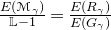 $\frac {E(\mathcal{M}_{\gamma} )}{\mathbb{L}-1}=\frac {E(R_{\gamma })}{E(G_{\gamma })}$
, and hence we can determine Betti and Hodge numbers of
$\frac {E(\mathcal{M}_{\gamma} )}{\mathbb{L}-1}=\frac {E(R_{\gamma })}{E(G_{\gamma })}$
, and hence we can determine Betti and Hodge numbers of $\mathcal{M}_{\gamma}$
. The role of the other summands of the series
$\mathcal{M}_{\gamma}$
. The role of the other summands of the series $Q_\mu$
is less transparent. Motivated by the definition of DT invariants in other contexts (see e.g. [Reference MozgovoyMoz13a, Reference MozgovoyMoz13b]), we define the DT invariants
$Q_\mu$
is less transparent. Motivated by the definition of DT invariants in other contexts (see e.g. [Reference MozgovoyMoz13a, Reference MozgovoyMoz13b]), we define the DT invariants $\operatorname {DT}^{E}_{\gamma} =\operatorname {DT}^{E}_{r,d}\in \mathbb{Q}(u^{\frac 12},v^{\frac 12})$
by the formula
$\operatorname {DT}^{E}_{\gamma} =\operatorname {DT}^{E}_{r,d}\in \mathbb{Q}(u^{\frac 12},v^{\frac 12})$
by the formula
 \begin{align} \sum _{d/r=\mu }\operatorname {DT}^{E}_{r,d}t^r =(\mathbb{L}^{\frac {1}{2}}-\mathbb{L}^{-{\frac {1}{2}}}){\rm Log}(Q_\mu ), \end{align}
where ${\rm Log}$
is the plethystic logarithm (45). As
${\rm Log}$
is the plethystic logarithm (45). As $Q_\mu$
can be computed explicitly, we can also compute the DT invariants. These computations show that
$Q_\mu$
can be computed explicitly, we can also compute the DT invariants. These computations show that $\operatorname {DT}^{E}_{r,d}$
are polynomials with integer coefficients. A similar statement in the context of quiver representations was proved in [Reference Kontsevich and SoibelmanKS11, Reference EfimovEfi12].
$\operatorname {DT}^{E}_{r,d}$
are polynomials with integer coefficients. A similar statement in the context of quiver representations was proved in [Reference Kontsevich and SoibelmanKS11, Reference EfimovEfi12].
Now let us describe the relationship between DT invariants and the intersection cohomology of moduli spaces. Given a complex algebraic variety $X$
of dimension
$X$
of dimension $d$
, let
$d$
, let ${\rm IC}_X\in {\rm Perv}(\mathbb{Q}_X)$
be its intersection complex. This can be lifted to a mixed Hodge module
${\rm IC}_X\in {\rm Perv}(\mathbb{Q}_X)$
be its intersection complex. This can be lifted to a mixed Hodge module ${\bf IC}_X$
of weight
${\bf IC}_X$
of weight $0$
(see Section 2.3) so that
$0$
(see Section 2.3) so that ${\bf IC}_X=\mathbb{Q}_X\left \langle d\right \rangle =\mathbb{Q}_X(d/2)[d]$
for smooth
${\bf IC}_X=\mathbb{Q}_X\left \langle d\right \rangle =\mathbb{Q}_X(d/2)[d]$
for smooth $X$
. The intersection cohomology
$X$
. The intersection cohomology
 \begin{align} {\rm IH}^*(X,\mathbb{Q})=H^*(X,{\bf IC}_X\left \langle -d\right \rangle ) \end{align}
is a complex of mixed Hodge structures (pure of weight $0$
if
$0$
if $X$
is projective) and we may consider its Hodge–Deligne polynomial.
$X$
is projective) and we may consider its Hodge–Deligne polynomial.
Theorem 1.1 (See Theorem 5.10). If ${\mathcal{M}}^{\mathsf{s}}_{\gamma} =\varnothing$
, then
${\mathcal{M}}^{\mathsf{s}}_{\gamma} =\varnothing$
, then $\operatorname {DT}^{E}_{\gamma}=0$
. If
$\operatorname {DT}^{E}_{\gamma}=0$
. If ${\mathcal{M}}^{\mathsf{s}}_{\gamma} \ne \varnothing$
, then
${\mathcal{M}}^{\mathsf{s}}_{\gamma} \ne \varnothing$
, then
 \begin{align} \operatorname {DT}^{E}_{\gamma} =E(H^*(\mathcal{M}_{\gamma} ,{\bf IC}_{\mathcal{M}_{\gamma} })) =\mathbb{L}^{-\dim \mathcal{M}_{\gamma} /2}E({\rm IH}^*(\mathcal{M}_{\gamma} ,\mathbb{Q})) \text {and} \end{align}
 \begin{align} \operatorname {DT}^{E}_{\gamma }(y,y) =(-y)^{-\dim \mathcal{M}_{\gamma} }\sum \nolimits _k\dim {\rm IH}^k(\mathcal{M}_{\gamma} ,\mathbb{Q})(-y)^k. \end{align}
The object ${\bf IC}_X$
is self-dual with respect to Verdier duality, and hence we obtain the following result.
${\bf IC}_X$
is self-dual with respect to Verdier duality, and hence we obtain the following result.
Corollary 1.2. We have:
-
(i) $\operatorname {DT}^{E}_{\gamma }\in \mathbb{Z}[u,v,(uv)^{-{\frac 12}}]$
;
$\operatorname {DT}^{E}_{\gamma }\in \mathbb{Z}[u,v,(uv)^{-{\frac 12}}]$
; -
(ii)
$\operatorname {DT}^{E}_{\gamma }(u^{-1},v^{-1})=\operatorname {DT}^{E}_{\gamma }(u,v)$
; and
-
(iii)
$\operatorname {DT}^{E}_{\gamma }(-y,-y)\in \mathbb{N}[y^{\pm 1}]$
.



In order to prove Theorem 1.1, we introduce relative DT classes $\operatorname {{\bf DT}}_{\gamma }\in \mathbf K({\rm MHM}(\mathcal{M}_{\gamma} ))$
such that
$\operatorname {{\bf DT}}_{\gamma }\in \mathbf K({\rm MHM}(\mathcal{M}_{\gamma} ))$
such that $E(a_!\operatorname {{\bf DT}}_{\gamma} )=\operatorname {DT}^{E}_{\gamma}$
for the projection
$E(a_!\operatorname {{\bf DT}}_{\gamma} )=\operatorname {DT}^{E}_{\gamma}$
for the projection $a:\mathcal{M}_{\gamma} \to {\bf pt}$
(we also have
$a:\mathcal{M}_{\gamma} \to {\bf pt}$
(we also have $E(a_!{\bf IC}_{\mathcal{M}_{\gamma} })=E(H^*(\mathcal{M}_{\gamma} ,{\bf IC}_{\mathcal{M}_{\gamma} }))$
). We prove an analogue of Theorem 1.1 for these classes.
$E(a_!{\bf IC}_{\mathcal{M}_{\gamma} })=E(H^*(\mathcal{M}_{\gamma} ,{\bf IC}_{\mathcal{M}_{\gamma} }))$
). We prove an analogue of Theorem 1.1 for these classes.
Theorem 1.3 (See Corollary 5.8). We have
 \begin{align*} \operatorname {\textbf{DT}}_{\gamma} =\left\{\begin{array}{l@{\quad}l}0 & \textit{if}\;\, {\mathcal{M}}^{\mathsf{s}}_{\gamma} = \varnothing ,\\[5pt] {[}\textbf{IC}_{\mathcal{M}_{\gamma} }{]} & \textit{if}\;\,{\mathcal{M}}^{\mathsf{s}}_{\gamma} \neq \varnothing ,\end{array}\right. \end{align*}
in $\mathbf K({\rm MHM}(\mathcal{M}_{\gamma} ))$
.
$\mathbf K({\rm MHM}(\mathcal{M}_{\gamma} ))$
.
For the proof of this result we will utilize the ideas in [Reference Meinhardt and ReinekeMR19], which studies moduli spaces of quiver representations; similar extensions of the methods of [Reference Meinhardt and ReinekeMR19] were developed independently in [Reference MeinhardtMei15]. In addition, we will clarify the technical issues in [Reference MeinhardtMei15, Reference Meinhardt and ReinekeMR19] in Section 2. First, we will introduce the moduli space ${\mathcal{M}}^{\mathsf{f}}_{\gamma}$
of stable framed vector bundles. Under appropriate assumptions, this moduli space is smooth, and the canonical morphism
${\mathcal{M}}^{\mathsf{f}}_{\gamma}$
of stable framed vector bundles. Under appropriate assumptions, this moduli space is smooth, and the canonical morphism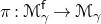 $\pi :{\mathcal{M}}^{\mathsf{f}}_{\gamma} \to \mathcal{M}_{\gamma}$
is projective. The fibres of this map over
$\pi :{\mathcal{M}}^{\mathsf{f}}_{\gamma} \to \mathcal{M}_{\gamma}$
is projective. The fibres of this map over ${\mathcal{M}}^{\mathsf{s}}_{\gamma}$
are projective spaces, while the other fibres can be identified with moduli spaces of stable nilpotent quiver representations (see Theorem 4.10). This analysis of the fibres will be used in Theorem 4.11 to show that
${\mathcal{M}}^{\mathsf{s}}_{\gamma}$
are projective spaces, while the other fibres can be identified with moduli spaces of stable nilpotent quiver representations (see Theorem 4.10). This analysis of the fibres will be used in Theorem 4.11 to show that $\pi$
is a virtually small map, which is a generalization of the notion of a small map (see Section 2.6). The properties of virtually small maps (see Theorem 2.21) imply that the leading term of
$\pi$
is a virtually small map, which is a generalization of the notion of a small map (see Section 2.6). The properties of virtually small maps (see Theorem 2.21) imply that the leading term of $\pi _*{\bf IC}_{{\mathcal{M}}^{\mathsf{f}}_{\gamma} }$
(with respect to the weight degree on the Grothendieck group of mixed Hodge modules) can be related to
$\pi _*{\bf IC}_{{\mathcal{M}}^{\mathsf{f}}_{\gamma} }$
(with respect to the weight degree on the Grothendieck group of mixed Hodge modules) can be related to ${\bf IC}_{\mathcal{M}_{\gamma} }$
. On the other hand, we can express the class of
${\bf IC}_{\mathcal{M}_{\gamma} }$
. On the other hand, we can express the class of $\pi _*{\bf IC}_{{\mathcal{M}}^{\mathsf{f}}_{\gamma} }$
in terms of DT classes (see Theorem 5.6), and we will show in Theorem 5.7 that the leading term in this expression is related to
$\pi _*{\bf IC}_{{\mathcal{M}}^{\mathsf{f}}_{\gamma} }$
in terms of DT classes (see Theorem 5.6), and we will show in Theorem 5.7 that the leading term in this expression is related to $\operatorname {{\bf DT}}_{\gamma}$
. While our main focus is on the moduli spaces of vector bundles on a curve, all our proofs generalize verbatim to moduli spaces in other hereditary categories.
$\operatorname {{\bf DT}}_{\gamma}$
. While our main focus is on the moduli spaces of vector bundles on a curve, all our proofs generalize verbatim to moduli spaces in other hereditary categories.
A closely related result is proved in [Reference Felisetti, Szenes and TrapeznikovaFST25]. More precisely, the authors consider the projection $\pi :{\mathcal{M}}^{\mathsf{f}}\to \mathcal{M}$
, where
$\pi :{\mathcal{M}}^{\mathsf{f}}\to \mathcal{M}$
, where $\mathcal{M}=\bigsqcup _{r\geqslant 0}\mathcal{M}_{r,0}$
and
$\mathcal{M}=\bigsqcup _{r\geqslant 0}\mathcal{M}_{r,0}$
and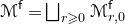 ${\mathcal{M}}^{\mathsf{f}}=\bigsqcup _{r\geqslant 0}{\mathcal{M}}^{\mathsf{f}}_{r,0}$
is the moduli space of stable framed objects for the parabolic framing functor (48) (
${\mathcal{M}}^{\mathsf{f}}=\bigsqcup _{r\geqslant 0}{\mathcal{M}}^{\mathsf{f}}_{r,0}$
is the moduli space of stable framed objects for the parabolic framing functor (48) ( $\mathcal{M}^{\mathsf{f}}_{r,0}$
is denoted by
$\mathcal{M}^{\mathsf{f}}_{r,0}$
is denoted by $\mathcal{P}_0(r)$
in [Reference Felisetti, Szenes and TrapeznikovaFST25]), and prove a specialization of Theorem 5.7 (see also Theorem 5.6) for Poincaré polynomials (see [Reference Felisetti, Szenes and TrapeznikovaFST25, Theorem 8.7]). As in our paper, the authors perform a careful analysis of the map
$\mathcal{P}_0(r)$
in [Reference Felisetti, Szenes and TrapeznikovaFST25]), and prove a specialization of Theorem 5.7 (see also Theorem 5.6) for Poincaré polynomials (see [Reference Felisetti, Szenes and TrapeznikovaFST25, Theorem 8.7]). As in our paper, the authors perform a careful analysis of the map $\pi$
and its fibres in order to determine the pushforward of the intersection complex.
$\pi$
and its fibres in order to determine the pushforward of the intersection complex.
2. Virtually small maps
2.1 Mixed t-categories
For a subcategory $\mathcal{S}\subseteq \mathcal{D}$
(or a collection of subcategories) of a triangulated category
$\mathcal{S}\subseteq \mathcal{D}$
(or a collection of subcategories) of a triangulated category $\mathcal{D}$
, let
$\mathcal{D}$
, let $\left \langle \mathcal{S}\right \rangle \subseteq \mathcal{D}$
be the minimal full subcategory that contains
$\left \langle \mathcal{S}\right \rangle \subseteq \mathcal{D}$
be the minimal full subcategory that contains $\mathcal{S}\cup \left \{0\right \}$
and is closed under extensions. A t-structure
$\mathcal{S}\cup \left \{0\right \}$
and is closed under extensions. A t-structure $(\mathcal{D}^{\le 0},\mathcal{D}^{\geqslant 0})$
[Reference Beilinson, Bernstein and DeligneBBD82] on a triangulated category
$(\mathcal{D}^{\le 0},\mathcal{D}^{\geqslant 0})$
[Reference Beilinson, Bernstein and DeligneBBD82] on a triangulated category $\mathcal{D}$
is called bounded if
$\mathcal{D}$
is called bounded if $\mathcal{D}=\left \langle \mathcal{A}[n]:n\in \mathbb{Z}\right \rangle$
for the heart
$\mathcal{D}=\left \langle \mathcal{A}[n]:n\in \mathbb{Z}\right \rangle$
for the heart $\mathcal{A}=\mathcal{D}^{\le 0}\cap \mathcal{D}^{\geqslant 0}$
. For
$\mathcal{A}=\mathcal{D}^{\le 0}\cap \mathcal{D}^{\geqslant 0}$
. For $M\in \mathcal{D}$
, we define the cohomology object
$M\in \mathcal{D}$
, we define the cohomology object $H^iM=\tau _{\le 0}\tau _{\geqslant 0}(M[i])\in \mathcal{A}$
. A (bounded) t-category is a triangulated category equipped with a (bounded) t-structure.
$H^iM=\tau _{\le 0}\tau _{\geqslant 0}(M[i])\in \mathcal{A}$
. A (bounded) t-category is a triangulated category equipped with a (bounded) t-structure.
Definition 2.1. A bounded t-structure on a triangulated category $\mathcal{D}$
is called mixed if its heart
$\mathcal{D}$
is called mixed if its heart $\mathcal{A}$
is equipped with strictly full subcategories
$\mathcal{A}$
is equipped with strictly full subcategories $\mathcal{A}_n\subseteq \mathcal{A}$
, for
$\mathcal{A}_n\subseteq \mathcal{A}$
, for $n\in \mathbb{Z}$
, satisfying:
$n\in \mathbb{Z}$
, satisfying:
-
(i)
${\rm Hom}^i(\mathcal{A}_m,\mathcal{A}_n)={\rm Hom}(\mathcal{A}_m,\mathcal{A}_n[i])=0$
for
$m\lt n+i$
; and -
(ii)
$\mathcal{A}=\left \langle \mathcal{A}_n:n\in \mathbb{Z}\right \rangle$
.



Objects of $\mathcal{A}_n$
are called pure of weight
$\mathcal{A}_n$
are called pure of weight $n$
. An object
$n$
. An object $M\in \mathcal{D}$
is called pure of weight
$M\in \mathcal{D}$
is called pure of weight $n$
if
$n$
if $H^iM$
is pure of weight
$H^iM$
is pure of weight $n+i$
for all
$n+i$
for all $i\in \mathbb{Z}$
. A triangulated category
$i\in \mathbb{Z}$
. A triangulated category $\mathcal{D}$
equipped with a mixed t-structure is called a mixed t-category. An abelian category
$\mathcal{D}$
equipped with a mixed t-structure is called a mixed t-category. An abelian category $\mathcal{A}$
such that the standard t-structure of
$\mathcal{A}$
such that the standard t-structure of $D^b(\mathcal{A})$
is mixed is called an (abelian) mixed category.
$D^b(\mathcal{A})$
is mixed is called an (abelian) mixed category.
Remark 2.2. The above notion is closely related to ft-categories [Reference Beĭlinson, Ginzburg and SchechtmanBGS88], mixed abelian categories [Reference Beilinson, Ginzburg and SoergelBGS96], weight structures [Reference BondarkoBon07], and co-t-structures [Reference PauksztelloPau07].
Remark 2.3. A structure as above will be called weakly mixed if the first axiom is substituted by the requirement ${\rm Hom}^i(\mathcal{A}_m,\mathcal{A}_n)=0$
for
${\rm Hom}^i(\mathcal{A}_m,\mathcal{A}_n)=0$
for $m\lt n+i$
,
$m\lt n+i$
, $m\ne n$
and
$m\ne n$
and ${\rm Hom}^i(\mathcal{A}_n,\mathcal{A}_n)=0$
for
${\rm Hom}^i(\mathcal{A}_n,\mathcal{A}_n)=0$
for $i\geqslant 2$
.
$i\geqslant 2$
.
Example 2.4. For an algebraic variety $X$
over
$X$
over $\mathbb{C}$
, the abelian category
$\mathbb{C}$
, the abelian category ${\rm MHM}(X)$
of mixed Hodge modules is mixed and of finite length. The category of pure weight
${\rm MHM}(X)$
of mixed Hodge modules is mixed and of finite length. The category of pure weight $n$
objects of
$n$
objects of ${\rm MHM}(X)$
is the category
${\rm MHM}(X)$
is the category ${\rm HM}^p(X,n)$
of polarizable pure Hodge modules of weight
${\rm HM}^p(X,n)$
of polarizable pure Hodge modules of weight $n$
over
$n$
over $X$
. We have
$X$
. We have ${\rm HM}^p({\bf pt}, n)={\rm HS}^p(\mathbb{Q},n)$
, the category of polarizable
${\rm HM}^p({\bf pt}, n)={\rm HS}^p(\mathbb{Q},n)$
, the category of polarizable $\mathbb{Q}$
-Hodge structures of weight
$\mathbb{Q}$
-Hodge structures of weight $n$
, and
$n$
, and ${\rm MHM}({\bf pt})={\rm MHS}^p(\mathbb{Q})$
, the category of (graded-)polarizable mixed
${\rm MHM}({\bf pt})={\rm MHS}^p(\mathbb{Q})$
, the category of (graded-)polarizable mixed $\mathbb{Q}$
-Hodge structures.
$\mathbb{Q}$
-Hodge structures.
Example 2.5. Let $X_0$
be an algebraic variety over a finite field. Then the category
$X_0$
be an algebraic variety over a finite field. Then the category $D^b_m(X_0,\bar {\mathbb{Q}}_\ell )\subset D^b_c(X_0,\bar {\mathbb{Q}}_\ell )$
of mixed complexes [Reference Beilinson, Bernstein and DeligneBBD82, Section 5.1] is a weakly mixed category. More precisely, it has a bounded (perverse) t-structure with the heart
$D^b_m(X_0,\bar {\mathbb{Q}}_\ell )\subset D^b_c(X_0,\bar {\mathbb{Q}}_\ell )$
of mixed complexes [Reference Beilinson, Bernstein and DeligneBBD82, Section 5.1] is a weakly mixed category. More precisely, it has a bounded (perverse) t-structure with the heart $\mathcal{A}$
of finite length equipped with a weight filtration. For any simple, non-isomorphic objects
$\mathcal{A}$
of finite length equipped with a weight filtration. For any simple, non-isomorphic objects $M,N\in \mathcal{A}$
one can prove that
$M,N\in \mathcal{A}$
one can prove that ${\rm Hom}^i(M,N)=0$
if
${\rm Hom}^i(M,N)=0$
if $w(M)\lt w(N)+i$
(the vanishing is proved for
$w(M)\lt w(N)+i$
(the vanishing is proved for $w(M)+1\lt w(N)+i$
in [Reference Beilinson, Bernstein and DeligneBBD82] and a similar argument can be used for our slightly stronger statement). One can also prove that
$w(M)+1\lt w(N)+i$
in [Reference Beilinson, Bernstein and DeligneBBD82] and a similar argument can be used for our slightly stronger statement). One can also prove that ${\rm Hom}^i(M,M)=0$
for
${\rm Hom}^i(M,M)=0$
for $i\geqslant 2$
, but
$i\geqslant 2$
, but ${\rm Hom}^1(M,M)$
is always nonzero for simple
${\rm Hom}^1(M,M)$
is always nonzero for simple $M$
. While most of the results in this paper are formulated in terms of mixed Hodge modules, they can be similarly formulated in the context of
$M$
. While most of the results in this paper are formulated in terms of mixed Hodge modules, they can be similarly formulated in the context of $\ell$
-adic sheaves.
$\ell$
-adic sheaves.
Lemma 2.6.
Let $\mathcal{A}$
be an abelian category and
$\mathcal{A}$
be an abelian category and $\mathcal{A}_n\subseteq \mathcal{A}$
,
$\mathcal{A}_n\subseteq \mathcal{A}$
, $n\in \mathbb{Z}$
, be strictly full subcategories such that
$n\in \mathbb{Z}$
, be strictly full subcategories such that ${\rm Hom}(\mathcal{A}_m,\mathcal{A}_n)={\rm Ext}^1(\mathcal{A}_m,\mathcal{A}_n)=0$
for
${\rm Hom}(\mathcal{A}_m,\mathcal{A}_n)={\rm Ext}^1(\mathcal{A}_m,\mathcal{A}_n)=0$
for $m\lt n$
and
$m\lt n$
and $\mathcal{A}=\left \langle \mathcal{A}_n:n\in \mathbb{Z}\right \rangle$
. Then
$\mathcal{A}=\left \langle \mathcal{A}_n:n\in \mathbb{Z}\right \rangle$
. Then $\mathcal{A}_n\subseteq \mathcal{A}$
are Serre subcategories of
$\mathcal{A}_n\subseteq \mathcal{A}$
are Serre subcategories of $\mathcal{A}$
(closed under taking extensions, quotients, and subobjects). Every object
$\mathcal{A}$
(closed under taking extensions, quotients, and subobjects). Every object $M\in \mathcal{A}$
has a unique increasing filtration
$M\in \mathcal{A}$
has a unique increasing filtration $W_\bullet M$
(called the weight filtration) such that:
$W_\bullet M$
(called the weight filtration) such that:
-
(i)
$W_{-n}M=0$
and
$W_nM=M$
for
$n\gg 0$
; and
-
(ii)
${\rm Gr}^W_n M=W_nM/W_{n-1}M\in \mathcal{A}_n$
for all
$n\in \mathbb{Z}$
.




Proof. Left to the reader.
Lemma 2.7 (Decomposition theorem). For every pure object $M\in \mathcal{D}$
there is a (non-canonical) isomorphism
$M\in \mathcal{D}$
there is a (non-canonical) isomorphism $M\simeq \bigoplus _{i\in \mathbb{Z}}H^i(M)[-i]$
. If
$M\simeq \bigoplus _{i\in \mathbb{Z}}H^i(M)[-i]$
. If $\mathcal{A}_n$
is of finite length, then it is semisimple.
$\mathcal{A}_n$
is of finite length, then it is semisimple.
Proof. Left to the reader.
For $M\in \mathcal{A}$
, we write
$M\in \mathcal{A}$
, we write $w(M)\leqslant n$
if
$w(M)\leqslant n$
if ${\rm Gr}^W_kM=0$
for
${\rm Gr}^W_kM=0$
for $k\gt n$
and we write
$k\gt n$
and we write $w(M)\geqslant n$
if
$w(M)\geqslant n$
if ${\rm Gr}^W_kM=0$
for
${\rm Gr}^W_kM=0$
for $k\lt n$
. We define
$k\lt n$
. We define
 \begin{align*}w(M)=\sup \left \{n\in \mathbb{Z}\,\middle |\,{\rm Gr}^W_nM\ne 0\right \}\in \mathbb{Z}\sqcup \left \{-\infty \right \}.\end{align*}
For $M\in \mathcal{D}$
, we write
$M\in \mathcal{D}$
, we write $w(M)\leqslant n$
if
$w(M)\leqslant n$
if $w(H^iM)\leqslant n+i$
for all
$w(H^iM)\leqslant n+i$
for all $i\in \mathbb{Z}$
and we write
$i\in \mathbb{Z}$
and we write $w(M)\geqslant n$
if
$w(M)\geqslant n$
if $w(H^iM)\geqslant n+i$
for all
$w(H^iM)\geqslant n+i$
for all $i\in \mathbb{Z}$
. We define
$i\in \mathbb{Z}$
. We define
 \begin{align*}w(M)=\max \left \{w(H^iM)-i\,\middle |\,i\in \mathbb{Z}\right \}\in \mathbb{Z}\sqcup \left \{-\infty \right \}.\end{align*}
Let
 \begin{gather*} \mathcal{D}_{\leqslant n}=\left \{M\in \mathcal{D}\,\middle |\,w(M)\leqslant n\right \}=\left \langle \mathcal{A}_m[i]:m+i\leqslant n\right \rangle ,\\[5pt] \mathcal{D}_{\geqslant n}=\left \{M\in \mathcal{D}\,\middle |\,w(M)\geqslant n\right \}=\left \langle \mathcal{A}_m[i]:m+i\geqslant n\right \rangle . \end{gather*}
Then $\mathcal{D}_{\leqslant n}[1]=\mathcal{D}_{\leqslant n+1}$
,
$\mathcal{D}_{\leqslant n}[1]=\mathcal{D}_{\leqslant n+1}$
, $\mathcal{D}_{\geqslant n}[1]=\mathcal{D}_{\geqslant n+1}$
and
$\mathcal{D}_{\geqslant n}[1]=\mathcal{D}_{\geqslant n+1}$
and
 \begin{align*}{\rm Hom}(\mathcal{D}_{\leqslant m},\mathcal{D}_{\geqslant n})=0\quad \forall m\lt n.\end{align*}
2.2 Exactness
An additive functor $F:\mathcal{D}_1\to \mathcal{D}_2$
between triangulated categories is called exact (or triangulated) if it commutes with translations and preserves distinguished triangles. For an exact functor
$F:\mathcal{D}_1\to \mathcal{D}_2$
between triangulated categories is called exact (or triangulated) if it commutes with translations and preserves distinguished triangles. For an exact functor $F:\mathcal{D}_1\to \mathcal{D}_2$
between t-categories with hearts
$F:\mathcal{D}_1\to \mathcal{D}_2$
between t-categories with hearts $\mathcal{A}_1,\mathcal{A}_2$
, we define
$\mathcal{A}_1,\mathcal{A}_2$
, we define
 \begin{align} {}^{{\rm p}}{F}:\mathcal{A}_1\to \mathcal{A}_2,\quad M\mapsto H^0FM. \end{align}
An exact functor $F:\mathcal{D}_1\to \mathcal{D}_2$
between t-categories is called right (respectively left) t-exact if
$F:\mathcal{D}_1\to \mathcal{D}_2$
between t-categories is called right (respectively left) t-exact if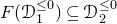 $F(\mathcal{D}_1^{\le 0})\subseteq \mathcal{D}_2^{\le 0}$
(respectively
$F(\mathcal{D}_1^{\le 0})\subseteq \mathcal{D}_2^{\le 0}$
(respectively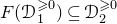 $F(\mathcal{D}_1^{\geqslant 0})\subseteq \mathcal{D}_2^{\geqslant 0}$
). We say that
$F(\mathcal{D}_1^{\geqslant 0})\subseteq \mathcal{D}_2^{\geqslant 0}$
). We say that $F$
has t-amplitude
$F$
has t-amplitude $[a,b]$
if
$[a,b]$
if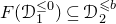 $F(\mathcal{D}_1^{\le 0})\subseteq \mathcal{D}_2^{\leqslant b}$
and
$F(\mathcal{D}_1^{\le 0})\subseteq \mathcal{D}_2^{\leqslant b}$
and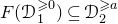 $F(\mathcal{D}_1^{\geqslant 0})\subseteq \mathcal{D}_2^{\geqslant a}$
.
$F(\mathcal{D}_1^{\geqslant 0})\subseteq \mathcal{D}_2^{\geqslant a}$
.
Theorem 2.8 (See [Reference Beilinson, Bernstein and DeligneBBD82]). Let $f:X\to Y$
be a morphism between algebraic varieties with fibres of dimension
$f:X\to Y$
be a morphism between algebraic varieties with fibres of dimension $\leqslant d$
. Then (for the perverse t-structure on
$\leqslant d$
. Then (for the perverse t-structure on $D^b_c(\mathbb{Q}_X)$
or the standard t-structure on
$D^b_c(\mathbb{Q}_X)$
or the standard t-structure on $D^b{\rm MHM}(X)$
):
$D^b{\rm MHM}(X)$
):
-
(i)
$f_!,f^*$
have t-amplitude
$\leqslant d$
, meaning that
$f_![d],f^*[d]$
are right t-exact; and
-
(ii)
$f_*,f^!$
have t-amplitude
$\geqslant -d$
, meaning that
$f_*[-d],f^![-d]$
are left t-exact.



If $f$
is affine, then
$f$
is affine, then $f_*$
is right t-exact and
$f_*$
is right t-exact and $f_!$
is left t-exact.
$f_!$
is left t-exact.
An exact functor $F:\mathcal{D}_1\to \mathcal{D}_2$
between mixed t-categories is called right (respectively left) w-exact if
$F:\mathcal{D}_1\to \mathcal{D}_2$
between mixed t-categories is called right (respectively left) w-exact if $F(\mathcal{D}_{1,\le 0})\subseteq \mathcal{D}_{2,\le 0}$
(respectively
$F(\mathcal{D}_{1,\le 0})\subseteq \mathcal{D}_{2,\le 0}$
(respectively $F(\mathcal{D}_{1,\geqslant 0})\subseteq \mathcal{D}_{2,\geqslant 0}$
). The following result is Deligne’s generalization of Weil’s conjectures in the
$F(\mathcal{D}_{1,\geqslant 0})\subseteq \mathcal{D}_{2,\geqslant 0}$
). The following result is Deligne’s generalization of Weil’s conjectures in the $\ell$
-adic context [Reference DeligneDel80] and Saito’s theorem in the
$\ell$
-adic context [Reference DeligneDel80] and Saito’s theorem in the ${\rm MHM}$
context [Reference SaitoSai90].
${\rm MHM}$
context [Reference SaitoSai90].
Theorem 2.9 (See [Reference DeligneDel80, Reference SaitoSai90]). Let $f:X\to Y$
be a morphism between algebraic varieties. Then:
$f:X\to Y$
be a morphism between algebraic varieties. Then:
-
(i)
$f_!,f^*$
are right w-exact; and
-
(ii)
$f_*,f^!$
are left w-exact.


Remark 2.10. The external tensor product [Reference SaitoSai90]
 \begin{align*}\boxtimes :{\rm MHM}(X)\times {\rm MHM}(Y)\to {\rm MHM}(X\times Y)\end{align*}
is w-exact, meaning that if $M\in {\rm MHM}(X)$
and
$M\in {\rm MHM}(X)$
and $N\in {\rm MHM}(Y)$
are pure, then
$N\in {\rm MHM}(Y)$
are pure, then $M\boxtimes N$
is pure of weight
$M\boxtimes N$
is pure of weight $w(M)+w(N)$
. The induced external tensor product on the derived categories is automatically t-exact (and w-exact). On the other hand, the tensor product
$w(M)+w(N)$
. The induced external tensor product on the derived categories is automatically t-exact (and w-exact). On the other hand, the tensor product $\otimes ^*$
on
$\otimes ^*$
on $D^b{\rm MHM}(X)$
, defined by
$D^b{\rm MHM}(X)$
, defined by $M\otimes ^* N=\Delta ^*(M\boxtimes N)$
for the diagonal
$M\otimes ^* N=\Delta ^*(M\boxtimes N)$
for the diagonal $\Delta :X\to X\times X$
, is right t-exact and right w-exact (cf. [Reference Beilinson, Bernstein and DeligneBBD82, 5.1.14]). The duality functor
$\Delta :X\to X\times X$
, is right t-exact and right w-exact (cf. [Reference Beilinson, Bernstein and DeligneBBD82, 5.1.14]). The duality functor $\mathbb{D}:{\rm MHM}(X)\to {\rm MHM}(X)^{{\rm op}}$
maps objects of weight
$\mathbb{D}:{\rm MHM}(X)\to {\rm MHM}(X)^{{\rm op}}$
maps objects of weight $n$
to objects of weight
$n$
to objects of weight $-n$
(actually
$-n$
(actually $\mathbb{D} M\simeq M(n)$
for any pure object
$\mathbb{D} M\simeq M(n)$
for any pure object $M$
of weight
$M$
of weight $n$
).
$n$
).
2.3 Mixed Hodge modules
For an algebraic variety $X$
over
$X$
over $\mathbb{C}$
, let
$\mathbb{C}$
, let $d_X=\dim X$
denote the maximal dimension of its irreducible components. Let
$d_X=\dim X$
denote the maximal dimension of its irreducible components. Let ${\rm MHM}(X)$
be the category of mixed Hodge modules over
${\rm MHM}(X)$
be the category of mixed Hodge modules over $X$
. Let
$X$
. Let $D^b_c(\mathbb{Q}_X)$
be the derived category of bounded
$D^b_c(\mathbb{Q}_X)$
be the derived category of bounded $\mathbb{Q}$
-complexes with constructible cohomology, and let
$\mathbb{Q}$
-complexes with constructible cohomology, and let ${\rm Perv}(\mathbb{Q}_X)\subset D^b_c(\mathbb{Q}_X)$
be the subcategory of perverse sheaves. The exact functor
${\rm Perv}(\mathbb{Q}_X)\subset D^b_c(\mathbb{Q}_X)$
be the subcategory of perverse sheaves. The exact functor ${\rm rat}:D^b{\rm MHM}(X)\to D^b_c(\mathbb{Q}_X)$
maps
${\rm rat}:D^b{\rm MHM}(X)\to D^b_c(\mathbb{Q}_X)$
maps ${\rm MHM}(X)$
to
${\rm MHM}(X)$
to ${\rm Perv}(\mathbb{Q}_X)$
and is compatible with Grothendieck’s six operations on both sides. We have
${\rm Perv}(\mathbb{Q}_X)$
and is compatible with Grothendieck’s six operations on both sides. We have ${\rm MHM}({\bf pt})={\rm MHS}^p(\mathbb{Q})$
, the category of (graded-)polarizable mixed
${\rm MHM}({\bf pt})={\rm MHS}^p(\mathbb{Q})$
, the category of (graded-)polarizable mixed $\mathbb{Q}$
-Hodge structures.
$\mathbb{Q}$
-Hodge structures.
Let $\mathbb{Q}(n)\in {\rm MHM}({\bf pt})$
be the Tate object of weight
$\mathbb{Q}(n)\in {\rm MHM}({\bf pt})$
be the Tate object of weight $-2n$
for
$-2n$
for $n\in \mathbb{Z}$
. It induces the Tate twist functor
$n\in \mathbb{Z}$
. It induces the Tate twist functor ${\rm MHM}(X)\to {\rm MHM}(X)$
,
${\rm MHM}(X)\to {\rm MHM}(X)$
, $M\mapsto M(n)=M\otimes \mathbb{Q}(n)$
. We consider the Lefschetz object
$M\mapsto M(n)=M\otimes \mathbb{Q}(n)$
. We consider the Lefschetz object
 \begin{align} \mathbb{L}=H^*_c(\mathbb{A}^1,\mathbb{Q})=\mathbb{Q}(-1)[-2]\in D^b{\rm MHM}({\bf pt}) \end{align}
of weight $0$
and the corresponding functor
$0$
and the corresponding functor
 \begin{align} \mathbb{L}:D^b{\rm MHM}(X)\to D^b{\rm MHM}(X),\quad M\mapsto M(-1)[-2]. \end{align}
Note that $H^*_c(\mathbb{P}^n,\mathbb{Q})=\mathbb{Q}\oplus \mathbb{L}\oplus \dots \oplus \mathbb{L}^n$
for
$H^*_c(\mathbb{P}^n,\mathbb{Q})=\mathbb{Q}\oplus \mathbb{L}\oplus \dots \oplus \mathbb{L}^n$
for $n\geqslant 0$
.
$n\geqslant 0$
.
In what follows, we will require the class $\mathbb{L}^{1/2}$
at the level of Grothendieck groups (see Section 2.4), but it will also be convenient to have a related object at the level of categories. We have two approaches to this problem. The first one is to embed
$\mathbb{L}^{1/2}$
at the level of Grothendieck groups (see Section 2.4), but it will also be convenient to have a related object at the level of categories. We have two approaches to this problem. The first one is to embed ${\rm MHM}(X)$
into the category of monodromic mixed Hodge modules
${\rm MHM}(X)$
into the category of monodromic mixed Hodge modules ${\rm MMHM}(X)$
(see [Reference Kontsevich and SoibelmanKS11, Reference Davison and MeinhardtDM20]), so that one has the objects
${\rm MMHM}(X)$
(see [Reference Kontsevich and SoibelmanKS11, Reference Davison and MeinhardtDM20]), so that one has the objects $\mathbb{Q}(1/2)\in {\rm MMHM}({\bf pt})$
and
$\mathbb{Q}(1/2)\in {\rm MMHM}({\bf pt})$
and $\mathbb{L}^{1/2}=\mathbb{Q}(-1/2)[-1]\in D^b{\rm MMHM}({\bf pt})$
and the corresponding twist functors. The second approach is to construct the root category
$\mathbb{L}^{1/2}=\mathbb{Q}(-1/2)[-1]\in D^b{\rm MMHM}({\bf pt})$
and the corresponding twist functors. The second approach is to construct the root category $\mathcal{A}^{1/2}$
and the functor
$\mathcal{A}^{1/2}$
and the functor $\mathbb{T}^{1/2}=\mathbb{Q}(1/2):\mathcal{A}^{1/2}\to \mathcal{A}^{1/2}$
for the category
$\mathbb{T}^{1/2}=\mathbb{Q}(1/2):\mathcal{A}^{1/2}\to \mathcal{A}^{1/2}$
for the category $\mathcal{A}={\rm MHM}(X)$
and the functor
$\mathcal{A}={\rm MHM}(X)$
and the functor $\mathbb{T}=\mathbb{Q}(1):\mathcal{A}\to \mathcal{A}$
. More generally, we construct the root category
$\mathbb{T}=\mathbb{Q}(1):\mathcal{A}\to \mathcal{A}$
. More generally, we construct the root category $\mathcal{A}^{1/r}$
and the functor
$\mathcal{A}^{1/r}$
and the functor $\mathbb{T}^{1/r}:\mathcal{A}^{1/r}\to \mathcal{A}^{1/r}$
for any
$\mathbb{T}^{1/r}:\mathcal{A}^{1/r}\to \mathcal{A}^{1/r}$
for any $r\geqslant 1$
as follows. We define
$r\geqslant 1$
as follows. We define $\mathcal{A}^{1/r}=\bigoplus _{i=0}^{r-1}\mathcal{A}^{(i)}$
with
$\mathcal{A}^{1/r}=\bigoplus _{i=0}^{r-1}\mathcal{A}^{(i)}$
with $\mathcal{A}^{{(i)}}=\mathcal{A}$
and the functor
$\mathcal{A}^{{(i)}}=\mathcal{A}$
and the functor $\mathbb{T}^{1/r}$
sending
$\mathbb{T}^{1/r}$
sending $\mathcal{A}^{(i)}\ni M\mapsto M\in \mathcal{A}^{(i+1)}$
for
$\mathcal{A}^{(i)}\ni M\mapsto M\in \mathcal{A}^{(i+1)}$
for $0\leqslant i\lt r-1$
and
$0\leqslant i\lt r-1$
and $\mathcal{A}^{(r-1)}\ni M\mapsto \mathbb{T} M\in \mathcal{A}^{(0)}$
. We embed
$\mathcal{A}^{(r-1)}\ni M\mapsto \mathbb{T} M\in \mathcal{A}^{(0)}$
. We embed $\mathcal{A}=\mathcal{A}^{(0)}\hookrightarrow \mathcal{A}^{1/r}$
so that
$\mathcal{A}=\mathcal{A}^{(0)}\hookrightarrow \mathcal{A}^{1/r}$
so that $(\mathbb{T}^{1/r})^r=\mathbb{T}$
. The weight of
$(\mathbb{T}^{1/r})^r=\mathbb{T}$
. The weight of $M\in \mathcal{A}^{(i)}\subset \mathcal{A}^{1/2}$
is defined to be
$M\in \mathcal{A}^{(i)}\subset \mathcal{A}^{1/2}$
is defined to be $w(M)-i$
(if
$w(M)-i$
(if $M\in \mathcal{A}$
is pure) so that
$M\in \mathcal{A}$
is pure) so that $\mathbb{T}^{1/2}$
has weight
$\mathbb{T}^{1/2}$
has weight $-1$
and
$-1$
and $\mathbb{T}=\mathbb{Q}(1)$
has weight
$\mathbb{T}=\mathbb{Q}(1)$
has weight $-2$
as before. We can also define the functor
$-2$
as before. We can also define the functor $\mathbb{Q}(n/2)$
for any
$\mathbb{Q}(n/2)$
for any $n\in \mathbb{Z}$
. The same construction can be applied to
$n\in \mathbb{Z}$
. The same construction can be applied to $D^b{\rm MHM}(X)$
and we define
$D^b{\rm MHM}(X)$
and we define $\mathbb{L}^{1/2}=\mathbb{Q}(-1/2)[-1]$
. By abuse of notation we will continue to write
$\mathbb{L}^{1/2}=\mathbb{Q}(-1/2)[-1]$
. By abuse of notation we will continue to write ${\rm MHM}(X)$
instead of
${\rm MHM}(X)$
instead of ${\rm MHM}(X)^{1/2}$
. We define
${\rm MHM}(X)^{1/2}$
. We define
 \begin{align} M\left \langle n\right \rangle =M(n/2)[n]=\mathbb{L}^{-n/2}M,\qquad M\in D^b{\rm MHM}(X). \end{align}
Note that the weight of $M\left \langle n\right \rangle$
is equal to the weight of
$M\left \langle n\right \rangle$
is equal to the weight of $M$
.
$M$
.
Let $X$
be an irreducible algebraic variety of dimension
$X$
be an irreducible algebraic variety of dimension $d$
. The object
$d$
. The object
 \begin{align*}\mathbb{Q}_X=a_X^*\mathbb{Q}\in D^b{\rm MHM}(X),\quad a_X:X\to {\bf pt},\end{align*}
has weight $\le 0$
. If
$\le 0$
. If $X$
is smooth, then
$X$
is smooth, then $\mathbb{Q}_X$
has weight 0 and
$\mathbb{Q}_X$
has weight 0 and $\mathbb{Q}_X[d]\in {\rm MHM}(X)$
. Generally, we define the intersection complex
$\mathbb{Q}_X[d]\in {\rm MHM}(X)$
. Generally, we define the intersection complex
 \begin{align} {\bf IC}_X =j_{!*}(\mathbb{Q}_U\left \langle d\right \rangle )\in {\rm MHM}(X), \end{align}
where $j:U\hookrightarrow X$
is an embedding of a nonempty, open, smooth subvariety and
$j:U\hookrightarrow X$
is an embedding of a nonempty, open, smooth subvariety and
 \begin{align} j_{!*}(M)=\Im ({}^{{\rm p}}j_! M\to {}^{{\rm p}}j_* M)\in {\rm MHM}(X),\quad M\in {\rm MHM}(U). \end{align}
The object ${\bf IC}_X$
is self-dual (meaning that
${\bf IC}_X$
is self-dual (meaning that $\mathbb{D}{\bf IC}_X\simeq {\bf IC}_X$
) and has weight
$\mathbb{D}{\bf IC}_X\simeq {\bf IC}_X$
) and has weight $0$
. The object
$0$
. The object ${\rm IC}_X={\rm rat}({\bf IC}_X)$
is the perverse intersection complex in
${\rm IC}_X={\rm rat}({\bf IC}_X)$
is the perverse intersection complex in ${\rm Perv}(\mathbb{Q}_X)$
. We define the intersection cohomology
${\rm Perv}(\mathbb{Q}_X)$
. We define the intersection cohomology
 \begin{align} {\rm IH}^*(X,\mathbb{Q}) =H^*(X,{\bf IC}_X\left \langle -d\right \rangle ) \end{align}
so that ${\rm IH}^*(X,\mathbb{Q})=H^*(X,\mathbb{Q})$
for smooth
${\rm IH}^*(X,\mathbb{Q})=H^*(X,\mathbb{Q})$
for smooth $X$
.
$X$
.
Remark 2.11. Some authors define the intersection complex ${\bf IC}'_X=j_{!*}(\mathbb{Q}_U[d])\in {\rm MHM}(X)$
. It is pure of weight
${\bf IC}'_X=j_{!*}(\mathbb{Q}_U[d])\in {\rm MHM}(X)$
. It is pure of weight $d$
and satisfies
$d$
and satisfies $\mathbb{D}{\bf IC}'_X\simeq {\bf IC}'_X(d)$
(the same is true for any pure object of weight
$\mathbb{D}{\bf IC}'_X\simeq {\bf IC}'_X(d)$
(the same is true for any pure object of weight $d$
). One has
$d$
). One has ${\bf IC}'_X={\rm Gr}^W_d H^d\mathbb{Q}_X$
[Reference SaitoSai89], where
${\bf IC}'_X={\rm Gr}^W_d H^d\mathbb{Q}_X$
[Reference SaitoSai89], where $H^d$
is the
$H^d$
is the $d$
th cohomology in
$d$
th cohomology in $D^b{\rm MHM}(X)$
.
$D^b{\rm MHM}(X)$
.
2.4 Degrees
For a graded abelian group $V=\bigoplus _{i\in \mathbb{Z}}V_i$
and
$V=\bigoplus _{i\in \mathbb{Z}}V_i$
and $x=\sum _{i\in \mathbb{Z}} x_i\in V$
with
$x=\sum _{i\in \mathbb{Z}} x_i\in V$
with $x_i\in V_i$
, let
$x_i\in V_i$
, let
 \begin{align} \deg (x)=\sup \left \{i\,\middle |\,x_i\ne 0\right \}\in \mathbb{Z}\sqcup \left \{-\infty \right \}. \end{align}
If $n=\deg (x)$
is finite, we call
$n=\deg (x)$
is finite, we call $x_n$
the leading term of
$x_n$
the leading term of $x$
. If
$x$
. If $A$
is a graded integral domain and
$A$
is a graded integral domain and $V$
is a graded torsion-free
$V$
is a graded torsion-free $A$
-module, then
$A$
-module, then
 \begin{align} \deg (ax)=\deg (a)+\deg (x)\quad \forall a\in A,\, x\in V. \end{align}
We extend the degree map to $\mathcal{F}(A)\otimes _A V$
, where
$\mathcal{F}(A)\otimes _A V$
, where $\mathcal{F}(A)$
is the fraction field of
$\mathcal{F}(A)$
is the fraction field of $A$
, by the formula
$A$
, by the formula
 \begin{align} \deg (x/a)=\deg (x)-\deg (a)\quad \forall a\in A\backslash \left \{0\right \},\, x\in V. \end{align}
For an abelian category $\mathcal{A}$
(respectively a triangulated category
$\mathcal{A}$
(respectively a triangulated category $\mathcal{D}$
), let
$\mathcal{D}$
), let $K(\mathcal{A})$
(respectively
$K(\mathcal{A})$
(respectively $K(\mathcal{D})$
) denote its Grothendieck group. Let
$K(\mathcal{D})$
) denote its Grothendieck group. Let $[M]\in K(\mathcal{D})$
denote the class of
$[M]\in K(\mathcal{D})$
denote the class of $M\in \mathcal{D}$
. If
$M\in \mathcal{D}$
. If $\mathcal{D}$
is a bounded t-category with the heart
$\mathcal{D}$
is a bounded t-category with the heart $\mathcal{A}$
, then the canonical map
$\mathcal{A}$
, then the canonical map $K(\mathcal{A})\to K(\mathcal{D})$
is an isomorphism. If
$K(\mathcal{A})\to K(\mathcal{D})$
is an isomorphism. If $\mathcal{D}$
is a mixed t-category with the heart
$\mathcal{D}$
is a mixed t-category with the heart $\mathcal{A}$
, then the Grothendieck group
$\mathcal{A}$
, then the Grothendieck group $K(\mathcal{A})\simeq K(\mathcal{D})$
is graded, where we define
$K(\mathcal{A})\simeq K(\mathcal{D})$
is graded, where we define $\deg [M]=n$
for a pure object
$\deg [M]=n$
for a pure object $M\in \mathcal{A}$
of weight
$M\in \mathcal{A}$
of weight $n$
. If
$n$
. If $\mathcal{A}$
is of finite length and
$\mathcal{A}$
is of finite length and $C_n$
denotes the set of isomorphism classes of simple objects in
$C_n$
denotes the set of isomorphism classes of simple objects in $\mathcal{A}_n$
, then
$\mathcal{A}_n$
, then $K(\mathcal{A})\simeq \bigoplus _{n\in \mathbb{Z}}\mathbb{Z} C_n$
.
$K(\mathcal{A})\simeq \bigoplus _{n\in \mathbb{Z}}\mathbb{Z} C_n$
.
In particular, the Grothendieck group $K({\rm MHM}(X))\simeq K(D^b{\rm MHM}(X))$
is a graded module over the graded ring
$K({\rm MHM}(X))\simeq K(D^b{\rm MHM}(X))$
is a graded module over the graded ring $K({\rm MHM}({\bf pt}))$
(cf. Section 3.3). Let
$K({\rm MHM}({\bf pt}))$
(cf. Section 3.3). Let
 \begin{align} \mathbb{L}=[H_c^*(\mathbb{A}^1,\mathbb{Q})]=[\mathbb{Q}(-1)]\in K({\rm MHM}({\bf pt})){\rm and} \end{align}
 \begin{align} \mathbf K({\rm MHM}(X))=K({\rm MHM}(X))\otimes _{\mathbb{Z}[\mathbb{L}]}\mathbb{Z}[\mathbb{L}^{\pm 1/2},(1-\mathbb{L}^n)^{-1}\mid n\geqslant 1]. \end{align}
Note that $\mathbb{L}$
has degree
$\mathbb{L}$
has degree $2$
. We extend the degree function to
$2$
. We extend the degree function to $\mathbf K({\rm MHM}(X))$
so that
$\mathbf K({\rm MHM}(X))$
so that $\mathbb{L}^{1/2}$
has degree
$\mathbb{L}^{1/2}$
has degree $1$
. For
$1$
. For $M\in D^b({\rm MHM}(X))$
, let
$M\in D^b({\rm MHM}(X))$
, let $\deg (M)=\deg [M]$
. For example,
$\deg (M)=\deg [M]$
. For example, $\deg (\mathbb{Q}[n])=0$
, while
$\deg (\mathbb{Q}[n])=0$
, while $w(\mathbb{Q}[n])=n$
for
$w(\mathbb{Q}[n])=n$
for $n\in \mathbb{Z}$
. The duality functor
$n\in \mathbb{Z}$
. The duality functor $\mathbb{D}$
on
$\mathbb{D}$
on ${\rm MHM}(X)$
induces the group homomorphism
${\rm MHM}(X)$
induces the group homomorphism $\mathbb{D}:\mathbf K({\rm MHM}(X))\to \mathbf K({\rm MHM}(X))$
such that
$\mathbb{D}:\mathbf K({\rm MHM}(X))\to \mathbf K({\rm MHM}(X))$
such that $\mathbb{D}(\mathbb{L}^n a)=\mathbb{L}^{-n}\mathbb{D}(a)$
for
$\mathbb{D}(\mathbb{L}^n a)=\mathbb{L}^{-n}\mathbb{D}(a)$
for $n\in {\frac 12}\mathbb{Z}$
and
$n\in {\frac 12}\mathbb{Z}$
and $a\in \mathbf K({\rm MHM}(X))$
. The class
$a\in \mathbf K({\rm MHM}(X))$
. The class $[{\bf IC}_X]\in \mathbf K({\rm MHM}(X))$
is self-dual (meaning that
$[{\bf IC}_X]\in \mathbf K({\rm MHM}(X))$
is self-dual (meaning that $\mathbb{D}[{\bf IC}_X]=[{\bf IC}_X]$
).
$\mathbb{D}[{\bf IC}_X]=[{\bf IC}_X]$
).
2.5 Decompositions
We say that an object $M\in {\rm MHM}(X)$
is supported on a locally closed subvariety
$M\in {\rm MHM}(X)$
is supported on a locally closed subvariety $Z\subseteq X$
if
$Z\subseteq X$
if $M=j_{!*}{}^{{\rm p}}j^*M$
for the embedding
$M=j_{!*}{}^{{\rm p}}j^*M$
for the embedding $j:Z\hookrightarrow X$
, meaning that the canonical map
$j:Z\hookrightarrow X$
, meaning that the canonical map $M\to {}^{{\rm p}}j_*{}^{{\rm p}}j^*M$
induces an isomorphism
$M\to {}^{{\rm p}}j_*{}^{{\rm p}}j^*M$
induces an isomorphism $M\xrightarrow {\sim } j_{!*}{}^{{\rm p}}j^*M\hookrightarrow {}^{{\rm p}}j_*{}^{{\rm p}}j^*M$
. For a simple object
$M\xrightarrow {\sim } j_{!*}{}^{{\rm p}}j^*M\hookrightarrow {}^{{\rm p}}j_*{}^{{\rm p}}j^*M$
. For a simple object $M$
, this means that
$M$
, this means that $Z$
contains a nonempty open subset of
$Z$
contains a nonempty open subset of $\textrm {supp} M$
. We say that
$\textrm {supp} M$
. We say that $M\in D^b{\rm MHM}(X)$
is supported on
$M\in D^b{\rm MHM}(X)$
is supported on $Z$
if every
$Z$
if every $H^iM$
is supported on
$H^iM$
is supported on $Z$
. In what follows, a partition of
$Z$
. In what follows, a partition of $X$
means a finite collection
$X$
means a finite collection $\mathcal{S}$
of locally closed subsets of
$\mathcal{S}$
of locally closed subsets of $X$
such that
$X$
such that $X=\bigsqcup _{S\in \mathcal{S}}S$
.
$X=\bigsqcup _{S\in \mathcal{S}}S$
.
Lemma 2.12.
Let $\mathcal{S}$
be a partition of an algebraic variety
$\mathcal{S}$
be a partition of an algebraic variety $X$
and
$X$
and $M\in {\rm MHM}(X)$
be a pure object. Then there is a unique decomposition
$M\in {\rm MHM}(X)$
be a pure object. Then there is a unique decomposition $M=\bigoplus _{S\in \mathcal{S}}M_S$
, where
$M=\bigoplus _{S\in \mathcal{S}}M_S$
, where $M_S$
is supported on
$M_S$
is supported on $S$
. We have
$S$
. We have $M_S=j_{S!*}{}^{{\rm p}}j_S^*M$
.
$M_S=j_{S!*}{}^{{\rm p}}j_S^*M$
.
Proof.
We can assume that $M$
is simple. There exists a smooth, irreducible, locally closed
$M$
is simple. There exists a smooth, irreducible, locally closed $U\subset X$
such that
$U\subset X$
such that $M=j_{!*}{}^{{\rm p}}j^*M$
for
$M=j_{!*}{}^{{\rm p}}j^*M$
for $j:U\hookrightarrow X$
. Let
$j:U\hookrightarrow X$
. Let $S\in \mathcal{S}$
be such that the dimension
$S\in \mathcal{S}$
be such that the dimension $d_{S\cap U}$
of
$d_{S\cap U}$
of $S\cap U$
is maximal. Then
$S\cap U$
is maximal. Then $S\cap U$
is open in
$S\cap U$
is open in $U$
. We can substitute
$U$
. We can substitute $U$
by
$U$
by $U\cap S$
and assume that
$U\cap S$
and assume that $U\subset S$
. Then
$U\subset S$
. Then $M=j_{S!*}{}^{{\rm p}}j_S^*M$
.
$M=j_{S!*}{}^{{\rm p}}j_S^*M$
.
To prove uniqueness, we need to show that ${}^{{\rm p}}j^*j_{!*}={\rm id}$
and
${}^{{\rm p}}j^*j_{!*}={\rm id}$
and ${}^{{\rm p}}i^*j_{!*}=0$
for two embeddings
${}^{{\rm p}}i^*j_{!*}=0$
for two embeddings $j:S\hookrightarrow X$
and
$j:S\hookrightarrow X$
and $i:T\hookrightarrow X$
such that
$i:T\hookrightarrow X$
such that $S\cap T=\varnothing$
. The first equation is clear. As
$S\cap T=\varnothing$
. The first equation is clear. As $j_{!*}N=\Im ({}^{{\rm p}}j_{!}N\to {}^{{\rm p}}j_{*}N)$
and
$j_{!*}N=\Im ({}^{{\rm p}}j_{!}N\to {}^{{\rm p}}j_{*}N)$
and ${}^{{\rm p}}i^*$
is right exact, it is enough to show that
${}^{{\rm p}}i^*$
is right exact, it is enough to show that ${}^{{\rm p}}i^*{}^{{\rm p}}j_{!}=0$
. We have
${}^{{\rm p}}i^*{}^{{\rm p}}j_{!}=0$
. We have ${}^{{\rm p}}i^*{}^{{\rm p}}j_{!}=\tau _{\geqslant 0}i^*\tau _{\geqslant 0}j_{!} =\tau _{\geqslant 0}i^*j_{!}=0$
as
${}^{{\rm p}}i^*{}^{{\rm p}}j_{!}=\tau _{\geqslant 0}i^*\tau _{\geqslant 0}j_{!} =\tau _{\geqslant 0}i^*j_{!}=0$
as $i^*j_{!}=0$
and
$i^*j_{!}=0$
and $\tau _{\geqslant 0}i^*\tau _{\geqslant 0}=\tau _{\geqslant 0}i^*$
.
$\tau _{\geqslant 0}i^*\tau _{\geqslant 0}=\tau _{\geqslant 0}i^*$
.
Lemma 2.13.
Let $\mathcal{S}$
be a partition of an algebraic variety
$\mathcal{S}$
be a partition of an algebraic variety $X$
and
$X$
and $M\in D^b{\rm MHM}(X)$
be a pure object. Then there is a decomposition
$M\in D^b{\rm MHM}(X)$
be a pure object. Then there is a decomposition $M=\bigoplus _{S\in \mathcal{S}}M_S$
, where
$M=\bigoplus _{S\in \mathcal{S}}M_S$
, where $M_S$
is supported on
$M_S$
is supported on $S$
. We have
$S$
. We have $M_S\simeq \bigoplus _i (j_{S!*}{}^{{\rm p}}j_S^*H^iM)[-i]$
.
$M_S\simeq \bigoplus _i (j_{S!*}{}^{{\rm p}}j_S^*H^iM)[-i]$
.
Proof.
Let $e_S=j_{S!*}{}^{{\rm p}}j^*_S$
and
$e_S=j_{S!*}{}^{{\rm p}}j^*_S$
and $\bar e_S(M)=\bigoplus _i (e_S H^iM)[-i]$
for
$\bar e_S(M)=\bigoplus _i (e_S H^iM)[-i]$
for $S\in \mathcal{S}$
. We have
$S\in \mathcal{S}$
. We have $e_S^2=e_S$
and
$e_S^2=e_S$
and $e_Se_T=0$
for
$e_Se_T=0$
for $S\ne T$
. Therefore
$S\ne T$
. Therefore $\bar e_S^2=\bar e_S$
and
$\bar e_S^2=\bar e_S$
and $\bar e_S\bar e_T=0$
for
$\bar e_S\bar e_T=0$
for $S\ne T$
. Using
$S\ne T$
. Using $M\simeq \bigoplus _i (H^iM)[-i]$
and applying the previous result to every
$M\simeq \bigoplus _i (H^iM)[-i]$
and applying the previous result to every $H^iM$
, we obtain
$H^iM$
, we obtain $M\simeq \bigoplus _S \bar e_S(M)$
. Let
$M\simeq \bigoplus _S \bar e_S(M)$
. Let $M=\bigoplus _S M_S$
be another decomposition with
$M=\bigoplus _S M_S$
be another decomposition with $M_S$
supported on
$M_S$
supported on $S$
. We have
$S$
. We have $\bar e_S (M_T)=0$
for
$\bar e_S (M_T)=0$
for $S\ne T$
, hence
$S\ne T$
, hence $\bar e_S(M)=\bar e_S(M_S)$
. By the same argument as before, we have
$\bar e_S(M)=\bar e_S(M_S)$
. By the same argument as before, we have $M_S\simeq \bigoplus _T \bar e_T(M_S)=\bar e_S(M_S)=\bar e_S(M)$
.
$M_S\simeq \bigoplus _T \bar e_T(M_S)=\bar e_S(M_S)=\bar e_S(M)$
.
2.6 Defects
Let $\pi :X\to Y$
be a projective morphism between algebraic varieties. For
$\pi :X\to Y$
be a projective morphism between algebraic varieties. For $i\in \mathbb{N}\sqcup \left \{-\infty \right \}$
, let
$i\in \mathbb{N}\sqcup \left \{-\infty \right \}$
, let $Y_i=\left \{y\in Y\,\middle |\,\dim \pi ^{-1}(y)=i\right \}$
(note that
$Y_i=\left \{y\in Y\,\middle |\,\dim \pi ^{-1}(y)=i\right \}$
(note that $\dim \varnothing =-\infty$
). The subsets
$\dim \varnothing =-\infty$
). The subsets $Y_{\leqslant k}=\bigsqcup _{i\leqslant k}Y_i$
are open in
$Y_{\leqslant k}=\bigsqcup _{i\leqslant k}Y_i$
are open in $Y$
. For a subvariety
$Y$
. For a subvariety $Z\subseteq Y$
, we define the (fibre) defect (cf. [Reference Goresky and MacPhersonGM88, Reference de Cataldo and MigliorinidCM03])
$Z\subseteq Y$
, we define the (fibre) defect (cf. [Reference Goresky and MacPhersonGM88, Reference de Cataldo and MigliorinidCM03])
 \begin{align} \delta (\pi ,Z)=\max \left \{2i+d_{Z\cap Y_i}-d_X\,\middle |\,i\geqslant 0\right \}. \end{align}
If $\mathcal{S}$
is a finite partition of
$\mathcal{S}$
is a finite partition of $Y$
such that the fibres of
$Y$
such that the fibres of $\pi$
over
$\pi$
over $S\in \mathcal{S}$
have dimension
$S\in \mathcal{S}$
have dimension $c_S$
, then
$c_S$
, then
 \begin{align} \delta (\pi ,Z)=\max _{S\in \mathcal{S}}{\delta (\pi ,Z\cap S)},\quad \delta (\pi ,Z\cap S)=2c_S+d_{Z\cap S}-d_X. \end{align}
Note that $\delta (\pi )=\delta (\pi ,Y)=d_{X\times _YX}-d_X\geqslant 0$
. A (surjective) morphism
$\delta (\pi )=\delta (\pi ,Y)=d_{X\times _YX}-d_X\geqslant 0$
. A (surjective) morphism $\pi$
is called semismall if
$\pi$
is called semismall if $\delta (\pi )=0$
and small if
$\delta (\pi )=0$
and small if $\delta (\pi )=0$
and
$\delta (\pi )=0$
and $\delta (\pi ,Y_i)=0$
only for
$\delta (\pi ,Y_i)=0$
only for $i=0$
.
$i=0$
.
Definition 2.14. A projective morphism $\pi :X\to Y$
is called
$\pi :X\to Y$
is called $n$
-small (or virtually small if
$n$
-small (or virtually small if $n$
is clear from the context) if there exists an open subset
$n$
is clear from the context) if there exists an open subset $U\subseteq Y$
such that
$U\subseteq Y$
such that $\delta (\pi ,Y\backslash U)\lt n$
and
$\delta (\pi ,Y\backslash U)\lt n$
and $U\subseteq Y_n$
. Note that
$U\subseteq Y_n$
. Note that $\delta (\pi )\leqslant n$
if
$\delta (\pi )\leqslant n$
if $\pi$
is
$\pi$
is $n$
-small.
$n$
-small.
Remark 2.15. If $\delta (\pi )\lt n$
, we can assume that the open set
$\delta (\pi )\lt n$
, we can assume that the open set $U$
above is empty. If
$U$
above is empty. If $\delta (\pi )=n$
, we can assume that
$\delta (\pi )=n$
, we can assume that $U$
is smooth and equidimensional (of dimension
$U$
is smooth and equidimensional (of dimension $d_X-n$
). If
$d_X-n$
). If $X$
is smooth, we can assume that
$X$
is smooth, we can assume that $\pi$
is smooth over
$\pi$
is smooth over $U$
.
$U$
.
Lemma 2.16.
If $\pi :X\to Y$
is a projective surjective morphism and
$\pi :X\to Y$
is a projective surjective morphism and $X$
,
$X$
, $Y$
are irreducible, then
$Y$
are irreducible, then $\pi :X\to Y$
is
$\pi :X\to Y$
is $n$
-small if and only if
$n$
-small if and only if $\delta (\pi ,Y_i)\lt n$
for
$\delta (\pi ,Y_i)\lt n$
for $i\ne n$
and
$i\ne n$
and $\delta (\pi ,Y_n)\leqslant n$
. If
$\delta (\pi ,Y_n)\leqslant n$
. If $\delta (\pi ,Y_n)=n$
, then
$\delta (\pi ,Y_n)=n$
, then $Y_n\subseteq Y$
is open and
$Y_n\subseteq Y$
is open and $n=d_X-d_Y$
.
$n=d_X-d_Y$
.
Proof.
Let $\pi$
be
$\pi$
be $n$
-small and
$n$
-small and $U\subseteq Y_n$
be such that
$U\subseteq Y_n$
be such that $\delta (\pi ,Y\backslash U)\lt n$
. Then
$\delta (\pi ,Y\backslash U)\lt n$
. Then $Y_i\subseteq Y\backslash U$
for
$Y_i\subseteq Y\backslash U$
for $i\ne n$
, hence
$i\ne n$
, hence $\delta (\pi ,Y_i)\lt n$
. We also have
$\delta (\pi ,Y_i)\lt n$
. We also have $\delta (\pi ,Y_n)\le \delta (\pi )\leqslant n$
. Conversely, assume that
$\delta (\pi ,Y_n)\le \delta (\pi )\leqslant n$
. Conversely, assume that $\delta (\pi ,Y_i)\lt n$
for
$\delta (\pi ,Y_i)\lt n$
for $i\ne n$
and
$i\ne n$
and $\delta (\pi ,Y_n)\leqslant n$
. If
$\delta (\pi ,Y_n)\leqslant n$
. If $\delta (\pi ,Y_n)\lt n$
, then
$\delta (\pi ,Y_n)\lt n$
, then $\delta (\pi )\lt n$
and we can take
$\delta (\pi )\lt n$
and we can take $U=\varnothing$
. If
$U=\varnothing$
. If $\delta (\pi ,Y_n)=n$
, then
$\delta (\pi ,Y_n)=n$
, then $d_X=n+d_{Y_n}=d_{\pi ^{-1}(Y_n)}$
, hence
$d_X=n+d_{Y_n}=d_{\pi ^{-1}(Y_n)}$
, hence $\pi ^{-1}(Y_n)\subseteq X$
is open. The subset
$\pi ^{-1}(Y_n)\subseteq X$
is open. The subset $\pi ^{-1}(Y_{\lt n})$
is also open, hence
$\pi ^{-1}(Y_{\lt n})$
is also open, hence $\pi ^{-1}(Y_{\lt n})=\varnothing$
and
$\pi ^{-1}(Y_{\lt n})=\varnothing$
and $Y_{\lt n}=\varnothing$
. Therefore
$Y_{\lt n}=\varnothing$
. Therefore $Y_n\subseteq Y$
is open and we can take
$Y_n\subseteq Y$
is open and we can take $U=Y_n$
. We have
$U=Y_n$
. We have $d_X=n+d_{Y_n}=n+d_Y$
, hence
$d_X=n+d_{Y_n}=n+d_Y$
, hence $n=d_X-d_Y$
.
$n=d_X-d_Y$
.
In what follows, let $\mathcal{D}$
denote the t-category
$\mathcal{D}$
denote the t-category $D^b{\rm MHM}(X)$
with the standard t-structure or the t-category
$D^b{\rm MHM}(X)$
with the standard t-structure or the t-category $D^b_c(\mathbb{Q}_X)$
with the perverse t-structure. These t-structures are compatible under the functor
$D^b_c(\mathbb{Q}_X)$
with the perverse t-structure. These t-structures are compatible under the functor ${\rm rat}:D^b{\rm MHM}(X)\to D^b_c(\mathbb{Q}_X)$
. For
${\rm rat}:D^b{\rm MHM}(X)\to D^b_c(\mathbb{Q}_X)$
. For $K\in D^b_c(\mathbb{Q}_X)$
, let
$K\in D^b_c(\mathbb{Q}_X)$
, let $\mathsf{H}^iK\in {\rm Sh}(\mathbb{Q}_X)$
denote the
$\mathsf{H}^iK\in {\rm Sh}(\mathbb{Q}_X)$
denote the $i$
th cohomology sheaf and
$i$
th cohomology sheaf and ${}^{{\rm p}}H^iK\in {\rm Perv}(\mathbb{Q}_X)$
denote the
${}^{{\rm p}}H^iK\in {\rm Perv}(\mathbb{Q}_X)$
denote the $i$
th cohomology object with respect to the perverse t-structure.
$i$
th cohomology object with respect to the perverse t-structure.
Lemma 2.17.
Let $M\in \mathcal{D}=D^b{\rm MHM} (Y)$
and
$M\in \mathcal{D}=D^b{\rm MHM} (Y)$
and $\mathcal{S}$
be a partition of
$\mathcal{S}$
be a partition of $Y$
such that
$Y$
such that $j_S^*M\in \mathcal{D}^{\leqslant n}$
for the embeddings
$j_S^*M\in \mathcal{D}^{\leqslant n}$
for the embeddings $j_S:S\hookrightarrow Y$
,
$j_S:S\hookrightarrow Y$
, $S\in \mathcal{S}$
. Then
$S\in \mathcal{S}$
. Then $M\in \mathcal{D}^{\leqslant n}$
.
$M\in \mathcal{D}^{\leqslant n}$
.
Proof.
Let $U\subseteq Y$
be open and
$U\subseteq Y$
be open and $j:U\hookrightarrow Y$
,
$j:U\hookrightarrow Y$
, $i:Y\backslash U\hookrightarrow Y$
be the corresponding embeddings. For every
$i:Y\backslash U\hookrightarrow Y$
be the corresponding embeddings. For every $M\in D^b{\rm MHM} (Y)$
there is a triangle
$M\in D^b{\rm MHM} (Y)$
there is a triangle $j_!j^*M\to M\to i_!i^*M\to$
. If
$j_!j^*M\to M\to i_!i^*M\to$
. If $i^*M\in \mathcal{D}^{\leqslant n}$
and
$i^*M\in \mathcal{D}^{\leqslant n}$
and $j^*M\in \mathcal{D}^{\leqslant n}$
, then
$j^*M\in \mathcal{D}^{\leqslant n}$
, then $M\in \mathcal{D}^{\leqslant n}$
as
$M\in \mathcal{D}^{\leqslant n}$
as $i_!,j_!$
are right t-exact. Given a partition, we can refine it so that it satisfies the frontier condition: if
$i_!,j_!$
are right t-exact. Given a partition, we can refine it so that it satisfies the frontier condition: if $S\cap \bar T\ne \varnothing$
, then
$S\cap \bar T\ne \varnothing$
, then $S\subseteq \bar T$
for
$S\subseteq \bar T$
for $S,T\in \mathcal{S}$
. Note that we still have
$S,T\in \mathcal{S}$
. Note that we still have $j^*_S M\in \mathcal{D}^{\leqslant n}$
for all
$j^*_S M\in \mathcal{D}^{\leqslant n}$
for all $S$
as the restriction functor is right exact. We can apply the previous argument inductively and deduce that
$S$
as the restriction functor is right exact. We can apply the previous argument inductively and deduce that $M\in \mathcal{D}^{\leqslant n}$
.
$M\in \mathcal{D}^{\leqslant n}$
.
Lemma 2.18.
Let $\pi :X\to Y$
be a projective morphism such that
$\pi :X\to Y$
be a projective morphism such that $X$
is smooth. For a locally closed embedding
$X$
is smooth. For a locally closed embedding $j:Z\hookrightarrow Y$
we have
$j:Z\hookrightarrow Y$
we have $j^*\pi _*{\bf IC}_X\in D^{\leqslant \delta (\pi ,Z)} {\rm MHM}(X)$
.
$j^*\pi _*{\bf IC}_X\in D^{\leqslant \delta (\pi ,Z)} {\rm MHM}(X)$
.
Proof.
By Lemma 2.17 we can assume that $Z\subset Y_k$
for some
$Z\subset Y_k$
for some $k\geqslant 0$
. Consider the following Cartesian square.
$k\geqslant 0$
. Consider the following Cartesian square.

An object $K\in D^b_c(\mathbb{Q}_X)$
is contained in
$K\in D^b_c(\mathbb{Q}_X)$
is contained in ${}^{{\rm p}}D^{\leqslant n}_c(\mathbb{Q}_X) \iff \dim (\textrm {supp} \mathsf{H}^iK)\leqslant -i+n$
for all
${}^{{\rm p}}D^{\leqslant n}_c(\mathbb{Q}_X) \iff \dim (\textrm {supp} \mathsf{H}^iK)\leqslant -i+n$
for all $i\in \mathbb{Z}$
. We have
$i\in \mathbb{Z}$
. We have $j^*\pi _*{\rm IC}_X=\pi '_*j'^*\mathbb{Q}_X[d_X]$
. The object
$j^*\pi _*{\rm IC}_X=\pi '_*j'^*\mathbb{Q}_X[d_X]$
. The object $K=j'^*\mathbb{Q}_X[d_X]$
satisfies
$K=j'^*\mathbb{Q}_X[d_X]$
satisfies $\dim (\textrm {supp} \mathsf{H}^iK)=d_{X'}=-i+(d_{X'}-d_X)$
for
$\dim (\textrm {supp} \mathsf{H}^iK)=d_{X'}=-i+(d_{X'}-d_X)$
for $i=-d_X$
and
$i=-d_X$
and $\mathsf{H}^i K=0$
otherwise. This implies that
$\mathsf{H}^i K=0$
otherwise. This implies that $K\in {}^{{\rm p}}D^{\leqslant d_{X'}-d_X}_c(\mathbb{Q}_X)$
. The functor
$K\in {}^{{\rm p}}D^{\leqslant d_{X'}-d_X}_c(\mathbb{Q}_X)$
. The functor $\pi '_*$
has amplitude
$\pi '_*$
has amplitude $[-k,k]$
. Therefore
$[-k,k]$
. Therefore $j^*\pi _*{\rm IC}_X =\pi '_*K \in {}^{{\rm p}}D^{\leqslant k+d_{X'}-d_X} ={}^{{\rm p}}D^{\le \delta (\pi ,Z)}(\mathbb{Q}_X).$
The functor
$j^*\pi _*{\rm IC}_X =\pi '_*K \in {}^{{\rm p}}D^{\leqslant k+d_{X'}-d_X} ={}^{{\rm p}}D^{\le \delta (\pi ,Z)}(\mathbb{Q}_X).$
The functor ${\rm rat}:D^b{\rm MHM}(X)\to D^b_c(\mathbb{Q}_X)$
sends
${\rm rat}:D^b{\rm MHM}(X)\to D^b_c(\mathbb{Q}_X)$
sends $j^*\pi _*{\bf IC}_X$
to
$j^*\pi _*{\bf IC}_X$
to $j^*\pi _*{\rm IC}_X$
and preserves t-structures, and hence
$j^*\pi _*{\rm IC}_X$
and preserves t-structures, and hence $j^*\pi _*{\bf IC}_X\in D^{\leqslant \delta (\pi ,Z)} {\rm MHM}(X)$
.
$j^*\pi _*{\bf IC}_X\in D^{\leqslant \delta (\pi ,Z)} {\rm MHM}(X)$
.
Lemma 2.19.
Let $f:X\to Y$
be a morphism between algebraic varieties and
$f:X\to Y$
be a morphism between algebraic varieties and $M\in \mathcal{D}=D^b{\rm MHM} (Y)$
be a pure object of weight
$M\in \mathcal{D}=D^b{\rm MHM} (Y)$
be a pure object of weight $0$
such that
$0$
such that $f^*M\in \mathcal{D}^{\leqslant n}$
. Then
$f^*M\in \mathcal{D}^{\leqslant n}$
. Then $\deg ({{}^{{\rm p}}f^*}H^iM)\leqslant n$
for all
$\deg ({{}^{{\rm p}}f^*}H^iM)\leqslant n$
for all $i\in \mathbb{Z}$
.
$i\in \mathbb{Z}$
.
Proof.
Since $M$
is pure, we have
$M$
is pure, we have $M\simeq \bigoplus _{i\in \mathbb{Z}}(H^iM)[-i]$
. Therefore,
$M\simeq \bigoplus _{i\in \mathbb{Z}}(H^iM)[-i]$
. Therefore, $f^*(H^iM)[-i]\in \mathcal{D}^{\leqslant n}$
and
$f^*(H^iM)[-i]\in \mathcal{D}^{\leqslant n}$
and $f^*(H^iM)\in \mathcal{D}^{\leqslant n-i}$
. If
$f^*(H^iM)\in \mathcal{D}^{\leqslant n-i}$
. If ${}^{{\rm p}}f^*(H^iM)\ne 0$
, then
${}^{{\rm p}}f^*(H^iM)\ne 0$
, then $i\leqslant n$
. As
$i\leqslant n$
. As $H^iM$
has weight
$H^iM$
has weight $i$
, the object
$i$
, the object ${}^{{\rm p}}f^*(H^iM)$
has weight at most
${}^{{\rm p}}f^*(H^iM)$
has weight at most $i\leqslant n$
.
$i\leqslant n$
.
Lemma 2.20.
Let $\pi :X\to Y$
be a projective morphism with smooth
$\pi :X\to Y$
be a projective morphism with smooth $X$
. Let
$X$
. Let $\mathcal{S}$
be a partition of
$\mathcal{S}$
be a partition of $Y$
and
$Y$
and $\pi _*{\bf IC}_X=\bigoplus _{S\in \mathcal{S}} M_S$
be a decomposition such that
$\pi _*{\bf IC}_X=\bigoplus _{S\in \mathcal{S}} M_S$
be a decomposition such that $M_S$
is supported on
$M_S$
is supported on $S$
. Then
$S$
. Then $\deg M_S\le \delta (\pi ,S)$
for all
$\deg M_S\le \delta (\pi ,S)$
for all $S\in \mathcal{S}$
.
$S\in \mathcal{S}$
.
Proof.
We have $M_S\simeq \bigoplus _i (j_{S!*}{}^{{\rm p}}j^*_S H^iM)[-i]$
for
$M_S\simeq \bigoplus _i (j_{S!*}{}^{{\rm p}}j^*_S H^iM)[-i]$
for $M=\pi _*{\bf IC}_X$
, and hence we need to show that
$M=\pi _*{\bf IC}_X$
, and hence we need to show that $\deg {}^{{\rm p}}j^*_SH^iM\le \delta (\pi ,S)$
. The object
$\deg {}^{{\rm p}}j^*_SH^iM\le \delta (\pi ,S)$
. The object $M$
is pure of weight
$M$
is pure of weight $0$
and by Lemma 2.18 we have
$0$
and by Lemma 2.18 we have $j^*_S M\in \mathcal{D}^{\le \delta (\pi ,S)}$
. By Lemma 2.19 we obtain
$j^*_S M\in \mathcal{D}^{\le \delta (\pi ,S)}$
. By Lemma 2.19 we obtain $\deg {}^{{\rm p}}j_S^* H^iM\le \delta (\pi ,S)$
.
$\deg {}^{{\rm p}}j_S^* H^iM\le \delta (\pi ,S)$
.
2.7 The leading term
If $\pi :X\to Y$
is a projective morphism and is a (topological) fibre bundle with all fibres irreducible and of dimension
$\pi :X\to Y$
is a projective morphism and is a (topological) fibre bundle with all fibres irreducible and of dimension $n$
, then (cf. [Reference Göttsche and SoergelGS93])
$n$
, then (cf. [Reference Göttsche and SoergelGS93])
 \begin{align} H^{n}\pi _*(\mathbb{Q}_X[d_X])\simeq \mathbb{Q}_Y[d_Y](-n). \end{align}
If $X$
and
$X$
and $Y$
are smooth (and irreducible), we obtain (cf. Appendix A)
$Y$
are smooth (and irreducible), we obtain (cf. Appendix A)
 \begin{align} H^n \pi _*{\bf IC}_X\simeq {\bf IC}_Y(-n/2). \end{align}
Theorem 2.21.
Let $\pi :X\to Y$
be an
$\pi :X\to Y$
be an $n$
-small morphism with
$n$
-small morphism with $X$
smooth, and let
$X$
smooth, and let $U\subseteq Y$
be a smooth equidimensional open subset such that
$U\subseteq Y$
be a smooth equidimensional open subset such that $\delta (\pi ,Y\backslash U)\lt n$
,
$\delta (\pi ,Y\backslash U)\lt n$
, $\delta (\pi ,U)=n$
, and the fibres of
$\delta (\pi ,U)=n$
, and the fibres of $\pi$
over
$\pi$
over $U$
are smooth, connected, and of dimension
$U$
are smooth, connected, and of dimension $n$
. Then
$n$
. Then $\pi _*{\bf IC}_X$
has degree
$\pi _*{\bf IC}_X$
has degree $n$
, and its leading term is
$n$
, and its leading term is ${\bf IC}_{\mkern 1.5mu\overline {\mkern -1.5muU\mkern -1.5mu}\mkern 1.5mu}\left \langle -n\right \rangle$
(see Section
2.4
).
${\bf IC}_{\mkern 1.5mu\overline {\mkern -1.5muU\mkern -1.5mu}\mkern 1.5mu}\left \langle -n\right \rangle$
(see Section
2.4
).
Proof.
Let $j:U\hookrightarrow Y$
and
$j:U\hookrightarrow Y$
and $i:Z=Y\backslash U\hookrightarrow Y$
be the embeddings. For
$i:Z=Y\backslash U\hookrightarrow Y$
be the embeddings. For $M=\pi _*{\bf IC}_X$
, we have
$M=\pi _*{\bf IC}_X$
, we have $M=M_U\oplus M_Z$
, where
$M=M_U\oplus M_Z$
, where $M_U\simeq \bigoplus _k(j_{!*}j^*H^kM)[-k]$
and
$M_U\simeq \bigoplus _k(j_{!*}j^*H^kM)[-k]$
and $M_Z\simeq \bigoplus _k(i_{!*}{}^{{\rm p}}i^*H^kM)[-k]$
. We have
$M_Z\simeq \bigoplus _k(i_{!*}{}^{{\rm p}}i^*H^kM)[-k]$
. We have $\deg (M_Z)\le \delta (\pi ,Z)\lt n$
by Lemma 2.20. On the other hand,
$\deg (M_Z)\le \delta (\pi ,Z)\lt n$
by Lemma 2.20. On the other hand, $j^*H^kM=H^k j^*M=H^k \pi '_*{\bf IC}_{X'}$
for
$j^*H^kM=H^k j^*M=H^k \pi '_*{\bf IC}_{X'}$
for $\pi ':X'=\pi ^{-1}(U)\to U$
. The object
$\pi ':X'=\pi ^{-1}(U)\to U$
. The object $H^k\pi '_*{\bf IC}_{X'}$
is zero for
$H^k\pi '_*{\bf IC}_{X'}$
is zero for $k\gt n$
and has degree
$k\gt n$
and has degree $\lt n$
for
$\lt n$
for $k\lt n$
. Morever, we have
$k\lt n$
. Morever, we have $H^n\pi '_*{\bf IC}_{X'}={\bf IC}_U(-n/2)$
, and hence the leading term of
$H^n\pi '_*{\bf IC}_{X'}={\bf IC}_U(-n/2)$
, and hence the leading term of $M_U$
is
$M_U$
is $(j_{!*}{\bf IC}_U(-n/2))[-n]={\bf IC}_{\mkern 1.5mu\overline {\mkern -1.5muU\mkern -1.5mu}\mkern 1.5mu}(-n/2)[-n]$
.
$(j_{!*}{\bf IC}_U(-n/2))[-n]={\bf IC}_{\mkern 1.5mu\overline {\mkern -1.5muU\mkern -1.5mu}\mkern 1.5mu}(-n/2)[-n]$
.
We prove the following well-known result (cf. [Reference Göttsche and SoergelGS93, Theorem 5]) for completeness.
Theorem 2.22.
Let $\pi :X\to Y$
be a semismall morphism with smooth
$\pi :X\to Y$
be a semismall morphism with smooth $X$
. Let
$X$
. Let $\mathcal{S}$
be a smooth partition of
$\mathcal{S}$
be a smooth partition of $Y$
such that
$Y$
such that $\pi$
is a (topological) fibre bundle with irreducible fibres over every
$\pi$
is a (topological) fibre bundle with irreducible fibres over every $S\in \mathcal{S}$
. Then
$S\in \mathcal{S}$
. Then $\pi _*{\bf IC}_X=\bigoplus _{\delta (\pi ,S)=0}{\bf IC}_{\bar S}$
.
$\pi _*{\bf IC}_X=\bigoplus _{\delta (\pi ,S)=0}{\bf IC}_{\bar S}$
.
Proof.
We have $M=\pi _*{\bf IC}_X\in \mathcal{D}^{\le 0}$
by Lemma 2.18. As
$M=\pi _*{\bf IC}_X\in \mathcal{D}^{\le 0}$
by Lemma 2.18. As $M$
is self-dual, we conclude that
$M$
is self-dual, we conclude that $M\in {\rm MHM}(X)$
. By Lemma 2.12 we have
$M\in {\rm MHM}(X)$
. By Lemma 2.12 we have $M=\bigoplus _S {}^{{\rm p}}j_{S!*}{}^{{\rm p}}j^*_S M$
. If
$M=\bigoplus _S {}^{{\rm p}}j_{S!*}{}^{{\rm p}}j^*_S M$
. If $\delta (\pi ,S)\lt 0$
, then
$\delta (\pi ,S)\lt 0$
, then $j_S^*M\in \mathcal{D}^{\lt 0}$
, and hence
$j_S^*M\in \mathcal{D}^{\lt 0}$
, and hence ${}^{{\rm p}}j_S^*M=0$
. Let us assume that
${}^{{\rm p}}j_S^*M=0$
. Let us assume that $\delta (\pi ,S)=0$
and let
$\delta (\pi ,S)=0$
and let $n=d_X-d_{X'}$
be the fibre dimension, where
$n=d_X-d_{X'}$
be the fibre dimension, where $X'=\pi ^{-1}(S)$
. Then
$X'=\pi ^{-1}(S)$
. Then
 \begin{align*} {}^{{\rm p}}j_S^*M =H^0(\pi '_{*}\mathbb{Q}_{X'}[d_X](d_X/2)) =H^{n}(\pi '_{*}\mathbb{Q}_{X'}[d_{X'}])(d_X/2) \simeq \mathbb{Q}_S[d_S](d_X/2-n)={\bf IC}_S, \end{align*}
where we applied (20) to $\pi ':X'\to S$
.
$\pi ':X'\to S$
.
3.
$\lambda$
-rings over commutative monoids

3.1 Pre-
$\lambda$
-rings of motivic functions

Let ${\rm Sch}={\rm Sch}_K$
be the category of algebraic schemes over a field
${\rm Sch}={\rm Sch}_K$
be the category of algebraic schemes over a field $K$
of characteristic zero, by which we mean schemes
$K$
of characteristic zero, by which we mean schemes $X$
equipped with a finite type morphism
$X$
equipped with a finite type morphism $a_X:X\to {\bf pt}={\bf Spec}(K)$
. For a scheme (or an Artin stack)
$a_X:X\to {\bf pt}={\bf Spec}(K)$
. For a scheme (or an Artin stack) $S$
locally of finite type over
$S$
locally of finite type over $K$
, let
$K$
, let ${\rm Sch}/ S$
be the category of morphisms
${\rm Sch}/ S$
be the category of morphisms $X\to S$
over
$X\to S$
over $K$
, where
$K$
, where $X\in {\rm Sch}$
. For a morphism
$X\in {\rm Sch}$
. For a morphism $f:S\to T$
we have the functor
$f:S\to T$
we have the functor
 \begin{align*}f_!:{\rm Sch}/ S\to {\rm Sch}/ T,\quad [X\to S]\mapsto [X\to S\to T].\end{align*}
If $f:S\to T$
is of finite type, then
$f:S\to T$
is of finite type, then $f_!$
has the right adjoint functor
$f_!$
has the right adjoint functor
 \begin{align*}f^*:{\rm Sch}/ T\to {\rm Sch}/ S,\quad [X\to T]\mapsto [X\times _T S\to S].\end{align*}
We also have the exterior product
 \begin{align*} \boxtimes :{\rm Sch}/ S\times {\rm Sch}/ T\to {\rm Sch}/ (S\times T),\qquad [X\to S]\boxtimes [Y\to T]=[X\times Y\to S\times T]. \end{align*}
Let $K({\rm Sch}/ S)$
be the Grothendieck group of algebraic schemes over
$K({\rm Sch}/ S)$
be the Grothendieck group of algebraic schemes over $S$
(see e.g. [Reference JoyceJoy07, Reference BridgelandBri12]). The above functors induce morphisms between Grothendieck groups. The Grothendieck group
$S$
(see e.g. [Reference JoyceJoy07, Reference BridgelandBri12]). The above functors induce morphisms between Grothendieck groups. The Grothendieck group $K({\rm Sch})=K({\rm Sch}/{\bf pt})$
has a commutative ring structure defined by
$K({\rm Sch})=K({\rm Sch}/{\bf pt})$
has a commutative ring structure defined by $[X]\cdot [Y]=[X\times Y]$
. The Grothendieck group
$[X]\cdot [Y]=[X\times Y]$
. The Grothendieck group $K({\rm Sch}/ S)$
is a module over
$K({\rm Sch}/ S)$
is a module over $K({\rm Sch})$
. We define (cf. (17))
$K({\rm Sch})$
. We define (cf. (17))
 \begin{align} \mathbb{L}=[\mathbb{A}^1]\in K({\rm Sch}),{\rm and} \end{align}
 \begin{align} \mathbf K({\rm Sch}/ S) =K({\rm Sch}/ S)\otimes _{\mathbb{Z}[\mathbb{L}]}\mathbb{Z}[\mathbb{L}^{\pm 1/2},(1-\mathbb{L}^n)^{-1}:n\geqslant 1]. \end{align}
In particular, the elements
 \begin{align} [\mathbb{P}^n]=\frac {1-\mathbb{L}^{n+1}}{1-\mathbb{L}},\quad [{\bf GL}_n]=\prod _{i=0}^{n-1}(\mathbb{L}^n-\mathbb{L}^i) \end{align}
are invertible in $\mathbf K({\rm Sch}/ {\bf pt})$
. Consider a morphism
$\mathbf K({\rm Sch}/ {\bf pt})$
. Consider a morphism $f:\mathcal{X}\to S$
, where
$f:\mathcal{X}\to S$
, where $\mathcal{X}$
is a finite type Artin stack with affine stabilizers. Then there exists an algebraic variety
$\mathcal{X}$
is a finite type Artin stack with affine stabilizers. Then there exists an algebraic variety $X$
with an action of the group
$X$
with an action of the group ${\bf GL}_n$
and a geometric bijection
${\bf GL}_n$
and a geometric bijection $X/{\bf GL}_n\to \mathcal{X}$
(see e.g. [Reference BridgelandBri12]). The class
$X/{\bf GL}_n\to \mathcal{X}$
(see e.g. [Reference BridgelandBri12]). The class
 \begin{align} [\mathcal{X}\to S]=[X\to \mathcal{X}\to S]/[{\bf GL}_n]\in \mathbf K({\rm Sch}/ S) \end{align}
depends only on the morphism $f$
(see e.g. [Reference BridgelandBri12]).
$f$
(see e.g. [Reference BridgelandBri12]).
Let $(S,\mu ,\eta )$
be a commutative monoid in the category of schemes (or Artin stacks) over
$(S,\mu ,\eta )$
be a commutative monoid in the category of schemes (or Artin stacks) over $K$
. We equip
$K$
. We equip ${\rm Sch}/ S$
with a symmetric monoidal structure having the tensor product
${\rm Sch}/ S$
with a symmetric monoidal structure having the tensor product
 \begin{align} [X\xrightarrow fS]\otimes [Y\xrightarrow gS]=\mu _!(f\boxtimes g) =[X\times Y\to S\times S\xrightarrow \mu S] \end{align}
and the unit object $\unicode {x1D7D9}=[{\bf pt}\xrightarrow \eta S]$
. This tensor product induces the ring structure on
$\unicode {x1D7D9}=[{\bf pt}\xrightarrow \eta S]$
. This tensor product induces the ring structure on $K({\rm Sch}/ S)$
. We equip
$K({\rm Sch}/ S)$
. We equip $K({\rm Sch}/ S)$
with a pre-
$K({\rm Sch}/ S)$
with a pre- $\lambda$
-ring structure having
$\lambda$
-ring structure having $\sigma$
-operations
$\sigma$
-operations
 \begin{align} \sigma ^n[X\to S]=[S^n(X)\to S^n(S)\xrightarrow \mu S],\quad n\geqslant 1, \end{align}
where $S^n(X)=X^n/S_n$
. We extend the pre-
$S^n(X)=X^n/S_n$
. We extend the pre- $\lambda$
-ring structure to
$\lambda$
-ring structure to $\mathbf K({\rm Sch}/ S)$
by the formula
$\mathbf K({\rm Sch}/ S)$
by the formula
 \begin{align} \sigma ^n(y^m a)=y^{mn}\sigma ^n(a),\quad y=-\mathbb{L}^{1/2},\ a\in \mathbf K({\rm Sch}/ S). \end{align}
In particular, ${\bf pt}$
is a commutative monoid, and hence
${\bf pt}$
is a commutative monoid, and hence $K({\rm Sch})$
and
$K({\rm Sch})$
and $\mathbf K({\rm Sch})$
are pre-
$\mathbf K({\rm Sch})$
are pre- $\lambda$
-rings. The maps
$\lambda$
-rings. The maps $\eta _!:K({\rm Sch})\to K({\rm Sch}/ S)$
and
$\eta _!:K({\rm Sch})\to K({\rm Sch}/ S)$
and $a_{S!}:K({\rm Sch}/ S)\to K({\rm Sch})$
(induced by the unit
$a_{S!}:K({\rm Sch}/ S)\to K({\rm Sch})$
(induced by the unit $\eta :{\bf pt}\to S$
and the projection
$\eta :{\bf pt}\to S$
and the projection $a_S:S\to {\bf pt}$
) are homomorphisms of pre-
$a_S:S\to {\bf pt}$
) are homomorphisms of pre- $\lambda$
-rings.
$\lambda$
-rings.
3.2 Graded pre-
$\lambda$
-rings and completions

More generally, let $\Lambda$
be a commutative monoid and
$\Lambda$
be a commutative monoid and $S=\bigsqcup _{\gamma \in \Lambda }S_{\gamma}$
be a
$S=\bigsqcup _{\gamma \in \Lambda }S_{\gamma}$
be a $\Lambda$
-graded commutative monoid in the category of schemes over
$\Lambda$
-graded commutative monoid in the category of schemes over $K$
. The pre-
$K$
. The pre- $\lambda$
-rings
$\lambda$
-rings $K({\rm Sch}/ S)=\bigoplus _{\gamma \in \Lambda }K({\rm Sch}/ S_{\gamma} )$
and
$K({\rm Sch}/ S)=\bigoplus _{\gamma \in \Lambda }K({\rm Sch}/ S_{\gamma} )$
and $\mathbf K({\rm Sch}/ S)=\bigoplus _{\gamma \in \Lambda }\mathbf K({\rm Sch}/ S_{\gamma} )$
are
$\mathbf K({\rm Sch}/ S)=\bigoplus _{\gamma \in \Lambda }\mathbf K({\rm Sch}/ S_{\gamma} )$
are $\Lambda$
-graded pre-
$\Lambda$
-graded pre- $\lambda$
-rings, meaning that
$\lambda$
-rings, meaning that
 \begin{align} \deg (ab)=\deg (a)+\deg (b),\quad \deg \sigma ^n(a)=n\deg a. \end{align}
In particular, we consider the commutative monoid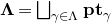 $\boldsymbol{\Lambda }=\bigsqcup _{\gamma \in \Lambda }{\bf pt}_{\gamma}$
with
$\boldsymbol{\Lambda }=\bigsqcup _{\gamma \in \Lambda }{\bf pt}_{\gamma}$
with ${\bf pt}_{\gamma} ={\bf Spec}(K)$
in the category of schemes over
${\bf pt}_{\gamma} ={\bf Spec}(K)$
in the category of schemes over $K$
. Then
$K$
. Then $K({\rm Sch}/\boldsymbol{\Lambda })=K({\rm Sch})[\Lambda ]=\bigoplus _{\gamma \in \Lambda }K({\rm Sch})t^\gamma$
is a
$K({\rm Sch}/\boldsymbol{\Lambda })=K({\rm Sch})[\Lambda ]=\bigoplus _{\gamma \in \Lambda }K({\rm Sch})t^\gamma$
is a $\Lambda$
-graded pre-
$\Lambda$
-graded pre- $\lambda$
-ring with the product and
$\lambda$
-ring with the product and $\sigma$
-operations
$\sigma$
-operations
 \begin{align*}[X]t^\gamma \cdot [Y]t^{\gamma '}=[X\times Y]t^{\gamma +\gamma '},\quad \sigma ^n([X]t^\gamma )=[S^nX]t^{n\gamma }.\end{align*}
The degree map
 \begin{align} \deg :S\to \boldsymbol{\Lambda },\quad S_{\gamma} \ni x\mapsto {\bf pt}_{\gamma} \end{align}
is a homomorphism of commutative monoids and induces a homomorphism of pre- $\lambda$
-rings
$\lambda$
-rings $\deg _!:K({\rm Sch}/ S)\to K({\rm Sch}/ \boldsymbol{\Lambda })=K({\rm Sch})[\Lambda ]$
.
$\deg _!:K({\rm Sch}/ S)\to K({\rm Sch}/ \boldsymbol{\Lambda })=K({\rm Sch})[\Lambda ]$
.
Assume that there exists a filtration $\Lambda =\Lambda _0\supseteq \Lambda _1\supseteq \dots$
such that
$\Lambda =\Lambda _0\supseteq \Lambda _1\supseteq \dots$
such that
 \begin{align} \Lambda _i+\Lambda _j\subseteq \Lambda _{i+j},\quad \left \lvert \Lambda \backslash \Lambda _i\right \rvert \lt \infty ,\quad \bigcap _{i\geqslant 0}\Lambda _i=\varnothing . \end{align}
For example, if $\Lambda \subseteq \mathbb{N}^n$
for some
$\Lambda \subseteq \mathbb{N}^n$
for some $n\geqslant 1$
, we can define
$n\geqslant 1$
, we can define $\Lambda _k=\left \{\gamma \in \Lambda \,\middle |\,\sum _{i=1}^n\gamma _i\geqslant k\right \}$
. For a
$\Lambda _k=\left \{\gamma \in \Lambda \,\middle |\,\sum _{i=1}^n\gamma _i\geqslant k\right \}$
. For a $\Lambda$
-graded ring
$\Lambda$
-graded ring $A=\bigoplus _{\gamma \in \Lambda }A_{\gamma}$
, we define its completion
$A=\bigoplus _{\gamma \in \Lambda }A_{\gamma}$
, we define its completion
 \begin{align} \widehat A=\varprojlim _k \left (A/\bigoplus \nolimits _{\gamma \in \Lambda _k}A_{\gamma} \right ) \simeq \prod \nolimits _{\gamma \in \Lambda }A_{\gamma} , \end{align}
where the last isomorphism is an isomorphism of abelian groups. In particular, the completion $\widehat {\mathbf K}({\rm Sch}/ S)\simeq \prod _{\gamma \in \Lambda }\mathbf K({\rm Sch}/ S_{\gamma} )$
inherits the structure of a pre-
$\widehat {\mathbf K}({\rm Sch}/ S)\simeq \prod _{\gamma \in \Lambda }\mathbf K({\rm Sch}/ S_{\gamma} )$
inherits the structure of a pre- $\lambda$
-ring. Let us assume that
$\lambda$
-ring. Let us assume that $\Lambda _1=\Lambda _+=\Lambda \backslash \left \{0\right \}$
, and consider the ideal
$\Lambda _1=\Lambda _+=\Lambda \backslash \left \{0\right \}$
, and consider the ideal $\widehat {\mathbf K_+}({\rm Sch}/ S)=\prod _{\gamma \in \Lambda _+}\mathbf K({\rm Sch}/ S_{\gamma} )$
. The plethystic exponential
$\widehat {\mathbf K_+}({\rm Sch}/ S)=\prod _{\gamma \in \Lambda _+}\mathbf K({\rm Sch}/ S_{\gamma} )$
. The plethystic exponential
 \begin{align} {\rm Exp}:\widehat {\mathbf K_+}({\rm Sch}/ S)\to 1+\widehat {\mathbf K_+}({\rm Sch}/ S),\quad a\mapsto \sum _{n\geqslant 0}\sigma ^n(a), \end{align}
where $\sigma^0(a)=1$
, is a group isomorphism (between the additive and the multiplicative groups).
$\sigma^0(a)=1$
, is a group isomorphism (between the additive and the multiplicative groups).
3.3
$\lambda$
-rings of mixed Hodge modules

Let $(S,\mu ,\eta )$
be a commutative monoid in the category of complex algebraic varieties such that the product
$(S,\mu ,\eta )$
be a commutative monoid in the category of complex algebraic varieties such that the product $\mu :S\times S\to S$
is a finite map. We will equip the category
$\mu :S\times S\to S$
is a finite map. We will equip the category ${\rm MHM}(S)$
with a symmetric monoidal structure in a similar way to the case of
${\rm MHM}(S)$
with a symmetric monoidal structure in a similar way to the case of ${\rm Sch}/ S$
considered earlier (see (26)).
${\rm Sch}/ S$
considered earlier (see (26)).
Theorem 3.1.
The category ${\rm MHM}(S)$
with the tensor product
${\rm MHM}(S)$
with the tensor product
 \begin{align*}\otimes :{\rm MHM}(S)\times {\rm MHM}(S)\to {\rm MHM}(S),\qquad E\otimes F=\mu _!(E\boxtimes F),\end{align*}
and the unit object $\unicode {x1D7D9}=\eta _!\mathbb{Q}$
is a symmetric monoidal category. The tensor product is exact and w-exact.
$\unicode {x1D7D9}=\eta _!\mathbb{Q}$
is a symmetric monoidal category. The tensor product is exact and w-exact.
Proof.
Let $\sigma :S\times S\to S\times S$
be the permutation of factors. By [Reference Maxim, Saito and SchürmannMSS11, Theorem 1.9] (applied to the variety
$\sigma :S\times S\to S\times S$
be the permutation of factors. By [Reference Maxim, Saito and SchürmannMSS11, Theorem 1.9] (applied to the variety $X=S\sqcup S$
), there exists a canonical isomorphism
$X=S\sqcup S$
), there exists a canonical isomorphism
 \begin{align*}\sigma ^\#:E\boxtimes F\to \sigma _*(F\boxtimes E)\end{align*}
satisfying $\sigma _*\sigma ^\#\circ \sigma ^\#=id$
. Applying the pushforward
$\sigma _*\sigma ^\#\circ \sigma ^\#=id$
. Applying the pushforward $\mu _!$
and using commutativity of the monoid, we obtain an isomorphism
$\mu _!$
and using commutativity of the monoid, we obtain an isomorphism $\sigma _{EF}:E\otimes F\to F\otimes E$
satisfying
$\sigma _{EF}:E\otimes F\to F\otimes E$
satisfying $\sigma _{EF}\circ \sigma _{FE}=id$
. This is the required braiding for the tensor product. We have
$\sigma _{EF}\circ \sigma _{FE}=id$
. This is the required braiding for the tensor product. We have $\unicode {x1D7D9}\otimes F =\mu _!(\eta _!\mathbb{Q}\boxtimes F) =\mu _!(\eta \times {\rm id})_!(\mathbb{Q}\boxtimes F)=F$
. The tensor product is exact (respectively w-exact) as both
$\unicode {x1D7D9}\otimes F =\mu _!(\eta _!\mathbb{Q}\boxtimes F) =\mu _!(\eta \times {\rm id})_!(\mathbb{Q}\boxtimes F)=F$
. The tensor product is exact (respectively w-exact) as both $\mu _!$
and
$\mu _!$
and $\boxtimes$
are exact (respectively w-exact).
$\boxtimes$
are exact (respectively w-exact).
The above tensor product $\otimes$
on
$\otimes$
on ${\rm MHM}(S)$
should not be confused with the tensor product
${\rm MHM}(S)$
should not be confused with the tensor product $\otimes ^*$
on
$\otimes ^*$
on $D^b{\rm MHM}(S)$
defined in Remark 2.10, which is only right w-exact.
$D^b{\rm MHM}(S)$
defined in Remark 2.10, which is only right w-exact.
Remark 3.2. Without the assumption that $\mu$
is finite, we can similarly equip the category
$\mu$
is finite, we can similarly equip the category $D^b{\rm MHM}(S)$
with a symmetric monoidal structure. There is a monoidal functor
$D^b{\rm MHM}(S)$
with a symmetric monoidal structure. There is a monoidal functor
 \begin{align} \chi _c:{\rm Sch}/ S\to D^b{\rm MHM}(S),\quad [X\xrightarrow fS]\mapsto f_!\mathbb{Q}_X. \end{align}
Let $\mathcal{A}={\rm MHM}(S)$
(or any other Karoubian symmetric monoidal category linear over
$\mathcal{A}={\rm MHM}(S)$
(or any other Karoubian symmetric monoidal category linear over $\mathbb{Q}$
). By [Reference GetzlerGet96, Reference HeinlothHei07], the split Grothendieck group
$\mathbb{Q}$
). By [Reference GetzlerGet96, Reference HeinlothHei07], the split Grothendieck group $\overline K(\mathcal{A})$
(with relations induced by direct sums) is a (special)
$\overline K(\mathcal{A})$
(with relations induced by direct sums) is a (special) $\lambda$
-ring, with the product and
$\lambda$
-ring, with the product and $\sigma$
-operations defined by
$\sigma$
-operations defined by
 \begin{align} [E]\cdot [F]=[E\otimes F], \end{align}
 \begin{align} \sigma ^n[E]=[S^n(E)],\quad S^n(E)=\Im \bigg (\frac 1{n!}\sum _{\sigma \in S_n}\sigma \bigg )\subseteq E^{\otimes n}, \end{align}
where $e=\frac 1{n!}\sum _{\sigma \in S_n}\sigma \in {\rm End}(E^{\otimes n})$
is an idempotent and
$e=\frac 1{n!}\sum _{\sigma \in S_n}\sigma \in {\rm End}(E^{\otimes n})$
is an idempotent and $\Im (e)$
is obtained by its splitting.
$\Im (e)$
is obtained by its splitting.
Remark 3.3. More generally, for any partition $\lambda \vdash n$
, let
$\lambda \vdash n$
, let $V_\lambda$
be the corresponding simple representation of the group
$V_\lambda$
be the corresponding simple representation of the group $S_n$
. We define the Schur functor (cf. [Reference DeligneDel02])
$S_n$
. We define the Schur functor (cf. [Reference DeligneDel02])
 \begin{align} S_\lambda :\mathcal{A}\to \mathcal{A},\quad E\mapsto {\rm Hom}_{S_n}(V_\lambda ,E^{\otimes n}), \end{align}
where we first construct ${\rm Hom}(V_\lambda ,E^{\otimes n})$
as a direct sum of
${\rm Hom}(V_\lambda ,E^{\otimes n})$
as a direct sum of $\dim V_\lambda$
copies of
$\dim V_\lambda$
copies of $E^{\otimes n}$
and then take the
$E^{\otimes n}$
and then take the $S_n$
-invariant subobject of
$S_n$
-invariant subobject of ${\rm Hom}(V_\lambda ,E^{\otimes n})$
by splitting the idempotent
${\rm Hom}(V_\lambda ,E^{\otimes n})$
by splitting the idempotent $e=\frac 1{n!}\sum _{\sigma \in S_n}\sigma$
. In particular, for the trivial representation we obtain
$e=\frac 1{n!}\sum _{\sigma \in S_n}\sigma$
. In particular, for the trivial representation we obtain $S^n(E)=S_{(n)}(E)$
and for the alternating representation we obtain
$S^n(E)=S_{(n)}(E)$
and for the alternating representation we obtain
 \begin{align} \Lambda ^n(E)=S_{(1^n)}(E)=\Im \bigg (\frac 1{n!}\sum _{\sigma \in S_n}(-1)^{\sigma }\sigma \bigg )\subseteq E^{\otimes n}. \end{align}
We have $s_\lambda [E]=[S_\lambda (E)]$
, where
$s_\lambda [E]=[S_\lambda (E)]$
, where $s_\lambda$
is the symmetric Schur function. In particular,
$s_\lambda$
is the symmetric Schur function. In particular, $\lambda ^n[E]=[\Lambda ^n(E)]$
.
$\lambda ^n[E]=[\Lambda ^n(E)]$
.
Theorem 3.4.
The $\lambda$
-ring structure on the split Grothendieck group
$\lambda$
-ring structure on the split Grothendieck group $\overline K({\rm MHM}(S))$
descends to a
$\overline K({\rm MHM}(S))$
descends to a $\lambda$
-ring structure on
$\lambda$
-ring structure on $K({\rm MHM}(S))$
with the unit element
$K({\rm MHM}(S))$
with the unit element $1=[\eta _*\mathbb{Q}]$
. This
$1=[\eta _*\mathbb{Q}]$
. This $\lambda$
-ring is
$\lambda$
-ring is $\mathbb{Z}$
-graded (see
(29)
) by weight.
$\mathbb{Z}$
-graded (see
(29)
) by weight.
Proof.
The above product on $\overline K({\rm MHM}(S))$
descends to
$\overline K({\rm MHM}(S))$
descends to $K({\rm MHM}(S))$
as the tensor product is exact. The
$K({\rm MHM}(S))$
as the tensor product is exact. The $\lambda$
-structure descends to
$\lambda$
-structure descends to $K({\rm MHM}(S))$
by [Reference Maxim and SchürmannMS12, Lemma 2.1] and [Reference BiglariBig10, Lemma 4.1]. We have seen in Section 2.4 that
$K({\rm MHM}(S))$
by [Reference Maxim and SchürmannMS12, Lemma 2.1] and [Reference BiglariBig10, Lemma 4.1]. We have seen in Section 2.4 that $K({\rm MHM}(S))$
is a
$K({\rm MHM}(S))$
is a $\mathbb{Z}$
-graded abelian group. The product preserves degrees since the tensor product
$\mathbb{Z}$
-graded abelian group. The product preserves degrees since the tensor product $\otimes$
on
$\otimes$
on ${\rm MHM}(S)$
is w-exact. To see that the
${\rm MHM}(S)$
is w-exact. To see that the $\lambda$
-structure respects the grading (see (29)), we note that if
$\lambda$
-structure respects the grading (see (29)), we note that if $E\in {\rm MHM}(S)$
is pure of weight
$E\in {\rm MHM}(S)$
is pure of weight $m$
, then
$m$
, then $E^{\otimes n}$
is pure of weight
$E^{\otimes n}$
is pure of weight $mn$
and so is
$mn$
and so is $S^n(E)\subseteq E^{\otimes n}$
.
$S^n(E)\subseteq E^{\otimes n}$
.
The monoidal functor defined in (34) induces a morphism of pre- $\lambda$
-rings (cf. [Reference SchuermannSch09, Reference Maxim and SchürmannMS12])
$\lambda$
-rings (cf. [Reference SchuermannSch09, Reference Maxim and SchürmannMS12])
 \begin{align} \chi _c:K({\rm Sch}/ S)\to K({\rm MHM}(S)),\quad [X\xrightarrow fS]\mapsto [f_!\mathbb{Q}_X]. \end{align}
We extend the $\lambda$
-ring structure to
$\lambda$
-ring structure to $\mathbf K({\rm MHM}(S))$
using (28). Then
$\mathbf K({\rm MHM}(S))$
using (28). Then $\chi _c$
extends to a morphism of pre-
$\chi _c$
extends to a morphism of pre- $\lambda$
-rings
$\lambda$
-rings $\chi _c:\mathbf K({\rm Sch}/ S)\to \mathbf K({\rm MHM}(S))$
.
$\chi _c:\mathbf K({\rm Sch}/ S)\to \mathbf K({\rm MHM}(S))$
.
Remark 3.5. Let $\mathcal{D}$
be a (Karoubian) bounded t-category with a t-exact symmetric monoidal structure (meaning that it preserves the heart
$\mathcal{D}$
be a (Karoubian) bounded t-category with a t-exact symmetric monoidal structure (meaning that it preserves the heart $\mathcal{A}$
). Then the
$\mathcal{A}$
). Then the $\lambda$
-ring structure on
$\lambda$
-ring structure on $\overline K(\mathcal{D})$
descends to a
$\overline K(\mathcal{D})$
descends to a $\lambda$
-ring structure on the Grothendieck group
$\lambda$
-ring structure on the Grothendieck group $K(\mathcal{D})$
(with relations induced by distinguished triangles, see [Reference BiglariBig10, Section 4]). The canonical isomorphism
$K(\mathcal{D})$
(with relations induced by distinguished triangles, see [Reference BiglariBig10, Section 4]). The canonical isomorphism $K(\mathcal{A})\xrightarrow {\sim } K(\mathcal{D})$
is an isomorphism of
$K(\mathcal{A})\xrightarrow {\sim } K(\mathcal{D})$
is an isomorphism of $\lambda$
-rings. We can apply this statement to
$\lambda$
-rings. We can apply this statement to $\mathcal{D}=D^b{\rm MHM}(S)$
, where
$\mathcal{D}=D^b{\rm MHM}(S)$
, where $(S,\mu ,\eta )$
is a commutative monoid in the category of complex algebraic varieties with finite maps
$(S,\mu ,\eta )$
is a commutative monoid in the category of complex algebraic varieties with finite maps $\mu ,\eta$
.
$\mu ,\eta$
.
Note that we use the notation $\mathbb{L}$
both for the class
$\mathbb{L}$
both for the class $\chi _c[\mathbb{A}^1]=[H_c^*(\mathbb{A}^1,\mathbb{Q})]\in K({\rm MHM}({\bf pt}))$
(16) and for the class
$\chi _c[\mathbb{A}^1]=[H_c^*(\mathbb{A}^1,\mathbb{Q})]\in K({\rm MHM}({\bf pt}))$
(16) and for the class $[\mathbb{A}^1]\in K({\rm Sch})$
(22), depending on the context. For a smooth (equidimensional) algebraic variety
$[\mathbb{A}^1]\in K({\rm Sch})$
(22), depending on the context. For a smooth (equidimensional) algebraic variety $X$
of dimension
$X$
of dimension $d$
(or a smooth Artin stack with affine stabilizers), we define its virtual class
$d$
(or a smooth Artin stack with affine stabilizers), we define its virtual class
 \begin{align} [X]_{{\rm vir}}=\mathbb{L}^{-d/2}[X]\in \mathbf K({\rm Sch}). \end{align}
For example,
 \begin{align} [\mathbb{P}^n]_{{\rm vir}}&=\mathbb{L}^{-n/2}(1+\mathbb{L}+\dots +\mathbb{L}^n) =\mathbb{L}^{-n/2}+\mathbb{L}^{-n/2+1}+\dots +\mathbb{L}^{n/2}, {\rm and}\end{align}
 \begin{align} [{\bf GL}_n]_{{\rm vir}}&=\mathbb{L}^{-n^2/2}\prod _{i=0}^{n-1}(\mathbb{L}^n-\mathbb{L}^i)=\mathbb{L}^{-n/2}\prod _{i=1}^n(\mathbb{L}^i-1). \end{align}
Note that ${\bf IC}_X=\mathbb{Q}_X\left \langle d\right \rangle =\mathbb{L}^{-d/2}\mathbb{Q}_X$
, and hence the class of
${\bf IC}_X=\mathbb{Q}_X\left \langle d\right \rangle =\mathbb{L}^{-d/2}\mathbb{Q}_X$
, and hence the class of
 \begin{align*} H_c(X,{\bf IC}_X) =\mathbb{L}^{-d/2}H_c(X,\mathbb{Q})\end{align*}
is equal to $\chi _c[X]_{{\rm vir}}$
, which we will also denote by
$\chi _c[X]_{{\rm vir}}$
, which we will also denote by $[X]_{{\rm vir}}$
by abuse of notation.
$[X]_{{\rm vir}}$
by abuse of notation.
Let $\Lambda$
be a commutative monoid admitting a filtration satisfying (31), and
$\Lambda$
be a commutative monoid admitting a filtration satisfying (31), and $\Lambda _1=\Lambda _+=\Lambda \backslash \left \{0\right \}$
. Let
$\Lambda _1=\Lambda _+=\Lambda \backslash \left \{0\right \}$
. Let $S=\bigsqcup _{\gamma \in \Lambda }S_{\gamma}$
be a
$S=\bigsqcup _{\gamma \in \Lambda }S_{\gamma}$
be a $\Lambda$
-graded commutative monoid in the category of complex algebraic varieties (so that the
$\Lambda$
-graded commutative monoid in the category of complex algebraic varieties (so that the $S_{\gamma}$
are of finite type) such that the product
$S_{\gamma}$
are of finite type) such that the product $\mu :S_{\gamma} \times S_{\gamma '}\to S_{\gamma +\gamma '}$
is finite. We define
$\mu :S_{\gamma} \times S_{\gamma '}\to S_{\gamma +\gamma '}$
is finite. We define
 \begin{align*}K({\rm MHM}(S))=\bigoplus \nolimits _{\gamma \in \Lambda }K({\rm MHM}(S_{\gamma} ))\end{align*}
and equip it with the $\mathbb{Z}$
-graded (and
$\mathbb{Z}$
-graded (and $\Lambda$
-graded)
$\Lambda$
-graded) $\lambda$
-ring structure using the same formulas as before. We extend this
$\lambda$
-ring structure using the same formulas as before. We extend this $\lambda$
-ring structure to
$\lambda$
-ring structure to $\mathbf K({\rm MHM}(S))=\bigoplus \nolimits _{\gamma \in \Lambda }\mathbf K({\rm MHM}(S_{\gamma} ))$
using (28). There is a commutative diagram
$\mathbf K({\rm MHM}(S))=\bigoplus \nolimits _{\gamma \in \Lambda }\mathbf K({\rm MHM}(S_{\gamma} ))$
using (28). There is a commutative diagram

where $\chi _c$
is defined in (39),
$\chi _c$
is defined in (39), $\deg :S\to \boldsymbol{\Lambda }$
is the degree map (30), and all arrows are homomorphisms of
$\deg :S\to \boldsymbol{\Lambda }$
is the degree map (30), and all arrows are homomorphisms of $\Lambda$
-graded pre-
$\Lambda$
-graded pre- $\lambda$
-rings. These maps induce homomorphisms between completions (32).
$\lambda$
-rings. These maps induce homomorphisms between completions (32).
As in (33), we have the plethystic exponential
 \begin{align} {\rm Exp}:\widehat {\mathbf K_+}({\rm MHM}(S))\to 1+\widehat {\mathbf K_+}({\rm MHM}(S)),\quad a\mapsto \sum _{n\geqslant 0}\sigma ^n(a). \end{align}
In terms of the Adams operations, ${\rm Exp}$
and its inverse (called the plethystic logarithm) are
${\rm Exp}$
and its inverse (called the plethystic logarithm) are
 \begin{align} {\rm Exp}(a)=\exp \bigg (\sum _{n\geqslant 1}\frac 1n\psi ^n(a)\bigg ),\quad {\rm Log}(1+a)=\sum _{n\geqslant 1}\frac {\mu (n)}n\psi ^n(\log (1+a)), \end{align}
where $\mu$
is the Möbius function.
$\mu$
is the Möbius function.
4. Moduli spaces of framed objects
Let $\mathcal{M}_{\gamma}$
(respectively
$\mathcal{M}_{\gamma}$
(respectively ${\mathcal{M}}^{\mathsf{s}}_{\gamma}$
) denote the moduli space of semistable (respectively stable) vector bundles over a curve
${\mathcal{M}}^{\mathsf{s}}_{\gamma}$
) denote the moduli space of semistable (respectively stable) vector bundles over a curve $C$
of type
$C$
of type $\gamma =(r,d)\in \mathbb{Z}^2$
. The moduli space
$\gamma =(r,d)\in \mathbb{Z}^2$
. The moduli space ${\mathcal{M}}^{\mathsf{s}}_{\gamma}$
is smooth, while the moduli space
${\mathcal{M}}^{\mathsf{s}}_{\gamma}$
is smooth, while the moduli space $\mathcal{M}_{\gamma}$
can have singularities if
$\mathcal{M}_{\gamma}$
can have singularities if $r$
and
$r$
and $d$
are not coprime. On the other hand, we can construct the moduli space
$d$
are not coprime. On the other hand, we can construct the moduli space ${\mathcal{M}}^{\mathsf{f}}_{\gamma}$
of stable framed vector bundles, consisting of pairs
${\mathcal{M}}^{\mathsf{f}}_{\gamma}$
of stable framed vector bundles, consisting of pairs $(E,s)$
, where
$(E,s)$
, where $E$
is a vector bundle over
$E$
is a vector bundle over $C$
of type
$C$
of type $\gamma$
and
$\gamma$
and $s\in \Gamma (C,E)$
is a section. Under certain conditions, this moduli space is smooth and the canonical morphism
$s\in \Gamma (C,E)$
is a section. Under certain conditions, this moduli space is smooth and the canonical morphism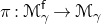 $\pi :{\mathcal{M}}^{\mathsf{f}}_{\gamma} \to \mathcal{M}_{\gamma}$
is projective. We will show that the fibres of
$\pi :{\mathcal{M}}^{\mathsf{f}}_{\gamma} \to \mathcal{M}_{\gamma}$
is projective. We will show that the fibres of $\pi$
can be identified with moduli spaces of nilpotent quiver representations, and we will use this result to prove that the morphism
$\pi$
can be identified with moduli spaces of nilpotent quiver representations, and we will use this result to prove that the morphism $\pi$
is virtually small (see Definition 2.14). The properties of virtually small maps (see Theorem 2.21) will be used later to analyse the degrees of the components of
$\pi$
is virtually small (see Definition 2.14). The properties of virtually small maps (see Theorem 2.21) will be used later to analyse the degrees of the components of $\pi _*{\bf IC}_{{\mathcal{M}}^{\mathsf{f}}_{\gamma} }$
. In what follows, we introduce moduli spaces of framed objects in a setting more general than that of vector bundles on a curve. A closely related treatment of framed objects in abelian categories, together with their moduli spaces, can be found in [Reference MozgovoyMoz13c].
$\pi _*{\bf IC}_{{\mathcal{M}}^{\mathsf{f}}_{\gamma} }$
. In what follows, we introduce moduli spaces of framed objects in a setting more general than that of vector bundles on a curve. A closely related treatment of framed objects in abelian categories, together with their moduli spaces, can be found in [Reference MozgovoyMoz13c].
4.1 Stability of framed objects
Let ${\rm Vec}_{\mathrm f}$
be the category of finite-dimensional vector spaces over a field
${\rm Vec}_{\mathrm f}$
be the category of finite-dimensional vector spaces over a field $K$
. Let
$K$
. Let $\mathcal{A}$
be an abelian
$\mathcal{A}$
be an abelian $K$
-linear category and
$K$
-linear category and $\Phi :\mathcal{A}\to {\rm Vec}_{\mathrm f}$
be a left exact functor, to be called a framing functor.
$\Phi :\mathcal{A}\to {\rm Vec}_{\mathrm f}$
be a left exact functor, to be called a framing functor.
Definition 4.1. A framed object is a pair $(E,s)$
, where
$(E,s)$
, where $E\in \mathcal{A}$
and
$E\in \mathcal{A}$
and $s\in \Phi (E)$
. We call it stable if for every
$s\in \Phi (E)$
. We call it stable if for every $F\subseteq E$
with
$F\subseteq E$
with $s\in \Phi (F)$
we have
$s\in \Phi (F)$
we have $F=E$
.
$F=E$
.
Let $Z=-\mathsf d+\mathsf r{\bf i}:\Gamma =K(\mathcal{A})\to \mathbb{C}$
be a stability function on an abelian category
$Z=-\mathsf d+\mathsf r{\bf i}:\Gamma =K(\mathcal{A})\to \mathbb{C}$
be a stability function on an abelian category $\mathcal{A}$
(see e.g. [Reference BridgelandBri07]), where
$\mathcal{A}$
(see e.g. [Reference BridgelandBri07]), where $\mathsf d,\mathsf r\in {\rm Hom}_{\mathbb{Z}}(\Gamma ,\mathbb{R})$
. For every
$\mathsf d,\mathsf r\in {\rm Hom}_{\mathbb{Z}}(\Gamma ,\mathbb{R})$
. For every $0\ne E\in \mathcal{A}$
, we have either
$0\ne E\in \mathcal{A}$
, we have either $\mathsf r(E)\gt 0$
or
$\mathsf r(E)\gt 0$
or $\mathsf r(E)=0$
and
$\mathsf r(E)=0$
and $\mathsf d(E)\gt 0$
. We define the slope of
$\mathsf d(E)\gt 0$
. We define the slope of $E$
$E$
 \begin{align*}\mu _Z(E)=\frac {\mathsf d(E)}{\mathsf r(E)}\in \mathbb{R}\sqcup \left \{+\infty \right \}\end{align*}
and we say that an object $E$
is
$E$
is $Z$
-semistable (respectively
$Z$
-semistable (respectively $Z$
-stable) if, for every proper
$Z$
-stable) if, for every proper $0\ne F\subset E$
, we have
$0\ne F\subset E$
, we have $\mu _Z(F)\le \mu _Z(E)$
(respectively
$\mu _Z(F)\le \mu _Z(E)$
(respectively $\mu _Z(F)\lt \mu _Z(E)$
). For
$\mu _Z(F)\lt \mu _Z(E)$
). For $\mu \in \mathbb{R}$
, let
$\mu \in \mathbb{R}$
, let $\mathcal{A}^\mu \subseteq \mathcal{A}$
be the subcategory of
$\mathcal{A}^\mu \subseteq \mathcal{A}$
be the subcategory of $Z$
-semistable objects having slope
$Z$
-semistable objects having slope $\mu$
(including the zero object). This is a weakly Serre subcategory of
$\mu$
(including the zero object). This is a weakly Serre subcategory of $\mathcal{A}$
, meaning an abelian subcategory closed under extensions, kernels and cokernels.
$\mathcal{A}$
, meaning an abelian subcategory closed under extensions, kernels and cokernels.
It will be convenient to extend the notion of framed objects $(E,s)$
as follows. Let
$(E,s)$
as follows. Let $\mathcal{A}_{\mathsf{f}}$
be the category consisting of triples
$\mathcal{A}_{\mathsf{f}}$
be the category consisting of triples $(E,V,s)$
, where
$(E,V,s)$
, where $E\in \mathcal{A}$
,
$E\in \mathcal{A}$
, $V\in {\rm Vec}_{\mathrm f}$
and
$V\in {\rm Vec}_{\mathrm f}$
and $s:V\to \Phi (E)$
is linear. The category
$s:V\to \Phi (E)$
is linear. The category $\mathcal{A}_{\mathsf{f}}$
is an abelian category, called the category of framed objects. A pair
$\mathcal{A}_{\mathsf{f}}$
is an abelian category, called the category of framed objects. A pair $(E,s)$
with
$(E,s)$
with $s\in \Phi (E)$
can be identified with the triple
$s\in \Phi (E)$
can be identified with the triple $(E,K,s)\in \mathcal{A}_{\mathsf{f}}$
. For
$(E,K,s)\in \mathcal{A}_{\mathsf{f}}$
. For $\varepsilon \gt 0$
, we define the stability function on
$\varepsilon \gt 0$
, we define the stability function on $\mathcal{A}_{\mathsf{f}}$
 \begin{align*}Z_\varepsilon (E,V,s)=Z(E)-\varepsilon \cdot \dim V\end{align*}
and the corresponding notion of stability in $\mathcal{A}_{\mathsf{f}}$
. A framed object
$\mathcal{A}_{\mathsf{f}}$
. A framed object $(E,s)$
is
$(E,s)$
is $Z_\varepsilon$
-stable for
$Z_\varepsilon$
-stable for $0\lt \varepsilon \ll \left \lvert Z(E)\right \rvert$
(we will say that it is
$0\lt \varepsilon \ll \left \lvert Z(E)\right \rvert$
(we will say that it is $Z_+$
-stable) if and only if:
$Z_+$
-stable) if and only if:
-
(i)
$E$
is
$Z$
-semistable; and -
(ii) for every proper
$F\subset E$
with
$s\in \Phi (F)$
, we have
$\mu _Z(F)\lt \mu _Z(E)$
.



Lemma 4.2.
For a framed object $(E,s)$
with
$(E,s)$
with $E\in \mathcal{C}=\mathcal{A}^\mu$
the following are equivalent:
$E\in \mathcal{C}=\mathcal{A}^\mu$
the following are equivalent:
-
(i)
$(E,s)$
is
$Z_+$
-stable in
$\mathcal{A}_{\mathsf{f}}$
; -
(ii)
$(E,s)$
is
$Z_+$
-stable in
$\mathcal{C}_{\mathsf{f}}$
; and
-
(iii) for every
$F\subseteq E$
in
$\mathcal{C}$
with
$s\in \Phi (F)$
, we have
$F=E$
.


Proof.
If $(E,s)$
is
$(E,s)$
is $Z_+$
-stable in
$Z_+$
-stable in $\mathcal{A}_{\mathsf{f}}$
, then it is automatically
$\mathcal{A}_{\mathsf{f}}$
, then it is automatically $Z_+$
-stable in
$Z_+$
-stable in $\mathcal{C}_{\mathsf{f}}$
. If
$\mathcal{C}_{\mathsf{f}}$
. If $(E,s)$
is
$(E,s)$
is $Z_+$
-stable in
$Z_+$
-stable in $\mathcal{C}_{\mathsf{f}}$
and
$\mathcal{C}_{\mathsf{f}}$
and $s\in \Phi (F)$
for a proper
$s\in \Phi (F)$
for a proper $F\subset E$
in
$F\subset E$
in $\mathcal{C}$
, then
$\mathcal{C}$
, then $\mu _Z(F)\lt \mu _Z(E)$
. This contradicts
$\mu _Z(F)\lt \mu _Z(E)$
. This contradicts $F\in \mathcal{C}=\mathcal{A}^\mu$
. Assume that
$F\in \mathcal{C}=\mathcal{A}^\mu$
. Assume that $(E,s)$
satisfies the third condition. Let
$(E,s)$
satisfies the third condition. Let $s\in \Phi (F)$
for a proper
$s\in \Phi (F)$
for a proper $F\subset E$
in
$F\subset E$
in $\mathcal{A}$
. As
$\mathcal{A}$
. As $E\in \mathcal{A}^\mu$
, we have
$E\in \mathcal{A}^\mu$
, we have $\mu _Z(F)\le \mu$
. If
$\mu _Z(F)\le \mu$
. If $\mu _Z(F)=\mu$
, then
$\mu _Z(F)=\mu$
, then $F\in \mathcal{A}^\mu =\mathcal{C}$
and, by our assumption,
$F\in \mathcal{A}^\mu =\mathcal{C}$
and, by our assumption, $F=E$
. Otherwise
$F=E$
. Otherwise $\mu _Z(F)\lt \mu _Z(E)$
. This implies that
$\mu _Z(F)\lt \mu _Z(E)$
. This implies that $(E,s)$
is
$(E,s)$
is $Z_+$
-stable in
$Z_+$
-stable in $\mathcal{A}_{\mathsf{f}}$
.
$\mathcal{A}_{\mathsf{f}}$
.
The above result implies that the notion of $Z_+$
-stability of framed objects in
$Z_+$
-stability of framed objects in $\mathcal{A}^\mu$
is equivalent to the notion of stability of framed objects from Definition 4.1. To define such a framed object, it is enough to have a left exact functor
$\mathcal{A}^\mu$
is equivalent to the notion of stability of framed objects from Definition 4.1. To define such a framed object, it is enough to have a left exact functor $\Phi :\mathcal{A}^\mu \to {\rm Vec}_{\mathrm f}$
. Usually, this functor will be exact.
$\Phi :\mathcal{A}^\mu \to {\rm Vec}_{\mathrm f}$
. Usually, this functor will be exact.
Example 4.3. Let $Q$
be a quiver and
$Q$
be a quiver and $\mathcal{A}={\rm Rep} Q$
be the category of
$\mathcal{A}={\rm Rep} Q$
be the category of $Q$
-representations over a field
$Q$
-representations over a field $K$
. For a fixed (framing) vector
$K$
. For a fixed (framing) vector ${\bf w}\in \mathbb{N}^{Q_0}$
, we define the exact functor
${\bf w}\in \mathbb{N}^{Q_0}$
, we define the exact functor
 \begin{align} \Phi :\mathcal{A}\to {\rm Vec}_{\mathrm f},\quad M\mapsto \bigoplus _{i\in Q_0}{\rm Hom}(K^{{\bf w}_i},M_i) \simeq \bigoplus _{i\in Q_0}M_i^{\oplus {\bf w}_i}. \end{align}
The category $\mathcal{A}_{\mathsf{f}}$
of framed objects can be identified with the category of representations of the new quiver
$\mathcal{A}_{\mathsf{f}}$
of framed objects can be identified with the category of representations of the new quiver $Q'$
obtained from
$Q'$
obtained from $Q$
by adding a new vertex
$Q$
by adding a new vertex $*$
and
$*$
and ${\bf w}_i$
arrows
${\bf w}_i$
arrows $*\to i$
for all
$*\to i$
for all $i\in Q_0$
. An object
$i\in Q_0$
. An object $(M,V,s)\in \mathcal{A}_{\mathsf{f}}$
is identified with the representation
$(M,V,s)\in \mathcal{A}_{\mathsf{f}}$
is identified with the representation $M'\in {\rm Rep} Q'$
such that
$M'\in {\rm Rep} Q'$
such that $M'_i=M_i$
for
$M'_i=M_i$
for $i\in Q_0$
and
$i\in Q_0$
and $M'_*=V$
. The linear map
$M'_*=V$
. The linear map $s:V\to \Phi (M)=\bigoplus _{i\in Q_0}M_i^{\oplus {\bf w}_i}$
induces linear maps
$s:V\to \Phi (M)=\bigoplus _{i\in Q_0}M_i^{\oplus {\bf w}_i}$
induces linear maps $M'_*\to M'_i$
corresponding to the arrows
$M'_*\to M'_i$
corresponding to the arrows $*\to i$
in
$*\to i$
in $Q'$
. A framed object
$Q'$
. A framed object $(M,s)$
corresponds to
$(M,s)$
corresponds to $M'\in {\rm Rep} Q'$
with
$M'\in {\rm Rep} Q'$
with $M'_*=K$
. It is stable if and only if
$M'_*=K$
. It is stable if and only if $M'_*$
generates the whole representation.
$M'_*$
generates the whole representation.
Example 4.4. Let $C$
be a smooth projective curve of genus
$C$
be a smooth projective curve of genus $g$
and
$g$
and $\mathcal{A}={\rm Coh} C$
be the category of coherent sheaves over
$\mathcal{A}={\rm Coh} C$
be the category of coherent sheaves over $C$
. We consider the stability function
$C$
. We consider the stability function $Z(E)=-\deg E+{\rm rk} E\cdot {\bf i}$
on
$Z(E)=-\deg E+{\rm rk} E\cdot {\bf i}$
on $\mathcal{A}$
. For
$\mathcal{A}$
. For $\mu \in \mathbb{Q}$
, let
$\mu \in \mathbb{Q}$
, let $\mathcal{A}^\mu ={\rm Coh}^\mu C\subset {\rm Coh}C$
be the category of semistable vector bundles of slope
$\mathcal{A}^\mu ={\rm Coh}^\mu C\subset {\rm Coh}C$
be the category of semistable vector bundles of slope $\mu$
. For a fixed line bundle
$\mu$
. For a fixed line bundle $L$
(or any coherent sheaf) over
$L$
(or any coherent sheaf) over $C$
, we consider the left exact functor
$C$
, we consider the left exact functor
 \begin{align} \Phi :\mathcal{A}\to {\rm Vec}_{\mathrm f},\quad E\mapsto {\rm Hom}(L,E). \end{align}
If the line bundle $L$
has degree
$L$
has degree $\ell \lt \mu -(2g-2)$
, then the functor
$\ell \lt \mu -(2g-2)$
, then the functor $\Phi :\mathcal{A}^\mu \to {\rm Vec}_{\mathrm f}$
is exact. Indeed,
$\Phi :\mathcal{A}^\mu \to {\rm Vec}_{\mathrm f}$
is exact. Indeed, ${\rm Ext}^1(L,E)\simeq {\rm Hom}(E,L\otimes \omega _C)^*=0$
for
${\rm Ext}^1(L,E)\simeq {\rm Hom}(E,L\otimes \omega _C)^*=0$
for $E\in \mathcal{A}^\mu$
since
$E\in \mathcal{A}^\mu$
since $\mu \gt \ell+2g-2$
.
$\mu \gt \ell+2g-2$
.
On the other hand, for a fixed point $p\in C$
, the fibre functor
$p\in C$
, the fibre functor
 \begin{align} \Phi :\mathcal{A}^\mu \to {\rm Vec}_{\mathrm f},\quad E\mapsto E(p)=E_p\otimes _{\mathcal{O}_{C,p}}K, \end{align}
is also exact. Framed objects in this situation can be identified with parabolic vector bundles.
As before, let $\mathcal{A}^\mu \subseteq \mathcal{A}$
be the category of
$\mathcal{A}^\mu \subseteq \mathcal{A}$
be the category of $Z$
-semistable objects of
$Z$
-semistable objects of $\mathcal{A}$
having slope
$\mathcal{A}$
having slope $\mu \in \mathbb{R}$
. The stable objects of
$\mu \in \mathbb{R}$
. The stable objects of $\mathcal{A}$
having slope
$\mathcal{A}$
having slope $\mu$
are exactly the simple objects of
$\mu$
are exactly the simple objects of $\mathcal{A}^\mu$
. Let
$\mathcal{A}^\mu$
. Let
 \begin{align*}E_1,\dots ,E_n\in \mathcal{A}^\mu \end{align*}
be a collection of (pairwise non-isomorphic) simple objects, and let $\mathcal{C}=\left \langle E_1,\dots ,E_n\right \rangle \subset \mathcal{A}^\mu$
be the abelian category generated by them. This is a Serre subcategory of
$\mathcal{C}=\left \langle E_1,\dots ,E_n\right \rangle \subset \mathcal{A}^\mu$
be the abelian category generated by them. This is a Serre subcategory of $\mathcal{A}^\mu$
, meaning an abelian subcategory closed under taking extensions, subobjects and quotients. Given a left exact functor
$\mathcal{A}^\mu$
, meaning an abelian subcategory closed under taking extensions, subobjects and quotients. Given a left exact functor $\Phi :\mathcal{A}^\mu \to {\rm Vec}_{\mathrm f}$
, we define the category
$\Phi :\mathcal{A}^\mu \to {\rm Vec}_{\mathrm f}$
, we define the category $\mathcal{C}_{\mathsf{f}}$
of framed objects in
$\mathcal{C}_{\mathsf{f}}$
of framed objects in $\mathcal{C}$
in the same way as before.
$\mathcal{C}$
in the same way as before.
We are going to describe the categories $\mathcal{C}$
and
$\mathcal{C}$
and $\mathcal{C}_{\mathsf{f}}$
as categories of quiver representations. Let
$\mathcal{C}_{\mathsf{f}}$
as categories of quiver representations. Let $Q$
be the quiver with vertices
$Q$
be the quiver with vertices $1,\dots ,n$
and the number of arrows from
$1,\dots ,n$
and the number of arrows from $i$
to
$i$
to $j$
equal to
$j$
equal to
 \begin{align} a_{ij}=\dim {\rm Ext}^1(E_i,E_j). \end{align}
Let $Q'$
be the quiver obtained from
$Q'$
be the quiver obtained from $Q$
by adding a new vertex
$Q$
by adding a new vertex $*$
and
$*$
and ${\bf w}_i=\dim \Phi (E_i)$
arrows
${\bf w}_i=\dim \Phi (E_i)$
arrows $*\to i$
for all
$*\to i$
for all $i\in Q_0$
. A representation of
$i\in Q_0$
. A representation of $Q$
is called nilpotent if it has a filtration by sub-representations such that the arrows of
$Q$
is called nilpotent if it has a filtration by sub-representations such that the arrows of $Q$
act trivially on the factors.
$Q$
act trivially on the factors.
Theorem 4.5.
-
(i) If
$\mathcal{A}^\mu$
is hereditary, then the category
$\mathcal{C}$
is equivalent to the category
${\rm Rep}^{{\rm nil}}(Q)$
of nilpotent representations of
$Q$
. -
(ii) If
$\mathcal{A}^\mu$
is hereditary and
$\Phi :\mathcal{A}^\mu \to {\rm Vec}_{\mathrm f}$
is exact, then the category of framed objects
$\mathcal{C}_{\mathsf{f}}$
is equivalent to
${\rm Rep}^{{\rm nil}}(Q')$
.





Proof.
For the first statement, see [Reference Deng and XiaoDX98, Section 1.5]. For the second statement we can assume that $\mathcal{C}={\rm Rep}^{{\rm nil}}(Q)$
and we will show that an exact functor
$\mathcal{C}={\rm Rep}^{{\rm nil}}(Q)$
and we will show that an exact functor $\Phi :\mathcal{C}\to {\rm Vec}_{\mathrm f}$
is uniquely determined (up to a non-unique natural transformation) by its values on the simple objects. This will imply the second statement, as
$\Phi :\mathcal{C}\to {\rm Vec}_{\mathrm f}$
is uniquely determined (up to a non-unique natural transformation) by its values on the simple objects. This will imply the second statement, as ${\rm Rep}^{{\rm nil}}(Q')$
can be identified with the category of framed objects in
${\rm Rep}^{{\rm nil}}(Q')$
can be identified with the category of framed objects in ${\rm Rep}^{{\rm nil}}(Q)$
(see Example 4.3).
${\rm Rep}^{{\rm nil}}(Q)$
(see Example 4.3).
Let $A=\Bbbk Q$
be the path algebra,
$A=\Bbbk Q$
be the path algebra, $\mathfrak{r}\subset A$
be the radical, and
$\mathfrak{r}\subset A$
be the radical, and $e_i\in A$
be the idempotent corresponding to the trivial path at a vertex
$e_i\in A$
be the idempotent corresponding to the trivial path at a vertex $i\in Q_0$
. It is enough to show that
$i\in Q_0$
. It is enough to show that $\Phi$
is uniquely determined on the subcategory
$\Phi$
is uniquely determined on the subcategory $\mathcal{C}_t={\rm Rep} A_t\subset \mathcal{C}$
(which is not an exact subcategory), where
$\mathcal{C}_t={\rm Rep} A_t\subset \mathcal{C}$
(which is not an exact subcategory), where $A_t=A/\mathfrak{r}^{t+1}$
for
$A_t=A/\mathfrak{r}^{t+1}$
for $t\geqslant 0$
. Let
$t\geqslant 0$
. Let $S_i$
be the simple modules and
$S_i$
be the simple modules and $P_i=A_te_i$
their projective covers as
$P_i=A_te_i$
their projective covers as $A_t$
-modules. For the projective module
$A_t$
-modules. For the projective module $P=\bigoplus _i \Phi (S_i)^*\otimes _\Bbbk P_i$
, where
$P=\bigoplus _i \Phi (S_i)^*\otimes _\Bbbk P_i$
, where $\Phi (S_i)^*$
denotes the dual vector space of
$\Phi (S_i)^*$
denotes the dual vector space of $\Phi (S_i)$
, we consider the functor
$\Phi (S_i)$
, we consider the functor $h_P={\rm Hom}(P,-):\mathcal{C}\to {\rm Vec}_{\mathrm f}$
. We will construct an isomorphism
$h_P={\rm Hom}(P,-):\mathcal{C}\to {\rm Vec}_{\mathrm f}$
. We will construct an isomorphism $a:h_P\to \Phi$
of functors over
$a:h_P\to \Phi$
of functors over $\mathcal{C}_t$
. The map
$\mathcal{C}_t$
. The map
 \begin{align*}{\rm Fun}(h_P,\Phi )\simeq \Phi (P) =\bigoplus _i \Phi (S_i)^*\otimes _\Bbbk \Phi (P_i) \to \bigoplus _i \Phi (S_i)^*\otimes _\Bbbk \Phi (S_i) \end{align*}
is surjective, as $P_i\to S_i$
is surjective and
$P_i\to S_i$
is surjective and $\Phi$
is exact. Consider a preimage
$\Phi$
is exact. Consider a preimage $a:h_P\to \Phi$
of the sum of identity maps. This corresponds to
$a:h_P\to \Phi$
of the sum of identity maps. This corresponds to $a_i:\Phi (S_i)\to \Phi (P_i)$
such that the composition
$a_i:\Phi (S_i)\to \Phi (P_i)$
such that the composition $\Phi (S_i)\to \Phi (P_i)\to \Phi (S_i)$
is the identity for all
$\Phi (S_i)\to \Phi (P_i)\to \Phi (S_i)$
is the identity for all $i$
. This induces a chain of maps
$i$
. This induces a chain of maps
 \begin{align*} h_P(M)&={\rm Hom}(P,M)=\bigoplus _i \Phi (S_i)\otimes _\Bbbk {\rm Hom}(P_i,M)\\[5pt] &\to \bigoplus _i \Phi (P_i)\otimes _\Bbbk {\rm Hom}(P_i,M)\to \Phi (M). \end{align*}
For $M=S_j$
, the composition of the last two arrows is an isomorphism. This implies that
$M=S_j$
, the composition of the last two arrows is an isomorphism. This implies that $a:h_P\to \Phi$
induces an isomorphism on simple objects. By the exactness of
$a:h_P\to \Phi$
induces an isomorphism on simple objects. By the exactness of $h_P$
and
$h_P$
and $\Phi$
on
$\Phi$
on $\mathcal{C}_t$
, we conclude that
$\mathcal{C}_t$
, we conclude that $a:h_P\to \Phi$
is an isomorphism of functors on the whole category
$a:h_P\to \Phi$
is an isomorphism of functors on the whole category $\mathcal{C}_t$
.
$\mathcal{C}_t$
.
The above theorem implies that the moduli space of stable pairs $(E,s)$
with
$(E,s)$
with $E\in \mathcal{C}$
can be identified with the moduli spaces of stable nilpotent representations of
$E\in \mathcal{C}$
can be identified with the moduli spaces of stable nilpotent representations of $Q'$
having dimension one at the vertex
$Q'$
having dimension one at the vertex $*$
(see Example 4.3). Stability of a representation
$*$
(see Example 4.3). Stability of a representation $M\in {\rm Rep} Q'$
means that
$M\in {\rm Rep} Q'$
means that $M_*$
generates the whole representation.
$M_*$
generates the whole representation.
Remark 4.6. The second statement of the theorem implies that $\mathcal{C}_{\mathsf{f}}$
is hereditary. More generally, one can show that if
$\mathcal{C}_{\mathsf{f}}$
is hereditary. More generally, one can show that if $\mathcal{A}$
is hereditary and
$\mathcal{A}$
is hereditary and $\Phi :\mathcal{A}\to {\rm Vec}_{\mathrm f}$
is exact, then
$\Phi :\mathcal{A}\to {\rm Vec}_{\mathrm f}$
is exact, then $\mathcal{A}_{\mathsf{f}}$
is hereditary [Reference MozgovoyMoz20].
$\mathcal{A}_{\mathsf{f}}$
is hereditary [Reference MozgovoyMoz20].
Example 4.7. Let $S$
be a smooth projective surface and
$S$
be a smooth projective surface and $H$
be an ample divisor such that
$H$
be an ample divisor such that $H\cdot K_S\lt 0$
, where
$H\cdot K_S\lt 0$
, where $K_S$
is the canonical divisor of
$K_S$
is the canonical divisor of $S$
. Define the slope function
$S$
. Define the slope function
 \begin{align*}\mu (E)=\frac {H\cdot c_1(E)}{{\rm rk} E},\quad E\in {\rm Coh} S.\end{align*}
For $\mu \in \mathbb{R}$
, let
$\mu \in \mathbb{R}$
, let $\mathcal{A}^\mu ={\rm Coh}^\mu S\subset {\rm Coh} S$
be the category of semistable vector bundles (also called Mumford semistable) having slope
$\mathcal{A}^\mu ={\rm Coh}^\mu S\subset {\rm Coh} S$
be the category of semistable vector bundles (also called Mumford semistable) having slope $\mu$
. This category is hereditary. Indeed, for any
$\mu$
. This category is hereditary. Indeed, for any $E,F\in \mathcal{A}^\mu$
, we have
$E,F\in \mathcal{A}^\mu$
, we have ${\rm Ext}^2(E,F)\simeq {\rm Hom}(F,E\otimes \omega _S)^*=0$
as both
${\rm Ext}^2(E,F)\simeq {\rm Hom}(F,E\otimes \omega _S)^*=0$
as both $F$
and
$F$
and $E\otimes \omega _S$
are semistable and
$E\otimes \omega _S$
are semistable and
 \begin{align*}\mu (E\otimes \omega _S)=\frac {H\cdot c_1(E)+{\rm rk} E\cdot H\cdot K_S}{{\rm rk} E}=\mu (E)+H\cdot K_S\lt \mu (F).\end{align*}
For $n\in \mathbb{Z}$
, we consider the left exact functor
$n\in \mathbb{Z}$
, we consider the left exact functor
 \begin{align} \Phi _n:\mathcal{A}^\mu \to {\rm Vec}_{\mathrm f},\qquad E\mapsto {\rm Hom}(\mathcal{O}(-nH),E). \end{align}
This functor is not exact in general, but one can prove the following (cf. [Reference Huybrechts and LehnHL10, Sections 1.7, 3.3]). For $E\in {\rm Coh} S$
, let
$E\in {\rm Coh} S$
, let ${\rm cl} (E)=({\rm rk} E,H\cdot c_1(E),c_2(E))\in \mathbb{Z}^3$
. For any finite subset
${\rm cl} (E)=({\rm rk} E,H\cdot c_1(E),c_2(E))\in \mathbb{Z}^3$
. For any finite subset $C\subset \mathbb{Z}^3$
, there exists
$C\subset \mathbb{Z}^3$
, there exists $n\gt 0$
such that
$n\gt 0$
such that $R^i\Phi _n(E)=0$
for all
$R^i\Phi _n(E)=0$
for all $i\gt 0$
and
$i\gt 0$
and $E\in \mathcal{A}^\mu$
with
$E\in \mathcal{A}^\mu$
with ${\rm cl}(E)\in C$
.
${\rm cl}(E)\in C$
.
4.2 Moduli spaces
Let $\mathcal{A}$
be an abelian (
$\mathcal{A}$
be an abelian ( $\mathbb{C}$
-linear) category and
$\mathbb{C}$
-linear) category and ${\rm cl}:K(\mathcal{A})\to \Gamma$
be a homomorphism to an abelian group
${\rm cl}:K(\mathcal{A})\to \Gamma$
be a homomorphism to an abelian group $\Gamma$
equipped with a bilinear form
$\Gamma$
equipped with a bilinear form $\chi$
compatible with the Euler form on
$\chi$
compatible with the Euler form on $\mathcal{A}$
 \begin{align} \chi ({\rm cl} E,{\rm cl} E')=\chi (E,E')=\sum _{i\geqslant 0}(-1)^i\dim {\rm Ext}^i(E,E'). \end{align}
Let $Z=-\mathsf d+\mathsf r{\bf i}:\Gamma \to \mathbb{C}$
be a homomorphism inducing a stability function
$Z=-\mathsf d+\mathsf r{\bf i}:\Gamma \to \mathbb{C}$
be a homomorphism inducing a stability function $K(\mathcal{A})\xrightarrow {{\rm cl}}\Gamma \xrightarrow Z\mathbb{C}$
(also denoted by
$K(\mathcal{A})\xrightarrow {{\rm cl}}\Gamma \xrightarrow Z\mathbb{C}$
(also denoted by $Z$
). For
$Z$
). For $\mu \in \mathbb{R}$
, let
$\mu \in \mathbb{R}$
, let $\mathcal{A}^\mu \subseteq \mathcal{A}$
be the category of
$\mathcal{A}^\mu \subseteq \mathcal{A}$
be the category of $Z$
-semistable objects having slope
$Z$
-semistable objects having slope $\mu$
(including the zero object). We define the semigroups
$\mu$
(including the zero object). We define the semigroups
 \begin{align} \Lambda =\left \{{\rm cl}(E)\in \Gamma \,\middle |\,E\in \mathcal{A}^\mu \right \},\quad \Lambda _+=\Lambda \backslash \left \{0\right \}. \end{align}
We assume that $\mathcal{A}^\mu$
is hereditary and we have an exact functor
$\mathcal{A}^\mu$
is hereditary and we have an exact functor $\Phi :\mathcal{A}^\mu \to {\rm Vec}_{\mathrm f}$
and a homomorphism
$\Phi :\mathcal{A}^\mu \to {\rm Vec}_{\mathrm f}$
and a homomorphism $\phi :\Lambda \to \mathbb{Z}$
such that
$\phi :\Lambda \to \mathbb{Z}$
such that
 \begin{align} \dim \Phi (E)=\phi ({\rm cl} E)\quad \forall E\in \mathcal{A}^\mu . \end{align}
Example 4.8. As in Example 4.4, let $C$
be a smooth projective curve of genus
$C$
be a smooth projective curve of genus $g$
over
$g$
over $\mathbb{C}$
, and let
$\mathbb{C}$
, and let $\mathcal{A}={\rm Coh} C$
and
$\mathcal{A}={\rm Coh} C$
and $\mathcal{A}^\mu ={\rm Coh}^\mu C\subset {\rm Coh} C$
for a fixed
$\mathcal{A}^\mu ={\rm Coh}^\mu C\subset {\rm Coh} C$
for a fixed $\mu \in \mathbb{Q}$
. We consider the Chern character map
$\mu \in \mathbb{Q}$
. We consider the Chern character map ${\rm ch}:K(\mathcal{A})\to \Gamma =\mathbb{Z}^2$
,
${\rm ch}:K(\mathcal{A})\to \Gamma =\mathbb{Z}^2$
, $[E]\mapsto ({\rm rk} E,\deg E)$
. Let
$[E]\mapsto ({\rm rk} E,\deg E)$
. Let $\Phi ={\rm Hom}(L,-):\mathcal{A}^\mu \to {\rm Vec}_{\mathrm f}$
for a line bundle
$\Phi ={\rm Hom}(L,-):\mathcal{A}^\mu \to {\rm Vec}_{\mathrm f}$
for a line bundle $L$
of degree
$L$
of degree $\ell \lt \mu -(2g-2)$
. For
$\ell \lt \mu -(2g-2)$
. For $\gamma ={\rm ch}(E)=(r,d)$
and
$\gamma ={\rm ch}(E)=(r,d)$
and $\gamma '={\rm ch} E'=(r',d')$
, we have
$\gamma '={\rm ch} E'=(r',d')$
, we have
 \begin{align} \chi (\gamma ,\gamma ')=\chi (E,E')=(1-g)rr'+(rd'-r'd), \end{align}
 \begin{align} \phi (\gamma )=\chi (L,E)=(1-g-\ell )r+d. \end{align}
Note that the Euler form is symmetric on $\Lambda$
. Indeed, if
$\Lambda$
. Indeed, if $\gamma ,\gamma '\in \Lambda$
, then
$\gamma ,\gamma '\in \Lambda$
, then $rd'=r'd$
, hence
$rd'=r'd$
, hence $\chi (\gamma ,\gamma ')=(1-g)rr'=\chi (\gamma ',\gamma )$
.
$\chi (\gamma ,\gamma ')=(1-g)rr'=\chi (\gamma ',\gamma )$
.
We assume that for every $\gamma \in \Lambda$
there exists a moduli space
$\gamma \in \Lambda$
there exists a moduli space $\mathcal{M}_{\gamma}$
of
$\mathcal{M}_{\gamma}$
of $Z$
-semistable objects in
$Z$
-semistable objects in $\mathcal{A}$
having class
$\mathcal{A}$
having class $\gamma$
, and a moduli space
$\gamma$
, and a moduli space ${\mathcal{M}}^{\mathsf{f}}_{\gamma}$
of stable framed objects
${\mathcal{M}}^{\mathsf{f}}_{\gamma}$
of stable framed objects $(E,s)$
with
$(E,s)$
with $E\in \mathcal{A}^\mu$
having class
$E\in \mathcal{A}^\mu$
having class $\gamma$
(see e.g. [Reference Huybrechts and LehnHL95] in the case of framed objects on a curve). The moduli space
$\gamma$
(see e.g. [Reference Huybrechts and LehnHL95] in the case of framed objects on a curve). The moduli space ${\mathcal{M}}^{\mathsf{f}}_{\gamma}$
is smooth as all objects are stable and the second
${\mathcal{M}}^{\mathsf{f}}_{\gamma}$
is smooth as all objects are stable and the second ${\rm Ext}$
-group vanishes (see e.g. [Reference ThaddeusTha94]). The moduli space
${\rm Ext}$
-group vanishes (see e.g. [Reference ThaddeusTha94]). The moduli space $\mathcal{M}_{\gamma}$
parametrizes poly-stable objects of the form
$\mathcal{M}_{\gamma}$
parametrizes poly-stable objects of the form
 \begin{align*}E=\bigoplus _{i=1}^n E_i^{m_i},\end{align*}
where $E_i$
are pairwise non-isomorphic stable objects in
$E_i$
are pairwise non-isomorphic stable objects in $\mathcal{A}$
with
$\mathcal{A}$
with $\gamma _i={\rm cl} E_i\in \Lambda _+$
such that
$\gamma _i={\rm cl} E_i\in \Lambda _+$
such that $\gamma =\sum _i m_i\gamma _i$
. Note that the objects
$\gamma =\sum _i m_i\gamma _i$
. Note that the objects $E_i$
are simple objects in
$E_i$
are simple objects in $\mathcal{A}^\mu$
. We define the type of
$\mathcal{A}^\mu$
. We define the type of $E$
to be the pair
$E$
to be the pair $(\boldsymbol{\gamma },{\bf m})$
with
$(\boldsymbol{\gamma },{\bf m})$
with
 \begin{align*}\boldsymbol{\gamma }=(\gamma _i)_{i=1}^n\in (\Lambda _+)^n,\quad {\bf m}=(m_i)_{i=1}^n\in \mathbb{N}^n.\end{align*}
The set $S_{\boldsymbol{\gamma },{\bf m}}\subset \mathcal{M}_{\gamma}$
of all objects having type
$S_{\boldsymbol{\gamma },{\bf m}}\subset \mathcal{M}_{\gamma}$
of all objects having type $(\boldsymbol{\gamma },{\bf m})$
is called the Luna stratum of type
$(\boldsymbol{\gamma },{\bf m})$
is called the Luna stratum of type $(\boldsymbol{\gamma },{\bf m})$
. In our applications they form a finite partition of
$(\boldsymbol{\gamma },{\bf m})$
. In our applications they form a finite partition of $\mathcal{M}_{\gamma}$
into locally closed subsets. If
$\mathcal{M}_{\gamma}$
into locally closed subsets. If $n=1$
and
$n=1$
and $m_1=1$
, then
$m_1=1$
, then $S_{\boldsymbol{\gamma },{\bf m}}$
is equal to the stable locus
$S_{\boldsymbol{\gamma },{\bf m}}$
is equal to the stable locus ${\mathcal{M}}^{\mathsf{s}}_{\gamma} \subseteq \mathcal{M}_{\gamma}$
which is smooth and open.
${\mathcal{M}}^{\mathsf{s}}_{\gamma} \subseteq \mathcal{M}_{\gamma}$
which is smooth and open.
The canonical projection $\pi :{\mathcal{M}}^{\mathsf{f}}_{\gamma} \to \mathcal{M}_{\gamma}$
sends a pair
$\pi :{\mathcal{M}}^{\mathsf{f}}_{\gamma} \to \mathcal{M}_{\gamma}$
sends a pair $(E,s)$
to the graded object associated with the Jordan–Hölder filtration of
$(E,s)$
to the graded object associated with the Jordan–Hölder filtration of $E$
in
$E$
in $\mathcal{A}^\mu$
. This map is projective, and its fibre over any
$\mathcal{A}^\mu$
. This map is projective, and its fibre over any $E\in {\mathcal{M}}^{\mathsf{s}}_{\gamma}$
is isomorphic to the projective space
$E\in {\mathcal{M}}^{\mathsf{s}}_{\gamma}$
is isomorphic to the projective space $P(\Phi (E))\simeq \mathbb{P}^{\phi (\gamma )-1}$
.
$P(\Phi (E))\simeq \mathbb{P}^{\phi (\gamma )-1}$
.
Following (49), we define the quiver $Q_{\boldsymbol{\gamma }}$
with vertices
$Q_{\boldsymbol{\gamma }}$
with vertices $1,\dots ,n$
and the number of arrows from
$1,\dots ,n$
and the number of arrows from $i$
to
$i$
to $j$
equal to
$j$
equal to
 \begin{align} a_{ij}=\dim {\rm Ext}^1(E_i,E_j)=\delta _{ij}-\chi (\gamma _i,\gamma _j). \end{align}
We define $Q'_{\boldsymbol{\gamma }}$
to be the quiver obtained from
$Q'_{\boldsymbol{\gamma }}$
to be the quiver obtained from $Q_{\boldsymbol{\gamma }}$
by adding one vertex
$Q_{\boldsymbol{\gamma }}$
by adding one vertex $*$
and adding
$*$
and adding
 \begin{align} {\bf w}_i=\dim \Phi (E_i)=\phi (\gamma _i) \end{align}
arrows $*\to i$
for all vertices
$*\to i$
for all vertices $i$
in
$i$
in $Q_{\boldsymbol{\gamma }}$
.
$Q_{\boldsymbol{\gamma }}$
.
Remark 4.9. In the case of vector bundles on a curve and $\gamma _i={\rm ch} E_i=(r_i,d_i)$
with
$\gamma _i={\rm ch} E_i=(r_i,d_i)$
with $d_i/r_i=\mu$
, we obtain
$d_i/r_i=\mu$
, we obtain $a_{ij}=\delta _{ij}+(g-1)r_ir_j$
. Note that the corresponding quiver is symmetric (
$a_{ij}=\delta _{ij}+(g-1)r_ir_j$
. Note that the corresponding quiver is symmetric ( $a_{ij}=a_{ji}$
).
$a_{ij}=a_{ji}$
).
The Euler form of $Q_{\boldsymbol{\gamma }}$
is given by
$Q_{\boldsymbol{\gamma }}$
is given by
 \begin{align*}\chi _{Q_{\boldsymbol{\gamma }}}({\bf m},{\bf m}')=\sum _{i}m_im'_i-\sum _{i,j}a_{ij}m_im'_j =\sum _{i,j}(\delta _{ij}-a_{ij})m_im'_j ,\quad {\bf m},{\bf m}'\in \mathbb{Z}^n.\end{align*}
If $\gamma =\sum _i m_i\gamma _i$
and
$\gamma =\sum _i m_i\gamma _i$
and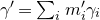 $\gamma '=\sum _i m'_i\gamma _i$
, then
$\gamma '=\sum _i m'_i\gamma _i$
, then
 \begin{align*}\chi (\gamma ,\gamma ')=\sum _{i,j}\chi (\gamma _i,\gamma _j)m_im'_j =\chi _{Q_{\boldsymbol{\gamma }}}({\bf m},{\bf m}').\end{align*}
This means that the map $\mathbb{Z}^n\to \Gamma$
,
$\mathbb{Z}^n\to \Gamma$
, ${\bf m}\mapsto \sum _i m_i\gamma _i$
preserves the Euler forms.
${\bf m}\mapsto \sum _i m_i\gamma _i$
preserves the Euler forms.
Theorem 4.10.
For any object $E\in \mathcal{M}_{\gamma}$
of type
$E\in \mathcal{M}_{\gamma}$
of type $(\boldsymbol{\gamma },{\bf m})$
, the fibre
$(\boldsymbol{\gamma },{\bf m})$
, the fibre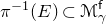 $\pi ^{-1}(E)\subset {\mathcal{M}}^{\mathsf{f}}_{\gamma}$
is isomorphic to the moduli space
$\pi ^{-1}(E)\subset {\mathcal{M}}^{\mathsf{f}}_{\gamma}$
is isomorphic to the moduli space $\mathcal{M}^{\mathsf{f},{\rm nil}}_{{\bf m}}$
of stable nilpotent representations
$\mathcal{M}^{\mathsf{f},{\rm nil}}_{{\bf m}}$
of stable nilpotent representations $M$
of
$M$
of $Q'_{\boldsymbol{\gamma }}$
with
$Q'_{\boldsymbol{\gamma }}$
with $M|_{Q_{\boldsymbol{\gamma }}}$
having dimension vector
$M|_{Q_{\boldsymbol{\gamma }}}$
having dimension vector ${\bf m}$
and
${\bf m}$
and $\dim M_*=1$
. Stability of
$\dim M_*=1$
. Stability of $M$
means that
$M$
means that $M_*$
generates the whole representation.
$M_*$
generates the whole representation.
Proof.
Let $E=\bigoplus _{i=1}^n E_i^{m_i}$
, where
$E=\bigoplus _{i=1}^n E_i^{m_i}$
, where ${\rm cl} E_i=\gamma _i\in \Lambda _+$
. Let
${\rm cl} E_i=\gamma _i\in \Lambda _+$
. Let $\mathcal{C}\subset \mathcal{A}^\mu$
be the abelian category generated by
$\mathcal{C}\subset \mathcal{A}^\mu$
be the abelian category generated by $E_1,\dots ,E_n$
. We proved in Theorem 4.5 that
$E_1,\dots ,E_n$
. We proved in Theorem 4.5 that $\mathcal{C}$
is equivalent to the category
$\mathcal{C}$
is equivalent to the category ${\rm Rep}^{{\rm nil}}(Q_{\boldsymbol{\gamma }})$
and
${\rm Rep}^{{\rm nil}}(Q_{\boldsymbol{\gamma }})$
and $\mathcal{C}_{\mathsf{f}}$
is equivalent to the category
$\mathcal{C}_{\mathsf{f}}$
is equivalent to the category ${\rm Rep}^{{\rm nil}}(Q'_{\boldsymbol{\gamma }})$
.
${\rm Rep}^{{\rm nil}}(Q'_{\boldsymbol{\gamma }})$
.
If $(E',s)\in \pi ^{-1}(E)$
, then the factors of the Jordan–Hölder filtration of
$(E',s)\in \pi ^{-1}(E)$
, then the factors of the Jordan–Hölder filtration of $E'\in \mathcal{A}^\mu$
contain
$E'\in \mathcal{A}^\mu$
contain $m_i$
copies of
$m_i$
copies of $E_i$
for all
$E_i$
for all $1\leqslant i\leqslant n$
. Therefore
$1\leqslant i\leqslant n$
. Therefore $E'\in \mathcal{C}$
and
$E'\in \mathcal{C}$
and $(E',s)$
is stable in
$(E',s)$
is stable in $\mathcal{C}_{\mathsf{f}}$
(cf. Lemma 4.2). As
$\mathcal{C}_{\mathsf{f}}$
(cf. Lemma 4.2). As $\mathcal{C}_{\mathsf{f}}\simeq {\rm Rep}^{{\rm nil}}(Q'_{\boldsymbol{\gamma }})$
, we can identify
$\mathcal{C}_{\mathsf{f}}\simeq {\rm Rep}^{{\rm nil}}(Q'_{\boldsymbol{\gamma }})$
, we can identify $(E',s)$
with a stable nilpotent representation
$(E',s)$
with a stable nilpotent representation $M$
of
$M$
of $Q'_{\boldsymbol{\gamma }}$
such that
$Q'_{\boldsymbol{\gamma }}$
such that $M|_{Q_{\boldsymbol{\gamma }}}$
has dimension vector
$M|_{Q_{\boldsymbol{\gamma }}}$
has dimension vector ${\bf m}$
and
${\bf m}$
and $\dim M_*=1$
.
$\dim M_*=1$
.
4.3 Virtual smallness
Let us now assume that the Euler form is symmetric on $\Lambda$
.
$\Lambda$
.
Theorem 4.11.
The defect of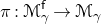 $\pi :{\mathcal{M}}^{\mathsf{f}}_{\gamma} \to \mathcal{M}_{\gamma}$
over
$\pi :{\mathcal{M}}^{\mathsf{f}}_{\gamma} \to \mathcal{M}_{\gamma}$
over $S_{\boldsymbol{\gamma },{\bf m}}$
is
$S_{\boldsymbol{\gamma },{\bf m}}$
is $\leqslant \phi (\gamma )-1$
, with equality only over the stable locus
$\leqslant \phi (\gamma )-1$
, with equality only over the stable locus ${\mathcal{M}}^{\mathsf{s}}_{\gamma} \subseteq \mathcal{M}_{\gamma}$
(if
${\mathcal{M}}^{\mathsf{s}}_{\gamma} \subseteq \mathcal{M}_{\gamma}$
(if ${\mathcal{M}}^{\mathsf{s}}_{\gamma} \ne \varnothing$
).
${\mathcal{M}}^{\mathsf{s}}_{\gamma} \ne \varnothing$
).
Proof.
Let $S_{\boldsymbol{\gamma },{\bf m}}\subseteq \mathcal{M}_{\gamma}$
be the stratum corresponding to
$S_{\boldsymbol{\gamma },{\bf m}}\subseteq \mathcal{M}_{\gamma}$
be the stratum corresponding to $\boldsymbol{\gamma }=(\gamma _1,\dots ,\gamma _n)\in \Gamma ^n$
and
$\boldsymbol{\gamma }=(\gamma _1,\dots ,\gamma _n)\in \Gamma ^n$
and ${\bf m}=(m_1,\dots ,m_n)\in \mathbb{N}^n$
such that
${\bf m}=(m_1,\dots ,m_n)\in \mathbb{N}^n$
such that $\sum _i m_i\gamma _i=\gamma$
. Let
$\sum _i m_i\gamma _i=\gamma$
. Let $Q=Q_{\boldsymbol{\gamma }}$
and
$Q=Q_{\boldsymbol{\gamma }}$
and $Q'=Q'_{\boldsymbol{\gamma }}$
be as in (56). By our assumptions, the quiver
$Q'=Q'_{\boldsymbol{\gamma }}$
be as in (56). By our assumptions, the quiver $Q$
is symmetric (cf. Remark 4.9). By Theorem 4.10, for
$Q$
is symmetric (cf. Remark 4.9). By Theorem 4.10, for $E=\bigoplus _{i=1}^nE_i^{m_i}\in S_{\boldsymbol{\gamma },{\bf m}}$
, we can identify the fibre
$E=\bigoplus _{i=1}^nE_i^{m_i}\in S_{\boldsymbol{\gamma },{\bf m}}$
, we can identify the fibre $\pi ^{-1}(E)$
with the moduli space
$\pi ^{-1}(E)$
with the moduli space $\mathcal{M}^{\mathsf{f},{\rm nil}}_{{\bf m}}$
of stable nilpotent representations of
$\mathcal{M}^{\mathsf{f},{\rm nil}}_{{\bf m}}$
of stable nilpotent representations of $Q'$
. Let
$Q'$
. Let $R_{{\bf m}}=\bigoplus _{a:i\to j}{\rm Hom}(\mathbb{C}^{m_i},\mathbb{C}^{m_j})$
be the space of all representations of
$R_{{\bf m}}=\bigoplus _{a:i\to j}{\rm Hom}(\mathbb{C}^{m_i},\mathbb{C}^{m_j})$
be the space of all representations of $Q$
having dimension vector
$Q$
having dimension vector ${\bf m}$
, and let
${\bf m}$
, and let $R^{{\rm nil}}_{{\bf m}}\subset R_{{\bf m}}$
be the subscheme of nilpotent representations. These schemes are equipped with the action of the group
$R^{{\rm nil}}_{{\bf m}}\subset R_{{\bf m}}$
be the subscheme of nilpotent representations. These schemes are equipped with the action of the group $G_{{\bf m}}=\prod _{i\in Q_0}{\bf GL}_{m_i}$
. As
$G_{{\bf m}}=\prod _{i\in Q_0}{\bf GL}_{m_i}$
. As $Q$
is a symmetric quiver, we have (see [Reference Meinhardt and ReinekeMR19])
$Q$
is a symmetric quiver, we have (see [Reference Meinhardt and ReinekeMR19])
 \begin{align*}{\tfrac 12}\chi _Q({\bf m},{\bf m})+\dim R^{{\rm nil}}_{{\bf m}}-\dim G_{{\bf m}}\leqslant \sum _{i=1}^nm_i\left ({\tfrac 12}\chi _Q(e_i,e_i)-1\right ),\end{align*}
where $e_i$
is the standard basis vector of
$e_i$
is the standard basis vector of $\mathbb{Z}^{n}$
. We have
$\mathbb{Z}^{n}$
. We have
 \begin{align*}\dim \mathcal{M}^{\mathsf{f},{\rm nil}}_{{\bf m}} =\dim R^{{\rm nil}}_{{\bf m}}(Q)-\dim G_{{\bf m}}+{\bf w}\cdot {\bf m} \end{align*}
as $G_{{\bf m}}$
acts freely on stable framed representations. Note that
$G_{{\bf m}}$
acts freely on stable framed representations. Note that ${\bf w}\cdot {\bf m}=\phi (\gamma )$
. Therefore,
${\bf w}\cdot {\bf m}=\phi (\gamma )$
. Therefore,
 \begin{align*}\dim \mathcal{M}_{{\bf m}}^{\mathsf{f},{\rm nil}}\leqslant \sum _{i=1}^nm_i\left ({\tfrac 12}\chi (\gamma _i,\gamma _i)-1\right ) -{\tfrac 12}\chi (\gamma ,\gamma )+\phi (\gamma ). \end{align*}
The dimension of the stable locus ${\mathcal{M}}^{\mathsf{s}}_{\gamma} \subseteq \mathcal{M}_{\gamma}$
is
${\mathcal{M}}^{\mathsf{s}}_{\gamma} \subseteq \mathcal{M}_{\gamma}$
is $1-\chi (\gamma ,\gamma )$
, and hence
$1-\chi (\gamma ,\gamma )$
, and hence $\dim S_{\boldsymbol{\gamma },{\bf m}}=\sum _{i=1}^n(1-\chi (\gamma _i,\gamma _i))$
(if
$\dim S_{\boldsymbol{\gamma },{\bf m}}=\sum _{i=1}^n(1-\chi (\gamma _i,\gamma _i))$
(if $S_{\boldsymbol{\gamma },{\bf m}}$
is non-empty). The defect of
$S_{\boldsymbol{\gamma },{\bf m}}$
is non-empty). The defect of $\pi$
over
$\pi$
over $S_{\boldsymbol{\gamma },{\bf m}}$
is equal to (see (18))
$S_{\boldsymbol{\gamma },{\bf m}}$
is equal to (see (18))
 \begin{align} \delta (\pi ,S_{\boldsymbol{\gamma },{\bf m}}) &=2\dim \mathcal{M}_{{\bf m}}^{\mathsf{f},{\rm nil}}+\dim S_{\boldsymbol{\gamma },{\bf m}}-\dim {\mathcal{M}}^{\mathsf{f}}_{\gamma} \nonumber \\[5pt] &=2\dim \mathcal{M}_{{\bf m}}^{\mathsf{f},{\rm nil}} +\sum _{i=1}^n(1-\chi (\gamma _i,\gamma _i)) +\left (\chi (\gamma ,\gamma )-\phi (\gamma )\right )\nonumber \\[5pt] & \le \sum _{i=1}^nm_i\left (\chi (\gamma _i,\gamma _i)-2\right ) +\sum _{i=1}^n(1-\chi (\gamma _i,\gamma _i))+\phi (\gamma )\nonumber \\[5pt] & =\sum _{i=1}^n(m_i-1)\left (\chi (\gamma _i,\gamma _i)-1\right ) -\sum _{i=1}^nm_i+\phi (\gamma ) \leqslant -\sum _{i=1}^nm_i+\phi (\gamma )\leqslant \phi (\gamma )-1, \end{align}
where we used the fact that $m_i\geqslant 1$
and
$m_i\geqslant 1$
and $\chi (\gamma _i,\gamma _i)\le 1$
. The last inequality in (58) can be an equality only for
$\chi (\gamma _i,\gamma _i)\le 1$
. The last inequality in (58) can be an equality only for $n=1$
and
$n=1$
and $m_1=1$
. In this case the stratum
$m_1=1$
. In this case the stratum $S_{\boldsymbol{\gamma },{\bf m}}$
is the stable locus
$S_{\boldsymbol{\gamma },{\bf m}}$
is the stable locus ${\mathcal{M}}^{\mathsf{s}}_{\gamma}$
. The fibre over
${\mathcal{M}}^{\mathsf{s}}_{\gamma}$
. The fibre over $E\in {\mathcal{M}}^{\mathsf{s}}_{\gamma}$
can be identified with the projective space
$E\in {\mathcal{M}}^{\mathsf{s}}_{\gamma}$
can be identified with the projective space $P(\Phi (E))\simeq \mathbb{P}^{\phi (\gamma )-1}$
. Therefore, the defect of
$P(\Phi (E))\simeq \mathbb{P}^{\phi (\gamma )-1}$
. Therefore, the defect of $\pi$
over
$\pi$
over ${\mathcal{M}}^{\mathsf{s}}_{\gamma}$
is
${\mathcal{M}}^{\mathsf{s}}_{\gamma}$
is
 \begin{align*}\delta (\pi ,{\mathcal{M}}^{\mathsf{s}}_{\gamma} ) =2(\phi (\gamma )-1)+(1-\chi (\gamma ,\gamma ))+(\chi (\gamma ,\gamma )-\phi (\gamma )) =\phi (\gamma )-1. \end{align*}
5. DT invariants
5.1 Moduli spaces
We follow the conventions from Section 4.2. Let $C$
be a smooth projective curve of genus
$C$
be a smooth projective curve of genus $g$
over
$g$
over $\mathbb{C}$
. Let
$\mathbb{C}$
. Let $\mathcal{A}={\rm Coh} C$
and
$\mathcal{A}={\rm Coh} C$
and $\mathcal{A}^\mu ={\rm Coh}^\mu C\subseteq {\rm Coh} C$
be the category of semistable vector bundles having a fixed slope
$\mathcal{A}^\mu ={\rm Coh}^\mu C\subseteq {\rm Coh} C$
be the category of semistable vector bundles having a fixed slope $\mu \in \mathbb{Q}$
. In a similar way to (52), we define
$\mu \in \mathbb{Q}$
. In a similar way to (52), we define
 \begin{align*}\Lambda _+=\left \{(r,d)\in \mathbb{Z}_{\gt 0}\times \mathbb{Z}\,\middle |\,d/r=\mu \right \},\quad \Lambda =\Lambda _+\sqcup \left \{0\right \}.\end{align*}
Note that $\Lambda =\mathbb{N}\gamma _0\simeq \mathbb{N}$
for a unique element
$\Lambda =\mathbb{N}\gamma _0\simeq \mathbb{N}$
for a unique element $\gamma _0=(r_0,d_0)\in \Lambda _+$
.
$\gamma _0=(r_0,d_0)\in \Lambda _+$
.
For $\gamma =(r,d)\in \Lambda$
, let
$\gamma =(r,d)\in \Lambda$
, let $\mathcal{M}_{\gamma}$
(respectively
$\mathcal{M}_{\gamma}$
(respectively ${\mathcal{M}}^{\mathsf{s}}_{\gamma}$
) be the moduli space of semistable (respectively stable) vector bundles over
${\mathcal{M}}^{\mathsf{s}}_{\gamma}$
) be the moduli space of semistable (respectively stable) vector bundles over $C$
having class
$C$
having class $\gamma$
(rank
$\gamma$
(rank $r$
and degree
$r$
and degree $d$
). Similarly, let
$d$
). Similarly, let $\mathfrak{M}_{\gamma}$
be the moduli stack of semistable vector bundles over
$\mathfrak{M}_{\gamma}$
be the moduli stack of semistable vector bundles over $C$
having class
$C$
having class $\gamma$
.
$\gamma$
.
Remark 5.1. The moduli space $\mathcal{M}_{\gamma}$
is always irreducible [Reference Le PotierLeP97, Theorem 8.5.2]. If the stable locus
$\mathcal{M}_{\gamma}$
is always irreducible [Reference Le PotierLeP97, Theorem 8.5.2]. If the stable locus ${\mathcal{M}}^{\mathsf{s}}_{\gamma} \subseteq \mathcal{M}_{\gamma}$
is nonempty, then it is smooth of dimension
${\mathcal{M}}^{\mathsf{s}}_{\gamma} \subseteq \mathcal{M}_{\gamma}$
is nonempty, then it is smooth of dimension $1-\chi (\gamma ,\gamma )=(g-1)r^2+1$
. Moreover, the following statements hold.
$1-\chi (\gamma ,\gamma )=(g-1)r^2+1$
. Moreover, the following statements hold.
-
(i) If
$g\geqslant 2$
, then
${\mathcal{M}}^{\mathsf{s}}_{\gamma} \ne \varnothing$
[Reference Le PotierLeP97, Theorem 8.6.1]. -
(ii) If
$g=1$
, then
$\mathcal{M}_{\gamma} \simeq S^k(C)$
for
$k=\gcd (r,d)$
[Reference Le PotierLeP97, Theorem 8.6.2]. We have
${\mathcal{M}}^{\mathsf{s}}_{\gamma} =\mathcal{M}_{\gamma}$
if
$k=1$
and
${\mathcal{M}}^{\mathsf{s}}_{\gamma} =\varnothing$
otherwise. Indeed, if
${\mathcal{M}}^{\mathsf{s}}_{\gamma} \ne \varnothing$
, then
$\dim S^k(C)=1$
, hence
$k=1$
. -
(iii) If
$g=0$
, then
$\mathcal{M}_{\gamma} ={\bf pt}$
if
$d/r\in \mathbb{Z}$
and
$\mathcal{M}_{\gamma} =\varnothing$
otherwise. We have
${\mathcal{M}}^{\mathsf{s}}_{\gamma} =\mathcal{M}_{\gamma}$
if
$r=1$
and
${\mathcal{M}}^{\mathsf{s}}_{\gamma} =\varnothing$
otherwise.





Remark 5.2. Note that the restriction of the Euler form (54) to $\Lambda$
(or
$\Lambda$
(or $\mathcal{A}^\mu$
) is symmetric. All of the results below translate verbatim to moduli spaces in other hereditary categories under the assumption that the restriction of the Euler form to
$\mathcal{A}^\mu$
) is symmetric. All of the results below translate verbatim to moduli spaces in other hereditary categories under the assumption that the restriction of the Euler form to $\mathcal{A}^\mu$
is symmetric.
$\mathcal{A}^\mu$
is symmetric.
As in Example 4.8, we fix a line bundle $L$
of degree
$L$
of degree $\ell \lt \mu -(2g-2)$
, and consider the exact functor
$\ell \lt \mu -(2g-2)$
, and consider the exact functor $\Phi ={\rm Hom}(L,-):\mathcal{A}^\mu \to {\rm Vec}_{\mathrm f}$
and the homomorphism
$\Phi ={\rm Hom}(L,-):\mathcal{A}^\mu \to {\rm Vec}_{\mathrm f}$
and the homomorphism $\phi :\Lambda \to \mathbb{Z}$
such that
$\phi :\Lambda \to \mathbb{Z}$
such that $\dim \Phi (E)=\phi ({\rm ch} E)$
for all
$\dim \Phi (E)=\phi ({\rm ch} E)$
for all $E\in \mathcal{A}^\mu$
. Let
$E\in \mathcal{A}^\mu$
. Let ${\mathcal{M}}^{\mathsf{f}}_{\gamma}$
be the moduli space of stable framed objects
${\mathcal{M}}^{\mathsf{f}}_{\gamma}$
be the moduli space of stable framed objects $(E,s)$
with
$(E,s)$
with $E\in \mathcal{A}^\mu$
having class
$E\in \mathcal{A}^\mu$
having class $\gamma$
and
$\gamma$
and $s\in \Phi (E)$
. We define
$s\in \Phi (E)$
. We define
 \begin{align*}\mathcal{M}=\bigsqcup _{\gamma \in \Lambda }\mathcal{M}_{\gamma} ,\quad \mathfrak{M}=\bigsqcup _{\gamma \in \Lambda }\mathfrak{M}_{\gamma} ,\quad {\mathcal{M}}^{\mathsf{f}}=\bigsqcup _{\gamma \in \Lambda }{\mathcal{M}}^{\mathsf{f}}_{\gamma} ,\end{align*}
and consider the commutative diagram

where the projective map $\pi :{\mathcal{M}}^{\mathsf{f}}\to \mathcal{M}$
was introduced in Section 4.2 and the map
$\pi :{\mathcal{M}}^{\mathsf{f}}\to \mathcal{M}$
was introduced in Section 4.2 and the map $q:{\mathcal{M}}^{\mathsf{f}}\to \mathfrak M$
sends a pair
$q:{\mathcal{M}}^{\mathsf{f}}\to \mathfrak M$
sends a pair $(E,s)$
to
$(E,s)$
to $E$
. The moduli space
$E$
. The moduli space $\mathcal{M}$
is a
$\mathcal{M}$
is a $\Lambda$
-graded commutative monoid in the category of algebraic schemes over
$\Lambda$
-graded commutative monoid in the category of algebraic schemes over $\mathbb{C}$
, where the product map
$\mathbb{C}$
, where the product map $\mu :\mathcal{M}\times \mathcal{M}\to \mathcal{M}$
is given by the direct sum of vector bundles and is a finite map. The unit map is
$\mu :\mathcal{M}\times \mathcal{M}\to \mathcal{M}$
is given by the direct sum of vector bundles and is a finite map. The unit map is $\eta :{\bf pt}=\mathcal{M}_0\hookrightarrow \mathcal{M}$
. By the results of Section 3, we have a
$\eta :{\bf pt}=\mathcal{M}_0\hookrightarrow \mathcal{M}$
. By the results of Section 3, we have a $\Lambda$
-graded pre-
$\Lambda$
-graded pre- $\lambda$
-ring
$\lambda$
-ring $\mathbf K({\rm Sch}/\mathcal{M})$
and a
$\mathbf K({\rm Sch}/\mathcal{M})$
and a $\Lambda$
-graded (and
$\Lambda$
-graded (and $\mathbb{Z}$
-graded)
$\mathbb{Z}$
-graded) $\lambda$
-ring
$\lambda$
-ring $\mathbf K({\rm MHM}(\mathcal{M}))$
. As in (43), we have a commutative diagram
$\mathbf K({\rm MHM}(\mathcal{M}))$
. As in (43), we have a commutative diagram

where $\deg :\mathcal{M}\to \boldsymbol{\Lambda }$
is the degree map (30),
$\deg :\mathcal{M}\to \boldsymbol{\Lambda }$
is the degree map (30), $E$
is the
$E$
is the $E$
-polynomial map (see Section 5.6), and all arrows are homomorphisms of pre-
$E$
-polynomial map (see Section 5.6), and all arrows are homomorphisms of pre- $\lambda$
-rings.
$\lambda$
-rings.
5.2 Motivic DT invariants
The (absolute) motivic DT invariants $\operatorname {DT}^{\mathfrak{m}}_{\gamma} \in \mathbf K({\rm Sch})$
are defined by the formula in
$\operatorname {DT}^{\mathfrak{m}}_{\gamma} \in \mathbf K({\rm Sch})$
are defined by the formula in $\widehat {\mathbf K}({\rm Sch}/\boldsymbol{\Lambda })\simeq \prod _{\gamma \in \Lambda }\mathbf K({\rm Sch})t^\gamma$
 \begin{align*}\sum _{\gamma \in \Lambda }\mathbb{L}^{{\frac 12}\chi (\gamma ,\gamma )}[\mathfrak M_{\gamma} ]t^\gamma ={\rm Exp}\bigg (\frac {\sum _{\gamma \in \Lambda _+}\operatorname {DT}^{\mathfrak{m}}_{\gamma} t^\gamma }{\mathbb{L}^{\frac {1}{2}}-\mathbb{L}^{-{\frac {1}{2}}}}\bigg ).\end{align*}
Note that $\dim \mathfrak M_{\gamma} =-\chi (\gamma ,\gamma )$
, and hence
$\dim \mathfrak M_{\gamma} =-\chi (\gamma ,\gamma )$
, and hence $\mathbb{L}^{{\frac 12}\chi (\gamma ,\gamma )}[\mathfrak M_{\gamma} ]=[\mathfrak M_{\gamma} ]_{{\rm vir}}$
(40). Note also that
$\mathbb{L}^{{\frac 12}\chi (\gamma ,\gamma )}[\mathfrak M_{\gamma} ]=[\mathfrak M_{\gamma} ]_{{\rm vir}}$
(40). Note also that $\mathbb{L}^{\frac {1}{2}}-\mathbb{L}^{-{\frac {1}{2}}}=[\mathbb G_{\mathrm m}]_{{\rm vir}}$
. Similarly, we define the (relative) motivic DT invariants
$\mathbb{L}^{\frac {1}{2}}-\mathbb{L}^{-{\frac {1}{2}}}=[\mathbb G_{\mathrm m}]_{{\rm vir}}$
. Similarly, we define the (relative) motivic DT invariants $\operatorname {{\bf DT}}^{\mathfrak{m}}_{\gamma} \in \mathbf K({\rm Sch}/\mathcal{M}_{\gamma} )$
by the formula in
$\operatorname {{\bf DT}}^{\mathfrak{m}}_{\gamma} \in \mathbf K({\rm Sch}/\mathcal{M}_{\gamma} )$
by the formula in $\widehat {\mathbf K}({\rm Sch}/\mathcal{M})$
 \begin{align} \sum _{\gamma \in \Lambda }\mathbb{L}^{{\frac 12}\chi (\gamma ,\gamma )}[\mathfrak M_{\gamma} \to \mathcal{M}_{\gamma} ] ={\rm Exp}\bigg (\frac {\sum _{\gamma \in \Lambda _+}\operatorname {{\bf DT}}^{\mathfrak{m}}_{\gamma} }{\mathbb{L}^{\frac {1}{2}}-\mathbb{L}^{-{\frac {1}{2}}}}\bigg ). \end{align}
We define $\operatorname {{\bf DT}}^{\mathfrak{m}}=\sum _{\gamma \in \Lambda _+}\operatorname {{\bf DT}}^{\mathfrak{m}}_{\gamma} \in \widehat {\mathbf K}({\rm Sch}/\mathcal{M})$
. The following statement is a relative analogue of the result proved in [Reference Kontsevich and SoibelmanKS11, Section 6.2, Theorem 10] for quivers with potentials (see also [Reference Kontsevich and SoibelmanKS08, Section 7.3, Conjecture 9]).
$\operatorname {{\bf DT}}^{\mathfrak{m}}=\sum _{\gamma \in \Lambda _+}\operatorname {{\bf DT}}^{\mathfrak{m}}_{\gamma} \in \widehat {\mathbf K}({\rm Sch}/\mathcal{M})$
. The following statement is a relative analogue of the result proved in [Reference Kontsevich and SoibelmanKS11, Section 6.2, Theorem 10] for quivers with potentials (see also [Reference Kontsevich and SoibelmanKS08, Section 7.3, Conjecture 9]).
Theorem 5.3 (Integrality conjecture [Reference MeinhardtMei15]). The class $\operatorname {{\bf DT}}^{\mathfrak{m}}_{\gamma}$
is contained in the image of the map
$\operatorname {{\bf DT}}^{\mathfrak{m}}_{\gamma}$
is contained in the image of the map $K({\rm Sch}/\mathcal{M}_{\gamma} )[\mathbb{L}^{-1/2}]\to \mathbf K({\rm Sch}/\mathcal{M}_{\gamma} ).$
5.3 Mixed DT invariants
The (absolute) DT invariants are defined by
 \begin{align} \operatorname {DT}_{\gamma} =\chi _c(\operatorname {DT}^{\mathfrak{m}}_{\gamma} )\in \mathbf K({\rm MHS}^p), \end{align}
where $\chi _c:\mathbf K({\rm Sch})\to \mathbf K({\rm MHS}^p)$
was defined in (39). Similarly, the relative DT invariants are
$\chi _c:\mathbf K({\rm Sch})\to \mathbf K({\rm MHS}^p)$
was defined in (39). Similarly, the relative DT invariants are
 \begin{align} \operatorname {{\bf DT}}_{\gamma} =\chi _c(\operatorname {{\bf DT}}^{\mathfrak{m}}_{\gamma} )\in \mathbf K({\rm MHM}(\mathcal{M}_{\gamma} )). \end{align}
Using the fact that $\chi _c:\mathbf K({\rm Sch}/\boldsymbol{\Lambda })\to \mathbf K({\rm MHM}(\boldsymbol{\Lambda }))$
and
$\chi _c:\mathbf K({\rm Sch}/\boldsymbol{\Lambda })\to \mathbf K({\rm MHM}(\boldsymbol{\Lambda }))$
and $\chi _c:\mathbf K({\rm Sch}/\mathcal{M})\to \mathbf K({\rm MHM}(\mathcal{M}))$
are morphisms of pre-
$\chi _c:\mathbf K({\rm Sch}/\mathcal{M})\to \mathbf K({\rm MHM}(\mathcal{M}))$
are morphisms of pre- $\lambda$
-rings, we can write
$\lambda$
-rings, we can write
 \begin{align} \sum _{\gamma \in \Lambda }\mathbb{L}^{{\frac 12}\chi (\gamma ,\gamma )}\chi _c[\mathfrak M_{\gamma} ] ={\rm Exp}\bigg (\frac {\sum _{\gamma \in \Lambda _+}\operatorname {DT}_{\gamma} }{\mathbb{L}^{\frac {1}{2}}-\mathbb{L}^{-{\frac {1}{2}}}}\bigg ) {\rm and} \end{align}
 \begin{align} \sum _{\gamma \in \Lambda }\mathbb{L}^{{\frac 12}\chi (\gamma ,\gamma )}\chi _c[\mathfrak M_{\gamma} \to \mathcal{M}_{\gamma} ] ={\rm Exp}\bigg (\frac {\sum _{\gamma \in \Lambda _+}\operatorname {{\bf DT}}_{\gamma} }{\mathbb{L}^{\frac {1}{2}}-\mathbb{L}^{-{\frac {1}{2}}}}\bigg ). \end{align}
Corollary 5.4.
The class $\operatorname {{\bf DT}}_{\gamma}$
is contained in
$\operatorname {{\bf DT}}_{\gamma}$
is contained in $K({\rm MHM}(\mathcal{M}_{\gamma} ))[\mathbb{L}^{1/2}]$
.
$K({\rm MHM}(\mathcal{M}_{\gamma} ))[\mathbb{L}^{1/2}]$
.
Proof.
By Theorem 5.3, the class $\operatorname {{\bf DT}}_{\gamma}$
is contained in the image of the map (note that
$\operatorname {{\bf DT}}_{\gamma}$
is contained in the image of the map (note that $\mathbb{L}$
is invertible)
$\mathbb{L}$
is invertible) $K({\rm MHM}(\mathcal{M}_{\gamma} ))[\mathbb{L}^{1/2}]\to \mathbf K({\rm MHM}(\mathcal{M}_{\gamma} ))$
. This map is injective, as
$K({\rm MHM}(\mathcal{M}_{\gamma} ))[\mathbb{L}^{1/2}]\to \mathbf K({\rm MHM}(\mathcal{M}_{\gamma} ))$
. This map is injective, as $K({\rm MHM}(\mathcal{M}_{\gamma} ))$
is free over
$K({\rm MHM}(\mathcal{M}_{\gamma} ))$
is free over $\mathbb{Z}[\mathbb{L}^{\pm 1}]$
(the basis consists of isomorphism classes of simple objects in
$\mathbb{Z}[\mathbb{L}^{\pm 1}]$
(the basis consists of isomorphism classes of simple objects in ${\rm MHM}(\mathcal{M}_{\gamma} )$
having weight
${\rm MHM}(\mathcal{M}_{\gamma} )$
having weight $0$
or
$0$
or $1$
).
$1$
).
Remark 5.5. The stack $\mathfrak{M}_{\gamma}$
can be represented as a global quotient
$\mathfrak{M}_{\gamma}$
can be represented as a global quotient $X/G$
, where
$X/G$
, where $X$
is smooth and
$X$
is smooth and $G={\bf GL}_n$
is a general linear group (see e.g. [Reference Huybrechts and LehnHL10]). If
$G={\bf GL}_n$
is a general linear group (see e.g. [Reference Huybrechts and LehnHL10]). If $q:X\to Y$
is a principal
$q:X\to Y$
is a principal $G$
-bundle between smooth algebraic varieties, then
$G$
-bundle between smooth algebraic varieties, then $[{\bf IC}_Y]=[G]_{{\rm vir}}^{-1} \cdot q_![{\bf IC}_X]$
. In our case, we consider the diagram
$[{\bf IC}_Y]=[G]_{{\rm vir}}^{-1} \cdot q_![{\bf IC}_X]$
. In our case, we consider the diagram

and formally define
 \begin{align*}p_![{\bf IC}_{\mathfrak{M}_{\gamma} }]=[G]_{{\rm vir}}^{-1}\cdot (pq)_![{\bf IC}_X] \in \mathbf K({\rm MHM}(M_{\gamma} )).\end{align*}
Then $p_![{\bf IC}_{\mathfrak{M}_{\gamma} }] =\mathbb{L}^{-d_X/2+d_G/2}[G]^{-1}\cdot (pq)_![\mathbb{Q}_X] =\mathbb{L}^{{\frac 12}\chi (\gamma ,\gamma )}\cdot \chi _c[\mathfrak M_{\gamma} \to \mathcal{M}_{\gamma} ]$
. Therefore,
$p_![{\bf IC}_{\mathfrak{M}_{\gamma} }] =\mathbb{L}^{-d_X/2+d_G/2}[G]^{-1}\cdot (pq)_![\mathbb{Q}_X] =\mathbb{L}^{{\frac 12}\chi (\gamma ,\gamma )}\cdot \chi _c[\mathfrak M_{\gamma} \to \mathcal{M}_{\gamma} ]$
. Therefore,
 \begin{align*}\sum _{\gamma \in \Lambda }p_![{\bf IC}_{\mathfrak{M}_{\gamma} }] ={\rm Exp}\bigg (\frac {\sum _{\gamma \in \Lambda _+}\operatorname {{\bf DT}}_{\gamma} }{\mathbb{L}^{\frac {1}{2}}-\mathbb{L}^{-{\frac {1}{2}}}}\bigg ).\end{align*}
5.4 DT invariants and framed moduli spaces
In this section we will express DT invariants using moduli spaces of stable framed objects. This expression is a version of a wall-crossing formula, also called a DT/PT correspondence. Recall that we have a commutative diagram

Theorem 5.6. We have
 \begin{align} \pi _!\bigg (\sum _{\gamma \in \Lambda }(-1)^{\phi (\gamma )}[{\bf IC}_{{\mathcal{M}}^{\mathsf{f}}_{\gamma} }]\bigg ) ={\rm Exp}\bigg (\sum _{\gamma \in \Lambda _+}(-1)^{\phi (\gamma )}[\mathbb{P}^{\phi (\gamma )-1}]_{{\rm vir}}\operatorname {{\bf DT}}_{\gamma} \bigg ). \end{align}
Proof.
We will prove a similar formula in $\widehat {\mathbf K}({\rm Sch}/\mathcal{M})$
and then apply the map
$\widehat {\mathbf K}({\rm Sch}/\mathcal{M})$
and then apply the map $\chi _c:\widehat {\mathbf K}({\rm Sch}/\mathcal{M})\to \widehat {\mathbf K}({\rm MHM}(\mathcal{M}))$
. The wall-crossing formula for framed objects (cf. [Reference Engel and ReinekeER09, Reference MozgovoyMoz13c, Reference BridgelandBri11]) implies that
$\chi _c:\widehat {\mathbf K}({\rm Sch}/\mathcal{M})\to \widehat {\mathbf K}({\rm MHM}(\mathcal{M}))$
. The wall-crossing formula for framed objects (cf. [Reference Engel and ReinekeER09, Reference MozgovoyMoz13c, Reference BridgelandBri11]) implies that
 \begin{align*}\sum _{\gamma }\mathbb{L}^{{\frac 12}\chi (\gamma ,\gamma )+\phi (\gamma )}[\mathfrak{M}_{\gamma} \to \mathcal{M}_{\gamma} ] = {\sum _{\gamma }\mathbb{L}^{{\frac 12}\chi (\gamma ,\gamma )}}[{\mathcal{M}}^{\mathsf{f}}_{\gamma} \to \mathcal{M}_{\gamma} ]\cdot \sum _{\gamma }\mathbb{L}^{{\frac 12}\chi (\gamma ,\gamma )}[\mathfrak{M}_{\gamma} \to \mathcal{M}_{\gamma} ]. \end{align*}
Applying (59), we obtain
 \begin{align*} {\rm Exp}\left (\frac {\sum _{\gamma }\mathbb{L}^{\phi (\gamma )}\operatorname {{\bf DT}}^{\mathfrak{m}}_{\gamma} }{\mathbb{L}^{\frac {1}{2}}-\mathbb{L}^{-{\frac {1}{2}}}}\right ) ={\sum _{\gamma} \mathbb{L}^{{\frac 12}\chi (\gamma ,\gamma )}[{\mathcal{M}}^{\mathsf{f}}_{\gamma} \to \mathcal{M}_{\gamma} ]}\cdot {\rm Exp}\left (\frac {\sum _{\gamma }\operatorname {{\bf DT}}^{\mathfrak{m}}_{\gamma} }{\mathbb{L}^{\frac {1}{2}}-\mathbb{L}^{-{\frac {1}{2}}}}\right ). \end{align*}
Let $d_{\gamma} =\dim {\mathcal{M}}^{\mathsf{f}}_{\gamma} =-\chi (\gamma ,\gamma )+\phi (\gamma )$
and
$d_{\gamma} =\dim {\mathcal{M}}^{\mathsf{f}}_{\gamma} =-\chi (\gamma ,\gamma )+\phi (\gamma )$
and $z_{\gamma} =\mathbb{L}^{-d_{\gamma} /2}[{\mathcal{M}}^{\mathsf{f}}_{\gamma} \to \mathcal{M}_{\gamma} ]$
. Then
$z_{\gamma} =\mathbb{L}^{-d_{\gamma} /2}[{\mathcal{M}}^{\mathsf{f}}_{\gamma} \to \mathcal{M}_{\gamma} ]$
. Then
 \begin{align*}\sum _{\gamma} \mathbb{L}^{{\frac 12}\phi (\gamma )}z_{\gamma} ={\rm Exp}\bigg (\frac {\sum _{\gamma }(\mathbb{L}^{\phi (\gamma )}-1)\operatorname {{\bf DT}}^{\mathfrak{m}}_{\gamma} }{\mathbb{L}^{\frac {1}{2}}-\mathbb{L}^{-{\frac {1}{2}}}}\bigg ) ={\rm Exp}\bigg (\sum _{\gamma }\mathbb{L}^{{\frac 12}}[\mathbb{P}^{\phi (\gamma )-1}]\operatorname {{\bf DT}}^{\mathfrak{m}}_{\gamma} \bigg ). \end{align*}
We apply the pre- $\lambda$
-ring morphism
$\lambda$
-ring morphism $\sum _{\gamma} x_{\gamma} \mapsto \sum _{\gamma} (-\mathbb{L}^{1/2})^{-\phi (\gamma )}x_{\gamma}$
to both sides and obtain
$\sum _{\gamma} x_{\gamma} \mapsto \sum _{\gamma} (-\mathbb{L}^{1/2})^{-\phi (\gamma )}x_{\gamma}$
to both sides and obtain
 \begin{align*}\sum _{\gamma} (-1)^{\phi (\gamma )}z_{\gamma} ={\rm Exp}\bigg (\sum _{\gamma }(-1)^{\phi (\gamma )}[\mathbb{P}^{\phi (\gamma )-1}]_{{\rm vir}}\operatorname {{\bf DT}}^{\mathfrak{m}}_{\gamma} \bigg ). \end{align*}
Finally, we apply $\chi _c$
to both sides and note that
$\chi _c$
to both sides and note that $\chi _c(z_{\gamma} )=[\pi _!(\mathbb{Q}_{{\mathcal{M}}^{\mathsf{f}}_{\gamma} }\left \langle d_{\gamma} \right \rangle )] =\pi _![{\bf IC}_{{\mathcal{M}}^{\mathsf{f}}_{\gamma} }]$
.
$\chi _c(z_{\gamma} )=[\pi _!(\mathbb{Q}_{{\mathcal{M}}^{\mathsf{f}}_{\gamma} }\left \langle d_{\gamma} \right \rangle )] =\pi _![{\bf IC}_{{\mathcal{M}}^{\mathsf{f}}_{\gamma} }]$
.
5.5 DT invariants and intersection complexes
For $\gamma =(r,d)\in \Lambda$
, the stable locus
$\gamma =(r,d)\in \Lambda$
, the stable locus ${\mathcal{M}}^{\mathsf{s}}_{\gamma} \subseteq \mathcal{M}_{\gamma}$
is open, smooth and has dimension
${\mathcal{M}}^{\mathsf{s}}_{\gamma} \subseteq \mathcal{M}_{\gamma}$
is open, smooth and has dimension $1-\chi (\gamma ,\gamma )$
(if
$1-\chi (\gamma ,\gamma )$
(if ${\mathcal{M}}^{\mathsf{s}}_{\gamma} \ne \varnothing$
). We consider the object
${\mathcal{M}}^{\mathsf{s}}_{\gamma} \ne \varnothing$
). We consider the object ${\bf IC}_{\mkern 1.5mu\overline {\mkern -1.5mu{\mathcal{M}}^{\mathsf{s}}_{\gamma} \mkern -1.5mu}\mkern 1.5mu}\in {\rm MHM}(\mathcal{M}_{\gamma} )$
, which is defined to be zero if
${\bf IC}_{\mkern 1.5mu\overline {\mkern -1.5mu{\mathcal{M}}^{\mathsf{s}}_{\gamma} \mkern -1.5mu}\mkern 1.5mu}\in {\rm MHM}(\mathcal{M}_{\gamma} )$
, which is defined to be zero if ${\mathcal{M}}^{\mathsf{s}}_{\gamma} =\varnothing$
.
${\mathcal{M}}^{\mathsf{s}}_{\gamma} =\varnothing$
.
Theorem 5.7.
We have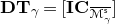 $\operatorname {{\bf DT}}_{\gamma} =[{\bf IC}_{\mkern 1.5mu\overline {\mkern -1.5mu{\mathcal{M}}^{\mathsf{s}}_{\gamma} \mkern -1.5mu}\mkern 1.5mu}]$
for
$\operatorname {{\bf DT}}_{\gamma} =[{\bf IC}_{\mkern 1.5mu\overline {\mkern -1.5mu{\mathcal{M}}^{\mathsf{s}}_{\gamma} \mkern -1.5mu}\mkern 1.5mu}]$
for $\gamma \in \Lambda$
.
$\gamma \in \Lambda$
.
Proof. The formula (64) can be written in the form
 \begin{align} (-1)^{\phi (\gamma )}\pi _*[{\bf IC}_{{\mathcal{M}}^{\mathsf{f}}_{\gamma} }] =\sum _{{\substack {m:\Lambda _+\to \mathbb{N}\\[5pt] \sum _\alpha m_\alpha \alpha =\gamma }}} \prod _{\alpha \in \Lambda _+} \sigma ^{m_\alpha }\big((-1)^{\phi (\alpha )}[\mathbb{P}^{\phi (\alpha )-1}]_{{\rm vir}}\operatorname {{\bf DT}}_{\alpha }\big). \end{align}
We will compare the highest degree terms on both sides. By Theorem 4.11, the map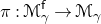 $\pi :{\mathcal{M}}^{\mathsf{f}}_{\gamma} \to \mathcal{M}_{\gamma}$
is
$\pi :{\mathcal{M}}^{\mathsf{f}}_{\gamma} \to \mathcal{M}_{\gamma}$
is $n$
-small, where
$n$
-small, where $n=\phi (\gamma )-1$
. It is a
$n=\phi (\gamma )-1$
. It is a $\mathbb{P}^n$
-fibration over
$\mathbb{P}^n$
-fibration over ${\mathcal{M}}^{\mathsf{s}}_{\gamma}$
. By Theorem 2.21, the object
${\mathcal{M}}^{\mathsf{s}}_{\gamma}$
. By Theorem 2.21, the object $\pi _*{\bf IC}_{{\mathcal{M}}^{\mathsf{f}}_{\gamma} }$
has degree
$\pi _*{\bf IC}_{{\mathcal{M}}^{\mathsf{f}}_{\gamma} }$
has degree $\leqslant n$
and the degree
$\leqslant n$
and the degree $n$
component
$n$
component ${\bf IC}_{\mkern 1.5mu\overline {\mkern -1.5mu{\mathcal{M}}^{\mathsf{s}}_{\gamma} \mkern -1.5mu}\mkern 1.5mu}\left \langle -n\right \rangle =\mathbb{L}^{n/2}{\bf IC}_{\mkern 1.5mu\overline {\mkern -1.5mu{\mathcal{M}}^{\mathsf{s}}_{\gamma} \mkern -1.5mu}\mkern 1.5mu}$
.
${\bf IC}_{\mkern 1.5mu\overline {\mkern -1.5mu{\mathcal{M}}^{\mathsf{s}}_{\gamma} \mkern -1.5mu}\mkern 1.5mu}\left \langle -n\right \rangle =\mathbb{L}^{n/2}{\bf IC}_{\mkern 1.5mu\overline {\mkern -1.5mu{\mathcal{M}}^{\mathsf{s}}_{\gamma} \mkern -1.5mu}\mkern 1.5mu}$
.
Let us consider the summand on the right corresponding to $m:\Lambda _+\to \mathbb{N}$
that is different from the delta-function
$m:\Lambda _+\to \mathbb{N}$
that is different from the delta-function $\delta _{\gamma} :\Lambda _+\to \mathbb{N}$
. By induction on
$\delta _{\gamma} :\Lambda _+\to \mathbb{N}$
. By induction on $\gamma$
, the DT invariants in this summand satisfy
$\gamma$
, the DT invariants in this summand satisfy $\operatorname {{\bf DT}}_\alpha =[{\bf IC}_{\mkern 1.5mu\overline {\mkern -1.5mu{\mathcal{M}}^{\mathsf{s}}_\alpha \mkern -1.5mu}\mkern 1.5mu}]$
, and hence have degree zero (if
$\operatorname {{\bf DT}}_\alpha =[{\bf IC}_{\mkern 1.5mu\overline {\mkern -1.5mu{\mathcal{M}}^{\mathsf{s}}_\alpha \mkern -1.5mu}\mkern 1.5mu}]$
, and hence have degree zero (if $\operatorname {{\bf DT}}_\alpha \ne 0$
). Therefore,
$\operatorname {{\bf DT}}_\alpha \ne 0$
). Therefore, $z_\alpha =(-1)^{\phi (\alpha )}[\mathbb{P}^{\phi (\alpha )-1}]_{{\rm vir}}\operatorname {{\bf DT}}_{\alpha }$
has degree
$z_\alpha =(-1)^{\phi (\alpha )}[\mathbb{P}^{\phi (\alpha )-1}]_{{\rm vir}}\operatorname {{\bf DT}}_{\alpha }$
has degree $\leqslant \phi (\alpha )-1$
. As
$\leqslant \phi (\alpha )-1$
. As $\mathbf K({\rm MHM}(\mathcal{M}))$
is a weight-graded
$\mathbf K({\rm MHM}(\mathcal{M}))$
is a weight-graded $\lambda$
-ring (see Theorem 3.4), we conclude that
$\lambda$
-ring (see Theorem 3.4), we conclude that $\sigma ^{m_\alpha }(z_\alpha )$
has degree
$\sigma ^{m_\alpha }(z_\alpha )$
has degree $\leqslant m_\alpha (\phi (\alpha )-1)$
. Therefore, the summand
$\leqslant m_\alpha (\phi (\alpha )-1)$
. Therefore, the summand $\prod _\alpha \sigma ^{m_\alpha }(z_\alpha )$
has degree
$\prod _\alpha \sigma ^{m_\alpha }(z_\alpha )$
has degree $\le \sum _\alpha m_\alpha (\phi (\alpha )-1) =\phi (\gamma )-\sum _\alpha m_\alpha \lt \phi (\gamma )-1=n$
.
$\le \sum _\alpha m_\alpha (\phi (\alpha )-1) =\phi (\gamma )-\sum _\alpha m_\alpha \lt \phi (\gamma )-1=n$
.
The summand on the right corresponding to the delta-function $\delta _{\gamma} :\Lambda _+\to \mathbb{N}$
is equal to
$\delta _{\gamma} :\Lambda _+\to \mathbb{N}$
is equal to $z_{\gamma} =(-1)^{\phi (\gamma )}[\mathbb{P}^{\phi (\gamma )-1}]_{{\rm vir}}\operatorname {{\bf DT}}_{\gamma}$
. By Corollary 5.4, we have
$z_{\gamma} =(-1)^{\phi (\gamma )}[\mathbb{P}^{\phi (\gamma )-1}]_{{\rm vir}}\operatorname {{\bf DT}}_{\gamma}$
. By Corollary 5.4, we have $\operatorname {{\bf DT}}_{\gamma} \in K({\rm MHM}(\mathcal{M}_{\gamma} ))[\mathbb{L}^{{\frac 12}}]$
, and hence we can write
$\operatorname {{\bf DT}}_{\gamma} \in K({\rm MHM}(\mathcal{M}_{\gamma} ))[\mathbb{L}^{{\frac 12}}]$
, and hence we can write $\operatorname {{\bf DT}}_{\gamma} =\sum _{i\in \mathbb{Z}}x_i$
, where
$\operatorname {{\bf DT}}_{\gamma} =\sum _{i\in \mathbb{Z}}x_i$
, where $x_i$
is homogeneous of degree
$x_i$
is homogeneous of degree $i$
. We can prove by induction that the class
$i$
. We can prove by induction that the class $\operatorname {{\bf DT}}_{\gamma}$
is self-dual, and hence
$\operatorname {{\bf DT}}_{\gamma}$
is self-dual, and hence $\operatorname {{\bf DT}}_{\gamma}$
has degree
$\operatorname {{\bf DT}}_{\gamma}$
has degree $r\geqslant 0$
(if
$r\geqslant 0$
(if $\operatorname {{\bf DT}}_{\gamma} \ne 0$
). Then
$\operatorname {{\bf DT}}_{\gamma} \ne 0$
). Then $z_{\gamma}$
has degree
$z_{\gamma}$
has degree $r+n$
and the leading term
$r+n$
and the leading term $(-1)^{\phi (\gamma )}\mathbb{L}^{n/2}x_r$
(if
$(-1)^{\phi (\gamma )}\mathbb{L}^{n/2}x_r$
(if $\operatorname {{\bf DT}}_{\gamma} \ne 0$
).
$\operatorname {{\bf DT}}_{\gamma} \ne 0$
).
We conclude that, if $\operatorname {{\bf DT}}_{\gamma}=0$
, then the right hand side has degree
$\operatorname {{\bf DT}}_{\gamma}=0$
, then the right hand side has degree $\lt n$
, hence
$\lt n$
, hence ${\bf IC}_{\mkern 1.5mu\overline {\mkern -1.5mu{\mathcal{M}}^{\mathsf{s}}_{\gamma} \mkern -1.5mu}\mkern 1.5mu}=0$
and
${\bf IC}_{\mkern 1.5mu\overline {\mkern -1.5mu{\mathcal{M}}^{\mathsf{s}}_{\gamma} \mkern -1.5mu}\mkern 1.5mu}=0$
and ${\mathcal{M}}^{\mathsf{s}}_{\gamma} =\varnothing$
. If
${\mathcal{M}}^{\mathsf{s}}_{\gamma} =\varnothing$
. If $\operatorname {{\bf DT}}_{\gamma} \ne 0$
, then the right hand side has degree
$\operatorname {{\bf DT}}_{\gamma} \ne 0$
, then the right hand side has degree $r+n$
and the leading term
$r+n$
and the leading term $(-1)^{\phi (\gamma )}\mathbb{L}^{n/2}x_r$
. Comparing it to the left hand side, we conclude that
$(-1)^{\phi (\gamma )}\mathbb{L}^{n/2}x_r$
. Comparing it to the left hand side, we conclude that $r=0$
and
$r=0$
and $x_0=[{\bf IC}_{\overline {{\mathcal{M}}^{\mathsf{s}}_{\gamma} }}]$
. As
$x_0=[{\bf IC}_{\overline {{\mathcal{M}}^{\mathsf{s}}_{\gamma} }}]$
. As $\operatorname {{\bf DT}}_{\gamma}$
is self-dual and
$\operatorname {{\bf DT}}_{\gamma}$
is self-dual and $x_i=0$
for
$x_i=0$
for $i\gt 0$
, we conclude that
$i\gt 0$
, we conclude that $\operatorname {{\bf DT}}_{\gamma} =x_0=[{\bf IC}_{\overline {{\mathcal{M}}^{\mathsf{s}}_{\gamma} }}]$
.
$\operatorname {{\bf DT}}_{\gamma} =x_0=[{\bf IC}_{\overline {{\mathcal{M}}^{\mathsf{s}}_{\gamma} }}]$
.
The above result translates verbatim to moduli spaces in other hereditary categories under the assumption that the restriction of the Euler form to $\mathcal{A}^\mu$
is symmetric (so that we can apply Theorem 4.11).
$\mathcal{A}^\mu$
is symmetric (so that we can apply Theorem 4.11).
Corollary 5.8 (cf. Theorem 1.3). We have
 \begin{equation} \operatorname {{\bf DT}}_{\gamma} =\left\{\begin{array}{l@{\quad}l} {[{\bf IC}_{\mathcal{M}_{\gamma} }]} & {\mathcal{M}}^{\mathsf{s}}_{\gamma} \neq \varnothing ,\\[5pt] 0&{\mathcal{M}}^{\mathsf{s}}_{\gamma} =\varnothing . \end{array}\right. \end{equation}
 \begin{align} \operatorname {DT}_{\gamma} =\left\{\begin{array}{l@{\quad}l} {[}H^*{(}\mathcal{M}_{\gamma} ,{\bf IC}_{\mathcal{M}_{\gamma} }{)}{]}& {\mathcal{M}}^{\mathsf{s}}_{\gamma} \neq \varnothing ,\\[5pt] 0&{\mathcal{M}}^{\mathsf{s}}_{\gamma} =\varnothing .\end{array} \right. \end{align}
Proof.
The moduli space $\mathcal{M}_{\gamma}$
is irreducible and
$\mathcal{M}_{\gamma}$
is irreducible and ${\mathcal{M}}^{\mathsf{s}}_{\gamma} \subseteq \mathcal{M}_{\gamma}$
is open. If
${\mathcal{M}}^{\mathsf{s}}_{\gamma} \subseteq \mathcal{M}_{\gamma}$
is open. If ${\mathcal{M}}^{\mathsf{s}}_{\gamma} \ne \varnothing$
, then
${\mathcal{M}}^{\mathsf{s}}_{\gamma} \ne \varnothing$
, then $\overline {{\mathcal{M}}^{\mathsf{s}}_{\gamma} }=\mathcal{M}_{\gamma}$
, hence
$\overline {{\mathcal{M}}^{\mathsf{s}}_{\gamma} }=\mathcal{M}_{\gamma}$
, hence $\operatorname {{\bf DT}}_{\gamma} =[{\bf IC}_{\overline {{\mathcal{M}}^{\mathsf{s}}_{\gamma} }}]=[{\bf IC}_{\mathcal{M}_{\gamma} }]$
and we obtain (66). To prove (67), we apply
$\operatorname {{\bf DT}}_{\gamma} =[{\bf IC}_{\overline {{\mathcal{M}}^{\mathsf{s}}_{\gamma} }}]=[{\bf IC}_{\mathcal{M}_{\gamma} }]$
and we obtain (66). To prove (67), we apply $a_!:\mathbf K({\rm MHM}(\mathcal{M}_{\gamma} ))\to \mathbf K({\rm MHM}({\bf pt}))$
for the projection
$a_!:\mathbf K({\rm MHM}(\mathcal{M}_{\gamma} ))\to \mathbf K({\rm MHM}({\bf pt}))$
for the projection $a:\mathcal{M}_{\gamma} \to {\bf pt}$
.
$a:\mathcal{M}_{\gamma} \to {\bf pt}$
.
Example 5.9. If $C$
is an elliptic curve, then
$C$
is an elliptic curve, then $\mathcal{M}_{\gamma} \simeq S^k(C)$
for
$\mathcal{M}_{\gamma} \simeq S^k(C)$
for $k=\gcd (r,d)$
,
$k=\gcd (r,d)$
, $\gamma =(r,d)$
. Moreover,
$\gamma =(r,d)$
. Moreover, ${\mathcal{M}}^{\mathsf{s}}_{\gamma} =\mathcal{M}_{\gamma}$
if
${\mathcal{M}}^{\mathsf{s}}_{\gamma} =\mathcal{M}_{\gamma}$
if $k=1$
and
$k=1$
and ${\mathcal{M}}^{\mathsf{s}}_{\gamma} =\varnothing$
otherwise. Therefore,
${\mathcal{M}}^{\mathsf{s}}_{\gamma} =\varnothing$
otherwise. Therefore,
 \begin{align*}\operatorname {{\bf DT}}_{\gamma } =\left\{\begin{array}{l@{\quad}l} {[}{\bf IC}_{\mathcal{M}_{\gamma} }{]}=\mathbb{L}^{-1/2}{[}\mathbb{Q}_{\mathcal{M}_{\gamma} }{]} & \textrm{gcd} {(}r,d{)}=1,\\[5pt] 0 & {\rm otherwise}. \end{array}\right. \end{align*}
5.6 Hodge–Deligne polynomials
Given a mixed Hodge structure $V$
, we define its Hodge–Deligne polynomial (also called Hodge–Euler polynomial or
$V$
, we define its Hodge–Deligne polynomial (also called Hodge–Euler polynomial or $E$
-polynomial)
$E$
-polynomial)
 \begin{align} E(V;\;u,v)=\sum _{p,q}h^{p,q}(V)u^pv^q,\quad h^{p,q}(V)=\dim {\rm Gr}_F^p{\rm Gr}^W_{p+q}(V_{\mathbb{C}}). \end{align}
This induces a $\lambda$
-ring homomorphism
$\lambda$
-ring homomorphism
 \begin{align} E:K({\rm MHM}({\bf pt}))=K({\rm MHS}^p(\mathbb{Q}))\to \mathbb{Z}[u^{\pm 1},v^{\pm 1}], \end{align}
where the $\lambda$
-ring structure on the right is given by the Adams operations
$\lambda$
-ring structure on the right is given by the Adams operations $\psi ^n(f(u,v))=f(u^n,v^n)$
. The fact that the above map preserves
$\psi ^n(f(u,v))=f(u^n,v^n)$
. The fact that the above map preserves $\lambda$
-ring structures follows from the fact that it is induced by an exact monoidal functor
$\lambda$
-ring structures follows from the fact that it is induced by an exact monoidal functor ${\rm MHS}^p(\mathbb{Q})\to {\rm Vec}_{\mathbb{C}}^{\mathbb{Z}^2}$
,
${\rm MHS}^p(\mathbb{Q})\to {\rm Vec}_{\mathbb{C}}^{\mathbb{Z}^2}$
, $V\mapsto V_{\mathbb{C}}$
(where
$V\mapsto V_{\mathbb{C}}$
(where ${\rm Vec}_{\mathbb{C}}^{\mathbb{Z}^2}$
denotes the category of
${\rm Vec}_{\mathbb{C}}^{\mathbb{Z}^2}$
denotes the category of $\mathbb{Z}^2$
-graded objects in
$\mathbb{Z}^2$
-graded objects in ${\rm Vec}_{\mathbb{C}}$
) and that
${\rm Vec}_{\mathbb{C}}$
) and that $K({\rm Vec}_{\mathbb{C}}^{\mathbb{Z}^2})\simeq \mathbb{Z}[u^{\pm 1},v^{\pm 1}]$
. For an algebraic variety
$K({\rm Vec}_{\mathbb{C}}^{\mathbb{Z}^2})\simeq \mathbb{Z}[u^{\pm 1},v^{\pm 1}]$
. For an algebraic variety $X$
, we have the class
$X$
, we have the class $\chi _c[X]=[H_c^*(X,\mathbb{Q})]=\sum _i(-1)^i[H^i_c(X,\mathbb{Q})]\in K({\rm MHM}({\bf pt}))$
and we define
$\chi _c[X]=[H_c^*(X,\mathbb{Q})]=\sum _i(-1)^i[H^i_c(X,\mathbb{Q})]\in K({\rm MHM}({\bf pt}))$
and we define
 \begin{align} E(X)=E(\chi _c[X]) =\sum _i(-1)^i E(H^i_c(X,\mathbb{Q})) \in \mathbb{Z}[u^{\pm 1},v^{\pm 1}]. \end{align}
In particular, $\mathbb{L}=H^*_c(\mathbb{A}^1,\mathbb{Q})=\mathbb{Q}(-1)[-2]$
and
$\mathbb{L}=H^*_c(\mathbb{A}^1,\mathbb{Q})=\mathbb{Q}(-1)[-2]$
and $E(\mathbb{L})=E(\mathbb{Q}(-1))=uv$
. We extend
$E(\mathbb{L})=E(\mathbb{Q}(-1))=uv$
. We extend $E$
to a
$E$
to a $\lambda$
-ring homomorphism
$\lambda$
-ring homomorphism
 \begin{align*}E:\mathbf K({\rm MHM}({\bf pt}))\to \mathbb{Q}(u^{1/2},v^{1/2})\end{align*}
with $E(\mathbb{L}^{1/2})=-(uv)^{1/2}$
(the minus sign corresponds to the fact that
$E(\mathbb{L}^{1/2})=-(uv)^{1/2}$
(the minus sign corresponds to the fact that $\mathbb{L}^{1/2}=\mathbb{Q}(-1/2)[-1]$
has odd homological degree). In what follows we will denote
$\mathbb{L}^{1/2}=\mathbb{Q}(-1/2)[-1]$
has odd homological degree). In what follows we will denote $E(\mathbb{L}^{1/2})$
by
$E(\mathbb{L}^{1/2})$
by $\mathbb{L}^{1/2}$
. For a finite type Artin stack
$\mathbb{L}^{1/2}$
. For a finite type Artin stack $X$
over
$X$
over $\mathbb{C}$
with affine stabilizers, we have the classes
$\mathbb{C}$
with affine stabilizers, we have the classes $[X]\in \mathbf K({\rm Sch}/{\bf pt})$
,
$[X]\in \mathbf K({\rm Sch}/{\bf pt})$
, $\chi _c[X]\in \mathbf K({\rm MHM}({\bf pt}))$
and we define
$\chi _c[X]\in \mathbf K({\rm MHM}({\bf pt}))$
and we define $E(X)=E(\chi _c[X])$
.
$E(X)=E(\chi _c[X])$
.
For $\mu \in \mathbb{Q}$
, we define the series (cf. (1))
$\mu \in \mathbb{Q}$
, we define the series (cf. (1))
 \begin{align} Q_\mu=1+\sum _{d/r=\mu }Q_{r,d}t^r=1+\sum _{d/r=\mu }\mathbb{L}^{(1-g)r^2/2}E(\mathfrak M_{r,d})t^r \in \mathbb{Q}(u^{1/2},v^{1/2})[\![t]\!]. \end{align}
Note that $\dim \mathfrak M_{\gamma} =-\chi (\gamma ,\gamma )=(g-1)r^2$
for
$\dim \mathfrak M_{\gamma} =-\chi (\gamma ,\gamma )=(g-1)r^2$
for $\gamma =(r,d)$
. As in the introduction, we define the DT invariants of the curve by the formula (2),
$\gamma =(r,d)$
. As in the introduction, we define the DT invariants of the curve by the formula (2),
 \begin{align} Q_\mu ={\rm Exp}\bigg (\frac {\sum _{d/r=\mu }\operatorname {DT}^{E}_{r,d}t^r}{\mathbb{L}^{\frac {1}{2}}-\mathbb{L}^{-{\frac {1}{2}}}}\bigg ). \end{align}
Theorem 5.10 (cf. Theorem 1.1). If ${\mathcal{M}}^{\mathsf{s}}_{\gamma} =\varnothing$
, then
${\mathcal{M}}^{\mathsf{s}}_{\gamma} =\varnothing$
, then $\operatorname {DT}^{E}_{\gamma}=0$
. If
$\operatorname {DT}^{E}_{\gamma}=0$
. If ${\mathcal{M}}^{\mathsf{s}}_{\gamma} \ne \varnothing$
, then
${\mathcal{M}}^{\mathsf{s}}_{\gamma} \ne \varnothing$
, then
 \begin{align} \operatorname {DT}^{E}_{\gamma} =E(H^*(\mathcal{M}_{\gamma} ,{\bf IC}_{\mathcal{M}_{\gamma} })) =\mathbb{L}^{-\dim \mathcal{M}_{\gamma} /2}E({\rm IH}^*(\mathcal{M}_{\gamma} ,\mathbb{Q})), \end{align}
 \begin{align} \operatorname {DT}^{E}_{\gamma }(y,y) =(-y)^{-\dim \mathcal{M}_{\gamma} }\sum \nolimits _k\dim {\rm IH}^k(\mathcal{M}_{\gamma} ,\mathbb{Q})(-y)^k, \end{align}
where $\dim \mathcal{M}_{\gamma} =\dim {\mathcal{M}}^{\mathsf{s}}_{\gamma} =(g-1)r^2+1$
for
$\dim \mathcal{M}_{\gamma} =\dim {\mathcal{M}}^{\mathsf{s}}_{\gamma} =(g-1)r^2+1$
for $\gamma =(r,d)\in \mathbb{Z}^2$
.
$\gamma =(r,d)\in \mathbb{Z}^2$
.
Proof.
Comparing (72) and (62), we conclude that $\operatorname {DT}^{E}_{\gamma} =E(\operatorname {DT}_{\gamma} )$
. Taking the
$\operatorname {DT}^{E}_{\gamma} =E(\operatorname {DT}_{\gamma} )$
. Taking the $E$
-polynomials on both sides of (67), we obtain
$E$
-polynomials on both sides of (67), we obtain $\operatorname {DT}^{E}_{\gamma} =\left\{\begin{array}{l@{\quad}l} E(H^*(\mathcal{M}_{\gamma} ,{\bf IC}_{\mathcal{M}_{\gamma} })) & {\mathcal{M}}^{\mathsf{s}}_{\gamma} \ne \varnothing ,\\[5pt] 0&{\mathcal{M}}^{\mathsf{s}}_{\gamma} =\varnothing .\end{array}\right. $
We have (cf. (12))
 \begin{align*}{\rm IH}^*(\mathcal{M}_{\gamma} ,\mathbb{Q})=H^*(\mathcal{M}_{\gamma} ,{\bf IC}_{\mathcal{M}_{\gamma} }\left \langle -\dim \mathcal{M}_{\gamma} \right \rangle ) =\mathbb{L}^{\dim {\mathcal{M}_{\gamma} }/2}H^*(\mathcal{M}_{\gamma} ,{\bf IC}_{\mathcal{M}_{\gamma} }),\end{align*}
hence $E(H^*(\mathcal{M}_{\gamma} ,{\bf IC}_{\mathcal{M}_{\gamma} }))=\mathbb{L}^{-\dim \mathcal{M}_{\gamma} /2}E({\rm IH}^*(\mathcal{M}_{\gamma} ,\mathbb{Q}))$
. The second formula follows by substitution
$E(H^*(\mathcal{M}_{\gamma} ,{\bf IC}_{\mathcal{M}_{\gamma} }))=\mathbb{L}^{-\dim \mathcal{M}_{\gamma} /2}E({\rm IH}^*(\mathcal{M}_{\gamma} ,\mathbb{Q}))$
. The second formula follows by substitution $u=v=y$
,
$u=v=y$
, $\mathbb{L}^{1/2}=-y$
and the fact that
$\mathbb{L}^{1/2}=-y$
and the fact that ${\rm IH}^k(\mathcal{M}_{\gamma} ,\mathbb{Q})$
is pure of weight
${\rm IH}^k(\mathcal{M}_{\gamma} ,\mathbb{Q})$
is pure of weight $k$
(note that
$k$
(note that $\left \langle 1\right \rangle$
does not change the weight).
$\left \langle 1\right \rangle$
does not change the weight).
If $g\geqslant 2$
, then
$g\geqslant 2$
, then ${\mathcal{M}}^{\mathsf{s}}_{\gamma} \ne \varnothing$
, hence
${\mathcal{M}}^{\mathsf{s}}_{\gamma} \ne \varnothing$
, hence $\dim \mathcal{M}_{\gamma} =(g-1)r^2+1$
for
$\dim \mathcal{M}_{\gamma} =(g-1)r^2+1$
for $\gamma =(r,d)$
. Therefore,
$\gamma =(r,d)$
. Therefore,
 \begin{align} \sum _{d/r=\mu }\mathbb{L}^{(1-g)r^2/2} E({\rm IH}^*(\mathcal{M}_{r,d}))t^r =\sum _{d/r=\mu }\mathbb{L}^{1/2} \operatorname {DT}^{E}_{r,d}t^r =(\mathbb{L}-1){\rm Log}(Q_\mu ). \end{align}
The next result is an explicit formula for $Q_{r,d}$
mentioned in the introduction; see [Reference ZagierZag96, Reference Laumon and RapoportLR96, Reference Mozgovoy and ReinekeMR14].
$Q_{r,d}$
mentioned in the introduction; see [Reference ZagierZag96, Reference Laumon and RapoportLR96, Reference Mozgovoy and ReinekeMR14].
Theorem 5.11.
For any $r,d$
, we have
$r,d$
, we have
 \begin{align*} Q_{r,d}= \sum _{{\substack {r_1,\dots ,r_k\gt 0\\[5pt] r_1+\dots +r_k=r}}} \prod _{i=1}^{k-1} \frac {\mathbb{L}^{(r_i+r_{i+1})\left \{(r_1+\dots +r_i)d/r\right \}}} {1-\mathbb{L}^{r_i+r_{i+1}}}Q_{r_1}\dots Q_{r_k}, \end{align*}
where $\left \{x\right \}=x-\lfloor x\rfloor$
is the fractional part of
$\left \{x\right \}=x-\lfloor x\rfloor$
is the fractional part of $x$
and
$x$
and
 \begin{align*}Q_r=\mathbb{L}^{(1-g)r^2/2} {\rm Res}_{t=1}\prod _{i=0}^{r-1}Z_C(\mathbb{L}^i t), \quad Z_C(t)=\sum _{n\geqslant 0}E(S^nC)t^n=\frac {(1-ut)^g(1-vt)^g}{(1-t)(1-uvt)}.\end{align*}
Remark 5.12. With $r_{\leqslant i}=r_1+\dots +r_i$
, we have
$r_{\leqslant i}=r_1+\dots +r_i$
, we have $\sum _{i=1}^{k-1}(r_i+r_{i+1}){r_{\leqslant i}}=(r-r_k)r$
, hence
$\sum _{i=1}^{k-1}(r_i+r_{i+1}){r_{\leqslant i}}=(r-r_k)r$
, hence
 \begin{align*} \sum _{i=1}^{k-1}(r_i+r_{i+1})\left \{r_{\leqslant i}d/r\right \} =(r-r_k)d-\sum _{i=1}^{k-1}(r_i+r_{i+1})\lfloor {r_{\leqslant i}d/r}\rfloor \in \mathbb{Z}. \end{align*}
Appendix A. Relative hard Lefschetz theorem
Let $\pi :X\to Y$
be a projective morphism between smooth (connected) algebraic varieties and
$\pi :X\to Y$
be a projective morphism between smooth (connected) algebraic varieties and $\ell \in H^2(X,\mathbb{Z}(1))$
be the first Chern class of a relatively ample line bundle on
$\ell \in H^2(X,\mathbb{Z}(1))$
be the first Chern class of a relatively ample line bundle on $X$
. This induces the map
$X$
. This induces the map $\ell :M\to M(1)[2]$
for any
$\ell :M\to M(1)[2]$
for any $M\in D^b{\rm MHM}(X)$
.
$M\in D^b{\rm MHM}(X)$
.
Theorem A.1 (Relative hard Lefschetz theorem [Reference Beilinson, Bernstein and DeligneBBD82, Reference SaitoSai88]). For a pure $M\in {\rm MHM}(X)$
, the map
$M\in {\rm MHM}(X)$
, the map
 \begin{align*}\ell ^i:H^{-i}\pi _*M\to H^i \pi _*M(i),\quad i\geqslant 0,\end{align*}
is an isomorphism.
We define the primitive parts of $\pi _*M$
 \begin{align} P_i={\rm Ker}(\ell ^{i+1}:H^{-i}\pi _*M\to H^{i+2}\pi _*M(i+1)),\qquad i\geqslant 0. \end{align}
Applying the isomorphism $\ell ^i$
, we obtain
$\ell ^i$
, we obtain
 \begin{align*}P_i\simeq {\rm Ker}(\ell :H^i\pi _*M\to H^{i+2}\pi _*M(1))(i).\end{align*}
By the above theorem, there are decompositions
 \begin{align} M=\bigoplus _{i\geqslant 0}P_i[i]\otimes H^*(\mathbb{P}^i,\mathbb{Q}), \end{align}
 \begin{align} H^kM=\bigoplus _{{\substack {0\leqslant j\leqslant i\\[5pt] -i+2j=k}}}P_i(-j) =\bigoplus _{j\geqslant 0,k}P_{2j-k}(-j) ,\quad k\in \mathbb{Z}. \end{align}
Lemma A.2.
Let $\pi :X\to Y$
be a smooth projective morphism with smooth
$\pi :X\to Y$
be a smooth projective morphism with smooth $Y$
and connected fibres of dimension
$Y$
and connected fibres of dimension $n$
. Then the primitive parts of
$n$
. Then the primitive parts of $\pi _*{\bf IC}_X$
satisfy
$\pi _*{\bf IC}_X$
satisfy $P_n=H^{-n}\pi _*{\bf IC}_X={\bf IC}_Y(n/2)$
and
$P_n=H^{-n}\pi _*{\bf IC}_X={\bf IC}_Y(n/2)$
and $P_i=0$
for
$P_i=0$
for $i\gt n$
. We also have
$i\gt n$
. We also have $H^n\pi _*{\bf IC}_X\simeq {\bf IC}_Y(-n/2)$
.
$H^n\pi _*{\bf IC}_X\simeq {\bf IC}_Y(-n/2)$
.
Proof.
The functor $\pi _*$
has amplitude
$\pi _*$
has amplitude $[-n,n]$
, hence
$[-n,n]$
, hence $H^{-i}\pi _*{\bf IC}_X=H^i\pi _*{\bf IC}_X=0$
for
$H^{-i}\pi _*{\bf IC}_X=H^i\pi _*{\bf IC}_X=0$
for $i\gt n$
. Therefore,
$i\gt n$
. Therefore, $P_n=H^{-n}\pi _*{\bf IC}_X$
. The map
$P_n=H^{-n}\pi _*{\bf IC}_X$
. The map $\mathbb{Q}_Y\to \pi _*\pi ^*\mathbb{Q}_Y=\pi _*\mathbb{Q}_X$
induces the map
$\mathbb{Q}_Y\to \pi _*\pi ^*\mathbb{Q}_Y=\pi _*\mathbb{Q}_X$
induces the map ${\bf IC}_Y\to \pi _*{\bf IC}_X(-n/2)[-n]$
, hence
${\bf IC}_Y\to \pi _*{\bf IC}_X(-n/2)[-n]$
, hence ${\bf IC}_Y\to H^{-n}\pi _*{\bf IC}_X(-n/2)$
. To show that this is an isomorphism, we consider the corresponding map between perverse sheaves
${\bf IC}_Y\to H^{-n}\pi _*{\bf IC}_X(-n/2)$
. To show that this is an isomorphism, we consider the corresponding map between perverse sheaves ${\rm IC}_Y\to {}^{{\rm p}}H^{-n}\pi _*{\rm IC}_X$
. As
${\rm IC}_Y\to {}^{{\rm p}}H^{-n}\pi _*{\rm IC}_X$
. As $\pi$
is smooth, the object
$\pi$
is smooth, the object $M=\pi _*{\rm IC}_X\in D^b_c(\mathbb{Q}_Y)$
is smooth. Therefore,
$M=\pi _*{\rm IC}_X\in D^b_c(\mathbb{Q}_Y)$
is smooth. Therefore, ${}^{{\rm p}}H^{i}M=(\mathsf{H}^{i-d_Y}M)[d_Y]$
for all
${}^{{\rm p}}H^{i}M=(\mathsf{H}^{i-d_Y}M)[d_Y]$
for all $i\in \mathbb{Z}$
, where
$i\in \mathbb{Z}$
, where $\mathsf{H}^iM\in {\rm Sh}(\mathbb{Q}_Y)$
denotes the
$\mathsf{H}^iM\in {\rm Sh}(\mathbb{Q}_Y)$
denotes the $i$
th cohomology sheaf. In particular,
$i$
th cohomology sheaf. In particular, ${}^{{\rm p}}H^{-n}\pi _*{\rm IC}_X=(\mathsf{H}^{-d_X}\pi _*{\rm IC}_X)[d_Y]=(\mathsf{H}^0\pi _*\mathbb{Q}_X)[d_Y]$
. The map
${}^{{\rm p}}H^{-n}\pi _*{\rm IC}_X=(\mathsf{H}^{-d_X}\pi _*{\rm IC}_X)[d_Y]=(\mathsf{H}^0\pi _*\mathbb{Q}_X)[d_Y]$
. The map ${\rm IC}_Y=\mathbb{Q}_Y[d_Y]\to (\mathsf{H}^{0}\pi _*\mathbb{Q}_X)[d_Y]$
is an isomorphism as the fibres are connected.
${\rm IC}_Y=\mathbb{Q}_Y[d_Y]\to (\mathsf{H}^{0}\pi _*\mathbb{Q}_X)[d_Y]$
is an isomorphism as the fibres are connected.
Remark A.3. If $\pi :X\to Y$
is a
$\pi :X\to Y$
is a $\mathbb{P}^n$
-fibration, then the primitive part
$\mathbb{P}^n$
-fibration, then the primitive part $P_n$
of
$P_n$
of $\pi _*{\bf IC}_X$
is the only nonzero component (we can check this on the fibres). Therefore,
$\pi _*{\bf IC}_X$
is the only nonzero component (we can check this on the fibres). Therefore,
 \begin{align} \pi _*{\bf IC}_X={\bf IC}_Y(n/2)[n]\otimes H^*(\mathbb{P}^n,\mathbb{Q}) ={\bf IC}_Y\otimes H^*(\mathbb{P}^n,\mathbb{Q})\left \langle n\right \rangle . \end{align}
Acknowledgements
The first author would like to thank Ben Davison, Jan Manschot and András Szenes for many useful discussions. He would also like to thank András Szenes for his encouragement to write a more comprehensive version of the paper. Both authors would like to thank Jörg Schürmann for helpful remarks on mixed Hodge modules.
Conflicts of interest
None.
Journal information
Moduli is published as a joint venture of the Foundation Compositio Mathematica and the London Mathematical Society. As not-for-profit organisations, the Foundation and Society reinvest $100\%$
of any surplus generated from their publications back into mathematics through their charitable activities.
$100\%$
of any surplus generated from their publications back into mathematics through their charitable activities.


 Open access

