





Introduction
The impact of COVID-19 in metropolitan areas and highly populated cities has been addressed by both surveillance data and mathematical models. Based on suboptimal evidence, public health officials have recommended non-pharmaceutical strategies, such as social distancing [Reference Lv1–Reference Fortaleza3]. The evidence for COVID-19 control measures in smaller cities is even scarcer [Reference de Almeida4]. This is a major challenge for countries such as Brazil, which are both huge and heterogeneous in socio-economic indexes, demography and access to health care [Reference de Andrade5].
São Paulo is the most populous and richest State in Brazil, with a population of 44 million inhabitants. Half of those people live in São Paulo Metropolitan area, a cluster of cities with high level of conurbation and demographic density. The impact of COVID-19 on that area was predicted by mathematical models [Reference Rocha Filho6], which lead to the implementation of a social distancing strategy for the whole state since 23 March 2020.
Preliminary studies demonstrated that this strategy lowered SARS-Cov-2 transmission and reproductive number of COVID-19 in the metropolitan area [Reference Ganen, Mendes and Oliveira7]. However, data on population mobility, identified by spatial monitoring of mobile phones (available at São Paulo State Government site, https://www.saopaulo.sp.gov.br/coronavirus/isolamento/) have detected lower adherence to social distancing in inner municipalities of the State. Also, the same system has demonstrated a trend towards neglecting governmental recommendations all over the state.
Many countries are now facing the exhaustion of lockdown measures and planning the return of social and economic activities [Reference Hoseinpour Dehkordi8, Reference Thomson9]. In a state that is more populous than several countries, any strategy for loosening social distancing measures must be carefully guided by epidemiological data and a rigorous assessment of regional risk. Therefore, we conducted a study aimed at identifying factors that affect vulnerability to COVID-19 among 604 municipalities in São Paulo State that are located outside the capital metropolitan area metropolitan area. We also aimed at providing a methodological approach that may be useful for other countries.
Methods
Study setting, design and exclusion criteria
São Paulo State has 645 municipalities and 46 million inhabitants. Our study included 604 municipalities from inner São Paulo State, Brazil, with aggregate population of ~24 million inhabitants. As of 8 May 2020, 247 (40.9%) municipalities did not report any case, and 357 (59.1%) of those municipalities reported 7181 confirmed cases and 488 deaths due to COVID-19. Since we were interested in studying the spread of COVID-19 in the inner State, we excluded from our analysis the state capital and cities located in its metropolitan area.
Data collection and analysis
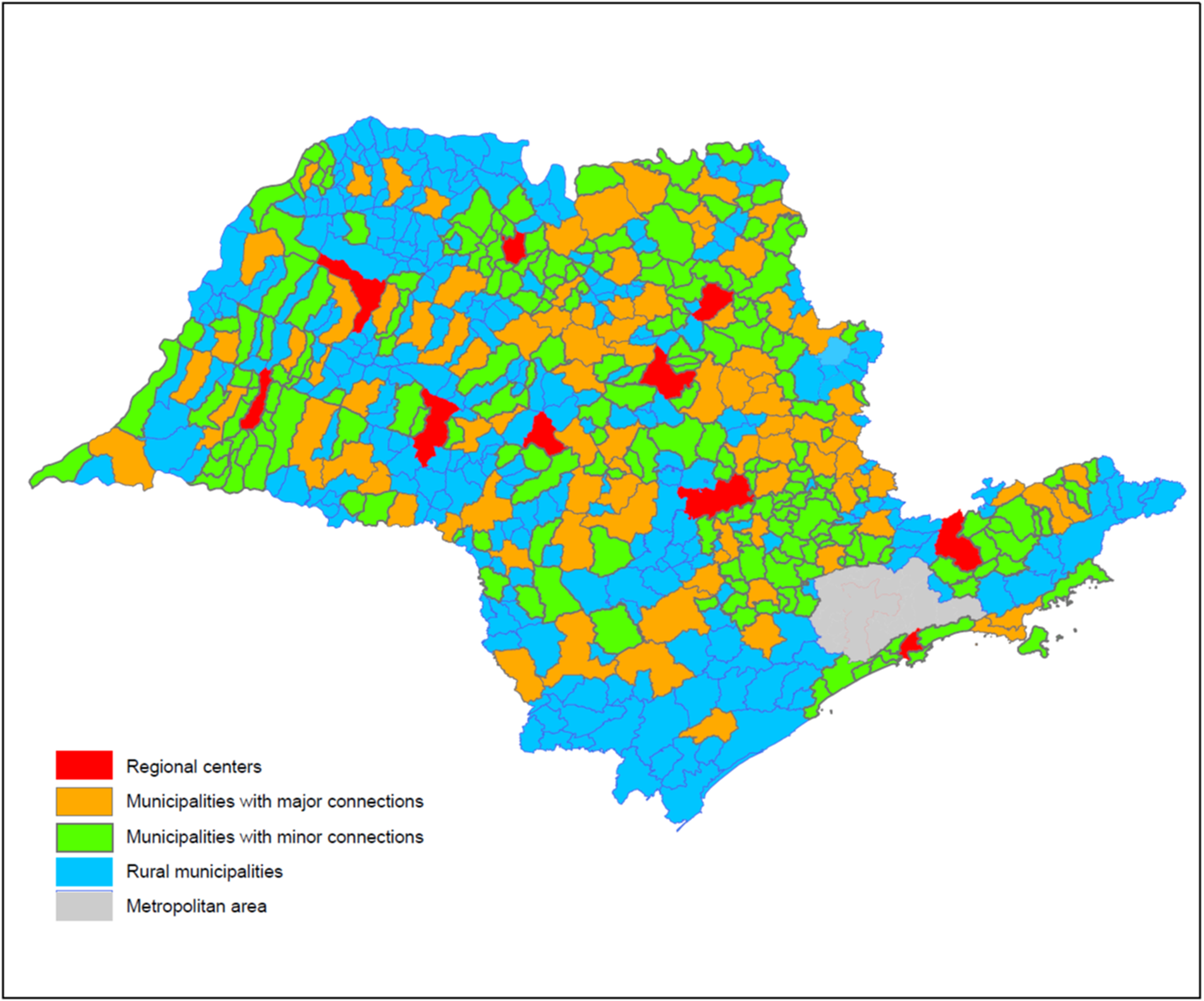
Data on notifications of confirmed COVID-19 cases and deaths were obtained from the Centre for Epidemiological Surveillance from São Paulo, State Health Department (CVE, www.cve.saude.sp.gov.br). Socio-demographic data for each municipality were obtained from the São Paulo State Foundation for Data Analysis (SEADE, https://www.seade.gov.br/). These data included demographic density, percentage of persons living in urban area, human development index (HDI) and Gini index for inequality of income [Reference Barbalat and Franck10]. Based on our previous analysis [Reference Fortaleza11], we identified 13 municipalities which are centres of greater regional influence. The remaining municipalities were classified according to criteria from the Brazilian Institute for Geography and Statistics (2017) [12]: (a) urban municipalities under major influence from regional centres; (b) urban municipalities under minor influence from regional centres; (c) rural municipalities (Fig. 1). In all models, the 13 regional centres were used as reference category. Finally, we identified the road distance from each municipality to the State capital, São Paulo City (http://www.cidadespaulistas.com.br/prt/cnt/distancias.html).
Map of São Paulo State, Brazil, highlighting different classifications of municipalities, according to their regional influence and connectiveness. The São Paulo City metropolitan area (grey area) was excluded from our analysis.
Statistical analysis
A descriptive analysis of data was performed to identify differences for major categories of municipalities. In the following step, we used multivariable Cox regression models to analyse time from the first report of COVID-19 in São Paulo State up to the first occurrence of autochthonous case in each municipality. We performed both univariate and multivariable analysis (including simultaneously all predictors cited above). Similarly, we also performed univariate and multivariable models of zero-inflated binomial negative regression, with rates of laboratory-confirmed cases and mortality due to COVID-19 as outcomes. The same variables were assessed as risk factors. All analyses were performed using STATA 14 (Statacorp, College Station, TX, USA) or SPSS22 (IBM, Armonk, NY, USA).
Results
Early occurrence and both higher incidence and mortality rates were reported in municipalities classified as major regional centres (Table 1). In univariate Cox regression, several variables were positively associated with early introduction of COVID-19: higher classification of influence/connectiveness, demographic density, proportion of persons living in urban area, HDI and the Gini index for inequalities in income. In an opposite way, distance from the capital had a protective effect (i.e. was negatively associated with the outcome). In multivariable models, influence/connectiveness, demographic density and HDI were predictors of early outcome, while distance from the capital was once again negatively associated (Table 2 and Fig. 2).
Cox regression graphics for time until introduction of COVID-19 in municipalities from inner São Paulo State, Brazil (based on surveillance data up to 8 May 2020).

Characteristics of municipalities from inner São Paulo State, Brazil

a Per 100 000 inhabitants, as of 8 May 2020.
b Though 75th percentiles were zero, upper values for COVID incidence and mortality in rural municipalities were 134.3 and 14.3 per 100 000 inhabitants, respectively. Those were obvious outliers.
Multivariable Cox regression results for likelihood of inner São Paulo State municipalities presenting at least one confirmed case of COVID-19 as of 8 May 2020

HR, hazard ratio; CI, confidence interval.
Note: Urbanisation rate is the measure of proportion of inhabitants living in urban area.
In the models of zero-inflated negative binomial regression (both univariate and multivariable), there was a positive association of COVID-19 incidence with higher influence/connectiveness degree, demographic density, HDI and Gini index, and a negative association with distance from the State Capital. The proportion of persons living in urban areas was positively associated with that outcome in univariable, but lost statistical significance after adjusting for confounders (Table 3).
Zero-inflated negative binomial regression results for rates of confirmed COVID-19 cases in inner São Paulo State municipalities, as of 8 May 2020

IRR, incidence rate ratio; CI, confidence interval.
Note: Urbanisation rate is the measure of proportion of inhabitants living in urban area.
Univariate results for COVID-19 mortality were similar to those found for incidence. However, in the multivariable analysis, only the higher degrees of influence/connectiveness, demographic density and HDI were significantly and positively associated with increased mortality (Table 4).
Zero-inflated negative binomial regression results for COVID-19 mortality in inner São Paulo State municipalities, as of 18 April 2020

IRR, incidence rate ratio; CI, confidence interval.
Note: Urbanisation rate is the measure of proportion of inhabitants living in urban area.
Discussion
The COVID-19 pandemic has imposed to epidemiologists the rapid performance of complex analyses, aimed at directing public health policies. In developing countries, such as Brazil, the challenges range from access to healthcare to the devastating effects of economic recession [Reference Andrade13–Reference Nicola15]. To date, more than half COVID-19 cases in São Paulo State occurred in the capital (São Paulo City) metropolitan area. This has created a false sensation of safety in the inner cities. Local authorities (e.g. city mayors) are questioning social distancing recommendations. Our study was conducted aiming to influence São Paulo Health Department (and ultimately, the State Governor's) policies. Alongside with previous analyses [Reference Fortaleza11], we attempted to identify the routes of spread and the vulnerability of municipalities to COVID-19.
One must notice that inner São Paulo State is heterogeneous, comprising cities that range from 1000 to 1.2 million inhabitants. Our findings highlight the importance of regionally relevant urban centres, some of which are located far from the capital (Fig. 1). Interestingly, both the classification of regional relevance and the demographic density were independently associated with early introduction and higher incidence rates.
It is worth noting that, besides regional relevance and other indexes of urbanisation, proximity to the state capital (i.e. the State epicentre of COVID-19) was also independently associated with early and greater impact of the pandemics. Therefore, we detected two patterns of epidemic spread into the inner state. In one pattern, the disease spreads by contiguity into areas neighbouring the capital and its metropolitan area. In the other, it disseminates rapidly to great cities located in central and western areas of the state, from which it spreads into smaller municipalities. The greater the connectiveness of those municipalities with their regional centres, the greater their vulnerability to COVID-19. This explains the apparent paradox of some high-risk cities being located far from the state capital, and vice versa. On the other hand, lower mortality in cities with higher HDI may reflect difficulties of access to hospitals and emergency centres in poorer municipalities in inner São Paulo State.
Our study may have inaccuracies inherent to the analysis of partial data in an ongoing pandemic, including underreporting and delays in information systems. Some variables presented collinearity (e.g. demographic density and proportion of persons living in urban areas), which were adjusted in the multivariable models. Despite its limitations, the ecological design provides the appropriate results to guide public health decisions [Reference Morgenstern16]. If we are to enter a ‘post-lockdown’ period, it must be planned considering the routes of COVID-19 spread into inner areas of the countries. Late introduction and lower (up-to-date) incidence may be erroneously interpreted as absence of risks. In our perspective, the findings of this study should be interpreted in the opposite way, i.e. suggesting that control measures should be strengthened in urban areas of great social and economical influence, and secondarily in municipalities with major connections with those cities [Reference Fortaleza11]. By identifying target areas for interrupting transmission, countries and states can make fine adjustments in their way out of lockdown or other social distancing strategies.
Conflict of interest
All authors state that they have no conflict of interest regarding this study. A preprint version was submitted to a repository (preprints.org).
Data availability statement
The authors state that the database used in the analyses can be available as a supplementary file to the paper, or provided to interested researchers upon reasonable request.


 Open access

