


During a June 2016 radio interview with Brietbart News Radio, then-candidate Donald Trump discussed his strategy for nominating federal judges. The future president told Brietbart, “We’re going to have great judges, conservative, all picked by the Federalist Society” (Millhiser Reference Millhiser2020). Trump’s campaign promise soon took shape with almost half of his judicial nominations from his first term in office – including all of his Supreme Court nominees – being affiliated with the Federalist Society (FedSoc) (Bird and McGee Reference Bird and McGee2023a; Whitehouse Reference Whitehouse2019). This is perhaps unsurprising as Trump selected Leonard Leo as his first White House adviser on judicial nominations. Formerly, Leo served as the Federalist Society’s executive vice president until leaving to work for the first Trump administration. Steven Calabresi, a Federalist Society cofounder, went so far as to dub the organization a “clearinghouse” for conservative judicial candidates akin to the American Bar Association with Republican presidents “relying on the Federalist Society to come up with qualified candidates” (Wheeler Reference Wheeler2017).
The Republican outsourcing of judicial selection to the Federalist Society has not gone unnoticed and, at times, has even been celebrated by senators in the Republican Party. At a 2018 Federalist Society gala, Orrin Hatch – a former Senate Judiciary Committee chairman and Republican senator from Utah – said, “Some have accused President Trump of outsourcing his judicial selection process to the Federalist Society. I say, ‘Damn right’” (Fredrickson and Segall Reference Fredrickson and Segall2020). Senator Sheldon Whitehouse (D-RI) took aim at the Federalist Society during the confirmation hearings for Supreme Court nominee Ketanji Brown Jackson saying the organization “controlled the turnstile” rather than “simply rooting for someone to be put on the court” (Eisen and Aftergut Reference Eisen and Aftergut2020). Clearly, the Federalist Society’s involvement in judicial nominations and confirmations has been noticed – and at times is at the forefront – of discourse on federal judicial candidates.
Conservative legal elites – including Antonin Scalia, Stephen Calabresi, Robert Bork, and Theodore Olson – at the University of Chicago and Yale University Law Schools formed the Federalist Society for Law and Public Policy (FedSoc) in 1982.Footnote 2 The organization’s goals, reflected on their website’s “About Us” section, state the FedSoc is “a group of conservatives and libertarians dedicated for reforming the the current legal order.” Further, the organization asserts it serves as a counterweight to the organization’s view of a legal profession and education system “dominated by a form of orthodox liberal ideology.” In doing so, the FedSoc aims to reshape the legal legal system to “place a premium on individual liberty, traditional values, and the rule of law.”
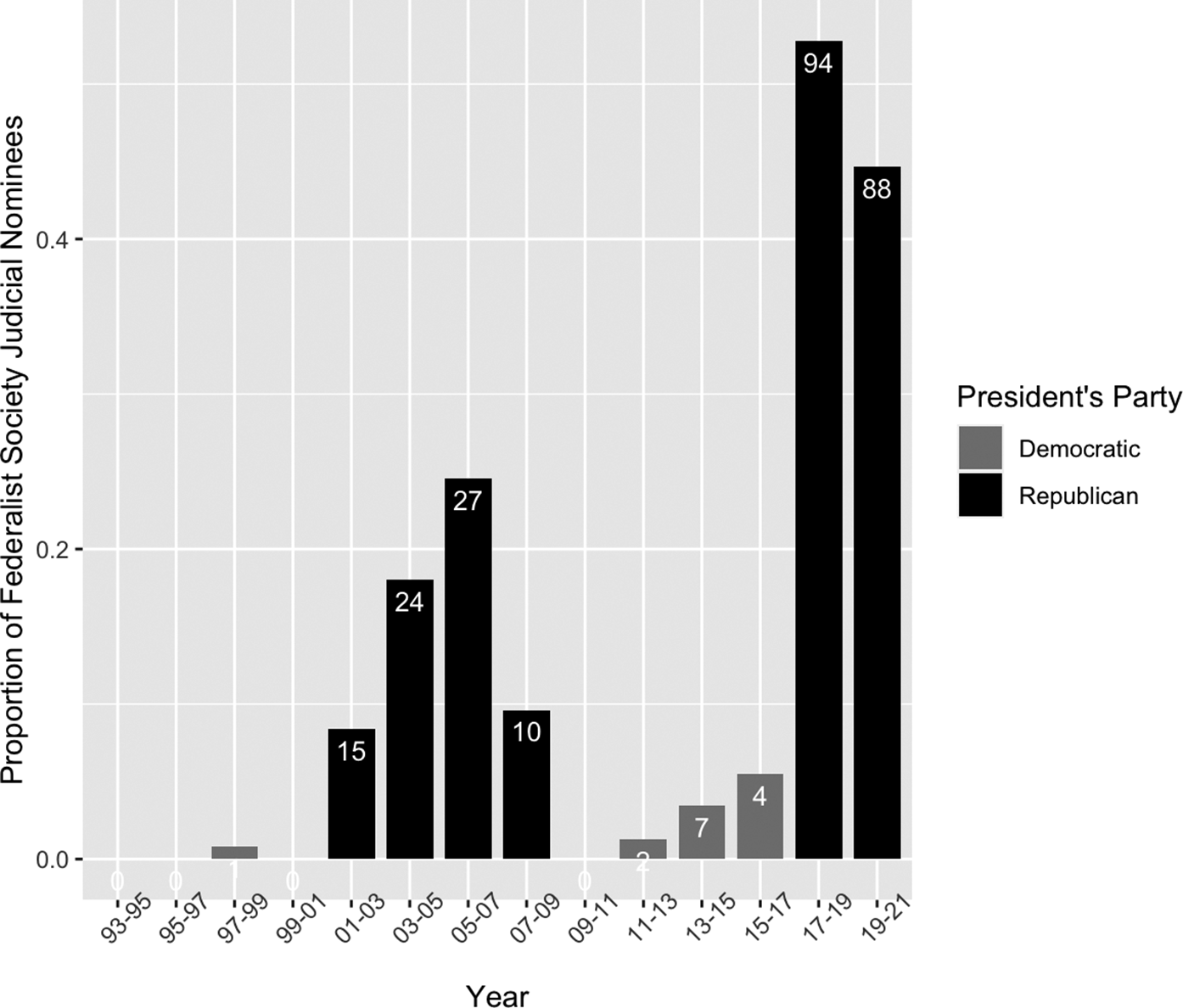
In working to achieve these goals, the FedSoc created a conservative and libertarian intellectual network that “extends to all levels of the legal community.”Footnote 3 To help curate this network, the FedSoc hosts thousands of events a year that range from a classic debate-style centered on a legal issue to networking and social events (Bird and McGee Reference Bird and McGee2023a). However, the FedSoc remains resolute in its characterization of its role as a non-advocacy group. In the “Frequently Asked Questions” page of their website, the society responds to the question, “Does the Federalist Society take positions on legal or policy issues or engage in other forms of political advocacy?” with “No. The Society is about ideas. We do not lobby for legislation, take policy positions, or sponsor or endorse nominees and candidates for public service.”Footnote 4 However, even with these distinctions from other advocacy groups, the FedSoc’s influence in federal judicial nominations is apparent even without the presence of more classic forms of advocacy seen in other interest groups. For example, the proportion of total judicial nominees affiliated with the Federalist Society jumped from just over 0.2 during George W. Bush’s presidency to just over 0.5 during the first Trump administration.
Judicial nominations in the U.S. Senate during the contemporary era are increasingly polarized, and the stakes are higher now than ever (Hartley and Holmes Reference Hartley and Holmes2002). Many pundits, court watchers, and politicians attribute increasing polarization, at least in part, to the growing influence of the Federalist Society. The Federalist Society played a foundational role in fostering the growth of the conservative legal movement and certainly is responsible for ushering “originalism” as the primary “correct” method or philosophy of constitutional interpretation in the conservative legal movement (Teles Reference Teles2008; Hollis-Brusky Reference Hollis-Brusky2015). All the while, the environment surrounding the politics of federal judicial nominations has shifted over the several decades due to violations of norms, dilatory tactics, and the use of the “nuclear option” (Binder and Maltzman Reference Binder and Maltzman2002; King and Ostrander Reference King and Ostrander2020) ushering in a new era of nomination politics in the face of eroding rules and procedures (Wawro and Schickler Reference Wawro and Schickler2018; Bird and McGee Reference Bird and McGee2023a; King and Ostrander Reference King and OstranderForthcoming). In this article, we look even further into nominations politics in order to better understand senator behavior in the nominations process.
We seek to advance understanding of how Federalist Society affiliation informs a senator’s vote on the floor. In this article, we ask, to what extent do senators respond to affiliation with the Federalist Society among judicial nominees, and does that affiliation go so far as to shape senator voting behavior? Is a nominee’s Federalist Society affiliation interpreted as a “cue” or “litmus test” for a nominee’s ideological commitments? Do senators use a nominee’s FedSoc affiliation as a cue when deciding how to vote on a judicial nomination? We argue the answer is yes.
Drawing from work in psychology on decision-making, we posit the Federalist Society cue represents a partisan cleavage in modern nominations politics and allows members of both parties to utilize the representativeness heuristic in choosing to support – or oppose – a nominee. We employ a novel dataset of roll call votes on judicial nominations combined with data on events the Federalist Society sponsored and from nominee responses in Senate Judiciary Questionnaires from 1991 to 2020. Our findings reveal a nuanced picture of the Federalist Society’s influence in contemporary nominations politics. We find overwhelming evidence that senators interpret Federalist Society affiliation as an important cue about latent ideological commitments and are strictly divided along partisan lines regarding their support for Federalist Society-affiliated nominees with results robust across all levels of the federal judicial hierarchy. Interestingly, however, a senator’s own Federalist Society affiliation does not appear to influence that senator’s vote on Federalist Society-affiliated nominees, compared to other Republican senators, suggesting the nominee’s affiliation – and not within-group opinion – drives senators’ voting patterns on the floor.
Theory and hypotheses
Political polarization, judicial nominations, and the Federalist Society
Interest groups are involved at every stage of the judicial nominations process from selection to supporting nominated candidates for confirmation (Scherer, Bartels and Steigerwalt Reference Scherer, Bartels and Steigerwalt2008; Cameron et al. Reference Cameron, Gray, Kastellac and Park2020). The success of potential nominees relies heavily on professional and political networks – including connections to interest groups such as the Federalist Society. As Marcia Coyle highlighted during Amy Coney Barrett’s nomination hearings, “These nominees, whoever they are, do become nominees because they have made contacts over the years, they have mentors that may be politically connected, and that’s how they come to the attention of the White House” (Coyle Reference Coyle2020). The Federalist Society is an organization that excels at socializing its members intellectually and professionally with an eye toward future opportunities, and political pundits and commentators are taking notice. (Hollis-Brusky Reference Hollis-Brusky2015; Bird and McGee Reference Bird and McGee2023a).
Judicial nominations have become increasingly polarized in the contemporary era to the point that individual nominee’s qualifications rarely move the needle (Ogundele and Keith Reference Ogundele and Keith1999; Bond, Fleisher, and Krutz Reference Bond, Fleisher and Krutz2009; Cameron, Kastellec and Park Reference Cameron, Kastellec and Park2013; Badas Reference Badas2024). Nominations have shifted from simple confirmations to politicized events in the public eye (Schoenherr, Lane and Armaly Reference Schoenherr, Lane and Armaly2020; Armaly, Krewson and Lane Reference Armaly, Krewson and Lane2024). Increased recognition of federal judicial influence on public policy during a lifetime appointment led to political parties prioritizing nominating the “correct” judges to the federal bench (Goldman Reference Goldman1997; Nemacheck Reference Nemacheck2008; Badas and Stauffer Reference Badas and Stauffer2018; Bird and McGee Reference Bird and McGee2023a; King, Schoenherr and Ostrander Reference King, Schoenherr and Ostrander2025).
For the Republican Party, the “correct” kind of judges appear to be those affiliated with the Federalist Society, as it is the largest proponent that originalism is the singular “correct” judicial philosophy. The Federalist Society, founded in the 1980s as a response to the prevalence of “orthodox liberal ideology” in law schools and the legal profession,Footnote 5 is an interest group and intellectual organization with strong ties to the growing influence of the conservative legal movement. The Federalist Society insists the organization was founded to engage in “ideas,” not “politics.” This claim is perhaps best exemplified by Senator Ted Cruz’s (R-TX) statement made at Amy Coney Barrett’s Supreme Court confirmation hearing:
The Federalist Society takes no positions. It doesn’t lobby, doesn’t file amicus briefs, doesn’t take public policy positions. Most of its events are debates where people on the left are featured prominently. Every single U.S. Supreme Court justice, all of them, have spoken at least one Federalist Society event.Footnote 6
Indeed, the Federalist Society’s current mission statement on its website states its focus is on intellectual debates surrounding constitutional interpretation methods and developments in doctrinal law with no explicit reference to the politics surrounding these issues.Footnote 7 As Senator Cruz stated, the organization goes to great lengths to appear apolitical. Their mission statement explicitly says that the Federalist Society does not lobby, engage, or directly support political or judicial candidates.Footnote 8 A lack of direct intervention notwithstanding, the organization supports particular ideas and produces a network that may nevertheless have an indirect effect on the political process such as their former executive vice president’s relationship to the first Trump administration. Increasingly, scholars describe the Federalist Society’s strategy on nominations as being an explicitly political one, despite their sincere claims to want to be viewed as a strictly intellectual organization (Liebell Reference Liebell2023; Bird and McGee Reference Bird and McGee2023b). We argue a nominee’s Federalist Society affiliation provides a clear informational signal to senators during the judicial confirmation process about what type of judge the nominee is likely to be.
Affiliation with the Federalist Society provides nominees access to influential elites with a substantial amount of power and an influential network that connects the ideas to institutional outcomes (Teles Reference Teles2008; Hollis-Brusky Reference Hollis-Brusky2015). The Federalist Society has established an elite network of 90,000+ members, is present at all American Bar Association accredited law schools (Hollis-Brusky Reference Hollis-Brusky2015, updated statistic – Federalist Society, 2025), and has hosted over 10,000 events in its history. And while the stated mission of the Federalist Society is facilitation of and engagement in intellectual debates, individuals inside its network have individual goals – such as a seat on the federal bench. Many have been successful in achieving this specific goal, as is evidenced by affiliates assuming seats in the ranks of the federal bench. Furthermore, this success extends to the top of the judicial hierarchy with all six members of the current Supreme Court conservative bloc having official ties to the Federalist Society prior to their nominations and a former member of the Bench – the late-Justice Antonin Scalia – being a founder of the group (Bird and McGee Reference Bird and McGee2023a).Footnote 9
Political decision-making & senators’ usage of information shortcuts
United States senators, while certainly powerful in American society, are nevertheless humans with limited capacities for decision-making. Humans are motivated by goals and will adapt their behavior in pursuit of those goals (Jones Reference Jones2001). For example, if a senator notices they are voting to confirm judges to the federal bench who are not issuing rulings that align with the senator’s ideological values, they will likely rethink their process for vetting judicial nominees. Yet, being a senator does not free one from the cognitive limitations we all have in prioritizing or processing information, calculating trade-offs, or generating outputs (Simon Reference Simon1996). If a senator could work 24 hours a day and neglect any other pressing policy concerns (and survival needs) in pursuit of confirming an originalist judge (assuming that is their goal for illustrative purposes), it would likely be an easy task to accomplish. They could spend days pouring over the prepared materials about the jurist, contact their professors from law school, interview their colleagues at private firms, review every word the nominee ever wrote, and so on. Theoretically, they would be in search of full information about the nominee and leave nothing to chance about the nominee’s commitment to originalism before making their decision to support the nominee.
For senators, these limitations are even more acute because they are consistently oversupplied with information (Porter Reference Porter1974; Kingdon Reference Kingdon1989; Baumgartner and Jones Reference Baumgartner and Jones1993; Jones and Baumgartner Reference Jones and Baumgartner2005).Footnote 10 Therefore, senators must find ways to make the decision-making process on judicial nominees (and any other issue they consider) more efficient within the bounds of our cognitive limitations. One strategy for doing so that all humans utilize, whether we do so consciously or not, is through heuristics. Heuristics are akin to a “rule of thumb” that can be used to simplify a complex problem and, ideally, lead to the same outcome or choice as a full-information decision would for the decision-maker (Tversky and Kahneman Reference Tversky and Kahneman1974; Jones Reference Jones2001). However, heuristics are spontaneous strategies, and they often mislead us; yet, this is not to say that error-correction can never occur (Jones Reference Jones2001).
“Reliance on heuristic principles fosters cognitive efficiency by guiding end-oriented processing; contextual cues can directly affect a recipient’s willingness to accept the conclusion of a message without altering the likelihood of yielding to supportive argumentation” (Mondak Reference Mondak1993, 170). We argue senators rely on affiliation with the Federalist Society as a cue and utilize the representativeness heuristic in particular when doing so (e.g., Tversky and Kahneman (Reference Tversky and Kahneman1974)). With an eye toward confirming judges that align with their ideological views, senators identify that nominees affiliated with the Federalist Society are more representative of their image of the “correct type” of judge (i.e., an originalist judge who is less likely to drift ideologically) than any other type of judge (Whittington Reference Whittington2017).
Drawing further on cue theory, and senator use of the representative heuristic, we further examine how Republican senators who themselves are affiliated with the FedSoc consider FedSoc affiliates as judicial nominees. Republican senators should be more likely to vote for Republican-appointed nominees overall (Kastellec et al. Reference Kastellec, Lax, Malecki and Phillips2015). Moreover, Republican senators who are also affiliated with the FedSoc should be more likely to vote for FedSoc-affiliated judicial nominees, as the cue is more informative and trustworthy and likely operates stronger based on shared networks. Most Republican senators who are FedSoc-affiliated are lawyers who joined in law school or were invited into the group because of an ideological commitment. These senators regularly attend and speak at FedSoc meetings and events.
For example, Ted Cruz (R-TX) joined the organization as a law student and remains an active member. Cruz had a prominent legal career including a prestigious Supreme Court clerkship with Chief Justice William Rehnquist and service as the Texas Solicitor General prior to running for his senate seat. Cruz is officially listed as a speaker at 25 FedSoc events dating back to 1999. However, FedSoc affiliation is not limited solely to senators with prestigious legal training. Rand Paul (R-KY), a medical doctor who is not a lawyer by training, is officially listed as speaking at four FedSoc events since 2017 and was even presented a Lifetime Service Award by the Georgetown Law School’s Student Chapter. Because of their strong ties to the organization, FedSoc-affiliated senators have internal knowledge of the ideals and philosophies of their fellow affiliates that might influence the way they view their fellow members’ bids for seats to the federal judiciary. Additionally, they may view their continued affiliation with the continually growing group as a means to further their own political ambitions or as a means to build the FedSoc’s organizational reputation.
These circumstances may make affiliation with the Federalist Society a particularly powerful cue for senators relying on the representativeness heuristic. Of course, utilizing this heuristic means privileging some set of information over another and can lead to overestimating the importance of that information when categorizing judicial nominees as originalists or not. Senators have learned this the hard way given that not all Federalist Society affiliates have retained their conservative views once on the bench. For example, Justice Souter was nominated by George H.W. Bush, a Republican president, to the Supreme Court. Yet nearly three decades later, another Republican president – Donald Trump – vowed to never nominate “another Souter” to the Supreme Court due to the justice’s reputation for siding with the Court’s liberal bloc (Kaplan Reference Kaplan2018). And, even Chief Justice John Roberts was chastised for not uniformly voting with the conservative supermajority during the first Trump presidency (Kaplan Reference Kaplan2018).
Situating the use of cues more broadly within the framework of decision-making is important for establishing the foundations of our theory. The use of cues as information shortcuts among members of Congress has been studied in other contexts (Matthews and Stimson Reference Matthews and Stimson1975; Box-Steffensmeier, Ryan and Sokhey Reference Box-Steffensmeier, Ryan and Sokhey2015; Box-Steffernsmeier, Christenson and Craig Reference Box-Steffernsmeier, Christenson and Craig2019). For example, Box-Steffensmeier, Ryan and Sokhey (Reference Box-Steffensmeier, Ryan and Sokhey2015) show senators need cues because they serve on multiple committees, leading to less specialized knowledge. Even if each senator thoroughly read the entire record of the hundreds of nominees put forward each congress, there is still a high likelihood that the senator’s expertise level might not lead to a full understanding of the implications of a record.
Moreover, the Senate Judiciary Committee is not excluded from other committee-system developments of the contemporary era of political polarization. Scholars have observed a trend indicating that hearings are increasingly used to bolster partisan positions and information, rather than generate an environment focused on problem-solving or expert testimony (Lewallen, Theriault and Jones Reference Lewallen, Theriault and Jones2016; Schoenherr, Lane and Armaly Reference Schoenherr, Lane and Armaly2020; Lewallen Reference Lewallen2020). While we might rightfully be skeptical of the role of committees in the contemporary Congress compared with traditional theoretical understandings (Krehbiel Reference Krehbiel1992; Hall Reference Hall1998), recent scholarship has also reaffirmed the role of committee chairs as salient cue-givers in the centralized, partisan-controlled Congress (Curry Reference Curry2019). Senators therefore are still clearly seeking cues from the president, party leadership, committee chairs, other members, and external sources like interest groups to estimate the ideological position of a judicial nominee (Kingdon Reference Kingdon1989; Box-Steffernsmeier, Christenson and Craig Reference Box-Steffernsmeier, Christenson and Craig2019; Cameron et al. Reference Cameron, Gray, Kastellac and Park2020).
Vetting judicial nominees in the new era of confirmation politics
While senators cannot possibly process and retain all information about every nominee, they do still spend a significant amount of time evaluating candidates for the federal judiciary in part because of the substantial information used to evaluate each nominee. Given how important this point is for our argument, allow us to elaborate briefly. Each nomination “packet” contains hundreds of pages of past legal opinions, self-disclosures, FBI background checks, ABA ratings, witness testimony, statements of support, and Questions for the Record. Simply put, evaluating a nominee to a lifetime judicial position is no small task. Further, while the size of an individual’s record may vary by nominee, the number of nominees senators consider increases as the level in the judicial hierarchy decreases. Compared to Supreme Court vacancies, which are rare, require the review of a single record, and halt all other nominations (Steigerwalt Reference Steigerwalt2010; Madonna, Monogan and Vining Reference Madonna, Monogan and Vining2016), evaluating the number of circuit and district nominees put forward each congress dramatically increases a senator’s workload. As several of these nominations may overlap – and even share Senate Judiciary Committee hearings – senators and their staffs have to process and review several records at a time. Given that staffers play a crucial role in congressional offices, long recognized as an important structural component of the contemporary Congress (Salisbury and Shepsle Reference Salisbury and Shepsle1981), having a consistent cue that any given staffer (in their Capitol Hill office or working for the Judiciary Committee) assisting with this task can utilize makes this affiliation even more useful in greasing the skids and keeping the Senate moving.Footnote 11 Therefore, the mere affiliation of a nominee with an interest group that provides information about their judicial philosophy is enough, perhaps even vital, to supply information to a decision maker – even if the cue is indirect.
The Senate Judiciary Committee nominations hearings are televised and, at least in the past five years for Supreme Court nominees, have attracted a substantial amount of traditional and social media attention allowing senators to pursue policy goals in meaningful ways (Feldman Reference Feldman2019; Dancey, Nelson and Ringsmuth Reference Dancey, Nelson and Ringsmuth2020; Boyd, Collins, and Ringhand Reference Boyd, Paul M. and Lori A.2023). While relatively forthcoming (Farganis and Wedeking Reference Farganis and Wedeking2014), nominees for the Supreme Court are often less than willing to answer questions about their ideological leanings directly in hearings (Chen and Bryan Reference Chen and Bryan2018). Cues from interest groups (and colleagues) help lawmakers make decisions on everything from their votes on the floor to the questions they ask in committee hearings (Baumgartner and Leech Reference Baumgartner and Leech1998; Krutz Reference Krutz2005; Hall and Deardorff Reference Hall and Deardorff2006; Curry Reference Curry2015; Box-Steffernsmeier, Christenson and Craig Reference Box-Steffernsmeier, Christenson and Craig2019).
The Senate’s advice and consent process operates slightly differently at lower court levels than for the Supreme Court. Senators representing the “home state” of a lower court seat are given an opportunity to weigh in on a judicial nominee via blue slips. After the president selects a nominee to fill a district or circuit court vacancy, the Chair of the Senate Judiciary committee sends a form (on blue paper, originating the term “blue slip,” which describes this process) to the home state senators.Footnote 12 If a home state senator supports the nomination, they return the blue slip to the Senate Judiciary Committee containing a statement of support. If a home state senator objects to the nomination, they either withhold the blue slip or return it with a negative statement of opposition. Blue slips were originally conceived to create a stronger connection in the judicial nominations process between nominee and the state’s representation in Congress.Footnote 13 Senators use blue slips as an opportunity to exhibit ideological preferences and can obstruct an ideologically distant nominee’s confirmation by refusing to return blue slips (Binder Reference Binder2007; Black, Madonna and Owens Reference Black, Madonna and Owens2011).
Following recent shifts in Senate rules and procedures, Federalist Society affiliates are more likely to be confirmed to the circuit courts than non-affiliates (Bird and McGee Reference Bird and McGee2023a). Here, we build on this work and ask, How does a nominee’s Federalist Society affiliation cue senators and impact their voting for (or against) a nominee? Does being affiliated with the Federalist Society influence the likelihood of gaining a senator’s vote for confirmation? Is support conditioned by a senator’s party identification or ideology? And, how does a senator’s own affiliation with the Federalist Society affect voting for other affiliates? From these questions, we propose the following hypotheses:
Hypothesis 1: More liberal [conservative] senators will be less [more] likely to vote for Federalist Society-affiliated nominees, regardless of court level.
Hypothesis 2: Federalist Society-affiliated Republican senators are more likely to vote for Federalist Society-affiliated judicial nominees than non-affiliated Republican senators.
We find substantial evidence that senators identify Federalist Society affiliation as a salient cue when considering a judicial nominee’s ideological predisposition across court level. Senators use this as a heuristic for a nominee’s judicial philosophy, associating Federalist Society affiliation with originalism statutory and constitutional interpretation. Affiliation, therefore, creates both partisan (conservative) and judicial philosophy (originalist) cues. In the following section, we describe our data and methodological approach. We then provide a detailed explanation of our findings. We conclude with a discussion of the role of cues and the Federalist Society in federal judicial nominations.
Data and methods
To see how Federalist Society affiliation impacts receiving a senator’s vote, we collect a novel dataset of 35,602 roll call votes for all U.S. district, circuit, and Supreme Court nominations from 1991 to 2020 (King Reference King2023). Specifically, we test our hypotheses on any nomination with a final, recorded vote on the Senate floor.Footnote 14 As such, our dependent variable is the dichotomous – “yea” or “nay” – individual senator’s vote on a nominee.
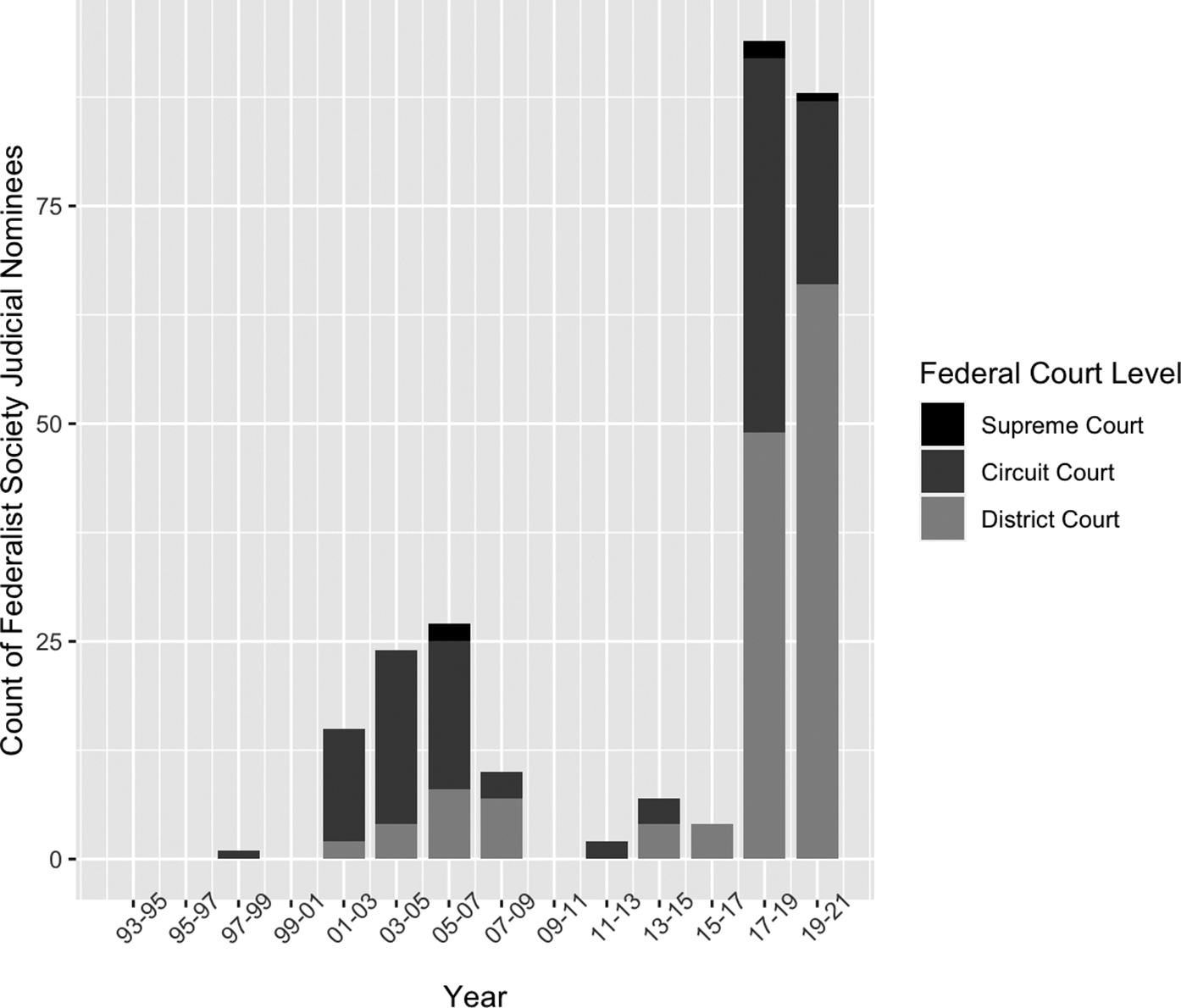
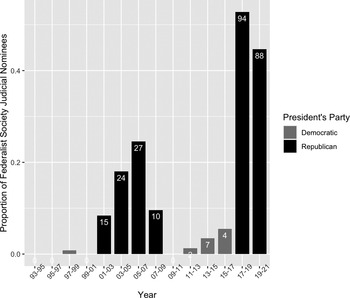
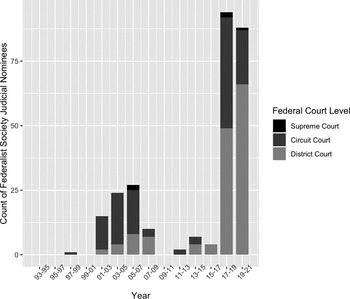
For each nomination, we collect several variables of interest. Our main covariate of interest is a nominee’s Federalist Society affiliation. Official lists of Federalist Society membership are not publicly available, and therefore, we consider only judges that are affiliated with the Federalist Society in a public way via event speaker roles or via self-disclosure in their public confirmation disclosures. Again, mere general attendance at an event or appearing as a labeled ideological counterweight in a debate is not sufficient for our measure of affiliation. In previous literature, affiliation was determined from speaking at Federalist Society events (Hollis-Brusky Reference Hollis-Brusky2015), reporting on events (Scherer and Miller Reference Scherer and Miller2009), Federalist Society archives (Teles Reference Teles2008), and/or self-identification on Senate Judiciary Committee questionnaires (Scherer and Miller Reference Scherer and Miller2009). Because the Federalist Society hosts many debate events where a liberal counterweight is invited to participate, we drop all persons (usually academics) from the data labeled as the liberal debater on the event page. All FedSoc affiliates were then validated with the Senate Judiciary Committee questionnaire disclosures. Following Bird and McGee (Reference Bird and McGee2023a), we identify 131 nominees that, under these criteria, are considered Federalist Society affiliates.Footnote 15 Democratic presidents rarely nominate Federalist Society affiliates, and when they do, they are mainly to district court judgeships in conservative states. Figure 1 provides the count of FedSoc-affiliated nominees over time. As is evident from Figure 1, Federalist Society affiliation has always been driven by Republican administrations, but its prevalence reached new levels under the first Trump administration.Footnote 16 In Figure 1, we show both the count and the proportion of judicial nominees affiliated with the Federalist Society. In Figure 2, we provide the count of FedSoc-affiliated nominees by court level. These figures demonstrate a trend of presidents nominating FedSoc affiliates across the entire judiciary and that this trend has become more common over time. FedSoc’s presence is clear but, at least descriptively, has not yet reached a tipping point where all potential nominees would find themselves compelled to affiliate in order to be confirmed.
Proportion and Count of Federalist Society Affiliates Nominated to the Federal Bench Over Time. The vertical bars indicate the proportion of nominees with Federalist Society Affiliation. The numbers within bars indicate the raw count of Federalist Society nominees.
Count of Federalist Society Affiliates Nominated to the Federal Bench Over Time, by Court Level.
In addition to Federalist Society affiliation, we collect several control variables for nominees. As senators are more favorable to female nominees, we control for the gender of nominees (Asmussen Reference Asmussen2011; King, Schoenherr and Ostrander Reference King, Schoenherr and Ostrander2025). Furthermore, as senators have significant say in nominees to their own states, we include whether a senator is the “home state” senator for the relevant nomination (Binder and Maltzman Reference Binder and Maltzman2004). To account for a nominee’s perceived qualifications, we include the American Bar Association’s (ABA) rating of a nominee.Footnote 17 Nominees are rated by the ABA on a scale of well qualified, qualified, or not qualified. Furthermore, as a nominee’s perceived ideology may influence how a senator votes for them, we include the nominee’s Judicial Common Space (JCS) scores (Giles, Hetinger and Peppers Reference Giles, Hetinger and Peppers2001; Epstein et al. Reference Epstein, Martin, Segal and Westerland2007; Boyd Reference Boyd2015).Footnote 18 Finally, we include whether a nominee attended an “elite” law school for their legal education.Footnote 19
We include senator-specific variables to account for differences among individual senators. To account for partisan differentiation, we code each senator as a member of either the Republican or Democratic Party.Footnote 20 Further, to account for variations in ideology outside of simple partisanship, we include a senator’s NOMINATE score (Lewis et al. Reference Lewis, Poole, Rosenthal, Boche, Rudkin and Sonnet2022). Similar to a nominee’s Federalist Society affiliation, we are interested in the interaction between Federalist Society-affiliated senators and nominees. As such, we code senators as being affiliated with the Federalist Society identically to the above coding scheme for Federalist Society-affiliated judges resulting in 25 Federalist Society-affiliated senators.Footnote 21
We also include variables to account for unique behavior by individual senators, individual congresses, or court-level variations. We recognize the unique nature of nominations to each court level and create a court level indicator for the Supreme Court, circuit, and district courts – including an indicator for the D.C. circuit and district courts (Martinek, Kemper and Winkle Reference Martinek, Kemper and Van Winkle2002; Primo, Binder and Maltzman Reference Primo, Binder and Maltzman2008). Further, we acknowledge that each congress enjoys its own political circumstances and create an indicator for each congress within our dataset. Finally, we create individual senator variables that account for the variation in voting behavior of each senator.
The data used in our analysis exhibit a clearly nested structure. Votes for nominees occur within an individual senator’s voting behavior, within individual congresses, and within their respective court levels. The characteristics of each of these levels are important predictors of whether a nominee will receive a senator’s vote for confirmation. Because of this, we employ a multilevel logistic regression to test our hypotheses (Gelman and Hill Reference Gelman and Hill2007). Multilevel models are useful, as they estimate parameters that take these spatial and temporal groupings into account as well as allowing for the inclusion of covariates at the same level of these groups.
The dependent variable is dichotomous and indicates whether an individual senator voted for or against a judicial nominee in a roll call vote. To analyze the influence of FedSoc affiliation on a senator’s vote, we estimate multilevel logistic regression models. The first level in the hierarchical model occurs at the individual level. Variables at this level include nominee gender, ideology, ABA rating, elite law school attendance, senator party identification, nominee Federalist Society affiliation, and senator Federalist Society affiliation. The second level of the model includes an indicator for the unique senator’s voting pattern and indicators for the level of the federal courts – Supreme, Circuit, D.C. Circuit, District, or D.C. District. We include random intercepts at this level to model for dependencies within the data from being grouped within a given senator’s vote or within a court level. Finally, our third level is set at the individual congress. We include random intercepts to capture temporal and political variations occurring within a unique congress. As is common practice with this model specification, we estimate maximum likelihood and assume the random intercepts are drawn from a normal distribution (Gelman and Hill Reference Gelman and Hill2007).
Results
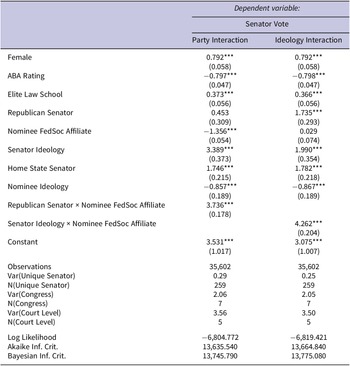
Table 1 provides the results of our first multilevel model. Specifically, Table 1 supplies estimates for 1) an interactive model of a nominee’s Federalist Society (FedSoc) affiliation and senator party identification and 2) an interactive model of FedSoc affiliation and senator ideology for Republican nominees. Specifically, we only examine Republican nominees, as over 95% of FedSoc-affiliated nominees are nominated by Republican presidents. We include models for all nominees in Table A1 in the appendix, which demonstrate that our main substantive results do not change.
Federalist Society Influence on Senator Voting: Republican-President Nominees
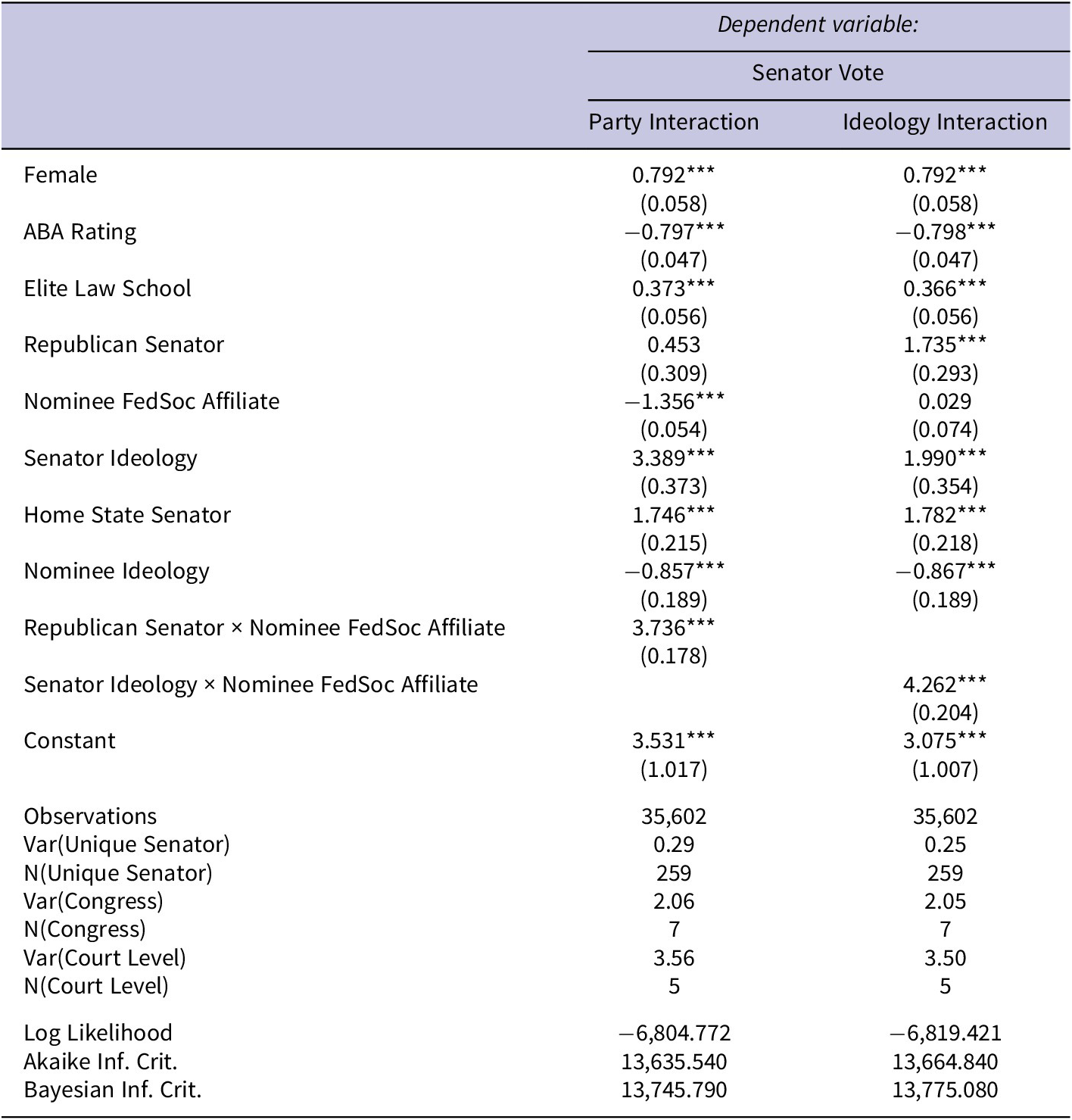
Note: *p<0.1; **p<0.05; ***p<0.01
In line with (Asmussen Reference Asmussen2011), we find that female nominees are more likely to receive a senator’s vote. Conversely, but intuitively, less qualified nominees – those with lower ABA ratings – are less likely to win a senator’s vote. Furthermore, attending an “elite” law school significantly increases a nominee’s likelihood of a gaining a senator’s vote. We see that a nominee for a senator’s “home state” is more likely to receive that senator’s vote, providing evidence of the strong effect blue slips have on lower court nominations (Binder and Maltzman Reference Binder and Maltzman2002). Finally, we see that both a senator’s and nominee’s ideology are statistically significant but in opposing directions. This is unsurprising, as more conservative senators are more likely to vote for Republican nominees, while Democratic senators are less likely to vote for more conservative nominees.
Importantly, and as expected in our first hypothesis, FedSoc affiliation has a conditional and statistically significant effect in both models. Specifically, the impact of nominee FedSoc affiliation is conditional on senator party identification and ideology with Democratic senators less likely to vote for FedSoc-affiliated nominees, while Republican senators are more likely. This effect is further conditioned by ideology, with more conservative Republican senators being more likely to vote for FedSoc-affiliated nominees than more moderate Republican senators. Conversely, more liberal Democratic senators are less likely to vote for FedSoc-affiliated nominees than their more moderate colleagues. These findings provide us with strong initial support for our first hypothesis that FedSoc affiliation is strongly associated with partisanship and ideology.
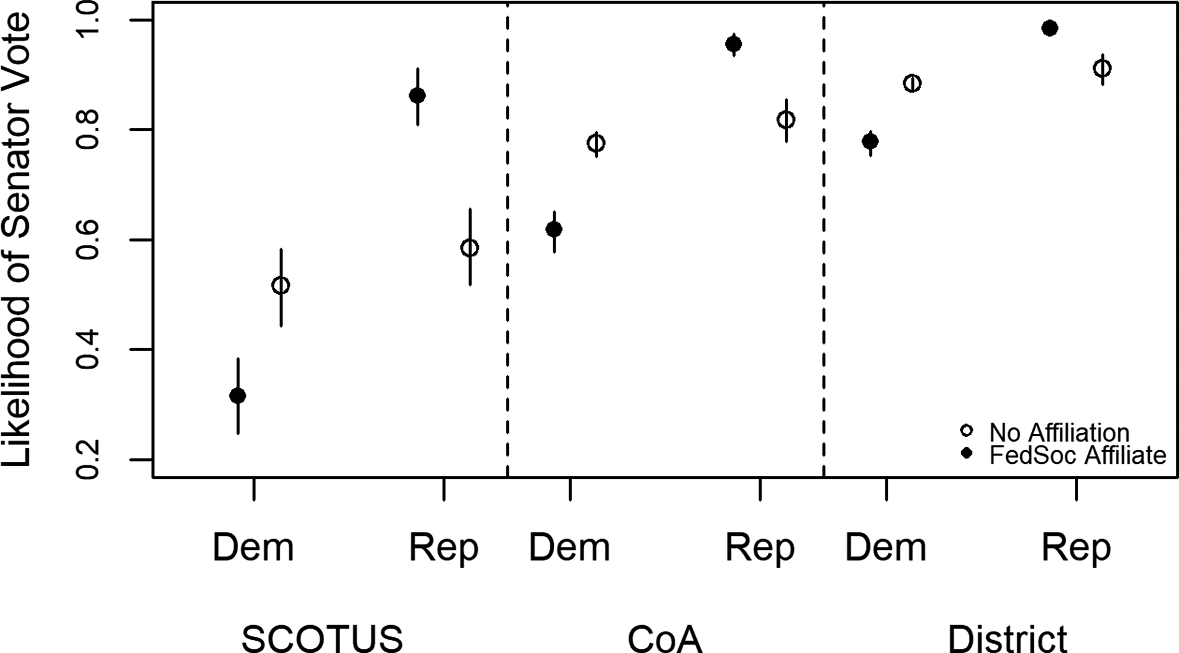
To investigate further, we generate a graphical depiction of predictions based off our regression estimates in Figure 3.Footnote 22 Specifically, Figure 3 provides the predicted probability of a senator voting to confirm a nominee at the Supreme Court, circuit, and district levels broken down by senator party identification and whether the nominee was an affiliate of the Federalist Society. Our findings in Figure 3 provide strong evidence for the conditional impact of the Federalist Society affiliation cue for senator vote choice. Further, we present evidence of court-level variation with regard to nominee FedSoc affiliation.Footnote 23
Likelihood of Receiving Senator Vote by Party ID.
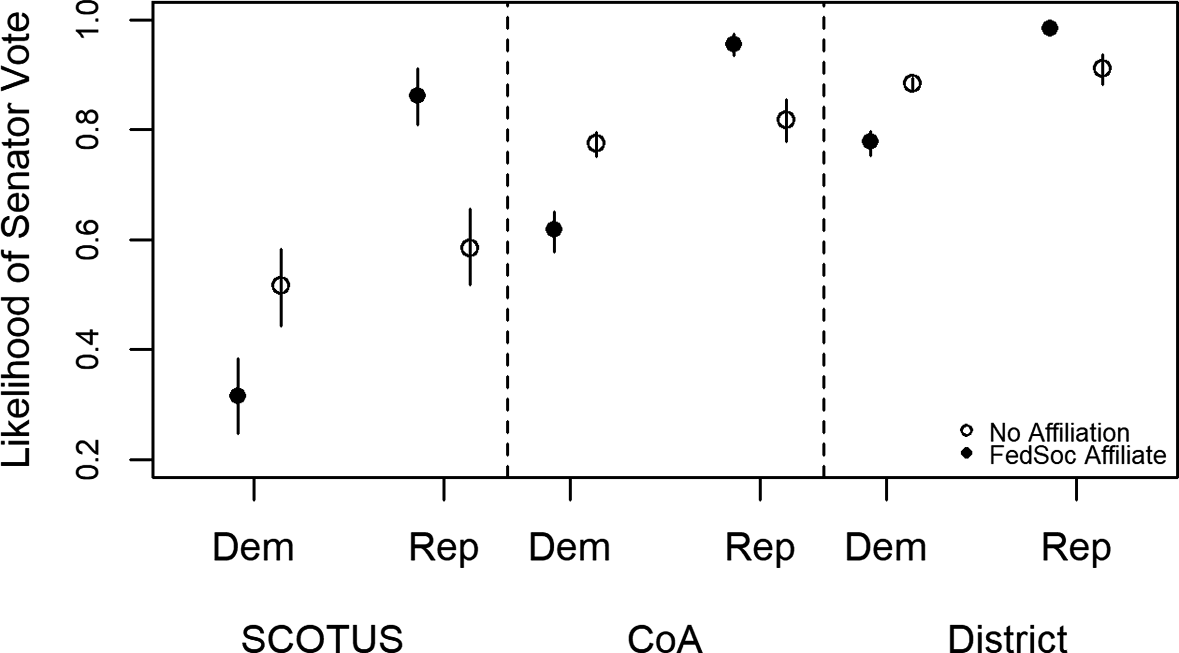
We show partisan variation in Figure 3, which clearly indicates a deep partisan cleavage from nominee FedSoc affiliation. Democrats are significantly less likely to vote for a FedSoc-affiliated nominee, while Republicans are significantly more likely to vote to confirm FedSoc affiliates.Footnote 24 This difference is evident at all court levels but is most pronounced at the Supreme Court level. A Democratic senator’s likelihood of voting to confirm a Supreme Court nominee drops from a 52% for non-FedSoc-affiliated nominees to 31% for FedSoc-affiliated nominees, a significant 21 percentage point decrease. Conversely, the FedSoc association cue leads to a strong increase in the likelihood of securing a Republican senator’s vote. The FedSoc affiliation cue appears to move a nominee from a likelihood of 60% (non-affiliated) to 89% for FedSoc-affiliated nominees – a 29 percentage point increase. We find similar returns at the circuit (Dem – 78% vs. 62%; Rep – 82% vs. 96%) and district (Dem – 88% vs. 78 %; Rep – 91 % vs. 99%) court levels for non-affiliated compared to FedSoc-affiliated nominees, respectively. Clearly, the Federalist Society affiliation cue has a staggering influence on the likelihood to receive a senator’s vote, conditional on senator partisanship.
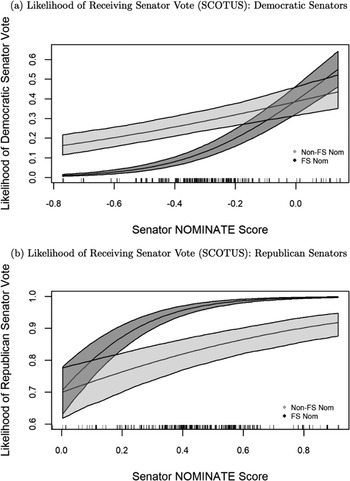
Partisanship, alone, may not tell the full story. As there are significant variations within-party of senator ideologies (Lewis et al. Reference Lewis, Poole, Rosenthal, Boche, Rudkin and Sonnet2022), examining how senator ideology affects voting for FedSoc-affiliated nominees may provide a more nuanced picture. Figure 4 demonstrates the significant within-party ideological variation influence on senator voting for these nominees.Footnote 25 Specifically, Figures 4a and 4b demonstrate the change in predicted likelihood of receiving a Democratic or Republican senator’s vote, respectively, for FedSoc or non-FedSoc-affiliated nominees by Republican presidents.Footnote 26
The predicted likelihood of a Supreme Court nominee receiving a senator’s vote by FedSoc affiliation for a) Democratic and b) Republican senators. Shaded areas represent 95% confidence intervals. Rug plot represents the distribution of senator ideology.
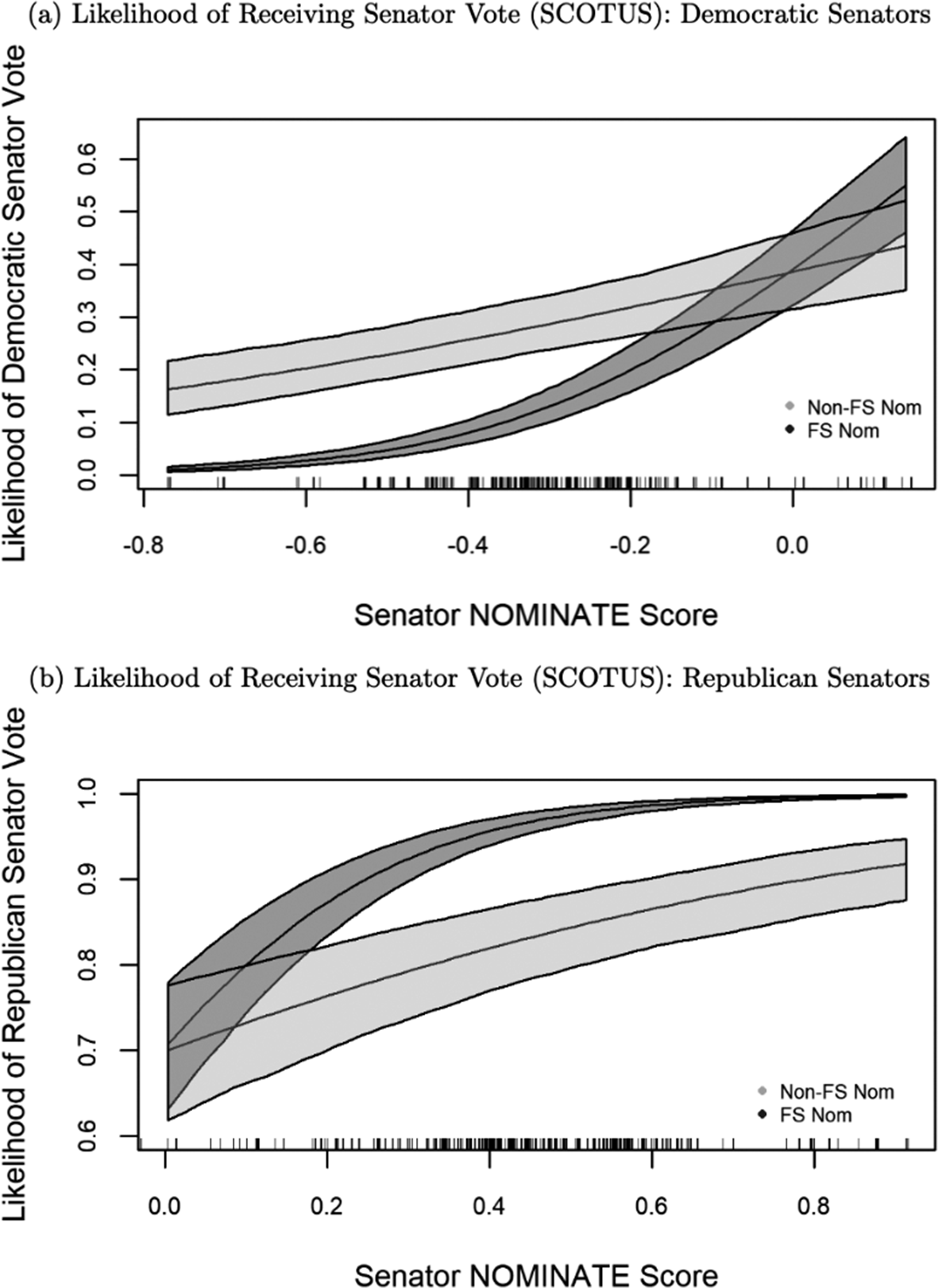
As is evident in Figure 4, ideology has a clear and significant influence on senator voting behavior with regard to nominee FedSoc affiliation.Footnote 27 Looking first at Figure 4a, we see the likelihood to receive a Democratic senator’s vote is conditioned on the interaction between ideology and FedSoc affiliate status. For example, a FedSoc-affiliated nominee has a 0.09 probability of gaining the vote of a Democratic senator with a NOMINATE score of -0.37 compared to a 0.27 probability for non-FedSoc-affiliated nominees – a statistically significant 18 percentage point difference.Footnote 28 And, this statistically significant difference holds save for the most conservative Democratic senators. However, importantly, moving from an ideologically more liberal to more moderate – the 3rd to 1st quartile of ideology – significantly increases the likelihood of gaining a senator’s vote from a probability of 0.09 to 0.17. Put another way, a FedSoc affiliate would be 8 percentage points more likely to receive a vote from Gary Peters (D-MI, NOMINATE $ \sim $
-0.24) than Patrick Leahy (D-VT, NOMINATE
$ \sim $
-0.24) than Patrick Leahy (D-VT, NOMINATE $ \sim $
-0.37).
$ \sim $
-0.37).
For Republicans, we continue to find that nominees’ FedSoc affiliation influences the likelihood of gaining a senator’s confirmation vote conditional on the senator’s ideology. While Figure 4a demonstrates that all Republican senators, regardless of ideology, are rather likely to vote for a Republican-appointed nominee, Republican senators are significantly more likely to vote for FedSoc-affiliated nominees than non-FedSoc affiliates as they move from more moderate to more conservative senators. For example, Chuck Grassley (R-IA, NOMINATE $ \sim $
0.36; 1st quartile (more moderate) of Republican senators) significantly increases from a 0.81 probability of voting for a non-FedSoc-affiliated nominee to a 0.95 probability for a FedSoc-affiliated nominee – a significant 14 percentage point increase. Similarly non-FedSoc affiliates are 12 percentage points less likely than FedSoc-affiliated nominees (0.86 vs. 0.98) to win John Kennedy’s (R-LA, NOMINATE
$ \sim $
0.36; 1st quartile (more moderate) of Republican senators) significantly increases from a 0.81 probability of voting for a non-FedSoc-affiliated nominee to a 0.95 probability for a FedSoc-affiliated nominee – a significant 14 percentage point increase. Similarly non-FedSoc affiliates are 12 percentage points less likely than FedSoc-affiliated nominees (0.86 vs. 0.98) to win John Kennedy’s (R-LA, NOMINATE $ \sim $
0.55; 3rd quartile of Republican senators) vote. And, while Republican senators are overall incredibly likely to vote for a Republican-appointed nominee, we find that Republican senators are significantly more likely – and almost guaranteed – to vote for FedSoc-affiliated nominees.
$ \sim $
0.55; 3rd quartile of Republican senators) vote. And, while Republican senators are overall incredibly likely to vote for a Republican-appointed nominee, we find that Republican senators are significantly more likely – and almost guaranteed – to vote for FedSoc-affiliated nominees.
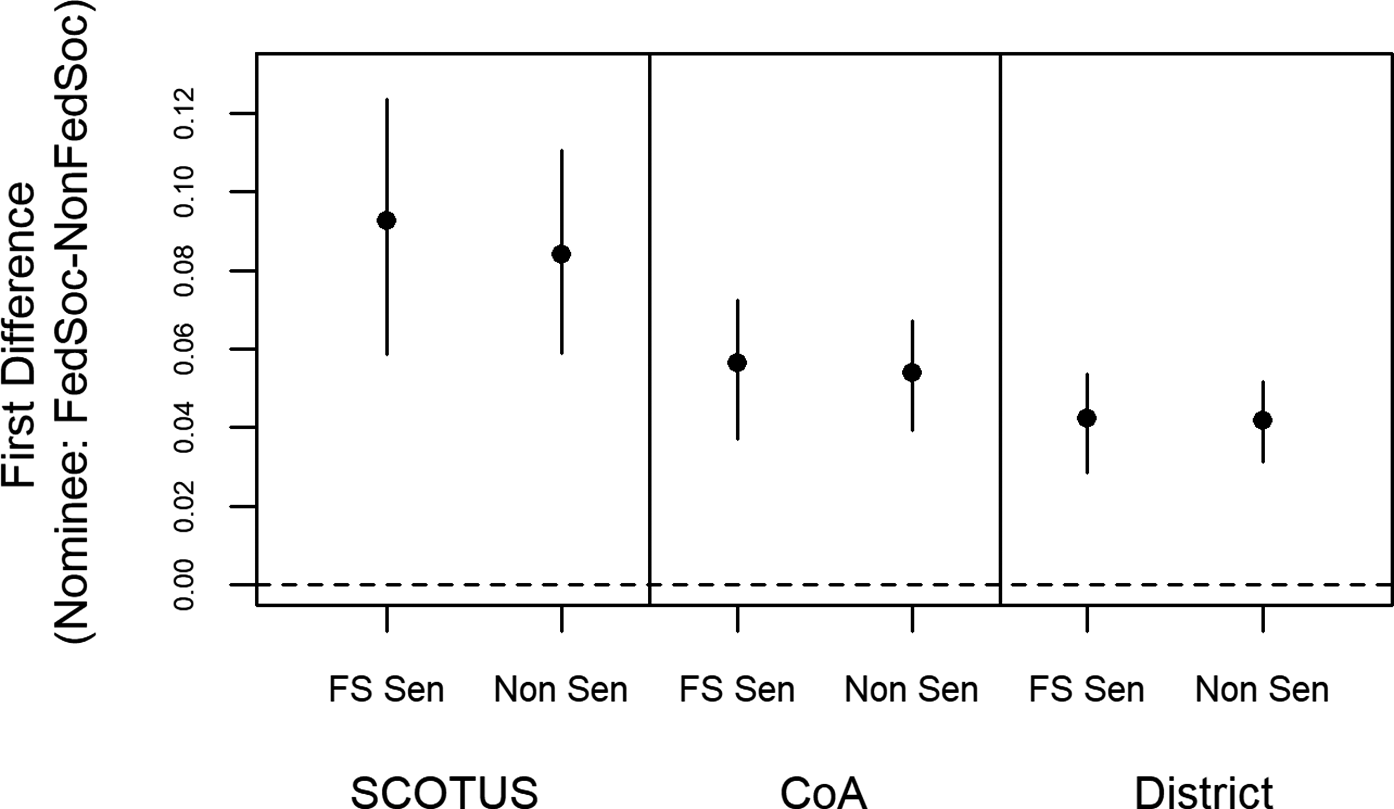
The findings above provide evidence of stark partisan differences based on a nominee’s FedSoc affiliation: Democratic senators are less likely to vote for affiliates, while Republican senators are more likely and that a senator’s ideology conditions this effect further. But, what about within-caucus differences? Particularly, as Republican senators increasingly affiliate with the FedSoc (Hollis-Brusky Reference Hollis-Brusky2015; Bird and McGee Reference Bird and McGee2023a), is there a difference in how FedSoc-affiliated Republican senators vote compared to their non-affiliated colleagues? Figure 5 provides evidence that the answer is no and that the importance lies with the FedSoc affiliation of the nominee, not the senator.
First differences of the interaction between nominee FedSoc affiliation and Republican senator FedSoc affiliation. Vertical bars represent 95% confidence intervals, and vertical bars crossing the dotted line at zero do not significantly differ.
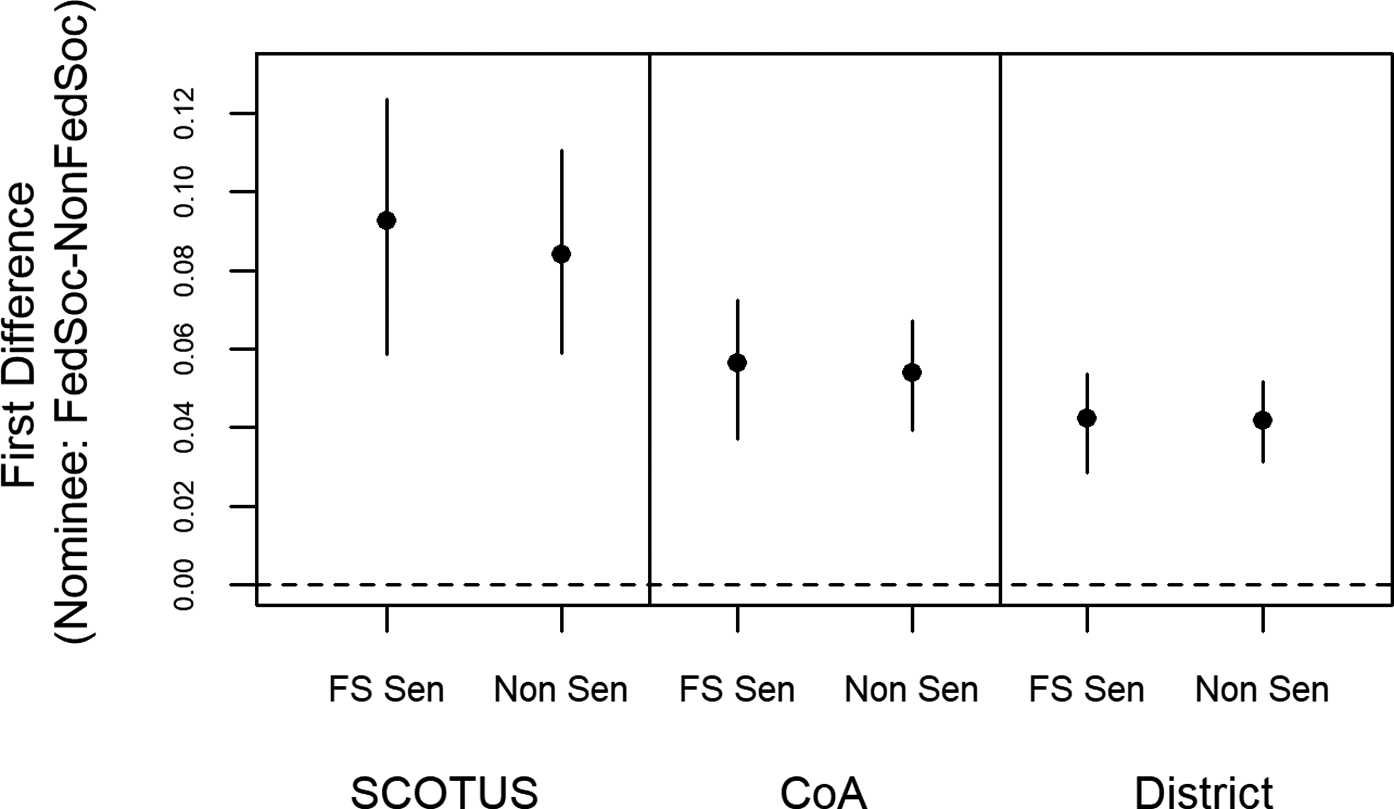
Figure 5 shows first difference estimates for the interaction between nominee FedSoc affiliation and a Republican senator’s FedSoc affiliation.Footnote 29 Values above the dotted line at zero denote FedSoc-affiliated nominees are more likely to gain a senator’s vote with values below zero meaning non-FedSoc-affiliated nominees are more likely. As is evident in Figure 5, FedSoc affiliated senators are significantly more likely to vote for FedSoc-affiliated nominees than non-affiliated nominees. However, we also see that non-affiliated senators are significantly more likely to support FedSoc-affiliated nominees than non-affiliated nominees.
From these results, we do not find support for our second hypothesis. However, we see it is the affiliation status of the nominee – not the senator – is the critical driver of support for a nomination. That is, FedSoc status is not simply a within-group signal where one must be a member to understand. Instead, a nominee’s FedSoc affiliation provides a relevant cue to all Republican senators about their perceived conservative bona fides, and Republican senators are more likely to vote for these nominees.
Taken together, we provide evidence that FedSoc affiliation is a significant cue to senators in their voting for judicial nominees. Furthermore, we find that the influence of how a senator votes on a nominee is conditional on 1) the senator’s own partisan identification, 2) a senator’s ideology, 3) but not a senator’s own affiliation with the FedSoc. From this, we find support for our hypothesis that voting for nominees is conditional on their FedSoc affiliation and that FedSoc affiliation provides a strong, significant cue for all Republican senators – regardless of their own FedSoc affiliation – in their voting behavior for federal judicial nominees.
Conclusion
The Federalist Society has long been at the forefront of the conservative legal movement and is currently working to extend its network further into all levels of the judiciary as well as into the Senate. The FedSoc is successfully and steadily establishing its influence broadly in American politics. But, does mere association with the FedSoc impact the way senators vote? With senators reviewing hundreds of judicial nominations per congress, we argue Federalist Society affiliation provides senators – of both parties – a crucial cue in estimating the nominee’s judicial philosophy and potential future jurisprudential behavior on the bench via the representativeness heuristic. FedSoc affiliation provides a quick, low-cost cue, and relying on the representative heuristic provides senators with much-needed time-saving information and in turn influences their final vote on a nominee.
Our findings demonstrate that a nominee’s affiliation with the Federalist Society dramatically, but conditionally, impacts their likelihood of receiving a senator’s support for confirmation. For Democratic senators, the FedSoc cue significantly decreases the likelihood of voting for a nominee. Conversely, Republican senators see the FedSoc as a salient heuristic that basically guarantees a nominee Republican senators’ votes. This influence is further conditioned by a senator’s own ideological leanings with more conservative senators more likely to vote for FedSoc affiliates, while more liberal senators are less likely to do so. Finally, this cue is salient regardless of a senator’s own affiliation with the FedSoc. This implies that the FedSoc heuristic is an important indicator when voting on the scores of judicial nominees before the Senate each congress for all senators.
We significantly contribute to the judicial nominations literature in a couple of ways. First, we connect well-established literature on interest group influence on the judiciary with senator voting behavior on judicial nominees. We suggest that simple affiliation with a well-known group – the Federalist Society – provides an essential cue for senators, under duress to make their decision-making process more efficient, in evaluating hundreds of judicial nominees. Second, we provide further evidence of the influence of the Federalist Society in the American legal system. Past research has shown the impact of Federalist Society affiliation on judges while on the bench (Teles Reference Teles2008; Hollis-Brusky Reference Hollis-Brusky2015). Our research demonstrates that Federalist Society affiliation is not solely influential while on the bench but an instrumental factor in gaining a senator’s vote for confirmation.
In the future, scholars could expand this research by investigating the potential influence of other interest groups’ influence in the confirmation process. Is it possible other interest groups may seek to emulate the Federalist Society’s success in influencing senators’ votes? If they did, would they be as successful? Further, research should consider potential variations where Federalist Society affiliates are being nominated and confirmed. For example, are Federalist Society affiliates more likely to be nominated to states with Federalist Society-affiliated senators, providing evidence of a selection effect? Furthermore, as the Federalist Society affiliates continue to grow in their proportion of judicial nominees from Republican presidents, is there a point where mere affiliation no longer conveys this cue effectively? More work is required to truly understand the causes and consequences of Federalist Society affiliation on the American legal system and more broadly among the American political elite.
Supplementary material
The supplementary material for this article can be found at http://doi.org/10.1017/jlc.2025.10005.


 Open access

